EP0337791B1 - Selbstnivellierende Fugenmasse für Strassen - Google Patents
Selbstnivellierende Fugenmasse für Strassen Download PDFInfo
- Publication number
- EP0337791B1 EP0337791B1 EP19890303696 EP89303696A EP0337791B1 EP 0337791 B1 EP0337791 B1 EP 0337791B1 EP 19890303696 EP19890303696 EP 19890303696 EP 89303696 A EP89303696 A EP 89303696A EP 0337791 B1 EP0337791 B1 EP 0337791B1
- Authority
- EP
- European Patent Office
- Prior art keywords
- weight
- group
- parts
- percent
- silicon
- Prior art date
- Legal status (The legal status is an assumption and is not a legal conclusion. Google has not performed a legal analysis and makes no representation as to the accuracy of the status listed.)
- Expired - Lifetime
Links
- 239000000565 sealant Substances 0.000 title claims description 25
- -1 aminoxysilicon compound Chemical class 0.000 claims description 84
- 239000000203 mixture Substances 0.000 claims description 84
- 239000000945 filler Substances 0.000 claims description 63
- XUIMIQQOPSSXEZ-UHFFFAOYSA-N Silicon Chemical group [Si] XUIMIQQOPSSXEZ-UHFFFAOYSA-N 0.000 claims description 37
- 125000002887 hydroxy group Chemical group [H]O* 0.000 claims description 35
- 229930195733 hydrocarbon Natural products 0.000 claims description 29
- 239000004215 Carbon black (E152) Substances 0.000 claims description 28
- BLRPTPMANUNPDV-UHFFFAOYSA-N Silane Chemical compound [SiH4] BLRPTPMANUNPDV-UHFFFAOYSA-N 0.000 claims description 24
- 229910000077 silane Inorganic materials 0.000 claims description 24
- 239000003085 diluting agent Substances 0.000 claims description 23
- 125000001997 phenyl group Chemical group [H]C1=C([H])C([H])=C(*)C([H])=C1[H] 0.000 claims description 18
- 229920002554 vinyl polymer Polymers 0.000 claims description 17
- 238000002156 mixing Methods 0.000 claims description 16
- 239000003431 cross linking reagent Substances 0.000 claims description 15
- 125000002344 aminooxy group Chemical group [H]N([H])O[*] 0.000 claims description 14
- 125000001495 ethyl group Chemical group [H]C([H])([H])C([H])([H])* 0.000 claims description 14
- 125000002496 methyl group Chemical group [H]C([H])([H])* 0.000 claims description 14
- 229920002379 silicone rubber Polymers 0.000 claims description 14
- 125000000391 vinyl group Chemical group [H]C([*])=C([H])[H] 0.000 claims description 13
- 239000012530 fluid Substances 0.000 claims description 12
- 125000000962 organic group Chemical group 0.000 claims description 11
- WNQIDJBLGCRIPM-UHFFFAOYSA-N aminooxysilicon Chemical class NO[Si] WNQIDJBLGCRIPM-UHFFFAOYSA-N 0.000 claims description 10
- 239000003208 petroleum Substances 0.000 claims description 10
- 229920001296 polysiloxane Polymers 0.000 claims description 10
- CJZGTCYPCWQAJB-UHFFFAOYSA-L calcium stearate Chemical compound [Ca+2].CCCCCCCCCCCCCCCCCC([O-])=O.CCCCCCCCCCCCCCCCCC([O-])=O CJZGTCYPCWQAJB-UHFFFAOYSA-L 0.000 claims description 9
- 239000008116 calcium stearate Substances 0.000 claims description 9
- 235000013539 calcium stearate Nutrition 0.000 claims description 9
- 239000002245 particle Substances 0.000 claims description 8
- 230000002378 acidificating effect Effects 0.000 claims description 7
- 239000012763 reinforcing filler Substances 0.000 claims description 7
- 239000003795 chemical substances by application Substances 0.000 claims description 6
- 125000001931 aliphatic group Chemical group 0.000 claims description 5
- 125000004430 oxygen atom Chemical group O* 0.000 claims description 5
- 229920000570 polyether Polymers 0.000 claims description 5
- 229910052710 silicon Inorganic materials 0.000 claims description 5
- 235000021355 Stearic acid Nutrition 0.000 claims description 4
- 150000004945 aromatic hydrocarbons Chemical class 0.000 claims description 4
- 238000000034 method Methods 0.000 claims description 4
- QIQXTHQIDYTFRH-UHFFFAOYSA-N octadecanoic acid Chemical compound CCCCCCCCCCCCCCCCCC(O)=O QIQXTHQIDYTFRH-UHFFFAOYSA-N 0.000 claims description 4
- OQCDKBAXFALNLD-UHFFFAOYSA-N octadecanoic acid Natural products CCCCCCCC(C)CCCCCCCCC(O)=O OQCDKBAXFALNLD-UHFFFAOYSA-N 0.000 claims description 4
- 239000008117 stearic acid Substances 0.000 claims description 4
- 239000008240 homogeneous mixture Substances 0.000 claims description 3
- ZMXDDKWLCZADIW-UHFFFAOYSA-N N,N-Dimethylformamide Chemical compound CN(C)C=O ZMXDDKWLCZADIW-UHFFFAOYSA-N 0.000 description 23
- 239000002904 solvent Substances 0.000 description 20
- 239000004205 dimethyl polysiloxane Substances 0.000 description 15
- 229920000435 poly(dimethylsiloxane) Polymers 0.000 description 15
- VTYYLEPIZMXCLO-UHFFFAOYSA-L Calcium carbonate Chemical compound [Ca+2].[O-]C([O-])=O VTYYLEPIZMXCLO-UHFFFAOYSA-L 0.000 description 13
- 239000004971 Cross linker Substances 0.000 description 12
- 238000012360 testing method Methods 0.000 description 12
- 239000004970 Chain extender Substances 0.000 description 11
- 229920000642 polymer Polymers 0.000 description 11
- 239000000463 material Substances 0.000 description 8
- YXFVVABEGXRONW-UHFFFAOYSA-N Toluene Chemical compound CC1=CC=CC=C1 YXFVVABEGXRONW-UHFFFAOYSA-N 0.000 description 6
- 229910000019 calcium carbonate Inorganic materials 0.000 description 6
- 150000003254 radicals Chemical class 0.000 description 5
- 125000000026 trimethylsilyl group Chemical group [H]C([H])([H])[Si]([*])(C([H])([H])[H])C([H])([H])[H] 0.000 description 5
- BPMXEJSBTONLLG-UHFFFAOYSA-N n-[[acetyl(methyl)amino]-prop-1-enylsilyl]-n-methylacetamide Chemical compound CC=C[SiH](N(C)C(C)=O)N(C)C(C)=O BPMXEJSBTONLLG-UHFFFAOYSA-N 0.000 description 4
- WEVYAHXRMPXWCK-UHFFFAOYSA-N Acetonitrile Chemical compound CC#N WEVYAHXRMPXWCK-UHFFFAOYSA-N 0.000 description 3
- 239000002585 base Substances 0.000 description 3
- 238000009435 building construction Methods 0.000 description 3
- 230000000052 comparative effect Effects 0.000 description 3
- 229920001971 elastomer Polymers 0.000 description 3
- 239000000806 elastomer Substances 0.000 description 3
- 239000004615 ingredient Substances 0.000 description 3
- 229910052500 inorganic mineral Inorganic materials 0.000 description 3
- 239000011707 mineral Substances 0.000 description 3
- VLKZOEOYAKHREP-UHFFFAOYSA-N n-Hexane Chemical compound CCCCCC VLKZOEOYAKHREP-UHFFFAOYSA-N 0.000 description 3
- 230000000704 physical effect Effects 0.000 description 3
- 239000011435 rock Substances 0.000 description 3
- 150000004756 silanes Chemical class 0.000 description 3
- 235000015096 spirit Nutrition 0.000 description 3
- UOCLXMDMGBRAIB-UHFFFAOYSA-N 1,1,1-trichloroethane Chemical compound CC(Cl)(Cl)Cl UOCLXMDMGBRAIB-UHFFFAOYSA-N 0.000 description 2
- 239000005046 Chlorosilane Substances 0.000 description 2
- RTZKZFJDLAIYFH-UHFFFAOYSA-N Diethyl ether Chemical compound CCOCC RTZKZFJDLAIYFH-UHFFFAOYSA-N 0.000 description 2
- VYPSYNLAJGMNEJ-UHFFFAOYSA-N Silicium dioxide Chemical compound O=[Si]=O VYPSYNLAJGMNEJ-UHFFFAOYSA-N 0.000 description 2
- FAPWRFPIFSIZLT-UHFFFAOYSA-M Sodium chloride Chemical compound [Na+].[Cl-] FAPWRFPIFSIZLT-UHFFFAOYSA-M 0.000 description 2
- GWEVSGVZZGPLCZ-UHFFFAOYSA-N Titan oxide Chemical compound O=[Ti]=O GWEVSGVZZGPLCZ-UHFFFAOYSA-N 0.000 description 2
- 125000000738 acetamido group Chemical group [H]C([H])([H])C(=O)N([H])[*] 0.000 description 2
- 239000000654 additive Substances 0.000 description 2
- 229910052783 alkali metal Inorganic materials 0.000 description 2
- PNEYBMLMFCGWSK-UHFFFAOYSA-N aluminium oxide Inorganic materials [O-2].[O-2].[O-2].[Al+3].[Al+3] PNEYBMLMFCGWSK-UHFFFAOYSA-N 0.000 description 2
- 239000010426 asphalt Substances 0.000 description 2
- OSGAYBCDTDRGGQ-UHFFFAOYSA-L calcium sulfate Chemical compound [Ca+2].[O-]S([O-])(=O)=O OSGAYBCDTDRGGQ-UHFFFAOYSA-L 0.000 description 2
- 239000003054 catalyst Substances 0.000 description 2
- KOPOQZFJUQMUML-UHFFFAOYSA-N chlorosilane Chemical compound Cl[SiH3] KOPOQZFJUQMUML-UHFFFAOYSA-N 0.000 description 2
- 230000008602 contraction Effects 0.000 description 2
- 229920001577 copolymer Polymers 0.000 description 2
- 230000000694 effects Effects 0.000 description 2
- 238000011049 filling Methods 0.000 description 2
- 230000005484 gravity Effects 0.000 description 2
- 239000012943 hotmelt Substances 0.000 description 2
- HXTZZFBBMWUFFG-UHFFFAOYSA-N n-[bis[acetyl(methyl)amino]-methylsilyl]-n-methylacetamide Chemical compound CC(=O)N(C)[Si](C)(N(C)C(C)=O)N(C)C(C)=O HXTZZFBBMWUFFG-UHFFFAOYSA-N 0.000 description 2
- BTQLZQAVGBUMOG-UHFFFAOYSA-N n-silylacetamide Chemical group CC(=O)N[SiH3] BTQLZQAVGBUMOG-UHFFFAOYSA-N 0.000 description 2
- 238000002360 preparation method Methods 0.000 description 2
- 239000005909 Kieselgur Substances 0.000 description 1
- FDEJNNNVDVOMKI-UHFFFAOYSA-N N-[(N-acetylanilino)-prop-1-enylsilyl]-N-phenylacetamide Chemical compound CC=C[SiH](N(C(C)=O)C1=CC=CC=C1)N(C(C)=O)C1=CC=CC=C1 FDEJNNNVDVOMKI-UHFFFAOYSA-N 0.000 description 1
- OHLUUHNLEMFGTQ-UHFFFAOYSA-N N-methylacetamide Chemical compound CNC(C)=O OHLUUHNLEMFGTQ-UHFFFAOYSA-N 0.000 description 1
- CTQNGGLPUBDAKN-UHFFFAOYSA-N O-Xylene Chemical compound CC1=CC=CC=C1C CTQNGGLPUBDAKN-UHFFFAOYSA-N 0.000 description 1
- 239000004721 Polyphenylene oxide Substances 0.000 description 1
- 230000032683 aging Effects 0.000 description 1
- 239000003963 antioxidant agent Substances 0.000 description 1
- 239000003849 aromatic solvent Substances 0.000 description 1
- 125000003118 aryl group Chemical group 0.000 description 1
- 238000009835 boiling Methods 0.000 description 1
- 239000006229 carbon black Substances 0.000 description 1
- 150000008280 chlorinated hydrocarbons Chemical class 0.000 description 1
- 239000011248 coating agent Substances 0.000 description 1
- 238000000576 coating method Methods 0.000 description 1
- 150000001875 compounds Chemical class 0.000 description 1
- 230000003247 decreasing effect Effects 0.000 description 1
- 230000001419 dependent effect Effects 0.000 description 1
- 230000001627 detrimental effect Effects 0.000 description 1
- YLJJAVFOBDSYAN-UHFFFAOYSA-N dichloro-ethenyl-methylsilane Chemical compound C[Si](Cl)(Cl)C=C YLJJAVFOBDSYAN-UHFFFAOYSA-N 0.000 description 1
- 239000006185 dispersion Substances 0.000 description 1
- 239000000975 dye Substances 0.000 description 1
- 238000001914 filtration Methods 0.000 description 1
- 230000009969 flowable effect Effects 0.000 description 1
- 238000009472 formulation Methods 0.000 description 1
- 239000011521 glass Substances 0.000 description 1
- 229920001519 homopolymer Polymers 0.000 description 1
- 150000002430 hydrocarbons Chemical class 0.000 description 1
- 239000012535 impurity Substances 0.000 description 1
- 239000010423 industrial mineral Substances 0.000 description 1
- 238000003780 insertion Methods 0.000 description 1
- 230000037431 insertion Effects 0.000 description 1
- UQSXHKLRYXJYBZ-UHFFFAOYSA-N iron oxide Inorganic materials [Fe]=O UQSXHKLRYXJYBZ-UHFFFAOYSA-N 0.000 description 1
- 239000004579 marble Substances 0.000 description 1
- 238000005259 measurement Methods 0.000 description 1
- 125000004573 morpholin-4-yl group Chemical group N1(CCOCC1)* 0.000 description 1
- XOUWQQUFDGZNRH-UHFFFAOYSA-N n-[bis(n-acetylanilino)-ethenylsilyl]-n-phenylacetamide Chemical compound C=1C=CC=CC=1N(C(C)=O)[Si](C=C)(N(C(C)=O)C=1C=CC=CC=1)N(C(=O)C)C1=CC=CC=C1 XOUWQQUFDGZNRH-UHFFFAOYSA-N 0.000 description 1
- NASKMVWXSAHSLX-UHFFFAOYSA-N n-[bis(n-acetylanilino)-methylsilyl]-n-phenylacetamide Chemical compound C=1C=CC=CC=1N(C(C)=O)[Si](C)(N(C(C)=O)C=1C=CC=CC=1)N(C(=O)C)C1=CC=CC=C1 NASKMVWXSAHSLX-UHFFFAOYSA-N 0.000 description 1
- GEEYEXCEWMASIB-UHFFFAOYSA-N n-[bis[acetyl(ethyl)amino]-ethenylsilyl]-n-ethylacetamide Chemical compound CCN(C(C)=O)[Si](C=C)(N(CC)C(C)=O)N(CC)C(C)=O GEEYEXCEWMASIB-UHFFFAOYSA-N 0.000 description 1
- VPXYFKDTYHPMJG-UHFFFAOYSA-N n-[bis[acetyl(ethyl)amino]-methylsilyl]-n-ethylacetamide Chemical compound CCN(C(C)=O)[Si](C)(N(CC)C(C)=O)N(CC)C(C)=O VPXYFKDTYHPMJG-UHFFFAOYSA-N 0.000 description 1
- FUXALVDNTYZYFE-UHFFFAOYSA-N n-[bis[acetyl(methyl)amino]-ethenylsilyl]-n-methylacetamide Chemical compound CC(=O)N(C)[Si](C=C)(N(C)C(C)=O)N(C)C(C)=O FUXALVDNTYZYFE-UHFFFAOYSA-N 0.000 description 1
- GYLDXXLJMRTVSS-UHFFFAOYSA-N n-butylacetamide Chemical compound CCCCNC(C)=O GYLDXXLJMRTVSS-UHFFFAOYSA-N 0.000 description 1
- 230000007935 neutral effect Effects 0.000 description 1
- 230000009965 odorless effect Effects 0.000 description 1
- 239000012766 organic filler Substances 0.000 description 1
- 239000003960 organic solvent Substances 0.000 description 1
- NDLPOXTZKUMGOV-UHFFFAOYSA-N oxo(oxoferriooxy)iron hydrate Chemical compound O.O=[Fe]O[Fe]=O NDLPOXTZKUMGOV-UHFFFAOYSA-N 0.000 description 1
- 239000000049 pigment Substances 0.000 description 1
- 125000000587 piperidin-1-yl group Chemical group [H]C1([H])N(*)C([H])([H])C([H])([H])C([H])([H])C1([H])[H] 0.000 description 1
- 229920002635 polyurethane Polymers 0.000 description 1
- 239000004814 polyurethane Substances 0.000 description 1
- 125000001436 propyl group Chemical group [H]C([*])([H])C([H])([H])C([H])([H])[H] 0.000 description 1
- 239000010453 quartz Substances 0.000 description 1
- 229920005989 resin Polymers 0.000 description 1
- 239000011347 resin Substances 0.000 description 1
- 239000012812 sealant material Substances 0.000 description 1
- 150000003377 silicon compounds Chemical class 0.000 description 1
- 229920002050 silicone resin Polymers 0.000 description 1
- 239000004590 silicone sealant Substances 0.000 description 1
- 239000011780 sodium chloride Substances 0.000 description 1
- 159000000000 sodium salts Chemical class 0.000 description 1
- 238000004381 surface treatment Methods 0.000 description 1
- 239000002352 surface water Substances 0.000 description 1
- 229920001169 thermoplastic Polymers 0.000 description 1
- 239000004416 thermosoftening plastic Substances 0.000 description 1
- 239000004408 titanium dioxide Substances 0.000 description 1
- 125000000725 trifluoropropyl group Chemical group [H]C([H])(*)C([H])([H])C(F)(F)F 0.000 description 1
- 238000005292 vacuum distillation Methods 0.000 description 1
- 230000000007 visual effect Effects 0.000 description 1
- 239000002699 waste material Substances 0.000 description 1
- 239000008096 xylene Substances 0.000 description 1
Classifications
-
- C—CHEMISTRY; METALLURGY
- C09—DYES; PAINTS; POLISHES; NATURAL RESINS; ADHESIVES; COMPOSITIONS NOT OTHERWISE PROVIDED FOR; APPLICATIONS OF MATERIALS NOT OTHERWISE PROVIDED FOR
- C09K—MATERIALS FOR MISCELLANEOUS APPLICATIONS, NOT PROVIDED FOR ELSEWHERE
- C09K3/00—Materials not provided for elsewhere
- C09K3/10—Materials in mouldable or extrudable form for sealing or packing joints or covers
- C09K3/1006—Materials in mouldable or extrudable form for sealing or packing joints or covers characterised by the chemical nature of one of its constituents
- C09K3/1018—Macromolecular compounds having one or more carbon-to-silicon linkages
-
- C—CHEMISTRY; METALLURGY
- C08—ORGANIC MACROMOLECULAR COMPOUNDS; THEIR PREPARATION OR CHEMICAL WORKING-UP; COMPOSITIONS BASED THEREON
- C08K—Use of inorganic or non-macromolecular organic substances as compounding ingredients
- C08K13/00—Use of mixtures of ingredients not covered by one single of the preceding main groups, each of these compounds being essential
- C08K13/06—Pretreated ingredients and ingredients covered by the main groups C08K3/00 - C08K7/00
-
- C—CHEMISTRY; METALLURGY
- C08—ORGANIC MACROMOLECULAR COMPOUNDS; THEIR PREPARATION OR CHEMICAL WORKING-UP; COMPOSITIONS BASED THEREON
- C08K—Use of inorganic or non-macromolecular organic substances as compounding ingredients
- C08K5/00—Use of organic ingredients
- C08K5/54—Silicon-containing compounds
- C08K5/544—Silicon-containing compounds containing nitrogen
- C08K5/5455—Silicon-containing compounds containing nitrogen containing at least one group
-
- C—CHEMISTRY; METALLURGY
- C08—ORGANIC MACROMOLECULAR COMPOUNDS; THEIR PREPARATION OR CHEMICAL WORKING-UP; COMPOSITIONS BASED THEREON
- C08L—COMPOSITIONS OF MACROMOLECULAR COMPOUNDS
- C08L83/00—Compositions of macromolecular compounds obtained by reactions forming in the main chain of the macromolecule a linkage containing silicon with or without sulfur, nitrogen, oxygen or carbon only; Compositions of derivatives of such polymers
- C08L83/04—Polysiloxanes
-
- C—CHEMISTRY; METALLURGY
- C08—ORGANIC MACROMOLECULAR COMPOUNDS; THEIR PREPARATION OR CHEMICAL WORKING-UP; COMPOSITIONS BASED THEREON
- C08G—MACROMOLECULAR COMPOUNDS OBTAINED OTHERWISE THAN BY REACTIONS ONLY INVOLVING UNSATURATED CARBON-TO-CARBON BONDS
- C08G77/00—Macromolecular compounds obtained by reactions forming a linkage containing silicon with or without sulfur, nitrogen, oxygen or carbon in the main chain of the macromolecule
- C08G77/04—Polysiloxanes
- C08G77/045—Polysiloxanes containing less than 25 silicon atoms
-
- C—CHEMISTRY; METALLURGY
- C08—ORGANIC MACROMOLECULAR COMPOUNDS; THEIR PREPARATION OR CHEMICAL WORKING-UP; COMPOSITIONS BASED THEREON
- C08G—MACROMOLECULAR COMPOUNDS OBTAINED OTHERWISE THAN BY REACTIONS ONLY INVOLVING UNSATURATED CARBON-TO-CARBON BONDS
- C08G77/00—Macromolecular compounds obtained by reactions forming a linkage containing silicon with or without sulfur, nitrogen, oxygen or carbon in the main chain of the macromolecule
- C08G77/04—Polysiloxanes
- C08G77/14—Polysiloxanes containing silicon bound to oxygen-containing groups
-
- C—CHEMISTRY; METALLURGY
- C08—ORGANIC MACROMOLECULAR COMPOUNDS; THEIR PREPARATION OR CHEMICAL WORKING-UP; COMPOSITIONS BASED THEREON
- C08G—MACROMOLECULAR COMPOUNDS OBTAINED OTHERWISE THAN BY REACTIONS ONLY INVOLVING UNSATURATED CARBON-TO-CARBON BONDS
- C08G77/00—Macromolecular compounds obtained by reactions forming a linkage containing silicon with or without sulfur, nitrogen, oxygen or carbon in the main chain of the macromolecule
- C08G77/04—Polysiloxanes
- C08G77/14—Polysiloxanes containing silicon bound to oxygen-containing groups
- C08G77/16—Polysiloxanes containing silicon bound to oxygen-containing groups to hydroxyl groups
-
- C—CHEMISTRY; METALLURGY
- C08—ORGANIC MACROMOLECULAR COMPOUNDS; THEIR PREPARATION OR CHEMICAL WORKING-UP; COMPOSITIONS BASED THEREON
- C08G—MACROMOLECULAR COMPOUNDS OBTAINED OTHERWISE THAN BY REACTIONS ONLY INVOLVING UNSATURATED CARBON-TO-CARBON BONDS
- C08G77/00—Macromolecular compounds obtained by reactions forming a linkage containing silicon with or without sulfur, nitrogen, oxygen or carbon in the main chain of the macromolecule
- C08G77/04—Polysiloxanes
- C08G77/20—Polysiloxanes containing silicon bound to unsaturated aliphatic groups
-
- C—CHEMISTRY; METALLURGY
- C08—ORGANIC MACROMOLECULAR COMPOUNDS; THEIR PREPARATION OR CHEMICAL WORKING-UP; COMPOSITIONS BASED THEREON
- C08G—MACROMOLECULAR COMPOUNDS OBTAINED OTHERWISE THAN BY REACTIONS ONLY INVOLVING UNSATURATED CARBON-TO-CARBON BONDS
- C08G77/00—Macromolecular compounds obtained by reactions forming a linkage containing silicon with or without sulfur, nitrogen, oxygen or carbon in the main chain of the macromolecule
- C08G77/04—Polysiloxanes
- C08G77/22—Polysiloxanes containing silicon bound to organic groups containing atoms other than carbon, hydrogen and oxygen
- C08G77/24—Polysiloxanes containing silicon bound to organic groups containing atoms other than carbon, hydrogen and oxygen halogen-containing groups
-
- C—CHEMISTRY; METALLURGY
- C08—ORGANIC MACROMOLECULAR COMPOUNDS; THEIR PREPARATION OR CHEMICAL WORKING-UP; COMPOSITIONS BASED THEREON
- C08G—MACROMOLECULAR COMPOUNDS OBTAINED OTHERWISE THAN BY REACTIONS ONLY INVOLVING UNSATURATED CARBON-TO-CARBON BONDS
- C08G77/00—Macromolecular compounds obtained by reactions forming a linkage containing silicon with or without sulfur, nitrogen, oxygen or carbon in the main chain of the macromolecule
- C08G77/04—Polysiloxanes
- C08G77/22—Polysiloxanes containing silicon bound to organic groups containing atoms other than carbon, hydrogen and oxygen
- C08G77/26—Polysiloxanes containing silicon bound to organic groups containing atoms other than carbon, hydrogen and oxygen nitrogen-containing groups
-
- C—CHEMISTRY; METALLURGY
- C08—ORGANIC MACROMOLECULAR COMPOUNDS; THEIR PREPARATION OR CHEMICAL WORKING-UP; COMPOSITIONS BASED THEREON
- C08G—MACROMOLECULAR COMPOUNDS OBTAINED OTHERWISE THAN BY REACTIONS ONLY INVOLVING UNSATURATED CARBON-TO-CARBON BONDS
- C08G77/00—Macromolecular compounds obtained by reactions forming a linkage containing silicon with or without sulfur, nitrogen, oxygen or carbon in the main chain of the macromolecule
- C08G77/70—Siloxanes defined by use of the MDTQ nomenclature
-
- C—CHEMISTRY; METALLURGY
- C09—DYES; PAINTS; POLISHES; NATURAL RESINS; ADHESIVES; COMPOSITIONS NOT OTHERWISE PROVIDED FOR; APPLICATIONS OF MATERIALS NOT OTHERWISE PROVIDED FOR
- C09K—MATERIALS FOR MISCELLANEOUS APPLICATIONS, NOT PROVIDED FOR ELSEWHERE
- C09K3/00—Materials not provided for elsewhere
- C09K3/10—Materials in mouldable or extrudable form for sealing or packing joints or covers
- C09K2003/1034—Materials or components characterised by specific properties
- C09K2003/1056—Moisture-curable materials
-
- C—CHEMISTRY; METALLURGY
- C09—DYES; PAINTS; POLISHES; NATURAL RESINS; ADHESIVES; COMPOSITIONS NOT OTHERWISE PROVIDED FOR; APPLICATIONS OF MATERIALS NOT OTHERWISE PROVIDED FOR
- C09K—MATERIALS FOR MISCELLANEOUS APPLICATIONS, NOT PROVIDED FOR ELSEWHERE
- C09K2200/00—Chemical nature of materials in mouldable or extrudable form for sealing or packing joints or covers
- C09K2200/02—Inorganic compounds
- C09K2200/0239—Oxides, hydroxides, carbonates
-
- C—CHEMISTRY; METALLURGY
- C09—DYES; PAINTS; POLISHES; NATURAL RESINS; ADHESIVES; COMPOSITIONS NOT OTHERWISE PROVIDED FOR; APPLICATIONS OF MATERIALS NOT OTHERWISE PROVIDED FOR
- C09K—MATERIALS FOR MISCELLANEOUS APPLICATIONS, NOT PROVIDED FOR ELSEWHERE
- C09K2200/00—Chemical nature of materials in mouldable or extrudable form for sealing or packing joints or covers
- C09K2200/04—Non-macromolecular organic compounds
- C09K2200/0447—Fats, fatty oils, higher fatty acids or derivatives thereof
Definitions
- This invention relates to highway sealants which are self leveling when applied.
- U.S. Patent No. 3,766,127, issued October 16, 1973, teaches a low modulus room temperature vulcanizable silicone elastomer.
- the composition is based upon an acetamido containing chain extender and crosslinker in combination with a hydroxyl endblocked polydiorganosiloxane. When fillers are used in the composition it is useful as a sealant.
- U.S. Patent No. 3,817,909 issued June 18, 1974, teaches a low modulus room temperature vulcanizable silicone elastomer is obtained by mixing a hydroxyl endblocked polydiorganosiloxane, non-acidic, non-reinforcing filler, acetamido containing chain extender and crosslinker which is an aminoxysilicon compound having 3 to 10 aminoxy groups per molecule.
- the sealant is useful in building construction.
- U.S. Patent No. 3,996,184, issued December 7, 1976, teaches a one package, low modulus, room temperature vulcanizable silicone elastomer composition having improved slump characteristics at low temperatures.
- This composition is obtained by mixing a hydroxyl endblocked polydimethylsiloxane, non-acidic, non-reinforcing filler, methylvinyldi-(N-acetamido)silane, an aminoxysilicon compound having 3 to 10 aminoxy groups per molecule and a diluent selected from N,N-dimethylformamide, acetonitrile or N-n-butylacetamide.
- the elastomer is useful in building construction.
- CA-A-1 195 033 discloses RTV organopolysiloxane compositions including an optionally treated filler.
- a silicone sealant composition which is self leveling when applied is obtained by combining a hydroxyl endblocked polydiorganosiloxane, a combination of treated and untreated filler, acetamidosilane chain extender, acetamidosilane crosslinker and diluent in the required proportions.
- This invention relates to a composition, which is stable in the absence of moisture but curable at room temperature upon exposure to moisture to a silicone elastomer and being self leveling when applied to a horizontal surface, said composition consisting essentially of a mixture prepared by mixing under anhydrous conditions (A) 100 parts by weight of a hydroxyl endblocked polydiorganosiloxane having a viscosity at 25°C of from 1.8 to 125 Pa ⁇ s and in which the organic groups are selected from the group consisting of methyl, ethyl, vinyl, phenyl and 3,3,3-trifluoropropyl radicals, in said polydiorganosiloxane no more than 50 percent of the organic groups being phenyl or 3,3,3-trifluoropropyl radicals and no more than 10 percent of the organic groups being vinyl radicals, (B) from 1 to 150 parts by weight of non-acidic, non-reinforcing filler having an average particle size of from 1 to 8 micrometers, said fill
- a silicone elastomer having an elongation of at least 600 percent, a durometer on the Shore A scale of from 5 to 20 inclusive and a modulus at 150 percent elongation of less than 345 kPa (50 pounds per square inch).
- Silicone compositions have been available for use as low modulus sealants useful in building construction. They have also been used as joint sealants in highways. Their use in highways has been restricted because of the necessity of tooling the sealant after it has been extruded into the joint in order to force the sealant into intimate contact with the sides of the joint in order to get good adhesion. It is also necessary to tool the joint in order to smooth the sealant surface and assure that the surface of the sealant is below the surface of the roadway. This additional step of tooling the sealant after insertion into the joint has resulted in higher labor costs and more material waste; when compared to the use of joint sealants such as hot melt asphalt, which is poured into place to give the proper degree of fill. This fluid material flows into contact with the joint sides and self levels its surface. A search for a composition which would be self leveling at ambient temperature resulted in the composition of this invention.
- the hydroxyl endblocked polydiorganosiloxanes (A) can have a viscosity at 25°C of from about 1.8 to 125 Pa ⁇ s, preferably from 3.5 to 70 Pa ⁇ s. These polydiorganosiloxane can be monodispersed, polydispersed or blends of varying viscosities as long as the average viscosity falls within the limits defined above.
- the hydroxyl endblocked polydiorganosiloxanes have organic groups selected from methyl, ethyl, vinyl, phenyl and 3,3,3-trifluoropropyl radicals.
- the organic groups of the polydiorganosiloxane contain no more than 50 percent phenyl or 3,3,3-trifluoropropyl radicals and no more than 10 percent vinyl radicals based upon the total number of radicals in the polydiorganosiloxane.
- Other monovalent hydrocarbon radicals and halogenated monovalent hydrocarbon radicals in small amounts can be present in the polydiorganosiloxane.
- the diorganosiloxane units of the hydroxyl endblocked polydiorganosiloxane can be, for example, dimethylsiloxane, diethylsiloxane ethylmethylsiloxane, diphenylsiloxane, methylphenylsiloxane, methylvinylsiloxane and 3,3,3-trifluoropropylmethylsiloxane.
- the term polydiorganosiloxane as used herein does not preclude small amounts of other siloxane units such an monoorganosiloxane units.
- the hydroxyl endblocked polydiorganosiloxanes are known in the art and can be made by known commercial methods.
- the preferred hydroxyl endblocked polydiorganosiloxane is hydroxyl endblocked polydimethylsiloxane.
- compositions of this invention contain from 0 to 150 parts by weight of non-acidic, non-reinforcing filler having an average particle size of from 1 to 8 micrometers per 100 parts by weight of hydroxyl endblocked polydiorganosiloxane. From 95 to 5 percent by weight of the filler is present as untreated filler. From 5 to 95 percent by weight of the filler is present as treated filler.
- the treated filler is treated with a treating agent selected from the group consisting of calcium stearate and stearic acid.
- the fillers are non-acidic, non-reinforcing filler and include for example, calcium carbonate, ferric oxide, diatomaceous earth, alumina, hydrated alumina, titanium dioxide, glass microballons, organic fillers, resins such as silicone resins, crushed quartz, calcium sulfate and the like.
- the filler is treated with the treating agent by either coating or reacting the filler with the treating agent.
- Treated fillers are commercially available, such as the calcium carbonate treated with calcium stearate that is known as CS-11 from Georgia Marble Company of Tate, Georgia and Kotamite from Cyprus Industrial Minerals Company of Englewood, Colorado.
- the longer polymer gives a tougher, lower modulus material that is ideal for this type of application.
- the silanes include, for example, methylvinyldi-(N-methylacetamido)silane and methylvinyldi-(N-phenylacetamido)silane.
- a preferred silane (C) is methylvinyldi-(N-methylacetamido)silane.
- These amidosilanes can be prepared by reacting a chlorosilane with an alkali metal salt of an appropriate N-organoacetamide. This method is further detailed in U.S. Patent No. 3,776,933, issued December 4, 1973 by Toporcer and Crossan.
- the amidosilanes can be prepared as by the following illustration: mixing a sodium salt of N-methylacetamide with methylvinyldichlorosilane in an inert organic solvent such as toluene, filtering the by-produced sodium chloride from the toluene-product solution and thereafter removing the toluene by vacuum distillation to obtain the product, methylvinyldi(N-methylacetamido)silane.
- the crosslinking agent (D) is selected from the group consisting of 0.3 to 4.2 parts by weight inclusive of a triamidosilane of the general formula in which R' is defined above and R'', is the same as R, at least one of R and R'' being vinyl; and 1 to 6 parts by weight inclusive of an aminoxysilicon compound having from 1 to 100 silicon atoms per molecule and from 3 to 10 aminoxy groups per molecule, said aminoxy group having a general formula -OX in which X is a monovalent amine radical selected from the group consisting of -NR2 and a heterocyclic amine, R is a monovalent hydrocarbon radical, the -OX group being bonded to silicon atoms through an SiO bond, the remaining valences of the silicon atoms in the aminoxysilicon compound being satisfied by divalent oxygen atoms which link the silicon atoms of the aminoxysilicon compounds having two or more silicon atoms per molecule through silicon-oxygen-silicon bonds and by monovalent hydrocarbon
- the triamidosilane of the general formula reacts with the hydroxyl endblocked polydiorganosiloxane to crosslink the polymer and so produce an elastomer.
- R′ is defined above and R'' is the same as R.
- These triamidosilanes include, for example, methyltri-(N-methylacetamido)silane, vinyltri-(N-methylacetamido)silane, methyltri-(N-ethylacetamido)silane, vinyltri-(N-ethylacetamido)silane, methyltri-(N-phenylacetamido)silane and vinyltri-(N-phenylacetamido)silane.
- triamidosilanes can be prepared by reacting the appropriate chlorosilane with an alkali metal salt of an appropriate N-organoacetamide, as further detailed in U.S. Patent No. 3,776,933, issued December 4, 1973, and U.S. Patent No. 3,776,934, issued December 4, 1973.
- a preferred triamidosilane is methyltri-(N-methylacetamido)silane.
- the aminoxysilicon compounds used as crosslinking agents can be silicon compounds having from 1 to 100 silicon atoms per molecule in which there are from 3 to 10 aminoxy groups per molecule.
- the aminoxysilicon compounds can be prepared by the method shown in U.S. Patent No. 3,441,583, issued April 29, 1969, which also illustrates many aminoxysilicon compounds.
- the aminoxy silicon compounds include silanes and siloxanes.
- the aminoxy group which is bonded to the silicon atoms through silicon-oxygen bonds can be represented by the general formula -OX wherein X is a monovalent amine radical of the group -NR2 and heterocyclic amine. R represents a monovalent hydrocarbon radical.
- the -NR2 groups can be represented by N,N-diethylamino, N,N-ethylmethylamino, N,N-dimethylamino, N,N-diisopropylamino, N,N-dipropylamino, N,N-dibutylamino, N,N-dipentylamino, N,N-hexylamino, N,N-dibutylamino, N,N-methylpropylamino, N,N-diphenylamino and N,N-methylphenylamino.
- the heterocyclic amines can be illustrated by ethyleneimino, pyrrolidino, piperidino and morpholino.
- aminoxysilicon compounds can be found in U.S. Patent No. 3,996,184, issued December 7, 1976.
- a preferred aminoxysilicon compound is a copolymer having per molecule an average of two trimethylsiloxane units, five methyl(N,N-diethylaminoxy)siloxane units and three dimethylsiloxane units.
- the amount of amidosilane (C) can be from 2.5 to 10 parts by weight per 100 parts by weight of polydiorganosiloxane.
- the most preferred compositions have from 4 to 8 parts by weight.
- the amount of amidosilane is less than 2.5 parts, the resulting composition cures to a silicone elastomer with sufficiently higher modulus so that it would no longer be classified as a low modulus silicone elastomer. No advantages are experienced in exceeding 10 parts by weight because slower cures and less desirable physical properties are observed.
- the amount of triamidosilane can be from 0.3 to 4.2 parts by weight per 100 parts by weight of the hydroxyl endblocked polydiorganosiloxane, preferably from 1 to 1.75 parts by weight when amidosilane (C) is present in an amount of from 5 to 8 parts by weight.
- the amount of aminoxysilicon compound can be from 1 to 6 parts by weight per 100 parts by weight of hydroxyl endblocked polydiorganosiloxane.
- the preferred amount of aminoxysilicon compound is dependent to some extent upon the viscosity of the hydroxyl endblocked polydiorganosiloxane.
- the larger amounts of aminoxysilicon compound are preferably used with the higher viscosity polydiorganosiloxane. If the amount of aminoxysilicon compound exceeds 6 parts, the resulting cured products are high modulus silicone elastomers.
- the preferred amount of aminoxysilicon compound is from 2 to 4 parts.
- the amount of aminoxysilicon compound regardless of viscosity should not exceed the weight of the amidosilane (C) and the combined weight of amidosilane (C) and aminoxysilicon compound (D) should be greater than 5 parts. Lower amounts of aminoxysilicone compound can be used, but the shelf life will be limited. Amounts of aminoxysilicon compound exceeding the weight of silane (C) result in cured products having high modulus.
- compositions of this invention contain from 1 to 50 percent by weight of a diluent, based upon the weight of the total composition.
- the diluent is selected from the group consisting of non-reactive silicone fluid and organic diluent.
- the non-reactive silicone fluid can be a homopolymer of R''2SiO units where R'' is methyl, ethyl, propyl, phenyl, vinyl or 3,3,3,trifluoropropyl and R'' can be the same or different in each unit.
- the endblocking unit of the silicone diluent can be R''3SiO where R'' is as described above.
- the viscosity of the silicone diluent is from 0.02 to 1 Pa ⁇ s, with from 0.02 to 0.10 most preferred. Less of the diluent can be used when the lower range of viscosity is selected.
- the organic diluent is selected from the group consisting of aliphatic petroleum naphthas, such as mineral spirits and VM&P naphtha, represented by the petroleum naphatha having a flash point of about 38°C (100°F.) and sold as Kwick Dry; aromatic petroleum hydrocarbons, such as the solvent having a boiling point of about 182°C (360°F.) and a flash point of about 66°C (150°F.) and sold as SC 150; and polyethers containing less than 1 percent hydroxyl groups, such as the polyether having a flash point of about 60°C (140°F.) and sold as Ansul 141.
- Chlorinated hydrocarbons such as chlorothene
- any organic diluent chosen be evaluated at the desired use level in the composition to make sure that the composition will still cure properly. For example, when 210 parts of the aromatic solvent SC 150 was used to dilute 1000 parts of base composition, the resulting sealant did not cure properly, but the cure was satisfactory when half of this amount of this diluent was used.
- a preferred amount of diluent is from 5 to 25 percent of diluent based upon the total weight of the composition.
- additives can be used so long as they are neutral or basic, including pigments, dyes, antioxidants, heat stability additives and the like.
- compositions are preferably made by mixing the hydroxyl endblocked polydiorganosiloxane and filler to make a homogeneous mixture with the filler well dispersed.
- a suitable mixture can usually be obtained in one hour using commercial mixers.
- the resulting mixture is preferably deaired and then a mixture of the amidosilane and crosslinking agent is added and mixed with the polymer and filler mixture. This mixing is done under essentially anhydrous conditions and then the resulting composition is put into containers for storage under essentially anhydrous conditions.
- the diluent can be mixed into the composition in any manner and at any time during the preparation, but it is preferred to add it after the polymer and filler have been mixed as a better filler dispersion takes place.
- one package compositions are made, they are stable, that is they do not cure, if the essentially moisture free conditions are maintained, but will cure to low modulus silicone elastomers when exposed to moisture at room temperature.
- the present compositions are designed as one package compositions, the components could be packaged in two or more packages, if desired.
- compositions of this invention provide a sealant material which is self leveling when extruded from the storage container into a horizontal joint; that is, the sealant will flow under the force of gravity sufficiently to provide intimate contact between the sealant and the sides of the joint space. This allows maximum adhesion of the sealant to the joint surface to take place.
- the self leveling also does away with the necessity of tooling the sealant after it is placed into the joint, such as is required with a sealant which is designed for use in both horizontal and vertical joints.
- compositions of this invention after cure by exposure to air atmosphere for seven days at 25°C and 50 percent relative humidity, have an elongation of at least 600 percent, a durometer on the Shore A scale of from 5 to 20 and a modulus at 150 percent elongation of less than 345 kPa (50 pounds per square inch). These requirements insure that the seal formed by this composition will not be broken by the thermally caused movement of a highway during exposure to extremes in temperature differences.
- compositions of the present invention do not require a catalyst to aid in curing the composition and it is observed that many of the conventional curing catalysts used in room temperature vulcanizable silicone elastomer compositions are detrimental to the curing of the compositions.
- compositions were prepared to illustrate the effect of filler type on the flowability of a sealant.
- a mixture was prepared by mixing 40.7 (93) parts of hydroxyl endblocked polydimethylsiloxane fluid having a viscosity of about 50 Pa ⁇ s at 25°C.
- hydroxyl endblocked polydimethylsiloxane having a viscosity of about 4.0 Pa ⁇ s at 25°C.
- 2.35 (5.4) parts of chain extender consisting of about 80 percent by weight of methylvinyldi-(N-methylacetamido)silane with the remaining 20 percent being impurities consisting primarily of other similar silanes and xylene
- 1.4 (3.2) parts of aminoxy-functional crosslinker which was a copolymer having per molecule an average of two trimethylsiloxane units, five methyl(N,N-diethylaminoxy)-siloxane units and three dimethylsiloxane units, 0.95 part of dimethylformamide and 0.1 (2.2) part of carbon black.
- the amount of calcium carbonate filler having an average particle size of about 3 micrometers (filler A) and the amount of treated calcium carbonate filler having a surface treated with calcium stearate and a particle size of about 3 micrometers (filler B) used is shown in Table I.
- the amount of organic petroleum naphtha solvent, sold as Kwick Dry, used in each formulation is also shown in Table I.
- the button slump test consisted of a flow measurement using the jig described in ASTM D 2202.
- a sample of the composition was placed in the jig, consisting of a hole 38 mm in diameter and 6.5 mm deep, then standing the jig vertically and forcing the composition out of the hole and measuring the amount it flowed down the face of the jig, in the time indicated in the table. The more flowable the composition, the farther it flowed in a given time.
- the self-leveling test consisted of a visual test performed by drawing a circle approximately the size of a quarter upon a sheet of paper, then extruding a portion of the composition into the center of the circle so that about 3/4 of the area is filled with sealant. After 2 minutes, the test piece is evaluated to see if the sealant flowed out to the circle, indicating that the composition flows under the force of gravity.
- the sealant was extruded from the storage tube and formed into test sheets, 80 millimeters thick, and allowed to cure at laboratory conditions.
- the cured sheets were cut into test specimens and tested for physical properties in accordance with ASTM D 2240 for durometer, and in accordance with ASTM D 412 for tensile strength, elongation and modulus.
- a comparison was prepared to illustrate the difference between a treated filler and a mixture of treated and untreated filler.
- a treated filler was prepared by treating a calcium carbonate filler, having an average particle size of about 3 micrometers, with sufficient calcium stearate to give about 0.5 percent by weight of calcium stearate (filler A).
- compositions were then prepared by mixing 40.7 (100) parts of the higher viscosity hydroxyl endblocked polydimethylsiloxane fluid of Example 1, 2.35 (5.8) parts of the chain extender of Example 1, 1.4 (3.4) parts of the crosslinker of Example 1, 0.95 (2.3) part of dimethylformamide, 10 (24.6) parts of organic petroleum naphtha solvent (Kwick Dry) and the parts of filler shown in Table II.
- Filler B is a commercial treated filler having about 1 weight percent calcium stearate treatment on a calcium carbonate filler having an average particle size of about 3 micrometers.
- Filler C is the same filler without a surface treatment.
- each composition was evaluated for flowability by means of the button slump test and self-leveling test.
- compositions were prepared using different amounts of solvent to evaluate the effect upon self-leveling, using the ingredients of Example 1.
- Each composition was prepared by mixing 40.7 (93.5) parts of the higher viscosity hydroxyl endblocked polydiorganosiloxane, 2.81 (6.5) parts of the lower viscosity hydroxyl endblocked polydiorganosiloxane, 2.35 (5.4) parts of chain extender, 1.4 (3.2) parts of crosslinker, 0.95 (2.2) part of dimethylformamide, 25.85 (59) parts of the treated filler, 25.85 (59) parts of the untreated filler and the parts of petroleum naphtha solvent (Kwick Dry) shown in Table III.
- the button slump and self-leveling of each composition was then evaluated, with the results shown in Table III.
- composition was prepared by mixing the following ingredients, as in Example 1; 40.7 (98.8) parts of the higher viscosity polydiorganosiloxane, 0.49 (1.2) part of a trimethylsilyl endblocked polydimethylsiloxane fluid having a viscosity of about 0.2 Pa ⁇ s at 25°C, 2.35 (5.7) parts of the chain extender, 1.4 (3.4) parts of the crosslinker, 0.95 (2.3) part of dimethylformamide, 38.8 (94) parts of untreated filler, 12.9 (31) parts of treated filler and 10 (24) parts of the indicated solvent.
- Solvent (a) was trimethylsilyl endblocked polydimethylsiloxane fluid having a viscosity of about 0.05 Pa ⁇ s at 25°C, solvent (b) was odorless mineral spirits and solvent (c) was an aliphatic petroleum naphtha sold as #140 Solvent 66.
- compositions were evaluated for Button slump and Self-leveling. A sample of each composition was also formed into a sheet and allowed to cure. Test samples were cut from the cured sheet and evaluated for physical properties as shown in Table IV, testing being in accordance with ASTM D-412.
- compositions were prepared using different ratios of treated to untreated filler.
- Composition A was prepared by mixing 40.8 (100) parts of the high viscosity hydroxyl endblocked polydimethylsiloxane fluid of Example 1, 2.1 parts (5.2) parts of chain extender, 1.26 (3.1) parts of crosslinker, 9.05 (22.2) parts of trimethylsilyl endblocked polydimethylsiloxane having a viscosity of about 0.1 Pa ⁇ s at 25°C, 12.95 (31.7) parts of treated filler and 32.39 (79.4) parts of untreated filler.
- Composition B was prepared by mixing 38.0 (100) parts of the high viscosity hydroxyl endblocked polydimethylsiloxane fluid of Example 1, 2.3 parts (6.0) parts of chain extender, 1.27 (3.3) parts of crosslinker, 9.01 (23.7) parts of trimethylsilyl endblocked polydimethylsiloxane having a viscosity of about 0.1 Pa ⁇ s at 25°C, 36.25 (95.3) parts of treated filler and 12.02 (31.7) parts of untreated filler.
- Table V Composition A B Weight Percent Treated Filler, based on total filler weight 28.6 75.0 Button slump 4.8cm(1.9in/60s 3.0cm(1.2in)/60s Self-leveling yes yes
- a base was prepared by mixing 2000 g of the higher viscosity polydimethylsiloxane of Example 1, 1905.9 g of the untreated filler and 635.3 g of the treated filler.
- compositions were prepared using a lower viscosity polydiorganosiloxane. Mixtures were prepared using the amounts of ingredients shown in Table VII.
- the polymer A was the polymer of example 1 having a viscosity of 50 Pa ⁇ s.
- Polymer B was a hydroxylendblocked polydimethylsiloxane having a viscosity of 2.0 Pa ⁇ s. Polymer A contained about 0.08 weight percent hydroxyl groups, while polymer B contained about 0.15 weight percent hydroxyl groups.
- Filler A and filler B are as described in Example 1, as are the chain extender and crosslinker. DMF is dimethylformamide, added to keep the crosslinker in solution. The solvent was Kwick Dry.
- samples 1 and 2 show that lowering the viscosity of the polymer will not cause self leveling.
- Samples 4 and 5 show that decreasing the fill level raises the button slump value, but does not cause self leveling.
- Samples 3 and 6 show that adding solvent alone does not cause self leveling although it does increase button flow.
- Sample 9 containing both treated and untreated filler with solvent showed self leveling.
Landscapes
- Chemical & Material Sciences (AREA)
- Organic Chemistry (AREA)
- Health & Medical Sciences (AREA)
- Chemical Kinetics & Catalysis (AREA)
- Medicinal Chemistry (AREA)
- Polymers & Plastics (AREA)
- Engineering & Computer Science (AREA)
- Materials Engineering (AREA)
- Compositions Of Macromolecular Compounds (AREA)
- Sealing Material Composition (AREA)
Claims (5)
- Zusammensetzung, die in Abwesenheit von Feuchtigkeit stabil ist, jedoch bei Raumtemperatur durch Aussetzen von Feuchtigkeit zu einem Siliconelastomer härtbar ist und bei Aufbringen auf horizontale Flächen selbstausgleichend ist, wobei die Zusammensetzung im wesentlichen aus einer Mischung besteht, die hergestellt wurde durch Mischen unter wasserfreien Bedingungen von(A) 100 Gewichtsteilen eines endständige blockierende Hydroxylgruppen aufweisenden Polydiorganolsiloxans mit einer Viskosität bei 25°C von 1,8 bis 125 Pa.s und bei dem die organischen Gruppen aus der aus Methyl-, Ethyl-, Vinyl-, Phenyl- und 3,3,3-Trifluorpropylresten bestehenden Gruppe ausgewählt sind, wobei in dem Polydiorganosiloxan nicht mehr als 50% der organischen Gruppen Phenyl- oder 3,3,3-Fluorproplyreste sind und nicht mehr als 10% der organischen Gruppen Vinylreste sind,(B) von 1 bis 150 Gewichtsteilen eines nicht-sauren, nichtverstärkenden Füllstoffes mit einer mittleren Teilchengröße von 1-8 µm, wobei der Füllstoff zu 95 bis 5 Gewichtsprozent aus nichtbehandeltem Füllstoff und zu 5 bis 95 Gewichtsprozent aus behandeltem Füllstoff besteht, wobei dieser behandelte Füllstoff mit einem aus der aus Calziumstearat und Stearinsäure bestehenden Gruppe ausgewählten Behandlungsmittel behandelt wurde,(C) von 2,5 bis einschließlich 10 Gewichtsteilen eines Silans der allgemeinen Formel
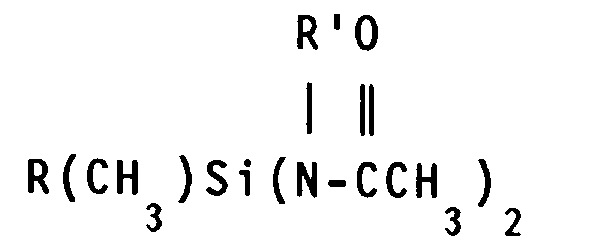 (D) einem Vernetzungsmittel, ausgewählt aus der Gruppe bestehend aus 0,3 bis einschließlich 4,2 Gewichtsteilen von(i) einem trifunktionellen Silan der allgemeinen Formel
 (ii) 1 bis einschließlich 6 Gewichtsteilen einer Aminoxysiliconverbindung mit 1 bis 100 Siliziumatomen pro Molekül und 3 bis 10 Aminoxygruppen pro Molekül, wobei die Aminoxygruppe der allgemeinen Formel -OX genügt, in der X ein einwertige Aminogruppe ist, ausgewählt aus der aus NR₂ und einem heterocyclischen Amin bestehenden Gruppe und R ein einwertiger Kohlenwasserstoffrest ist, die -OX-Gruppe durch eine SiO-Bindung an Siliziumatome gebunden ist, die verbleibenden Valenzen der Siliziumatome in der Aminoxy-Siliconverbindung durch zweiwertige Sauerstoffatome abgesättigt sind, die die Siliziumatome der Aminoxyverbindungen mit 2 oder mehr Siliziumatomen pro Molekül durch Silizium-Sauerstoff-Siliziumbindungen verbinden oder durch einwertige Kohlenwasserstoffreste oder halogenierte Kohlenwasserstoffreste abgesättigt sind, die an die Siliziumatome durch Silizium-Kohlenstoffbindungen gebunden sind, wobei im Mittel mindestens ein einwertiger Kohlenwasserstoffrest oder halogenierter einwertiger Kohlenwasserstoffrest pro Siliziumatom vorhanden ist und(E) von 1-50 Gewichtsprozent der Gesamtzusammensetzung eines Verdünnungsmittels, ausgewählt aus der Gruppe bestehend aus nicht reaktiver flüssiger Siliconverbindung und organischem Verdünnungsmittel, ausgewählt aus der aus aliphatischen Naphtha, aromatischen Kohlenwasserstoffen und Polyethern bestehenden Gruppe, wobei das Silan (C) und das Vernetzungsmittel (D) in ausreichenden Mengen vorhanden sind, um ein kombiniertes Gewicht von mindestens 3,5 Gewichtsteilen pro 100 Gewichtsteile von (A) zu ergeben und das Vernetzungsmittel (D) nicht in einer größeren Mengee als das Gewicht des Silans (C) vorhanden ist, wobei die Zusammensetzung nach 7 Tage Härtung bei 25°C durch Aussetzen einer Luftatmosphäre mit 50% relativer Feuchte ein Siliconelastomer ergibt, das mindestens eine Dehnung von 600%, eine Durometer Härte auf der Shore A Skala von 5 bis einschließlich 20 und einen Modul bei 150% Dehnung von unter 345 kPa (50 Pfund/Inch²) aufweist.
 - Zusammensetzung nach Anspruch 1,
dadurch gekennzeichnet,
daß das Silan (C) von 2,5 bis einschließlich 10 Gewichtsteilen eines Silans der allgemeinen Formel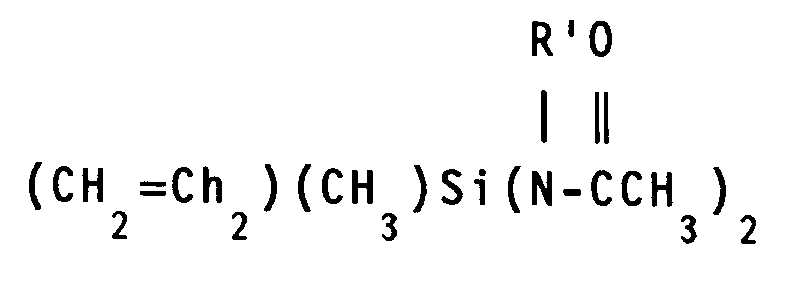
- Zusammensetzung nach Anspruch 1,
dadurch gekennzeichnet,
daß das Vernetzungsmittel 1 bis einschließlich 6 Gewichtsteile einer Aminoxysiliconverbindung ist mit 1 bis 100 Siliziumatomen pro Molekül und 3 bis 10 Aminoxygruppen pro Molekül, wobei die Aminoxygruppe der allgemeinen Formel -OX genügt, in der X eine einwertige Aminogruppe ist, ausgewählt aus der aus -NR₂ und einem heterocyclischen Amin bestehenden Gruppe, R ein einwertiger Kohlenwasserstoffrest ist, die -OX-Gruppe durch SiO-Bindung an Siliziumatome gebunden ist, die verbleibenden Valenzen der Siliziumatome in der Aminoxysiliconverbindung durch zweiwertige Sauerstoffatome abgesättigt sind, die die Siliziumatome der Aminoxysiliconverbindungen mit 2 oder mehr Siliziumatomen pro Molekül durch Silizium-Sauerstoff-Siliziumbindungen verbinden und durch einwertige Kohlenwasserstoffreste und halogenierte einwertige Kohlenwasserstoffreste abgesättigt sind, die an die Siliziumatome durch Silizium-Kohlenstoffbindungen gebunden sind, wobei im Mittel mindestens ein einwertiger Kohlenwasserstoffrest oder halogenierter einwertiger Kohlenwasserstoffrest pro Siliziumatom vorhanden ist. - Verfahren zum Herstellen einer Zusammensetzung, die in Abwesenheit von Feuchtigkeit stabil ist, jedoch bei Raumtemperatur durch Aussetzen von Feuchtigkeit zu einem Siliconelastomer härtbar ist und bei Aufbringen auf horizontale Flächen selbstausgleichend ist durchI. Mischen, um eine homogene Mischung zu erhalten von(A) 100 Gewichtsteile eines endständige blockierende Hydroxylgruppen aufweisenden Polydiorganosiloxans mit einer Viskosität bei 25°C von 1,8 bis 125 Pa.s und bei dem die organischen Gruppen aus der aus Methyl-, Ethyl-, Vinyl-, Phenyl- und 3,3,3-Trifluorpropylresten bestehenden Gruppe ausgewählt sind, wobei in dem Polydiorganosiloxan nicht mehr als 50% der organischen Gruppen Phenyl- oder 3,3,3-Trifluorpropylreste sind und nicht mehr als 10% der organischen Gruppen Vinylreste sind,(B) von 1 bis 150 Gewichtsteilen eines nicht-sauren, nichtverstärkenden Füllstoffes mit einer mittleren Teilchengröße von 1 bis 8 µm, wobei der Füllstoff zu 95 bis 5 Gewichtsprozent aus nichtbehandeltem Füllstoff und zu 5 bis 95 Gewichtsprozent aus behandeltem Füllstoff besteht, wobei der behandelte Füllstoff mit einem aus der Gruppe aus Calziumstearat und Stearinsäure bestehenden Gruppe ausgewählten Behandlungsmittel behandelt wurde,II. Einmischen in die aus (I) erhaltene homogene Mischung unter im wesentlichen wasserfreien Bedingungen,(C) von 2,5 bis einschließlich 10 Gewichtsteilen eines Silans der allgemeinen Formel
 (D) einem Vernetzungsmittel, ausgewählt aus der Gruppe bestehend aus 0,3 bis einschließlich 4,2 Gewichtsteilen von (i) einem trifunktionellen Silan der allgemeinen Formel
(ii) 1 bis einschließlich 6 Gewichtsteilen einer Aminoxysiliconverbindung mit 1 bis 100 Siliziumatomen pro Molekül und 3 bis 10 Aminoxygruppen pro Molekül, wobei die Aminoxygruppe der allgemeinen Formel -OX genügt, in der X eine einwertige Aminogruppe ist, ausgewählt aus der aus -NR₂ und einem heterocyclischen Amin bestehenden Gruppe und R ein einwertiger Kohlenwasserstoffrest ist, die -OX-Gruppe durch eine SiO-Bindung an Siliziumatome gebunden ist, die verbleibenden Valenzen der Siliziumatome in der Aminoxysiliconverbindung durch zweiwertige Sauerstoffatome abgesättigt sind, die die Siliziumatome der Aminoxyverbindungen mit 2 oder mehr Siliziumatomen pro Molekül durch Silizium-Sauerstoff-Siliziumbindungen verbinden und durch einwertige Kohlenwasserstoffreste oder halogenierte Kohlenwasserstoffreste abgesättigt sind, die an die Siliziumatome durch Silizium-Kohlenstoffbindungen gebunden sind, wobei im Mittel mindestens ein einwertiger Kohlenwasserstoffrest oder halogenierter einwertiger Kohlenwasserstoffrest pro Siliziumatom vorhanden ist, wobei das Silan (C) und das Vernetzungmittel (D) in ausreichenden Mengen vorhanden sind, um ein kombiniertes Gewicht von mindestens 3,5 Gewichtsteile pro 100 Gewichtsteile von (A) zu ergeben und das Vernetzungsmittel nicht in einer größeren Menge als das Gewicht des Silans (C) vorhanden ist und(E) von 1 bis 50 Gewichtsprozent der Zusammensetzung eines Verdünnungsmittels, ausgewählt aus der Gruppe bestehend aus nichtreaktiver flüssiger Siliconverbindung und organischem Verdünnungsmittel, ausgewählt aus der aus aliphatischen Naphtha, aromatischen Kohlenwasserstoffen und Polyethern bestehenden Gruppe undIII. Anordnen der aus II erhaltenen Zusammensetzung in einem Lagerbehälter, der die Zusammensetzung im wesentlichen von Feuchtigkeit ausschließt und Aufrechterhalten der Zusammensetzung unter einer im wesentlichen wasserfreien Bedingung, wobei die Zusammensetzung nach 7 Tage Härtung bei 25°C durch Aussetzen einer Luftatmosphäre mit 50% relativer Luftfeuchte ein Siliconelastomer ergibt, das mindestens eine Dehnung von 600%, eine Durometer Härte auf der Shore A Skala von 5 bis einschließlich 20 und einem Modul bei 150% Dehnung von unter 345 kPa (50 Pfund pro Inch²) aufweist. - Verwendung einer Zusammensetzung nach einem der Ansprüche 1 bis 3 als Dichtungsmittel zum Verbinden eines Straßenbelages.
Applications Claiming Priority (2)
| Application Number | Priority Date | Filing Date | Title |
|---|---|---|---|
| US18188388A | 1988-04-15 | 1988-04-15 | |
| US181883 | 1988-04-15 |
Publications (3)
| Publication Number | Publication Date |
|---|---|
| EP0337791A2 EP0337791A2 (de) | 1989-10-18 |
| EP0337791A3 EP0337791A3 (en) | 1990-09-12 |
| EP0337791B1 true EP0337791B1 (de) | 1994-03-16 |
Family
ID=22666210
Family Applications (1)
| Application Number | Title | Priority Date | Filing Date |
|---|---|---|---|
| EP19890303696 Expired - Lifetime EP0337791B1 (de) | 1988-04-15 | 1989-04-13 | Selbstnivellierende Fugenmasse für Strassen |
Country Status (5)
| Country | Link |
|---|---|
| EP (1) | EP0337791B1 (de) |
| JP (1) | JPH0637616B2 (de) |
| AU (1) | AU611278B2 (de) |
| CA (1) | CA1337313C (de) |
| DE (1) | DE68913788T2 (de) |
Families Citing this family (3)
| Publication number | Priority date | Publication date | Assignee | Title |
|---|---|---|---|---|
| US5246980A (en) * | 1992-07-02 | 1993-09-21 | Dow Corning Corporation | Two-part, ultralow modulus silicone sealant |
| DE102006061458B4 (de) * | 2006-12-23 | 2014-06-18 | Bostik Gmbh | Verwendung einer selbstverlaufenden, wasserfreien Beschichtungsmasse und Fußboden, mit Laminat- oder Parkettpaneelen |
| CN104109388B (zh) * | 2014-07-31 | 2016-05-25 | 江苏省交通规划设计院股份有限公司 | 一种高长径比针状硅灰石填充改性双组份道路灌缝胶 |
Family Cites Families (7)
| Publication number | Priority date | Publication date | Assignee | Title |
|---|---|---|---|---|
| BE795952A (fr) * | 1972-09-29 | 1973-08-27 | Dow Corning | Compositions d'elastomere de silicone a faible module durcissables a la temperature ambiante |
| US3996184A (en) * | 1975-12-08 | 1976-12-07 | Dow Corning Corporation | Low modulus room temperature vulcanizable silicone elastomer with improved slump characteristics |
| CA1195033A (en) * | 1983-03-11 | 1985-10-08 | Melvin D. Beers | Low modulus one-component rtv compositions and processes |
| JPS6189281A (ja) * | 1984-10-08 | 1986-05-07 | Toshiba Silicone Co Ltd | 表面硬化性シ−リング材 |
| JPS6189269A (ja) * | 1984-10-08 | 1986-05-07 | Toshiba Silicone Co Ltd | シリコ−ンシ−リング材表面の改質方法 |
| CA1284849C (en) * | 1985-03-26 | 1991-06-11 | Melvin D. Beers | Self-leveling silicone sealant compositions and methods for making same |
| US4711928A (en) * | 1986-03-03 | 1987-12-08 | Dow Corning Corporation | Moisture cured one-part RTV silicone sealant |
-
1989
- 1989-03-02 CA CA 592582 patent/CA1337313C/en not_active Expired - Fee Related
- 1989-04-13 DE DE1989613788 patent/DE68913788T2/de not_active Expired - Fee Related
- 1989-04-13 EP EP19890303696 patent/EP0337791B1/de not_active Expired - Lifetime
- 1989-04-14 AU AU33011/89A patent/AU611278B2/en not_active Ceased
- 1989-04-14 JP JP1093309A patent/JPH0637616B2/ja not_active Expired - Lifetime
Also Published As
| Publication number | Publication date |
|---|---|
| CA1337313C (en) | 1995-10-10 |
| DE68913788D1 (de) | 1994-04-21 |
| EP0337791A2 (de) | 1989-10-18 |
| EP0337791A3 (en) | 1990-09-12 |
| JPH0637616B2 (ja) | 1994-05-18 |
| JPH01306489A (ja) | 1989-12-11 |
| AU3301189A (en) | 1989-10-19 |
| DE68913788T2 (de) | 1994-10-27 |
| AU611278B2 (en) | 1991-06-06 |
Similar Documents
| Publication | Publication Date | Title |
|---|---|---|
| EP0337478B1 (de) | Fugenmasse für Beton mit verbesserter Adhäsionskraft | |
| US3996184A (en) | Low modulus room temperature vulcanizable silicone elastomer with improved slump characteristics | |
| EP0337764B1 (de) | Fugenmasse für Asphaltstrassen | |
| JP6297117B2 (ja) | 室温加硫性シリコーン組成物 | |
| EP0399682A2 (de) | Dichtungsmasse auf Basis von schnellhärtenden Polysiloxanen mit Oxim-Ethoxy-Gruppen | |
| EP0415596B1 (de) | Silikon-Dichtungsmaterial | |
| EP0457264B1 (de) | Einen sehr niedrigen Elastizitätsmodul aufweisende Zweikomponenten-Silicondichtungsmasse | |
| EP0337792B1 (de) | Fliessfähige Fugenmasse für Betonstrassen | |
| EP0577336B1 (de) | Einen sehr niedrigen Elastizitätsmodul aufweisende Zweikomponenten-Silicondichtungsmasse | |
| EP0337791B1 (de) | Selbstnivellierende Fugenmasse für Strassen | |
| US4360631A (en) | Flowable, room temperature vulcanizable silicone composition | |
| EP0468663B1 (de) | Bei Raumtemperatur härtende Zusammensetzung |
Legal Events
| Date | Code | Title | Description |
|---|---|---|---|
| PUAI | Public reference made under article 153(3) epc to a published international application that has entered the european phase |
Free format text: ORIGINAL CODE: 0009012 |
|
| AK | Designated contracting states |
Kind code of ref document: A2 Designated state(s): BE DE FR GB |
|
| PUAL | Search report despatched |
Free format text: ORIGINAL CODE: 0009013 |
|
| AK | Designated contracting states |
Kind code of ref document: A3 Designated state(s): BE DE FR GB |
|
| 17P | Request for examination filed |
Effective date: 19901025 |
|
| 17Q | First examination report despatched |
Effective date: 19920319 |
|
| GRAA | (expected) grant |
Free format text: ORIGINAL CODE: 0009210 |
|
| AK | Designated contracting states |
Kind code of ref document: B1 Designated state(s): BE DE FR GB |
|
| REF | Corresponds to: |
Ref document number: 68913788 Country of ref document: DE Date of ref document: 19940421 |
|
| ET | Fr: translation filed | ||
| PLBE | No opposition filed within time limit |
Free format text: ORIGINAL CODE: 0009261 |
|
| STAA | Information on the status of an ep patent application or granted ep patent |
Free format text: STATUS: NO OPPOSITION FILED WITHIN TIME LIMIT |
|
| 26N | No opposition filed | ||
| PGFP | Annual fee paid to national office [announced via postgrant information from national office to epo] |
Ref country code: BE Payment date: 20000329 Year of fee payment: 12 |
|
| PGFP | Annual fee paid to national office [announced via postgrant information from national office to epo] |
Ref country code: GB Payment date: 20010312 Year of fee payment: 13 Ref country code: FR Payment date: 20010312 Year of fee payment: 13 Ref country code: DE Payment date: 20010312 Year of fee payment: 13 |
|
| PG25 | Lapsed in a contracting state [announced via postgrant information from national office to epo] |
Ref country code: BE Free format text: LAPSE BECAUSE OF NON-PAYMENT OF DUE FEES Effective date: 20010430 |
|
| BERE | Be: lapsed |
Owner name: DOW CORNING CORP. Effective date: 20010430 |
|
| REG | Reference to a national code |
Ref country code: GB Ref legal event code: IF02 |
|
| PG25 | Lapsed in a contracting state [announced via postgrant information from national office to epo] |
Ref country code: GB Free format text: LAPSE BECAUSE OF NON-PAYMENT OF DUE FEES Effective date: 20020413 |
|
| PG25 | Lapsed in a contracting state [announced via postgrant information from national office to epo] |
Ref country code: DE Free format text: LAPSE BECAUSE OF NON-PAYMENT OF DUE FEES Effective date: 20021101 |
|
| GBPC | Gb: european patent ceased through non-payment of renewal fee |
Effective date: 20020413 |
|
| PG25 | Lapsed in a contracting state [announced via postgrant information from national office to epo] |
Ref country code: FR Free format text: LAPSE BECAUSE OF NON-PAYMENT OF DUE FEES Effective date: 20021231 |
|
| REG | Reference to a national code |
Ref country code: FR Ref legal event code: ST |