EP0336951B1 - Verfahren zum herstellen von kontakten bei integrierten schaltungen - Google Patents
Verfahren zum herstellen von kontakten bei integrierten schaltungen Download PDFInfo
- Publication number
- EP0336951B1 EP0336951B1 EP88909410A EP88909410A EP0336951B1 EP 0336951 B1 EP0336951 B1 EP 0336951B1 EP 88909410 A EP88909410 A EP 88909410A EP 88909410 A EP88909410 A EP 88909410A EP 0336951 B1 EP0336951 B1 EP 0336951B1
- Authority
- EP
- European Patent Office
- Prior art keywords
- layer
- electrode layer
- refractory metal
- dielectric
- process according
- Prior art date
- Legal status (The legal status is an assumption and is not a legal conclusion. Google has not performed a legal analysis and makes no representation as to the accuracy of the status listed.)
- Expired - Lifetime
Links
Images




Classifications
-
- H—ELECTRICITY
- H10—SEMICONDUCTOR DEVICES; ELECTRIC SOLID-STATE DEVICES NOT OTHERWISE PROVIDED FOR
- H10D—INORGANIC ELECTRIC SEMICONDUCTOR DEVICES
- H10D44/00—Charge transfer devices
- H10D44/01—Manufacture or treatment
- H10D44/041—Manufacture or treatment having insulated gates
-
- H—ELECTRICITY
- H10—SEMICONDUCTOR DEVICES; ELECTRIC SOLID-STATE DEVICES NOT OTHERWISE PROVIDED FOR
- H10W—GENERIC PACKAGES, INTERCONNECTIONS, CONNECTORS OR OTHER CONSTRUCTIONAL DETAILS OF DEVICES COVERED BY CLASS H10
- H10W20/00—Interconnections in chips, wafers or substrates
- H10W20/01—Manufacture or treatment
- H10W20/031—Manufacture or treatment of conductive parts of the interconnections
- H10W20/064—Manufacture or treatment of conductive parts of the interconnections by modifying the conductivity of conductive parts, e.g. by alloying
- H10W20/066—Manufacture or treatment of conductive parts of the interconnections by modifying the conductivity of conductive parts, e.g. by alloying by forming silicides of refractory metals
-
- H—ELECTRICITY
- H10—SEMICONDUCTOR DEVICES; ELECTRIC SOLID-STATE DEVICES NOT OTHERWISE PROVIDED FOR
- H10W—GENERIC PACKAGES, INTERCONNECTIONS, CONNECTORS OR OTHER CONSTRUCTIONAL DETAILS OF DEVICES COVERED BY CLASS H10
- H10W20/00—Interconnections in chips, wafers or substrates
- H10W20/01—Manufacture or treatment
- H10W20/071—Manufacture or treatment of dielectric parts thereof
- H10W20/092—Manufacture or treatment of dielectric parts thereof by smoothing the dielectric parts
Definitions
- This invention relates to integrated circuit contact fabrication processes of the kind including the steps of: forming over an active region of a semiconductor substrate a first patterned electrode layer and an overlying first dielectric layer; forming in the active region and on said first dielectric layer a second electrode layer overlying at least an edge of said first electrode layer, to create a nonplanar step in the region of overlap with said first electrode layer; and forming a refractory metal based layer on said second electrode layer, said second electrode layer being patterned to retain the nonplanar step.
- FIG. l A process for integrated circuit contact fabrication is known from US-A-4,403,394 and is illustrated in Fig. l of the present drawings.
- the prior art represents a portion of a DRAM cell formed in a lightly doped p-type monocrystalline substrate l, having an n+ conductively doped region 2 on one side of the active region and a doped polycrystalline silicon layer 3 (poly I) situated at the other side.
- the active region is bordered on the sides by field oxides 4.
- Poly I layer 3 is one electrode of a capacitor, which is selectively coupled to conductive region 2 upon the enablement of the field effect transistor formed by secondly deposited polysilicon gate electrode 6 (poly II) through a channel between region 2 and the substrate proximate electrode 3.
- An oxide dielectric 7 covers electrode 6. Connections between the poly II electrode layer 6 and subsequent metalization layers are made by contacts using metal 8, formed in known manner by masking and then etching openings through dielectric 7, depositing of a metal layer, and patterning the metalization.
- the known process has the disadvantage that the concluding contour is far from planar, and that the extent of overlapping between poly I capacitor electrode 3 and poly II gate electrode 6 must be significant to ensure that alignment tolerances do not result in a contact cut down to the level of the poly I layer by a misalignment of the contact cut mask over the edge of poly II layer.
- a relatively large contact area between metal 8 and poly II electrode 6 is also required to minimize the effects of contact resistance on the conduction of charge to poly II electrode 6.
- the known process also has a disadvantage that the contact masking and etching steps are costly, and furthermore the area of the underlying polysilicon layer must be relatively large to compensate for alignment errors which are introduced by the successive masking operations.
- an integrated circuit contact fabrication process of the kind specified in the opening paragraph of this description, characterized by the steps of: planarizing the structure with second dielectric to selectively expose the surface of the refractory metal based layer; and forming a patterned metalization layer over the second dielectric to make contact with the exposed surface of the refractory metal based layer.
- an integrated circuit contact fabrication process has the advantage of providing a self-aligned contact structure and the further advantages of not requiring masking or etching to form contact openings in a dielectric layer, reducing the polysilicon area allocation for mask alignment tolerances, minimizing metal step coverage problems, providing low ohmic resistance contact connections, and providing a degree of planarization for subsequent metalization layers.
- the use of a contact fabrication process according to the invention reduces the "footprint" or area of the contact from the metalization layer to the second polysilicon gate electrode, and thereby measurably reduces undesired capacitive coupling between the gate electrode of the access transistor and the storage capacitor electrode.
- Fig. l is a cross-sectional schematic of a DRAM fabricated according to the prior art.
- Figs. 2 and 3 illustrate by way of schematic cross sections two embodiments of DRAM cells fabricated according to the present invention.
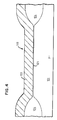
- FIGs. 4-9 schematically illustrate in the cross section representative stages in the fabrication sequence which concludes as the embodiment depicted in Fig. 2.
- FIG. 2 of the drawings A structure fabricated according to the present invention is depicted in Fig. 2 of the drawings. The substantial planarity of the structures is immediately evident. Similarly visible is the minimal overlap between the poly I capacitor electrode 123 and the poly II gate electrode structures 111/112, namely in region 113.
- the compositely formed gate electrode comprising poly II layer III and a selectively deposited refractory metal layers 112, provides a comparatively low resistance electrode structure. Note also that the contact between the poly II electrode and metalization 109, through intermediate dielectric, is self-aligned with relation to the edge of poly I electrode 123 by the nonplanar step at location 114.
- shunting refractory metal layer 112 minimizes contact resistance effects which might otherwise arise with a misalignment of the first metalization layer, such as that at 116, where direct metal-to-metal ensures acceptably low ohmic connection.
- FIG. 3 An alternative process according to the invention results in a structure schematically depicted in Fig. 3, wherein references denoting elements corresponding to those of Fig. 1 commence with the digit "2".
- the concluding structure has a shunting refractory metal layer 212 over the upper surface alone of poly II layer 211.
- Fabrication of the structure in Fig. 3 is believed to be somewhat easier, in that selective deposition of tungsten is not required. However, this variant requires the etching of successive tungsten and polysilicon layers during the formation of the electrode 211/212 pattern.
- Fig. 4 lightly doped p-type monocrystalline silicon substrate 101 is processed to create field oxide regions 104, and thereby define an active region 119 situated medially.
- the active region is thereafter covered by a thin oxide layer 121, preferably formed to a thickness of approximately 20 nanometers by thermal oxidation of the substrate 101, and a conductively doped polycrystalline silicon layer 122, poly I, deposited by known techniques to a thickness of approximately 500 nanometers.
- Poly I layer 122 and oxide 121 are then patterned by standard photoresist masking and etching techniques to create the structure depicted in Fig. 5, a capacitor electrode 123 electrically isolated from substrate 101 by an oxide dielectric 124.
- the patterned poly I layer 123 is then subjected to an oxidation operation suitable to form directly or in a sequence of multiple steps a dielectric suitable to isolate electrode 123 from any succeeding layers of conductive polysilicon.
- the thickness of the oxide dielectric immediately over substrate 101, designated as 126 in Fig. 6, is nominally 20 nanometers, while the dielectric layer 127 surrounding capacitor electrode 123 is nominally at least 70 nanometers.
- the difference in thickness is primarily attributable to the accentuated oxidation rate of doped polysilicon 123 over lightly doped monocrystalline silicon 101. The result is consistent with a preference for having a relatively thin gate oxide dielectric 126 while providing a relatively thicker interelectrode oxide dielectric 127.
- oxide regions 126 and 127 are covered in the next step of fabrication by a layer of doped polycrystalline silicon 128, poly II, which is in normal manner conformally deposited to the same nominal depth of approximately 500 nanometers as the Poly I layer 122.
- a feature of this deposition is the creation of step 129 in the contour of poly II layer 128, above the edge of poly I electrode layer 123.
- Step 129 is attributable to the difference in height between oxide layer 126 on one side and the combination of poly I layer 123 and somewhat thicker oxide layer 127 on the other side, whereby the step 129 is defined between first and second portions of the layer 128 which and respectively coplanar with, and overlying, the first electrode layer 123.
- the preferred embodiment includes masking and etching to retain a segment, electrode 111, of the poly II layer 128 over channel region 132, with a small elevated segment overlying poly I electrode 123 at location 133.
- the preferred practice of the invention next involves a selective deposition of a refractory metal layer 112, such as tungsten to a nominal thickness of 100 nanometers, onto any exposed silicon surface. Tungsten is preferred for its low resistance and high temperature capabilities. Nevertheless, other refractory metals or silicides thereof are also suitable shunting layers. The objective is to create low resistance shunting layers over the doped but relatively higher resistance polysilicon electrode 111.
- Fig. 7 is next subjected to an ion implantation using phosphorus or the like to form n+ doped region 102.
- Polysilicon layers 111 and 123 serve as implant masks to create the alignment between the edge of the poly II and tungsten gate electrode 111/112 and the doped region 102.
- Relatively thin gate oxide 126 does not materially impede the implant.
- a slight variation of the preferred embodiment involves the performance of the implant which produces doped region 102 prior to the selective deposition of refractory metal layer 112.
- the poly I and poly II layers 123 and 111 would serve as self-align masks, and if so desired, could receive their impurity dose during such implant in lieu of being in situ doped during deposition.
- the desirability of doing so for poly I electrode 123 is materially less, in that this would reduce the differential oxidation rate used to create a thicker oxide layer 127 over that of 126, and could create an undoped region of poly I electrode 123 immediately under the edge of the poly II layer at 133.
- the structure of Fig. 7 is preferably covered by approximately 1,000 nanometers of chemical vapor deposited (CVD) or plasma CVD oxide 136.
- CVD chemical vapor deposited
- plasma CVD oxide 136 The importance of having a high temperature refractory metal layer 112 becomes acutely evident with the use of plasma deposition.
- substrate 101 is covered with a relatively viscous planarization layer 137.
- Layer 137 is preferably a dielectric such as doped spin-on-glass (SOG) or polyimide, deposited in an amount and manner to form a relatively planar surface 138 over substrate 101.
- planar character of surface 138 is then transferred down and into dielectric layer 136 by an isotropic etch of the composite structure using etchants which remove polyimide/SOG and dielectric 136 at substantially equal rates.
- etchants which remove polyimide/SOG and dielectric 136 at substantially equal rates.
- a representative technique for such etching is described in US-A-4,604,l62.
- the l:l etch is continued until the surface of metal 112 is exposed. See Fig. 9. End point detection for the etch can be related to the presence of metal 112 in the etch residuals.
- the poly I electrode 123 remains dielectrically isolated and substantially decoupled from overlying poly II/refractory metal electrode 111/112 by the presence of relatively thick oxide layer 127.
- Upper surface 139 of the substrate is substantially planar, and would likely have even greater planarity if the field oxide regions 104 were replaced with trench structures. Note that the exposed surface of metal 112 is aligned with the poly II electrode 111 and the edge of the poly I electrode 123, obviating the need for contact masking, etching and dimensional compensation.
- the low resistance of the metal-to-metal contact provides greater latitude in misalignment, yet provides a highly conductive shunt over the full extent of the poly II gate electrode.
Landscapes
- Semiconductor Memories (AREA)
- Internal Circuitry In Semiconductor Integrated Circuit Devices (AREA)
- Electrodes Of Semiconductors (AREA)
Claims (9)
- Ein Kontaktherstellungsverfahren für integrierte Schaltungen mit den Schritten: Bilden einer ersten strukturierten Elektrodenschicht (123, 223) und einer darüberliegenden ersten dielektrischen Schicht (127) über einem aktiven Bereich eines Halbleitersubstrats (l0l, 20l); Bilden einer zweiten Elektrodenschicht (111, 211) in dem aktiven Bereich und auf der ersten dielektrischen Schicht (127) über zumindest einer Kante der ersten Elektrodenschicht (l23, 223), um eine nichtplanare Stufe (l29) in dem Bereich der Überlappung mit der ersten Elektrodenschicht (123, 223) zu formen; und Bilden einer Schicht (ll2, 2l2) basierend auf hitzebeständigem Metall auf der zweiten Elektrodenschicht (ll1, 211), wobei die zweite Elektrodenschicht (111, 211) derart strukturiert ist, daß sie die nichtplanare Stufe behält, gekennzeichnet durch die Schritte: Planarisieren der Struktur mit einem zweiten Dielektrikum (136, l37; 236, 237), um die Oberfläche der Schicht (112, 212) basierend auf hitzebeständigem Metall selektiv freizulegen; und Bilden einer strukturierten Metallisationsschicht (l09, 209) über dem zweiten Dielektrikum (l36, l37; 236; 237), um einen Kontakt mit der freigelegten Oberfläche der Schicht (112, 212) basierend auf dem hitzebeständigen Metall herzustellen.
- Verfahren nach Anspruch 1, dadurch gekennzeichnet, daß die zweite Elektrodenschicht (111) vor der Bildung der Schicht basierend auf hitzebeständigem Metall strukturiert wird und daß die Schicht (ll2) basierend auf hitzebeständigem Metall selektiv auf der zweiten Elektrodenschicht (lll) abgelagert wird.
- Verfahren nach Anspruch l, dadurch gekennzeichnet, daß die Schicht (2l2) basierend auf hitzebeständigem Metall vor der Strukturierung der zweiten Elektrodenschicht (211) gebildet wird und daß die Strukturierung der zweiten Elektrodenschicht (2l1) eine aufeinaderfolgende und im wesentlichen koexistente Ätzung der Schicht (212) basierend auf hitzebeständigem Metall und der zweiten Elektrodenschicht (211) einschließt.
- Verfahren nach Anspruch 1, dadurch gekennzeichnet, daß ein erster Abschnitt der zweiten Elektrodenschicht (lll, ll2; 2ll, 2l2) im wesentlichen koplanar mit der ersten Elektrodenschicht (l23, 223) und ein zweiter Abschnitt der zweiten Elektrodenschicht (ll1, 112; 2ll, 212) im wesentlichen über der ersten Elektrodenschicht (l23, 223) gebildet werden, wobei die Stufe (129) zwischen dem ersten und zweiten Abschnitt definiert wird.
- Verfahren nach Anspruch 4, dadurch gekennzeichnet, daß der Planarisierungsschritt umfaßt: Bilden aufeinanderfolgender Schichten eines konformen Dielektrikums (136, 236) und eines viskosen Planarisierungsdielektrikums (137, 237), um eine im wesentlichen planare Oberfläche zu formen; Ätzen der Oberfläche, um mit im wesentlichen gleichen Geschwindigkeiten konformes und viskoses Dielektrikum (l36, l37; 236, 237) zu entfernen und Beenden der Ätzung bei Freilegen der Schicht (112, 212) basierend auf hitzebeständigem Metall.
- Verfahren nach Anspruch 5, dadurch gekennzeichnet, daß die zweite Elektrodenschicht (lll, 2ll) leitend dotiertes Polykristallin oder amorphes Silizium ist.
- Verfahren nach Anspruch l, dadurch gekennzeichnet, daß das hitzebeständige Metall Wolfram ist.
- Verfahren nach Anspruch l, dadurch gekennzeichnet, daß das hitzebeständige Metall ein wolframreiches Silizid ist.
- Verfahren nach Anspruch l, dadurch gekennzeichnet, daß die erste und zweite Elektrodenschicht (l23, 111; 223, 2ll) mit annähernd der gleichen Dicke gebildet werden.
Applications Claiming Priority (2)
| Application Number | Priority Date | Filing Date | Title |
|---|---|---|---|
| US10708687A | 1987-10-08 | 1987-10-08 | |
| US107086 | 1998-06-29 |
Publications (2)
| Publication Number | Publication Date |
|---|---|
| EP0336951A1 EP0336951A1 (de) | 1989-10-18 |
| EP0336951B1 true EP0336951B1 (de) | 1992-09-09 |
Family
ID=22314754
Family Applications (1)
| Application Number | Title | Priority Date | Filing Date |
|---|---|---|---|
| EP88909410A Expired - Lifetime EP0336951B1 (de) | 1987-10-08 | 1988-09-23 | Verfahren zum herstellen von kontakten bei integrierten schaltungen |
Country Status (4)
| Country | Link |
|---|---|
| EP (1) | EP0336951B1 (de) |
| JP (1) | JPH02501519A (de) |
| DE (1) | DE3874522T2 (de) |
| WO (1) | WO1989003589A1 (de) |
Family Cites Families (1)
| Publication number | Priority date | Publication date | Assignee | Title |
|---|---|---|---|---|
| IT1186485B (it) * | 1985-12-20 | 1987-11-26 | Sgs Microelettronica Spa | Circuito integrato monolitico,in particolare di tipo mos o cmos e processo per la realizzazione di tale circuito |
-
1988
- 1988-09-23 JP JP63508669A patent/JPH02501519A/ja active Pending
- 1988-09-23 EP EP88909410A patent/EP0336951B1/de not_active Expired - Lifetime
- 1988-09-23 WO PCT/US1988/003271 patent/WO1989003589A1/en not_active Ceased
- 1988-09-23 DE DE8888909410T patent/DE3874522T2/de not_active Expired - Fee Related
Non-Patent Citations (2)
| Title |
|---|
| EXTENDED ABSTRACTS, vol. 86-2, 19-24 October 1986, (Princeton, NJ, US), C.H.TING et al.: "Spin-on-glass as a planarizing dielectric layer for multilevel metallization", page 529, abstract 352 * |
| JOURNAL OF THE ELECTROCHEMICAL SOCIETY, vol. 130, no. 9, September 1983, (Manchester, New Hampshire, US), R.M.LEVIN et al.: "Oxide isolation for double polysilicon VLSI devices", pages 1894-1897 * |
Also Published As
| Publication number | Publication date |
|---|---|
| JPH02501519A (ja) | 1990-05-24 |
| WO1989003589A1 (en) | 1989-04-20 |
| EP0336951A1 (de) | 1989-10-18 |
| DE3874522D1 (de) | 1992-10-15 |
| DE3874522T2 (de) | 1993-04-22 |
Similar Documents
| Publication | Publication Date | Title |
|---|---|---|
| US4327476A (en) | Method of manufacturing semiconductor devices | |
| EP0088922B1 (de) | Verfahren zum Herstellen von Elektroden und Verdrahtungsstreifen auf einer Halbleiteranordnung | |
| US5541434A (en) | Semiconductor device incorporating a contact for electrically connecting adjacent portions within the semiconductor device | |
| JP3199717B2 (ja) | 半導体装置およびその製造方法 | |
| US5330934A (en) | Method of fabricating a semiconductor device having miniaturized contact electrode and wiring structure | |
| US4453306A (en) | Fabrication of FETs | |
| EP0179407A2 (de) | Verfahren zum Herstellen einer DMOS-Halbleiteranordnung | |
| JP3022744B2 (ja) | 半導体装置及びその製造方法 | |
| US5969393A (en) | Semiconductor device and method of manufacture of the same | |
| JP3132435B2 (ja) | 半導体装置の製造方法 | |
| US5930614A (en) | Method for forming MOS device having field shield isolation | |
| EP0996151B1 (de) | Verfahren zur Transistorsherstellung | |
| US5309023A (en) | Contact structure for interconnection in semiconductor devices and manufacturing method thereof | |
| US6953744B2 (en) | Methods of fabricating integrated circuit devices providing improved short prevention | |
| US5913136A (en) | Process for making a transistor with self-aligned source and drain contacts | |
| US5580806A (en) | Method of fabricating a buried contact structure for SRAM | |
| EP0696061B1 (de) | Herstellungsverfahren für einen Kontakt in einer integrierten Schaltung | |
| KR940011101B1 (ko) | Dram 셀용 고성능 트렌치 커패시터 | |
| US5731240A (en) | Manufacturing method for semiconductor depositing device | |
| US5744835A (en) | MOS semiconductor device with mask layers | |
| US6297093B1 (en) | Method of making an electrically programmable memory cell | |
| JPH02143456A (ja) | 積層型メモリセルの製造方法 | |
| EP0336951B1 (de) | Verfahren zum herstellen von kontakten bei integrierten schaltungen | |
| US6136633A (en) | Trench-free buried contact for locos isolation | |
| KR950012916B1 (ko) | 반도체장치의 소자분리방법 |
Legal Events
| Date | Code | Title | Description |
|---|---|---|---|
| PUAI | Public reference made under article 153(3) epc to a published international application that has entered the european phase |
Free format text: ORIGINAL CODE: 0009012 |
|
| AK | Designated contracting states |
Kind code of ref document: A1 Designated state(s): DE GB NL |
|
| 17P | Request for examination filed |
Effective date: 19891017 |
|
| 17Q | First examination report despatched |
Effective date: 19910503 |
|
| GRAA | (expected) grant |
Free format text: ORIGINAL CODE: 0009210 |
|
| RAP1 | Party data changed (applicant data changed or rights of an application transferred) |
Owner name: NCR INTERNATIONAL INC. |
|
| AK | Designated contracting states |
Kind code of ref document: B1 Designated state(s): DE GB NL |
|
| REF | Corresponds to: |
Ref document number: 3874522 Country of ref document: DE Date of ref document: 19921015 |
|
| PLBE | No opposition filed within time limit |
Free format text: ORIGINAL CODE: 0009261 |
|
| STAA | Information on the status of an ep patent application or granted ep patent |
Free format text: STATUS: NO OPPOSITION FILED WITHIN TIME LIMIT |
|
| 26N | No opposition filed | ||
| NLT1 | Nl: modifications of names registered in virtue of documents presented to the patent office pursuant to art. 16 a, paragraph 1 |
Owner name: AT&T GLOBAL INFORMATION SOLUTIONS INTERNATIONAL IN |
|
| REG | Reference to a national code |
Ref country code: GB Ref legal event code: 732E |
|
| REG | Reference to a national code |
Ref country code: GB Ref legal event code: 732E |
|
| NLS | Nl: assignments of ep-patents |
Owner name: AT&T GLOBAL INFORMATION SOLUTIONS INTERNATIONAL IN |
|
| NLS | Nl: assignments of ep-patents |
Owner name: AT&T GLOBAL INFORMATION SOLUTIONS INTERNATIONAL IN |
|
| NLT1 | Nl: modifications of names registered in virtue of documents presented to the patent office pursuant to art. 16 a, paragraph 1 |
Owner name: NCR INTERNATIONAL, INC;HYUNDAI ELECTRONICS AMERICA |
|
| NLT1 | Nl: modifications of names registered in virtue of documents presented to the patent office pursuant to art. 16 a, paragraph 1 |
Owner name: NCR INTERNATIONAL, INC;HYUNDAI ELECTRONICS AMERICA |
|
| REG | Reference to a national code |
Ref country code: GB Ref legal event code: IF02 |
|
| NLS | Nl: assignments of ep-patents |
Owner name: NCR INTERNATIONAL, INC Owner name: HYNIX SEMICONDUCTOR INC. Owner name: HYUNDAI ELECTRONICS AMERICA |
|
| NLT1 | Nl: modifications of names registered in virtue of documents presented to the patent office pursuant to art. 16 a, paragraph 1 |
Owner name: NCR INTERNATIONAL, INC Owner name: HYNIX SEMICONDUCTOR AMERICA INC. |
|
| REG | Reference to a national code |
Ref country code: GB Ref legal event code: 732E |
|
| PGFP | Annual fee paid to national office [announced via postgrant information from national office to epo] |
Ref country code: NL Payment date: 20050904 Year of fee payment: 18 |
|
| PGFP | Annual fee paid to national office [announced via postgrant information from national office to epo] |
Ref country code: DE Payment date: 20050915 Year of fee payment: 18 |
|
| PGFP | Annual fee paid to national office [announced via postgrant information from national office to epo] |
Ref country code: GB Payment date: 20050921 Year of fee payment: 18 |
|
| NLS | Nl: assignments of ep-patents |
Owner name: MAGNACHIP SEMICONDUCTOR LTD. Effective date: 20060913 Owner name: NCR INTERNATIONAL, INC Effective date: 20060913 |
|
| PG25 | Lapsed in a contracting state [announced via postgrant information from national office to epo] |
Ref country code: NL Free format text: LAPSE BECAUSE OF NON-PAYMENT OF DUE FEES Effective date: 20070401 |
|
| PG25 | Lapsed in a contracting state [announced via postgrant information from national office to epo] |
Ref country code: DE Free format text: LAPSE BECAUSE OF NON-PAYMENT OF DUE FEES Effective date: 20070403 |
|
| GBPC | Gb: european patent ceased through non-payment of renewal fee |
Effective date: 20060923 |
|
| NLV4 | Nl: lapsed or anulled due to non-payment of the annual fee |
Effective date: 20070401 |
|
| PG25 | Lapsed in a contracting state [announced via postgrant information from national office to epo] |
Ref country code: GB Free format text: LAPSE BECAUSE OF NON-PAYMENT OF DUE FEES Effective date: 20060923 |