EP0336912A2 - Verfahren und Vorrichtung zum Behandeln von Mineralwolle - Google Patents
Verfahren und Vorrichtung zum Behandeln von Mineralwolle Download PDFInfo
- Publication number
- EP0336912A2 EP0336912A2 EP89850095A EP89850095A EP0336912A2 EP 0336912 A2 EP0336912 A2 EP 0336912A2 EP 89850095 A EP89850095 A EP 89850095A EP 89850095 A EP89850095 A EP 89850095A EP 0336912 A2 EP0336912 A2 EP 0336912A2
- Authority
- EP
- European Patent Office
- Prior art keywords
- mineral wool
- layers
- path
- split
- vacuum
- Prior art date
- Legal status (The legal status is an assumption and is not a legal conclusion. Google has not performed a legal analysis and makes no representation as to the accuracy of the status listed.)
- Withdrawn
Links
Images

Classifications
-
- D—TEXTILES; PAPER
- D04—BRAIDING; LACE-MAKING; KNITTING; TRIMMINGS; NON-WOVEN FABRICS
- D04H—MAKING TEXTILE FABRICS, e.g. FROM FIBRES OR FILAMENTARY MATERIAL; FABRICS MADE BY SUCH PROCESSES OR APPARATUS, e.g. FELTS, NON-WOVEN FABRICS; COTTON-WOOL; WADDING ; NON-WOVEN FABRICS FROM STAPLE FIBRES, FILAMENTS OR YARNS, BONDED WITH AT LEAST ONE WEB-LIKE MATERIAL DURING THEIR CONSOLIDATION
- D04H1/00—Non-woven fabrics formed wholly or mainly of staple fibres or like relatively short fibres
- D04H1/40—Non-woven fabrics formed wholly or mainly of staple fibres or like relatively short fibres from fleeces or layers composed of fibres without existing or potential cohesive properties
- D04H1/42—Non-woven fabrics formed wholly or mainly of staple fibres or like relatively short fibres from fleeces or layers composed of fibres without existing or potential cohesive properties characterised by the use of certain kinds of fibres insofar as this use has no preponderant influence on the consolidation of the fleece
- D04H1/4209—Inorganic fibres
-
- B—PERFORMING OPERATIONS; TRANSPORTING
- B23—MACHINE TOOLS; METAL-WORKING NOT OTHERWISE PROVIDED FOR
- B23D—PLANING; SLOTTING; SHEARING; BROACHING; SAWING; FILING; SCRAPING; LIKE OPERATIONS FOR WORKING METAL BY REMOVING MATERIAL, NOT OTHERWISE PROVIDED FOR
- B23D59/00—Accessories specially designed for sawing machines or sawing devices
- B23D59/006—Accessories specially designed for sawing machines or sawing devices for removing or collecting chips
-
- B—PERFORMING OPERATIONS; TRANSPORTING
- B28—WORKING CEMENT, CLAY, OR STONE
- B28D—WORKING STONE OR STONE-LIKE MATERIALS
- B28D1/00—Working stone or stone-like materials, e.g. brick, concrete or glass, not provided for elsewhere; Machines, devices, tools therefor
- B28D1/005—Cutting sheet laminae in planes between faces
-
- D—TEXTILES; PAPER
- D04—BRAIDING; LACE-MAKING; KNITTING; TRIMMINGS; NON-WOVEN FABRICS
- D04H—MAKING TEXTILE FABRICS, e.g. FROM FIBRES OR FILAMENTARY MATERIAL; FABRICS MADE BY SUCH PROCESSES OR APPARATUS, e.g. FELTS, NON-WOVEN FABRICS; COTTON-WOOL; WADDING ; NON-WOVEN FABRICS FROM STAPLE FIBRES, FILAMENTS OR YARNS, BONDED WITH AT LEAST ONE WEB-LIKE MATERIAL DURING THEIR CONSOLIDATION
- D04H1/00—Non-woven fabrics formed wholly or mainly of staple fibres or like relatively short fibres
- D04H1/40—Non-woven fabrics formed wholly or mainly of staple fibres or like relatively short fibres from fleeces or layers composed of fibres without existing or potential cohesive properties
- D04H1/42—Non-woven fabrics formed wholly or mainly of staple fibres or like relatively short fibres from fleeces or layers composed of fibres without existing or potential cohesive properties characterised by the use of certain kinds of fibres insofar as this use has no preponderant influence on the consolidation of the fleece
- D04H1/4209—Inorganic fibres
- D04H1/4218—Glass fibres
- D04H1/4226—Glass fibres characterised by the apparatus for manufacturing the glass fleece
-
- D—TEXTILES; PAPER
- D04—BRAIDING; LACE-MAKING; KNITTING; TRIMMINGS; NON-WOVEN FABRICS
- D04H—MAKING TEXTILE FABRICS, e.g. FROM FIBRES OR FILAMENTARY MATERIAL; FABRICS MADE BY SUCH PROCESSES OR APPARATUS, e.g. FELTS, NON-WOVEN FABRICS; COTTON-WOOL; WADDING ; NON-WOVEN FABRICS FROM STAPLE FIBRES, FILAMENTS OR YARNS, BONDED WITH AT LEAST ONE WEB-LIKE MATERIAL DURING THEIR CONSOLIDATION
- D04H1/00—Non-woven fabrics formed wholly or mainly of staple fibres or like relatively short fibres
- D04H1/40—Non-woven fabrics formed wholly or mainly of staple fibres or like relatively short fibres from fleeces or layers composed of fibres without existing or potential cohesive properties
- D04H1/54—Non-woven fabrics formed wholly or mainly of staple fibres or like relatively short fibres from fleeces or layers composed of fibres without existing or potential cohesive properties by welding together the fibres, e.g. by partially melting or dissolving
- D04H1/559—Non-woven fabrics formed wholly or mainly of staple fibres or like relatively short fibres from fleeces or layers composed of fibres without existing or potential cohesive properties by welding together the fibres, e.g. by partially melting or dissolving the fibres being within layered webs
-
- D—TEXTILES; PAPER
- D04—BRAIDING; LACE-MAKING; KNITTING; TRIMMINGS; NON-WOVEN FABRICS
- D04H—MAKING TEXTILE FABRICS, e.g. FROM FIBRES OR FILAMENTARY MATERIAL; FABRICS MADE BY SUCH PROCESSES OR APPARATUS, e.g. FELTS, NON-WOVEN FABRICS; COTTON-WOOL; WADDING ; NON-WOVEN FABRICS FROM STAPLE FIBRES, FILAMENTS OR YARNS, BONDED WITH AT LEAST ONE WEB-LIKE MATERIAL DURING THEIR CONSOLIDATION
- D04H1/00—Non-woven fabrics formed wholly or mainly of staple fibres or like relatively short fibres
- D04H1/40—Non-woven fabrics formed wholly or mainly of staple fibres or like relatively short fibres from fleeces or layers composed of fibres without existing or potential cohesive properties
- D04H1/58—Non-woven fabrics formed wholly or mainly of staple fibres or like relatively short fibres from fleeces or layers composed of fibres without existing or potential cohesive properties by applying, incorporating or activating chemical or thermoplastic bonding agents, e.g. adhesives
- D04H1/593—Non-woven fabrics formed wholly or mainly of staple fibres or like relatively short fibres from fleeces or layers composed of fibres without existing or potential cohesive properties by applying, incorporating or activating chemical or thermoplastic bonding agents, e.g. adhesives to layered webs
Definitions
- the present invention relates to a method in the manufacture of mineral wool products from a mineral wool path by splitting the mineral wool path into two or several layers by means of split cuts extending parallelly to the plane of the mineral wool path, which method is useful for reducing the spreading of dust from the ready products by exhausting loose fibres and other particles therefrom.
- the invention is based on studies of the mechanisms which cause appearance of dust and also the mechanisms which can be used to prevent spreading of dust. These studies have shown that the air-borne dust which is produced when handling mineral wool mainly comprises thin, short mineral fibres. The studies also have shown that the air-borne fibres and other particles, which are produced, emanate from the surfaces of the mineral wool products.
- the binding is effected by means of a binding substance.
- the binder generally is a thermosetting resin which, in the shape of small drops, is distributed in the mineral wool products. If such a binder drop sticks to a fibre said fibre is prevented from becoming air-borne.
- the fastening can be effected by means of a dust binding oil, which, in the form of a thin layer, covers large portions of the fibre surfaces.
- a dust binding oil which, in the form of a thin layer, covers large portions of the fibre surfaces.
- the process of manufacturing mineral wool products includes a hardening stage in which the product and the binder of the product are heated to about 200°C, whereby the binder is finally hardened.
- the product also becomes completely dried, and since the hardening stage is combined with a heavy gas flow through the products the fibres may become electrostatically charged.
- the subsequent cutting and packing etc. of the mineral wool product said electrostatic charge is maintained and fibres which have become charged tend to be retained in the product.
- Upon storing and transporting of the product becomes discharged and subsequently the fibres, which were once electrostatically fastened, then can become air-borne.
- the third mechanism for keeping the fibres in the mineral wool mass is the mechanical one. A sufficiently long fibre will always be in contact with a large number of other fibres and said fibre will be kept in the product solely by means of friction and will be prevented from becoming air-borne.
- a high efficiency in a mineral wool line causes high path speeds. This, in turn, necessitates high effiency of for instance cutting machines, i.e. the apparatus by means of which the path is divided by cuts extending perpendicularly to the longitudinal direction of the path.
- cutting machines i.e. the apparatus by means of which the path is divided by cuts extending perpendicularly to the longitudinal direction of the path.
- the split cuts are made by means of band saws or similar apparatus which provide horizontal cuts in the advancing mineral wool path.
- the invention relates to a method and an apparatus of reducing the spreading of dust from the ready products in the manufacture of mineral wool products whereby a mineral wool path is split cut into two or more layers by means of split cuts which are parallel to the plane of the mineral wool path, and this is made by vacuum exhausting loose fibres and other particles from the cut surfaces.
- the invention is characterized in that vacuum cleaning means are introduced between the two layers formed by the cutting process, and said vacuum cleaning means vacuum clean the cut surfaces just formed, whereupon the layers are moved together again.
- the vacuum cleaning of the cut surfaces is made more effective in that the surfaces are processed thereby facilitating the releasing of fibres and particles.
- a particularly suitable method of processing the cut surfaces is to blow air jets onto said surfaces.
- Another method which has proved to be useful, and which is based on the observation that particles, especially fibres, of a surface are electrostatically charged, is a process of reducing the static charge of the particles. This is made by increasing the moisture, or by treating the surfaced with ionized radiation.
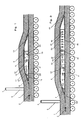
- figure 1 shows a vacuum cleaning apparatus which is introduced in a split cut of a mineral wool path.
- Figure 2 shows a source of radiation in combination with a vacuum cleaning apparatus according to figure 1, and figure 3 shows another embodiment of the vacuum cleaning apparatus of figure 1.
- numeral 1 stands for a mineral wool path which is moved in the direction of the arrow 2 on a roll conveyor 3.
- a band saw 4 rotating of wheels 5 splits the mineral wool path 1 into two layers 6, 7.
- a wedge 8 separates the two layers 6 and 7 thereby providing a space therebetween.
- a vacuum cleaning means 9 is introduced, which means is in the form of an extended part of the wedge 8.
- the vacuum cleaning means 9 is ended by a tapering part 10, at the downstream side of which the two layers 6 and 7 are moved together.
- a suction opening 11 which over an opening 12 communicates with a suction channel 13.
- a part of the air which is exhausted passes through the mineral wool. Since said air flows out through the surface to be cleaned the air facilitates the releasing of fibres which are not strongly bound to the surface. This is also facilitated by an air jet 14 coming from an opening 15 of a suction box 16 which in this case is enclosed in the wedge 8. Similarly there is an opening 17 in the lower part of the vacuum cleaning means 9, which opening 17 over another opening 18 communicates with the suction channel 13. By the flow or air thereby provided at the upper surface of the lower mineral wool layer 7 loose fibres and other particles are removed from said surface. This removal is facilitated by means of an air jet 19 coming from a blower box 21 over an opening 20. For distributing the suction effect between the two openings 11 and 17 there are valves 22 and 23 in the openings 12 and 18.
- FIG 2 there is shown how a source of radiation 24 is mounted downstream the wedge 8 for emitting radiation to the lower surface 27 of the upper layer 6 and the upper layer 28 of the lower layer 7 via openings 25 and 26 resp.
- An air jet 31 coming from a blower box 29 via an opening 30 is directed to the lower surface 27 of the upper layer 6.
- a suction slot 32 which over an opening 33 acts on the lower surface 27 of the upper layer 6 communicates with a suction box 35.
- the air flow which is thereby induced from along the said surface 27 removes loose fibres and other particles from said surface 27. This removal is facilitated by the air jet 31.
- FIG 3 shows a grid 39 which is mounted downstream a blower box 36 which via an opening 37 sends an air jet 38 against the upper surface 28 of the lower mineral wool layer 7.
- the upper mineral wool layer 6 moves over the grid 39.
- a similar grid 40 is mounted over the lower mineral wool layer 7.
- Over a nozzle 41 a dust binding substance is sprayed onto the lower surface 27 of the upper layer 6 and the upper surface 28 of the lower layer 7. Excess of aerosol, that is drops of the dust binding substance which have not become fastened on the surfaces, are transferred to a suction pipe 43 over an opening 42. Also the sides of the mineral wool layers 6 and 7 which are opposed to the nozzle 41 can be vacuum cleaned.
- the degree of ventilation is set by means of a valve 44.
Landscapes
- Engineering & Computer Science (AREA)
- Textile Engineering (AREA)
- Chemical & Material Sciences (AREA)
- Inorganic Chemistry (AREA)
- Mechanical Engineering (AREA)
- Manufacturing & Machinery (AREA)
- Mining & Mineral Resources (AREA)
- Disintegrating Or Milling (AREA)
- Crushing And Grinding (AREA)
- Cleaning In General (AREA)
- Prevention Of Fouling (AREA)
Applications Claiming Priority (2)
| Application Number | Priority Date | Filing Date | Title |
|---|---|---|---|
| SE8801209A SE8801209L (sv) | 1988-03-31 | 1988-03-31 | Foerfarande och anordning foer att bearbeta en mineralullsbana |
| SE8801209 | 1988-03-31 |
Publications (2)
| Publication Number | Publication Date |
|---|---|
| EP0336912A2 true EP0336912A2 (de) | 1989-10-11 |
| EP0336912A3 EP0336912A3 (de) | 1990-08-29 |
Family
ID=20371885
Family Applications (1)
| Application Number | Title | Priority Date | Filing Date |
|---|---|---|---|
| EP89850095A Withdrawn EP0336912A3 (de) | 1988-03-31 | 1989-03-21 | Verfahren und Vorrichtung zum Behandeln von Mineralwolle |
Country Status (5)
| Country | Link |
|---|---|
| EP (1) | EP0336912A3 (de) |
| DK (1) | DK154489A (de) |
| FI (1) | FI891458L (de) |
| NO (1) | NO891314L (de) |
| SE (1) | SE8801209L (de) |
Cited By (2)
| Publication number | Priority date | Publication date | Assignee | Title |
|---|---|---|---|---|
| WO2003060213A3 (de) * | 2002-01-17 | 2003-12-24 | Saint Gobain Isover Austria Ag | Verfahren und vorrichtung zur herstellung eines glaswollebahnmaterials |
| RU2721593C1 (ru) * | 2019-07-16 | 2020-05-20 | Роквул Интернэшнл А/С | Способ и устройство для горизонтального разъединения полотна из минеральной ваты |
Family Cites Families (4)
| Publication number | Priority date | Publication date | Assignee | Title |
|---|---|---|---|---|
| FR1138130A (fr) * | 1955-01-15 | 1957-06-11 | Fortuna Werke Spezialmaschinen | Procédé et dispositif pour l'enlèvement des gros copeaux sur les machines à fendre et à parer |
| SU755774A1 (ru) * | 1978-05-11 | 1980-08-15 | Akhangaranskij Tsementnyj Kom | Линия для производства жестких минераловатных плит 1 |
| US4333369A (en) * | 1980-12-16 | 1982-06-08 | Owens-Corning Fiberglas Corporation | Apparatus and method for dividing fibrous mineral blankets |
| SU1047889A1 (ru) * | 1982-03-12 | 1983-10-15 | Киевский Завод Строительных Материалов | Устройство дл резки минераловатных плит |
-
1988
- 1988-03-31 SE SE8801209A patent/SE8801209L/xx not_active Application Discontinuation
-
1989
- 1989-03-21 EP EP89850095A patent/EP0336912A3/de not_active Withdrawn
- 1989-03-28 FI FI891458A patent/FI891458L/fi not_active Application Discontinuation
- 1989-03-29 NO NO89891314A patent/NO891314L/no unknown
- 1989-03-30 DK DK154489A patent/DK154489A/da not_active Application Discontinuation
Cited By (5)
| Publication number | Priority date | Publication date | Assignee | Title |
|---|---|---|---|---|
| WO2003060213A3 (de) * | 2002-01-17 | 2003-12-24 | Saint Gobain Isover Austria Ag | Verfahren und vorrichtung zur herstellung eines glaswollebahnmaterials |
| RU2721593C1 (ru) * | 2019-07-16 | 2020-05-20 | Роквул Интернэшнл А/С | Способ и устройство для горизонтального разъединения полотна из минеральной ваты |
| WO2021009198A1 (en) | 2019-07-16 | 2021-01-21 | Rockwool International A/S | A method and an apparatus for horizontally splitting a mineral wool web |
| JP2022541485A (ja) * | 2019-07-16 | 2022-09-26 | ロックウール インターナショナル アー/エス | ミネラルウールウェブを水平方向に断割する方法および装置 |
| US11982030B2 (en) | 2019-07-16 | 2024-05-14 | Rockwool A/S | Method and an apparatus for horizontally splitting a mineral wool web |
Also Published As
| Publication number | Publication date |
|---|---|
| FI891458A0 (fi) | 1989-03-28 |
| SE8801209L (sv) | 1989-10-01 |
| FI891458A7 (fi) | 1989-10-01 |
| FI891458L (fi) | 1989-10-01 |
| DK154489A (da) | 1989-10-01 |
| NO891314D0 (no) | 1989-03-29 |
| DK154489D0 (da) | 1989-03-30 |
| EP0336912A3 (de) | 1990-08-29 |
| SE8801209D0 (sv) | 1988-03-31 |
| NO891314L (no) | 1989-10-02 |
Similar Documents
| Publication | Publication Date | Title |
|---|---|---|
| EP1146999B1 (de) | Verfahren zur verarbeitung von gipsplatten | |
| US4261790A (en) | Apparatus for stripping filter paper from filter rod | |
| US5601629A (en) | Apparatus for producing a fiberglass pack with two steps of binder application | |
| AU5376879A (en) | Process for the manufacture of abrasives | |
| JPH0335997A (ja) | 走行する帯状材料を断裁するための装置 | |
| EP0336912A2 (de) | Verfahren und Vorrichtung zum Behandeln von Mineralwolle | |
| JP3615793B2 (ja) | たばこ連続体から過剰量のたばこを取去るための装置 | |
| CA1081426A (en) | Method of manufacturing fibreboard | |
| US2990004A (en) | Method and apparatus for processing fibrous material | |
| JPH0659197B2 (ja) | 刻み湿りたばこ材料の送風加工方法及び装置 | |
| CA1079601A (en) | Opening and moistening tobacco from bales | |
| DK169098B1 (da) | Fremgangsmåde og apparat til reduktion af afgivelsen af fibre og andre partikler fra mineraluldsprodukter | |
| US5324337A (en) | Method for producing fiber product | |
| JPH04262771A (ja) | 比較的乾燥されかつ圧縮されてこりに梱包されたたばこを解じょするための方法および装置 | |
| US4343838A (en) | Preparation of a surface for adhesive bonding | |
| EP0335849B1 (de) | Verfahren und Vorrichtung zur Vakuumreinigung der Mineralwollprodukte während Komprimierung des Produkts | |
| GB1598852A (en) | Particle board free of formaldehyde | |
| US3320676A (en) | Method and apparatus for humidifying hydrophilic materials | |
| KR102346859B1 (ko) | 국소적 결함을 검출 및 제거함으로써 미네랄 섬유 매트를 처리하기 위한 장치, 및 상응하는 방법 | |
| US20070295438A1 (en) | Method And Device To Prevent Contamination Of A Transport Device By Freshly Glued Fibers | |
| US3085368A (en) | Treating corrugated surfaced sheets | |
| US20190242647A1 (en) | Method for Drying Scarfed Veneers | |
| US6279201B1 (en) | Device for distributing particles | |
| FI62385B (fi) | Saett och anordning foer behandling av ett fibroest eller partikulaert material | |
| DK169866B1 (da) | Fremgangsmåde og apparat til fjernelse af løse fibre og andre partikler fra en mineraluldsflade |
Legal Events
| Date | Code | Title | Description |
|---|---|---|---|
| PUAI | Public reference made under article 153(3) epc to a published international application that has entered the european phase |
Free format text: ORIGINAL CODE: 0009012 |
|
| AK | Designated contracting states |
Kind code of ref document: A2 Designated state(s): AT BE CH DE FR GB IT LI LU NL SE |
|
| PUAL | Search report despatched |
Free format text: ORIGINAL CODE: 0009013 |
|
| RHK1 | Main classification (correction) |
Ipc: B08B 5/04 |
|
| AK | Designated contracting states |
Kind code of ref document: A3 Designated state(s): AT BE CH DE FR GB IT LI LU NL SE |
|
| STAA | Information on the status of an ep patent application or granted ep patent |
Free format text: STATUS: THE APPLICATION IS DEEMED TO BE WITHDRAWN |
|
| 18D | Application deemed to be withdrawn |
Effective date: 19910302 |