EP0333957A2 - Geschichtete, extrudierte, thermoschockbeständige Gegenstände und Verfahren zur Herstellung dieser Gegenstände - Google Patents
Geschichtete, extrudierte, thermoschockbeständige Gegenstände und Verfahren zur Herstellung dieser Gegenstände Download PDFInfo
- Publication number
- EP0333957A2 EP0333957A2 EP88311243A EP88311243A EP0333957A2 EP 0333957 A2 EP0333957 A2 EP 0333957A2 EP 88311243 A EP88311243 A EP 88311243A EP 88311243 A EP88311243 A EP 88311243A EP 0333957 A2 EP0333957 A2 EP 0333957A2
- Authority
- EP
- European Patent Office
- Prior art keywords
- sinterable
- materials
- article
- sintered
- articles
- Prior art date
- Legal status (The legal status is an assumption and is not a legal conclusion. Google has not performed a legal analysis and makes no representation as to the accuracy of the status listed.)
- Granted
Links
Images



Classifications
-
- B—PERFORMING OPERATIONS; TRANSPORTING
- B32—LAYERED PRODUCTS
- B32B—LAYERED PRODUCTS, i.e. PRODUCTS BUILT-UP OF STRATA OF FLAT OR NON-FLAT, e.g. CELLULAR OR HONEYCOMB, FORM
- B32B3/00—Layered products comprising a layer with external or internal discontinuities or unevennesses, or a layer of non-planar shape; Layered products comprising a layer having particular features of form
- B32B3/10—Layered products comprising a layer with external or internal discontinuities or unevennesses, or a layer of non-planar shape; Layered products comprising a layer having particular features of form characterised by a discontinuous layer, i.e. formed of separate pieces of material
-
- B—PERFORMING OPERATIONS; TRANSPORTING
- B32—LAYERED PRODUCTS
- B32B—LAYERED PRODUCTS, i.e. PRODUCTS BUILT-UP OF STRATA OF FLAT OR NON-FLAT, e.g. CELLULAR OR HONEYCOMB, FORM
- B32B18/00—Layered products essentially comprising ceramics, e.g. refractory products
-
- B—PERFORMING OPERATIONS; TRANSPORTING
- B32—LAYERED PRODUCTS
- B32B—LAYERED PRODUCTS, i.e. PRODUCTS BUILT-UP OF STRATA OF FLAT OR NON-FLAT, e.g. CELLULAR OR HONEYCOMB, FORM
- B32B5/00—Layered products characterised by the non- homogeneity or physical structure, i.e. comprising a fibrous, filamentary, particulate or foam layer; Layered products characterised by having a layer differing constitutionally or physically in different parts
- B32B5/16—Layered products characterised by the non- homogeneity or physical structure, i.e. comprising a fibrous, filamentary, particulate or foam layer; Layered products characterised by having a layer differing constitutionally or physically in different parts characterised by features of a layer formed of particles, e.g. chips, powder or granules
-
- C—CHEMISTRY; METALLURGY
- C04—CEMENTS; CONCRETE; ARTIFICIAL STONE; CERAMICS; REFRACTORIES
- C04B—LIME, MAGNESIA; SLAG; CEMENTS; COMPOSITIONS THEREOF, e.g. MORTARS, CONCRETE OR LIKE BUILDING MATERIALS; ARTIFICIAL STONE; CERAMICS; REFRACTORIES; TREATMENT OF NATURAL STONE
- C04B35/00—Shaped ceramic products characterised by their composition; Ceramics compositions; Processing powders of inorganic compounds preparatory to the manufacturing of ceramic products
- C04B35/01—Shaped ceramic products characterised by their composition; Ceramics compositions; Processing powders of inorganic compounds preparatory to the manufacturing of ceramic products based on oxide ceramics
- C04B35/10—Shaped ceramic products characterised by their composition; Ceramics compositions; Processing powders of inorganic compounds preparatory to the manufacturing of ceramic products based on oxide ceramics based on aluminium oxide
-
- B—PERFORMING OPERATIONS; TRANSPORTING
- B32—LAYERED PRODUCTS
- B32B—LAYERED PRODUCTS, i.e. PRODUCTS BUILT-UP OF STRATA OF FLAT OR NON-FLAT, e.g. CELLULAR OR HONEYCOMB, FORM
- B32B2305/00—Condition, form or state of the layers or laminate
- B32B2305/80—Sintered
-
- C—CHEMISTRY; METALLURGY
- C04—CEMENTS; CONCRETE; ARTIFICIAL STONE; CERAMICS; REFRACTORIES
- C04B—LIME, MAGNESIA; SLAG; CEMENTS; COMPOSITIONS THEREOF, e.g. MORTARS, CONCRETE OR LIKE BUILDING MATERIALS; ARTIFICIAL STONE; CERAMICS; REFRACTORIES; TREATMENT OF NATURAL STONE
- C04B2237/00—Aspects relating to ceramic laminates or to joining of ceramic articles with other articles by heating
- C04B2237/30—Composition of layers of ceramic laminates or of ceramic or metallic articles to be joined by heating, e.g. Si substrates
- C04B2237/32—Ceramic
- C04B2237/34—Oxidic
- C04B2237/343—Alumina or aluminates
-
- Y—GENERAL TAGGING OF NEW TECHNOLOGICAL DEVELOPMENTS; GENERAL TAGGING OF CROSS-SECTIONAL TECHNOLOGIES SPANNING OVER SEVERAL SECTIONS OF THE IPC; TECHNICAL SUBJECTS COVERED BY FORMER USPC CROSS-REFERENCE ART COLLECTIONS [XRACs] AND DIGESTS
- Y10—TECHNICAL SUBJECTS COVERED BY FORMER USPC
- Y10S—TECHNICAL SUBJECTS COVERED BY FORMER USPC CROSS-REFERENCE ART COLLECTIONS [XRACs] AND DIGESTS
- Y10S502/00—Catalyst, solid sorbent, or support therefor: product or process of making
- Y10S502/524—Spinel
Definitions
- This invention relates to laminated extruded thermal shock resistant articles formed from sinterable particulate or powdered materials and to the method of making such articles.
- ceramics Due to properties such as high strength, temperature and chemical stability, and electrical and thermal insulating properties, ceramics are widely used engineering materials. In many applications, such as cookware, spark plug insulators, abrasive wheels, refractory linings, applications in the chemical process industries, heat exchangers, and high temperature automotive substrates, ceramic materials can be exposed to rapid changes in temperature or large thermal gradients. To be useful, the materials should desirably exhibit good thermal shock resistance, i.e., must maintain their strength after thermal shocking.
- Thermal shock resistance is usually measured by quenching from a high temperature and by measuring the strength degradation (as compared to measurements made on samples not yet subjected to thermal shock). A commonly used test for thermal shock resistance is then described by Hasselman. See e.g., Hasselman, "Strength Behaviour of Polycrystalline Alumina Subjected to Thermal Shock," J. Am. Ceramic Soc. , Vol. 53, No. 9, pp.490-495, Sept. 1970, and Larson and Hasselman, "Comparative Behaviour of High-Alumina Refractories Subjected to Sudden Heating and Cooling", Transactions and Journal of the British Ceramic Society , (74) No. 2, pp. 59-65, March/April 1975.
- Figures 1a and 1b present graphs of schematic thermal shock test results, the first graph illustrating the catastrophic decrease in strength exhibited by a material which undergoes rapid crack propagation, and the second graph illustrating the gradual decrease in strength exhibited by a material which undergoes stable crack propagation and which is thus deemed to possess good thermal shock resistance.
- materials which undergo rapid crack propagation are not suited for applications in which they will be exposed to rapid changes in temperature.
- Ceramic materials in general do not have particularly good thermal shock resistance because of their brittle nature, and a need exists for methods to improve the thermal shock resistance properties of these valuable materials.
- the present invention relates to articles of high strength sinterable materials, such as ceramics, which exhibit good thermal shock resistance. More specifically, the articles of this invention comprise high strength sintered extruded laminated bodies having multiple discrete layers of at least a first and second sintered material, where said first and second sintered materials are different and are selected from high strength sintered inorganic particulate or powdered materials and wherein said layers of each of said first and second sintered materials are substantially uniformly distributed throughout the body.
- the ratio of either of said layers of first or second sintered materials to the other is no greater than about 1.2:1. Generally, however, the ratio of either of said layers of first or second sintered materials to the other may be up to 10:1.
- This invention also relates to a method of producing such sintered laminated extruded articles.
- the method of this invention comprises
- this invention relates to the green articles which are sintered to form the high strength extruded laminated articles above-described, and to the method of making such green articles.
- green is used in the art and in this application to refer to the state of a formed body or piece made of sinterable powder or particulate material that has not yet been fired to the sintered state.
- the green body may have been heated to dry it by evaporating or volatilizing plasticizing liquid or vehicle and perhaps also to burn out volatile organic or decomposable binders mixed with the sinterable powder to render it adequately plastically formable and/or sufficiently coherent (having green strength) so that the body can be handled without deformation and other damage.
- the sintered articles of this invention exhibit good thermal shock resistance. It is believed that this good thermal shock resistance is the result of several factors. First, the presence of the discontinuities in the sintered article resulting from the presence of a plurality of phases is believed to prevent crack growth and relieve stresses. Secondly, it is known that microcracking enhances the thermal shock resistance of an article based on ceramics by lowering the modulus of elasticity of the article. Microcracking is encouraged when the material in the different phases in the articles of this invention possess different thermal expansions and firing shrinkages. Third, the plurality of phases arranged in a laminated fashion results in each of the phases being substantially discontinuous.
- the materials from which the extruded laminated articles of this invention are made may be any of the well-known sinterable inorganic materials capable of providing mechanical strength and good thermal properties.
- the materials are ceramic materials, but they may also be selected from cermet, metallic, glass and glass-ceramic materials.
- suitable materials include glasses, such as boro-silicates, soda-lime-silicates, lead-silicates, alumino-silicates, alkaline earth silicates, and fused silica, and oxide ceramics such as alumina, alumina-zirconia, thoria, spinels, titania, urania, rare earth oxides, calcium-aluminates, sillimanite, mullite, magnesia, zirconia, various silicates including cordierite, steatite, petalite, spodumene, fosterite, clay, zircon, talc and porcelain, various nitrides including silicon nitride, silicon oxynitrides, and aluminum nitride, various carbides including silicon carbide, boron carbide, titanium carbide and zirconium carbide, various borides, various zirconates, various titanates, various glass-ceramics, and mixtures or combinations of such materials
- the sinterable materials may also be selected from glass-ceramics or from sinterable ceramic and metal mixtures, e.g., chromium and alumina mixtures, to form cermets.
- sinterable metal powders e.g., powders of Fe, Al, Cu, Ti, Zr, Ni, Cr, stainless steel, various other alloys and mixtures or combinations thereof. Additional examples of metal powders which can be sintered to form a sintered body are disclosed in U.S. 4,649,003, the disclosure of which is herein incorporated by reference.
- the phases or layers of sinterable materials may optionally contain reinforcing whiskers, e.g., of alumina, silicon nitride or silicon carbide, or fibers, e.g., carbon fibers, as disclosed in U.S. 3,794,707 and U.S. 4,673,658.
- reinforcing whiskers e.g., of alumina, silicon nitride or silicon carbide
- fibers e.g., carbon fibers
- the sinterable particulate or powdered ceramic, glass or glass-ceramic materials used in this invention may also optionally contain substantial amounts of a component which causes intracrystalline and intercrystalline microcracking to occur.
- Ceramic materials which contain such a component, and are therefore contemplated for use within the present invention are disclosed in U.S. Patents 3,528,831, 3,549,400 and 3,578,471, all issued to I. M. Lachman.
- a preferred microcracking agent or addition to the ceramic material is aluminum titanate, which is normally incorporated into a ceramic matrix as a "solid solution" with the basic ceramic material.
- An aluminum titanate solid solution with mullite is disclosed in U.S. Patent 4,483,944 to Day et al. The disclosures of the four above-mentioned patents are incorporated herein by reference.
- the choice of materials from which the articles of this invention will be made is not necessarily critical, and the above-mentioned materials are recited solely for purposes of exemplification.
- the materials of the different laminated phases have differing thermal expansion and firing shrinkage properties to enhance microcracking.
- the sinterable materials of the layers not be reactive with one another to a degree so as to diminish the integrity of the discrete layers in the article.
- the sinterable materials of which each layer in the article is formed are separately formed into moldable bodies by mixing the constituent materials with an additional substance that binds those materials into a plasticized mass.
- This plasticizing/binding agent can be any of the well-known materials commonly used in the ceramic art for such purposes. Suitable plasticizing/binding agents are disclosed in: "Ceramics Processing Before Firing,” ed. by George Y. Onoda, Jr. & L. L. Hench, John Wiley & Sons, New York "Study of Several Groups of Organic Binders Under Low-Pressure Extrusion," C.C. Treischel & E. W. Emrich, Jour. Am. Cer. Soc., (29) pp.
- Preferred agents are methyl cellulose, polyvinyl alcohol or a silicone resin.
- the silicone resins preferred for use are described in U.S. Patent 3,090,691 to Weyer.
- the most preferred binder is methyl cellulose, available as Methocel K75 from the Dow Chemical Company.
- the sinterable particulate or powdered materials are separately mixed with sufficient plasticizing/binding agent to form a moldable mass.
- the mixing step can be performed wet or dry. Intensive mixing such as obtained with a Littleford Mixer is preferred, but other conventional mixing equipment can also be used.
- a liquid, preferably water is added, which acts as a plasticizer.
- the plasticizing/binding agent is a silicone resin, it is preferred to use isopropyl alcohol or equivalent solvent, in addition to water. Plasticizing is attained with the use of a mix muller or other commonly used shearing device.
- plasticized masses of sinterable particulate or powdered material are molded or formed into multiple discrete bodies such as rods, discs, spheres, cylinders, pellets, bars, ribbons or sheets. This is generally done by extrusion methods, but other methods such as tape casting, pressing, pug milling, slip casting and slurry filtering may also be used. See, e.g., Thompson, J.J., "forming Thin Ceramics,” Ceramic Bulletin , Vol. 42, No. 9, page 480 (1963); and U.S. Patents 2,966,719, 3,007,222 and 3,444,925, the disclosures of which are herein incorporated by reference.
- Such bodies are the first sinterable material ("first" bodies) are then intermingled with bodies of the second sinterable material (“second” bodies) to form an assembly suitable for coextrusion through a die to form a composite laminated article of the desired shape.
- the first and second bodies of sinterable material should be substantially uniformly distributed throughout the assembly and composite article.
- the ratio of either of said bodies to the other will not exceed about 10:1 and more desirably 3:1.
- the ratio of either of said bodies to the other will not exceed about 1.2:1, and, more preferably, the ratio of either of said bodies to the other is about 1:1.
- the size and shape of the first and second bodies of sinterable material be about the same.
- the composite article so formed can be of any size or shape so long as the first and second bodies of sinterable material are substantially uniformly distributed throughout and are present therein in distinct phases and so long as the composite article can be extruded, if desired, through a die to form the article in its final desired shape.
- the manner of forming the composite article can be of any means by which these criteria are substantially met.
- the first and second bodies of sinterable material can be molded together into a composite article in the shape of a sausage, sphere, bar or disc which is then extruded into the final monolith shape.
- Figure 2c illustrates a bar and a disc of first and second bodies of sinterable material, 1 and 2, respectively. It is also possible, and preferred, to intermingle the bodies directly in the inlet barrel of the extruder, thus forming an assembly which can be immediately extruded thereafter, as shown in Figure 2a.
- Figures 2d and 2e illustrate how different geometrical assemblies can be oriented in the extruder barrel.
- Figure 2d shows how rods, spheres or slugs of first and second sinterable materials, 1 and 2, could be assembled, e.g. by axially stacking in adjacent columns, in the extruder barrel 3 so that, after extrusion, a laminated composite article results.
- Figure 2e shows how discs or sheets 1 and 2 can be layered in the barrel 3 of an extruder so that the plane of the disc is perpendicular to the axis of the extruder. This method of axially stacking will produce a type of laminated extrusion, especially if thin layers are used.
- the plasticized masses of first and second sinterable materials are separately extruded through a die into elongated shapes, preferably of rectangular, hexagonal or circular cross-section.
- the shapes and dimensions thereof are the same for each sinterable material.
- the plasticized sinterable materials are extruded as ribbons approximately 4mm thick by 32 mm wide.
- the extruded composite bodies are then assembled by intermingling the molded components axially or longitudinally. Most preferably, this will be done so that the ribbons are substantially parallel.
- the extruded bodies are positioned to be substantially uniformly distributed throughout the assembly.
- Figure 2a depicts the cross-sectional of an assembly of ribbons of the two phases of materials assembled longitudinally in the barrel, 3, of an extruder.
- First and second bodies of sinterable material, 1 and 2, respectively, are uniformly distributed through the assembly.
- the composite so assembled is then itself preferably extruded through a rod die one or more times to reduce its own cross-sectional area and to effect further distribution of the two phases therein.
- a typical distribution of the composite bodies in a die head or extruder barrel 3 prior to reextrusion is illustrated in Figure 2b.
- the distribution of the phases in the extruded article e.g., the relative thicknesses of the layers, can be controlled not only by the number of extrusions performed but also on the initial size of the first and second bodies used to form the composite. It is convenient that extrusion be performed in a die that reduces the size of the cross-sectional area of the composite itself to that similar to one of the original constituent ribbons.
- the composite is extruded through a die to form the desired shape of the final article.
- the article so extruded is a honeycomb body or multichannel monolith having substantially parallel cells or passages extending between open end faces thereof.
- Typical honeycomb monoliths for examples, have 400 square cells per square inch with a wall thickness of 7 mils, or as another example, have 200 square cells per square inch with a wall thickness of 20 mils.
- Figure 3 shows an enlarged portion of a honeycomb monolith formed by the extrusion of a composite as described above.
- Layers 1b of a first sinterable material are interspersed with layers of 2b of a second sinterable material, and both such layers are substantially uniformly distributed throughout the article and both are substantially discontinuous.
- This is in contrast to the extruded monolithic catalyst supports prepared by extrusion and disclosed in U.S. 4,631,268.
- the articles disclosed therein were prepared by extrusion methods similar to those described above; however, the extrusion was carried out so that, rather than forming laminated phases or layers, one of the sinterable materials, the catalyst-support phase, was embedded in the second sinterable material, a ceramic which formed a substantially continuous matrix phase.
- the extruded shapes are then heated to a temperature and for a time sufficient to sinter the particulate or powdered materials.
- this heating/sintering step is preceded by drying the shapes at about 100° - 120°C. It is then preferred to burn out the temporary binders in the range of 250° - 500°C.
- the heating/sintering step generally takes place above 800°C, although when silicone resin is used as a binder for the ceramic matrix, temperatures as low as 500°C may be sufficient.
- the maximum firing temperature is limited by the melting points of the constituents in the compositions.
- test results were obtained using the following: Flexural Strength - ASTM Test No. C-158-84 Thermal Expansion - ASTM Test No. E831-81 Modulus of Elasticity - ASTM Test No. C326-82 Bulk Density - Volume computed from measurements of the physical dimensions of a bar and weighed dry for final computation of the bulk density.
- the dry powders were mixed in a Model M5G Littleford dry blender for three minutes.
- the Model M5G is a plow oriented blender which thoroughly mixes the powders without changing particle size or increasing batch temperature due to friction.
- Methylcellulose (Dow K75, 4% in Examples 1 and 2, 6% in Examples 3, 4 and 5), a temporary binder, and, in Examples 1 and 2, 1% sodium stearate lubricant were mixed with the other dry materials.
- compositions were wet mulled using a Lancaster counter current batch mixture type PC. Water was introduced during this process and all batches were mulled between 15 to 20 minutes for good plasticity and homogeneity of the materials. After mulling, the batch consistency had an appearance of crumbs to small, flat chunks that were somewhat soft and plastic.
- Shapes extruded for this study included 8 mm rods for firing, shrinkage, flexural strength, axial thermal expansion, mercury porosity and Hasselman thermal shock testing; 5 mm x 15 mm bars for modulus of elasticity measurements; 1" diameter, 400 cells/in2 honeycomb for laboratory thermal shock testing and evaluation.
- Example 2 The data in Table 2 indicates that, in the case of the calcium-aluminate laminated composition, Example 1, the firing shrinkage is actually an expansion (+2.5% @1600°C), resulting in very low strengths (1800 psi @ 1600°C).
- Example 2 the extruded laminated composition with alumina and zirconia, has higher strengths (6000 psi @ 1600°C) but also higher axial thermal expansion (81.0 x 10 ⁇ 7 @ 1600°C).
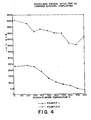
- Example 1 and 2 were also tested for thermal shock resistance using the Hasselman test. Samples previously fired at 1600°C for six hours were chosen for the test. The dimensions of the test samples were 1/4" diameter x 4" long, and they were tested over a range of quench temperatures, 200°C to 1000°C, at 100° increments. Four rods were used at each quench temperature with a new set of rods being used at each succeeding temperature. Samples were held at temperature for fifteen minutes and then quenched in cold water. Tested rods were then dried and submitted for room temperature modulus of rupture. The strength results for the thermal shock tested samples are shown in Figure 4. As these data indicate, the material of Example 2 has good thermal shock resistance because of its rather stable crack propagation. The material of Example 1 is much weaker and displays signs of being less stable.
- Axial thermal expansion was in the range of 60 - 70 x 10 ⁇ 7 @ 1000°C for all the compositions of all three examples.
- the laminated layers of the mullite extruded laminated series of Examples 3 - 5 fired at both 1500°C and 1650°C are very distinctive in photomicrographs of the articles.
- Modulus of elasticity measurements were conducted on fired bars (.110" thick x .475" wide x 5.0" long) for the compositions of Examples 2 - 5, the composition of Example 1 being too weak to test.
- the results, in Table 5 show rather low values indicating that microcracking has occurred. It is estimated that the examples in Table 5 would have room temperature modulus of elasticity values of 40x 106 psi or more if there were no microcracking.
- the results also indicate that for the mullite-alumina series (Examples 3-5) a gradual decrease in modulus of elasticity occurred as the amount of zirconia increased, with a much lower reading for the alumina laminated sample.
- the Hasselman thermal shock test was conducted on the laminated extruded rods of Examples 3 - 5 which had been fired at both 1500°C and 1650°C for 6 hours. The results are graphically illustrated in Figures 5, 6 and 7 and make apparent the differences between the 1500°C and 1650°C firings. Good strength remains at the lower end of the test quench temperature (200-400°C) and then a general decrease in strength with increasing quench temperature. Although the strength decrease is substantial over the whole range of the Hasselman thermal shock test, the results appear to indicate stable rather than catastrophic crack propagation.
Landscapes
- Engineering & Computer Science (AREA)
- Chemical & Material Sciences (AREA)
- Ceramic Engineering (AREA)
- Manufacturing & Machinery (AREA)
- Materials Engineering (AREA)
- Structural Engineering (AREA)
- Organic Chemistry (AREA)
- Life Sciences & Earth Sciences (AREA)
- Wood Science & Technology (AREA)
- Compositions Of Oxide Ceramics (AREA)
- Press-Shaping Or Shaping Using Conveyers (AREA)
- Laminated Bodies (AREA)
Applications Claiming Priority (2)
| Application Number | Priority Date | Filing Date | Title |
|---|---|---|---|
| US170783 | 1988-03-21 | ||
| US07/170,783 US5053092A (en) | 1988-03-21 | 1988-03-21 | Method for producing a sinterable extruded laminated article |
Publications (3)
| Publication Number | Publication Date |
|---|---|
| EP0333957A2 true EP0333957A2 (de) | 1989-09-27 |
| EP0333957A3 EP0333957A3 (en) | 1990-09-05 |
| EP0333957B1 EP0333957B1 (de) | 1994-08-03 |
Family
ID=22621234
Family Applications (1)
| Application Number | Title | Priority Date | Filing Date |
|---|---|---|---|
| EP88311243A Expired - Lifetime EP0333957B1 (de) | 1988-03-21 | 1988-11-28 | Geschichtete, extrudierte, thermoschockbeständige Gegenstände und Verfahren zur Herstellung dieser Gegenstände |
Country Status (6)
| Country | Link |
|---|---|
| US (1) | US5053092A (de) |
| EP (1) | EP0333957B1 (de) |
| JP (1) | JP2791486B2 (de) |
| KR (1) | KR970001181B1 (de) |
| CA (1) | CA1332499C (de) |
| DE (1) | DE3850959T2 (de) |
Cited By (3)
| Publication number | Priority date | Publication date | Assignee | Title |
|---|---|---|---|---|
| EP0639540A1 (de) * | 1993-07-16 | 1995-02-22 | FIAT AUTO S.p.A. | Verfahren zur Herstellung von Metall- und/oder Keramikplatten durch Sintern von Pulvern und nach dem Verfahren hergestellte Gegenstände |
| WO2002052579A1 (en) * | 2000-12-22 | 2002-07-04 | Koninklijke Philips Electronics N.V. | A method for producing a grid structure |
| EP2003753A1 (de) * | 2007-06-14 | 2008-12-17 | Beru Aktiengesellschaft | Zündkerze und Verfahren zur Herstellung einer Zündkerze |
Families Citing this family (29)
| Publication number | Priority date | Publication date | Assignee | Title |
|---|---|---|---|---|
| US5741842A (en) * | 1991-07-10 | 1998-04-21 | Bayer Aktiengesellschaft | Thermoplastic moulding compounds, a process for their preparation and a process for the production of ceramic or metal moulded parts by sintering |
| US5382396A (en) * | 1992-06-15 | 1995-01-17 | Industrial Technology Research Institute | Method of making a porous ceramic filter |
| JPH06236819A (ja) * | 1993-01-11 | 1994-08-23 | Boam R & D Co Ltd | フェライト磁性体チップビード構造及びその製造方法 |
| US5308556A (en) * | 1993-02-23 | 1994-05-03 | Corning Incorporated | Method of making extrusion dies from powders |
| US5645781A (en) * | 1994-09-21 | 1997-07-08 | The Regents Of The University Of Michigan | Process for preparing textured ceramic composites |
| US5492883A (en) * | 1994-11-21 | 1996-02-20 | Corning Incorporated | Molecular sieve structures using aqueous emulsions |
| US5813872A (en) * | 1996-03-06 | 1998-09-29 | Cooper Technologies Company | Automotive spark plug cover |
| US6479129B1 (en) | 1999-02-18 | 2002-11-12 | Corning Incorporated | Titanium-coating silica glass honeycomb structure from silica soot extrusion |
| EP1156988A4 (de) | 1999-02-18 | 2004-11-17 | Corning Inc | Verfahren zur herstellung einer wabenförmigen quarzglass-struktur durch extrudieren von siliciumdioxid-russ |
| US6740286B2 (en) * | 2000-12-04 | 2004-05-25 | Advanced Ceramics Research, Inc. | Consolidation and densification methods for fibrous monolith processing |
| US6974624B2 (en) * | 2000-12-04 | 2005-12-13 | Advanced Ceramics Research, Inc. | Aligned composite structures for mitigation of impact damage and resistance to wear in dynamic environments |
| US6709737B2 (en) * | 2000-12-04 | 2004-03-23 | Advanced Ceramics Research, Inc. | Aligned composite structures for mitigation of impact damage and resistance to wear in dynamic environments |
| US6805946B2 (en) * | 2000-12-04 | 2004-10-19 | Advanced Ceramics Research, Inc. | Multi-functional composite structures |
| US6803003B2 (en) * | 2000-12-04 | 2004-10-12 | Advanced Ceramics Research, Inc. | Compositions and methods for preparing multiple-component composite materials |
| US6797220B2 (en) * | 2000-12-04 | 2004-09-28 | Advanced Ceramics Research, Inc. | Methods for preparation of three-dimensional bodies |
| US6847699B2 (en) | 2000-12-04 | 2005-01-25 | Advanced Ceramics Research, Inc. | Composite components for use in high temperature applications |
| WO2002096647A1 (en) * | 2001-05-25 | 2002-12-05 | Advanced Ceramics Research, Inc. | Ceramic components having multilayered architectures and processes for manufacturing the same |
| US7640732B2 (en) | 2005-11-16 | 2010-01-05 | Geo2 Technologies, Inc. | Method and apparatus for filtration of a two-stroke engine exhaust |
| US7938876B2 (en) | 2005-11-16 | 2011-05-10 | GE02 Technologies, Inc. | Low coefficient of thermal expansion materials including nonstoichiometric cordierite fibers and methods of manufacture |
| US7938877B2 (en) | 2005-11-16 | 2011-05-10 | Geo2 Technologies, Inc. | Low coefficient of thermal expansion materials including modified aluminosilicate fibers and methods of manufacture |
| CA2629180A1 (en) * | 2005-11-16 | 2007-05-31 | Geo2 Technologies, Inc. | System for extruding a porous substrate |
| US7959704B2 (en) * | 2005-11-16 | 2011-06-14 | Geo2 Technologies, Inc. | Fibrous aluminum titanate substrates and methods of forming the same |
| US20070107396A1 (en) * | 2005-11-16 | 2007-05-17 | Bilal Zuberi | Method and apparatus for a gas-liquid separator |
| US8038759B2 (en) | 2005-11-16 | 2011-10-18 | Geoz Technologies, Inc. | Fibrous cordierite materials |
| US20070107395A1 (en) | 2005-11-16 | 2007-05-17 | Bilal Zuberi | Extruded porous substrate and products using the same |
| US8039050B2 (en) | 2005-12-21 | 2011-10-18 | Geo2 Technologies, Inc. | Method and apparatus for strengthening a porous substrate |
| US7781372B2 (en) | 2007-07-31 | 2010-08-24 | GE02 Technologies, Inc. | Fiber-based ceramic substrate and method of fabricating the same |
| US9950362B2 (en) * | 2009-10-19 | 2018-04-24 | MHI Health Devices, LLC. | Clean green energy electric protectors for materials |
| US11122935B2 (en) * | 2018-05-29 | 2021-09-21 | Chun-Shyong LEE | Ceramic deep-frying device capable of withstanding high temperatures and releasing far-infrared energy and method for making the same |
Family Cites Families (14)
| Publication number | Priority date | Publication date | Assignee | Title |
|---|---|---|---|---|
| US1538818A (en) * | 1921-05-25 | 1925-05-19 | Miller Rubber Co | Battery box |
| US3444925A (en) * | 1957-05-07 | 1969-05-20 | Minnesota Mining & Mfg | Structural articles and method of making |
| US3528400A (en) * | 1964-12-21 | 1970-09-15 | Corning Glass Works | Lamellar ceramic body |
| US3505158A (en) * | 1967-12-22 | 1970-04-07 | Coors Porcelain Co | Composite porous-dense ceramic article |
| US3713877A (en) * | 1969-02-10 | 1973-01-30 | H Kirchner | Method of strengthening ceramic bodies and strengthened ceramic bodies produced thereby |
| GB1341726A (en) * | 1971-02-04 | 1973-12-25 | Imp Metal Ind Kynoch Ltd | Superconductors |
| US3790654A (en) * | 1971-11-09 | 1974-02-05 | Corning Glass Works | Extrusion method for forming thinwalled honeycomb structures |
| JPS5116441A (de) * | 1974-07-31 | 1976-02-09 | Shin Kobe Electric Machinery | |
| JPS5144913B2 (de) * | 1974-10-03 | 1976-12-01 | ||
| US4428895A (en) * | 1979-03-02 | 1984-01-31 | Blasch Precision Ceramics, Inc. | Composite inorganic structures and process of producing same |
| JPS59224309A (ja) * | 1983-06-03 | 1984-12-17 | 日立造船株式会社 | 複合セラミツクス管の製造方法 |
| US4631268A (en) * | 1985-03-18 | 1986-12-23 | Corning Glass Works | Preparation of monolithic catalyst support structures having an integrated high surface area phase |
| WO1988001258A1 (en) * | 1986-08-19 | 1988-02-25 | Commonwealth Scientific And Industrial Research Or | Composite refractory materials |
| JPH0773785B2 (ja) * | 1987-06-22 | 1995-08-09 | 三菱重工業株式会社 | 型締装置 |
-
1988
- 1988-03-21 US US07/170,783 patent/US5053092A/en not_active Expired - Fee Related
- 1988-11-28 CA CA000584336A patent/CA1332499C/en not_active Expired - Fee Related
- 1988-11-28 EP EP88311243A patent/EP0333957B1/de not_active Expired - Lifetime
- 1988-11-28 DE DE3850959T patent/DE3850959T2/de not_active Expired - Fee Related
- 1988-12-10 KR KR1019880016428A patent/KR970001181B1/ko not_active Expired - Fee Related
-
1989
- 1989-02-14 JP JP1034881A patent/JP2791486B2/ja not_active Expired - Lifetime
Cited By (3)
| Publication number | Priority date | Publication date | Assignee | Title |
|---|---|---|---|---|
| EP0639540A1 (de) * | 1993-07-16 | 1995-02-22 | FIAT AUTO S.p.A. | Verfahren zur Herstellung von Metall- und/oder Keramikplatten durch Sintern von Pulvern und nach dem Verfahren hergestellte Gegenstände |
| WO2002052579A1 (en) * | 2000-12-22 | 2002-07-04 | Koninklijke Philips Electronics N.V. | A method for producing a grid structure |
| EP2003753A1 (de) * | 2007-06-14 | 2008-12-17 | Beru Aktiengesellschaft | Zündkerze und Verfahren zur Herstellung einer Zündkerze |
Also Published As
| Publication number | Publication date |
|---|---|
| DE3850959D1 (de) | 1994-09-08 |
| JP2791486B2 (ja) | 1998-08-27 |
| EP0333957A3 (en) | 1990-09-05 |
| KR970001181B1 (ko) | 1997-01-29 |
| JPH01249437A (ja) | 1989-10-04 |
| DE3850959T2 (de) | 1995-03-16 |
| EP0333957B1 (de) | 1994-08-03 |
| US5053092A (en) | 1991-10-01 |
| KR890014226A (ko) | 1989-10-23 |
| CA1332499C (en) | 1994-10-18 |
Similar Documents
| Publication | Publication Date | Title |
|---|---|---|
| EP0333957B1 (de) | Geschichtete, extrudierte, thermoschockbeständige Gegenstände und Verfahren zur Herstellung dieser Gegenstände | |
| US4316965A (en) | Low-expansion ceramics and method of producing the same | |
| CA1059160A (en) | Method of preparing crack-free monolithic polycrystalline cordierite substrates | |
| JP2968534B2 (ja) | 高温安定低熱膨張セラミックおよびその製造方法 | |
| US4598054A (en) | Ceramic material for a honeycomb structure | |
| US4960737A (en) | Calcium dialuminate/hexaluminate ceramic structures | |
| US4483944A (en) | Aluminum titanate-mullite ceramic articles | |
| EP1805112B1 (de) | Auf aluminiumtitanat basierender keramikkörper mit einer glasphase | |
| US7001861B2 (en) | Aluminum titanate-based ceramic article | |
| US4476236A (en) | Method for producing a cordierite body | |
| EP0361883A1 (de) | Keramische Wärmeaustauscher und deren Herstellung | |
| JPS6356187B2 (de) | ||
| US5518969A (en) | Process for producing low shrink ceramic composition | |
| EP0425833A1 (de) | Werkstoff, Struktur, Filter und Katalysator | |
| CA1227225A (en) | Silicon nitride-cordierite ceramic composition, article and process of manufacture thereof | |
| US20050217228A1 (en) | Low thermal expansion articles | |
| US5296420A (en) | Composite refractory materials | |
| US3321285A (en) | Molybdenum fiber reinforced alumina | |
| JPS6219391B2 (de) | ||
| KR950007708B1 (ko) | 복합 내열성 물질 | |
| JPS6172679A (ja) | 低熱膨脹セラミツクス焼結体 | |
| US4888312A (en) | Zirconyl phosphate sintered bodies and production thereof | |
| JP2644841B2 (ja) | 板状無機物質焼結体及びその製法 | |
| JP2521119B2 (ja) | 耐熱けい酸カルシウム系焼結体 | |
| Das et al. | Evaluation of mechanical and thermal properties of ceramic honeycomb substrates for long term durability |
Legal Events
| Date | Code | Title | Description |
|---|---|---|---|
| PUAI | Public reference made under article 153(3) epc to a published international application that has entered the european phase |
Free format text: ORIGINAL CODE: 0009012 |
|
| AK | Designated contracting states |
Kind code of ref document: A2 Designated state(s): BE DE FR |
|
| PUAL | Search report despatched |
Free format text: ORIGINAL CODE: 0009013 |
|
| AK | Designated contracting states |
Kind code of ref document: A3 Designated state(s): BE DE FR |
|
| 17P | Request for examination filed |
Effective date: 19910212 |
|
| 17Q | First examination report despatched |
Effective date: 19920904 |
|
| RAP1 | Party data changed (applicant data changed or rights of an application transferred) |
Owner name: CORNING GLASS WORKS |
|
| GRAA | (expected) grant |
Free format text: ORIGINAL CODE: 0009210 |
|
| AK | Designated contracting states |
Kind code of ref document: B1 Designated state(s): BE DE FR |
|
| REF | Corresponds to: |
Ref document number: 3850959 Country of ref document: DE Date of ref document: 19940908 |
|
| ET | Fr: translation filed | ||
| PLBE | No opposition filed within time limit |
Free format text: ORIGINAL CODE: 0009261 |
|
| STAA | Information on the status of an ep patent application or granted ep patent |
Free format text: STATUS: NO OPPOSITION FILED WITHIN TIME LIMIT |
|
| 26N | No opposition filed | ||
| PGFP | Annual fee paid to national office [announced via postgrant information from national office to epo] |
Ref country code: FR Payment date: 19991103 Year of fee payment: 12 |
|
| PGFP | Annual fee paid to national office [announced via postgrant information from national office to epo] |
Ref country code: DE Payment date: 19991125 Year of fee payment: 12 |
|
| PGFP | Annual fee paid to national office [announced via postgrant information from national office to epo] |
Ref country code: BE Payment date: 19991214 Year of fee payment: 12 |
|
| PG25 | Lapsed in a contracting state [announced via postgrant information from national office to epo] |
Ref country code: BE Free format text: LAPSE BECAUSE OF NON-PAYMENT OF DUE FEES Effective date: 20001130 |
|
| BERE | Be: lapsed |
Owner name: CORNING GLASS WORKS Effective date: 20001130 |
|
| PG25 | Lapsed in a contracting state [announced via postgrant information from national office to epo] |
Ref country code: FR Free format text: LAPSE BECAUSE OF NON-PAYMENT OF DUE FEES Effective date: 20010731 |
|
| PG25 | Lapsed in a contracting state [announced via postgrant information from national office to epo] |
Ref country code: DE Free format text: LAPSE BECAUSE OF NON-PAYMENT OF DUE FEES Effective date: 20010801 |
|
| REG | Reference to a national code |
Ref country code: FR Ref legal event code: ST |