EP0331484A2 - Molding device with hand operable mold releasing mechanism - Google Patents
Molding device with hand operable mold releasing mechanism Download PDFInfo
- Publication number
- EP0331484A2 EP0331484A2 EP89302076A EP89302076A EP0331484A2 EP 0331484 A2 EP0331484 A2 EP 0331484A2 EP 89302076 A EP89302076 A EP 89302076A EP 89302076 A EP89302076 A EP 89302076A EP 0331484 A2 EP0331484 A2 EP 0331484A2
- Authority
- EP
- European Patent Office
- Prior art keywords
- boards
- shaft
- support
- faces
- face
- Prior art date
- Legal status (The legal status is an assumption and is not a legal conclusion. Google has not performed a legal analysis and makes no representation as to the accuracy of the status listed.)
- Granted
Links
- 238000000465 moulding Methods 0.000 title claims abstract description 24
- 230000007246 mechanism Effects 0.000 title claims description 15
- 125000006850 spacer group Chemical group 0.000 claims abstract description 34
- 230000001154 acute effect Effects 0.000 claims description 4
- 230000000295 complement effect Effects 0.000 claims 1
- 238000009415 formwork Methods 0.000 description 3
- 238000010276 construction Methods 0.000 description 2
- 230000000712 assembly Effects 0.000 description 1
- 238000000429 assembly Methods 0.000 description 1
Images

Classifications
-
- B—PERFORMING OPERATIONS; TRANSPORTING
- B28—WORKING CEMENT, CLAY, OR STONE
- B28B—SHAPING CLAY OR OTHER CERAMIC COMPOSITIONS; SHAPING SLAG; SHAPING MIXTURES CONTAINING CEMENTITIOUS MATERIAL, e.g. PLASTER
- B28B7/00—Moulds; Cores; Mandrels
- B28B7/22—Moulds for making units for prefabricated buildings, i.e. units each comprising an important section of at least two limiting planes of a room or space, e.g. cells; Moulds for making prefabricated stair units
-
- E—FIXED CONSTRUCTIONS
- E04—BUILDING
- E04G—SCAFFOLDING; FORMS; SHUTTERING; BUILDING IMPLEMENTS OR AIDS, OR THEIR USE; HANDLING BUILDING MATERIALS ON THE SITE; REPAIRING, BREAKING-UP OR OTHER WORK ON EXISTING BUILDINGS
- E04G11/00—Forms, shutterings, or falsework for making walls, floors, ceilings, or roofs
- E04G11/06—Forms, shutterings, or falsework for making walls, floors, ceilings, or roofs for walls, e.g. curved end panels for wall shutterings; filler elements for wall shutterings; shutterings for vertical ducts
- E04G11/08—Forms, which are completely dismantled after setting of the concrete and re-built for next pouring
- E04G11/082—Retractable forms for the inside face of at least three walls
Definitions
- This invention relates to a molding device for concrete construction which can be released easily from a formed concrete structure and easily reset at another location for next molding.
- 4,679,762 of the inventor of this application discloses a form assembly which is used to form an enclosed multi-sided wall as shown in Figure 1 and includes component boards and wedge-shaped spacer boards which are operated by a rack-and-gear mechanism including a plurality of worm wheels mounted on vertical shafts and horizontal shafts to drive rack members.
- a rack-and-gear mechanism including a plurality of worm wheels mounted on vertical shafts and horizontal shafts to drive rack members.
- the spacer boards must be moved inward simultaneously.
- the form boards on two sides of the spacer boards also move simultaneously so that a great deal of force is needed to simultaneously release the entire form assembly. Accordingly, a powerful hydraulic device is necessary for operation.
- this form assembly is suitable only for forming enclosed multi-sided walls.
- An object of the invention is to provide a molding device which has a simple construction and which can be operated easily and with less power than that required by the prior form assemblies.
- Another object of the invention is to provide a molding device for forming an enclosed multi-sided wall which can be released in part from the formed wall.
- Still another object of the invention is to provide a molding device which can easily be removed manually from the formed structure.
- a molding device comprises: a first component form board having a first forming face and a first end face connected to the forming face and forming an acute angle with a line normal to the first forming face; a second component form board having a second forming face and a second end face connected to the second forming face and forming an acute angle with a line normal to the second forming face, the second end face being abutted with and releasably connected to the first end face; means for releaseably connecting the first and second component form boards; and an operating unit associated with the first and second form boards and being operable to move said first and second form boards relative to one another, the unit including a rack member mounted on the first form board, a lever mounted on the second form board for turning about a horizontal axis adjacent to the rack member, a pawl member connected with the lever to swing about a horizontal axis which is eccentric with respect to the axis of the lever, the pawl member engaging with the rack member and displacing the rack member when
- the molding device includes a wedge-shaped spacer board placed between the two form boards, and the operating means moves the spacer board relative to each of the form boards.
- the operating unit further includes a mounting seat mounted on each component board, and having at least one mounting hole, the lever having a shaft removably inserted in the mounting hole and an elongated handle connected to the shaft for turning the shaft, the operating unit further having an eccentric member fixed to the shaft, the pawl member having one end rotatably sleeved around the eccentric member.
- the rack member includes a thick plate member having a top surface with rack teeth formed thereon and an upward edge flange thereon, the spacer board having an accommodating recess for removably receiving the rack member so as to change the position of the rack member as desired.
- the pawl member has a free end which has two opposite edge teeth either of which can engage with the rack teeth.
- a molding device 11 for molding an inner side of a four-sided wall including two angled component form boards 12, two angled component form boards 13 and four spacer boards 14 which are interconnected to establish a four-sided forming face for a four wall room.
- Each spacer board 14 has a wedge-shaped cross-section and two diverging end faces 14a extending from a forming face 14b of the spacer board 14.
- Each form board 12 has two inclined end faces 12a abutting with and connected releaseably to adjacent end faces 14a of the spacer board 14.
- each form board 13 has two inclined end faces 13a abutting with and connected releaseably to adjacent end faces 14a of the spacer board 14.
- Support bases 12c, 13c and 14c are disposed respectively at the bottom sides of the form boards 12 and 13 and the spacer boards 14.
- each slanted side of the base 12c or 13c is provided with an elongated groove 21 which has a restricted elongated opening 21a and receives an elongated bar 22 in a slideable position.
- Each bar 22 is connected through screws 23 to one side of the base 14c of each spacer board 14. The bar 22 can be prevented from moving in the groove 21 by tightening the screws 23, thereby securing together the spacer board 14 and the adjacent form board 12 and 13.
- each spacer board 14 On the base 14c of each spacer board 14 are mounted two rack members 18 near the end faces of the spacer board 14.
- Each rack member 18 is a thick plate which is provided with teeth 19 at the top surface thereof and an upward stop edge flange 20.
- the rack member 18 is attached removably to the base 14c. The removable attachment may be accomplished by placing the rack member in a recess 181 of the base 14c.
- an operating means 25 is mounted through a mounting seat 15 on one side of each base 12c or 13c adjacent to each rack member 18.
- the mounting seat 15 includes two raised parts provided respectively with outer and inner journal holes 16 and 17 and a stop projection 15a.
- the stop projection 15a is used to engage with the stop flange 20 of the rack member so as to stop the movement of the rack member.
- an operating means 25, to operably associate with the rack member includes a lever 26 connected to an operating shaft 27 which can be inserted changeably in two mounting holes 16 and 17.
- An eccentric member 34 is mounted on the shaft 27 adjacent to the lever 26.
- a pawl member 28 is sleeved with one end thereof rotatably around the eccentric member 34.
- the free end of the pawl member 28 has two opposed edge teeth 29 and 30.
- Adjacent to the eccentric member 34 is another pawl member 31 which is mounted on an end portion of the shaft 27 to swing thereabout and which is prevented from escaping by means of a locking screw 36.
- the pawl also has two opposed edge teeth 32 and 33.
- FIG. 10 The operation of releasing the form of the invention is illustrated in Figure 10. Firstly, the two form boards 13 are moved inward by operating the levers 26 so as to move the spacer boards 14 in the directions shown by arrow A relative to the form boards 12. Then, the form boards 12 are moved in the directions shown by arrow B by moving inward the spacer boards 14 relative to the form boards 13. The movement of the two form boards 12 or 13 can be effected either simultaneously or successively.
- the eccentric member 34 will cause the pawl member 28 to move slightly forward, thereby moving forward the rack member.
- the pawl member 28 moves rearward and engages with a next tooth of the rack member.
- the rack member 18 can be moved in a direction shown by arrow 50 to cause the spacer board 14 and the form board 13 to move to their molding positions.
- the movement of the rack member 18 stops when the flange 20 of the rack 18 contacts the projection 15a of the mounting seat 15.
- the tooth 32 of the pawl 31 prevents the backward movement of the rack member when the lever is operated.
- FIG 9 shows an alternative mounting seat 80 and an alternative rack member 82 which can be used in the present invention.
- the mounting seat 80 includes a single mounting hole 81 into which the shaft 27 can be inserted for moving the rack member in two directions.
- the rack member 82 is received removably in the recess 181 of the base member 14c so that the rack member 82 can be detached from the base member 14c to change its position. Since a single hole is provided on the mounting seat 80, the length of the rack member 82 must be greater than that of the rack member 18.
- the teeth of the rack members 18 and 82 are arranged such that their positions must be changed to be able to engage with the teeth 29 and 30 of the pawl arm 28 so as to move the rack members 18 and 82 in two directions, i.e. to a molding position and to a released position
- the teeth of the rack member or the pawl used in the present invention may be arranged such that they are operative without changing the position of the rack member.
- the form assembly according to the invention can be operated manually to move to a molding position or a position released from the molded concrete structure, and that the simultaneous operations of the two operating means of each form board 12 or 13 can move the form board 12 or 13 relative to the adjacent spacer boards 14.
Landscapes
- Engineering & Computer Science (AREA)
- Architecture (AREA)
- Mechanical Engineering (AREA)
- Civil Engineering (AREA)
- Structural Engineering (AREA)
- Manufacturing & Machinery (AREA)
- Chemical & Material Sciences (AREA)
- Ceramic Engineering (AREA)
- Moulds, Cores, Or Mandrels (AREA)
- Forms Removed On Construction Sites Or Auxiliary Members Thereof (AREA)
- Moulds For Moulding Plastics Or The Like (AREA)
Abstract
Description
- This invention relates to a molding device for concrete construction which can be released easily from a formed concrete structure and easily reset at another location for next molding.
- It is known in the art to provide molding devices which can be collapsed or contracted to be released from a formed concrete structure and can be stretched to a molding position. Various types of collapsible molding devices have been suggested in the art. For example, U.S. Patent Numbers 2,544,297, 3,614,054, 3,934,808 and French Patent No. 2489206 disclose inner formwork boards used to form inner sides of multi-sided concrete walls. These formwork boards incorporate hydraulically operated linkage mechanisms which hold and operate the formwork boards. U.S Patent No. 4,679,762 of the inventor of this application discloses a form assembly which is used to form an enclosed multi-sided wall as shown in Figure 1 and includes component boards and wedge-shaped spacer boards which are operated by a rack-and-gear mechanism including a plurality of worm wheels mounted on vertical shafts and horizontal shafts to drive rack members. To release this form assembly, the spacer boards must be moved inward simultaneously. When the spacer boards are moved, the form boards on two sides of the spacer boards also move simultaneously so that a great deal of force is needed to simultaneously release the entire form assembly. Accordingly, a powerful hydraulic device is necessary for operation. Moreover, this form assembly is suitable only for forming enclosed multi-sided walls.
- An object of the invention is to provide a molding device which has a simple construction and which can be operated easily and with less power than that required by the prior form assemblies.
- Another object of the invention is to provide a molding device for forming an enclosed multi-sided wall which can be released in part from the formed wall.
- Still another object of the invention is to provide a molding device which can easily be removed manually from the formed structure.
- According to the present invention, a molding device comprises: a first component form board having a first forming face and a first end face connected to the forming face and forming an acute angle with a line normal to the first forming face; a second component form board having a second forming face and a second end face connected to the second forming face and forming an acute angle with a line normal to the second forming face, the second end face being abutted with and releasably connected to the first end face; means for releaseably connecting the first and second component form boards; and an operating unit associated with the first and second form boards and being operable to move said first and second form boards relative to one another, the unit including a rack member mounted on the first form board, a lever mounted on the second form board for turning about a horizontal axis adjacent to the rack member, a pawl member connected with the lever to swing about a horizontal axis which is eccentric with respect to the axis of the lever, the pawl member engaging with the rack member and displacing the rack member when the lever is operated.
- In one aspect of the invention, the molding device includes a wedge-shaped spacer board placed between the two form boards, and the operating means moves the spacer board relative to each of the form boards.
- In another aspect of the invention, the operating unit further includes a mounting seat mounted on each component board, and having at least one mounting hole, the lever having a shaft removably inserted in the mounting hole and an elongated handle connected to the shaft for turning the shaft, the operating unit further having an eccentric member fixed to the shaft, the pawl member having one end rotatably sleeved around the eccentric member.
- The rack member includes a thick plate member having a top surface with rack teeth formed thereon and an upward edge flange thereon, the spacer board having an accommodating recess for removably receiving the rack member so as to change the position of the rack member as desired. The pawl member has a free end which has two opposite edge teeth either of which can engage with the rack teeth.
- The exemplary preferred embodiment will be described in detail with reference to the accompanying drawings, in which:
- Figure 1 is a schematic plan view showing the operation of a form assembly in the art;
- Figure 2 is a schematic plan view showing a molding device of the present invention;
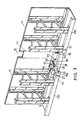
- Figure 3 is a fragmentary perspective view of the molding device of Figure 2;
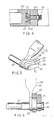
- Figure 4 is a fragmentary sectional view taken along line 4-4 of Figure 3;
- Figure 5 is a perspective view of an operating mechanism of the present invention;
- Figure 6 is a sectional view of the operating mechanism of Figure 5;
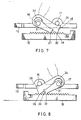
- Figures 7 and 8 show the operations of the operating mechanism of Figure 5;
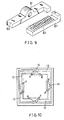
- Figure 9 shows another example of the rack member and the mounting seat of the invention; and
- Figure 10 shows the operation of releasing the molding device from the formed structure.
- Referring to Figures 2 and 3, a molding device 11 for molding an inner side of a four-sided wall is shown, including two angled
component form boards 12, two angledcomponent form boards 13 and fourspacer boards 14 which are interconnected to establish a four-sided forming face for a four wall room. Eachspacer board 14 has a wedge-shaped cross-section and two diverging end faces 14a extending from a forming face 14b of thespacer board 14. Eachform board 12 has two inclined end faces 12a abutting with and connected releaseably to adjacent end faces 14a of thespacer board 14. Also, eachform board 13 has two inclined end faces 13a abutting with and connected releaseably to adjacent end faces 14a of thespacer board 14. Support bases 12c, 13c and 14c are disposed respectively at the bottom sides of theform boards spacer boards 14. Referring to Figure 4 in combination with Figure 3, each slanted side of the base 12c or 13c is provided with anelongated groove 21 which has a restrictedelongated opening 21a and receives anelongated bar 22 in a slideable position. Eachbar 22 is connected throughscrews 23 to one side of the base 14c of eachspacer board 14. Thebar 22 can be prevented from moving in thegroove 21 by tightening thescrews 23, thereby securing together thespacer board 14 and theadjacent form board - On the base 14c of each
spacer board 14 are mounted tworack members 18 near the end faces of thespacer board 14. Eachrack member 18 is a thick plate which is provided withteeth 19 at the top surface thereof and an upwardstop edge flange 20. Therack member 18 is attached removably to the base 14c. The removable attachment may be accomplished by placing the rack member in arecess 181 of the base 14c. Referring to Figures 5 and 6 in combination with Figure 3, anoperating means 25 is mounted through amounting seat 15 on one side of each base 12c or 13c adjacent to eachrack member 18. Themounting seat 15 includes two raised parts provided respectively with outer andinner journal holes stop projection 15a. Thestop projection 15a is used to engage with thestop flange 20 of the rack member so as to stop the movement of the rack member. - Referring to Figures 5 and 6, an operating means 25, to operably associate with the rack member, includes a
lever 26 connected to anoperating shaft 27 which can be inserted changeably in twomounting holes eccentric member 34 is mounted on theshaft 27 adjacent to thelever 26. Apawl member 28 is sleeved with one end thereof rotatably around theeccentric member 34. The free end of thepawl member 28 has twoopposed edge teeth eccentric member 34 is anotherpawl member 31 which is mounted on an end portion of theshaft 27 to swing thereabout and which is prevented from escaping by means of alocking screw 36. The pawl also has twoopposed edge teeth levers 26, thespacer boards 14 can be moved relative to theadjacent form boards - The operation of releasing the form of the invention is illustrated in Figure 10. Firstly, the two
form boards 13 are moved inward by operating thelevers 26 so as to move thespacer boards 14 in the directions shown by arrow A relative to theform boards 12. Then, theform boards 12 are moved in the directions shown by arrow B by moving inward thespacer boards 14 relative to theform boards 13. The movement of the twoform boards - The operation of the operating means of the invention is shown in Figures 7 and 8. When the
spacer board 14 is to be moved in the direction opposite to direction A or B, theoperating shaft 27 is inserted in theouter hole 16 of themounting seat 15, thepawl member 18 is placed in therecess 181 of thespacer board 14 in such a manner that theupward flange 20 is directed toward the forming face 14b of thespacer board 14, and theedge tooth 30 of thepawl member 28 is arranged to engage with theteeth 19 of the rack member, as shown in Figure 7. In this situation, thetooth 32 of thepawl 31 engages the rack member. When the lever is turned down, i.e. clockwise, from the upward position as shown, theeccentric member 34 will cause thepawl member 28 to move slightly forward, thereby moving forward the rack member. When the lever turns counter-clockwise, thepawl member 28 moves rearward and engages with a next tooth of the rack member. By turning upward and downward thelever 26, therack member 18 can be moved in a direction shown byarrow 50 to cause thespacer board 14 and theform board 13 to move to their molding positions. The movement of therack member 18 stops when theflange 20 of therack 18 contacts theprojection 15a of themounting seat 15. Thetooth 32 of thepawl 31 prevents the backward movement of the rack member when the lever is operated. - When the
spacer board 14 is to be moved in the direction A or B, theshaft 27 is inserted in thehole 17 of themounting seat 15, and the position of therack member 18 is changed so as to place theupward edge flange 20 away from the forming face 14b. In this situation,tooth 29 of thepawl member 28 andtooth 33 of thepawl 31 engage with therack member 18. By operating thelever 26, therack member 18 can be moved in adirection 51 opposite todirection 50 to release thespacer board 14 or theform board 13 from the formed concrete structure. - Figure 9 shows an
alternative mounting seat 80 and analternative rack member 82 which can be used in the present invention. The mountingseat 80 includes a single mounting hole 81 into which theshaft 27 can be inserted for moving the rack member in two directions. Therack member 82 is received removably in therecess 181 of the base member 14c so that therack member 82 can be detached from the base member 14c to change its position. Since a single hole is provided on the mountingseat 80, the length of therack member 82 must be greater than that of therack member 18. - While the teeth of the
rack members teeth pawl arm 28 so as to move therack members - It can be appreciated that the form assembly according to the invention can be operated manually to move to a molding position or a position released from the molded concrete structure, and that the simultaneous operations of the two operating means of each
form board form board adjacent spacer boards 14.
Claims (7)
two vertical component form boards (12, 13) each having a forming face and a base support (12c, 13c) extending horizontally at the bottom of each of said component form boards, each base support having a joint end face (12a, 13c) forming an acute angle with said forming face and a substantially horizontal top support face adjacent to said end face;
a spacer board (14) disposed between said component form boards and having a vertical forming face and a base support (14c) extending horizontally from the bottom of said spacer board, said base support of said spacer board having two diverging joint and end faces (14a) abutting with and releaseably connected to said joint end faces of said component boards and two substantially horizontal top support faces adjacent to said diverging joint end faces;
means (21, 22, 23) for releasably connecting said form boards to said spacer board; and
a force imparting, sliding movement mechanism operably associated with said horizontal support face of each of said component boards and said horizontal support face of said spacer board adjacent said support face of each of said component boards, said mechanism including a rack member (18) mounted on one of said adjacent support faces, said rack member having a thick plate member having a top surface provided with rack teeth (19), said one support face having a recess (181) for removably accommodating said thick plate member, said mechanism further including a mounting seat (15) fixed to the other one of said adjacent support faces and having at least one mounting hole (16, 17), a horizontal shaft (27) removably insertable into said mounting hole, a lever (26) connected to said shaft for turning said shaft, an eccentric member (34) fixed to said shaft, and a pawl member (28) having one end rotatably sleeved around said eccentric member and an opposite free end to engage with said rack teeth, said pawl member being capable of swinging freely.
Priority Applications (1)
| Application Number | Priority Date | Filing Date | Title |
|---|---|---|---|
| AT89302076T ATE85386T1 (en) | 1988-03-02 | 1989-03-02 | FORMWORK WITH HAND-OPERATED DESHUTTING MECHANISM. |
Applications Claiming Priority (2)
| Application Number | Priority Date | Filing Date | Title |
|---|---|---|---|
| JP28582/88 | 1988-03-02 | ||
| JP1988028582U JPH071435Y2 (en) | 1988-03-02 | 1988-03-02 | Force transmission mechanism of mold |
Publications (3)
| Publication Number | Publication Date |
|---|---|
| EP0331484A2 true EP0331484A2 (en) | 1989-09-06 |
| EP0331484A3 EP0331484A3 (en) | 1990-05-30 |
| EP0331484B1 EP0331484B1 (en) | 1993-02-03 |
Family
ID=12252595
Family Applications (1)
| Application Number | Title | Priority Date | Filing Date |
|---|---|---|---|
| EP89302076A Expired - Lifetime EP0331484B1 (en) | 1988-03-02 | 1989-03-02 | Molding device with hand operable mold releasing mechanism |
Country Status (5)
| Country | Link |
|---|---|
| EP (1) | EP0331484B1 (en) |
| JP (1) | JPH071435Y2 (en) |
| CN (1) | CN1015564B (en) |
| AT (1) | ATE85386T1 (en) |
| DE (1) | DE68904661T2 (en) |
Cited By (1)
| Publication number | Priority date | Publication date | Assignee | Title |
|---|---|---|---|---|
| CN112538963A (en) * | 2020-12-08 | 2021-03-23 | 姜大山 | Detachable and easy-to-clean building template for building engineering construction |
Families Citing this family (4)
| Publication number | Priority date | Publication date | Assignee | Title |
|---|---|---|---|---|
| CN103434017B (en) * | 2013-08-05 | 2015-09-16 | 兖州嘉禾建筑设备有限公司 | Four-axle linked stripper apparatus under flexible state |
| CN105239772B (en) * | 2015-09-01 | 2017-09-22 | 中民筑友有限公司 | Governor motion, interior cylinder mould and Lift well mould panel assembly |
| CN107813409B (en) * | 2017-10-27 | 2021-01-29 | 李宜君 | Internal mold of building wall forming mold and mold shrinking method thereof |
| CN117145195A (en) * | 2023-07-29 | 2023-12-01 | 陕西玉蜂工程机械有限公司 | A method for making a wedge-type linkage deformation template |
Family Cites Families (7)
| Publication number | Priority date | Publication date | Assignee | Title |
|---|---|---|---|---|
| US2031815A (en) * | 1935-09-05 | 1936-02-25 | Duplex Tool Co | Lifting jack |
| US3481581A (en) * | 1967-08-24 | 1969-12-02 | Joe N Sunseri | Lifting jack |
| FR2410110A1 (en) * | 1977-11-29 | 1979-06-22 | Equip Modernes Indls | Radially contracting ring shutter - is for bore of concrete chimney of square section and has corner sections with wedge shaped beams |
| US4570896A (en) * | 1984-02-06 | 1986-02-18 | Strickland Systems, Inc. | Slide action inside corner form |
| JPS61237762A (en) * | 1984-12-13 | 1986-10-23 | 李 淵河 | Method and apparatus for assembling and disassembling mold frame |
| US4614326A (en) * | 1985-01-09 | 1986-09-30 | Strickland Systems, Inc. | Concrete mold core assembly |
| IN166742B (en) * | 1985-11-26 | 1990-07-14 | Yuan Ho Lee |
-
1988
- 1988-03-02 JP JP1988028582U patent/JPH071435Y2/en not_active Expired - Lifetime
-
1989
- 1989-02-28 CN CN89101038.6A patent/CN1015564B/en not_active Expired
- 1989-03-02 EP EP89302076A patent/EP0331484B1/en not_active Expired - Lifetime
- 1989-03-02 AT AT89302076T patent/ATE85386T1/en not_active IP Right Cessation
- 1989-03-02 DE DE8989302076T patent/DE68904661T2/en not_active Expired - Fee Related
Cited By (1)
| Publication number | Priority date | Publication date | Assignee | Title |
|---|---|---|---|---|
| CN112538963A (en) * | 2020-12-08 | 2021-03-23 | 姜大山 | Detachable and easy-to-clean building template for building engineering construction |
Also Published As
| Publication number | Publication date |
|---|---|
| JPH071435Y2 (en) | 1995-01-18 |
| CN1036243A (en) | 1989-10-11 |
| DE68904661T2 (en) | 1993-08-12 |
| DE68904661D1 (en) | 1993-03-18 |
| EP0331484B1 (en) | 1993-02-03 |
| CN1015564B (en) | 1992-02-19 |
| JPH01130448U (en) | 1989-09-05 |
| EP0331484A3 (en) | 1990-05-30 |
| ATE85386T1 (en) | 1993-02-15 |
Similar Documents
| Publication | Publication Date | Title |
|---|---|---|
| JPH0711921Y2 (en) | Tool position setting device for workbench | |
| US4846438A (en) | Molding device with hand operable mold | |
| EP0331484B1 (en) | Molding device with hand operable mold releasing mechanism | |
| EP1186264A1 (en) | Children's bed improving the shaping of a baby's head | |
| JPH11198730A (en) | Vehicle article carrier | |
| JP2624192B2 (en) | Cutting end socket mounting device | |
| US4502393A (en) | Worktable, particularly an office desk | |
| KR100790963B1 (en) | How to construct formwork for interior walls | |
| CN218061416U (en) | Template supporting tool for overhanging part of composite floor slab construction | |
| US5983762A (en) | Punch catch device | |
| US3844526A (en) | Vertical shaft form with cammed stripping units | |
| US6427734B1 (en) | Wood planing machine with a tightening unit | |
| EP0225093A1 (en) | Molding device for modular concrete unit | |
| US5357826A (en) | Adjustable handlebar for bicycle | |
| DE3821206A1 (en) | VIDEO PROJECTION DEVICE WITH SWIVEL LIFT SYSTEM | |
| JPH0635356U (en) | Driver's seat armrest | |
| DE19509138A1 (en) | Adjustable wall fastener for shower suspension | |
| EP0492646A1 (en) | An apparatus for locking operative position of each furniture on furniture raising/lowering type floor equipment | |
| JP3743784B2 (en) | Double floor floor panel support equipment | |
| KR102811150B1 (en) | Scaffolding support device for buildings | |
| KR800000393B1 (en) | Means for producing precast concrete panels with built-in outer sash frames | |
| JPH087904Y2 (en) | Amusement machine | |
| KR200268612Y1 (en) | Assemblable furniture | |
| JPH0744332Y2 (en) | vendor | |
| US5799447A (en) | Apparatus for moving a wall form assembly |
Legal Events
| Date | Code | Title | Description |
|---|---|---|---|
| PUAI | Public reference made under article 153(3) epc to a published international application that has entered the european phase |
Free format text: ORIGINAL CODE: 0009012 |
|
| AK | Designated contracting states |
Kind code of ref document: A2 Designated state(s): AT BE CH DE ES FR GR IT LI LU NL SE |
|
| PUAL | Search report despatched |
Free format text: ORIGINAL CODE: 0009013 |
|
| AK | Designated contracting states |
Kind code of ref document: A3 Designated state(s): AT BE CH DE ES FR GR IT LI LU NL SE |
|
| 17P | Request for examination filed |
Effective date: 19900921 |
|
| 17Q | First examination report despatched |
Effective date: 19910605 |
|
| GRAA | (expected) grant |
Free format text: ORIGINAL CODE: 0009210 |
|
| AK | Designated contracting states |
Kind code of ref document: B1 Designated state(s): AT BE CH DE ES FR GR IT LI LU NL SE |
|
| PG25 | Lapsed in a contracting state [announced via postgrant information from national office to epo] |
Ref country code: SE Effective date: 19930203 Ref country code: LI Effective date: 19930203 Ref country code: GR Free format text: LAPSE BECAUSE OF FAILURE TO SUBMIT A TRANSLATION OF THE DESCRIPTION OR TO PAY THE FEE WITHIN THE PRESCRIBED TIME-LIMIT Effective date: 19930203 Ref country code: ES Free format text: THE PATENT HAS BEEN ANNULLED BY A DECISION OF A NATIONAL AUTHORITY Effective date: 19930203 Ref country code: CH Effective date: 19930203 Ref country code: BE Effective date: 19930203 Ref country code: AT Effective date: 19930203 |
|
| REF | Corresponds to: |
Ref document number: 85386 Country of ref document: AT Date of ref document: 19930215 Kind code of ref document: T |
|
| REF | Corresponds to: |
Ref document number: 68904661 Country of ref document: DE Date of ref document: 19930318 |
|
| PG25 | Lapsed in a contracting state [announced via postgrant information from national office to epo] |
Ref country code: LU Free format text: LAPSE BECAUSE OF NON-PAYMENT OF DUE FEES Effective date: 19930331 |
|
| ITF | It: translation for a ep patent filed | ||
| REG | Reference to a national code |
Ref country code: CH Ref legal event code: PL |
|
| ET | Fr: translation filed | ||
| PLBE | No opposition filed within time limit |
Free format text: ORIGINAL CODE: 0009261 |
|
| STAA | Information on the status of an ep patent application or granted ep patent |
Free format text: STATUS: NO OPPOSITION FILED WITHIN TIME LIMIT |
|
| 26N | No opposition filed | ||
| PGFP | Annual fee paid to national office [announced via postgrant information from national office to epo] |
Ref country code: DE Payment date: 19970307 Year of fee payment: 9 |
|
| PGFP | Annual fee paid to national office [announced via postgrant information from national office to epo] |
Ref country code: FR Payment date: 19970313 Year of fee payment: 9 |
|
| PGFP | Annual fee paid to national office [announced via postgrant information from national office to epo] |
Ref country code: NL Payment date: 19970327 Year of fee payment: 9 |
|
| PG25 | Lapsed in a contracting state [announced via postgrant information from national office to epo] |
Ref country code: FR Free format text: THE PATENT HAS BEEN ANNULLED BY A DECISION OF A NATIONAL AUTHORITY Effective date: 19980331 |
|
| PG25 | Lapsed in a contracting state [announced via postgrant information from national office to epo] |
Ref country code: NL Free format text: LAPSE BECAUSE OF NON-PAYMENT OF DUE FEES Effective date: 19981001 |
|
| NLV4 | Nl: lapsed or anulled due to non-payment of the annual fee |
Effective date: 19981001 |
|
| PG25 | Lapsed in a contracting state [announced via postgrant information from national office to epo] |
Ref country code: DE Free format text: LAPSE BECAUSE OF NON-PAYMENT OF DUE FEES Effective date: 19981201 |
|
| REG | Reference to a national code |
Ref country code: FR Ref legal event code: ST |
|
| PG25 | Lapsed in a contracting state [announced via postgrant information from national office to epo] |
Ref country code: IT Free format text: LAPSE BECAUSE OF NON-PAYMENT OF DUE FEES Effective date: 20050302 |