EP0329397B1 - Process for producing azolylmethylcyclopentanol derivatives - Google Patents
Process for producing azolylmethylcyclopentanol derivatives Download PDFInfo
- Publication number
- EP0329397B1 EP0329397B1 EP19890301420 EP89301420A EP0329397B1 EP 0329397 B1 EP0329397 B1 EP 0329397B1 EP 19890301420 EP19890301420 EP 19890301420 EP 89301420 A EP89301420 A EP 89301420A EP 0329397 B1 EP0329397 B1 EP 0329397B1
- Authority
- EP
- European Patent Office
- Prior art keywords
- mixture
- derivative
- added
- polar solvent
- formula
- Prior art date
- Legal status (The legal status is an assumption and is not a legal conclusion. Google has not performed a legal analysis and makes no representation as to the accuracy of the status listed.)
- Expired - Lifetime
Links
- 238000000034 method Methods 0.000 title claims description 39
- WTCLHADIQBSFAE-UHFFFAOYSA-N 1-(1h-pyrrol-2-ylmethyl)cyclopentan-1-ol Chemical class C=1C=CNC=1CC1(O)CCCC1 WTCLHADIQBSFAE-UHFFFAOYSA-N 0.000 title claims description 24
- 239000000203 mixture Substances 0.000 claims description 53
- SECXISVLQFMRJM-UHFFFAOYSA-N N-Methylpyrrolidone Chemical compound CN1CCCC1=O SECXISVLQFMRJM-UHFFFAOYSA-N 0.000 claims description 52
- DKGAVHZHDRPRBM-UHFFFAOYSA-N Tert-Butanol Chemical compound CC(C)(C)O DKGAVHZHDRPRBM-UHFFFAOYSA-N 0.000 claims description 42
- 238000006243 chemical reaction Methods 0.000 claims description 36
- -1 azole compound Chemical class 0.000 claims description 17
- 239000002798 polar solvent Substances 0.000 claims description 16
- 229910052757 nitrogen Inorganic materials 0.000 claims description 14
- BGTOWKSIORTVQH-HOSYLAQJSA-N cyclopentanone Chemical class O=[13C]1CCCC1 BGTOWKSIORTVQH-HOSYLAQJSA-N 0.000 claims description 13
- 125000004432 carbon atom Chemical group C* 0.000 claims description 12
- 125000004435 hydrogen atom Chemical group [H]* 0.000 claims description 11
- 229910052783 alkali metal Inorganic materials 0.000 claims description 10
- 239000002585 base Substances 0.000 claims description 10
- ZMXDDKWLCZADIW-UHFFFAOYSA-N N,N-Dimethylformamide Chemical compound CN(C)C=O ZMXDDKWLCZADIW-UHFFFAOYSA-N 0.000 claims description 9
- 125000000217 alkyl group Chemical group 0.000 claims description 9
- KAESVJOAVNADME-UHFFFAOYSA-N 1H-pyrrole Natural products C=1C=CNC=1 KAESVJOAVNADME-UHFFFAOYSA-N 0.000 claims description 8
- 241000196324 Embryophyta Species 0.000 claims description 8
- 150000001340 alkali metals Chemical group 0.000 claims description 8
- LSDPWZHWYPCBBB-UHFFFAOYSA-N Methanethiol Chemical compound SC LSDPWZHWYPCBBB-UHFFFAOYSA-N 0.000 claims description 7
- LFQSCWFLJHTTHZ-UHFFFAOYSA-N Ethanol Chemical compound CCO LFQSCWFLJHTTHZ-UHFFFAOYSA-N 0.000 claims description 6
- 125000001997 phenyl group Chemical group [H]C1=C([H])C([H])=C(*)C([H])=C1[H] 0.000 claims description 6
- IAZDPXIOMUYVGZ-UHFFFAOYSA-N dimethyl sulfoxide Natural products CS(C)=O IAZDPXIOMUYVGZ-UHFFFAOYSA-N 0.000 claims description 5
- 125000004433 nitrogen atom Chemical group N* 0.000 claims description 4
- IWOKCMBOJXYDEE-UHFFFAOYSA-N sulfinylmethane Chemical compound C=S=O IWOKCMBOJXYDEE-UHFFFAOYSA-N 0.000 claims description 4
- 206010017533 Fungal infection Diseases 0.000 claims description 3
- 208000031888 Mycoses Diseases 0.000 claims description 3
- 230000001276 controlling effect Effects 0.000 claims description 3
- 239000003085 diluting agent Substances 0.000 claims description 3
- 125000005843 halogen group Chemical group 0.000 claims description 3
- 238000002156 mixing Methods 0.000 claims description 3
- 230000008635 plant growth Effects 0.000 claims description 3
- 230000001105 regulatory effect Effects 0.000 claims description 3
- FXHOOIRPVKKKFG-UHFFFAOYSA-N N,N-Dimethylacetamide Chemical compound CN(C)C(C)=O FXHOOIRPVKKKFG-UHFFFAOYSA-N 0.000 claims 1
- 125000004093 cyano group Chemical group *C#N 0.000 claims 1
- 125000000449 nitro group Chemical group [O-][N+](*)=O 0.000 claims 1
- 125000002023 trifluoromethyl group Chemical group FC(F)(F)* 0.000 claims 1
- VLKZOEOYAKHREP-UHFFFAOYSA-N n-Hexane Chemical compound CCCCCC VLKZOEOYAKHREP-UHFFFAOYSA-N 0.000 description 68
- XEKOWRVHYACXOJ-UHFFFAOYSA-N Ethyl acetate Chemical compound CCOC(C)=O XEKOWRVHYACXOJ-UHFFFAOYSA-N 0.000 description 36
- HEDRZPFGACZZDS-UHFFFAOYSA-N Chloroform Chemical compound ClC(Cl)Cl HEDRZPFGACZZDS-UHFFFAOYSA-N 0.000 description 26
- KEAYESYHFKHZAL-UHFFFAOYSA-N Sodium Chemical compound [Na] KEAYESYHFKHZAL-UHFFFAOYSA-N 0.000 description 26
- 239000012312 sodium hydride Substances 0.000 description 26
- 229910000104 sodium hydride Inorganic materials 0.000 description 26
- XLYOFNOQVPJJNP-UHFFFAOYSA-N water Substances O XLYOFNOQVPJJNP-UHFFFAOYSA-N 0.000 description 26
- 239000000463 material Substances 0.000 description 23
- 150000001875 compounds Chemical class 0.000 description 21
- IJGRMHOSHXDMSA-UHFFFAOYSA-N Atomic nitrogen Chemical compound N#N IJGRMHOSHXDMSA-UHFFFAOYSA-N 0.000 description 20
- MSXVEPNJUHWQHW-UHFFFAOYSA-N 2-methylbutan-2-ol Chemical compound CCC(C)(C)O MSXVEPNJUHWQHW-UHFFFAOYSA-N 0.000 description 18
- RAXXELZNTBOGNW-UHFFFAOYSA-N imidazole Natural products C1=CNC=N1 RAXXELZNTBOGNW-UHFFFAOYSA-N 0.000 description 18
- LGRLWUINFJPLSH-UHFFFAOYSA-N methanide Chemical compound [CH3-] LGRLWUINFJPLSH-UHFFFAOYSA-N 0.000 description 17
- 230000005587 bubbling Effects 0.000 description 16
- NSPMIYGKQJPBQR-UHFFFAOYSA-N 4H-1,2,4-triazole Chemical compound C=1N=CNN=1 NSPMIYGKQJPBQR-UHFFFAOYSA-N 0.000 description 14
- 239000012044 organic layer Substances 0.000 description 14
- PMZURENOXWZQFD-UHFFFAOYSA-L Sodium Sulfate Chemical compound [Na+].[Na+].[O-]S([O-])(=O)=O PMZURENOXWZQFD-UHFFFAOYSA-L 0.000 description 12
- VYPSYNLAJGMNEJ-UHFFFAOYSA-N Silicium dioxide Chemical compound O=[Si]=O VYPSYNLAJGMNEJ-UHFFFAOYSA-N 0.000 description 11
- 238000004440 column chromatography Methods 0.000 description 11
- 239000000741 silica gel Substances 0.000 description 11
- 229910002027 silica gel Inorganic materials 0.000 description 11
- 239000010410 layer Substances 0.000 description 10
- MFRIHAYPQRLWNB-UHFFFAOYSA-N sodium tert-butoxide Chemical compound [Na+].CC(C)(C)[O-] MFRIHAYPQRLWNB-UHFFFAOYSA-N 0.000 description 10
- YXFVVABEGXRONW-UHFFFAOYSA-N Toluene Chemical compound CC1=CC=CC=C1 YXFVVABEGXRONW-UHFFFAOYSA-N 0.000 description 9
- 239000002904 solvent Substances 0.000 description 9
- KEPJZBFFLDRKSF-UHFFFAOYSA-M trimethylsulfoxonium bromide Chemical compound [Br-].C[S+](C)(C)=O KEPJZBFFLDRKSF-UHFFFAOYSA-M 0.000 description 9
- DKWOHBPRFZIUQL-UHFFFAOYSA-N dimethyl-methylidene-oxo-$l^{6}-sulfane Chemical compound C[S+](C)([CH2-])=O DKWOHBPRFZIUQL-UHFFFAOYSA-N 0.000 description 8
- 239000011541 reaction mixture Substances 0.000 description 7
- DLPBZANLIRTMKU-UHFFFAOYSA-N 5-[(4-chlorophenyl)methyl]-2,2-dimethylcyclopentan-1-one Chemical compound O=C1C(C)(C)CCC1CC1=CC=C(Cl)C=C1 DLPBZANLIRTMKU-UHFFFAOYSA-N 0.000 description 6
- UXVMQQNJUSDDNG-UHFFFAOYSA-L Calcium chloride Chemical compound [Cl-].[Cl-].[Ca+2] UXVMQQNJUSDDNG-UHFFFAOYSA-L 0.000 description 6
- 239000006227 byproduct Substances 0.000 description 6
- 239000001110 calcium chloride Substances 0.000 description 6
- 229910001628 calcium chloride Inorganic materials 0.000 description 6
- 238000003756 stirring Methods 0.000 description 6
- 238000001816 cooling Methods 0.000 description 5
- XWPZUHJBOLQNMN-UHFFFAOYSA-N metconazole Chemical compound C1=NC=NN1CC1(O)C(C)(C)CCC1CC1=CC=C(Cl)C=C1 XWPZUHJBOLQNMN-UHFFFAOYSA-N 0.000 description 5
- 150000002924 oxiranes Chemical class 0.000 description 5
- 238000002360 preparation method Methods 0.000 description 5
- 150000007980 azole derivatives Chemical class 0.000 description 4
- UHOVQNZJYSORNB-UHFFFAOYSA-N Benzene Chemical compound C1=CC=CC=C1 UHOVQNZJYSORNB-UHFFFAOYSA-N 0.000 description 3
- YMWUJEATGCHHMB-UHFFFAOYSA-N Dichloromethane Chemical compound ClCCl YMWUJEATGCHHMB-UHFFFAOYSA-N 0.000 description 3
- KWYUFKZDYYNOTN-UHFFFAOYSA-M Potassium hydroxide Chemical compound [OH-].[K+] KWYUFKZDYYNOTN-UHFFFAOYSA-M 0.000 description 3
- HEMHJVSKTPXQMS-UHFFFAOYSA-M Sodium hydroxide Chemical compound [OH-].[Na+] HEMHJVSKTPXQMS-UHFFFAOYSA-M 0.000 description 3
- ZMANZCXQSJIPKH-UHFFFAOYSA-N Triethylamine Chemical compound CCN(CC)CC ZMANZCXQSJIPKH-UHFFFAOYSA-N 0.000 description 3
- 230000015572 biosynthetic process Effects 0.000 description 3
- KFZMGEQAYNKOFK-UHFFFAOYSA-N Isopropanol Chemical compound CC(C)O KFZMGEQAYNKOFK-UHFFFAOYSA-N 0.000 description 2
- MZRVEZGGRBJDDB-UHFFFAOYSA-N N-Butyllithium Chemical compound [Li]CCCC MZRVEZGGRBJDDB-UHFFFAOYSA-N 0.000 description 2
- JUJWROOIHBZHMG-UHFFFAOYSA-N Pyridine Chemical compound C1=CC=NC=C1 JUJWROOIHBZHMG-UHFFFAOYSA-N 0.000 description 2
- CDBYLPFSWZWCQE-UHFFFAOYSA-L Sodium Carbonate Chemical compound [Na+].[Na+].[O-]C([O-])=O CDBYLPFSWZWCQE-UHFFFAOYSA-L 0.000 description 2
- WQDUMFSSJAZKTM-UHFFFAOYSA-N Sodium methoxide Chemical compound [Na+].[O-]C WQDUMFSSJAZKTM-UHFFFAOYSA-N 0.000 description 2
- BTANRVKWQNVYAZ-UHFFFAOYSA-N butan-2-ol Chemical compound CCC(C)O BTANRVKWQNVYAZ-UHFFFAOYSA-N 0.000 description 2
- 239000013078 crystal Substances 0.000 description 2
- GZRYBYIBLHMWCD-UHFFFAOYSA-N dimethyl(methylidene)-$l^{4}-sulfane Chemical compound CS(C)=C GZRYBYIBLHMWCD-UHFFFAOYSA-N 0.000 description 2
- BWHMMNNQKKPAPP-UHFFFAOYSA-L potassium carbonate Chemical compound [K+].[K+].[O-]C([O-])=O BWHMMNNQKKPAPP-UHFFFAOYSA-L 0.000 description 2
- BPLKQGGAXWRFOE-UHFFFAOYSA-M trimethylsulfoxonium iodide Chemical compound [I-].C[S+](C)(C)=O BPLKQGGAXWRFOE-UHFFFAOYSA-M 0.000 description 2
- 238000007039 two-step reaction Methods 0.000 description 2
- BKNBZXIYLJDPIS-UHFFFAOYSA-N 1-(1,2,4-triazol-1-ylmethyl)-2-[[3-(trifluoromethyl)phenyl]methyl]cyclopentan-1-ol Chemical compound C1CCC(CC=2C=C(C=CC=2)C(F)(F)F)C1(O)CN1C=NC=N1 BKNBZXIYLJDPIS-UHFFFAOYSA-N 0.000 description 1
- AZHWYUGUSFZXJD-UHFFFAOYSA-N 1-(1h-pyrrol-2-yl)cyclopentan-1-ol Chemical class C=1C=CNC=1C1(O)CCCC1 AZHWYUGUSFZXJD-UHFFFAOYSA-N 0.000 description 1
- QEEHVPIONMGPLD-UHFFFAOYSA-N 2-[(4-chlorophenyl)methyl]-1-(1,2,4-triazol-1-ylmethyl)cyclopentan-1-ol Chemical compound C1CCC(CC=2C=CC(Cl)=CC=2)C1(O)CN1C=NC=N1 QEEHVPIONMGPLD-UHFFFAOYSA-N 0.000 description 1
- VJZOMMAKBUSHJY-UHFFFAOYSA-N 2-[(4-chlorophenyl)methyl]-5-propan-2-ylcyclopentan-1-one Chemical compound O=C1C(C(C)C)CCC1CC1=CC=C(Cl)C=C1 VJZOMMAKBUSHJY-UHFFFAOYSA-N 0.000 description 1
- OPLDIHWEFBYKBR-UHFFFAOYSA-N 2-[(4-chlorophenyl)methyl]cyclopentan-1-one Chemical compound C1=CC(Cl)=CC=C1CC1C(=O)CCC1 OPLDIHWEFBYKBR-UHFFFAOYSA-N 0.000 description 1
- RNHCIORPSPLKLS-UHFFFAOYSA-N 2-[(4-nitrophenyl)methyl]-1-(1,2,4-triazol-1-ylmethyl)cyclopentan-1-ol Chemical compound C1CCC(CC=2C=CC(=CC=2)[N+]([O-])=O)C1(O)CN1C=NC=N1 RNHCIORPSPLKLS-UHFFFAOYSA-N 0.000 description 1
- PBGRPFKGOFKHFC-UHFFFAOYSA-N 2-[(4-nitrophenyl)methyl]cyclopentan-1-one Chemical compound C1=CC([N+](=O)[O-])=CC=C1CC1C(=O)CCC1 PBGRPFKGOFKHFC-UHFFFAOYSA-N 0.000 description 1
- UAEARZDZCFOVOL-UHFFFAOYSA-N 2-[(4-phenylphenyl)methyl]-1-(1,2,4-triazol-1-ylmethyl)cyclopentan-1-ol Chemical compound C1CCC(CC=2C=CC(=CC=2)C=2C=CC=CC=2)C1(O)CN1C=NC=N1 UAEARZDZCFOVOL-UHFFFAOYSA-N 0.000 description 1
- KOCMDBKYFLKJGD-UHFFFAOYSA-N 2-[(4-phenylphenyl)methyl]cyclopentan-1-one Chemical compound O=C1CCCC1CC1=CC=C(C=2C=CC=CC=2)C=C1 KOCMDBKYFLKJGD-UHFFFAOYSA-N 0.000 description 1
- YCKWTUUKLHLNOT-UHFFFAOYSA-N 2-[[3-(trifluoromethyl)phenyl]methyl]cyclopentan-1-one Chemical compound FC(F)(F)C1=CC=CC(CC2C(CCC2)=O)=C1 YCKWTUUKLHLNOT-UHFFFAOYSA-N 0.000 description 1
- FDADFPIDKGHHHY-UHFFFAOYSA-N 4-[(2-oxocyclopentyl)methyl]benzonitrile Chemical compound O=C1CCCC1CC1=CC=C(C#N)C=C1 FDADFPIDKGHHHY-UHFFFAOYSA-N 0.000 description 1
- BIVSUQMZTRSAEH-UHFFFAOYSA-N 4-[[2-hydroxy-2-(imidazol-1-ylmethyl)cyclopentyl]methyl]benzonitrile Chemical compound C1CCC(CC=2C=CC(=CC=2)C#N)C1(O)CN1C=CN=C1 BIVSUQMZTRSAEH-UHFFFAOYSA-N 0.000 description 1
- IDLYNFQDASSSGO-UHFFFAOYSA-N 5-[(4-chlorophenyl)methyl]-1-(imidazol-1-ylmethyl)-2,2-dimethylcyclopentan-1-ol Chemical compound C1=CN=CN1CC1(O)C(C)(C)CCC1CC1=CC=C(Cl)C=C1 IDLYNFQDASSSGO-UHFFFAOYSA-N 0.000 description 1
- BVKZGUZCCUSVTD-UHFFFAOYSA-L Carbonate Chemical compound [O-]C([O-])=O BVKZGUZCCUSVTD-UHFFFAOYSA-L 0.000 description 1
- FAPWRFPIFSIZLT-UHFFFAOYSA-M Sodium chloride Chemical class [Na+].[Cl-] FAPWRFPIFSIZLT-UHFFFAOYSA-M 0.000 description 1
- 150000004703 alkoxides Chemical class 0.000 description 1
- 238000009835 boiling Methods 0.000 description 1
- 238000007796 conventional method Methods 0.000 description 1
- 238000000605 extraction Methods 0.000 description 1
- 238000007710 freezing Methods 0.000 description 1
- 230000008014 freezing Effects 0.000 description 1
- 239000000417 fungicide Substances 0.000 description 1
- 150000004678 hydrides Chemical class 0.000 description 1
- XLYOFNOQVPJJNP-UHFFFAOYSA-M hydroxide Chemical compound [OH-] XLYOFNOQVPJJNP-UHFFFAOYSA-M 0.000 description 1
- QTYCMDBMOLSEAM-UHFFFAOYSA-N ipconazole Chemical compound C1=NC=NN1CC1(O)C(C(C)C)CCC1CC1=CC=C(Cl)C=C1 QTYCMDBMOLSEAM-UHFFFAOYSA-N 0.000 description 1
- WFKAJVHLWXSISD-UHFFFAOYSA-N isobutyramide Chemical compound CC(C)C(N)=O WFKAJVHLWXSISD-UHFFFAOYSA-N 0.000 description 1
- 150000002736 metal compounds Chemical class 0.000 description 1
- 238000005580 one pot reaction Methods 0.000 description 1
- 239000003960 organic solvent Substances 0.000 description 1
- 150000002921 oxetanes Chemical class 0.000 description 1
- 229910000027 potassium carbonate Inorganic materials 0.000 description 1
- NTTOTNSKUYCDAV-UHFFFAOYSA-N potassium hydride Chemical compound [KH] NTTOTNSKUYCDAV-UHFFFAOYSA-N 0.000 description 1
- 229910000105 potassium hydride Inorganic materials 0.000 description 1
- LPNYRYFBWFDTMA-UHFFFAOYSA-N potassium tert-butoxide Chemical compound [K+].CC(C)(C)[O-] LPNYRYFBWFDTMA-UHFFFAOYSA-N 0.000 description 1
- UMJSCPRVCHMLSP-UHFFFAOYSA-N pyridine Natural products COC1=CC=CN=C1 UMJSCPRVCHMLSP-UHFFFAOYSA-N 0.000 description 1
- 229910000029 sodium carbonate Inorganic materials 0.000 description 1
- QDRKDTQENPPHOJ-UHFFFAOYSA-N sodium ethoxide Chemical compound [Na+].CC[O-] QDRKDTQENPPHOJ-UHFFFAOYSA-N 0.000 description 1
- 239000007787 solid Substances 0.000 description 1
- 230000008023 solidification Effects 0.000 description 1
- 238000007711 solidification Methods 0.000 description 1
- 239000011877 solvent mixture Substances 0.000 description 1
- GOTIICCWNAPLMN-UHFFFAOYSA-M trimethylsulfanium;bromide Chemical compound [Br-].C[S+](C)C GOTIICCWNAPLMN-UHFFFAOYSA-M 0.000 description 1
- VFJYIHQDILEQNR-UHFFFAOYSA-M trimethylsulfanium;iodide Chemical compound [I-].C[S+](C)C VFJYIHQDILEQNR-UHFFFAOYSA-M 0.000 description 1
Classifications
-
- C—CHEMISTRY; METALLURGY
- C07—ORGANIC CHEMISTRY
- C07D—HETEROCYCLIC COMPOUNDS
- C07D231/00—Heterocyclic compounds containing 1,2-diazole or hydrogenated 1,2-diazole rings
- C07D231/02—Heterocyclic compounds containing 1,2-diazole or hydrogenated 1,2-diazole rings not condensed with other rings
- C07D231/10—Heterocyclic compounds containing 1,2-diazole or hydrogenated 1,2-diazole rings not condensed with other rings having two or three double bonds between ring members or between ring members and non-ring members
- C07D231/12—Heterocyclic compounds containing 1,2-diazole or hydrogenated 1,2-diazole rings not condensed with other rings having two or three double bonds between ring members or between ring members and non-ring members with only hydrogen atoms, hydrocarbon or substituted hydrocarbon radicals, directly attached to ring carbon atoms
-
- C—CHEMISTRY; METALLURGY
- C07—ORGANIC CHEMISTRY
- C07D—HETEROCYCLIC COMPOUNDS
- C07D233/00—Heterocyclic compounds containing 1,3-diazole or hydrogenated 1,3-diazole rings, not condensed with other rings
- C07D233/54—Heterocyclic compounds containing 1,3-diazole or hydrogenated 1,3-diazole rings, not condensed with other rings having two double bonds between ring members or between ring members and non-ring members
- C07D233/56—Heterocyclic compounds containing 1,3-diazole or hydrogenated 1,3-diazole rings, not condensed with other rings having two double bonds between ring members or between ring members and non-ring members with only hydrogen atoms or radicals containing only hydrogen and carbon atoms, attached to ring carbon atoms
-
- C—CHEMISTRY; METALLURGY
- C07—ORGANIC CHEMISTRY
- C07D—HETEROCYCLIC COMPOUNDS
- C07D249/00—Heterocyclic compounds containing five-membered rings having three nitrogen atoms as the only ring hetero atoms
- C07D249/02—Heterocyclic compounds containing five-membered rings having three nitrogen atoms as the only ring hetero atoms not condensed with other rings
- C07D249/08—1,2,4-Triazoles; Hydrogenated 1,2,4-triazoles
Definitions
- the present invention relates to a process for producing an azolylmethylcyclopentanol derivative represented by the formula (II): wherein R1 represents a hydrogen atom or an alkyl group having 1 to 5 carbon atoms, R2 represents a hydrogen atom or an alkyl group having 1 or 2 carbon atoms, X represents a halogen atom, an alkyl group having 1 to 4 carbon atoms, a phenyl group, a CN group, a CF3 group or a NO2 group, m is an integer of 1 to 5 and A represents a nitrogen atom or a CH group provided that when X is phenyl m is not 3,4 or 5.
- R1 represents a hydrogen atom or an alkyl group having 1 to 5 carbon atoms
- R2 represents a hydrogen atom or an alkyl group having 1 or 2 carbon atoms
- X represents a halogen atom, an alkyl group having 1 to 4 carbon atoms, a phenyl
- the invention also relates to a process for forming an agricultural or horticultural composition comprising the azolylmethylcyclopentanol derivative so prepared, to a process for controlling a fungal infection on plants or regulating the growth of plants and to a process for killing weeds at a locus.
- GB-A-2,180,236 discloses a method of reacting a cyclopentanone derivative with dimethyloxosulfonium methylide in a presence of a diluent, obtaining an oxirane derivative and thereafter reacting the oxirane derivative with an azole derivative.
- the yield of the oxirane derivative in the first step is about 50 to 60% and the yield of the azole derivative in the second step is about 60 to 70%, accordingly the total yield being unsatisfactory.
- a by-product such as an oxetane derivative is formed. If the reaction temperature is high, the formation of a by-product increases, while if the reaction temperature is lowered to avoid the formation of a by-product, the reaction hardly reaches its completion.
- the present inventors have developed a process for producing an azolylmethylcyclopentanol derivative, which is the target compound, with a high yield, suppressing the formation of an oxetane compound, a by-product, by performing the reaction for producing an oxirane derivative and the reaction for producing an azole derivative in one reaction vessel while using a specific solvent, preferably a specific solvent mixture and the present invention has been achieved by this development.
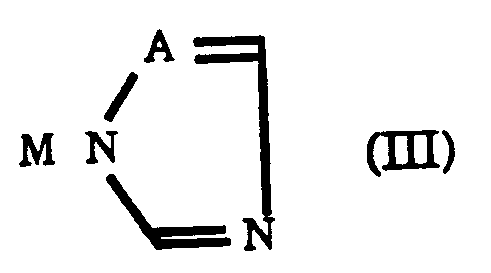
- the present invention provides a process for producing an azolylmethylcyclopentanol derivative represented by the formula (II): wherein R1 represents a hydrogen atom or an alkyl group having 1 to 5 carbon atoms, R2 represents a hydrogen atom or an alkyl group having 1 or 2 carbon atoms, X represents a halogen atom, an alkyl group having 1 to 4 carbon atoms, a phenyl group, a CN group, a CF3 group or a NO2 group, m is an integer of 1 to 5 and A represents a nitrogen atom or a CH group provided that when X is a phenyl group m is not 3, 4 or 5; which process comprises reacting a cyclopentanone derivative represented by the formula (I): wherein R1, R2, X and m are the same as defined in the formula (II) with an azole compound represented by the formula (III): wherein A represents a nitrogen atom or a CH group and M represents an alkal
- the present invention therefore provides a method of producing an azolylmethylcyclopentanol derivative represented by the above formula (II), the target compound, in a one-step reaction by reacting a cyclopentanone derivative represented by the formula (I) with an imidazole or 1,2,4-triazole represented by the formula (III) in a polar solution in the presence of a sulfonium methylide or a sulfoxonium methylide.
- the polar solvent preferably dimethyl sulfoxide or a polar solvent having an amide bond such as N-methyl-2-pyrrolidone, dimethylformamide or dimethylacetomamide can be used singly. However, such a polar solvent is preferably used together with an alcohol having 1 to 5 carbon atoms in the form of a mixture. A mixture of N-methyl-2-pyrrolidone and tert-butyl alcohol is particularly preferably.
- the mixing ratio of the polar solvent and the alcohol can be optional, but is preferably from 20:80 to 95:05 by volume, more preferably 50:50 to 95:05 by volume.
- M in the azole derivative represented by the formula (III) is a hydrogen atom
- the reaction with a sulfonium methylide or a sulfoxonium methylide is carried out in the presence of a base and when M is an alkali metal atom, the presence of a base is not always necessary.
- dimethylsulfoxonium methylide and dimethylsulfonium methylide are usable.
- Examples of the base are a carbonate of an alkali metal such as sodium carbonate and potassium carbonate; a hydroxide of an alkali metal such as sodium hydroxide and potassium hydroxide; an alkoxide of an alkali metal such as sodium methoxide, sodium ethoxide, sodium tert-butoxide and potassium tert-butoxide; a hydride of an alkali metal such as sodium hydride and potassium hydride; an organic metal compound of an alkali metal such as n-butyl lithium; and others, such as, triethylamine and pyridine.
- a carbonate of an alkali metal such as sodium carbonate and potassium carbonate
- a hydroxide of an alkali metal such as sodium hydroxide and potassium hydroxide
- an alkoxide of an alkali metal such as sodium methoxide, sodium ethoxide, sodium tert-butoxide and potassium tert-butoxide
- a cyclopentanone derivative represented by the formula (I) is reacted with the imidazole or 1,2,4-triazole in the above solvent in the presence of a base and a methylide or an alkali metal salt of imidazole or of 1,2,4-triazole in the above solvent and a methylide.
- a solution of a cyclopentanone derivative dissolved in the above solvent is reacted with a methylide prepared separately and a solution of an alkali metal salt of imidazole or of 1,2,4-triazole dissolved in the same solvent.
- the reaction is carried out by dissolving said cyclopentanone derivative and said azole compound in said polar solvent or said mixture and intermittently adding a trimethylsulfonium halide or a trimethylsulfoxonium halide and a base to the solution.
- the reaction is carried out by dissolving said cyclopentanone derivative, said azole compound and said base in said polar solvent or said mixture and intermittently adding a trimethylsulfonium halide or a trimethylsulfoxonium halide to the solution.
- the methylide prepared in advance and separately it is also preferable to add the methylide dividing it into 3 to 10 portions or dropwise during 3 to 7 hours.
- the amount of dimethyloxosulfonium methylide or dimethylsulfonium methylide and the amount of azole to be added are preferably 1.0 to 2.0 equivalents of a cyclopentanone derivative used.
- the reaction temperature can be any temperature ranging from the freezing point to the boiling point of the solvent used, but practically, it is preferable that the reaction is carried out at a temperature of room temperature to 120°C, more preferably 70 to 110°C.
- the reaction is carried out for 3 to 20 hours, 3 to 10 hours in many instances, preferably with stirring.
- the reaction mixture obtained is cooled, and thereafter poured into iced water then extracted with an organic solvent such as ethyl acetate, chloroform, methylene chloride, benzene and toluene.
- an organic solvent such as ethyl acetate, chloroform, methylene chloride, benzene and toluene.
- the organic layer separated is then washed with water and dried and thereafter the solvent is distilled off under a reduced pressure.
- the residue is purified to obtain the target compound, namely, an azolylmethylcyclopentanol derivative.
- the reacting operation is simpler than in a conventional method which requires a two-step reaction and it is possible to obtain the target compound with a higher yield only with a small amount of by-product.
- the present invention also provides a process for forming an agricultural or horticultural composition which process comprises preparing an azolylmethylcyclopentanol derivative of formula (II) in accordance with the present invention and formulating the said azolylmethylcyclopentanol derivative thus prepared with a suitable carrier and/or diluent.
- the invention also provides a process for controlling a fungal infection on plants or regulating the growth of plants which process comprises preparing an azolylmethylcyclopentanol derivative of formula (II) in accordance with the present invention and applying to the plants an effective amount of the said azolylmethylcyclopentanol derivative.
- the invention yet further provides a process for killing weeds at a locus which process comprises preparing an azolylmethylcyclopentanol derivative of formula (II) in accordance with the present invention and applying to the locus a herbicidally effective amount of the said azolylmethylcyclopentanol derivative.
- Example 2 The same target compound was synthesized in the same manner as in Example 1 except that 2-propyl alcohol and 2-butyl alcohol were respectively used in place of tert-amyl alcohol. The results are shown in Table 1. Table 1 Example 2 Example 3 Alcohol Used 2-Propyl alcohol 2-Butyl alcohol Yield % of the Target Compound 50.2 53.2
- the sodium tert-butoxide solution was prepared by adding 2.4 g of sodium hydride (60% oily sodium hydride washed with dried hexane) to 40 ml of N-methyl-2-pyrrolidone under a current of nitrogen, thereafter adding dropwise 7.4 g of tert-butyl alcohol and stirring the mixture at 30°C until bubbling was over.
- reaction solution After cooling the reaction solution to room temperature, it was poured into iced water, extracted with chloroform and obtained an organic layer. The layer was washed with water and dried over anhydrous sodium sulfate and chloroform was then distilled off to obtain an oily material.
- reaction solution After cooling the reaction solution to room temperature, it was poured into iced water, extracted with chloroform and obtained an organic layer. The layer was washed with water and dried over anhydrous sodium sulfate and chloroform was distilled off to obtain an oily material.
- reaction solution After cooling the reaction solution to room temperature, it was poured into iced water, extracted with chloroform and obtained an organic layer. The layer was washed with water and dried over anhydrous sodium sulfate and chloroform was then distilled off to obtain an oily material.
- reaction solution After cooling the reaction solution to room temperature, it was poured into iced water, extracted with chloroform and obtained an organic layer. The layer was washed with water and dried over anhydrous sodium sulfate and chloroform was then distilled off to obtain an oily material.
- Example 12 Example 12
- 5.2 g of trimethylsulfoxonium bromide were added and the temperature was maintained at 105°C.
- Each 5.2 g of trimethylsulfoxonium bromide was added after 30 minutes, 1 hour and 1.5 hours respectively and each 2.6 g of trimethylsulfoxonium bromide was subsequently added after 2 hours and 2.5 hours, also respectively, and continued the reaction for another 1.5 hours.
- reaction solution After leaving the reaction solution to cool, it was poured into iced water and extracted with toluene to obtain an organic layer. The organic layer was washed with water and dried over anhydrous sodium sulfate, and thereafter toluene was distilled off to obtain an oily material.
Landscapes
- Chemical & Material Sciences (AREA)
- Organic Chemistry (AREA)
- Organic Low-Molecular-Weight Compounds And Preparation Thereof (AREA)
- Plural Heterocyclic Compounds (AREA)
Description
- The present invention relates to a process for producing an azolylmethylcyclopentanol derivative represented by the formula (II):

wherein R¹ represents a hydrogen atom or an alkyl group having 1 to 5 carbon atoms, R² represents a hydrogen atom or an alkyl group having 1 or 2 carbon atoms, X represents a halogen atom, an alkyl group having 1 to 4 carbon atoms, a phenyl group, a CN group, a CF₃ group or a NO₂ group, m is an integer of 1 to 5 and A represents a nitrogen atom or a CH group provided that when X is phenyl m is not 3,4 or 5. The invention also relates to a process for forming an agricultural or horticultural composition comprising the azolylmethylcyclopentanol derivative so prepared, to a process for controlling a fungal infection on plants or regulating the growth of plants and to a process for killing weeds at a locus. - Some methods of producing an azolylmethylcyclopentanol derivative from a cyclopentanone derivative have been known. For example, GB-A-2,180,236 discloses a method of reacting a cyclopentanone derivative with dimethyloxosulfonium methylide in a presence of a diluent, obtaining an oxirane derivative and thereafter reacting the oxirane derivative with an azole derivative. However, in case of producing an azolylmethylcyclopentanol derivative in two steps as is described above, the yield of the oxirane derivative in the first step is about 50 to 60% and the yield of the azole derivative in the second step is about 60 to 70%, accordingly the total yield being unsatisfactory. During the reaction for producing an oxirane derivative, which is usually carried out at a temperature of -10 to 80°C, a by-product such as an oxetane derivative is formed. If the reaction temperature is high, the formation of a by-product increases, while if the reaction temperature is lowered to avoid the formation of a by-product, the reaction hardly reaches its completion.
- As described above, in the method of producing an azolylmethylcyclopentanol derivative represented by the formula (II) from a cyclopentanone derivative, there are several disadvantages, for example, (1) two-step reaction is necessary, (2) a large amount of by-product can not be avoided and (3) the yield cannot be sufficiently high.
- The present inventors have developed a process for producing an azolylmethylcyclopentanol derivative, which is the target compound, with a high yield, suppressing the formation of an oxetane compound, a by-product, by performing the reaction for producing an oxirane derivative and the reaction for producing an azole derivative in one reaction vessel while using a specific solvent, preferably a specific solvent mixture and the present invention has been achieved by this development.
- The present invention provides a process for producing an azolylmethylcyclopentanol derivative represented by the formula (II):

wherein R¹ represents a hydrogen atom or an alkyl group having 1 to 5 carbon atoms, R² represents a hydrogen atom or an alkyl group having 1 or 2 carbon atoms, X represents a halogen atom, an alkyl group having 1 to 4 carbon atoms, a phenyl group, a CN group, a CF₃ group or a NO₂ group, m is an integer of 1 to 5 and A represents a nitrogen atom or a CH group provided that when X is a phenyl group m is not 3, 4 or 5; which process comprises reacting a cyclopentanone derivative represented by the formula (I):
wherein R¹, R², X and m are the same as defined in the formula (II) with an azole compound represented by the formula (III):
wherein A represents a nitrogen atom or a CH group and M represents an alkali metal atom or a hydrogen atom, and a sulfonium methylide or a sulfoxonium methylide in a polar solvent or a mixture of a polar solvent and an alcohol having 1 to 5 carbon atoms and, when M represents a hydrogen atom, in the presence of a base. - The present invention therefore provides a method of producing an azolylmethylcyclopentanol derivative represented by the above formula (II), the target compound, in a one-step reaction by reacting a cyclopentanone derivative represented by the formula (I) with an imidazole or 1,2,4-triazole represented by the formula (III) in a polar solution in the presence of a sulfonium methylide or a sulfoxonium methylide.
- The polar solvent, preferably dimethyl sulfoxide or a polar solvent having an amide bond such as N-methyl-2-pyrrolidone, dimethylformamide or dimethylacetomamide can be used singly. However, such a polar solvent is preferably used together with an alcohol having 1 to 5 carbon atoms in the form of a mixture. A mixture of N-methyl-2-pyrrolidone and tert-butyl alcohol is particularly preferably. The mixing ratio of the polar solvent and the alcohol can be optional, but is preferably from 20:80 to 95:05 by volume, more preferably 50:50 to 95:05 by volume.
- When M in the azole derivative represented by the formula (III) is a hydrogen atom, the reaction with a sulfonium methylide or a sulfoxonium methylide is carried out in the presence of a base and when M is an alkali metal atom, the presence of a base is not always necessary.
- It is disclosed in GB-A-2,180,236 and EP-A-0,267,778 that azolylmethylcyclopentanol derivatives produced by a process according to the present invention are useful as agricultural and horticultural fungicides.
- As the methylide, dimethylsulfoxonium methylide and dimethylsulfonium methylide are usable.
- Examples of the base are a carbonate of an alkali metal such as sodium carbonate and potassium carbonate; a hydroxide of an alkali metal such as sodium hydroxide and potassium hydroxide; an alkoxide of an alkali metal such as sodium methoxide, sodium ethoxide, sodium tert-butoxide and potassium tert-butoxide; a hydride of an alkali metal such as sodium hydride and potassium hydride; an organic metal compound of an alkali metal such as n-butyl lithium; and others, such as, triethylamine and pyridine.
- When a process according to the present invention is to be performed, a cyclopentanone derivative represented by the formula (I) is reacted with the imidazole or 1,2,4-triazole in the above solvent in the presence of a base and a methylide or an alkali metal salt of imidazole or of 1,2,4-triazole in the above solvent and a methylide. To explain this more concretely, a solution of a cyclopentanone derivative dissolved in the above solvent is reacted with a methylide prepared separately and a solution of an alkali metal salt of imidazole or of 1,2,4-triazole dissolved in the same solvent.
- According to a preferred embodiment, the reaction is carried out by dissolving said cyclopentanone derivative and said azole compound in said polar solvent or said mixture and intermittently adding a trimethylsulfonium halide or a trimethylsulfoxonium halide and a base to the solution. According to another preferred embodiment, the reaction is carried out by dissolving said cyclopentanone derivative, said azole compound and said base in said polar solvent or said mixture and intermittently adding a trimethylsulfonium halide or a trimethylsulfoxonium halide to the solution.
- When the methylide prepared in advance and separately is used, it is also preferable to add the methylide dividing it into 3 to 10 portions or dropwise during 3 to 7 hours.
- The amount of dimethyloxosulfonium methylide or dimethylsulfonium methylide and the amount of azole to be added are preferably 1.0 to 2.0 equivalents of a cyclopentanone derivative used.
- The reaction temperature can be any temperature ranging from the freezing point to the boiling point of the solvent used, but practically, it is preferable that the reaction is carried out at a temperature of room temperature to 120°C, more preferably 70 to 110°C. The reaction is carried out for 3 to 20 hours, 3 to 10 hours in many instances, preferably with stirring.
- After the completion of the reaction, the reaction mixture obtained is cooled, and thereafter poured into iced water then extracted with an organic solvent such as ethyl acetate, chloroform, methylene chloride, benzene and toluene. The organic layer separated is then washed with water and dried and thereafter the solvent is distilled off under a reduced pressure. The residue is purified to obtain the target compound, namely, an azolylmethylcyclopentanol derivative.
- In a process for producing an azolylmethylcyclopentanol derivative according to the present invention, the reacting operation is simpler than in a conventional method which requires a two-step reaction and it is possible to obtain the target compound with a higher yield only with a small amount of by-product.
- The present invention also provides a process for forming an agricultural or horticultural composition which process comprises preparing an azolylmethylcyclopentanol derivative of formula (II) in accordance with the present invention and formulating the said azolylmethylcyclopentanol derivative thus prepared with a suitable carrier and/or diluent. The invention also provides a process for controlling a fungal infection on plants or regulating the growth of plants which process comprises preparing an azolylmethylcyclopentanol derivative of formula (II) in accordance with the present invention and applying to the plants an effective amount of the said azolylmethylcyclopentanol derivative. The invention yet further provides a process for killing weeds at a locus which process comprises preparing an azolylmethylcyclopentanol derivative of formula (II) in accordance with the present invention and applying to the locus a herbicidally effective amount of the said azolylmethylcyclopentanol derivative.
- The following examples illustrate the process of the invention for the preparation of on azolylcyclopentanol derivative.
- Into a 300-ml four-necked flask equipped with a cooler having a calcium chloride cylinder, an agitator, a thermometer and a nitrogen-introducing pipe, 3.5 g (0.0875 mol) of 60% oily sodium hydride was charged, washed with dried hexane and hexane was removed. 30 ml of N-methyl-2-pyrrolidone was added thereto and the mixture was stirred. 6.49 g (0.0375 mol) of trimethylsulfoxonium bromide was added to the reaction mixture in a small quantity at a time and prepared dimethyloxosulfonium methylide.
- After bubbling was over, 3.45 g (0.05 mol) of 1,2,4-triazole was added in a small quantity at a time. Alter stirring the whole mixture for 30 minutes, 30 ml of tert-amyl alcohol and 5.9 g (0.025 mol) of 5-(4-chlorobenzyl)-2,2-dimethylcyclopentanone were added and the mixture was stirred at 100°C for 4 hours.
- After cooling the reaction solution to room temperature, it was poured into iced water, extracted with chloroform and obtained an organic layer. The layer was washed with water and dried over anhydrous sodium sulfate and chloroform was then distilled off to obtain 9.3 g of an oily material.
- By purifying the oily material with column chromatography using silica gel, 4.37 g of the target compound, 5-(4-chlorobenzyl)-1-(1H-1,2,4-triazol-1-ylmethyl)-2,2-dimethylcyclopentanol was obtained.
(Yield: 54.7%, m.p. 114 to 116°C.) - The same target compound was synthesized in the same manner as in Example 1 except that 2-propyl alcohol and 2-butyl alcohol were respectively used in place of tert-amyl alcohol. The results are shown in Table 1.
Table 1 Example 2 Example 3 Alcohol Used 2-Propyl alcohol 2-Butyl alcohol Yield % of the Target Compound 50.2 53.2 -
- (1) Into a 2-l four-necked flask equipped with a cooler having a calcium chloride cylinder, an agitator, a thermometer and a nitrogen-introducing pipe, 32 g of 60% oily sodium hydride was charged, washed with dried hexane and hexane was removed. 200 ml of N-methyl-2-pyrrolidone was added thereto and the mixture was stirred. 55.2 g of 1, 2, 4-triazole was added to the reaction mixture and stirred at room temperature until bubbling was over. 200 ml of tert-butyl alcohol and 100 g of 2-(4-chlorobenzyl)-5-(2-propyl)cyclopentanone were then added and the mixture was heated. When the temperature reached 100°C, 120 ml of the solution of methylide prepared separately as follow was added and each 120 ml of the same solutions of methylide was further added after 1.5 and 3 hours respectively. The whole mixture was thereafter stirred at 100°C for 2 hours.
After leaving the reaction solution to cool, it was poured into iced water, extracted with ethyl acetate and obtained an organic layer. The layer was washed with water and a saturated saline solution and dried over anhydrous sodium sulfate. Ethyl acetate was then distilled off to obtain 126.2 g of an oily material.
By purifying the oily material with column chromatography using silica gel, 58.5 g of the target compound, 2-(4-chlorobenzyl)-1-(1H-1,2,4-triazol-1-ylmethyl)-5-(2-propyl)cyclopentanol was obtained in the form of white crystals. (Yield: 43.8%; m.p 75 to 81°C.) - (2) Preparation of a Solution of Methylide.
Under a current of nitrogen, 24 g of 60% oily sodium hydride was washed with dried hexane; 50 ml of N-methyl-2-pyrrolidone was added thereto and 150 ml of tert-butyl alcohol was further added to the mixture. After bubbling was over, 132 g of trimethylsulfoxonium iodide was added and the mixture was stirred for 1 hour at 40°C, thereby obtaining the solution of methylide to be used in above (1). -
- (1) Under a current of nitrogen, 480 mg of sodium hydride (60% oily sodium hydride washed with dried hexane) was added to 8 ml of N-methyl-2-pyrrolidone. 1.34 g of imidazole was then added thereto and the mixture was stirred at room temperature until bubbling was over. 8 ml of tert-butyl alcohol was then added and 2.37 g of 5-(4-chlorobenzyl)-2,2-dimethylcyclopentanone was added to the solution obtained. The mixture was heated. The solution of methylide, separately prepared as follow, was divided into three equal volume portions (each portion was about 3.3 ml) and one portion was added when the temperature reached 90°C, one portion after 2 hours and the last portion after 4 hours. The whole mixture was thereafter stirred at 90°C for 2 hours.
After leaving the reaction solution to cool, it was poured into iced water, extracted with ethyl acetate and obtained an organic layer. The layer was washed with water and dried over anhydrous sodium sulfate and thereafter ethyl acetate was distilled off under a reduced pressure to obtain an oily material.
By adding a small amount of n-hexane and ethyl acetate for solidification, 2.3 g of 5-(4-chlorobenzyl)-1-(1H-imidazol-l-ylmethyl)-2,2-dimethylcyclopentanol was obtained in the form of crystals. (Yield: 75%, m.p. 131 to 132°C.) - (2) Preparation of a Solution of Methylide.
Under a current of nitrogen, 360 mg of sodium hydride (60% oily sodium hydride washed with dried hexane) was added to 5 ml of N-methyl-2-pyrrolidone. 5 ml of tert-butyl alcohol was added to the mixture. After bubbling was over, 3.3 g of trimethylsulfoxonium iodide was added and the mixture was stirred at 35 to 40°C for 1 hour, thereby obtaining the solution of methylide to be used in above (1). - Under a current of nitrogen, 1.2 g of sodium hydride (60% oily sodium hydride washed with dried hexane) was added to 25 ml of N-methyl-2-pyrrolidone. 3.5 g of 1,2,4-triazole was then added thereto and the mixture was stirred at room temperature until bubbling was over. 5.9 g of 5-(4-chlorobenzyl)-2,2-dimethylcyclopentanone was added to the solution obtained. The mixture was heated and when the temperature reached 90°C, 7.5 ml of the solution of methylide, prepared separately in the same way as in Example 4, was added and the temperature was maintained at 100°C to promote the reaction. Each 7.5 ml of the solution of methylide was further added after 2 and 4 hours respectively and 2.5 ml of the solution was further added 2 hours thereafter and continued the reaction for another 2 hours.
- After leaving the reaction solution to cool, it was poured into iced water, extracted with ethyl acetate and obtained an organic layer. The layer was washed with water and dried over anhydrous sodium sulfate and thereafter ethyl acetate was distilled off under a reduced pressure to obtain an oily material.
- By purifying the oily material with column chromatography using silica gel, 5.63 g of the target compound, 5-(4-chlorobenzyl)-1-(1H-1,2,4-triazol-1-ylmethyl)-2,2-dimethylcyclopentanol was obtained.
(Yield: 70.5%). - The same target compound was synthesized in the same manner as in Example 6 except that dimethylformamide was used in place of N-methyl-2-pyrrolidone. (Yield: 44.5%).
- The same target compound was synthesized in the same manner as in Example 6 except that dimethylacetoamide was used in place of N-methyl-2-pyrrolidone. (Yield: 48.2%).
- The same target compound was synthesized in the same manner as in Example 6 except that dimethylsulfoxide was used in place of N-methyl-2-pyrrolidone. (Yield: 46.2%).
- Under a current of nitrogen, 1.2 g of sodium hydride (60% oily sodium hydride washed with dried hexane) was added to N-methyl-2-pyrrolidone. 3.5 g of 1,2,4-triazole was then added thereto and the mixture was stirred at room temperature until bubbling was over. tert-butyl alcohol was then added to the mixture. The mixing ratio of the solvents was varied keeping the total amount of N-methyl-2-pyrrolidone and tert-butyl alcohol including those used for the preparation of the solution of methylide to be 60 ml. 5.9 g of 5-(4-chlorobenzyl)-2,2-dimethylcyclopentanone was added to the solution obtained. The mixture was heated. When the temperature reached 100°C, 7.5 ml of the solution of methylide prepared separately in the same way as in Example 4 was added. Each 7.5 ml of the solution was further added after 2 and 4 hours respectively and the reaction was continued for another 2 hours.
- After leaving the reaction solution to cool, it was poured into iced water, extracted with chloroform and obtained an organic layer. The layer was washed with water and dried over anhydrous sodium sulfate and thereafter chloroform was distilled off to obtain an oily material.
- By purifying the oily material with column chromatography using silica gel, the target compound, 5-(4-chlorobenzyl)-1-(1H-1,2,4-triazol-1-ylmethyl)-2,2-dimethylcyclopentanol was obtained. The results are shown in Table 2.
Table 2 Amount of Solvent Used (ml) Yield of the Target Compound(%) N-Methyl-2-pyrrolidone tert-Butyl Alcohol 60 0 47.0 50 10 55.8 40 20 60.2 30 30 62.1 20 40 53.6 -
- (1) Under a current of nitrogen, 480 mg of sodium hydride (60% oily sodium hydride washed with dried hexane) was added to 8 ml of N-methyl-2-pyrrolidone. 1.38 g of 1,2,4-triazole was then added thereto and the mixture was stirred at room temperature until bubbling was over. 8 ml of tert-butyl alcohol and 2.08 g of 2-(4-chlorobenzyl)cyclopentanone were then added. To the mixture, the solution of sulfonium methylide prepared separately as follow was added and the whole mixture was stirred for 2 hours at room temperature and then at 80°C for another 1 hour. The reaction solution obtained was poured into iced water, thereby stopping the reaction. An organic layer obtained by extraction with ethyl acetate was washed with water and dried over anhydrous sodium sulfate and thereafter ethyl acetate was distilled off under a reduced pressure to obtain an oily material.
By purifying the oily material with column chromatography using silica gel, 1.3 g of the target compound, 2-(4-chlorobenzyl)-1-(1H-1,2,4-triazol-1-ylmethyl)cyclopentanol was obtained in the form of a glassy solid.
(Yield: 45%). - (2) Preparation of the solution of sulfonium methylide.
Under a current of nitrogen, 350 mg of sodium hydride (60% oily sodium hydride washed with dried hexane) was added to 5 ml of N-methyl-2-pyrrolidone. 5 ml of tert-butyl alcohol was added to the mixture. After bubbling was over, 3.06 g of trimethylsulfonium iodide was added in a small quantity at a time and the mixture was stirred for 30 minutes at room temperature, thereby obtaining the solution of sulfonium methylide to be used in above (1). - Under a current of nitrogen, 6 g of sodium hydride (60% oily sodium hydride washed with dried hexane) was added to 100 ml of N-methyl-2-pyrrolidone. 11.1 g of tert-butyl alcohol was then added dropwise thereto and the mixture was stirred at 30°C until bubbling was over. 10.3 g of 1,2,4-triazole was added to the solution and the obtained solution was heated. When the temperature of the solution reached 100°C, 23.7 g of 5-(4-chlorobenzyl)-2,2-dimethylcyclopentanone was added. To the obtained solution, sodium tert-butoxide solution prepared separately as follow and trimethylsulfonium bromide were added in accordance with the following schedule to promote the reaction.
Schedule Sodium tert-Butoxide Solution Added (ml) Trimethylsulfoxonium bromide Added (g) Start of Reaction 15 5.2 After 1 hour 15 5.2 After 2 hours 15 5.2 After 3 hours 5 5.2 After 4 hours -- 2.6 After 5 hours -- 2.6 After 8 hours, the reaction is completed. - After pouring the reaction solution obtained into iced water, it was extracted with ethyl acetate and obtained an organic layer. The layer was washed with water and dried over anhydrous sodium sulfate and ethyl acetate was distilled off under a reduced pressure to obtain an oily material.
- By purifying the oily material with column chromatography using silica gel, 23.1 g of the target compound, 5-(4-chlorobenzyl)-1-(1H-1,2,4-triazol-1-ylmethyl)-2,2-dimethylcyclopentanol was obtained. (Yield: 72.2%).
- The sodium tert-butoxide solution was prepared by adding 2.4 g of sodium hydride (60% oily sodium hydride washed with dried hexane) to 40 ml of N-methyl-2-pyrrolidone under a current of nitrogen, thereafter adding dropwise 7.4 g of tert-butyl alcohol and stirring the mixture at 30°C until bubbling was over.
- Into a 300-ml four-necked flask equipped with a cooler having a calcium chloride cylinder, an agitator, a thermometer and a nitrogen-introducing pipe, 3.5 g (0.0875 mol) of 60% oily sodium hydride was charged, washed with dried hexane and hexane was removed. 30 ml of N-methyl-2-pyrrolidone was added thereto and the mixture was stirred. 6.49 g (0.0375 mol) of trimethylsulfoxonium bromide was added to the reaction mixture in a small quantity at a time to prepare dimethyloxosulfonium methylide.
- After bubbling was over, 3.40 g (0.05 mol) of imidazole was added in a small quantity at a time and the mixture was stirred for 30 minutes. Thereafter, 30 ml of tert-amyl alcohol and 4.9 g (0.025 mol) of 2-(4-cyanobenzyl)cyclopentanone were added and the mixture was stirred at 100°C for 4 hours.
- After cooling the reaction solution to room temperature, it was poured into iced water, extracted with chloroform and obtained an organic layer. The layer was washed with water and dried over anhydrous sodium sulfate and chloroform was then distilled off to obtain an oily material.
- By purifying the oily material with column chromatography using silica gel, 3.28 g of the target compound, 2-(4-cyanobenzyl)-1-(imidazol-1-ylmethyl)cyclopentanol was obtained. (Yield: 53.8%, m.p. 103 to 104°C).
- Into a 300-ml four-necked flask equipped with a cooler having a calcium chloride cylinder, an agitator, a thermometer and a nitrogen-introducing pipe, 3.5 g (0.0875 mol) of 60% oily sodium hydride was charged, washed with dried hexane and hexane was removed. 30 ml of N-methyl-2-pyrrolidone was added thereto and the mixture was stirred. 6.49 g (0.0375 mol) of trimethylsulfoxonium bromide was added to the reaction mixture in a small quantity at a time to prepare dimethyloxosulfonium methylide.
- After bubbling was over, 3.45 g (0.05 mol) of 1,2,4-triazole was added in a small quantity at a time. After stirring the mixture for 30 minutes, 30 ml of tert-amyl alcohol and 6.0 g (0.025 mol) of 2-(3-trifluoromethylbenzyl)cyclopentanone were added and the mixture was stirred at 100°C for 4 hours.
- After cooling the reaction solution to room temperature, it was poured into iced water, extracted with chloroform and obtained an organic layer. The layer was washed with water and dried over anhydrous sodium sulfate and chloroform was distilled off to obtain an oily material.
- By purifying the oily material with column chromatography using silica gel, 3.87 g of the target compound, 2-(3-trifluoromethylbenzyl)-1-(1H-1,2,4-triazol-1-ylmethyl)cyclopentanol was obtained.
(Yield: 53.6%, m.p. 152 to 153°C). - Into a 300-ml four-necked flask equipped with a cooler having a calcium chloride cylinder, an agitator, a thermometer and a nitrogen-introducing pipe, 3.5 g (0.0875 mol) of 60% oily sodium hydride was charged, washed with dried hexane and hexane was removed. 30 ml of N-methyl-2-pyrrolidone was added thereto and the mixture was stirred. 6.49 g (0.0375 mol) of trimethylsulfoxonium bromide was added to the reaction mixture in a small quantity at a time to prepare dimethyloxosulfonium methylide.
- After bubbling was over, 3.45 g (0.05 mol) of 1,2,4-triazole was added in a small quantity at a time. After stirring the mixture for 30 minutes, 30 ml of tert-amyl alcohol and 5.4 g (0.025 mol) of 2-(4-nitrobenzyl)cyclopentanone were added and the mixture was stirred at 100°C for 4 hours.
- After cooling the reaction solution to room temperature, it was poured into iced water, extracted with chloroform and obtained an organic layer. The layer was washed with water and dried over anhydrous sodium sulfate and chloroform was then distilled off to obtain an oily material.
- By purifying the oily material with column chromatography using silica gel, 3.60 g of the target compound, 2-(4-nitrobenzyl)-1-(1H-1,2,4-triazol-1-ylmethyl)cyclopentanol was obtained. (Yield: 54.2%, m.p. 131 to 132°C).
- Into a 300-ml four-necked flask equipped with a cooler having a calcium chloride cylinder, an agitator, a thermometer and a nitrogen-introducing pipe, 3.5 g (0.0875 mol) of 60% oily sodium hydride was charged, washed with dried hexane and hexane was removed. 30 ml of N-methyl-2-pyrrolidone was added thereto and the mixture was stirred. 6.49 g (0.0375 mol) of trimethylsulfoxonium bromide was added to the reaction mixture in a small quantity at a time to prepare dimethyloxosulfonium methylide.
- After bubbling was over, 3.45 g (0.05 mol) of 1,2,4-triazole was added in a small quantity at a time. After stirring the mixture for 30 minutes, 30 ml of tert-amyl alcohol and 6.3 g (0.025 mol) of 2-(4-phenylbenzyl)cyclopentanone were added and the mixture was stirred at 100°C for 4 hours.
- After cooling the reaction solution to room temperature, it was poured into iced water, extracted with chloroform and obtained an organic layer. The layer was washed with water and dried over anhydrous sodium sulfate and chloroform was then distilled off to obtain an oily material.
- By purifying the oily material with column chromatography using silica gel, 4.10 g of the target compound, 2-(4-phenylbenzyl)-1-(1H-1,2,4-triazol-1-ylmethyl)cyclopentanol was obtained. (Yield: 50.8%, m.p. 146 to 147°C).
- Under a current of nitrogen, 3.6 g of sodium hydride (60% oily sodium hydride washed with dried hexane) was added to 100 ml of N-methyl-2-pyrrolidone. 11.1 g of tert-butyl alcohol was then added thereto and the mixture was stirred at room temperature until bubbling was over. 10.35 g of 1,2,4-triazole and 23.6 g of 5-(4-chlorobenzyl)-2,2-dimethylcyclopentanone were then added to the mixture and the whole mixture was heated. When the temperature reached 105°C, 9.5 g of sodium tert-butoxide, which had been prepared separately in 40 ml of N-methyl-2-pyrrolidone (cf. Example 12), and 5.2 g of trimethylsulfoxonium bromide were added and the temperature was maintained at 105°C. Each 5.2 g of trimethylsulfoxonium bromide was added after 30 minutes, 1 hour and 1.5 hours respectively and each 2.6 g of trimethylsulfoxonium bromide was subsequently added after 2 hours and 2.5 hours, also respectively, and continued the reaction for another 1.5 hours.
- After leaving the reaction solution to cool, it was poured into iced water and extracted with toluene to obtain an organic layer. The organic layer was washed with water and dried over anhydrous sodium sulfate, and thereafter toluene was distilled off to obtain an oily material.
- By purifying the oily material with column chromatography using silica gel, 20.1 g of the target compound, 5-(4-chlorobenzyl)-1-(1H-1,2,4-triazol-1-ylmethyl)-2,2-dimethylcyclopentanol was obtained. (Yield: 62.8%).
Claims (10)
- A process for producing an azolylmethylcyclopentanol derivative represented by the formula (II):


- A process according to claim 1, wherein the reaction is carried out by dissolving said cyclopentanone derivative and said azole compound in said polar solvent or said mixture and intermittently adding a trimethylsulfonium halide or a trimethylsulfoxonium halide and a base to the solution.
- A process according to claim 1, wherein the reaction is carried out by dissolving said cyclopentanone derivative, said azole compound and said base in said polar solvent or said mixture and intermittently adding a trimethylsulfonium halide or a trimethylsulfoxonium halide to the solution.
- A process according to any one of the preceding claims, wherein said polar solvent is dimethylsulfoxide or a polar solvent having an amide bond.
- A process according to claim 4, wherein said polar solvent having an amide bond is selected from N-methyl-2-pyrrolidone, dimethylformamide and dimethylacetamide.
- A process according to any one of the preceding claims, wherein the mixing ratio of said polar solvent and said alcohol is from 20:80 to 95:05 by volume.
- A process according to any one of the preceding claims, wherein said mixture is a mixture of N-methyl-2-pyrrolidone and tert-butyl alcohol.
- A process for forming an agricultural or horticultural composition which process comprises preparing an azolymethylcyclopentanol derivative of formula (II) by the process of any one of claims 1 to 7 and formulating the said azolylmethylcyclopentanol derivative thus prepared with a suitable carrier and/or diluent.
- A process for controlling a fungal infection on plants or regulating the growth of plants which process comprises preparing an azolylmethylcyclopentanol derivative of formula (II) by the process of any one of claims 1 to 7 and applying to the plants an effective amount of the said azolylmethylcyclopentanol derivative thus obtained.
- A process for killing weeds at a locus which process comprises preparing an azolylmethylcyclopentanol derivative of formula (II) by the process of any one of claims 1 to 7 and applying to the locus a herbicidally effective amount of the said azolylmethylcyclopentanol derivative thus obtained.
Applications Claiming Priority (4)
| Application Number | Priority Date | Filing Date | Title |
|---|---|---|---|
| JP33773/88 | 1988-02-16 | ||
| JP3377388 | 1988-02-16 | ||
| JP231338/88 | 1988-09-14 | ||
| JP63231338A JPH0762001B2 (en) | 1988-02-16 | 1988-09-14 | Process for producing azolylmethylcycloalkanol derivative |
Publications (2)
| Publication Number | Publication Date |
|---|---|
| EP0329397A1 EP0329397A1 (en) | 1989-08-23 |
| EP0329397B1 true EP0329397B1 (en) | 1993-10-27 |
Family
ID=26372532
Family Applications (1)
| Application Number | Title | Priority Date | Filing Date |
|---|---|---|---|
| EP19890301420 Expired - Lifetime EP0329397B1 (en) | 1988-02-16 | 1989-02-15 | Process for producing azolylmethylcyclopentanol derivatives |
Country Status (3)
| Country | Link |
|---|---|
| EP (1) | EP0329397B1 (en) |
| JP (1) | JPH0762001B2 (en) |
| DE (1) | DE68910145T2 (en) |
Cited By (4)
| Publication number | Priority date | Publication date | Assignee | Title |
|---|---|---|---|---|
| US8765636B2 (en) | 2005-07-28 | 2014-07-01 | Bayer Intellectual Property Gmbh | Synergistic fungicidal active compound combinations containing a carboxamide, an azole, a second azole or a strobilurin |
| US9035069B2 (en) | 2011-06-07 | 2015-05-19 | Kureha Corporation | Azole derivative, method for producing same, intermediate compound, and agricultural or horticultural chemical agent and industrial material protecting agent |
| US9278941B2 (en) | 2011-11-25 | 2016-03-08 | Kureha Corporation | Azole derivative and uses thereof |
| US9339037B2 (en) | 2003-10-23 | 2016-05-17 | Bayer Cropscience Ag | Synergistic fungicidal active combinations |
Families Citing this family (28)
| Publication number | Priority date | Publication date | Assignee | Title |
|---|---|---|---|---|
| GB2225006B (en) * | 1988-08-31 | 1992-02-12 | Shell Int Research | Process for the preparation of cyclopentane derivatives |
| JPH04202188A (en) * | 1990-11-30 | 1992-07-22 | Kureha Chem Ind Co Ltd | Optically active triazole derivative and agent for agricultural and horticultural use |
| US5225430A (en) * | 1990-11-30 | 1993-07-06 | Kureha Kagahu Kogyo K.K. | Azolylmethyloxabicyclohexane derivatives and fungicidal compositions thereof |
| JPH06100542A (en) * | 1992-09-24 | 1994-04-12 | Kureha Chem Ind Co Ltd | Production of @(3754/24)azolylmethyl) @(3754/24)biphenylmethyl) cyclopentanol derivative |
| JPH07112973A (en) * | 1993-10-13 | 1995-05-02 | Kureha Chem Ind Co Ltd | Purification of azolylmethyl cyclopentanol derivative |
| JPH07138234A (en) * | 1993-11-11 | 1995-05-30 | Kureha Chem Ind Co Ltd | Production of azolymethylcycloalkanol derivative |
| US7166750B1 (en) | 2000-08-11 | 2007-01-23 | Kureha Corporation | Process for the preparation of 5-[(4-chlorophenyl)methyl]-2,2-dimethylcyclopentanone |
| DE10347090A1 (en) | 2003-10-10 | 2005-05-04 | Bayer Cropscience Ag | Synergistic fungicidal drug combinations |
| DE102004049761A1 (en) | 2004-10-12 | 2006-04-13 | Bayer Cropscience Ag | Fungicidal drug combinations |
| DE102005015677A1 (en) | 2005-04-06 | 2006-10-12 | Bayer Cropscience Ag | Synergistic fungicidal drug combinations |
| DE102005026482A1 (en) | 2005-06-09 | 2006-12-14 | Bayer Cropscience Ag | Active substance combination, useful e.g. for combating unwanted phytopathogenic fungus, comprises herbicides e.g. glyphosate and active substances e.g. strobilurin, triazoles, valinamide and carboxamide |
| CN104170838B (en) | 2005-06-09 | 2016-03-30 | 拜尔农作物科学股份公司 | active substance combination |
| DE102006023263A1 (en) | 2006-05-18 | 2007-11-22 | Bayer Cropscience Ag | Synergistic drug combinations |
| EP2000028A1 (en) | 2007-06-06 | 2008-12-10 | Bayer CropScience Aktiengesellschaft | Fungicidal active agent compounds |
| DE102007045920B4 (en) | 2007-09-26 | 2018-07-05 | Bayer Intellectual Property Gmbh | Synergistic drug combinations |
| UA104887C2 (en) | 2009-03-25 | 2014-03-25 | Баєр Кропсаєнс Аг | Synergic combinations of active ingredients |
| WO2010122169A1 (en) * | 2009-04-24 | 2010-10-28 | Basf Se | 5-mercapto- [1,2, 4] triazole compounds and their agricultural and pharmaceutical uses |
| CN104430378A (en) | 2009-07-16 | 2015-03-25 | 拜尔农作物科学股份公司 | Synergistic active substance combinations containing phenyl triazoles |
| UA108867C2 (en) | 2009-12-08 | 2015-06-25 | APPROACHES OF AZOLS, THE METHOD OF THEIR PRODUCTS (OPTIONS), INTERMEDIATES, AGRICULTURAL AND HORTICULTURAL PRODUCTS | |
| JPWO2012165499A1 (en) | 2011-05-31 | 2015-02-23 | 株式会社クレハ | Triazole compounds and use thereof |
| WO2012169559A1 (en) | 2011-06-07 | 2012-12-13 | 株式会社クレハ | Azole derivative, method for producing azole derivative, and intermediate compound |
| US20140113899A1 (en) | 2011-06-07 | 2014-04-24 | Kureha Corporation | Agricultural or horticultural chemical agent, composition for controlling plant disease, method for controlling plant disease, and product for controlling plant disease |
| IN2014DN08354A (en) * | 2012-04-18 | 2015-05-08 | Kureha Corp | |
| JPWO2014057844A1 (en) | 2012-10-11 | 2016-09-05 | 株式会社クレハ | Method for producing cycloalkanol derivative and method for producing azole derivative |
| WO2015083436A1 (en) | 2013-12-05 | 2015-06-11 | 株式会社クレハ | Agricultural and horticultural chemical, plant disease control method and plant disease control product |
| WO2015083437A1 (en) | 2013-12-05 | 2015-06-11 | 株式会社クレハ | Agricultural and horticultural chemical, plant disease control method and plant disease control product |
| EP2910126A1 (en) | 2015-05-05 | 2015-08-26 | Bayer CropScience AG | Active compound combinations having insecticidal properties |
| GB2581208B (en) * | 2019-02-11 | 2021-07-28 | Rotam Agrochem Int Co Ltd | A novel form of metconazole, a process for its preperation and use of the same |
Family Cites Families (3)
| Publication number | Priority date | Publication date | Assignee | Title |
|---|---|---|---|---|
| JPS62149667A (en) * | 1985-09-12 | 1987-07-03 | Kureha Chem Ind Co Ltd | Novel azole derivative, production thereof and use of same as agricultural and horticultural agent |
| US4863505A (en) * | 1985-09-12 | 1989-09-05 | Kureha Kagaku Kogyo Kabushiki Kaisha | Novel derivative of azole, and agricultural and horticultural composition containing the same as an active incredient |
| JPH0625140B2 (en) * | 1986-11-10 | 1994-04-06 | 呉羽化学工業株式会社 | Novel azole derivative, method for producing the same and agricultural / horticultural drug of the derivative |
-
1988
- 1988-09-14 JP JP63231338A patent/JPH0762001B2/en not_active Expired - Lifetime
-
1989
- 1989-02-15 DE DE1989610145 patent/DE68910145T2/en not_active Expired - Lifetime
- 1989-02-15 EP EP19890301420 patent/EP0329397B1/en not_active Expired - Lifetime
Cited By (5)
| Publication number | Priority date | Publication date | Assignee | Title |
|---|---|---|---|---|
| US9339037B2 (en) | 2003-10-23 | 2016-05-17 | Bayer Cropscience Ag | Synergistic fungicidal active combinations |
| US9717247B2 (en) | 2003-10-23 | 2017-08-01 | Bayer Cropscience Ag | Synergistic fungicidal active combinations |
| US8765636B2 (en) | 2005-07-28 | 2014-07-01 | Bayer Intellectual Property Gmbh | Synergistic fungicidal active compound combinations containing a carboxamide, an azole, a second azole or a strobilurin |
| US9035069B2 (en) | 2011-06-07 | 2015-05-19 | Kureha Corporation | Azole derivative, method for producing same, intermediate compound, and agricultural or horticultural chemical agent and industrial material protecting agent |
| US9278941B2 (en) | 2011-11-25 | 2016-03-08 | Kureha Corporation | Azole derivative and uses thereof |
Also Published As
| Publication number | Publication date |
|---|---|
| JPH0762001B2 (en) | 1995-07-05 |
| DE68910145T2 (en) | 1994-02-17 |
| EP0329397A1 (en) | 1989-08-23 |
| DE68910145D1 (en) | 1993-12-02 |
| JPH01301664A (en) | 1989-12-05 |
Similar Documents
| Publication | Publication Date | Title |
|---|---|---|
| EP0329397A1 (en) | Process for producing azolylmethylcyclopentanol derivatives | |
| US4898954A (en) | Process for the preparation of oxiranes | |
| AU607425B2 (en) | Alpha-aryl-alpha-phenylethyl-1h-1,2,4-triazole-1- propanenitriles | |
| US5466816A (en) | Process for preparation of azolylmethylcycloalkanol derivatives | |
| US4931082A (en) | Triazole derivatives useful as plant growth regulating agents | |
| JPS6017791B2 (en) | Method for producing triazolyl-alkanols and salts thereof | |
| HU189702B (en) | Process for preparing new triazolyl-methyl-oxirane derivatives | |
| JPS5941989B2 (en) | Method for producing triazolyl-O,N-acetal | |
| IE59337B1 (en) | Imidazoliums, intermediates thereto and method of use | |
| US4210657A (en) | Aryl imidazolyl vinyl ethers and processes for using same | |
| WO2015150947A1 (en) | A process for the preparation of isavuconazole and its intermediates | |
| HU202873B (en) | Process for producing asymmetrically modified boron hydride type compounds | |
| US4960911A (en) | Process for the preparation of oxiranes | |
| HU190545B (en) | Process for preparing antifungal triazole-derivatives and pharmaceutical compositions comprising these compounds | |
| US4958033A (en) | Process for preparing alcohols | |
| US4632999A (en) | Process for the preparation of oxiranes | |
| PL145094B1 (en) | Method to produce new derivative triazole | |
| US4895589A (en) | Heterocyclic compounds | |
| US4876353A (en) | Process for the preparation of optically active 2-hydroxyethyl-azole derivatives | |
| CA3093047A1 (en) | Improved process for preparation of intermediates | |
| CA1119179A (en) | Process for preparing n-tritylimidazole compounds | |
| JPH01168675A (en) | Production of 1,3-dialkylpyrazole-5-carboxylic acid esters | |
| US6194584B1 (en) | Process for preparing triazole antimycotic compounds | |
| JPH04316531A (en) | Cyclohexanone derivative | |
| EA043158B1 (en) | IMPROVED METHOD FOR PRODUCING INTERMEDIATES |
Legal Events
| Date | Code | Title | Description |
|---|---|---|---|
| PUAI | Public reference made under article 153(3) epc to a published international application that has entered the european phase |
Free format text: ORIGINAL CODE: 0009012 |
|
| AK | Designated contracting states |
Kind code of ref document: A1 Designated state(s): BE DE FR GB NL |
|
| 17P | Request for examination filed |
Effective date: 19891115 |
|
| 17Q | First examination report despatched |
Effective date: 19910909 |
|
| GRAA | (expected) grant |
Free format text: ORIGINAL CODE: 0009210 |
|
| AK | Designated contracting states |
Kind code of ref document: B1 Designated state(s): BE DE FR GB NL |
|
| REF | Corresponds to: |
Ref document number: 68910145 Country of ref document: DE Date of ref document: 19931202 |
|
| ET | Fr: translation filed | ||
| PLBE | No opposition filed within time limit |
Free format text: ORIGINAL CODE: 0009261 |
|
| STAA | Information on the status of an ep patent application or granted ep patent |
Free format text: STATUS: NO OPPOSITION FILED WITHIN TIME LIMIT |
|
| 26N | No opposition filed | ||
| REG | Reference to a national code |
Ref country code: GB Ref legal event code: IF02 |
|
| NLT1 | Nl: modifications of names registered in virtue of documents presented to the patent office pursuant to art. 16 a, paragraph 1 |
Owner name: KUREHA CORPORATION |
|
| REG | Reference to a national code |
Ref country code: FR Ref legal event code: CA Ref country code: FR Ref legal event code: CD |
|
| BECA | Be: change of holder's address |
Owner name: *KUREHA CORP.3-2, NIHONBASHI-HAMACHO 3-CHOME, JP - Effective date: 20060119 |
|
| PGFP | Annual fee paid to national office [announced via postgrant information from national office to epo] |
Ref country code: DE Payment date: 20080207 Year of fee payment: 20 Ref country code: GB Payment date: 20080213 Year of fee payment: 20 Ref country code: NL Payment date: 20080217 Year of fee payment: 20 |
|
| PGFP | Annual fee paid to national office [announced via postgrant information from national office to epo] |
Ref country code: FR Payment date: 20080208 Year of fee payment: 20 |
|
| PGFP | Annual fee paid to national office [announced via postgrant information from national office to epo] |
Ref country code: BE Payment date: 20080417 Year of fee payment: 20 |
|
| REG | Reference to a national code |
Ref country code: GB Ref legal event code: PE20 Expiry date: 20090214 |
|
| NLV7 | Nl: ceased due to reaching the maximum lifetime of a patent |
Effective date: 20090215 |
|
| PG25 | Lapsed in a contracting state [announced via postgrant information from national office to epo] |
Ref country code: NL Free format text: LAPSE BECAUSE OF EXPIRATION OF PROTECTION Effective date: 20090215 |
|
| PG25 | Lapsed in a contracting state [announced via postgrant information from national office to epo] |
Ref country code: GB Free format text: LAPSE BECAUSE OF EXPIRATION OF PROTECTION Effective date: 20090214 |