EP0327875B1 - Verfahren zur Herstellung von N-alkylierten Anilinen - Google Patents
Verfahren zur Herstellung von N-alkylierten Anilinen Download PDFInfo
- Publication number
- EP0327875B1 EP0327875B1 EP89101170A EP89101170A EP0327875B1 EP 0327875 B1 EP0327875 B1 EP 0327875B1 EP 89101170 A EP89101170 A EP 89101170A EP 89101170 A EP89101170 A EP 89101170A EP 0327875 B1 EP0327875 B1 EP 0327875B1
- Authority
- EP
- European Patent Office
- Prior art keywords
- zsm
- process according
- pentasil
- reaction
- weight
- Prior art date
- Legal status (The legal status is an assumption and is not a legal conclusion. Google has not performed a legal analysis and makes no representation as to the accuracy of the status listed.)
- Expired - Lifetime
Links
- PAYRUJLWNCNPSJ-UHFFFAOYSA-N N-phenyl amine Natural products NC1=CC=CC=C1 PAYRUJLWNCNPSJ-UHFFFAOYSA-N 0.000 title claims description 35
- 238000000034 method Methods 0.000 title claims description 24
- 230000008569 process Effects 0.000 title claims description 22
- 238000002360 preparation method Methods 0.000 title claims description 4
- VYPSYNLAJGMNEJ-UHFFFAOYSA-N Silicium dioxide Chemical compound O=[Si]=O VYPSYNLAJGMNEJ-UHFFFAOYSA-N 0.000 claims description 30
- 239000010457 zeolite Substances 0.000 claims description 28
- 238000006243 chemical reaction Methods 0.000 claims description 23
- LFQSCWFLJHTTHZ-UHFFFAOYSA-N Ethanol Chemical compound CCO LFQSCWFLJHTTHZ-UHFFFAOYSA-N 0.000 claims description 19
- 239000003054 catalyst Substances 0.000 claims description 18
- 150000001448 anilines Chemical class 0.000 claims description 16
- PNEYBMLMFCGWSK-UHFFFAOYSA-N aluminium oxide Inorganic materials [O-2].[O-2].[O-2].[Al+3].[Al+3] PNEYBMLMFCGWSK-UHFFFAOYSA-N 0.000 claims description 14
- 229910052681 coesite Inorganic materials 0.000 claims description 14
- 229910052906 cristobalite Inorganic materials 0.000 claims description 14
- 239000000377 silicon dioxide Substances 0.000 claims description 14
- 235000012239 silicon dioxide Nutrition 0.000 claims description 14
- 229910052682 stishovite Inorganic materials 0.000 claims description 14
- 229910052905 tridymite Inorganic materials 0.000 claims description 14
- 229910021536 Zeolite Inorganic materials 0.000 claims description 12
- HNPSIPDUKPIQMN-UHFFFAOYSA-N dioxosilane;oxo(oxoalumanyloxy)alumane Chemical compound O=[Si]=O.O=[Al]O[Al]=O HNPSIPDUKPIQMN-UHFFFAOYSA-N 0.000 claims description 12
- 125000004178 (C1-C4) alkyl group Chemical group 0.000 claims description 9
- 229910052593 corundum Inorganic materials 0.000 claims description 9
- 229910001845 yogo sapphire Inorganic materials 0.000 claims description 9
- 239000011230 binding agent Substances 0.000 claims description 8
- 239000001257 hydrogen Substances 0.000 claims description 8
- 229910052739 hydrogen Inorganic materials 0.000 claims description 8
- -1 rare earths Chemical compound 0.000 claims description 7
- 150000001768 cations Chemical class 0.000 claims description 6
- ZAMOUSCENKQFHK-UHFFFAOYSA-N Chlorine atom Chemical compound [Cl] ZAMOUSCENKQFHK-UHFFFAOYSA-N 0.000 claims description 5
- 239000000203 mixture Substances 0.000 claims description 5
- 239000012071 phase Substances 0.000 claims description 5
- PXGOKWXKJXAPGV-UHFFFAOYSA-N Fluorine Chemical compound FF PXGOKWXKJXAPGV-UHFFFAOYSA-N 0.000 claims description 4
- UFHFLCQGNIYNRP-UHFFFAOYSA-N Hydrogen Chemical compound [H][H] UFHFLCQGNIYNRP-UHFFFAOYSA-N 0.000 claims description 4
- XEEYBQQBJWHFJM-UHFFFAOYSA-N Iron Chemical compound [Fe] XEEYBQQBJWHFJM-UHFFFAOYSA-N 0.000 claims description 4
- 239000000460 chlorine Substances 0.000 claims description 4
- 229910052801 chlorine Inorganic materials 0.000 claims description 4
- 239000007789 gas Substances 0.000 claims description 4
- 150000002431 hydrogen Chemical class 0.000 claims description 4
- 239000000543 intermediate Substances 0.000 claims description 4
- 150000002500 ions Chemical class 0.000 claims description 4
- 229910052751 metal Inorganic materials 0.000 claims description 4
- 239000002184 metal Substances 0.000 claims description 4
- 229910003158 γ-Al2O3 Inorganic materials 0.000 claims description 4
- 125000000229 (C1-C4)alkoxy group Chemical group 0.000 claims description 3
- WKBOTKDWSSQWDR-UHFFFAOYSA-N Bromine atom Chemical compound [Br] WKBOTKDWSSQWDR-UHFFFAOYSA-N 0.000 claims description 3
- 239000011575 calcium Substances 0.000 claims description 3
- 229910052791 calcium Inorganic materials 0.000 claims description 3
- 229910052802 copper Inorganic materials 0.000 claims description 3
- 239000010949 copper Substances 0.000 claims description 3
- 150000001983 dialkylethers Chemical class 0.000 claims description 3
- 229910052731 fluorine Inorganic materials 0.000 claims description 3
- 239000011737 fluorine Substances 0.000 claims description 3
- 229910052725 zinc Inorganic materials 0.000 claims description 3
- 239000011701 zinc Substances 0.000 claims description 3
- OYPRJOBELJOOCE-UHFFFAOYSA-N Calcium Chemical compound [Ca] OYPRJOBELJOOCE-UHFFFAOYSA-N 0.000 claims description 2
- VYZAMTAEIAYCRO-UHFFFAOYSA-N Chromium Chemical compound [Cr] VYZAMTAEIAYCRO-UHFFFAOYSA-N 0.000 claims description 2
- RYGMFSIKBFXOCR-UHFFFAOYSA-N Copper Chemical compound [Cu] RYGMFSIKBFXOCR-UHFFFAOYSA-N 0.000 claims description 2
- DGAQECJNVWCQMB-PUAWFVPOSA-M Ilexoside XXIX Chemical compound C[C@@H]1CC[C@@]2(CC[C@@]3(C(=CC[C@H]4[C@]3(CC[C@@H]5[C@@]4(CC[C@@H](C5(C)C)OS(=O)(=O)[O-])C)C)[C@@H]2[C@]1(C)O)C)C(=O)O[C@H]6[C@@H]([C@H]([C@@H]([C@H](O6)CO)O)O)O.[Na+] DGAQECJNVWCQMB-PUAWFVPOSA-M 0.000 claims description 2
- FYYHWMGAXLPEAU-UHFFFAOYSA-N Magnesium Chemical compound [Mg] FYYHWMGAXLPEAU-UHFFFAOYSA-N 0.000 claims description 2
- ZLMJMSJWJFRBEC-UHFFFAOYSA-N Potassium Chemical compound [K] ZLMJMSJWJFRBEC-UHFFFAOYSA-N 0.000 claims description 2
- ATJFFYVFTNAWJD-UHFFFAOYSA-N Tin Chemical compound [Sn] ATJFFYVFTNAWJD-UHFFFAOYSA-N 0.000 claims description 2
- RTAQQCXQSZGOHL-UHFFFAOYSA-N Titanium Chemical compound [Ti] RTAQQCXQSZGOHL-UHFFFAOYSA-N 0.000 claims description 2
- HCHKCACWOHOZIP-UHFFFAOYSA-N Zinc Chemical compound [Zn] HCHKCACWOHOZIP-UHFFFAOYSA-N 0.000 claims description 2
- QCWXUUIWCKQGHC-UHFFFAOYSA-N Zirconium Chemical compound [Zr] QCWXUUIWCKQGHC-UHFFFAOYSA-N 0.000 claims description 2
- GDTBXPJZTBHREO-UHFFFAOYSA-N bromine Substances BrBr GDTBXPJZTBHREO-UHFFFAOYSA-N 0.000 claims description 2
- 229910052794 bromium Inorganic materials 0.000 claims description 2
- 229910052804 chromium Inorganic materials 0.000 claims description 2
- 239000011651 chromium Substances 0.000 claims description 2
- 229910017052 cobalt Inorganic materials 0.000 claims description 2
- 239000010941 cobalt Substances 0.000 claims description 2
- GUTLYIVDDKVIGB-UHFFFAOYSA-N cobalt atom Chemical compound [Co] GUTLYIVDDKVIGB-UHFFFAOYSA-N 0.000 claims description 2
- 229910052742 iron Inorganic materials 0.000 claims description 2
- 239000007791 liquid phase Substances 0.000 claims description 2
- 229910052749 magnesium Inorganic materials 0.000 claims description 2
- 239000011777 magnesium Substances 0.000 claims description 2
- WPBNNNQJVZRUHP-UHFFFAOYSA-L manganese(2+);methyl n-[[2-(methoxycarbonylcarbamothioylamino)phenyl]carbamothioyl]carbamate;n-[2-(sulfidocarbothioylamino)ethyl]carbamodithioate Chemical compound [Mn+2].[S-]C(=S)NCCNC([S-])=S.COC(=O)NC(=S)NC1=CC=CC=C1NC(=S)NC(=O)OC WPBNNNQJVZRUHP-UHFFFAOYSA-L 0.000 claims description 2
- 229910052700 potassium Inorganic materials 0.000 claims description 2
- 239000011591 potassium Substances 0.000 claims description 2
- 229910052708 sodium Inorganic materials 0.000 claims description 2
- 239000011734 sodium Substances 0.000 claims description 2
- 229910052715 tantalum Inorganic materials 0.000 claims description 2
- GUVRBAGPIYLISA-UHFFFAOYSA-N tantalum atom Chemical compound [Ta] GUVRBAGPIYLISA-UHFFFAOYSA-N 0.000 claims description 2
- 229910052718 tin Inorganic materials 0.000 claims description 2
- 239000011135 tin Substances 0.000 claims description 2
- 229910052719 titanium Inorganic materials 0.000 claims description 2
- 239000010936 titanium Substances 0.000 claims description 2
- 229910052726 zirconium Inorganic materials 0.000 claims description 2
- 235000012211 aluminium silicate Nutrition 0.000 claims 1
- 229910000323 aluminium silicate Inorganic materials 0.000 claims 1
- OKKJLVBELUTLKV-UHFFFAOYSA-N Methanol Chemical compound OC OKKJLVBELUTLKV-UHFFFAOYSA-N 0.000 description 21
- 230000029936 alkylation Effects 0.000 description 9
- 238000005804 alkylation reaction Methods 0.000 description 9
- NBIIXXVUZAFLBC-UHFFFAOYSA-N Phosphoric acid Chemical compound OP(O)(O)=O NBIIXXVUZAFLBC-UHFFFAOYSA-N 0.000 description 6
- 238000007069 methylation reaction Methods 0.000 description 6
- 238000007126 N-alkylation reaction Methods 0.000 description 5
- JJYPMNFTHPTTDI-UHFFFAOYSA-N 3-methylaniline Chemical compound CC1=CC=CC(N)=C1 JJYPMNFTHPTTDI-UHFFFAOYSA-N 0.000 description 4
- 230000002378 acidificating effect Effects 0.000 description 4
- 150000001298 alcohols Chemical class 0.000 description 4
- 230000000694 effects Effects 0.000 description 4
- 229910052757 nitrogen Inorganic materials 0.000 description 4
- UHOVQNZJYSORNB-UHFFFAOYSA-N Benzene Chemical compound C1=CC=CC=C1 UHOVQNZJYSORNB-UHFFFAOYSA-N 0.000 description 3
- RTZKZFJDLAIYFH-UHFFFAOYSA-N Diethyl ether Chemical compound CCOCC RTZKZFJDLAIYFH-UHFFFAOYSA-N 0.000 description 3
- YXFVVABEGXRONW-UHFFFAOYSA-N Toluene Chemical compound CC1=CC=CC=C1 YXFVVABEGXRONW-UHFFFAOYSA-N 0.000 description 3
- 229910000147 aluminium phosphate Inorganic materials 0.000 description 3
- 230000015572 biosynthetic process Effects 0.000 description 3
- 230000000052 comparative effect Effects 0.000 description 3
- 230000007423 decrease Effects 0.000 description 3
- 239000008187 granular material Substances 0.000 description 3
- 238000004519 manufacturing process Methods 0.000 description 3
- 150000004992 toluidines Chemical class 0.000 description 3
- IJGRMHOSHXDMSA-UHFFFAOYSA-N Atomic nitrogen Chemical compound N#N IJGRMHOSHXDMSA-UHFFFAOYSA-N 0.000 description 2
- 229910052684 Cerium Inorganic materials 0.000 description 2
- 229910002530 Cu-Y Inorganic materials 0.000 description 2
- LCGLNKUTAGEVQW-UHFFFAOYSA-N Dimethyl ether Chemical compound COC LCGLNKUTAGEVQW-UHFFFAOYSA-N 0.000 description 2
- YNQLUTRBYVCPMQ-UHFFFAOYSA-N Ethylbenzene Chemical compound CCC1=CC=CC=C1 YNQLUTRBYVCPMQ-UHFFFAOYSA-N 0.000 description 2
- KFZMGEQAYNKOFK-UHFFFAOYSA-N Isopropanol Chemical compound CC(C)O KFZMGEQAYNKOFK-UHFFFAOYSA-N 0.000 description 2
- LRHPLDYGYMQRHN-UHFFFAOYSA-N N-Butanol Chemical compound CCCCO LRHPLDYGYMQRHN-UHFFFAOYSA-N 0.000 description 2
- OFBQJSOFQDEBGM-UHFFFAOYSA-N Pentane Chemical compound CCCCC OFBQJSOFQDEBGM-UHFFFAOYSA-N 0.000 description 2
- 229940100198 alkylating agent Drugs 0.000 description 2
- 239000002168 alkylating agent Substances 0.000 description 2
- 229910052782 aluminium Inorganic materials 0.000 description 2
- RWGFKTVRMDUZSP-UHFFFAOYSA-N cumene Chemical compound CC(C)C1=CC=CC=C1 RWGFKTVRMDUZSP-UHFFFAOYSA-N 0.000 description 2
- 230000002349 favourable effect Effects 0.000 description 2
- 239000011261 inert gas Substances 0.000 description 2
- ZXEKIIBDNHEJCQ-UHFFFAOYSA-N isobutanol Chemical compound CC(C)CO ZXEKIIBDNHEJCQ-UHFFFAOYSA-N 0.000 description 2
- UAEPNZWRGJTJPN-UHFFFAOYSA-N methylcyclohexane Chemical compound CC1CCCCC1 UAEPNZWRGJTJPN-UHFFFAOYSA-N 0.000 description 2
- XHXFXVLFKHQFAL-UHFFFAOYSA-N phosphoryl trichloride Chemical compound ClP(Cl)(Cl)=O XHXFXVLFKHQFAL-UHFFFAOYSA-N 0.000 description 2
- 239000000047 product Substances 0.000 description 2
- XLYOFNOQVPJJNP-UHFFFAOYSA-N water Chemical compound O XLYOFNOQVPJJNP-UHFFFAOYSA-N 0.000 description 2
- CDULGHZNHURECF-UHFFFAOYSA-N 2,3-dimethylaniline 2,4-dimethylaniline 2,5-dimethylaniline 2,6-dimethylaniline 3,4-dimethylaniline 3,5-dimethylaniline Chemical class CC1=CC=C(N)C(C)=C1.CC1=CC=C(C)C(N)=C1.CC1=CC(C)=CC(N)=C1.CC1=CC=C(N)C=C1C.CC1=CC=CC(N)=C1C.CC1=CC=CC(C)=C1N CDULGHZNHURECF-UHFFFAOYSA-N 0.000 description 1
- XDTMQSROBMDMFD-UHFFFAOYSA-N Cyclohexane Chemical compound C1CCCCC1 XDTMQSROBMDMFD-UHFFFAOYSA-N 0.000 description 1
- NHTMVDHEPJAVLT-UHFFFAOYSA-N Isooctane Chemical compound CC(C)CC(C)(C)C NHTMVDHEPJAVLT-UHFFFAOYSA-N 0.000 description 1
- OJGMBLNIHDZDGS-UHFFFAOYSA-N N-Ethylaniline Chemical class CCNC1=CC=CC=C1 OJGMBLNIHDZDGS-UHFFFAOYSA-N 0.000 description 1
- CTQNGGLPUBDAKN-UHFFFAOYSA-N O-Xylene Chemical compound CC1=CC=CC=C1C CTQNGGLPUBDAKN-UHFFFAOYSA-N 0.000 description 1
- 239000002253 acid Substances 0.000 description 1
- 230000002152 alkylating effect Effects 0.000 description 1
- 150000004982 aromatic amines Chemical class 0.000 description 1
- 230000008901 benefit Effects 0.000 description 1
- 235000013877 carbamide Nutrition 0.000 description 1
- 230000003197 catalytic effect Effects 0.000 description 1
- GWXLDORMOJMVQZ-UHFFFAOYSA-N cerium Chemical compound [Ce] GWXLDORMOJMVQZ-UHFFFAOYSA-N 0.000 description 1
- 230000008859 change Effects 0.000 description 1
- 239000007795 chemical reaction product Substances 0.000 description 1
- 238000010924 continuous production Methods 0.000 description 1
- 238000005260 corrosion Methods 0.000 description 1
- 230000007797 corrosion Effects 0.000 description 1
- 230000009849 deactivation Effects 0.000 description 1
- JVSWJIKNEAIKJW-UHFFFAOYSA-N dimethyl-hexane Natural products CCCCCC(C)C JVSWJIKNEAIKJW-UHFFFAOYSA-N 0.000 description 1
- 239000003814 drug Substances 0.000 description 1
- 239000000975 dye Substances 0.000 description 1
- 238000002474 experimental method Methods 0.000 description 1
- 238000010574 gas phase reaction Methods 0.000 description 1
- 229930195733 hydrocarbon Natural products 0.000 description 1
- 150000002430 hydrocarbons Chemical class 0.000 description 1
- 125000004435 hydrogen atom Chemical group [H]* 0.000 description 1
- 239000013462 industrial intermediate Substances 0.000 description 1
- 239000012442 inert solvent Substances 0.000 description 1
- 238000011835 investigation Methods 0.000 description 1
- 229910052746 lanthanum Inorganic materials 0.000 description 1
- FZLIPJUXYLNCLC-UHFFFAOYSA-N lanthanum atom Chemical compound [La] FZLIPJUXYLNCLC-UHFFFAOYSA-N 0.000 description 1
- 229910052748 manganese Inorganic materials 0.000 description 1
- 239000011572 manganese Substances 0.000 description 1
- 239000000463 material Substances 0.000 description 1
- 229910044991 metal oxide Inorganic materials 0.000 description 1
- 150000004706 metal oxides Chemical class 0.000 description 1
- 229910052914 metal silicate Inorganic materials 0.000 description 1
- GYNNXHKOJHMOHS-UHFFFAOYSA-N methyl-cycloheptane Natural products CC1CCCCCC1 GYNNXHKOJHMOHS-UHFFFAOYSA-N 0.000 description 1
- 239000002808 molecular sieve Substances 0.000 description 1
- KUDPGZONDFORKU-UHFFFAOYSA-N n-chloroaniline Chemical class ClNC1=CC=CC=C1 KUDPGZONDFORKU-UHFFFAOYSA-N 0.000 description 1
- FRCFWPVMFJMNDP-UHFFFAOYSA-N n-propan-2-ylaniline Chemical class CC(C)NC1=CC=CC=C1 FRCFWPVMFJMNDP-UHFFFAOYSA-N 0.000 description 1
- 229910052759 nickel Inorganic materials 0.000 description 1
- 239000000575 pesticide Substances 0.000 description 1
- 239000000843 powder Substances 0.000 description 1
- BDERNNFJNOPAEC-UHFFFAOYSA-N propan-1-ol Chemical compound CCCO BDERNNFJNOPAEC-UHFFFAOYSA-N 0.000 description 1
- 239000000376 reactant Substances 0.000 description 1
- URGAHOPLAPQHLN-UHFFFAOYSA-N sodium aluminosilicate Chemical compound [Na+].[Al+3].[O-][Si]([O-])=O.[O-][Si]([O-])=O URGAHOPLAPQHLN-UHFFFAOYSA-N 0.000 description 1
- 239000003381 stabilizer Substances 0.000 description 1
- 238000003756 stirring Methods 0.000 description 1
- 230000007306 turnover Effects 0.000 description 1
- 150000003672 ureas Chemical class 0.000 description 1
- 150000003673 urethanes Chemical class 0.000 description 1
- 239000008096 xylene Substances 0.000 description 1
Classifications
-
- C—CHEMISTRY; METALLURGY
- C07—ORGANIC CHEMISTRY
- C07C—ACYCLIC OR CARBOCYCLIC COMPOUNDS
- C07C209/00—Preparation of compounds containing amino groups bound to a carbon skeleton
- C07C209/04—Preparation of compounds containing amino groups bound to a carbon skeleton by substitution of functional groups by amino groups
- C07C209/14—Preparation of compounds containing amino groups bound to a carbon skeleton by substitution of functional groups by amino groups by substitution of hydroxy groups or of etherified or esterified hydroxy groups
- C07C209/18—Preparation of compounds containing amino groups bound to a carbon skeleton by substitution of functional groups by amino groups by substitution of hydroxy groups or of etherified or esterified hydroxy groups with formation of amino groups bound to carbon atoms of six-membered aromatic rings or from amines having nitrogen atoms bound to carbon atoms of six-membered aromatic rings
Definitions
- the present invention relates to a process for the preparation of N-alkylated anilines by reacting anilines with lower alcohols or dialkyl ethers at elevated temperature and in the presence of proton-containing zeolites of the pentasil type with an SiO2 / Al2O3 ratio of at least 70, with a binder are pressed.
- N-alkylated anilines are important industrial intermediates for the production of dyes, stabilizers, urethanes, ureas, pharmaceuticals and pesticides. They are generally prepared by alkylating anilines with alcohols in the presence of acidic catalysts, for example phosphorus oxychloride, under pressure or by passing aniline and alcohol vapor through hot phosphoric acid at normal pressure.
- acidic catalysts for example phosphorus oxychloride
- Y zeolites both HY and with Cu, Ni, Co, Mn, Zn -, Ca and Ce ions loaded, suitable as catalysts for the reaction of methanol with aniline to N-methylated anilines.
- Table 1 on page 23 of this reference it can be seen that all reactions are accompanied by toluidine formation, that is, by core alkylation.
- Cu-Y has the highest N-methylation rate (92%), although the conversion is significantly lower (44.9%) and the toluidine formation is still 3.4%.
- both the basic and the acidic properties of the zeolites are said to be responsible for the catalytic activity in such a way that the core alkylation decreases when the zeolites are impregnated with metal oxides. Nevertheless, even under the most favorable conditions (table on p. 744) with MgO / H-ZSM 5 there is still a clear core alkylation. In addition, a temperature of 350 ° C and a large excess of methanol must be used. This is an indication of a very low activity of such zeolites. Furthermore, with increasing SiO2 / Al2O3 ratio there is a falling turnover for aniline (Fig. 1 on p. 741). The selectivity increases, but even in the best case the core alkylation is still several percent (Fig. 2 on p. 742).
- the acidic H-ZSM 5 consequently appears to be the least suitable zeolite. It produces almost the lowest aniline conversion and is rapidly deactivated (Fig. 3 on p. 743) and also causes one of the highest core alkylation rates (Table 2 on p. 743).
- JP-A-62-195305 (1987) also uses crystalline metal silicates with a pentasil structure for the N-alkylation of aromatic amines in the gas phase.
- the formation of the monoalkylated products is mentioned as an advantage. But this process also creates a mixture of mono- and dialkylated products.
- Suitable anilines for the process according to the invention are those of the formula (II), for example aniline or the isomeric toluidines, fluoranilines, chloroanilines, bromanilines, xylidines, ethylanilines, isopropylanilines and others which result from (II).
- R13 and R14 with the independently meaning hydrogen, C1-C2-alkyl, C1-C2-alkoxy, fluorine or chlorine, preferably R23 and R24 with the independently meaning hydrogen, C1-C2-alkyl or chlorine take the place of R3 and R4.
- Suitable alkylating agents for the process according to the invention are, for example, dimethyl ether, diethyl ether, methanol, ethanol, propanol, isopropanol, butanol or isobutanol, preferably methanol and ethanol.
- the reactants can be diluted by inert gases such as nitrogen or water vapor or by inert solvents such as hydrocarbons, for example, pentane, cyclohexane, methylcyclohexane, isooctane, benzene, toluene, xylene, cumene or ethylbenzene.
- inert gases such as nitrogen or water vapor
- inert solvents such as hydrocarbons, for example, pentane, cyclohexane, methylcyclohexane, isooctane, benzene, toluene, xylene, cumene or ethylbenzene.
- the SiO2 / Al2O3 ratio according to the invention is 70 to 1,500, preferably 80 to 1,000.
- Preferred pentasiles are, for example, ZSM 5, ZSM 11, ZSM 8, ZSM 5 / ZSM 11 intermediates, Zeta 1, Zeta 3, ZBM 10, Ultrasil, Ultrazet, TZ-01, NU-4, NU-5 and AZ-1. Pentasils of the type ZSM 5, ZSM 8, ZSM 11 and ZSM 5 / ZSM 11 intermediates. Pentasils of the ZSM 5 type are very particularly preferred. The production of such Pentasil types is known. For this, reference can be made to DW Breck: Zeolite Molecular Sieves, John Wiley and Sons Inc., New York 1974, Russ. J. Phys. Chem.
- the pentasil zeolites suitable for the process according to the invention can contain only protons as cations. However, up to 50 equivalent% of the protons can also be substituted by other ions.
- the ions of sodium, potassium, magnesium, zinc, cobalt, copper, calcium, iron, the rare earths (for example cerium, lanthanum), tin, manganese, chromium, titanium, zirconium, tantalum and others are suitable for this purpose.
- the protons are substituted by other metal cations mentioned.
- the reaction of the process according to the invention can be carried out batchwise with stirring in the liquid phase and the pressure which is established, it being possible for the pentasil zeolites to be used in lumpy or in powder form.
- the amount of pentasil is 2 to 50% by weight, preferably 5 to 40% by weight, particularly preferably 7 to 30% by weight, based on the total weight of the batch.
- the reaction can continue to be carried out continuously in the gas phase. In this case, implementation under normal pressure is particularly possible. Such a continuous process is preferred for industrial use.
- an aniline / alcohol-vapor mixture optionally diluted with inert gas or inert vapor, is passed over a catalyst bed of pentasil zeolite present in granular form.
- the catalyst load is variable within wide limits. Good conversions were obtained when a catalyst load in the range from 0.01 to 8.0, preferably 0.05 to 5.0, particularly preferably 0.1 to 4.0 liters of mixture / l catalyst / h to be converted is set.
- the pentasil zeolites can be brought into the lumpy form that is favorable for the operation of a gas phase reactor, they are pressed with granules and binders.
- the reaction temperature is 240 to 350 ° C, preferably 260 to 330 ° C.
- the ratio of aniline to alcohol is largely variable. However, it is also responsible for the ratio of N-monoalkylated to N, N-dialkylated anilines obtained in the reaction product. In general, an amount of 0.5 to 3 mol of alcohol / mol of aniline can be used, preferably 0.7 to 2 mol. If a high proportion of N-monoalkylated aniline is desired, it is advisable to use an alcohol: aniline molar ratio of 0.5: 1.2, preferably 0.7: 1.0.
- Example 1.3 showed no change in the activity of the H-ZSM 5 zeolite even after a running time of 35 hours. Even with an extremely high SiO2 / Al2O3 ratio, high selectivity with regard to N-alkylation was obtained (Example 1.4). The selectivity with respect to N-monoalkylation was markedly improved by a higher aniline supply (Example 1.5), thus demonstrating the flexibility of the process according to the invention. According to Comparative Example 1.6, a good selectivity of the N-methylation was achieved under comparable conditions with a non-acidic Na-ZSM 5, but only a completely inadequate conversion. At higher temperatures, the conversion was increased according to the abovementioned prior art, but at the same time the proportion of core alkylation.
- N-alkylation (2.1 and 2.2) was also obtained with ethanol.
- the N-monoalkylation was higher under the same conditions than in the N-methylation.
- the ⁇ -aluminum oxide used alone as the binder material shows too little conversion, core alkylation and rapid deactivation (comparative example 3.3).
Landscapes
- Chemical & Material Sciences (AREA)
- Organic Chemistry (AREA)
- Low-Molecular Organic Synthesis Reactions Using Catalysts (AREA)
- Organic Low-Molecular-Weight Compounds And Preparation Thereof (AREA)
- Catalysts (AREA)
Description
- Die vorliegende Erfindung betrifft ein Verfahren zur Herstellung von N-alkylierten Anilinen durch Umsetzung von Anilinen mit niederen Alkoholen oder Dialkylethern bei erhöhter Temperatur und in Gegenwart von Protonenhaltigen Zeolithen des Pentasil-Typs mit einem SiO₂/Al₂O₃-Verhältnis von mindestens 70, die mit einem Bindemittel verpreßt sind.
- N-alkylierte Aniline sind wichtige industrielle Zwischenprodukte zur Herstellung von Farbstoffen, Stabilisatoren, Urethanen, Harnstoffen, Pharmaka und Pflanzenschutzmitteln. Sie werden in der Regel durch Alkylierung von Anilinen mit Alkoholen in Gegenwart saurer Katalysatoren, beispielsweise Phosphoroxychlorid, unter Druck oder durch gemeinsames Durchleiten von Anilin- und Alkoholdampf durch heiße Phosphorsäure bei Normaldruck hergestellt.
- Diese Verfahren sind in mancher Hinsicht nicht befriedigend. Die Umsetzung in Autoklaven unter Druck ist technisch aufwendig, und durch die homogen gelösten sauren Katalysatoren wird starke Korrosion verursacht. Das drucklose Phosphorsäureverfahren weist diesen Nachteil weniger auf, aber die relativ große Menge Phosphorsäure wird im Laufe der Zeit als Katalysator unbrauchbar und muß entsorgt und durch frische ersetzt werden.
- Für beide Verfahren gilt, daß sie hinsichtlich der wechselweisen Herstellung von N-Monoalkyl-anilinen und N,N-Dialkyl-anilinen nur eine relativ geringe Flexibilität aufweisen.
- Man hat bereits Zeolithe als Katalysatoren für diese Umsetzungen vorgeschlagen und gezeigt, daß man sowohl N-Monoalkyl- als auch N,N-Dialkyl-aniline erhalten kann. Allerdings treten hierbei andere Nachteile auf.
- Nach Waseda Daigaku Rikogaku Konkyusho Hokoku 69 (1975), 21-25 (zitiert in C.A. 84 (1976), 121 339 k) sind Y-Zeolithe, sowohl H-Y als auch mit Cu-, Ni-, Co-, Mn-, Zn-, Ca- und Ce-Ionen beladene, geeignet als Katalysatoren für die Umsetzung von Methanol mit Anilin zu N-methylierten Anilinen. Aus der Tabelle 1 auf Seite 23 dieser Literaturstelle läßt sich jedoch entnehmen, daß alle Umsetzungen von Toluidin-Bildung, also von Kernalkylierung, begleitet sind. Die höchste Aktivität (100 % Umsatz) und dabei eine der höchsten Raten (86 %) an N-Methylierung zeigt H-Y, allerdings nur bei einem unwirtschaftlichen Molverhältnis von Methanol:Anilin = 3:1. Die höchste N-Methylierungsrate (92 %) weist Cu-Y auf, wobei allerdings der Umsatz deutlich niedriger (44,9 %) liegt und die Toluidin-Bildung dennoch 3,4 % beträgt.
- Außerdem weist die Reaktion an Cu-Y und H-Y eine sehr ungünstige Temperaturabhängigkeit auf, da nur in einem sehr engen Temperaturbereich um 250°C herum ein brauchbarer Umsatz erzielt wird (vgl. Fig. 1 und 2 auf Seite 22), bei anderen nur wenig veränderten Temperaturen jedoch sowohl Umsatz als auch Ausbeute an N-alkylierten Anilinen abnehmen.
- P.Y. Chen, M.C. Chen, H.Y. Chu, N.S. Chang und T.K. Chuang, Proc. 7th Intern. Zeolite Conf. Y. Murakami, A. Iijima und J.W. Ward (Hrsg.), S. 739-744, Kodansha, Tokyo und Elsevier, Amsterdam, Oxford, New York, Tokyo 1986, zeigen in ihrer Untersuchung der N-Methylierung von Anilin mit Methanol an ZSM-5-Zeolithen, daß Kernalkylierung immer zu beobachten ist und sind der Überzeugung, daß sie von aktiven Zentren and der Oberfläche der Zeolithe verursacht wird. Ferner sollen sowohl die basischen als auch die sauren Eigenschaften der Zeolithe für die katalytische Aktivität verantwortlich seien in der Weise, daß bei einer Imprägnierung der Zeolithe mit Metalloxiden die Kernalkylierung zurückgeht. Dennoch findet man selbst unter den günstigsten Bedingungen (Tabelle auf S. 744) mit MgO/H-ZSM 5 noch eine deutliche Kernalkylierung. Außerdem muß eine Temperatur von 350°C und ein großer Überschuß an Methanol angewandt werden. Dies ist ein Hinweis auf eine sehr geringe Aktivität solcher Zeolithe. Weiterhin ergibt sich mit steigendem SiO₂/Al₂O₃-Verhältnis ein fallender Umsatz für Anilin (Fig. 1 auf S. 741). Die Selektivität steigt dabei zwar, aber selbst im günstigsten Fall beträgt die Kernalkylierung immer noch mehrere %-Anteile (Fig. 2 auf S. 742).
- Der saure H-ZSM 5 erscheint folgerichtig als der am wenigsten geeignete Zeolith. Er erzeugt nahezu den niedrigsten Anilinumsatz und wird rasch desaktiviert (Fig. 3 auf S. 743) und verursacht außerdem eine der höchsten Kernalkylierungsraten (Tabelle 2 auf S. 743).
- Auch in JP-A-62-195305 (1987) werden kristalline Metallsilikate mit Pentasil-Struktur zur N-Alkylierung aromatischer Amine in der Gasphase eingesetzt. Dabei wird als Vorteil die Bildung der monoalkylierten Produkte genannt. Aber auch nach diesem Verfahren entsteht ein Gemisch von mono- und dialkylierten Produkten.
- Es wurde nun überraschend gefunden, daß Protonen-haltige Zeolithe vom Pentasil-Typ mit einem SiO₂/Al₂O₃-Verhältnis von mindestens 60, die mit Bindemitteln verpreßt wurden, wesentlich bessere Katalysatoren für die N-Alkylierung von Anilin mit Alkoholen darstellen, nur geringfügige oder praktisch keine Kernalkylierung verursachen, verbesserte Standzeiten aufweisen und auch bei niedrigem Alkohol/Anilin-Verhältnis gute Umsätze erzielen.
- Die Erfindung betrifft daher ein Verfahren zur Herstellung von N-alkylierten Anilinen der Formel

durch Umsetzung von Anilinen der Formel
wobei in den Formeln - R¹
- C₁-C₄-Alkyl und
- R²
- Wasserstoff oder C₁-C₄-Alkyl bedeuten und
- R³ und R⁴
- unabhängig voneinander für Wasserstoff, C₁-C₄-Alkyl, C₁-C₄-Alkoxy, Fluor, Chlor oder Brom stehen
- Geeignete Aniline für das erfindungsgemäße Verfahren sind solche der Formel (II), beispielsweise Anilin oder die isomeren Toluidine, Fluoraniline, Chloraniline, Bromaniline, Xylidine, Ethylaniline, Isopropylaniline und andere, die sich aus (II) ergeben. Bevorzugt sind solche Aniline in denen R¹¹ = C₁-C₂-Alkyl und R¹² = Wasserstoff oder C₁- C₂-Alkyl an die Stelle von R¹ und R² treten. Weiter bevorzugte Aniline sind solche, in denen R¹³ und R¹⁴ mit der voneinander unabhängigen Bedeutung Wasserstoff, C₁- C₂-Alkyl, C₁-C₂-Alkoxy, Fluor oder Chlor, bevorzugt R²³ und R²⁴ mit der voneinander unabhängigen Bedeutung Wasserstoff, C₁-C₂-Alkyl oder Chlor an die Stelle von R³ und R⁴ treten.
- Geeignete Alkylierungsmittel für das erfindungsgemäße Verfahren sind beispielsweise Dimethylether, Diethylether, Methanol, Ethanol, Propanol, Isopropanol, Butanol oder Isobutanol, bevorzugt Methanol und Ethanol.
- Die Reaktionspartner können durch Inertgase wie Stickstoff oder Wasserdampf oder durch inerte Lösungsmittel, wie Kohlenwasserstoffe, z,B, Pentan, Cyclohexan, Methylcyclohexan, Isooctan, Benzol, Toluol, Xylol, Cumol oder Ethylbenzol, verdünnt werden.
- Geeignete Zeolithe für das erfindungsgemäße Verfahren sind Pentasile, die Protonen enthalten, und unter die Formel
H(Mm/z)[mAlO₂·nSiO₂]·qH₂O (III)
fallen, in der
n/m, als SiO₂/Al₂O₃-Verhältnis gerechnet, mindestens 70 beträgt, - (Mm/z)
- teilweise für die Wasserstoffionen im Pentasil vorhandene Metallkationen darstellt, wobei
- z
- die Wertigkeit solcher Kationen angibt, und
- q
- die Menge der sorbierten Wasserphase angibt.
- Das SiO₂/Al₂O₃-Verhältnis beträgt erfindungsgemäß 70 bis 1.500, bevorzugt 80 bis 1.000.
- Bevorzugte Pentasile sind beispielsweise ZSM 5, ZSM 11, ZSM 8, ZSM 5/ZSM 11-Intermediates, Zeta 1, Zeta 3, ZBM 10, Ultrasil, Ultrazet, TZ-01, NU-4, NU-5 und AZ-1. Besonders bevorzugt sind Pentasile vom Typ ZSM 5, ZSM 8, ZSM 11 und ZSM 5/ZSM 11-Intermediates. Ganz besonders bevorzugt sind Pentasile vom ZSM 5-Typ. Die Herstellung solcher Pentasil-Typen ist bekannt. Hierzu kann verwiesen werden auf D.W. Breck: Zeolite Molecular Sieves, John Wiley and Sons Inc., New York 1974, Russ. J. Phys. Chem. 55 (1981), 1175 und die Patentschriften EP 18 090, EP 34 727, EP 54 386, EP 57 016, EP 65 401, EP 113 116, DE-OS 2 548 697, DE-OS 2 643 929, US 3.702.886, US 3.709.979 und GB 1.334.243.
- Die für das erfindungsgemäße Verfahren geeigneten Pentasil-Zeolithe können als Kationen ausschließlich Protonen enthalten. Bis zu 50 Äquivalent-% der Protonen können jedoch auch durch andere Ionen substituiert werden. Hierzu geeignet sind beispielsweise die Ionen von Natrium, Kalium, Magnesium, Zink, Kobalt, Kupfer, Calcium, Eisen, den seltenen Erden (beispielsweise Cer, Lanthan), Zinn, Mangan, Chrom, Titan, Zirkon, Tantal und anderen. In bevorzugter Weise sind in den Pentasilen höchstens 25 Äquivalent-%, in besonders bevorzugter Weise höchstens 10 Äquivalent-% und in der am stärksten bevorzugten Weise höchstens 5 Äquivalent-%, der Protonen durch andere der genannten Metallkationen substituiert.
- Die Reaktionsführung des erfindungsgemäßen Verfahrens kann absatzweise unter Rühren in flüssiger Phase und dem sich einstellenden Druck durchgeführt werden, wobei die Pentasil-Zeolithe in stückiger oder in pulveriger Form verwendet werden können. Die Menge des Pentasils beträgt 2 bis 50 Gew.-%, bevorzugt 5 bis 40 Gew.-%, besonders bevorzugt 7 bis 30 Gew.-%, bezogen auf das Gesamtgewicht des Ansatzes.
- Die Reaktionsführung kann weiterhin kontinuierlich in der Gasphase durchgeführt werden. Hierbei ist insbesondere eine Durchführung unter Normaldruck möglich. Eine solche kontinuierliche Durchführung ist für die industrielle Anwendung bevorzugt. Hierzu wird ein gegebenenfalls mit Inertgas oder Inertdampf verdünntes Anilin/Alkohol-Dampfgemisch über ein Katalysatorbett von in gekörnter Form vorliegendem Pentasil-Zeolith geleitet. Die Katalysatorbelastung ist hierbei in weiten Grenzen variabel. Gute Umsätze wurden erhalten, wenn eine Katalysatorbelastung im Bereich von 0,01 bis 8,0, bevorzugt 0,05 bis 5,0, besonders bevorzugt 0,1 bis 4,0 Liter umzusetzendes Gemisch/l Katalysator/h eingestellt wird.
- Damit die Pentasil-Zeolithe in die für den Betrieb eines Gasphasen-Reaktors günstige stückige Form gebracht werden können, werden sie mit Bindemitteln verpreßt und granuliert. Als Bindemittel geeignet sind verschiedene Tonerden, Aluminiumsilikate und Aluminiumoxide, besonders γ-Al₂O₃ und SiO₂. Diese Bindemittel werden in Mengen von 15 bis 50 Gew.-%, bezogen auf den fertigen Zeolith-Katalysator, eingesetzt.
- Die Reaktionstemperatur liegt bei 240 bis 350°C, bevorzugt bei 260 bis 330°C.
- Das Verhältnis des Anilins zum Alkohol ist weitgehend variabel. Jedoch ist es auch dafür verantwortlich, welches Verhältnis an N-monoalkylierten zu N,N-dialkylierten Anilinen im Reaktionsprodukt erhalten wird. So kann im allgemeinen eine Menge von 0,5 bis 3 Mol Alkohol/Mol Anilin eingesetzt werden, bevorzugt 0,7 bis 2 Mol. Wird ein hoher Anteil an N-monoalkyliertem Anilin gewünscht, ist es zweckmäßig, mit einem Molverhältnis Alkohol:Anilin von 0,5:1,2, bevorzugt 0,7:1,0, zu arbeiten.
- In ein Reaktionsrohr von ca. 20 mm Durchmesser wurden 20 g eines Zeolithgranulates mit einem mittleren Korndurchmesser von 1 bis 2 mm eingefüllt. Ein Gemisch von Anilin- und Methanoldampf wurde mit unterschiedlichen Katalysatorbelastungen bei verschiedenen Temperaturen mehrere Stunden über dieses Zeolithgranulat geleitet. Die genauen Bedingungen und die Ergebnisse dieser Experimente sind in Tabelle I gesammelt.
- Entsprechend den Beispielen 1.1 und 1.2 konnte eine selektive N-Methylierung auch in der Gasphasenreaktion unter Normaldruck erzielt werden. Beispiel 1.3 ergab auch nach 35 Stunden Laufzeit keine Änderung der Aktivität des H-ZSM 5-Zeoliths. Selbst bei extrem hohem SiO₂/Al₂O₃-Verhältnis erhielt man noch eine hohe Selektivität bezüglich der N-Alkylierung (Beispiel 1.4). Durch ein höheres Anilinangebot wurde die Selektivität bezüglich der N-Monoalkylierung deutlich verbessert (Beispiel 1.5), womit die Flexibilität des erfindungsgemäßen Verfahrens erwiesen wurde. Nach Vergleichsbeispiel 1.6 wurde unter vergleichbaren Bedingungen mit einem nicht sauren Na-ZSM 5 zwar eine gute Selektivität der N-Methylierung erzielt, aber nur ein völlig unzureichender Umsatz. Bei höheren Temperaturen wurde entsprechend dem obengenannten Stand der Technik zwar der Umsatz gesteigert, aber zugleich auch der Anteil der Kernalkylierung.

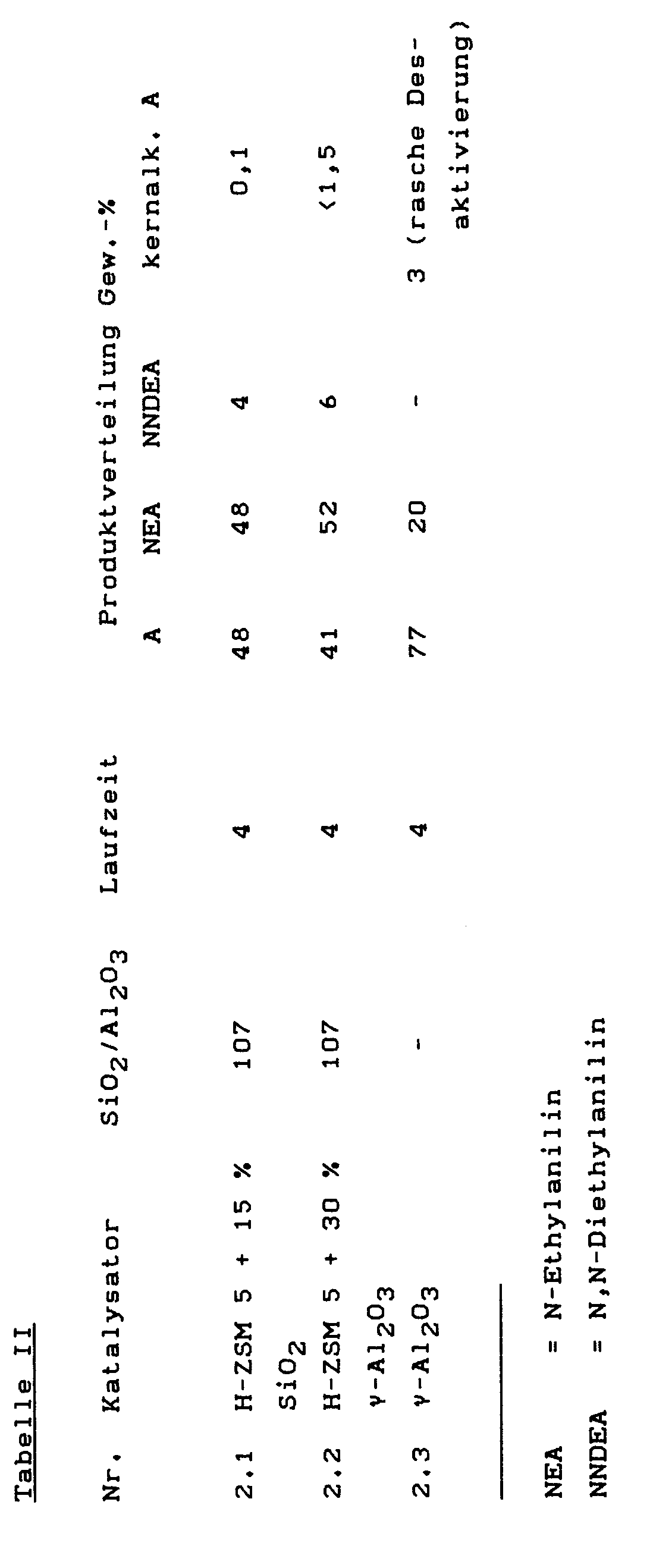
- Es wurde so verfahren, wie in Beispiel 1 beschrieben. Als Alkylierungsmittel wurde hier jedoch Ethanol verwendet und zwar im Molverhältnis Anilin:Ethanol = 1:1. Alle Reaktionen wurden bei 300°C und einer Katalysatorbelastung von 1,0 ml/ml/h durchgeführt (siehe Tabelle II).
- Mit Ethanol erhielt man ebenfalls eine hohe Selektivität in der N-Alkylierung (2.1 und 2.2). Die N-Monoalkylierung fiel hier unter gleichen Bedingungen höher aus als bei der N-Methylierung. Das als Bindermaterial benutzte γ-Aluminiumoxid allein weist unter den Reaktionsbedingungen einen zu geringen Umsatz, Kernalkylierung und rasche Desaktivierung auf (Vergleichsbeispiel 3.3).
- Unter den Bedingungen des Beispiels 2 wurde m-Toluidin mit Ethanol umgesetzt.
- Mit H-ZSM 5 wurde die erwartete, praktisch 100 %ige N-Alkylierung gefunden und nach 100 Stunden kein Nachlassen der Katalysatoraktivität (3.1).
- Im Vergleichsbeispiel 3.2 mit H-Y wurde ein beachtlicher Teil des m-Toluidins im Kern alkyliert.

Claims (10)
- Verfahren zur Herstellung von N-alkylierten Anilinen der Formel

 R¹ C₁-C₄-Alkyl undR² Wasserstoff oder C₁-C₄-Alkyl bedeuten undR³ und R⁴ unabhängig voneinander für Wasserstoff, C₁-C₄-Alkyl, C₁-C₄-Alkoxy, Fluor, Chlor oder Brom stehen,mit C₁-C₄-Alkoholen oder den entsprechenden Dialkylethern im Verhältnis von 0,5-3 Mol Alkohol/Mol Anilin in Gegenwart von Zeolithen bei Temperaturen von 240-350° C, dadurch gekennzeichnet, daß man als Zeolithe solche des Pentasil-Typs verwendet, die Protonen enthalten und ein SiO₂/Al₂O₃-Verhältnis von 70 - 1,500 aufweisen, wobei bis zu 50 Äquivalent-% der Protonen durch Metallkationen ausgetauscht sein können, und die weiterhin mit 15 - 50 Gew.-%, bezogen auf den fertigen Zeolith-Katalysator, eines Bindemittels aus der Gruppe von Tonerden, Aluminiumsilikaten und Aluminiumoxiden, bevorzugt γ-Al₂O₃ und SiO₂, verpreßt sind.
 - Verfahren nach Anspruch 1, dadurch gekennzeichnet, daß das SiO₂/Al₂O₃-Verhältnis 80 bis 1.000 beträgt.
- Verfahren nach Anspruch 1, dadurch gekennzeichnet, daß als Pentasil-Typen ZSM 5, ZSM 11, ZSM 8, ZSM 5/ZSM 11-Intermediates, Zeta 1, Zeta 3, ZBM 10, Ultrasil, Ultrazet, TZ-01, NU-4, NU-5 oder AZ-1 eingesetzt werden.
- Verfahren nach Anspruch 3, dadurch gekennzeichnet, daß als Pentasil-Typen ZSM 5, ZSM 8, ZSM 11 oder ZSM 5/ZSM 11-Intermediates eingesetzt werden.
- Verfahren nach Anspruch 4, dadurch gekennzeichnet, daß Pentasile vom ZSM 5-Typ eingesetzt werden.
- Verfahren nach Anspruch 1, dadurch gekennzeichnet, daß 0 bis 50 Äquivalent-% der Protonen gegen Ionen von Natrium, Kalium, Magnesium, Zink, Kobalt, Kupfer, Calcium, Eisen, seltene Erden, Zinn, Mangan, Chrom, Titan, Zirkon und/oder Tantal ausgetauscht sind.
- Verfahren nach Anspruch 6, dadurch gekennzeichnet, daß 0 bis 25, bevorzugt 0 bis 10, besonders bevorzugt 0 bis 5 Äquivalent-% der Protonen ausgetauscht sind.
- Verfahren nach Anspruch 1, dadurch gekennzeichnet, daß bei absatzweiser Reaktionsführung in der Flüssigphase 2 bis 50 Gew.-%, bevorzugt 5 bis 40 Gew.-%, besonders bevorzugt 7 bis 30 Gew.-%, Pentasil-Zeolith, bezogen auf das Gesamtgewicht des Ansatzes, angewandt werden.
- Verfahren nach Anspruch 1, dadurch gekennzeichnet, daß bei bei kontinuierlicher Reaktionsführung in der Gasphase eine Katalysatorbelastung im Bereich von 0,01 bis 8,0, bevorzugt 0,05 bis 5,0, besonders bevorzugt 0,1 bis 4,0 Liter umzusetzendes Gemisch/l Katalysator/h eingestellt wird.
- Verfahren nach Anspruch 1, dadurch gekennzeichnet, daß bei einer Temperatur von 260 bis 330° C, gearbeitet wird.
Applications Claiming Priority (2)
| Application Number | Priority Date | Filing Date | Title |
|---|---|---|---|
| DE3803661A DE3803661A1 (de) | 1988-02-06 | 1988-02-06 | Verfahren zur herstellung von n-alkylierten anilinen |
| DE3803661 | 1988-02-06 |
Publications (2)
| Publication Number | Publication Date |
|---|---|
| EP0327875A1 EP0327875A1 (de) | 1989-08-16 |
| EP0327875B1 true EP0327875B1 (de) | 1993-03-24 |
Family
ID=6346827
Family Applications (1)
| Application Number | Title | Priority Date | Filing Date |
|---|---|---|---|
| EP89101170A Expired - Lifetime EP0327875B1 (de) | 1988-02-06 | 1989-01-24 | Verfahren zur Herstellung von N-alkylierten Anilinen |
Country Status (4)
| Country | Link |
|---|---|
| US (1) | US5068434A (de) |
| EP (1) | EP0327875B1 (de) |
| JP (1) | JP2553183B2 (de) |
| DE (2) | DE3803661A1 (de) |
Families Citing this family (8)
| Publication number | Priority date | Publication date | Assignee | Title |
|---|---|---|---|---|
| DE3928152A1 (de) * | 1989-08-25 | 1991-02-28 | Bayer Ag | Verfahren zur herstellung von n,n-dialkylanilinen |
| EP0433811B1 (de) * | 1989-12-21 | 1995-06-28 | Bayer Ag | Verfahren zur Herstellung von N-alkylierten aromatischen Aminen |
| TW401406B (en) * | 1993-07-20 | 2000-08-11 | Nissan Chemiacl Ind Ltd | The alkylation method of the triazine derivitives |
| CN1041399C (zh) * | 1994-12-30 | 1998-12-30 | 中国石油化工总公司 | 一种含稀土的结晶硅酸铝沸石 |
| RU2232749C2 (ru) * | 2002-08-07 | 2004-07-20 | Открытое акционерное общество "Пигмент" | Двухступенчатый способ получения n-метиланилина |
| RU2472774C1 (ru) | 2011-09-28 | 2013-01-20 | Закрытое Акционерное Общество "Ифохим" | Способ селективного получения n-метил-пара-анизидина |
| CN103570553B (zh) | 2012-08-01 | 2016-08-10 | 中国科学院兰州化学物理研究所 | 一种通过催化烷基化制备n-取代胺类化合物的方法 |
| EP3345890A1 (de) | 2017-01-05 | 2018-07-11 | Lanxess Deutschland GmbH | Verfahren zur herstellung von n-methyl-p-toluidin für dessen einsatz als additiv für flugbenzin |
Family Cites Families (8)
| Publication number | Priority date | Publication date | Assignee | Title |
|---|---|---|---|---|
| US2012801A (en) * | 1933-02-07 | 1935-08-27 | Ig Farbenindustrie Ag | Production of alkyl derivatives of ammonia |
| US3728408A (en) * | 1969-05-05 | 1973-04-17 | Mobil Oil Corp | Conversion of polar compounds using highly siliceous zeolite-type catalysts |
| DE2335906C3 (de) * | 1973-07-14 | 1978-06-15 | Basf Ag, 6700 Ludwigshafen | Verfahren zur kontinuierlichen Herstellung von N-Alkylarylaminen |
| US4613705A (en) * | 1984-06-25 | 1986-09-23 | Ethyl Corporation | Catalytic alkylation of aromatic amines with alkanols |
| US4806689A (en) * | 1984-11-16 | 1989-02-21 | E. I. Du Pont De Nemours And Company | Zeolite Rho as catalyst for conversion of methanol and ammonia to dimethylamine |
| JPS62195350A (ja) * | 1986-02-21 | 1987-08-28 | Idemitsu Kosan Co Ltd | N−アルキル芳香族アミンの製造方法 |
| US4801752A (en) * | 1987-02-12 | 1989-01-31 | Industrial Technology Research Institute | Preparation of N-alkyl and N,N-dialkylaniline |
| JPH02195350A (ja) * | 1989-01-24 | 1990-08-01 | Fuji Photo Film Co Ltd | 画像形成用溶媒塗布装置 |
-
1988
- 1988-02-06 DE DE3803661A patent/DE3803661A1/de not_active Withdrawn
-
1989
- 1989-01-24 DE DE8989101170T patent/DE58903851D1/de not_active Expired - Fee Related
- 1989-01-24 EP EP89101170A patent/EP0327875B1/de not_active Expired - Lifetime
- 1989-01-25 US US07/301,929 patent/US5068434A/en not_active Expired - Lifetime
- 1989-02-01 JP JP1020930A patent/JP2553183B2/ja not_active Expired - Fee Related
Non-Patent Citations (8)
| Title |
|---|
| 7th Intern. Zeolite Conf., S. 739-44, Tokyo, 1986 * |
| CHEMICAL ABSTRACTS, Band 103, Nr. 17, 28. Oktober 1985, Seite 684, Spalte 1, Zusammenfassung Nr. 141538p, Columbus, Ohio, USA; O. MAKOTO et al: "Selective N-monoalkylation of aniline derivatives by use of alkali cation exchanged X- and Y-type zeolites" * |
| CHEMICAL ABSTRACTS, Band 103, Nr. 2, 15. Juli 1985, Seite 75, Spalte 1, Zusammenfassung Nr. 7725u, Columbus, Ohio, USA; G. O. CHIVADZE et al: "Alkylation of aniline by methanol on modified synthetic zeolites" * |
| CHEMICAL ABSTRACTS, Band 107, Nr. 1, 6. Juli 1987, Seite 616, Spalte 1, Zusammenfassung Nr. 6705h, Columbus, Ohio, USA; P. Y. CHEN et al: "The selective alkylation of aniline with methanol over ZSM-5 zeolite" * |
| CHEMICAL ABSTRACTS, Band 108, Nr. 3, 18. Januar 1988, Seite 558, Spalte 2, Zusammenfassung Nr. 21483y, Columbus, Ohio, USA; & JP-A-62 195 350 * |
| CHEMICAL ABSTRACTS, Band 109, Nr. 10, 5. September 1988, Seite 127, Spalte 1, Zusammenfassung Nr. 75635p, Columbus, Ohio, USA; K. WU et al: "Alkylation of aniline with methanol over ZSM-5 and ADHM zeolites" * |
| CHEMICAL ABSTRACTS, Band 84, Nr. 17, 26. April 1976, Seite 500, Spalte 1, Zusammenfassung Nr. 121339k, Columbus, Ohio, USA; T. NOBUO et al: "N-Methylation of aniline with methanol over transition metal zeolite" * |
| PATENT ABSTRACTS OF JAPAN, Band 12, Nr. 47 (C-475)(2894), 12. Februar 1988; & JP-A-62 195 350 * |
Also Published As
| Publication number | Publication date |
|---|---|
| JPH021431A (ja) | 1990-01-05 |
| JP2553183B2 (ja) | 1996-11-13 |
| US5068434A (en) | 1991-11-26 |
| EP0327875A1 (de) | 1989-08-16 |
| DE58903851D1 (de) | 1993-04-29 |
| DE3803661A1 (de) | 1989-08-17 |
Similar Documents
| Publication | Publication Date | Title |
|---|---|---|
| US4740620A (en) | Alkylation of aromatic amines in the presence of acidic, crystalline molecular sieves | |
| DE19535395C1 (de) | Verfahren zur Hydrogenolyse von C-O und C=O Bindungen in organischen Substanzen | |
| EP0351661B1 (de) | Ruthenium-Trägerkatalysator, seine Herstellung und sein Einsatz bei der Herstellung von gegebenenfalls substituiertem Cyclohexylamin und gegebenenfalls substituiertem Dicyclohexylamin | |
| DE3703291A1 (de) | Verfahren zur herstellung von 2,6-dialkylnaphthalin | |
| EP0431451B1 (de) | Verfahren zur Herstellung von Aminen | |
| DE3803661A1 (de) | Verfahren zur herstellung von n-alkylierten anilinen | |
| EP0092103B1 (de) | Verfahren zur Herstellung von o-Toluidin und/oder m-Toluidin und/oder p-Toluidin | |
| DE60021305T2 (de) | Verfahren zur Herstellung von Diaminodiphenylmethan und seiner höheren Homologen | |
| EP0164045B1 (de) | Verfahren zur Isomerisierung von Mono- oder Dichlortoluolen | |
| EP0433811B1 (de) | Verfahren zur Herstellung von N-alkylierten aromatischen Aminen | |
| EP0844991B1 (de) | Verfahren zur herstellung von aminen aus olefinen an bor-beta-zeolithen | |
| DE68908010T2 (de) | Methode zur Erhaltung der Aktivität von Zeolit-Katalysatoren. | |
| DE3309354C2 (de) | Verfahren zur Herstellung von 2-substituierten 6-Methylanilinen | |
| DE2348738A1 (de) | N-alkylierung aromatischer amine | |
| EP0327874B1 (de) | Verfahren zur Herstellung von N-Alkylanilinen | |
| DE69023451T2 (de) | Orthoalkylierung von aromatischen Aminen. | |
| EP0414077B1 (de) | Verfahren zur Herstellung von N,N-Dialkylaninlinen | |
| DE69019454T2 (de) | Orthoalkylierung von aromatischen Aminen. | |
| US5068435A (en) | Ortho-alkylated aromatic amines via gamma alumina catalyst | |
| DE4013613A1 (de) | Selektive n-alkylierung von anilinen | |
| DE3543228A1 (de) | Verfahren zur herstellung von linearen polyalkylenpolyaminen | |
| EP0513640B1 (de) | Verfahren zur Herstellung von Dicyclohexylaminen | |
| DE69815690T2 (de) | Herstellung von alkylierten aromatischen Aminen | |
| DE4013614A1 (de) | Verfahren zur selektiven ringalkylierung von anilinen | |
| EP0164046B1 (de) | Verfahren zur Isomerisierung von o-, m-, und/oder p-Toluidin |
Legal Events
| Date | Code | Title | Description |
|---|---|---|---|
| PUAI | Public reference made under article 153(3) epc to a published international application that has entered the european phase |
Free format text: ORIGINAL CODE: 0009012 |
|
| 17P | Request for examination filed |
Effective date: 19890124 |
|
| AK | Designated contracting states |
Kind code of ref document: A1 Designated state(s): BE DE FR GB IT |
|
| 17Q | First examination report despatched |
Effective date: 19910402 |
|
| GRAA | (expected) grant |
Free format text: ORIGINAL CODE: 0009210 |
|
| AK | Designated contracting states |
Kind code of ref document: B1 Designated state(s): BE DE FR GB IT |
|
| REF | Corresponds to: |
Ref document number: 58903851 Country of ref document: DE Date of ref document: 19930429 |
|
| GBT | Gb: translation of ep patent filed (gb section 77(6)(a)/1977) |
Effective date: 19930413 |
|
| ITF | It: translation for a ep patent filed | ||
| ET | Fr: translation filed | ||
| PLBE | No opposition filed within time limit |
Free format text: ORIGINAL CODE: 0009261 |
|
| STAA | Information on the status of an ep patent application or granted ep patent |
Free format text: STATUS: NO OPPOSITION FILED WITHIN TIME LIMIT |
|
| ITTA | It: last paid annual fee | ||
| 26N | No opposition filed | ||
| PGFP | Annual fee paid to national office [announced via postgrant information from national office to epo] |
Ref country code: DE Payment date: 20011213 Year of fee payment: 14 |
|
| REG | Reference to a national code |
Ref country code: GB Ref legal event code: IF02 |
|
| PGFP | Annual fee paid to national office [announced via postgrant information from national office to epo] |
Ref country code: GB Payment date: 20020123 Year of fee payment: 14 Ref country code: FR Payment date: 20020123 Year of fee payment: 14 |
|
| PGFP | Annual fee paid to national office [announced via postgrant information from national office to epo] |
Ref country code: BE Payment date: 20020130 Year of fee payment: 14 |
|
| PG25 | Lapsed in a contracting state [announced via postgrant information from national office to epo] |
Ref country code: GB Free format text: LAPSE BECAUSE OF NON-PAYMENT OF DUE FEES Effective date: 20030124 |
|
| PG25 | Lapsed in a contracting state [announced via postgrant information from national office to epo] |
Ref country code: BE Free format text: LAPSE BECAUSE OF NON-PAYMENT OF DUE FEES Effective date: 20030131 |
|
| PG25 | Lapsed in a contracting state [announced via postgrant information from national office to epo] |
Ref country code: DE Free format text: LAPSE BECAUSE OF NON-PAYMENT OF DUE FEES Effective date: 20030801 |
|
| GBPC | Gb: european patent ceased through non-payment of renewal fee | ||
| PG25 | Lapsed in a contracting state [announced via postgrant information from national office to epo] |
Ref country code: FR Free format text: LAPSE BECAUSE OF NON-PAYMENT OF DUE FEES Effective date: 20030930 |
|
| REG | Reference to a national code |
Ref country code: FR Ref legal event code: ST |
|
| PG25 | Lapsed in a contracting state [announced via postgrant information from national office to epo] |
Ref country code: IT Free format text: LAPSE BECAUSE OF NON-PAYMENT OF DUE FEES;WARNING: LAPSES OF ITALIAN PATENTS WITH EFFECTIVE DATE BEFORE 2007 MAY HAVE OCCURRED AT ANY TIME BEFORE 2007. THE CORRECT EFFECTIVE DATE MAY BE DIFFERENT FROM THE ONE RECORDED. Effective date: 20050124 |