EP0325567A2 - Procédé de préparation d'un électrocatalyseur - Google Patents
Procédé de préparation d'un électrocatalyseur Download PDFInfo
- Publication number
- EP0325567A2 EP0325567A2 EP89830020A EP89830020A EP0325567A2 EP 0325567 A2 EP0325567 A2 EP 0325567A2 EP 89830020 A EP89830020 A EP 89830020A EP 89830020 A EP89830020 A EP 89830020A EP 0325567 A2 EP0325567 A2 EP 0325567A2
- Authority
- EP
- European Patent Office
- Prior art keywords
- catalyst metal
- particles
- electrocatalyst
- support
- platinum
- Prior art date
- Legal status (The legal status is an assumption and is not a legal conclusion. Google has not performed a legal analysis and makes no representation as to the accuracy of the status listed.)
- Granted
Links
Images
Classifications
-
- H—ELECTRICITY
- H01—ELECTRIC ELEMENTS
- H01M—PROCESSES OR MEANS, e.g. BATTERIES, FOR THE DIRECT CONVERSION OF CHEMICAL ENERGY INTO ELECTRICAL ENERGY
- H01M4/00—Electrodes
- H01M4/86—Inert electrodes with catalytic activity, e.g. for fuel cells
- H01M4/90—Selection of catalytic material
- H01M4/92—Metals of platinum group
- H01M4/925—Metals of platinum group supported on carriers, e.g. powder carriers
- H01M4/926—Metals of platinum group supported on carriers, e.g. powder carriers on carbon or graphite
-
- H—ELECTRICITY
- H01—ELECTRIC ELEMENTS
- H01M—PROCESSES OR MEANS, e.g. BATTERIES, FOR THE DIRECT CONVERSION OF CHEMICAL ENERGY INTO ELECTRICAL ENERGY
- H01M4/00—Electrodes
- H01M4/86—Inert electrodes with catalytic activity, e.g. for fuel cells
- H01M4/90—Selection of catalytic material
- H01M4/92—Metals of platinum group
-
- B—PERFORMING OPERATIONS; TRANSPORTING
- B01—PHYSICAL OR CHEMICAL PROCESSES OR APPARATUS IN GENERAL
- B01J—CHEMICAL OR PHYSICAL PROCESSES, e.g. CATALYSIS OR COLLOID CHEMISTRY; THEIR RELEVANT APPARATUS
- B01J21/00—Catalysts comprising the elements, oxides, or hydroxides of magnesium, boron, aluminium, carbon, silicon, titanium, zirconium, or hafnium
- B01J21/18—Carbon
-
- H—ELECTRICITY
- H01—ELECTRIC ELEMENTS
- H01M—PROCESSES OR MEANS, e.g. BATTERIES, FOR THE DIRECT CONVERSION OF CHEMICAL ENERGY INTO ELECTRICAL ENERGY
- H01M4/00—Electrodes
- H01M4/86—Inert electrodes with catalytic activity, e.g. for fuel cells
- H01M2004/8678—Inert electrodes with catalytic activity, e.g. for fuel cells characterised by the polarity
- H01M2004/8689—Positive electrodes
-
- H—ELECTRICITY
- H01—ELECTRIC ELEMENTS
- H01M—PROCESSES OR MEANS, e.g. BATTERIES, FOR THE DIRECT CONVERSION OF CHEMICAL ENERGY INTO ELECTRICAL ENERGY
- H01M2300/00—Electrolytes
- H01M2300/0002—Aqueous electrolytes
- H01M2300/0005—Acid electrolytes
- H01M2300/0008—Phosphoric acid-based
-
- H—ELECTRICITY
- H01—ELECTRIC ELEMENTS
- H01M—PROCESSES OR MEANS, e.g. BATTERIES, FOR THE DIRECT CONVERSION OF CHEMICAL ENERGY INTO ELECTRICAL ENERGY
- H01M2300/00—Electrolytes
- H01M2300/0017—Non-aqueous electrolytes
- H01M2300/0065—Solid electrolytes
- H01M2300/0082—Organic polymers
-
- H—ELECTRICITY
- H01—ELECTRIC ELEMENTS
- H01M—PROCESSES OR MEANS, e.g. BATTERIES, FOR THE DIRECT CONVERSION OF CHEMICAL ENERGY INTO ELECTRICAL ENERGY
- H01M4/00—Electrodes
- H01M4/86—Inert electrodes with catalytic activity, e.g. for fuel cells
- H01M4/90—Selection of catalytic material
- H01M4/92—Metals of platinum group
- H01M4/921—Alloys or mixtures with metallic elements
-
- Y—GENERAL TAGGING OF NEW TECHNOLOGICAL DEVELOPMENTS; GENERAL TAGGING OF CROSS-SECTIONAL TECHNOLOGIES SPANNING OVER SEVERAL SECTIONS OF THE IPC; TECHNICAL SUBJECTS COVERED BY FORMER USPC CROSS-REFERENCE ART COLLECTIONS [XRACs] AND DIGESTS
- Y02—TECHNOLOGIES OR APPLICATIONS FOR MITIGATION OR ADAPTATION AGAINST CLIMATE CHANGE
- Y02E—REDUCTION OF GREENHOUSE GAS [GHG] EMISSIONS, RELATED TO ENERGY GENERATION, TRANSMISSION OR DISTRIBUTION
- Y02E60/00—Enabling technologies; Technologies with a potential or indirect contribution to GHG emissions mitigation
- Y02E60/30—Hydrogen technology
- Y02E60/50—Fuel cells
Definitions
- the present invention relates to an electrocatalyst which can be employed in various electrolysis reactions, especially which is capable of obtaining higher reaction activity for oxygen reduction with a lesser amount of the catalyst metal in a liquid or solid polymer- or solid electrolyte-type fuel cell in which an oxygen reduction reaction occurs as a cathode reaction.
- the mass activity elevation has been intended by making the specific surface area larger by means of reduction of the particle size of the platinum particles supported, it has the limit as the platinum catalyst does.
- the said phenomenon which has not been avoided is called "loss of mass activity" which is a large barrier especially against the mass activity elevation of the platinum.
- the surface area is increased not by reducing the active metal particle size, but by increasing the platinum amount with the sacrifice of profitability, it is technically difficult in this case to support the platinum particles having the particle size near the limit in which the activity loss may occur on the support by reason of platinum loading.
- the amount of a support catalyst forming an electrode reaction layer is increased to increase the platinum surface area in order to achieve the same object, the reaction layer becomes too thick to elevate the performance so that there arises a problem that the expected gas permeation efficiency cannot be achieved.
- An object of this invention is to provide an electrocatalyst which elevates the mass activity of platinum and the like especially in a fuel cell.
- Another object of the invention is to provide an electrocatalyst substantially free from the mass activity loss.
- the present invention is an electrocatalyst comprising a support and active catalyst metal particles supported theron in which an average interparticle distance of the metal particles is at least 15 nm.
- the average interparticle distance of the active catalyst metals supported on the support of the electrocatalyst according to the present invention is made at least 15 nm by adjusting the specific surface area of the support, the amount of the supported catalyst metals and so on.
- the overlapping of the territories around the particles between the adjacent particles diminishes thereby so that the desired activity value can be obtained without the decrease of the specific activity even when the particle diameter of the catalyst particles is considerably decreased.
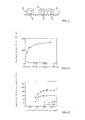
- Catalyst metal particles 2 which are platinum particles in the drawing supported on the surface of a support 1 have an inactive area near the surface of the support 1 (dotted line portion) and an active area opposite to the surface of the support 1 (solid line portion).
- Fig. 2 is a graph showing the dependency of the specific surface area variation of a platinum crystallite on the BET specific surface area of various carbons. The graph shows that the carbon having a larger surface area gives better dispersion of the platinum crystallite, that is, 170 m 2 /g-Pt. It is not surface conditions but a specific surface area which is important for obtaining highly dispersed catalyst metal particles.
- Fig. 3 which is the result of the below Example shows the relation between a specific surface area of various carbon catalysts having various specific surface areas supporting platinum particles on their surfaces and an interparticle distance of the platinum particles in the case that the catalysts are employed as those for oxygen reduction on the cathode (air electrode or oxygen electrode) of a fuel cell.
- the graph shows that the activity per the unit surface area of the platinum gradually increases with the increase of the interparticle distance, and the activity reaches the maximum value at about 17 nm in case of oxygen and at 20 nm in case of air, respectively, and further increase of the interparticle distance scarcely influences the specific activity.
- the specific activity of the platinum reaches the maximum value at around 17 to 20 nm, and the specific activity can be maintained nearly constant by increasing the interparticle distance beyond that value.
- the said interparticle distance can be set optionally by adjusting the specific surface area of the support, the particle diameter of the catalyst metal and the supported amount thereof.
- the supporting method of the catalyst metal is not particularly restricted, a colloid method in which the catalyst metal is supported by applying colloid containing the catalyst metal directly on the support; a thermal decomposition method in which a solution of a compound of the catalyst metal is applied before it is thermally decomposed; a reduction method in which a solution of a compound of the catalyst metal is mixed with the support and the compound of the catalyst metal is reduced by means of an appropriate reducing agent and the like can be employed.
- the electrocatalyst having the desired activity value can be obtained by increasing the interparticle distance of the catalyst metal particles, especially the platinum or platinum alloy particles, beyond the value employed in the prior art without decrease of the specific activity even when the particle diameter of the catalyst metal particles is considerably decreased.
- acetylene black particles diameter: about 10 to 50 m ⁇ ; surface area: about 60 to 800 m 2 /g
- furnace black particle diameter: about 10 to 30 m ⁇ ; surface area: about 200 to 1400 m 2 /g
- 10 % of platinum colloid was supported to each 10 g of respective these eight different supports to prepare respective two platinum supported carbon catalysts for the eight supports each having an interparticle distance of about 13.7, 15.6, 17.5, 19.2, 19.7, 21, 21.6 and 27 nm.
- the interparticle distance was calculated according to the following equation on the assumption that the catalyst particles were regularly arranged on the surface of the carbon support in the closest packing. Wherein, a: density of the catalyst metal particles (unit:g/nm 3 )
- the platinum particles were observed to be uniformly dispersed on the support, and the interparticle distance was confirmed by TEM.
- the respective carbon supports were formed into a gas permeable electrode for oxygen reduction in a fuel cell with 30 O /o by weight of polytetrafluoroethylene by means of a hot-press method.
- the reduction activity of pure oxygen was measured with one of the above two catalysts and that of oxygen in air with the other catalyst at one atmosphere, 190 °C and at a constant voltage (0.9 V for the pure oxygen and 0.8 V for air) employing 100 O /o phosphoric acid as an electrolyte.
- the result was shown in the graph of Fig. 3 and the below Table.
Landscapes
- Chemical & Material Sciences (AREA)
- Engineering & Computer Science (AREA)
- Materials Engineering (AREA)
- Chemical Kinetics & Catalysis (AREA)
- Electrochemistry (AREA)
- General Chemical & Material Sciences (AREA)
- Catalysts (AREA)
- Inert Electrodes (AREA)
Applications Claiming Priority (2)
| Application Number | Priority Date | Filing Date | Title |
|---|---|---|---|
| JP12405/88 | 1988-01-22 | ||
| JP63012405A JP2977199B2 (ja) | 1988-01-22 | 1988-01-22 | 電極触媒 |
Publications (3)
| Publication Number | Publication Date |
|---|---|
| EP0325567A2 true EP0325567A2 (fr) | 1989-07-26 |
| EP0325567A3 EP0325567A3 (en) | 1989-09-06 |
| EP0325567B1 EP0325567B1 (fr) | 1993-12-15 |
Family
ID=11804352
Family Applications (1)
| Application Number | Title | Priority Date | Filing Date |
|---|---|---|---|
| EP89830020A Revoked EP0325567B1 (fr) | 1988-01-22 | 1989-01-20 | Procédé de préparation d'un électrocatalyseur |
Country Status (3)
| Country | Link |
|---|---|
| EP (1) | EP0325567B1 (fr) |
| JP (1) | JP2977199B2 (fr) |
| DE (1) | DE68911323T2 (fr) |
Cited By (3)
| Publication number | Priority date | Publication date | Assignee | Title |
|---|---|---|---|---|
| US7803734B2 (en) | 2004-06-10 | 2010-09-28 | Sumitomo Electric Industries, Ltd. | Metal catalyst and method for production thereof |
| EP1427041A3 (fr) * | 2002-11-29 | 2011-03-09 | Honda Motor Co., Ltd. | Revêtement de catalyseur optimisé pour électrode de pile à combustible comprenant membrane à électrolyte solide polymérique |
| WO2014033202A1 (fr) | 2012-08-29 | 2014-03-06 | University Of Copenhagen | Matériau catalyseur présentant une activité spécifique améliorée |
Families Citing this family (2)
| Publication number | Priority date | Publication date | Assignee | Title |
|---|---|---|---|---|
| JP3106971B2 (ja) * | 1996-08-21 | 2000-11-06 | トヨタ自動車株式会社 | 酸素センサ |
| JP7344484B1 (ja) * | 2023-01-23 | 2023-09-14 | 石福金属興業株式会社 | 触媒担持カーボン、それを用いた固体高分子形燃料電池用膜電極接合体および固体高分子形燃料電池 |
Family Cites Families (6)
| Publication number | Priority date | Publication date | Assignee | Title |
|---|---|---|---|---|
| US4044193A (en) * | 1971-06-16 | 1977-08-23 | Prototech Company | Finely particulated colloidal platinum compound and sol for producing the same, and method of preparation of fuel cell electrodes and the like employing the same |
| US3953368A (en) * | 1971-11-01 | 1976-04-27 | Exxon Research And Engineering Co. | Polymetallic cluster compositions useful as hydrocarbon conversion catalysts |
| US4136059A (en) * | 1977-12-12 | 1979-01-23 | United Technologies Corporation | Method for producing highly dispersed catalytic platinum |
| US4186110A (en) * | 1978-07-03 | 1980-01-29 | United Technologies Corporation | Noble metal-refractory metal alloys as catalysts and method for making |
| DE2835629A1 (de) * | 1978-08-14 | 1980-02-28 | Shell Oil Co | Katalysator fuer die hydrazinzersetzung und verfahren zu seiner herstellung |
| JPS62269751A (ja) * | 1986-05-16 | 1987-11-24 | Nippon Engeruharudo Kk | 白金−銅合金電極触媒およびそれを使用した酸電解質燃料電池用電極 |
-
1988
- 1988-01-22 JP JP63012405A patent/JP2977199B2/ja not_active Expired - Lifetime
-
1989
- 1989-01-20 EP EP89830020A patent/EP0325567B1/fr not_active Revoked
- 1989-01-20 DE DE68911323T patent/DE68911323T2/de not_active Revoked
Cited By (3)
| Publication number | Priority date | Publication date | Assignee | Title |
|---|---|---|---|---|
| EP1427041A3 (fr) * | 2002-11-29 | 2011-03-09 | Honda Motor Co., Ltd. | Revêtement de catalyseur optimisé pour électrode de pile à combustible comprenant membrane à électrolyte solide polymérique |
| US7803734B2 (en) | 2004-06-10 | 2010-09-28 | Sumitomo Electric Industries, Ltd. | Metal catalyst and method for production thereof |
| WO2014033202A1 (fr) | 2012-08-29 | 2014-03-06 | University Of Copenhagen | Matériau catalyseur présentant une activité spécifique améliorée |
Also Published As
| Publication number | Publication date |
|---|---|
| JP2977199B2 (ja) | 1999-11-10 |
| EP0325567A3 (en) | 1989-09-06 |
| EP0325567B1 (fr) | 1993-12-15 |
| JPH0265064A (ja) | 1990-03-05 |
| DE68911323T2 (de) | 1994-07-07 |
| DE68911323D1 (de) | 1994-01-27 |
Similar Documents
| Publication | Publication Date | Title |
|---|---|---|
| Watanabe et al. | High platinum electrocatalyst utilizations for direct methanol oxidation | |
| CA1161824A (fr) | Catalyseurs en alliage de metal noble et de chrome | |
| Jiang et al. | Size-dependent activity of palladium nanoparticles for oxygen electroreduction in alkaline solutions | |
| Jiang et al. | Oxygen reduction reaction on carbon supported Pt and Pd in alkaline solutions | |
| Pinheiro et al. | Electrocatalysis on noble metal and noble metal alloys dispersed on high surface area carbon | |
| Tripković et al. | Methanol electrooxidation on supported Pt and PtRu catalysts in acid and alkaline solutions | |
| CA2039464C (fr) | Platine contenant du materiel electrocatalyseur | |
| Hartl et al. | IL-TEM investigations on the degradation mechanism of Pt/C electrocatalysts with different carbon supports | |
| JP4230920B2 (ja) | 担持されたナノ粒子触媒の製造方法 | |
| Choi et al. | Designed synthesis of well‐defined Pd@ Pt core–shell nanoparticles with controlled shell thickness as efficient oxygen reduction electrocatalysts | |
| Hou et al. | CO tolerance electrocatalyst of PtRu-HxMeO3/C (Me= W, Mo) made by composite support method | |
| Kumar et al. | Nafion-stabilised platinum nanoparticles supported on titanium nitride: An efficient and durable electrocatalyst for phosphoric acid based polymer electrolyte fuel cells | |
| US20050282061A1 (en) | Catalyst support for an electrochemical fuel cell | |
| Ohno et al. | Remarkable mass activities for the oxygen evolution reaction at iridium oxide nanocatalysts dispersed on tin oxides for polymer electrolyte membrane water electrolysis | |
| Kim et al. | A novel non-platinum group electrocatalyst for PEM fuel cell application | |
| Sun et al. | A rotating disk electrode study of the particle size effects of Pt for the hydrogen oxidation reaction | |
| GB2242203A (en) | Catalyst material comprising platinum alloy supported on carbon | |
| Dos Santos et al. | Preparation and characterization of supported Pt–Ru catalysts with a high Ru content | |
| Ahn et al. | Effect of N-doped carbon coatings on the durability of highly loaded platinum and alloy catalysts with different carbon supports for polymer electrolyte membrane fuel cells | |
| Chen et al. | Investigation of the Pt–Ni–Pb/C ternary alloy catalysts for methanol electrooxidation | |
| Marinkas et al. | Enhanced stability of multilayer graphene-supported catalysts for polymer electrolyte membrane fuel cell cathodes | |
| Favilla et al. | Size control of carbon-supported platinum nanoparticles made using polyol method for low temperature fuel cells | |
| Colmati et al. | Effect of thermal treatment on phase composition and ethanol oxidation activity of a carbon supported Pt50Sn50 alloy catalyst | |
| Solorza-Feria et al. | Temperature effects for oxygen reduction on Ru-nanoparticles in acid solution | |
| EP0325567A2 (fr) | Procédé de préparation d'un électrocatalyseur |
Legal Events
| Date | Code | Title | Description |
|---|---|---|---|
| PUAI | Public reference made under article 153(3) epc to a published international application that has entered the european phase |
Free format text: ORIGINAL CODE: 0009012 |
|
| PUAL | Search report despatched |
Free format text: ORIGINAL CODE: 0009013 |
|
| AK | Designated contracting states |
Kind code of ref document: A2 Designated state(s): DE GB IT |
|
| AK | Designated contracting states |
Kind code of ref document: A3 Designated state(s): DE GB IT |
|
| 17P | Request for examination filed |
Effective date: 19900212 |
|
| 17Q | First examination report despatched |
Effective date: 19920114 |
|
| ITF | It: translation for a ep patent filed | ||
| GRAA | (expected) grant |
Free format text: ORIGINAL CODE: 0009210 |
|
| AK | Designated contracting states |
Kind code of ref document: B1 Designated state(s): DE GB IT |
|
| REF | Corresponds to: |
Ref document number: 68911323 Country of ref document: DE Date of ref document: 19940127 |
|
| ITTA | It: last paid annual fee | ||
| PLBI | Opposition filed |
Free format text: ORIGINAL CODE: 0009260 |
|
| 26 | Opposition filed |
Opponent name: DEGUSSA AG, FRANKFURT - ZWEIGNIEDERLASSUNG WOLFGAN Effective date: 19940915 |
|
| APAC | Appeal dossier modified |
Free format text: ORIGINAL CODE: EPIDOS NOAPO |
|
| APAA | Appeal reference recorded |
Free format text: ORIGINAL CODE: EPIDOS REFN |
|
| PGFP | Annual fee paid to national office [announced via postgrant information from national office to epo] |
Ref country code: DE Payment date: 19970320 Year of fee payment: 9 |
|
| PGFP | Annual fee paid to national office [announced via postgrant information from national office to epo] |
Ref country code: GB Payment date: 19980112 Year of fee payment: 10 |
|
| APAC | Appeal dossier modified |
Free format text: ORIGINAL CODE: EPIDOS NOAPO |
|
| RDAG | Patent revoked |
Free format text: ORIGINAL CODE: 0009271 |
|
| STAA | Information on the status of an ep patent application or granted ep patent |
Free format text: STATUS: PATENT REVOKED |
|
| 27W | Patent revoked |
Effective date: 19980223 |
|
| GBPR | Gb: patent revoked under art. 102 of the ep convention designating the uk as contracting state |
Free format text: 980223 |
|
| APAH | Appeal reference modified |
Free format text: ORIGINAL CODE: EPIDOSCREFNO |