EP0321563B1 - Spirooxazine compounds, photosensitive materials using them, and process for forming them - Google Patents
Spirooxazine compounds, photosensitive materials using them, and process for forming them Download PDFInfo
- Publication number
- EP0321563B1 EP0321563B1 EP19870904318 EP87904318A EP0321563B1 EP 0321563 B1 EP0321563 B1 EP 0321563B1 EP 19870904318 EP19870904318 EP 19870904318 EP 87904318 A EP87904318 A EP 87904318A EP 0321563 B1 EP0321563 B1 EP 0321563B1
- Authority
- EP
- European Patent Office
- Prior art keywords
- group
- carbon atoms
- formula
- spiro
- hydrogen atom
- Prior art date
- Legal status (The legal status is an assumption and is not a legal conclusion. Google has not performed a legal analysis and makes no representation as to the accuracy of the status listed.)
- Expired
Links
- 239000000463 material Substances 0.000 title claims abstract description 47
- 238000000034 method Methods 0.000 title claims abstract description 23
- 150000001875 compounds Chemical class 0.000 title abstract description 63
- 125000000217 alkyl group Chemical group 0.000 claims abstract description 33
- 125000004435 hydrogen atom Chemical group [H]* 0.000 claims abstract description 27
- 125000003545 alkoxy group Chemical group 0.000 claims abstract description 19
- 125000005843 halogen group Chemical group 0.000 claims abstract description 19
- 229920005989 resin Polymers 0.000 claims abstract description 18
- 239000011347 resin Substances 0.000 claims abstract description 18
- 125000004453 alkoxycarbonyl group Chemical group 0.000 claims abstract description 12
- 125000005138 alkoxysulfonyl group Chemical group 0.000 claims abstract description 11
- 125000004390 alkyl sulfonyl group Chemical group 0.000 claims abstract description 9
- 125000002947 alkylene group Chemical group 0.000 claims abstract description 7
- 125000000113 cyclohexyl group Chemical group [H]C1([H])C([H])([H])C([H])([H])C([H])(*)C([H])([H])C1([H])[H] 0.000 claims abstract description 6
- 125000004430 oxygen atom Chemical group O* 0.000 claims abstract description 4
- 125000001424 substituent group Chemical group 0.000 claims abstract description 4
- 125000004432 carbon atom Chemical group C* 0.000 claims description 61
- 238000000465 moulding Methods 0.000 claims description 18
- 229920002037 poly(vinyl butyral) polymer Polymers 0.000 claims description 9
- 125000002496 methyl group Chemical group [H]C([H])([H])* 0.000 claims description 6
- 125000000732 arylene group Chemical group 0.000 claims description 4
- 125000000956 methoxy group Chemical group [H]C([H])([H])O* 0.000 claims description 2
- 229920000058 polyacrylate Polymers 0.000 claims description 2
- 125000005649 substituted arylene group Chemical group 0.000 abstract 1
- ZWEHNKRNPOVVGH-UHFFFAOYSA-N 2-Butanone Chemical compound CCC(C)=O ZWEHNKRNPOVVGH-UHFFFAOYSA-N 0.000 description 30
- UHOVQNZJYSORNB-UHFFFAOYSA-N Benzene Chemical compound C1=CC=CC=C1 UHOVQNZJYSORNB-UHFFFAOYSA-N 0.000 description 21
- 239000000203 mixture Substances 0.000 description 18
- -1 di-substituted phenyl group Chemical group 0.000 description 17
- LFQSCWFLJHTTHZ-UHFFFAOYSA-N Ethanol Chemical compound CCO LFQSCWFLJHTTHZ-UHFFFAOYSA-N 0.000 description 16
- 239000002904 solvent Substances 0.000 description 16
- 238000010438 heat treatment Methods 0.000 description 13
- 239000000243 solution Substances 0.000 description 11
- 0 *C(*)(C12Oc(ccc3ccccc33)c3N=C1)C(C=C*C=C1)=C1N2*=C Chemical compound *C(*)(C12Oc(ccc3ccccc33)c3N=C1)C(C=C*C=C1)=C1N2*=C 0.000 description 10
- ZMANZCXQSJIPKH-UHFFFAOYSA-N Triethylamine Chemical compound CCN(CC)CC ZMANZCXQSJIPKH-UHFFFAOYSA-N 0.000 description 9
- 238000002844 melting Methods 0.000 description 9
- 230000008018 melting Effects 0.000 description 9
- 239000011521 glass Substances 0.000 description 8
- 238000001819 mass spectrum Methods 0.000 description 8
- 230000015572 biosynthetic process Effects 0.000 description 7
- 239000011159 matrix material Substances 0.000 description 7
- BXXWFOGWXLJPPA-UHFFFAOYSA-N 2,3-dibromobutane Chemical compound CC(Br)C(C)Br BXXWFOGWXLJPPA-UHFFFAOYSA-N 0.000 description 6
- CSCPPACGZOOCGX-UHFFFAOYSA-N Acetone Chemical compound CC(C)=O CSCPPACGZOOCGX-UHFFFAOYSA-N 0.000 description 6
- HEDRZPFGACZZDS-UHFFFAOYSA-N Chloroform Chemical compound ClC(Cl)Cl HEDRZPFGACZZDS-UHFFFAOYSA-N 0.000 description 6
- YMWUJEATGCHHMB-UHFFFAOYSA-N Dichloromethane Chemical compound ClCCl YMWUJEATGCHHMB-UHFFFAOYSA-N 0.000 description 6
- KFZMGEQAYNKOFK-UHFFFAOYSA-N Isopropanol Chemical compound CC(C)O KFZMGEQAYNKOFK-UHFFFAOYSA-N 0.000 description 6
- OKKJLVBELUTLKV-UHFFFAOYSA-N Methanol Chemical compound OC OKKJLVBELUTLKV-UHFFFAOYSA-N 0.000 description 6
- 238000004440 column chromatography Methods 0.000 description 6
- 238000001816 cooling Methods 0.000 description 6
- 238000004821 distillation Methods 0.000 description 6
- 239000003480 eluent Substances 0.000 description 6
- 238000000354 decomposition reaction Methods 0.000 description 5
- 238000001035 drying Methods 0.000 description 5
- 229920003229 poly(methyl methacrylate) Polymers 0.000 description 5
- 239000004926 polymethyl methacrylate Substances 0.000 description 5
- FLHJIAFUWHPJRT-UHFFFAOYSA-N 2,3,3-trimethylindole Chemical class C1=CC=C2C(C)(C)C(C)=NC2=C1 FLHJIAFUWHPJRT-UHFFFAOYSA-N 0.000 description 4
- ULDFPQKCKOFNOF-UHFFFAOYSA-N 5-nitrosoquinolin-6-ol Chemical class N1=CC=CC2=C(N=O)C(O)=CC=C21 ULDFPQKCKOFNOF-UHFFFAOYSA-N 0.000 description 4
- LRHPLDYGYMQRHN-UHFFFAOYSA-N N-Butanol Chemical compound CCCCO LRHPLDYGYMQRHN-UHFFFAOYSA-N 0.000 description 4
- NQRYJNQNLNOLGT-UHFFFAOYSA-N Piperidine Chemical compound C1CCNCC1 NQRYJNQNLNOLGT-UHFFFAOYSA-N 0.000 description 4
- 238000006243 chemical reaction Methods 0.000 description 4
- 238000000576 coating method Methods 0.000 description 4
- APQIUTYORBAGEZ-UHFFFAOYSA-N 1,1-dibromoethane Chemical compound CC(Br)Br APQIUTYORBAGEZ-UHFFFAOYSA-N 0.000 description 3
- YXAOOTNFFAQIPZ-UHFFFAOYSA-N 1-nitrosonaphthalen-2-ol Chemical class C1=CC=CC2=C(N=O)C(O)=CC=C21 YXAOOTNFFAQIPZ-UHFFFAOYSA-N 0.000 description 3
- PMZURENOXWZQFD-UHFFFAOYSA-L Sodium Sulfate Chemical compound [Na+].[Na+].[O-]S([O-])(=O)=O PMZURENOXWZQFD-UHFFFAOYSA-L 0.000 description 3
- YXFVVABEGXRONW-UHFFFAOYSA-N Toluene Chemical compound CC1=CC=CC=C1 YXFVVABEGXRONW-UHFFFAOYSA-N 0.000 description 3
- 238000000862 absorption spectrum Methods 0.000 description 3
- 239000011248 coating agent Substances 0.000 description 3
- 239000013078 crystal Substances 0.000 description 3
- 125000004093 cyano group Chemical group *C#N 0.000 description 3
- 239000005340 laminated glass Substances 0.000 description 3
- 239000012299 nitrogen atmosphere Substances 0.000 description 3
- 239000012454 non-polar solvent Substances 0.000 description 3
- 230000003287 optical effect Effects 0.000 description 3
- 125000001997 phenyl group Chemical group [H]C1=C([H])C([H])=C(*)C([H])=C1[H] 0.000 description 3
- 229920006267 polyester film Polymers 0.000 description 3
- 239000011541 reaction mixture Substances 0.000 description 3
- 238000010992 reflux Methods 0.000 description 3
- 229910052938 sodium sulfate Inorganic materials 0.000 description 3
- 235000011152 sodium sulphate Nutrition 0.000 description 3
- 229920006230 thermoplastic polyester resin Polymers 0.000 description 3
- UOCLXMDMGBRAIB-UHFFFAOYSA-N 1,1,1-trichloroethane Chemical compound CC(Cl)(Cl)Cl UOCLXMDMGBRAIB-UHFFFAOYSA-N 0.000 description 2
- QPFMBZIOSGYJDE-UHFFFAOYSA-N 1,1,2,2-tetrachloroethane Chemical compound ClC(Cl)C(Cl)Cl QPFMBZIOSGYJDE-UHFFFAOYSA-N 0.000 description 2
- YNAVUWVOSKDBBP-UHFFFAOYSA-N Morpholine Chemical compound C1COCCN1 YNAVUWVOSKDBBP-UHFFFAOYSA-N 0.000 description 2
- GLUUGHFHXGJENI-UHFFFAOYSA-N Piperazine Chemical compound C1CNCCN1 GLUUGHFHXGJENI-UHFFFAOYSA-N 0.000 description 2
- 239000004743 Polypropylene Substances 0.000 description 2
- 229920001328 Polyvinylidene chloride Polymers 0.000 description 2
- PPBRXRYQALVLMV-UHFFFAOYSA-N Styrene Chemical compound C=CC1=CC=CC=C1 PPBRXRYQALVLMV-UHFFFAOYSA-N 0.000 description 2
- 230000001476 alcoholic effect Effects 0.000 description 2
- 238000005266 casting Methods 0.000 description 2
- 239000003054 catalyst Substances 0.000 description 2
- MVPPADPHJFYWMZ-UHFFFAOYSA-N chlorobenzene Chemical compound ClC1=CC=CC=C1 MVPPADPHJFYWMZ-UHFFFAOYSA-N 0.000 description 2
- 238000003618 dip coating Methods 0.000 description 2
- 239000000284 extract Substances 0.000 description 2
- 238000005562 fading Methods 0.000 description 2
- 150000008282 halocarbons Chemical class 0.000 description 2
- 238000001746 injection moulding Methods 0.000 description 2
- 239000005453 ketone based solvent Substances 0.000 description 2
- 238000002156 mixing Methods 0.000 description 2
- 125000000449 nitro group Chemical group [O-][N+](*)=O 0.000 description 2
- 239000002985 plastic film Substances 0.000 description 2
- 229920006255 plastic film Polymers 0.000 description 2
- 239000002798 polar solvent Substances 0.000 description 2
- 229920005668 polycarbonate resin Polymers 0.000 description 2
- 239000004431 polycarbonate resin Substances 0.000 description 2
- 229920000642 polymer Polymers 0.000 description 2
- 229920001155 polypropylene Polymers 0.000 description 2
- 239000011118 polyvinyl acetate Substances 0.000 description 2
- 229920002689 polyvinyl acetate Polymers 0.000 description 2
- 239000004800 polyvinyl chloride Substances 0.000 description 2
- 229920000915 polyvinyl chloride Polymers 0.000 description 2
- 239000005033 polyvinylidene chloride Substances 0.000 description 2
- 239000000843 powder Substances 0.000 description 2
- BDERNNFJNOPAEC-UHFFFAOYSA-N propan-1-ol Chemical compound CCCO BDERNNFJNOPAEC-UHFFFAOYSA-N 0.000 description 2
- 125000002943 quinolinyl group Chemical group N1=C(C=CC2=CC=CC=C12)* 0.000 description 2
- 239000000126 substance Substances 0.000 description 2
- VZGDMQKNWNREIO-UHFFFAOYSA-N tetrachloromethane Chemical compound ClC(Cl)(Cl)Cl VZGDMQKNWNREIO-UHFFFAOYSA-N 0.000 description 2
- 229910052724 xenon Inorganic materials 0.000 description 2
- FHNFHKCVQCLJFQ-UHFFFAOYSA-N xenon atom Chemical compound [Xe] FHNFHKCVQCLJFQ-UHFFFAOYSA-N 0.000 description 2
- OCJBOOLMMGQPQU-UHFFFAOYSA-N 1,4-dichlorobenzene Chemical compound ClC1=CC=C(Cl)C=C1 OCJBOOLMMGQPQU-UHFFFAOYSA-N 0.000 description 1
- HMJPSXRANHDJOF-UHFFFAOYSA-N 10-nitrosophenanthren-9-ol Chemical compound C1=CC=C2C(O)=C(N=O)C3=CC=CC=C3C2=C1 HMJPSXRANHDJOF-UHFFFAOYSA-N 0.000 description 1
- ORIHZIZPTZTNCU-VMPITWQZSA-N 2-[(E)-hydroxyiminomethyl]phenol Chemical compound O\N=C\C1=CC=CC=C1O ORIHZIZPTZTNCU-VMPITWQZSA-N 0.000 description 1
- JEYLQCXBYFQJRO-UHFFFAOYSA-N 2-[2-[2-(2-ethylbutanoyloxy)ethoxy]ethoxy]ethyl 2-ethylbutanoate Chemical compound CCC(CC)C(=O)OCCOCCOCCOC(=O)C(CC)CC JEYLQCXBYFQJRO-UHFFFAOYSA-N 0.000 description 1
- WZFUQSJFWNHZHM-UHFFFAOYSA-N 2-[4-[2-(2,3-dihydro-1H-inden-2-ylamino)pyrimidin-5-yl]piperazin-1-yl]-1-(2,4,6,7-tetrahydrotriazolo[4,5-c]pyridin-5-yl)ethanone Chemical compound C1C(CC2=CC=CC=C12)NC1=NC=C(C=N1)N1CCN(CC1)CC(=O)N1CC2=C(CC1)NN=N2 WZFUQSJFWNHZHM-UHFFFAOYSA-N 0.000 description 1
- ZNQVEEAIQZEUHB-UHFFFAOYSA-N 2-ethoxyethanol Chemical compound CCOCCO ZNQVEEAIQZEUHB-UHFFFAOYSA-N 0.000 description 1
- 239000004925 Acrylic resin Substances 0.000 description 1
- 229920000178 Acrylic resin Polymers 0.000 description 1
- ZAMOUSCENKQFHK-UHFFFAOYSA-N Chlorine atom Chemical compound [Cl] ZAMOUSCENKQFHK-UHFFFAOYSA-N 0.000 description 1
- XDTMQSROBMDMFD-UHFFFAOYSA-N Cyclohexane Chemical compound C1CCCCC1 XDTMQSROBMDMFD-UHFFFAOYSA-N 0.000 description 1
- 239000001856 Ethyl cellulose Substances 0.000 description 1
- ZZSNKZQZMQGXPY-UHFFFAOYSA-N Ethyl cellulose Chemical compound CCOCC1OC(OC)C(OCC)C(OCC)C1OC1C(O)C(O)C(OC)C(CO)O1 ZZSNKZQZMQGXPY-UHFFFAOYSA-N 0.000 description 1
- 229920002292 Nylon 6 Polymers 0.000 description 1
- 229920003171 Poly (ethylene oxide) Polymers 0.000 description 1
- 239000004952 Polyamide Substances 0.000 description 1
- 239000004698 Polyethylene Substances 0.000 description 1
- 239000004793 Polystyrene Substances 0.000 description 1
- XTXRWKRVRITETP-UHFFFAOYSA-N Vinyl acetate Chemical compound CC(=O)OC=C XTXRWKRVRITETP-UHFFFAOYSA-N 0.000 description 1
- BZHJMEDXRYGGRV-UHFFFAOYSA-N Vinyl chloride Chemical compound ClC=C BZHJMEDXRYGGRV-UHFFFAOYSA-N 0.000 description 1
- KURZCZMGELAPSV-UHFFFAOYSA-N [Br].[I] Chemical compound [Br].[I] KURZCZMGELAPSV-UHFFFAOYSA-N 0.000 description 1
- 238000002835 absorbance Methods 0.000 description 1
- 239000002250 absorbent Substances 0.000 description 1
- 230000002745 absorbent Effects 0.000 description 1
- 125000005595 acetylacetonate group Chemical group 0.000 description 1
- 125000005073 adamantyl group Chemical group C12(CC3CC(CC(C1)C3)C2)* 0.000 description 1
- 239000000654 additive Substances 0.000 description 1
- 125000002723 alicyclic group Chemical group 0.000 description 1
- 238000005804 alkylation reaction Methods 0.000 description 1
- 239000003963 antioxidant agent Substances 0.000 description 1
- 230000003078 antioxidant effect Effects 0.000 description 1
- 239000003849 aromatic solvent Substances 0.000 description 1
- QVGXLLKOCUKJST-UHFFFAOYSA-N atomic oxygen Chemical compound [O] QVGXLLKOCUKJST-UHFFFAOYSA-N 0.000 description 1
- 125000001797 benzyl group Chemical group [H]C1=C([H])C([H])=C(C([H])=C1[H])C([H])([H])* 0.000 description 1
- 238000000071 blow moulding Methods 0.000 description 1
- 125000000484 butyl group Chemical group [H]C([*])([H])C([H])([H])C([H])([H])C([H])([H])[H] 0.000 description 1
- 229910052799 carbon Inorganic materials 0.000 description 1
- 239000001913 cellulose Substances 0.000 description 1
- 229920002678 cellulose Polymers 0.000 description 1
- 229920002301 cellulose acetate Polymers 0.000 description 1
- 239000013522 chelant Substances 0.000 description 1
- 229910052801 chlorine Inorganic materials 0.000 description 1
- 239000000460 chlorine Substances 0.000 description 1
- 239000002131 composite material Substances 0.000 description 1
- 229920001577 copolymer Polymers 0.000 description 1
- 230000003247 decreasing effect Effects 0.000 description 1
- 229940117389 dichlorobenzene Drugs 0.000 description 1
- 238000007606 doctor blade method Methods 0.000 description 1
- 230000000694 effects Effects 0.000 description 1
- 239000003822 epoxy resin Substances 0.000 description 1
- 239000005007 epoxy-phenolic resin Substances 0.000 description 1
- 229920001249 ethyl cellulose Polymers 0.000 description 1
- 235000019325 ethyl cellulose Nutrition 0.000 description 1
- 125000001495 ethyl group Chemical group [H]C([H])([H])C([H])([H])* 0.000 description 1
- 125000006125 ethylsulfonyl group Chemical group 0.000 description 1
- 230000001747 exhibiting effect Effects 0.000 description 1
- 238000001125 extrusion Methods 0.000 description 1
- 239000011888 foil Substances 0.000 description 1
- LNEPOXFFQSENCJ-UHFFFAOYSA-N haloperidol Chemical compound C1CC(O)(C=2C=CC(Cl)=CC=2)CCN1CCCC(=O)C1=CC=C(F)C=C1 LNEPOXFFQSENCJ-UHFFFAOYSA-N 0.000 description 1
- 229920001519 homopolymer Polymers 0.000 description 1
- 238000010348 incorporation Methods 0.000 description 1
- 238000002347 injection Methods 0.000 description 1
- 239000007924 injection Substances 0.000 description 1
- 230000001678 irradiating effect Effects 0.000 description 1
- 238000010030 laminating Methods 0.000 description 1
- 230000000873 masking effect Effects 0.000 description 1
- 229910052751 metal Inorganic materials 0.000 description 1
- 239000002184 metal Substances 0.000 description 1
- 125000005395 methacrylic acid group Chemical group 0.000 description 1
- 125000004170 methylsulfonyl group Chemical group [H]C([H])([H])S(*)(=O)=O 0.000 description 1
- 239000000178 monomer Substances 0.000 description 1
- 239000001301 oxygen Substances 0.000 description 1
- 229910052760 oxygen Inorganic materials 0.000 description 1
- 239000000123 paper Substances 0.000 description 1
- 239000008188 pellet Substances 0.000 description 1
- 238000005453 pelletization Methods 0.000 description 1
- 229920001568 phenolic resin Polymers 0.000 description 1
- 229920003023 plastic Polymers 0.000 description 1
- 239000004033 plastic Substances 0.000 description 1
- 239000004014 plasticizer Substances 0.000 description 1
- 229920003227 poly(N-vinyl carbazole) Polymers 0.000 description 1
- 229920002454 poly(glycidyl methacrylate) polymer Polymers 0.000 description 1
- 229920002492 poly(sulfone) Polymers 0.000 description 1
- 229920002647 polyamide Polymers 0.000 description 1
- 239000004417 polycarbonate Substances 0.000 description 1
- 229920000515 polycarbonate Polymers 0.000 description 1
- 229920000647 polyepoxide Polymers 0.000 description 1
- 229920000728 polyester Polymers 0.000 description 1
- 229920001225 polyester resin Polymers 0.000 description 1
- 239000004645 polyester resin Substances 0.000 description 1
- 229920000570 polyether Polymers 0.000 description 1
- 229920000573 polyethylene Polymers 0.000 description 1
- 229920013716 polyethylene resin Polymers 0.000 description 1
- 229920000098 polyolefin Polymers 0.000 description 1
- 229920002223 polystyrene Polymers 0.000 description 1
- 229920005990 polystyrene resin Polymers 0.000 description 1
- 239000004814 polyurethane Substances 0.000 description 1
- 229920002635 polyurethane Polymers 0.000 description 1
- 238000002360 preparation method Methods 0.000 description 1
- 125000001436 propyl group Chemical group [H]C([*])([H])C([H])([H])C([H])([H])[H] 0.000 description 1
- 238000004528 spin coating Methods 0.000 description 1
- 238000005507 spraying Methods 0.000 description 1
- 238000003756 stirring Methods 0.000 description 1
- 229920005992 thermoplastic resin Polymers 0.000 description 1
- 229920001187 thermosetting polymer Polymers 0.000 description 1
- 229910052723 transition metal Inorganic materials 0.000 description 1
- 150000003624 transition metals Chemical class 0.000 description 1
- 238000007666 vacuum forming Methods 0.000 description 1
- 229940117958 vinyl acetate Drugs 0.000 description 1
Images

Classifications
-
- C—CHEMISTRY; METALLURGY
- C07—ORGANIC CHEMISTRY
- C07D—HETEROCYCLIC COMPOUNDS
- C07D498/00—Heterocyclic compounds containing in the condensed system at least one hetero ring having nitrogen and oxygen atoms as the only ring hetero atoms
- C07D498/02—Heterocyclic compounds containing in the condensed system at least one hetero ring having nitrogen and oxygen atoms as the only ring hetero atoms in which the condensed system contains two hetero rings
- C07D498/10—Spiro-condensed systems
-
- C—CHEMISTRY; METALLURGY
- C07—ORGANIC CHEMISTRY
- C07D—HETEROCYCLIC COMPOUNDS
- C07D498/00—Heterocyclic compounds containing in the condensed system at least one hetero ring having nitrogen and oxygen atoms as the only ring hetero atoms
- C07D498/12—Heterocyclic compounds containing in the condensed system at least one hetero ring having nitrogen and oxygen atoms as the only ring hetero atoms in which the condensed system contains three hetero rings
- C07D498/20—Spiro-condensed systems
-
- C—CHEMISTRY; METALLURGY
- C07—ORGANIC CHEMISTRY
- C07D—HETEROCYCLIC COMPOUNDS
- C07D519/00—Heterocyclic compounds containing more than one system of two or more relevant hetero rings condensed among themselves or condensed with a common carbocyclic ring system not provided for in groups C07D453/00 or C07D455/00
-
- G—PHYSICS
- G03—PHOTOGRAPHY; CINEMATOGRAPHY; ANALOGOUS TECHNIQUES USING WAVES OTHER THAN OPTICAL WAVES; ELECTROGRAPHY; HOLOGRAPHY
- G03C—PHOTOSENSITIVE MATERIALS FOR PHOTOGRAPHIC PURPOSES; PHOTOGRAPHIC PROCESSES, e.g. CINE, X-RAY, COLOUR, STEREO-PHOTOGRAPHIC PROCESSES; AUXILIARY PROCESSES IN PHOTOGRAPHY
- G03C1/00—Photosensitive materials
- G03C1/72—Photosensitive compositions not covered by the groups G03C1/005 - G03C1/705
- G03C1/73—Photosensitive compositions not covered by the groups G03C1/005 - G03C1/705 containing organic compounds
Definitions
- This invention relates to novel spiro-oxazine compounds having photochromic properties; photosensitive materials comprising a base having provided thereon a photosensitive layer containing a resin having dissolved or dispersed therein a spiro-oxazine compound; and to a process for producing photosensitive materials by film forming or molding a resin containing a spiro-oxazine compound.
- Japanese Patent Publication No. 45-28892 discloses photochromic materials containing spiro-naphthoxazine compounds having the formula: (wherein R a represents a hydrogen atom, a halogen atom, a cyano group, or an alkyl or alkoxy group having from 1 to 8 carbon atoms).
- Japanese Patent Publication No. 49-48631 discloses a photochromic photosensitive material comprising a high polymeric substance having dispersed therein spiro-naphthoxazine compounds having the formula: (wherein R b represents -(CH 2 )- n COOH, -(CH 2 )- n CN or -(CH 2 )- n COOR, (wherein R represents an alkyl group having from 1 to 5 carbon atoms); Rc and R d each represents an alkyl group having from 1 to 5 carbon atoms; Re represents a hydrogen atom, an alkyl group having from 1 to 5 carbon atoms, a nitro group, a cyano group, an alkoxy carbonyl group having from 2 to 6 carbon atoms, or an alkoxy group having from 1 to 5 carbon atoms).
- JP-A-55-36284 discloses photochromic compounds having the formula: (wherein one of R f and R g represents a halogen atom or a lower alkoxy group with the other representing a hydrogen atom; and R h and R' each represents a hydrogen atom, a lower alkyl group, a lower alkoxy group, or a halogen atom).
- U.S. Patent 4,342,668 proposes photochromic compounds having the formula: (wherein one of R J and R k represents a halogen atom or a lower alkoxy group, with the other representing a hydrogen atom; R f and Rm each represents a hydrogen atom, a lower alkyl group, a lower alkoxy group, or a halogen atom; and R" represents an alkyl group having from 2 to 10 carbon atoms).
- JP-A-60-112880 proposes spiro-pyridobenzoxazine compounds having the formula shown below and a photochromic photosensitive material comprising a high polymeric substance having dispersed therein such compounds having the formula:
- RP represents an alkyl group having from 1 to 8 carbon atoms, a phenyl group, a phenalkyl group having from 1 to 4 carbon atoms, an alkyl group, or a mono- or di-subsituted phenyl group where the substituent is selected from alkyl groups having from 1 to 4 carbon atoms or alkoxy groups having from 1 to 5 carbon atoms
- R q and Rr each represents an alkyl group having from 1 to 5 carbon atoms, a phenyl group, an alkoxy group having from 1 to 5 carbon atoms, a mono- or di-substituted phenyl group, or a benzyl group, or R q and Rr are taken together to form an ali
- Photochromic spiro-pyrans and their use for the preparation of direct positive photosensitive layers are also disclosed in FR-A-2 093 370.
- photochromic photosensitive materials are generally used in the form of a film comprising a high-molecular compound having dissolved or dispersed therein the spiro-oxazine compounds as exemplified by the above prior art.
- a typical conventional process for film formation comprises once dissolving a photochromic compound in an appropriate solvent, mixing the solution with a separately prepared solution of a high-molecular matrix and a plasticizer, applying the resulting composition on a support, and removing the solvent by drying.
- a spiro-oxazine derivative of the formula: as a photochromic compound (hereinafter referred to as SP-1) is dissolved in 30 g of isopropanol (IPA), and the solution is mixed with a previously prepared solution of a high-molecular matrix such as 4.5 g of polyvinyl butyral (PVB) and 1.5 g of triethylene glycol di-2-ethylbutyrate (3GH) in 100 g of IPA, followed by thoroughly stirring.
- the resulting solution C is applied on a base (a glass is used here) by casting, spin coating, dip coating, spray coating or the like technique, followed by drying at 90°C for 30 minutes to remove the solvent thereby forming a film.
- the high-molecular matrix includes not only thermoplastic resins but thermosetting resins.
- the thus obtained photochromic film on the glass base is laminated with other materials as described in JP-A-60-205429.
- a PVB intermediate film e.g., 760 ⁇ m thick
- the material is set in a vacuum bag and maintained in vacuo under atmospheric pressure at 90°C for 30 minutes to effect preliminary press bonding.
- the material is then maintained in an autoclave at 140°C for 45 minutes under a pressure of 12.5 kg/cm 2 to complete press bonding.
- the conventional spiro-oxazine compounds are poor in heat resistance as having a low melting point and a low heat decomposition temperature as shown in Table 1 below. It is unreasonable, therefore, to use these compounds in a film formation technique or a molding technique which comprises directly incorporating the compounds into a high-molecular matrix and molding the resin compounds into a film or other molded articles. When the compounds are applied to this molding technique, productivity attained is very low.
- One object of this invention is to provide photochromic spiro-oxazine compounds having satisfactory heat resistance, developing a color having a high density and excellent fastness and having a stability of developing a color or fading a color repeatedly.
- Another object of this invention is to provide a photosensitive material comprising a base having provided thereon a photosensitive layer containing such photochromic compounds.
- a further object of this invention is to provide a highly productive process for film formation or molding comprising directly incorporating such a photochromic compound into a high-molecular matrix, followed by film formation or molding.
- the gist of the present invention relates to spiro-oxazine compounds represented by formula (I): [wherein A and A', which are the same, represent or X i , X 2 , Y 1 , and Y 2 each represents an alkyl group, or X 1 and X 2 , or Y 1 and Y 2 are linked to each other to form a cyclohexane ring; Z represents a straight chain or branched chain alkylene group which may contain therein or (each of which may have a substituent), or an oxygen atom; or an arylene group which may be substituted and R1, R2, R3, R 4 , R 5 , and R 6 each represents a hydrogen atom, a halogen atom, an alkyl group, an alkoxy group, an alkoxycarbonyl group, an alkoxysulfonyl group or an alkylsulfonyl group] and photosensitive materials using the compounds and a process for forming
- A is in a light-on state, while B is in a light-off state.
- X i , X 2 , Y 1 , and Y 2 each represents an alkyl group containing from 1 to 23 carbon atoms, preferably from 1 to 4 carbon atoms, or X 1 and X 2 , or Y 1 and Y 2 may be linked to each other to form a cyclohexyl ring.
- X 1 , X 2 , Y 1 , and Y 2 each preferably represents a methyl, ethyl, propyl or butyl group, with a methyl group being more preferred, or a cyclohexane ring formed by linking X 1 and X 2 , or Y 1 and Y 2 .
- Z represents a straight chain or branched chain alkylene group or a substituted or unsubstituted arylene group.
- the alkylene group may contain therein an oxygen atom or a group selected from and (each of which may be substituted).
- Such an alkylene group includes -(CH 2 )- n , -CH 2 -Q-CH 2 -, and wherein Q represents or n represents an integer of from 1 to 10; and f and m each represents 1 or 2, with -(CH 2 )- n , wherein n is from 4 to 8 being preferred.
- alkylene group examples include -CH 2 -, -(CH 2 )- 2 , -(CH 2 )- 3 , -(CH 2 )- 4 , -(CH 2 )- 5 , -(CH 2 )- 6 , -(CH 2 -) 7 , -(CH 2 )- 8 , -(CH 2 )- 10 , and Z represents arylene group which may be substituted, includes and
- a and A' which are the same, represent or with being preferred.
- R 1 , R 2 , R 3 , R 4 , R 5 , and R 6 each represents a hydrogen atom; a halogen atom, e.g., chlorine, bromine iodine; an alkyl group, for example, having from 1 to 6 carbon atoms; an alkoxy group, for example, having from 1 to 6 carbon atoms; an alkoxycarbonyl group, for example, having from 1 to 6 carbon atoms; an alkoxysulfonyl group, for example, having from 1 to 6 carbon atoms, e.g., methoxysulfonyl and ethoxysulfonyl; or an alkylsulfonyl group having from 1 to 6 carbon atoms, e.g., methylsulfonyl and ethylsulfonyl.
- a halogen atom e.g., chlorine, bromine iodine
- an alkyl group for example, having from 1 to
- R 1 , R 2 , R 5 , and R 6 each represents a hydrogen atom, a halogen atom, an alkyl group having from 1 to 6 carbon atoms, an alkoxycarbonyl group having from 1 to 6 carbon atoms, an alkylsulfonyl group having from 1 to 6 carbon atoms, or an alkoxysulfonyl group having from 1 to 6 carbon atoms; and R 3 and R 4 each represents a hydrogen atom, an alkoxy group having from 1 to 6 carbon atoms, a halogen atom, or an alkyl group having from 1 to 6 carbon atoms.
- R 1 , R 2 , R 5 , and R 6 each represents a hydrogen atom, an alkyl group having from 1 to 4 carbon atoms, an alkoxycarbonyl group having from 1 to 4 carbon atoms, an alkoxysulfonyl group having from 1 to 4 carbon atoms, or an alkoxysulfonyl group having from 1 to 4 carbon atoms; and R 3 and R 4 each represents a hydrogen atom, an alkoxy group having from 1 to 4 carbon atoms, a halogen atom, or an alkyl group having from 1 to 4 carbon atoms.
- R 1 , R 2 , R 5 , and R 6 each represents a hydrogen atom, an alkyl group having 1 or2 carbon atoms, an alkoxycarbonyl group having 1 or 2 carbon atoms, an alkylsulfonyl group having 1 or 2 carbon atoms, or an alkoxysulfonyl group having 1 or 2 carbon atoms;
- R 3 and R 4 each represents a hydrogen atom, an alkoxy group having 1 or 2 carbon atoms, a halogen atom, or an alkyl group having 1 or 2 carbon atoms;
- X 1 , X 2 , Y 1 and Y 2 each represents a methyl group;
- Z represents -(CH 2 )- n , wherein n is from 4 to 8; and
- a and A' both represent
- the compounds of the present invention can be prepared, for example, by reacting a 2,3,3-trimethylindolenine derivative represented by formulae (II) and (III): (wherein X 1 , X 2 , R 1 and R 2 are the same as defined above), (wherein Y 1 , Y 2 , R 5 , and R 6 are the same as defined above), with a dihalide compound represented by formula (IV): (wherein M represents a halogen atom; and Z is as defined above), and then reacting the resulting compound with a 1-nitroso-2-naphthol derivative represented by formula (V): a 9-nitroso-10-hydroxyphenalene derivative represented by formula (VI): or a 5-nitroso-6-hydroxyquinoline derivative represented by formula (VII): (wherein R 3 and R 4 are the same as defined above).
- the alkylation reaction using the dihalide can be carried out in the absence of a solvent or in the presence of a non-polar solvent such as aromatic solvents e.g., chlorobenzene and dichlorobenzene, at a temperature of from 80 to 200°C.
- a non-polar solvent such as aromatic solvents e.g., chlorobenzene and dichlorobenzene
- the reaction is preferably carried out in the absence of a solvent at a temperature between 130°C and 150°C.
- the reaction with a 1-nitroso-2-naphtol derivative of the formula (V), a 9-nitroso-10-hydroxyphenalene derivative of the formula (VI), or a 5-nitroso-6-hydroxyquinoline derivative of the formula (VII), is carried out in a polar or non-polar solvent, such as alcoholic solvents, e.g., methanol, ethanol, propanol and butanol, ketone solvents, e.g., acetone and methyl ethyl ketone, and halogenated hydrocarbon solvents, e.g., dichloromethane and trichloroethane, in the presence of basic catalysts, e.g., piperidine, piperazine and morpholine, at a temperature ranging from 0 to 200°C.
- the reaction is preferably effected in ethanol, methyl ethyl ketone or acetone in the presence of a piperidine catalyst at 40 to 120°C.
- the compounds of the present invention can also be prepared by reacting a compound represented by formula (VIII): (wherein X 1 , X 2 , Y 1 , Y 2 , Z, R i , R 2 , R 5 , and R 6 are as defined above), with a 1-nitroso-2-naphthol derivative of formula (V), a 9-nitroso-10-hydroxyphenalene derivative of formula (VI) or a 5-nitroso-6-hydroxyquinoline derivative of formula (VII). (wherein R 3 and R 4 are the same as defined above).
- This reaction is usually carried out in a polar or non-polar solvent, such as alcoholic solvents e.g., methanol, ethanol, propanol, and butanol, ketone solvents e.g., acetone and methyl ethyl ketone and halogenated hydrocarbon solvents e.g., dichloromethane and trichloroethane, at 0 to 200°C, preferably 40 to 120°C.
- alcoholic solvents e.g., methanol, ethanol, propanol, and butanol
- ketone solvents e.g., acetone and methyl ethyl ketone
- halogenated hydrocarbon solvents e.g., dichloromethane and trichloroethane
- the compounds of the present invention are novel and exhibit photochromism.
- the compounds develop a color on ultraviolet irradiation and then return to their original colorless state on irradiation of visible light or heating to 80°C or higher. This color change is repeatable.
- a further subject matter of the invention is a photosensitive material comprising a base having provided thereon a photosensitive layer containing a resin having dissolved or dispersed therein the spiro-oxazine compound of the present invention as mentioned above this material can be obtained in a usual manner.
- the resin in which the compound is dissolved or dispersed includes polyester resins, polystyrene resins, polyvinyl butyral resins, polyvinylidene chloride, polyvinyl chloride, polymethyl methacrylate, polyvinyl acetate, cellulose acetate, epoxy resins, and phenolic resins.
- the solvent to be used includes carbon tetrachloride, benzene, cyclohexane, methyl ethyl ketone, tetrachloroethane, toluene, ethanol, and ethyl cellosolve.
- the compounds of the present invention are usually used in an amount of from 3 to 50%, preferably from 5 to 20%, based on the resins.
- the photosensitive layer may contain additives, such as a transition metal chelate compound (e.g., acetylacetonato chelates, bisphenyldithiol, salicylaldehyde oxime, and bisdithiol-a-diketone) as a quencher for single state oxygen, an ultraviolet absorbent and an antioxidant
- a transition metal chelate compound e.g., acetylacetonato chelates, bisphenyldithiol, salicylaldehyde oxime, and bisdithiol-a-diketone
- the photosensitive layer can be formed by a commonly employed coating method, such as doctor blade coating, casting, spinner coating, dip coating, and the like.
- the thickness of the photosensitive layer is usually from 0.5 ⁇ m to 1.0 mm, preferably from 5 to 100 pm.
- the base to be used in the present invention may be either transparent or opaque. In photosensitive materials having a base on both sides of the photosensitive layer, at least one of the two bases should be transparent.
- the base includes glass plates, plastic films, paper, metal plates or foils, and composite materials thereof. Preferred of them are glass plates and plastic films from various aspects. Implicit in the plastic are acrylic resins, methacrylic resins, vinyl acetate resins, vinyl chloride resins, polyethylene resins, polypropylene resins, polycarbonate resins, polypropylene resins, polycarbonate resins, polysulfone resins, etc.
- Still a further subject matter of the invention is a molding process for producing a photosensitive material comprising incorporating a compound of formula (I) as mentioned above into a high-molecular material at a high temperature, followed by film formation or molding.
- the high-molecular material to be used as a matrix includes all the resins capable of being injection molded, such as acrylic polymers, e.g., polymethyl methacrylate (PMMA), styrene polymers, e.g., polystyrene, polycarbonate, polyesters, polyethers, e.g., polyethylene oxide, polyamides, e.g., nylon 6, polyolefins, e.g., polyethylene, cellulose polymers e.g., ethyl cellulose, polyvinyl chloride, polyurethane, polivinyl alcohol, polyvinyl butyral, polyvinyl acetate, polyglycidyl methacrylate, poly-N-vinylcarbazole, polyethylene vinylacetate, polyvinylidene chloride, copolymers comprising monomers constituting these homopolymers, and mixtures thereof.
- acrylic polymers e.g., polymethyl methacrylate (PMMA)
- the amount of the photochromic compound of formula (I) to be incorporated into the high-molecular material usually ranges from 0.001 to 15% by weight, preferably from 0.01 to 5% by weight.
- the molding can be performed by molding techniques requiring high temperatures, such as film extrusion, injection molding, vacuum forming, blow molding, press molding, injection molding of thermo-setting resins, pul- trusion, RIM molding, RTM molding, and the like.
- a thermoplastic polyester resin "Vylon 200" produced by Toyobo Co., Ltd.
- 100 methyl ethyl ketone was coated on a 100 ⁇ m thick polyester film (produced by DIAFOIL Co., Ltd.) by means of a bar coater No. 3, followed by drying at 75°C for 10 minutes.
- a photosensitive material was produced by using the compound in the same manner as in Example 1.
- a photosensitive material was produced by using the compound in the same manner as in Example 1.
- a photosensitive material was produced by using each of these compounds in the same manner as in Example 1. Upon ultraviolet irradiation, the sample developed a color having tone and ⁇ max as shown in Table 2 and, on visible light irradiation or heating to 80°C or higher it returned to its original colorless state. These color changes could be effected repeatedly.
- a thermoplastic polyester resin "Vylon 200", produced by Toyobo Co., Ltd.
- 100 methyl ethyl ketone was coated on a polyester film (produced by DIAFOIL Co., Ltd. having 100 ⁇ m thick) by means of a bar coater No. 3, followed by drying at 75°C for 10 minutes.
- the absorption spectrum of the developed color is shown in Fig. 1. Then, it returned to its original state of pale blue on irradiation of visible light or heating at 50°C or more. These color changes could be effected repeatedly.
- a photosensitive material was produced by usingthe compound in the same manner as in Example 5.
- a photosensitive material was produced by using the compound in the same manner as in Example 5.
- a photosensitive material was produced by using each of these compounds in the same manner as in Example 5. Upon ultraviolet irradiation, the sample developed a color having tone and ⁇ max as shown in Table 3 and, on visible light irradiation or heating to 80°C or higher it returned to its original pale blue state. These color changes could be effected repeatdely.
- a thermoplastic polyester resin "Vylon 200" produced by Toyobo Co., Ltd.
- 100 methyl ethyl ketone was coated on a 100 gm thick polyester film (produced by DIAFOIL Co., Ltd.) by means of a bar coater No. 3, followed by drying at 75°C for 10 minutes.
- the absorption spectrum of the developed color is shown in Fig. 2. Then, it returned to its original colorless state on irradiation of visible light or heating at 80°C or higher. These color changes could be effected repeatedly.
- a photosensitive material was produced by using the compound in the same manner as in Example 9.
- a photosensitive material was produced by using the compound in the same manner as in Example 9.
- a photosensitive material was produced by using each of these compounds in the same manner as in Example 9. Upon ultraviolet irradiation, the sample developed a color having tone and Imax as shown in Table 4 and, on visible light irradiation or heating to 80°C or higher it returned to its original colorless state. These color changes could be effected repeatedly.
- the resulting film was interposed between a pair of glass plates in a usual laminating method to produce a laminated glass for use in motor cars.
- a laminated glass was produced in the same manner, except for using SP-1 in place of SP-2.
- the laminated glass was irradiated with light emitted from a xenon lamp (30,000 lux) in a sunshine weath- erometer, "UXL-75D" manufactured by Ushio Electric Ind.
- the change of optical density (AOD) at 610 nm with irradiation time is shown in Fig. 3.
- the ordinate indicates AOD
- the abscissa indicates an irradiation time (sec)
- A is light-on
- B is light-off.
- SP-1 exhibits substantially no photochromism because it has been evaporated or decomposed during incorporation into the high-molecular material due to its low melting point and a low heat decomposition temperature.
- a mixture of 50 g of the compound having a quinoline ring as synthesized in Example 9 (designated as SP-3) and 950 g of a polymethyl methacrylate (PMMA) powder were melt-mixed at 210°C and pelletized in a pelletizer. The resulting pellets were injection-molded at 240°C to obtain a lens for glasses.
- SP-3 the compound having a quinoline ring as synthesized in Example 9
- PMMA polymethyl methacrylate
- a lens was obtained in the same manner, except for replacing SP-3 with a spiro-oxazine derivative having a quinoline ring as represented by formula: (designated as SP-4).
- FIG. 4 A and B have the same meanings as in Fig. 3. It can be seen from Fig. 4 that SP-3 exhibits desired photochromism, whereas SP-4 exhibits no photochromism because it has been heat decomposed during pelletization or molding.
- the spiro-oxazine compounds according to the present invention exhibits photochromism and satisfactory heat resistance and develop a color having a high density and fastness.
- the photosensitive materials obtained by using the spiro-oxazine compounds of the invention are useful in various fields as light control materials, optical filters, masking materials, actinometers, etc.
- the spiro-oxazine compounds of the invention have high melting points and satisfactory heat resistance, they can be processed not only by the conventional coating techniques but by various molding techniques after melt-mixing with a high-molecular matrix material at a high temperature.
- Application of the molding techniques makes it possible (a) to form a photochromic layer having a large thickness thereby exhibiting weather resistance, to increase a productivity thereby decreasing the cost, (b) to obtain a photochromic photosensitive material having a complicated shape, and (c) which could not be produced by the conventional coating techniques.
Landscapes
- Chemical & Material Sciences (AREA)
- Organic Chemistry (AREA)
- Engineering & Computer Science (AREA)
- Materials Engineering (AREA)
- Physics & Mathematics (AREA)
- General Physics & Mathematics (AREA)
- Nitrogen And Oxygen Or Sulfur-Condensed Heterocyclic Ring Systems (AREA)
- Non-Silver Salt Photosensitive Materials And Non-Silver Salt Photography (AREA)
Abstract
Description
- This invention relates to novel spiro-oxazine compounds having photochromic properties; photosensitive materials comprising a base having provided thereon a photosensitive layer containing a resin having dissolved or dispersed therein a spiro-oxazine compound; and to a process for producing photosensitive materials by film forming or molding a resin containing a spiro-oxazine compound.
- It is hitherto known that spiro-oxazine compounds exhibit photochromism, developing a color or fading a color on light irradiation, and various photochromic photosensitive materials utilizing these compounds have been proposed.
- For example, Japanese Patent Publication No. 45-28892 discloses photochromic materials containing spiro-naphthoxazine compounds having the formula:

- Japanese Patent Publication No. 49-48631 discloses a photochromic photosensitive material comprising a high polymeric substance having dispersed therein spiro-naphthoxazine compounds having the formula:

- JP-A-55-36284 (the term "JP-A" as used herein means an "unexamined published Japanese patent application") discloses photochromic compounds having the formula:

- U.S. Patent 4,342,668 proposes photochromic compounds having the formula:

- Tetrahedron Letters, Vol. 22, No. 40, 3945 proposes photochromic compounds having the formula:

- JP-A-60-112880 proposes spiro-pyridobenzoxazine compounds having the formula shown below and a photochromic photosensitive material comprising a high polymeric substance having dispersed therein such compounds having the formula:

- Photochromic spiro-pyrans and their use for the preparation of direct positive photosensitive layers are also disclosed in FR-A-2 093 370.
- However, these conventional spiro-oxazine compounds were not satisfactory in density and fastness of a developed color.
- On the other hand, photochromic photosensitive materials are generally used in the form of a film comprising a high-molecular compound having dissolved or dispersed therein the spiro-oxazine compounds as exemplified by the above prior art.
- A typical conventional process for film formation comprises once dissolving a photochromic compound in an appropriate solvent, mixing the solution with a separately prepared solution of a high-molecular matrix and a plasticizer, applying the resulting composition on a support, and removing the solvent by drying. For example, 0.5 g of a spiro-oxazine derivative of the formula:

- The high-molecular matrix includes not only thermoplastic resins but thermosetting resins. For pratical use, the thus obtained photochromic film on the glass base is laminated with other materials as described in JP-A-60-205429. For example, a PVB intermediate film (e.g., 760 µm thick) is laid on the photochromic layer on the glass base, and a glass plate is further laminate thereon. The material is set in a vacuum bag and maintained in vacuo under atmospheric pressure at 90°C for 30 minutes to effect preliminary press bonding. The material is then maintained in an autoclave at 140°C for 45 minutes under a pressure of 12.5 kg/cm2 to complete press bonding.
- The conventional spiro-oxazine compounds are poor in heat resistance as having a low melting point and a low heat decomposition temperature as shown in Table 1 below. It is unreasonable, therefore, to use these compounds in a film formation technique or a molding technique which comprises directly incorporating the compounds into a high-molecular matrix and molding the resin compounds into a film or other molded articles. When the compounds are applied to this molding technique, productivity attained is very low.

- One object of this invention is to provide photochromic spiro-oxazine compounds having satisfactory heat resistance, developing a color having a high density and excellent fastness and having a stability of developing a color or fading a color repeatedly.
- Another object of this invention is to provide a photosensitive material comprising a base having provided thereon a photosensitive layer containing such photochromic compounds.
- A further object of this invention is to provide a highly productive process for film formation or molding comprising directly incorporating such a photochromic compound into a high-molecular matrix, followed by film formation or molding.
- That is, the gist of the present invention relates to spiro-oxazine compounds represented by formula (I):


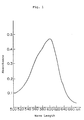
- Figures 1 and 2 each shows an absorption spectrum of two embodiments (Examples 5 and 9) of the spiro-oxazine compounds according to the present invention in the state where a color is developed by ultraviolet irradiation. An ordinate shows an absorbance and an abscissa shows a wavelength.
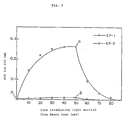
- Figure 3 is a graph showing a relation between films using SP-2 and SP-1 as a comparison, according to Example 13, in terms of a relation between time (ordinate, second) irradiating light emitted from a xenon lamp on the film and change in optical density (abscissa, AOD (at 610 nm)).
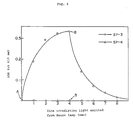
- And Figure 4 is a graph showing the same relation as shown in Figure 3 between films using SP-3 and SP-4 as a comparison, according to Example 14. In the Figure an ordinate shows the same as of Figure 3, and a unit shown in an abscissa shows in minute.
- Further, in both Figures 3 and 4, A is in a light-on state, while B is in a light-off state.
- A constitution of the spiro-oxazine compounds represented by formula (I) according to the present invention is described in detail below.
- In formula (I), Xi, X2, Y1, and Y2 each represents an alkyl group containing from 1 to 23 carbon atoms, preferably from 1 to 4 carbon atoms, or X1 and X2, or Y1 and Y2 may be linked to each other to form a cyclohexyl ring. X1, X2, Y1, and Y2 each preferably represents a methyl, ethyl, propyl or butyl group, with a methyl group being more preferred, or a cyclohexane ring formed by linking X1 and X2, or Y1 and Y2.
- Z represents a straight chain or branched chain alkylene group or a substituted or unsubstituted arylene group. The alkylene group may contain therein an oxygen atom or a group selected from


- A and A', which are the same, represent


- R1, R2, R3, R4, R5, and R6 each represents a hydrogen atom; a halogen atom, e.g., chlorine, bromine iodine; an alkyl group, for example, having from 1 to 6 carbon atoms; an alkoxy group, for example, having from 1 to 6 carbon atoms; an alkoxycarbonyl group, for example, having from 1 to 6 carbon atoms; an alkoxysulfonyl group, for example, having from 1 to 6 carbon atoms, e.g., methoxysulfonyl and ethoxysulfonyl; or an alkylsulfonyl group having from 1 to 6 carbon atoms, e.g., methylsulfonyl and ethylsulfonyl.
- The preferred compounds are those wherein R1, R2, R5, and R6 each represents a hydrogen atom, a halogen atom, an alkyl group having from 1 to 6 carbon atoms, an alkoxycarbonyl group having from 1 to 6 carbon atoms, an alkylsulfonyl group having from 1 to 6 carbon atoms, or an alkoxysulfonyl group having from 1 to 6 carbon atoms; and R3 and R4 each represents a hydrogen atom, an alkoxy group having from 1 to 6 carbon atoms, a halogen atom, or an alkyl group having from 1 to 6 carbon atoms.
- More preferred are those compounds wherein R1, R2, R5, and R6 each represents a hydrogen atom, an alkyl group having from 1 to 4 carbon atoms, an alkoxycarbonyl group having from 1 to 4 carbon atoms, an alkoxysulfonyl group having from 1 to 4 carbon atoms, or an alkoxysulfonyl group having from 1 to 4 carbon atoms; and R3 and R4 each represents a hydrogen atom, an alkoxy group having from 1 to 4 carbon atoms, a halogen atom, or an alkyl group having from 1 to 4 carbon atoms.
- Still more preferred are those compounds wherein R1, R2, R5, and R6 each represents a hydrogen atom, an alkyl group having 1 or2 carbon atoms, an alkoxycarbonyl group having 1 or 2 carbon atoms, an alkylsulfonyl group having 1 or 2 carbon atoms, or an alkoxysulfonyl group having 1 or 2 carbon atoms; R3 and R4 each represents a hydrogen atom, an alkoxy group having 1 or 2 carbon atoms, a halogen atom, or an alkyl group having 1 or 2 carbon atoms; X1, X2, Y1 and Y2 each represents a methyl group; Z represents -(CH2)-n, wherein n is from 4 to 8; and A and A' both represent
-

- Still more preferred are those compounds of the formula I wherein A and A', which are the same, represent

- The compounds of the present invention can be prepared, for example, by reacting a 2,3,3-trimethylindolenine derivative represented by formulae (II) and (III):


- The alkylation reaction using the dihalide can be carried out in the absence of a solvent or in the presence of a non-polar solvent such as aromatic solvents e.g., chlorobenzene and dichlorobenzene, at a temperature of from 80 to 200°C. The reaction is preferably carried out in the absence of a solvent at a temperature between 130°C and 150°C.
- The reaction with a 1-nitroso-2-naphtol derivative of the formula (V), a 9-nitroso-10-hydroxyphenalene derivative of the formula (VI), or a 5-nitroso-6-hydroxyquinoline derivative of the formula (VII), is carried out in a polar or non-polar solvent, such as alcoholic solvents, e.g., methanol, ethanol, propanol and butanol, ketone solvents, e.g., acetone and methyl ethyl ketone, and halogenated hydrocarbon solvents, e.g., dichloromethane and trichloroethane, in the presence of basic catalysts, e.g., piperidine, piperazine and morpholine, at a temperature ranging from 0 to 200°C. The reaction is preferably effected in ethanol, methyl ethyl ketone or acetone in the presence of a piperidine catalyst at 40 to 120°C.
- The compounds of the present invention can also be prepared by reacting a compound represented by formula (VIII):


- This reaction is usually carried out in a polar or non-polar solvent, such as alcoholic solvents e.g., methanol, ethanol, propanol, and butanol, ketone solvents e.g., acetone and methyl ethyl ketone and halogenated hydrocarbon solvents e.g., dichloromethane and trichloroethane, at 0 to 200°C, preferably 40 to 120°C.
- The compounds of the present invention are novel and exhibit photochromism. The compounds develop a color on ultraviolet irradiation and then return to their original colorless state on irradiation of visible light or heating to 80°C or higher. This color change is repeatable.
- A further subject matter of the invention is a photosensitive material comprising a base having provided thereon a photosensitive layer containing a resin having dissolved or dispersed therein the spiro-oxazine compound of the present invention as mentioned above this material can be obtained in a usual manner.
- The resin in which the compound is dissolved or dispersed includes polyester resins, polystyrene resins, polyvinyl butyral resins, polyvinylidene chloride, polyvinyl chloride, polymethyl methacrylate, polyvinyl acetate, cellulose acetate, epoxy resins, and phenolic resins. The solvent to be used includes carbon tetrachloride, benzene, cyclohexane, methyl ethyl ketone, tetrachloroethane, toluene, ethanol, and ethyl cellosolve.
- The compounds of the present invention are usually used in an amount of from 3 to 50%, preferably from 5 to 20%, based on the resins.
- For the purpose of improving stability or light-resistance, the photosensitive layer may contain additives, such as a transition metal chelate compound (e.g., acetylacetonato chelates, bisphenyldithiol, salicylaldehyde oxime, and bisdithiol-a-diketone) as a quencher for single state oxygen, an ultraviolet absorbent and an antioxidant
- The photosensitive layer can be formed by a commonly employed coating method, such as doctor blade coating, casting, spinner coating, dip coating, and the like. The thickness of the photosensitive layer is usually from 0.5 µm to 1.0 mm, preferably from 5 to 100 pm.
- The base to be used in the present invention may be either transparent or opaque. In photosensitive materials having a base on both sides of the photosensitive layer, at least one of the two bases should be transparent. The base includes glass plates, plastic films, paper, metal plates or foils, and composite materials thereof. Preferred of them are glass plates and plastic films from various aspects. Implicit in the plastic are acrylic resins, methacrylic resins, vinyl acetate resins, vinyl chloride resins, polyethylene resins, polypropylene resins, polycarbonate resins, polypropylene resins, polycarbonate resins, polysulfone resins, etc.
- Still a further subject matter of the invention is a molding process for producing a photosensitive material comprising incorporating a compound of formula (I) as mentioned above into a high-molecular material at a high temperature, followed by film formation or molding.
- The high-molecular material to be used as a matrix includes all the resins capable of being injection molded, such as acrylic polymers, e.g., polymethyl methacrylate (PMMA), styrene polymers, e.g., polystyrene, polycarbonate, polyesters, polyethers, e.g., polyethylene oxide, polyamides, e.g., nylon 6, polyolefins, e.g., polyethylene, cellulose polymers e.g., ethyl cellulose, polyvinyl chloride, polyurethane, polivinyl alcohol, polyvinyl butyral, polyvinyl acetate, polyglycidyl methacrylate, poly-N-vinylcarbazole, polyethylene vinylacetate, polyvinylidene chloride, copolymers comprising monomers constituting these homopolymers, and mixtures thereof.
- The amount of the photochromic compound of formula (I) to be incorporated into the high-molecular material usually ranges from 0.001 to 15% by weight, preferably from 0.01 to 5% by weight.
- The molding can be performed by molding techniques requiring high temperatures, such as film extrusion, injection molding, vacuum forming, blow molding, press molding, injection molding of thermo-setting resins, pul- trusion, RIM molding, RTM molding, and the like.
- The present invention is now illustrated in greater detail by way of Examples, but it should be understood that the present invention is not deemed to be limited thereto.
- A mixture of 15.9 g of 2,3,3-trimethylindolenine of formula:


- A solution consisting of 4 g of the compound, 10 g of a thermoplastic polyester resin ("Vylon 200" produced by Toyobo Co., Ltd.), and 100 g of methyl ethyl ketone was coated on a 100 µm thick polyester film (produced by DIAFOIL Co., Ltd.) by means of a bar coater No. 3, followed by drying at 75°C for 10 minutes.
- The resulting photosensitive material was colorless in an ordinary state but turned to deep blue color (λmax=606 nm) on irradiation of ultraviolet light. Then, it returned to its original colorless state on irradiation of visible light or heating at 80°C or more. These color changes could be effected repeatedly.
- In the same manner as in Example 1, exceptfor using 9.4 g of dibromoethane in place of the dibromobutane, a compound of formula shown below was obtained.


- A photosensitive material was produced by using the compound in the same manner as in Example 1. The sample developed a deep blue color (λmax=606 nm) on ultraviolet irradiation and returned to its original colorles state on visible light irradiation or heating to 80°C or more. These color changes could be effected repeatedly
- In 1000 ml of methyl ethyl ketone was dissolved 42.0 g of a compound of formula:


- The mixture was refluxed for 3 hours and then cooled to room temperature. The solvent was removed by distillation, and the residue was separated and purified by column chromatography (benzene as an eluent) to obtain a spiro-oxazine compound of formula:

- Mass Spectrum are as follows.

- A photosensitive material was produced by using the compound in the same manner as in Example 1. The resulting sample developed a deep blue color (λmax=606 nm) on ultraviolet irradiation and then returned to its original colorless state on visible light irradiation or heating to 80°C or higher. These color changes could be effected repeatedly.
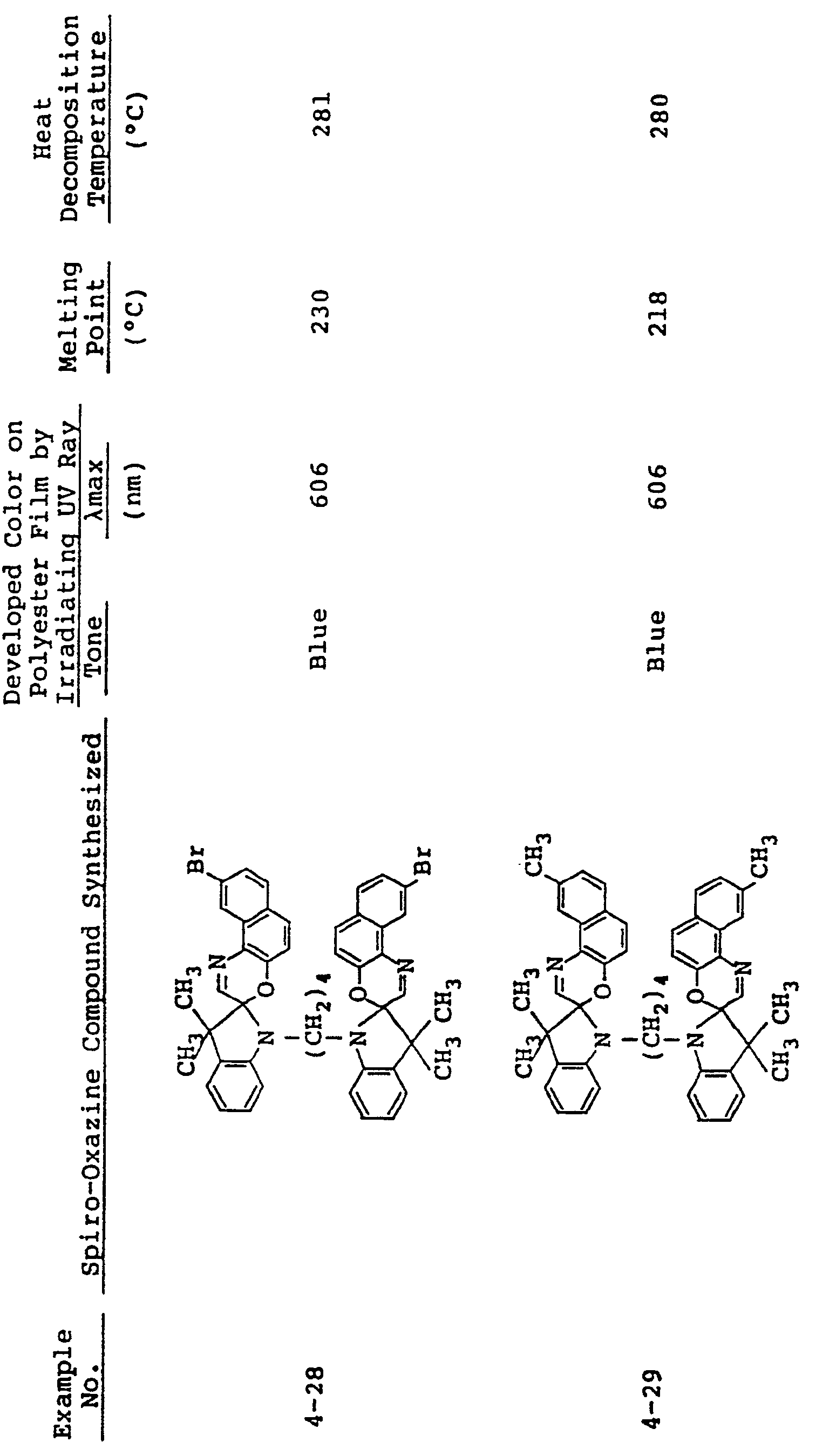
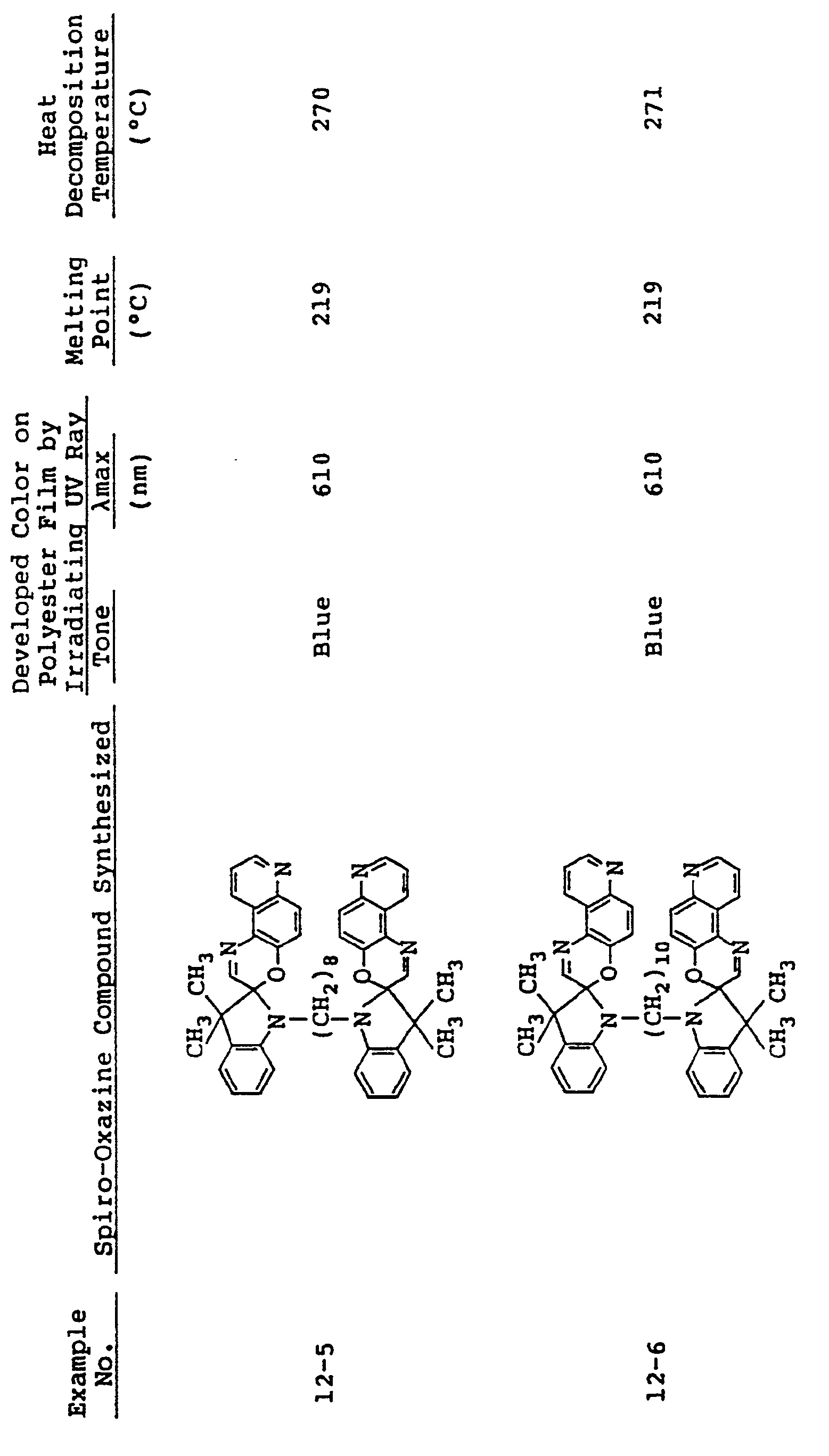
- In the same manner as in Examples 1 to 3, spiro-oxazine compounds shown in Table 2 below were synthesized. The melting point and heat decomposition temperature of these compounds are also shown in Table 2.
- A photosensitive material was produced by using each of these compounds in the same manner as in Example 1. Upon ultraviolet irradiation, the sample developed a color having tone and λmax as shown in Table 2 and, on visible light irradiation or heating to 80°C or higher it returned to its original colorless state. These color changes could be effected repeatedly.




- A mixture of 15.9 g of 2,3,3-trimethylindolenine of formula:


- Mass Spectrum are as follows.

- A solution consisting of 4 g of the compound,10 g of a thermoplastic polyester resin ("Vylon 200", produced by Toyobo Co., Ltd.), and 100 g of methyl ethyl ketone was coated on a polyester film (produced by DIAFOIL Co., Ltd. having 100 µm thick) by means of a bar coater No. 3, followed by drying at 75°C for 10 minutes.
- The resulting photosensitive material was pale blue in an ordinary state but turned to deep blue (λmax=600 nm) on irradiation of ultraviolet light. The absorption spectrum of the developed color is shown in Fig. 1. Then, it returned to its original state of pale blue on irradiation of visible light or heating at 50°C or more. These color changes could be effected repeatedly.
- In the same manneras in Example 5, exceptfor using 9.4 g of dibromoethane in place of the dibromobutane, a compound of formula shown below was obtained.


- A photosensitive material was produced by usingthe compound in the same manner as in Example 5. The sample developed a deep blue color (λmax=600 nm) on ultraviolet irradiation and returned to its original pale blue state on visible light irradiation or heating to 50°C or higher. These color changes could be effected repeatedly.
- In 1000 ml of methyl ethyl ketone was dissolved 42.0 g of a compound of formula:


- The mixture was refluxed for 3 hours and then cooled to room temperature. The solvent was removed by distillation, and the residue was purified by column chromatography (benzene as an eluent) to obtain a spiro-oxazine compound of formula:


- A photosensitive material was produced by using the compound in the same manner as in Example 5. The resulting sample developed a deep blue color (λmax=600 nm) on ultraviolet irradiation and then returned to its original state of pale blue on visible light irradiation or heating to 50°C or higher. These color changes could be effected repeatedly.
- In the same manner as in Examples 5 to 7, spiro-oxazine compounds shown in Table 3 below were synthesized. The melting point and heat decomposition temperature of these compounds are also shown in Table 3.
- A photosensitive material was produced by using each of these compounds in the same manner as in Example 5. Upon ultraviolet irradiation, the sample developed a color having tone and λmax as shown in Table 3 and, on visible light irradiation or heating to 80°C or higher it returned to its original pale blue state. These color changes could be effected repeatdely.


- A mixture of 15.9 g of 2,3,3-trimethylindolenine of formula:


- A solution consisting of 4 g of the compound, 10 g of a thermoplastic polyester resin ("Vylon 200" produced by Toyobo Co., Ltd.) and 100 g of methyl ethyl ketone was coated on a 100 gm thick polyester film (produced by DIAFOIL Co., Ltd.) by means of a bar coater No. 3, followed by drying at 75°C for 10 minutes.
- The resulting photosensitive material was colorless in an ordinary state but turned to deep blue (λmax=610 nm) on irradiation of ultraviolet light. The absorption spectrum of the developed color is shown in Fig. 2. Then, it returned to its original colorless state on irradiation of visible light or heating at 80°C or higher. These color changes could be effected repeatedly.
- In the same manner as in Example 9, exceptfor using 9.4 g of dibromoethane in place of the dibromobutane, a compound of formula shown below was obtained.


- A photosensitive material was produced by using the compound in the same manner as in Example 9. The sample developed a deep blue color (λmax=610 nm) on ultraviolet irradiation and returned to its original colorless state on visible light irradiation or heating to 80°C or higher. These color changes could be effected repeatedly.
- In 1000 mI of methyl ethyl ketone was dissolved 42.0 g of a compound of formula:


- The mixture was refluxed for 3 hours and then cooled to room temperature. The solvent was removed by distillation, and the residue was purified by column chromatography (benzene as an eluent) to obtain a spiro-oxazine compound of formula:


- A photosensitive material was produced by using the compound in the same manner as in Example 9. The resulting sample developed a deep blue color (λmax=61 nm) on ultraviolet irradiation and then returned to its original colorless state on visible light irradiation or heating to 80°C or higher. These color changes could be effected repeatedly.
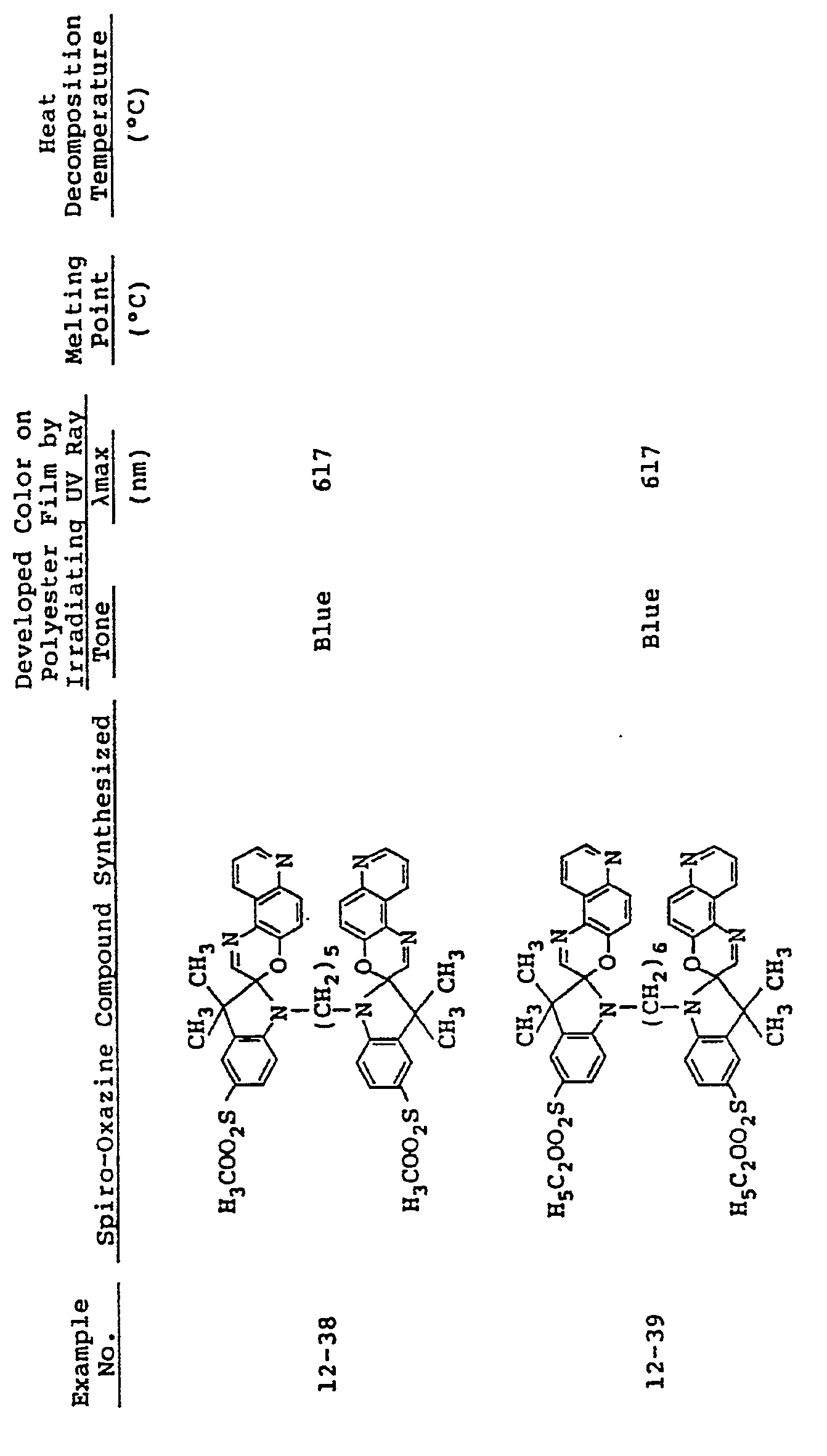
- In the same manner as in Examples 9 to 11, spiro-oxazine compounds of formula (I) shown in Table 4 below were synthesized. The melting point and heat decomposition temperature of these compounds are also shown in Table 4.
- A photosensitive material was produced by using each of these compounds in the same manner as in Example 9. Upon ultraviolet irradiation, the sample developed a color having tone and Imax as shown in Table 4 and, on visible light irradiation or heating to 80°C or higher it returned to its original colorless state. These color changes could be effected repeatedly.




- Ten grams of the photochromic compound of Example 4-1 shown in Table 2 (designated as SP-2) were added to 990 g of a polyvinylbutyral (PVB) powder, and 250 g of 3GH was added thereto. The mixture was meltmixed at 204°C and extruded from an extruder through a die to obtain a film having a thickness of 380 µm.
- The resulting film was interposed between a pair of glass plates in a usual laminating method to produce a laminated glass for use in motor cars. For comparison, a laminated glass was produced in the same manner, except for using SP-1 in place of SP-2.
- The laminated glass was irradiated with light emitted from a xenon lamp (30,000 lux) in a sunshine weath- erometer, "UXL-75D" manufactured by Ushio Electric Ind. The change of optical density (AOD) at 610 nm with irradiation time is shown in Fig. 3. In Fig. 3, the ordinate indicates AOD, and the abscissa indicates an irradiation time (sec); A is light-on, and B is light-off.
- SP-1 exhibits substantially no photochromism because it has been evaporated or decomposed during incorporation into the high-molecular material due to its low melting point and a low heat decomposition temperature.
- Then, a mixture comprising 3 g of SP-2, 82 g of PVB, and 15 g of 3GH was melt-mixed in the same manner as described above. The molten mixture was extruded to obtain a film having a thickness of 760 µm (film①) or 380 µm (film②) or cast to obtain a film having a thickness of 50 µm (film③). Each of the film samples was irradiated in the same manner as described above, and AOD at 610 nm was determined. The results are shown in Table 5.

- Weather resistance of photochromic compounds can generally be enhanced as the film thickness increases. In this connection, the results of Table 5 prove that the compound of the present invention and the film formation or molding process of the present invention are advantageous in favor of weather resistance as compared with the fact that the film thickness reached by the conventional film formation technique was about 100 µm at the most.
- A mixture of 50 g of the compound having a quinoline ring as synthesized in Example 9 (designated as SP-3) and 950 g of a polymethyl methacrylate (PMMA) powder were melt-mixed at 210°C and pelletized in a pelletizer. The resulting pellets were injection-molded at 240°C to obtain a lens for glasses.
- For comparison, a lens was obtained in the same manner, except for replacing SP-3 with a spiro-oxazine derivative having a quinoline ring as represented by formula:

- Each of the lenses was evaluated for AOD at 610 nm in the same manner as in Example 13, and the results obtained are shown in Fig. 4. In Fig. 4, A and B have the same meanings as in Fig. 3. It can be seen from Fig. 4 that SP-3 exhibits desired photochromism, whereas SP-4 exhibits no photochromism because it has been heat decomposed during pelletization or molding.
- As described above, the spiro-oxazine compounds according to the present invention exhibits photochromism and satisfactory heat resistance and develop a color having a high density and fastness. The photosensitive materials obtained by using the spiro-oxazine compounds of the invention are useful in various fields as light control materials, optical filters, masking materials, actinometers, etc.
- Further, since the spiro-oxazine compounds of the invention have high melting points and satisfactory heat resistance, they can be processed not only by the conventional coating techniques but by various molding techniques after melt-mixing with a high-molecular matrix material at a high temperature. Application of the molding techniques makes it possible (a) to form a photochromic layer having a large thickness thereby exhibiting weather resistance, to increase a productivity thereby decreasing the cost, (b) to obtain a photochromic photosensitive material having a complicated shape, and (c) which could not be produced by the conventional coating techniques.
Claims (15)


Applications Claiming Priority (8)
| Application Number | Priority Date | Filing Date | Title |
|---|---|---|---|
| JP160124/86 | 1986-07-08 | ||
| JP61160124A JPS6314786A (en) | 1986-07-08 | 1986-07-08 | Spironaphthoxazine based compound and photosensitive material using said compound |
| JP61249250A JPS63115884A (en) | 1986-10-20 | 1986-10-20 | Spiroxazine based compound and photosensitive material utilizing said compound |
| JP249251/86 | 1986-10-20 | ||
| JP24925186A JPS63115885A (en) | 1986-10-20 | 1986-10-20 | Spiroxazine compound and photosensitive material utilizing said compound |
| JP249250/86 | 1986-10-20 | ||
| JP134954/87 | 1987-06-01 | ||
| JP13495487A JPS63301228A (en) | 1987-06-01 | 1987-06-01 | Membrane formation and molding of photochromic material |
Publications (3)
| Publication Number | Publication Date |
|---|---|
| EP0321563A1 EP0321563A1 (en) | 1989-06-28 |
| EP0321563A4 EP0321563A4 (en) | 1989-07-19 |
| EP0321563B1 true EP0321563B1 (en) | 1991-11-06 |
Family
ID=27471875
Family Applications (1)
| Application Number | Title | Priority Date | Filing Date |
|---|---|---|---|
| EP19870904318 Expired EP0321563B1 (en) | 1986-07-08 | 1987-07-03 | Spirooxazine compounds, photosensitive materials using them, and process for forming them |
Country Status (3)
| Country | Link |
|---|---|
| EP (1) | EP0321563B1 (en) |
| DE (1) | DE3774437D1 (en) |
| WO (1) | WO1988000196A1 (en) |
Cited By (8)
| Publication number | Priority date | Publication date | Assignee | Title |
|---|---|---|---|---|
| US7256921B2 (en) | 2003-07-01 | 2007-08-14 | Transitions Optical, Inc. | Polarizing, photochromic devices and methods of making the same |
| US7342112B2 (en) | 2003-07-01 | 2008-03-11 | Ppg Industries Ohio, Inc. | Photochromic compounds |
| US7978391B2 (en) | 2004-05-17 | 2011-07-12 | Transitions Optical, Inc. | Polarizing, photochromic devices and methods of making the same |
| US8003005B2 (en) | 2003-07-01 | 2011-08-23 | Transitions Optical, Inc. | Alignment facilities for optical dyes |
| US8077373B2 (en) | 2003-07-01 | 2011-12-13 | Transitions Optical, Inc. | Clear to circular polarizing photochromic devices |
| US8211338B2 (en) | 2003-07-01 | 2012-07-03 | Transitions Optical, Inc | Photochromic compounds |
| US9096014B2 (en) | 2003-07-01 | 2015-08-04 | Transitions Optical, Inc. | Oriented polymeric sheets exhibiting dichroism and articles containing the same |
| US10866455B2 (en) | 2017-10-19 | 2020-12-15 | Ppg Industries Ohio, Inc. | Display devices including photochromic-dichroic compounds and dichroic compounds |
Families Citing this family (7)
| Publication number | Priority date | Publication date | Assignee | Title |
|---|---|---|---|---|
| IT1238694B (en) * | 1990-02-16 | 1993-09-01 | Enichem Sintesi | LUXMETERS CONTAINING PHOTOCROMATIC SUBSTANCES |
| DE19643773A1 (en) * | 1996-10-23 | 1998-04-30 | Tschochner Rolfheinz | Photo:chromic spiro:oxazine compounds |
| US8582192B2 (en) | 2003-07-01 | 2013-11-12 | Transitions Optical, Inc. | Polarizing photochromic articles |
| US8518546B2 (en) | 2003-07-01 | 2013-08-27 | Transitions Optical, Inc. | Photochromic compounds and compositions |
| US8698117B2 (en) | 2003-07-01 | 2014-04-15 | Transitions Optical, Inc. | Indeno-fused ring compounds |
| US8545984B2 (en) | 2003-07-01 | 2013-10-01 | Transitions Optical, Inc. | Photochromic compounds and compositions |
| CN111440193B (en) * | 2020-05-20 | 2023-01-24 | 南开大学 | Indene-thick naphtho-spirooxazine photochromic compound and preparation method thereof |
Family Cites Families (4)
| Publication number | Priority date | Publication date | Assignee | Title |
|---|---|---|---|---|
| FR2093370A5 (en) * | 1970-06-12 | 1972-01-28 | Kodak Pathe | Spiro pyrans photochromic compsn - for lithographic plates and printed circuits prepn |
| CA1246565A (en) * | 1984-07-06 | 1988-12-13 | Shinichi Yamamoto | Spiro-oxazine compounds and preparation thereof and photochronic shaped article |
| DE3852831T2 (en) * | 1987-02-02 | 1995-05-18 | Toray Industries | Photochromic connection. |
| JPH06263587A (en) * | 1993-03-09 | 1994-09-20 | Japan Energy Corp | Molecular beam epitaxial growth apparatus |
-
1987
- 1987-07-03 WO PCT/JP1987/000464 patent/WO1988000196A1/en not_active Ceased
- 1987-07-03 DE DE8787904318T patent/DE3774437D1/en not_active Expired - Lifetime
- 1987-07-03 EP EP19870904318 patent/EP0321563B1/en not_active Expired
Cited By (24)
| Publication number | Priority date | Publication date | Assignee | Title |
|---|---|---|---|---|
| US7847998B2 (en) | 2003-07-01 | 2010-12-07 | Transitions Optical, Inc. | Polarizing, photochromic devices and methods of making the same |
| US7394585B2 (en) | 2003-07-01 | 2008-07-01 | Ppg Industries Ohio, Inc. | Polarizing, photochromic devices and methods of making the same |
| US7342112B2 (en) | 2003-07-01 | 2008-03-11 | Ppg Industries Ohio, Inc. | Photochromic compounds |
| US7349138B2 (en) | 2003-07-01 | 2008-03-25 | Ppg Industries Ohio, Inc. | Polarizing, photochromic devices and methods of making the same |
| US7349137B2 (en) | 2003-07-01 | 2008-03-25 | Ppg Industries Ohio, Inc. | Polarizing, photochromic devices and methods of making the same |
| US7359104B2 (en) | 2003-07-01 | 2008-04-15 | Ppg Industries Ohio, Inc. | Polarizing, photochromic devices and methods of making the same |
| US7505189B2 (en) | 2003-07-01 | 2009-03-17 | Transitions Optical, Inc. | Polarizing, photochromic devices and methods of making the same |
| US7429105B2 (en) | 2003-07-01 | 2008-09-30 | Ppg Industries Ohio, Inc. | Polarizing, photochromic devices and methods of making the same |
| US7457025B2 (en) | 2003-07-01 | 2008-11-25 | Transitions Optical, Inc. | Polarizing, photochromic devices and methods of making the same |
| US7466469B2 (en) | 2003-07-01 | 2008-12-16 | Ppg Industries Ohio, Inc. | Polarizing, photochromic devices and methods of making the same |
| US7286275B2 (en) | 2003-07-01 | 2007-10-23 | Transitions Optical, Inc. | Polarizing, photochromic devices and methods of making the same |
| US7471436B2 (en) | 2003-07-01 | 2008-12-30 | Transitions Optical, Inc. | Polarizing, photochromic devices and methods of making the same |
| US8089678B2 (en) | 2003-07-01 | 2012-01-03 | Transitions Optical, Inc | Clear to circular polarizing photochromic devices and methods of making the same |
| US10619018B2 (en) | 2003-07-01 | 2020-04-14 | Transitions Optical, Inc. | Oriented polymeric sheets exhibiting dichroism and articles containing the same |
| US8003005B2 (en) | 2003-07-01 | 2011-08-23 | Transitions Optical, Inc. | Alignment facilities for optical dyes |
| US8077373B2 (en) | 2003-07-01 | 2011-12-13 | Transitions Optical, Inc. | Clear to circular polarizing photochromic devices |
| US7256921B2 (en) | 2003-07-01 | 2007-08-14 | Transitions Optical, Inc. | Polarizing, photochromic devices and methods of making the same |
| US8211338B2 (en) | 2003-07-01 | 2012-07-03 | Transitions Optical, Inc | Photochromic compounds |
| US8705160B2 (en) | 2003-07-01 | 2014-04-22 | Transitions Optical, Inc. | Photochromic compounds |
| US8926091B2 (en) | 2003-07-01 | 2015-01-06 | Transitions Optical, Inc. | Optical elements with alignment facilities for optical dyes |
| US9096014B2 (en) | 2003-07-01 | 2015-08-04 | Transitions Optical, Inc. | Oriented polymeric sheets exhibiting dichroism and articles containing the same |
| US10007038B2 (en) | 2003-07-01 | 2018-06-26 | Transitions Optical, Inc. | Optical elements with alignment facilities for optical dyes |
| US7978391B2 (en) | 2004-05-17 | 2011-07-12 | Transitions Optical, Inc. | Polarizing, photochromic devices and methods of making the same |
| US10866455B2 (en) | 2017-10-19 | 2020-12-15 | Ppg Industries Ohio, Inc. | Display devices including photochromic-dichroic compounds and dichroic compounds |
Also Published As
| Publication number | Publication date |
|---|---|
| DE3774437D1 (en) | 1991-12-12 |
| EP0321563A1 (en) | 1989-06-28 |
| EP0321563A4 (en) | 1989-07-19 |
| WO1988000196A1 (en) | 1988-01-14 |
Similar Documents
| Publication | Publication Date | Title |
|---|---|---|
| EP0321563B1 (en) | Spirooxazine compounds, photosensitive materials using them, and process for forming them | |
| US5847156A (en) | Polymerizable diketopyrrolopyrroles and polymers prepared therewith | |
| EP0141407B1 (en) | Photochromic compound and articles containing the same | |
| US5114621A (en) | Indolino-spiro-oxazine photochromic compounds with five-membered rings, method for their preparation, photochromic compositions and articles containing such compounds | |
| US5266447A (en) | Photochromic composition | |
| US4880667A (en) | Photochromic plastic article and method for preparing same | |
| FI90560C (en) | Photochromic products and compounds | |
| EP0449669A1 (en) | Photochromic compound, composition and use thereof | |
| JPH06502180A (en) | Photochromic naphthopyran | |
| US6846934B2 (en) | Photochromic diarylethene substituted with isoxazole group | |
| EP0625518B1 (en) | Spiro-pyranic compounds endowed with photochromic characteristics | |
| US4772700A (en) | Spiropiperidinenaphthoxazine compound | |
| US20030099910A1 (en) | Photochromic spirobenzopyran compounds and their derivatives, spiropyran group-containing polymers, process for producing the same, compositions comprising said spiropyrans or spiropyran group-containing polymers and photochromic switch thin films prepared | |
| US6207084B1 (en) | Naphthopyrans annelated in C6-C7, their preparation and compositions and (CO)polymer matrices containing them | |
| JPH0121831B2 (en) | ||
| CA1288767C (en) | Photochromic compound and articles containing the same | |
| AU613711B2 (en) | Novel spirooxazine compounds | |
| EP0432841B1 (en) | Spiro-indoline-oxazine compounds with photochromatic and photosensitizing characteristics and the process for their preparation | |
| EP1044979A2 (en) | 1-[(N-(un)substituted)amidoalkyl]spiroindolinonaphthoxazines, their preparation, compositions and (co)polymer matrices containing them | |
| CN114031597B (en) | Polysubstituted dibenzochromene compound and application thereof | |
| JP2663439B2 (en) | Spirooxazine-based compound and photosensitive material using the compound | |
| JPS6330488A (en) | Spirooxazine derivative and sensitized material using said derivative | |
| CN114031596A (en) | Bis-benzo-chromene photochromic compound and application thereof | |
| JPS6330584A (en) | Photochromic substance | |
| JPH085896B2 (en) | Photosensitive material |
Legal Events
| Date | Code | Title | Description |
|---|---|---|---|
| PUAI | Public reference made under article 153(3) epc to a published international application that has entered the european phase |
Free format text: ORIGINAL CODE: 0009012 |
|
| 17P | Request for examination filed |
Effective date: 19890105 |
|
| AK | Designated contracting states |
Kind code of ref document: A1 Designated state(s): DE GB |
|
| A4 | Supplementary search report drawn up and despatched |
Effective date: 19890719 |
|
| 17Q | First examination report despatched |
Effective date: 19900710 |
|
| GRAA | (expected) grant |
Free format text: ORIGINAL CODE: 0009210 |
|
| AK | Designated contracting states |
Kind code of ref document: B1 Designated state(s): DE GB |
|
| REF | Corresponds to: |
Ref document number: 3774437 Country of ref document: DE Date of ref document: 19911212 |
|
| PLBE | No opposition filed within time limit |
Free format text: ORIGINAL CODE: 0009261 |
|
| STAA | Information on the status of an ep patent application or granted ep patent |
Free format text: STATUS: NO OPPOSITION FILED WITHIN TIME LIMIT |
|
| 26N | No opposition filed | ||
| REG | Reference to a national code |
Ref country code: GB Ref legal event code: IF02 |
|
| PGFP | Annual fee paid to national office [announced via postgrant information from national office to epo] |
Ref country code: GB Payment date: 20020703 Year of fee payment: 16 |
|
| PGFP | Annual fee paid to national office [announced via postgrant information from national office to epo] |
Ref country code: DE Payment date: 20020710 Year of fee payment: 16 |
|
| PG25 | Lapsed in a contracting state [announced via postgrant information from national office to epo] |
Ref country code: GB Free format text: LAPSE BECAUSE OF NON-PAYMENT OF DUE FEES Effective date: 20030703 |
|
| PG25 | Lapsed in a contracting state [announced via postgrant information from national office to epo] |
Ref country code: DE Free format text: LAPSE BECAUSE OF NON-PAYMENT OF DUE FEES Effective date: 20040203 |
|
| GBPC | Gb: european patent ceased through non-payment of renewal fee |
Effective date: 20030703 |