EP0320116A2 - Entkoffeinierung von wasserhaltigen Extrakten - Google Patents
Entkoffeinierung von wasserhaltigen Extrakten Download PDFInfo
- Publication number
- EP0320116A2 EP0320116A2 EP88310435A EP88310435A EP0320116A2 EP 0320116 A2 EP0320116 A2 EP 0320116A2 EP 88310435 A EP88310435 A EP 88310435A EP 88310435 A EP88310435 A EP 88310435A EP 0320116 A2 EP0320116 A2 EP 0320116A2
- Authority
- EP
- European Patent Office
- Prior art keywords
- column
- carbon dioxide
- caffeine
- foam
- extract
- Prior art date
- Legal status (The legal status is an assumption and is not a legal conclusion. Google has not performed a legal analysis and makes no representation as to the accuracy of the status listed.)
- Ceased
Links
Images
Classifications
-
- A—HUMAN NECESSITIES
- A23—FOODS OR FOODSTUFFS; TREATMENT THEREOF, NOT COVERED BY OTHER CLASSES
- A23F—COFFEE; TEA; THEIR SUBSTITUTES; MANUFACTURE, PREPARATION, OR INFUSION THEREOF
- A23F5/00—Coffee; Coffee substitutes; Preparations thereof
- A23F5/20—Reducing or removing alkaloid content; Preparations produced thereby; Extracts or infusions thereof
- A23F5/208—Reducing or removing alkaloid content; Preparations produced thereby; Extracts or infusions thereof by extraction of the beans with water, aqueous solutions without organic or inorganic solvents or aqueous coffee extract
-
- A—HUMAN NECESSITIES
- A23—FOODS OR FOODSTUFFS; TREATMENT THEREOF, NOT COVERED BY OTHER CLASSES
- A23F—COFFEE; TEA; THEIR SUBSTITUTES; MANUFACTURE, PREPARATION, OR INFUSION THEREOF
- A23F5/00—Coffee; Coffee substitutes; Preparations thereof
- A23F5/20—Reducing or removing alkaloid content; Preparations produced thereby; Extracts or infusions thereof
- A23F5/22—Reducing or removing alkaloid content from coffee extract
- A23F5/226—Reducing or removing alkaloid content from coffee extract by extraction with selective solvents
-
- B—PERFORMING OPERATIONS; TRANSPORTING
- B01—PHYSICAL OR CHEMICAL PROCESSES OR APPARATUS IN GENERAL
- B01D—SEPARATION
- B01D11/00—Solvent extraction
- B01D11/04—Solvent extraction of solutions which are liquid
- B01D11/0403—Solvent extraction of solutions which are liquid with a supercritical fluid
- B01D11/0407—Solvent extraction of solutions which are liquid with a supercritical fluid the supercritical fluid acting as solvent for the solute
Definitions
- the present invention relates generally to extraction processes and more particularly to decaffeination of coffee by a continuous extraction process.
- a caffeine-laden aqueous extract of green coffee is prepared from which caffeine is extracted by the use of carbon diodide as a solvent.
- the invention in particular relates to the use of specific equipment under closely controlled conditions of pressure and temperature to provide high yields and economical costs of production.
- decaffeinated coffee may contain inadvertent traces of organic solvent which might be toxic or carcinogenic. Furthermore, organic solvents remove other coffee constituents along with caffeine to the detriment of the coffee flavor. There has thus arisen a need for a process which does not use organic solvent.
- Carbon dioxide a normal constituent of roasted coffee, is a preferred solvent for decaffeination. It is produced naturally during the roasting process, typically to the extent of 2 to 3% of coffee weight. It is non-toxic and will selectively remove caffeine from coffee beans or coffee extract. It may be used for decaffeination at elevated pressure although much more carbon dioxide is required than conventional organic solvents. Consequently, for economic operation, highly efficient decaffeination equipment is required.
- U.S. Patent 4,260,639 to Zosel discloses a slow process, not readily made continuous, for the carbon dioxide decaffeination of coffee from batches of moistened green coffee beans in a period of 5 to 30 hours.
- each batch of green (unroasted) coffee beans is extracted in a high pressure vessel which must be charged and closed.
- the carbon dioxide must then be admitted and pumped to a high pressure before decaffeination can be effected.
- After decaffeination the pressure must be released slowly so that the beans do not fracture by expansion of the carbon dioxide inside the beans.
- the vessel is then opened to discharge the decaffeinated coffee.
- the cost and time re quired for loading, caffeine extraction and unloading and the cost of re-pressurizing the carbon dioxide after each batch make this process economically unattractive.
- German patent application No. 2,638,383 to van der Stegen describes a continuous process which substitutes carbon dioxide for the chlorinated organic solvent in the "water process".
- the van der Stegen suggestion has the advantage that coffee beans can be extracted with a water solution at low or atmospheric pressure and only this solution need be handled at elevated pressure in contact with carbon dioxide.
- the van der Stegen idea has been open to public inspection since March 3, 1977, yet there has been no known commercial application of the process.
- Extraction requires the transfer of a solute (caffeine) from one fluid (green coffee extract) to a second fluid (pressurized carbon dioxide). Close contact of the fluids followed by their effective separation is essential. Generally a series of such contacts and separations arranged countercurrently is required for efficient extraction. I have found that the green coffee extract has a strong tendency to form a foam when intermixed with pressurized carbon dioxide. This foam makes caffeine extraction and separation of the carbon dioxide from the solution as suggested by van der Stegan impractical in equipment of conventional design.
- Mechanically assisted columns such as “rotating disc” columns or “Scheibel” columns are also subject to axial mixing.
- the mechanical agitation also promotes formation of emulsion or foam which inhibits separation of the two fluids.
- What is desired is a method of making decaffeinated coffee efficiently and economically without the loss of coffee flavor and aroma precursors and without introducing any organic solvent or other additive.
- the invention provides a process for decaffeination of green coffee comprising the steps of: (a) extracting caffeine from green coffee beans by contacting the beans with a decaffeinated aqueous solution of green coffee to prepare an extract containing caffeine and coffee beans substantially freed of caffeine; (b) feeding the extract to near the upper end of a perforated plate extraction column having a plurality of plates; (c) feeding supercritical carbon dioxide continuously to near the lower end of the said column and withdrawing it together with dissolved caffeine continuously near the upper end of the column to remove caffeine from the green coffee extract; (d) contacting foam, formed by intermixing of the green coffee extract and the supercritical carbon dioxide, with means for breaking foam, the said means being spaced above each perforated plate and extending across the column between successive plates; (e) removing theaqueous green coffee extract, now substantially freed of caffeine, continuously from near the lower end of the column and recycling it to step (a) to decaffeinate additional green coffee beans; (f) maintaining the pressure within the column at greater than about 330
- the invention also provides a perforated plate extraction column apparatus in which a liquid phase is continuously contacted by a supercritical gas phase and in which foaming tends to inhibit necessary separation of the phases, in which a physical foam-breaking means is spaced above each plate and extends across the column.
- the subsidiary claims set forth preferred and optional features, including: optimized anti-foam mesh area and void percentages; a foam suppressing mesh network; and a method of operation at otpimal pressure, temperature, extract concentration, extract flow rate, and carbon dioxide flow rate to render the process economical and efficient.
- the apparatus and technique disclosed herein may be used in decaffeinating extracts of roasted or of green coffee.
- the preferred application is to the decaffeination of green coffee extract to be used to produce decaffeinated green coffee beans. Decaffeination of green coffee extract avoids loss during decaffeination of delicate and fugitive coffee flavors and aromas developed subsequently by roasting.
- Carbon dioxide is used at elevated pressure. It is preferred to other known decaffeination solvents because it is non-toxic and, under suitable conditions, highly selective for caffeine. However, it has some disadvantages. Although very selective for caffeine, carbon dioxide is a relatively poor solvent for caffeine. Efficient extraction requires a relatively high ratio of carbon dioxide to coffee solution of approximately 30 to 35 is required for 99% decaffeination. The extremely low viscosity of supercritical carbon dioxide also affects extractor design.
- a liquid-liquid extraction column of unique design is employed. Above its critical temperature of 31°C (87.8°F) carbon dioxide cannot exist as a liquid regardless of the pressure and is therefore called a supercritical fluid. At the elevated pressure used in the process to be described, the fluid approaches the density of some liquids.
- the present invention employs equipment designed for continuous countercurrent contact of two liquids. Such equipment is an improvement for the present purpose upon the prior art.
- the present invention avoids the limitations found in a packed extraction column or a mechanically assisted column. Those columns are incapable of handling high solvent ratios of 10 or more. See R.B. Akell, Chemical Engineering Progress 62 (9) 1966 page 50 and E. D. Oliver, "Diffusional Separation Processes” John Wiley, New York 1966 page 363.
- the preferred extraction temperature is about 80 to 85°C. Temperatures from about 75 to 100°C can be used. However, above about 85°C there is a slow deterioration and discoloration of the aqueous green coffee extract. Temperatures below about 80°C increase foam viscosity in the extractor, although the effect of small temperature changes on viscosity of unfoamed extract is extremely small. Increased foam viscosity can interfere with extractor operation even under otherwise optimum conditions.
- the concentration of the aqueous green coffee solution may be between about 18% and about 30% dissolved solubles. At higher concentrations the foam viscosity apparently increases excessively, again despite a very small change in viscosity of the unfoamed solution. Surprisingly, the tendency to foam is increased at lower solubles concentration. Operation is best in the range of 22 to 27% solubles, preferably about 26%.
- the structure of the porous solid surface employed to break the foam is very important. In general, the larger the surface area made available, the better the performance. How ever, practical extractor design is limited by two other factors: the hydraulics of sieve plate extractors and the commercial availability of suitable materials.
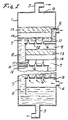
- the preferred embodiment of the sieve plate extraction column 1 of the present invention is shown in Fig. 1.
- the column is capable of safely sustaining the preferred operating pressure of 420 bar.
- Inlet port means 2 allows aqueous green coffee extract containing caffeine to be introduced under pressure near the top of the column.
- Extract outlet port means allows decaffeinated green coffee extract to leave the bottom of the column.
- Carbon dioxide input port means allows carbon dioxide containing very little or no caffeine to enter under pressure near the bottom of the column.
- Carbon dioxide output port 5 allows carbon dioxide laden with caffeine removed from the aqueous extract to leave near the top of the column.
- the perforated sieve plates are depicted at 6 . For clarity only three plates are shown although the column may contain any number of plates.
- the plates and other components of the column are arranged so that green coffee solution 7 forms a continuous body of liquid from inlet port 2 to its outlet port 3 , constituting a continuous phase.
- the liquid being more dense than carbon dioxide, the system is configured so that the continuous phase solution flows downward through the column but is constrained to flow generally horizontally across each plate and then downward to the next lower plate through a channel called a downcomer 8 .
- the liquid cannot fall through the perforations on the plates because the carbon dioxide is rising through all the perforations at sufficient velocity.
- the plates 6 have no perforations directly beneath the bottom of downcomers where rising bubbles would interfere with liquid flowing down the downcomers.
- Carbon dioxide 9 is the dispersed phase. In operation it rises through the extraction column because its density is lower than that of the coffee solution.
- a porous foam breaking material 13 presenting exposed solid surface for breaking foam is spaced above the liquid layer. The porous material fills the available cross-section in the extractor to prevent rising foam from passing through channels without contacting the material.
- Suitable surface materials for foam breaking include stainless steel and polytetrafluorethylene.
- Stainless steel is preferable because it is wetted by the collapsed foam which then drains more easily by capillary action and gravity, returning to the solution layer.
- the surface of polytetrafluorethylene tends to become loaded with collapsed foam especially at high carbon dioxide flow rates. The effect is a tendency to cause the column to "flood" and the aqueous solution to empty from the column.
- polytetrafluorethylene is difficult to fabricate with a large surface area.
- a somewhat similar material, polyfluorinated ethylene-propylene, is much easier to fabricate. However, it deteriorates mechanically by swelling in supercritical carbon dioxide.
- a surface area of at least about 12 square centimeters per cubic centimeter of knitted wire is needed to break foam.
- a large void fraction minimizes resistance to flow of the carbon dioxide.
- Suitable porous material can be made from knitted stainless steel wire. Such materials are sold by Koch Engineering Company, Inc., as well as others, for use as mist eliminators in distillation or evaporation equipment. Table I presents data on coffee foam breaking by knitted stainless steel wire materials in an extraction column under constant operating conditions while decaffeinating a solution of green coffee solubles with supercritical carbon dioxide.
- foam 14 which forms from the carbon dioxide bubbles and the coffee solution fills the space above the liquid and partially penetrates the foam-breaking material.
- Carbon dioxide 9 leaves the top of the foam-breaking material substantially free of liquid. Liquid formed by the collapse of the foam drains back to the liquid layer.
- extraction stage is used to refer to a unit within which both contact and separation of the two fluids take place.
- a perforated plate 6 is at the bottom of each stage.
- the gas flow rate being much greater than the liquid rate. This facilitates transfer of caffeine to the carbon dioxide approaching an equilibrium concentration.
- Efficient extraction is effected by use of a number of extraction stages, stacked vertically, so that the fluids flow countercurrently, the stack comprising an "extraction column.”
- the preferred number of stages can be calculated by conventional means known to persons skilled in the art, such as the McCabe-Theile method.
- the distributed coefficient is defined as the ratio of the caffeine concentration in carbon dioxide to that in the aqueous solution after the two fluids have experienced sufficient contact to reach equilibrium (when no further transfer of caffeine is detected). Under the preferred operating conditions of this invention the distribution coefficient was found to average about 0.035, slightly lower at low caffeine concentrations and slightly higher at high concentrations. Increasing the system pressure increased the distribution coefficient. No effect of temperature on the distribution coefficient was found within the preferred temperature range of 80-85°C.
- the system is designed and operated, as described below, so that a thick layer of coffee solution is maintained on every plate. This assures that the gas jets issuing from the plate perforations can form droplets in the liquid and provide the needed large contact area between the two fluids. If the layer is too thin, the gas will push away the liquid above each plate perforation and minimize contact and extraction efficiency. Furthermore, sufficient liquid is needed to provide a liquid seal to prevent gas from rising through the downcomers instead of through the plate perforations.
- the liquid height may be regarded as the intrastage interface level between liquid and gas. The depth determines the quantity of coffee extract inventory in the extractor. For practical reasons it is desirable to minimize this inventory.
- the top of the liquid layer should be kept spaced below the bottom of the porous foam-breaking material which becomes less effective if submerged in liquid. Experience has shown that the layer should be at least about 20mm and preferably about 35 to 50mm deep.
- Liquid pressure drop is caused by flow resistance in the downcomers and by flow direction changes in entering and leaving the downcomers.
- Gas pressure drop is affected by the number and size of perforations through which the gas must pass and, to a small extent, by interfacial tension which must be overcome to form bubbles of gas.
- the porous foam-breaking material of this invention adds resistance to the gas flow and would be expected to interfere with extraction operation. It has been discovered, however, that in accordance with this invention foam-breaking performance is effective at velocities of about 0.1 to 0.15 meters per second through the plate perforations. These rates are typical of industrial sieve plate extractors operating with non-foaming systems. The results shown in Table I were obtained at a perforation gas velocity of about 0.12 meters per second.
- the foam-breaking material must be optimized for best results. Increased exposed surface area increases foam-breaking action but also increases the gas pressure drop and depresses the liquid layer depth. Also, porosity (percent of voids) of the material affects pressure drop; materials of smaller porosities cause greater pressure drops.
- the effectiveness of the foam-breaking surface also can affect liquid layer depth. For example, use of a mesh with a relatively large void percentage and a relatively small surface area is expected to cause a smaller pressure drop. However, when there is insufficient area for efficient foam breaking, the foam tends to fill the voids and restrict free flow of the gas with resulting excess pressure drop, reduced liquid depth and, eventually, an extractor emptied of liquid.
- a bed of foam-breaking material with a height of 150mm provided more area and was more effective than a 75mm bed of the same material despite expected increased pressure drop.
- the depth of liquid on the plates can be calculated from the liquid inventory obtained by metering the coffee solution entering and leaving the column since startup. Alternatively, it can be measured on shutdown by stopping both liquid and gas flows and draining the liquid. The liquid normally drains quickly if the foam breaking has been operating well. If not, draining will be slow and it may be necessary to reduce system pressure to below about 70 bar in order to decrease the density of the gas sufficiently to allow foam to flow downward and coalesce to a liquid.
- control of the interface level above the top plate known as the principal interface level is necessary.
- the denser liquid is fed above the top plate and the rate of discharge of liquid from the bottom of the column is controlled by means of a throttling valve in the discharge line which responds to the top interface level measured by an instrument.
- the throttling valve opens proportionally to provide control.
- This technique was found to be unstable in the present system because when the valve opened and liquid flow increased, the liquid pressure drop increased in each stage causing the liquid depth on the plates to fall and resulting in a temporary rise in the top interface level. Furthermore, there was a considerable time delay until discharge rates could be sensed at the column top. It was found that stable control was obtained by providing a constant rate of decaffeinated liquid discharge from the bottom of the column and arranging for a variable feed rate of undecaffeinated liquid extract to the top of the column in response to the level instrument.
- the extract decaffeination operation is but one part of a preferred process for decaffeinating coffee.
- Application of the decaffeinated extract to decaffeinate green coffee beans and the recovery of caffeine-laden carbon dioxide are simultaneous operations which must be integrated with the extract decaffeination.
- the other steps are preferably continuous.
- Advantages of continuous operation include product uniformity, simplified automatic control, minimal process inventory and generally smaller, more economical equipment.
- the preferred system comprises a solid-liquid extractor 15 in which both decaffeinated aqueous extract 16 and undecaffeinated coffee beans 17 move continuously in opposite directions.
- the green bean extract travels in a continuous loop.
- Decaffeinated (“lean ⁇ ) extract 16 from the bottom of the column is returned to the opposite end of the bean extractor where the decaffeinated beans 21 leave.
- Fresh water 22 must be added to make up for moisture absorbed by the beans. This water is conveniently used to wash extract from the surface of the decaffeinated beans before the wash 23 goes to the bean extractor. Washing means 24 is needed to prevent lumping of beans and loss of solids and flavor during subsequent drying.
- the dry decaffeinated beans 25 are discharged continuously from drier 26 .
- caffeine must be removed simultaneously from the carbon dioxide 27 which has decaffeinated the coffee extract to allow re-use of the carbon dioxide for economy. This might be done by filtration through a bed of activated carbon but again economy demands recovery of the carbon. That is difficult because carbon holds caffeine tightly and carbon recovery may require incineration with associated heating and cooling costs as well as loss of caffeine.
- the carbon dioxide entering the extract decaffeination column must have no more than about 2 to 3 parts per million of caffeine. This very low level depends on the efficiency of the carbon dioxide washing column. Caffeine level in the carbon dioxide is not easily measured directly. However, a simple expedient was found to serve. A small portion of the low-caffeine carbon dioxide stream is cooled and passed through a vessel where some water is allowed to condense and settle. Since the condensed water is in equilibrium with the carbon dioxide, caffeine analysis of a sample of this water may be used to calculate the caffeine level in the carbon dioxide by applying a predetermined distribution coefficient of caffeine dissolved in carbon dioxide in contact with water. This distribution coefficient is about 0.1. (The distribution coefficient for carbon dioxide in contact with coffee extract was 0.035 which implies that coffee extract has a greater "affinity" for caffeine than does water.)
- the effectiveness of the extract decaffeination column can be assessed by caffeine analyses of samples of the entering and exiting extract streams, provided that the entering carbon dioxide is sufficiently low in caffeine.
- the effectiveness of the bean extractor can be measured by caffeine analyses of the raw green coffee and the decaffeinated beans, provided that the caffeine level in the decaffeinated extract is low.
- Green coffee extract is a fertile medium for microbio logical growth. Sanitary handling is essential to minimize contamination. In addition, the extract must be kept at elevated temperature of not less than about 75°C to prevent deterioration.
- Fresh coffee extract carries a small amount of insoluble solids including bits of chaff and particles of soil acquired by the beans on the plantation or in handling and transport.
- the extract may be centrifuged before being fed to the column. Some of these solids are readily removed in a low speed centrifuge with a centrifugal force of 1000 times gravity, but a much better job is done with a higher speed unit at about 10,000 times gravity. The solids removed represent less than 1% of the dry weight of the green beans and some of that weight, the chaff, would later have been lost by burning during normal roasting.
- the removal of soil particles is believed to be responsible for an improved "cleaner" flavor in the decaffeinated roasted coffee as compared to the undecaffeinated coffee.
- a very small fraction of solid waxy material apparently derived from a natural coating on the beans is also preferably removed by centrifugation. Unlike the other removable solids, the density of the waxy material is less than that of the extract.
- the yield of decaffeinated green coffee is better than 95% of the undecaffeinated beans fed to the system.
- the difference represents caffeine extracted, chaff and insoluble solids removed in the centrifuge, a trace amount of soluble material extracted with the caffeine, and a very small amount of fines blown away while drying the decaffeinated beans.
- This invention provides the means for economically producing excellent quality decaffeinated coffee. Flavor and aroma present in undecaffeinated coffee is retained because processing time is short, conditions are gentle, and contact with organic solvents is avoided. A high degree of decaffeination is readily attained, exceeding 99% if desired.
- the process is economical because it is continuous, the beans are not handled at elevated pressure, industrial flow rates are employed in the extractor, and the outturn of decaffeinated coffee exceeds 95% of the weight of undecaffeinated coffee.
- a complete pilot plant is constructed and operated employing the process disclosed.
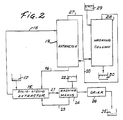
- the principal equipment is arranged as shown in Figure 2. All the equipment is constructed of 304 or 316 stainless steel or Inconel 600.
- the extraction column 19 for extraction of caffeine from green coffee extract with carbon dioxide is a vertical cylinder 76mm in diameter and l2.8m tall containing 40 plates, spaced 254mm apart. Each plate has 59 perforations, 12 in Figure 1, of 3.2mm diameter arranged in triangular pitch on 6.4mm centers. The total area of the perforations in each plate is 10.5% of the column cross-sectional area.
- An open tube of 21mm inside diameter and 235mm long is attached to each plate, serving as the downcomer 8 .
- Each plate is fitted with a TFE Teflon sheet lip seal gasket in contact with the inside wall of the column. The distance between plates is maintained by four spacer tubes 6mm in diameter located between adjacent plates. Rods 3mm in diameter pass through these tubes as well as through holes in the plates and extend the length of the column.
- each downcomer Near the bottom of each downcomer an orifice plate is installed containing three perforations, each of 3mm diameter.
- the foam-breaking material is made of knitted stainless steel wire 0.108mm in diameter and has a bulk density of 0.433 g/m3 and a surface area of about 20 square centimeters per cubic centimeter of mesh. About 250g of this material is fitted between successive plates starting 90mm above each plate and extending 150mm upward. A portion of the mesh near the column wall is extended downward toward the plate to insure effective drainage of liquid formed by breaking of foam.
- the column is pressurized with carbon dioxide maintained at 414 ⁇ 1 bar with an automatically controlled makeup pump.
- a separate circulating pump provides a flow of 2.80 kilograms per minute of carbon dioxide up through the column. This flow is equivalent to a velocity of 0.12 meters per second through the plate perforations.
- the carbon dioxide flow is sensed by a differential pressure transmitter which measures pressure drop across a section of the piping and controls an automatic throttling valve.
- the circulating pump also has an automatically regulated bypass valve which maintains a constant pressure drop across the throttling valve.
- the green coffee extract containing caffeine is pumped to the top of the column.
- the speed of this pump is automatic ally controlled by a differential pressure transmitter which senses extract level at the top of the column.
- the extract flow rate of 4.5 liters per hour is maintained at the extract exit at the bottom of the column.
- the column temperature of 82°C is maintained by means of an automatically controlled, steam heated exchanger through which the carbon dioxide passes before entering the column. Also, four automatically controlled steam tracing lines are wrapped around the column and covered with insulation.
- a second sieve plate column of the same design, 28 in Figure 2 is used to wash the caffeine from the carbon dioxide.
- Deionized water is provided to the top of this second column by an automatic water pump and the water, laden with caffeine, exits the bottom at a controlled rate of 30 liters per hour. The temperature and pressure are close to those maintained in the coffee extract column.
- Green coffee is fed at a constant rate of 3 kilograms per hour to one end of the bean extractor, 15 in Figure 2.
- extract at 25.4% solubles concentration and laden with caffeine exits.
- the extract is passed through a centrifuge to remove insoluble matter and then is pumped to the extract decaffeination column.
- the beans move through the bean extractor continuously with a residence time of about 6 hours and are maintained at 92 to 95°C.
- decaffeinated extract from the extract column enters and decaffeinated beans leave.
- the decaffeinated beans are continuously elevated with an inclined screw conveyor fitted with spray nozzles supplied with deionized water to wash off the decaffeinated extract which coats the wet beans.
- the dilute extract formed by the water wash flows down the screw conveyor and enters the bean extractor. Washed beans are discharged from the upper end of the screw conveyor into the bean drier.
- a vibrating fluid bed drier serves to dry the beans. The beans are supported on a vibrating deck provided with perforations to admit heated air from below for drying. The deck is 2.75m long. A 75mm deep bed of beans is maintained in a fluidized state by the flow of drying air assisted by vibration of the deck. A beam temperature of about 95°C is maintained near the entry point and the temperature is gradually reduced to about 80°C as the beans move through the drier. They are then cooled to about 45°C. The bean residence time is about 1 1/2 hours in the drier. The discharged beans have a moisture content of 8.8%.
- the green coffee contains 1.09% caf feine.
- the dried decaffeinated beans containing 0.015% caffeine, calculated on an equal moisture basis, is 98.6% decaffeinated.
- the discharge rate of decaffeinated beans under constant conditions for a period of three hours is at the rate of 2.895 kilograms per hour, corrected for the small difference in moisture between the decaffeinated and undecaffeinated coffees. This rate of discharge is only 3.5% less than the bean feed rate.
- the flavor quality and strength of the decaffeinated coffee is excellent, equaling the fine quality of the green coffee being fed to the process.
Landscapes
- Chemical & Material Sciences (AREA)
- Life Sciences & Earth Sciences (AREA)
- Engineering & Computer Science (AREA)
- Food Science & Technology (AREA)
- Polymers & Plastics (AREA)
- Chemical Kinetics & Catalysis (AREA)
- Tea And Coffee (AREA)
- Extraction Or Liquid Replacement (AREA)
Applications Claiming Priority (2)
| Application Number | Priority Date | Filing Date | Title |
|---|---|---|---|
| US07/129,801 US4816275A (en) | 1983-03-28 | 1987-12-07 | Decaffeination of aqueous extracts |
| US129801 | 1987-12-07 |
Publications (2)
| Publication Number | Publication Date |
|---|---|
| EP0320116A2 true EP0320116A2 (de) | 1989-06-14 |
| EP0320116A3 EP0320116A3 (de) | 1990-05-09 |
Family
ID=22441659
Family Applications (1)
| Application Number | Title | Priority Date | Filing Date |
|---|---|---|---|
| EP88310435A Ceased EP0320116A3 (de) | 1987-12-07 | 1988-11-07 | Entkoffeinierung von wasserhaltigen Extrakten |
Country Status (5)
| Country | Link |
|---|---|
| US (1) | US4816275A (de) |
| EP (1) | EP0320116A3 (de) |
| DE (1) | DE320116T1 (de) |
| ES (1) | ES2012433A4 (de) |
| GR (1) | GR900300143T1 (de) |
Cited By (1)
| Publication number | Priority date | Publication date | Assignee | Title |
|---|---|---|---|---|
| US20120269913A1 (en) * | 2009-07-21 | 2012-10-25 | Yi-Fang Chu | Crude caffeine complex, improved food products using the crude caffeine complex, and methods of use thereof |
Families Citing this family (5)
| Publication number | Priority date | Publication date | Assignee | Title |
|---|---|---|---|---|
| DE3735636A1 (de) * | 1987-10-21 | 1989-05-03 | Jacobs Suchard Gmbh | Vorrichtung zum kontinuierlichen entcoffeinieren von rohkaffee |
| US4951561A (en) * | 1989-06-06 | 1990-08-28 | Kraft General Foods, Inc. | Apparatus for fluid-solid bed processing |
| US5520942A (en) * | 1994-02-15 | 1996-05-28 | Nabisco, Inc. | Snack food coating using supercritical fluid spray |
| FI19992510A7 (fi) * | 1999-11-24 | 2001-05-25 | Nokia Corp | Elektroniikkalaite ja menetelmä elektroniikkalaitteessa |
| NO324831B1 (no) * | 2004-06-04 | 2007-12-17 | Polymers Holding As | En fremgangsmate og en anordning for handtering av vaeske |
Family Cites Families (16)
| Publication number | Priority date | Publication date | Assignee | Title |
|---|---|---|---|---|
| GB314059A (en) * | 1928-06-22 | 1930-03-06 | Wilhelm Klapproth | Improved process for the extraction of caffeine from coffee beans |
| US2309092A (en) * | 1941-05-09 | 1943-01-26 | Gen Foods Corp | Process of decaffeinating coffee |
| US2721790A (en) * | 1951-11-02 | 1955-10-25 | Shell Dev | Liquid contacting method and apparatus using coalescers |
| DE1493190C3 (de) * | 1963-04-16 | 1980-10-16 | Studiengesellschaft Kohle Mbh, 4330 Muelheim | Verfahren zur Trennung von Stoffgemischen |
| CH535543A (de) * | 1970-02-05 | 1973-04-15 | Studiengesellschaft Kohle Mbh | Verfahren zur Entcoffeinierung von Rohkaffee |
| DE2106133C3 (de) * | 1971-02-10 | 1978-12-14 | Studiengesellschaft Kohle Mbh, 4330 Muelheim | Verfahren zur Gewinnung von Aromabestandteile enthaltendem Kaffeeöl aus Röstkaffee |
| DE2212281C3 (de) * | 1972-03-14 | 1978-11-18 | Hag Ag | Verfahren zur entcoffeinierung von rohkaffee |
| DE2638383A1 (de) * | 1975-08-27 | 1977-03-03 | D E J Int Research | Verfahren zum entfernen des coffeins aus kaffee |
| US4348422A (en) * | 1978-02-13 | 1982-09-07 | Studiengesellschaft Kohle M.B.H. | Process for the direct decaffeination of aqueous coffee extract solutions |
| US4322445A (en) * | 1978-08-14 | 1982-03-30 | Siegfried Peter | Process for decaffeinating coffee |
| US4251559A (en) * | 1978-11-06 | 1981-02-17 | Societe D'assistance Technique Pour Produits Nestle S.A. | Decaffeination process |
| US4341804A (en) * | 1979-03-26 | 1982-07-27 | General Foods Corporation | Decaffeination of aqueous roasted coffee extract |
| US4246291A (en) * | 1979-03-26 | 1981-01-20 | General Foods Corporation | Decaffeination of aqueous extracts |
| US4349415A (en) * | 1979-09-28 | 1982-09-14 | Critical Fluid Systems, Inc. | Process for separating organic liquid solutes from their solvent mixtures |
| US4322367A (en) * | 1979-11-26 | 1982-03-30 | Colgate-Palmolive Company | Deoiling of aqueous solutions of sodium lauryl sulfate |
| NL188074C (nl) * | 1982-12-10 | 1992-04-01 | Douwe Egberts Tabaksfab | Werkwijze voor het decaffeineren van groene koffiebonen met actieve kool. |
-
1987
- 1987-12-07 US US07/129,801 patent/US4816275A/en not_active Expired - Fee Related
-
1988
- 1988-11-07 ES ES88310435T patent/ES2012433A4/es active Pending
- 1988-11-07 EP EP88310435A patent/EP0320116A3/de not_active Ceased
- 1988-11-07 DE DE198888310435T patent/DE320116T1/de active Pending
-
1991
- 1991-09-27 GR GR90300143T patent/GR900300143T1/el unknown
Cited By (1)
| Publication number | Priority date | Publication date | Assignee | Title |
|---|---|---|---|---|
| US20120269913A1 (en) * | 2009-07-21 | 2012-10-25 | Yi-Fang Chu | Crude caffeine complex, improved food products using the crude caffeine complex, and methods of use thereof |
Also Published As
| Publication number | Publication date |
|---|---|
| EP0320116A3 (de) | 1990-05-09 |
| ES2012433A4 (es) | 1990-04-01 |
| GR900300143T1 (en) | 1991-09-27 |
| US4816275A (en) | 1989-03-28 |
| DE320116T1 (de) | 1990-05-03 |
Similar Documents
| Publication | Publication Date | Title |
|---|---|---|
| CN1024318C (zh) | 用超临界流体除去咖啡因的方法 | |
| US4348422A (en) | Process for the direct decaffeination of aqueous coffee extract solutions | |
| US4277509A (en) | Process for extracting ground roasted coffee | |
| US5471917A (en) | Apparatus for treating ground roasted coffee | |
| US20060124544A1 (en) | System for liquid extraction, and methods | |
| US4802975A (en) | Method for stripping of residual solvent | |
| US4246291A (en) | Decaffeination of aqueous extracts | |
| US4341804A (en) | Decaffeination of aqueous roasted coffee extract | |
| EP0320116A2 (de) | Entkoffeinierung von wasserhaltigen Extrakten | |
| US5043178A (en) | Method for the extraction of roasted and ground coffee | |
| JPS61501272A (ja) | 分散液を浮選する方法および装置 | |
| US3361571A (en) | Continuous process for producing decaffeinated beverage extract | |
| US4996317A (en) | Caffeine recovery from supercritical carbon dioxide | |
| KR100382295B1 (ko) | 인삼 추출물로부터의 농약 성분 제거법 | |
| US4951557A (en) | Apparatus for decaffeination of aqueous extracts | |
| US3720518A (en) | Process for the manufacture of a concentrated coffee product | |
| US2907640A (en) | Solvent extraction apparatus | |
| US2472121A (en) | Decaffeinated soluble coffee | |
| Kemper | Solvent extraction | |
| US4922812A (en) | Device for continuously decaffeinating raw coffee | |
| DE2357590A1 (de) | Verfahren zur entcoffeinierung von rohkaffee | |
| US2817588A (en) | Decaffeination of coffee | |
| US3988116A (en) | Apparatus for countercurrent liquid-liquid extraction | |
| US2309139A (en) | Process and apparatus for decaffeinating coffee | |
| US4271291A (en) | Process for recovering cellulose ester fines |
Legal Events
| Date | Code | Title | Description |
|---|---|---|---|
| PUAI | Public reference made under article 153(3) epc to a published international application that has entered the european phase |
Free format text: ORIGINAL CODE: 0009012 |
|
| AK | Designated contracting states |
Kind code of ref document: A2 Designated state(s): AT BE CH DE ES FR GB GR IT LI LU NL SE |
|
| ITCL | It: translation for ep claims filed |
Representative=s name: STUDIO BIANCHETTI |
|
| TCAT | At: translation of patent claims filed | ||
| TCNL | Nl: translation of patent claims filed | ||
| EL | Fr: translation of claims filed | ||
| PUAL | Search report despatched |
Free format text: ORIGINAL CODE: 0009013 |
|
| DET | De: translation of patent claims | ||
| AK | Designated contracting states |
Kind code of ref document: A3 Designated state(s): AT BE CH DE ES FR GB GR IT LI LU NL SE |
|
| 17P | Request for examination filed |
Effective date: 19900903 |
|
| 17Q | First examination report despatched |
Effective date: 19910722 |
|
| STAA | Information on the status of an ep patent application or granted ep patent |
Free format text: STATUS: THE APPLICATION HAS BEEN REFUSED |
|
| 18R | Application refused |
Effective date: 19920719 |