EP0319085A1 - Digitale Übertragung mit galvanischer Trennung in Videoschaltungen - Google Patents
Digitale Übertragung mit galvanischer Trennung in Videoschaltungen Download PDFInfo
- Publication number
- EP0319085A1 EP0319085A1 EP19880202669 EP88202669A EP0319085A1 EP 0319085 A1 EP0319085 A1 EP 0319085A1 EP 19880202669 EP19880202669 EP 19880202669 EP 88202669 A EP88202669 A EP 88202669A EP 0319085 A1 EP0319085 A1 EP 0319085A1
- Authority
- EP
- European Patent Office
- Prior art keywords
- bit stream
- separation
- video
- circuit
- signal
- Prior art date
- Legal status (The legal status is an assumption and is not a legal conclusion. Google has not performed a legal analysis and makes no representation as to the accuracy of the status listed.)
- Withdrawn
Links
Images
Classifications
-
- H—ELECTRICITY
- H04—ELECTRIC COMMUNICATION TECHNIQUE
- H04L—TRANSMISSION OF DIGITAL INFORMATION, e.g. TELEGRAPHIC COMMUNICATION
- H04L25/00—Baseband systems
- H04L25/02—Details ; arrangements for supplying electrical power along data transmission lines
- H04L25/0264—Arrangements for coupling to transmission lines
- H04L25/0266—Arrangements for providing Galvanic isolation, e.g. by means of magnetic or capacitive coupling
- H04L25/0268—Arrangements for providing Galvanic isolation, e.g. by means of magnetic or capacitive coupling with modulation and subsequent demodulation
Definitions
- the invention relates to a video circuit including a conversion unit which has for its object to convert, under the control of a clock signal, an analog signal or a digital signal, respectively, whilst preserving the information contained therein, into a digital or an analog signal, respectively; and separation means for producing a galvanic separation from ground in the video circuit.
- Such a video circuit is frequently used to preprocess a video signal applied thereto either as an analog signal or as a digital signal to give it a shape appropriate for further processing to or from a transmission circuit.
- a separation transformer is arranged between a video signal source, for example a video camera, and the input of a video circuit.
- a video signal source for example a video camera
- Such a proposed solution has the drawback that such a ground separation transformer must be capable of transmitting the signal at base-band level. Such a requirement is an impediment to a cost-effective solution of the ground separation problem.
- the invention has for its object to obviate the above drawback.
- the basic idea is to provide, different from the above-mentioned technique, a ground separation plane in those positions in the circuit in which a video signal is present in the digital form. More specifically, such a ground separation plane is then provided at the output of a converter unit, in the present case an analog-to-digital converter (transmitting section of the circuit) and, optionally, at the input of a converter unit, in the present case a digital-to-analog converter (receiving section of the circuit).
- a video circuit is therefore characterized in that the separation means for each bit stream path connected to a relevant converter unit include a separation member, for example a separation capacitor, incorporated in such a bit stream path; and that such a bit stream path further includes:
- a video circuit according to the invention is more specifically characterized in that said modulation unit is constituted by an XOR-gate driven by said clock signal; and said demodulation unit is constituted by a buffer clocked by a phase-shifted version of said clock signal.
- a pulse transmission circuit having the aforedescribed characterizing features can be used for the transparent transmission of pulse sequences in which long subsequences of consecutive "zeros" or "ones" may occur, over a path including a galvanic separation.
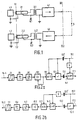
- the circuit configuration shown schematically in Figure 1 is an embodiment which is illustrative of the field of usage of the invention.
- Such a configuration comprises a signal source 1.1, for example a video camera; a video cable 2.1 having for its object to convey a signal applied by this signal source, to a video signal part present in the area of this source; 3.1 and 3.2, respectively, a first and a second ground separation transformer, respectively; a signal processing system 4.1 and 4.2, respectively of the transmitter section and the receiver section, respectively, of the video circuit, which system will be described in greater detail with reference to Figure 2; a video transmission system 5 which can transmit a video signal processed at the transmitter end of the video circuit via a transmission medium (coaxial cable, fibre optic cable, the ether) to a comparatively remote section at the receiver end of the video circuit; a signal user set 1.2, such as, for example, a video receiver; a video cable 2.2 serving to convey the signal applied by the second ground separation transformer to the signal user set; a first interface I.1 provided
- the video cable for example 2.1 (which may have a length of, for example, 100 to 200 mtres.) is provided together with one or more further cables, for example cables conveying electricity, in the same cable duct.
- Such neighbouring cables induce significant noise voltages in the relevant video cable, such as, for example, 50Hz hum voltages.
- the disturbing influence thereof on the useful video signal can be eliminated by forming a ground separation plane.
- such a ground separation plane is implemented by a ground separation transformer such as 3.1.
- Such a ground separation transformer must be capable of transmitting a video signal at baseband level (0-6 MHz). Such a requirement implies that the implementation of such a ground separation transformer will be comparatively costly and difficult.
- the cross-inductance introduced by such a ground separation transformer must be dimensioned for a lowest frequency of, for example, 0.1 Hz. This is objectionable from the constructional and cost point of view; in addition special attention must be paid to provisions ensuring the quality of the transmission properties in this circuit section, more specifically as regards the upper part of the 0-6 MHz band.
- a transmission system which may include, for example, a coaxial cable or an optical fibre cable
- that part of the path that is interposed between the first and second interfaces such as I.1 and II.1 (transmitter end) and I.2 and II.2 (receiver end) is denoted as the video circuit.
- a video circuit present at the transmitter end must incorporate an A/D converter and a multiplexer and a video circuit present at the receiver end must comprise a D/A converter and a demultiplexer.
- a ground separation plane in the video circuit at the transmitter end and, optionally, in the video circuit provided at the receiver end. More specifically, to that end such a ground separation plane is formed between the output end of the A/D converter and the multiplexer provided in the video circuit, and optionally between the input end of the D/A converter and the demultiplexer present in the video circuit.
- such a ground separation plane is created between every physical output of the A/D converter and the corresponding physical input of the multiplexer added thereto, and also optionally between every physical input of a D/A converter and the corresponding output of the demultiplexer added thereto, by providing a series capacitor.
- each stream of equal bits appearing for every individual A/D-converter output i.e . a direct current, must be applied undistorted to the corresponding, individual D/A-converter input of the receiver station.
- the upper and lower halves, respectively, of the diagram shown in Figure 2 is an illustrative embodiment of the invention such as it is used in the respective blocks 4.1 and 4.2 of a connecting path of the type described in the foregoing.
- Figure 2 shows and indicates the following components: a video equalizer 7.1 and 7.2, respectively; a low-pass filter (0-6 MHz) 8.1 and 8.2, respectively; a group-delay equalizer 9.1 and 9.2,respectively; a clamping amplifier 10.1; an amplifier 10.2; an A/D converter 11.2; a bit sequence modulator 12.1 and 12.2, respectively; a ground separation capacitor 13.1, 13.1′ and 13.2, 13.2′, respectively; a bit sequence demodulator 14.1 and 14.2, respectively; and a clock signal channel 15.1 and 15.2, respectively.
- an analog-video signal input and an analog video signal output are denoted by the respective arrows 16.1 and 16.2, whilst a digital video signal output and a digital video signal input are denoted by the respective arrows 17.1 and 17.2.
- every digital output and digital input, respectively of the respective A/D and D/A converters is included in a series circuit formed by a bit sequence modulator, for example 12.1 and 12.2, respectively, a separation capacitor, for example 13.1 and 13.2, respectively and also a bit sequence demodulator for example 14.1 and 14.2, respectively.
- n is, for example, equal to 8 or 9
- the inputs such as 16.1 and the output 16.2, respectively are as a rule coupled to a video cable via an interface; the output such as 17.1 and the input such as 17.2, respectively are coupled to a multiplexer or a demultiplexer, respectively.
- Each video signal or each n-bit word remains available during an interval corresponding on one period of a clock signal as applied via the path such as 15.1 and 15.2, respectively.
- Each bit sequence modulator for example 12.1 is arranged for up-modulating a sequence of bits applied thereto, each bit being a constituent part of consecutively appearing video signal samples, to a frequency level as given by the frequency f cl of the clock signal. This means that a sequence of consecutive bits of equal values are converted via such a modulator into a sequence of consecutive bits of unequal values. More specifically, a relatively long sequence of consecutive "zeros" and "ones", respectively, will appear at the output of such a demodulator as a replica of the relevant clock signal or a phase-shifted version of this signal, respectively.
- ground separation capacitor is dimensioned such that it is transparent to frequencies ⁇ 1/2.f cl .
- the clock signal frequency f cl when used in the field of application described will here generally exceed approximately 13 MHz.
- a bit sequency demodulator such as 14.1 or 14.2, respectively, is connected to the other side of the ground separation capacitor.
- Such a bit sequence demodulator is arranged for down modulation of a bit stream applied to it, in such manner that such a down-modulated bit stream is a faithful replica of the corresponding bit stream applied to the bit sequence modulator.
- Such a bit sequence modulator is, for example, in the form of an XOR gate, whilst such a bit sequence demodulator is, for example, in the form of a D-type flip-flop.
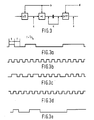
- T 1/f cl .
- the clock signal operative for sampling is illustrated by the pulse diagram b and this clock signal is also used for driving the bit sequence modulator.
- the bit sequence, for example as denoted by "a”, which is up-modulated by such a bit sequence modulator is illustrated by pulse diagram c.
- a bit sequence derived thus from the bit sequence "a” passes predominantly undistortedly through the ground separation capacitor in spite of the presence of a plurality of consecutive "zeros" and a plurality of "ones" in the bit sequence a.
- the associated bit sequence demodulator is driven by a clock signal which is illustrated by the pulse diagram d.
- This clock signal is phase-shifted relative to the clock signal b in such a way that an upwardly directed edge occurs in each interval in which the clock signal is "low", as a result of which the bit value of the sequence c is equal to that of the sequence a.
- the up-modulated bit sequence c is modulated downwardly again so that ultimately a bit sequence is obtained as illustrated by e. From a and e it appears that said last bit sequence is a phase-shifted replica of the first-mentioned bit sequence.
- any ground separation can be shunted by utilizing an associated XOR-gate, more specifically because such a signal bit sequence is modulated such that actually no d.c. component must pass the ground separation capacitor.
- the present invention provides an economically attractive and efficient solution for the outlined problem.
- simple and inexpensive means can be used without it being necessary to use numerous communication transformers for such a ground separation.
- the use of the invention is not limited to the embodiment described in the foregoing.
- the invention can more particularly be used for the transparent transmission of pulse sequences in which relatively long sub-sequences of consecutive equal bits may occur, via a path in which direct current blocking or galvanic separation occurs.
Landscapes
- Engineering & Computer Science (AREA)
- Power Engineering (AREA)
- Computer Networks & Wireless Communication (AREA)
- Signal Processing (AREA)
- Dc Digital Transmission (AREA)
- Details Of Television Systems (AREA)
- Picture Signal Circuits (AREA)
Applications Claiming Priority (2)
| Application Number | Priority Date | Filing Date | Title |
|---|---|---|---|
| NL8702860A NL8702860A (nl) | 1987-11-30 | 1987-11-30 | Digitale inrichting dienende om aardscheidingen bij videocircuits te overbruggen. |
| NL8702860 | 1987-11-30 |
Publications (1)
| Publication Number | Publication Date |
|---|---|
| EP0319085A1 true EP0319085A1 (de) | 1989-06-07 |
Family
ID=19850994
Family Applications (1)
| Application Number | Title | Priority Date | Filing Date |
|---|---|---|---|
| EP19880202669 Withdrawn EP0319085A1 (de) | 1987-11-30 | 1988-11-24 | Digitale Übertragung mit galvanischer Trennung in Videoschaltungen |
Country Status (5)
| Country | Link |
|---|---|
| US (1) | US4982190A (de) |
| EP (1) | EP0319085A1 (de) |
| JP (1) | JPH01236776A (de) |
| DK (1) | DK662088A (de) |
| NL (1) | NL8702860A (de) |
Citations (3)
| Publication number | Priority date | Publication date | Assignee | Title |
|---|---|---|---|---|
| FR2088752A5 (de) * | 1970-04-23 | 1972-01-07 | Cit Alcatel | |
| GB2102230A (en) * | 1981-07-16 | 1983-01-26 | Plessey Co Ltd | A pulse drive circuit |
| GB2157521A (en) * | 1984-04-14 | 1985-10-23 | Video Interactive Systems Ltd | Improvements relating to interface circuits |
Family Cites Families (1)
| Publication number | Priority date | Publication date | Assignee | Title |
|---|---|---|---|---|
| JPH0697792B2 (ja) * | 1985-12-13 | 1994-11-30 | パイオニア株式会社 | 映像信号再生装置 |
-
1987
- 1987-11-30 NL NL8702860A patent/NL8702860A/nl not_active Application Discontinuation
-
1988
- 1988-11-24 EP EP19880202669 patent/EP0319085A1/de not_active Withdrawn
- 1988-11-25 DK DK662088A patent/DK662088A/da not_active Application Discontinuation
- 1988-11-29 JP JP63299759A patent/JPH01236776A/ja active Pending
- 1988-11-30 US US07/277,627 patent/US4982190A/en not_active Expired - Lifetime
Patent Citations (3)
| Publication number | Priority date | Publication date | Assignee | Title |
|---|---|---|---|---|
| FR2088752A5 (de) * | 1970-04-23 | 1972-01-07 | Cit Alcatel | |
| GB2102230A (en) * | 1981-07-16 | 1983-01-26 | Plessey Co Ltd | A pulse drive circuit |
| GB2157521A (en) * | 1984-04-14 | 1985-10-23 | Video Interactive Systems Ltd | Improvements relating to interface circuits |
Non-Patent Citations (2)
| Title |
|---|
| ELECTRONIC DESIGN, vol. 27, no. 15, 19th July 1979, pages 110-116, Rochelle Park, US; J.J.NORTON: "Drop your costs, but not your bits with a Manchester-data decoder" * |
| MULTIPLEXTECHNIK, vol. 10, 1987, special volume: "Multiplex- und Leitungseinrichtungen" pages 62-68; F.HORNUNG et al.: "Aufbereitung von Fernsehsignalen für 140-Mbit/s-Verbindungen" * |
Also Published As
| Publication number | Publication date |
|---|---|
| DK662088A (da) | 1989-05-31 |
| JPH01236776A (ja) | 1989-09-21 |
| NL8702860A (nl) | 1989-06-16 |
| US4982190A (en) | 1991-01-01 |
| DK662088D0 (da) | 1988-11-25 |
Similar Documents
| Publication | Publication Date | Title |
|---|---|---|
| US4999831A (en) | Synchronous quantized subcarrier multiplexer for digital transport of video, voice and data | |
| US7528753B2 (en) | Codec simultaneously processing multiple analog signals with only one analog-to-digital converter and method thereof | |
| EP0146894B1 (de) | Übertragungssystem zum gleichzeitigen Senden und Empfangen von Daten- und Sprachsignalen über Zweidrahtleitungen | |
| US5051981A (en) | Digital filtering | |
| EP0876030A3 (de) | System und Verfahren zur dynamischen Optimierung einer Symboltabelle und Modem,d er diese verwendet | |
| US4677608A (en) | Method of transferring an additional information channel across a transmission medium | |
| EP0924864A2 (de) | Digitales Funkübertragungssystem zusammengesetzt aus mehreren Einheiten | |
| HK109297A (en) | Signal distribution | |
| BRPI0014187B1 (pt) | receptor ótico digital para sistemas de televisão a cabo | |
| EP1641136A1 (de) | Leitungsschnittstelle für Daten- und Leistungsversorgung | |
| US6667994B1 (en) | Multiplexing digital communication system | |
| JPH11234045A (ja) | カウンタを備えた周波数遷移キーイング復調器 | |
| US4630285A (en) | Method for reducing group delay distortion | |
| RU2000122973A (ru) | Способ обработки сигналов телефонной связи от аналогового оконечного устройства телефонной связи и данных от оконечного устройства передачи данных | |
| EP0319085A1 (de) | Digitale Übertragung mit galvanischer Trennung in Videoschaltungen | |
| EP0667687A1 (de) | Echo-Löscher | |
| GB2128454A (en) | Head-end and receiver for a signal distribution system | |
| US20030154495A1 (en) | Data rate compression device for cable television return path using bandpass puncturing | |
| CA1174384A (en) | Digital transmultiplexer | |
| EP0277392B1 (de) | Datenübertragungssystem mit Entfaltungsfiltern | |
| US6999499B1 (en) | Demodulation apparatus of a base station in a CDMA mobile communication system | |
| GB2117601A (en) | Conference circuit | |
| Vaidyanathan et al. | Optimality of principal component filter banks for discrete multitone communication systems | |
| JPS6439122A (en) | Digital data demodulating circuit | |
| KR0178227B1 (ko) | 병렬 구조를 갖는 펄스 성형 필터 회로 |
Legal Events
| Date | Code | Title | Description |
|---|---|---|---|
| PUAI | Public reference made under article 153(3) epc to a published international application that has entered the european phase |
Free format text: ORIGINAL CODE: 0009012 |
|
| AK | Designated contracting states |
Kind code of ref document: A1 Designated state(s): DE FR GB IT NL SE |
|
| 17P | Request for examination filed |
Effective date: 19891204 |
|
| RAP1 | Party data changed (applicant data changed or rights of an application transferred) |
Owner name: AT&T NETWORK SYSTEMS INTERNATIONAL B.V. Owner name: APT NEDERLAND B.V. |
|
| RAP3 | Party data changed (applicant data changed or rights of an application transferred) |
Owner name: AT&T NETWORK SYSTEMS NEDERLAND B.V. Owner name: AT&T NETWORK SYSTEMS INTERNATIONAL B.V. |
|
| 17Q | First examination report despatched |
Effective date: 19911105 |
|
| STAA | Information on the status of an ep patent application or granted ep patent |
Free format text: STATUS: THE APPLICATION IS DEEMED TO BE WITHDRAWN |
|
| 18D | Application deemed to be withdrawn |
Effective date: 19920317 |