EP0318682A2 - Tricyclic thiazole derivatives - Google Patents
Tricyclic thiazole derivatives Download PDFInfo
- Publication number
- EP0318682A2 EP0318682A2 EP88117164A EP88117164A EP0318682A2 EP 0318682 A2 EP0318682 A2 EP 0318682A2 EP 88117164 A EP88117164 A EP 88117164A EP 88117164 A EP88117164 A EP 88117164A EP 0318682 A2 EP0318682 A2 EP 0318682A2
- Authority
- EP
- European Patent Office
- Prior art keywords
- group
- formula
- lower alkyl
- carbamoyl
- halogen
- Prior art date
- Legal status (The legal status is an assumption and is not a legal conclusion. Google has not performed a legal analysis and makes no representation as to the accuracy of the status listed.)
- Granted
Links
Classifications
-
- C—CHEMISTRY; METALLURGY
- C07—ORGANIC CHEMISTRY
- C07D—HETEROCYCLIC COMPOUNDS
- C07D495/00—Heterocyclic compounds containing in the condensed system at least one hetero ring having sulfur atoms as the only ring hetero atoms
- C07D495/02—Heterocyclic compounds containing in the condensed system at least one hetero ring having sulfur atoms as the only ring hetero atoms in which the condensed system contains two hetero rings
- C07D495/04—Ortho-condensed systems
-
- A—HUMAN NECESSITIES
- A61—MEDICAL OR VETERINARY SCIENCE; HYGIENE
- A61P—SPECIFIC THERAPEUTIC ACTIVITY OF CHEMICAL COMPOUNDS OR MEDICINAL PREPARATIONS
- A61P21/00—Drugs for disorders of the muscular or neuromuscular system
- A61P21/02—Muscle relaxants, e.g. for tetanus or cramps
-
- A—HUMAN NECESSITIES
- A61—MEDICAL OR VETERINARY SCIENCE; HYGIENE
- A61P—SPECIFIC THERAPEUTIC ACTIVITY OF CHEMICAL COMPOUNDS OR MEDICINAL PREPARATIONS
- A61P25/00—Drugs for disorders of the nervous system
- A61P25/20—Hypnotics; Sedatives
-
- C—CHEMISTRY; METALLURGY
- C07—ORGANIC CHEMISTRY
- C07D—HETEROCYCLIC COMPOUNDS
- C07D205/00—Heterocyclic compounds containing four-membered rings with one nitrogen atom as the only ring hetero atom
- C07D205/02—Heterocyclic compounds containing four-membered rings with one nitrogen atom as the only ring hetero atom not condensed with other rings
- C07D205/04—Heterocyclic compounds containing four-membered rings with one nitrogen atom as the only ring hetero atom not condensed with other rings having no double bonds between ring members or between ring members and non-ring members
-
- C—CHEMISTRY; METALLURGY
- C07—ORGANIC CHEMISTRY
- C07D—HETEROCYCLIC COMPOUNDS
- C07D333/00—Heterocyclic compounds containing five-membered rings having one sulfur atom as the only ring hetero atom
- C07D333/02—Heterocyclic compounds containing five-membered rings having one sulfur atom as the only ring hetero atom not condensed with other rings
- C07D333/04—Heterocyclic compounds containing five-membered rings having one sulfur atom as the only ring hetero atom not condensed with other rings not substituted on the ring sulphur atom
- C07D333/26—Heterocyclic compounds containing five-membered rings having one sulfur atom as the only ring hetero atom not condensed with other rings not substituted on the ring sulphur atom with hetero atoms or with carbon atoms having three bonds to hetero atoms with at the most one bond to halogen, e.g. ester or nitrile radicals, directly attached to ring carbon atoms
- C07D333/38—Carbon atoms having three bonds to hetero atoms with at the most one bond to halogen, e.g. ester or nitrile radicals
-
- C—CHEMISTRY; METALLURGY
- C07—ORGANIC CHEMISTRY
- C07D—HETEROCYCLIC COMPOUNDS
- C07D455/00—Heterocyclic compounds containing quinolizine ring systems, e.g. emetine alkaloids, protoberberine; Alkylenedioxy derivatives of dibenzo [a, g] quinolizines, e.g. berberine
- C07D455/02—Heterocyclic compounds containing quinolizine ring systems, e.g. emetine alkaloids, protoberberine; Alkylenedioxy derivatives of dibenzo [a, g] quinolizines, e.g. berberine containing not further condensed quinolizine ring systems
-
- C—CHEMISTRY; METALLURGY
- C07—ORGANIC CHEMISTRY
- C07D—HETEROCYCLIC COMPOUNDS
- C07D455/00—Heterocyclic compounds containing quinolizine ring systems, e.g. emetine alkaloids, protoberberine; Alkylenedioxy derivatives of dibenzo [a, g] quinolizines, e.g. berberine
- C07D455/03—Heterocyclic compounds containing quinolizine ring systems, e.g. emetine alkaloids, protoberberine; Alkylenedioxy derivatives of dibenzo [a, g] quinolizines, e.g. berberine containing quinolizine ring systems directly condensed with at least one six-membered carbocyclic ring, e.g. protoberberine; Alkylenedioxy derivatives of dibenzo [a, g] quinolizines, e.g. berberine
- C07D455/04—Heterocyclic compounds containing quinolizine ring systems, e.g. emetine alkaloids, protoberberine; Alkylenedioxy derivatives of dibenzo [a, g] quinolizines, e.g. berberine containing quinolizine ring systems directly condensed with at least one six-membered carbocyclic ring, e.g. protoberberine; Alkylenedioxy derivatives of dibenzo [a, g] quinolizines, e.g. berberine containing a quinolizine ring system condensed with only one six-membered carbocyclic ring, e.g. julolidine
- C07D455/06—Heterocyclic compounds containing quinolizine ring systems, e.g. emetine alkaloids, protoberberine; Alkylenedioxy derivatives of dibenzo [a, g] quinolizines, e.g. berberine containing quinolizine ring systems directly condensed with at least one six-membered carbocyclic ring, e.g. protoberberine; Alkylenedioxy derivatives of dibenzo [a, g] quinolizines, e.g. berberine containing a quinolizine ring system condensed with only one six-membered carbocyclic ring, e.g. julolidine containing benzo [a] quinolizine ring systems
-
- C—CHEMISTRY; METALLURGY
- C07—ORGANIC CHEMISTRY
- C07D—HETEROCYCLIC COMPOUNDS
- C07D495/00—Heterocyclic compounds containing in the condensed system at least one hetero ring having sulfur atoms as the only ring hetero atoms
- C07D495/12—Heterocyclic compounds containing in the condensed system at least one hetero ring having sulfur atoms as the only ring hetero atoms in which the condensed system contains three hetero rings
- C07D495/14—Ortho-condensed systems
-
- C—CHEMISTRY; METALLURGY
- C07—ORGANIC CHEMISTRY
- C07D—HETEROCYCLIC COMPOUNDS
- C07D513/00—Heterocyclic compounds containing in the condensed system at least one hetero ring having nitrogen and sulfur atoms as the only ring hetero atoms, not provided for in groups C07D463/00, C07D477/00 or C07D499/00 - C07D507/00
- C07D513/02—Heterocyclic compounds containing in the condensed system at least one hetero ring having nitrogen and sulfur atoms as the only ring hetero atoms, not provided for in groups C07D463/00, C07D477/00 or C07D499/00 - C07D507/00 in which the condensed system contains two hetero rings
- C07D513/04—Ortho-condensed systems
-
- C—CHEMISTRY; METALLURGY
- C07—ORGANIC CHEMISTRY
- C07D—HETEROCYCLIC COMPOUNDS
- C07D513/00—Heterocyclic compounds containing in the condensed system at least one hetero ring having nitrogen and sulfur atoms as the only ring hetero atoms, not provided for in groups C07D463/00, C07D477/00 or C07D499/00 - C07D507/00
- C07D513/12—Heterocyclic compounds containing in the condensed system at least one hetero ring having nitrogen and sulfur atoms as the only ring hetero atoms, not provided for in groups C07D463/00, C07D477/00 or C07D499/00 - C07D507/00 in which the condensed system contains three hetero rings
- C07D513/14—Ortho-condensed systems
Definitions
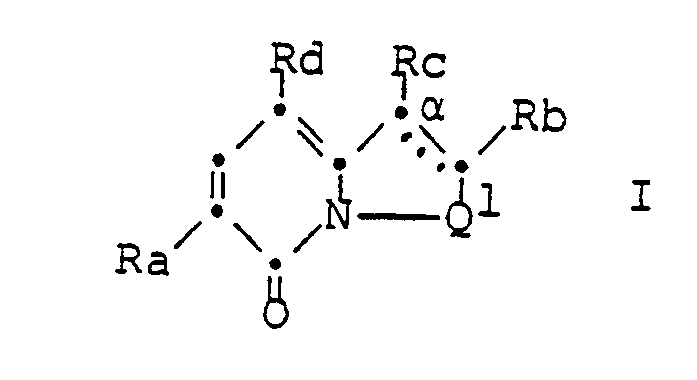
- Ra is a phenyl, pyridyl or thienyl group optionally substituted by halogen, trifluoromethyl, nitro, lower alkyl or lower alkoxy, Rb and Rc together with the carbon atom denoted by ⁇ , one optionally by halogen, trifluoromethyl, lower Alkyl, lower alkoxy, nitro, amino or mono- or di (lower alkyl) amino substituted group of the formula > C
- These compounds of formula I have valuable pharmacological properties and can be used to control or prevent diseases. They are particularly muscle-relaxing, sedative-hypnotic, anxiolytic and / or anticonvulsant and can therefore be used to combat or prevent muscle tension, tension, insomnia, anxiety stands and / or convulsions are used.
- alkanoyl taken alone or in combinations, such as alkanoyl, alkanoyloxy and alkoxyalkyl, denotes straight-chain or branched, saturated hydrocarbon radicals, such as methyl, ethyl, propyl, isopropyl and t-butyl.
- cycloalkyl denotes cyclic, saturated hydrocarbon radicals, such as cyclohexyl.
- alkoxy denotes alkyl groups such as methoxy and ethoxy bonded via an oxygen atom.
- hydroxyalkyl refers to alkyl groups substituted by hydroxy, such as 2-hydroxyethyl.
- alkanoyl and “alkanoyloxy” denote fatty acid residues such as acetyl and acetoxy.
- alkylene denotes straight-chain or branched, saturated hydrocarbon radicals with two free valences, such as methylene, 1,2-ethylene and 1,3-propylene.
- halogen denotes the four forms fluorine, chlorine, bromine and iodine.
- aryl preferably denotes phenyl groups which are optionally substituted by halogen, trifluoromethyl, lower alkyl, lower alkoxy, nitro, amino or mono- or di (lower alkyl) amino.
- the 5-membered, saturated, partially unsaturated or aromatic heterocycles bonded via a carbon atom preferably contain, as hetero ring members, an oxygen or sulfur atom or an imino or lower alkylimino group and optionally one or two nitrogen atoms, the carbon atom via which the Heterocycle is bound, preferably located next to or between two heteroatoms.
- heterocycles which can also be substituted as mentioned, are: 2-oxazolin-2-yl, 3-methyl-1,2,4-oxadiazol-5-yl, 2-thiazolin-2-yl, 2-tetrahydrofuryl and 2-thiazolyl.
- N-R5 as a ring member
- -NR3R4 denotes on the one hand heterocycles with only one heteroatom, namely the nitrogen atom , via which they are bound, and on the other hand heterocycles with two heteroatoms, namely said nitrogen atom and one oxygen or sulfur atom or a second nitrogen atom.
- heterocycles which can also be substituted as mentioned, are: 2- (lower alkoxyalkyl) -1-azetidinyl, 3- (lower alkoxy) -1-azetidinyl, 3-hydroxy-1-azetidinyl, 2- (lower hydroxyalkyl) -1-azetidinyl, 2- (lower alkanoyloxyalkyl) -1-pyrrolidinyl, 3-oxo-1-pyrrolidinyl, 2- (lower alkoxycarbonyl) -1-pyrrolidinyl, 3- (lower alkoxy) -1-pyrrolidinyl, 3-hydroxy- 1-pyrrolidinyl, 2- (lower alkoxyalkyl) -1-pyrrolidinyl, 2- (lower hydroxyalkyl) -1-pyrrolidinyl, 2- (lower hydroxyalkyl) -4-hydroxy-1-pyrrolidinyl, 2- (lower alkoxyalkyl)
- the symbol Ra preferably denotes a phenyl group optionally substituted by m-halogen or m-trifluoromethyl, phenyl being particularly preferred.
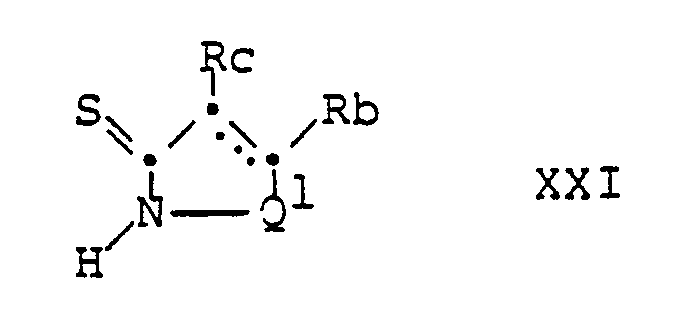
- the compounds of formula II can be prepared, for example, by using a compound of the general formula wherein Q1, Rb, Rc and the dashed line have the above meaning, with a compound of the general formula wherein X1 and X2 each represent halogen and R ⁇ has the above meaning, implemented.
- the reaction of a compound of formula XXI with a compound of formula XXII, wherein X1 is preferably chlorine and X2 is preferably bromine, is preferably carried out at room temperature in a halogenated hydrocarbon, such as chloroform, followed by a basic Amine, such as triethylamine, treated.
- the reaction of a compound of formula XXI with a compound of formula XXIII is preferably carried out in an inert solvent such as acetone, N, N-dimethylformamide, dimethyl sulfoxide and the like at room temperature.
- Method B 28.6 g of 1-phenyl-2,2 are added to a solution of 26.35 g of 4,5-dihydrothieno [2,3-c] pyridine-7 (6H) -thione in 140 ml of dimethylformamide with stirring -dicyan-oxiran, the solution immediately turning deep red. After 16 hours, the crystalline precipitate is filtered off and washed with ethyl acetate. 5,6-dihydro-3-hydroxy-2-phenylthiazolo [3,2-a] thieno [2,3-c] pyridinium hydroxide (inner salt) of mp. 208-209 ° is obtained.
- aab 41.3 g of 3,3'-dithiobis-thiophene-2-carboxylic acid are suspended in 340 ml of thionyl chloride, whereupon the mixture is heated under reflux for 2.5 hours. The excess thionyl chloride is removed in vacuo and the residue is suspended in 700 ml of dioxane. Ammonia is now introduced into the solution. After cooling in an ice bath, the mixture is filtered and the crystals are stirred in 1500 ml of water for 30 minutes. The crystals are filtered off.
- 3,3'-dithiobis-thiophene-2-carboxamide is obtained as colorless crystals of mp. 222-223 °.
- aac 77.5 g of 3,3'-dithio-bis-thiophene-2-carboxamide are suspended in 1200 ml of dioxane, whereupon the mixture is heated to 45 ° under inert gas. 46.4 g of sodium borohydride are added in portions to the suspension at 45-48 °. After the evolution of hydrogen has ended, the mixture is heated under reflux until the disulfide has disappeared.
- Method B 65.4 g of methyl 3-mercapto-thiophene-2-carboxylate are dissolved in 800 ml of ethanol, whereupon 19.4 ml of ethyleneimine are added.
- the reaction mixture is cooled in an ice bath and the hydrochloride is precipitated by introducing dry hydrogen chloride. The crystals are filtered off and the filtrate is evaporated to give more crude product.
- Acid ethyl ester 3 - [(2-aminoethyl) thio] -2-thiophene-carboxylic acid methyl ester hydrochloride is obtained as white crystals of mp. 174-176 °.
- the reaction can also be carried out with 1.1 molar equivalent of potassium tert-butoxide solution in toluene.
- acb 1.0 g of 3,4-dihydro-thieno [2,3-f] [1,4] thiazepine-5) 2H) -one are refluxed together with 15 ml of pyridine and 1.35 g of phosphorus pentasulfide for 5 hours heated. After cooling, it is poured onto 90 ml of water and the crystals are filtered off. After chromatography on silica gel, the residue is recrystallized from ethyl acetate.
- thieno [2,3-c] pyridine 6-oxide hydrochloride obtained in this way is sufficiently pure to be used for the next stage, mp. 202 °. adb) 671.5 g of thieno [2,3-c] pyridine 6-oxide hydrochloride are suspended in 4000 ml of dioxane under argon and 655 ml Phosphorus oxychloride are added. It is heated on the oil bath until the onset of the exothermic reaction. After the exothermic reaction has subsided, the mixture is heated under reflux for a further 10 minutes. The mixture is concentrated in vacuo and the residue is taken up in 2000 ml of toluene. 3000 ml of water are then slowly added while cooling.
- the mixture is heated to 110-115 ° for one hour, a further 1.06 g of sodium hydrogen sulfide monohydrate are added and the mixture is kept at the above-mentioned temperature for a further hour. It is poured onto 150 ml of ice water and acidified with 1N aqueous hydrochloric acid solution. After briefly stirring at 2 °, the yellowish crystals are filtered off. After recrystallization from a toluene / ethyl acetate mixture, pure thieno [2,3-c] pyridine-7 (6H) -thione, mp. 187-189 ° is obtained.
- connection described in Example 3bd can also be produced as follows:
Landscapes
- Chemical & Material Sciences (AREA)
- Organic Chemistry (AREA)
- Health & Medical Sciences (AREA)
- Veterinary Medicine (AREA)
- Life Sciences & Earth Sciences (AREA)
- Neurology (AREA)
- Public Health (AREA)
- Bioinformatics & Cheminformatics (AREA)
- Chemical Kinetics & Catalysis (AREA)
- General Chemical & Material Sciences (AREA)
- Medicinal Chemistry (AREA)
- Nuclear Medicine, Radiotherapy & Molecular Imaging (AREA)
- Engineering & Computer Science (AREA)
- Pharmacology & Pharmacy (AREA)
- General Health & Medical Sciences (AREA)
- Animal Behavior & Ethology (AREA)
- Biomedical Technology (AREA)
- Neurosurgery (AREA)
- Anesthesiology (AREA)
- Pain & Pain Management (AREA)
- Orthopedic Medicine & Surgery (AREA)
- Physical Education & Sports Medicine (AREA)
- Nitrogen Condensed Heterocyclic Rings (AREA)
- Pharmaceuticals Containing Other Organic And Inorganic Compounds (AREA)
- Heterocyclic Carbon Compounds Containing A Hetero Ring Having Oxygen Or Sulfur (AREA)
- Nitrogen And Oxygen Or Sulfur-Condensed Heterocyclic Ring Systems (AREA)
- Plural Heterocyclic Compounds (AREA)
Abstract
Description
Die vorliegende Erfindung betrifft Verbindungen der allgemeinen Formel


Diese Verbindungen der Formel I besitzen wertvolle pharmakologische Eigenschaften und können zur Bekämpfung oder Verhütung von Krankheiten verwendet werden. Sie sind insbesondere muskelrelaxierend, sedativhypnotisch, anxiolytisch und/oder antikonvulsiv wirksam und können demnach bei der Bekämpfung oder Verhütung von Muskelspannungen, Spannungszuständen, Schlaflosigkeit, Angstzu ständen und/oder Konvulsionen verwendet werden.These compounds of formula I have valuable pharmacological properties and can be used to control or prevent diseases. They are particularly muscle-relaxing, sedative-hypnotic, anxiolytic and / or anticonvulsant and can therefore be used to combat or prevent muscle tension, tension, insomnia, anxiety stands and / or convulsions are used.
Die Verbindungen der Formel I und ihre Herstellung ausgehend von Verbindungen der Formel II werden in der Europäischen Patentanmeldung Nr. 85 113 864.4 (Veröffentlichungsnummer: 183 994) beschrieben.The compounds of formula I and their preparation starting from compounds of formula II are described in European Patent Application No. 85 113 864.4 (publication number: 183 994).
Der Ausdruck "nieder" bezeichnet Reste und Verbindungen mit höchstens sieben, vorzugsweise höchstens vier Kohlenstoffatomen. Der Ausdruck "Alkyl" für sich allein genommen oder in Kombinationen, wie Alkanoyl, Alkanoyloxy und Alkoxyalkyl, bezeichnet geradkettige oder verzweigte, gesättigte Kohlenwasserstoffreste, wie Methyl, Aethyl, Propyl, Isopropyl und t-Butyl. Der Ausdruck "Cycloalkyl" bezeichnet cyclische, gesättigte Kohlenwasserstoffreste, wie Cyclohexyl. Der Ausdruck "Alkoxy" bezeichnet über ein Sauerstoffatom gebundene Alkylgruppen, wie Methoxy und Aethoxy. Der Ausdruck "Hydroxyalkyl" bezeichnet durch Hydroxy substituierte Alkylgruppen, wie 2-Hydroxyäthyl. die Ausdrücke "Alkanoyl" und "Alkanoyloxy" bezeichnen Fettsäurereste, wie Acetyl und Acetoxy. Der Ausdruck "Alkylen" bezeichnet geradkettige oder verzweigte, gesättigte Kohlenwasserstoffreste mit zwei freien Valenzen, wie Methylen, 1,2-Aethylen und 1,3-Propylen. Der Ausdruck "Halogen" bezeichnet die vier Formen Fluor, Chlor, Brom und Jod.The term "lower" denotes residues and compounds with at most seven, preferably at most four, carbon atoms. The term "alkyl" taken alone or in combinations, such as alkanoyl, alkanoyloxy and alkoxyalkyl, denotes straight-chain or branched, saturated hydrocarbon radicals, such as methyl, ethyl, propyl, isopropyl and t-butyl. The term "cycloalkyl" denotes cyclic, saturated hydrocarbon radicals, such as cyclohexyl. The term "alkoxy" denotes alkyl groups such as methoxy and ethoxy bonded via an oxygen atom. The term "hydroxyalkyl" refers to alkyl groups substituted by hydroxy, such as 2-hydroxyethyl. the terms "alkanoyl" and "alkanoyloxy" denote fatty acid residues such as acetyl and acetoxy. The term "alkylene" denotes straight-chain or branched, saturated hydrocarbon radicals with two free valences, such as methylene, 1,2-ethylene and 1,3-propylene. The term "halogen" denotes the four forms fluorine, chlorine, bromine and iodine.
Der Ausdruck "Aryl" bezeichnet vorzugsweise Phenylgruppen, welche gegebenenfalls durch Halogen, Trifluormethyl, niederes Alkyl, niederes Alkoxy, Nitro, Amino oder mono- oder di(niederes Alkyl)amino substituiert sind.The term "aryl" preferably denotes phenyl groups which are optionally substituted by halogen, trifluoromethyl, lower alkyl, lower alkoxy, nitro, amino or mono- or di (lower alkyl) amino.
Die über ein Kohlenstoffatom gebundenen, 5-gliedrigen, gesättigten, partiell ungesättigten oder aromatischen Heterocyclen enthalten als Heteroringglieder vorzugsweise ein Sauerstoff- oder Schwefelatom oder eine Imino- oder niedere Alkyliminogruppe und gegebenenfalls ein oder zwei Stickstoffatome, wobei das Kohlenstoffatom, über das der Heterocyclus gebunden ist, sich vorzugsweise neben einem oder zwischen zwei Heteroatomen befindet. Beispiele solcher Heterocyclen, welche noch wie erwähnt substituiert sein können, sind: 2-Oxazolin-2-yl, 3-Methyl-1,2,4-oxadiazol-5-yl, 2-Thiazolin-2-yl, 2-Tetrahydrofuryl und 2-Thiazolyl.The 5-membered, saturated, partially unsaturated or aromatic heterocycles bonded via a carbon atom preferably contain, as hetero ring members, an oxygen or sulfur atom or an imino or lower alkylimino group and optionally one or two nitrogen atoms, the carbon atom via which the Heterocycle is bound, preferably located next to or between two heteroatoms. Examples of such heterocycles, which can also be substituted as mentioned, are: 2-oxazolin-2-yl, 3-methyl-1,2,4-oxadiazol-5-yl, 2-thiazolin-2-yl, 2-tetrahydrofuryl and 2-thiazolyl.
Der Ausdruck "3- bis 7-gliedriger, gesättigter N-Heterocyclus, der als Ringglied noch ein Sauerstoff- oder Schwefelatom oder die Gruppe >N-R⁵ enthalten kann" als Bedeutungsmöglichkeit für -NR³R⁴ bezeichnet einerseits Heterocyclen mit nur einem heteroatom, nämlich dem Stickstoffatom, über das sie gebunden sind, und andererseits Heterocyclen mit zwei Heteroatomen, nämlich dem besagten Stickstoffatom und einem Sauerstoff- oder Schwefelatom oder einem zweiten Stickstoffatom. Beispiele derartiger Heterocyclen, welche noch wie erwähnt substituiert sein können, sind: 2-(niederes Alkoxyalkyl)-1-azetidinyl, 3-(niederes Alkoxy)-1-azetidinyl, 3-Hydroxy-1-azetidinyl, 2-(niederes Hydroxyalkyl)-1-azetidinyl, 2-(niederes Alkanoyloxyalkyl)-1-pyrrolidinyl, 3-Oxo-1-pyrrolidinyl, 2-(niederes Alkoxycarbonyl)-1-pyrrolidinyl, 3-(niederes Alkoxy)-1-pyrrolidinyl, 3-Hydroxy-1-pyrrolidinyl, 2-(niederes Alkoxyalkyl)-1-pyrrolidinyl, 2-(niederes Hydroxyalkyl)-1-pyrrolidinyl, 2-(niederes Hydroxyalkyl)-4-hydroxy-1-pyrrolidinyl, 2-(niederes Alkoxyalkyl)-4-(niederes Alkoxy)-1-pyrrolidinyl, 4-Morpholinyl, 2,6-Di(niederes Alkyl)-4-morpholinyl, 4-Thiomorpholinyl, 1-Piperazinyl, 1-(niederes Alkyl)-4-piperazinyl, 1-(niederes Alkoxyalkyl)-4-piperazinyl, 1-(niederes Alkanoyl)-4-piperazinyl, 4-(niederes Hydroxyalkyl)-1-piperidinyl, 4-Oxo-1-piperidinyl, 4-(niederes Alkoxy)-1-piperidinyl, 4-(niederes Alkoxycarbonyl)-1-piperidinyl, 4-Hydroxy-1-piperidinyl, 4-(niederes Alkylcarbamoyl)-1-piperidinyl, 4-(niederes Alkanyloxy)-1-piperidinyl, 2-(niederes Alkoxyalkyl)-1-piperidinyl, 2-(niederes Hydroxyalkyl)-1-piperidinyl, 3-(niederes Alkoxy)-1-piperidinyl, 4,4-(niederes Alkylendioxy)-1- piperidinyl und 3-Hydroxy-1-piperidinyl.The expression "3- to 7-membered, saturated N-heterocycle, which may also contain an oxygen or sulfur atom or the group> N-R⁵ as a ring member" as a possible meaning for -NR³R⁴ denotes on the one hand heterocycles with only one heteroatom, namely the nitrogen atom , via which they are bound, and on the other hand heterocycles with two heteroatoms, namely said nitrogen atom and one oxygen or sulfur atom or a second nitrogen atom. Examples of such heterocycles, which can also be substituted as mentioned, are: 2- (lower alkoxyalkyl) -1-azetidinyl, 3- (lower alkoxy) -1-azetidinyl, 3-hydroxy-1-azetidinyl, 2- (lower hydroxyalkyl) -1-azetidinyl, 2- (lower alkanoyloxyalkyl) -1-pyrrolidinyl, 3-oxo-1-pyrrolidinyl, 2- (lower alkoxycarbonyl) -1-pyrrolidinyl, 3- (lower alkoxy) -1-pyrrolidinyl, 3-hydroxy- 1-pyrrolidinyl, 2- (lower alkoxyalkyl) -1-pyrrolidinyl, 2- (lower hydroxyalkyl) -1-pyrrolidinyl, 2- (lower hydroxyalkyl) -4-hydroxy-1-pyrrolidinyl, 2- (lower alkoxyalkyl) -4- (lower alkoxy) -1-pyrrolidinyl, 4-morpholinyl, 2,6-di (lower alkyl) -4-morpholinyl, 4-thiomorpholinyl, 1-piperazinyl, 1- (lower alkyl) -4-piperazinyl, 1- (lower Alkoxyalkyl) -4-piperazinyl, 1- (lower alkanoyl) -4-piperazinyl, 4- (lower hydroxyalkyl) -1-piperidinyl, 4-oxo-1-piperidinyl, 4- (lower alkoxy) -1-piperidinyl, 4- (lower alkoxycarbonyl) -1-piperidinyl, 4-hydroxy-1-piperidinyl, 4- (lower alkylcarbamoyl) -1-piperidine yl, 4- (lower alkanyloxy) -1-piperidinyl, 2- (lower alkoxyalkyl) -1-piperidinyl, 2- (lower hydroxyalkyl) -1-piperidinyl, 3- (lower alkoxy) -1-piperidinyl, 4,4- (lower alkylenedioxy) -1- piperidinyl and 3-hydroxy-1-piperidinyl.
Das Symbol Q¹ bedeutet zusammen mit dem Stickstoffatom vorzugsweise die Gruppe der Formel >N-CH₂CH₂- (a) oder >N-CH=CH- (c). Das Symbol Ra bedeutet vorzugsweise eine gegebenenfalls durch m-Halogen oder m-Trifluormethyl substituierte Phenylgruppe, wobei die Bedeutungsmöglichkeit Phenyl besonders bevorzugt ist. Die Symbole Rb und Rc bedeuten zusammen mit dem mit α bezeichneten Kohlenstoffatom vorzugsweise eine gegebenenfalls durch Halogen substituierte Gruppe der Formel >Cα-S-CH=CH- (h) oder >Cα-CH=CH-CH=CH- (j), insbesondere die Gruppe der Formel >Cα-S-CH=CH- oder >Cα-CH=CCl-CH=CH-, wobei die gestrichelte Linie eine zusätzliche Bindung bedeutet.The symbol Q¹ together with the nitrogen atom preferably means the group of the formula> N-CH₂CH₂- (a) or> N-CH = CH- (c). The symbol Ra preferably denotes a phenyl group optionally substituted by m-halogen or m-trifluoromethyl, phenyl being particularly preferred. The symbols Rb and Rc together with the carbon atom denoted by α preferably denote a group of the formula> C α -S-CH = CH- (h) or> C α -CH = CH-CH = CH- (j ), in particular the group of the formula> C α -S-CH = CH- or> C α -CH = CCl-CH = CH-, the dashed line signifying an additional bond.
Die Verbindungen der Formel II können beispielsweise dadurch ergestellt werden, dass man eine Verbindung der allgemeinen Formel


Die nachfolgenden Beispiele dienen der näheren Erläuterung der vorliegenden Erfindung. Sämtliche Temperaturen sind in Celsiusgraden angegeben.The following examples serve to explain the present invention in more detail. All temperatures are given in degrees Celsius.
aa) Methode A: Zu einer Lösung von 23,3 g 4,5-Dihydrothieno[2,3-c]pyridin-7(6H)-thion in 630 ml Chloroform gibt man unter Rühren tropfenweise 29,4 g α-Bromphenylessigsäurechlorid, wobei man dafür sorgt, dass die Temperatur nicht über 25° steigt. Nach 30 Minuten versetzt man mit 25,45 g Triäthylamin und rührt noch während 3 Stunden. Man verdünnt die Mischung mit Wasser, trennt die organische Phase ab, wäscht mit gesättigter wässriger Natriumchloridlösung, trocknet über Magnesiumsulfat, dampft ein und chromatographiert den Rückstand an Kieselgel (Laufmittel Toluol/Aethanol 95:5). Man erhält 5,6-Dihydro-3-hydroxy -2-phenylthiazolo[3,2-a]thieno[2,3-c]pyridinium-hydroxid (inneres Salz) vom Smp. 225° (Zers.) (aus Dioxan/Acetonitril).
aa) Method A: 29.4 g of α-bromophenylacetic acid chloride are added dropwise to a solution of 23.3 g of 4,5-dihydrothieno [2,3-c] pyridine-7 (6H) -thione in 630 ml of chloroform, with stirring, taking care that the temperature does not rise above 25 °. After 30 minutes, 25.45 g of triethylamine are added and stirring is continued for 3 hours. The mixture is diluted with water, the organic phase is separated off, washed with saturated aqueous sodium chloride solution, dried over magnesium sulfate, evaporated and the residue is chromatographed on silica gel (mobile solvent toluene / ethanol 95: 5). 5,6-Dihydro-3-hydroxy-2-phenylthiazolo [3,2-a] thieno [2,3-c] pyridinium hydroxide (inner salt) of mp. 225 ° (dec.) (From dioxane / Acetonitrile).
Methode B: Zu einer Lösung von 26,35 g 4,5-Dihydrothieno[2,3-c]pyridin-7(6H)-thion in 140 ml Dimethylformamid gibt man unter Rühren 28,6 g 1-Phenyl-2,2-dicyan-oxiran, wobei sich die Lösung sofort tiefrot färbt. Nach 16 Stunden wird der kristalline Niederschlag abgesaugt und mit Essigester gewaschen. Man erhält 5,6-dihydro-3-hydroxy-2-phenylthiazolo[3,2-a]thieno[2,3-c]pyridinium-hydroxid (inneres Salz) vom Smp. 208-209°.Method B: 28.6 g of 1-phenyl-2,2 are added to a solution of 26.35 g of 4,5-dihydrothieno [2,3-c] pyridine-7 (6H) -thione in 140 ml of dimethylformamide with stirring -dicyan-oxiran, the solution immediately turning deep red. After 16 hours, the crystalline precipitate is filtered off and washed with ethyl acetate. 5,6-dihydro-3-hydroxy-2-phenylthiazolo [3,2-a] thieno [2,3-c] pyridinium hydroxide (inner salt) of mp. 208-209 ° is obtained.
In analoger Weise erhält man:
ab) Aus 4,5-Dihydrothieno[2,3-c]pyridin-7(6H)-thion und 1-(o-Chlorphenyl)-2,2-dicyan-oxiran das 5,6-Dihydro-3-hydroxy -2-(o-chlorphenyl)-thiazolo[3,2-a]thieno[2,3-c]pyridinium -hydroxid (inneres Salz) vom Smp. 174-175° (aus Dioxan/Acetonitril);
ac) aus 4,5-Dihydrothieno[2,3-c]pyridin-7(6H)-thion und 1-(m-Chlorphenyl)-2,2-dicyan-oxiran das 5,6-Dihydro-3-hydroxy -2-(m-chlorphenyl)-thiazolo[3,2-a]thieno[2,3-c]-pyridinium -hydroxid (inneres Salz) vom Smp. 179-181°;
ad) aus 4,5-Dihydrothieno[2,3-c]pyridin-7(6H)-thion und 1-(p-Chlorphenyl)-2,2-dicyan-oxiran das 5,6-Dihydro-3-hydroxy -2-(p-chlorphenyl)-thiazolo[3,2-a]thieno[2,3-c]pyridinium -hydroxid (inneres Salz) vom Smp. 215° (Zers.);
ae) aus 4,5-Dihydrothieno[2,3-c]pyridin-7(6H)-thion und 1-(m-Chlorphenyl)-2,2-dicyan-oxiran das 5,6-Dihydro-3-hydroxy -2-(m-chlorphenyl)-thiazolo[3,2-a]thieno[2,3-c]pyridinium -hydroxid (inneres Salz);
af) aus 6,7-Dihydrothieno[2,3-c]pyridin-7(6H)-thion mit 1-Phenyl-2,2-dicyan-oxiran das 5,6-Dihydro-3-hydroxy -2-phenylthiazolo[3,2-a]thieno[2,3-c]pyridinium -hydroxid (inneres Salz) vom Smp. 198-202° (Zers.)In an analogous way one obtains:
ab) From 4,5-dihydrothieno [2,3-c] pyridine-7 (6H) -thione and 1- (o-chlorophenyl) -2,2-dicyanoxirane the 5,6-dihydro-3-hydroxy - 2- (o-chlorophenyl) thiazolo [3,2-a] thieno [2,3-c] pyridinium hydroxide (inner salt) of mp 174-175 ° (from dioxane / acetonitrile);
ac) from 4,5-dihydrothieno [2,3-c] pyridine-7 (6H) -thione and 1- (m-chlorophenyl) -2,2-dicyanoxirane the 5,6-dihydro-3-hydroxy - 2- (m-chlorophenyl) thiazolo [3,2-a] thieno [2,3-c] pyridinium hydroxide (inner salt) of mp 179-181 °;
ad) from 4,5-dihydrothieno [2,3-c] pyridine-7 (6H) -thione and 1- (p-chlorophenyl) -2,2-dicyanoxirane the 5,6-dihydro-3-hydroxy - 2- (p-chlorophenyl) thiazolo [3,2-a] thieno [2,3-c] pyridinium hydroxide (inner salt), mp. 215 ° (dec.);
ae) from 4,5-dihydrothieno [2,3-c] pyridine-7 (6H) -thione and 1- (m-chlorophenyl) -2,2-dicyano-oxirane the 5,6-dihydro-3-hydroxy - 2- (m-chlorophenyl) thiazolo [3,2-a] thieno [2,3-c] pyridinium hydroxide (inner salt);
af) from 6,7-dihydrothieno [2,3-c] pyridine-7 (6H) -thione with 1-phenyl-2,2-dicyano-oxirane the 5,6-dihydro-3-hydroxy -2-phenylthiazolo [ 3,2-a] thieno [2,3-c] pyridinium hydroxide (inner salt) of mp. 198-202 ° (dec.)
aa) Methode A: 23,65 g 3,4-Dihydroisochinolin-1(2H)-thion werden in 750 ml Chloroform gelöst, worauf man bei Raumtemperatur unter Kühlen zunächst mit 54 g α-Bromphenylacetylchlorid und 90 Minuten später mit 53 ml Triäthylamin versetzt und über Nacht bei Raumtemperatur rührt. Das Reaktionsgemisch wird mit Wasser gewaschen, über Magnesiumsulfat getrocknet und im Vakuum eingedampft. Man erhält 5,6-Dihydro-3-hydroxy -2-phenylthiazolo[2,3-a]isochinolinium-hydroxid (inneres Salz) vom Smp. 210° (Zers.) (aus Acetonitril/Dioxan).
ab) Methode B: 2,96 g 7-Chlor-3,4-dihydroisochinolin-1(2H)-thion und 3,7 g 1-(p-Chlorphenyl)-2,2-dicyanoxiran werden in 60 ml Aceton über Nacht gerührt. Der ausgefallene rote kristalline Niederschlag wird abgesaugt und aus Dioxan umkristallisiert. Man erhält 9-Chlor-2-(p-chlorphenyl)-5,6-dihydro -3-hydroxythiazolo[2,3-a]isochinolinium-hydroxid (inneres Salz) vom Smp. 276° (Zers.).
aa) Method A: 23.65 g of 3,4-dihydroisoquinoline-1 (2H) -thione are dissolved in 750 ml of chloroform, whereupon 54 g of α-bromophenylacetyl chloride are added at room temperature while cooling, and 53 ml of triethylamine are added 90 minutes later and stirred overnight at room temperature. The reaction mixture is washed with water, dried over magnesium sulfate and evaporated in vacuo. You get 5,6-Dihydro-3-hydroxy -2-phenylthiazolo [2,3-a] isoquinolinium hydroxide (inner salt) of mp. 210 ° (dec.) (From acetonitrile / dioxane).
ab) Method B: 2.96 g of 7-chloro-3,4-dihydroisoquinoline-1 (2H) -thione and 3.7 g of 1- (p-chlorophenyl) -2,2-dicyanoxirane in 60 ml of acetone overnight touched. The precipitated red crystalline precipitate is filtered off and recrystallized from dioxane. 9-Chloro-2- (p-chlorophenyl) -5,6-dihydro -3-hydroxythiazolo [2,3-a] isoquinolinium hydroxide (inner salt) of mp 276 ° (dec.) Is obtained.
In analoger Weise erhält man:
ac) Aus 7-Chlor-3,4-dihydroisochinolin-1(2H)-thion und α-Bromphenylacetylchlorid (Methode A) oder 1-Phenyl-2,2-dicyanoxiran (Methode B) das 9-Chlor-2-phenyl-5,6-dihydro -3-hydroxythiazolo[2,3-a]isochinolinium-hydroxid (inneres Salz) vom Smp. 296° (Zers.);
ad) aus 7-Chlor-3,4-dihydroisochinolin-1(2H)-thion und 1-(o-Chlorphenyl)-2,2-dicyanoxiran das 9-Chlor-2(o-chlorphenyl)5,6-dihydro -3-hydroxythiazolo [2,3-a]isochinolinium-hydroxid (inneres Salz) vom Smp. 260-262° (Methode B, Dimethylformamid als Lösungsmittel).In an analogous way one obtains:
ac) From 7-chloro-3,4-dihydroisoquinoline-1 (2H) -thione and α-bromophenylacetyl chloride (method A) or 1-phenyl-2,2-dicyanoxirane (method B) the 9-chloro-2-phenyl 5,6-dihydro -3-hydroxythiazolo [2,3-a] isoquinolinium hydroxide (inner salt) of mp. 296 ° (dec.);
ad) from 7-chloro-3,4-dihydroisoquinolin-1 (2H) -thione and 1- (o-chlorophenyl) -2,2-dicyanoxirane the 9-chloro-2 (o-chlorophenyl) 5,6-dihydro - 3-hydroxythiazolo [2,3-a] isoquinolinium hydroxide (inner salt) of mp. 260-262 ° (method B, dimethylformamide as solvent).
aaa) 38,9 g 3,3′-Dithiobis-thiophen-2-carbonsäure-methylester werden in 1500 ml 1N-Natronlauge und 700 ml Aethanol suspendiert, worauf man bis zur Beendigung der Reaktion unter Rückfluss erhitzt. Nach Abkühlen im Eisbad wird mit 25-proz. Salzsäure angesäuert, wobei das Produkt auskristallisiert. Durch Umkristallisieren aus Wasser erhält man 3,3′-Dithio-bis-thiophen-2-carbonsäure als farblose Kristalle vom Smp. 256-257°.
aab) 41,3 g 3,3′-Dithiobis-thiophen-2-carbonsäure werden in 340 ml Thionylchlorid suspendiert, worauf man während 2,5 Stunden unter Rückfluss erhitzt. Das überschüssige Thionylchlorid wird im Vakuum entfernt, und der Rückstand wird in 700 ml Dioxan suspendiert. Es wird nun Ammoniak in die Lösung eingeleitet. Nach Kühlen im Eisbad wird filtriert, und die Kristalle werden in 1500 ml Wasser während 30 Minuten gerührt. Die Kristalle werden abfiltriert. Durch Umkristallisieren aus n-Butanol/Dioxan erhält man 3,3′-Dithiobis-thiophen-2-carboxamid als farblose Kristalle vom Smp. 222-223°.
aac) 77,5 g 3,3′-Dithio-bis-thiophen-2-carboxamid werden in 1200 ml Dioxan suspendiert, worauf man unter Inertgas auf 45° erwärmt. Zur Suspension gibt man bei 45-48° portionenweise 46,4 g Natriumborhydrid. Nach Beendigung der Wasserstoffentwicklung wird bis zum Verschwinden des Disulfides unter Rückfluss erhitzt. Unter Kühlen werden nun 450 ml Wasser zugetropft und anschliessend wird mit 2N-Salzsäure angesäuert. Nach Verdünnen der Lösung mit 1800 ml Wasser und Sättigung mit Kochsalz wird erschöpfend mit Aether extrahiert. Die vereinigten Extrakte werden über Natriumsulfat getrocknet, filtriert und eingedampft. Nach Trocknen erhält man das rohe 3-Mercaptothiophen-2-carboxamid vom Smp. 116-120°.
aad) 11,1 g 3-Mercapto-thiophen-2-carboxamid, 2,2 g 95-proz. Paraformaldehyd und 13,3 g p-Toluolsul- fonsäure-monohydrat werden zusammen mit 300 ml Mesitylen unter Rückfluss erhitzt. Nach beendeter Reaktion lässt man abkühlen und entfernt das Lösungsmittel im Vakuum. Nach Chromatographieren des Rückstandes an Kieselgel und Umkristallisieren aus Essigsäureäthylester erhält man 2,3-Dihydro-4H-thieno[2,3-e][1,3]thiazin-4-on als gelbliche Kristalle vom Smp. 153-155°.
aae) 19,6 g 2,3-Dihydro-4H-thieno[2,3-e]1,3]-thiazin-4-on werden zusammen mit 23,1 g Lawesson-Reagens in 200 ml Acetonitril unter Rückfluss solange erhitzt, bis alles Ausgangsmaterial umgesetzt ist. Das Reaktionsgemisch wird abgekühlt, und das auskristallisierte Produkt wird abfiltriert. Durch Umkristallisieren aus Essigsäureäthylester erhält man reines 2,3-Dihydro-4H-[2,3-e][1,3]thiazin-4-thion vom Smp. 136-138°. Durch Eindampfen der Mutterlauge und Umkristallisieren kann weiteres Material gewonnen werden.
aba) In analoger Weise erhält man aus 4,5,6,7-Tetrahydro-8H-thieno[2,3-c]azepin-8-on das 4,5,6,7-Tetrahydro-8H-thieno[2,3-c]azepin-8-thion vom Smp. 103-104° (aus Essigsäureäthylester).
aca) Methode A: 17,4 g 3-Mercapto-thiophen-2-carbonsäure-methylester werden unter einer Inertgasatmosphäre in 350 ml Toluol gelöst, worauf man mit 20,5 g 2-Aminoäthylbromid-hydrobromid und dann mit 100 ml 3N-Natriummethylatlösung in Methanol versetzt. Es wird während 30 Minuten bei Raumtemperatur gerührt und nachher unter Rückfluss erhitzt, bis die Reaktion beendet ist. Man dampft im Vakuum ein, nimmt den Rückstand in 300 ml Wasser auf, säuert mit 2N-Salzsäure an und filtriert die Kristalle ab. Durch Umkristallisieren aus Chloroform erhält man 3,4-Dihydro-thieno[2,3-f][1,4]thiazepin-5(2H)-on als weisse Kristalle vom Smp. 186-188°.
aaa) 38.9 g of 3,3'-dithiobis-thiophene-2-carboxylic acid methyl ester are suspended in 1500 ml of 1N sodium hydroxide solution and 700 ml of ethanol, whereupon the mixture is heated under reflux until the reaction has ended. After cooling in an ice bath, 25 percent. Acidified hydrochloric acid, the product crystallizing out. By recrystallization from water, 3,3'-dithio-bis-thiophene-2-carboxylic acid is obtained as colorless crystals of mp. 256-257 °.
aab) 41.3 g of 3,3'-dithiobis-thiophene-2-carboxylic acid are suspended in 340 ml of thionyl chloride, whereupon the mixture is heated under reflux for 2.5 hours. The excess thionyl chloride is removed in vacuo and the residue is suspended in 700 ml of dioxane. Ammonia is now introduced into the solution. After cooling in an ice bath, the mixture is filtered and the crystals are stirred in 1500 ml of water for 30 minutes. The crystals are filtered off. By recrystallization from n-butanol / dioxane, 3,3'-dithiobis-thiophene-2-carboxamide is obtained as colorless crystals of mp. 222-223 °.
aac) 77.5 g of 3,3'-dithio-bis-thiophene-2-carboxamide are suspended in 1200 ml of dioxane, whereupon the mixture is heated to 45 ° under inert gas. 46.4 g of sodium borohydride are added in portions to the suspension at 45-48 °. After the evolution of hydrogen has ended, the mixture is heated under reflux until the disulfide has disappeared. 450 ml of water are then added dropwise with cooling and then acidified with 2N hydrochloric acid. After dilution of the solution with 1800 ml of water and saturation with sodium chloride, the mixture is extracted exhaustively with ether. The combined extracts are dried over sodium sulfate, filtered and evaporated. After drying, the crude 3-mercaptothiophene-2-carboxamide of mp. 116-120 ° is obtained.
aad) 11.1 g of 3-mercapto-thiophene-2-carboxamide, 2.2 g of 95 percent. Paraformaldehyde and 13.3 g p-toluenesulfonic acid monohydrate are heated together with 300 ml mesitylene under reflux. After the reaction is allowed to cool and the solvent is removed in vacuo. After chromatography of the residue on silica gel and recrystallization from ethyl acetate, 2,3-dihydro-4H-thieno [2,3-e] [1,3] thiazin-4-one is obtained as yellowish crystals of mp 153-155 °.
aae) 19.6 g of 2,3-dihydro-4H-thieno [2,3-e] 1,3] -thiazin-4-one are heated together with 23.1 g of Lawesson's reagent in 200 ml of acetonitrile under reflux until all starting material is implemented. The reaction mixture is cooled and the crystallized product is filtered off. Recrystallization from ethyl acetate gives pure 2,3-dihydro-4H- [2,3-e] [1,3] thiazine-4-thione, mp 136-138 °. Further material can be obtained by evaporating the mother liquor and recrystallizing.
aba) In an analogous manner, 4,5,6,7-tetrahydro-8H-thieno [2,3-c] azepin-8-one gives 4,5,6,7-tetrahydro-8H-thieno [2, 3-c] azepin-8-thione of mp. 103-104 ° (from ethyl acetate).
aca) Method A: 17.4 g of 3-mercapto-thiophene-2-carboxylic acid methyl ester are dissolved in 350 ml of toluene under an inert gas atmosphere, followed by 20.5 g of 2-aminoethyl bromide hydrobromide and then with 100 ml of 3N sodium methylate solution added in methanol. The mixture is stirred at room temperature for 30 minutes and then heated under reflux until the reaction has ended. It is evaporated in vacuo, the residue is taken up in 300 ml of water, acidified with 2N hydrochloric acid and the crystals are filtered off. Recrystallization from chloroform gives 3,4-dihydro-thieno [2,3-f] [1,4] thiazepin-5 (2H) -one as white crystals with a melting point of 186-188 °.
Methode B: 65,4 g 3-Mercapto-thiophen-2-carbonsäure-methylester werden in 800 ml Aethanol gelöst, worauf man mit 19,4 ml Aethylenimin versetzt. Nach beendeter Reaktion wird das Reaktionsgemisch im Eisbad abgekühlt, und durch Einleiten von trockenem Chlorwasserstoff wird das Hydrochlorid ausgefällt. Die Kristalle werden abfiltriert, und das Filtrat wird eingedampft, wobei noch mehr Rohprodukt gewonnen wird. Durch Umkristallisieren aus Methanol/Essig säureäthylester erhält man 3-[(2-Aminoäthyl)thio]-2-thiophen-carbonsäure-methylester -hydrochlorid als weisse Kristalle vom Smp. 174-176°.Method B: 65.4 g of methyl 3-mercapto-thiophene-2-carboxylate are dissolved in 800 ml of ethanol, whereupon 19.4 ml of ethyleneimine are added. When the reaction has ended, the reaction mixture is cooled in an ice bath and the hydrochloride is precipitated by introducing dry hydrogen chloride. The crystals are filtered off and the filtrate is evaporated to give more crude product. By recrystallization from methanol / vinegar Acid ethyl ester 3 - [(2-aminoethyl) thio] -2-thiophene-carboxylic acid methyl ester hydrochloride is obtained as white crystals of mp. 174-176 °.
1,0 g 3-[(2-Aminoäthyl)thio]-2-thiophen-carbonsäure-methylester - hydrochlorid werden unter Argon in 20 ml Toluol suspendiert, worauf man 9,4 Ml 1N-Natriummethylatlösung in Methanol zugibt. Nach beendeter Reaktion wird im Vakuum eingedampft, und der Rückstand wird mit 20 ml Wasser behandelt. Die Kristalle werden abfiltriert, mit Wasser gewaschen und getrocknet. Durch Umkristallisieren erhält man 3,4-Dihydro-thieno[2,3-f][1,4]thiazepin-5(2H)-on als weisse Kristalle vom Smp. 186-188°. Die Reaktion kann auch mit 1,1 Moläquivalent Kalium-tert-butylatlösung in Toluol ausgeführt werden. acb) 1,0 g 3,4-Dihydro-thieno[2,3-f][1,4]thiazepin-5)2H)-on werden zusammen mit 15 ml Pyridin und 1,35 g Phosphorpentasulfid während 5 Stunden unter Rückfluss erhitzt. Nach Abkühlen giesst man auf 90 ml Wasser und filtriert die Kristalle ab. Nach Chromatographieren an Kieselgel wird aus Essigsäureäthylester ukristallisiert. Man erhält 3,4-Dihydro-thieno[2,3-f][1,4]thiazepin5(2H)-thion als gelbe Kristalle vom Smp. 138-139°.
ada) 288 g Thieno[2,3-c]pyridin werden in 5,3 l Methylenchlorid gelöst und bei -5° bis 0° wird portionenweise eine äquivalente Menge m-Chloroperbenzoesäure zugesetzt. Es wird bis zur Beendigung der Reaktion weitergerührt. Zugabe von 800 ml gesättigter ätherischer Chlorwasserstofflösung fällt das Produkt als weisse Kristalle aus, die mit Aether gewaschen werden. Das so erhaltene Thieno[2,3-c]pyridin 6-oxid-hydrochlorid ist genügend rein, um für die nächste Stufe ein- gesetzt zu werden, Smp. 202°.
adb) 671,5 g Thieno[2,3-c]pyridin 6-oxid-hydrochlorid werden unter Argon in 4000 ml Dioxan suspendiert und 655 ml Phosphorxychlorid werden zugesetzt. Es wird auf dem Oelbad bis zum Einsetzen der exothermen Reaktion erwärmt. Nach dem Abklingen der exothermen Reaktion wird noch 10 Minuten zum Rückfluss erhitzt. Man engt im Vakuum ein und nimmt den Rückstand in 2000 ml Toluol auf. Dann wird unter Kühlung langsam mit 3000 ml Wasser versetzt. Durch portionenweise Zugabe von Soda wird neutralisiert. Die organische Phase wird abgetrennt und die wässrige Phase nochmals mit 1000 ml Toluol extrahiert. Nach Waschen mit Wasser wird über Natriumsulfat getrocknet, filtriert und eingedampft, wobei rohes 7-Chlor-thieno[2,3-c]pyridin als braunes Oel erhalten wird.
adc) 4,85 g 7-Chlor-thieno[2,3-c]pyridin werden in 15 ml Dimethylformamid gelöst und unter Argon werden 3,18 g Natriumhydrogensulfid-monohydrat zugesetzt. Es wird eine Stunde auf 110-115° erhitzt, nochmals 1,06 g Natriumhydrogensulfid-monohydrat zusetzt und während einer weiteren Stunde bei der oben angegebenen Temperatur hält. Es wird auf 150 ml Eiswasser gegossen und mit 1N wässeriger Salzsäurelösung angesäuert. Nach kurzem Rühren bei 2° werden die gelblichen Kristalle abfiltriert. Nach Umkristallisation aus einem Toluol/Essigsäureäthylestergemisch erhält man reines Thieno[2,3-c]pyridin-7(6H)-thion, Smp. 187-189°.
ba) 16,7 g Thieno[2,3-c]pyridin-7(6H)-thion werden in 1000 ml Methylenchlorid unter einer Inertgasatmosphäre suspendiert, worauf man 15,3 ml ca. 90-proz. α-Bromphenylessigsäurechlorid zutropft. Nach beendeter Zugabe wird noch etwa eine halbe Stunde bei Raumtemperatur gerührt und dann 27,8 ml Triäthylamin zugetropft. Anschliessend wird während 30 Minuten bei Raumtemperatur gerührt. Die Lösung wird zweimal mit je 750 ml Wasser gewaschen, über Natriumsulfat getrocknet, filtriert und im Vakuum eingedampft. Die erhaltenen roten Kristalle werden durch Chromatographieren und Umkristallisieren aus Chloroform/Aether/Hexan gereinigt. Man erhält 3-Hydroxy-2-phenylthiazolo [3,2-a]thieno[2,3-c]pyridinium-hydroxid (inneres Salz) als rote Kristalle vom Smp. 195-200° (Zers.).
1.0 g of 3 - [(2-aminoethyl) thio] -2-thiophene-carboxylic acid methyl ester hydrochloride are suspended in 20 ml of toluene under argon, after which 9.4 ml of 1N sodium methylate solution in methanol are added. After the reaction is evaporated in vacuo and the residue is treated with 20 ml of water. The crystals are filtered off, washed with water and dried. Recrystallization gives 3,4-dihydro-thieno [2,3-f] [1,4] thiazepin-5 (2H) -one as white crystals with a melting point of 186-188 °. The reaction can also be carried out with 1.1 molar equivalent of potassium tert-butoxide solution in toluene. acb) 1.0 g of 3,4-dihydro-thieno [2,3-f] [1,4] thiazepine-5) 2H) -one are refluxed together with 15 ml of pyridine and 1.35 g of phosphorus pentasulfide for 5 hours heated. After cooling, it is poured onto 90 ml of water and the crystals are filtered off. After chromatography on silica gel, the residue is recrystallized from ethyl acetate. 3,4-Dihydro-thieno [2,3-f] [1,4] thiazepine5 (2H) -thione is obtained as yellow crystals of mp. 138-139 °.
ada) 288 g of thieno [2,3-c] pyridine are dissolved in 5.3 l of methylene chloride and an equivalent amount of m-chloroperbenzoic acid is added in portions at -5 ° to 0 °. Stirring is continued until the reaction is complete. The addition of 800 ml of saturated ethereal hydrogen chloride solution precipitates the product as white crystals, which are washed with ether. The thieno [2,3-c] pyridine 6-oxide hydrochloride obtained in this way is sufficiently pure to be used for the next stage, mp. 202 °.
adb) 671.5 g of thieno [2,3-c] pyridine 6-oxide hydrochloride are suspended in 4000 ml of dioxane under argon and 655 ml Phosphorus oxychloride are added. It is heated on the oil bath until the onset of the exothermic reaction. After the exothermic reaction has subsided, the mixture is heated under reflux for a further 10 minutes. The mixture is concentrated in vacuo and the residue is taken up in 2000 ml of toluene. 3000 ml of water are then slowly added while cooling. It is neutralized by adding soda in portions. The organic phase is separated off and the aqueous phase is extracted again with 1000 ml of toluene. After washing with water, it is dried over sodium sulfate, filtered and evaporated to give crude 7-chlorothieno [2,3-c] pyridine as a brown oil.
adc) 4.85 g of 7-chlorothieno [2,3-c] pyridine are dissolved in 15 ml of dimethylformamide and 3.18 g of sodium hydrogen sulfide monohydrate are added under argon. The mixture is heated to 110-115 ° for one hour, a further 1.06 g of sodium hydrogen sulfide monohydrate are added and the mixture is kept at the above-mentioned temperature for a further hour. It is poured onto 150 ml of ice water and acidified with 1N aqueous hydrochloric acid solution. After briefly stirring at 2 °, the yellowish crystals are filtered off. After recrystallization from a toluene / ethyl acetate mixture, pure thieno [2,3-c] pyridine-7 (6H) -thione, mp. 187-189 ° is obtained.
ba) 16.7 g of thieno [2,3-c] pyridine-7 (6H) -thione are suspended in 1000 ml of methylene chloride under an inert gas atmosphere, whereupon 15.3 ml of about 90 percent. α-Bromophenylacetic acid chloride added dropwise. After the addition has ended, the mixture is stirred for another half an hour at room temperature and then 27.8 ml of triethylamine are added dropwise. The mixture is then stirred at room temperature for 30 minutes. The solution is washed twice with 750 ml of water, dried over sodium sulfate, filtered and evaporated in vacuo. The red crystals obtained are purified by chromatography and recrystallization from chloroform / ether / hexane. 3-Hydroxy-2-phenylthiazolo is obtained [3,2-a] thieno [2,3-c] pyridinium hydroxide (inner salt) as red crystals of mp 195-200 ° (dec.).
In analoger Weise erhält man:
bb) Aus 2,3-Dihydro-4H-thieno[2,3-e][1.3]thiazin-4-thion und α-Bromphenacetylchlorid das 7-Hydroxy-8-phenyl-5H-thiazolo[3,2-c]thieno[2,3-e][1,3] thiazinium-hydroxid (inneres Salz) vom Smp. 194-197° (aus Methanol);
bc) aus 4,5,6,7-Tetrahydro-8H-thieno[2,3-c]azepin-8-thion und α-Bromphenacetylchlorid das 5,6-Dihydro-8-hydroxy-9-phenyl -4H-thiazolo[3,2-a]thieno[2,3-c]azepinium-hydroxid (inneres Salz) vom Smp. 205-208° (aus Chloroform/Diäthyläther);
bd) aus 3,4-Dihydrothieno[2,3-f][1,4]thiazepin-5(2H)-thion und α-Bromphenacetylchlorid das 5,6-Dihydro-8-hydroxy-9-phenyl -thiazolo[3,2-d]thieno[2,3-f][1,4]thiazepinium-hydroxid (inneres Salz) vom Smp. 196-198° (aus Chloroform/Diäthyläther).In an analogous way one obtains:
bb) From 2,3-dihydro-4H-thieno [2,3-e] [1.3] thiazine-4-thione and α-bromophenacetyl chloride, the 7-hydroxy-8-phenyl-5H-thiazolo [3,2-c] thieno [2,3-e] [1,3] thiazinium hydroxide (inner salt) of mp 194-197 ° (from methanol);
bc) from 4,5,6,7-tetrahydro-8H-thieno [2,3-c] azepine-8-thione and α-bromophenacetyl chloride, the 5,6-dihydro-8-hydroxy-9-phenyl -4H-thiazolo [3,2-a] thieno [2,3-c] azepinium hydroxide (inner salt) of mp. 205-208 ° (from chloroform / diethyl ether);
bd) from 3,4-dihydrothieno [2,3-f] [1,4] thiazepine-5 (2H) -thione and α-bromophenacetyl chloride, the 5,6-dihydro-8-hydroxy-9-phenylthiazolo [3 , 2-d] thieno [2,3-f] [1,4] thiazepinium hydroxide (inner salt) of mp 196-198 ° (from chloroform / diethyl ether).
Die in Beispiel 3bd beschriebene Verbindung kann auch wie folgt hergestellt werden:The connection described in Example 3bd can also be produced as follows:
0,6 g 3,4-Dihydro-thieno[2,3-f][1,4]thiazepin-5(2H)-thion und 1,0 g α-(Tosylhydrazono)phenylacetyl-chlorid werden in 50 ml Methylenchlorid längere Zeit bei Raumtemperatur und in Gegenwart von 0,84 ml Triäthylamin gerührt. Das Lösungsmittel wird im Vakuum entfernt, und der Rück- stand wird an Kieselgel chromatographiert. Man erhält 5,6-Dihydro-8-hydroxy-9-phenyl -thiazolo[3,2-d]thieno[2,3-f][1,4]thiazepinium-hydroxyd (inneres Salz) vom Smp. 190-195°.0.6 g of 3,4-dihydro-thieno [2,3-f] [1,4] thiazepine-5 (2H) -thione and 1.0 g of α- (tosylhydrazono) phenylacetyl chloride become longer in 50 ml of methylene chloride Stirred at room temperature and in the presence of 0.84 ml of triethylamine. The solvent is removed in vacuo and the residue is chromatographed on silica gel. 5,6-Dihydro-8-hydroxy-9-phenylthiazolo [3,2-d] thieno [2,3-f] [1,4] thiazepinium hydroxide (inner salt) of mp 190-195 is obtained °.
Claims (11)


Priority Applications (2)
| Application Number | Priority Date | Filing Date | Title |
|---|---|---|---|
| EP88117164A EP0318682B1 (en) | 1984-11-06 | 1985-10-31 | Tricyclic thiazole derivatives |
| AT88117164T ATE87630T1 (en) | 1984-11-06 | 1985-10-31 | TRICYCLIC THIAZOLE DERIVATIVES. |
Applications Claiming Priority (5)
| Application Number | Priority Date | Filing Date | Title |
|---|---|---|---|
| CH530484 | 1984-11-06 | ||
| CH5304/84 | 1984-11-06 | ||
| CH383685 | 1985-09-05 | ||
| CH3836/85 | 1985-09-05 | ||
| EP88117164A EP0318682B1 (en) | 1984-11-06 | 1985-10-31 | Tricyclic thiazole derivatives |
Related Parent Applications (1)
| Application Number | Title | Priority Date | Filing Date |
|---|---|---|---|
| EP85113864.4 Division | 1985-10-31 |
Publications (3)
| Publication Number | Publication Date |
|---|---|
| EP0318682A2 true EP0318682A2 (en) | 1989-06-07 |
| EP0318682A3 EP0318682A3 (en) | 1989-08-16 |
| EP0318682B1 EP0318682B1 (en) | 1993-03-31 |
Family
ID=25693960
Family Applications (2)
| Application Number | Title | Priority Date | Filing Date |
|---|---|---|---|
| EP85113864A Expired - Lifetime EP0183994B1 (en) | 1984-11-06 | 1985-10-31 | Tricyclic pyridone derivatives |
| EP88117164A Expired - Lifetime EP0318682B1 (en) | 1984-11-06 | 1985-10-31 | Tricyclic thiazole derivatives |
Family Applications Before (1)
| Application Number | Title | Priority Date | Filing Date |
|---|---|---|---|
| EP85113864A Expired - Lifetime EP0183994B1 (en) | 1984-11-06 | 1985-10-31 | Tricyclic pyridone derivatives |
Country Status (23)
| Country | Link |
|---|---|
| US (2) | US4735940A (en) |
| EP (2) | EP0183994B1 (en) |
| JP (1) | JPH0692405B2 (en) |
| CN (1) | CN1016871B (en) |
| AR (1) | AR242579A1 (en) |
| AT (1) | ATE51232T1 (en) |
| AU (1) | AU584132B2 (en) |
| CA (1) | CA1277659C (en) |
| DE (2) | DE3587235D1 (en) |
| DK (1) | DK507685A (en) |
| DO (1) | DOP1985004378A (en) |
| ES (8) | ES8705436A1 (en) |
| FI (1) | FI89049C (en) |
| GB (1) | GB2169288B (en) |
| HU (1) | HU205353B (en) |
| IE (1) | IE58850B1 (en) |
| IL (1) | IL76894A (en) |
| IS (1) | IS1469B6 (en) |
| MC (1) | MC1707A1 (en) |
| MY (1) | MY103172A (en) |
| NO (1) | NO171914C (en) |
| PT (1) | PT81431B (en) |
| ZW (1) | ZW17385A1 (en) |
Families Citing this family (15)
| Publication number | Priority date | Publication date | Assignee | Title |
|---|---|---|---|---|
| US4889848A (en) * | 1984-11-06 | 1989-12-26 | Hoffmann-La Roche Inc. | Tricyclic pyridine derivatives |
| NO162285C (en) * | 1984-11-23 | 1989-12-06 | Fujisawa Pharmaceutical Co | ANALOGUE PROCEDURE FOR THE PREPARATION OF THERAPEUTIC ACTIVE QUINOLIZINON DERIVATIVES. |
| CA1317945C (en) * | 1985-12-13 | 1993-05-18 | Ulf Fischer | Tricyclic pyridazopyridone derivatives |
| EP0294599A3 (en) * | 1987-06-12 | 1990-05-09 | F. Hoffmann-La Roche Ag | Tricyclic pyridone derivatives |
| ATE145208T1 (en) * | 1990-07-06 | 1996-11-15 | Yoshitomi Pharmaceutical | CONDENSED THIOPHENE COMPOUNDS AND THEIR USE |
| CA2058640A1 (en) * | 1991-01-25 | 1992-07-26 | Richard R. Scherschlicht | Tricyclic pyridone derivative |
| US5532240A (en) * | 1991-12-26 | 1996-07-02 | Yoshitomi Pharmaceutical Industries, Ltd. | Condensed thiophene compound and pharmaceutical use thereof |
| FR2689129B1 (en) * | 1992-03-27 | 1995-05-12 | Atochem Elf Sa | New derivatives of 3-mercapto-2-thenoic acid and their preparation processes. |
| EP0650966A1 (en) * | 1993-10-28 | 1995-05-03 | F. Hoffmann-La Roche Ag | Process for the preparation of a benzo(a)quinolizinone derivative |
| US5869500A (en) * | 1996-12-13 | 1999-02-09 | Hoffmann-La Roche Inc. | Pyridone compounds useful in treating Alzheimer's disease |
| GB9708945D0 (en) * | 1997-05-01 | 1997-06-25 | Merck Sharp & Dohme | Therapeutic agents |
| GB0119828D0 (en) * | 2001-08-14 | 2001-10-10 | Merck Sharp & Dohme | Therapeutic agents |
| GB0119803D0 (en) * | 2001-08-14 | 2001-10-10 | Merck Sharp & Dohme | Therapeutic agents |
| ATE533782T1 (en) | 2006-01-13 | 2011-12-15 | Univ Pennsylvania | VACCINES AND IMMUNOTHERAPEUTICS WITH CODONE-OPTIMIZED IL-15 AND METHODS OF USE THEREOF |
| WO2015021432A1 (en) | 2013-08-08 | 2015-02-12 | The Scripps Research Institute | A method for the site-specific enzymatic labelling of nucleic acids in vitro by incorporation of unnatural nucleotides |
Family Cites Families (8)
| Publication number | Priority date | Publication date | Assignee | Title |
|---|---|---|---|---|
| MC1289A1 (en) * | 1978-10-13 | 1980-07-22 | Hoffmann La Roche | PHENYL QUINOLIZIDINES |
| EP0067565A1 (en) * | 1981-06-16 | 1982-12-22 | Beecham Group Plc | Pharmaceutically active compounds |
| GB8408292D0 (en) * | 1984-03-30 | 1984-05-10 | Fujisawa Pharmaceutical Co | Quinolizinone compound |
| GB8420602D0 (en) * | 1984-08-14 | 1984-09-19 | Wyeth John & Brother Ltd | Thienoquinolizines |
| NO162285C (en) * | 1984-11-23 | 1989-12-06 | Fujisawa Pharmaceutical Co | ANALOGUE PROCEDURE FOR THE PREPARATION OF THERAPEUTIC ACTIVE QUINOLIZINON DERIVATIVES. |
| GB8509435D0 (en) * | 1985-04-12 | 1985-05-15 | Beecham Group Plc | Intermediates & process |
| AU582663B2 (en) * | 1985-08-10 | 1989-04-06 | John Wyeth & Brother Limited | Sulphonamides |
| US4686226A (en) * | 1985-09-03 | 1987-08-11 | Merck & Co., Inc. | Substituted benzo[b]furo- and benzo[b]thieno quinolizines |
-
1985
- 1985-10-02 ZW ZW173/85A patent/ZW17385A1/en unknown
- 1985-10-10 CA CA000492742A patent/CA1277659C/en not_active Expired - Lifetime
- 1985-10-28 FI FI854211A patent/FI89049C/en not_active IP Right Cessation
- 1985-10-31 EP EP85113864A patent/EP0183994B1/en not_active Expired - Lifetime
- 1985-10-31 AU AU49241/85A patent/AU584132B2/en not_active Ceased
- 1985-10-31 US US06/793,511 patent/US4735940A/en not_active Expired - Fee Related
- 1985-10-31 IL IL76894A patent/IL76894A/en not_active IP Right Cessation
- 1985-10-31 EP EP88117164A patent/EP0318682B1/en not_active Expired - Lifetime
- 1985-10-31 AT AT85113864T patent/ATE51232T1/en not_active IP Right Cessation
- 1985-10-31 DE DE8888117164T patent/DE3587235D1/en not_active Expired - Fee Related
- 1985-10-31 DE DE8585113864T patent/DE3576691D1/en not_active Expired - Lifetime
- 1985-11-04 AR AR85302161A patent/AR242579A1/en active
- 1985-11-04 DK DK507685A patent/DK507685A/en not_active Application Discontinuation
- 1985-11-04 HU HU854211A patent/HU205353B/en not_active IP Right Cessation
- 1985-11-04 MC MC851800A patent/MC1707A1/en unknown
- 1985-11-04 CN CN85108120A patent/CN1016871B/en not_active Expired
- 1985-11-05 IS IS3054A patent/IS1469B6/en unknown
- 1985-11-05 GB GB8527196A patent/GB2169288B/en not_active Expired
- 1985-11-05 DO DO1985004378A patent/DOP1985004378A/en unknown
- 1985-11-05 NO NO854404A patent/NO171914C/en unknown
- 1985-11-05 ES ES548532A patent/ES8705436A1/en not_active Expired
- 1985-11-05 PT PT81431A patent/PT81431B/en not_active IP Right Cessation
- 1985-11-05 JP JP60246439A patent/JPH0692405B2/en not_active Expired - Lifetime
- 1985-11-05 IE IE275185A patent/IE58850B1/en not_active IP Right Cessation
-
1986
- 1986-04-28 ES ES554429A patent/ES8800935A1/en not_active Expired
- 1986-04-28 ES ES554426A patent/ES8800932A1/en not_active Expired
- 1986-04-28 ES ES554430A patent/ES8800939A1/en not_active Expired
- 1986-04-28 ES ES554428A patent/ES8800934A1/en not_active Expired
- 1986-04-28 ES ES554432A patent/ES8800937A1/en not_active Expired
- 1986-04-28 ES ES554427A patent/ES8800933A1/en not_active Expired
- 1986-04-28 ES ES554431A patent/ES8800936A1/en not_active Expired
-
1987
- 1987-09-07 MY MYPI87001572A patent/MY103172A/en unknown
-
1989
- 1989-10-16 US US07/422,397 patent/US5036066A/en not_active Expired - Fee Related
Non-Patent Citations (1)
| Title |
|---|
| None |
Also Published As
Similar Documents
| Publication | Publication Date | Title |
|---|---|---|
| EP0318682B1 (en) | Tricyclic thiazole derivatives | |
| EP0254245B1 (en) | Hetrazepins and processes for their preparation | |
| EP0230942B1 (en) | Thieno-1,4-diazepines | |
| US5001130A (en) | Psychotropic heterobicycloalkylpiperazine derivatives | |
| DE3724031A1 (en) | NEW HETRAZEPINES AND METHOD FOR THEIR PRODUCTION | |
| FI95036C (en) | Process for the preparation of thieno-triazolidodiazepine derivatives | |
| CS258483B2 (en) | Method of new thienopyridones production | |
| DE3701344A1 (en) | NEW THIENO-1,4-DIAZEPINE | |
| EP1265904B1 (en) | Novel positive allosteric ampa receptor modulators (paarm), method for the production and use thereof as medicaments | |
| DE4015137A1 (en) | Thieno-triazol-diazepine derivs. - used as anti-ischaemic, anti-asthmatic and anti-allergic agents and as gastrointestinal protectors | |
| DE3752373T2 (en) | PYRIDINE DERIVATIVES | |
| US3636041A (en) | 4 5-dihydro-7h-thieno(2 3-c)thiopyrans | |
| US5321021A (en) | Tricyclic pyridine derivatives | |
| EP0226196B1 (en) | Tricyclic pyridone derivatives | |
| US5334591A (en) | Tricyclic thienothiopyran carbonic anhydrase inhibitors | |
| DE60304047T2 (en) | 1-OXA-3-AZA-DIBENZOAZULENE AS INHIBITORS OF THE PRODUCTION OF TUMOR NECROSIS FACTOR AND INTERMEDIATE PRODUCTS FOR THEIR PREPARATION | |
| GB2200117A (en) | Tricyclic pyridine derivatives | |
| NO158462B (en) | ANALOGY PROCEDURE FOR THE PREPARATION OF THERAPEUTIC ACTIVE (1,2) -CONDENSED 1,4-BENZODIAZEPINE COMPOUNDS. | |
| AT394562B (en) | Process for the preparation of novel thienotriazolodiazepines | |
| DD265405A5 (en) | NEW THIENO-1,4-DIAZEPINE | |
| US5175284A (en) | Tricyclic thienothiopyrans as pharmaceutical intermediates | |
| CH676847A5 (en) | ||
| KR930005448B1 (en) | Process for preparing tricyclic pyridine derivatives | |
| FI95035B (en) | Process for the preparation of thieno-triazolo-diazepines | |
| US5206365A (en) | Psychotropic heterobicycloalkylpiperazine derivatives |
Legal Events
| Date | Code | Title | Description |
|---|---|---|---|
| PUAI | Public reference made under article 153(3) epc to a published international application that has entered the european phase |
Free format text: ORIGINAL CODE: 0009012 |
|
| 17P | Request for examination filed |
Effective date: 19881014 |
|
| AC | Divisional application: reference to earlier application |
Ref document number: 183994 Country of ref document: EP |
|
| AK | Designated contracting states |
Kind code of ref document: A2 Designated state(s): AT BE CH DE FR IT LI LU NL SE |
|
| PUAL | Search report despatched |
Free format text: ORIGINAL CODE: 0009013 |
|
| AK | Designated contracting states |
Kind code of ref document: A3 Designated state(s): AT BE CH DE FR IT LI LU NL SE |
|
| RAP1 | Party data changed (applicant data changed or rights of an application transferred) |
Owner name: F. HOFFMANN-LA ROCHE AG |
|
| 17Q | First examination report despatched |
Effective date: 19911104 |
|
| GRAA | (expected) grant |
Free format text: ORIGINAL CODE: 0009210 |
|
| AC | Divisional application: reference to earlier application |
Ref document number: 183994 Country of ref document: EP |
|
| AK | Designated contracting states |
Kind code of ref document: B1 Designated state(s): AT BE CH DE FR IT LI LU NL SE |
|
| REF | Corresponds to: |
Ref document number: 87630 Country of ref document: AT Date of ref document: 19930415 Kind code of ref document: T |
|
| ITF | It: translation for a ep patent filed | ||
| REF | Corresponds to: |
Ref document number: 3587235 Country of ref document: DE Date of ref document: 19930506 |
|
| ET | Fr: translation filed | ||
| EPTA | Lu: last paid annual fee | ||
| PLBE | No opposition filed within time limit |
Free format text: ORIGINAL CODE: 0009261 |
|
| STAA | Information on the status of an ep patent application or granted ep patent |
Free format text: STATUS: NO OPPOSITION FILED WITHIN TIME LIMIT |
|
| 26N | No opposition filed | ||
| EAL | Se: european patent in force in sweden |
Ref document number: 88117164.9 |
|
| PGFP | Annual fee paid to national office [announced via postgrant information from national office to epo] |
Ref country code: SE Payment date: 19950919 Year of fee payment: 11 |
|
| PGFP | Annual fee paid to national office [announced via postgrant information from national office to epo] |
Ref country code: BE Payment date: 19950920 Year of fee payment: 11 |
|
| PGFP | Annual fee paid to national office [announced via postgrant information from national office to epo] |
Ref country code: LU Payment date: 19951001 Year of fee payment: 11 |
|
| PGFP | Annual fee paid to national office [announced via postgrant information from national office to epo] |
Ref country code: FR Payment date: 19951003 Year of fee payment: 11 |
|
| PGFP | Annual fee paid to national office [announced via postgrant information from national office to epo] |
Ref country code: DE Payment date: 19951019 Year of fee payment: 11 Ref country code: CH Payment date: 19951019 Year of fee payment: 11 |
|
| PGFP | Annual fee paid to national office [announced via postgrant information from national office to epo] |
Ref country code: NL Payment date: 19951031 Year of fee payment: 11 Ref country code: AT Payment date: 19951031 Year of fee payment: 11 |
|
| PG25 | Lapsed in a contracting state [announced via postgrant information from national office to epo] |
Ref country code: LU Free format text: LAPSE BECAUSE OF NON-PAYMENT OF DUE FEES Effective date: 19961031 Ref country code: LI Effective date: 19961031 Ref country code: CH Effective date: 19961031 Ref country code: BE Effective date: 19961031 Ref country code: AT Effective date: 19961031 |
|
| PG25 | Lapsed in a contracting state [announced via postgrant information from national office to epo] |
Ref country code: SE Effective date: 19961101 |
|
| BERE | Be: lapsed |
Owner name: F. HOFFMANN-LA ROCHE A.G. Effective date: 19961031 |
|
| PG25 | Lapsed in a contracting state [announced via postgrant information from national office to epo] |
Ref country code: NL Effective date: 19970501 |
|
| REG | Reference to a national code |
Ref country code: CH Ref legal event code: PL |
|
| PG25 | Lapsed in a contracting state [announced via postgrant information from national office to epo] |
Ref country code: FR Effective date: 19970630 |
|
| NLV4 | Nl: lapsed or anulled due to non-payment of the annual fee |
Effective date: 19970501 |
|
| PG25 | Lapsed in a contracting state [announced via postgrant information from national office to epo] |
Ref country code: DE Effective date: 19970701 |
|
| EUG | Se: european patent has lapsed |
Ref document number: 88117164.9 |
|
| REG | Reference to a national code |
Ref country code: FR Ref legal event code: ST |