EP0318088B1 - Thermosetting liquid composition containing a polyepoxide - Google Patents
Thermosetting liquid composition containing a polyepoxide Download PDFInfo
- Publication number
- EP0318088B1 EP0318088B1 EP88202583A EP88202583A EP0318088B1 EP 0318088 B1 EP0318088 B1 EP 0318088B1 EP 88202583 A EP88202583 A EP 88202583A EP 88202583 A EP88202583 A EP 88202583A EP 0318088 B1 EP0318088 B1 EP 0318088B1
- Authority
- EP
- European Patent Office
- Prior art keywords
- anhydride
- component
- liquid
- chosen
- composition
- Prior art date
- Legal status (The legal status is an assumption and is not a legal conclusion. Google has not performed a legal analysis and makes no representation as to the accuracy of the status listed.)
- Expired - Lifetime
Links
- 239000000203 mixture Substances 0.000 title claims abstract description 60
- 239000007788 liquid Substances 0.000 title claims abstract description 19
- 229920001187 thermosetting polymer Polymers 0.000 title claims abstract description 18
- 229920000647 polyepoxide Polymers 0.000 title claims abstract description 17
- 238000000465 moulding Methods 0.000 claims abstract description 8
- 150000003627 tricarboxylic acid derivatives Chemical class 0.000 claims abstract description 5
- OFOBLEOULBTSOW-UHFFFAOYSA-N Malonic acid Chemical compound OC(=O)CC(O)=O OFOBLEOULBTSOW-UHFFFAOYSA-N 0.000 claims abstract description 4
- KMOUUZVZFBCRAM-OLQVQODUSA-N (3as,7ar)-3a,4,7,7a-tetrahydro-2-benzofuran-1,3-dione Chemical compound C1C=CC[C@@H]2C(=O)OC(=O)[C@@H]21 KMOUUZVZFBCRAM-OLQVQODUSA-N 0.000 claims description 20
- MWSKJDNQKGCKPA-UHFFFAOYSA-N 6-methyl-3a,4,5,7a-tetrahydro-2-benzofuran-1,3-dione Chemical compound C1CC(C)=CC2C(=O)OC(=O)C12 MWSKJDNQKGCKPA-UHFFFAOYSA-N 0.000 claims description 16
- 150000008064 anhydrides Chemical class 0.000 claims description 14
- BRLQWZUYTZBJKN-UHFFFAOYSA-N Epichlorohydrin Chemical compound ClCC1CO1 BRLQWZUYTZBJKN-UHFFFAOYSA-N 0.000 claims description 12
- 238000000034 method Methods 0.000 claims description 11
- 229940014800 succinic anhydride Drugs 0.000 claims description 10
- FALRKNHUBBKYCC-UHFFFAOYSA-N 2-(chloromethyl)pyridine-3-carbonitrile Chemical compound ClCC1=NC=CC=C1C#N FALRKNHUBBKYCC-UHFFFAOYSA-N 0.000 claims description 9
- LGRFSURHDFAFJT-UHFFFAOYSA-N Phthalic anhydride Natural products C1=CC=C2C(=O)OC(=O)C2=C1 LGRFSURHDFAFJT-UHFFFAOYSA-N 0.000 claims description 7
- JHIWVOJDXOSYLW-UHFFFAOYSA-N butyl 2,2-difluorocyclopropane-1-carboxylate Chemical compound CCCCOC(=O)C1CC1(F)F JHIWVOJDXOSYLW-UHFFFAOYSA-N 0.000 claims description 6
- 125000004432 carbon atom Chemical group C* 0.000 claims description 6
- LTVUCOSIZFEASK-MPXCPUAZSA-N (3ar,4s,7r,7as)-3a-methyl-3a,4,7,7a-tetrahydro-4,7-methano-2-benzofuran-1,3-dione Chemical compound C([C@H]1C=C2)[C@H]2[C@H]2[C@]1(C)C(=O)OC2=O LTVUCOSIZFEASK-MPXCPUAZSA-N 0.000 claims description 4
- WVRNUXJQQFPNMN-VAWYXSNFSA-N 3-[(e)-dodec-1-enyl]oxolane-2,5-dione Chemical compound CCCCCCCCCC\C=C\C1CC(=O)OC1=O WVRNUXJQQFPNMN-VAWYXSNFSA-N 0.000 claims description 4
- OFNISBHGPNMTMS-UHFFFAOYSA-N 3-methylideneoxolane-2,5-dione Chemical compound C=C1CC(=O)OC1=O OFNISBHGPNMTMS-UHFFFAOYSA-N 0.000 claims description 4
- 125000004450 alkenylene group Chemical group 0.000 claims description 4
- 125000000843 phenylene group Chemical group C1(=C(C=CC=C1)*)* 0.000 claims description 4
- 239000003054 catalyst Substances 0.000 claims description 3
- KNDQHSIWLOJIGP-UMRXKNAASA-N (3ar,4s,7r,7as)-rel-3a,4,7,7a-tetrahydro-4,7-methanoisobenzofuran-1,3-dione Chemical compound O=C1OC(=O)[C@@H]2[C@H]1[C@]1([H])C=C[C@@]2([H])C1 KNDQHSIWLOJIGP-UMRXKNAASA-N 0.000 claims description 2
- MUTGBJKUEZFXGO-OLQVQODUSA-N (3as,7ar)-3a,4,5,6,7,7a-hexahydro-2-benzofuran-1,3-dione Chemical compound C1CCC[C@@H]2C(=O)OC(=O)[C@@H]21 MUTGBJKUEZFXGO-OLQVQODUSA-N 0.000 claims description 2
- JPSKCQCQZUGWNM-UHFFFAOYSA-N 2,7-Oxepanedione Chemical compound O=C1CCCCC(=O)O1 JPSKCQCQZUGWNM-UHFFFAOYSA-N 0.000 claims description 2
- CDAWCLOXVUBKRW-UHFFFAOYSA-N 2-aminophenol Chemical class NC1=CC=CC=C1O CDAWCLOXVUBKRW-UHFFFAOYSA-N 0.000 claims description 2
- AYKYXWQEBUNJCN-UHFFFAOYSA-N 3-methylfuran-2,5-dione Chemical compound CC1=CC(=O)OC1=O AYKYXWQEBUNJCN-UHFFFAOYSA-N 0.000 claims description 2
- 125000000217 alkyl group Chemical group 0.000 claims description 2
- 125000002947 alkylene group Chemical group 0.000 claims description 2
- 238000004132 cross linking Methods 0.000 claims description 2
- 125000005843 halogen group Chemical group 0.000 claims description 2
- 150000002460 imidazoles Chemical class 0.000 claims description 2
- 239000011256 inorganic filler Substances 0.000 claims description 2
- 229910003475 inorganic filler Inorganic materials 0.000 claims description 2
- 239000004850 liquid epoxy resins (LERs) Substances 0.000 claims description 2
- FPYJFEHAWHCUMM-UHFFFAOYSA-N maleic anhydride Chemical compound O=C1OC(=O)C=C1 FPYJFEHAWHCUMM-UHFFFAOYSA-N 0.000 claims description 2
- VYKXQOYUCMREIS-UHFFFAOYSA-N methylhexahydrophthalic anhydride Chemical compound C1CCCC2C(=O)OC(=O)C21C VYKXQOYUCMREIS-UHFFFAOYSA-N 0.000 claims description 2
- 125000002950 monocyclic group Chemical group 0.000 claims description 2
- 239000012766 organic filler Substances 0.000 claims description 2
- 239000003340 retarding agent Substances 0.000 claims description 2
- 239000007787 solid Substances 0.000 claims description 2
- 150000003512 tertiary amines Chemical class 0.000 claims description 2
- AUHHYELHRWCWEZ-UHFFFAOYSA-N tetrachlorophthalic anhydride Chemical compound ClC1=C(Cl)C(Cl)=C2C(=O)OC(=O)C2=C1Cl AUHHYELHRWCWEZ-UHFFFAOYSA-N 0.000 claims description 2
- 239000013008 thixotropic agent Substances 0.000 claims description 2
- 150000002924 oxiranes Chemical group 0.000 claims 2
- 238000004519 manufacturing process Methods 0.000 claims 1
- 125000003700 epoxy group Chemical group 0.000 abstract 1
- IISBACLAFKSPIT-UHFFFAOYSA-N bisphenol A Chemical compound C=1C=C(O)C=CC=1C(C)(C)C1=CC=C(O)C=C1 IISBACLAFKSPIT-UHFFFAOYSA-N 0.000 description 22
- 150000002118 epoxides Chemical group 0.000 description 13
- XXBDWLFCJWSEKW-UHFFFAOYSA-N dimethylbenzylamine Chemical compound CN(C)CC1=CC=CC=C1 XXBDWLFCJWSEKW-UHFFFAOYSA-N 0.000 description 12
- 230000009477 glass transition Effects 0.000 description 12
- 239000000047 product Substances 0.000 description 12
- 229940106691 bisphenol a Drugs 0.000 description 11
- 239000008240 homogeneous mixture Substances 0.000 description 11
- 101100514821 Caenorhabditis elegans dsc-4 gene Proteins 0.000 description 10
- 239000003822 epoxy resin Substances 0.000 description 10
- 238000009863 impact test Methods 0.000 description 10
- 239000002253 acid Substances 0.000 description 5
- IJGRMHOSHXDMSA-UHFFFAOYSA-N Atomic nitrogen Chemical compound N#N IJGRMHOSHXDMSA-UHFFFAOYSA-N 0.000 description 4
- 238000002360 preparation method Methods 0.000 description 4
- WSFSSNUMVMOOMR-UHFFFAOYSA-N Formaldehyde Chemical compound O=C WSFSSNUMVMOOMR-UHFFFAOYSA-N 0.000 description 3
- 239000007795 chemical reaction product Substances 0.000 description 3
- 230000008602 contraction Effects 0.000 description 3
- 238000003756 stirring Methods 0.000 description 3
- LYCAIKOWRPUZTN-UHFFFAOYSA-N Ethylene glycol Chemical compound OCCO LYCAIKOWRPUZTN-UHFFFAOYSA-N 0.000 description 2
- UQSXHKLRYXJYBZ-UHFFFAOYSA-N Iron oxide Chemical compound [Fe]=O UQSXHKLRYXJYBZ-UHFFFAOYSA-N 0.000 description 2
- ATUOYWHBWRKTHZ-UHFFFAOYSA-N Propane Chemical compound CCC ATUOYWHBWRKTHZ-UHFFFAOYSA-N 0.000 description 2
- GWEVSGVZZGPLCZ-UHFFFAOYSA-N Titan oxide Chemical compound O=[Ti]=O GWEVSGVZZGPLCZ-UHFFFAOYSA-N 0.000 description 2
- GYZLOYUZLJXAJU-UHFFFAOYSA-N diglycidyl ether Chemical compound C1OC1COCC1CO1 GYZLOYUZLJXAJU-UHFFFAOYSA-N 0.000 description 2
- PSHKMPUSSFXUIA-UHFFFAOYSA-N n,n-dimethylpyridin-2-amine Chemical compound CN(C)C1=CC=CC=N1 PSHKMPUSSFXUIA-UHFFFAOYSA-N 0.000 description 2
- 229910052757 nitrogen Inorganic materials 0.000 description 2
- 230000009466 transformation Effects 0.000 description 2
- JYEUMXHLPRZUAT-UHFFFAOYSA-N 1,2,3-triazine Chemical compound C1=CN=NN=C1 JYEUMXHLPRZUAT-UHFFFAOYSA-N 0.000 description 1
- WFUUAJVRMXKBBI-UHFFFAOYSA-N 2-[1-(2-hydroxyethyl)cyclohexyl]ethanol Chemical compound OCCC1(CCO)CCCCC1 WFUUAJVRMXKBBI-UHFFFAOYSA-N 0.000 description 1
- LXBGSDVWAMZHDD-UHFFFAOYSA-N 2-methyl-1h-imidazole Chemical compound CC1=NC=CN1 LXBGSDVWAMZHDD-UHFFFAOYSA-N 0.000 description 1
- ISWSIDIOOBJBQZ-UHFFFAOYSA-N Phenol Chemical compound OC1=CC=CC=C1 ISWSIDIOOBJBQZ-UHFFFAOYSA-N 0.000 description 1
- 239000004743 Polypropylene Substances 0.000 description 1
- 239000000654 additive Substances 0.000 description 1
- 125000001931 aliphatic group Chemical group 0.000 description 1
- 150000004982 aromatic amines Chemical class 0.000 description 1
- 125000003118 aryl group Chemical group 0.000 description 1
- 239000000440 bentonite Substances 0.000 description 1
- 229910000278 bentonite Inorganic materials 0.000 description 1
- SVPXDRXYRYOSEX-UHFFFAOYSA-N bentoquatam Chemical compound O.O=[Si]=O.O=[Al]O[Al]=O SVPXDRXYRYOSEX-UHFFFAOYSA-N 0.000 description 1
- WCEYJKCPOSACMI-UHFFFAOYSA-N bis(oxiran-2-ylmethyl) 2-methylcyclohex-3-ene-1,2-dicarboxylate Chemical compound C1OC1COC(=O)C1(C)C=CCCC1C(=O)OCC1CO1 WCEYJKCPOSACMI-UHFFFAOYSA-N 0.000 description 1
- JRPRCOLKIYRSNH-UHFFFAOYSA-N bis(oxiran-2-ylmethyl) benzene-1,2-dicarboxylate Chemical compound C=1C=CC=C(C(=O)OCC2OC2)C=1C(=O)OCC1CO1 JRPRCOLKIYRSNH-UHFFFAOYSA-N 0.000 description 1
- KIKYOFDZBWIHTF-UHFFFAOYSA-N bis(oxiran-2-ylmethyl) cyclohex-3-ene-1,2-dicarboxylate Chemical compound C1CC=CC(C(=O)OCC2OC2)C1C(=O)OCC1CO1 KIKYOFDZBWIHTF-UHFFFAOYSA-N 0.000 description 1
- 230000003197 catalytic effect Effects 0.000 description 1
- 239000001913 cellulose Substances 0.000 description 1
- 229920002678 cellulose Polymers 0.000 description 1
- 239000003153 chemical reaction reagent Substances 0.000 description 1
- 239000007859 condensation product Substances 0.000 description 1
- IIXOVPGRABFCAI-UHFFFAOYSA-N cyclohexylmethanediol Chemical compound OC(O)C1CCCCC1 IIXOVPGRABFCAI-UHFFFAOYSA-N 0.000 description 1
- BQQUFAMSJAKLNB-UHFFFAOYSA-N dicyclopentadiene diepoxide Chemical compound C12C(C3OC33)CC3C2CC2C1O2 BQQUFAMSJAKLNB-UHFFFAOYSA-N 0.000 description 1
- 150000001993 dienes Chemical class 0.000 description 1
- CZZYITDELCSZES-UHFFFAOYSA-N diphenylmethane Chemical compound C=1C=CC=CC=1CC1=CC=CC=C1 CZZYITDELCSZES-UHFFFAOYSA-N 0.000 description 1
- 150000002170 ethers Chemical class 0.000 description 1
- 125000003055 glycidyl group Chemical group C(C1CO1)* 0.000 description 1
- 238000010438 heat treatment Methods 0.000 description 1
- WGCNASOHLSPBMP-UHFFFAOYSA-N hydroxyacetaldehyde Natural products OCC=O WGCNASOHLSPBMP-UHFFFAOYSA-N 0.000 description 1
- XLSZMDLNRCVEIJ-UHFFFAOYSA-N methylimidazole Natural products CC1=CNC=N1 XLSZMDLNRCVEIJ-UHFFFAOYSA-N 0.000 description 1
- 238000002156 mixing Methods 0.000 description 1
- JAYXSROKFZAHRQ-UHFFFAOYSA-N n,n-bis(oxiran-2-ylmethyl)aniline Chemical compound C1OC1CN(C=1C=CC=CC=1)CC1CO1 JAYXSROKFZAHRQ-UHFFFAOYSA-N 0.000 description 1
- 239000012299 nitrogen atmosphere Substances 0.000 description 1
- 150000002894 organic compounds Chemical class 0.000 description 1
- 229920000098 polyolefin Polymers 0.000 description 1
- -1 polypropylene Polymers 0.000 description 1
- 229920001155 polypropylene Polymers 0.000 description 1
- 239000001294 propane Substances 0.000 description 1
- 239000010453 quartz Substances 0.000 description 1
- 229920005989 resin Polymers 0.000 description 1
- 239000011347 resin Substances 0.000 description 1
- VYPSYNLAJGMNEJ-UHFFFAOYSA-N silicon dioxide Inorganic materials O=[Si]=O VYPSYNLAJGMNEJ-UHFFFAOYSA-N 0.000 description 1
- 239000004408 titanium dioxide Substances 0.000 description 1
Classifications
-
- C—CHEMISTRY; METALLURGY
- C08—ORGANIC MACROMOLECULAR COMPOUNDS; THEIR PREPARATION OR CHEMICAL WORKING-UP; COMPOSITIONS BASED THEREON
- C08G—MACROMOLECULAR COMPOUNDS OBTAINED OTHERWISE THAN BY REACTIONS ONLY INVOLVING UNSATURATED CARBON-TO-CARBON BONDS
- C08G59/00—Polycondensates containing more than one epoxy group per molecule; Macromolecules obtained by polymerising compounds containing more than one epoxy group per molecule using curing agents or catalysts which react with the epoxy groups
- C08G59/18—Macromolecules obtained by polymerising compounds containing more than one epoxy group per molecule using curing agents or catalysts which react with the epoxy groups ; e.g. general methods of curing
- C08G59/40—Macromolecules obtained by polymerising compounds containing more than one epoxy group per molecule using curing agents or catalysts which react with the epoxy groups ; e.g. general methods of curing characterised by the curing agents used
- C08G59/42—Polycarboxylic acids; Anhydrides, halides or low molecular weight esters thereof
- C08G59/4238—Polycarboxylic acids; Anhydrides, halides or low molecular weight esters thereof heterocyclic
-
- C—CHEMISTRY; METALLURGY
- C08—ORGANIC MACROMOLECULAR COMPOUNDS; THEIR PREPARATION OR CHEMICAL WORKING-UP; COMPOSITIONS BASED THEREON
- C08G—MACROMOLECULAR COMPOUNDS OBTAINED OTHERWISE THAN BY REACTIONS ONLY INVOLVING UNSATURATED CARBON-TO-CARBON BONDS
- C08G59/00—Polycondensates containing more than one epoxy group per molecule; Macromolecules obtained by polymerising compounds containing more than one epoxy group per molecule using curing agents or catalysts which react with the epoxy groups
- C08G59/18—Macromolecules obtained by polymerising compounds containing more than one epoxy group per molecule using curing agents or catalysts which react with the epoxy groups ; e.g. general methods of curing
- C08G59/40—Macromolecules obtained by polymerising compounds containing more than one epoxy group per molecule using curing agents or catalysts which react with the epoxy groups ; e.g. general methods of curing characterised by the curing agents used
- C08G59/42—Polycarboxylic acids; Anhydrides, halides or low molecular weight esters thereof
Definitions
- This invention relates to a thermosetting liquid composition containing a polyepoxide.
- the invention also relates to manufactured articles obtainable from said composition, especially by the liquid moulding process.
- thermosetting composition for liquid moulding has desirable characteristics for workability reasons, low shrinkage during setting and high glass transition temperature (tg) together with good mechanical and electrical characteristics and good thermal cycle resistance of the articles obtained.
- Thermosetting liquid moulding compositions are known in the art containing a polyepoxide, a polycarboxylic acid and an anhydride of a dicarboxylic acid, such as described in US patents 3,767,617 and 3,954,712. These known compositions are however poor with regard to volume contraction during setting. Furthermore with these compositions it is generally difficult to combine high tg values with required mechanical, thermal and electrical characteristics for the article when set.
- thermosetting liquid moulding composition comprising:
- the component (a) of the composition of the present invention can be any aliphatic, cycloaliphatic or aromatic polyepoxide which is liquid at ambient temperature (20-25°C) and contains two or more epoxide groups per molecule.
- said component (a) can be chosen from the phenol glycidyl derivatives, for example the bis-glycidyl derivatives of bishydroxyphenylmethane and bishydroxyphenyl propane; polyglycidyl ethers of the condensation products of phenol with formaldehyde (epoxynovolac resins); N-glycidyl derivatives of aromatic amines such as tetra-glycidylamino diphenylmethane and diglycidylaniline; glycidyl esters such as diglycidyl phthalate, diglycidyl tetrahydrophthalate and diglycidyl methyltetrahydrophthalate; di-or poly-glycidylethers of a glycol or triazine such as diglycidylether of cyclohexanediethanol and diglycidylether of dihydroxycyclohexylmethane; triglycidylisocyanurates; and diole
- liquid epoxy resins deriving from the reaction of bisphenol-A with epichlorohydrin are preferred.
- the component (b) of the composition of the present invention is preferably the product of the reaction between trihydroxyethylisocyanurate: and an equivalent quantity of one or more anhydrides chosen from: maleic anhydride, succinic anhydride, dodecenylsuccinic anhydride, itaconic anhydride, citraconic anhydride, adipic anhydride, hexahydrophthalic anhydride, methyl-hexahydro-phthalic anhydride, nadic anhydride [endo-cis-bicyclo(2,2,1)-5-heptene-2,3-dicarboxylic anhydride], methyl nadic anhydride, tetrahydrophthalic anhydride, methyltetrahydrophthalic anhydride, phthalic anhydride and tetrachlorophthalic anhydride.
- anhydrides chosen from: maleic anhydride, succinic anhydride, dodecenylsuccinic anhydride,
- the reaction between trihydroxyethylisocyanurate and the aforesaid anhydrides is easily conducted by heating the reagents to a temperature of the order of 120-180°C possibly operating in the presence of catalytic quantities of a basic organic compound containing nitrogen, such as dimethylaminopyridine.
- component (b) of the composition of the present invention is the product of the reaction between trihydroxyethylisocyanurate and an equivalent quantity of at least one anhydride chosen from: phthalic anhydride, tetrahydrophthalic anhydride and succinic anhydride.
- the component (b) of the present invention generally has an acid value (expressed as mg of KOH/g) of between 210 and 315.
- the liquid anhydrides which constitute component (c) of the composition can be partially substituted by an anhydride which is solid at ambient temperature provided that it is soluble, such as itaconic anhydride and tetrahydrophthalic anhydride.
- the preferred component (c) for the present invention is methyltetrahydrophthalic anhydride.
- composition of the present invention can also contain a crosslinking catalyst, normally chosen from tertiary amines (dimethylbenzylamine, dimethylaminopyridine), aminophenols (2,4,6-dimethylaminophenol), imidazoles (methyl-imidazole) and the like.
- a crosslinking catalyst normally chosen from tertiary amines (dimethylbenzylamine, dimethylaminopyridine), aminophenols (2,4,6-dimethylaminophenol), imidazoles (methyl-imidazole) and the like.
- This catalyst can generally be present in a quantity of between 0.1 and 5 parts by weight per 100 parts by weight of the sum of components (a), (b) and (c).
- the composition can also contain inorganic fillers (such as bentonite, titanium dioxide, iron oxide or quartz) or organic fillers (such as powdered polypropylene or other polyolefins and cellulose).
- inorganic fillers such as bentonite, titanium dioxide, iron oxide or quartz
- organic fillers such as powdered polypropylene or other polyolefins and cellulose.
- thixotropic agents and flame-retarding agents.
- composition of the present invention can be prepared by mixing components (a), (b) and (c) in any order.
- a homogeneous mixture of components (b) and (c) is firstly prepared and then added to and homogenized with the component (a).
- composition of the present invention has a viscosity of between 2000 and 20,000 mPa.s which gives it good workability.
- composition sets with low volume contraction, said contraction being generally in the range of about 1.7-2.2%.
- the manufactured articles obtained from the composition have a glass transition temperature (tg) within the range of 100-130°C while maintaining good mechanical, electrical and thermal cycle resistance characteristics and good elongation and flexibility values.
- composition of the present invention is particularly suitable for transformation into thermoset articles by liquid moulding, said articles being particularly useful for applications in the electrical sector.
- the setting cycles for the composition are those usual in the art.
- a typical cycle comprises setting in a mould at 80°C for 5 hours followed by post-setting at 130°C for 16 hours.
- Examples 1 to 3 relate to the preparation of component (b) of the composition of the present invention.
- Examples 4 to 13 relate to compositions according to the present invention and their transformation into manufactured articles.
- component (b) Preparation of component (b) from trihydroxyethylisocyanurate, succinic anhydride and tetrahydrophthalic anhydride in a molar ratio of 1:2:1.
- the mixture is heated to 160°C for 6 hours under effective stirring to obtain a reaction product with an acid value of 270 (theoretical value 273.8).
- a component (b) is prepared from trihydroxyethylisocyanurate, succinic anhydride and tetrahydrophthalic anhydride in a molar ratio of 1:1.5:1.5.
- component (b) Preparation of component (b) from trihydroxyethylisocyanurate, phthalic anhydride and tetrahydrophthalic anhydride in a molar ratio of 1:1.5:1.5.
- Example 1 The procedure of Example 1 is followed reacting the following: - trihydroxyethylisocyanurate 480 g (1.837 moles) - phthalic anhydride 408 g (2.754 moles) - tetrahydrophthalic anhydride 419 g (2.754 moles) - dimethylaminopyridine 3.92 g (0.3%)
- the mixture is heated to 160°C for 6 hours under effective stirring to obtain a reaction product with an acid value of 215 (theoretical value 236).
- component (b) from trihydroxyethylisocyanurate and tetrahydrophthalic anhydride in a molar ratio of 1:3.
- Example 1 The procedure of Example 1 is followed reacting the following: - trihydroxyethylisocyanurate 800 g (3.062 moles) - tetrahydrophthalic anhydride 1397.6 g (9.188 moles) - dimethylaminopyridine 0.87 g (0.4 per mil)
- the mixture is heated to 160°C for 6 hours under effective stirring to obtain a reaction product with an acid value of 228 (theoretical value 234).
- a component (b) is prepared by replacing the tetrahydrophthalic anhydride with an equivalent quantity of succinic anhydride.
- component c 80 g of a mixture containing 70% by weight of methyltetrahydrophthalic anhydride (component c) and 30% by weight of component (b), consisting of the product of the reaction between trihydroxyethylisocyanurate, phthalic anhydride and tetrahydrophthalic anhydride in a molar ratio of 1:1.5:1.5, are added to 100 g of epoxy resin formed from bisphenol-A and epichlorohydrin having an epoxide equivalent of about 190 and a viscosity of about 12,000 mPa.s (component a). 1 g of BDMA (benzyldimethylamine) is also added.
- component b 80 g of a mixture containing 70% by weight of methyltetrahydrophthalic anhydride (component c) and 30% by weight of component (b), consisting of the product of the reaction between trihydroxyethylisocyanurate, phthalic anhydride and tetrahydrophthalic
- the mixture of components (b) and (c) has a viscosity of about 4000 mPa.s at 25°C.
- the aforesaid components are carefully mixed to obtain a homogeneous mixture with a viscosity of about 8500 mPa.s at 25°C, said mixture then being heated to 80°C, exposed to vacuum to remove the contained air and poured into moulds preheated to 80°C.
- the setting is conducted at 80°C for 5 hours followed by 16 hours of post-setting at 130°C.
- thermoset test pieces obtained: - tensile strength GY (MN/m2) (ISO R 527) 50 - flexural strength 6 c (MN/m2) (ISO R 178) 134 - glass transition temperature (°C) (DSC 4) 121 - notch impact test (kj/m2) (ISO R 180) 1.7 - tg ⁇ (%) at 25°C (IEC 250) 0.25 at 80°C 0.20 - shrinkage (%) 2
- component c 80 g of a mixture containing 70% by weight of methyltetrahydrophthalic anhydride (component c) and 30% by weight of component (b), consisting of the product of the reaction between trihydroxyethylisocyanurate, tetrahydrophthalic anhydride and succinic anhydride in a molar ratio of 1:1.5:1.5, are added to 100 g of epoxy resin formed from bisphenol-A and epichlorohydrin having an epoxide equivalent of about 190 and a viscosity of about 12,000 mPa.s (component a). 1 g of BDMA is also added.
- the mixture of components (b) and (c) has a viscosity of about 1250 mPa.s at 25°C.
- the aforesaid components are carefully mixed to obtain a homogeneous mixture with a viscosity of about 4600 mPa.s at 25°C, said mixture then being heated to 80°C, exposed to vacuum to remove the contained air and poured into moulds preheated to 80°C.
- the setting is conducted at 80°C for 5 hours followed by 16 hours of post-setting at 130°C.
- thermoset test pieces obtained: - tensile strength GY (MN/m2) (ISO R 527) 65 - flexural strength 6 c (MN/m2) (ISO R 178) 111 - glass transition temperature (°C) (DSC 4) 117 - notch impact test (kj/m2) (ISO R 180) 1.2 - tg ⁇ (%) at 25°C (IEC 250) 0.2 at 80°C 0.44 - shrinkage (%) 2.6
- component c 80 g of a mixture containing 70% by weight of methyltetrahydrophthalic anhydride (component c) and 30% by weight of component (b), consisting of the product of the reaction between trihydroxyethylisocyanurate, and succinic anhydride in a molar ratio of 1:3 are added to 100 g of epoxy resin formed from bisphenol-A and epichlorohydrin having an epoxide equivalent of about 190 and a viscosity of about 12,000 mPa.s (component a). 1 g of BDMA is also added.
- the mixture of components (b) and (c) has a viscosity of about 4100 mPa.s at 25°C.
- the aforesaid components are carefully mixed to obtain a homogeneous mixture with a viscosity of about 9500 mPa.s at 25°C, said mixture then being heated to 80°C, exposed to vacuum to remove the contained air and poured into moulds preheated to 80°C.
- the setting is conducted at 80°C for 5 hours followed by 16 hours of post-setting at 130°C.
- thermoset test pieces obtained: - tensile strength GY (MN/m2) (ISO R 527) 84 - flexural strength 6 c (MN/m2) (ISO R 178) 120 - glass transition temperature (°C) (DSC 4) 117 - notch impact test (kj/m2) (ISO R 180) 1.0 - tg ⁇ (%) at 25°C (IEC 250) 0.3 at 80°C 0.3 - shrinkage (%) 2.16
- component c methyltetrahydrophthalic anhydride
- component (b) consisting of the product of the reaction between trihydroxyethylisocyanurate, and tetrahydrophthalic anhydride in a molar ratio of 1:3 are added to 100 g of epoxy resin formed from bisphenol-A and epichlorohydrin having an epoxide equivalent of about 190 and a viscosity of about 12,000 mPa.s (component a). 1 g of BDMA is also added.
- the mixture of components (b) and (c) has a viscosity of about 25,000 mPa.s at 25°C.
- the aforesaid components are carefully mixed to obtain a homogeneous mixture with a viscosity of about 17,000 mPa.s at 25°C, said mixture then being heated to 80°C, exposed to vacuum to remove the contained air and poured into moulds preheated to 80°C.
- the setting is conducted at 80°C for 5 hours followed by 16 hours of post-setting at 130°C.
- thermoset test pieces obtained: - tensile strength GY (MN/m2) (ISO R 527) 67 - flexural strength 6 c (MN/m2) (ISO R 178) 100 - glass transition temperature (°C) (DSC 4) 121 - notch impact test (kj/m2) (ISO R 180) 1.5 - tg ⁇ (%) at 25°C (IEC 250) 0.2 at 80°C 0.2 - shrinkage (%) 2.1
- component (b) 85 g of a mixture containing 66% by weight of methyltetrahydrophthalic anhydride (component c) and 34% by weight of component (b), consisting of the product of the reaction between trihydroxyethylisocyanurate and tetrahydrophthalic anhydride in a molar ratio of 1:3 are added to 100 g of epoxy resin formed from bisphenol-A and epichlorohydrin having an epoxide equivalent of about 190 and a viscosity of about 12,000 mPa.s (component a). 1 g of BDMA is also added.
- the mixture of components (b) and (c) has a viscosity of about 12,000 mPa.s at 25°C.
- the aforesaid components are carefully mixed to obtain a homogeneous mixture with a viscosity of about 12,000 mPa.s at 25°C, said mixture then being heated to 80°C, exposed to vacuum to remove the contained air and poured into moulds preheated to 80°C.
- the setting is conducted at 80°C for 5 hours followed by 16 hours of post-setting at 130°C.
- thermoset test pieces obtained: - tensile strength GY (MN/m2) (ISO R 527) 65 - flexural strength 6 c (MN/m2) (ISO R 178) 133 - glass transition temperature (°C) (DSC 4) 124 - notch impact test (kj/m2) (ISO R 180) 0.9 - tg ⁇ (%) at 25°C (IEC 250) 0.2 at 80°C 0.16 - shrinkage (%) 1.77
- component (b) a mixture containing 74% by weight of methyltetrahydrophthalic anhydride (component c) and 26% by weight of component (b), consisting of the product of the reaction between trihydroxyethylisocyanurate and tetrahydrophthalic anhydride in a molar ratio of 1:3 are added to 100 g of epoxy resin formed from bisphenol-A and epichlorohydrin having an epoxide equivalent of about 190 and a viscosity of about 12,000 mPa.s (component a). 1 g of BDMA is also added.
- the mixture of components (b) and (c) has a viscosity of about 2500 mPa.s at 25°C.
- the aforesaid components are carefully mixed to obtain a homogeneous mixture with a viscosity of about 6500 mPa.s at 25°C, said mixture then being heated to 80°C, exposed to vacuum to remove the contained air and poured into moulds preheated to 80°C.
- the setting is conducted at 80°C for 5 hours followed by 16 hours of post-setting at 130°C.
- thermoset test pieces obtained: - tensile strength GY (MN/m2) (ISO R 527) 55 - flexural strength 6 c (MN/m2) (ISO R 178) 122 - glass transition temperature (°C) (DSC 4) 121 - notch impact test (kj/m2) (ISO R 180) 0.8 - tg ⁇ (%) at 25°C (IEC 250) 0.2 at 80°C 0.2 - shrinkage (%) 1.79
- component (b) 72 g of a mixture containing 88% by weight of methyltetrahydrophthalic anhydride (component c) and 22% by weight of component (b), consisting of the product of the reaction between trihydroxyethylisocyanurate and tetrahydrophthalic anhydride in a molar ratio of 1:3 are added to 100 g of epoxy resin formed from bisphenol-A and epichlorohydrin having an epoxide equivalent of about 190 and a viscosity of about 12,000 mPa.s (component a). 1 g of BDMA is also added.
- the mixture of components (b) and (c) has a viscosity of about 1150 mPa.s at 25°C.
- the aforesaid components are carefully mixed to obtain a homogeneous mixture with a viscosity of about 4500 mPa.s at 25°C, said mixture then being heated to 80°C, exposed to vacuum to remove the contained air and poured into moulds preheated to 80°C.
- the setting is conducted at 80°C for 5 hours followed by 16 hours of post-setting at 130°C.
- thermoset test pieces obtained: - tensile strength GY (MN/m2) (ISO R 527) 50 - flexural strength 6 c (MN/m2) (ISO R 178) 128 - glass transition temperature (°C) (DSC 4) 117 - notch impact test (kj/m2) (ISO R 180) 1.4 - tg ⁇ (%) at 25°C (IEC 250) 0.2 at 80°C 0.2 - shrinkage (%) 2.2
- component (b) 70 g of a mixture containing 66% by weight of methyltetrahydrophthalic anhydride (component c) and 34% by weight of component (b), consisting of the product of the reaction between trihydroxyethylisocyanurate and tetrahydrophthalic anhydride in a molar ratio of 1:3 are added to 100 g of epoxy resin formed from bisphenol-A and epichlorohydrin having an epoxide equivalent of about 190 and a viscosity of about 12,000 mPa.s (component a). 1 g of BDMA is also added.
- the mixture of components (b) and (c) has a viscosity of about 12,500 mPa.s at 25°C.
- the aforesaid components are carefully mixed to obtain a homogeneous mixture with a viscosity of about 12,000 mPa.s at 25°C, said mixture then being heated to 80°C, exposed to vacuum to remove the contained air and poured into moulds preheated to 80°C.
- the setting is conducted at 80°C for 5 hours followed by 16 hours of post-setting at 130°C.
- thermoset test pieces obtained: - tensile strength GY (MN/m2) (ISO R 527) 50 - flexural strength 6 c (MN/m2) (ISO R 178) 130 - glass transition temperature (°C) (DSC 4) 110 - notch impact test (kj/m2) (ISO R 180) 1.9 - tg ⁇ (%) at 25°C (IEC 250) 0.23 at 80°C 0.23 - shrinkage (%) 2.1
- component (b) 75 g of a mixture containing 68% by weight of methyltetrahydrophthalic anhydride (component c) and 32% by weight of component (b), consisting of the product of the reaction between trihydroxyethylisocyanurate and tetrahydrophthalic anhydride in a molar ratio of 1:3 are added to 100 g of epoxy resin formed from bisphenol-A and epichlorohydrin having an epoxide equivalent of about 190 and a viscosity of about 12,000 mPa.s (component a). 1 g of BDMA is also added.
- the mixture of components (b) and (c) has a viscosity of about 7300 mPa.s at 25°C.
- the aforesaid components are carefully mixed to obtain a homogeneous mixture with a viscosity of about 9500 mPa.s at 25°C, said mixture then being heated to 80°C, exposed to vacuum to remove the contained air and poured into moulds preheated to 80°C.
- the setting is conducted at 80°C for 5 hours followed by 16 hours of post-setting at 130°C.
- thermoset test pieces obtained: - tensile strength GY (MN/m2) (ISO R 527) 60 - flexural strength 6 c (MN/m2) (ISO R 178) 138 - glass transition temperature (°C) (DSC 4) 116 - notch impact test (kj/m2) (ISO R 180) 1.0 - tg ⁇ (%) at 25°C (IEC 250) 0.2 at 80°C 0.2 - shrinkage (%) 2
- component c 95 g of a mixture containing 75% by weight of methyltetrahydrophthalic anhydride (component c) and 25% by weight of component (b), consisting of the product of the reaction between trihydroxyethylisocyanurate and tetrahydrophthalic anhydride in a molar ratio of 1:3 are added to 100 g of epoxy resin formed from bisphenol-A and epichlorohydrin having an epoxide equivalent of about 190 and a viscosity of about 12,000 mPa.s (component a). 1 g of BDMA is also added.
- the mixture of components (b) and (c) has a viscosity of about 2000 mPa.s at 25°C.
- the aforesaid components are carefully mixed to obtain a homogeneous mixture with a viscosity of about 5500 mPa.s at 25°C, said mixture then being heated to 80°C, exposed to vacuum to remove the contained air and poured into moulds preheated to 80°C.
- the setting is conducted at 80°C for 5 hours followed by 16 hours of post-setting at 130°C.
- thermoset test pieces obtained: - tensile strength GY (MN/m2) (ISO R 527) 69 - flexural strength 6 c (MN/m2) (ISO R 178) 128 - glass transition temperature (°C) (DSC 4) 129 - notch impact test (kj/m2) (ISO R 180) 1.4 - tg ⁇ (%) at 25°C (IEC 250) 0.2 at 80°C 0.2 - shrinkage (%) 2.2
Landscapes
- Chemical & Material Sciences (AREA)
- Health & Medical Sciences (AREA)
- Chemical Kinetics & Catalysis (AREA)
- Medicinal Chemistry (AREA)
- Polymers & Plastics (AREA)
- Organic Chemistry (AREA)
- Epoxy Resins (AREA)
- Compositions Of Macromolecular Compounds (AREA)
Abstract
Description
- This invention relates to a thermosetting liquid composition containing a polyepoxide.
- The invention also relates to manufactured articles obtainable from said composition, especially by the liquid moulding process.
- The desirable characteristics of a thermosetting composition for liquid moulding are its pre-setting fluidity for workability reasons, low shrinkage during setting and high glass transition temperature (tg) together with good mechanical and electrical characteristics and good thermal cycle resistance of the articles obtained.
- Thermosetting liquid moulding compositions are known in the art containing a polyepoxide, a polycarboxylic acid and an anhydride of a dicarboxylic acid, such as described in US patents 3,767,617 and 3,954,712. These known compositions are however poor with regard to volume contraction during setting. Furthermore with these compositions it is generally difficult to combine high tg values with required mechanical, thermal and electrical characteristics for the article when set.
- The object of the present invention is to obviate the aforesaid drawbacks of the known art by a thermosetting liquid moulding composition comprising:
- a) a liquid polyepoxide containing at least two epoxide groups per molecule;
- b) a liquid tricarboxylic acid definable by the general formula:

R¹, R² and R³, which can be identical or different, independently represent an alkylene group (containing from 1 to 14 carbon atoms); an alkenylene group (containing from 2 to 14 carbon atoms); a monocyclic or bicyclic alkylene or alkenylene group containing from 6 to 10 carbon atoms in the ring (possibly substituted with one or more alkyl groups); a phenylene group; or a phenylene group substituted with one or more halogen atoms); and - c) a liquid anhydride of a dicarboxylic acid chosen from methyltetrahydrophthalic anhydride, methylnadic anhydride and dodecenylsuccinic anhydride;
which for each epoxide equivalent of component (a) contains from 0.04 to 0.09 equivalents of said tricarboxylic acid (b) and from 0.48 to 0.82 moles of said anhydride (c). - The component (a) of the composition of the present invention can be any aliphatic, cycloaliphatic or aromatic polyepoxide which is liquid at ambient temperature (20-25°C) and contains two or more epoxide groups per molecule.
- In particular, said component (a) can be chosen from the phenol glycidyl derivatives, for example the bis-glycidyl derivatives of bishydroxyphenylmethane and bishydroxyphenyl propane; polyglycidyl ethers of the condensation products of phenol with formaldehyde (epoxynovolac resins); N-glycidyl derivatives of aromatic amines such as tetra-glycidylamino diphenylmethane and diglycidylaniline; glycidyl esters such as diglycidyl phthalate, diglycidyl tetrahydrophthalate and diglycidyl methyltetrahydrophthalate; di-or poly-glycidylethers of a glycol or triazine such as diglycidylether of cyclohexanediethanol and diglycidylether of dihydroxycyclohexylmethane; triglycidylisocyanurates; and diolefin diepoxides such as cyclohexenedioxide and dicyclopentadiene dioxide.
- Of these, the liquid epoxy resins deriving from the reaction of bisphenol-A with epichlorohydrin are preferred.
- The component (b) of the composition of the present invention is preferably the product of the reaction between trihydroxyethylisocyanurate:
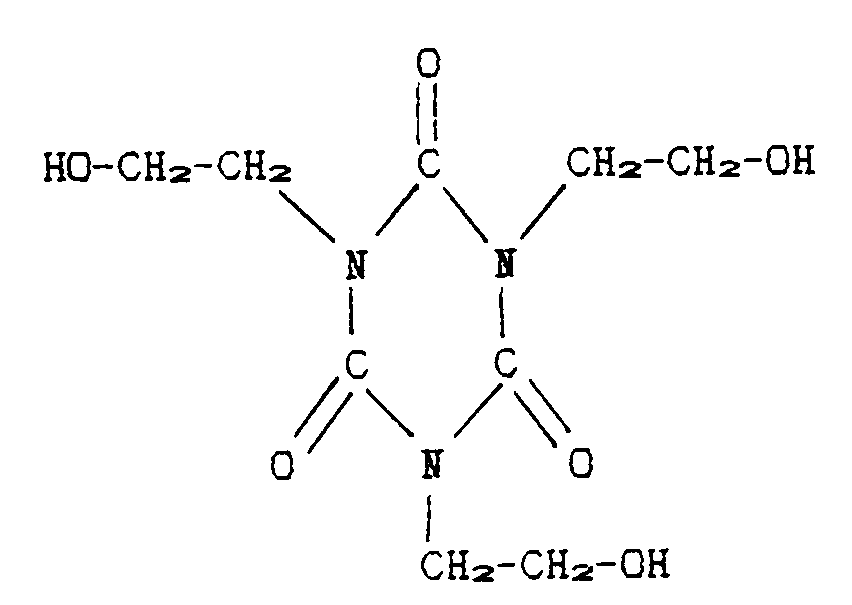
and an equivalent quantity of one or more anhydrides chosen from: maleic anhydride, succinic anhydride, dodecenylsuccinic anhydride, itaconic anhydride, citraconic anhydride, adipic anhydride, hexahydrophthalic anhydride, methyl-hexahydro-phthalic anhydride, nadic anhydride [endo-cis-bicyclo(2,2,1)-5-heptene-2,3-dicarboxylic anhydride], methyl nadic anhydride, tetrahydrophthalic anhydride, methyltetrahydrophthalic anhydride, phthalic anhydride and tetrachlorophthalic anhydride. - The reaction between trihydroxyethylisocyanurate and the aforesaid anhydrides is easily conducted by heating the reagents to a temperature of the order of 120-180°C possibly operating in the presence of catalytic quantities of a basic organic compound containing nitrogen, such as dimethylaminopyridine.
- In the most preferred embodiment the component (b) of the composition of the present invention is the product of the reaction between trihydroxyethylisocyanurate and an equivalent quantity of at least one anhydride chosen from: phthalic anhydride, tetrahydrophthalic anhydride and succinic anhydride.
- The component (b) of the present invention generally has an acid value (expressed as mg of KOH/g) of between 210 and 315.
- The liquid anhydrides which constitute component (c) of the composition can be partially substituted by an anhydride which is solid at ambient temperature provided that it is soluble, such as itaconic anhydride and tetrahydrophthalic anhydride.
- The preferred component (c) for the present invention is methyltetrahydrophthalic anhydride.
- The composition of the present invention can also contain a crosslinking catalyst, normally chosen from tertiary amines (dimethylbenzylamine, dimethylaminopyridine), aminophenols (2,4,6-dimethylaminophenol), imidazoles (methyl-imidazole) and the like.
- This catalyst can generally be present in a quantity of between 0.1 and 5 parts by weight per 100 parts by weight of the sum of components (a), (b) and (c).
- The composition can also contain inorganic fillers (such as bentonite, titanium dioxide, iron oxide or quartz) or organic fillers (such as powdered polypropylene or other polyolefins and cellulose).
- Further additives which can be present are thixotropic agents and flame-retarding agents.
- The composition of the present invention can be prepared by mixing components (a), (b) and (c) in any order.
- However in the preferred embodiment, a homogeneous mixture of components (b) and (c) is firstly prepared and then added to and homogenized with the component (a).
- Under ambient temperature conditions the composition of the present invention has a viscosity of between 2000 and 20,000 mPa.s which gives it good workability.
- Furthermore, said composition sets with low volume contraction, said contraction being generally in the range of about 1.7-2.2%.
- Finally, when set the manufactured articles obtained from the composition have a glass transition temperature (tg) within the range of 100-130°C while maintaining good mechanical, electrical and thermal cycle resistance characteristics and good elongation and flexibility values.
- The composition of the present invention is particularly suitable for transformation into thermoset articles by liquid moulding, said articles being particularly useful for applications in the electrical sector.
- The setting cycles for the composition are those usual in the art.
- A typical cycle comprises setting in a mould at 80°C for 5 hours followed by post-setting at 130°C for 16 hours.
- The following experimental examples illustrate but do not limit the scope of the present invention.
- Examples 1 to 3 relate to the preparation of component (b) of the composition of the present invention. Examples 4 to 13 relate to compositions according to the present invention and their transformation into manufactured articles.
- Preparation of component (b) from trihydroxyethylisocyanurate, succinic anhydride and tetrahydrophthalic anhydride in a molar ratio of 1:2:1.
- The following are fed under a nitrogen atmosphere into a a flask fitted with a thermometer, bladed stirrer and a nitrogen connection:
- trihydroxyethylisocyanurate 522.3 g (2.0 moles) - succinic anhydride 400.3 g (4.0 moles) - tetrahydrophthalic anhydride 304.3 g (2.0 moles) - dimethylaminopyridine 0.59 g (0.5 per mil) - The mixture is heated to 160°C for 6 hours under effective stirring to obtain a reaction product with an acid value of 270 (theoretical value 273.8).
- By a similar procedure a component (b) is prepared from trihydroxyethylisocyanurate, succinic anhydride and tetrahydrophthalic anhydride in a molar ratio of 1:1.5:1.5.
- Preparation of component (b) from trihydroxyethylisocyanurate, phthalic anhydride and tetrahydrophthalic anhydride in a molar ratio of 1:1.5:1.5.
- The procedure of Example 1 is followed reacting the following:
- trihydroxyethylisocyanurate 480 g (1.837 moles) - phthalic anhydride 408 g (2.754 moles) - tetrahydrophthalic anhydride 419 g (2.754 moles) - dimethylaminopyridine 3.92 g (0.3%) - The mixture is heated to 160°C for 6 hours under effective stirring to obtain a reaction product with an acid value of 215 (theoretical value 236).
- Preparation of component (b) from trihydroxyethylisocyanurate and tetrahydrophthalic anhydride in a molar ratio of 1:3.
- The procedure of Example 1 is followed reacting the following:
- trihydroxyethylisocyanurate 800 g (3.062 moles) - tetrahydrophthalic anhydride 1397.6 g (9.188 moles) - dimethylaminopyridine 0.87 g (0.4 per mil) - The mixture is heated to 160°C for 6 hours under effective stirring to obtain a reaction product with an acid value of 228 (theoretical value 234).
- Operating in a similar manner a component (b) is prepared by replacing the tetrahydrophthalic anhydride with an equivalent quantity of succinic anhydride.
- 80 g of a mixture containing 70% by weight of methyltetrahydrophthalic anhydride (component c) and 30% by weight of component (b), consisting of the product of the reaction between trihydroxyethylisocyanurate, phthalic anhydride and tetrahydrophthalic anhydride in a molar ratio of 1:1.5:1.5, are added to 100 g of epoxy resin formed from bisphenol-A and epichlorohydrin having an epoxide equivalent of about 190 and a viscosity of about 12,000 mPa.s (component a). 1 g of BDMA (benzyldimethylamine) is also added.
- The mixture of components (b) and (c) has a viscosity of about 4000 mPa.s at 25°C.
- The aforesaid components are carefully mixed to obtain a homogeneous mixture with a viscosity of about 8500 mPa.s at 25°C, said mixture then being heated to 80°C, exposed to vacuum to remove the contained air and poured into moulds preheated to 80°C.
- The setting is conducted at 80°C for 5 hours followed by 16 hours of post-setting at 130°C.
- The following characteristics are then determined on the thermoset test pieces obtained:
- tensile strength GY (MN/m²) (ISO R 527) 50 - flexural strength 6 c (MN/m²) (ISO R 178) 134 - glass transition temperature (°C) (DSC 4) 121 - notch impact test (kj/m²) (ISO R 180) 1.7 - tg δ (%) at 25°C (IEC 250) 0.25 at 80°C 0.20 - shrinkage (%) 2 - 80 g of a mixture containing 70% by weight of methyltetrahydrophthalic anhydride (component c) and 30% by weight of component (b), consisting of the product of the reaction between trihydroxyethylisocyanurate, tetrahydrophthalic anhydride and succinic anhydride in a molar ratio of 1:1.5:1.5, are added to 100 g of epoxy resin formed from bisphenol-A and epichlorohydrin having an epoxide equivalent of about 190 and a viscosity of about 12,000 mPa.s (component a). 1 g of BDMA is also added.
- The mixture of components (b) and (c) has a viscosity of about 1250 mPa.s at 25°C.
- The aforesaid components are carefully mixed to obtain a homogeneous mixture with a viscosity of about 4600 mPa.s at 25°C, said mixture then being heated to 80°C, exposed to vacuum to remove the contained air and poured into moulds preheated to 80°C.
- The setting is conducted at 80°C for 5 hours followed by 16 hours of post-setting at 130°C.
- The following characteristics are then determined on the thermoset test pieces obtained:
- tensile strength GY (MN/m²) (ISO R 527) 65 - flexural strength 6 c (MN/m²) (ISO R 178) 111 - glass transition temperature (°C) (DSC 4) 117 - notch impact test (kj/m²) (ISO R 180) 1.2 - tg δ (%) at 25°C (IEC 250) 0.2 at 80°C 0.44 - shrinkage (%) 2.6 -
- 80 g of a mixture containing 70% by weight of methyltetrahydrophthalic anhydride (component c) and 30% by weight of component (b), consisting of the product of the reaction between trihydroxyethylisocyanurate, and succinic anhydride in a molar ratio of 1:3 are added to 100 g of epoxy resin formed from bisphenol-A and epichlorohydrin having an epoxide equivalent of about 190 and a viscosity of about 12,000 mPa.s (component a). 1 g of BDMA is also added.
- The mixture of components (b) and (c) has a viscosity of about 4100 mPa.s at 25°C.
- The aforesaid components are carefully mixed to obtain a homogeneous mixture with a viscosity of about 9500 mPa.s at 25°C, said mixture then being heated to 80°C, exposed to vacuum to remove the contained air and poured into moulds preheated to 80°C.
- The setting is conducted at 80°C for 5 hours followed by 16 hours of post-setting at 130°C.
- The following characteristics are then determined on the thermoset test pieces obtained:
- tensile strength GY (MN/m²) (ISO R 527) 84 - flexural strength 6 c (MN/m²) (ISO R 178) 120 - glass transition temperature (°C) (DSC 4) 117 - notch impact test (kj/m²) (ISO R 180) 1.0 - tg δ (%) at 25°C (IEC 250) 0.3 at 80°C 0.3 - shrinkage (%) 2.16 - 90 g of a mixture containing 62% by weight of methyltetrahydrophthalic anhydride (component c) and 38% by weight of component (b), consisting of the product of the reaction between trihydroxyethylisocyanurate, and tetrahydrophthalic anhydride in a molar ratio of 1:3 are added to 100 g of epoxy resin formed from bisphenol-A and epichlorohydrin having an epoxide equivalent of about 190 and a viscosity of about 12,000 mPa.s (component a). 1 g of BDMA is also added.
- The mixture of components (b) and (c) has a viscosity of about 25,000 mPa.s at 25°C.
- The aforesaid components are carefully mixed to obtain a homogeneous mixture with a viscosity of about 17,000 mPa.s at 25°C, said mixture then being heated to 80°C, exposed to vacuum to remove the contained air and poured into moulds preheated to 80°C.
- The setting is conducted at 80°C for 5 hours followed by 16 hours of post-setting at 130°C.
- The following characteristics are then determined on the thermoset test pieces obtained:
- tensile strength GY (MN/m²) (ISO R 527) 67 - flexural strength 6 c (MN/m²) (ISO R 178) 100 - glass transition temperature (°C) (DSC 4) 121 - notch impact test (kj/m²) (ISO R 180) 1.5 - tg δ (%) at 25°C (IEC 250) 0.2 at 80°C 0.2 - shrinkage (%) 2.1 - 85 g of a mixture containing 66% by weight of methyltetrahydrophthalic anhydride (component c) and 34% by weight of component (b), consisting of the product of the reaction between trihydroxyethylisocyanurate and tetrahydrophthalic anhydride in a molar ratio of 1:3 are added to 100 g of epoxy resin formed from bisphenol-A and epichlorohydrin having an epoxide equivalent of about 190 and a viscosity of about 12,000 mPa.s (component a). 1 g of BDMA is also added.
- The mixture of components (b) and (c) has a viscosity of about 12,000 mPa.s at 25°C.
- The aforesaid components are carefully mixed to obtain a homogeneous mixture with a viscosity of about 12,000 mPa.s at 25°C, said mixture then being heated to 80°C, exposed to vacuum to remove the contained air and poured into moulds preheated to 80°C.
- The setting is conducted at 80°C for 5 hours followed by 16 hours of post-setting at 130°C.
- The following characteristics are then determined on the thermoset test pieces obtained:
- tensile strength GY (MN/m²) (ISO R 527) 65 - flexural strength 6 c (MN/m²) (ISO R 178) 133 - glass transition temperature (°C) (DSC 4) 124 - notch impact test (kj/m²) (ISO R 180) 0.9 - tg δ (%) at 25°C (IEC 250) 0.2 at 80°C 0.16 - shrinkage (%) 1.77 - 76 g of a mixture containing 74% by weight of methyltetrahydrophthalic anhydride (component c) and 26% by weight of component (b), consisting of the product of the reaction between trihydroxyethylisocyanurate and tetrahydrophthalic anhydride in a molar ratio of 1:3 are added to 100 g of epoxy resin formed from bisphenol-A and epichlorohydrin having an epoxide equivalent of about 190 and a viscosity of about 12,000 mPa.s (component a). 1 g of BDMA is also added.
- The mixture of components (b) and (c) has a viscosity of about 2500 mPa.s at 25°C.
- The aforesaid components are carefully mixed to obtain a homogeneous mixture with a viscosity of about 6500 mPa.s at 25°C, said mixture then being heated to 80°C, exposed to vacuum to remove the contained air and poured into moulds preheated to 80°C.
- The setting is conducted at 80°C for 5 hours followed by 16 hours of post-setting at 130°C.
- The following characteristics are then determined on the thermoset test pieces obtained:
- tensile strength GY (MN/m²) (ISO R 527) 55 - flexural strength 6 c (MN/m²) (ISO R 178) 122 - glass transition temperature (°C) (DSC 4) 121 - notch impact test (kj/m²) (ISO R 180) 0.8 - tg δ (%) at 25°C (IEC 250) 0.2 at 80°C 0.2 - shrinkage (%) 1.79 - 72 g of a mixture containing 88% by weight of methyltetrahydrophthalic anhydride (component c) and 22% by weight of component (b), consisting of the product of the reaction between trihydroxyethylisocyanurate and tetrahydrophthalic anhydride in a molar ratio of 1:3 are added to 100 g of epoxy resin formed from bisphenol-A and epichlorohydrin having an epoxide equivalent of about 190 and a viscosity of about 12,000 mPa.s (component a). 1 g of BDMA is also added.
- The mixture of components (b) and (c) has a viscosity of about 1150 mPa.s at 25°C.
- The aforesaid components are carefully mixed to obtain a homogeneous mixture with a viscosity of about 4500 mPa.s at 25°C, said mixture then being heated to 80°C, exposed to vacuum to remove the contained air and poured into moulds preheated to 80°C.
- The setting is conducted at 80°C for 5 hours followed by 16 hours of post-setting at 130°C.
- The following characteristics are then determined on the thermoset test pieces obtained:
- tensile strength GY (MN/m²) (ISO R 527) 50 - flexural strength 6 c (MN/m²) (ISO R 178) 128 - glass transition temperature (°C) (DSC 4) 117 - notch impact test (kj/m²) (ISO R 180) 1.4 - tg δ (%) at 25°C (IEC 250) 0.2 at 80°C 0.2 - shrinkage (%) 2.2 - 70 g of a mixture containing 66% by weight of methyltetrahydrophthalic anhydride (component c) and 34% by weight of component (b), consisting of the product of the reaction between trihydroxyethylisocyanurate and tetrahydrophthalic anhydride in a molar ratio of 1:3 are added to 100 g of epoxy resin formed from bisphenol-A and epichlorohydrin having an epoxide equivalent of about 190 and a viscosity of about 12,000 mPa.s (component a). 1 g of BDMA is also added.
- The mixture of components (b) and (c) has a viscosity of about 12,500 mPa.s at 25°C.
- The aforesaid components are carefully mixed to obtain a homogeneous mixture with a viscosity of about 12,000 mPa.s at 25°C, said mixture then being heated to 80°C, exposed to vacuum to remove the contained air and poured into moulds preheated to 80°C.
- The setting is conducted at 80°C for 5 hours followed by 16 hours of post-setting at 130°C.
- The following characteristics are then determined on the thermoset test pieces obtained:
- tensile strength GY (MN/m²) (ISO R 527) 50 - flexural strength 6 c (MN/m²) (ISO R 178) 130 - glass transition temperature (°C) (DSC 4) 110 - notch impact test (kj/m²) (ISO R 180) 1.9 - tg δ (%) at 25°C (IEC 250) 0.23 at 80°C 0.23 - shrinkage (%) 2.1 - 75 g of a mixture containing 68% by weight of methyltetrahydrophthalic anhydride (component c) and 32% by weight of component (b), consisting of the product of the reaction between trihydroxyethylisocyanurate and tetrahydrophthalic anhydride in a molar ratio of 1:3 are added to 100 g of epoxy resin formed from bisphenol-A and epichlorohydrin having an epoxide equivalent of about 190 and a viscosity of about 12,000 mPa.s (component a). 1 g of BDMA is also added.
- The mixture of components (b) and (c) has a viscosity of about 7300 mPa.s at 25°C.
- The aforesaid components are carefully mixed to obtain a homogeneous mixture with a viscosity of about 9500 mPa.s at 25°C, said mixture then being heated to 80°C, exposed to vacuum to remove the contained air and poured into moulds preheated to 80°C.
- The setting is conducted at 80°C for 5 hours followed by 16 hours of post-setting at 130°C.
- The following characteristics are then determined on the thermoset test pieces obtained:
- tensile strength GY (MN/m²) (ISO R 527) 60 - flexural strength 6 c (MN/m²) (ISO R 178) 138 - glass transition temperature (°C) (DSC 4) 116 - notch impact test (kj/m²) (ISO R 180) 1.0 - tg δ (%) at 25°C (IEC 250) 0.2 at 80°C 0.2 - shrinkage (%) 2 - 95 g of a mixture containing 75% by weight of methyltetrahydrophthalic anhydride (component c) and 25% by weight of component (b), consisting of the product of the reaction between trihydroxyethylisocyanurate and tetrahydrophthalic anhydride in a molar ratio of 1:3 are added to 100 g of epoxy resin formed from bisphenol-A and epichlorohydrin having an epoxide equivalent of about 190 and a viscosity of about 12,000 mPa.s (component a). 1 g of BDMA is also added.
- The mixture of components (b) and (c) has a viscosity of about 2000 mPa.s at 25°C.
- The aforesaid components are carefully mixed to obtain a homogeneous mixture with a viscosity of about 5500 mPa.s at 25°C, said mixture then being heated to 80°C, exposed to vacuum to remove the contained air and poured into moulds preheated to 80°C.
- The setting is conducted at 80°C for 5 hours followed by 16 hours of post-setting at 130°C.
- The following characteristics are then determined on the thermoset test pieces obtained:
- tensile strength GY (MN/m²) (ISO R 527) 69 - flexural strength 6 c (MN/m²) (ISO R 178) 128 - glass transition temperature (°C) (DSC 4) 129 - notch impact test (kj/m²) (ISO R 180) 1.4 - tg δ (%) at 25°C (IEC 250) 0.2 at 80°C 0.2 - shrinkage (%) 2.2
Claims (9)
- A process for preparing a thermosetting liquid moulding composition comprising the step of combining together:a) a liquid polyepoxide containing at least two epoxide groups per molecule;b) a liquid tricarboxylic acid defined by the general formula:

R¹, R² and R³, which can be identical or different, independently represent an alkylene group (containing from 1 to 14 carbon atoms); an alkenylene group (containing from 2 to 14 carbon atoms); a monocyclic or bicyclic alkylene or alkenylene group containing from 6 to 10 carbon atoms in the ring (possibly substituted with one or more alkyl groups); a phenylene group; or a phenylene group substituted with one or more halogen atoms; andc) a liquid anhydride of a dicarboxylic acid chosen from methyltetrahydrophthalic anhydride, methylnadic anhydride and dodecenylsuccinic anhydride;which for each epoxide equivalent of component (a) contains from 0.04 to 0.09 equivalents of said tricarboxylic acid (b) and from 0.48 to 0.82 moles of said anhydride (c). - A process as claimed in claim 1, wherein said component (a) is a liquid epoxy resin deriving from bispbenol-A and epichlorohydrin.
- A process as claimed in claim 1, wherein said component (b) is the product of the reaction between trihydroxyethylisocyanurate and an equivalent quantity of one or more anhydrides chosen from: maleic anhydride, succinic anhydride, dodecenylsuccinic anhydride, itaconic anhydride, citraconic anhydride, adipic anhydride, hexahydrophthalic anhydride, methylhexahydrophthalic anhydride, nadic anhydride, methylnadic anhydride, tetrahydrophthalic anhydride, methyltetrahydrophthalic anhydride, phthalic anhydride and tetrachlorophthalic anhydride.
- A process as claimed in claim 3, wherein said component (b) is the product of the reaction between trihydroxyethylisocyanurate and an equivalent quantity of at least one anhydride chosen from phthalic anhydride, tetrahydrophthalic anhydride and succinic anhydride.
- A process as claimed in claim 1, wherein the liquid anhydride which constitutes component (c) is partially substituted by a solid, soluble anhydride chosen from itaconic anhydride and tetrahydrophthalic anhydride.
- A process as claimed in claim 1, wherein said component (c) is methyltetrahydrophthalic anhydride.
- A process as claimed in claim 1, wherein said composition further contains a crosslinking catalyst chosen from tertiary amines, aminophenols and imidazoles in a quantity of between 0.1 and 5 parts by weight per 100 parts by weight of the sum of components (a), (b) and (c).
- A process as claimed in claim 1, wherein said composition also contains one or more of: organic fillers, inorganic fillers, thixotropic agents and flame-retarding agents.
Applications Claiming Priority (2)
| Application Number | Priority Date | Filing Date | Title |
|---|---|---|---|
| IT22788/87A IT1223170B (en) | 1987-11-27 | Polyepoxide thermosetting liq. moulding compsn. | |
| IT2278887 | 1987-11-27 |
Publications (3)
| Publication Number | Publication Date |
|---|---|
| EP0318088A2 EP0318088A2 (en) | 1989-05-31 |
| EP0318088A3 EP0318088A3 (en) | 1989-10-11 |
| EP0318088B1 true EP0318088B1 (en) | 1993-07-21 |
Family
ID=11200454
Family Applications (1)
| Application Number | Title | Priority Date | Filing Date |
|---|---|---|---|
| EP88202583A Expired - Lifetime EP0318088B1 (en) | 1987-11-27 | 1988-11-17 | Thermosetting liquid composition containing a polyepoxide |
Country Status (6)
| Country | Link |
|---|---|
| US (1) | US4942215A (en) |
| EP (1) | EP0318088B1 (en) |
| JP (1) | JPH01193317A (en) |
| AT (1) | ATE91694T1 (en) |
| DE (1) | DE3882494T2 (en) |
| ES (1) | ES2058239T3 (en) |
Families Citing this family (17)
| Publication number | Priority date | Publication date | Assignee | Title |
|---|---|---|---|---|
| US5371167A (en) * | 1992-01-27 | 1994-12-06 | Basf Corporation | Carboxyl-functional compound for curable coating composition |
| US5380804A (en) * | 1993-01-27 | 1995-01-10 | Cytec Technology Corp. | 1,3,5-tris-(2-carboxyethyl) isocyanurate crosslinking agent for polyepoxide coatings |
| US5336566A (en) * | 1993-04-30 | 1994-08-09 | Basf Corporation | Tri-carbamate-functional crosslinking agents |
| US5373069A (en) * | 1993-07-28 | 1994-12-13 | Basf Corporation | Curable carbamate-functional polymers |
| US5512639A (en) * | 1993-07-28 | 1996-04-30 | Basf Corporation | Curable compositions containing carbamate-modified polyisocyanates |
| US5744522A (en) * | 1996-09-13 | 1998-04-28 | Mitsui Toatsu Chemicals, Inc. | Low gloss coating compositions |
| KR20000048959A (en) * | 1996-10-08 | 2000-07-25 | 마이클 제이. 켈리 | Crosslinker compositions and low gloss epoxy coatings therefrom |
| JP3442006B2 (en) | 1999-08-24 | 2003-09-02 | 日東電工株式会社 | Epoxy resin composition for casting |
| JP4762659B2 (en) * | 2005-10-04 | 2011-08-31 | 新日鐵化学株式会社 | Epoxy resin and epoxy resin composition |
| MX2011009919A (en) | 2009-04-03 | 2012-01-20 | Cook Composites & Polymers | Thermosetting compositions containing isocyanurate rings. |
| JP6362558B2 (en) * | 2014-05-13 | 2018-07-25 | 日本化薬株式会社 | Polyfunctional acid anhydride and thermosetting resin composition |
| WO2016013257A1 (en) * | 2014-07-24 | 2016-01-28 | 日本化薬株式会社 | Polycarboxylic acid, polycarboxylic acid composition, epoxy resin composition and heat-curable resin composition each containing said polycarboxylic acid, cured products of said compositions, and optical semiconductor device |
| JP6441024B2 (en) * | 2014-10-22 | 2018-12-19 | 信越化学工業株式会社 | Epoxy resin containing silicone-modified epoxy resin and polyvalent carboxylic acid compound and cured product thereof |
| CN107250282A (en) * | 2015-02-05 | 2017-10-13 | 日本化药株式会社 | A thermosetting resin composition containing a polyol compound, an acid anhydride compound, and a thermosetting resin, a polycarboxylic acid resin, a thermosetting resin composition using the same, and any of the aforementioned thermosetting resin compositions Optical semiconductor device used as packaging material or reflective material |
| JP2016141806A (en) * | 2015-02-05 | 2016-08-08 | 日本化薬株式会社 | Polycarboxylic acid resin, thermosetting resin composition using the same and optical semiconductor device using the thermosetting resin composition as encapsulation material or reflector |
| CN107207704A (en) * | 2015-02-27 | 2017-09-26 | 克拉斯特科技有限公司 | White reflector shaping curable epoxy resin composition and its solidfied material, optical semiconductor board for mounting electronic and optical semiconductor device |
| JP6767816B2 (en) * | 2016-09-07 | 2020-10-14 | 日本化薬株式会社 | Polycarboxylic acid and polyvalent carboxylic acid composition containing it, epoxy resin composition, cured products thereof, and optical semiconductor device |
Family Cites Families (6)
| Publication number | Priority date | Publication date | Assignee | Title |
|---|---|---|---|---|
| US3182073A (en) * | 1962-04-27 | 1965-05-04 | Gen Electric | Trimellitic anhydride derivatives |
| BE631373A (en) * | 1962-04-27 | |||
| US3293248A (en) * | 1964-12-04 | 1966-12-20 | Schenectady Chemical | Isocyanurate-trianhydride polymer |
| CH534189A (en) * | 1970-05-27 | 1973-02-28 | Ciba Geigy Ag | New curable epoxy resin mixtures |
| US3954712A (en) * | 1971-11-10 | 1976-05-04 | Ciba-Geigy Corporation | Hot-curable mixtures based on epoxide resin |
| JPS5833243B2 (en) * | 1975-04-22 | 1983-07-19 | 大日本インキ化学工業株式会社 | Jyushiso Saibutsu |
-
1988
- 1988-11-17 ES ES88202583T patent/ES2058239T3/en not_active Expired - Lifetime
- 1988-11-17 EP EP88202583A patent/EP0318088B1/en not_active Expired - Lifetime
- 1988-11-17 AT AT88202583T patent/ATE91694T1/en not_active IP Right Cessation
- 1988-11-17 DE DE88202583T patent/DE3882494T2/en not_active Expired - Fee Related
- 1988-11-18 US US07/273,358 patent/US4942215A/en not_active Expired - Fee Related
- 1988-11-28 JP JP63298434A patent/JPH01193317A/en active Pending
Also Published As
| Publication number | Publication date |
|---|---|
| DE3882494T2 (en) | 1993-12-09 |
| US4942215A (en) | 1990-07-17 |
| EP0318088A2 (en) | 1989-05-31 |
| ES2058239T3 (en) | 1994-11-01 |
| JPH01193317A (en) | 1989-08-03 |
| ATE91694T1 (en) | 1993-08-15 |
| DE3882494D1 (en) | 1993-08-26 |
| EP0318088A3 (en) | 1989-10-11 |
Similar Documents
| Publication | Publication Date | Title |
|---|---|---|
| US4942215A (en) | Thermosetting liquid composition containing a polyepoxide and a tricarboxylic isocyanurate | |
| EP0009645B1 (en) | 5-(2,5-diketotetrahydrofuryl)-3-methyl-3-cyclohexene-1,2-dicarboxylicanhydride, its use as curing agent for epoxy resins and as raw material for the production of polyimides, epoxy resins containing it, and their use in the preparation of various articles, and powder coating compositions | |
| US4002599A (en) | Epoxy resin compositions from glycidyl derivatives of aminophenols cured with tetracarboxylic dianhydrides | |
| US4340715A (en) | Epoxy resin compositions cured with imide-amines | |
| US20190292308A1 (en) | Anhydride epoxy curing agents having imidazole salt additives for epoxy resin systems | |
| EP1491566A1 (en) | Curable epoxy resin composition, and process for the production of shaped articles therefrom | |
| US3793248A (en) | Adducts,containing epoxide groups,from polyepoxide compounds and binuclear n-heterocyclic compounds | |
| US3793247A (en) | Curable epoxide resin compositions containing boron-trichloride-tertiary amine complexes | |
| US3496122A (en) | Modified triglycidylisocyanurate resins | |
| JP2017115164A (en) | Thermosetting resin composition and epoxy resin cured product | |
| JP3924875B2 (en) | Liquid epoxy resin composition | |
| EP0068474B1 (en) | Epoxy resin composition | |
| US3530095A (en) | Curable mixtures of epoxide resins and cyclic urea derivatives | |
| US4672101A (en) | Polyepoxy aromatic hydantoins | |
| US3620983A (en) | {11 -methylglycidyl-isocyanurates | |
| US3692705A (en) | Epoxy phthalimide resins | |
| US4366302A (en) | Imide-anhydrides and epoxy resin systems containing such compounds | |
| US3480692A (en) | Mixtures of triglycidyl isocyanurate and other heterocyclic epoxides | |
| US3351610A (en) | Curable compositions containing a 1, 2-epoxy compound and a ditertiary cycloaliphatic amine | |
| US3592823A (en) | N,n'-diglycidyl compounds | |
| US4346207A (en) | Flowable, curable epoxy resin mixture | |
| JPS6136846B2 (en) | ||
| US4689376A (en) | Heat-hardenable epoxide resin mixtures | |
| JPH08231683A (en) | Reaction resin system, method for producing fire-resistant casting resin molding material, and flame-resistant casting resin molding, coating or casing produced from the reaction resin system | |
| JP2533592B2 (en) | Epoxy resin composition |
Legal Events
| Date | Code | Title | Description |
|---|---|---|---|
| PUAI | Public reference made under article 153(3) epc to a published international application that has entered the european phase |
Free format text: ORIGINAL CODE: 0009012 |
|
| AK | Designated contracting states |
Kind code of ref document: A2 Designated state(s): AT BE CH DE ES FR GB GR LI LU NL SE |
|
| PUAL | Search report despatched |
Free format text: ORIGINAL CODE: 0009013 |
|
| AK | Designated contracting states |
Kind code of ref document: A3 Designated state(s): AT BE CH DE ES FR GB GR LI LU NL SE |
|
| 17P | Request for examination filed |
Effective date: 19900301 |
|
| 17Q | First examination report despatched |
Effective date: 19920817 |
|
| GRAA | (expected) grant |
Free format text: ORIGINAL CODE: 0009210 |
|
| AK | Designated contracting states |
Kind code of ref document: B1 Designated state(s): AT BE CH DE ES FR GB GR LI LU NL SE |
|
| REF | Corresponds to: |
Ref document number: 91694 Country of ref document: AT Date of ref document: 19930815 Kind code of ref document: T |
|
| REF | Corresponds to: |
Ref document number: 3882494 Country of ref document: DE Date of ref document: 19930826 |
|
| ET | Fr: translation filed | ||
| REG | Reference to a national code |
Ref country code: GR Ref legal event code: FG4A Free format text: 3008812 |
|
| EPTA | Lu: last paid annual fee | ||
| PLBE | No opposition filed within time limit |
Free format text: ORIGINAL CODE: 0009261 |
|
| STAA | Information on the status of an ep patent application or granted ep patent |
Free format text: STATUS: NO OPPOSITION FILED WITHIN TIME LIMIT |
|
| 26N | No opposition filed | ||
| REG | Reference to a national code |
Ref country code: ES Ref legal event code: FG2A Ref document number: 2058239 Country of ref document: ES Kind code of ref document: T3 |
|
| EAL | Se: european patent in force in sweden |
Ref document number: 88202583.6 |
|
| PGFP | Annual fee paid to national office [announced via postgrant information from national office to epo] |
Ref country code: LU Payment date: 19961001 Year of fee payment: 9 |
|
| PGFP | Annual fee paid to national office [announced via postgrant information from national office to epo] |
Ref country code: BE Payment date: 19961113 Year of fee payment: 9 |
|
| PGFP | Annual fee paid to national office [announced via postgrant information from national office to epo] |
Ref country code: GR Payment date: 19971017 Year of fee payment: 10 |
|
| PG25 | Lapsed in a contracting state [announced via postgrant information from national office to epo] |
Ref country code: LU Free format text: LAPSE BECAUSE OF NON-PAYMENT OF DUE FEES Effective date: 19971117 |
|
| PG25 | Lapsed in a contracting state [announced via postgrant information from national office to epo] |
Ref country code: BE Free format text: LAPSE BECAUSE OF NON-PAYMENT OF DUE FEES Effective date: 19971130 |
|
| REG | Reference to a national code |
Ref country code: CH Ref legal event code: PUE Owner name: CIBA-GEIGY S.P.A. TRANSFER- CIBA SPECIALTY CHEMICA |
|
| NLS | Nl: assignments of ep-patents |
Owner name: CIBA SPECIALTY CHEMICALS S.P.A.;CIBA-GEIGY S.P.A. |
|
| REG | Reference to a national code |
Ref country code: FR Ref legal event code: TP |
|
| BERE | Be: lapsed |
Owner name: ENICHEM SYNTHESIS S.P.A. Effective date: 19971130 |
|
| REG | Reference to a national code |
Ref country code: ES Ref legal event code: PC2A Ref country code: GB Ref legal event code: 732E |
|
| REG | Reference to a national code |
Ref country code: CH Ref legal event code: PUE Owner name: CIBA SPECIALTY CHEMICALS S.P.A. TRANSFER- CIBA SPE |
|
| PG25 | Lapsed in a contracting state [announced via postgrant information from national office to epo] |
Ref country code: GR Free format text: LAPSE BECAUSE OF NON-PAYMENT OF DUE FEES Effective date: 19981130 |
|
| REG | Reference to a national code |
Ref country code: FR Ref legal event code: TP |
|
| REG | Reference to a national code |
Ref country code: GB Ref legal event code: 732E |
|
| NLS | Nl: assignments of ep-patents |
Owner name: CIBA SPECIALTY CHEMICALS HOLDING INC. |
|
| REG | Reference to a national code |
Ref country code: ES Ref legal event code: PC2A |
|
| REG | Reference to a national code |
Ref country code: CH Ref legal event code: PUE Owner name: CIBA SPECIALTY CHEMICALS HOLDING INC. TRANSFER- VA |
|
| REG | Reference to a national code |
Ref country code: GB Ref legal event code: 732E |
|
| NLS | Nl: assignments of ep-patents |
Owner name: VANTICO AG |
|
| REG | Reference to a national code |
Ref country code: GB Ref legal event code: IF02 |
|
| REG | Reference to a national code |
Ref country code: FR Ref legal event code: TP |
|
| PGFP | Annual fee paid to national office [announced via postgrant information from national office to epo] |
Ref country code: GB Payment date: 20031029 Year of fee payment: 16 |
|
| PGFP | Annual fee paid to national office [announced via postgrant information from national office to epo] |
Ref country code: NL Payment date: 20031030 Year of fee payment: 16 Ref country code: CH Payment date: 20031030 Year of fee payment: 16 |
|
| PGFP | Annual fee paid to national office [announced via postgrant information from national office to epo] |
Ref country code: SE Payment date: 20031103 Year of fee payment: 16 Ref country code: DE Payment date: 20031103 Year of fee payment: 16 |
|
| PGFP | Annual fee paid to national office [announced via postgrant information from national office to epo] |
Ref country code: AT Payment date: 20031105 Year of fee payment: 16 |
|
| PGFP | Annual fee paid to national office [announced via postgrant information from national office to epo] |
Ref country code: FR Payment date: 20031107 Year of fee payment: 16 |
|
| PGFP | Annual fee paid to national office [announced via postgrant information from national office to epo] |
Ref country code: ES Payment date: 20031119 Year of fee payment: 16 |
|
| PG25 | Lapsed in a contracting state [announced via postgrant information from national office to epo] |
Ref country code: GB Free format text: LAPSE BECAUSE OF NON-PAYMENT OF DUE FEES Effective date: 20041117 Ref country code: AT Free format text: LAPSE BECAUSE OF NON-PAYMENT OF DUE FEES Effective date: 20041117 |
|
| PG25 | Lapsed in a contracting state [announced via postgrant information from national office to epo] |
Ref country code: SE Free format text: LAPSE BECAUSE OF NON-PAYMENT OF DUE FEES Effective date: 20041118 Ref country code: ES Free format text: LAPSE BECAUSE OF NON-PAYMENT OF DUE FEES Effective date: 20041118 |
|
| PG25 | Lapsed in a contracting state [announced via postgrant information from national office to epo] |
Ref country code: LI Free format text: LAPSE BECAUSE OF NON-PAYMENT OF DUE FEES Effective date: 20041130 Ref country code: CH Free format text: LAPSE BECAUSE OF NON-PAYMENT OF DUE FEES Effective date: 20041130 |
|
| PG25 | Lapsed in a contracting state [announced via postgrant information from national office to epo] |
Ref country code: NL Free format text: LAPSE BECAUSE OF NON-PAYMENT OF DUE FEES Effective date: 20050601 Ref country code: DE Free format text: LAPSE BECAUSE OF NON-PAYMENT OF DUE FEES Effective date: 20050601 |
|
| EUG | Se: european patent has lapsed | ||
| GBPC | Gb: european patent ceased through non-payment of renewal fee |
Effective date: 20041117 |
|
| REG | Reference to a national code |
Ref country code: CH Ref legal event code: PL |
|
| PG25 | Lapsed in a contracting state [announced via postgrant information from national office to epo] |
Ref country code: FR Free format text: LAPSE BECAUSE OF NON-PAYMENT OF DUE FEES Effective date: 20050729 |
|
| NLV4 | Nl: lapsed or anulled due to non-payment of the annual fee |
Effective date: 20050601 |
|
| REG | Reference to a national code |
Ref country code: FR Ref legal event code: ST |
|
| REG | Reference to a national code |
Ref country code: ES Ref legal event code: FD2A Effective date: 20041118 |