EP0306918B1 - Bewegliches Satellitenkommunikationssystem - Google Patents
Bewegliches SatellitenkommunikationssystemInfo
- Publication number
- EP0306918B1 EP0306918B1 EP88114608A EP88114608A EP0306918B1 EP 0306918 B1 EP0306918 B1 EP 0306918B1 EP 88114608 A EP88114608 A EP 88114608A EP 88114608 A EP88114608 A EP 88114608A EP 0306918 B1 EP0306918 B1 EP 0306918B1
- Authority
- EP
- European Patent Office
- Prior art keywords
- signal
- outputs
- baseband
- signals
- transponder
- Prior art date
- Legal status (The legal status is an assumption and is not a legal conclusion. Google has not performed a legal analysis and makes no representation as to the accuracy of the status listed.)
- Expired - Lifetime
Links
- 238000004891 communication Methods 0.000 title claims description 35
- 239000011159 matrix material Substances 0.000 claims description 16
- 238000005070 sampling Methods 0.000 claims description 9
- 238000012545 processing Methods 0.000 description 17
- 238000010586 diagram Methods 0.000 description 15
- 238000006243 chemical reaction Methods 0.000 description 9
- 238000011084 recovery Methods 0.000 description 6
- 230000003321 amplification Effects 0.000 description 4
- 238000010276 construction Methods 0.000 description 4
- 238000000034 method Methods 0.000 description 4
- 238000003199 nucleic acid amplification method Methods 0.000 description 4
- 230000004044 response Effects 0.000 description 4
- 238000001228 spectrum Methods 0.000 description 3
- 238000013519 translation Methods 0.000 description 3
- 230000005540 biological transmission Effects 0.000 description 2
- 238000001514 detection method Methods 0.000 description 2
- 239000006185 dispersion Substances 0.000 description 2
- 230000000694 effects Effects 0.000 description 2
- 230000003252 repetitive effect Effects 0.000 description 2
- 230000001360 synchronised effect Effects 0.000 description 2
- 238000013459 approach Methods 0.000 description 1
- 238000002474 experimental method Methods 0.000 description 1
- 230000006870 function Effects 0.000 description 1
- 238000009499 grossing Methods 0.000 description 1
- 238000003780 insertion Methods 0.000 description 1
- 230000037431 insertion Effects 0.000 description 1
- 238000004519 manufacturing process Methods 0.000 description 1
- 230000015654 memory Effects 0.000 description 1
- 230000005855 radiation Effects 0.000 description 1
- 230000001172 regenerating effect Effects 0.000 description 1
- 238000010408 sweeping Methods 0.000 description 1
- 230000001131 transforming effect Effects 0.000 description 1
Images






Classifications
-
- H—ELECTRICITY
- H04—ELECTRIC COMMUNICATION TECHNIQUE
- H04B—TRANSMISSION
- H04B7/00—Radio transmission systems, i.e. using radiation field
- H04B7/14—Relay systems
- H04B7/15—Active relay systems
- H04B7/204—Multiple access
- H04B7/2045—SS-FDMA, FDMA satellite switching
-
- H—ELECTRICITY
- H04—ELECTRIC COMMUNICATION TECHNIQUE
- H04B—TRANSMISSION
- H04B7/00—Radio transmission systems, i.e. using radiation field
- H04B7/14—Relay systems
- H04B7/15—Active relay systems
- H04B7/204—Multiple access
- H04B7/2041—Spot beam multiple access
-
- H—ELECTRICITY
- H04—ELECTRIC COMMUNICATION TECHNIQUE
- H04B—TRANSMISSION
- H04B7/00—Radio transmission systems, i.e. using radiation field
- H04B7/14—Relay systems
- H04B7/15—Active relay systems
- H04B7/185—Space-based or airborne stations; Stations for satellite systems
- H04B7/1853—Satellite systems for providing telephony service to a mobile station, i.e. mobile satellite service
- H04B7/18539—Arrangements for managing radio, resources, i.e. for establishing or releasing a connection
Definitions
- the present invention relates to a mobile satellite communication system which affords voice channels and digital data channels to a number of mobile stations that are distributed over a wide area on the earth.
- a satellite communication system which allows an earth station to directly connect itself to a communication satellite with miniature antenna is extensively developed.
- This kind of communication system promotes small-size configuration of an earth station and has other various advantages.
- a prior art satellite communication system of the type described has a problem that the output effective isotropic radiation power (EIRP) and reception gain-to-noise temperature (GT) ratio attainable with the earth station are extremely limited, and a problem that the frequency resources allocated to mobile station communications are scarce.
- the EIRP and reception GT ratio problem may be coped with by adopting spot beams which are effective in increasing the antenna gain of a satellite.
- the frequency resource problem may be eliminated by adopting spot beams which promote frequency re-use and dividing a frequency band used into a number of narrow band channels.
- NASA's MSAT (Mobil Satellite Experiment) program contemplates a method which uses eighty-seven spot beams and a method which transmits voice and data by using a channel band of 5 kilohertz.
- Omninet Corp of U.S.A. is planning to transmit voice in a 5-kilohertz channel band by SSB-AM (Single Sideband Amplitude Modulation).
- FDM Frequency Division Multiplex
- the FDM system may be successfull in simplifying the construction of a transmitter and that of a receiver of a ground station, it gives rise to cross modulation noise because it causes an onboard transponder to apply common amplification to FDM signals.
- cross modulation noise Because it causes an onboard transponder to apply common amplification to FDM signals.
- the operation points of an amplifier be selected with sufficient back-offs with respect to the saturation point. This brings about EIRP losses corresponding to the back-offs.
- One possible approach to solve this problem may be transforming FDM signals into TDM (Time Division Multiplex) signals on a satellite.
- this mobile satellite communication system sets up high quality voice channels and data channels for a number of mobile stations which are distributed in a wide area, maximizes the power efficiency of a satellite, and allows a minimum of interchannel interference to occur and facilitates signal connections between spot beams.
- Fig. 1 schematically shows an FDM-TDM transmultiplexer 10 which converts an FDM signal into a TDM signal on a satellite by using the chirp Z conversion principle, as proposed by Nippon Telegraph and Telephone Co.
- the transmultiplexer 10 includes a mixer 12 to which an input intermediate frequency (IF) signal S1 is applied.
- An IF signal S2 swept by the mixer 12 is fed to a chirp filter 14.
- a mixer 16 is supplied with an output signal S3 of the chirp filter 14 and in turn generates an output baseband signal S4.
- a chirp signal generator 18 delivers a first chirp signal S5 to the mixer 12 and a second chirp signal S6 to the mixer 16.
- Figs. 2A to 2F are representative of the operation of the transmultiplexer 10 shown in Fig. 1 while Figs. 3A and 3B show the waveforms of signals which have been produced by the transmultiplexer 10.
- the chirp filter 14 has a delay characteristic (referred to as dispersion characteristic hereinafter) which is proportional to the frequency, so that FDM-TDM translation is effected by the operation of Figs. 2A to 2B very smoothly.
- the waveforms of TDM signals actually produced by the transmultiplexer 10 are shown in Figs. 3A and 3B. While each TDM channel signal has a finite time width as shown in Figs.
- the actual waveform is extended in a sin x/x configuration on the time axis as shown in Figs. 3A and 3B. Since the waveform periodically becomes “0 (zero) ", time-division-multiplexing without interchannel interference is achievable by selecting a frequency step ⁇ f and the dispersion characteristic (chirp ratio) such that TDM signals on other channels appear at the zero points. However, this holds true only when the period of data on each channel is coincident with the period of the chirp signal S5 shown in Fig. 2B with respect to phase.
- the signal waveform undergone FDM-TDM conversion is brought out of the sin x/x configuration to cause crosstalk between various channels.
- a timing phase error is " ⁇ "
- not only a signal does not appear at a time position of an expected channel but also the time positions of nearby channels suffer from the maximum interference.
- a prerequisite with chirp Z conversion is that the data timing of each channel be synchronized to the sweeping period on a satelite with respect to phase, resulting in considerable difficulty in the operation aspect. Furthermore, it will be clear the system cannot transmit analog signals without causing interchannel interference.
- a mobile satellite communication system embodying the present invention is shown and generally designated by the reference numeral 20.
- Fig. 5 is a schematic block diagram showing one of mobile stations or terminals which are included in the system of Fig. 4.
- the system 20 comprises a plurality of mobile stations 22 (11) and 22 (12), 22 (21) and 22 (22) and 22 (31) and 22 (32) which are situated on the earth, and a communication satellite 24 communicatable with the mobile stations 22 by sending radio signals over a plurality of spot beams SB1 to SB3.
- Fig. 5 is a schematic block diagram showing one of mobile stations or terminals which are included in the system of Fig. 4.
- the system 20 comprises a plurality of mobile stations 22 (11) and 22 (12), 22 (21) and 22 (22) and 22 (31) and 22 (32) which are situated on the earth, and a communication satellite 24 communicatable with the mobile stations 22 by sending radio signals over a plurality of spot beams SB1 to SB3.
- each mobile station 22 includes a transmitter 222 for modulating voice and data to produce an FDM signal and transmitting it to the satellite 24 over the beam SB, a receiver 224, and an antenna 226 connected to the transmitter 222 and receiver 224.
- the satellite 24 includes an onboard transponder 26 which separates FDM signals from the mobile stations 22 and sets up beam connections to transmit signals over the spot beams SB1 to SB3 to expected mobile stations 22 via antennas 242 (1) to 242 (4).
- the transponder 26 includes demultiplexing circuits for individually separating received FDM signals on a channel basis by the transmultiplexer method, baseband matrix means for connecting outputs of the demultiplexing circuits to the spot beams SB which are to be transmitted, and transmitting means for time-division-mutliplexing outputs of the baseband matrix means to produce a transmission frame and sending it as a TDM signal.
- the receiver 224 included in each mobile station 22 as previously stated is adapted to select a channel signal which it should receive out of the TDM signals which are sent from the transmitting means of the onboard transponder, and demodulates it to regenerate a signal. While three spot beams SB are shown in Fig. 4 and each is assigned to two mobile stations 22, the gist is that two or more spot beams SB are used and each is assigned to two or more mobile stations 22.
- a specific construction of the onboard transponder 26 includes receive antennas 28 (1) and 28 (2) for receiving FDM signals over the beams SB1 and SB2, respectively. Outputs of the receive antennas 28 (1) and 28 (2) are respectively fed to receivers 30 (1) and 30 (2) each of which includes a low noise amplifier (LNA) and a downconverter.
- Receives 30 (1) and 30 (2) each of which includes a low noise amplifier (LNA) and a downconverter.
- Transmultiplexer type demultiplexers 32 (1) and 32 (2) are provided for separating respectively the outputs of the receivers 30 (1) and 30 (2) on a channel basis and converting them into parallel baseband signals.
- a baseband switch matrix 34 connects the outputs of the demultiplexers 32 (1) and 32 (2) to the transmitting sections of the spot beams which should be transmitted individually.
- the baseband switch matrix 34 is controlled by a baseband matrix controller 36. Parallel outputs of the baseband switch matrix 34 are applied to time-division multiplexers 38 (1) and 38 (2) to be multiplexed thereby in response to a high-speed timing signal (multiplexing clock).
- Unique Word (UW) generators 40 (1) and 40 (2) are adapted to generate unique words, i.e. fixed patterns.
- the outputs of the time-division multiplexers 38 (1) and 38 (2) and the outputs of the UW generators 40 (1) and 40 (2) are individually delivered to frame synthesizers 42 (1) and 42 (2) each serving to insert a UW at each multiplexing period to form a frame.
- Modulators 44 (1) and 44 (2) modulate a common carrier with the outputs of the frame synthesizers 42 (1) and 42 (2), respectively.
- Transmitters 46 (1) and 46 (2) each includes a high-power amplifier (HPA) for amplifying the output of the modulator 44 associated therewith approximately to the saturation point of a transmit amplifier, an upconverter, etc.
- transmit antennas 48 (1) and 48 (2) are provided for sending respectively the outputs of the transmitters 46 (1) and 46 (2) to the downlinks of the spot beams SB1 and SB2.
- the solid lines and the dotted lines are representative of real portion signals and imaginary portion signals, respectively.
- the demultiplexer 32 is made up of a local oscillator 50, a ⁇ /2 phase shifter 52, mixers 54 (1) and 54 (2), low-pass filters (LPF) 56 (1) and 56 (2), analog-to-digital (AD) converters 58 (1) and 58 (2), an oscillator 60 for oscillating a high-speed sampling clock, an N divider 62, a serial-to-parallel (SP) converter 64, digital filters 66 (1) to 66 (N), and an N-point fast Fourier transform circuit 68.
- LPF low-pass filters
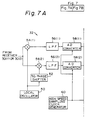
- Fig. 7 shows the frame format of a TDM signal. As shown, the frame format includes time slots P1 to P k assigned to a unique word (UW) and time slots CH1 to CH l assigned to data.
- Fig. 9 is representative of the amplification characteristic and operation points of the high-power amplifier which is included in each of the transmitters 46 (1) and 46 (2) of the transponder 26.
- A, B, P i , P s and P o designate respectively the operation point associated with common amplification of FDM signals, the operation point associated with FDM-TDM translation, the input, the power at the saturation point, and the output.
- Fig. 6 FDM signals received over the beams SB1 and SB2 are separated by the transmultiplexer type demultiplexers 32 (1) and 32 (2), respectively. More specifically, the demultiplexers 32 (1) and 32 (2) each being constructed as shown in Fig. 7 separate FDM channels by the filter banks which equivalently are arranged at each frequency step ⁇ f and then applies frequency conversion to the separated channels by using zero hertz for the center, thereby sampling the channels at a frequency of ⁇ f.
- each of the demultiplexers 32 (1) and 32 (2) plays two different roles at the same time, i.e., FDM demultiplexing by the filter bank and the converting the frequency to the baseband.
- FDM demultiplexing by the filter bank and the converting the frequency to the baseband.
- the principle of a transmultiplexer is shown and described in detail in the previously discussed document.
- the transmultiplexer type demultiplexers 32 (1) and 32 (2) execute complex signal processing and all of their output signals are constituted by a pair of real portion signal and imaginary portion signal.
- the solid lines and the dotted lines show real portion signals and imaginary portion signals, respectively.
- the output signal which should be connected to the same spot beam SB is fed to the transmit section assigned to that spot beam, i.e. time division multiplexer 38 (1) or 38 (2).
- the output signal on another channel which should be connected to the other spot beam SB is connected to that spot beam SB via the baseband switch matrix 34.
- interchange is effected with respect to the spot beam SB to which a signal is to be connected and the channel number.
- the time-division multiplexers 38 (1) and 38 (2) individually multiplex parallel input signals (signal rate of ⁇ f samples/second) in respeonse to the high-speed multiplexing clock (M which is an integral multiple of ⁇ f). Further, unique words generated by the UW generators 40 (1) and 40 (2) are respectively inserted in the outputs of the multiplexers 38 (1) and 38 (2) by the frame synthesizers 42 (1) and 42 (2), whereby the frame shown in Fig. 8 is completed.
- the frame length is N
- K time slots of the frame are constituted by a UW
- L time slots are constituted by data.
- the modulators 44 (1) and 44 (2) shown in Fig. 6 are individually modulated by the frame of Fig. 8.
- the outputs of the modulators 44 (1) and 44 (2) are individually converted into the radio frequency (RF) band, then high-power amplified, and then sent toward the spot beams SB1 and SB2 via the transmit antennas 48 (1) and 48 (2) which are assigned to the downlinks.
- this particular embodiment generates a single modulated wave.
- This allows a high-power amplifier of a satellite to be operated in the vicinity of a saturation point, as shown in Fig. 9.
- the frequency-division-multiplexing system needs back-off as shown in Fig. 9, the illustrative embodiment eliminates the need for such back-off and therefore allows EIRP to be increased correspondingly.
- the increase in EIRP attainable with this embodiment usually amounts to 8 to 15 dB.
- the receive IF circuit 70 which is included in the receiver 224 of each mobile station 22 of the communication system 20.
- the receive IF circuit 70 includes a bandpass filter 72 having a predetermined band width for removing noise outside the IF band.
- a multiplexing clock recovery circuit 74 inlcudes an envelope detector 740 for detecting the envelope of the output of the filter 72 to extract a multiplexing clock component, a tank 742 which is tuned to the multiplexing clock component, a phase comparator 744 for comparing the output of the tank 742 and a feed-back signal with respect to phase, a sampler 746 for sampling the output of the phase comparator 744 timed at the appearance timing of a UW portion, a loop filter 748 for smoothing the output of the sampler 746, and a clock voltage controlled oscillator (VCO) 750 for generating a clock signal in response to the output of the loop filter 748 and applying it to the phase comparator 744.
- VCO clock voltage controlled oscillator
- a carrier recovery control circuit 76 includes a multiplier 760 for, when the unique word portion has undergone 2-phase PSK modulation, multiplying the 2-phase PSK wave by 2 and, when the unique word portion has undergone 4-phase PSK modulation, multiplying it by 4 in order to remove the modulated component, a bandpass filter 762, a phase comparator 764, a sampler 766, a loop filter 768, and a multiplier 770.
- a carrier VCO 78 functions to recover a carrier under the control of a carrier recover controller 50.
- a mixer 80 (1) applies frequency conversion to the baseband signal of a real portion by multiplying the output of the bandpass filter 72 by that of the carrier VCO 78.
- a ⁇ /2 phase shifter 82 shifts the output of the clock VCO 78 by ⁇ /2 with respect to phase.
- a mixer 80 (2) applies frequency conversion to the baseband signal of an imaginary portion by multiplying the output of the bandpass filter 72 by that of the ⁇ /2 phase shifter 82.
- a timing adjuster 84 is supplied with the multiplexing clock signal from the VCO 750 to set up an optimum sampling timing.
- LPFs 86 (1) and 86 (2) are adapted to limit respectively the outputs of the mixers 80 (1) and 80 (2) with respect to band.
- AD converters 88 (1) and 88 (2) sample respectively the outputs of the LPFs 86 (1) and 86 (2) with the output of the timing adjuster 84 to thereby convert them into digital signals.
- a UW detector 90 detects a unique word on the basis of the polarity bits of the outputs of the AD converters 88 (1) and 88 (2).
- a frame synchronizer 92 responds to a UW detection pulse from the UW detector 90 and the output of the clock VCO 750 for setting up frame synchronization and delivering sampling pulses to the samplers 746 and 766.
- a coincidence detector 94 is supplied with the output of the frame synchronizer 92 to decode a receive channel number, thereby outputting a channel clock. Further, a D-type flip-flop 96 selects a channel signal to be received out of the outputs of the AD converters 88 (1) and 88 (2) in response to the output of the coincidence detector 94.
- Fig. 10 shows a circuit arrangement for recovering both of a clock and a carrier, it is usually not necessary to recover a carrier with such an arrangement. More specifically, the carrier VCO 78 may be implemented by a fixed oscillator and, therefore, the carrier recover controller 76 shown in Fig. 10 is not essential.
- the operation of the sample type multiplexing clock recovery circuit 74 will be described.
- the bandpass filter 72, envelope detector 740 and tank 742 cooperate to extract a clock component.
- the output of the clock VCO 750 is compared with the extracted clock by the phase comparator 744 with respect to phase.
- the output of the phase comparator 744 is sampled by the sampler 746 at the timing at which a UW portion appears and used to control the clock VCO 750 via the loop filter 748.
- the carrier recovery circuit is operated in the same manner as the clock recovery circuit 74 except that the multiplier 760 executes doubling when a UW portion has been 2-phase PSK modulated and quadrupting when it has been 4-phase PSK modulated.
- the output of the bandpass filter 72 is subjected to frequency conversion at the two mixers 80 (1) and 80 (2) to become baseband signals which are individually associated with the real portion and the imaginary portion.
- the outputs of the mixers 80 (1) and 80 (2) are respectively limited in band by the LPFs 86 (1) and 86 (2) and then subjected to AD conversion at the AD converters 88 (1) and 88 (2). More specifically, the AD converters 88 (1) and 88 (2) individually sample the input data with the recovered multiplexing clock to thereby convert them into digital data.
- the sampling timing is adjusted by the timing adjuster 84 to an optimum timing.
- the polarity bits of the outputs of the AD converters 88 (1) and 88 (2) are fed to the UW detector 90 to detect a UW.
- the frame synchronizer 92 establishes receive frame synchronization.
- the frame synchronizer 92 outputs sampling pulses so that the samplers 746 and 766 extract respectively a phase error signal associated with the clock and a phase error signal associated with the carrier out of the UW portion, whereby the clock and the carrier are recovered.
- the timing of the frame synchronizer 92 is decoded to generate a channel clock.
- a flip-flop 96 selects a signal on the channel to be received out of the outputs of the AD converters 88 (1) and 88 (2) and delivers it to a baseband processing circuit.
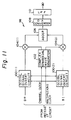
- the processing circuit includes a digital signal inserting circuit 100 (1) for inserting a real portion baseband signal BR, a channel clock and a multiplexing clock which are applied thereto.
- a digital signal inserting circuit 100 (2) inserts an imaginary portion baseband signal BI, a channel clock and a multiplexing clock which are fed thereto.
- a complex sinusoidal wave generator 102 is supplied with a channel clock and a multiplexing clock to generate a sine local signal which is half the frequency of the channel clock and a cosine local signal.
- a multiplier 104 (1) multiplies the output of the signal inserting circuit 100 (1) and the sine local signal from the complex sinusoidal wave generator 102.
- a multiplier 104 (2) multiplies the output of the signal inserting circuit 100 (2) and the cosine local signal from the complex sinusoidal wave generator 102.
- the outputs of the multipliers 104 (1) and 104 (2) are added by an adder 106.
- a digital-to-analog (DA) converter 108 converts the digital output of the adder 106 into an analog signal.
- An LPF 110 is provided for removing high-frequency components from the output of the PA converter 108, thereby outputting a continuous recovered voice signal BO.
- Figs. 12A to 12D demonstrate the operation of the baseband processing circuit 98 stated above. How a voice signal undergone analog modulation is regenerated will be described with reference to Figs. 11 and 12A to 12D.
- a real portion baseband signal BR and an imaginary portion baseband signal BI are sampled at the sampling frequency of ⁇ f and therefore have a repetitive spectrum as shown in Fig. 12A.
- the spectrum of the resulting repetitive period is SSB and therefore asymmetric with respect to the positive and negative frequency axis.
- the complex sinusoidal wave generator 102 generates a sinusoidal wave whose frequency is ⁇ f/2 so that a voice spectrum is obtained in a correct frequency band as a result of complex multiplication by the multipliers 104 (1) and 104 (2) and adder 106, as shown in Fig. 12C.
- the resulting sequency is still a sample sequence.
- this sample sequence is routed through the DA converter 108 and analog LPF 110 to become a continuous signal, i.e. regenerated voice signal BO as shown in Fig. 12D.
- a baseband processing circuit 112 included in the receiver 224 of the mobile station 22 for processing a digital signal is shown in a schematic block diagram.
- the processing circuit 112 includes a digital signal inserting circuit 114 (1) for inserting a real portion baseband signal BR, a channel clock and a multiplexing clock which are applied thereto.
- a digital signal inserting circuit 114 (2) inserts an imaginary portion baseband signal BI, a channel clock and a multiplexing clock which are fed thereto.
- a synchronous detecting and demodulating circuit 116 is made up of a complex multiplier 1162 for demodulating the outputs of the signal inserting circuits 114 (1) and 114 (2) to thereby regenerate a signal, a digital VCO 1164, a clock extracting circuit 1166, a phase-locked loop 1168, a digital loop filter 1170, a D-type flip-flop 1172, and a carrier phase error detector 1174.
- a differential detecting and demodulating circuit 118 consists of a complex multiplier 1182 for demodulating the outputs of the digital signal inserting circuits 114 (1) and 114 (2) to thereby regenerate a signal, delay units 1184 and 1186, a clock extractor 1188, a phase-locked loop 1190, and a D-type flip-flop 1192.
- the operation of the baseband processing circuit 112 shown in Fig. 13 is analogous to the operation for demodulating an ordinary PSK modulated signal.
- Fig. 14 shows a digital inserting circuit installed in the communication system 20.
- the digital inserting circuit 120 is made up of a shift register 122, a counter 124, read only memories (ROMs) 126 (1) to 126 ( l ) each storing a tap coefficient, multipliers 128 (1) to 128( l ), and an adder 130.
- ROMs read only memories
- Fig. 15 shows an analog inserting circuit also installed in the communication system 20.
- the analog inserting circuit 132 is comprised of a DA converter 134 and an LPF 136.
- Fig. 16 is a plot showing the frequency characteristic particular to the analog inserting circuit 132 of Fig. 15.
- the present invention achieves various advantages as enumerated below:
Landscapes
- Engineering & Computer Science (AREA)
- Computer Networks & Wireless Communication (AREA)
- Signal Processing (AREA)
- Radio Relay Systems (AREA)
- Mobile Radio Communication Systems (AREA)
Claims (5)
- Satellitenkommunikationssystem mit mehreren auf der Erde angeordneten mobilen Stationen (22) und mit einem Nachrichtensatellit (24), der durch die Verwendung von Funksignalen über mehrere eng gebündelte Strahlen (SB₁ bis SB₃) mit den mobilen Stationen (22) verbindbar ist;
wobei die mobilen Stationen (22) jeweils aufweisen: einen Sender (222) zum Modulieren von Sprache und Daten, um ein Frequenzmultiplex (FDM)-Signal zu erzeugen, und zum Senden des FDM-Signals über einen der eng gebündelten Strahlen (SB), der der mobilen Station (22) zugeordnet ist, an den Nachrichtensatellit; und
wobei der Nachrichtensatellit (24) aufweist: einen Bordtransponder (26) zum Trennen der von den mobilen Stationen (22) gesendeten FDM-Signale voneinander und zum anschließenden Koppeln der eng gebündelten Strahlen (SB), um Sendesignale an diejenigen mobilen Stationen (22) zu senden, für die die FDM-Signale bestimmt sind;
wobei der Transponder (26) eine Demultiplexeinrichtung (32) zum Demultiplexen der empfangenen FDM-Signale auf einer Kanalbasis, eine Basisband-Matrixeinrichtung (34, 36) zum Verbinden der Ausgangssignale der Demultiplexeinrichtung (32) mit den Strahlen, über die die FDM-Signale gesenden werden, und eine Sendeeinrichtung (38, 40, 42, 44, 46, 48) zum Zeitmultiplexen der Ausgangssignale der Basisband-Matrixeinrichtungen (34, 36) aufweist, um einen Senderahmen zu erzeugen und den Senderahmen als ein Zeitmultiplex (TDM)-Signal zu senden; und
wobei die Demultiplexeinrichtung (32) des Transponders (26) einen Transmultiplexer-Demultiplexer zum Trennen der Ausgangssignale des Empfängers (30) auf einer Kanalbasis aufweist, um die Ausgangssignale in parallele Basisbandsignale umzuwandeln;
dadurch gekennzeichnet, daß der Transmultiplexer-Demultiplexer (32) des Transponders (26) einen einzelnen Komplex-Digital-Demodulator mit einem Empfangsoszillator (50), Mischern (54), Tiefpaßfiltern (56) und A/D-Wandlern (58), und einen gemeinsamen, jedem eng gebündelten Strahl (SB) zugewiesenen Taktgenerator (60) mit schneller Abtastung aufweist. - Satellitenkommunikationssystem nach Anspruch 1, wobei die mobilen Stationen jeweils einen Empfänger (224) zum Auswählen eines zu empfangenden Kanalsignals aus dem TDM-Signal, das von der Sendeeinrichtung (46) des Transponders (26) gesendet wird, und zum Demodulieren des Kanalsignals aufweist, um ein Signal zu regenerieren.
- Satellitenkommunikationssystem nach Anspruch 1 oder 2, wobei der Transponder (26) ferner eine Empfangsantenne (28) zum Empfangen der FDM-Signale und einen Empfänger (30) zum Empfangen eines Ausgangssignals der Empfangsantenne (28) aufweist.
- Satellitenkommunikationssystem nach einem der Ansprüche 1 bis 3, wobei die Basisband-Matrixeinrichtung (34, 36) des Transponders (26) eine Basisband-Verteilermatrix (34) zum Verbinden der Ausgangssignale des Transmultiplexer-Demultiplexers mit Abschnitten zum Senden der Strahlen, die einzeln den Ausgangssignalen zugeordnet sind, und eine Basisband-Verteilermatrix-Steuereinrichtung (36) zum Steuern der Basisband-Verteilermatrix (34) aufweist.
- Satellitenkommunikationssystem nach einem der Ansprüche 1 bis 4, wobei die Sendeeinrichtung des Transponders (26) einen Zeitmultiplexer (38) zum Zeitmultiplexen der parallelen Ausgangssignale der Basisband-Verteilermatrix (34) mit einem schnellen Taktsignal, einen Generator (40) für die Erzeugung eindeutiger Wörter (UW) zum Erzeugen eines eindeutigen Wortes, einen Rahmensynthesizer (42), dem zum Einfügen eines eindeutigen Wortes bei jeder Multiplexperiode die Ausgangssignale des Zeitmultiplexers (38) und ein Ausgangssignal des UW-Generators (40) zugeführt werden, um einen Rahmen zu bilden, einen Modulator (44) zum Modulieren eines Sendeträgers mit einem Ausgangssignal des Rahmensynthesizers, einen Hochleistungsverstärker zum Hochleistungsverstärken eines Ausgangssignals des Modulators, einen Sender (46) und eine Sendeantenne (48) zum Senden eines Ausgangssignals des Senders (46) an eine Abwärtsstrecke einer der eng gebündelten Strahlen (SB) aufweist.
Applications Claiming Priority (2)
| Application Number | Priority Date | Filing Date | Title |
|---|---|---|---|
| JP228088/87 | 1987-09-11 | ||
| JP62228088A JPS6471329A (en) | 1987-09-11 | 1987-09-11 | Mobile body satellite communication system |
Publications (3)
| Publication Number | Publication Date |
|---|---|
| EP0306918A2 EP0306918A2 (de) | 1989-03-15 |
| EP0306918A3 EP0306918A3 (en) | 1989-08-30 |
| EP0306918B1 true EP0306918B1 (de) | 1993-07-21 |
Family
ID=16871000
Family Applications (1)
| Application Number | Title | Priority Date | Filing Date |
|---|---|---|---|
| EP88114608A Expired - Lifetime EP0306918B1 (de) | 1987-09-11 | 1988-09-07 | Bewegliches Satellitenkommunikationssystem |
Country Status (6)
| Country | Link |
|---|---|
| US (1) | US4901310A (de) |
| EP (1) | EP0306918B1 (de) |
| JP (1) | JPS6471329A (de) |
| AU (1) | AU604206B2 (de) |
| CA (1) | CA1291584C (de) |
| DE (1) | DE3882464D1 (de) |
Families Citing this family (46)
| Publication number | Priority date | Publication date | Assignee | Title |
|---|---|---|---|---|
| US4858225A (en) * | 1987-11-05 | 1989-08-15 | International Telecommunications Satellite | Variable bandwidth variable center-frequency multibeam satellite-switched router |
| NO165980C (no) * | 1988-11-07 | 1991-05-08 | Frobe Radio As | Fremgangsmaate for omforming respektive prosessering av elektroniske multiplekssignaler, og anordning for prosessering av slike signaler. |
| US5038344A (en) * | 1988-11-22 | 1991-08-06 | Nec Corporation | FDM-TDM transforming device |
| CA2022189C (en) * | 1989-09-05 | 1998-11-17 | Bary Robert Bertiger | Power management system for a worldwide multiple satellite communications system |
| US5161248A (en) * | 1989-10-02 | 1992-11-03 | Motorola, Inc. | Method of predicting cell-to-cell hand-offs for a satellite cellular communications system |
| US5187805A (en) * | 1989-10-02 | 1993-02-16 | Motorola, Inc. | Telemetry, tracking and control for satellite cellular communication systems |
| US5239670A (en) * | 1989-11-30 | 1993-08-24 | Motorola, Inc. | Satellite based global paging system |
| US5010317A (en) * | 1989-11-30 | 1991-04-23 | Motorola, Inc. | Satellite based simulcast paging system |
| DE69031687T2 (de) * | 1989-12-14 | 1998-04-02 | Motorola Inc | Satellitengebundenes personenrufmeldesystem mit rückquittierung |
| US5228029A (en) * | 1990-02-27 | 1993-07-13 | Motorola, Inc. | Cellular tdm communication system employing offset frame synchronization |
| DE69118777T2 (de) * | 1990-07-31 | 1996-10-02 | Int Telecomm Satellite | Bordseitige Nutzlast zur Kommunikation, schaltbar für Mehrfachband- und Mehrstrahlanwendungen |
| US5216671A (en) * | 1990-12-13 | 1993-06-01 | Rca Licensing Corporation | High speed bit serial systems |
| US5274627A (en) * | 1991-07-10 | 1993-12-28 | International Telecommunications Satellite Organization | Non-regenerative multibeam satellite communications system with FDMA access and SSTDM connectivity |
| US5625624A (en) * | 1993-10-21 | 1997-04-29 | Hughes Aircraft Company | High data rate satellite communication system |
| US5943324A (en) * | 1994-01-11 | 1999-08-24 | Ericsson, Inc. | Methods and apparatus for mobile station to mobile station communications in a mobile satellite communication system |
| US5539730A (en) * | 1994-01-11 | 1996-07-23 | Ericsson Ge Mobile Communications Inc. | TDMA/FDMA/CDMA hybrid radio access methods |
| US5619503A (en) * | 1994-01-11 | 1997-04-08 | Ericsson Inc. | Cellular/satellite communications system with improved frequency re-use |
| US6157811A (en) * | 1994-01-11 | 2000-12-05 | Ericsson Inc. | Cellular/satellite communications system with improved frequency re-use |
| US5619210A (en) * | 1994-04-08 | 1997-04-08 | Ericsson Inc. | Large phased-array communications satellite |
| FR2723279B1 (fr) * | 1994-07-29 | 1996-09-06 | Europ Agence Spatiale | Systeme d'emission numerique par satellite |
| US5768268A (en) * | 1995-07-19 | 1998-06-16 | Watkins Johnson Company | Wideband base station architecture for digital cellular communications system |
| US5652750A (en) * | 1995-08-28 | 1997-07-29 | Ericsson Inc. | Optical satellite feeder links |
| US5835487A (en) | 1995-12-08 | 1998-11-10 | Worldspace International Network, Inc. | Satellite direct radio broadcast system |
| US5870390A (en) * | 1996-11-05 | 1999-02-09 | Worldspace International Network, Inc. | Statellite direct radio broadcast receiver for extracting a broadcast channel and service control header from time division multiplexed transmissions |
| US5864546A (en) * | 1996-11-05 | 1999-01-26 | Worldspace International Network, Inc. | System for formatting broadcast data for satellite transmission and radio reception |
| US6115366A (en) * | 1996-11-05 | 2000-09-05 | Worldspace, Inc. | System for managing space segment usage among broadcast service providers |
| US5867490A (en) * | 1996-11-05 | 1999-02-02 | Worldspace International Network, Inc. | Direct radio broadcast receiver for providing frame synchronization and correlation for time division multiplexed transmissions |
| US6542480B1 (en) | 1996-11-05 | 2003-04-01 | Worldspace, Inc. | Satellite payload processing system using polyphase demultiplexing, quadrature phase shift keying demodulation and rate alignment |
| US6333922B1 (en) | 1996-11-05 | 2001-12-25 | Worldspace, Inc. | Satellite payload processing system for switching uplink signals to time division multiplexed downlink signals |
| US6108319A (en) * | 1996-11-05 | 2000-08-22 | Worldspace International Networks, Inc. | Satellite payload processing system providing on-board rate alignment |
| TR199901741T2 (xx) * | 1996-11-05 | 1999-11-22 | Worldspace, Inc. | Dijital uydudan yap�lan do�rudan yay�n. |
| GB2319695B (en) * | 1996-11-20 | 1999-03-03 | I Co Global Communications | Communication method and apparatus |
| US6049566A (en) * | 1997-07-24 | 2000-04-11 | Trw Inc. | High efficiency signaling with minimum spacecraft hardware |
| CN1281606A (zh) * | 1997-11-14 | 2001-01-24 | 世界空间管理公司 | 卫星直接无线广播系统的信令协议 |
| US6201798B1 (en) | 1997-11-14 | 2001-03-13 | Worldspace Management Corporation | Signaling protocol for satellite direct radio broadcast system |
| US6064645A (en) * | 1997-12-22 | 2000-05-16 | Trw Inc. | Bulk filtering and demodulation of independent FDMA sources |
| US6185265B1 (en) | 1998-04-07 | 2001-02-06 | Worldspace Management Corp. | System for time division multiplexing broadcast channels with R-1/2 or R-3/4 convolutional coding for satellite transmission via on-board baseband processing payload or transparent payload |
| EP1353454A3 (de) * | 1999-09-27 | 2005-10-19 | EMS Technologies, Inc. | Mehrstrahlsatellitenkommunikationssystem |
| EP1091506A3 (de) * | 1999-10-01 | 2001-05-16 | Ascom Systec AG | Hybrider Funk CDMA/TDMA Zugriff für Satelliten Kommunikationssysteme |
| US6268827B1 (en) | 1999-10-29 | 2001-07-31 | Ball Aerospace & Technologies Corp. | Method and apparatus for carrying signals having different frequencies in a space-deployed antenna system |
| GB2365677A (en) * | 2000-02-29 | 2002-02-20 | Ico Services Ltd | Satellite communications with satellite routing according to channels assignment |
| US20040056852A1 (en) * | 2002-09-23 | 2004-03-25 | Jun-Ren Shih | Source driver for driver-on-panel systems |
| RU2279762C2 (ru) * | 2004-05-24 | 2006-07-10 | Военный университет связи | Система спутниковой связи |
| WO2010027213A2 (en) * | 2008-09-05 | 2010-03-11 | Lg Electronics Inc. | Network assisted positioning |
| EP2629433A1 (de) * | 2012-02-16 | 2013-08-21 | Astrium Limited | Signalumwandlung in Kommunikationssatelliten |
| US9848370B1 (en) * | 2015-03-16 | 2017-12-19 | Rkf Engineering Solutions Llc | Satellite beamforming |
Family Cites Families (10)
| Publication number | Priority date | Publication date | Assignee | Title |
|---|---|---|---|---|
| JPS512314A (ja) * | 1974-06-24 | 1976-01-09 | Nippon Telegraph & Telephone | Tsushinhoshiki |
| GB1517172A (en) * | 1974-06-28 | 1978-07-12 | Trt Telecom Radio Electr | Telecommunication system |
| US4381562A (en) * | 1980-05-01 | 1983-04-26 | Bell Telephone Laboratories, Incorporated | Broadcast type satellite communication systems |
| US4425639A (en) * | 1981-01-12 | 1984-01-10 | Bell Telephone Laboratories, Incorporated | Satellite communications system with frequency channelized beams |
| US4456988A (en) * | 1981-01-29 | 1984-06-26 | Kokusai Denshin Denwa Kabushiki Kaisha | Satellite repeater |
| JPS6259432A (ja) * | 1985-09-10 | 1987-03-16 | Nec Corp | Fdm/tdm相互変換方式 |
| IT1191288B (it) * | 1986-03-17 | 1988-02-24 | Selenia Spazio Spa | Sistema di telecomunicazione via satellite per terminali monolocali multiservizi |
| US4705239A (en) * | 1986-08-18 | 1987-11-10 | Baird Eric A | Toy parachute |
| US4872015A (en) * | 1986-12-01 | 1989-10-03 | Hughes Aircraft Company | Satellite communications system for mobile users |
| JPS6488273A (en) * | 1987-09-30 | 1989-04-03 | Nec Corp | Communication/position-measurement system of moving body by satellites |
-
1987
- 1987-09-11 JP JP62228088A patent/JPS6471329A/ja active Granted
-
1988
- 1988-09-07 AU AU21944/88A patent/AU604206B2/en not_active Ceased
- 1988-09-07 EP EP88114608A patent/EP0306918B1/de not_active Expired - Lifetime
- 1988-09-07 DE DE8888114608T patent/DE3882464D1/de not_active Expired - Lifetime
- 1988-09-09 US US07/242,707 patent/US4901310A/en not_active Expired - Fee Related
- 1988-09-09 CA CA000577002A patent/CA1291584C/en not_active Expired - Lifetime
Also Published As
| Publication number | Publication date |
|---|---|
| US4901310A (en) | 1990-02-13 |
| AU2194488A (en) | 1989-03-16 |
| JPS6471329A (en) | 1989-03-16 |
| AU604206B2 (en) | 1990-12-06 |
| EP0306918A3 (en) | 1989-08-30 |
| CA1291584C (en) | 1991-10-29 |
| DE3882464D1 (de) | 1993-08-26 |
| EP0306918A2 (de) | 1989-03-15 |
| JPH0553412B2 (de) | 1993-08-10 |
Similar Documents
| Publication | Publication Date | Title |
|---|---|---|
| US4901310A (en) | Mobile satellite communication system | |
| US4905221A (en) | Earth station capable of effectively using a frequency band of a satellite | |
| US4783779A (en) | Frequency assignment system in FDMA communication system | |
| US4912722A (en) | Self-synchronous spread spectrum transmitter/receiver | |
| US4470141A (en) | Multi-direction time division multiplex communication system | |
| US4456988A (en) | Satellite repeater | |
| US6011952A (en) | Self-interference cancellation for relayed communication networks | |
| US5038341A (en) | Relay communication system | |
| AU2280395A (en) | A large phased-array communications satellite | |
| EP0383908B1 (de) | Verfahren zur ableitung einer genauen frequenzreferenz für den burstdemodulator einer satellitenübertragungsanlage | |
| US5805579A (en) | Symbol switching of CDMA channels | |
| EP0807344B1 (de) | Verfahren und anordnung zum erzeugen von mehreren quadraturmodulierten trägern | |
| JPS6248819A (ja) | 衛星通信方式 | |
| US6064645A (en) | Bulk filtering and demodulation of independent FDMA sources | |
| US3452156A (en) | Radio transmission system with independent diversity reception of plural sideband components | |
| Ananasso et al. | A multirate digital multicarrier demodulator: design, implementation, and performance evaluation | |
| US3939407A (en) | Plural channel communications system | |
| KR0129619B1 (ko) | 위성통신 시스템의 단말국에서의 주파수 오차 보정 장치 | |
| JPH0738522A (ja) | 多重化変換方式 | |
| Nuspl et al. | On-board processing for telecommunications satellites | |
| JPS63276927A (ja) | Fdm/tdm変換再生中継衛星通信方式 | |
| Feher | Modulation techniques for power and spectrally efficient SATCOM systems | |
| Nguyen et al. | Communication system architectures for missions to Mars-a preliminary investigation | |
| MXPA97003293A (en) | Switching symbols of accessometric channels to class division | |
| JPH0659045B2 (ja) | 共通変復調回路 |
Legal Events
| Date | Code | Title | Description |
|---|---|---|---|
| PUAI | Public reference made under article 153(3) epc to a published international application that has entered the european phase |
Free format text: ORIGINAL CODE: 0009012 |
|
| 17P | Request for examination filed |
Effective date: 19880907 |
|
| AK | Designated contracting states |
Kind code of ref document: A2 Designated state(s): DE FR GB |
|
| PUAL | Search report despatched |
Free format text: ORIGINAL CODE: 0009013 |
|
| AK | Designated contracting states |
Kind code of ref document: A3 Designated state(s): DE FR GB |
|
| 17Q | First examination report despatched |
Effective date: 19911016 |
|
| GRAA | (expected) grant |
Free format text: ORIGINAL CODE: 0009210 |
|
| AK | Designated contracting states |
Kind code of ref document: B1 Designated state(s): DE FR GB |
|
| PG25 | Lapsed in a contracting state [announced via postgrant information from national office to epo] |
Ref country code: FR Effective date: 19930721 Ref country code: DE Effective date: 19930721 |
|
| REF | Corresponds to: |
Ref document number: 3882464 Country of ref document: DE Date of ref document: 19930826 |
|
| EN | Fr: translation not filed | ||
| PLBE | No opposition filed within time limit |
Free format text: ORIGINAL CODE: 0009261 |
|
| STAA | Information on the status of an ep patent application or granted ep patent |
Free format text: STATUS: NO OPPOSITION FILED WITHIN TIME LIMIT |
|
| 26N | No opposition filed | ||
| PGFP | Annual fee paid to national office [announced via postgrant information from national office to epo] |
Ref country code: GB Payment date: 19950905 Year of fee payment: 8 |
|
| PG25 | Lapsed in a contracting state [announced via postgrant information from national office to epo] |
Ref country code: GB Effective date: 19960907 |
|
| GBPC | Gb: european patent ceased through non-payment of renewal fee |
Effective date: 19960907 |