EP0304894A2 - Analog-Digitalwandler mit einem supraleitenden Stoff - Google Patents
Analog-Digitalwandler mit einem supraleitenden Stoff Download PDFInfo
- Publication number
- EP0304894A2 EP0304894A2 EP88113795A EP88113795A EP0304894A2 EP 0304894 A2 EP0304894 A2 EP 0304894A2 EP 88113795 A EP88113795 A EP 88113795A EP 88113795 A EP88113795 A EP 88113795A EP 0304894 A2 EP0304894 A2 EP 0304894A2
- Authority
- EP
- European Patent Office
- Prior art keywords
- analog
- digital converter
- superconducting
- converter according
- superconducting current
- Prior art date
- Legal status (The legal status is an assumption and is not a legal conclusion. Google has not performed a legal analysis and makes no representation as to the accuracy of the status listed.)
- Withdrawn
Links
- 239000000463 material Substances 0.000 title claims abstract description 17
- 230000008859 change Effects 0.000 claims abstract description 11
- 239000002887 superconductor Substances 0.000 claims description 31
- 239000010408 film Substances 0.000 claims description 22
- 230000005291 magnetic effect Effects 0.000 claims description 17
- 239000002131 composite material Substances 0.000 claims description 9
- 230000000737 periodic effect Effects 0.000 claims description 7
- 239000000758 substrate Substances 0.000 claims description 7
- 239000010409 thin film Substances 0.000 claims description 6
- 239000012212 insulator Substances 0.000 claims description 5
- 230000004044 response Effects 0.000 claims description 5
- 239000013078 crystal Substances 0.000 claims description 4
- QVGXLLKOCUKJST-UHFFFAOYSA-N atomic oxygen Chemical compound [O] QVGXLLKOCUKJST-UHFFFAOYSA-N 0.000 claims description 3
- 239000004020 conductor Substances 0.000 claims description 3
- 239000001301 oxygen Substances 0.000 claims description 3
- 229910052760 oxygen Inorganic materials 0.000 claims description 3
- 229910002370 SrTiO3 Inorganic materials 0.000 claims description 2
- 238000000576 coating method Methods 0.000 claims description 2
- 229910052594 sapphire Inorganic materials 0.000 claims description 2
- 239000010980 sapphire Substances 0.000 claims description 2
- 238000005245 sintering Methods 0.000 claims 1
- 238000000034 method Methods 0.000 description 6
- 239000007788 liquid Substances 0.000 description 4
- 230000007704 transition Effects 0.000 description 4
- 238000001514 detection method Methods 0.000 description 3
- 239000001307 helium Substances 0.000 description 3
- 229910052734 helium Inorganic materials 0.000 description 3
- SWQJXJOGLNCZEY-UHFFFAOYSA-N helium atom Chemical compound [He] SWQJXJOGLNCZEY-UHFFFAOYSA-N 0.000 description 3
- IJGRMHOSHXDMSA-UHFFFAOYSA-N Atomic nitrogen Chemical compound N#N IJGRMHOSHXDMSA-UHFFFAOYSA-N 0.000 description 2
- 238000005481 NMR spectroscopy Methods 0.000 description 2
- 230000008901 benefit Effects 0.000 description 2
- 238000005516 engineering process Methods 0.000 description 2
- 238000000059 patterning Methods 0.000 description 2
- 238000005240 physical vapour deposition Methods 0.000 description 2
- 229910000750 Niobium-germanium Inorganic materials 0.000 description 1
- 229910003808 Sr-Cu Inorganic materials 0.000 description 1
- 230000003466 anti-cipated effect Effects 0.000 description 1
- 230000004888 barrier function Effects 0.000 description 1
- 230000005540 biological transmission Effects 0.000 description 1
- 230000015572 biosynthetic process Effects 0.000 description 1
- 238000006243 chemical reaction Methods 0.000 description 1
- 238000001816 cooling Methods 0.000 description 1
- 230000003247 decreasing effect Effects 0.000 description 1
- 230000005292 diamagnetic effect Effects 0.000 description 1
- 230000001747 exhibiting effect Effects 0.000 description 1
- 238000009413 insulation Methods 0.000 description 1
- 238000007733 ion plating Methods 0.000 description 1
- 238000005259 measurement Methods 0.000 description 1
- 239000000203 mixture Substances 0.000 description 1
- 238000012986 modification Methods 0.000 description 1
- 230000004048 modification Effects 0.000 description 1
- 229910052757 nitrogen Inorganic materials 0.000 description 1
- 238000010248 power generation Methods 0.000 description 1
- 230000008569 process Effects 0.000 description 1
- 230000005855 radiation Effects 0.000 description 1
- 238000004544 sputter deposition Methods 0.000 description 1
- 238000002560 therapeutic procedure Methods 0.000 description 1
- 230000001960 triggered effect Effects 0.000 description 1
Images


Classifications
-
- H—ELECTRICITY
- H03—ELECTRONIC CIRCUITRY
- H03M—CODING; DECODING; CODE CONVERSION IN GENERAL
- H03M1/00—Analogue/digital conversion; Digital/analogue conversion
- H03M1/12—Analogue/digital converters
- H03M1/34—Analogue value compared with reference values
- H03M1/36—Analogue value compared with reference values simultaneously only, i.e. parallel type
- H03M1/361—Analogue value compared with reference values simultaneously only, i.e. parallel type having a separate comparator and reference value for each quantisation level, i.e. full flash converter type
-
- H—ELECTRICITY
- H10—SEMICONDUCTOR DEVICES; ELECTRIC SOLID-STATE DEVICES NOT OTHERWISE PROVIDED FOR
- H10N—ELECTRIC SOLID-STATE DEVICES NOT OTHERWISE PROVIDED FOR
- H10N69/00—Integrated devices, or assemblies of multiple devices, comprising at least one superconducting element covered by group H10N60/00
Definitions
- the present invention relates in general to analog-to-digital converters. More particularly, the invention is directed to the structure of an analog-to-digital converter utilizing a superconductor.
- This phenomenon of superconductivity has the potential to be used in a very broad range of applications including power generation by magnetohydrodynamics (MHD), power transmission, power storage, magnetic levitational trains, electromagnetically propelled ships, as well as very sensitive measurements of magnetic fields, high frequency, radiation, etc. in such instrumentation fields as nuclear magnetic resonance (NMR), pionic therapy and laboratory equipment used in high-energy physics.
- MHD magnetohydrodynamics
- NMR nuclear magnetic resonance
- pionic therapy pionic therapy and laboratory equipment used in high-energy physics.
- Another potential application of superconductivity is in electronic devices of the type including Josephson junction elements which are anticipated to realize circuits that consume less power and operate at faster speeds than conventional devices.
- sintered composite oxides are superconductors that are capable of exhibiting superconductivity at higher critical temperatures. This discovery has triggered active research efforts to commercialize technology of superconductivity using non-cryogenic superconductors. While various composite oxides have been reported as promising non-cryogenic superconductors, those which are based on Y-Ba-Cu, La-Ba-Cu, or La-Sr-Cu systems and which have crystallographic structures similar to perovskite are particularly interesting since they make the transition to a superconducting state at the temperature of liquid nitrogen and higher.
- the present invention has been accomplished as a result of intensive studies made by the present inventors in order to find an effective way of utilizing the recently reported new superconducting materials. It provides a novel analog-to-digital converter as a device that exploits the potential of these superconducting materials.
- Another object of the present invention is to provide an analog-to-digital converter that can be fabricated through very simple steps by forming a plurality of Josephson junctions of a superconducting material having a high superconducting transition temperature and which is capable of very fast operation even under conditions that are relatively close to those of the natural environment.
- the analog-to-digital converter comprises a plurality of series-connected superconducting current channels for which different values of a certain critical condition are set, the values differing from one another by a fixed amount.
- a detector portion is furnished with means for detecting the interruption of the flow of superconducting current in each of the superconducting current channels.
- the analog-to-digital converter detects either a change in current on which is superposed an analog signal applied to the converter portion or a change in magnetic field on which the analog signal is superposed.
- the analog-to-digital converter outputs a digital signal in response to the detected change.
- Particularly advantageous combinations of elements include Ba-Y-Cu, Ba-La-Cu and Sr-La-Cu systems, and composite oxides of these combinations of elements exhibit superconductivity at temperatures above the temperature of liquid helium, so superconducting circuits fabricated from these composite oxides hold much promise for use in commercial applications.
- the analog-to-digital converter according to the present invention includes a converter portion that comprises a plurality of series-connected superconducting current channels having different values of critical current.
- each of the superconducting current channels in the analog-to-digital converter is formed of a composite oxide superconducting material represented by the following general formula: ( ⁇ 1-x ⁇ x ) ⁇ y ⁇ z
- ⁇ denotes an element of Group IIa of the periodic table
- ⁇ denotes an element of Group IIIa of the periodic table
- ⁇ denotes an element of Group Ib, IIb, IIIb, IVa or VIIIa of the period table
- ⁇ denotes oxygen
- particularly advantageous combinations of elements include Ba-Y-Cu, Ba-La-Cu and Sr-La-Cu.
- superconducting current channels usually have predetermined values for critical conditions including critical current density, critical magnetic field and critical temperature. In an environment where the values of these critical conditions are below their predetermined levels, the superconducting current channels become entirely resistanceless and no voltage will develop in these channels. In a different environment where the values of these critical conditions exceed their respective predetermined levels, the superconducting state is upset and the superconducting current channels will become either a normal conductor (governed by Ohm's law) or an insulator, depending upon the material of which the channels are formed. Needless to say, a voltage will develop across the superconducting current channels in proportion to the applied current or voltage.
- a plurality of superconducting current channels having different values of critical current are connected in series.
- a predetermined current smaller than the minimum value of a critical current is flowing through the converter portion. If, under this condition, a change occurs either in the current on which is superimposed an analog signal applied to the converter portion or in a magnetic field (or surrounding magnetic field) on which said analog signal is superimposed, any of the superconducting current channels with a critical condition having a smaller value than the levels corresponding to the resultant change will revert to normal conductors, thereby producing a certain voltage across each of these particular superconducting current channels. Therefore, in accordance with the principles of the present invention, any change in either the current or surrounding magnetic field on which an applied analog signal is superimposed is converted to a digital signal.
- the detector portion of the analog-to-digital converter of the present invention may include a circuit capable of detecting the voltage that has developed in the manner described in the preceding paragraph. Therefore, in accordance with the present invention, a plurality of superconducting current channels having different values of a critical condition that vary stepwise by a fixed amount are connected in series and the detected voltage is supplied to an encoder, which outputs a digital signal, for example, a binary signal.
- the superconducting current channels may be formed of Josephson junctions so as to enable very rapid device operations.
- the superconducting current channels in the converter portion which have different values of a critical condition can be physically controlled by changing such factors as the junction area of each Josephson junction.
- the analog-to-digital converter of the present invention can advantageously be fabricated by forming superconducting thin films on a substrate by physical vapor deposition techniques, such as sputtering and ion plating.
- substrates having surface properties with the perovskite or a similar structure are preferably used.
- Such preferable substrates are single-crystal SrTiO3, single-crystal MgO, and sapphire.
- superconducting layers can be formed on a substrate by a wet coating process and subsequently sintered to produce superconducting current channels for use in the analog-to-digital converter of the present invention.
- FIGURE 1 shows schematically the converter portion of an analog-to-digital converter that is composed of Josephson junctions in accordance with the present invention.
- this converter portion is composed of superconducting members S1, S2, ... S n , ... S n+1 in superposition that vary stepwise in their cross-sectional area.
- a thin insulation layer is interposed between individual superconducting members to form Josephson junctions J1, J2, ... J n having different values of critical current.
- the two ends of the assembly of these superconducting members are connected to a pair of terminals P1 and P0 through which a current is to be applied to said assembly.
- the individual superconducting members S2, ... S n are connected to voltage detecting terminals P2, P3, ... P n , respectively.
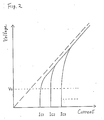
- FIGURE 2 is a graph showing the voltage that develops across several Josephson junctions as a function of an input current on which an analog signal is superimposed.
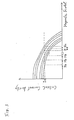
- FIGURE 3 is a graph showing the critical current density at several Josephson junctions as a function of a magnetic field surrounding the converter portion.
- a predetermined current I0 that is smaller than the value of critical current for Josephson junction J1 having a minimum value of critical current is applied to the assembly of superconducting members through terminals P1 and P0. If, under this condition, an analog signal is applied to the assembly, it is superimposed on the input current and, as is apparent from FIGURE 3, the superconducting state of a certain junctions J i to J i-1 that have lower values of critical current than J i are upset to produce an electric resistance across each of these junctions. As a result, a DC voltage develops between detection terminals P2 and P1.
- a magnetic field H m of a certain strength may be applied to the assembly of superconducting members.
- junction J i and junctions J1 to J i-1 which have lower values of critical current than J i is also upset to produce an electric resistance across each of these junctions. In this case, too, a DC voltage develops between detection terminals P2 and P1.
- the voltage that is produced from each of the detection terminals P2, P3, ... P n in response to the change in the input current or surrounding magnetic field may be applied to an encoder coupled in the manner shown in FIGURE 4.
- the encoder will output a digital signal such as a binary signal.
- FIGURE 5 is a cross section of a circuit in the analog-to-digital converter shown in FIGURE 1 which is fabricated from an assembly of Josephson junctions.
- the superconductor 1a which is situated at the far left in the drawing formed first.
- oxide film 2a is formed.
- oxide film 2a is formed.
- the second superconductor layer 1b is formed.
- FIGURE 6 is a cross section of another circuit in which the analog-to-digital converter shown in FIGURE 1 is fabricated from an assembly of Josephson junctions.
- the first superconductor layer A includes isolated superconductor films 10a, 10b, ... 10i, ... whose surface area (expressed by their length in FIGURE 6, which is a cross-section view) increases stepwise in the leftward direction.
- the top surface of the first superconductor layer A is oxidized to form thin insulator films 11a, 11b, ... 11i ... that will serve as barrier layers for Josephson junctions.
- the first layer A is overlaid with the second superconductor layer B which is also made of a patterned superconducting material.
- Isolated superconductor films 20a, 20b, ... 20i ... are so patterned that each of them bridges two adjacent films in the first superconductor layer A. Stated more specifically, the superconductor film 20a bridges the superconductor films 10a and 10b, the film 20b bridges the films 10b and 10c, and so on until the necessary number of Josephson junctions are formed.
- the first superconductor layer is composed of a plurality of isolated superconductor films that are situated in a predetermined common plane and whose top surfaces are covered with a thin insulator layer
- the second superconductor layer is composed of a plurality of superconductor films that are separated in such a way that each of them bridges two adjacent regions of the first superconductor layer.
- the superconductor films 10a, 10b, ... 10i, ... and 20a, 20b, ... 20i, ... can be formed by known thin-film patterning techniques, so a detailed explanation of the procedures for forming these films will not be provided.
- a Josephson junction is formed between superconductor films 10a and 20a, between superconductor films 20a and 10b, and between all other regions of the first and second superconductor layers in superposition via an insulator layer.
- the assembly of Josephson junctions forming the converter portion of the analog-to-digital converter of the present invention can be fabricated by a minimum number of steps using no more than two kinds of masks.
- an assembly of superconducting current channels is formed of a plurality of series-connected Josephson junctions having varying areas of junction. If desired, a similar assembly may be formed by superimposing superconductor layers having different cross-sectional areas or different values of a certain critical condition. Alternatively, two or three of these methods may be combined in an appropriate way and this is of course included within the scope of the present invention.
- the analog-to-digital converter of the present invention receives as an input either a current or a magnetic field in which an analog signal is superimposed, and it outputs a digital signal in response to the change in the input current or magnetic field the results from the superposition of the analog signal.
- the conversion to a digital signal is direct and this is a notable advantage of the present invention since there has never been an analog-to-digital converter in the art that is capable of directly outputting a digital signal in response to a change in applied magnetic field. Therefore, the analog-to-digital converter of the present invention has the potential to be used as a fast operating and highly sensitive magnetic sensor that is capable of direct outputting of a digital signal.
- the operating speed of the analog-to-digital converter can be significantly increased by having its converter portion formed from an assembly of Josephson junctions.
Landscapes
- Engineering & Computer Science (AREA)
- Theoretical Computer Science (AREA)
- Analogue/Digital Conversion (AREA)
- Superconductor Devices And Manufacturing Methods Thereof (AREA)
Applications Claiming Priority (6)
| Application Number | Priority Date | Filing Date | Title |
|---|---|---|---|
| JP62210708A JPH0624259B2 (ja) | 1987-08-25 | 1987-08-25 | アナログ/ディジタル変換器 |
| JP62210710A JPH0624261B2 (ja) | 1987-08-25 | 1987-08-25 | アナログ/ディジタル変換器 |
| JP62210709A JPH0624260B2 (ja) | 1987-08-25 | 1987-08-25 | アナログ/ディジタル変換器 |
| JP210710/87 | 1987-08-25 | ||
| JP210709/87 | 1987-08-25 | ||
| JP210708/87 | 1987-08-25 |
Publications (2)
| Publication Number | Publication Date |
|---|---|
| EP0304894A2 true EP0304894A2 (de) | 1989-03-01 |
| EP0304894A3 EP0304894A3 (de) | 1992-06-03 |
Family
ID=27329162
Family Applications (1)
| Application Number | Title | Priority Date | Filing Date |
|---|---|---|---|
| EP19880113795 Withdrawn EP0304894A3 (de) | 1987-08-25 | 1988-08-24 | Analog-Digitalwandler mit einem supraleitenden Stoff |
Country Status (5)
| Country | Link |
|---|---|
| US (1) | US4963871A (de) |
| EP (1) | EP0304894A3 (de) |
| KR (1) | KR920003885B1 (de) |
| AU (1) | AU598695B2 (de) |
| CA (1) | CA1336788C (de) |
Cited By (3)
| Publication number | Priority date | Publication date | Assignee | Title |
|---|---|---|---|---|
| EP0414426A1 (de) * | 1989-08-24 | 1991-02-27 | Trw Inc. | Supraleitender Analog-zu-Digital-Konverter mit einem geerdeten Vier-Übergang-Squid-Zweirichtungszähler |
| FR2691860A1 (fr) * | 1992-05-27 | 1993-12-03 | Air Liquide | Convertisseur analogique-numérique à haute fréquence de fonctionnement. |
| WO2004049577A1 (fr) * | 2002-11-22 | 2004-06-10 | Thales | Convertisseur analogique/numerique pour hyperfrequences |
Families Citing this family (2)
| Publication number | Priority date | Publication date | Assignee | Title |
|---|---|---|---|---|
| KR100724098B1 (ko) * | 2006-05-10 | 2007-06-04 | 한국표준과학연구원 | 조셉슨 dac를 이용한 아날로그 디지탈 변환장치 및 방법 |
| US8188897B2 (en) * | 2010-10-29 | 2012-05-29 | Hewlett-Packard Development Company, L.P. | Analog to digital converter |
Family Cites Families (4)
| Publication number | Priority date | Publication date | Assignee | Title |
|---|---|---|---|---|
| US3419712A (en) * | 1959-03-05 | 1968-12-31 | Rca Corp | Function generation and analog-to-digital conversion using superconducting techniques |
| US3084339A (en) * | 1959-09-22 | 1963-04-02 | Space Technology Lab Inc | Analog-to-digital converter |
| US3458735A (en) * | 1966-01-24 | 1969-07-29 | Gen Electric | Superconductive totalizer or analog-to-digital converter |
| US4672359A (en) * | 1985-11-12 | 1987-06-09 | Trw Inc. | Superconducting analog-to-digital converter and digital magnetometer and related method for its use |
-
1988
- 1988-08-17 KR KR1019880010421A patent/KR920003885B1/ko not_active Expired
- 1988-08-24 CA CA000575603A patent/CA1336788C/en not_active Expired - Fee Related
- 1988-08-24 US US07/235,940 patent/US4963871A/en not_active Expired - Fee Related
- 1988-08-24 EP EP19880113795 patent/EP0304894A3/de not_active Withdrawn
- 1988-08-25 AU AU21541/88A patent/AU598695B2/en not_active Ceased
Cited By (4)
| Publication number | Priority date | Publication date | Assignee | Title |
|---|---|---|---|---|
| EP0414426A1 (de) * | 1989-08-24 | 1991-02-27 | Trw Inc. | Supraleitender Analog-zu-Digital-Konverter mit einem geerdeten Vier-Übergang-Squid-Zweirichtungszähler |
| FR2691860A1 (fr) * | 1992-05-27 | 1993-12-03 | Air Liquide | Convertisseur analogique-numérique à haute fréquence de fonctionnement. |
| WO2004049577A1 (fr) * | 2002-11-22 | 2004-06-10 | Thales | Convertisseur analogique/numerique pour hyperfrequences |
| US7075467B2 (en) | 2002-11-22 | 2006-07-11 | Thales | Analog/digital converter for microwave frequencies |
Also Published As
| Publication number | Publication date |
|---|---|
| KR890004508A (ko) | 1989-04-22 |
| CA1336788C (en) | 1995-08-22 |
| AU2154188A (en) | 1989-03-02 |
| US4963871A (en) | 1990-10-16 |
| AU598695B2 (en) | 1990-06-28 |
| KR920003885B1 (ko) | 1992-05-16 |
| EP0304894A3 (de) | 1992-06-03 |
Similar Documents
| Publication | Publication Date | Title |
|---|---|---|
| Geballe et al. | Superconductivity—The State That Came in from the Cold | |
| Malozemoff et al. | High-temperature cuprate superconductors get to work | |
| Sterne et al. | Higher Tc through metallic inter-layer coupling in Bi2Sr2CaCu2O8 | |
| Maezawa et al. | Overdamped Josephson junctions with Nb/AlO x/Al/AlO x/Nb structure for integrated circuit application | |
| Beasley | High-temperature superconductive thin films | |
| Ford et al. | High-temperature superconductivity-ten years on | |
| US4963871A (en) | Analog-to-digital converter using superconducting material | |
| Tanaka | High-temperature superconductivity | |
| JPH0624259B2 (ja) | アナログ/ディジタル変換器 | |
| Müller et al. | High-temperature superconductivity | |
| Kitaguchi et al. | Advances in Bi-Based High-Tc superconducting tapes and wires | |
| JPH0624260B2 (ja) | アナログ/ディジタル変換器 | |
| JPH0624261B2 (ja) | アナログ/ディジタル変換器 | |
| Müller | The first five years of high-Tc superconductivity | |
| US5795849A (en) | Bulk ceramic superconductor structures | |
| Rogalla | Superconducting electronics | |
| EP0284061A2 (de) | Supraleitendes Materialgemisch aus Oxidkeramik | |
| US5206214A (en) | Method of preparing thin film of superconductor | |
| Huebener | The Big Surprise: High-Temperature Superconductivity | |
| JP3058515B2 (ja) | 超電導ジョセフソン素子およびその製法 | |
| Liu et al. | Complexity and simplicity of the metal-superconductor-insulator transition in the (Tl1− xPbx) Sr2 (Ca1− yYy) Cu2O7− δ system | |
| JP2519773B2 (ja) | 超電導材 | |
| Wesche | Milestones in the History of Superconductivity | |
| Gupta et al. | Selected topics in superconductivity | |
| Hitaish et al. | Bulk Superconductors: Materials and Applications |
Legal Events
| Date | Code | Title | Description |
|---|---|---|---|
| PUAI | Public reference made under article 153(3) epc to a published international application that has entered the european phase |
Free format text: ORIGINAL CODE: 0009012 |
|
| AK | Designated contracting states |
Kind code of ref document: A2 Designated state(s): DE FR GB IT |
|
| 17P | Request for examination filed |
Effective date: 19901220 |
|
| PUAL | Search report despatched |
Free format text: ORIGINAL CODE: 0009013 |
|
| AK | Designated contracting states |
Kind code of ref document: A3 Designated state(s): DE FR GB IT |
|
| 17Q | First examination report despatched |
Effective date: 19940324 |
|
| GRAH | Despatch of communication of intention to grant a patent |
Free format text: ORIGINAL CODE: EPIDOS IGRA |
|
| STAA | Information on the status of an ep patent application or granted ep patent |
Free format text: STATUS: THE APPLICATION IS DEEMED TO BE WITHDRAWN |
|
| 18D | Application deemed to be withdrawn |
Effective date: 19960611 |