EP0302739A2 - NMR Untersuchung von Proben - Google Patents
NMR Untersuchung von Proben Download PDFInfo
- Publication number
- EP0302739A2 EP0302739A2 EP88307248A EP88307248A EP0302739A2 EP 0302739 A2 EP0302739 A2 EP 0302739A2 EP 88307248 A EP88307248 A EP 88307248A EP 88307248 A EP88307248 A EP 88307248A EP 0302739 A2 EP0302739 A2 EP 0302739A2
- Authority
- EP
- European Patent Office
- Prior art keywords
- zqc
- period
- sample
- pulse
- zqcs
- Prior art date
- Legal status (The legal status is an assumption and is not a legal conclusion. Google has not performed a legal analysis and makes no representation as to the accuracy of the status listed.)
- Withdrawn
Links
Images



Classifications
-
- G—PHYSICS
- G01—MEASURING; TESTING
- G01R—MEASURING ELECTRIC VARIABLES; MEASURING MAGNETIC VARIABLES
- G01R33/00—Arrangements or instruments for measuring magnetic variables
- G01R33/20—Arrangements or instruments for measuring magnetic variables involving magnetic resonance
- G01R33/44—Arrangements or instruments for measuring magnetic variables involving magnetic resonance using nuclear magnetic resonance [NMR]
- G01R33/46—NMR spectroscopy
- G01R33/4608—RF excitation sequences for enhanced detection, e.g. NOE, polarisation transfer, selection of a coherence transfer pathway
Definitions
- the invention relates to methods for investigating a sample using nuclear magnetic resonance (NMR).
- nuclei for example the hydrogen nucleus
- exhibit an intrinsic spin so that when the nucleus is exposed to a magnetic field it will precess around the magnetic field with a frequency ⁇ known as the Larmor frequency with the spin preferentially aligned in the direction of the magnetic field.
- the magnetic field experienced by the nucleus will be modified by the screening effect of those electrons. This will cause each chemically different set of nuclei to precess at a slightly different Larmor frequency.
- This phenomenon known as chemical shift, reflects the chemical environment of a nucleus and enables the chemical structure of many molecules to be determined by observing the precession frequencies present within the sample.
- the intrinsic spin of a spin-1/2 nucleus is quantised and can take up one of two states, either parallel or anti-parallel with the main magnetic field. In the presence of the main magnetic field only, the spins will preferentially take up the parallel state, to produce a net magnetisation vector in that direction.
- the injection of energy in the form of a radio frequency pulse will cause a proportion of the nuclei in the sample to change their spin state causing a rotation of the net magnetisation vector from alignment with the main field to a direction dependent on the duration of the pulse.
- the component of the vector which is perpendicular to the direction of the field can then be observed to precess about it due to chemical shift and scalar couplings.
- the spins of adjacent magnetic nuclei interact (scalar spin-spin coupling) via the electrons of the intervening bonds.
- the two spin system can exist in four different states depending on the relative orientations of the respective spins to each other and to the main field.
- the spin system will give rise to four single-quantum transitions; in the (conventional) single-quantum coherence spectrum the chemically shifted peak of each spin will be split into two lines, the splitting between which is known as the scalar coupling constant.
- the number of component lines of a multiplet into which the resonance of a particular spin is split is dependent upon the number and type of adjacent spins.
- the scalar coupling constant enables properties of the sample to be derived such as the angle between bonds of adjacent nuclei and the number of intervening bonds.
- the size of the scalar coupling constant can be obtained by determining the separation between the components of a multiplets within a chemical shift band.
- a method of investigating a sample using nuclear magnetic resonance comprises:
- This technique allows all but a single ZQC, selected by its precessional frequency, to be filtered out from the ZQC spectrum, and, by means of a coherence transfer other ZQCs which are part of the same spin system can be made to reappear.
- t1 may be zero in which case, upon fourier transform of the FID obtained, a 1D spectrum is obtained consisting solely of signals from the spin system from which the selected ZQC arose (providing a method B filter is used to be described below).
- the technique works by combining two or more FIDs from separate experiments with different values of N allowing free precession to occur for differing times before the start of acquisition or collection (step v).
- the difference in free precession time between consecutive experiments is chosen such that only the coherence that one wishes to preserve will have the same phase in each case and will therefore constructively interfere when the FIDs are co-added while all other coherences will destructively interfere and hence cancel each other out.
- One common pulse sequence comprises a 90° radio frequency pulse in the X direction, a relaxation period of duration ⁇ /2, a 180° radio frequency pulse in the Y direction followed by a further relaxation period of duration ⁇ /2 and a final 90° pulse in the X direction. It is assumed that the main magnetic field extends in the Z direction.
- ⁇ is chosen to be equal to ⁇ / ⁇ ZQC , where ⁇ ZQC is the frequency of the ZQC chosen to pass through the filter, and step v) comprises adding the FID signal collected after each step iii) in which N is an odd integer.
- steps ii) and v) include applying a 180° radio frequency pulse at a time ⁇ /2 after commencement of the relevant period.
- the pulse removes effects on intensity due to chemical shift evolution during these periods from the resultant spectrum.
- step iii) has a duration of N ⁇ + ⁇ ′ + t1, an additional pulse ⁇ ⁇ being applied after a time N ⁇ + ⁇ ′, wherein 0° ⁇ ⁇ ⁇ 90°, and wherein ⁇ indicates a direction orthogonal to the magnetic field direction.
- This new pulse sequence is distinguished from the conventional ZQC pulse sequence mentioned above in that it incorporates two additional delays and two or more additional rf pulses.
- the purpose of the additional delays is to allow evolution between in-phase and anti-phase ZQC.
- the purpose of the additional pulses is to effect a transfer of coherence between those ZQCs present immediately prior to them and any ZQCs which may be generated from the spins which either participate in those ZQCs, or to which they were coupled.
- ⁇ preferably lies between 0° and 180°.
- the pulse sequence in accordance with the second aspect of the invention will need to be repeated at least once with ⁇ and ⁇ 1 being phase cycled.
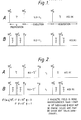
- Figure 1A illustrates a basic pulse sequence for producing filtered zero-quantum coherence spectra.
- This sequence comprises a zero quantum coherence preparation period of duration ⁇ .
- a 90° rf pulse is injected into the sample in the X direction of an orthogonal coordinate system with axes X,Y,Z.
- a further 90° pulse is injected in the X direction.
- N ⁇ + t1 is followed by an evolution period of duration N ⁇ + t1.
- a coherence transfer pulse (90° ⁇ ) is injected and after a further period ⁇ , the resulting free induction decay signal is acquired in the direction ⁇ .
- ⁇ will be phase cycled in a conventional manner when the magnetic field has a homogeneity better than 1 part in 106.
- Figure 1B illustrates a modified form of the Figure 1A sequence in which an additional 180° X pulse is injected into the sample in both the preparation and acquisition periods.
- a ZQC (ZQC) y present at the beginning of the evolution period will evolve during the total evolution time (N. ⁇ +t1) into: (ZQC) y cos((N. ⁇ +t1) ⁇ eff ) + (ZQC) x sin((N. ⁇ +t1) ⁇ eff ).
- Filtration is accomplished by acquiring FIDs with several different values N for each t1 value. These are then added if Eq.1 is invariant with respect to N for the ZQC chosen to pass through the filter, or, if it is not invariant, the phase of the receiver is cycled in such a way that it appears to be so to the observer.
- ⁇ (2 ⁇ / ⁇ ZQC )
- the frequency characteristic, A( ⁇ ), of the filter is given by Eq.2, and its transmission bandwidth (defined as the distance between the first two points of zero intensity on each side of ⁇ ZQC ) as a fraction of ⁇ ZQC will be equal to (1/(n+1)). It can be seen from Eq.2 that additional transmision bands will occur at 0.0, 2. ⁇ ZQC , 3. ⁇ ZQC , 4. ⁇ ZQC ... etc in the F1 dimension of the spectrum.
- ⁇ ( ⁇ / ⁇ ZQC )
- ⁇ ZQC is the frequency of the ZQC chosen to pass through the filter.
- the frequency characteristic, A( ⁇ ), of the filter is given by Eq.3, and its transmission bandwidth as a fraction of ⁇ ZQC will be equal to (2/)n+1)). Additional transmission bands will occur (Eq.1) at 3. ⁇ ZQC , 5. ⁇ ZQC , 7. ⁇ ZQC ...etc in the F1 dimension of the spectrum.
- Method A has the advantage of giving the narrowest transmission bandwidth ... half that of Method B ... although Method B has the advantage of letting through fewer additional unwanted bands; Method B only transmits additional bands at odd integer multiples of ⁇ ZQC , whereas Method A passes additional bands at all integer multiples of ZQC .
- Method A is to be prefered where there is no danger of unwanted ZQCs slipping through at multiples of ⁇ ZQC , which is obviously the case when ⁇ ZQC >F1/2. However, when F1/2 > ⁇ ZQC >F1/3 only Method B offers this assurance.
- Method B with its fewer additional windows,although no longer imperveous to unwanted coherences, is more likely to secure their exclusion.
- Method A is demonstrated on a mixture of amino acids in Fig.4B, where all except two overlapping ZQCs from alanine and threonine have been removed from the spectrum.
- Fig.4C When applied on the innermost threonine resonance, Fig.4C, however, Method A proved to be inadequate since a valine ZQC occurs at almost twice the frequency and hence passed through the 2. ⁇ ZQC window.
- Method B which does not have this additional window, effectively removed all unwanted ZQCs (Fig.4D).
- ZQCs which either consist of spins to which it is coupled, or which are active within it, can be made to reappear using the pulse sequence summarised in Fig.2B.
- This pulse sequence differs from that in Fig.1B in that it includes an additional delay and an additional pulse.
- This delay allows a ZQC such as (12) y (a component of ZQC consisting of spins 1 and 2 ), created at the end of the preparation period, to evolve (13) due to its precessional frequency, and its scalar couplings to other passive spins, for example 3 , into antiphase ZQC terms such as (12) y 2.I 3z .
- the subsequent pulse ⁇ will convert this into terms including (13) y 2.I 2z and (23) y 2.I 1z ; i.e. coherence will be transfered from the ZQC 12 , to 13 and 23
- All ZQCs thus created from the ZQC selected by the filtration process described above will be encoded in the data matrix with respect to t1 and will, therefore, be present in the F1 spectrum. All other ZQC will cancel out when, for each value of t1, the FIDs obtained with different values of N are combined.
- Figure 2A illustrates a simplified form of the pulse sequence shown in Figure 2B in which the 180° pulses in the preparation and acquisition periods have been omitted.
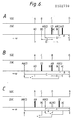
- Fig.6 An extended ZEUS-D analysis of two ZQCs, AB and CD, is given diagramatically in Fig.6. This gives additional information on the relative positions of the frequency spaces between A & B , and C & D in the SQC spectrum. For the case represented in Fig.6A the frequency region bounded by A and B in the SQC spectrum does not overlap with that bounded by C and D , whereas for the case in Fig.6B there is partial overlap, and in Fig.6C total overlap. This additional information is a result of the identification and analysis of the additional pairs of 2-spin ZQCs which may arise from the four spins: AC & BD and AD & BC.
- the upper line represents the single quantum coherence (SQC) spectrum and the lower line the ZQC spectrum.
- the tall bold face lines in the ZQC spectrum represent the two ZQCs whose relationship is under consideration.
- the other tall lines represent 4-spin ZQCs at the sum, ⁇ , and difference, ⁇ , in frequencies of these two ZQCs.
- the short thin lines represent ZQCs concerned with the extended ZEUS analysis.
- the symbol "+" means that the sum of the frequencies of the two ZQCs indicated is equivalent to that of the ZQC indicated by the following arrow; this will be at either ⁇ or ⁇ .
- the extended Zeus-C is similar, although in this case its primary importance is to confirm the previous assignment rather than to seek additional information about the spin system.
- ZEUS-D the identificationon of peaks at both the sum and difference of the frequencies of two ZQCs is reasonably conclusive evidence that their relationship actually is of the ZEUS-D type and not ZEUS-C.
- a further question must be asked: is this a genuine case of ZEUS-C or just a case of ZEUS-D in which one of the sum and difference peaks has not been excited, or is below the detection threshold?
- Figure 7 (A) The spin B is within the SQC frequency range between spins A and C , and D outside of this range.
- Figure 7(B) The spin B is within the SQC frequency range between A and C , and so is D .
- Figure 7(C) The spin B is outside of the SQC frequency range between A and C , as is D .
- Figure 7(D) The spin B is outside the SQC frequency range between A and C , but D is inside it.
- the upper line represents the SQC spectrum and the lower line the ZQC spectrum.
- the tall bold face lines represent those ZQCs whose relationship is under consideration.
- the other tall lines represents a ZQC at the sum, ⁇ or difference, ⁇ , of these ZQCs.
- the short thin lines represent ZQCs concerned with the extended ZEUS analysis.
- the symbol "+" indicates that the sum of the frequencies of the two ZQCs indicated is equal to that of the ZQC indicated by the arrow; this will be either ⁇ or ⁇ .
- Zero-quantum coherences cannot be created directly by the action of a single r.f. pulse on the magnetisation of a spin system at equilibrium, and neither can they be detected directly since they have no net magnetisation in any direction. Consequently, both creation and detection must be accomplished by using a series of pulses and delays.
- In an inhomogeneous magnetic field there is the additional requirement that any dephasing due to magnetic field inhomogeneity must be eliminated.
- There are two excitation sequences in common use which fulfill this requirement: 90 x - ⁇ /2 - 180 y - ⁇ /2 - 45 y and 90 x - ⁇ /2 - 180 y - ⁇ /2 - 90 x .
- the first 90° pulse will convert the longitudinal magnetisation of a spin, 1 , into a (SQC) magnetisation vector, -I 1y , along the y-axis of the rotating reference frame.
- This magnetisation will evolve during ⁇ solely due to its scalar couplings with its ( N -1) coupling partners (neglecting relaxation), chemical shift and magnetic field inhomogeneity evolution being cancelled out by the 180° pulse at ⁇ /2.
- the resulting antiphase SQC ( described using the product operator formalism) includes terms such as:
- the first term contains the product operator 2I 1x I 2z which describes SQC of the spin 1 antiphase due to its scalar coupling to the spin 2 .
- the rest of the term describes the amplitude of the product operator, and can be seen to be dependent upon the spin's scalar couplings and the length of the preparation period ⁇ .
- the second and third terms consist of SQC of the spin 1 antiphase with respect to two and three other spins respectively. These product operators are converted by the second 90° pulse into 2I 1x I 2y , 4I 1z I 2y I 3y , and 8I 1x I 2y I 3y I 4y respectively (omitting their amplitudes).
- the first term now consists of 2-spin coherences (a mixture of zero- and double-quantum coherence) of spins 1 and 2 whereas the second term consists of two-spin coherences of spins 2 and 3 antiphase with respect to spin 1 .
- the third term consists of four-spin coherences. Each term consists of a mixture of coherence.
- pure ZQC is given by Eqs.6 and 7.
- ZQC(1,2) x 1/2(2I 1x I 2x + 2I 1y I 2y ) (6)
- ZQC(1,2) y 1/2(2I 1y I 2x - 2I 1x I 2y ) (7)
- Other terms can be analysed in a similar manner.
- BC will have non-zero scalar couplings to both spins A and D the amplitudes of which can be calculated from Eq. 8, where m is a passive spin which is coupled to a coherence consisting of spins k with an effective couplings constant J eff .
- FIG. 3A A very simple form of the new MUSE sequence is illustrated in Figure 3A with Figure 3B illustrating a slightly more complex version in which 180° pulses have been inserted into the evolution period.
- the MUSE pulse sequence is distinguished from the conventional ZQC pulse sequence in that it incorporates two additional delays and two additional r.f. pulses.
- the purpose of the additional delays is to allow evolution between in-phase and antiphase ZQC.
- the purpose of the additional pulses is to effect a transfer of coherence between those ZQCs present immediately prior to them, and any ZQCs which may be generated from the spins which either participate in those ZQCs, or to which they were coupled. Coherence will unavoidably be transferred to other orders of multiple-quantum coherence besides ZQC, and as a consequence of this the intensity of ZQC will be reduced.
- the intensities of the ZQCs produced by MUSE are dependent upon the precessional frequencies of the intermediate ZQCs present during ⁇ . This dependency can be removed by inserting a 180° pulse at the centre of ⁇ ′ (Fig. 3C). However, if this is done, then ⁇ may not be 90° since for this value only odd orders of multiple-quantum coherence will be generated.
- phase cycling for the pulse sequences given in Fig 3 is defined as follows: ⁇ is cycled through x,y,-x,-y, and for each value of ⁇ , ⁇ 1 is cycled through x,y,-x,-y. In general ⁇ n is cycled through x,y,-x,-y for each value of ⁇ (n-1). To obtain the spectra presented here, only ⁇ and ⁇ 1 were phase cycled: additional phase cycling was made redunant by the use of an inhomogeneous magnetic field; ⁇ 2 was cycled as ⁇ 1.
- the width of F1 used in each experiment was 2200 Hz; 512 t1 values were used, with 16 transients collected for each.
- the t1 dimension of the data set was zero-filled to 4K. Because it was not possible to perform single point acquisition (the method to be preferred in an inhomogeneous magnetic field where F2 will contain no useful information), F2 was set to 80 KHz and 128 points acquired. This allowed, after FT with respect to t2, the approximation to be made that the majority of the signal was contained within one t1 interferrogram, and it is the FT of this which is given here in each case.
- a pseudo-echo apodization function was used prior to the FT of each dimension. All other parameters are given elsewhere.
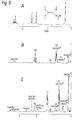
- the conventional ZQC spectrum of allyl bromide (Fig.5B) was obtained using a value of ⁇ which excites two ZQCs with significant intensity; these are 23 (i.e. the ZQC between spins 2 and 3 ) and 34. From this spectrum it can be seen that there is a peak at the difference between their frequencies, 24, which indicates some type of connectivity between then. However, uncertainty as to whether the complete spectrum has been excited means that no conclusions can be drawn regarding its conformity to any particular case of either the ZEUS-C, or the ZEUS-D, analysis.
- the corresponding MUSE-1 spectrum (Fig.5C) contains many more ZQCs.
- Fig.5C contains the complete ZQC spectrum of allyl bromide.
Landscapes
- Physics & Mathematics (AREA)
- Spectroscopy & Molecular Physics (AREA)
- High Energy & Nuclear Physics (AREA)
- Condensed Matter Physics & Semiconductors (AREA)
- General Physics & Mathematics (AREA)
- Magnetic Resonance Imaging Apparatus (AREA)
Applications Claiming Priority (2)
| Application Number | Priority Date | Filing Date | Title |
|---|---|---|---|
| GB878718723A GB8718723D0 (en) | 1987-08-07 | 1987-08-07 | Investigating sample using nmr |
| GB8718723 | 1987-08-07 |
Publications (2)
| Publication Number | Publication Date |
|---|---|
| EP0302739A2 true EP0302739A2 (de) | 1989-02-08 |
| EP0302739A3 EP0302739A3 (de) | 1990-02-07 |
Family
ID=10621956
Family Applications (1)
| Application Number | Title | Priority Date | Filing Date |
|---|---|---|---|
| EP88307248A Withdrawn EP0302739A3 (de) | 1987-08-07 | 1988-08-05 | NMR Untersuchung von Proben |
Country Status (5)
| Country | Link |
|---|---|
| US (1) | US5045790A (de) |
| EP (1) | EP0302739A3 (de) |
| JP (1) | JPH0196544A (de) |
| AU (1) | AU611928B2 (de) |
| GB (1) | GB8718723D0 (de) |
Cited By (1)
| Publication number | Priority date | Publication date | Assignee | Title |
|---|---|---|---|---|
| EP0638815A3 (de) * | 1993-08-11 | 1995-10-25 | Hennig Juergen | Verfahren der bildgebenden Kernspintomographie zur Erzeugung von RARE-Bildern mit zusätzlicher Präparation der Magnetisierung zur Magnetisierung. |
Families Citing this family (7)
| Publication number | Priority date | Publication date | Assignee | Title |
|---|---|---|---|---|
| EP0413686B1 (de) * | 1988-04-20 | 1995-03-08 | Laurance David Hall | Untersuchung einer probe mittels magnetischer kernresonanz |
| WO1992001235A1 (en) * | 1990-07-11 | 1992-01-23 | Spectrospin Ag | Multiple-quantum nmr with frequency-modulated chirp pulses |
| US5227725A (en) * | 1990-11-29 | 1993-07-13 | The United States Of America As Represented By The Secretary Of The Navy | Nuclear magnetic resonance imaging with short gradient pulses |
| US5168229A (en) * | 1991-04-02 | 1992-12-01 | General Electric Company | Multidimensional nmr spectroscopy using switched acquisition time gradients for multiple coherence transfer pathway detection |
| US5262723A (en) * | 1991-07-09 | 1993-11-16 | General Electric Company | Method and apparatus for obtaining pure-absorption two-dimensional lineshape data for multidimensional NMR spectroscopy using switched acquisition time gradients |
| US7200430B2 (en) * | 2001-03-29 | 2007-04-03 | The Regents Of The University Of California | Localized two-dimensional shift correlated MR spectroscopy of human brain |
| US7466127B2 (en) * | 2006-07-04 | 2008-12-16 | Bruker Biospin Ag | Method of 2D-NMR correlation spectroscopy with double quantum filtration followed by evolution of single quantum transitions |
Family Cites Families (5)
| Publication number | Priority date | Publication date | Assignee | Title |
|---|---|---|---|---|
| US4134058A (en) * | 1977-11-28 | 1979-01-09 | Varian Associates, Inc. | Selective detection of multiple quantum transitions in nuclear magnetic resonance |
| US4238735A (en) * | 1979-02-21 | 1980-12-09 | Varian Associates, Inc. | Indirect detection of nuclear spins of low gyromagentic ratio coupled to spins of high gyromagnetic ratio |
| DE3143625C2 (de) * | 1981-11-04 | 1985-11-28 | Spectrospin AG, Fällanden, Zürich | Verfahren zur Aufnahme von Kernresonanzspektren von Molekülen in einem zweidimensionalen Frequenzbereich und Kernresonanzspektrometer zur Durchführung des Verfahrens |
| US4680546A (en) * | 1986-01-27 | 1987-07-14 | General Electric Company | Methods of, and pulse sequences for, the supression of undesired resonances by generation of quantum coherence in NMR imaging and spectroscopy |
| US4703270A (en) * | 1986-04-18 | 1987-10-27 | The University Of British Columbia | Zero quantum NMR imaging and spectroscopy in a low homogeneity magnetic field |
-
1987
- 1987-08-07 GB GB878718723A patent/GB8718723D0/en active Pending
-
1988
- 1988-08-04 AU AU20414/88A patent/AU611928B2/en not_active Ceased
- 1988-08-05 US US07/229,156 patent/US5045790A/en not_active Expired - Lifetime
- 1988-08-05 EP EP88307248A patent/EP0302739A3/de not_active Withdrawn
- 1988-08-08 JP JP63197822A patent/JPH0196544A/ja active Pending
Cited By (2)
| Publication number | Priority date | Publication date | Assignee | Title |
|---|---|---|---|---|
| EP0638815A3 (de) * | 1993-08-11 | 1995-10-25 | Hennig Juergen | Verfahren der bildgebenden Kernspintomographie zur Erzeugung von RARE-Bildern mit zusätzlicher Präparation der Magnetisierung zur Magnetisierung. |
| US5541511A (en) * | 1993-08-11 | 1996-07-30 | Hennig; J+E,Uml U+Ee Rgen | Method of magnetic resonance imaging for the production of rare images with additional preparation of the magnetization for contrast variation |
Also Published As
| Publication number | Publication date |
|---|---|
| US5045790A (en) | 1991-09-03 |
| AU611928B2 (en) | 1991-06-27 |
| GB8718723D0 (en) | 1987-09-16 |
| EP0302739A3 (de) | 1990-02-07 |
| JPH0196544A (ja) | 1989-04-14 |
| AU2041488A (en) | 1989-02-09 |
Similar Documents
| Publication | Publication Date | Title |
|---|---|---|
| EP0239724B1 (de) | Methoden und Pulsfolgen für die Unterdrückung von unerwünschten Resonanzen durch Erzeugung von Quanten-Kohärenz in NMR-Abbildung | |
| Kessler et al. | Transformation of homonuclear two-dimensional NMR techniques into one-dimensional techniques using Gaussian pulses | |
| Kessler et al. | Multi‐dimensional NMR experiments using selective pulses | |
| EP0254983B1 (de) | Polarisationstransfer durch selektive Homonukleartechnik zur Unterdrückung von entkoppelten Spins in der KMR-Spektroskopie | |
| Ogura et al. | An improved double-tuned and isotope-filtered pulse scheme based on a pulsed field gradient and a wide-band inversion shaped pulse | |
| Andersson et al. | Spin-state selection filters for the measurement of heteronuclear one-bond coupling constants | |
| US4510449A (en) | Method for recording two-dimensional nuclear magnetic resonance spectra and a device for carrying out the same | |
| GB2200462A (en) | Methods and apparatus for detecting certain compounds | |
| Rance et al. | Uniform excitation of multiple-quantum coherence. Application to two-dimensional double-quantum spectroscopy | |
| Counsell et al. | The selection of coherence-transfer pathways by inhomogeneous z pulses | |
| US6888348B2 (en) | Decoupling sideband resolved NMR spectroscopy (desire) | |
| US5045790A (en) | Investigating a sample using NMR | |
| JPS6193941A (ja) | 2次元磁気回転共鳴分光分析装置 | |
| Bodenhause et al. | Separation of dipolar and quadrupolar splittings in single crystal nitrogen-14 NMR | |
| Boulat et al. | Measurement of proton relaxation rates in proteins | |
| US4843321A (en) | Method for volume localized spectral editing of NMR signals produced by metabolites containing coupled spins | |
| Chan et al. | Optical detection of endor in a zero-field transition of phosphorescent quinoxaline | |
| Mackin et al. | Phase-sensitive two-dimensional HMQC and HMQC-TOCSY spectra obtained using double pulsed-field-gradient spin echoes | |
| Ross et al. | Efficient methods for obtaining phase-sensitive gradient-enhanced HMQC spectra | |
| US4766377A (en) | Phase correction method in two-dimensional NMR spectroscopy | |
| EP0413686B1 (de) | Untersuchung einer probe mittels magnetischer kernresonanz | |
| GB2117119A (en) | Nuclear magnetic resonance decoupling | |
| US5168225A (en) | Method of analyzing 3D NMR spectrum | |
| Burum | Heteronuclear correlated 2d nmr spectroscopy of spins greater than 12. Application to decaborane | |
| US4766382A (en) | Two-dimensional nuclear magnetic resonance spectrometry |
Legal Events
| Date | Code | Title | Description |
|---|---|---|---|
| PUAI | Public reference made under article 153(3) epc to a published international application that has entered the european phase |
Free format text: ORIGINAL CODE: 0009012 |
|
| AK | Designated contracting states |
Kind code of ref document: A2 Designated state(s): CH DE FR GB IT LI |
|
| PUAL | Search report despatched |
Free format text: ORIGINAL CODE: 0009013 |
|
| AK | Designated contracting states |
Kind code of ref document: A3 Designated state(s): CH DE FR GB IT LI |
|
| 17P | Request for examination filed |
Effective date: 19900803 |
|
| 17Q | First examination report despatched |
Effective date: 19940415 |
|
| STAA | Information on the status of an ep patent application or granted ep patent |
Free format text: STATUS: THE APPLICATION IS DEEMED TO BE WITHDRAWN |
|
| 18D | Application deemed to be withdrawn |
Effective date: 19941026 |