EP0302402A2 - Washing and cleaning agents for fabrics - Google Patents
Washing and cleaning agents for fabrics Download PDFInfo
- Publication number
- EP0302402A2 EP0302402A2 EP88112291A EP88112291A EP0302402A2 EP 0302402 A2 EP0302402 A2 EP 0302402A2 EP 88112291 A EP88112291 A EP 88112291A EP 88112291 A EP88112291 A EP 88112291A EP 0302402 A2 EP0302402 A2 EP 0302402A2
- Authority
- EP
- European Patent Office
- Prior art keywords
- sodium
- detergent
- weight
- embodiment according
- washing
- Prior art date
- Legal status (The legal status is an assumption and is not a legal conclusion. Google has not performed a legal analysis and makes no representation as to the accuracy of the status listed.)
- Withdrawn
Links
Images

Classifications
-
- C—CHEMISTRY; METALLURGY
- C11—ANIMAL OR VEGETABLE OILS, FATS, FATTY SUBSTANCES OR WAXES; FATTY ACIDS THEREFROM; DETERGENTS; CANDLES
- C11D—DETERGENT COMPOSITIONS; USE OF SINGLE SUBSTANCES AS DETERGENTS; SOAP OR SOAP-MAKING; RESIN SOAPS; RECOVERY OF GLYCEROL
- C11D3/00—Other compounding ingredients of detergent compositions covered in group C11D1/00
- C11D3/39—Organic or inorganic per-compounds
- C11D3/3942—Inorganic per-compounds
-
- C—CHEMISTRY; METALLURGY
- C11—ANIMAL OR VEGETABLE OILS, FATS, FATTY SUBSTANCES OR WAXES; FATTY ACIDS THEREFROM; DETERGENTS; CANDLES
- C11D—DETERGENT COMPOSITIONS; USE OF SINGLE SUBSTANCES AS DETERGENTS; SOAP OR SOAP-MAKING; RESIN SOAPS; RECOVERY OF GLYCEROL
- C11D1/00—Detergent compositions based essentially on surface-active compounds; Use of these compounds as a detergent
- C11D1/02—Anionic compounds
- C11D1/12—Sulfonic acids or sulfuric acid esters; Salts thereof
- C11D1/28—Sulfonation products derived from fatty acids or their derivatives, e.g. esters, amides
-
- C—CHEMISTRY; METALLURGY
- C11—ANIMAL OR VEGETABLE OILS, FATS, FATTY SUBSTANCES OR WAXES; FATTY ACIDS THEREFROM; DETERGENTS; CANDLES
- C11D—DETERGENT COMPOSITIONS; USE OF SINGLE SUBSTANCES AS DETERGENTS; SOAP OR SOAP-MAKING; RESIN SOAPS; RECOVERY OF GLYCEROL
- C11D3/00—Other compounding ingredients of detergent compositions covered in group C11D1/00
- C11D3/02—Inorganic compounds ; Elemental compounds
- C11D3/04—Water-soluble compounds
- C11D3/06—Phosphates, including polyphosphates
-
- C—CHEMISTRY; METALLURGY
- C11—ANIMAL OR VEGETABLE OILS, FATS, FATTY SUBSTANCES OR WAXES; FATTY ACIDS THEREFROM; DETERGENTS; CANDLES
- C11D—DETERGENT COMPOSITIONS; USE OF SINGLE SUBSTANCES AS DETERGENTS; SOAP OR SOAP-MAKING; RESIN SOAPS; RECOVERY OF GLYCEROL
- C11D3/00—Other compounding ingredients of detergent compositions covered in group C11D1/00
- C11D3/02—Inorganic compounds ; Elemental compounds
- C11D3/12—Water-insoluble compounds
- C11D3/124—Silicon containing, e.g. silica, silex, quartz or glass beads
- C11D3/1246—Silicates, e.g. diatomaceous earth
- C11D3/128—Aluminium silicates, e.g. zeolites
Definitions
- the invention relates to a further development of textile washing and cleaning agents which contain detergent surfactants in a mixture with builder substances for their use in washing or cleaning textiles in an aqueous liquor.
- the invention is based in particular on the object of further improving the environmental compatibility of the active substance mixtures required for textile washing and cleaning.
- the invention is based on the object of further facilitating the disposal of used washing and cleaning solutions in that wash-active surfactant systems are to be used which are characterized by optimal environmental compatibility and in particular by optimal values for acute aquatic toxicity, so that undesired side effects in the destruction of used washing and cleaning liquors are suppressed as far as possible.
- the invention seeks to maintain as much as possible the high cleaning power of today's branded laundry detergents in the field of textile washing.
- the teaching of the invention is based on the finding that the di-salts of alpha-sulfonated fatty acids of natural and / or synthetic origin, in particular the chain length range of C10 ⁇ 22, preferably the C number range of C14 ⁇ 18 and very particularly the corresponding sodium -Disalts of the tallow fatty acid range (C 16/18 ) are characterized by optimal properties in their ecological assessment.
- ABS or LAS shows an LC value of 3.2 to 4.9 mg / l when determining the acute aquatic toxicity on fish (gold thrown, 48 h). The corresponding value of daphnia (24 hours) is 8.9 to 14 mg / l.
- Comparable LC50 values for alcohol ethoxylates are in the range of 1 to 50 mg / l for fish and in the range of 2 to 200 mg / l for daphnia.
- sodium disalts of alpha-sulfo fatty acids - hereinafter referred to simply as "sodium disalts" - shows their considerable weakness as a detergent active, determined as the primary detergency on standard soiled test fabrics in conventional detergent mixtures. Although it has always been known that sodium disalts of the type in question can have a certain washing power, they have been regarded as unusable for practical use as a surfactant component or even as a main surfactant component.
- DE-ASen 21 44 592 and 21 61 726 describe textile detergents which, in addition to the usual washing-active nonionic and / or anionic surfactant components, contain alkali metal salts of alpha-sulfonated saturated fatty acids with 14 to 20 carbon atoms. These sodium disalts should either serve alone as builders for the surfactant components used or together with conventional builders combinations, in particular based on calcium ions complex binding and / or precipitating builders salts are used. A further modification of this application of the sodium disalts as builder components is described in the European patents 00 70 190 and 00 70 191 (in each case B1).
- the sodium disalts of alpha-sulfonated carboxylic acids are to be used here as cobuilders together with sodium zeolite as the main builder component in textile detergent mixtures based on customary surfactant mixtures. All these proposals have nothing in common with the object of the invention to design sodium disalts of the type mentioned because of their ecological properties, which are unique in the relevant surfactant sector, into a functionally essential or even the only detergent-active surfactant component in the context of textile detergents.
- JA-OS 60-18592 describes a bleaching detergent mixture which is characterized by the content of (A) 1-15% by weight of an alkali metal salt of sulfofatty acids of the type concerned here and (B) 3-15% by weight Sodium percarbonate.
- A 1-15% by weight of an alkali metal salt of sulfofatty acids of the type concerned here
- B 3-15% by weight Sodium percarbonate.
- ABS or LAS is mentioned first as a suitable surface-active surfactant.
- JA-OS 58-125849 describes a textile detergent with a finishing effect which, in addition to 5-30% by weight of an anionic surface-active agent (A), contains 0.1-10% by weight of a quaternary ammonium compound (B).
- Alkaline or alkaline earth metal salts of alpha-sulfofatty acids and / or corresponding esters of alpha-sulfofatty acid should predominantly be used as surfactant component A.
- the invention is based on the surprising finding that it adheres to a plurality of parameters in the The composition of the detergent concentrates, on the one hand, and the desired dosage of detergent compositions composed according to the invention in the wash liquor, on the other hand, are required in order to achieve the desired goal of high primary washing power with surfactants based on sodium disalts of the type described.
- the subject of the invention in the most general embodiment is the use of sodium perborate together with at least approximately equal proportions of sodium sulfate, sodium zeolite and / or sodium tripolyphosphate (STP) and, if desired, further alkalizing sodium alkaline builder components for textile detergents as multi-component builders for enhancing the primary washing power of sodium disalphases alpha -sulfonated fatty acids of natural or synthetic origin, in particular the chain length range of C10 ⁇ 22 - hereinafter referred to simply as "sodium disalts" - when used as a detergent surfactant component in solid and / or liquid detergents and cleaning agents for textiles (detergent concentrates) , wherein the content of sodium perborate in the detergent concentrate is at least about 15% by weight and the content of sodium disalts is selected so that Nat rium disalt contents in the wash liquor of at least about 1 g / l are formed.
- STP sodium tripolyphosphate
- the sodium disalt content in the detergent concentrate is preferably selected so that when it is used as intended, sodium disalt contents of at least about 1.5 g / l and in particular at least about 1.7 g / l are formed in the aqueous wash liquor.
- Working with sodium disaline contents in the wash liquor in the range of about 2 g / l and more can be particularly expedient.
- sodium disaline contents are necessary for the formation of a high primary washing power Wash liquor in the range of approximately 1.7-3.5 g / l is sufficient, in particular those in the range of approximately 2-3 g / l, although the use of even higher amounts of sodium disalcohols means that the primary washing power in individual cases - taking into account the following Information - can be further strengthened.
- the preferred sodium disalts for the use according to the invention are derived from saturated alpha-sulfofatty acids in the range C14 ⁇ 18 and in particular from the corresponding C 16/18 acids or the corresponding acid mixtures.
- a very important builder component for increasing the primary washing power of sodium disalts when used as the only or essential detergent component in detergent mixtures is sodium perborate, which is usually used in the form of crystalline materials - tetrahydrate and / or monohydrate - in fine crystalline form.
- sodium perborate of this type is in itself a conventional component in heavy duty laundry detergents in the European sector, which is however assigned a very specific meaning: The sodium perborate serves as a supplier of active oxygen or oxygen peroxide and is therefore the conventional detergent component for removing bleachable soiling.
- perborate In conventional heavy duty laundry detergents, perborate is mostly used in combination with activators for triggering the bleaching action, in particular in combination with tetraacetylethylene diamine (TAED) or tetraacetylglycoluril (TAGU). It has been shown that the sodium perborate makes an important contribution to achieving the object according to the invention - raising the primary washing power of the sodium disalts concerned here to the standard of brand detergents customary today, which goes beyond its additional persistent bleaching action.
- TAED tetraacetylethylene diamine
- TAGU tetraacetylglycoluril
- sodium perborate alone, but especially sodium perborate in Abmi Schung with the other cobuilder components mentioned sodium sulfate, sodium zeolite and / or STP leads to a noticeable increase in the primary washing power of washing liquors containing sodium disalts in the sense according to the invention, regardless of a possible influence on bleachable soiling.
- the perborate range in the detergent concentrate can be particularly suitable at contents of about 18-25% by weight.
- the content of the combination of builder substances which reinforce the primary washing power namely sodium perborate together with sodium sulfate, sodium zeolite and / or STP, to at least about 25% by weight and in particular to at least 30% by weight.
- appropriate proportions of these substance mixtures in the range of about 25-80% by weight and in particular amounts in the range of about 30-70% by weight are suitable. All percentages by weight relate to the total weight of the detergent concentrate.
- the content of the builder components sodium perborate in a mixture with sodium sulfate, sodium zeolite and / or STP is preferably set according to the invention in the detergent concentrates such that when the detergent concentrates are used as intended, the contents of these primary detergency boosters total at least about 2.5 g / l and preferably about 3 - 10 g / l are formed in the aqueous wash liquor.
- Working with a wash liquor content of this inorganic builder combination in the range of about 3-8 g / l can be particularly preferred.
- the teaching according to the invention is based on the surprising finding that, in the case of textile detergents of the type concerned here, which contain sodium disalts as active surfactant component, high results of the primary washing power can be obtained if, on the one hand, comparatively high contents of the disalt surfactant component are used in the wash liquor and, on the other hand, their effectiveness is increased by the use of the specified mineral builder components.
- the primary washing power of detergents of the type affected here only increases in the usual range for the surfactant content of aqueous washing liquors under European conditions - surfactant amounts up to about 1.2 g / l or even up to about 1.5 g / l - with increasing amounts of surfactant very moderate, as long as sodium disalts of the type concerned are used as a detergent surfactant component. Even with increasing amounts of builder components, there is initially no substantial increase in the level of the primary washing power. The standard commercial laundry detergent appears unattainable.
- sodium sulfate is also tends to have the same effect with regard to the builder effect in the area of high sodium disalt concentrations in the wash liquor as STP mentioned here. Based on these facts, it can only be concluded that sodium disalts and the washing and cleaning effects they cause on textiles are washing-active components or phenomena of their own kind that cannot easily be adapted to the previous picture of surfactant chemistry.
- the preferred content of sodium disalts in the detergent concentrates is in the range from about 10 to 40% by weight and in particular about 15 to 30% by weight, with amounts in the range from about 17 to 25% by weight again being particularly suitable can.
- Detergent concentrates of this type are suitable for a nominal dosage in the formation of the aqueous detergent solution in the range of at least about 7.5 g / l of detergent liquor and in particular in the range of about 7.5-15 g / l.
- Typical dosages, in particular for solid detergents of the type described are in the range of about 10 g / l under European conditions, for example in the range of about 8-12 g / l.
- the detergent concentrates according to the invention and thus the aqueous wash liquors used can contain further detergent surfactants and / or detergent boosters.
- the amount of such detergent-active cosurfactants is at most approximately the same or preferably less than the amount of sodium disaline present in the detergent.
- the amount of such additional cosurfactants does not, or not significantly, exceed about 80% by weight, and preferably about 60% by weight, of the sodium disalting amount.
- the amount of detersive cosurfactants preferably makes up no more than about 50% by weight of the amount of sodium disalt used, with substantially smaller amounts, for example not more than 35% by weight and in particular not more than 20% by weight. can be particularly suitable.
- the selection according to the invention is determined by the use of cosurfactants with the lowest possible toxicity - determined, for example, using the aforementioned aquatic toxicity model - and / or the use of the smallest possible amounts of such cosurfactants.
- cosurfactants all the usual, in particular anionic and / or nonionic, surfactant components in the detergent sector are suitable for this use as cosurfactants.
- cosurfactants can be fatty alcohol sulfates, in particular tallow sulfate, soaps and / or alkylglycosides, but also selected detergent boosters, for example those from the class of the fatty acid alkanolamides.
- fatty acid soaps in particular sodium soaps from natural and / or synthetic fatty acids in the C number range of C10 ⁇ 22, in particular C12 ⁇ 18 and particularly preferably C 16/18, are important cosurfactants to the sodium disalts in the sense of the teaching according to the invention.
- the sodium disalts on the one hand and the soaps used as cosurfactants on the other hand can be derived from the same natural and / or synthetic, in particular saturated, fatty acids or fatty acid mixtures. It is clear that considerable relief is obtained here, in particular for the production of corresponding surfactant mixtures, by selective partial sulfonation of a starting material containing carboxylic acids or carboxylic acid derivatives.
- the use of the detergent surfactants based on ABS or LAS, which are widely used today, is dispensed with.
- the detergent concentrates in the detergent concentrates according to the invention can be increased by using additional conventional builder components.
- Sodium-alkaline builder components such as water glass and / or soda are particularly suitable here.
- Water glass, ie soluble sodium silicate, can be used, for example, in amounts of up to about 15% by weight. Suitable amounts for the soda additional lie z. B. in the range of 5-35 wt .-%.
- Calcium complex-binding compounds such as EDTA, NTA and / or polycarboxylates, which are known from conventional detergent technology, are also suitable.
- the action according to the invention also provides for the use of swellable, finely divided sheet silicates, in particular from the class of natural and / or synthetic crystalline smectites with a strongly swellable layer structure.
- swellable, finely divided sheet silicates in particular from the class of natural and / or synthetic crystalline smectites with a strongly swellable layer structure.
- Mica-like layered silicates with a three-layer structure from the smectite group, such as montmorillonite, hectorite, saponite, beidellite and comparable compounds, are particularly suitable.
- Bentonite is a suitable natural feed material, which is known to contain the majority of layered silicate of the montmorillonite structure.
- Corresponding smectite clays are available under the most varied trade names on the market. Examples are the materials which are sold under the trade names “Laponite RD”, “Dis-Thix-Extra”, “Thixogel”, “Softclark” or under other known trade names.
- the amount of this swellable layered silicate with a swaying action in the detergent concentrates according to the invention is in the range from about 3 to 25% by weight, preferably in the range from about 3 to 15% by weight and in particular within the range from about 5 to 10% by weight .
- these additives also have a certain builder effect with regard to the primary washing power.
- the additional advantage of a washing bath finish can be exploited, as described in detail in the earlier application mentioned P 36 04 039.8 (D 7537).
- the detergent concentrates of the invention may be liquid detergents or solid materials.
- Solid multi-component detergent mixtures are the generally preferred embodiment. Powdery and / or granular materials can be of particular importance.
- a phosphate-free washing powder base formulation is mixed with gradually increasing amounts of the disodium salt of the hardened tallow fatty acid (C 16/18 ).
- the washing powders produced in this way have the following composition: x% by weight of tallow fatty acid sodium disalt 4.0% by weight of coconut fatty acid monoethanolamide (Comperlan 100) 7.5% by weight of water glass (Portil N) 22.0% by weight sodium perborate 0.5% by weight carboxymethyl cellulose (CMC) 0.2% by weight of ethylenediamine tetraacetic acid (EDTA) 30.0% by weight sodium sulfate
- the disodium salt content is increased in the range from 0 to 30% by weight in steps of 5% by weight.
- Launderometer washing tests are carried out with the washing powders thus produced under the following conditions: Temperature 60 ° C, water hardness 16 ° dH, liquor ratio 1:30, 10 steel balls, washing time 30 minutes, rinsing time 4 x 30 seconds.
- Standard test fabrics based on polyester / cotton (H-SH-PBV) soiled with dust / skin oil are washed.
- the washing powder is dosed in the respective washing test in an amount of 7.5 g washing powder / l aqueous washing liquor.
- the washing capacity is checked as a function of the disaline content by determining the degree of lightening on the washed goods (% remission determined using the Elrephomat from Carl Zeiss, Oberkochem, FRG). The values determined are summarized in Table 1 below.
- the water value determined without the addition of washing powder under the specified washing conditions is 27.3% remission, a high-performance brand detergent delivers a remission value of 77.4 under the same washing conditions.
- Table 1 % Sodium disalt in washing powder % Remission 0 30.5 5 35.5 10th 38.6 15 41.8 20th 66.2 25th 73.6 30th 76.2
- FIG. 1 shows particularly clearly the sudden increase in the primary washing power in the range of about 1 to 1.5 g of active substance (AS) disalt - correspondingly with the washing powder dosage chosen the disaline content of about 15-20% AS in the washing powder.
- AS active substance
- Washing powders are produced according to the basic recipe of Example 1 with a content of 20% by weight (AS) sodium disalt.
- AS 20% by weight
- the sodium sulfate content is now gradually replaced by crystalline zeolite NaA (detergent quality) and the zeolite NaA content is increased to 40% by weight in an additional detergent formulation.
- the inorganic builder salts mentioned as the last position of this detergent formulation are varied within the framework of the teaching according to the invention and compared with a control experiment which omits the use of this detergent component.
- the washing results obtained are determined under the washing conditions mentioned in Example 2 (dosage of the washing powder 7.5 g / l). They are summarized in Table 3 below.
- Example 1 To determine the influence of detergent boosters (WKV) used in small quantities, various washing powder mixtures based on sodium disaline are compiled according to the recipe from Example 1. In a first test series, the sodium disaline content is set to 10% by weight (AS), in a second test series this sodium disaline content (AS) is set to 20% by weight of the detergent concentrate.
- AS sodium disaline content
- washing tests are carried out under the conditions of the previous examples on H-SH-PBV test rags in a launderometer.
- the washing powders used in each case are modified by the addition of various types of detergency booster shown in Table 4 below.
- Each detergent booster is in turn added to the basic formulation in the proportions of 2% by weight, 4% by weight and 6% by weight WKV.
- the dosage of the respective washing powder is 7.5 g / l.
- AS 10% by weight
- the lower limit for the disalt in the washing liquor of about 1 g / l defined according to the invention is not reached, while in the test series with a Content of 20 wt .-% (AS) sodium disalt in the detergent concentrate, the sodium disalt contents in the wash liquor are about 1.5 g / l.
- Table 4 WKV number No WKV 1 2nd 3rd 4th 5 Branded laundry detergent 10% (AS) disalt 2% WKV 36.2 37.2 36.8 35.9 39.6 4% WKV 32.7 38.6 44.1 38.8 40.2 46.4 6% WKV 39.7 47.6 41.1 42.2 61.0 76.3 20% (AS) disalz7 2% WKV 73.2 76.2 75.0 74.7 75.5 4% WKV 69.5 76.2 76.3 75.6 77.3 75.9 6% WKV 74.5 73.9 75.8 77.2 76.5
- This basic formulation is mixed with the detergent surfactant components listed below, with this amount of surfactant being gradually increased - in each case 2% by weight additive - in the range from 0 to 10% by weight additional surfactant.
- additional surfactants are used: ABS (Maranil A 55) Tallow sulfate (sulfopone T 55) coconut sulfate (Sulfopon K 35) Fatty alcohol ether sulfate (Texapon NSO) Ester sulfonate (Texin ES 68) Alkyl glucoside (V 13S) Nonionic surfactant (Dehydol LT 7)
- the washing conditions in launderometer washing correspond to the information in Example 1. Dosage of the washing powder in each case 7.5 g / l.
- the basic detergent formulation 4.0% by weight of Comperlan 100 7.0% by weight of Portil N 22.0% by weight sodium perborate 0.5 wt% CMC 0.2% by weight EDTA on the one hand with increasing amounts of sodium disalt (10 - 40% by weight (AS) disalt in steps of 10% by weight) and at the same time with increasing amounts of sodium sulfate in the range of 0 - 60% by weight sodium sulfate ( levels of 10% by weight) were also increased here.
- AS 40% by weight
- Table 6 % By weight (AS) disalt % By weight Na2SO4 0 10th 20th 30th 40 50 60 10th 38.0 38.7 38.5 39.9 40.3 40.3 42.4 20th 60.6 65.3 68.7 71.3 75.6 74.8 74.5 30th 76.2 76.5 74.6 74.5 74.4 74.4 74.3 40 74.9 75.0 75.7 73.6 83.8 74.3 75.2
- Example 6 The series examinations of Example 6 are repeated. In the new experiments, however, the sodium sulfate is replaced by crystalline zeolite NaA. The test conditions are otherwise the same as in Example 6.
- Table 7 % By weight (AS) disalt Wt% zeolite NaA 0 10th 20th 30th 40 50 60 10th 37.4 44.2 48.9 53.7 57.0 63.1 66.6 20th 59.9 63.6 71.2 75.3 75.3 75.2 75.3 30th 74.9 77.3 77.3 76.8 76.7 76.0 75.8 40 75.3 75.2 76.0 74.8 74.3 74.3 74.1
- washing powder composed exclusively of disodium salt of tallow fatty acid (C 16/18 ) and soda.
- the washing conditions correspond to the information in the previous examples at a dosage of 7.5 g washing powder / l washing liquor.
- the reflectance values determined on the washed and dried test textiles are summarized in Table 8 below. It can be seen that in a detergent constructed according to the invention, it is possible to activate the washing power in the range of 75% remission solely by adding soda, without the need to use further surfactant components with possibly undesirable effects in the wastewater problem.
- Table 8 % By weight soda 0 10th 20th Disalz + soda 35.3 49.4 55.2 Disalz + soda + perborate content 53.6 58.6 62.9 Disalt + soda + perborate + Na2SO4 (30% by weight) 68.6 74.5 74.9
Landscapes
- Chemical & Material Sciences (AREA)
- Life Sciences & Earth Sciences (AREA)
- Engineering & Computer Science (AREA)
- Chemical Kinetics & Catalysis (AREA)
- Oil, Petroleum & Natural Gas (AREA)
- Wood Science & Technology (AREA)
- Organic Chemistry (AREA)
- Inorganic Chemistry (AREA)
- Detergent Compositions (AREA)
Abstract
Die Natrium-Disalze der alpha-sulfonierten C₁₀-C₂₂-Fettsäuren werden als waschaktive Tensidkomponente zusammen mit Natriumperborat und mit wenigstens einer Verbindung aus der Gruppe bestehend aus Natriumsulfat, Natriumzeolith und/oder Natriumtripolyphosphat in Textilwaschmitteln verwendet. Zum Waschen wird eine Waschlauge bereitet, in der die Disalzkonzentration wenigstens 1 g/l ausmacht. 
Description
Die Erfindung betrifft eine Weiterentwicklung textiler Wasch- und Reinigungsmittel, die waschaktive Tenside in Abmischung mit Buildersubstanzen für deren Einsatz beim Waschen beziehungsweise Reinigen von Textilien in wäßriger Flotte enthalten. Die Erfindung geht dabei insbesondere von der Aufgabe aus, die Umweltverträglichkeit der zum textilen Waschen und Reinigen benötigten Wirkstoffgemische weiterführend zu verbessern.The invention relates to a further development of textile washing and cleaning agents which contain detergent surfactants in a mixture with builder substances for their use in washing or cleaning textiles in an aqueous liquor. The invention is based in particular on the object of further improving the environmental compatibility of the active substance mixtures required for textile washing and cleaning.
Die Bemühungen der Waschmittelindustrie und der Chemikalien für dieses Einsatzgebiet liefernden chemischen Industrie zur Entschärfung der Umweltproblematik beim Ablassen verbrauchter Wasch- und Reinigungslösungen in das Abwasser haben sich bisher überwiegend auf die Umgestaltung der sogenannten Buildersysteme gerichtet, die zur Entwicklung und zum Schutz der tensidischen Waschkraft, insbesondere bei Gegenwart von Wasserhärte erforderlich sind. Das früher als Builder nahezu ausschließlich eingesetzte Natriumtripolyphosphat (STP) ist heute in den handelsüblichen europäischen Textil-Markenwaschmitteln weitgehend oder vollständig durch Natriumzeolith, insbesondere den Zeolith NaA in Waschmittelqualität ersetzt. Der Erfolg oder Mißerfolg textilen Waschens ist aber untrennbar verbunden mit den im Waschmittelgemisch eingesetzten waschaktiven Tensiden, die in vielgestaltiger Form in die komplexen Vorgänge des Waschprozesses eingreifen. Weitaus überwiegend werden hier Gemische von anionischen und nichtionischen Tensiden eingesetzt, wobei weltweit bis heute der mengenmäßig herausragende Vertreter für die Aniontenside das Alkylbenzolsulfonat (ABS beziehungsweise LAS) ist. Die klassischen Vertreter für nichtionische Tenside in solchen Textilwaschmittelgemischen sind Fettalkohol-Polyethoxylate mit im allgemeinen beschränkter Kettenlänge des Polyglykolrestes. Tensidgemische dieser Art zeichnen sich in wäßrig alkalischen Waschlaugen in Gegenwart der Buildersysteme durch hohe Netzfähigkeit aus. Sie erscheinen damit bis heute - in Verbindung mit ihrer wirtschaftlich vertretbaren Zugänglichkeit - als nur schwer zu ersetzende Bestandteile hochwertiger Wasch- und Reinigungsmittel, insbesondere für die Textilwäsche.The efforts of the detergent industry and the chemicals industry for this area of application to alleviate the environmental problems when draining used washing and cleaning solutions into the wastewater have so far mainly focused on the redesign of the so-called builder systems, which are used to develop and protect the surfactant detergent, in particular in the presence of water hardness are required. Sodium tripolyphosphate (STP), which was used almost exclusively as a builder, is nowadays largely or completely made of sodium zeolite, in particular, in commercially available European textile brand detergents replaced the zeolite NaA in detergent quality. The success or failure of textile washing is inextricably linked to the detergent surfactants used in the detergent mixture, which intervene in a variety of ways in the complex processes of the washing process. Mixtures of anionic and non-ionic surfactants are predominantly used here, with alkylbenzenesulfonate (ABS or LAS) being the most outstanding representative of the anionic surfactants worldwide. The classic representatives for nonionic surfactants in such textile detergent mixtures are fatty alcohol polyethoxylates with a generally limited chain length of the polyglycol radical. Surfactant mixtures of this type are notable for high wetting ability in aqueous alkaline wash liquors in the presence of the builder systems. To date, they appear - in conjunction with their economically justifiable accessibility - as difficult-to-replace components of high-quality detergents and cleaning agents, especially for textile laundry.
Die ökologischen Daten und insbesondere die akute aquatische Toxizität dieser im großen Umfang eingesetzten waschaktiven Tensidverbindungen hat jedoch gerade in der letzten Zeit zunehmend zu Kritik, insbesondere am unbeschränkten Einsatz von ABS beziehungsweise LAS enthaltenden Textilvollwaschmitteln geführt. Die als Antwort hierauf entwickelte Mehrkomponenten-Waschmaschine ermöglicht zwar die Reduktion der Tensidmenge auf den im jeweiligen speziellen Fall benötigten Betrag, damit kann aber begreiflicherweise nur ein kleiner Teil der täglich anfallenden textilen Wasch- und Reinigungsvorgänge erfaßt werden.However, the ecological data and in particular the acute aquatic toxicity of these detergent surfactant compounds, which are used on a large scale, have recently led to criticism, in particular of the unlimited use of heavy-duty detergent containing ABS or LAS. The multi-component washing machine developed in response to this allows the amount of surfactant to be reduced to the amount required in the particular case, but it is understandable that only a small part of the daily textile washing and cleaning processes can be recorded.
Die Erfindung geht von der Aufgabe aus, die Entsorgung verbrauchter Wasch- und Reinigungslösungen dadurch weiterhin zu erleichtern, daß waschaktive Tensidsysteme zum Einsatz kommen sollen, die sich durch eine optimale Umweltverträglichkeit und insbesondere durch optimale Werte zur akuten aquatischen Toxizität auszeichnen, so daß auf diese Weise unerwünschte Begleiterscheinungen bei der Vernichtung verbrauchter Wasch-und Reinigungsflotten soweit wie möglich zurückgedrängt werden. Zur gleichen Zeit will die Erfindung aber die hohe Reinigungskraft heute üblicher Markenwaschmittel auf dem Gebiet der Textilwäsche soweit wie nur irgendmöglich erhalten. In der Austestung des Waschmittels bedeutet das, daß der hohe Standard der Primärwaschkraft heutiger Markenwaschmittel erreicht oder nahezu erreicht werden soll, auch wenn auf die bis heute üblichen hochnetzenden und hochwaschaktiven Tenside beziehungsweise Tensidsysteme ganz oder wenigstens teilweise verzichtet wird.The invention is based on the object of further facilitating the disposal of used washing and cleaning solutions in that wash-active surfactant systems are to be used which are characterized by optimal environmental compatibility and in particular by optimal values for acute aquatic toxicity, so that undesired side effects in the destruction of used washing and cleaning liquors are suppressed as far as possible. At the same time, however, the invention seeks to maintain as much as possible the high cleaning power of today's branded laundry detergents in the field of textile washing. In the testing of the detergent, this means that the high standard of the primary washing power of today's branded detergents is to be achieved or almost to be achieved, even if the highly wetting and highly washing-active surfactants or surfactant systems which have been customary to this day are completely or at least partially dispensed with.
Die Lehre der Erfindung geht von der Feststellung aus, daß sich die Di-Salze alpha-sulfonierter Fettsäuren natürlichen und/oder synthetischen Ursprungs, insbesondere des Kettenlängenbereiches von C₁₀₋₂₂, bevorzugt des C-Zahlbereiches von C₁₄₋₁₈ und ganz besonders die entsprechenden Natrium-Disalze des Talgfettsäurebereiches (C16/18) durch optimale Eigenschaften bei ihrer ökologischen Bewertung auszeichnen. ABS beziehungsweise LAS zeigt beispielsweise bei der Bestimmung der akuten aquatischen Toxizität an Fischen (Goldorfen, 48 h) einen LC₅₀Wert von 3,2 bis 4,9 mg/l. Der entsprechende Wert an Daphnien (24 Stunden) liegt bei 8,9 bis 14 mg/l. Vergleichbare LC₅₀-Werte für Alkoholethoxylate liegen bei Fischen im Bereich von 1 bis 50 mg/l und bei Daphnien im Bereich von 2 bis 200 mg/l.The teaching of the invention is based on the finding that the di-salts of alpha-sulfonated fatty acids of natural and / or synthetic origin, in particular the chain length range of C₁₀₋₂₂, preferably the C number range of C₁₄₋₁₈ and very particularly the corresponding sodium -Disalts of the tallow fatty acid range (C 16/18 ) are characterized by optimal properties in their ecological assessment. ABS or LAS, for example, shows an LC value of 3.2 to 4.9 mg / l when determining the acute aquatic toxicity on fish (gold thrown, 48 h). The corresponding value of daphnia (24 hours) is 8.9 to 14 mg / l. Comparable LC₅₀ values for alcohol ethoxylates are in the range of 1 to 50 mg / l for fish and in the range of 2 to 200 mg / l for daphnia.
Demgegenüber sind für die Natrium-Disalze von alpha-Sulfofettsäuren der angegebenen Art die folgenden Werte für die akute aquatische Toxizität bestimmt worden: Fische (Goldorfen, 48 h) LCo: > 200 mg/l; Daphnien (24 h) LCo: >1000 mg/l. Berücksichtigt man weiterhin, daß die Natrium-Disalze von alpha-Sulfofettsäuren der genannten Art sowohl beim sogenannten Primärabbau wie beim aeroben Abbau im Boden gute Werte zeigen, wird die Überlegenheit dieser Stoffklasse als potentieller Kandidat für Wasch- und Reinigungsmittel der genannten Art ersichtlich.In contrast, the following values for the acute aquatic toxicity have been determined for the sodium disalts of alpha-sulfofatty acids of the stated type: Fish (gold throw, 48 h) LC o :> 200 mg / l; Daphnia (24 h) LC o :> 1000 mg / l. If one also takes into account that the sodium disalts of alpha-sulfofatty acids of the type mentioned are used both in Primary degradation as well as aerobic degradation in the soil show good values, the superiority of this class of substances becomes apparent as a potential candidate for detergents and cleaning agents of the type mentioned.
Die Überprüfung der waschtechnischen Eigenschaften dieser Natrium-Disalze von alpha-Sulfofettsäuren - im nachfolgenden der Einfachheithalber als "Natrium-Disalze" bezeichnet - zeigt allerdings ihre beträchtliche Schwäche als waschaktives Tensid, bestimmt als Primärwaschkraft an Standard-angeschmutzten Testgeweben in üblichen Waschmittelgemischen. Es ist zwar schon immer bekannt, daß Natrium-Disalzen der hier betroffenen Art ein gewisses Waschvermögen zukommen kann, sie sind aber für den praktischen Einsatz als tensidische Komponente oder gar als tensidische Hauptkomponente als unbrauchbar angesehen worden. Bei der Herstellung einer nahe verwandten Tensidklasse, nämlich den Mono-Natriumsalzen der alpha-Sulfofettsäuremethylester, wird in der einschlägigen Literatur immer wieder darauf verwiesen, den Begleitgehalt dieser Tenside an den durch Esterspaltung entstehenden Natrium-Disalzen so gering wie möglich zu halten. Als Grund für die geringe Tensidaktivität dieser Natrium-Disalze wird deren ungünstiges Verhältnis von Struktur und Löslichkeitsverhalten angesehen. Die aus waschtechnischen Gründen bevorzugten Natrium-Disalze des Talgfettsäurebereiches, insbesondere der C16/18-Fettsäuren sind bereits schwer löslich und erscheinen damit als waschaktive Tensidhauptkomponente unerwünscht.Examination of the washing properties of these sodium disalts of alpha-sulfo fatty acids - hereinafter referred to simply as "sodium disalts" - shows their considerable weakness as a detergent active, determined as the primary detergency on standard soiled test fabrics in conventional detergent mixtures. Although it has always been known that sodium disalts of the type in question can have a certain washing power, they have been regarded as unusable for practical use as a surfactant component or even as a main surfactant component. When producing a closely related class of surfactants, namely the monosodium salts of methyl alpha-sulfofatty acid esters, the relevant literature repeatedly refers to keeping the accompanying content of these surfactants in the sodium disalts formed by ester cleavage as low as possible. The reason for the low surfactant activity of these sodium disalts is their unfavorable relationship between structure and solubility behavior. The sodium disalts of the tallow fatty acid range, in particular the C 16/18 fatty acids, which are preferred for washing reasons, are already sparingly soluble and thus appear undesirable as the main detergent surfactant component.
Der Stand der Technik hat mehrfach die Verwendung von Disalzen in Waschmittelgemischen erwogen. In den DE-ASen 21 44 592 und 21 61 726 sind Textilwaschmittel beschrieben, die neben üblichen waschaktiven nichtionischen und/oder anionischen Tensidkomponenten Alkalisalze von alpha-sulfonierten gesättigten Fettsäuren mit 14 bis 20 Kohlenstoffatomen enthalten. Diese Natrium-Disalze sollen entweder alleine als Builder für die eingesetzten Tensidkomponenten dienen oder aber zusammen mit üblichen Builderkom binationen, insbesondere auf Basis von Kalziumionen komplex bindenden und/oder fällenden Gerüststoffsalzen zur Verwendung kommen. Eine weiterführende Modifikation dieser Anwendung der Natrium-Disalze als Builderkomponenten ist in den Europäischen Patentschriften 00 70 190 und 00 70 191 (jeweils B1) beschrieben. Hier sollen die Natrium-Disalze alpha-sulfonierter Carbonsäuren als Cobuilder zusammen mit Natriumzeolith als Hauptbuilderkomponente in Textilwaschmittelgemischen auf Basis üblicher Tensidgemische eingesetzt werden. Alle diese Vorschläge haben nichts mit der erfindungsgemäßen Aufgabe gemein, Natrium-Disalze der genannten Art aufgrund ihrer im einschlägigen Tensidbereich einzigartigen ökologischen Eigenschaften zu einer funktionell wesentlichen oder gar zur einzigen waschaktiven Tensidkomponente im Rahmen von Textilwaschmitteln auszugestalten.The prior art has considered the use of disalts in detergent mixtures several times. DE-ASen 21 44 592 and 21 61 726 describe textile detergents which, in addition to the usual washing-active nonionic and / or anionic surfactant components, contain alkali metal salts of alpha-sulfonated saturated fatty acids with 14 to 20 carbon atoms. These sodium disalts should either serve alone as builders for the surfactant components used or together with conventional builders combinations, in particular based on calcium ions complex binding and / or precipitating builders salts are used. A further modification of this application of the sodium disalts as builder components is described in the European patents 00 70 190 and 00 70 191 (in each case B1). The sodium disalts of alpha-sulfonated carboxylic acids are to be used here as cobuilders together with sodium zeolite as the main builder component in textile detergent mixtures based on customary surfactant mixtures. All these proposals have nothing in common with the object of the invention to design sodium disalts of the type mentioned because of their ecological properties, which are unique in the relevant surfactant sector, into a functionally essential or even the only detergent-active surfactant component in the context of textile detergents.
In der älteren Anmeldung P 36 04 039.8 (D 7537) der Anmelderin wird der Einsatz von Natrium-Disalzen der geschilderten Art zusammen mit stark quellfähigen feinstteiligen Schichtsilikaten insbesondere aus der Klasse natürlicher und/oder synthetischer kristalliner Smectite mit stark quellfähiger Schichtstruktur in Textilwasch- und Reinigungsmitteln beschrieben. Hier stellt es die beanspruchte Lehre auf die Ausbildung eines verbesserten, insbesondere synergistisch verstärkten Weichmachungseffektes im gewaschenen und getrockneten Textilgut ab. Die Mitverwendung ausgewählter Tenside aus der Klasse der Fettalkoholsulfate, Alkylglucoside, Fettsäurealkanolamide und/oder Etheramine ist vorgesehen. Auch hier finden sich keine Angaben, wie Textilwaschmittel auszugestalten sind, in denen die Natrium-Disalze alleinige oder überwiegende Tensidkomponente sind, sofern optimale Primärwaschergebnisse im Bereich heute üblicher Markenwaschmittel gefordert werden.In the earlier application P 36 04 039.8 (D 7537) by the applicant, the use of sodium disalts of the type described together with highly swellable, finely divided sheet silicates, in particular from the class of natural and / or synthetic crystalline smectites with a strongly swellable layer structure in textile detergents and cleaning agents described. Here it places the claimed teaching on the development of an improved, in particular synergistically enhanced softening effect in the washed and dried textile material. The use of selected surfactants from the class of fatty alcohol sulfates, alkyl glucosides, fatty acid alkanolamides and / or ether amines is provided. Here, too, there is no information on how to design textile detergents in which the sodium disalts are the sole or predominant surfactant component, provided that optimal primary washing results are required in the area of branded detergents common today.
In der japanischen Patentliteratur gibt es eine Reihe von Hinweisen auf den Einsatz von Natrium-Disalzen als Tensid bzw. Cotensid in Textilwaschmitteln. So beschreibt beispielsweise die JA-OS 60-18592 ein bleichendes Detergensgemisch, das gekennzeichnet ist durch den Gehalt von (A) 1 - 15 Gew.-% eines Alkalidisalzes von Sulfofettsäuren der hier betroffenen Art und (B) 3 - 15 Gew.-% Natriumpercarbonat. Die Mitverwendung anderer oberflächenaktiver Mittel und dafür geeigneter Builder sowie üblicher Waschmittelbestandteile ist vorgesehen. Als geeignetes oberflächenaktives Tensid ist an erster Stelle ABS bzw. LAS genannt. In den konkreten Beispielen werden neben beschränkten Mengen an Natrium-Disalz (4 - 10 Gew.-%) alpha-Sulfofettsäuremethylester und überwiegende Mengen (15 Gew.-%) an LAS bzw. Natrium-alpha-olefinsulfonat eingesetzt. Die JA-OS 58-125849 beschreibt ein Textilwaschmittel mit Avivageeffekt, das neben 5 - 30 Gew.-% eines anionischen oberflächenaktiven Mittels (A) 0,1 - 10 Gew.-% einer quartären Ammoniumverbindung (B) enthält. Als tensidische Komponente A sollen überwiegend Alkali- oder Erdalkalisalze von alpha-Sulfofettsäuren und/oder entsprechenden Estern der alpha-Sulfofettsäure eingesetzt werden. Die Mitverwendung anderer Cotenside ist vorgesehen, wobei auch hier wieder an erster Stelle ABS bzw. LAS benannt ist. Die konkreten Beispiele sind entsprechend formuliert. Neben beschränkten Mengen an Natrium-Disalz liegen überwiegende Mengen an LAS und/oder alpha-Sulfofettsäure-methylestersalz vor. Eine technische Lehre, wie sie im nachfolgenden für die Erfindung zur Lösung der zuvor geschilderten Aufgabenstellung vorgeschlagen wird, ist nach Wissen der Anmelderin im bisherigen einschlägigen Stand der Technik weder unmittelbar noch mittelbar in der Summe ihrer essentiellen Elemente beschrieben.In the Japanese patent literature there are a number of references to the use of sodium disalcohols as a surfactant or cosurfactant in textile detergents. For example, JA-OS 60-18592 describes a bleaching detergent mixture which is characterized by the content of (A) 1-15% by weight of an alkali metal salt of sulfofatty acids of the type concerned here and (B) 3-15% by weight Sodium percarbonate. The use of other surface-active agents and suitable builders as well as common detergent ingredients is provided. ABS or LAS is mentioned first as a suitable surface-active surfactant. In the specific examples, in addition to limited amounts of sodium disalt (4 to 10% by weight) alpha-sulfofatty acid methyl ester and predominant amounts (15% by weight) of LAS or sodium alpha-olefin sulfonate are used. JA-OS 58-125849 describes a textile detergent with a finishing effect which, in addition to 5-30% by weight of an anionic surface-active agent (A), contains 0.1-10% by weight of a quaternary ammonium compound (B). Alkaline or alkaline earth metal salts of alpha-sulfofatty acids and / or corresponding esters of alpha-sulfofatty acid should predominantly be used as surfactant component A. The use of other cosurfactants is also envisaged, with ABS and LAS again being named first. The concrete examples are formulated accordingly. In addition to limited amounts of sodium disalt, there are predominant amounts of LAS and / or alpha-sulfofatty acid methyl ester salt. According to the knowledge of the applicant, a technical teaching, as proposed in the following for the invention to solve the above-described task, has not been described directly or indirectly in the sum of its essential elements in the relevant state of the art to date.
Die Erfindung geht von der überraschenden Feststellung aus, daß es der Einhaltung einer Mehrzahl von Parametern in der Zusammensetzung der Waschmittelkonzentrate einerseits und der Solldosierung erfindungsgemäß zusammengesetzter Waschmittelkompositionen in der Waschflotte andererseits bedarf, um zum angestrebten Ziel einer hohen Primärwaschkraft mit Tensiden auf Basis von Natrium-Disalzen der geschilderten Art zu kommen.The invention is based on the surprising finding that it adheres to a plurality of parameters in the The composition of the detergent concentrates, on the one hand, and the desired dosage of detergent compositions composed according to the invention in the wash liquor, on the other hand, are required in order to achieve the desired goal of high primary washing power with surfactants based on sodium disalts of the type described.
Gegenstand der Erfindung ist dementsprechend in der allgemeinsten Ausführungsform die Verwendung von Natriumperborat zusammen mit wenigstens etwa mengengleichen Anteilen an Natriumsulfat, Natriumzeolith und/oder Natriumtripolyphosphat (STP) und gewünschtenfalls weiteren alkalisierenden natriumalkalischen Builderkomponenten für Textilwaschmittel als Mehrkomponentenbuilder für die Verstärkung der Primärwaschkraft von Natrium-Disalzen alpha-sulfonierter Fettsäuren natürlichen oder synthetischen Ursprungs, insbesondere des Kettenlängenbereichs von C₁₀₋₂₂ - im folgenden der Einfachheit halber als "Natrium-Disalze" bezeichnet - bei deren Einsatz als waschaktive Tensidkomponente in festen und/oder flüssigen Wasch- und Reinigungsmitteln für Textilien (Waschmittelkonzentrate), wobei der Gehalt an Natriumperborat im Waschmittelkonzentrat wenigstens etwa 15 Gew.-% beträgt und der Gehalt an Natrium-Disalzen so gewählt wird, daß bei bestimmungsgemäßer Anwendung der Waschmittelkonzentrate Natrium-Disalzgehalte in der Waschflotte von wenigstens etwa 1 g/l ausgebildet werden.Accordingly, the subject of the invention in the most general embodiment is the use of sodium perborate together with at least approximately equal proportions of sodium sulfate, sodium zeolite and / or sodium tripolyphosphate (STP) and, if desired, further alkalizing sodium alkaline builder components for textile detergents as multi-component builders for enhancing the primary washing power of sodium disalphases alpha -sulfonated fatty acids of natural or synthetic origin, in particular the chain length range of C₁₀₋₂₂ - hereinafter referred to simply as "sodium disalts" - when used as a detergent surfactant component in solid and / or liquid detergents and cleaning agents for textiles (detergent concentrates) , wherein the content of sodium perborate in the detergent concentrate is at least about 15% by weight and the content of sodium disalts is selected so that Nat rium disalt contents in the wash liquor of at least about 1 g / l are formed.
Bevorzugt wird der Gehalt an Natrium-Disalz im Waschmittelkonzentrat so gewählt, daß bei dessen bestimmungsgemäßer Anwendung Natrium-Disalzgehalte in der wäßrigen Waschflotte von wenigstens etwa 1,5 g/l und insbesondere von wenigstens etwa 1,7 g/l ausgebildet werden. Das Arbeiten mit Natrium-Disalzgehalten in der Waschlauge im Bereich von etwa 2 g/l und mehr kann besonders zweckmäßig sein. Im allgemeinen sind für die Ausbildung einer hohen Primärwaschkraft Natrium-Disalzgehalte in der Waschlauge im Bereich von etwa 1,7 - 3,5 g/l ausreichend, insbesondere solche des Bereiches von etwa 2 - 3 g/l, wenn auch durch Einsatz noch höherer Mengen an Natrium-Disalzen die Primärwaschkraft im Einzelfalls - unter Berücksichtigung der nachfolgenden Angaben - weiter verstärkt werden kann.The sodium disalt content in the detergent concentrate is preferably selected so that when it is used as intended, sodium disalt contents of at least about 1.5 g / l and in particular at least about 1.7 g / l are formed in the aqueous wash liquor. Working with sodium disaline contents in the wash liquor in the range of about 2 g / l and more can be particularly expedient. In general, sodium disaline contents are necessary for the formation of a high primary washing power Wash liquor in the range of approximately 1.7-3.5 g / l is sufficient, in particular those in the range of approximately 2-3 g / l, although the use of even higher amounts of sodium disalcohols means that the primary washing power in individual cases - taking into account the following Information - can be further strengthened.
Die bevorzugten Natrium-Disalze für den erfindungsgemäßen Einsatz leiten sich von gesättigten alpha-Sulfofettsäuren des Bereichs C₁₄₋₁₈ und insbesondere von den entsprechenden C16/18-Säuren bzw. den entsprechenden Säuregemischen ab.The preferred sodium disalts for the use according to the invention are derived from saturated alpha-sulfofatty acids in the range C₁₄₋₁₈ and in particular from the corresponding C 16/18 acids or the corresponding acid mixtures.
Eine ganz entscheidende Builderkomponente für die Steigerung der Primärwaschkraft von Natrium-Disalzen bei ihrem Einsatz als einzige oder wesentliche waschaktive Tensidkomponente in Waschmittelgemischen ist das Natriumperborat, das üblicherweise in Form Kristallwasser haltiger Materialien - Tetrahydrat und/oder Monohydrat - in feinkristalliner Form zum Einsatz kommt. Natriumperborat dieser Art ist an sich in Textilvollwaschmitteln des europäischen Bereichs eine konventionelle Komponente, der jedoch eine ganz bestimmte Bedeutung zugeordnet wird: Das Natriumperborat dient als Lieferant aktiven Sauerstoffs bzw. von Sauerstoffperoxid und ist damit der konventionelle Waschmittelbestandteil zur Beseitigung von bleichbaren Anschmutzungen. Perborat wird in konventionellen Textilvollwaschmitteln meist in Kombination mit Aktivatoren für die Auslösung der Bleichwirkung, insbesondere in Kombination mit Tetraacetylethylendiamin (TAED) oder Tetraacetylglykoluril (TAGU) eingesetzt. Es hat sich gezeigt, daß zur Lösung der erfindungsgemäßen Aufgabe - Anhebung der Primärwaschkraft der hier betroffenen Natrium-Disalze auf den Standard heute üblicher Markenwaschmittel - das Natriumperborat einen wichtigen Beitrag leistet, der über seine zusätzliche fortbestehende Bleichwirkung hinausreicht. Natriumperborat alleine, insbesondere aber Natriumperborat in Abmi schung mit den genannten weiteren Cobuilderkomponenten Natriumsulfat, Natriumzeolith und/oder STP führt zur merkbaren Anhebung der Primärwaschkraft von Natrium-Disalze im erfindungsgemäßen Sinne enthaltenden Waschflotten, ganz unabhängig von einer möglichen Beeinflussung bleichbarer Verschmutzungen. In diesem Sinne ist es erfindungsgemäß bevorzugt, Natriumperborat und insbesondere Kristallwasser haltige Natriumperboratsalze im Waschmittelkonzentrat in Mengen bis etwa 40 Gew.-% und vorzugsweise in Mengen bis etwa 30 Gew.-% einzusetzen. Besonders geeignet kann der Perboratbereich bei Gehalten von etwa 18 -25 Gew.-% im Waschmittelkonzentrat liegen.A very important builder component for increasing the primary washing power of sodium disalts when used as the only or essential detergent component in detergent mixtures is sodium perborate, which is usually used in the form of crystalline materials - tetrahydrate and / or monohydrate - in fine crystalline form. Sodium perborate of this type is in itself a conventional component in heavy duty laundry detergents in the European sector, which is however assigned a very specific meaning: The sodium perborate serves as a supplier of active oxygen or oxygen peroxide and is therefore the conventional detergent component for removing bleachable soiling. In conventional heavy duty laundry detergents, perborate is mostly used in combination with activators for triggering the bleaching action, in particular in combination with tetraacetylethylene diamine (TAED) or tetraacetylglycoluril (TAGU). It has been shown that the sodium perborate makes an important contribution to achieving the object according to the invention - raising the primary washing power of the sodium disalts concerned here to the standard of brand detergents customary today, which goes beyond its additional persistent bleaching action. Sodium perborate alone, but especially sodium perborate in Abmi Schung with the other cobuilder components mentioned sodium sulfate, sodium zeolite and / or STP leads to a noticeable increase in the primary washing power of washing liquors containing sodium disalts in the sense according to the invention, regardless of a possible influence on bleachable soiling. In this sense it is preferred according to the invention to use sodium perborate and in particular sodium perborate salts containing water of crystallization in the detergent concentrate in amounts of up to about 40% by weight and preferably in amounts of up to about 30% by weight. The perborate range in the detergent concentrate can be particularly suitable at contents of about 18-25% by weight.
Bevorzugt ist es weiterhin, den Gehalt der die Primärwaschkraft verstärkenden Kombination von Buildersubstanzen, nämlich Natriumperborat zusammen mit Natriumsulfat, Natriumzeolith und/oder STP auf wenigstens etwa 25 Gew.-% und insbesondere auf wenigstens auf 30 Gew.-% einzustellen. Geeignet sind beispielsweise entsprechende Mengenanteile dieser Stoffgemische im Bereich von etwa 25 - 80 Gew.-% und insbesondere Mengen im Bereich von etwa 30 - 70 Gew.-%. Alle Gewichtsprozentangaben beziehen sich dabei auf das Gesamtgewicht des Waschmittelkonzentrats.It is furthermore preferred to adjust the content of the combination of builder substances which reinforce the primary washing power, namely sodium perborate together with sodium sulfate, sodium zeolite and / or STP, to at least about 25% by weight and in particular to at least 30% by weight. For example, appropriate proportions of these substance mixtures in the range of about 25-80% by weight and in particular amounts in the range of about 30-70% by weight are suitable. All percentages by weight relate to the total weight of the detergent concentrate.
Der Gehalt an den Builderkomponenten Natriumperborat in Abmischung mit Natriumsulfat, Natriumzeolith und/oder STP ist dabei erfindungsgemäß bevorzugt in den Waschmittelkonzentraten so eingestellt, daß bei bestimmungsgemäßer Anwendung der Waschmittelkonzentrate Gehalte dieser Primärwaschkraftverstärker von insgesamt wenigstens etwa 2,5 g/l und bevorzugt von etwa 3 - 10 g/l in der wäßrigen Waschflotte ausgebildet werden. Das Arbeiten mit einem Gehalt der Waschflotte an dieser anorganischen Builderkombination im Bereich von etwa 3 - 8 g/l kann besonders bevorzugt sein.The content of the builder components sodium perborate in a mixture with sodium sulfate, sodium zeolite and / or STP is preferably set according to the invention in the detergent concentrates such that when the detergent concentrates are used as intended, the contents of these primary detergency boosters total at least about 2.5 g / l and preferably about 3 - 10 g / l are formed in the aqueous wash liquor. Working with a wash liquor content of this inorganic builder combination in the range of about 3-8 g / l can be particularly preferred.
Die erfindungsgemäße Lehre geht von der überraschenden Erkenntnis aus, daß bei Textilwaschmitteln der hier betroffenen Art, die Natrium-Disalze als aktive Tensidkomponente enthalten, hohe Ergebnisse der Primärwaschkraft dann erhalten werden können, wenn einerseits vergleichsweise hohe Gehalte der Disalz-Tensidkomponente in der Waschlauge eingesetzt und andererseits deren Wirkung durch die Mitverwendung der angegebenen mineralischen Builderkomponenten verstärkt wird. Dabei sind mehrere Feststellungen bemerkenswert, die im einzelnen in dem Beispielteil dargestellt sind.The teaching according to the invention is based on the surprising finding that, in the case of textile detergents of the type concerned here, which contain sodium disalts as active surfactant component, high results of the primary washing power can be obtained if, on the one hand, comparatively high contents of the disalt surfactant component are used in the wash liquor and, on the other hand, their effectiveness is increased by the use of the specified mineral builder components. Several findings are worth noting, which are shown in detail in the example section.
Die Primärwaschkraft von Waschmitteln der hier betroffenen Art nimmt im an sich üblichen Bereich für den Tensidgehalt von wäßrigen Waschflotten unter europäischen Bedingungen - Tensidmengen bis etwa 1,2 g/l oder auch noch bis zu etwa 1,5 g/l - mit steigenden Tensidmengen nur sehr mäßig zu, solange Natrium-Disalze der hier betroffenen Art als waschaktive Tensidkomponente eingesetzt werden. Auch durch steigende Mengen von Builderkomponenten wird zunächst keine substantielle Anhebung des Niveaus der Primärwaschkraft erreicht. Der Standard handelsüblicher Markenwaschmittel erscheint unerreichbar.The primary washing power of detergents of the type affected here only increases in the usual range for the surfactant content of aqueous washing liquors under European conditions - surfactant amounts up to about 1.2 g / l or even up to about 1.5 g / l - with increasing amounts of surfactant very moderate, as long as sodium disalts of the type concerned are used as a detergent surfactant component. Even with increasing amounts of builder components, there is initially no substantial increase in the level of the primary washing power. The standard commercial laundry detergent appears unattainable.
Sprunghaft verändern sich die Verhältnisse, wenn der Grenzbereich von etwa 1 - 1,5 g/l Aktivsubstanz (AS) Natrium-Disalz in der Waschflotte überschritten wird, wobei die genaue Lage dieses Wirkungssprunges durch Art und Menge der mitverwendeten Builderkombination beeinflußt wird. Die Optimierung der Primärwaschkraftergebnisse bis hin zum Leistungsniveau gängiger hochwertiger Textilwaschmittel und sogar darüber hinaus wird jetzt mit Waschmittelkombinationen auf Basis von Natrium-Disalzen möglich. Eine entscheidende Rolle spielt dabei die bereits erläuterte Mitverwendung von Natriumperborat, aber auch der anderen genannten mineralischen Builderkomponenten. In diesem Zusammenhang ist es erstaunlich, daß ein Elektrolytsalz wie Natriumsulfat praktisch gleichwertig in seiner Builderwirkung ist wie der heute in großem Umfange eingesetzte Natriumzeolith, insbesondere von der Art des kristallinen Zeolith NaA. Natriumsulfat ist aber auch tendenziell gleichwirkend bezüglich des Buildereffektes im hier angesprochenen Bereich hoher Natrium-Disalzkonzentrationen in der Waschlauge wie STP. Auf diesen Tatsachen aufbauend kann nur geschlossen werden, daß Natrium-Disalze und die durch sie ausgelösten Wasch- und Reinigungseffekte an Textilien waschaktive Komponenten bzw. Erscheinungen eigener Art sind, die sich nicht ohne weiteres in das bisherige Bild der Tensidchemie einpassen lassen.The situation changes abruptly when the limit range of about 1 - 1.5 g / l of active substance (AS) sodium disalt in the wash liquor is exceeded, the precise location of this leap in action being influenced by the type and amount of the builder combination used. The optimization of the primary washing power results up to the performance level of common high-quality textile detergents and even beyond is now possible with detergent combinations based on sodium disalts. The already mentioned concomitant use of sodium perborate, but also of the other mineral builder components mentioned, plays a decisive role here. In this connection, it is surprising that an electrolyte salt such as sodium sulfate is practically equivalent in its builder effect to that of sodium zeolite, which is widely used today, in particular of the type of crystalline zeolite NaA. But sodium sulfate is also tends to have the same effect with regard to the builder effect in the area of high sodium disalt concentrations in the wash liquor as STP mentioned here. Based on these facts, it can only be concluded that sodium disalts and the washing and cleaning effects they cause on textiles are washing-active components or phenomena of their own kind that cannot easily be adapted to the previous picture of surfactant chemistry.
Die Kombination von Natriumperborat mit jeder der genannten anderen mineralischen Builderkomponenten wie auch mit Mischungen von zwei oder mehr dieser anderen mineralischen Builderkomponenten ist möglich und führt zu den angestrebten hohen Werten der Primärwaschkraft. So ist es also möglich, Natriumperborat zusammen mit Natriumsulfat alleine ebenso wie mit Zeolith NaA oder STP alleine im Waschmittelkonzentrat vorzulegen. Ebenso können aber auch Mischungen dieser Komponenten mit Natriumperborat eingesetzt werden. In allen Fällen können - geeignete Solldosierung der Natrium-Disalze vorausgesetzt - hochwertige Waschergebnisse erhalten werden.The combination of sodium perborate with each of the other mineral builder components mentioned as well as with mixtures of two or more of these other mineral builder components is possible and leads to the desired high values of the primary washing power. So it is possible to add sodium perborate together with sodium sulfate alone as well as with zeolite NaA or STP alone in the detergent concentrate. Mixtures of these components with sodium perborate can also be used. In all cases - assuming a suitable target dosage of the sodium disalts - high-quality washing results can be obtained.
Der bevorzugte Gehalt der Waschmittelkonzentrate an Natrium-Disalzen liegt im Bereich von etwa 10 - 40 Gew.-% und insbesondere bei etwa 15 - 30 Gew.-%, wobei Mengen im Bereich von etwa 17 - 25 Gew.-% wiederum besonders geeignet sein können. Waschmittelkonzentrate dieser Art sind für eine Solldosierung bei der Ausbildung der wäßrigen Waschmittellauge im Bereich von wenigstens etwa 7,5 g/l Waschmittelflotte und insbesondere im Bereich von etwa 7,5 - 15 g/l geeignet. Typische Dosierungen insbesondere für feste Waschmittel der geschilderten Art liegen unter euroäischen Verhältnissen im Bereich von etwa 10 g/l, beispielsweise also im Bereich von etwa 8 - 12 g/l.The preferred content of sodium disalts in the detergent concentrates is in the range from about 10 to 40% by weight and in particular about 15 to 30% by weight, with amounts in the range from about 17 to 25% by weight again being particularly suitable can. Detergent concentrates of this type are suitable for a nominal dosage in the formation of the aqueous detergent solution in the range of at least about 7.5 g / l of detergent liquor and in particular in the range of about 7.5-15 g / l. Typical dosages, in particular for solid detergents of the type described, are in the range of about 10 g / l under European conditions, for example in the range of about 8-12 g / l.
Zusätzlich zu den Natrium-Disalzen können die erfindungsgemäß zusammengestellten Waschmittelkonzentrate und damit die zum Einsatz kommenden wäßrigen Waschlaugen weitere waschaktive Tenside und/oder Waschkraftverstärker enthalten. In der bevorzugten Ausführungsform der Erfindung ist die Menge solcher waschaktiver Cotenside höchstens etwa gleich oder bevorzugt geringer als die im Waschmittel vorliegende Natrium-Disalzmenge. In wichtigen Ausführungsformen überschreitet die Menge solcher zusätzlicher Cotenside den Wert von etwa 80 Gew.-% und vorzugsweise von etwa 60 Gew.-% der Natrium-Disalzmenge nicht oder nicht wesentlich. Bevorzugt macht die Menge der waschaktiven Cotenside nicht mehr als etwa 50 Gew.-% der eingesetzten Menge an Natrium-Disalz aus, wobei wesentlich geringere Mengen, zum Beispiel nicht mehr als 35 Gew.-% und insbesondere nicht mehr als 20 Gew.-% besonders geeignet sein können. Dieser Einschränkung der Menge der Cotenside liegt eine bestimmte Absicht im Sinne des Kerns der erfindungsgemäßen Aufgabenstellung zugrunde, die Umweltverträglichkeit der neuen Waschmittelgemische nun auch von der Tensidseite her substantiell zu steigern und insbesondere die aquatoxischen Werte des Waschmittelgemisches in dem Bereich zu erhalten, der für die in diesem Sinne praktisch nicht toxischen Natrium-Disalze charakteristisch ist.In addition to the sodium disalts, the detergent concentrates according to the invention and thus the aqueous wash liquors used can contain further detergent surfactants and / or detergent boosters. In the preferred embodiment of the invention, the amount of such detergent-active cosurfactants is at most approximately the same or preferably less than the amount of sodium disaline present in the detergent. In important embodiments, the amount of such additional cosurfactants does not, or not significantly, exceed about 80% by weight, and preferably about 60% by weight, of the sodium disalting amount. The amount of detersive cosurfactants preferably makes up no more than about 50% by weight of the amount of sodium disalt used, with substantially smaller amounts, for example not more than 35% by weight and in particular not more than 20% by weight. can be particularly suitable. This limitation of the amount of cosurfactants is based on a certain intention in the spirit of the essence of the task according to the invention to substantially increase the environmental compatibility of the new detergent mixtures from the surfactant side and in particular to maintain the aquatoxic values of the detergent mixture in the range which is suitable for the practically non-toxic sodium disalts is characteristic of this.
Wenn also auch die Auswahl solcher Cotenside einerseits bestimmt werden wird durch ihren möglichen Effekt auf das angestrebte Wasch- und Reinigungsergebnis, insbesondere also in Richtung auf nochmals gesteigerte Primärwaschergebnisse, so kommt dem anderen Auswahlaspekt der erhöhten ökologischen Verträglichkeit die wichtigere Bedeutung zu. Die Verwendung von Cotensiden mit möglichst geringer Toxizität - beispielsweise bestimmt am zuvor genannten aquatischen Toxizitätsmodell - und/oder die Mitverwendung von möglichst geringen Mengen an solchen Cotensiden bestimmt die erfindungsgemäße Auswahl. Durch eine Optimierung dieser Gesichtspunkte gelingt es, nun auch hohe Umweltverträg lichkeit für Textilwaschmittelgemische aus tensidischer Sicht sicherzustellen.So if the choice of such cosurfactants is determined on the one hand by their possible effect on the desired washing and cleaning result, in particular in the direction of further increased primary washing results, the other selection aspect of increased ecological compatibility is of greater importance. The selection according to the invention is determined by the use of cosurfactants with the lowest possible toxicity - determined, for example, using the aforementioned aquatic toxicity model - and / or the use of the smallest possible amounts of such cosurfactants. By optimizing these aspects, it is now possible to achieve high levels of environmental compatibility ensure the ability for detergent mixtures from a surfactant perspective.
Grundsätzlich eignen sich alle üblichen insbesondere anionischen und/oder nichtionischen Tensidkomponenten des Waschmittelbereichs für diesen Einsatz als Cotensid. Besonders geeignete Cotenside können sein Fettalkoholsulfate, insbesondere Talgsulfat, Seifen und/oder Alkylglycoside, aber auch ausgewählte Waschkraftverstärker, beispielsweise solche aus der Klasse der Fettsäurealkanolamide. Gerade Fettsäureseifen, insbesondere Natriumseifen von natürlichen und/oder synthetischen Fettsäuren des C-Zahlbereichs von C₁₀₋₂₂, insbesondere C₁₂₋₁₈ und besonders bevorzugt C16/18 sind wichtige Cotenside zu den Natrium-Disalzen im Sinne der erfindungsgemäßen Lehre. In einer bevorzugten Ausführungsform können die Natrium-Disalze einerseits und die als Cotenside eingesetzten Seifen andererseits von den gleichen natürlichen und/oder synthetischen insbesondere gesättigten Fettsäuren bzw. Fettsäuregemischen abstammen. Es leuchtet ein, daß hier insbesondere für die Herstellung entsprechender Tensidgemische durch gezielte partielle Sulfonierung eines Carbonsäuren bzw. Carbonsäurederivate enthaltenden Ausgangsmaterials beträchtliche Erleichterungen erhalten werden.Basically, all the usual, in particular anionic and / or nonionic, surfactant components in the detergent sector are suitable for this use as cosurfactants. Particularly suitable cosurfactants can be fatty alcohol sulfates, in particular tallow sulfate, soaps and / or alkylglycosides, but also selected detergent boosters, for example those from the class of the fatty acid alkanolamides. Especially fatty acid soaps, in particular sodium soaps from natural and / or synthetic fatty acids in the C number range of C₁₀₋₂₂, in particular C₁₂₋₁₈ and particularly preferably C 16/18, are important cosurfactants to the sodium disalts in the sense of the teaching according to the invention. In a preferred embodiment, the sodium disalts on the one hand and the soaps used as cosurfactants on the other hand can be derived from the same natural and / or synthetic, in particular saturated, fatty acids or fatty acid mixtures. It is clear that considerable relief is obtained here, in particular for the production of corresponding surfactant mixtures, by selective partial sulfonation of a starting material containing carboxylic acids or carboxylic acid derivatives.
In einer wichtigen Ausführungsform der Erfindung wird auf die Mitverwendung der heute weitverbreiteten Waschmitteltenside auf ABS- bzw. LAS-Basis verzichtet.In an important embodiment of the invention, the use of the detergent surfactants based on ABS or LAS, which are widely used today, is dispensed with.
Eine Verstärkung der Waschkraft kann in den erfindungsgemäß zusammengestellten Waschmittelkonzentraten durch Mitverwendung zusätzlicher üblicher Builderkomponenten erreicht werden. In Betracht kommen hier insbesondere natriumalkalische Builderkomponenten wie Wasserglas und/oder Soda. Wasserglas, d.h. lösliches Natriumsilikat kann beispielsweise in Mengen bis etwa 15 Gew.-% zum Einsatz kommen. Geeignete Mengen für den Soda zusatz liegen z. B. im Bereich von 5 - 35 Gew.-%. In Betracht kommen aber auch Kalzium komplex bindende Verbindungen wie EDTA, NTA und/oder Polycarboxylate, die aus der konventionellen Waschmitteltechnologie bekannt sind. Weitere übliche Zusatzstoffe in Waschmittelgemischen sind Polymerkomponenten zur Verbesserung des Schmutztragevermögens, beispielsweise auf Basis von Carboxymethylcellulose sowie Enzyme, Duft- und Farbstoffe und weitere übliche Hilfsstoffe in Waschmitteln. Alle diese zusätzlichen Hilfsstoffe liegen üblicherweise nur in geringen Mengen vor, die in ihrer Gesamtheit nicht mehr als etwa 35 Gew.-% und vorzugsweise nicht mehr als etwa 10 - 20 Gew.-% des Waschmittelkonzentrates ausmachen. Alle diese Gewichtsprozentangaben beziehen sich dabei auf das Waschmittelkonzentrat.The detergent concentrates in the detergent concentrates according to the invention can be increased by using additional conventional builder components. Sodium-alkaline builder components such as water glass and / or soda are particularly suitable here. Water glass, ie soluble sodium silicate, can be used, for example, in amounts of up to about 15% by weight. Suitable amounts for the soda additional lie z. B. in the range of 5-35 wt .-%. Calcium complex-binding compounds such as EDTA, NTA and / or polycarboxylates, which are known from conventional detergent technology, are also suitable. Other common additives in detergent mixtures are polymer components to improve dirt-carrying capacity, for example based on carboxymethyl cellulose, as well as enzymes, fragrances and dyes and other customary auxiliaries in detergents. All of these additional auxiliaries are usually only present in small amounts, which in their entirety make up no more than about 35% by weight and preferably no more than about 10-20% by weight of the detergent concentrate. All these percentages by weight relate to the detergent concentrate.
In einer wichtigen Ausführungsform wird im Rahmen der erfindungsgemäßen Lehre zusätzlich von den Elementen Gebrauch gemacht, die in der eingangs genannten älteren Anmeldung P 36 04 039.8 (D 7537) geschildert sind. Hier sieht auch das erfindungsgemäße Handeln die Mitverwendung von quellfähigen feinstteiligen Schichtsilikaten insbesondere aus der Klasse natürlicher und/oder synthetischer kristalliner Smectite mit stark quellfähiger Schichtstruktur vor. Geeignet sind insbesondere glimmerartige Schichtsilikate mit Dreischichtstruktur aus der Gruppe der Smectite wie Montmorillonit, Hectorit, Saponit, Beidellit und vergleichbare Verbindungen. Bentonit ist ein geeignetes natürliches Einsatzmaterial, das bekanntlich zum überwiegenden Anteil Schichtsilikat der Montmorillonit-Struktur enthält. Entsprechende Smectit-Tone sind unter den verschiedenartigsten Handelsbezeichnungen auf dem Markt erhältlich. Als Beispiele genannt seien die Materialien, die unter den Warenbezeichnungen "Laponite RD", "Dis-Thix-Extra", "Thixogel", "Softclark" oder unter weiteren an sich bekannten Handelsnamen vertrieben werden.In an important embodiment, in the context of the teaching according to the invention use is also made of the elements which are described in the earlier application P 36 04 039.8 (D 7537) mentioned at the beginning. The action according to the invention also provides for the use of swellable, finely divided sheet silicates, in particular from the class of natural and / or synthetic crystalline smectites with a strongly swellable layer structure. Mica-like layered silicates with a three-layer structure from the smectite group, such as montmorillonite, hectorite, saponite, beidellite and comparable compounds, are particularly suitable. Bentonite is a suitable natural feed material, which is known to contain the majority of layered silicate of the montmorillonite structure. Corresponding smectite clays are available under the most varied trade names on the market. Examples are the materials which are sold under the trade names "Laponite RD", "Dis-Thix-Extra", "Thixogel", "Softclark" or under other known trade names.
Die Menge dieses quellfähigen Schichtsilikats mit Avivagewirkung liegt in den erfindungsgemäßen Waschmittelkonzentraten im Bereich von etwa 3 - 25 Gew.-%, bevorzugt im Bereich von etwa 3 - 15 Gew.-% und insbesondere innerhalb des Bereichs von etwa 5 - 10 Gew.-%. Wie sich gezeigt hat, kommt auch diesen Zusatzstoffen eine gewisse Builderwirkung bezüglich der Primärwaschkraft zu. Insbesondere kann aber in dieser Ausführungsform der Erfindung der zusätzliche Vorteil einer Waschbad-Avivage ausgenutzt werden, wie er im einzelnen in der genannten älteren Anmeldung P 36 04 039.8 (D 7537) geschildert ist.The amount of this swellable layered silicate with a swaying action in the detergent concentrates according to the invention is in the range from about 3 to 25% by weight, preferably in the range from about 3 to 15% by weight and in particular within the range from about 5 to 10% by weight . As has been shown, these additives also have a certain builder effect with regard to the primary washing power. In particular, however, in this embodiment of the invention, the additional advantage of a washing bath finish can be exploited, as described in detail in the earlier application mentioned P 36 04 039.8 (D 7537).
Die Waschmittelkonzentrate der Erfindung können als Flüssigwaschmittel oder als Feststoffmaterialien ausgebildet sein. Feste mehrkomponentige Waschmittelgemische sind die im allgemeinen bevorzugte Ausführungsform. Besondere Bedeutung können dabei pulverförmige und/oder kornförmig granulierte Materialien besitzen.The detergent concentrates of the invention may be liquid detergents or solid materials. Solid multi-component detergent mixtures are the generally preferred embodiment. Powdery and / or granular materials can be of particular importance.
Eine phosphatfreie Waschpulvergrundrezeptur wird mit stufenweise ansteigenden Mengen des Dinatriumsalzes der gehärteten Talgfettsäure (C16/18) versetzt. Die so hergestellten Waschpulver entsprechen der folgenden Zusammensetzung:
x Gew.-% Talgfettsäure-Natrium-Disalz
4,0 Gew.-% Kokosfettsäure-Monoethanolamid (Comperlan 100)
7,5 Gew.-% Wasserglas (Portil N)
22,0 Gew.-% Natriumperborat
0,5 Gew.-% Carboxymethylcellulose (CMC)
0,2 Gew.-% Ethylendiamin-Tetraessigsäure (EDTA)
30,0 Gew.-% NatriumsulfatA phosphate-free washing powder base formulation is mixed with gradually increasing amounts of the disodium salt of the hardened tallow fatty acid (C 16/18 ). The washing powders produced in this way have the following composition:
x% by weight of tallow fatty acid sodium disalt
4.0% by weight of coconut fatty acid monoethanolamide (Comperlan 100)
7.5% by weight of water glass (Portil N)
22.0% by weight sodium perborate
0.5% by weight carboxymethyl cellulose (CMC)
0.2% by weight of ethylenediamine tetraacetic acid (EDTA)
30.0% by weight sodium sulfate
Der Gehalt an Dinatriumsalz wird im Bereich von 0 - 30 Gew.-% in Stufen von jeweils 5 Gew.-% aufsgestockt.The disodium salt content is increased in the range from 0 to 30% by weight in steps of 5% by weight.
Mit den so hergestellten Waschpulvern werden Launderometer-Waschversuche unter den folgenden Bedingungen durchgeführt:
Temperatur 60 °C, Wasserhärte 16 °dH, Flottenverhältnis 1:30, 10 Stahlkugeln, Waschdauer 30 Minuten, Spüldauer 4 x 30 Sekunden.Launderometer washing tests are carried out with the washing powders thus produced under the following conditions:
Gewaschen werden jeweils mit Staub/Hautfett angeschmutzte Standardtestgewebe auf Basis Polyester/Baumwolle-veredelt (H-SH-PBV).Standard test fabrics based on polyester / cotton (H-SH-PBV) soiled with dust / skin oil are washed.
Das Waschpulver wird in dem jeweiligen Waschversuch in einer Menge von 7,5 g Waschpulver/l wäßrige Waschflotte dosiert.The washing powder is dosed in the respective washing test in an amount of 7.5 g washing powder / l aqueous washing liquor.
Die Prüfung des Waschvermögens in Abhängigkeit vom Disalzgehalt erfolgt durch Bestimmung des Aufhellungsgrades am gewaschenen Gut (%-Remission bestimmt mit dem Elrephomat der Firma Carl Zeiss, Oberkochem, BRD). Die ermittelten Werte sind in der nachfolgenden Tabelle 1 zusammengefaßt.The washing capacity is checked as a function of the disaline content by determining the degree of lightening on the washed goods (% remission determined using the Elrephomat from Carl Zeiss, Oberkochem, FRG). The values determined are summarized in Table 1 below.
Der ohne Zusatz von Waschpulver unter den angegebenen Waschbedingungen ermittelte Wasserwert liegt bei 27,3 % Remission, ein hochleistungsfähiges Markenwaschmittel liefert unter den gleichen Waschbedingungen einen Remissionswert von 77,4.
Die Übertragung dieser Zahlenwerte in die beigefügte Figur 1 zeigt besonders anschaulich den sprunghaften Anstieg der Primärwaschkraft im Bereich von etwa 1 - 1,5 g Aktivsubstanz (AS)-Disalz - bei der gewählten Waschpulverdosierung entsprechend dem Disalzgehalt von etwa 15 - 20 % AS im Waschpulver.The transfer of these numerical values into the attached FIG. 1 shows particularly clearly the sudden increase in the primary washing power in the range of about 1 to 1.5 g of active substance (AS) disalt - correspondingly with the washing powder dosage chosen the disaline content of about 15-20% AS in the washing powder.
Es werden Waschpulver gemäß der Grundrezeptur des Beispiels 1 mit einem Gehalt von 20 Gew.-% (AS) Natrium-Disalz hergestellt. In Abweichung von der Rezeptur des Beispiels 1 wird jetzt jedoch der Gehalt an Natriumsulfat stufenweise gegen kristallinen Zeolith NaA (Waschmittelqualität) ausgetauscht und dabei in einer zusätzlichen Waschmittelrezeptur der Gehalt an Zeolith NaA auf 40 Gew.-% erhöht.Washing powders are produced according to the basic recipe of Example 1 with a content of 20% by weight (AS) sodium disalt. In deviation from the formulation of Example 1, however, the sodium sulfate content is now gradually replaced by crystalline zeolite NaA (detergent quality) and the zeolite NaA content is increased to 40% by weight in an additional detergent formulation.
Mit den so zusammengesetzten Waschpulvern werden unter den Standardbedingungen und an dem gleichen Textiltestmaterial Waschversuche durchgeführt. Die erhaltenen Aufhellungsgrade (%-Remission) werden an den gewaschenen und getrockneten Textilproben ermittelt. Sie sind in der nachfolgenden Tabelle 2 zusammengefaßt.
Es wird in vergleichenden Versuchen zur Prüfung der Wascheigenschaften in Abhängigkeit vom eingesetzten anorganischen Buildersalz mit einer Standardwaschmittelformulierung der folgenden Rezeptur gearbeitet:
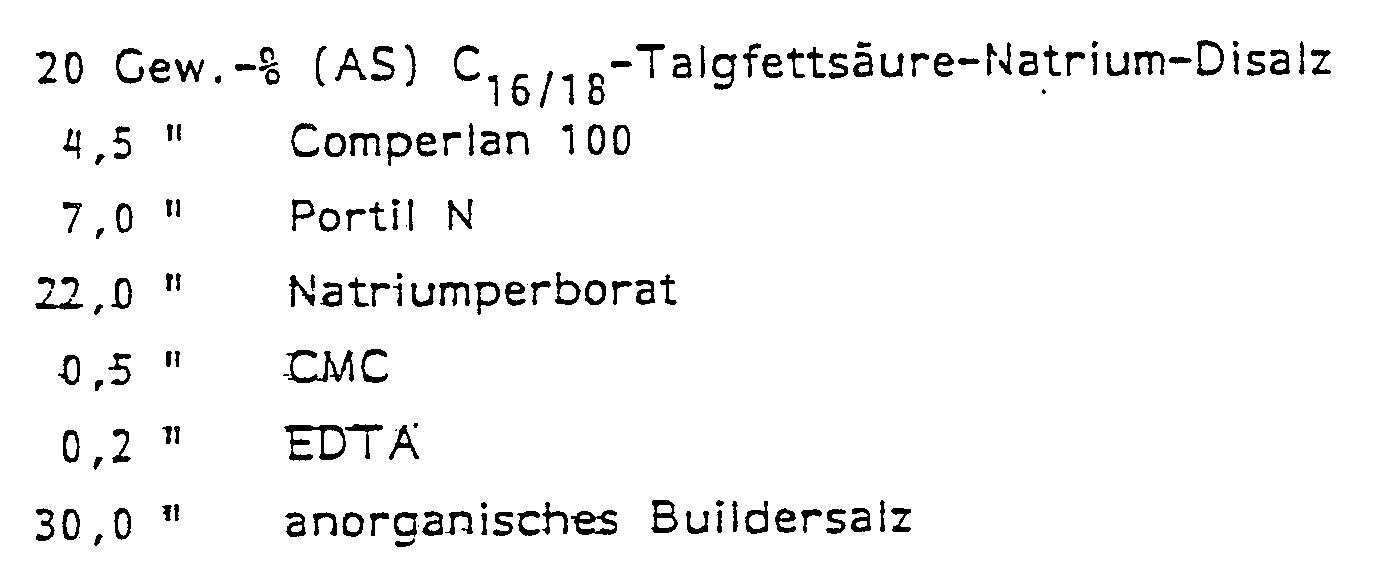
Die als letzte Position dieser Waschmittelrezeptur genannten anorganischen Buildersalze werden im Rahmen der erfindungsgemäßen Lehre variiert und mit einem Kontrollversuch verglichen, der die Mitverwendung dieser Waschmittelkomponente ausläßt. Unter den in Beispiel 2 genannten Waschbedingungen (Dosierung des Waschpulvers 7,5 g/l) werden die erhaltenen Waschergebnisse ermittelt. Sie sind in der nachfolgenden Tabelle 3 zusammengestellt.
Zur Ermittlung des Einflusses von in jeweils geringer Menge mitverwendeten Waschkraftverstärkern (WKV) werden verschiedene Waschpulvergemische auf Natrium-Disalzbasis gemäß der Rezeptur aus Beispiel 1 zusammengestellt. Dabei wird in einer ersten Versuchsreihe der Natrium-Disalzgehalt auf 10 Gew.-% (AS) eingestellt, in einer zweiten Versuchsreihe wird dieser Gehalt an Natrium-Disalz (AS) auf 20 Gew.-% des Waschmittelkonzentrats festgelegt.To determine the influence of detergent boosters (WKV) used in small quantities, various washing powder mixtures based on sodium disaline are compiled according to the recipe from Example 1. In a first test series, the sodium disaline content is set to 10% by weight (AS), in a second test series this sodium disaline content (AS) is set to 20% by weight of the detergent concentrate.
Es werden Waschversuche unter den Bedingungen der vorherigen Beispiele an H-SH-PBV Testlappen im Launderometer durchgeführt. Dabei werden die jeweils eingesetzten Waschpulver durch den in der nachfolgenden Tabelle 4 gezeigten Zusatz verschiedenartiger Waschkraftverstärker modifiziert. Jeder Waschkraftverstärker wird seinerseits der Grundrezeptur in den Mengenanteilen von 2 Gew.-%, 4 Gew.-% und 6 Gew.-% WKV zugefügt.Washing tests are carried out under the conditions of the previous examples on H-SH-PBV test rags in a launderometer. The washing powders used in each case are modified by the addition of various types of detergency booster shown in Table 4 below. Each detergent booster is in turn added to the basic formulation in the proportions of 2% by weight, 4% by weight and 6% by weight WKV.
Die Dosierung der jeweiligen Waschpulver beträgt 7,5 g/l. Das bedeutet, daß in der Versuchsreihe mit Waschpulvern des Gehaltes von 10 Gew.-% (AS) Natrium-Disalz der erfindungsgemäß definierte untere Grenzwert für das Disalz in der Waschflotte von etwa 1 g/l nicht erreicht wird, während in der Versuchsserie mit einem Gehalt von 20 Gew.-% (AS) Natrium-Disalz im Waschmittelkonzentrat die Natrium-Disalzgehalte in der Waschflotte bei etwa 1,5 g/l liegen.The dosage of the respective washing powder is 7.5 g / l. This means that in the test series with washing powders with a content of 10% by weight (AS) sodium disalt, the lower limit for the disalt in the washing liquor of about 1 g / l defined according to the invention is not reached, while in the test series with a Content of 20 wt .-% (AS) sodium disalt in the detergent concentrate, the sodium disalt contents in the wash liquor are about 1.5 g / l.
Die eingesetzten Waschkraftverstärker sind die folgenden:
- 1) Comperlan 100 (Kokosfettsäure(C₁₂₋₁₈)-Monoethanolamid)
- 2) Comperlan KD (Kokosfettsäure-Diethanolamid)
- 3) Kokosamin . 2 EO
- 4) Dehyton-K-Vorstufe (Kokosfettsäure-N,N-dimethyl-propylendiamin)
- 5) Dehydol LT7 (Fettalkoholpolyethoxylat mit im Mittel 7 EO)
- 1) Comperlan 100 (coconut fatty acid (C₁₂₋₁₈) monoethanolamide)
- 2) Comperlan KD (coconut fatty acid diethanolamide)
- 3) coconut amine. 2 EO
- 4) Dehyton K precursor (coconut fatty acid N, N-dimethyl-propylenediamine)
- 5) Dehydol LT7 (fatty alcohol polyethoxylate with an average of 7 EO)
Zum Vergleich wird ein hochwertiges pulverförmiges Markenwaschmittel in gleicher Konzentration mitgewaschen.For comparison, a high-quality powdered brand detergent is washed in the same concentration.
Die im Waschpulver eingesetzten Waschkraftverstärker, ihre stufenweise Anreicherung im Waschpulver und die jeweils erhaltenen Waschergebnisse - bestimmt als % Remission - sind in der nachfolgenden Tabelle 4 zusammengefaßt.
Es wird untersucht, wie sich der Zusatz verschiedenartigster Tensidkomponenten zu der erfindungsgemäßen Grundrezeptur auf Basis Natrium-Disalz/Natriumperborat/Natriumsulfat verhält. Dabei wird mit der folgenden Grundrezeptur gearbeitet:
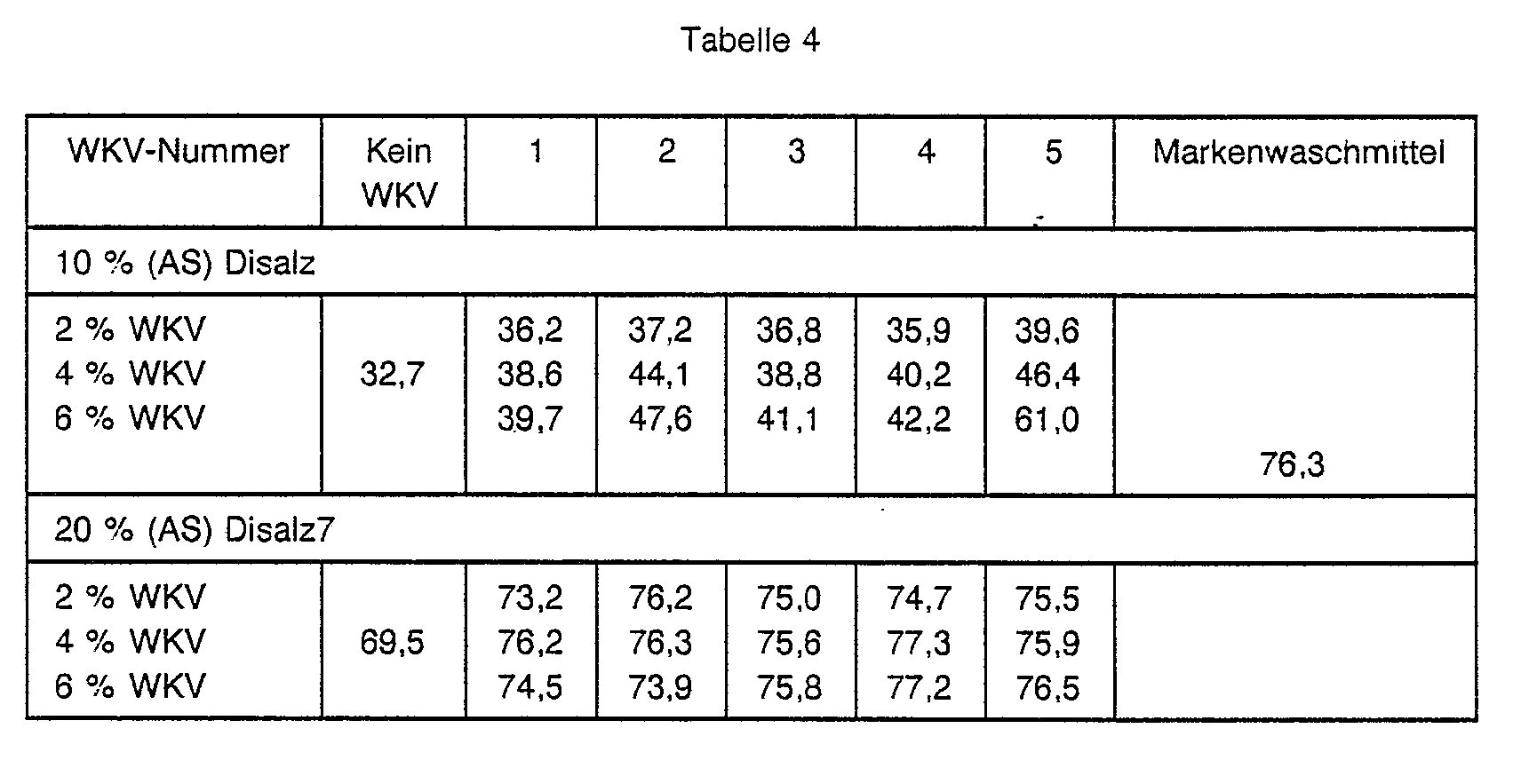
Diese Grundrezeptur wird mit den nachfolgend aufgezählten waschaktiven Tensidkomponenten versetzt, wobei diese Tensidmenge stufenweise - jeweilige Stufe 2 Gew.-% Zusatz - im Bereich von 0 - 10 Gew.-% zusätzliches Tensid aufgestockt wird. Es kommen die folgenden zusätzlichen Tenside zum Einsatz:
ABS (Maranil A 55)
Talgsulfat (Sulfopon T 55)
Kokossulfat (Sulfopon K 35)
Fettalkoholethersulfat (Texapon NSO)
Estersulfonat (Texin ES 68)
Alkylglucosid (V 13S)
Niotensid (Dehydol LT 7)This basic formulation is mixed with the detergent surfactant components listed below, with this amount of surfactant being gradually increased - in each case 2% by weight additive - in the range from 0 to 10% by weight additional surfactant. The following additional surfactants are used:
ABS (Maranil A 55)
Tallow sulfate (sulfopone T 55)
Coconut sulfate (Sulfopon K 35)
Fatty alcohol ether sulfate (Texapon NSO)
Ester sulfonate (Texin ES 68)
Alkyl glucoside (V 13S)
Nonionic surfactant (Dehydol LT 7)
Die Waschbedingungen in der Launderometerwäsche entsprechen den Angaben des Beispiels 1. Dosierung des Waschpulvers jeweils 7,5 g/l.The washing conditions in launderometer washing correspond to the information in Example 1. Dosage of the washing powder in each case 7.5 g / l.
Die bei diesen Waschversuchen an den gewaschenen und getrockneten Textilproben bestimmten Remissionswerte sind in der nachfolgenden Tabelle 5 zusammengefaßt.
Die Waschmittelgrundrezeptur aus
4,0 Gew.-% Comperlan 100
7,0 Gew.-% Portil N
22,0 Gew.-% Natriumperborat
0,5 Gew.-% CMC
0,2 Gew.-% EDTA
wird einerseits mit steigenden Mengen an Natrium-Disalz (10 - 40 Gew.-% (AS) Disalz in Stufen von jeweils 10 Gew.-%) und gleichzeitig mit steigenden Mengen an Natriumsulfat im Mengenbereich von 0 - 60 Gew.-% Natriumsulfat (auch hier Stufen von jeweils 10 Gew.-%) aufgestockt.The basic detergent formulation
4.0% by weight of Comperlan 100
7.0% by weight of Portil N
22.0% by weight sodium perborate
0.5 wt% CMC
0.2% by weight EDTA
on the one hand with increasing amounts of sodium disalt (10 - 40% by weight (AS) disalt in steps of 10% by weight) and at the same time with increasing amounts of sodium sulfate in the range of 0 - 60% by weight sodium sulfate ( levels of 10% by weight) were also increased here.
Mit den in dieser Form zusammengestellten Waschmittelkonzentraten wird unter den in den vorherigen Beispielen eingesetzten Waschbe dingungen bei der jeweiligen Dosierung von 7,5 g Waschpulver/l Waschflotte gearbeitet.With the detergent concentrates compiled in this form, the detergent used in the previous examples conditions worked with the respective dosage of 7.5 g washing powder / l washing liquor.
Die dabei erhaltenen Waschergebnisse - % Remission - sind in der nachfolgenden Tabelle 6 zusammengestellt.
Die Reihenuntersuchungen des Beispiels 6 werden wiederholt. In den neuen Versuchen wird jedoch das Natriumsulfat mengengleich ersetzt durch kristallinen Zeolith NaA. Im übrigen sind die Versuchsbedingungen mit denen des Beispiels 6 übereinstimmend.The series examinations of Example 6 are repeated. In the new experiments, however, the sodium sulfate is replaced by crystalline zeolite NaA. The test conditions are otherwise the same as in Example 6.
Die bei den Waschversuchen erhaltenen Ergebnisse (% Remission) sind in der nachfolgenden Tabelle 7 zusammengefaßt.
In einer neuen vergleichenden Serie von Waschversuchen wird der waschkraftverstärkende Effekt eines Zusatzes von Soda untersucht. Dabei kommen die folgenden drei Grundrezepturen für die eingesetzten Waschpulver zur Anwendung:
Waschpulver zusammengesetzt ausschließlich aus Dinatriumsalz der Talgfettsäure (C16/18) und Soda.In a new comparative series of washing tests, the washing-strengthening effect of an addition of soda is examined. The following three basic recipes are used for the washing powder used:
Washing powder composed exclusively of disodium salt of tallow fatty acid (C 16/18 ) and soda.
Waschpulver aus dem Disalz, Soda und den in Beispiel 6 aufgeführten Grundkomponenten des natriumperborathaltigen Buildergemisches

Waschpulver aus Disalz, Soda und den zuvor genannten Builderbestandteilen, jetzt unter Zusatz von 30,0 Gew.-% Natriumsulfat.Washing powder from disalt, soda and the previously mentioned builder components, now with the addition of 30.0% by weight sodium sulfate.
Zum Vergleich werden in allen Fällen entsprechende Waschpulver ohne Sodazusatz mitgewaschen.In all cases, corresponding washing powder without added soda is washed for comparison.
Die Waschbedingungen entsprechen den Angaben der vorhergehenden Beispiele bei einer Dosierung von 7,5 g Waschpulver/l Waschflotte. Die an den gewaschenen und getrockneten Testtextilien bestimmten Remissionswerte sind in der nachfolgenden Tabelle 8 zusammengefaßt. Es ist ersichtlich, daß in einem erfindungsgemäß aufgebauten Waschmittel alleine durch Sodazusatz eine Aktivierung der Waschkraft bis in den Bereich von 75 % Remission möglich ist, ohne daß es der Mitverwendung weiterer tensidischer Komponenten mit ggf. unerwünschter Wirkung in der Abwasserproblematik bedürfte.
Claims (14)
Applications Claiming Priority (2)
| Application Number | Priority Date | Filing Date | Title |
|---|---|---|---|
| DE19873726326 DE3726326A1 (en) | 1987-08-07 | 1987-08-07 | IMPROVED WASHING AND CLEANING AGENTS FOR TEXTILES (II) |
| DE3726326 | 1987-08-07 |
Publications (2)
| Publication Number | Publication Date |
|---|---|
| EP0302402A2 true EP0302402A2 (en) | 1989-02-08 |
| EP0302402A3 EP0302402A3 (en) | 1989-11-29 |
Family
ID=6333300
Family Applications (1)
| Application Number | Title | Priority Date | Filing Date |
|---|---|---|---|
| EP88112291A Withdrawn EP0302402A3 (en) | 1987-08-07 | 1988-07-29 | Washing and cleaning agents for fabrics |
Country Status (4)
| Country | Link |
|---|---|
| EP (1) | EP0302402A3 (en) |
| JP (1) | JPS6466297A (en) |
| KR (1) | KR890003937A (en) |
| DE (1) | DE3726326A1 (en) |
Cited By (5)
| Publication number | Priority date | Publication date | Assignee | Title |
|---|---|---|---|---|
| US5317896A (en) * | 1992-03-13 | 1994-06-07 | American Sterilizer Company | Method of detecting liquid in a sterilization system |
| US5508258A (en) * | 1990-08-03 | 1996-04-16 | Henkel Kommanditgesellschaft Auf Aktien | Use of surface-active alpha-sulfo-fatty acid di-salts in water and oil based drilling fluids and other drill-hole treatment agents |
| US5508009A (en) * | 1992-03-13 | 1996-04-16 | American Sterilizer Company | Optimum hydrogen peroxide vapor sterilization system |
| US5534221A (en) * | 1992-03-13 | 1996-07-09 | American Sterilizer Company | Device and system for sterilizing objects |
| WO1997011143A3 (en) * | 1995-09-18 | 1997-04-24 | Stepan Co | Heavy duty liquid detergent compositions comprising salts of alpha sulfonated fatty acid methyl esters and use of alpha-sulfonatedfatty acid salts to inhibit redeposition of soil on fabric |
Families Citing this family (1)
| Publication number | Priority date | Publication date | Assignee | Title |
|---|---|---|---|---|
| US7820612B2 (en) * | 2006-06-19 | 2010-10-26 | The Procter & Gamble Company | Laundry detergent containing methyl ester sulfonate |
Family Cites Families (3)
| Publication number | Priority date | Publication date | Assignee | Title |
|---|---|---|---|---|
| US3632517A (en) * | 1970-08-21 | 1972-01-04 | Us Agriculture | Synergistic tallow-based detergent compositions |
| GB1368736A (en) * | 1970-09-09 | 1974-10-02 | Unilever Ltd | Detergent compositions |
| DE3604039A1 (en) * | 1986-02-08 | 1987-08-20 | Henkel Kgaa | TEXTILE DETERGENT AND CLEANING AGENT |
-
1987
- 1987-08-07 DE DE19873726326 patent/DE3726326A1/en not_active Withdrawn
-
1988
- 1988-07-29 EP EP88112291A patent/EP0302402A3/en not_active Withdrawn
- 1988-08-06 KR KR1019880010053A patent/KR890003937A/en not_active Withdrawn
- 1988-08-08 JP JP63197806A patent/JPS6466297A/en active Pending
Cited By (5)
| Publication number | Priority date | Publication date | Assignee | Title |
|---|---|---|---|---|
| US5508258A (en) * | 1990-08-03 | 1996-04-16 | Henkel Kommanditgesellschaft Auf Aktien | Use of surface-active alpha-sulfo-fatty acid di-salts in water and oil based drilling fluids and other drill-hole treatment agents |
| US5317896A (en) * | 1992-03-13 | 1994-06-07 | American Sterilizer Company | Method of detecting liquid in a sterilization system |
| US5508009A (en) * | 1992-03-13 | 1996-04-16 | American Sterilizer Company | Optimum hydrogen peroxide vapor sterilization system |
| US5534221A (en) * | 1992-03-13 | 1996-07-09 | American Sterilizer Company | Device and system for sterilizing objects |
| WO1997011143A3 (en) * | 1995-09-18 | 1997-04-24 | Stepan Co | Heavy duty liquid detergent compositions comprising salts of alpha sulfonated fatty acid methyl esters and use of alpha-sulfonatedfatty acid salts to inhibit redeposition of soil on fabric |
Also Published As
| Publication number | Publication date |
|---|---|
| KR890003937A (en) | 1989-04-18 |
| DE3726326A1 (en) | 1989-02-16 |
| EP0302402A3 (en) | 1989-11-29 |
| JPS6466297A (en) | 1989-03-13 |
Similar Documents
| Publication | Publication Date | Title |
|---|---|---|
| AT390447B (en) | DETERGENT COMPOSITION | |
| DE2334899C2 (en) | Granular detergent containing builders for washing and softening textiles at the same time | |
| DE2514676C2 (en) | laundry detergent | |
| DE3344098A1 (en) | PARTICULATE TEXTILE SOFTENER SUITABLE AS A DETERGENT ADDITIVE | |
| DE1080250B (en) | laundry detergent | |
| DE2825879B2 (en) | Masking of Ca ++ and Mg ++ in aqueous solutions with mixtures of zeolites | |
| DE2327234C3 (en) | Phosphate-free detergent | |
| DE3885801T2 (en) | Hectorite clay detergent / fabric softener compositions. | |
| DE3787950T2 (en) | Detergent composition. | |
| DE3024912A1 (en) | PARTICULATE BLENDER | |
| DE2211576C3 (en) | Use of quaternary benzimidazoles as fabric softeners with a simultaneous dirt-releasing effect | |
| DE69418326T2 (en) | GRANULAR DETERGENT COMPOSITIONS CONTAINING SELECTED SCAFFOLDING SUBSTANCES WITH OPTIMIZED RATIO | |
| DE3486155T2 (en) | Laundry detergent. | |
| DE2409457A1 (en) | DETERGENT COMPOSITION | |
| DE3854135T2 (en) | Use of a composition for softening textiles. | |
| DE69225449T2 (en) | Detergent compositions | |
| DE2753175C2 (en) | Detergent mixture | |
| DE3726326A1 (en) | IMPROVED WASHING AND CLEANING AGENTS FOR TEXTILES (II) | |
| DE68922792T2 (en) | Detergent compositions. | |
| DE4011487A1 (en) | TENSID MIXTURE FOR USE IN WASHING AND CLEANING AGENTS | |
| EP0302403A2 (en) | Washing and cleaning agents for fabrics | |
| DE3604039A1 (en) | TEXTILE DETERGENT AND CLEANING AGENT | |
| DE2144592A1 (en) | Detergent | |
| DE2657517A1 (en) | DETERGENTS AND DETERGENTS | |
| DE3905423A1 (en) | CHINESE TO POWDERFUL WATER-DISHWASHER |
Legal Events
| Date | Code | Title | Description |
|---|---|---|---|
| PUAI | Public reference made under article 153(3) epc to a published international application that has entered the european phase |
Free format text: ORIGINAL CODE: 0009012 |
|
| AK | Designated contracting states |
Kind code of ref document: A2 Designated state(s): AT BE CH DE ES FR GB GR IT LI NL SE |
|
| PUAL | Search report despatched |
Free format text: ORIGINAL CODE: 0009013 |
|
| AK | Designated contracting states |
Kind code of ref document: A3 Designated state(s): AT BE CH DE ES FR GB GR IT LI NL SE |
|
| 17P | Request for examination filed |
Effective date: 19900427 |
|
| 17Q | First examination report despatched |
Effective date: 19920504 |
|
| STAA | Information on the status of an ep patent application or granted ep patent |
Free format text: STATUS: THE APPLICATION HAS BEEN WITHDRAWN |
|
| 18W | Application withdrawn |
Withdrawal date: 19930116 |