EP0301779B1 - Vorrichtung und Verfahren zur Umwandlung einer Drehbewegung in eine lineare Bewegung - Google Patents
Vorrichtung und Verfahren zur Umwandlung einer Drehbewegung in eine lineare Bewegung Download PDFInfo
- Publication number
- EP0301779B1 EP0301779B1 EP88306796A EP88306796A EP0301779B1 EP 0301779 B1 EP0301779 B1 EP 0301779B1 EP 88306796 A EP88306796 A EP 88306796A EP 88306796 A EP88306796 A EP 88306796A EP 0301779 B1 EP0301779 B1 EP 0301779B1
- Authority
- EP
- European Patent Office
- Prior art keywords
- nut
- leadscrew
- threadform
- threadforms
- air
- Prior art date
- Legal status (The legal status is an assumption and is not a legal conclusion. Google has not performed a legal analysis and makes no representation as to the accuracy of the status listed.)
- Expired - Lifetime
Links
Images
Classifications
-
- B—PERFORMING OPERATIONS; TRANSPORTING
- B23—MACHINE TOOLS; METAL-WORKING NOT OTHERWISE PROVIDED FOR
- B23Q—DETAILS, COMPONENTS, OR ACCESSORIES FOR MACHINE TOOLS, e.g. ARRANGEMENTS FOR COPYING OR CONTROLLING; MACHINE TOOLS IN GENERAL CHARACTERISED BY THE CONSTRUCTION OF PARTICULAR DETAILS OR COMPONENTS; COMBINATIONS OR ASSOCIATIONS OF METAL-WORKING MACHINES, NOT DIRECTED TO A PARTICULAR RESULT
- B23Q5/00—Driving or feeding mechanisms; Control arrangements therefor
- B23Q5/22—Feeding members carrying tools or work
- B23Q5/34—Feeding other members supporting tools or work, e.g. saddles, tool-slides, through mechanical transmission
- B23Q5/38—Feeding other members supporting tools or work, e.g. saddles, tool-slides, through mechanical transmission feeding continuously
- B23Q5/40—Feeding other members supporting tools or work, e.g. saddles, tool-slides, through mechanical transmission feeding continuously by feed shaft, e.g. lead screw
-
- F—MECHANICAL ENGINEERING; LIGHTING; HEATING; WEAPONS; BLASTING
- F16—ENGINEERING ELEMENTS AND UNITS; GENERAL MEASURES FOR PRODUCING AND MAINTAINING EFFECTIVE FUNCTIONING OF MACHINES OR INSTALLATIONS; THERMAL INSULATION IN GENERAL
- F16H—GEARING
- F16H25/00—Gearings comprising primarily only cams, cam-followers and screw-and-nut mechanisms
- F16H25/18—Gearings comprising primarily only cams, cam-followers and screw-and-nut mechanisms for conveying or interconverting oscillating or reciprocating motions
- F16H25/20—Screw mechanisms
- F16H25/24—Elements essential to such mechanisms, e.g. screws, nuts
-
- Y—GENERAL TAGGING OF NEW TECHNOLOGICAL DEVELOPMENTS; GENERAL TAGGING OF CROSS-SECTIONAL TECHNOLOGIES SPANNING OVER SEVERAL SECTIONS OF THE IPC; TECHNICAL SUBJECTS COVERED BY FORMER USPC CROSS-REFERENCE ART COLLECTIONS [XRACs] AND DIGESTS
- Y10—TECHNICAL SUBJECTS COVERED BY FORMER USPC
- Y10T—TECHNICAL SUBJECTS COVERED BY FORMER US CLASSIFICATION
- Y10T74/00—Machine element or mechanism
- Y10T74/18—Mechanical movements
- Y10T74/18568—Reciprocating or oscillating to or from alternating rotary
- Y10T74/18576—Reciprocating or oscillating to or from alternating rotary including screw and nut
- Y10T74/18736—Pressurized fluid introduced between nut and screw
-
- Y—GENERAL TAGGING OF NEW TECHNOLOGICAL DEVELOPMENTS; GENERAL TAGGING OF CROSS-SECTIONAL TECHNOLOGIES SPANNING OVER SEVERAL SECTIONS OF THE IPC; TECHNICAL SUBJECTS COVERED BY FORMER USPC CROSS-REFERENCE ART COLLECTIONS [XRACs] AND DIGESTS
- Y10—TECHNICAL SUBJECTS COVERED BY FORMER USPC
- Y10T—TECHNICAL SUBJECTS COVERED BY FORMER US CLASSIFICATION
- Y10T74/00—Machine element or mechanism
- Y10T74/19—Gearing
- Y10T74/19991—Lubrication
- Y10T74/19995—Teeth
Definitions
- the present invention relates to mechanisms to convert rotary motion to linear motion.
- a system that includes a nut to convert rotary motion from a leadscrew to linear motion by way of a special threadform which utilizes air (or some other fluid) as an interface between the threads of the nut and the threads of the leadscrew whereby, among other things, the nut is floated to damp out mechanical noise.
- the special threadforms of the leadscrew and the nut when supplied with high pressure gas, provide a mechanism for the nut very efficiently to convert the rotary power of the leadscrew to linear power.
- the use of a gas or fluid as an interface between the threadforms eliminates friction and results in almost 100% power conversion efficiency.
- the high pressure gas or fluid interface between the threadforms also acts to preload the nut thereby eliminating backlash between the leadscrew and nut.
- the special thread design furthermore, enables the nut to act as a coupling between itself and a movable carriage such that only forces along an axis parallel to the axis of the leadscrew are transmitted from the nut to the carriage. Simultaneously, potential misalignment forces and moments, along and about the other two axes that are orthogonal to the leadscrew axis are not generated or transmitted as a result of misalignment of the leadscrew axis with the axis of the movable carriage.
- the first known application of a leadscrew thread to do useful work was Archimedes' leadscrew pump which converted rotary power of a leadscrew into an elevator for raising water from a river to an irrigation ditch.
- the first leadscrew cutting lathes were introduced in the fifteenth century and were used to manufacture wooden screws. Screwthreads could be increased in accuracy with hand finishing and it was just a matter of time before they developed into useful tools for metal working.
- Leadscrews worked well, but they were subject to friction and wear. Since the workspace of machines were not used equally, wear was not easily compensated. The wear was attributed to the sliding contact between the threads of the leadscrew and the nut. With the advent of advanced grinding machines for internal surfaces, the ballscrew was born. The threadform of the leadscrew and nut was made in an arched form, and contact between the leadscrew and the nut was made through ball bearings. The ballnut has a recirculating tube attached to the end of the threadform which carries the balls back to the beginning of the thread. By introducing rolling elements between the threads, greater life could be achieved. Today, the ballscrew is the most common forms of leadscrew used in the design of industrial machinery. It can be used to achieve accuracies on the order of 1 ⁇ 27 x10 ⁇ 4cms per cm (50 microinches per inch). Ballscrews, however, still are subject to wear.
- rollerscrew has a nut built from three or more small sections of a leadscrew held in a circle with their threads engaging the lead of a long leadscrew.
- the small leadscrews are held by bearing journals and are allowed to rotate, thus reducing friction while still converting rotary motion of the leadscrew into linear motion of the nut.
- Rollerscrews can be manufactured with accuracies on the order of 5 ⁇ 1 x10 ⁇ 5 cms per cm (20 microinches per inch).
- the mechanical advantage provided by a leadscrew is a function of the lead and efficiency.
- leadscrew and nut can increase the apparent stiffness of an electric motor.
- the stiffer the drive system the higher the natural frequency of the machine. Machines which have low drive train natural frequencies tend to "chatter" and leave marks on the surface being machined.
- the stiffness of a motor is proportional to the magnetic field strength that can be maintained. The strength of the magnetic field is in turn governed by the type of magnets that are available.
- linear motor technology will advance to the point where linear motors will be as stiff as present rotary motor leadscrew combinations.
- Linear motors are more easily coupled to a linearly movable carriage without imposing loads due to misalignment on the carriage.
- the same magnet technology that may be developed to give future linear motors high performance levels could also be used to give higher performance for rotary motors.
- a leadscrew and nut could be designed that was not subject to wear or alignment errors, it could be used with future rotary motors to economically outperform linear motors.
- the pneumatic centering system can operate by increasing the pressure on one side of the nut when that side approaches the leadscrew.” This is exactly what is not desirable in a precision leadscrew.
- a leadscrew ideally is only stiff in the axial direction, the bearing carriage that the leadscrew moves is supposed to hold the nut in the radial direction. Providing stiffness in the radial direction only introduces errors caused by misalignment of the leadscrew and bearing carriage it moves.
- Perkins does not teach how to provide high axial stiffness. In the invention report issued by the Jet Propulsion Laboratory, Perkins describes a Vespel nut (plastic) fitted to a metal leadscrew. He describes a successful experiment: air was applied and the friction went away.
- Another objective is to accomplish rotary to linear power transmission with mechanical motion smoothness and accuracy on the order of micrometers (microinches) while using components which themselves have only been manufactured with a tolerance on the order of hundreds of micrometers (microinches).
- Another objective is to accomplish rotary to linear power transmission with the axial stiffness of the mechanism equal to or greater than the axial stiffness of any other component in the system, such as the leadscrew shaft.
- a further objective is to provide a mechanism to accomplish the preceding objectives while acting as its own coupling between the nut and movable carriage such that only forces along an axis parallel to the axis of the leadscrew are transmitted from the nut to the carriage, while potential misalignment forces and moments along and about the other two axes that are orthogonal to the leadscrew axis are not generated or transmitted as a result of misalignment of the leadscrew axis with the axis of the movable carriage.
- the foregoing objectives are attained, generally, in a mechanism to convert rotary power from a leadscrew to linear motion by way of a special threadform which utilizes air (or some other fluid) as an interface between a special threadform of a leadscrew and the special threadform of an associated nut.
- the special threadforms when supplied with high pressure gas or other fluid and incorporated into the design of a leadscrew and nut provide a way for the nut to convert the rotary power of the leadscrew to linear power, for powering a linear movable slide, without losing any power in the form of friction between the threadforms of the leadscrew and the nut.
- the mechanism furthermore uses the high pressure gas or fluid interface between the threadforms to preload the nut thereby eliminating backlash between the leadscrew and nut.
- the mechanism also acts as its own coupling between the nut and a linearly movable carriage such that only forces along an axis parallel to the axis of the leadscrew are transmitted from the nut to the carriage, while potential misalignment forces and moments, along and about the other two axes that are orthogonal to the leadscrew axis are not generated or transmitted as a result of misalignment of the leadscrew axis with the axis of the movable carriage.
- the leadscrew rotates about its axis to effect parallel linear movement therealong of the nut, the cooperative threadforms of the leadscrew and nut being shaped to provide for a small degree of pitch and yaw and relative radial movement of the nut out of parallelity with the leadscrew; a way is provided continuously supplying pressurized fluid between the cooperative threads of the leadscrew and nut, and a way is provided for controlling the fluid pressure continuously to provide high axial stiffness with substantially zero stiffness in yaw, pitch, rotation and radial motion while inhibiting mechanical contact between the cooperative threads, thereby to maintain the linear movement of the nut parallel to the leadscrew axis.
- Frictionless motion between surfaces is required to prevent wear.
- Some types of leadscrews and nuts strive to achieve frictionless operation by forcing high pressure lubricating oil into the threads of a conventional nut. This is referred to as a hydrostatic nut.
- the use of a continuous flow of oil helps to reduce friction and control thermal expansion of the nut.
- German patent DE A 20 30 260 discloses a leadscrew and nut mechanism wherein rotation of the leadscrew about its axis effects parallel linear movement of the nut along the leadscrew.
- a continuous supply of pressurised fluid is fed between the cooperative threads of the leadscrew and the nut and the pressure of the fluid is controlled continuously thereby to maintain linear movement of the nut parallel to the leadscrew axis.
- CH A 394 728 discloses a leadscrew and nut mechanism essentially comprising the features of the previously mentioned prior art document, DE A 20 30 260, but also including cavities in the threadforms of the nut for receiving pressurised fluid distributed between the threadforms of the mechanism.
- Aerostatic bearing operate on the same principle as hydrostatic bearings, however, air is not viscous enough to act as a lubricant if it were to be merely pumped into a convention nut the way some hydrostatic bearings are used.
- the air must be forced into a gap between two surfaces through an orifice from a reservoir.
- an air bearing is composed to two opposing bearings such that when a load is applied, the gap across one bearing decreases while the gap across the second bearing increases.
- the pressure in the bearing with the decreasing gap increases while the pressure in the bearing with an increasing gap decreases to create a pressure differential.
- the pressure differential acts to force the supported structure back in the direction of increasing gap.
- the orifices and reservoir thus serve the purpose of preventing the supply of air from escaping unrestricted through the bearing with the increasing gap.
- a leadscrew and nut mechanism wherein rotation of the leadscrew about its axis effects parallel linear movement therealong of the nut, the cooperative threadforms of the leadscrew and nut respectively being shaped to provide for a small degree of pitch and yaw and relative radial movement of the nut out of parallellity with the leadscrew, supply means for continuously supplying pressurised fluid between the cooperative threads of the leadscrew and the nut characterised by the provision of symmetrically arranged continuous pressurised fluid receiving grooves formed in each side of the threadforms, each threadform having an internal passageway leading to each of two orifices, each one orifice formed in the base of each one of the receiving grooves so as to admit high pressure fluid thereto for distribution between the threads and equalise fluid pressure along each respective side of the threadforms.
- a method for converting rotary motion to linear motion is disclosed in claim 4.
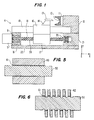
- the drawing shows a mechanism or system that is operative to convert rotary power from a leadscrew to linear motion of a nut by means of special threadforms which utilize air (or other fluid) as an interface between the special threadforms of the leadscrew and the nut.
- the mechanism is used to operate a machine or system 4 which is composed of a tail 6, a bed 22, a head 21, a headstock 10, a spindle 11, a part 12 held to the spindle, a tool 13 held by a toolpost 14 that is anchored to a linearly movable carriage 15 that is supported by a linear bearing 16.
- a motor 5 turns a leadscrew 19 with the special threadform 24 ground into its length, as later discussed in detail.
- a nut 17 mates with the leadscrew 19 and converts rotary power to linear power to move the carriage 15 and the tool 13 for cutting a contour into the part 12, with very high efficiency and zero backlash or wear between the leadscrew 19 and the nut 17.
- the leadscrew 19 and mating aperture within the nut 17 are, of course, circular-cylindrical in shape and cross dimensions. In the leadscrew and nut system shown, rotation of the leadscrew about its axis effects parallel linear movement of the nut therealong, the cooperative threadforms of the leadscrew and nut being shaped to provide for small degree of pitch, yaw, as well as small relative radial movement of the nut out of parallelity with the leadscrew.
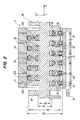
- an inner core 28A, containing the special threadform 28 is fastened to an outer core 30 by means of a bonding mechanism such as an adhesive 29 (or shrink fit techniques may be employed).
- the threadform 28 mates with the threadform 24 of the leadscrew 19 such that sufficient axial clearance 31 is provided between the nut and leadscrew threadforms to allow a cushion of high pressure air to act as an interface between them.
- the clearance 31 must also be sufficient to allow for rocking motion of the nut 17 about the Y and Z axes by an amount equal to the expected angular misalignment of the leadscrew 19 with the linearly movable carriage 15.
- radial clearance 32 is provided between the threadform 28 of the nut 17 and the threadform 24 of the leadscrew 19 to allow for radial motion of the nut in the Y and Z directions by an amount equal to the expected lateral (radial) misalignment of the leadscrew 19 with the linearly movable carriage 15, and to allow high pressure air escaping from the clearances 31 between the nut and leadscrew threadforms to easily exhaust to the atmosphere.
- the threadform 28 of the nut also contains shallow radially-elongate grooves 22A and 22B (shown greatly enlarged) to distribute and equalize air pressure along the length (i.e., radial dimension) of each respective side of the teeth of the nut threadform 28.
- These grooves extend continuously in a helical fashion along the entire helix of each side of the nut's threadform 28, but are capped at the ends of the helix to prevent loss of the pressurized air.
- Orifices such as 23 (shown greatly enlarged) from air passages or holes 26 are placed along the length of the grooves 22A and 22B to provide high pressure air along the entire helical length of the grooves and to the clearance 31 between the leadscrew and nut threadforms.
- the air supply holes, 26, extend radially inwardly from a larger air plenum or reservoir 27 to intersect with the orifices and serve to supply high pressure air to them and hence to the grooves 22A and 22B.
- Air (or other suitable gas) is supplied to the plenum 27 by a nozzle 20.
- Radial exhaust holes such as 21 are drilled about the circumference of the nut 17 to help exhaust air that may otherwise build up in the radial clearance space 32 between the leadscrew and nut threadforms.
- the second consideration is to allow the nut to function as its own coupling between itself and the movable carriage 15, such that only forces along the X axis are transmitted from the nut to the carriage, while forces and moments along and about the Y and Z axes (e.g., yaw and pitch) that could be generated or transmitted as a result of misalignment of the leadscrew axis with the axis of the movable carriage, are not generated or transmitted therebetween. If the teeth that form the threadforms of the leadscrew and nut have uniform cross sections, that is, the axial thickness at the root of each tooth substantially equals the thickness at the peak, then the nut will be able to move radially.
- the remaining two degrees of freedom required are those that prevent moments from being transmitted about axes that are orthogonal to the axis of the leadscrew (i.e., the Y and Z axes). If the air bearing interface were constructed only with orifices and independent recesses along the length of the thread helix, then the nut would transmit the undesirable moments. If, however, the recesses on each side of the threadform are connected together (but not to the recesses on opposite sides of the thread) to form a long helical groove than runs the length of the thread helix on the nut (but just shy of the ends of the helix), then the pressure along one side of the thread will be constant throughout.
- the gap for example, between the left side of the thread on the upper side of the leadscrew opens while the gap on the left side of the thread on the lower side of the leadscrew closes.
- this would result in a correcting force couple caused by a pressure differential resulting from one gap opening and one gap closing; however, if a pressure equalizing groove such as 22A which connects the recesses is cut into the threadform to connect all the recesses fed by the orifices, then the pressure will equalize and no force couple will be generated.
- An analogous situation exists for the right side of the thread.
- the pressure equalizing grooves 22A and 22B act to prevent the bearing with the required remaining two small degrees of freedom from transmitting moments about the Y and Z axes between the nut and carriage.
- the groove 22A and 22B are radially-elongate depressions at each side of each tooth forming the nut threadform 28 and each groove is disposed along a helical path that extends axially along the nut threadform 28.
- These pressure equalizing grooves also act to allow the use of non rectangular threadforms such as Acme or triangular, while still allowing the nut to move radially.
- Use of a non rectangular threadform may be desirable in some special cases as they may be easier to grind.
- the shape of the threadform will determine how much radial error motion can be tolerated before mechanical contact is made between threads.
- a stress relieved nut thread blank 60 is epoxied at 61 (or shrunk fit) onto a mandrel 50 in Fig. 5.
- the mandrel can then be held in the same machine used to grind the thread in the leadscrew.
- the finished form of the nut thread is labeled 62 in Fig. 6.
- the grooves 22A and 22B are machined using a tool 40 in Fig. 7. Care must be taken in machining the grooves 22A and 22B as they are often only a thousandth of an inch deep.
- the orifices such as 23 are often only a few thousandths of an inch in diameter.
- the threadform 62 After the grooves, air supply holes, and orifices are made in the threadform 62, it is removed from the mandrel 50 and becomes the threadform 28 which can be epoxied at 29 in Fig. 2 or shrunk fit into the inside diameter of the core 30, as before noted.
- the angular position of the air supply holes must be marked so the air supply holes can be drilled through the core and its plenum 27 to link up with the air supply holes 26 in the threadform 28. Plugs such as 33 are pressed into the radial holes to seal them.
- the nut can now be placed on the leadscrew while high pressure air is supplied.
- the nut does not have any radial support from the leadscrew, thus care must be taken in handling the assembly when it is installed into the machine 4.
- the maximum axial force, F axial max the air bearing nut can support when supplied with air at pressure P without making mechanical contact with the leadscrew is on the order of: F axial max ⁇ PN ⁇ (R o 2 - R i 2 ) 2
- F axial max ⁇ PN ⁇ (R o 2 - R i 2 ) 2
- K thread I5EIAG 5AGL3 + 18LEI where A is the area of the thread along its length, I is the second moment of the area, G and E are the shear and Young's modulus respectively, and L is the helical length of the thread.
- K thread 5EN ⁇ (R o +R i )t3G (R o -R i )[5G(R o -R i )2 + 6Et2]
- the stiffness of the leadscrew shaft is most often the "soft" link in a leadscrew/nut system.
- leadscrew-nut system shown herein with high, controlled fluid pressure between the threads of the leadscrew and the nut, results in high axial stiffness of the system with substantially zero stiffness in yaw, pitch, rotation and radial motion while inhibiting mechanical contact between the cooperative threads, thereby, in an operative system, to maintain the linear movement of the nut parallel to the leadscrew axis.
Landscapes
- Engineering & Computer Science (AREA)
- General Engineering & Computer Science (AREA)
- Mechanical Engineering (AREA)
- Transmission Devices (AREA)
Claims (5)
- Ein Schraubenspindel- und Muttergewindestück-Mechanismus, bei dem eine Drehbewegung der Schraubenspindel (19) um ihre Achse eine parallele lineare Bewegung des Muttergewindestückes (17) entlang dieser Achse bewirkt, wobei die zusammenarbeitenden Gewindeformen (24, 28) der Spindelschraube (19) bzw. des Muttergewindestückes (17) geformt sind, um ein geringes Maß an Steigung und Abweichung sowie an radialer Relativbewegung des Muttergewindestückes aus der Parallelität mit der Schraubenspindel (19) zu erreichen, mit Versorgungsmittel (20, 26, 27) für eine kontinuierliche Zuführung eines Druckmediums zwischen die zusammenwirkenden Gewinde (24, 28) der Schraubenspindel (19) und des Muttergewinestückes (17), gekennzeichnet durch symmetrisch angeordnete, durchgehende und zur Aufnahme eines Druckmediums dienende Nuten (22A, 22B), die in jeder Seite oder Flanke der Gewinde oder Gewindeformen (28) vorgesehen sind, wobei jede Gewindeform (28) einen internen Durchlaß aufweist, der jeweils zu zwei Öffnungen (23) führt, wobei jede Öffnung (23) am Boden einer der das Druckmedium aufnehmenden Nuten (22A, 22B) vorgesehen ist, um dort einen Zutritt für das unter hohem Druck stehende Druckmedium zu ermöglichen, und zwar für eine Verteilung und für eine Egalisierung des Druckes des Druckmediums entlang jeder Seite der Gewindeformen (28).
- Ein Mechanismus nach Anspruch 1, dadurch gekennzeichnet, daß das unter Druck stehende Strömungsmedium Luft ist, und daß das Muttergewindestück (17) Versorgungskanäle (26) für die Luft aufweist, die sich von einer Luftkammer (27) im Muttergewindestück (17) wegerstrecken, wobei die Versorgungskanäle (26) zu internen Durchlässen in den Gewindeformen (28) führen, die die erwähnten Öffnungen (23) schneiden.
- Ein Mechanismus nach Anspruch 2, dadurch gekennzeichnet, daß Auslaßöffnungen (21) für die Druckluft etwa am Umfang des Muttergewindestückes (17) gebildet sind.
- Verfahren zur Umwandlung einer Rotationsbewegung in eine lineare Bewegung, bei dem eine Schraubenspindel (19) mit einer Gewindeform oder einem Gewinde (24) an ihrer Außenfläche vorgesehen wird, bei welchem ein Muttergewindestück (17) verwendet wird, um die Schraubenspindel (19) aufzunehmen, welches ein Gewinde (28) an der Innenfläche des Muttergewindestückes (17) bildet, um mit dem Gewinde (24) der Schraubenspindel (19) in Eingriff zu stehen, und bei dem ein Spalt oder Spiel zwischen dem Gewinde (28) des Muttergewindestückes und dem Gewinde (24) der Schraubenspindel vorgesehen ist, um es einem Strömungsmittel mit hohem Druck zu ermöglichen, als ein Interface oder Zwischenmedium zwischen den Gewinden (24, 28) zu wirken, wobei das Spiel auch eine Hin- und Herbewegung des Muttergewindestückes (17) an der Schraubenspindel (19) mit einem Betrag ermöglicht, der ausreichend ist, um einen Winkel-Versatz der Schraubenspindel auszugleichen, dadurch gekennzeichnet, daß symmetrisch angeordnete und durchgehende Nuten (22A, 22B) zur Aufnahme eines unter Druck stehenden Strömungsmediums an beiden Seiten der Gewindeform (28) des Muttergewindestückes vorgesehen sind, daß ein innerer Durchlaß in jeder Gewindeform (28) gebildet wird, der jeweils zu zwei Öffnugnen (23) führt, daß jede Öffnung (23) am Boden jeder Nute (22A, 22B) gebildet ist, um so diesen das unter hohem Druck stehende Strömungsmedium zuzuführen, und zwar für eine Verteilung zwischen den Gewinden (24, 28) und dafür, um den Druck des Strömungsmedium entlang beider Seiten der Gewindeformen (28) zu egalisieren oder gleichzumachen.
- Ein Verfahren nach Anspruch 4, dadurch gekennzeichnet, daß Austrittsöffnungen (21) im Muttergewindestück (17) vorgesehen werden, und zwar für den Austritt des unter Druck stehenden Strömungsmediums aus dem Spalt oder Zwischenraum zwischen den Gewindeformen bzw. Gewinden (24, 28).
Applications Claiming Priority (2)
| Application Number | Priority Date | Filing Date | Title |
|---|---|---|---|
| US77804 | 1987-07-27 | ||
| US07/077,804 US4836042A (en) | 1987-07-27 | 1987-07-27 | System to convert rotary motion to linear motion |
Publications (3)
| Publication Number | Publication Date |
|---|---|
| EP0301779A2 EP0301779A2 (de) | 1989-02-01 |
| EP0301779A3 EP0301779A3 (en) | 1990-03-07 |
| EP0301779B1 true EP0301779B1 (de) | 1995-01-25 |
Family
ID=22140155
Family Applications (1)
| Application Number | Title | Priority Date | Filing Date |
|---|---|---|---|
| EP88306796A Expired - Lifetime EP0301779B1 (de) | 1987-07-27 | 1988-07-25 | Vorrichtung und Verfahren zur Umwandlung einer Drehbewegung in eine lineare Bewegung |
Country Status (5)
| Country | Link |
|---|---|
| US (1) | US4836042A (de) |
| EP (1) | EP0301779B1 (de) |
| JP (1) | JPH01112070A (de) |
| CA (1) | CA1319032C (de) |
| DE (1) | DE3852852D1 (de) |
Families Citing this family (16)
| Publication number | Priority date | Publication date | Assignee | Title |
|---|---|---|---|---|
| US4955730A (en) * | 1988-12-05 | 1990-09-11 | Kayaba Kogyo Kabushiki Kaisha | Oil-pressure bearing apparatus |
| SE464830B (sv) * | 1989-10-19 | 1991-06-17 | Volvo Ab | Anordning foer smoerjning av kugghjul |
| JP3119451B2 (ja) * | 1990-10-18 | 2000-12-18 | ファナック株式会社 | 静圧空気ねじ |
| US5405282A (en) * | 1993-07-28 | 1995-04-11 | Western Atlas Corporation | Hydrostatic nut and lead screw assembly, and method of forming said nut |
| JP3869465B2 (ja) * | 1995-02-23 | 2007-01-17 | テラダイン・インコーポレーテッド | 自動テスト装置のテストヘッド用マニピュレータ |
| JPH08277899A (ja) * | 1995-04-06 | 1996-10-22 | Toyoda Mach Works Ltd | 静圧送りねじ装置および移動体の送り装置 |
| FR2739428B1 (fr) * | 1995-10-03 | 1997-10-24 | Thomson Csf | Verin de puissance a frottements secs reduits |
| US6817260B2 (en) * | 2001-11-09 | 2004-11-16 | Hiwin Technologies Corporation | Ball screw with cooling means |
| DE102009045857A1 (de) * | 2009-10-20 | 2011-04-21 | Robert Bosch Gmbh | Verfahren zur Herstellung einer Spindel für einen Spindeltrieb, Wälzgewindetrieb mit einer solchen Spindel und Verwendung des Wälzgewindetriebs |
| US9151369B2 (en) | 2013-06-17 | 2015-10-06 | Korea Institute Of Machinery & Materials | Aerostatic air bearing, assembling method thereof, and aerostatic lead screw actuator using the same |
| CN104595445A (zh) * | 2015-02-04 | 2015-05-06 | 中山联合光电科技有限公司 | 一种新型马达传动装置 |
| CN107943289B (zh) * | 2017-11-16 | 2020-11-06 | 陈昭胜 | Vr行走机构以及在虚拟现实场景中行走的方法 |
| DE102020102211A1 (de) * | 2020-01-30 | 2021-08-05 | Khs Gmbh | Hygienische Gewinde-Verstellvorrichtung für eine Behälterbehandlungsmaschine und Verfahren zur Reinigung der Gewinde-Verstellvorrichtung |
| US11751960B2 (en) * | 2020-06-18 | 2023-09-12 | Cilag Gmbh International | Robotic surgical tools that translate through instrument driver |
| CN119825880A (zh) * | 2020-09-29 | 2025-04-15 | 深圳市中图仪器股份有限公司 | 柔性连接结构及闪测仪载物台 |
| CN113757325A (zh) * | 2021-09-28 | 2021-12-07 | 中核核电运行管理有限公司 | 一种电动丝杆直线导轨 |
Family Cites Families (16)
| Publication number | Priority date | Publication date | Assignee | Title |
|---|---|---|---|---|
| US2320353A (en) * | 1941-08-04 | 1943-06-01 | Cincinnati Milling Machine Co | Power transmission mechanism |
| BE621270A (de) * | 1958-09-08 | |||
| US3171295A (en) * | 1962-06-05 | 1965-03-02 | Martin Marietta Corp | Air-lubricated screw and nut |
| US3183732A (en) * | 1962-12-11 | 1965-05-18 | Gordon H Porath | Precision lead screw |
| FR1403703A (fr) * | 1964-05-06 | 1965-06-25 | Derefa Etablissement Pour Le D | Perfectionnement aux systèmes de graissage des dispositifs à vis et écrou pour lacommande d'organes de machines |
| DE1550774A1 (de) * | 1966-07-01 | 1969-10-09 | Kernforschung Gmbh Ges Fuer | Hydrostatisch gelagertes Schraubengetriebe |
| GB1239557A (de) * | 1967-09-15 | 1971-07-21 | ||
| US3448632A (en) * | 1967-11-15 | 1969-06-10 | Scully Intern Corp | Self-adjusting hydrostatic lead screw and nut assembly |
| FR2045711A1 (de) * | 1969-06-25 | 1971-03-05 | Loustalet Pierre | |
| US3670583A (en) * | 1970-10-19 | 1972-06-20 | Overton Gear And Tool Corp | Long span screw and nut drives |
| IT1134214B (it) * | 1980-11-12 | 1986-08-13 | Tecnomare Spa | Dispositivo elettrico per lo sfruttamento dell'energia meccanica di corpi in movimento rettilineo a bassa velocita' |
| JPS591899B2 (ja) * | 1982-03-27 | 1984-01-14 | 株式会社不二越 | 静圧空気ねじ |
| JPS591900B2 (ja) * | 1982-03-27 | 1984-01-14 | 株式会社不二越 | 静圧空気ねじ |
| US4566345A (en) * | 1984-07-23 | 1986-01-28 | Erikson Kenneth W | Tool carrier assembly |
| US4776229A (en) * | 1986-09-19 | 1988-10-11 | D. E. A. Digital Electronic Automation S.P.A. | Device for controlling the rectilinear translation of a movable member |
| DE3750904T2 (de) * | 1987-06-29 | 1995-08-03 | Nippon Telegraph & Telephone | Vorschubeinrichtung. |
-
1987
- 1987-07-27 US US07/077,804 patent/US4836042A/en not_active Expired - Fee Related
-
1988
- 1988-07-19 CA CA000572428A patent/CA1319032C/en not_active Expired - Fee Related
- 1988-07-25 JP JP63185311A patent/JPH01112070A/ja active Pending
- 1988-07-25 DE DE3852852T patent/DE3852852D1/de not_active Expired - Lifetime
- 1988-07-25 EP EP88306796A patent/EP0301779B1/de not_active Expired - Lifetime
Non-Patent Citations (2)
| Title |
|---|
| PATENT ABSTRACTS OF JAPAN vol.10, no.320 (M-530)(2376), 30 October 1986; & JP-A-61127966 (CANON INC.)16.06.1986 * |
| PATENT ABSTRACTS OF JAPAN vol.8, no.284(M-348)(1721), 26 December 1984; & JP-A-59151659 (HITACHI SEISAKUSHO K.K.) 30.08.1984 * |
Also Published As
| Publication number | Publication date |
|---|---|
| EP0301779A2 (de) | 1989-02-01 |
| US4836042A (en) | 1989-06-06 |
| EP0301779A3 (en) | 1990-03-07 |
| DE3852852D1 (de) | 1995-03-09 |
| JPH01112070A (ja) | 1989-04-28 |
| CA1319032C (en) | 1993-06-15 |
Similar Documents
| Publication | Publication Date | Title |
|---|---|---|
| EP0301779B1 (de) | Vorrichtung und Verfahren zur Umwandlung einer Drehbewegung in eine lineare Bewegung | |
| CN101674916B (zh) | 长工作距离主轴驱动系统和方法 | |
| US6446520B1 (en) | Feed screw and method of manufacturing the same | |
| GB2135916A (en) | Xy table for machine operations | |
| US4620351A (en) | Unlimited sliding ball spline assembly | |
| US5090265A (en) | System to convert rotary motion to linear motion | |
| Tsay et al. | Consideration of manufacturing parameters in the design of grooved globoidal cam indexing mechanisms | |
| CN113892003A (zh) | 滚珠丝杠机构和直线移动装置 | |
| US6260285B1 (en) | Precision workpiece positioning device | |
| US6964215B2 (en) | Rotary positioning multi-faced tooling fixture and associated methods | |
| CN217977244U (zh) | 一种3d打印与机加工艺结合的微型滚珠丝杠副 | |
| CN215903196U (zh) | 一种新型高速、高精数控内圆磨床及其使用的动静压轴承 | |
| DE102023104623A1 (de) | Kompakte Rollenlagereinheit mit Direktantrieb für Rundtische mit hochgenauen Plan-/Rundlauf und Verfahren zur Regelung der Rundlaufgenauigkeit | |
| CN2144560Y (zh) | 立式机床行星磨削装置 | |
| CN116408663A (zh) | 一种高精密卧式镗铣加工中心 | |
| CN115106596A (zh) | 一种旋风内铣头 | |
| CN113146379A (zh) | 一种新型高速、高精数控内圆磨床及其使用的动静压轴承 | |
| CN219724704U (zh) | 一种轴键槽加工工装 | |
| US6578454B2 (en) | Machining process for hydrodynamic bearing | |
| CN222404377U (zh) | 一种支架一体式伺服展刀头 | |
| EP4146951B1 (de) | Kompakte rollenlagereinheit mit direktantrieb fuer rundtische mit hochgenauen plan-/rundlauf | |
| GB2167992A (en) | Producing profiles of non-circular cross-section | |
| Engel | Special design features of NC contouring machines | |
| WO2025208255A1 (zh) | 环面蜗杆与圆弧齿轮、蜗杆与圆弧齿条传动副及其传动装置 | |
| CN111347178A (zh) | 一种用于激光切割设备上带底板的整体式轴承 |
Legal Events
| Date | Code | Title | Description |
|---|---|---|---|
| PUAI | Public reference made under article 153(3) epc to a published international application that has entered the european phase |
Free format text: ORIGINAL CODE: 0009012 |
|
| AK | Designated contracting states |
Kind code of ref document: A2 Designated state(s): AT BE CH DE ES FR GB GR IT LI LU NL SE |
|
| RBV | Designated contracting states (corrected) |
Designated state(s): BE CH DE FR GB IT LI NL SE |
|
| PUAL | Search report despatched |
Free format text: ORIGINAL CODE: 0009013 |
|
| RHK1 | Main classification (correction) |
Ipc: F16H 25/24 |
|
| AK | Designated contracting states |
Kind code of ref document: A3 Designated state(s): BE CH DE FR GB IT LI NL SE |
|
| 17P | Request for examination filed |
Effective date: 19900818 |
|
| 17Q | First examination report despatched |
Effective date: 19911025 |
|
| GRAA | (expected) grant |
Free format text: ORIGINAL CODE: 0009210 |
|
| AK | Designated contracting states |
Kind code of ref document: B1 Designated state(s): BE CH DE FR GB IT LI NL SE |
|
| PG25 | Lapsed in a contracting state [announced via postgrant information from national office to epo] |
Ref country code: IT Free format text: LAPSE BECAUSE OF FAILURE TO SUBMIT A TRANSLATION OF THE DESCRIPTION OR TO PAY THE FEE WITHIN THE PRE;WARNING: LAPSES OF ITALIAN PATENTS WITH EFFECTIVE DATE BEFORE 2007 MAY HAVE OCCURRED AT ANY TIME BEFORE 2007. THE CORRECT EFFECTIVE DATE MAY BE DIFFERENT FROM THE ONE RECORDED.SCRIBED TIME-LIMIT Effective date: 19950125 Ref country code: LI Effective date: 19950125 Ref country code: FR Effective date: 19950125 Ref country code: NL Effective date: 19950125 Ref country code: CH Effective date: 19950125 Ref country code: BE Effective date: 19950125 |
|
| REF | Corresponds to: |
Ref document number: 3852852 Country of ref document: DE Date of ref document: 19950309 |
|
| PG25 | Lapsed in a contracting state [announced via postgrant information from national office to epo] |
Ref country code: SE Effective date: 19950425 |
|
| PG25 | Lapsed in a contracting state [announced via postgrant information from national office to epo] |
Ref country code: DE Effective date: 19950426 |
|
| REG | Reference to a national code |
Ref country code: CH Ref legal event code: PL |
|
| EN | Fr: translation not filed | ||
| NLV1 | Nl: lapsed or annulled due to failure to fulfill the requirements of art. 29p and 29m of the patents act | ||
| PG25 | Lapsed in a contracting state [announced via postgrant information from national office to epo] |
Ref country code: GB Effective date: 19950725 |
|
| PLBE | No opposition filed within time limit |
Free format text: ORIGINAL CODE: 0009261 |
|
| STAA | Information on the status of an ep patent application or granted ep patent |
Free format text: STATUS: NO OPPOSITION FILED WITHIN TIME LIMIT |
|
| 26N | No opposition filed | ||
| GBPC | Gb: european patent ceased through non-payment of renewal fee |
Effective date: 19950725 |