EP0301404B1 - Pfropfpolymerisate auf Basis von Polyphenylenether - Google Patents
Pfropfpolymerisate auf Basis von Polyphenylenether Download PDFInfo
- Publication number
- EP0301404B1 EP0301404B1 EP88111750A EP88111750A EP0301404B1 EP 0301404 B1 EP0301404 B1 EP 0301404B1 EP 88111750 A EP88111750 A EP 88111750A EP 88111750 A EP88111750 A EP 88111750A EP 0301404 B1 EP0301404 B1 EP 0301404B1
- Authority
- EP
- European Patent Office
- Prior art keywords
- weight
- graft
- parts
- polymer
- grafting
- Prior art date
- Legal status (The legal status is an assumption and is not a legal conclusion. Google has not performed a legal analysis and makes no representation as to the accuracy of the status listed.)
- Expired - Lifetime
Links
- 229920000578 graft copolymer Polymers 0.000 title claims description 37
- 229920001955 polyphenylene ether Polymers 0.000 title claims description 23
- 239000000178 monomer Substances 0.000 claims description 22
- 229920000642 polymer Polymers 0.000 claims description 21
- 238000000034 method Methods 0.000 claims description 13
- 239000003999 initiator Substances 0.000 claims description 8
- 229920005601 base polymer Polymers 0.000 claims description 6
- 125000004432 carbon atom Chemical group C* 0.000 claims description 5
- ROZDMUUELHCVQC-ARJAWSKDSA-N (z)-4-oxo-4-(2-prop-2-enoyloxyethoxy)but-2-enoic acid Chemical group OC(=O)\C=C/C(=O)OCCOC(=O)C=C ROZDMUUELHCVQC-ARJAWSKDSA-N 0.000 claims description 4
- 239000002904 solvent Substances 0.000 claims description 4
- HSFXEOPJXMFQHG-ARJAWSKDSA-N (z)-4-[2-(2-methylprop-2-enoyloxy)ethoxy]-4-oxobut-2-enoic acid Chemical group CC(=C)C(=O)OCCOC(=O)\C=C/C(O)=O HSFXEOPJXMFQHG-ARJAWSKDSA-N 0.000 claims description 2
- PPBRXRYQALVLMV-UHFFFAOYSA-N Styrene Chemical compound C=CC1=CC=CC=C1 PPBRXRYQALVLMV-UHFFFAOYSA-N 0.000 description 22
- RTZKZFJDLAIYFH-UHFFFAOYSA-N Diethyl ether Chemical compound CCOCC RTZKZFJDLAIYFH-UHFFFAOYSA-N 0.000 description 14
- 229920002223 polystyrene Polymers 0.000 description 12
- 239000004793 Polystyrene Substances 0.000 description 11
- -1 aliphatic diols Chemical class 0.000 description 10
- 238000006243 chemical reaction Methods 0.000 description 10
- 239000000047 product Substances 0.000 description 9
- 150000003254 radicals Chemical class 0.000 description 9
- XLYMOEINVGRTEX-ARJAWSKDSA-N Ethyl hydrogen fumarate Chemical compound CCOC(=O)\C=C/C(O)=O XLYMOEINVGRTEX-ARJAWSKDSA-N 0.000 description 6
- XLYMOEINVGRTEX-UHFFFAOYSA-N fumaric acid monoethyl ester Natural products CCOC(=O)C=CC(O)=O XLYMOEINVGRTEX-UHFFFAOYSA-N 0.000 description 6
- VZCYOOQTPOCHFL-OWOJBTEDSA-N Fumaric acid Chemical compound OC(=O)\C=C\C(O)=O VZCYOOQTPOCHFL-OWOJBTEDSA-N 0.000 description 5
- VZCYOOQTPOCHFL-UHFFFAOYSA-N trans-butenedioic acid Natural products OC(=O)C=CC(O)=O VZCYOOQTPOCHFL-UHFFFAOYSA-N 0.000 description 5
- NLHHRLWOUZZQLW-UHFFFAOYSA-N Acrylonitrile Chemical compound C=CC#N NLHHRLWOUZZQLW-UHFFFAOYSA-N 0.000 description 4
- YMWUJEATGCHHMB-UHFFFAOYSA-N Dichloromethane Chemical compound ClCCl YMWUJEATGCHHMB-UHFFFAOYSA-N 0.000 description 4
- JIGUQPWFLRLWPJ-UHFFFAOYSA-N Ethyl acrylate Chemical compound CCOC(=O)C=C JIGUQPWFLRLWPJ-UHFFFAOYSA-N 0.000 description 4
- 239000000155 melt Substances 0.000 description 4
- 239000000203 mixture Substances 0.000 description 4
- 239000000243 solution Substances 0.000 description 4
- 229920002554 vinyl polymer Polymers 0.000 description 4
- 125000004209 (C1-C8) alkyl group Chemical group 0.000 description 3
- OFOBLEOULBTSOW-UHFFFAOYSA-N Propanedioic acid Natural products OC(=O)CC(O)=O OFOBLEOULBTSOW-UHFFFAOYSA-N 0.000 description 3
- 238000007872 degassing Methods 0.000 description 3
- 230000000694 effects Effects 0.000 description 3
- VZCYOOQTPOCHFL-UPHRSURJSA-N maleic acid Chemical compound OC(=O)\C=C/C(O)=O VZCYOOQTPOCHFL-UPHRSURJSA-N 0.000 description 3
- 239000011976 maleic acid Substances 0.000 description 3
- FPYJFEHAWHCUMM-UHFFFAOYSA-N maleic anhydride Chemical compound O=C1OC(=O)C=C1 FPYJFEHAWHCUMM-UHFFFAOYSA-N 0.000 description 3
- 238000004519 manufacturing process Methods 0.000 description 3
- 150000001451 organic peroxides Chemical class 0.000 description 3
- 239000002244 precipitate Substances 0.000 description 3
- 125000006273 (C1-C3) alkyl group Chemical group 0.000 description 2
- HIDBROSJWZYGSZ-UHFFFAOYSA-N 1-phenylpyrrole-2,5-dione Chemical compound O=C1C=CC(=O)N1C1=CC=CC=C1 HIDBROSJWZYGSZ-UHFFFAOYSA-N 0.000 description 2
- QQOMQLYQAXGHSU-UHFFFAOYSA-N 2,3,6-Trimethylphenol Chemical compound CC1=CC=C(C)C(O)=C1C QQOMQLYQAXGHSU-UHFFFAOYSA-N 0.000 description 2
- KAKZBPTYRLMSJV-UHFFFAOYSA-N Butadiene Chemical compound C=CC=C KAKZBPTYRLMSJV-UHFFFAOYSA-N 0.000 description 2
- ZAMOUSCENKQFHK-UHFFFAOYSA-N Chlorine atom Chemical compound [Cl] ZAMOUSCENKQFHK-UHFFFAOYSA-N 0.000 description 2
- HEDRZPFGACZZDS-UHFFFAOYSA-N Chloroform Chemical compound ClC(Cl)Cl HEDRZPFGACZZDS-UHFFFAOYSA-N 0.000 description 2
- VVQNEPGJFQJSBK-UHFFFAOYSA-N Methyl methacrylate Chemical compound COC(=O)C(C)=C VVQNEPGJFQJSBK-UHFFFAOYSA-N 0.000 description 2
- 239000004721 Polyphenylene oxide Substances 0.000 description 2
- 238000007792 addition Methods 0.000 description 2
- 125000002947 alkylene group Chemical group 0.000 description 2
- 239000000470 constituent Substances 0.000 description 2
- 239000006185 dispersion Substances 0.000 description 2
- 239000001530 fumaric acid Substances 0.000 description 2
- 238000002844 melting Methods 0.000 description 2
- 230000008018 melting Effects 0.000 description 2
- 150000002734 metacrylic acid derivatives Chemical class 0.000 description 2
- 150000002825 nitriles Chemical class 0.000 description 2
- PNJWIWWMYCMZRO-UHFFFAOYSA-N pent‐4‐en‐2‐one Natural products CC(=O)CC=C PNJWIWWMYCMZRO-UHFFFAOYSA-N 0.000 description 2
- 239000007858 starting material Substances 0.000 description 2
- 125000003837 (C1-C20) alkyl group Chemical group 0.000 description 1
- DMWVYCCGCQPJEA-UHFFFAOYSA-N 2,5-bis(tert-butylperoxy)-2,5-dimethylhexane Chemical compound CC(C)(C)OOC(C)(C)CCC(C)(C)OOC(C)(C)C DMWVYCCGCQPJEA-UHFFFAOYSA-N 0.000 description 1
- XMNIXWIUMCBBBL-UHFFFAOYSA-N 2-(2-phenylpropan-2-ylperoxy)propan-2-ylbenzene Chemical compound C=1C=CC=CC=1C(C)(C)OOC(C)(C)C1=CC=CC=C1 XMNIXWIUMCBBBL-UHFFFAOYSA-N 0.000 description 1
- SBYMUDUGTIKLCR-UHFFFAOYSA-N 2-chloroethenylbenzene Chemical compound ClC=CC1=CC=CC=C1 SBYMUDUGTIKLCR-UHFFFAOYSA-N 0.000 description 1
- KGIGUEBEKRSTEW-UHFFFAOYSA-N 2-vinylpyridine Chemical compound C=CC1=CC=CC=N1 KGIGUEBEKRSTEW-UHFFFAOYSA-N 0.000 description 1
- JLBJTVDPSNHSKJ-UHFFFAOYSA-N 4-Methylstyrene Chemical compound CC1=CC=C(C=C)C=C1 JLBJTVDPSNHSKJ-UHFFFAOYSA-N 0.000 description 1
- PEEHTFAAVSWFBL-UHFFFAOYSA-N Maleimide Chemical compound O=C1NC(=O)C=C1 PEEHTFAAVSWFBL-UHFFFAOYSA-N 0.000 description 1
- 150000001252 acrylic acid derivatives Chemical class 0.000 description 1
- 150000001298 alcohols Chemical class 0.000 description 1
- 125000001931 aliphatic group Chemical group 0.000 description 1
- 125000000217 alkyl group Chemical group 0.000 description 1
- XYLMUPLGERFSHI-UHFFFAOYSA-N alpha-Methylstyrene Chemical compound CC(=C)C1=CC=CC=C1 XYLMUPLGERFSHI-UHFFFAOYSA-N 0.000 description 1
- 229920001400 block copolymer Polymers 0.000 description 1
- 238000009835 boiling Methods 0.000 description 1
- 238000012662 bulk polymerization Methods 0.000 description 1
- 150000001735 carboxylic acids Chemical class 0.000 description 1
- 229910052801 chlorine Inorganic materials 0.000 description 1
- 239000000460 chlorine Substances 0.000 description 1
- 239000011248 coating agent Substances 0.000 description 1
- 238000000576 coating method Methods 0.000 description 1
- 230000000052 comparative effect Effects 0.000 description 1
- 150000001875 compounds Chemical class 0.000 description 1
- 238000001816 cooling Methods 0.000 description 1
- 229920001577 copolymer Polymers 0.000 description 1
- 229920006037 cross link polymer Polymers 0.000 description 1
- 125000002993 cycloalkylene group Chemical group 0.000 description 1
- LSXWFXONGKSEMY-UHFFFAOYSA-N di-tert-butyl peroxide Chemical compound CC(C)(C)OOC(C)(C)C LSXWFXONGKSEMY-UHFFFAOYSA-N 0.000 description 1
- 150000001993 dienes Chemical class 0.000 description 1
- 239000000975 dye Substances 0.000 description 1
- 239000000839 emulsion Substances 0.000 description 1
- 238000007720 emulsion polymerization reaction Methods 0.000 description 1
- 150000002148 esters Chemical class 0.000 description 1
- 125000001033 ether group Chemical group 0.000 description 1
- 150000002170 ethers Chemical class 0.000 description 1
- 238000001125 extrusion Methods 0.000 description 1
- 239000000945 filler Substances 0.000 description 1
- 239000003063 flame retardant Substances 0.000 description 1
- 238000010528 free radical solution polymerization reaction Methods 0.000 description 1
- 239000011521 glass Substances 0.000 description 1
- 238000010559 graft polymerization reaction Methods 0.000 description 1
- 239000008187 granular material Substances 0.000 description 1
- 238000001746 injection moulding Methods 0.000 description 1
- 229910010272 inorganic material Inorganic materials 0.000 description 1
- 239000011147 inorganic material Substances 0.000 description 1
- 238000004898 kneading Methods 0.000 description 1
- 239000000314 lubricant Substances 0.000 description 1
- 230000004048 modification Effects 0.000 description 1
- 238000012986 modification Methods 0.000 description 1
- 238000005691 oxidative coupling reaction Methods 0.000 description 1
- 150000002989 phenols Chemical class 0.000 description 1
- 239000000049 pigment Substances 0.000 description 1
- 229920003023 plastic Polymers 0.000 description 1
- 239000004033 plastic Substances 0.000 description 1
- 229920002959 polymer blend Polymers 0.000 description 1
- 238000006116 polymerization reaction Methods 0.000 description 1
- 230000005855 radiation Effects 0.000 description 1
- 230000002787 reinforcement Effects 0.000 description 1
- 229920005989 resin Polymers 0.000 description 1
- 239000011347 resin Substances 0.000 description 1
- 239000003381 stabilizer Substances 0.000 description 1
- 150000003440 styrenes Chemical class 0.000 description 1
- 239000000126 substance Substances 0.000 description 1
- 239000000725 suspension Substances 0.000 description 1
- 238000010557 suspension polymerization reaction Methods 0.000 description 1
- 238000003786 synthesis reaction Methods 0.000 description 1
- 238000009757 thermoplastic moulding Methods 0.000 description 1
- XLYOFNOQVPJJNP-UHFFFAOYSA-N water Substances O XLYOFNOQVPJJNP-UHFFFAOYSA-N 0.000 description 1
Classifications
-
- C—CHEMISTRY; METALLURGY
- C08—ORGANIC MACROMOLECULAR COMPOUNDS; THEIR PREPARATION OR CHEMICAL WORKING-UP; COMPOSITIONS BASED THEREON
- C08F—MACROMOLECULAR COMPOUNDS OBTAINED BY REACTIONS ONLY INVOLVING CARBON-TO-CARBON UNSATURATED BONDS
- C08F257/00—Macromolecular compounds obtained by polymerising monomers on to polymers of aromatic monomers as defined in group C08F12/00
- C08F257/02—Macromolecular compounds obtained by polymerising monomers on to polymers of aromatic monomers as defined in group C08F12/00 on to polymers of styrene or alkyl-substituted styrenes
-
- C—CHEMISTRY; METALLURGY
- C08—ORGANIC MACROMOLECULAR COMPOUNDS; THEIR PREPARATION OR CHEMICAL WORKING-UP; COMPOSITIONS BASED THEREON
- C08F—MACROMOLECULAR COMPOUNDS OBTAINED BY REACTIONS ONLY INVOLVING CARBON-TO-CARBON UNSATURATED BONDS
- C08F283/00—Macromolecular compounds obtained by polymerising monomers on to polymers provided for in subclass C08G
- C08F283/06—Macromolecular compounds obtained by polymerising monomers on to polymers provided for in subclass C08G on to polyethers, polyoxymethylenes or polyacetals
- C08F283/08—Macromolecular compounds obtained by polymerising monomers on to polymers provided for in subclass C08G on to polyethers, polyoxymethylenes or polyacetals on to polyphenylene oxides
Definitions
- the invention further relates to the production and use of these graft polymers.
- EP-A 54 140 additionally acrylates, nitriles or unsaturated carboxylic acids (see EP-A 25 200) or a mixture of styrene and acrylonitrile (see EP-A 83 098 and 59 482, US Patents 3,522,326 and 4,486,568 and DE-A 3 100 534) are graft-polymerized on polyphenylene ether.
- a mixture of styrene and methacrylates or maleic anhydride (EP-A 17 939 or JP-8 77/19864) was grafted onto polyphenylene ether in order, inter alia, to to increase the adhesion to inorganic materials.
- an organic peroxide as a radical initiator either in solution, aqueous dispersion or in a melt extruder.
- Component A forms the base polymer for the graft polymers according to the invention which contain 80 to 99.9, preferably 90 to 99.9, in particular 94 to 99.5 parts by weight of A, based on 100 parts by weight of the graft polymer.
- the base polymer consists of 40 to 100% by weight of polyphenylene ether and 0 to 60, preferably 2 to 10% by weight of a vinyl aromatic polymer.
- the polyphenlene ethers are prepared by known processes from phenols disubstituted in the ortho position by alkyl groups by oxidative coupling (cf. US Pat. Nos. 3,661,848, 3,378,505, 3,306,874, 3,306,875 and 3,639,656).
- the optionally alkyl-substituted polyphenylene ethers are preferably compatible with vinyl aromatic polymers.
- Polymers are considered to be compatible with one another if they are largely or completely soluble in one another (cf. A. Noshay, "Block Copolymers, Academic Press [1977], pages 8 to 10; and O. Olabisi,” Polymer-Polymer Miscibility ", Academic Press [1979], pages 117 to 189.
- Compatible polyphenylene ethers are, for example Poly (2,6-diethyl-1,4-phenylene) ether, Poly (2-methyl-6-ethyl-1,4phenylene) ether, Poly (2-methyl-6-propyl-1,4-phenylene) ether, Poly (2,6-dipropyl-1,4-phenylene) ether, Poly (2-ethyl-6-propyl-1,4-phenylene) ether or copolymers such as those containing 2,3,6-trimethylphenol, also polymer blends.
- poly (2,6-dimethyl-1,4-phenylene) ether is particularly preferred.
- the polyphenylene ethers are generally high molecular weight. They usually have molecular weights of 10,000 to 90,000, in particular 20,000 to 80,000, determined by the method given in "Macromolecular Syntheses" 1 (1977), page 83. As already mentioned, part of the polyphenylene ether can be replaced by a vinylaromatic polymer which is preferably compatible with the polyphenylene ether.
- Vinyl aromatic polymers compatible with polyphenylene ether are described, for example, by O. Olabisi in "Polymer-Polymer Miscibility", Academic Press (1979), pages 224 to 230 and 245.
- Vinylaromatic polymers which consist of: styrene, chlorostyrene, ⁇ -methylstyrene, p-methylstyrene, to a minor extent (preferably below 8% by weight) of (meth) acrylonitrile are particularly suitable.
- Polystyrene is particularly preferably used.
- the weight average (M w ) of the molecular weight of the vinylaromatic polymers is 1500 to 2,000,000, particularly preferably 70,000 to 1,000,000.
- the polymers can be prepared by the usual polymerization processes, such as bulk, suspension, emulsion or solution polymerization.
- the base polymer A reacts by reaction with the monomer B and optionally further monomers C to give the graft polymer according to the invention.
- B is present in the graft polymer in amounts of 0.1 to 20, preferably 0.1 to 10, in particular 0.5 to 6 parts by weight, based on 100 parts by weight of the graft polymer.
- the C C double bonds in B, which is substituted on the double bond C atoms with only one CO group, is generally a part of the structure where R1 is -O-, a C1 to C20 alkyleneoxy or -NR2- and R2 is - H or an aliphatic C1 to C20 radical.
- Both parts of the molecule are combined in B in one monomer.
- the other properties are of no importance, although this goes without saying, provided they do not prevent the graft reaction and impair the properties of the graft polymers according to the invention.
- maleic acid mono-2-acryloxyethyl ester and maleic acid mono-2-methacryloxyethyl ester are preferred.
- Suitable graft-polymerizable monomers with olefinic double bonds C are styrene, acrylonitrile, methyl methacrylate, maleic anhydride or mixtures thereof, preferably in amounts below 20 parts by weight, based on 100 parts by weight of the graft polymer. C. is particularly preferably missing.
- the polymers according to the invention can be prepared in a known manner, e.g. can be modified by adding reinforcements and fillers, stabilizers, lubricants and flame retardants as well as dyes and pigments.
- the graft polymer can be prepared in solution or dispersion.
- graft polymerization in a melt extruder is preferred.
- the components are intimately mixed and reacted at temperatures of 170 to 350 ° C., preferably between 240 and 300 ° C., the melting point of the polyphenylene ether optionally being varied by additions.
- a twin-screw extruder is preferably used, which can be equipped with kneading elements, some with a backward-conveying thread.
- the components are generally metered together and melted in a melting zone of the extruder.
- the reaction zone usually adjoins this zone.
- the residence time in the extruder is generally 0.5 to 10 minutes, preferably 1 to 5 minutes.
- the melt discharged is usually granulated.
- a radical initiator which is preferably an organic peroxide or an azo compound, may be present in the reaction.
- Such radical initiators are known to the person skilled in the art. In general, organic peroxides with a half-life of decay (cf. Modern Plastics 36 , 1959, No. 2, Pages 142 to 148) at 200 ° C for 1 to 300 seconds.
- the choice of radical initiator depends on the desired reaction temperature. Examples include di-cumyl peroxide and di-tert-butyl peroxide.
- the radical initiators can be present in amounts below 10% by weight, preferably below 3% by weight, based on the reaction components used. Products which are particularly soluble are obtained if, in particular at temperatures above 240 ° C, without the addition of a radical starter, i.e. works in the absence or practical absence of radical starters.
- largely uncrosslinked graft polymers are understood to be those which not only swell in a solvent, but essentially, i.e. are at least 85% by weight, preferably 90% by weight, soluble.
- the determination of the soluble proportions of the graft polymers is usually carried out as follows: 5 g of the graft polymers are refluxed with 95 g of CH2CL2 for 15 minutes. The product is then immediately filtered through a type G 4 glass frit. It is evaporated and the residue is determined.
- the polyphenylene ether resins according to the invention have good heat resistance, coupled with a light intrinsic color, which significantly increases their performance properties. They can be processed without difficulty using thermoplastic molding processes such as injection molding or extrusion and used as molded parts or for coating surfaces. In particular, they can advantageously be further converted into graft copolymers by grafting with olefinically unsaturated, preferably vinyl aromatic monomers.
- the good product properties of the graft copolymers, such as good crosslinkability after processing, are caused by the high grafting activity of the graft polymers according to the invention. It is namely possible with the graft polymers according to the invention to graft the vast majority of the monomers onto the graft polymers, so that advantageous uniform products are obtained.
- the graft polymers according to the invention are generally grafted radically with olefinically unsaturated monomers by customary methods (for example US Pat. No. 4,097,556), in general in the presence of other polymers, preferably vinylaromatic polymers such as polystyrene.
- Particularly suitable monomers are styrene and C1 ⁇ 4-alkyl-substituted styrenes, as well as unsaturated nitriles such as acrylonitrile, C1 ⁇ 8-alkyl acrylates and methacrylates, dienes such as butadiene, maleic acid or maleic anhydride.
- the graft copolymers obtained were examined for the graft yield.
- the granules in CH2Cl2 (5 wt .-%) were heated to boiling and then kept at 20 ° C for 24 h.
- Polyphenylene ether forms a CH2Cl2 complex which precipitates (see DM White, Journal of Polymer Science, Polymer Chemistry Edition, Vol. 21, 2921-2936 (1983).
- the precipitate was centrifuged off, dried and weighed out.
- the precipitate consists of polyphenylene ether and Polyphenylene ether with grafted polystyrene.
- Table 1 shows the amount of the grafted polystyrene in% by weight, based on the total amount of the polystyrene in the graft copolymers, which is composed of the polystyrene and monomeric styrene added during the grafting with styrene.
Landscapes
- Chemical & Material Sciences (AREA)
- Health & Medical Sciences (AREA)
- Chemical Kinetics & Catalysis (AREA)
- Medicinal Chemistry (AREA)
- Polymers & Plastics (AREA)
- Organic Chemistry (AREA)
- Graft Or Block Polymers (AREA)
Description
- Die Erfindung betrifft weitgehend unvernetzte Pfropfpolymerisate, welche in einem Lösungsmittel zu mindestens 85 Gew.-% löslich sind, aus
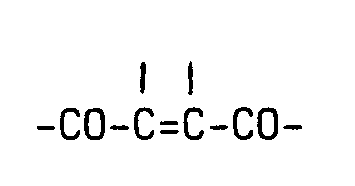
- A) 80-99,9 Gew.-Teilen eines Basispolymeren aus 40 bis 100 Gew.-% Polyphenylenether und 0 bis 60 Gew.-% eines vinylaromatischen Polymeren,
- B) 0,1-20 Gew.-Teilen eines Monomeren, enthaltend eine C=C-Doppelbindung, die an den Doppelbindungs-C-Atomen mit nur einer CO-Gruppe substituiert ist und zusätzlich zwei über eine C=C-Doppelbindung verknüpfte CO-Gruppen der Struktur
- C) 0-20 Gew.-Teilen weiteren olefinisch ungesättigten Monomeren, je weils bezogen auf 100 Gew.-Teile des Pfropfpolymerisates.
- Weiterhin betrifft die Erfindung die Herstellung und Verwendung dieser Pfropfpolymerisate.
- Die Modifizierung von Polyphenylenether durch Pfropfung mit olefinisch ungesättigten Verbindungen zur Verbesserung der anwendungstechnischen Eigenschaften ist bereits bekannt. So können nach üblichen Methoden z.B. Styrol (vgl. z.B. US-Patent 3 929 931, JP-A 52/33949 und JP-A 53/16757), Vinylpyridin (vgl. US-Patent 4 278 777), Methylmethacrylat (vgl. EP-A 54 140), zusätzlich Acrylate, Nitrile oder ungesättigte Carbonsäuren (vgl. EP-A 25 200) oder eine Mischung aus Styrol und Acrylnitril (vgl. EP-A 83 098 und 59 482, US-Patente 3 522 326 und 4 486 568 sowie DE-A 3 100 534) auf Polyphenylenether pfropfpolymerisiert werden. Eine Mischung von Styrol und Methacrylaten bzw. Maleinsäureanhydrid (EP-A 17 939 bzw. JP-8 77/19864) wurde auf Polyphenylenether aufgepfropft, um u.a. die Haftfähigkeit auf anorganischen Materialien zu erhöhen. Im allgemeinen arbeitet man in Gegenwart eines organischen Peroxides als Radikalstarter entweder in Lösung, wäßriger Dispersion oder in einem Schmelzextruder.
- Die Verfahren benötigen jedoch im allgemeinen ungünstig hohe Pfropftemperaturen, hohe Mengen an Radikalstartern bzw. sind langwierig und umständlich.
- Außerdem war bekannt, Polyphenylenether mit Maleinimid (EP-A 222 246), Fumarsäure (EP-A 223 116) oder Maleinsäurehalbester (EP-A 254 048 (Stand der Technik nach Art. 54 (3) EPü) zu pfropfen.
- Weiterhin ist es aus DE-A 33 07 408 bekannt, Polymere mit Hilfe von oligomeren Estern der Maleinsäure mit aliphatischen Diolen und Alkoholen durch radikalerzeugende Strahlung zu vernetzen. Diese hochvernetzten Produkte sind jedoch nicht thermoplastisch verarbeitbar und daher nur äußerst begrenzt einsetzbar.
- Darüber hinaus war es aus US-P 4 097 556 bekannt, Polyphenylenether und Polystyrol in Gegenwart von Styrol und einem Radikalstarter zu mischen, um ein Pfropfcopolymerisat zu erhalten. Nachteilig ist, daß die Umsetzung nicht vollständig abläuft, so daß Produkte mit hoher Uneinheitlichkeit und naturgemäß schlechtem Eigenschaftsbild entstehen.
- Aufgabe der vorliegenden Erfindung war es daher, weitgehend unvernetzte Pfropfpolymerisate auf Basis von Polyphenylenether bereitzustellen, die die geschilderten Nachteils vermeiden und einheitliche Produkte mit hoher Pfropfausbeute liefern, wenn sie ihrerseits mit Monomeren gepfropft werden.
- Demgemäß wurden weitgehend unvernetzte Pfropfpolymerisate, welche in einem Lösungsmittel zu mindestens 85 Gew.-% löslich sind, aus
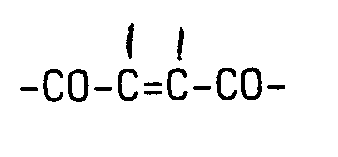
- A) 80-99,9 Gew.-Teilen eines Basispolymeren aus 40 bis 100 Gew.-% Polyphenylenether und 0 bis 60 Gew.-% eines vinylaromatischen Polymeren,
- B) 0,1-20 Gew.-Teilen eines Monomeren, enthaltend eine C=C-Doppelbindung, die an den Doppelbindungs-C-Atomen mit nur einer CO-Gruppe substituiert ist und zusätzlich zwei über eine C=C-Doppelbindung verknüpfte CO-Gruppen der Struktur
- C) 0-20 Gew.-Teilen weiteren olefinisch ungesättigten Monomeren, jeweils bezogen auf 100 Gew.-Teile des Pfropfpolymerisates,
- Weiterhin wurden spezielle Ausgestaltungen der Erfindung gemäß der Unteransprüche und ein Verfahren zu ihrer Herstellung und ihre Verwendung zur Herstellung von Pfropfcopolymeren gefunden.
- Die Komponente A bildet das Basispolymere für die erfindungsgemäßen Pfropfpolymerisate, die 80 bis 99,9 bevorzugt 90 bis 99,9, insbesondere 94 bis 99,5 Gew.-Teile, bezogen auf 100 Gew.-Teile des Pfropfpolymerisates, von A enthalten.
- Das Basispolymere besteht aus 40 bis 100 Gew.-% Polyphenylenether und 0 bis 60, bevorzugt 2 bis 10 Gew.-% eines vinylaromatischen Polymerisates.
- Die Polyphenlenether werden nach bekannten Verfahren aus in ortho-Position durch Alkylgruppen disubstituierten Phenolen durch oxidative Kupplung hergestellt (vgl. US-Patent 3 661 848, 3 378 505, 3 306 874, 3 306 875 und 3 639 656). Die gegebenenfalls alkylsubstituierten Polyphenylenether sind bevorzugt mit vinylaromatischen Polymerisaten verträglich.
- Polymere gelten als miteinander verträglich, wenn sie weitgehend oder ganz ineinander löslich sind (vgl. A. Noshay, "Block Copolymers, Academic Press [1977], Seiten 8 bis 10; sowie O. Olabisi, "Polymer-Polymer Miscibility", Academic Press [1979], Seiten 117 bis 189.
- Verträgliche Polyphenylenether sind beispielsweise
Poly(2,6-diethyl-1,4-phenylen)-ether,
Poly(2-methyl-6-ethyl-1,4phenylen)-ether,
Poly(2-methyl-6-propyl-1,4-phenylen)-ether,
Poly(2,6-dipropyl-1,4-phenylen)ether,
Poly(2-ethyl-6-propyl-1,4-phenylen)-ether oder Copolymere, wie solche, die 2,3,6-Trimethylphenol enthalten, außerdem Polymermischungen. Besonders bevorzugt ist jedoch Poly(2,6-dimethyl-1,4-phenylen)-ether. - Die Polyphenylenether sind im allgemeinen hochmolekular. Sie weisen üblicherweise Molekulargewichte von 10 000 bis 90 000, insbesondere 20 000 bis 80 000, bestimmt nach der in "Macromolecular Syntheses" 1 (1977), Seite 83, angegebenen Methode, auf. Ein Teil des Polyphenylenethers kann, wie schon erwähnt, durch ein vinylaromatisches Polymerisat ersetzt sein, das bevorzugt mit dem Polyphenylenether verträglich ist.
- Mit Polyphenylenether verträgliche vinylaromatische Polymerisate sind beispielsweise von O. Olabisi in "Polymer-Polymer Miscibility", Academic Press (1979), Seiten 224 bis 230 und 245 beschrieben. Besonders geeignet sind vinylaromatische Polymerisate, die bestehen aus: Styrol, Chlorstyrol, α-Methylstyrol, p-Methylstyrol, im untergeordneten Maße (vorzugsweise unter 8 Gew.-%) aus (Meth)acrylnitril. Besonders bevorzugt wird Polystyrol eingesetzt.
- Das Gewichtsmittel (Mw) des Molekulargewichts der vinylaromatischen Polymeren beträgt 1500 bis 2 000 000, besonders bevorzugt 70 000 bis 1 000 000.
- Die Polymerisate können durch die üblichen Polymerisationsverfahren, wie Masse-, Suspensions-, Emulsions- oder Lösungspolymerisation hergestellt werden.
- Das Basispolymere A reagiert durch Umsetzung mit dem Monomeren B und gegebenenfalls weiteren Monomeren C zum erfindungsgemäßen Pfropfpolymerisat.
- B liegt im Pfropfpolymerisat in Mengen von 0,1 bis 20, bevorzugt 0,1 bis 10, insbesondere 0,5 bis 6 Gew.-Teilen, bezogen auf 100 Gew.-Teile des Pfropfpolymerisates, vor.
- Die C=C-Doppelbindungen in B, die an den Doppelbindungs-C-Atomen mit nur einer CO-Gruppe substituiert ist, ist im allgemeinen ein Molekülteil der Struktur
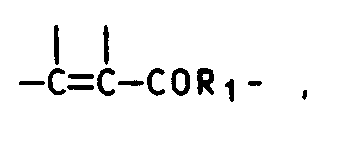
wobei R₁ für -O-, einen C₁ bis C₂₀-Alkylenoxyrest oder -NR₂- und R₂ für - H oder einen aliphatischen C₁ bis C₂₀-Rest stehen. - Die zwei über eine C=C-Doppelbindung verknüpften CO-Gruppen können ein Molekülteil der Struktur

sein, wobei R₃ -H, C₁-C₂₀-Alkyl, NH₄, Li, Na, Ca(1/2) oder Zn(1/2) sein können. - Beide Molekülteile sind in B in einem Monomeren vereinigt. Auf die übrigen Eigenschaften kommt es, was sich allerdings von selbst versteht, nicht an, soweit sie nicht die Pfropfreaktion verhindern und die Eigenschaften der erfindungsgemäßen Pfropfpolymerisate verschlechtern.
- Bevorzugt ist B ein Monomeres der allgemeinen Formel I

wobei - R₃
- die obengenannte Bedeutung, insbesondere -H,
- R₄
- C₁-C₈-Alkyl, insbesondere -H,
- R₅
- C₂-C₈-Alkyl, insbesondere -CH₃ oder -H,
- R₆, R₇
- C₁-C₃-Alkyl, Chlor und insbesondere -H,
- X
- -NR₄- und insbesondere -O- und
- Y
- Cycloalkylen oder Alkylen mit bis zu 12 C-Atomen, insbesondere C₂-Alkylen
- Insbesondere sind Maleinsäure-mono-2-acryloxyethylester und Maleinsäure-mono-2-methacryloxyethylester bevorzugt.
- Als pfropfpolymerisierbare Monomere mit olefinischen Doppelbindungen C eignen sich Styrol, Acrylnitril, Methylmethacrylat, Maleinsäureanhydrid oder deren Gemische, bevorzugt in Mengen unter 20 Gew.-Teilen, bezogen auf 100 Gew.-Teile des Pfropfpolymerisates. Besonders bevorzugt fehlt C.
- Die erfindungsgemäßen Polymerisate können in bekannter Weise, z.B. durch Zusatz von Verstärkungs- und Füllstoffen, Stabilisatoren, Gleit- und Flammschutzmitteln sowie Farbstoffen und Pigmenten modifiziert werden.
- Das Pfropfpolymerisat kann in Lösung oder Dispersion hergestellt werden. Bevorzugt ist jedoch die Pfropfpolymerisation in einem Schmelzextruder. Dazu werden die Komponenten bei Temperaturen von 170 bis 350°C, vorzugsweise zwischen 240 und 300°C innig vermischt und zur Reaktion gebracht, wobei gegebenenfalls der Schmelzpunkt des Polyphenylenethers durch Zusätze variiert werden kann. Vorzugsweise verwendet man einen Zweischneckenextruder, der mit Knetelementen, zum Teil mit rückwärtsförderndem Gewinde, ausgerüstet sein kann. Die Komponenten werden im allgemeinen gemeinsam dosiert und in einer Aufschmelzzone des Extruders aufgeschmolzen. An diese Zone schließt sich üblicherweise die Reaktionszone an. Vor dem Produktaustrag befindet sich im allgemeinen eine Entgasungszone zur Entfernung der flüchtigen Bestandteile. Die Verweilzeit im Extruder beträgt im allgemeinen 0,5 bis 10 Minuten, bevorzugt 1 bis 5 Minuten. Die ausgetragene Schmelze wird üblicherweise granuliert.
- Bei der Reaktion kann ein Radikalstarter, der bevorzugt ein organisches Peroxid oder eine Azoverbindung ist, zugegen sein. Solche Radikalstarter sind dem Fachmann bekannt. Allgemein werden organische Peroxide mit einer Halbwertszeit des Zerfalls (vgl. Modern Plastics 36, 1959, Heft 2, Seiten 142 bis 148) bei 200°C von 1 bis 300 Sekunden verwendet. Die Wahl des Radikalstarters richtet sich nach der gewünschten Reaktionstemperatur. Beispielhaft seien genannt Di-cumyl-peroxid und Di-tert.-butylperoxid.
- Die Radikalstarter können in Mengen unter 10 Gew.-%, bevorzugt unter 3 Gew.-%, bezogen auf die eingesetzten Reaktionskomponenten, anwesend sein. Man erhält besonders gut lösliche Produkte, wenn man, insbesondere bei Temperaturen über 240°C, ohne Zusatz eines Radikalstarters, d.h. in Abwesenheit oder praktischer Abwesenheit von Radikalstartern arbeitet.
- Unter weitgehend unvernetzten Pfropfpolymerisaten im Sinne der Erfindung sind solche zu verstehen, die in einem Lösungsmittel nicht nur quellen, sondern im wesentlichen, d.h. zu mindestens 85 Gew.-%, bevorzugt 90 Gew.-% löslich sind.
- Die Bestimmung der löslichen Anteile der Pfropfpolymerisate wird üblicherweise wie folgt durchgeführt: 5 g des Pfropfpolymerisates werden mit 95 g CH₂CL₂ 15 Minuten am Rückfluß gekocht. Dann wird das Produkt sofort durch eine Glasfritte Typ G 4, filtriert. Man dampft ein und bestimmt den Rückstand.
- Die erfindungsgemäßen Polyphenylenetherharze haben eine gute Wärmeformbeständigkeit, gekoppelt mit einer hellen Eigenfarbe, was ihre Gebrauchseigenschaften deutlich erhöht. Sie können ohne Schwierigkeit durch thermoplastische Verformungsverfahren wie Spritzguß oder Extrusion verarbeitet und als Formteile oder zur Beschichtung von Oberflächen eingesetzt werden. Insbesondere können sie in vorteilhafter Weise durch Pfropfung mit olefinisch ungesättigten, bevorzugt vinylaromatischen Monomeren weiter zu Pfropfcopolymerisaten umgesetzt werden. Die guten Produkteigenschaften der Pfropfcopolymerisate, wie zum Beispiel gute Vernetzbarkeit nach der Verarbeitung werden durch die hohe Pfropfaktivität der erfindungsgemäßen Pfropfpolymerisate hervorgerufen. Es ist nämlich mit den erfindungsgemäßen Pfropfpolymerisaten möglich, den weitaus größten Teil der Monomeren auf die Pfropfpolymerisate aufzupfropfen, so daß vorteilhafte einheitliche Produkte entstehen.
- Bei dieser Umsetzung werden die erfindungsgemäßen Pfropfpolymerisate nach üblichen Methoden (z.B. US-Patent 4 097 556) im allgemeinen in Gegenwart von anderen Polymerisaten, bevorzugt vinylaromatischen Polymeren wie Polystyrol, im allgemeinen radikalisch mit olefinisch ungesättigten Monomeren gepfropft. Als Monomere kommen insbesondere Styrol und C₁₋₄-Alkylsubstituierte Styrole, daneben auch ungesättigte Nitrile wie Acrylnitril, C₁₋₈-Alkylacrylate und -methacrylate, Diene wie Butadien, Maleinsäure oder Maleinsäureanhydrid in Betracht.
- 9,35 kg Poly-(2,6-Dimethyl-1,4-phenylen)ether (PPE) mit einer relativen Viskosität von 0,54, gemessen in 1 gew.-%iger Chloroformlösung bei 25°C, 0,5 kg Polystyrol (Mw = 200.000) und 0,15 kg Maleinsäure-mono-2-acryloxyethylester (Fa. Röhm Chemieprodukte) wurden in einem Zweischneckenextruder bei 270°C miteinander umgesetzt und anschließend in einer Entgasungszone bei 280°C bei vermindertem Druck entgast. Die mittlere Verweilzeit im Extruder betrug 1,8 Minuten. Die Schmelze wurde zur Kühlung durch ein Wasserbad geleitet, granuliert und getrocknet.
- 9,20 kg PPE, 0,7 kg Polystyrol und 0,1 kg Maleinsäure-mono-2-acryloxyethylester werden gemäß Beispiel 1 umgesetzt.
- Zur Bestimmung der Pfropfaktivität wurden folgende Vergleichspolymere eingesetzt:
- V(1):
- 9,35 kg des PPE aus Beispiel 1 und 0,5 kg des Polystyrols aus Beispiel 1 wurden mit 0,15 kg Maleinsäuremonoethylester wie in Beispiel 1 umgesetzt.
- V(2):
- Man arbeitete wie bei V(1), setzte jedoch Ethylacrylat statt des Maleinsäuremonoethylesters ein.
- V(3):
- Man arbeitete wie bei V(1), setzte jedoch statt 0,15 kg Maleinsäuremonoethylester eine Mischung aus
0,075 kg Ethylacrylat und
0,075 kg Maleinsäuremonoethylester ein. - V(4):
- Man arbeitete wie bei V(1), setzte jedoch Fumarsäure statt des Maleinsäuremonoethylesters ein.
- v(5):
- Man arbeitete wie bei V(1), setzte jedoch N-Phenylmaleinimid statt des Maleinsäuremonoethylesters ein.
- V(6) :
- unmodifiziertes PPE aus Beispiel 1
- Zur Überprüfung der Pfropfaktivität wurden 700 Gew.-Teile der Polymerisate gemäß Tabelle 1, 500 Gew. -Teile Polystyrol (MW = 200.000) und eine Lösung von 30 Gew.-Teilen 2,5-Dimethyl-2,5-di(tert-butylperoxy)hexan in 200 Gew.-Teilen Styrol in einem Zweischneckenextruder gemischt und umgesetzt, wobei die Temperatur 250°C betrug und die Verweilzeit 2 Min. Im Entgasungsdom wurden flüchtige Bestandteile abgezogen, das erhaltene Pfropfcopolymerisat wurde ausgetragen und granuliert.
- Die erhaltenen Pfropfcopolymerisate wurden auf Pfropfausbeute untersucht. Dazu wurde das Granulat in CH₂Cl₂ (5 gew.-%ig) zum Sieden erwärmt und anschließend 24 h bei 20°C gehalten. Polyphenylenether bildet einen CH₂Cl₂-Komplex, der ausfällt (s. D.M. White, Journal of Polymer Science, Polymer Chemistry Edition, Vol. 21, 2921-2936 (1983). Der Niederschlag wurde abzentrifugiert, getrocknet und ausgewogen. Der Niederschlag besteht aus Polyphenylenether und Polyphenylenether mit aufgepfropftem Polystyrol.
- Die folgende Tabelle 1 zeigt die Menge des aufgepfropften Polystyrols in Gew.-%, bezogen auf die Gesamtmenge des Polystyrols in den Pfropfcopolymerisaten, die sich zusammensetzt aus dem bei der Pfropfung mit Styrol zugegebenem Polystyrol und monomerem Styrol.

Claims (7)
- Weitgehend unvernetzte Pfropfpolymerisate, welche in einem Lösungsmittel zu mindestens 85 Gew.-% löslich sind, ausA) 80-99,9 Gew.-Teilen eines Basispolymeren aus 40 bis 100 Gew.-% Polyphenylenether und 0 bis 60 Gew.-% eines vinylaromatischen Polymeren,B) 0,1-20 Gew.-Teilen eines Monomeren, enthaltend eine C=C-Doppelbindung, die an den Doppelbindungs-C-Atomen mit nur einer CO-Gruppe substituiert ist und zusätzlich zwei über eine C=C-Doppelbindung verknüpfte CO-Gruppen der Struktur
-CO-C=C-CO
enthält, sowieC) 0-20 Gew.-Teilen weiteren olefinisch ungesättigten Monomeren, jeweils bezogen auf 100 Gew.-Teile des Pfropfpolymerisates. - Pfropfpolymerisate nach Anspruch 1, in denen B Maleinsäure-mono-2-acryloxyethylester oder Maleinsäure-mono-2-methacryloxyethylester ist.
- Pfropfpolymerisate nach den Ansprüchen 1 oder 2 aus 90 bis 99,9 Gew.-Teilen der Komponente A und 0,1 bis 10 Gew.-Teilen der Komponente B, jeweils bezogen auf 100 Gew.-Teile des Pfropfpolymerisates.
- Verfahren zur Herstellung von Pfropfpolymerisaten gemäß den Ansprüchen 1 bis 3 durch Pfropfung eines Polyphenylenethers mit einem Pfropfmonomeren, dadurch gekennzeichnet, daß man als Pfropfmonomeres ein Monomeres B und gegebenenfalls weitere olefinische ungesättigte Monomere C verwendet.
- Verfahren nach Anspruch 4, dadurch gekennzeichnet, daß man die Pfropfung bei 170 bis 350°C vornimmt.
- Verfahren nach den Ansprüchen 4 und 5, dadurch gekennzeichnet, daß man die Pfropfung in Abwesenheit oder praktischer Abwesenheit eines Radikalstarters vornimmt.
- Verwendung der Pfropfpolymerisate gemäß den Ansprüchen 1 bis 6 zur Herstellung von Pfropfcoplymerisaten durch Pfropfung mit olefinisch ungesättigten Monomeren.
Applications Claiming Priority (2)
| Application Number | Priority Date | Filing Date | Title |
|---|---|---|---|
| DE19873725112 DE3725112A1 (de) | 1987-07-29 | 1987-07-29 | Pfropfpolymerisate auf basis von polyphenylenether |
| DE3725112 | 1987-07-29 |
Publications (3)
| Publication Number | Publication Date |
|---|---|
| EP0301404A2 EP0301404A2 (de) | 1989-02-01 |
| EP0301404A3 EP0301404A3 (en) | 1990-03-14 |
| EP0301404B1 true EP0301404B1 (de) | 1992-03-18 |
Family
ID=6332620
Family Applications (1)
| Application Number | Title | Priority Date | Filing Date |
|---|---|---|---|
| EP88111750A Expired - Lifetime EP0301404B1 (de) | 1987-07-29 | 1988-07-21 | Pfropfpolymerisate auf Basis von Polyphenylenether |
Country Status (2)
| Country | Link |
|---|---|
| EP (1) | EP0301404B1 (de) |
| DE (2) | DE3725112A1 (de) |
Cited By (1)
| Publication number | Priority date | Publication date | Assignee | Title |
|---|---|---|---|---|
| US6211327B1 (en) | 1999-02-05 | 2001-04-03 | General Electric Company | Process for the manufacture of low molecular weight polyphenylene ether resins |
Families Citing this family (3)
| Publication number | Priority date | Publication date | Assignee | Title |
|---|---|---|---|---|
| DE3833956A1 (de) * | 1988-10-06 | 1990-04-12 | Basf Ag | Verfahren zur herstellung von thermoplastischen formmassen auf basis von modifiziertem polyphenylenether und gepfropftem schlagzaehem polystyrol |
| DE19606198A1 (de) | 1996-02-21 | 1997-08-28 | Basf Ag | Verfahren zur Herstellung von Oxazingruppen enthaltenden Polymeren |
| US6417274B1 (en) | 1999-02-05 | 2002-07-09 | General Electric Co. | Process for the manufacture of functionalized polyphenylene ether resins |
Family Cites Families (1)
| Publication number | Priority date | Publication date | Assignee | Title |
|---|---|---|---|---|
| DE3540118A1 (de) * | 1985-11-13 | 1987-05-14 | Basf Ag | Modifizierte polyphenylenetherharze mit carboxylgruppen |
-
1987
- 1987-07-29 DE DE19873725112 patent/DE3725112A1/de not_active Withdrawn
-
1988
- 1988-07-21 DE DE8888111750T patent/DE3869261D1/de not_active Expired - Lifetime
- 1988-07-21 EP EP88111750A patent/EP0301404B1/de not_active Expired - Lifetime
Cited By (1)
| Publication number | Priority date | Publication date | Assignee | Title |
|---|---|---|---|---|
| US6211327B1 (en) | 1999-02-05 | 2001-04-03 | General Electric Company | Process for the manufacture of low molecular weight polyphenylene ether resins |
Also Published As
| Publication number | Publication date |
|---|---|
| DE3869261D1 (en) | 1992-04-23 |
| DE3725112A1 (de) | 1989-02-09 |
| EP0301404A3 (en) | 1990-03-14 |
| EP0301404A2 (de) | 1989-02-01 |
Similar Documents
| Publication | Publication Date | Title |
|---|---|---|
| EP0450511B1 (de) | Teilförmiges Pfropfpolymerisat und daraus hergestellte thermoplastische Formmasse mit verbesserter Zähigkeit | |
| DE3414118A1 (de) | Thermoplastische formmassen | |
| DE3617267A1 (de) | Kerbschlagzaehe pfropfpolymerisate | |
| DE2843450A1 (de) | Zusammensetzungen, die copolymere einer vinylaromatischen verbindung, ein ungesaettigtes cyclisches anhydrid und mittel zur verbesserung der schlagfestigkeit enthalten | |
| EP0276768B1 (de) | Kontinuierliches Verfahren zur Herstellung von Formmassen auf der Basis von Polyphenylenethern und Polyamiden | |
| DE4342045A1 (de) | Dreistufige Pfropfcopolymerisate und solche enthaltende witterungsbeständige, matte thermoplastische Formmassen mit hoher Kältezähigkeit | |
| EP0254048A1 (de) | Propfpolymerisate von Polyphenylenethern | |
| EP0301404B1 (de) | Pfropfpolymerisate auf Basis von Polyphenylenether | |
| EP0534211B1 (de) | Pfropfkautschuk-Mischung und seine Verwendung zur Herstellung von Formmassen | |
| EP0387824A2 (de) | Thermoplastische Formmassen auf Basis von schlagzäh modifiziertem Polyamid und funktionalisiertem Polyphenylenäther | |
| EP0296402A1 (de) | Thermoplastische Siliconkautschukpfropfpolymerisate (I) | |
| DE19639592A1 (de) | Thermoplastische Formmassen | |
| EP0529378B1 (de) | Thermoplastische Formmasse auf Basis von Polyamiden und Polyphenylenethern | |
| EP0725091B1 (de) | Formmassen mit verbesserter Tieftemperaturzähigkeit | |
| EP0370346A2 (de) | Polymermischungen mit guter Alterungsbeständigkeit | |
| DE19531976C2 (de) | Zusammensetzungen aus Polyphenylenetherharz | |
| EP0056871B1 (de) | Thermoplastische Formmassen | |
| EP0056964B1 (de) | Thermoplastische Formmasse enthaltend ein Styrolpolymerisat, einen gepropften Polyacrylsäureester und einen Polyphenylenether | |
| EP0071785B1 (de) | Thermoplastische Formmasse | |
| EP0285970B1 (de) | Thermoplastische Formmassen auf Basis von Polyphenylenether | |
| EP0264791A2 (de) | Thermoplastische Formmassen | |
| DE3905340A1 (de) | Pfropfpolymerisate auf basis von funktionalisiertem polyphenylenether | |
| EP0223115B1 (de) | Modifizierte Polyphenylenetherharze mit Lactamgruppen und deren Herstellung | |
| EP0172516A2 (de) | Polymere mit einem Styrol-Acrylnitril-Copolymeren als Hauptkette und über Benzyletherbrücken gebundenen Polyphenylenether-Seitenketten und deren Verwendung zur Herstellung von Polymermischungen und Formkörpern | |
| DE3140566A1 (de) | Thermoplastische formmassen |
Legal Events
| Date | Code | Title | Description |
|---|---|---|---|
| PUAI | Public reference made under article 153(3) epc to a published international application that has entered the european phase |
Free format text: ORIGINAL CODE: 0009012 |
|
| AK | Designated contracting states |
Kind code of ref document: A2 Designated state(s): BE DE FR GB NL |
|
| PUAL | Search report despatched |
Free format text: ORIGINAL CODE: 0009013 |
|
| AK | Designated contracting states |
Kind code of ref document: A3 Designated state(s): BE DE FR GB NL |
|
| 17P | Request for examination filed |
Effective date: 19900210 |
|
| 17Q | First examination report despatched |
Effective date: 19910607 |
|
| GRAA | (expected) grant |
Free format text: ORIGINAL CODE: 0009210 |
|
| AK | Designated contracting states |
Kind code of ref document: B1 Designated state(s): BE DE FR GB NL |
|
| REF | Corresponds to: |
Ref document number: 3869261 Country of ref document: DE Date of ref document: 19920423 |
|
| GBT | Gb: translation of ep patent filed (gb section 77(6)(a)/1977) | ||
| ET | Fr: translation filed | ||
| PLBE | No opposition filed within time limit |
Free format text: ORIGINAL CODE: 0009261 |
|
| STAA | Information on the status of an ep patent application or granted ep patent |
Free format text: STATUS: NO OPPOSITION FILED WITHIN TIME LIMIT |
|
| 26N | No opposition filed | ||
| REG | Reference to a national code |
Ref country code: GB Ref legal event code: IF02 |
|
| PGFP | Annual fee paid to national office [announced via postgrant information from national office to epo] |
Ref country code: FR Payment date: 20020616 Year of fee payment: 15 |
|
| PGFP | Annual fee paid to national office [announced via postgrant information from national office to epo] |
Ref country code: NL Payment date: 20020618 Year of fee payment: 15 |
|
| PGFP | Annual fee paid to national office [announced via postgrant information from national office to epo] |
Ref country code: BE Payment date: 20020703 Year of fee payment: 15 |
|
| PGFP | Annual fee paid to national office [announced via postgrant information from national office to epo] |
Ref country code: GB Payment date: 20020716 Year of fee payment: 15 |
|
| PGFP | Annual fee paid to national office [announced via postgrant information from national office to epo] |
Ref country code: DE Payment date: 20020718 Year of fee payment: 15 |
|
| PG25 | Lapsed in a contracting state [announced via postgrant information from national office to epo] |
Ref country code: GB Free format text: LAPSE BECAUSE OF NON-PAYMENT OF DUE FEES Effective date: 20030721 |
|
| PG25 | Lapsed in a contracting state [announced via postgrant information from national office to epo] |
Ref country code: BE Free format text: LAPSE BECAUSE OF NON-PAYMENT OF DUE FEES Effective date: 20030731 |
|
| PG25 | Lapsed in a contracting state [announced via postgrant information from national office to epo] |
Ref country code: DE Free format text: LAPSE BECAUSE OF THE APPLICANT RENOUNCES Effective date: 20030822 |
|
| BERE | Be: lapsed |
Owner name: *BASF A.G. Effective date: 20030731 |
|
| PG25 | Lapsed in a contracting state [announced via postgrant information from national office to epo] |
Ref country code: NL Free format text: LAPSE BECAUSE OF NON-PAYMENT OF DUE FEES Effective date: 20040201 |
|
| GBPC | Gb: european patent ceased through non-payment of renewal fee |
Effective date: 20030721 |
|
| PG25 | Lapsed in a contracting state [announced via postgrant information from national office to epo] |
Ref country code: FR Free format text: LAPSE BECAUSE OF NON-PAYMENT OF DUE FEES Effective date: 20040331 |
|
| NLV4 | Nl: lapsed or anulled due to non-payment of the annual fee |
Effective date: 20040201 |
|
| REG | Reference to a national code |
Ref country code: FR Ref legal event code: ST |