EP0301099B1 - Processes for preparing organosilicon compounds and silicon carbide - Google Patents
Processes for preparing organosilicon compounds and silicon carbide Download PDFInfo
- Publication number
- EP0301099B1 EP0301099B1 EP88901299A EP88901299A EP0301099B1 EP 0301099 B1 EP0301099 B1 EP 0301099B1 EP 88901299 A EP88901299 A EP 88901299A EP 88901299 A EP88901299 A EP 88901299A EP 0301099 B1 EP0301099 B1 EP 0301099B1
- Authority
- EP
- European Patent Office
- Prior art keywords
- silicon
- high molecular
- molecular weight
- weight compound
- compound
- Prior art date
- Legal status (The legal status is an assumption and is not a legal conclusion. Google has not performed a legal analysis and makes no representation as to the accuracy of the status listed.)
- Expired - Lifetime
Links
Images

Classifications
-
- C—CHEMISTRY; METALLURGY
- C08—ORGANIC MACROMOLECULAR COMPOUNDS; THEIR PREPARATION OR CHEMICAL WORKING-UP; COMPOSITIONS BASED THEREON
- C08G—MACROMOLECULAR COMPOUNDS OBTAINED OTHERWISE THAN BY REACTIONS ONLY INVOLVING UNSATURATED CARBON-TO-CARBON BONDS
- C08G77/00—Macromolecular compounds obtained by reactions forming a linkage containing silicon with or without sulfur, nitrogen, oxygen or carbon in the main chain of the macromolecule
- C08G77/60—Macromolecular compounds obtained by reactions forming a linkage containing silicon with or without sulfur, nitrogen, oxygen or carbon in the main chain of the macromolecule in which all the silicon atoms are connected by linkages other than oxygen atoms
-
- C—CHEMISTRY; METALLURGY
- C01—INORGANIC CHEMISTRY
- C01B—NON-METALLIC ELEMENTS; COMPOUNDS THEREOF; METALLOIDS OR COMPOUNDS THEREOF NOT COVERED BY SUBCLASS C01C
- C01B32/00—Carbon; Compounds thereof
- C01B32/90—Carbides
- C01B32/914—Carbides of single elements
- C01B32/956—Silicon carbide
-
- C—CHEMISTRY; METALLURGY
- C01—INORGANIC CHEMISTRY
- C01B—NON-METALLIC ELEMENTS; COMPOUNDS THEREOF; METALLOIDS OR COMPOUNDS THEREOF NOT COVERED BY SUBCLASS C01C
- C01B32/00—Carbon; Compounds thereof
- C01B32/90—Carbides
- C01B32/914—Carbides of single elements
- C01B32/956—Silicon carbide
- C01B32/963—Preparation from compounds containing silicon
- C01B32/977—Preparation from organic compounds containing silicon
-
- C—CHEMISTRY; METALLURGY
- C04—CEMENTS; CONCRETE; ARTIFICIAL STONE; CERAMICS; REFRACTORIES
- C04B—LIME, MAGNESIA; SLAG; CEMENTS; COMPOSITIONS THEREOF, e.g. MORTARS, CONCRETE OR LIKE BUILDING MATERIALS; ARTIFICIAL STONE; CERAMICS; REFRACTORIES; TREATMENT OF NATURAL STONE
- C04B35/00—Shaped ceramic products characterised by their composition; Ceramics compositions; Processing powders of inorganic compounds preparatory to the manufacturing of ceramic products
- C04B35/515—Shaped ceramic products characterised by their composition; Ceramics compositions; Processing powders of inorganic compounds preparatory to the manufacturing of ceramic products based on non-oxide ceramics
- C04B35/56—Shaped ceramic products characterised by their composition; Ceramics compositions; Processing powders of inorganic compounds preparatory to the manufacturing of ceramic products based on non-oxide ceramics based on carbides or oxycarbides
- C04B35/565—Shaped ceramic products characterised by their composition; Ceramics compositions; Processing powders of inorganic compounds preparatory to the manufacturing of ceramic products based on non-oxide ceramics based on carbides or oxycarbides based on silicon carbide
-
- C—CHEMISTRY; METALLURGY
- C04—CEMENTS; CONCRETE; ARTIFICIAL STONE; CERAMICS; REFRACTORIES
- C04B—LIME, MAGNESIA; SLAG; CEMENTS; COMPOSITIONS THEREOF, e.g. MORTARS, CONCRETE OR LIKE BUILDING MATERIALS; ARTIFICIAL STONE; CERAMICS; REFRACTORIES; TREATMENT OF NATURAL STONE
- C04B35/00—Shaped ceramic products characterised by their composition; Ceramics compositions; Processing powders of inorganic compounds preparatory to the manufacturing of ceramic products
- C04B35/515—Shaped ceramic products characterised by their composition; Ceramics compositions; Processing powders of inorganic compounds preparatory to the manufacturing of ceramic products based on non-oxide ceramics
- C04B35/56—Shaped ceramic products characterised by their composition; Ceramics compositions; Processing powders of inorganic compounds preparatory to the manufacturing of ceramic products based on non-oxide ceramics based on carbides or oxycarbides
- C04B35/565—Shaped ceramic products characterised by their composition; Ceramics compositions; Processing powders of inorganic compounds preparatory to the manufacturing of ceramic products based on non-oxide ceramics based on carbides or oxycarbides based on silicon carbide
- C04B35/571—Shaped ceramic products characterised by their composition; Ceramics compositions; Processing powders of inorganic compounds preparatory to the manufacturing of ceramic products based on non-oxide ceramics based on carbides or oxycarbides based on silicon carbide obtained from Si-containing polymer precursors or organosilicon monomers
-
- C—CHEMISTRY; METALLURGY
- C07—ORGANIC CHEMISTRY
- C07F—ACYCLIC, CARBOCYCLIC OR HETEROCYCLIC COMPOUNDS CONTAINING ELEMENTS OTHER THAN CARBON, HYDROGEN, HALOGEN, OXYGEN, NITROGEN, SULFUR, SELENIUM OR TELLURIUM
- C07F7/00—Compounds containing elements of Groups 4 or 14 of the Periodic Table
- C07F7/02—Silicon compounds
- C07F7/08—Compounds having one or more C—Si linkages
- C07F7/0803—Compounds with Si-C or Si-Si linkages
-
- C—CHEMISTRY; METALLURGY
- C07—ORGANIC CHEMISTRY
- C07F—ACYCLIC, CARBOCYCLIC OR HETEROCYCLIC COMPOUNDS CONTAINING ELEMENTS OTHER THAN CARBON, HYDROGEN, HALOGEN, OXYGEN, NITROGEN, SULFUR, SELENIUM OR TELLURIUM
- C07F7/00—Compounds containing elements of Groups 4 or 14 of the Periodic Table
- C07F7/02—Silicon compounds
- C07F7/08—Compounds having one or more C—Si linkages
- C07F7/0803—Compounds with Si-C or Si-Si linkages
- C07F7/0825—Preparations of compounds not comprising Si-Si or Si-cyano linkages
- C07F7/0827—Syntheses with formation of a Si-C bond
- C07F7/0829—Hydrosilylation reactions
-
- C—CHEMISTRY; METALLURGY
- C07—ORGANIC CHEMISTRY
- C07F—ACYCLIC, CARBOCYCLIC OR HETEROCYCLIC COMPOUNDS CONTAINING ELEMENTS OTHER THAN CARBON, HYDROGEN, HALOGEN, OXYGEN, NITROGEN, SULFUR, SELENIUM OR TELLURIUM
- C07F7/00—Compounds containing elements of Groups 4 or 14 of the Periodic Table
- C07F7/02—Silicon compounds
- C07F7/08—Compounds having one or more C—Si linkages
- C07F7/0896—Compounds with a Si-H linkage
-
- C—CHEMISTRY; METALLURGY
- C08—ORGANIC MACROMOLECULAR COMPOUNDS; THEIR PREPARATION OR CHEMICAL WORKING-UP; COMPOSITIONS BASED THEREON
- C08F—MACROMOLECULAR COMPOUNDS OBTAINED BY REACTIONS ONLY INVOLVING CARBON-TO-CARBON UNSATURATED BONDS
- C08F30/00—Homopolymers or copolymers of compounds having one or more unsaturated aliphatic radicals, each having only one carbon-to-carbon double bond, and containing phosphorus, selenium, tellurium or a metal
- C08F30/04—Homopolymers or copolymers of compounds having one or more unsaturated aliphatic radicals, each having only one carbon-to-carbon double bond, and containing phosphorus, selenium, tellurium or a metal containing a metal
- C08F30/08—Homopolymers or copolymers of compounds having one or more unsaturated aliphatic radicals, each having only one carbon-to-carbon double bond, and containing phosphorus, selenium, tellurium or a metal containing a metal containing silicon
-
- C—CHEMISTRY; METALLURGY
- C08—ORGANIC MACROMOLECULAR COMPOUNDS; THEIR PREPARATION OR CHEMICAL WORKING-UP; COMPOSITIONS BASED THEREON
- C08F—MACROMOLECULAR COMPOUNDS OBTAINED BY REACTIONS ONLY INVOLVING CARBON-TO-CARBON UNSATURATED BONDS
- C08F8/00—Chemical modification by after-treatment
- C08F8/30—Introducing nitrogen atoms or nitrogen-containing groups
-
- C—CHEMISTRY; METALLURGY
- C01—INORGANIC CHEMISTRY
- C01P—INDEXING SCHEME RELATING TO STRUCTURAL AND PHYSICAL ASPECTS OF SOLID INORGANIC COMPOUNDS
- C01P2002/00—Crystal-structural characteristics
- C01P2002/80—Crystal-structural characteristics defined by measured data other than those specified in group C01P2002/70
- C01P2002/82—Crystal-structural characteristics defined by measured data other than those specified in group C01P2002/70 by IR- or Raman-data
-
- C—CHEMISTRY; METALLURGY
- C01—INORGANIC CHEMISTRY
- C01P—INDEXING SCHEME RELATING TO STRUCTURAL AND PHYSICAL ASPECTS OF SOLID INORGANIC COMPOUNDS
- C01P2006/00—Physical properties of inorganic compounds
- C01P2006/10—Solid density
-
- C—CHEMISTRY; METALLURGY
- C01—INORGANIC CHEMISTRY
- C01P—INDEXING SCHEME RELATING TO STRUCTURAL AND PHYSICAL ASPECTS OF SOLID INORGANIC COMPOUNDS
- C01P2006/00—Physical properties of inorganic compounds
- C01P2006/60—Optical properties, e.g. expressed in CIELAB-values
Definitions
- This invention relates to a process for the preparation of silicon-containing polymers by subjecting certain specific alkenylsilanes to anionic coordination, radical or ionic polymerization, and a process for the production of silicon carbide by firing some specific polyolefins which contain silyl groups in side chains. It also relates to novel silicon-containing polymers.
- Organosilicon compound is a generic term for compounds which generally contain one or more Si-C bonds.
- the organosilicon-related chemical industry is now growing rapidly, as typified by silicones (polyorganosiloxanes).
- silicones polyorganosiloxanes.
- Several processes are known for the preparation of organosilicon compounds. The following processes may be mentioned as representative ones.
- the process (1) is Rochow's direct process, in which an organosilicon compound is prepared directly from metallic silicon and a halogenated hydrocarbon. It is a process useful for the preparation of alkylchlorosilanes, which are the most important basic starting materials in the present organosilicon industry.
- halogenated hydrocarbons RCl, methyl chloride and chlorobenzene are used industrially. Other halogenated hydrocarbons give unduly low yields and are hence not suitable for industrial application.
- Process (2) is a Grignard process while process (3) is a dechlorination process making use of metallic sodium. These processes permit introduction of a desired alkyl group but Grignard reagents and metallic sodium are expensive and uneconomical.
- Process (4) is addition of a silane to an alkene. It is accompanied by a serious problem that its raw material is limited to HSiCl 3 , CH 3 SiHCl 2 byproduced in the direct process, or the like.
- silicon-containing polymers organopolysiloxanes
- Their raw materials are alkylchlorosilanes produced by the reaction of metallic silicon and their corresponding halogenated hydrocarbons, namely, by the so-called direct process, in particular, dimethyldichlorosilane.
- silicones there are only a few practical application examples of silicon-containing polymers.
- the following silicon-containing polymers are examples of known materials:
- the preparation of silicon-containing polymers for example, the above-mentioned polymers (a), (b) and (c) from conventional alkylchlorosilanes as raw materials is however practiced in chlorine-containing systems, so that the potential danger of corrosion of apparatus is involved. Moreover, their preparation processes are extremely complex.
- the polymers (d) are polymers of vinylsilane.
- the copolymers of vinylsilane with ethylene are used in a large volume for coating electrical wires and cables in the form of polyethylenes cross-linkable with water.
- silicon-containing ceramics For example, silicon carbide (SiC), silicon nitride (Si 3 N 4 ), Cyalon, Si-Ti-C-O ceramics ("Tylano Fibers", product of Ube Industries, Ltd.), SiC-B 4 C ceramics, Si 3 N 4 -SiC composite ceramics and the like have attracted attention as so-called fine ceramics.
- silicon carbide is available in various forms such as powder, whiskers and fibers. It has been produced by various processes. For example, there are direct carbonization, reduction carbonization, vapor-phase synthesis, pyrolysis of silicon compounds, etc.
- Direct carbonization comprises reduction of metallic silicon with coke at an elevated temperature (1400 - 2600°C) and is hence economical.
- Fine silica SiO 2 powder is however indispensable for obtaining fine SiC crystals excellent in sinterability. The reaction is exothermic and its control is hence difficult.
- Reduction carbonization features reduction of SiO 2 with coke. By reacting them at 1,500 - 2,000°C in argon, ⁇ -SiC is obtained. On the other hand, ⁇ -SiC is obtained by the Acheson process which is similar to reduction carbonization. Reduction carbonization is employed principally these days in the industry.
- Ceramics obtained by the above-described processes are all powdery. In order to obtain shaped products from them, it is hence necessary to press and process them in the presence of a sintering agent at elevated temperature and pressure. Their processing requires an extremely large press. In addition, limitations are imposed on their shaping and processing so that products of complex configurations can hardly be fabricated.
- Pyrolysis of silicon compounds features easy processing, and also features pyrolyzing, as ceramics prepolymers, linear or cyclic silicon-containing high-molecular compounds having such recurring structural units as exemplified below.
- the polycarbosilanes are obtained by the pyrolysis of permethylpolysilanes or various organosilicon compounds, for example, tetramethylsilane, dimethyldichlorosilane and dodecamethylcyclohexasilane. They are fusible and also soluble in organic solvents such as benzene.
- step (A) the removal of unreacted sodium is cumbersome because metallic sodium is used in a solvent, and fractionation of polymers (separation and-removal of low molecular-weight polycarbosilanes) is required.
- step (B) the reaction has to be carried out at high temperature and pressure (400°C, 100 atm).
- the overall yield is low [especially, in the steps (B) and (C)], and free carbon and silica which are contained in at substantial levels in final products give deleterious effects to the physical properties of the final products.
- An object of this invention is to provide a novel polymerization process of a polymer containing silyl groups and the polymer containing silyl groups.
- a further objection of this invention is to provide a process for producing silicon carbide of good physical properties in a high yield and economically.
- a novel silicon-containing high molecular weight compound of this invention has recurring structural units represented by the following general formula: wherein n is 1 and m is a positive integer of 5 - 20, or n is 2 or 3 3 and is 0 or a a positive integer of 1-20, R 1 means hydrogen, an alkyl group, an aryl group or a halogen, R 2 denotes an alkylene or phenylene group, and R 1 and R 2 may optionally contain one or more functional groups such as COOH, NH 2 , Cl and OH.
- anionic coordination polymerization (where n is 2 or 3 and m is 0 or a positive integer of 1 - 20) or radical polymerization or ionic polymerization (where n stands for 1, 2 or 3) of an organosilicon compound represented by the following general formula: wherein n is 1, 2 or 3, m is 0 or a positive integer of 1 - 20, R 1 means hydrogen, an alkyl group, an aryl group or a halogen, R 2 denotes an alkylene or phenylene group, and R 1 and R 2 may optionally contain one or more functional groups such as COOH, NH 2 , Cl and OH, a polymer having the corresponding recurring structural units is obtained.
- the above organosilicon compound can also undergo radical copolymerisation with an unsaturated hydrocarbon having at least one carbon-carbon double bond per molecule.
- silicon carbide is produced by firing at a temperature in a range of 500° - 2,500°C a silicon-containing high-molecular weight compound having recurring structural units represented by the following general formula: wherein m is 0 or a positive integer of 1 - 20, n stands for 1, 2 or 3, R 1 means hydrogen, an alkyl group, an aryl group or a halogen, R 2 denotes an alkylene or phenylene group, and R 1 and R 2 may optionally contain one or more functional groups such as COOH, NH 2 , Cl and OH.
- Figure 1 is an infrared absorption spectrum of the silicon-containing polymer obtained in Example 11
- Figure 2 is an infrared absorption spectrum of the silicon-containing polymer obtained in Example 12.
- R 1 means hydrogen, an alkyl group, an aryl group or a halogen
- R 2 denotes an alkylene or phenylene group
- R 1 and R 2 may optionally contain one or more functional groups such as COOH, NH 2 , Cl and/or OH.
- R 1 is hydrogen, a halogen, or preferably, the above-described group having 1 - 20 carbon atoms, for example, -CH 3 , -C 2 H 5 , -n-C 3 H 7 , CH 2 Cl, -n-C 4 H 9 , -iso-C 4 H 9 , or the like.
- R 2 may preferably be the above-mentioned group having 1 - 20 carbon atoms, for example, -CH 2 -, -C 2 H 4 -, -C 3 H 6 -, -C 4 H 8 -, -C 6 H 12 -, -C 8 H 16 -, -C 9 H 18 -, -C 12 H 24 -, -C 15 H 30 -, -C 20 H 40 -, -CHCl-, or the like.
- its preparation may be achieved in various ways, for example, by subjecting the ⁇ -olefin to anionic coordination polymerization in the presence of a Ziegler-Natta catalyst (a catalyst composed of a salt of a transition metal such as titanium halide, vanadium halide or zirconium halide and an alkylaluminum); by subjecting the ⁇ -olefin to cationic polymerization in the presence of a catalyst such as metal oxide (Cr 2 O 3 , SiO 2 , Al 2 O 3 or the like), a hydroacid (H 2 SO 4 , H 3 PO 4 , HClO 4 , HCl or the like), or Lewis acid (BF 3 , AlCl 3 , FeCl 3 , SnCl 4 , or the like); by subjecting the ⁇ -olefin to anionic polymerization in the presence of a catalyst such as alkali metal (Li, Na, K or the like), alkylalkali [C 2 H 5 Na,
- the polymerization may be practised in either vapor phase or liquid phase and either with a solvent or without any solvent (bulk polymerization).
- the molecular weight of the resulting polymer may be regulated easily with hydrogen or the like which is allowed to exist concurrently.
- radical polymerization Describing the radical polymerization in further detail, no particular limitation is imposed on the manner of the radical polymerization and various methods may be adopted. For example, use of heat, light, radiation, electricity, catalyst (initiator) or the like is feasible. It is however most preferable to use a catalyst.
- exemplary catalysts may be mentioned hydrogen peroxide, ammonium persulfate, benzoyl peroxide, cumene peroxide, cyclohexane peroxide, di-t-butyl peroxide, t-butyl hydroperoxide, methyl ethyl ketone peroxide, azobisisobutylonitrile and the like.
- the polymerization may be performed in either vapor phase or liquid phase, and a polymerization method such as bulk polymerization, solution polymerization, suspension polymerization or emulsion polymerization may be used.
- the reaction temperature and reaction pressure vary depending on the manner of the polymerization and the monomers to be reacted. When a catalyst is used, the reaction temperature may be 0 - 200°C, preferably, 20 - 150°C. The higher the reaction pressure, the better from the standpoint of equilibrium. It may range from atmospheric pressure to 1,000 atm. It is also feasible to conduct the polymerization by using a solvent such as benzene, toluene, xylene, pentane, dimethylformamide, chloroform or water.
- a solvent such as benzene, toluene, xylene, pentane, dimethylformamide, chloroform or water.
- the structure of the polymer is not limited particularly. Its recurring units, molecular weight, molecular weight distribution, crosslinking degree and the like may vary depending on the kind of the monomer and the manner of polymerization. As the most representative polymer structure, the following recurring unit may be given by way of example. No limitation is imposed on the stereoregularity of the polymer. No particular limitation is imposed either on its molecular weight. However, about 100 - 10,000,000, preferably, about 200 - 1,000,000 is desirable in view of its shapability or moldability, its solubility in a solvent, etc.
- n 1 in the silicon-containing high molecular compound
- polymerizable silicon compounds useful in the practice of this invention may be copolymerized (random, alternating, block, graft, or the like) with other polymerizable monomers, for example, ethylene, propylene, butene, butadiene, styrene, vinyl chloride, vinylidene chloride, acrylic esters, methyl methacrylate, vinyl acetate, acrylonitrile and ethylene tetrafluoride.
- the proportion of such a monomer may be chosen as desired depending on the purpose of use of the resulting copolymer.
- the unsaturated hydrocarbon may be used in a proportion of 0.00001 - 100,000 parts by weight, preferably, 0.001 - 1,000 parts by weight per part by weight of the silicon compound.
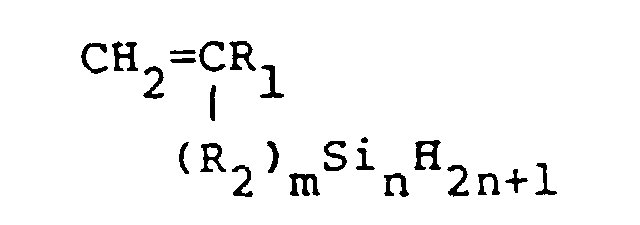
- the silicon compound usable as a monomer in the present invention is represented by the following general formula: wherein m is 0 or a positive integer of 1 - 20, n stands for 1, 2 or 3, R 1 means hydrogen, an alkyl group, an aryl group or a halogen, for example, H, CH 3 , C 2 H 5 , i-C 3 H 7 , ⁇ ( ⁇ indicates a phenyl group. This definition will hereinafter be applied equally), ⁇ CH 3 , CH 2 ⁇ , F, Cl, Br or the like, R 1 having fewer carbon atoms is preferred and hydrogen is most preferable, R 2 denotes an alkylene or phenylene group, for example, CH 2 , ⁇ ( ⁇ indicates a phenylene group. This definition will hereinafter be applied equally.), CH 2 ⁇ or the like, and R 1 and R 2 may optionally contain one or more functional groups such as COOH, NH 2 , Cl and/or OH.
- These monomers which contain one or more silyl groups and pertain to the present invention namely, the silicon compounds may be prepared by various processes. Although not limiting particularly, processes such as those to be described by the following equations may be employed in the present invention by way of example.
- the processes (3), (4), (5) and (6) use SiH 4 as a starting material and especially, the processes (3) and (4) are hydrosilylating reactions in which a Group VIII metal is used as a catalyst. These processes can easily provide desired ⁇ -olefins containing one or more SiH 3 groups.
- SiH 4 is a new silicon-containing raw material whose demand has increased for polysilicon and amorphous silicon. It is now produced in a large volume and at a low price. This trend is expected to be enhanced further in the future (this also applies to Si 2 H 6 and Si 3 H 8 ). Two or more of these silicon compounds may be used in combination.
- the silicon-containing polymers according to the present invention are easy not only in their preparation but also in changing their processability (flow characteristics of their melts, their solubility in solvents) by controlling the type of the polymer or copolymer (random, block, alternating or graft) and/or the monomer composition, molecular weight and stereoregularity of the copolymer.
- the SiH 3 groups contained in the silicon-containing polymers of this invention are relatively stable, and even when placed in air, they are not oxidized easily at room temperature and may be oxidized barely at temperatures as high as about 100 - 200°C.
- the silicon-containing polymers according to the present invention are soluble in solvents and are thermoplastic. Their industrial utility is therefore great, and numerous application fields are expected for them, e.g., prepolymers for ceramics (SiC), binders for ceramics, surface treatment agents, water repellants, raw materials for IPN, semiconductors, photoresists, etc. Functions of these polymers make use of the high reactivity of Si-H bond and the electrical conductivity and optical splittability of Si-Si bond. Especially, the function employed favorably in the present invention resides in the reactivity of silyl group (SiH 3 ).
- the present invention can contribute greatly to the creation of new high functional materials which have not existed so far.
- the conversion of the silicon-containing compound of this invention into ceramics may be carried out basically in the same manner as in the use of conventional silicon-containing prepolymers, for example, a prepolymer having the following recurring units:
- a first method comprises applying an ordinary resin processing technique, such as injection molding or extrusion forming, to the silicon-containing high molecular weight compound of this invention in an inert gas like conventional thermoplastic polymers by making use of the high processability of the silicon-containing high molecular weight compound, thereby to shape the compound into a desired shape and then firing the thus-shaped body at an elevated temperature (500 - 2,500°C).
- an ordinary resin processing technique such as injection molding or extrusion forming
- Ceramics such as SiC and Si 3 N 4 require a large and expensive compression molding machine due to the adoption of such a shaping method that powder is generally compression-molded at an extremely high pressure (for example, an elevated pressure as high as 1,000 atm or even higher) and then sintered at a high temperature.
- an extremely high pressure for example, an elevated pressure as high as 1,000 atm or even higher
- products of complex configurations cannot be obtained due to the use of compression molding.
- the above method can solve such problems. Incidentally, it is of course possible to perform compression molding as in the conventional methods after the silicon-containing high molecular compound is fired into SiC powder at a high temperature.
- a second method can also reduce the drawbacks of conventional compression molding methods of ceramic powder.
- ceramics powder such as SiC powder or Si 3 N 4 powder is added to an extent not losing its processability.
- the thus-added SiC powder is expected to act like a binder and such an action is also expected to be shown by the silicon-containing high molecular compound containing a small amount of Si).
- Organic additives reported in the past include primarily mixtures obtained respectively by mixing lubricants such as polystyrene, styrenebutadiene copolymer and stearic acid with a plasticizer more susceptible to decomposition and evaporation such as diethyl phthalate at suitable ratios, those prepared by adding a thermosetting resin (phenol resin) to the former, those formed by mixing wax in thermosetting resins (phenol resins, epoxy resins, coumaron-indene resins), mixtures of monoolefin polymers and ethylene glycol, compositions composed principally of sublimable substances such as naphthalene, etc.
- lubricants such as polystyrene, styrenebutadiene copolymer and stearic acid with a plasticizer more susceptible to decomposition and evaporation such as diethyl phthalate at suitable ratios
- phenol resin thermosetting resin
- phenol resins epoxy resins
- the silicon-containing high molecular weight compound according to this invention on the other hand, a majority of the polymer is allowed to remain as SiC in the ceramics as compared with the above-mentioned additives. Fewer pores are hence formed in the ceramics, so that a greater bulk density is achieved. Furthermore, the silicon-containing high molecular weight compound acts like a binder so that molded products have high strength.
- the process essentially comprises a first step of mixing and kneading SiC or Si 3 N 4 powder with the silicon-containing high molecular weight compound as an additive, a second step of forming the resultant mixture, and a third step of sintering the thus-formed green body (including elimination of the additive and presintering).
- the ceramics powder and the silicon-containing high molecular compound are mixed.
- the amount of the silicon-containing high molecular compound to be added varies depending on its kind, other additive or additives to be employed simultaneously and the subsequent molding or forming method but may preferably be 0.01 wt.% - 200 wt.% with 0.1 wt.% - 50 wt.% being more preferred. If it is added in an unduly small amount, it is difficult to obtain a molded or otherwise shaped, sintered SiC body. If it is added too much on the contrary, the strength is reduced and the high-temperature oxidation resistance is also lowered.
- the second step comprises the forming of the mixture.
- various methods for example, including mechanical pressing, isostatic pressing, slip casting, doctor-blade forming, extrusion forming, injection molding, hot pressing, etc. These methods can all be employed.
- injection molding allows the exhibition of the effects of this invention to the greatest extent.
- Hot pressing and isostatic pressing can simultaneously effect sintering which will be described next.
- the third step is a sintering step of a formed or molded green body. It may be required to conduct elimination of additives (degreasing, binder removal, dewaxing) and presintering as pre-steps if necessary.
- the temperature of such pre-steps may generally range from room temperature to 500°C.
- the final sintering is practised in a temperature range of 500 - 2,500°C.
- the third process is useful in producing fibrous ceramics by spinning the silicon-containing high molecular compound into a fibrous shape like SiC fibers and then firing the thus-spun green fibers.
- the formation of the silicon-containing high molecular compound into fibers may be conducted basically in the same manner as the use of conventional polycarbosilanes, polysilastyrenes and the like, for example, prepolymers containing as recurring structural units.
- the silicon-containing high molecular compound of this invention is spun in an inert gas in accordance with any one of melt spinning, wet spinning and dry spinning methods, most preferably, a melt or dry spinning method by making use of the easy processability of the compound.
- the thus-obtained fibers are then subjected to surface oxidation or infusibilizing treatment in a temperature range of about 50 - 300°C in an oxygen-containing gas so as to prevent cohesion of the fibers.
- the treatment time varies depending on the temperature and the concentration of oxygen, but may be suitable from a range of from several seconds to several hours.
- the concentration of oxygen may range from 10 ppm to 100%. It is of course possible to omit this treatment depending on the nature of fibers as will be demonstrated in subsequent Examples.
- the fibers thus infusibilized are thereafter heated at about 800 - 2,000°C for several minutes to several tens hours in vacuo or in an atmosphere of an inert gas such as nitrogen, helium, neon, argon or krypton, thereby to form desired silicon carbide fibers.
- an inert gas such as nitrogen, helium, neon, argon or krypton
- a polycarbosilane composed of the following recurring units: is now used as a prepolymer for SiC fibers.
- the yield of the ceramics when formed into fibers is rather good, they are said to contain a lot of free carbon (about 10 wt.%).
- SiO 2 is said to mix in (to about 20 wt.%) during the infusibilizing treatment applied in the course of the spinning step. They are considered to give deleterious effects to the strength of fibers.
- the process of this invention for the production of silicon carbide fibers by firing the silicon-containing high molecular weight compound permits suitable oxidation and infusibilization of the surfaces of the spun polymer by controlling the amount of oxygen (oxygen concentration) in an oxygen-containing gaseous atmosphere in which the infusibilization treatment is applied, and the temperature for the infusibilization treatment, because the silicon-containing high molecular compound contains silyl groups (SiH 3 groups) having high reactivity with oxygen. Namely, in the process of this invention, some Si-H bonds of silyl groups (SiH 3 groups) on the surface are oxidized and crosslinked by siloxane bonds. It is hence possible to obtain fibers of high properties, i.e., containing less incorporated oxygen and less silica compared with the use of a conventional polycarbosilane.
- the infusibilization treatment may be carried out with a nitrogen-containing compound by making use of the fact that silyl groups are highly reactive with N-H bonds.
- nitrogen-containing compound means at least one N-H bond per molecule. Specifically, it includes NH 3 , NH 2 NH 2 , CH 3 NH 2 , C 2 H 5 NH 2 , n-C 3 H 7 NH 2 , n-C 4 H 9 NH 2 , n-C 6 H 13 NH 2 , Among them, those having a lower boiling point and fewer carbon atoms are desirable.
- spun fibers When it is desired to effect the infusibilization treatment in a liquid phase, for example, spun fibers may be immersed for a predetermined period of time in a solution of the above-mentioned nitrogen-containing compound.
- a solution of the above-mentioned nitrogen-containing compound for example, spun fibers may be immersed for a predetermined period of time in a solution of the above-mentioned nitrogen-containing compound.
- benzene, toluene, xylene, hexane, heptane, ether, dioxane or the like as a solvent and an alkali metal or an alkali metal amide as a catalyst.
- the reaction temperature may preferably range from 0 to 200°C in general.
- the treatment time varies depending on the reaction time, but may generally range from several tens seconds to several hours.
- the nitrogen-containing compound When it is desired to conduct the infusibilization treatment in a vapor phase on the other hand, it is desirable to use as the nitrogen-containing compound a low boiling-point compound such as NH 3 , CH 3 NH 2 or C 2 H 5 NH 2 .
- the reaction temperature may generally range from 0°C to 500°C, with a range of 50 - 400°C being preferred.
- the treatment time varies depending on the reaction temperature as mentioned above. It is also possible to use a catalyst. Needless to say, the amount of remaining SiO 2 can be reduced significantly by the above infusibilization treatment which makes use of the nitrogen-containing compound.
- the fourth process comprises impregnating a sintered body of a silicon-containing ceramic material such as SiC or Si 3 N 4 with a solution of the silicon-containing high molecular compound of this invention and then firing the thus-impregnated sintered body.
- a silicon-containing ceramic material such as SiC or Si 3 N 4
- a solution of the silicon-containing high molecular compound of this invention firing the thus-impregnated sintered body.
- the high molecular weight organosilicon compound is fired at a high temperature to produce SiC.
- This invention is therefore not necessarily limited to the first - fourth processes described above.
- the resultant product was 13.1 g heavy (yield: 92%), and the viscosity of the product was 2.5 cps at 20°C.
- the viscosity of the product was 2.5 cps at 20°C.
- It had a molecular weight range of about 5,000 - 17,000.
- the resultant product was 9.8 g heavy (yield: 46%), and the viscosity of the product was 1.9 cps at 20°C. As a result of its analysis by liquid chromatography, it had a molecular weight range of about 1,000 - 10,000.
- the resultant polymer was in the form of white powder and its weight was 39.8 g.
- the Si content of the polymer was 15 wt.%.
- the polymer had a molecular weight range of about 5,000 - 15,000.
- the thus-obtained polymer was 125 g heavy and had an Si content of 17 wt.%.
- the polymer had a molecular weight range of about 5,000 - 15,000.
- the resultant polymer was in the form of white powder and its weight was 33.2 g.
- the Si content of the polymer was 16 wt.%.
- the polymer had a molecular weight range of about 3,000 - 10,000.
- 36.7 g of the vinylsilane, 1 g of a titanium trichloride base catalyst for the polymerization of olefins (product of Toho Titanium Company, Limited), 3.3 ml of Al(i-C 4 H 9 ) 3 and 150 ml of n-heptane were charged in an autoclave whose capacity was 200-ml. They were reacted at 70°C for 4 hours. After completion of the reaction, the reaction mixture was added to methanol, thereby removing catalyst residue from the resultant polymer and at the same time causing the polymer to crystalize out.
- the thus-obtained polymer was 19 g heavy.
- the polymer was stable at room temperature in air. At about 150°C, SiH 3 groups were lost suddenly, and siloxane bonds were formed. The degree of its crystallinity was about 60% and its melting point was 170 - 180°C. Its average molecular weight was about 100,000 (by the viscosity method; each subsequent average molecular weight will be by the same method).
- Polyvinyldisilane was obtained by using vinyl-disilane as a monomer in Example 7. The polymer was fired in the same manner as in Example 7.
- Polymer evaluation was conducted in the same manner as in Example 7 except that permethylpolysilane (product of Shin Nisso Kako Co., Ltd.; average molecular weight: about 2,000) having the following recurring units: and polycarboxysilane having the following recurring units: (which had been obtained by heating and firing permethylpolysilane at 400°C and 100 atm in an autoclave) were used separately as polymers.
- permethylpolysilane product of Shin Nisso Kako Co., Ltd.; average molecular weight: about 2,000
- polycarboxysilane having the following recurring units: (which had been obtained by heating and firing permethylpolysilane at 400°C and 100 atm in an autoclave) were used separately as polymers.
- the bulk specific gravity of the resultant crucible was 3.12.
- the crucible had a service life improved significantly compared with conventional SiC crucibles.
- single crystals obtained by the pulling method contained extremely little impurities.
- the bulk specific gravity of the thus-obtained sintered body was 3.04.
- the rod-like sintered body was used as a heating element, it fully withstood the actual use and compared with conventional SiC heating elements, had a longer service life.
- the bulk specific gravity of the thus-obtained sintered body was 3.04.
- the rod-like sintered body was used as a heating element, it fully withstood the actual use and compared with conventional SiC heating elements, had a longer service life.
- the bulk specific gravity of the thus-obtained crucible was 3.09.
- the crucible had a service life improved significantly compared with conventional SiC crucibles.
- single crystals obtained by the pulling method contained extremely little impurities.
- the resultant mixture was heated and formed into a plate-like shape at 150°C in nitrogen gas. In a vacuum, the plate-like green body was heated gradually from room temperature to 1,500°C, followed by firing at 1,800°C for 5 hours.
- the bulk specific gravity of the thus-obtained sintered body was 3.02.
- the impact fracture strength of the sintered body was above 3 times compared with that (bulk specific gravity: 2.94) obtained by using polystyrene in lieu of the silicon-containing polymer (c).
- Polyvinylsilane (e) which had been obtained by polymerizing vinylsilane in the presence of AIBN as a radical polymerization initiator and had an average molecular weight of about 20,000, was spun by the melt-spinning method.
- the thus-spun fibers were subjected to a infusibilizing treatment at 180°C in air, whereby fibers having a diameter of 10 ⁇ m and made of a high molecular organosilicon compound were obtained.
- Those fibers were pre-heated in a vacuum (1 x 10 -3 mmHg) by raising its temperature to 1,000°C over 10 hours.
- Polypropenylsilane and polybutenylsilane obtained separately in the same manner as in Examples 10 and 11 were individually dissolved in toluene. They were separately spun by the dry spinning method, so that fibers having a diameter of 10 ⁇ m and made of high molecular organosilicon compounds respectively were obtained. Those fibers were treated in the same manner as in Example 17, thereby obtaining silicon carbide fibers.
- SiC fibers were obtained in the same manner as in Example 17 except that the polyvinylsilane (e) was spun by the melt spinning method and then caused to pass for their infusibilization through a dioxane solution maintained at 40°C and containing 40 wt.% of n-propylamine and 5 wt.% of potassium (time of contact: about 10 minutes).
- SiC fibers were obtained in the same manner as in Example 17 except for the use of polycarbosilane of the same kind as that employed in Comparative Example 2.
- Example 13 The crucible obtained. in Example 13 was immersed at room temperature for 2 days in a benzene solution which contained the oily polyvinylsilane (c) at a concentration of 50 wt.%. Benzene was then eliminated. The crucible was thereafter heated in a vacuum while gradually raising the temperature from room temperature to 1,500°C, followed by firing at 1,800°C for 4 days. This operation was repeated three times. The bulk specific density was 3.15. The mechanical strength of the crucible was about twice as strong as the crucible obtained in Example 13 before its treatment, thereby improving the service life considerably.
- a benzene solution which contained the oily polyvinylsilane (c) at a concentration of 50 wt.%. Benzene was then eliminated.
- the crucible was thereafter heated in a vacuum while gradually raising the temperature from room temperature to 1,500°C, followed by firing at 1,800°C for 4 days. This operation was repeated three times.
- the bulk specific density was 3.15.
- This invention provides a process for the production of novel silicon-containing polymers which are useful industrially. Specifically, this invention primarily features inexpensive monomers and their economical polymerization process.
- various functions are expected, especially, including prepolymers for ceramics (SiC), modifiers for various polymers, raw materials for IPN, surface treatment agents, etc. by way of example.
- functions such as crosslinkability, foamability and reactivity with other monomers or polymers may be imparted to conventional polymers such as styrene and polyvinyl chloride, especially, by using the reactivity of silyl groups, thereby making a significant contribution to the creation of new high function materials.
- the present invention also provides novel silicon-containing high molecular weight compounds containing the above-mentioned silyl groups and a process for the production of silicon carbide ceramics by using the high molecular compounds as prepolymers.
- the prepolymers containing silyl groups which are useful in the present invention, are excellent in plasticity, solvent solubility and the like and permit easy processing. Moreover, they enjoy higher ceramics yields compared with conventional prepolymers (polysilane, polycarbosilane, etc.). In addition, little free carbon is contained in ceramics to be obtained upon firing.
- the prepolymers have such excellent characteristic features.
- the specific, easily-processable, silicon-containing, high-molecular compounds specified in the present invention are used as prepolymers. It is hence possible to obtain molded ceramics bodies of silicon carbide having a desired shape by molding or otherwise forming the high-molecular compounds either as is or subsequent to their mixing and kneading with ceramics powder and then firing the thus-molded or formed green bodies.
- the fibers When SiC fibers or the like are produced in particular, the fibers have smaller silica or carbon content compared with conventional fibers obtained by using polycarbosilane as a prepolymer, thereby exhibiting high-temperature strength far superior to conventional SiC fibers.
Landscapes
- Chemical & Material Sciences (AREA)
- Organic Chemistry (AREA)
- Engineering & Computer Science (AREA)
- Chemical Kinetics & Catalysis (AREA)
- Ceramic Engineering (AREA)
- Health & Medical Sciences (AREA)
- Polymers & Plastics (AREA)
- Medicinal Chemistry (AREA)
- Materials Engineering (AREA)
- Inorganic Chemistry (AREA)
- Structural Engineering (AREA)
- Manufacturing & Machinery (AREA)
- General Health & Medical Sciences (AREA)
- General Chemical & Material Sciences (AREA)
- Ceramic Products (AREA)
- Silicon Polymers (AREA)
- Addition Polymer Or Copolymer, Post-Treatments, Or Chemical Modifications (AREA)
Abstract
Description
- This invention relates to a process for the preparation of silicon-containing polymers by subjecting certain specific alkenylsilanes to anionic coordination, radical or ionic polymerization, and a process for the production of silicon carbide by firing some specific polyolefins which contain silyl groups in side chains. It also relates to novel silicon-containing polymers.
- "Organosilicon compound" is a generic term for compounds which generally contain one or more Si-C bonds. The organosilicon-related chemical industry is now growing rapidly, as typified by silicones (polyorganosiloxanes). Several processes are known for the preparation of organosilicon compounds. The following processes may be mentioned as representative ones.


- The process (1) is Rochow's direct process, in which an organosilicon compound is prepared directly from metallic silicon and a halogenated hydrocarbon. It is a process useful for the preparation of alkylchlorosilanes, which are the most important basic starting materials in the present organosilicon industry. As halogenated hydrocarbons RCl, methyl chloride and chlorobenzene are used industrially. Other halogenated hydrocarbons give unduly low yields and are hence not suitable for industrial application.
- Process (2) is a Grignard process while process (3) is a dechlorination process making use of metallic sodium. These processes permit introduction of a desired alkyl group but Grignard reagents and metallic sodium are expensive and uneconomical.
- Process (4) is addition of a silane to an alkene. It is accompanied by a serious problem that its raw material is limited to HSiCl3, CH3SiHCl2 byproduced in the direct process, or the like.
- The processes (5) and (6) both involve high-temperature reactions and their raw materials are extremely limited, for example, to

- As has been mentioned above, basic raw materials of the present organosilicon industry are mostly methyl- or phenylchlorosilanes. Using these silicon compounds as starting raw materials, various functional materials such as silicones, silane coupling agents and silylating agents have been developed.
- However, the conventional processes of the organosilicon industry, which employ chlorosilanes as basic raw materials, are generally accompanied by the following problems. Firstly, process equipment is subjected to considerable corrosion since the raw materials contain chlorine so that hydrogen chloride is given off. Secondly, the processes involve many reaction steps and are hence complex. Thirdly, methylchlorosilanes are used principally due to a raw-material-related limitation and at least one of the alkyl groups is required to be a methyl group.
- The current principal application of silicon-containing polymers in the industry is as silicones (organopolysiloxanes). Their raw materials are alkylchlorosilanes produced by the reaction of metallic silicon and their corresponding halogenated hydrocarbons, namely, by the so-called direct process, in particular, dimethyldichlorosilane. Besides silicones, there are only a few practical application examples of silicon-containing polymers. The following silicon-containing polymers are examples of known materials:
- (a) Permethylpolysilanes:

- (b) Polysilastyrenes:

- (c) Polycarbosilanes:

- (d) Polyvinylalkoxysilanes:

The polymers (a) are prepared in a solvent such as xylene as shown by the following equation:
This is also applied to the polymers (b). Although the polymers (a) are insoluble and infusible, the polymers (b) are soluble in solvents and thermoplastic. The polymers (c) are obtained by subjecting the polymers (a) to pyrolysis at high temperature and pressure, and are soluble in solvents and thermoplastic. The polymers (a), (b) and (c) are employed as ceramics binders, and the polymers (b) and (c) are employed as precursors for ceramics (SiC), especially, for ceramic (SiC) fibers ("NICARON", trade mark; product of Nippon Carbon Co., Ltd.). - The preparation of silicon-containing polymers, for example, the above-mentioned polymers (a), (b) and (c) from conventional alkylchlorosilanes as raw materials is however practiced in chlorine-containing systems, so that the potential danger of corrosion of apparatus is involved. Moreover, their preparation processes are extremely complex. The polymers (d) are polymers of vinylsilane. The copolymers of vinylsilane with ethylene are used in a large volume for coating electrical wires and cables in the form of polyethylenes cross-linkable with water.
- Polymers of alkenylsilanes have not been reported except for only one case in which allylsilane (CH2=CH=CH2-SiH3) was subjected to polymerization (anionic coordination polymerization) in the presence of a Ziegler catalyst [Journal of Polymer Science, 31, No. 122, 181(1958); Italian Patent 606,018].
- Considerable technological development has been made with respect to silicon-containing ceramics in recent years. For example, silicon carbide (SiC), silicon nitride (Si3N4), Cyalon, Si-Ti-C-O ceramics ("Tylano Fibers", product of Ube Industries, Ltd.), SiC-B4C ceramics, Si3N4-SiC composite ceramics and the like have attracted attention as so-called fine ceramics.
- Among these, silicon carbide is available in various forms such as powder, whiskers and fibers. It has been produced by various processes. For example, there are direct carbonization, reduction carbonization, vapor-phase synthesis, pyrolysis of silicon compounds, etc.
- Direct carbonization comprises reduction of metallic silicon with coke at an elevated temperature (1400 - 2600°C) and is hence economical. Fine silica SiO2 powder is however indispensable for obtaining fine SiC crystals excellent in sinterability. The reaction is exothermic and its control is hence difficult.
- Reduction carbonization features reduction of SiO2 with coke. By reacting them at 1,500 - 2,000°C in argon, β-SiC is obtained. On the other hand, α-SiC is obtained by the Acheson process which is similar to reduction carbonization. Reduction carbonization is employed principally these days in the industry.
- In vapor-phase synthesis, a hydrocarbon is reacted with SiCl4, SiH4 or the like at 1,200°C or higher so that silicon carbide is obtained with high purity and in the form of ultrafine powder. However, the raw material is costly and the productivity is low.
- Ceramics obtained by the above-described processes are all powdery. In order to obtain shaped products from them, it is hence necessary to press and process them in the presence of a sintering agent at elevated temperature and pressure. Their processing requires an extremely large press. In addition, limitations are imposed on their shaping and processing so that products of complex configurations can hardly be fabricated.
- Pyrolysis of silicon compounds features easy processing, and also features pyrolyzing, as ceramics prepolymers, linear or cyclic silicon-containing high-molecular compounds having such recurring structural units as exemplified below.
- (a) Permethylpolysilanes:

- (b) Polysilastyrenes:

- (c) Polycarbosilanes:

- The polycarbosilanes are obtained by the pyrolysis of permethylpolysilanes or various organosilicon compounds, for example, tetramethylsilane, dimethyldichlorosilane and dodecamethylcyclohexasilane. They are fusible and also soluble in organic solvents such as benzene. As a polycarbosilane produced presently and industrially by pyrolysis, there are SiC fibers ("NICARON", trade mark; product of Nippon Carbon Co., Ltd.). The above fibers are produced in accordance with equations (A), (B) and (C) to be described below, by using as a starting material dimethyldichlorosilane obtained by the direct process. As high-strength fibers excellent in heat resistance, their future demand as a reinforcing material for resins, metals and ceramics is expected to increase [Chemistry Letters, 551(1976); Japanese Patent Publication No. 26527/1982; Japanese Patent Publication No. 53892/1982; Japanese Patent Publication No. 38548/1982].


- It is the problem of the above process that the production steps are complex. Especially, in the step (A), the removal of unreacted sodium is cumbersome because metallic sodium is used in a solvent, and fractionation of polymers (separation and-removal of low molecular-weight polycarbosilanes) is required. In the reaction of the step (B), the reaction has to be carried out at high temperature and pressure (400°C, 100 atm). In addition, the overall yield is low [especially, in the steps (B) and (C)], and free carbon and silica which are contained in at substantial levels in final products give deleterious effects to the physical properties of the final products.
- EP-A-41,839 discloses film-forming polymers prepared by Ziegler-Natta copolymerisation of an allylsilane CH2=CH-CH2-SiR3 and an alkene.
- US-A-4,546,163 discloses polysilanes having the average formula (R2Si) (RSi) (Rd(CH2=CH)Si) produced by reacting at least one disilane (RbXcSi)2 with at least one silane Rd(CH2=CH)SiX3-d where R=alkyl and X=Cl or Br. They may be pyrolysed to form SiC-containing ceramics.
- An object of this invention is to provide a novel polymerization process of a polymer containing silyl groups and the polymer containing silyl groups.
- A further objection of this invention is to provide a process for producing silicon carbide of good physical properties in a high yield and economically.
- A novel silicon-containing high molecular weight compound of this invention has recurring structural units represented by the following general formula:

- By anionic coordination polymerization (where n is 2 or 3 and m is 0 or a positive integer of 1 - 20) or radical polymerization or ionic polymerization (where n stands for 1, 2 or 3) of an organosilicon compound represented by the following general formula:

- Further, silicon carbide is produced by firing at a temperature in a range of 500° - 2,500°C a silicon-containing high-molecular weight compound having recurring structural units represented by the following general formula:

- In the drawings, Figure 1 is an infrared absorption spectrum of the silicon-containing polymer obtained in Example 11, and Figure 2 is an infrared absorption spectrum of the silicon-containing polymer obtained in Example 12.
- A description will next be made of the process for the preparation of the silicon-containing high molecular compound having recurring structural units represented by the following general formula:

- Where n stands for 1 and m is a positive integer of 5 - 20 or n stands for 2 or 3 and m is 0 or a positive integer of 1 - 20 in the above formula, the silicon-containing high molecular compound is a novel compound and has been proposed for the first time by the present invention. In the above formula, R1 is hydrogen, a halogen, or preferably, the above-described group having 1 - 20 carbon atoms, for example, -CH3, -C2H5, -n-C3H7, CH2Cl, -n-C4H9, -iso-C4H9,


- The silicon-containing high molecular compound may be obtained, for example, by subjecting an α-olefin CH2=CR1[(R2)mSinH2n+1] to anionic coordination polymerization, radical polymerization or ionic polymerization. Namely, its preparation may be achieved in various ways, for example, by subjecting the α-olefin to anionic coordination polymerization in the presence of a Ziegler-Natta catalyst (a catalyst composed of a salt of a transition metal such as titanium halide, vanadium halide or zirconium halide and an alkylaluminum); by subjecting the α-olefin to cationic polymerization in the presence of a catalyst such as metal oxide (Cr2O3, SiO2, Al2O3 or the like), a hydroacid (H2SO4, H3PO4, HClO4, HCl or the like), or Lewis acid (BF3, AlCl3, FeCl3, SnCl4, or the like); by subjecting the α-olefin to anionic polymerization in the presence of a catalyst such as alkali metal (Li, Na, K or the like), alkylalkali [C2H5Na, (C2H5)3Al, C6H5Li or the like], or hydroxide (NaOH, KOH, or the like); or by subjecting the α-olefin to radical polymerization in the presence of a peroxide as an initiator. Needless to say, the polymerization may be practised in either vapor phase or liquid phase and either with a solvent or without any solvent (bulk polymerization). In such polymerization, the molecular weight of the resulting polymer may be regulated easily with hydrogen or the like which is allowed to exist concurrently.
- Describing the radical polymerization in further detail, no particular limitation is imposed on the manner of the radical polymerization and various methods may be adopted. For example, use of heat, light, radiation, electricity, catalyst (initiator) or the like is feasible. It is however most preferable to use a catalyst. As exemplary catalysts, may be mentioned hydrogen peroxide, ammonium persulfate, benzoyl peroxide, cumene peroxide, cyclohexane peroxide, di-t-butyl peroxide, t-butyl hydroperoxide, methyl ethyl ketone peroxide, azobisisobutylonitrile and the like.
- In the above polymerization, it is also possible to additionally use dimethylaniline, Co or Mn naphthenate or the like as a cocatalyst (promoter); and/or sodium hyposulfite, sodium thiosulfate, mercaptan, ferrous (Fe++) salt, cuprous (Cu+) salt or the like as an activator (reducing agent).
- For the control of the reaction velocity, it is possible to use mercaptan or its analogous compound or an aromatic nitro compound as a reaction decellerator. Mercaptan or its analogous compound may also be used as polymerization degree regulator. A variety of crosslinking agents may also be used. Crosslinking may be effected as desired, for example, by copolymerization with a monomer such as (CH2=CH)2SiH2 or (CH2=CH)3SiH.
- No particular limitation is imposed on the manner of the polymerization. The polymerization may be performed in either vapor phase or liquid phase, and a polymerization method such as bulk polymerization, solution polymerization, suspension polymerization or emulsion polymerization may be used. The reaction temperature and reaction pressure vary depending on the manner of the polymerization and the monomers to be reacted. When a catalyst is used, the reaction temperature may be 0 - 200°C, preferably, 20 - 150°C. The higher the reaction pressure, the better from the standpoint of equilibrium. It may range from atmospheric pressure to 1,000 atm. It is also feasible to conduct the polymerization by using a solvent such as benzene, toluene, xylene, pentane, dimethylformamide, chloroform or water.
- Regarding the radical polymerization in this invention, the structure of the polymer is not limited particularly. Its recurring units, molecular weight, molecular weight distribution, crosslinking degree and the like may vary depending on the kind of the monomer and the manner of polymerization. As the most representative polymer structure, the following recurring unit may be given by way of example.

- Where n = 1 in the silicon-containing high molecular compound, the radical polymerization may be carried out in the same manner as in the case of n=2 or 3.
- Needless to say, polymerizable silicon compounds useful in the practice of this invention may be copolymerized (random, alternating, block, graft, or the like) with other polymerizable monomers, for example, ethylene, propylene, butene, butadiene, styrene, vinyl chloride, vinylidene chloride, acrylic esters, methyl methacrylate, vinyl acetate, acrylonitrile and ethylene tetrafluoride. The proportion of such a monomer may be chosen as desired depending on the purpose of use of the resulting copolymer. The unsaturated hydrocarbon may be used in a proportion of 0.00001 - 100,000 parts by weight, preferably, 0.001 - 1,000 parts by weight per part by weight of the silicon compound.
- The silicon compound usable as a monomer in the present invention is represented by the following general formula:
- These monomers which contain one or more silyl groups and pertain to the present invention, namely, the silicon compounds may be prepared by various processes. Although not limiting particularly, processes such as those to be described by the following equations may be employed in the present invention by way of example.


- Among the above processes, the processes (3), (4), (5) and (6) use SiH4 as a starting material and especially, the processes (3) and (4) are hydrosilylating reactions in which a Group VIII metal is used as a catalyst. These processes can easily provide desired α-olefins containing one or more SiH3 groups. In recent years, SiH4 is a new silicon-containing raw material whose demand has increased for polysilicon and amorphous silicon. It is now produced in a large volume and at a low price. This trend is expected to be enhanced further in the future (this also applies to Si2H6 and Si3H8). Two or more of these silicon compounds may be used in combination.
- The silicon-containing polymers according to the present invention are easy not only in their preparation but also in changing their processability (flow characteristics of their melts, their solubility in solvents) by controlling the type of the polymer or copolymer (random, block, alternating or graft) and/or the monomer composition, molecular weight and stereoregularity of the copolymer. In addition, the SiH3 groups contained in the silicon-containing polymers of this invention are relatively stable, and even when placed in air, they are not oxidized easily at room temperature and may be oxidized barely at temperatures as high as about 100 - 200°C.
- The silicon-containing polymers according to the present invention are soluble in solvents and are thermoplastic. Their industrial utility is therefore great, and numerous application fields are expected for them, e.g., prepolymers for ceramics (SiC), binders for ceramics, surface treatment agents, water repellants, raw materials for IPN, semiconductors, photoresists, etc. Functions of these polymers make use of the high reactivity of Si-H bond and the electrical conductivity and optical splittability of Si-Si bond. Especially, the function employed favorably in the present invention resides in the reactivity of silyl group (SiH3). It is possible to incorporate an interesting function in conventional polymers such as polystyrene, polyvinyl chloride and polymethacrylic acid , for example, to impart crosslinkability, foamability or reactivity with other monomer or polymer by taking the silicon compound partly in the polymers through copolymerization. Namely, the present invention can contribute greatly to the creation of new high functional materials which have not existed so far.
- A description will next be made of the process for the production of silicon carbide by firing the silicon-containing high molecular compound at elevated temperatures (converting the compound into ceramics).
- The conversion of the silicon-containing compound of this invention into ceramics may be carried out basically in the same manner as in the use of conventional silicon-containing prepolymers, for example, a prepolymer having the following recurring units:

- The manner of conversion into ceramics will hereinafter be described in detail.
- A first method comprises applying an ordinary resin processing technique, such as injection molding or extrusion forming, to the silicon-containing high molecular weight compound of this invention in an inert gas like conventional thermoplastic polymers by making use of the high processability of the silicon-containing high molecular weight compound, thereby to shape the compound into a desired shape and then firing the thus-shaped body at an elevated temperature (500 - 2,500°C).
- Ceramics such as SiC and Si3N4 require a large and expensive compression molding machine due to the adoption of such a shaping method that powder is generally compression-molded at an extremely high pressure (for example, an elevated pressure as high as 1,000 atm or even higher) and then sintered at a high temperature. In addition, products of complex configurations cannot be obtained due to the use of compression molding. The above method can solve such problems. Incidentally, it is of course possible to perform compression molding as in the conventional methods after the silicon-containing high molecular compound is fired into SiC powder at a high temperature.
- Similarly to the first method, a second method can also reduce the drawbacks of conventional compression molding methods of ceramic powder. In the second method, ceramics powder such as SiC powder or Si3N4 powder is added to an extent not losing its processability. Like the first method, it is then injection-molded or extrusion-formed, followed by firing at elevated temperatures (in this method, the thus-added SiC powder is expected to act like a binder and such an action is also expected to be shown by the silicon-containing high molecular compound containing a small amount of Si).
- Processes have conventionally been developed that ceramics powder and an additive such as easily-processable organic compound are mixed and after injection molding of the resultant mixture, the thus-molded green body is sintered at elevated temperatures (including elimination of the additive and presintering). Organic additives reported in the past include primarily mixtures obtained respectively by mixing lubricants such as polystyrene, styrenebutadiene copolymer and stearic acid with a plasticizer more susceptible to decomposition and evaporation such as diethyl phthalate at suitable ratios, those prepared by adding a thermosetting resin (phenol resin) to the former, those formed by mixing wax in thermosetting resins (phenol resins, epoxy resins, coumaron-indene resins), mixtures of monoolefin polymers and ethylene glycol, compositions composed principally of sublimable substances such as naphthalene, etc. The most serious problem in the present injecting molding processes resides in that there is a limitation to the strength of molded or otherwise shaped products for the formation of pores in the ceramics in the additive (resin) elimination step and other reasons.
- In the case of the silicon-containing high molecular weight compound according to this invention on the other hand, a majority of the polymer is allowed to remain as SiC in the ceramics as compared with the above-mentioned additives. Fewer pores are hence formed in the ceramics, so that a greater bulk density is achieved. Furthermore, the silicon-containing high molecular weight compound acts like a binder so that molded products have high strength.
- The process essentially comprises a first step of mixing and kneading SiC or Si3N4 powder with the silicon-containing high molecular weight compound as an additive, a second step of forming the resultant mixture, and a third step of sintering the thus-formed green body (including elimination of the additive and presintering).
- In the first step, the ceramics powder and the silicon-containing high molecular compound are mixed. Here, it is possible to use two or more silicon-containing high molecular compounds. It is also possible to employ one or more silicon-free other additives (thermoplastic resins, plasticizers, lubricants, aids) at the same time as described above. The amount of the silicon-containing high molecular compound to be added varies depending on its kind, other additive or additives to be employed simultaneously and the subsequent molding or forming method but may preferably be 0.01 wt.% - 200 wt.% with 0.1 wt.% - 50 wt.% being more preferred. If it is added in an unduly small amount, it is difficult to obtain a molded or otherwise shaped, sintered SiC body. If it is added too much on the contrary, the strength is reduced and the high-temperature oxidation resistance is also lowered.
- The second step comprises the forming of the mixture. There are various methods, for example, including mechanical pressing, isostatic pressing, slip casting, doctor-blade forming, extrusion forming, injection molding, hot pressing, etc. These methods can all be employed. Among these, injection molding allows the exhibition of the effects of this invention to the greatest extent. Hot pressing and isostatic pressing can simultaneously effect sintering which will be described next.
- The third step is a sintering step of a formed or molded green body. It may be required to conduct elimination of additives (degreasing, binder removal, dewaxing) and presintering as pre-steps if necessary. The temperature of such pre-steps may generally range from room temperature to 500°C. The final sintering is practised in a temperature range of 500 - 2,500°C.
- The third process is useful in producing fibrous ceramics by spinning the silicon-containing high molecular compound into a fibrous shape like SiC fibers and then firing the thus-spun green fibers.
- In the present invention, the formation of the silicon-containing high molecular compound into fibers may be conducted basically in the same manner as the use of conventional polycarbosilanes, polysilastyrenes and the like, for example, prepolymers containing

- Namely, the silicon-containing high molecular compound of this invention is spun in an inert gas in accordance with any one of melt spinning, wet spinning and dry spinning methods, most preferably, a melt or dry spinning method by making use of the easy processability of the compound.
- The thus-obtained fibers are then subjected to surface oxidation or infusibilizing treatment in a temperature range of about 50 - 300°C in an oxygen-containing gas so as to prevent cohesion of the fibers. The treatment time varies depending on the temperature and the concentration of oxygen, but may be suitable from a range of from several seconds to several hours. The concentration of oxygen may range from 10 ppm to 100%. It is of course possible to omit this treatment depending on the nature of fibers as will be demonstrated in subsequent Examples.
- The fibers thus infusibilized are thereafter heated at about 800 - 2,000°C for several minutes to several tens hours in vacuo or in an atmosphere of an inert gas such as nitrogen, helium, neon, argon or krypton, thereby to form desired silicon carbide fibers.
As merits of the process of this invention for the preparation of silicon carbide fibers, may be mentioned that as will be described in the subsequent Examples, the yield of the ceramics(SiC) is extremely high and that the fibers contain extremely little free carbon after their firing. - For example, a polycarbosilane composed of the following recurring units:

- The process of this invention for the production of silicon carbide fibers by firing the silicon-containing high molecular weight compound permits suitable oxidation and infusibilization of the surfaces of the spun polymer by controlling the amount of oxygen (oxygen concentration) in an oxygen-containing gaseous atmosphere in which the infusibilization treatment is applied, and the temperature for the infusibilization treatment, because the silicon-containing high molecular compound contains silyl groups (SiH3 groups) having high reactivity with oxygen. Namely, in the process of this invention, some Si-H bonds of silyl groups (SiH3 groups) on the surface are oxidized and crosslinked by siloxane bonds. It is hence possible to obtain fibers of high properties, i.e., containing less incorporated oxygen and less silica compared with the use of a conventional polycarbosilane.
- As a further feature of the silicon-containing high molecular compounds according to the present invention, the infusibilization treatment may be carried out with a nitrogen-containing compound by making use of the fact that silyl groups are highly reactive with N-H bonds. The term "nitrogen-containing compound" as used herein means at least one N-H bond per molecule. Specifically, it includes NH3, NH2NH2, CH3NH2, C2H5NH2, n-C3H7NH2, n-C4H9NH2, n-C6H13NH2,


- When it is desired to effect the infusibilization treatment in a liquid phase, for example, spun fibers may be immersed for a predetermined period of time in a solution of the above-mentioned nitrogen-containing compound. In this case, it is possible to use benzene, toluene, xylene, hexane, heptane, ether, dioxane or the like as a solvent and an alkali metal or an alkali metal amide as a catalyst. The reaction temperature may preferably range from 0 to 200°C in general. The treatment time varies depending on the reaction time, but may generally range from several tens seconds to several hours. When it is desired to conduct the infusibilization treatment in a vapor phase on the other hand, it is desirable to use as the nitrogen-containing compound a low boiling-point compound such as NH3, CH3NH2 or C2H5NH2. The reaction temperature may generally range from 0°C to 500°C, with a range of 50 - 400°C being preferred. The treatment time varies depending on the reaction temperature as mentioned above. It is also possible to use a catalyst. Needless to say, the amount of remaining SiO2 can be reduced significantly by the above infusibilization treatment which makes use of the nitrogen-containing compound.
- It is also feasible to conduct the infusibilization treatment in the presence of an alkali catalyst in water or an alcohol by making use of the fact that silyl groups are susceptible to splitting in an alkaline atmosphere.
- Reflecting the low carbon and silica contents of silicon carbide fibers according to this invention, they have much superior high-temperature strength to fibers obtained by conventional processes as will be demonstrated in Examples.
- The fourth process comprises impregnating a sintered body of a silicon-containing ceramic material such as SiC or Si3N4 with a solution of the silicon-containing high molecular compound of this invention and then firing the thus-impregnated sintered body. By this process, the mechanical strength of the sintered ceramic body is enhanced. This process is particularly effective in improving the mechanical strength of a sintered body which has been obtained in accordance with the first or second process described above and contain pores therein.
- It is the fundamental feature of the present invention that the high molecular weight organosilicon compound is fired at a high temperature to produce SiC. This invention is therefore not necessarily limited to the first - fourth processes described above.
- Incidentally, it is not clear why the yield of the ceramics is high and less free carbon is contained in fibers in the process of the present invention. The Si-H bonds of SiH3 groups seem to be split first to induce crosslinking in the course of the pyrolysis, thereby making the starting material difficult to scatter out of the system, and the thus-released hydrogen appears to prevent the carbonization of the resulting polymer.
- This invention will hereinafter be described by the following Examples.
- In an autoclave whose capacity was 100 mℓ, were charged 14.2 g (260 mmol) of vinylsilane (CH2=CH-SiH3, b.p. -23°C) and 1.0 g of benzoyl peroxide as a polymerization initiator, followed by reaction at 80°C for 8 hours.
- After completion of the reaction, the autoclave was opened to obtain 13.6 g of a viscous product (yield: 96%). The viscosity of the product was 2.3 cps at 20°C. As a result of its analysis by liquid chromatography, it has a molecular weight range of about 4,000 - 15,000 (in terms of polystyrene). An IR analysis indicated an absorption peak characteristic to SiH3 groups (FIG. 1).
- An experiment was conducted in the same manner as in Example 1 except that 0.5 g of azobisisobutyronitrile (AIBN) was used as a polymerization initiator.
- The resultant product was 13.1 g heavy (yield: 92%), and the viscosity of the product was 2.5 cps at 20°C. As a result of its analysis by liquid chromatography, it had a molecular weight range of about 5,000 - 17,000. An IR analysis indicated an absorption peak characteristic to SiH3 groups (FIG. 2).
- An experiment was conducted in the same manner as in Example 1 except that 21.4 g (177 mmol) of 2-chloro-4-silyl-1-butene (CH2=CCl-CH2-CH2-SiH3) was used in place of vinylsilane.
- The resultant product was 9.8 g heavy (yield: 46%), and the viscosity of the product was 1.9 cps at 20°C. As a result of its analysis by liquid chromatography, it had a molecular weight range of about 1,000 - 10,000.
- Charged in a 100-ml autoclave were 15.1 g 260 mmol) of vinylsilane (CH2=CH-SiH3, b.p. -23°C) and 31.2 g (300 mmol) of styrene, followed by further charging of 1.2 of benzoyl peroxide as a polymerization initiator. Under hermetic condition, they were reacted at 80°C for 8 hours.
- After completion of the reaction, the autoclave was opened and its contents were poured into methanol under stirring. The resultant polymer was in the form of white powder and its weight was 39.8 g. The Si content of the polymer was 15 wt.%. The polymer had a molecular weight range of about 5,000 - 15,000.
- Charged in a 500-mℓ autoclave were 300 mℓ of water containing 0.3 g of polyvinyl alcohol dissolved therein, 0.2 g of lauroyl peroxide, 50 g of vinylsilane and 100 g of vinyl chloride. Under hermetic condition, they were reacted at 60°C for 8 hours.
- After completion of the reaction, the autoclave was opened, and the resultant white powder was washed with water and then dried. The thus-obtained polymer was 125 g heavy and had an Si content of 17 wt.%. The polymer had a molecular weight range of about 5,000 - 15,000.
- Charged in a 100-mℓ autoclave were 24.2 g 200 mmol) of 2-chloro-4-silyl-1-butene (CH2=CCl-CH2-CH2-SiH3), 31.2 g (300 mmol) of styrene and 0.5 g of AIBN (azobisisobutyronitrile) as a polymerization initiator, followed by reaction at 80°C for 8 hours under hermetic condition.
- After completion of the reaction, the autoclave was opened and its contents were poured into methanol under stirring. The resultant polymer was in the form of white powder and its weight was 33.2 g. The Si content of the polymer was 16 wt.%. The polymer had a molecular weight range of about 3,000 - 10,000.
- CH2=CH-SiCl3 was reduced with LiAlH4 to obtain CH2=CH-SiH3. In a nitrogen atmosphere, 36.7 g of the vinylsilane, 1 g of a titanium trichloride base catalyst for the polymerization of olefins (product of Toho Titanium Company, Limited), 3.3 mℓ of Al(i-C4H9)3 and 150 mℓ of n-heptane were charged in an autoclave whose capacity was 200-mℓ. They were reacted at 70°C for 4 hours. After completion of the reaction, the reaction mixture was added to methanol, thereby removing catalyst residue from the resultant polymer and at the same time causing the polymer to crystalize out. The thus-obtained polymer was 19 g heavy. As a result of its IR, elemental analysis and the like, it was confirmed to be a polymer having the following recurring structural units:

- Evaluation results of the polymer are shown in Table 1.
- Next, 0.5 g of the above polymer was placed in a silica-made firing tube whose inner diameter was 15 mm. In an argon stream (flow velocity: 50 mℓ/min), it was heated to 1,400°C at a heating rate of 5°C/min. The yield of the resultant ceramics was 55 wt.% (79% on Si basis). The thus-fired product was fired further to 2,000°C and was then analyzed by X-ray diffractometry. No diffraction peak characteristic to free carbon was observed.
- An experiment was conducted in the same manner as in Example 7 except that the heating rate was changed to 0.5°C/min upon firing the polymer.
- Results are also given in Table 1.
- In an autoclave whose capacity was 100 ml, were charged 14.2 g (260 mmol) of vinylsilane (CH2=CH-SiH3, b.p. -23°C) and 1.0 g of benzoyl peroxide as a polymerization initiator, followed by reaction at 80°C for 8 hours.
- After completion of the reaction, the autoclave was opened to obtain 13.6 g of a viscous product [polyvinylsilane (b)] (yield: 96%). The viscosity of the product was 2.3 cps at 20°C. As a result of its analysis by liquid chromatography, it had a molecular weight of about 3,000 (in terms of polystyrene). An IR analysis indicated an absorption peak characteristic to SiH3 groups. The polymer was evaluated in the same manner as in Example 7.
- Evaluation results of the polymer are shown in Table 1.
- Experiments were separately carried out in the same manner as in Example 7 except that propenylsilane and butenylsilane were used respectively as polymerization monomers in place of vinylsilane, thereby obtaining polymers having the following recurring structural units:

- Evaluation results of the polymer are shown in Table 1.
- Polyvinyldisilane was obtained by using vinyl-disilane as a monomer in Example 7. The polymer was fired in the same manner as in Example 7.
- Evaluation results are shown in Table 1.
- Polymer evaluation was conducted in the same manner as in Example 7 except that permethylpolysilane (product of Shin Nisso Kako Co., Ltd.; average molecular weight: about 2,000) having the following recurring units:


- Results are given in Table 1.
- Charged in an autoclave were 100 g of vinylsilane and 1 g of AIBN (azobisisobutyronitrile), followed by polymerization at 70°C for 8 hours to obtain about 90 g of a silicon-containing oily polymer (c) having an average molecular weight of about 2,000.
- Forty grams of commercial SiC powder of about 300 mesh on average and 5 g of the above polymer (c) were mixed and kneaded, and then compression-molded into a crucible-like shape. The compression-molded body was then heated in a vacuum while raising the temperature from room temperature to 1,500°C, followed by firing at 1,800°C for 4 hours.
- The bulk specific gravity of the resultant crucible was 3.12. When the crucible was used for melting polycrystalline silicon, the crucible had a service life improved significantly compared with conventional SiC crucibles. Moreover, single crystals obtained by the pulling method contained extremely little impurities.
- After mixing 6 g of the silicon-containing polymer (c) and 25 g of polystyrene with 40 g of SiC powder of the same kind as that employed in Example 13, the resultant mixture was heated and formed into a rod-like shape at 150°C in nitrogen gas. The rod-like green body was heated gradually from room temperature to 600°C under reduced pressure, followed by firing at 1,700°C for 5 hours in an argon atmosphere.
- The bulk specific gravity of the thus-obtained sintered body was 3.04. When the rod-like sintered body was used as a heating element, it fully withstood the actual use and compared with conventional SiC heating elements, had a longer service life.
- Two hundred grams of vinylsilane were polymerized at 70°C for 3 hours by using a titanium trichloride base catalyst for the polymerization of olefins, thereby obtaining 110 g of powdery polyvinylsilane (d).
- After mixing 10 g of the polyvinylsilane (d) with 40 g of SiC powder of the same kind as that employed in Example 13, the resultant mixture was formed into a rod-like shape under a pressure of 200 Kg/cm2. The rod-like green body was heated gradually from room temperature to 1,700°C under reduced pressure, followed by firing at 1,700°C for 5 hours in an argon atmosphere.
- The bulk specific gravity of the thus-obtained sintered body was 3.04. When the rod-like sintered body was used as a heating element, it fully withstood the actual use and compared with conventional SiC heating elements, had a longer service life.
- Two hundred grams of allylsilane were polymerized at 70°C for 3 hours by using a titanium trichloride base catalyst for the polymerization of olefins, thereby obtaining 150 g of powdery polyallylsilane.
- After mixing 6 g of the above polymer with 40 g of SiC powder of the same kind as that employed in Example 13, the resultant mixture was heated and molded into a crucible-like shape in nitrogen. In a vacuum, the crucible-like green body was heated gradually from room temperature to 1,500°C, followed by firing at 1,800°C for further 4 hours.
- The bulk specific gravity of the thus-obtained crucible was 3.09. When the crucible was used for melting polycrystalline silicon, the crucible had a service life improved significantly compared with conventional SiC crucibles. Moreover, single crystals obtained by the pulling method contained extremely little impurities.
- After mixing 10 g of the silicon-containing polymer (c) employed in Example 13 and 40 g of commercial Si3N4 powder of 400 mesh on average, the resultant mixture was heated and formed into a plate-like shape at 150°C in nitrogen gas. In a vacuum, the plate-like green body was heated gradually from room temperature to 1,500°C, followed by firing at 1,800°C for 5 hours.
- The bulk specific gravity of the thus-obtained sintered body was 3.02. The impact fracture strength of the sintered body was above 3 times compared with that (bulk specific gravity: 2.94) obtained by using polystyrene in lieu of the silicon-containing polymer (c).
- Polyvinylsilane (e), which had been obtained by polymerizing vinylsilane in the presence of AIBN as a radical polymerization initiator and had an average molecular weight of about 20,000, was spun by the melt-spinning method. The thus-spun fibers were subjected to a infusibilizing treatment at 180°C in air, whereby fibers having a diameter of 10 µm and made of a high molecular organosilicon compound were obtained. Those fibers were pre-heated in a vacuum (1 x 10⁻³ mmHg) by raising its temperature to 1,000°C over 10 hours. They were then heated in an argon gas atmosphere to 1,200°C, at which they were subjected to high-temperature firing for 2 hours to obtain SiC fibers. The ceramics yield was 48% in the production of the fibers. The tensile strength of the fibers was 750 Kg/mm2. The fired product was fired further at 2,000°C and was then analyzed by X-ray diffractometry. No diffraction peak characteristic of free carbon was observed.
- Polypropenylsilane and polybutenylsilane obtained separately in the same manner as in Examples 10 and 11 were individually dissolved in toluene. They were separately spun by the dry spinning method, so that fibers having a diameter of 10 µm and made of high molecular organosilicon compounds respectively were obtained. Those fibers were treated in the same manner as in Example 17, thereby obtaining silicon carbide fibers.
- Evaluation results are summarized in Table 2.
- SiC fibers were obtained in the same manner as in Example 17 except that the polyvinylsilane (e) was spun by the melt spinning method and then caused to pass for their infusibilization through a dioxane solution maintained at 40°C and containing 40 wt.% of n-propylamine and 5 wt.% of potassium (time of contact: about 10 minutes).
- Evaluation results are shown in Table 2.
- SiC fibers were obtained in the same manner as in Example 17 except for the use of polycarbosilane of the same kind as that employed in Comparative Example 2.
- Evaluation results are shown in Table 2.
- The crucible obtained. in Example 13 was immersed at room temperature for 2 days in a benzene solution which contained the oily polyvinylsilane (c) at a concentration of 50 wt.%. Benzene was then eliminated. The crucible was thereafter heated in a vacuum while gradually raising the temperature from room temperature to 1,500°C, followed by firing at 1,800°C for 4 days. This operation was repeated three times. The bulk specific density was 3.15. The mechanical strength of the crucible was about twice as strong as the crucible obtained in Example 13 before its treatment, thereby improving the service life considerably.


- This invention provides a process for the production of novel silicon-containing polymers which are useful industrially. Specifically, this invention primarily features inexpensive monomers and their economical polymerization process. In view of the specific physical properties and reactivity of the resulting polymers, especially, silyl groups, various functions (applications) are expected, especially, including prepolymers for ceramics (SiC), modifiers for various polymers, raw materials for IPN, surface treatment agents, etc. by way of example. For example, functions such as crosslinkability, foamability and reactivity with other monomers or polymers may be imparted to conventional polymers such as styrene and polyvinyl chloride, especially, by using the reactivity of silyl groups, thereby making a significant contribution to the creation of new high function materials.
- Furthermore, the present invention also provides novel silicon-containing high molecular weight compounds containing the above-mentioned silyl groups and a process for the production of silicon carbide ceramics by using the high molecular compounds as prepolymers. The prepolymers containing silyl groups, which are useful in the present invention, are excellent in plasticity, solvent solubility and the like and permit easy processing. Moreover, they enjoy higher ceramics yields compared with conventional prepolymers (polysilane, polycarbosilane, etc.). In addition, little free carbon is contained in ceramics to be obtained upon firing. The prepolymers have such excellent characteristic features. Different from the conventional compression-molding method for ceramics powder which requires large equipment, the specific, easily-processable, silicon-containing, high-molecular compounds specified in the present invention are used as prepolymers. It is hence possible to obtain molded ceramics bodies of silicon carbide having a desired shape by molding or otherwise forming the high-molecular compounds either as is or subsequent to their mixing and kneading with ceramics powder and then firing the thus-molded or formed green bodies.
- When SiC fibers or the like are produced in particular, the fibers have smaller silica or carbon content compared with conventional fibers obtained by using polycarbosilane as a prepolymer, thereby exhibiting high-temperature strength far superior to conventional SiC fibers.
Claims (11)
- A high molecular weight compound containing recurring structural units represented by the following general formula:

- A high molecular weight compound containing recurring structural units represented by the following general formula:

- A process for the preparation of the silicon-containing polymer according to Claim 1, which comprises subjecting, to anionic coordination polymerization, a silicon compound represented by the following general formula:
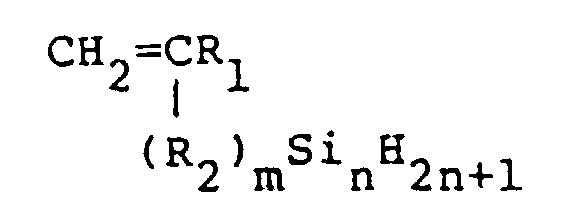
- A process for the preparation of a high molecular weight compound containing recurring structural units represented by the following general formula:


- A process for the preparation of a high molecular weight compound, which comprises subjecting, to radical copolymerization, a silicon compound represented by the following general formula:

- A process for the production of silicon carbide, which comprises firing at a temperature in a range of 500°C - 2,500°C a silicon-containing high molecular compound which contains recurring units represented by the following general formula:

- The process as claimed in Claim 6, wherein the silicon-containing high molecular weight compound is polyvinylsilane or polyvinyldisilane.
- The process as claimed in Claim 6, wherein the silicon-containing high molecular weight compound is fired subsequent to its shaping.
- The process as claimed in Claim 6, wherein the silicon-containing high molecular weight compound is fired after silicon carbide powder produced in advance is added and mixed with the silicon-containing high molecular weight compound and the resultant mixture is shaped.
- The process as claimed in Claim 6, wherein the silicon-containing high molecular weight compound is fired subsequent to its spinning into a fibrous shape.
- The process as claimed in Claim 6, wherein the silicon-containing high molecular weight compound is fired subsequent to impregnation of a sintered body of silicon carbide with a solution of the silicon-containing high molecular weight compound.
Applications Claiming Priority (21)
| Application Number | Priority Date | Filing Date | Title |
|---|---|---|---|
| JP15929/87 | 1987-01-28 | ||
| JP62015929A JPH07121801B2 (en) | 1987-01-28 | 1987-01-28 | Method for producing silicon carbide |
| JP31514/87 | 1987-02-16 | ||
| JP62031514A JPH07121802B2 (en) | 1987-02-16 | 1987-02-16 | Method for producing silicon carbide |
| JP35696/87 | 1987-02-20 | ||
| JP62035696A JPH07116642B2 (en) | 1987-02-20 | 1987-02-20 | Method for producing silicon carbide fiber |
| JP62088871A JPH0764855B2 (en) | 1987-04-13 | 1987-04-13 | Method for producing organosilicon compound |
| JP88871/87 | 1987-04-13 | ||
| JP62089888A JPH0764856B2 (en) | 1987-04-14 | 1987-04-14 | Method for producing organosilicon compound |
| JP89888/87 | 1987-04-14 | ||
| JP9741787A JPH0725841B2 (en) | 1987-04-22 | 1987-04-22 | Method for producing silicon-containing polymer |
| JP97417/87 | 1987-04-22 | ||
| JP98698/87 | 1987-04-23 | ||
| JP9869887A JPH0725842B2 (en) | 1987-04-23 | 1987-04-23 | Method for producing silicon-containing polymer |
| JP62307491A JPH026614A (en) | 1987-12-07 | 1987-12-07 | Production of silicon carbide fiber |
| JP307493/87 | 1987-12-07 | ||
| JP62307492A JP2505505B2 (en) | 1987-12-07 | 1987-12-07 | Method for producing organosilicon compound |
| JP307491/87 | 1987-12-07 | ||
| JP307492/87 | 1987-12-07 | ||
| JP62307493A JPH01294575A (en) | 1987-12-07 | 1987-12-07 | Production of ceramic molded article |
| PCT/JP1988/000065 WO1988005779A1 (en) | 1987-01-28 | 1988-01-28 | Processes for preparing organosilicon compounds and silicon carbide |
Publications (3)
| Publication Number | Publication Date |
|---|---|
| EP0301099A1 EP0301099A1 (en) | 1989-02-01 |
| EP0301099A4 EP0301099A4 (en) | 1990-10-03 |
| EP0301099B1 true EP0301099B1 (en) | 1996-11-06 |
Family
ID=27579665
Family Applications (1)
| Application Number | Title | Priority Date | Filing Date |
|---|---|---|---|
| EP88901299A Expired - Lifetime EP0301099B1 (en) | 1987-01-28 | 1988-01-28 | Processes for preparing organosilicon compounds and silicon carbide |
Country Status (5)
| Country | Link |
|---|---|
| US (1) | US5596117A (en) |
| EP (1) | EP0301099B1 (en) |
| KR (3) | KR910008295B1 (en) |
| DE (1) | DE3855646T2 (en) |
| WO (1) | WO1988005779A1 (en) |
Families Citing this family (4)
| Publication number | Priority date | Publication date | Assignee | Title |
|---|---|---|---|---|
| KR920005671B1 (en) | 1987-12-16 | 1992-07-13 | 미쯔이도오아쯔가가꾸 가부시끼가이샤 | Method for producing silicon-containing polymer |
| DE19956810C1 (en) * | 1999-11-25 | 2001-02-15 | Wacker Chemie Gmbh | Preparation of 1,2-bis(mono-, di- or tri-halo-silyl)ethanes, useful in synthesis, e.g. of pharmaceuticals, agrochemicals or polymer chemicals, as solvent or in analysis, involves catalytic hydrogenation of corresponding ethene |
| DE102012221669A1 (en) | 2012-11-27 | 2014-05-28 | Evonik Industries Ag | Process for producing carbon-containing hydridosilanes |
| JP7122833B2 (en) * | 2018-02-08 | 2022-08-22 | 株式会社Ihiエアロスペース | Method for producing silicon carbide fiber |
Family Cites Families (15)
| Publication number | Priority date | Publication date | Assignee | Title |
|---|---|---|---|---|
| US2537763A (en) * | 1950-02-08 | 1951-01-09 | Gen Electric | Preparation of organosilanes |
| US2786862A (en) * | 1954-11-12 | 1957-03-26 | Gen Electric | Preparation of dialkylsilanes |
| NL234502A (en) * | 1957-12-23 | |||
| US3026213A (en) * | 1959-09-23 | 1962-03-20 | Du Pont | Preparation and use of unsaturated organosilanes |
| NL132148C (en) * | 1963-12-18 | |||
| US3385876A (en) * | 1964-12-18 | 1968-05-28 | Gen Electric | Curing catalyst system for si-h additions |
| US3410886A (en) * | 1965-10-23 | 1968-11-12 | Union Carbide Corp | Si-h to c=c or c=c addition in the presence of a nitrile-platinum (ii) halide complex |
| GB1143570A (en) * | 1966-11-30 | |||
| JPS5242873A (en) * | 1975-10-03 | 1977-04-04 | Agency Of Ind Science & Technol | Process for preparation of pyrpolidone containing silicon |
| US4393113A (en) * | 1980-06-05 | 1983-07-12 | Teitin Limited | Novel silicon-containing copolymer, ultrathin solid membrane composed of said copolymer, use of said solid membrane for concentrating a specified gas in a gaseous mixture, and process for producing said solid membrane |
| JPS5726527A (en) * | 1980-07-25 | 1982-02-12 | Minoru Yamamoto | Fish breeding method using circular assembling tank made of foamed synthetic resin |
| JPS5738547A (en) * | 1980-08-19 | 1982-03-03 | Toshiba Corp | Rotary anode x-ray tube |
| JPS599120B2 (en) * | 1980-09-12 | 1984-02-29 | 株式会社東芝 | PROM protection circuit due to incorrect programming of PROM writer |
| DE3170707D1 (en) * | 1980-11-21 | 1985-07-04 | Union Carbide Corp | Branched polycarbosilanes and their use in the production of silicon carbide |
| US4546163A (en) * | 1984-09-04 | 1985-10-08 | Dow Corning Corporation | Silicon carbide preceramic vinyl-containing polymers |
-
1988
- 1988-01-28 KR KR1019900702573A patent/KR910008295B1/en not_active Expired
- 1988-01-28 DE DE3855646T patent/DE3855646T2/en not_active Expired - Fee Related
- 1988-01-28 KR KR1019880701187A patent/KR910001078B1/en not_active Expired
- 1988-01-28 KR KR1019900702572A patent/KR920001354B1/en not_active Expired
- 1988-01-28 WO PCT/JP1988/000065 patent/WO1988005779A1/en not_active Ceased
- 1988-01-28 EP EP88901299A patent/EP0301099B1/en not_active Expired - Lifetime
-
1995
- 1995-02-03 US US08/383,712 patent/US5596117A/en not_active Expired - Fee Related
Also Published As
| Publication number | Publication date |
|---|---|
| KR910008295B1 (en) | 1991-10-12 |
| KR890700597A (en) | 1989-04-26 |
| WO1988005779A1 (en) | 1988-08-11 |
| KR920700528A (en) | 1992-02-19 |
| DE3855646D1 (en) | 1996-12-12 |
| DE3855646T2 (en) | 1997-04-17 |
| US5596117A (en) | 1997-01-21 |
| KR920001354B1 (en) | 1992-02-11 |
| KR910001078B1 (en) | 1991-02-23 |
| EP0301099A4 (en) | 1990-10-03 |
| EP0301099A1 (en) | 1989-02-01 |
| KR920700527A (en) | 1992-02-19 |
Similar Documents
| Publication | Publication Date | Title |
|---|---|---|
| Birot et al. | Comprehensive chemistry of polycarbosilanes, polysilazanes, and polycarbosilazanes as precursors of ceramics | |
| US4414403A (en) | Branched polycarbosilanes and their use in the production of silicon carbide | |
| US4767876A (en) | Method for converting organosilicon polymers containing SIH repeat units and organopolysilazane precursors to new and useful preceramic polymers and silicon nitride enriched ceramic materials | |
| US4482669A (en) | Preceramic organosilazane polymers | |
| EP0123934B1 (en) | Polysilane precursors containing olefinic groups for silicon carbide | |
| KR910008328B1 (en) | Two-step process for producing an organopolysilazane reticulum that can be improved in heat resistance and especially used as a ceramic precursor | |
| JPH05247219A (en) | Method for producing preceramic organosilicon polymer | |
| US4761458A (en) | Preceramic polycarbosilane derivatives | |
| US4800221A (en) | Silicon carbide preceramic polymers | |
| US4948763A (en) | Preparation of hollow ceramic fibers | |
| EP0063459A1 (en) | Polymer composition, production and use | |
| EP0139257B1 (en) | Process for the manufacture of silicon carbide | |
| US5596117A (en) | Preparation process of organo silicon compounds and production process of silicon | |
| US5508363A (en) | Preparation process of organosilicon compounds and production of silicon carbide | |
| US5620934A (en) | Production process of silicon carbide from organosilicon compounds | |
| CA1340699C (en) | Preparation process of organosilicon compounds and production process of silicon carbide | |
| GB2100711A (en) | Process for the production of silicon nitride type molded bodies | |
| Bacqué et al. | Synthesis of disilylmethanes and polysilacarbosilanes, precursors of silicon carbide-based materials | |
| EP0278001B1 (en) | Method for using organopolysilazane precursors to form new preceramic polymers and silicon nitride-rich ceramic materials | |
| JPH0832604B2 (en) | Method for manufacturing ceramic molded body | |
| JPH0551620B2 (en) | ||
| JPH07121802B2 (en) | Method for producing silicon carbide | |
| JPWO1988005779A1 (en) | Method for producing organosilicon compounds and silicon carbide | |
| JPH07121801B2 (en) | Method for producing silicon carbide | |
| Elias | Inorganic Chains |
Legal Events
| Date | Code | Title | Description |
|---|---|---|---|
| PUAI | Public reference made under article 153(3) epc to a published international application that has entered the european phase |
Free format text: ORIGINAL CODE: 0009012 |
|
| 17P | Request for examination filed |
Effective date: 19881017 |
|
| AK | Designated contracting states |
Kind code of ref document: A1 Designated state(s): DE FR GB IT NL |
|
| A4 | Supplementary search report drawn up and despatched |
Effective date: 19900813 |
|
| AK | Designated contracting states |
Kind code of ref document: A4 Designated state(s): DE FR GB IT NL |
|
| DA4 | Supplementary search report drawn up and despatched (deleted) | ||
| RA4 | Supplementary search report drawn up and despatched (corrected) |
Effective date: 19930113 |
|
| 17Q | First examination report despatched |
Effective date: 19940309 |
|
| GRAH | Despatch of communication of intention to grant a patent |
Free format text: ORIGINAL CODE: EPIDOS IGRA |
|
| GRAH | Despatch of communication of intention to grant a patent |
Free format text: ORIGINAL CODE: EPIDOS IGRA |
|
| RBV | Designated contracting states (corrected) |
Designated state(s): DE FR GB NL |
|
| GRAH | Despatch of communication of intention to grant a patent |
Free format text: ORIGINAL CODE: EPIDOS IGRA |
|
| GRAA | (expected) grant |
Free format text: ORIGINAL CODE: 0009210 |
|
| AK | Designated contracting states |
Kind code of ref document: B1 Designated state(s): DE FR GB NL |
|
| REF | Corresponds to: |
Ref document number: 3855646 Country of ref document: DE Date of ref document: 19961212 |
|
| ET | Fr: translation filed | ||
| PLBE | No opposition filed within time limit |
Free format text: ORIGINAL CODE: 0009261 |
|
| STAA | Information on the status of an ep patent application or granted ep patent |
Free format text: STATUS: NO OPPOSITION FILED WITHIN TIME LIMIT |
|
| 26N | No opposition filed | ||
| PGFP | Annual fee paid to national office [announced via postgrant information from national office to epo] |
Ref country code: FR Payment date: 19980109 Year of fee payment: 11 |
|
| PGFP | Annual fee paid to national office [announced via postgrant information from national office to epo] |
Ref country code: GB Payment date: 19980119 Year of fee payment: 11 |
|
| PGFP | Annual fee paid to national office [announced via postgrant information from national office to epo] |
Ref country code: NL Payment date: 19980128 Year of fee payment: 11 |
|
| PGFP | Annual fee paid to national office [announced via postgrant information from national office to epo] |
Ref country code: DE Payment date: 19980206 Year of fee payment: 11 |
|
| REG | Reference to a national code |
Ref country code: GB Ref legal event code: 732E |
|
| REG | Reference to a national code |
Ref country code: FR Ref legal event code: TP |
|
| NLS | Nl: assignments of ep-patents |
Owner name: MITSUI CHEMICALS, INC. |
|
| PG25 | Lapsed in a contracting state [announced via postgrant information from national office to epo] |
Ref country code: GB Free format text: LAPSE BECAUSE OF NON-PAYMENT OF DUE FEES Effective date: 19990128 |
|
| PG25 | Lapsed in a contracting state [announced via postgrant information from national office to epo] |
Ref country code: NL Free format text: LAPSE BECAUSE OF NON-PAYMENT OF DUE FEES Effective date: 19990801 |
|
| GBPC | Gb: european patent ceased through non-payment of renewal fee |
Effective date: 19990128 |
|
| PG25 | Lapsed in a contracting state [announced via postgrant information from national office to epo] |
Ref country code: FR Free format text: LAPSE BECAUSE OF NON-PAYMENT OF DUE FEES Effective date: 19990930 |
|
| PG25 | Lapsed in a contracting state [announced via postgrant information from national office to epo] |
Ref country code: DE Free format text: LAPSE BECAUSE OF NON-PAYMENT OF DUE FEES Effective date: 19991103 |
|
| REG | Reference to a national code |
Ref country code: FR Ref legal event code: ST |