EP0300601A2 - Process for the production of sintered aluminium nitrides - Google Patents
Process for the production of sintered aluminium nitrides Download PDFInfo
- Publication number
- EP0300601A2 EP0300601A2 EP88305045A EP88305045A EP0300601A2 EP 0300601 A2 EP0300601 A2 EP 0300601A2 EP 88305045 A EP88305045 A EP 88305045A EP 88305045 A EP88305045 A EP 88305045A EP 0300601 A2 EP0300601 A2 EP 0300601A2
- Authority
- EP
- European Patent Office
- Prior art keywords
- aluminium nitride
- sintering
- weight
- temperature
- powder
- Prior art date
- Legal status (The legal status is an assumption and is not a legal conclusion. Google has not performed a legal analysis and makes no representation as to the accuracy of the status listed.)
- Withdrawn
Links
- 238000000034 method Methods 0.000 title claims abstract description 39
- 230000008569 process Effects 0.000 title claims abstract description 29
- 229910052782 aluminium Inorganic materials 0.000 title claims description 11
- 239000004411 aluminium Substances 0.000 title claims description 10
- -1 aluminium nitrides Chemical class 0.000 title description 6
- 238000004519 manufacturing process Methods 0.000 title description 5
- 229910017083 AlN Inorganic materials 0.000 claims abstract description 77
- PIGFYZPCRLYGLF-UHFFFAOYSA-N Aluminum nitride Chemical compound [Al]#N PIGFYZPCRLYGLF-UHFFFAOYSA-N 0.000 claims abstract description 77
- 238000005245 sintering Methods 0.000 claims abstract description 54
- 239000000843 powder Substances 0.000 claims abstract description 53
- 239000011261 inert gas Substances 0.000 claims abstract description 18
- 229910052751 metal Inorganic materials 0.000 claims abstract description 18
- 239000002184 metal Substances 0.000 claims abstract description 18
- 239000012535 impurity Substances 0.000 claims abstract description 17
- OKTJSMMVPCPJKN-UHFFFAOYSA-N Carbon Chemical compound [C] OKTJSMMVPCPJKN-UHFFFAOYSA-N 0.000 claims abstract description 16
- 239000001257 hydrogen Substances 0.000 claims abstract description 15
- 229910052739 hydrogen Inorganic materials 0.000 claims abstract description 15
- UFHFLCQGNIYNRP-UHFFFAOYSA-N Hydrogen Chemical compound [H][H] UFHFLCQGNIYNRP-UHFFFAOYSA-N 0.000 claims abstract description 14
- 229910052799 carbon Inorganic materials 0.000 claims abstract description 13
- 229910052710 silicon Inorganic materials 0.000 claims abstract description 11
- 229910052760 oxygen Inorganic materials 0.000 claims abstract description 10
- 239000010703 silicon Substances 0.000 claims abstract description 10
- QVGXLLKOCUKJST-UHFFFAOYSA-N atomic oxygen Chemical compound [O] QVGXLLKOCUKJST-UHFFFAOYSA-N 0.000 claims abstract description 9
- 239000001301 oxygen Substances 0.000 claims abstract description 9
- 238000001816 cooling Methods 0.000 claims abstract description 6
- 150000002736 metal compounds Chemical class 0.000 claims abstract description 6
- XEEYBQQBJWHFJM-UHFFFAOYSA-N Iron Chemical compound [Fe] XEEYBQQBJWHFJM-UHFFFAOYSA-N 0.000 claims description 20
- 239000000203 mixture Substances 0.000 claims description 15
- 239000011230 binding agent Substances 0.000 claims description 10
- 229910052742 iron Inorganic materials 0.000 claims description 10
- XAGFODPZIPBFFR-UHFFFAOYSA-N aluminium Chemical compound [Al] XAGFODPZIPBFFR-UHFFFAOYSA-N 0.000 claims description 6
- 150000002506 iron compounds Chemical class 0.000 claims description 5
- 150000002739 metals Chemical class 0.000 claims description 5
- 150000001875 compounds Chemical class 0.000 claims description 4
- 238000002156 mixing Methods 0.000 claims description 4
- 239000002904 solvent Substances 0.000 claims description 4
- XUIMIQQOPSSXEZ-UHFFFAOYSA-N Silicon Chemical compound [Si] XUIMIQQOPSSXEZ-UHFFFAOYSA-N 0.000 claims description 3
- 150000003377 silicon compounds Chemical class 0.000 claims description 3
- 150000001722 carbon compounds Chemical class 0.000 claims description 2
- 238000010304 firing Methods 0.000 claims description 2
- SIWVEOZUMHYXCS-UHFFFAOYSA-N oxo(oxoyttriooxy)yttrium Chemical compound O=[Y]O[Y]=O SIWVEOZUMHYXCS-UHFFFAOYSA-N 0.000 claims description 2
- 150000002431 hydrogen Chemical class 0.000 claims 1
- 238000010438 heat treatment Methods 0.000 abstract 1
- PNEYBMLMFCGWSK-UHFFFAOYSA-N aluminium oxide Inorganic materials [O-2].[O-2].[O-2].[Al+3].[Al+3] PNEYBMLMFCGWSK-UHFFFAOYSA-N 0.000 description 9
- IJGRMHOSHXDMSA-UHFFFAOYSA-N nitrogen Substances N#N IJGRMHOSHXDMSA-UHFFFAOYSA-N 0.000 description 8
- 239000000463 material Substances 0.000 description 7
- 239000012298 atmosphere Substances 0.000 description 6
- 239000000919 ceramic Substances 0.000 description 6
- 229910052757 nitrogen Inorganic materials 0.000 description 6
- 239000000758 substrate Substances 0.000 description 6
- 238000000227 grinding Methods 0.000 description 5
- CSCPPACGZOOCGX-UHFFFAOYSA-N Acetone Chemical compound CC(C)=O CSCPPACGZOOCGX-UHFFFAOYSA-N 0.000 description 4
- PXHVJJICTQNCMI-UHFFFAOYSA-N Nickel Chemical compound [Ni] PXHVJJICTQNCMI-UHFFFAOYSA-N 0.000 description 4
- RUDFQVOCFDJEEF-UHFFFAOYSA-N yttrium(III) oxide Inorganic materials [O-2].[O-2].[O-2].[Y+3].[Y+3] RUDFQVOCFDJEEF-UHFFFAOYSA-N 0.000 description 4
- 239000010439 graphite Substances 0.000 description 3
- 229910002804 graphite Inorganic materials 0.000 description 3
- 150000004767 nitrides Chemical class 0.000 description 3
- 239000004014 plasticizer Substances 0.000 description 3
- 238000010298 pulverizing process Methods 0.000 description 3
- 239000000376 reactant Substances 0.000 description 3
- 239000007921 spray Substances 0.000 description 3
- 239000000126 substance Substances 0.000 description 3
- 229910052727 yttrium Inorganic materials 0.000 description 3
- QGZKDVFQNNGYKY-UHFFFAOYSA-N Ammonia Chemical compound N QGZKDVFQNNGYKY-UHFFFAOYSA-N 0.000 description 2
- XKRFYHLGVUSROY-UHFFFAOYSA-N Argon Chemical compound [Ar] XKRFYHLGVUSROY-UHFFFAOYSA-N 0.000 description 2
- 239000004743 Polypropylene Substances 0.000 description 2
- 239000011575 calcium Substances 0.000 description 2
- 238000002474 experimental method Methods 0.000 description 2
- 239000007789 gas Substances 0.000 description 2
- 230000005484 gravity Effects 0.000 description 2
- 239000011159 matrix material Substances 0.000 description 2
- 238000003801 milling Methods 0.000 description 2
- 238000012986 modification Methods 0.000 description 2
- 230000004048 modification Effects 0.000 description 2
- 229910052759 nickel Inorganic materials 0.000 description 2
- QJGQUHMNIGDVPM-UHFFFAOYSA-N nitrogen(.) Chemical compound [N] QJGQUHMNIGDVPM-UHFFFAOYSA-N 0.000 description 2
- 229920002037 poly(vinyl butyral) polymer Polymers 0.000 description 2
- 229920001155 polypropylene Polymers 0.000 description 2
- 238000002360 preparation method Methods 0.000 description 2
- 238000012545 processing Methods 0.000 description 2
- 230000003068 static effect Effects 0.000 description 2
- 229920002554 vinyl polymer Polymers 0.000 description 2
- VWQVUPCCIRVNHF-UHFFFAOYSA-N yttrium atom Chemical compound [Y] VWQVUPCCIRVNHF-UHFFFAOYSA-N 0.000 description 2
- DSEKYWAQQVUQTP-XEWMWGOFSA-N (2r,4r,4as,6as,6as,6br,8ar,12ar,14as,14bs)-2-hydroxy-4,4a,6a,6b,8a,11,11,14a-octamethyl-2,4,5,6,6a,7,8,9,10,12,12a,13,14,14b-tetradecahydro-1h-picen-3-one Chemical compound C([C@H]1[C@]2(C)CC[C@@]34C)C(C)(C)CC[C@]1(C)CC[C@]2(C)[C@H]4CC[C@@]1(C)[C@H]3C[C@@H](O)C(=O)[C@@H]1C DSEKYWAQQVUQTP-XEWMWGOFSA-N 0.000 description 1
- RZRNAYUHWVFMIP-KTKRTIGZSA-N 1-oleoylglycerol Chemical compound CCCCCCCC\C=C/CCCCCCCC(=O)OCC(O)CO RZRNAYUHWVFMIP-KTKRTIGZSA-N 0.000 description 1
- 229910052582 BN Inorganic materials 0.000 description 1
- PZNSFCLAULLKQX-UHFFFAOYSA-N Boron nitride Chemical compound N#B PZNSFCLAULLKQX-UHFFFAOYSA-N 0.000 description 1
- 241000273930 Brevoortia tyrannus Species 0.000 description 1
- ZTQSAGDEMFDKMZ-UHFFFAOYSA-N Butyraldehyde Chemical compound CCCC=O ZTQSAGDEMFDKMZ-UHFFFAOYSA-N 0.000 description 1
- OYPRJOBELJOOCE-UHFFFAOYSA-N Calcium Chemical compound [Ca] OYPRJOBELJOOCE-UHFFFAOYSA-N 0.000 description 1
- 229910052684 Cerium Inorganic materials 0.000 description 1
- RYGMFSIKBFXOCR-UHFFFAOYSA-N Copper Chemical compound [Cu] RYGMFSIKBFXOCR-UHFFFAOYSA-N 0.000 description 1
- 229910052692 Dysprosium Inorganic materials 0.000 description 1
- 229910052688 Gadolinium Inorganic materials 0.000 description 1
- 238000004566 IR spectroscopy Methods 0.000 description 1
- 238000007696 Kjeldahl method Methods 0.000 description 1
- 229910052779 Neodymium Inorganic materials 0.000 description 1
- CGSLYBDCEGBZCG-UHFFFAOYSA-N Octicizer Chemical compound C=1C=CC=CC=1OP(=O)(OCC(CC)CCCC)OC1=CC=CC=C1 CGSLYBDCEGBZCG-UHFFFAOYSA-N 0.000 description 1
- 229910019142 PO4 Inorganic materials 0.000 description 1
- 239000004264 Petrolatum Substances 0.000 description 1
- 239000004372 Polyvinyl alcohol Substances 0.000 description 1
- 229910052777 Praseodymium Inorganic materials 0.000 description 1
- 229910052772 Samarium Inorganic materials 0.000 description 1
- RTAQQCXQSZGOHL-UHFFFAOYSA-N Titanium Chemical compound [Ti] RTAQQCXQSZGOHL-UHFFFAOYSA-N 0.000 description 1
- BAECOWNUKCLBPZ-HIUWNOOHSA-N Triolein Natural products O([C@H](OCC(=O)CCCCCCC/C=C\CCCCCCCC)COC(=O)CCCCCCC/C=C\CCCCCCCC)C(=O)CCCCCCC/C=C\CCCCCCCC BAECOWNUKCLBPZ-HIUWNOOHSA-N 0.000 description 1
- PHYFQTYBJUILEZ-UHFFFAOYSA-N Trioleoylglycerol Natural products CCCCCCCCC=CCCCCCCCC(=O)OCC(OC(=O)CCCCCCCC=CCCCCCCCC)COC(=O)CCCCCCCC=CCCCCCCCC PHYFQTYBJUILEZ-UHFFFAOYSA-N 0.000 description 1
- HCHKCACWOHOZIP-UHFFFAOYSA-N Zinc Chemical compound [Zn] HCHKCACWOHOZIP-UHFFFAOYSA-N 0.000 description 1
- 238000010521 absorption reaction Methods 0.000 description 1
- 238000005054 agglomeration Methods 0.000 description 1
- 230000002776 aggregation Effects 0.000 description 1
- 229910052784 alkaline earth metal Inorganic materials 0.000 description 1
- 150000001342 alkaline earth metals Chemical class 0.000 description 1
- 229910052786 argon Inorganic materials 0.000 description 1
- 238000000889 atomisation Methods 0.000 description 1
- 238000000498 ball milling Methods 0.000 description 1
- 229910052788 barium Inorganic materials 0.000 description 1
- 230000015572 biosynthetic process Effects 0.000 description 1
- 229910052791 calcium Inorganic materials 0.000 description 1
- 239000004359 castor oil Substances 0.000 description 1
- ZMIGMASIKSOYAM-UHFFFAOYSA-N cerium Chemical compound [Ce][Ce][Ce][Ce][Ce][Ce][Ce][Ce][Ce][Ce][Ce][Ce][Ce][Ce][Ce][Ce][Ce][Ce][Ce][Ce][Ce][Ce][Ce][Ce][Ce][Ce][Ce][Ce][Ce][Ce][Ce][Ce][Ce][Ce][Ce][Ce][Ce][Ce] ZMIGMASIKSOYAM-UHFFFAOYSA-N 0.000 description 1
- 238000006243 chemical reaction Methods 0.000 description 1
- UPHIPHFJVNKLMR-UHFFFAOYSA-N chromium iron Chemical compound [Cr].[Fe] UPHIPHFJVNKLMR-UHFFFAOYSA-N 0.000 description 1
- 150000001860 citric acid derivatives Chemical class 0.000 description 1
- 229910017052 cobalt Inorganic materials 0.000 description 1
- 239000010941 cobalt Substances 0.000 description 1
- GUTLYIVDDKVIGB-UHFFFAOYSA-N cobalt atom Chemical compound [Co] GUTLYIVDDKVIGB-UHFFFAOYSA-N 0.000 description 1
- 239000000470 constituent Substances 0.000 description 1
- 238000007796 conventional method Methods 0.000 description 1
- 229910052802 copper Inorganic materials 0.000 description 1
- 239000010949 copper Substances 0.000 description 1
- 229910052593 corundum Inorganic materials 0.000 description 1
- 239000013078 crystal Substances 0.000 description 1
- 238000000354 decomposition reaction Methods 0.000 description 1
- 230000007423 decrease Effects 0.000 description 1
- JXTHNDFMNIQAHM-UHFFFAOYSA-N dichloroacetic acid Chemical compound OC(=O)C(Cl)Cl JXTHNDFMNIQAHM-UHFFFAOYSA-N 0.000 description 1
- 229960005215 dichloroacetic acid Drugs 0.000 description 1
- 238000009792 diffusion process Methods 0.000 description 1
- KBQHZAAAGSGFKK-UHFFFAOYSA-N dysprosium atom Chemical compound [Dy] KBQHZAAAGSGFKK-UHFFFAOYSA-N 0.000 description 1
- 150000002170 ethers Chemical class 0.000 description 1
- 230000001747 exhibiting effect Effects 0.000 description 1
- 238000004880 explosion Methods 0.000 description 1
- 235000021323 fish oil Nutrition 0.000 description 1
- 150000002222 fluorine compounds Chemical class 0.000 description 1
- UIWYJDYFSGRHKR-UHFFFAOYSA-N gadolinium atom Chemical compound [Gd] UIWYJDYFSGRHKR-UHFFFAOYSA-N 0.000 description 1
- RZRNAYUHWVFMIP-HXUWFJFHSA-N glycerol monolinoleate Natural products CCCCCCCCC=CCCCCCCCC(=O)OC[C@H](O)CO RZRNAYUHWVFMIP-HXUWFJFHSA-N 0.000 description 1
- SMESMKWYOSOHJZ-UHFFFAOYSA-N hexanedioic acid;2-hydroxyacetic acid Chemical compound OCC(O)=O.OC(=O)CCCCC(O)=O SMESMKWYOSOHJZ-UHFFFAOYSA-N 0.000 description 1
- 229910052746 lanthanum Inorganic materials 0.000 description 1
- FZLIPJUXYLNCLC-UHFFFAOYSA-N lanthanum atom Chemical compound [La] FZLIPJUXYLNCLC-UHFFFAOYSA-N 0.000 description 1
- 230000001050 lubricating effect Effects 0.000 description 1
- 229910052749 magnesium Inorganic materials 0.000 description 1
- 229910044991 metal oxide Inorganic materials 0.000 description 1
- 150000002790 naphthalenes Chemical class 0.000 description 1
- QEFYFXOXNSNQGX-UHFFFAOYSA-N neodymium atom Chemical compound [Nd] QEFYFXOXNSNQGX-UHFFFAOYSA-N 0.000 description 1
- 150000002823 nitrates Chemical class 0.000 description 1
- 238000005121 nitriding Methods 0.000 description 1
- 239000012299 nitrogen atmosphere Substances 0.000 description 1
- 229940049964 oleate Drugs 0.000 description 1
- ZQPPMHVWECSIRJ-KTKRTIGZSA-N oleic acid Chemical compound CCCCCCCC\C=C/CCCCCCCC(O)=O ZQPPMHVWECSIRJ-KTKRTIGZSA-N 0.000 description 1
- 239000011368 organic material Substances 0.000 description 1
- 239000003960 organic solvent Substances 0.000 description 1
- 239000012188 paraffin wax Substances 0.000 description 1
- 239000002245 particle Substances 0.000 description 1
- 229940066842 petrolatum Drugs 0.000 description 1
- 235000019271 petrolatum Nutrition 0.000 description 1
- 235000021317 phosphate Nutrition 0.000 description 1
- 150000003013 phosphoric acid derivatives Chemical class 0.000 description 1
- 125000005498 phthalate group Chemical class 0.000 description 1
- 230000000704 physical effect Effects 0.000 description 1
- 229920003229 poly(methyl methacrylate) Polymers 0.000 description 1
- 229920000151 polyglycol Polymers 0.000 description 1
- 239000010695 polyglycol Substances 0.000 description 1
- 239000004926 polymethyl methacrylate Substances 0.000 description 1
- 229920002451 polyvinyl alcohol Polymers 0.000 description 1
- PUDIUYLPXJFUGB-UHFFFAOYSA-N praseodymium atom Chemical compound [Pr] PUDIUYLPXJFUGB-UHFFFAOYSA-N 0.000 description 1
- 229910052761 rare earth metal Inorganic materials 0.000 description 1
- 150000002910 rare earth metals Chemical class 0.000 description 1
- 230000009467 reduction Effects 0.000 description 1
- WBHHMMIMDMUBKC-QJWNTBNXSA-M ricinoleate Chemical compound CCCCCC[C@@H](O)C\C=C/CCCCCCCC([O-])=O WBHHMMIMDMUBKC-QJWNTBNXSA-M 0.000 description 1
- 229940066675 ricinoleate Drugs 0.000 description 1
- KZUNJOHGWZRPMI-UHFFFAOYSA-N samarium atom Chemical compound [Sm] KZUNJOHGWZRPMI-UHFFFAOYSA-N 0.000 description 1
- 238000012216 screening Methods 0.000 description 1
- CXMXRPHRNRROMY-UHFFFAOYSA-N sebacic acid Chemical class OC(=O)CCCCCCCCC(O)=O CXMXRPHRNRROMY-UHFFFAOYSA-N 0.000 description 1
- 239000004065 semiconductor Substances 0.000 description 1
- 238000001694 spray drying Methods 0.000 description 1
- 229910001220 stainless steel Inorganic materials 0.000 description 1
- 239000010935 stainless steel Substances 0.000 description 1
- 229910052712 strontium Inorganic materials 0.000 description 1
- 239000010936 titanium Substances 0.000 description 1
- 229910052719 titanium Inorganic materials 0.000 description 1
- PHYFQTYBJUILEZ-IUPFWZBJSA-N triolein Chemical compound CCCCCCCC\C=C/CCCCCCCC(=O)OCC(OC(=O)CCCCCCC\C=C/CCCCCCCC)COC(=O)CCCCCCC\C=C/CCCCCCCC PHYFQTYBJUILEZ-IUPFWZBJSA-N 0.000 description 1
- 239000001993 wax Substances 0.000 description 1
- 229910001845 yogo sapphire Inorganic materials 0.000 description 1
- 229910052725 zinc Inorganic materials 0.000 description 1
- 239000011701 zinc Substances 0.000 description 1
Images

Classifications
-
- C—CHEMISTRY; METALLURGY
- C04—CEMENTS; CONCRETE; ARTIFICIAL STONE; CERAMICS; REFRACTORIES
- C04B—LIME, MAGNESIA; SLAG; CEMENTS; COMPOSITIONS THEREOF, e.g. MORTARS, CONCRETE OR LIKE BUILDING MATERIALS; ARTIFICIAL STONE; CERAMICS; REFRACTORIES; TREATMENT OF NATURAL STONE
- C04B35/00—Shaped ceramic products characterised by their composition; Ceramics compositions; Processing powders of inorganic compounds preparatory to the manufacturing of ceramic products
- C04B35/622—Forming processes; Processing powders of inorganic compounds preparatory to the manufacturing of ceramic products
- C04B35/64—Burning or sintering processes
-
- C—CHEMISTRY; METALLURGY
- C04—CEMENTS; CONCRETE; ARTIFICIAL STONE; CERAMICS; REFRACTORIES
- C04B—LIME, MAGNESIA; SLAG; CEMENTS; COMPOSITIONS THEREOF, e.g. MORTARS, CONCRETE OR LIKE BUILDING MATERIALS; ARTIFICIAL STONE; CERAMICS; REFRACTORIES; TREATMENT OF NATURAL STONE
- C04B35/00—Shaped ceramic products characterised by their composition; Ceramics compositions; Processing powders of inorganic compounds preparatory to the manufacturing of ceramic products
- C04B35/515—Shaped ceramic products characterised by their composition; Ceramics compositions; Processing powders of inorganic compounds preparatory to the manufacturing of ceramic products based on non-oxide ceramics
- C04B35/58—Shaped ceramic products characterised by their composition; Ceramics compositions; Processing powders of inorganic compounds preparatory to the manufacturing of ceramic products based on non-oxide ceramics based on borides, nitrides, i.e. nitrides, oxynitrides, carbonitrides or oxycarbonitrides or silicides
- C04B35/581—Shaped ceramic products characterised by their composition; Ceramics compositions; Processing powders of inorganic compounds preparatory to the manufacturing of ceramic products based on non-oxide ceramics based on borides, nitrides, i.e. nitrides, oxynitrides, carbonitrides or oxycarbonitrides or silicides based on aluminium nitride
Definitions
- the present invention relates to a process for the production of sintered aluminium nitrides which are suitable for use as substrates for integrated circuits and in other electrical devices.
- the present invention relates to the production of sintered aluminium nitride bodies having high thermal conductivity, good consistency, i.e. uniform colour, uniform physical properties, e.g. uniform mechanical properties such as flexural strength, excellent sintered density, and uniform shrinkage.
- the first method is disadvantageous in that the resulting nitride can contain a large amount of impurities such as metallic aluminium or various metallic compounds. Generally these impurities originate in the raw aluminium powder reactant, and /or from the pulverizing step.
- the second method there is always a large amount of oxygen present, generally from 2 to 5% by weight or more.
- the oxygen is present as unreacted alumina or other metallic oxides. It is known that the presence of these impurities drastically affects the properties of the sintered aluminium nitride body; in particular, the thermal conductivity decreases to such an extent that sintered aluminium nitride thus produced cannot be used as a substrate for most electronic components.
- aluminium nitride powders thus utilized possess an average particle diameter of nor more than 2 microns, comprise at least 97% by weight aluminium nitride, and contain at most 1.5% by weight of bound oxygen; at most 0.5% by weight (calculated as metal) of metal or metal compound impurities, wherein at most 0.1% by weight of the metal is iron chromium, nickel, cobalt, copper, zinc or titanium; or at most 0.5% by weight (calculated as carbon or silicon compounds) of carbon or silicon.
- metal metal or metal compound impurities
- carbon or silicon compounds calculated as carbon or silicon compounds
- the present invention aims to provide an improved process for the production of sintered aluminium nitride bodies suitable for use as substrates for integrated circuits, or for other electrical components.
- the present process may utilize relatively impure aluminium nitride powders, and yet produce sintered bodies having high densities, thermal conductivities and other desired properties.
- second phase (non-aluminium nitride) materials e.g. yttria
- yttria non-aluminium nitride materials
- the sintered bodies produced by the present process are translucent (which, as used herein, embraces transparent bodies as well), exhibiting the various advantages ascribed to translucent aluminium nitride ceramics in the art.
- Aluminium nitride sintered bodies are prepared in accordance with the present invention from aluminium nitride powders which, as indicated above, have surface areas of at least about 2.5m2/gram, preferably about 4-7 m2/gram.
- the surface area of the aluminium nitride is measured by conventional B.E.T. absorption methods.
- the average agglomerate diameter of the aluminium nitride powder ranges from about 1 to 5 microns.
- the actual crystal diameter is much smaller.
- aluminium nitride powders may be utilized in the present process notwithstanding the presence of impurities including bound oxygen contents of up to about 3%, preferably no more than about 2.5%, by weight; iron or iron compound impurities in an amount of up to about 0.35%, preferably up to about 0.1% by weight; carbon, silicon or compounds thereof, in aggregate amounts of not more than about 0.5% by weight, preferably up to about 0.15% by weight of carbon or carbon compounds and up to about 0.1% by weight of silicon of silicon compounds, respectively.
- impurities including bound oxygen contents of up to about 3%, preferably no more than about 2.5%, by weight
- iron or iron compound impurities in an amount of up to about 0.35%, preferably up to about 0.1% by weight
- carbon, silicon or compounds thereof in aggregate amounts of not more than about 0.5% by weight, preferably up to about 0.15% by weight of carbon or carbon compounds and up to about 0.1% by weight of silicon of silicon compounds, respectively.
- metal or metal compound impurities may be present in the aluminium nitride powder in amounts, which aggregate together with any iron impurities, up to about 0.6% by weight, each individual metal or metal compound being present in an amount of not more than about 0.1% by weight of the powder.
- Aluminium nitride powders meeting these specifications may be prepared from either metallic aluminium or alumina, utilizing the techniques described hereinabove.
- Commercially available materials which are useful in the process hereof are available, for example, from Starck (e.g. as its Grade C Aluminium Nitride Powder), Denka (as, for example, its Grade AP10 Aluminium Nitride Powder), Tokuyama Soda (as, for example, its Grade F or Type G Aluminium Nitride Powders), or Toshiba.
- the initial AIN Powder can also be obtained by mixing various commercial aluminium nitrides as described, for example, in U.S. patent application Serial No. 5,476 filed January 20, 1987 (European patent application No. 88300471.5, filed January 20, 1988),the disclosure of which is incorporated herein by this reference.
- the powder is initially dry screened as received and /or after milling, in general with a 35 mesh screen, to remove metallic Al or other large debris or impurities.
- the screening may, desirably, be carried out as described in the aforesaid U.S. patent application No. 5,476, and in U.S. patent application Serial No. 4,951 filed January 20, 1987 (European patent application No. 88300470.7, filed January 20, 1988), the disclosure of which is also incorporated herein by this reference.
- the aluminium nitride powder is mixed with any of the art-recognized sintering aids such as, for example, the oxides or fluorides of metals selected from the group of yttrium, the rare earth metals (lanthanum, cerium, praseodymium, neodymium, samarium, gadolinium, dysprosium, etc.) the alkaline earth metals (Ca,Sr, Ba) and, preferably, oxides or nitrates of yttrium or calcium.
- sintering aids are described, for example, in European Patent Application Nos. EP-A-153,737 and EP-A-166,073 and in U.S. Patent No.
- the sintering aid is preferably admixed with the aluminium nitride powder in an amount of from about 0.05 to 10% by weight, more preferably in an amount of from about 0.5 to 3.0% by weight.
- the sintering aid has a surface area of, preferably, from about 6.0 to 8.0 m2/g.
- the ratio ofsurface area of the sintering aid to that of the aluminium nitride powder is about 2:1 to 4:1, more preferably about 2.9:1.
- Homogeneous mixing of the aluminium nitride with the sintering aid is carried out, for example, by using conventional dry and wet ball milling. In general, this is achieved by using a grinding aid, for example, gycerol trioleate, Menhaden fish oil, or others.
- a grinding aid for example, gycerol trioleate, Menhaden fish oil, or others.
- Some organic binders may also be used during processing of the ceramic powder. Binders so useful are well known in the art, and comprise high molecular weight organic materials which are soluble in organic solvents, such as industrial waxes, e.g. paraffin, ceresine, ozokerite or highly viscous polyglycols, PMMA, PVA or polyvinyl formal or butyral. Such binders are known to have bonding and lubricating properties which, under forming pressure, allow the grains of material to glide on each other into the relative positions which produce a highly compact body.
- organic solvents such as industrial waxes, e.g. paraffin, ceresine, ozokerite or highly viscous polyglycols, PMMA, PVA or polyvinyl formal or butyral.
- Such binders are known to have bonding and lubricating properties which, under forming pressure, allow the grains of material to glide on each other into the relative positions which produce a highly compact body.
- the binders can also be mixed with suitable plasticizers, organic substances which are well known in the art for improving the flexibility and reducing the viscosity of the binders.
- plasticizers commonly used with polyvinylbutyral are the phthalates, phosphates, polyethylenglycol ethers, glycerol monooleate, petrolatum, ricinoleate, sebacates, citrates, and castor oils, while those used for polyvinyl formal binders comprise dibenzoate, chlorinated naphthalenes, furfuryl oleate, or glycolate adipate.
- the aluminium nitride body is thereafter formulated by a suitable agglomeration technique.
- Conventional techniques e.g. solvent spray drying with acetone or the like, may be so utilized.
- the green body is then subjected to the sintering cycle of the present invention.
- a hydrogen/inert gas mixture is introduced at temperatures of up to about 1200°C, preferably at temperature of from room temperature to about 800 °C.
- the hydrogen/inert gas mixture contains hydrogen in an amount less than that which would pose any risk of explosion.
- Amounts of up to about 4%, preferably from about 1 to 3%, hydrogen by volume are thus admixed with the inert gas, e.g. nitrogen or argon.
- the inert gas e.g. nitrogen or argon.
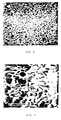
- the presence of the small proportion of hydrogen facilitates the removal of any second phase material from the aluminium nitride matrix; this may be seen by comparison of the photomicrographs of FIGS. 1 and 2, as compared with FlGS. 3 and 4, as discussed more fully below.
- Thermodynamic equilibria calculations indicate that the hydrogen/inert gas atmosphere may be maintained up to temperatures of at least about 1200°C without substantial reaction of the hydrogen with the aluminium nitride composition.
- the ramp temperature is preferably increased at a rate from about 10° to 200°C per hour, more preferably at a rate of from about 20° to 80°C per hour.
- the temperature in the sintering zone reaches the indicated level (about 1200°C, preferably 800°C)
- the atmosphere in the sintering zone is changed to pure inerts and the inert gas (or mixture of inert gases) is introduced, preferably under dynamic conditions, e.g. with nitrogen at a rate of about 2-3 SCFH and under a pressure of about 10-20 psig, or at whatever rate is necessary to ensure from about 20-30 changes of the furnace atmosphere per hour.
- the aluminium nitride is thereafter sintered at sintering temperatures within the range of from about 1600° to 1900°C, preferably at from about 1770° to 1850°C, and most desirably at a sintering temperature ranging from about 1810° to 1830°C. Sintering is thus effected suitably for about 3 hours, preferably for about 3-10 hours, and most desirably for about 6-7 hours.
- Sintering is suitably carried out utilizing a closed aluminium nitride boat, sagger, plat or other container known to be useful in sintering operations.
- a boat of graphite coated with aluminium nitride can be used in order to prevent any diffusion of impurities into the body to be sintered.
- Boats of other high purity materials such as boron nitride, aluminium oxide, etc. can be also utilized in the present process.
- the boat employed is closed with a lid made of the same substances indicated below.
- the sintered bodies are cooled at a rate of not more than about 300°C per hour, preferably fromabout 100-275° per hour.
- sintered aluminium nitride bodies having increased thermal conductivities may be produced from ultra pure aluminium nitride powders, such as, for example, the powders described in the aforesaid U.S. Patent No. 4,618,592, and that sintered bodies having thermal conductivities adequate for use as substrates for electronic components or the like, may be produced from aluminium nitride powders of lesser purities.
- Tokuyama Soda Grade F aluminium nitride powder was used as an initial reactant.
- the chemical composition of the powder was as follows:
- Nitrogen content was measured by the Kjeldahl method, oxygen and carbon were measured by IR spectroscopy of the sample decomposition gases and metals, and all other constituents were determined by the intercoupled plasma technique.
- the surface area of the aluminium nitride powder was 3.15 m2/gm
- the bulk and tap densities of the powder were 0.25 and 0.60 gm/cc, respectively.
- the powder was dry screened with a 35 mesh stainless steel sieve to remove metallic Al and other large debris or impurities.
- the AlN powder was then admixed with 25% by weight Y2O3 as a sintering aid (Union Molycorp 99% yttrium oxide, having a surface area of 14.2 m2/gm.), and 1% by weight of commercially available glycerol trioleate as a grinding aid.
- This mixture was then dry milled in 3 kg portions for 3 hours in 5 gal. polypropylene jars (at 65% of critical speed) with 18 kg of 85% Al2O3 rod grinding media 1/2 inch in diameter by 1/2 inch in length.
- the bulk and tap densities of the milled powder were 0.78 and 1.27 gm/cc, respectively.
- the powder was separated from the grinding media with a 1/8 inch polypropylene sieve.
- the thus dry milled powder was substantially mixed with 2% by weight polyvinyl butyral (Monsanto's BUTUAR Grade B76) as a binder, 27% by weight 2-ethylhexyl diphenyl phosphate (Monsanto's SANTICIZER Grade S141) as a plasticizer, and 100% by weight acetone as a solvent, in a Cowles dissolver. (All the weight %'s are expressed on a powder basis).
- the mixture was then spray dried in a conventional closed cycle, N2 atmosphere solvent spray dryer with rotary atomization at 10,000 rpm.
- the resulting powder had bulk and tap densities of 1.07 and 1.24 gm/cc, respectively, and an agglomerate size of 90% less than 162 microns, 50% less than 88 microns and 10% less than 36 microns.
- the spray dried powder contained 63.0% Al, 31.0% N, 3.10% C (mostly binder), 1.60% O, 1.42% Y, 0.051% Si, 0.010% Mg, 0.006% Fe, and 0.001% Ni.
- the powder was uniaxially cold pressed in a conventional dry press to a 1.990 gm/cc green density, as calculated from dimensions and weight.
- the compacted product was then close packed inside a closed AlN sagger and sintered in a graphite resistance element furnace.
- the temperature program during the sintering cycle was as follows: 25°C/hr to 800°C, 33°C/hr to 1000°C, 80°C/hr to 1500°C, 300°C/hr to 1800°C, soak for 6 hrs, cool down at 140°C/hr.
- the temperature program during the sinering cycle was as follows: static air for 2 hrs., evacuation to 28 inches Hg, backfill with 98% N2/2%H2 to 2-3 psig and 45 SCFH to 800°C, then addition of N2 only at 2-3 psig and 45 SCFH to 1000°C, then 9 psig and 45 SCFH N2 only to 1500°C, then 9 psig without any further addition of gas to 1800°C and, finally, resumption of 45 SCHF N2 flow at 1500°C, during the cool down.
- the resulting ceramic was near white in colour and was translucent. As may be seen in FIGS. 1 and 2 of the drawings, no second phase material was visible in the grain boundaries. The sample was too thin to accurately measure thermal diffusivity.
- a further sample of the same aluminium nitride powder utilized in the above example was mixed with sintering and grinding aids, milled, and compacted as described above.
- the green ceramic body thus formed was close packed within a closed AlN sagger and sintered in a graphite resistance element furnace in the same manner as described in the preceding example.
- the following temperature and atmosphere programs were, however, employed. Temperature: 25°C/hr. to 800°C, 33°C/hr to 1000°C,. 80°C/hr to 1840°C, soak for 6 hrs, cool down at a rate of 140°C/hr.
- the atmosphere program was as follows: Static air for 2 hrs, evacuate to 28 inches Hg, backfill with N2 to 2-3 psig and continue to add 70 SCFH N2 up to 1000°C, and increase the N2 pressure to 10 psig and flow to 140SCFH throughout the remainder of the cycle.
- the resulting ceramic was light yellow in colour.
- a second phase material, presumably yttria, is apparent as white grains in a matrix of gray grains in the photomicrographs of FIGS. 3 and 4. These grains appear as white nodes having diameters of about 0.l to 0.4 micron, dispersed across much of FIG.4.
- the thermal diffusivity was 0.65 cm2/sec as measured by conventional laser flash.
- the calculated thermal conductivity was 153 w /m0k where thermal conductivity equals the specific heat x the specific gravity x diffusivity x 100 and where the specific heat is 0.73 ws/gm 0k as measured and as reported in the literature.
Landscapes
- Engineering & Computer Science (AREA)
- Chemical & Material Sciences (AREA)
- Ceramic Engineering (AREA)
- Manufacturing & Machinery (AREA)
- Materials Engineering (AREA)
- Structural Engineering (AREA)
- Organic Chemistry (AREA)
- Inorganic Chemistry (AREA)
- Ceramic Products (AREA)
Abstract
A process for producing sintered aluminium nitride bodies comprises sintering a relatively impure aluminium nitride powder comprising at least 95% by weight aluminium nitride and having not more than 3% bound oxygen content, not more than 0.6% metal or metal compound impurities, and not more than 0.5% silicon or carbon impurities, the sintering being carried out by heating the aluminium nitride body from room temperature to the sintering temperature at a rate of not more than 250°C per hour; introducing an inert gas containing from 1 to 4% by volume hydrogen until the temperature reaches 1200°C; continuing to introduce solely an inert gas as the temperature is further increased to the sintering temperature; sintering the body at a sintering temperature of from 1600° to 1900°C; and cooling the sintered body at a rate of not more than 300°C per hour.
Description
- The present invention relates to a process for the production of sintered aluminium nitrides which are suitable for use as substrates for integrated circuits and in other electrical devices.
- More particularly, the present invention relates to the production of sintered aluminium nitride bodies having high thermal conductivity, good consistency, i.e. uniform colour, uniform physical properties, e.g. uniform mechanical properties such as flexural strength, excellent sintered density, and uniform shrinkage.
- It is well known in the semiconductor art to use sintered aluminium nitride for insulating substrates because of its thermal conductivity. Many methods are known for preparing aluminium nitride powders which may be used for preparing sintered bodies having such properties. The two principal methods used for this purpose involve the direct nitriding of metallic aluminium powder at high temperature, in an atmosphere of nitrogen or ammonia gas, followed by milling the resulting nitride (see for example, U.S. Patent No. US-A-3,108,887); and reducing alumina by firing alumina and carbon powder in nitrogen or ammonia gas, and thereafter pulverizing the resulting nitride (see, for example, U.K. Patent No. GB-A-1,100,865).
- The first method is disadvantageous in that the resulting nitride can contain a large amount of impurities such as metallic aluminium or various metallic compounds. Generally these impurities originate in the raw aluminium powder reactant, and /or from the pulverizing step.
- In the second method there is always a large amount of oxygen present, generally from 2 to 5% by weight or more. The oxygen is present as unreacted alumina or other metallic oxides. It is known that the presence of these impurities drastically affects the properties of the sintered aluminium nitride body; in particular, the thermal conductivity decreases to such an extent that sintered aluminium nitride thus produced cannot be used as a substrate for most electronic components.
- Various sintering cycle modifications have been proposed in the processing of aluminium nitrides, e.g. modifications in sintering temperatures, programmed increases from room temperature to the sintering temperature (ramp temperature), and post sintering cooling cycles. According to the prior art, notwithstanding changes in sintering cycles, the properties of the sintered bodies depend upon the properties of the initial AIN powder.
- It is also known from U.S. Patent No US-A-4,618,592 that high purity aluminium nitride powders may be prepared by alumina reduction without using a pulverizing step in an effort to obtain sintered bodies having high density and high thermal conductivity. According to this patent it is essential that aluminium nitride powders thus utilized possess an average particle diameter of nor more than 2 microns, comprise at least 97% by weight aluminium nitride, and contain at most 1.5% by weight of bound oxygen; at most 0.5% by weight (calculated as metal) of metal or metal compound impurities, wherein at most 0.1% by weight of the metal is iron chromium, nickel, cobalt, copper, zinc or titanium; or at most 0.5% by weight (calculated as carbon or silicon compounds) of carbon or silicon. According to this patent, it is not possible to obtain an aluminium nitride sintered body having good thermal conductivity and other properties without using such a high purity aluminium nitride powder.
- More recently, it has been found that by employing a particular sintering cycle, sintered aluminium nitride bodies having high thermal conductivity may be prepared, even without the use of aluminium nitride reactants having the relatively high purities required by US-A-4,618,592. Such cycle involves:
- (a) increasing the temperature of a compacted aluminium nitride body from room temperature to the sintering temperature (the ramp temperature) at a rate of no more than 250°C per hour;
- (b) sintering the body in an inert atmosphere at a temperature between about 1600°C and 1900°C and
- (c) thereafter cooling the sintered body at a rate of no more than 300°C per hour.
- The aforesaid sintering cycle is more fully described in copending U.S. patent application Serial No. 5,475 filed on January 20, 1987 (European patent application No. 88300473.1, filed January 20, 1988); the disclosure of said application is incorporated herein by this reference.
- The present invention aims to provide an improved process for the production of sintered aluminium nitride bodies suitable for use as substrates for integrated circuits, or for other electrical components. The present process, like the process of the aforesaid U.S. patent application No. 5475, may utilize relatively impure aluminium nitride powders, and yet produce sintered bodies having high densities, thermal conductivities and other desired properties.
- In accordance with the present invention there is provided a process for producing sintered aluminium nitride bodies, which comprises;
- (a) mixing an aluminium nitride powder with a sintering aid, the powder having a surface area of at least about 2.5 m²/g, comprising at least about 95% by weight aluminium nitride, and incorporating impurities in no more than the following amounts:
- (i) a bound oxygen content of not more than about 3% by weight;
- (ii) metal or metal compounds in an amount of not more than about 0.6% by weight (calculated as the metals), including iron or iron compound impurities in an amount of not more than about 0.35% by weight (calculated as iron), and /or other metal impurities in an amount of not more than about 0.1% by weight per individual metal (calculated as the metal); and
- (iii) silicon or carbon or compounds thereof in an amount of not more than about 0.5% by weight (calculated as carbon or silicon);
- (b) compacting the mixture to form an aluminium nitride body; and
- (c) subjecting the body to the following sintering cycle:
- (i) increasing the temperature from room temperature to the sintering temperature at a rate of not more than about 250°C per hour;
- (ii) introducing an inert gas containing from about 1 to 4% by volume hydrogen until the temperature reaches about 1200°C;
- (iii) continuing to introduce solely an inert gas as the temperature is further increased to the sintering temperature;
- (iv) sintering the body at a sintering temperature from about 1600° to 1900°C; and
- (v) cooling the sintered body at a rate of not more than about 300°C per hour.
- It has been found that by thus introducing a hydrogen/inert gas mixture during the ramp temperature cycle, second phase (non-aluminium nitride) materials, e.g. yttria, in the grain boundaries of the sintered aluminium nitride bodies are substantially reduced, if not eliminated. While not wishing to be bound by such theory, if is believed that the addition of a small proportion of hydrogen during the ramp temperature cycle may more effectively eliminate binder during sintering, facilitate use of the yttria as a sintering aid, and thereby prevent the formation of or eliminate a second phase. Whatever the explanation, it has been found that use of the present process produces more homogeneous aluminium nitride bodies which exhibit higher thermal conductivities than sintered aluminium nitride ceramics otherwise prepared, and thereby facilitates the use of aluminium nitride powders of lesser purities than heretofore required for the preparation of substrates for electronic components
- The sintered bodies produced by the present process are translucent (which, as used herein, embraces transparent bodies as well), exhibiting the various advantages ascribed to translucent aluminium nitride ceramics in the art.
- The nature and advantages of the aluminium nitride sintered bodies prepared by the process of the present invention will be more apparent from consideration of the following detailed description, considered in connection with the accompanying drawings, in which:
- FIG. 1 is a scanning electron photomicrograph of the mechanically fractured surface of an aluminium nitride sintered body produced in accordance with the preferred embodiment of the invention described below, viewed at 2000 X magnification;
- FIG. 2 is a scanning electron photomicrograph of the mechanically fractured surface of the aforesaid aluminium sintered body, viewed at 5,200 X magnification;
- FIG. 3 is a scanning electron photomicrograph of a mechanically fractured surface of an aluminium nitride sintered body produced by the technique of the control experiment described below, without use of a hydrogen/inert gas mixture during the ramp temperature stage of the sintering cycle, photographed at the same magnification (2000 X) as FIG. 1; and
- FIG. 4 is a scanning electron photomicrograph of the mechanically fractured surface of the aluminium nitride sintered body produced by the control procedure, photographed at 5,100 X magnification.
- Aluminium nitride sintered bodies are prepared in accordance with the present invention from aluminium nitride powders which, as indicated above, have surface areas of at least about 2.5m²/gram, preferably about 4-7 m²/gram. The surface area of the aluminium nitride is measured by conventional B.E.T. absorption methods. Generally, with the above surface areas the average agglomerate diameter of the aluminium nitride powder ranges from about 1 to 5 microns. However, as recognized in the art, the actual crystal diameter is much smaller.
- As noted, aluminium nitride powders may be utilized in the present process notwithstanding the presence of impurities including bound oxygen contents of up to about 3%, preferably no more than about 2.5%, by weight; iron or iron compound impurities in an amount of up to about 0.35%, preferably up to about 0.1% by weight; carbon, silicon or compounds thereof, in aggregate amounts of not more than about 0.5% by weight, preferably up to about 0.15% by weight of carbon or carbon compounds and up to about 0.1% by weight of silicon of silicon compounds, respectively. In addition to iron or iron compounds, other metal or metal compound impurities may be present in the aluminium nitride powder in amounts, which aggregate together with any iron impurities, up to about 0.6% by weight, each individual metal or metal compound being present in an amount of not more than about 0.1% by weight of the powder.
- Aluminium nitride powders meeting these specifications may be prepared from either metallic aluminium or alumina, utilizing the techniques described hereinabove. Commercially available materials which are useful in the process hereof are available, for example, from Starck (e.g. as its Grade C Aluminium Nitride Powder), Denka (as, for example, its Grade AP10 Aluminium Nitride Powder), Tokuyama Soda (as, for example, its Grade F or Type G Aluminium Nitride Powders), or Toshiba.
- The initial AIN Powder can also be obtained by mixing various commercial aluminium nitrides as described, for example, in U.S. patent application Serial No. 5,476 filed January 20, 1987 (European patent application No. 88300471.5, filed January 20, 1988),the disclosure of which is incorporated herein by this reference.
- Desirably, the powder is initially dry screened as received and /or after milling, in general with a 35 mesh screen, to remove metallic Al or other large debris or impurities. The screening may, desirably, be carried out as described in the aforesaid U.S. patent application No. 5,476, and in U.S. patent application Serial No. 4,951 filed January 20, 1987 (European patent application No. 88300470.7, filed January 20, 1988), the disclosure of which is also incorporated herein by this reference.
- The aluminium nitride powder is mixed with any of the art-recognized sintering aids such as, for example, the oxides or fluorides of metals selected from the group of yttrium, the rare earth metals (lanthanum, cerium, praseodymium, neodymium, samarium, gadolinium, dysprosium, etc.) the alkaline earth metals (Ca,Sr, Ba) and, preferably, oxides or nitrates of yttrium or calcium. These sintering aids are described, for example, in European Patent Application Nos. EP-A-153,737 and EP-A-166,073 and in U.S. Patent No. US-A-3,108,887. The sintering aid is preferably admixed with the aluminium nitride powder in an amount of from about 0.05 to 10% by weight, more preferably in an amount of from about 0.5 to 3.0% by weight. The sintering aid has a surface area of, preferably, from about 6.0 to 8.0 m²/g. Preferably, the ratio ofsurface area of the sintering aid to that of the aluminium nitride powder is about 2:1 to 4:1, more preferably about 2.9:1.
- Homogeneous mixing of the aluminium nitride with the sintering aid is carried out, for example, by using conventional dry and wet ball milling. In general, this is achieved by using a grinding aid, for example, gycerol trioleate, Menhaden fish oil, or others.
- Some organic binders may also be used during processing of the ceramic powder. Binders so useful are well known in the art, and comprise high molecular weight organic materials which are soluble in organic solvents, such as industrial waxes, e.g. paraffin, ceresine, ozokerite or highly viscous polyglycols, PMMA, PVA or polyvinyl formal or butyral. Such binders are known to have bonding and lubricating properties which, under forming pressure, allow the grains of material to glide on each other into the relative positions which produce a highly compact body.
- The binders can also be mixed with suitable plasticizers, organic substances which are well known in the art for improving the flexibility and reducing the viscosity of the binders. For example, plasticizers commonly used with polyvinylbutyral are the phthalates, phosphates, polyethylenglycol ethers, glycerol monooleate, petrolatum, ricinoleate, sebacates, citrates, and castor oils, while those used for polyvinyl formal binders comprise dibenzoate, chlorinated naphthalenes, furfuryl oleate, or glycolate adipate.
- The aluminium nitride body is thereafter formulated by a suitable agglomeration technique. Conventional techniques, e.g. solvent spray drying with acetone or the like, may be so utilized.
- The green body is then subjected to the sintering cycle of the present invention. In particular, as the aluminium nitride body is initially heated a hydrogen/inert gas mixture is introduced at temperatures of up to about 1200°C, preferably at temperature of from room temperature to about 800 °C. The hydrogen/inert gas mixture contains hydrogen in an amount less than that which would pose any risk of explosion. Amounts of up to about 4%, preferably from about 1 to 3%, hydrogen by volume are thus admixed with the inert gas, e.g. nitrogen or argon. The presence of the small proportion of hydrogen facilitates the removal of any second phase material from the aluminium nitride matrix; this may be seen by comparison of the photomicrographs of FIGS. 1 and 2, as compared with FlGS. 3 and 4, as discussed more fully below.
- Thermodynamic equilibria calculations indicate that the hydrogen/inert gas atmosphere may be maintained up to temperatures of at least about 1200°C without substantial reaction of the hydrogen with the aluminium nitride composition. At the same time, the ramp temperature is preferably increased at a rate from about 10° to 200°C per hour, more preferably at a rate of from about 20° to 80°C per hour. When the temperature in the sintering zone reaches the indicated level (about 1200°C, preferably 800°C), the atmosphere in the sintering zone is changed to pure inerts and the inert gas (or mixture of inert gases) is introduced, preferably under dynamic conditions, e.g. with nitrogen at a rate of about 2-3 SCFH and under a pressure of about 10-20 psig, or at whatever rate is necessary to ensure from about 20-30 changes of the furnace atmosphere per hour.
- The aluminium nitride is thereafter sintered at sintering temperatures within the range of from about 1600° to 1900°C, preferably at from about 1770° to 1850°C, and most desirably at a sintering temperature ranging from about 1810° to 1830°C. Sintering is thus effected suitably for about 3 hours, preferably for about 3-10 hours, and most desirably for about 6-7 hours.
- Sintering is suitably carried out utilizing a closed aluminium nitride boat, sagger, plat or other container known to be useful in sintering operations. A boat of graphite coated with aluminium nitride can be used in order to prevent any diffusion of impurities into the body to be sintered. Boats of other high purity materials such as boron nitride, aluminium oxide, etc. can be also utilized in the present process. Generally, the boat employed is closed with a lid made of the same substances indicated below.
- Finally, the sintered bodies are cooled at a rate of not more than about 300°C per hour, preferably fromabout 100-275° per hour.
- By combining use of the various conditions noted above, it has been found that sintered aluminium nitride bodies having increased thermal conductivities may be produced from ultra pure aluminium nitride powders, such as, for example, the powders described in the aforesaid U.S. Patent No. 4,618,592, and that sintered bodies having thermal conductivities adequate for use as substrates for electronic components or the like, may be produced from aluminium nitride powders of lesser purities.
- The following example and control experiment illustrate the improved results obtained utilizing the process of the present invention:
- Tokuyama Soda Grade F aluminium nitride powder was used as an initial reactant. The chemical composition of the powder was as follows:
- Al 65.50
N 33.50
O 1.08
C .092
Y less than 0.001
Fe less than 0.001
Mg less than 0.001
Ni less than 0.001
Si less than 0.001
- Nitrogen content was measured by the Kjeldahl method, oxygen and carbon were measured by IR spectroscopy of the sample decomposition gases and metals, and all other constituents were determined by the intercoupled plasma technique.
- The surface area of the aluminium nitride powder was 3.15 m²/gm The bulk and tap densities of the powder were 0.25 and 0.60 gm/cc, respectively.
- 50 Kg of the powder was dry screened with a 35 mesh stainless steel sieve to remove metallic Al and other large debris or impurities. The AlN powder was then admixed with 25% by weight Y₂O₃ as a sintering aid (Union Molycorp 99% yttrium oxide, having a surface area of 14.2 m²/gm.), and 1% by weight of commercially available glycerol trioleate as a grinding aid. This mixture was then dry milled in 3 kg portions for 3 hours in 5 gal. polypropylene jars (at 65% of critical speed) with 18 kg of 85% Al₂O₃ rod grinding media 1/2 inch in diameter by 1/2 inch in length.
- The bulk and tap densities of the milled powder were 0.78 and 1.27 gm/cc, respectively. The powder was separated from the grinding media with a 1/8 inch polypropylene sieve.
- The thus dry milled powder was substantially mixed with 2% by weight polyvinyl butyral (Monsanto's BUTUAR Grade B76) as a binder, 27% by weight 2-ethylhexyl diphenyl phosphate (Monsanto's SANTICIZER Grade S141) as a plasticizer, and 100% by weight acetone as a solvent, in a Cowles dissolver. (All the weight %'s are expressed on a powder basis). The mixture was then spray dried in a conventional closed cycle, N₂ atmosphere solvent spray dryer with rotary atomization at 10,000 rpm.
- The resulting powder had bulk and tap densities of 1.07 and 1.24 gm/cc, respectively, and an agglomerate size of 90% less than 162 microns, 50% less than 88 microns and 10% less than 36 microns.
- The spray dried powder contained 63.0% Al, 31.0% N, 3.10% C (mostly binder), 1.60% O, 1.42% Y, 0.051% Si, 0.010% Mg, 0.006% Fe, and 0.001% Ni.
- The powder was uniaxially cold pressed in a conventional dry press to a 1.990 gm/cc green density, as calculated from dimensions and weight.
- The compacted product was then close packed inside a closed AlN sagger and sintered in a graphite resistance element furnace. The temperature program during the sintering cycle was as follows: 25°C/hr to 800°C, 33°C/hr to 1000°C, 80°C/hr to 1500°C, 300°C/hr to 1800°C, soak for 6 hrs, cool down at 140°C/hr. The temperature program during the sinering cycle was as follows: static air for 2 hrs., evacuation to 28 inches Hg, backfill with 98% N₂/2%H₂ to 2-3 psig and 45 SCFH to 800°C, then addition of N₂ only at 2-3 psig and 45 SCFH to 1000°C, then 9 psig and 45 SCFH N₂ only to 1500°C, then 9 psig without any further addition of gas to 1800°C and, finally, resumption of 45 SCHF N₂ flow at 1500°C, during the cool down.
- The resulting ceramic was near white in colour and was translucent. As may be seen in FIGS. 1 and 2 of the drawings, no second phase material was visible in the grain boundaries. The sample was too thin to accurately measure thermal diffusivity.
- A further sample of the same aluminium nitride powder utilized in the above example was mixed with sintering and grinding aids, milled, and compacted as described above. The green ceramic body thus formed was close packed within a closed AlN sagger and sintered in a graphite resistance element furnace in the same manner as described in the preceding example. The following temperature and atmosphere programs were, however, employed. Temperature: 25°C/hr. to 800°C, 33°C/hr to 1000°C,. 80°C/hr to 1840°C, soak for 6 hrs, cool down at a rate of 140°C/hr. The atmosphere program was as follows: Static air for 2 hrs, evacuate to 28 inches Hg, backfill with N₂ to 2-3 psig and continue to add 70 SCFH N₂ up to 1000°C, and increase the N₂ pressure to 10 psig and flow to 140SCFH throughout the remainder of the cycle.
- The resulting ceramic was light yellow in colour. The specific gravity, as determined by ASTM C373.72, was 3.283 gm/cc. A second phase material, presumably yttria, is apparent as white grains in a matrix of gray grains in the photomicrographs of FIGS. 3 and 4. These grains appear as white nodes having diameters of about 0.l to 0.4 micron, dispersed across much of FIG.4.
- The thermal diffusivity was 0.65 cm²/sec as measured by conventional laser flash. The calculated thermal conductivity was 153 w/m⁰k where thermal conductivity equals the specific heat x the specific gravity x diffusivity x 100 and where the specific heat is 0.73 ws/gm ⁰k as measured and as reported in the literature.
Claims (15)
1. A process for producing sintered aluminium nitride bodies, characterized by comprising:
(a) mixing an aluminium nitride powder with a sintering aid, the powder having a surface area of at least 2.5 m²/g, comprising at least 95% by weight aluminium nitride, and incorporating impurities in no more than the following amounts:
(i) a bound oxygen content of not more than 3% by weight;
(ii) metal or metal compounds in an amount of not more than 0.6% by weight, calculated as the metals, and including iron or iron compounds in an amount of not more than 0.35% by weight, calculated as iron, and/or other metals in an amount of not more than 0.1% by weight per individual metal, calculated as the metal; and
(iii) silicon or carbon or compounds thereof in an amount of not more than 0.5% by weight, calculated as carbon or silicon;
(i) a bound oxygen content of not more than 3% by weight;
(ii) metal or metal compounds in an amount of not more than 0.6% by weight, calculated as the metals, and including iron or iron compounds in an amount of not more than 0.35% by weight, calculated as iron, and/or other metals in an amount of not more than 0.1% by weight per individual metal, calculated as the metal; and
(iii) silicon or carbon or compounds thereof in an amount of not more than 0.5% by weight, calculated as carbon or silicon;
(b) compacting the mixture to form an aluminium nitride body; and
(c) subjecting the body to the following sintering cycle:
(i) increasing the temperature from room temperature to the sintering temperature at a rate of not more than 250°C per hour;
(ii) introducing an inert gas containing from 1 to 4% by volume hydrogen until the temperature reaches up to 1200°C;
(iii) continuing to introduce solely an inert gas as the temperature is further increased to the sintering termperature;
(iv) sintering the body at a sintering temperature from 1600°C to 1900°C; and
(v) cooling the sintered body at a rate of not more than 300°C per hour.
(i) increasing the temperature from room temperature to the sintering temperature at a rate of not more than 250°C per hour;
(ii) introducing an inert gas containing from 1 to 4% by volume hydrogen until the temperature reaches up to 1200°C;
(iii) continuing to introduce solely an inert gas as the temperature is further increased to the sintering termperature;
(iv) sintering the body at a sintering temperature from 1600°C to 1900°C; and
(v) cooling the sintered body at a rate of not more than 300°C per hour.
2. A process as claimed in claim 1, characterized in that the surface area of the aluminium nitride powder is from 4 to 7 m²/g.
3. A process as claimed in claim 1 or 2, characterized in that the oxygen content in the aluminium nitride powder is not more than 2.5% by weight.
4. A process as claimed in any of claims 1 to 3, characterized in that the amount of iron or iron compounds in the aluminium nitride powder is not more than 0.1% by weight, calculated as iron.
5. A process as claimed in any of claims 1 to 4, characterized in that the amount of carbon or carbon compounds in the aluminium nitride powder is not more than 0.15% by weight, calculated as carbon.
6. A process as claimed in any of claims 1 to 5, characterized in that the amount of silicon or silicon compounds in the aluminium nitride powder is not more than 0.1% by weight, calculated as silicon.
7. A process as claimed in any of claims 1 to 6, characterized in that the inert gas mixture introduced in step (c) (ii) contains from 1 to 3% by volume hydrogen, and wherein the inert gas mixture is introduced until the temperature reaches 800°C.
8. A process as claimed in any of claims 1 to 7, characterized in that the sintering temperature is within the range of from 1770° to 1850°C.
9. A process as claimed in any of claims 1 to 8, characterized in that the ramp temperature is from 10° to 200°C per hour.
10. A process as claimed in any of claims 1 to 9, characterized in that the cooling rate is from 100° to 275°C per hour.
11. A process as claimed in any of claims 1 to 10, characterized in that the sintering aid is yttrium oxide.
12. A process as claimed in any of claims 1 to 11 characterized in the ratio of the surface area of the sintering aid to that of the aluminium nitride powder is from 2:1 to 4:1.
13. A process as claimed in any of claims 1 to 12, characterized in that the aluminium nitride powder is sintered in a firing container of aluminium nitride
14. A process as claimed in any of claims 1 to 13, characterized in that the inert gas is introduced during the sintering cycle at a rate of from 2 to 3 SCFH and under a pressure of from 10 to 20 psig.
15. A process as claimed in any of claims 1 to 14, characterized in that a binder in admixture with a solvent is added to the aluminium nitride-sintering aid mixture formed in step (a), and the resulting powder is thereafter dried.
Applications Claiming Priority (2)
| Application Number | Priority Date | Filing Date | Title |
|---|---|---|---|
| US07/057,623 US4778778A (en) | 1987-06-03 | 1987-06-03 | Process for the production of sintered aluminum nitrides |
| US57623 | 1987-06-03 |
Publications (2)
| Publication Number | Publication Date |
|---|---|
| EP0300601A2 true EP0300601A2 (en) | 1989-01-25 |
| EP0300601A3 EP0300601A3 (en) | 1990-05-02 |
Family
ID=22011751
Family Applications (1)
| Application Number | Title | Priority Date | Filing Date |
|---|---|---|---|
| EP88305045A Withdrawn EP0300601A3 (en) | 1987-06-03 | 1988-06-02 | Process for the production of sintered aluminium nitrides |
Country Status (2)
| Country | Link |
|---|---|
| US (1) | US4778778A (en) |
| EP (1) | EP0300601A3 (en) |
Cited By (1)
| Publication number | Priority date | Publication date | Assignee | Title |
|---|---|---|---|---|
| CN104725062A (en) * | 2015-03-18 | 2015-06-24 | 山东理工大学 | Manufacturing method of corundum crucible for vacuum induction melting of high-temperature alloys |
Families Citing this family (23)
| Publication number | Priority date | Publication date | Assignee | Title |
|---|---|---|---|---|
| CN1037321A (en) * | 1988-03-15 | 1989-11-22 | 唐化学原料公司 | Armour material |
| KR900701686A (en) * | 1988-09-02 | 1990-12-04 | 원본미기재 | Method of Increasing Thermal Conductivity of Aluminum Nitride by Pre-Densification |
| US4957885A (en) * | 1988-10-06 | 1990-09-18 | Benchmark Structural Ceramics Corporation | Process for making a silicon carbide composition |
| US4948761A (en) * | 1988-12-02 | 1990-08-14 | Benchmark Structural Ceramics Corporation | Process for making a silicon carbide composition |
| AU4645189A (en) * | 1988-10-06 | 1990-05-01 | Benchmark Structural Ceramics Corporation | Process for making a silicon carbide composition |
| EP0393524A3 (en) * | 1989-04-17 | 1993-02-10 | Kawasaki Steel Corporation | Method of making a sintered body of aluminium nitride |
| US5100846A (en) * | 1990-09-13 | 1992-03-31 | The Dow Chemical Company | Purification of carbothermally produced aluminum nitride |
| US5320990A (en) * | 1993-03-30 | 1994-06-14 | The Dow Chemical Company | Process for sintering aluminum nitride to a high thermal conductivity and resultant sintered bodies |
| US5668524A (en) * | 1994-02-09 | 1997-09-16 | Kyocera Corporation | Ceramic resistor and electrostatic chuck having an aluminum nitride crystal phase |
| ATE318199T1 (en) | 1995-06-02 | 2006-03-15 | A H Casting Services Ltd | METHOD FOR PRODUCING A CERAMIC MATERIAL WITH HIGH DENSITY AND THERMAL SHOCK RESISTANCE |
| US6017485A (en) * | 1996-03-28 | 2000-01-25 | Carborundum Corporation | Process for making a low electrical resistivity, high purity aluminum nitride electrostatic chuck |
| US5942148A (en) * | 1997-12-24 | 1999-08-24 | Preston; Kenneth G. | Nitride compacts |
| US6723274B1 (en) * | 1999-12-09 | 2004-04-20 | Saint-Gobain Ceramics & Plastics, Inc. | High-purity low-resistivity electrostatic chucks |
| DE10085268T1 (en) | 1999-12-09 | 2002-12-12 | Saint Gobain Ceramics | Electrostatic disk holder with flat film electrode |
| US6603650B1 (en) | 1999-12-09 | 2003-08-05 | Saint-Gobain Ceramics And Plastics, Inc. | Electrostatic chuck susceptor and method for fabrication |
| US6607836B2 (en) * | 2000-10-23 | 2003-08-19 | Ngk Insulators, Ltd. | Material of low volume resistivity, an aluminum nitride sintered body and a member used for the production of semiconductors |
| US20040267854A1 (en) * | 2003-06-26 | 2004-12-30 | Towfique Haider | Logarithmic and inverse logarithmic conversion system and method |
| US7081425B2 (en) * | 2003-09-25 | 2006-07-25 | Tokuyama Corporation | Aluminum nitride sintered body |
| US7247591B2 (en) * | 2005-05-26 | 2007-07-24 | Osram Sylvania Inc. | Translucent PCA ceramic, ceramic discharge vessel, and method of making |
| DE102013105304A1 (en) * | 2013-05-23 | 2014-11-27 | Osram Opto Semiconductors Gmbh | Process for the preparation of a powdery precursor material, powdery precursor material and its use |
| CN104788106B (en) * | 2015-03-18 | 2017-06-30 | 山东理工大学 | The manufacture method of vacuum induction melting high temperature alloy crucible |
| EP3666462A1 (en) | 2016-04-11 | 2020-06-17 | 3M Innovative Properties Company | A green body, a grinding wheel and a method for manufacturing at least a green body |
| PL442163A1 (en) * | 2022-08-30 | 2024-03-04 | Sieć Badawcza Łukasiewicz - Instytut Ceramiki I Materiałów Budowlanych | Method of producing elements from functional ceramics based on aluminum nitride |
Family Cites Families (9)
| Publication number | Priority date | Publication date | Assignee | Title |
|---|---|---|---|---|
| US3108887A (en) * | 1959-05-06 | 1963-10-29 | Carborundum Co | Refractory articles and method of making same |
| US3436179A (en) * | 1964-07-27 | 1969-04-01 | Tokyo Shibaura Electric Co | Method of preparing sintered masses of aluminum nitride |
| US3930787A (en) * | 1970-08-10 | 1976-01-06 | General Electric Company | Sintering furnace with hydrogen carbon dioxide atmosphere |
| FR2411813A1 (en) * | 1977-12-13 | 1979-07-13 | Thomson Csf | FAST SINTERING PROCESS OF CERAMIC PARTS, OVEN FOR IMPLEMENTING SUCH A PROCESS, AND FERRITE THUS OBTAINED |
| DE3333406A1 (en) * | 1982-09-17 | 1984-03-22 | Tokuyama Soda K.K., Tokuyama, Yamaguchi | FINE ALUMINUM NITRIDE POWDER, METHOD FOR THE PRODUCTION THEREOF AND MEANS CONTAINING IT |
| US4547471A (en) * | 1983-11-18 | 1985-10-15 | General Electric Company | High thermal conductivity aluminum nitride ceramic body |
| DE3587481T2 (en) * | 1984-02-27 | 1993-12-16 | Toshiba Kawasaki Kk | Circuit substrate with high thermal conductivity. |
| US4698320A (en) * | 1984-06-26 | 1987-10-06 | Kabushiki Kaisha Toshiba | Aluminum nitride sintered body |
| DE3675463D1 (en) * | 1985-08-29 | 1990-12-13 | Toshiba Tungaloy Co Ltd | METHOD FOR PLASTICALLY DEFORMING A PRESSURE-Sintered Or Pressureless-Sintered Ceramic Body, And Ceramic Forming Material Manufactured According To This Method. |
-
1987
- 1987-06-03 US US07/057,623 patent/US4778778A/en not_active Expired - Fee Related
-
1988
- 1988-06-02 EP EP88305045A patent/EP0300601A3/en not_active Withdrawn
Cited By (1)
| Publication number | Priority date | Publication date | Assignee | Title |
|---|---|---|---|---|
| CN104725062A (en) * | 2015-03-18 | 2015-06-24 | 山东理工大学 | Manufacturing method of corundum crucible for vacuum induction melting of high-temperature alloys |
Also Published As
| Publication number | Publication date |
|---|---|
| US4778778A (en) | 1988-10-18 |
| EP0300601A3 (en) | 1990-05-02 |
Similar Documents
| Publication | Publication Date | Title |
|---|---|---|
| US4778778A (en) | Process for the production of sintered aluminum nitrides | |
| CA1186346A (en) | Sintered bodies of aluminum nitride | |
| US4073845A (en) | High density high strength S13 N4 ceramics prepared by pressureless sintering of partly crystalline, partly amorphous S13 N4 powder | |
| Watari et al. | Densification and thermal conductivity of AIN doped with Y2O3, CaO, and Li2O | |
| US4803183A (en) | Dense molded bodies of polycrystalline aluminum nitride and process for preparation without use of sintering aids | |
| US4351787A (en) | Process for sintering reaction bonded silicon nitride | |
| KR940001657B1 (en) | Sintered silicon carbide ceramic body of high electrical resistivity | |
| CA1235146A (en) | High thermal conductivity ceramic body | |
| US4711861A (en) | Sintered aluminum nitride body and method for making | |
| EP0287841B1 (en) | Sintered body of aluminum nitride | |
| EP0166073B1 (en) | Aluminum nitride sintered body | |
| US5077245A (en) | Aluminum nitride-based sintered body and process for the production thereof | |
| CA1266554A (en) | Heating aluminum nitride with reducing additives to produce high thermal conductivity ceramics | |
| US4539298A (en) | Highly heat-conductive ceramic material | |
| US5154863A (en) | Aluminum nitride-based sintered body and process for the production thereof | |
| US4376652A (en) | High density high strength Si3 N4 ceramics prepared by pressureless sintering of amorphous Si3 N4 powder and Ti | |
| JP3636370B2 (en) | Aluminum nitride powder and method for producing the same | |
| EP0276149A2 (en) | Process for preparing sintered aluminium nitride bodies | |
| JPH0712981B2 (en) | Method for manufacturing aluminum nitride sintered body | |
| JPH0518776B2 (en) | ||
| JPH01167279A (en) | Sintered polycrystalline containing aluminium nitride as main component and method for its manufacture | |
| Kim et al. | Effect of Al2O3 addition on phase reaction of the AIN-Y2O3 system | |
| JPH02160610A (en) | Production of aluminum nitride powder | |
| JPS61286267A (en) | Manufacture of aluminum nitride base sintered body | |
| JPS6374966A (en) | Manufacture of aluminum nitride sintered body |
Legal Events
| Date | Code | Title | Description |
|---|---|---|---|
| PUAI | Public reference made under article 153(3) epc to a published international application that has entered the european phase |
Free format text: ORIGINAL CODE: 0009012 |
|
| AK | Designated contracting states |
Kind code of ref document: A2 Designated state(s): BE DE FR GB IT NL SE |
|
| PUAL | Search report despatched |
Free format text: ORIGINAL CODE: 0009013 |
|
| AK | Designated contracting states |
Kind code of ref document: A3 Designated state(s): BE DE FR GB IT NL SE |
|
| STAA | Information on the status of an ep patent application or granted ep patent |
Free format text: STATUS: THE APPLICATION IS DEEMED TO BE WITHDRAWN |
|
| 18D | Application deemed to be withdrawn |
Effective date: 19901103 |