EP0299117B2 - Verfahren und Vorrichtung zum Formen von Polyurethan-Gegenständen - Google Patents
Verfahren und Vorrichtung zum Formen von Polyurethan-Gegenständen Download PDFInfo
- Publication number
- EP0299117B2 EP0299117B2 EP87202400A EP87202400A EP0299117B2 EP 0299117 B2 EP0299117 B2 EP 0299117B2 EP 87202400 A EP87202400 A EP 87202400A EP 87202400 A EP87202400 A EP 87202400A EP 0299117 B2 EP0299117 B2 EP 0299117B2
- Authority
- EP
- European Patent Office
- Prior art keywords
- mould
- cavity
- polyurethane
- polyurethane material
- time
- Prior art date
- Legal status (The legal status is an assumption and is not a legal conclusion. Google has not performed a legal analysis and makes no representation as to the accuracy of the status listed.)
- Expired - Lifetime
Links
- 229920002635 polyurethane Polymers 0.000 title claims abstract description 141
- 239000004814 polyurethane Substances 0.000 title claims abstract description 141
- 238000000034 method Methods 0.000 title claims abstract description 33
- 238000000465 moulding Methods 0.000 title claims description 7
- 239000000463 material Substances 0.000 claims abstract description 116
- 239000007788 liquid Substances 0.000 claims abstract description 24
- 238000006116 polymerization reaction Methods 0.000 claims abstract description 20
- 239000007787 solid Substances 0.000 claims abstract description 19
- 238000004519 manufacturing process Methods 0.000 claims abstract description 17
- 238000007906 compression Methods 0.000 claims description 28
- 230000006835 compression Effects 0.000 claims description 28
- 239000006071 cream Substances 0.000 claims description 14
- 230000015572 biosynthetic process Effects 0.000 claims description 10
- 229920003023 plastic Polymers 0.000 claims description 10
- 239000004033 plastic Substances 0.000 claims description 10
- 230000009969 flowable effect Effects 0.000 claims description 3
- 230000000149 penetrating effect Effects 0.000 claims description 3
- 230000002093 peripheral effect Effects 0.000 claims description 3
- 238000007789 sealing Methods 0.000 claims description 3
- 230000000063 preceeding effect Effects 0.000 claims description 2
- 239000000203 mixture Substances 0.000 abstract description 34
- 230000007547 defect Effects 0.000 abstract description 2
- 238000005755 formation reaction Methods 0.000 description 9
- 238000013461 design Methods 0.000 description 8
- 230000008569 process Effects 0.000 description 7
- XLYOFNOQVPJJNP-UHFFFAOYSA-N water Substances O XLYOFNOQVPJJNP-UHFFFAOYSA-N 0.000 description 7
- 238000009472 formulation Methods 0.000 description 5
- 230000033458 reproduction Effects 0.000 description 5
- 230000009471 action Effects 0.000 description 3
- 230000008859 change Effects 0.000 description 3
- 238000010276 construction Methods 0.000 description 3
- 239000012948 isocyanate Substances 0.000 description 3
- 150000002513 isocyanates Chemical class 0.000 description 3
- 238000005266 casting Methods 0.000 description 2
- 238000002474 experimental method Methods 0.000 description 2
- 238000005187 foaming Methods 0.000 description 2
- 238000002347 injection Methods 0.000 description 2
- 239000007924 injection Substances 0.000 description 2
- 239000011344 liquid material Substances 0.000 description 2
- 238000013022 venting Methods 0.000 description 2
- 239000004721 Polyphenylene oxide Substances 0.000 description 1
- 229920005830 Polyurethane Foam Polymers 0.000 description 1
- YXFVVABEGXRONW-UHFFFAOYSA-N Toluene Chemical compound CC1=CC=CC=C1 YXFVVABEGXRONW-UHFFFAOYSA-N 0.000 description 1
- 238000006243 chemical reaction Methods 0.000 description 1
- 238000010586 diagram Methods 0.000 description 1
- 230000006355 external stress Effects 0.000 description 1
- 239000006260 foam Substances 0.000 description 1
- -1 for example Chemical class 0.000 description 1
- 239000007789 gas Substances 0.000 description 1
- 238000001746 injection moulding Methods 0.000 description 1
- 238000012986 modification Methods 0.000 description 1
- 230000004048 modification Effects 0.000 description 1
- 229920000728 polyester Polymers 0.000 description 1
- 229920000570 polyether Polymers 0.000 description 1
- 230000000379 polymerizing effect Effects 0.000 description 1
- 239000011496 polyurethane foam Substances 0.000 description 1
- 238000003825 pressing Methods 0.000 description 1
- 239000000376 reactant Substances 0.000 description 1
- 238000007493 shaping process Methods 0.000 description 1
- 239000000126 substance Substances 0.000 description 1
- 238000012360 testing method Methods 0.000 description 1
- 230000007704 transition Effects 0.000 description 1
Images

Classifications
-
- B—PERFORMING OPERATIONS; TRANSPORTING
- B29—WORKING OF PLASTICS; WORKING OF SUBSTANCES IN A PLASTIC STATE IN GENERAL
- B29C—SHAPING OR JOINING OF PLASTICS; SHAPING OF MATERIAL IN A PLASTIC STATE, NOT OTHERWISE PROVIDED FOR; AFTER-TREATMENT OF THE SHAPED PRODUCTS, e.g. REPAIRING
- B29C43/00—Compression moulding, i.e. applying external pressure to flow the moulding material; Apparatus therefor
- B29C43/02—Compression moulding, i.e. applying external pressure to flow the moulding material; Apparatus therefor of articles of definite length, i.e. discrete articles
-
- B—PERFORMING OPERATIONS; TRANSPORTING
- B29—WORKING OF PLASTICS; WORKING OF SUBSTANCES IN A PLASTIC STATE IN GENERAL
- B29C—SHAPING OR JOINING OF PLASTICS; SHAPING OF MATERIAL IN A PLASTIC STATE, NOT OTHERWISE PROVIDED FOR; AFTER-TREATMENT OF THE SHAPED PRODUCTS, e.g. REPAIRING
- B29C44/00—Shaping by internal pressure generated in the material, e.g. swelling or foaming ; Producing porous or cellular expanded plastics articles
- B29C44/02—Shaping by internal pressure generated in the material, e.g. swelling or foaming ; Producing porous or cellular expanded plastics articles for articles of definite length, i.e. discrete articles
- B29C44/10—Applying counter-pressure during expanding
-
- B—PERFORMING OPERATIONS; TRANSPORTING
- B29—WORKING OF PLASTICS; WORKING OF SUBSTANCES IN A PLASTIC STATE IN GENERAL
- B29K—INDEXING SCHEME ASSOCIATED WITH SUBCLASSES B29B, B29C OR B29D, RELATING TO MOULDING MATERIALS OR TO MATERIALS FOR MOULDS, REINFORCEMENTS, FILLERS OR PREFORMED PARTS, e.g. INSERTS
- B29K2075/00—Use of PU, i.e. polyureas or polyurethanes or derivatives thereof, as moulding material
Definitions
- the present invention refers to a method and an apparatus for moulding articles in polyurethane material.
- the invention further concerns a die mould construction or apparatus for the production of articles in polyurethane material according to the method referred to above, in particular for the production of shoe soles and portions thereof, articles for car industry, as well as technical articles.
- a prescribed ammount of liquid material consisting of a mixture of at least a polyole and an isocyanate with reactants, is charged by casting, pouring or by injection into the cavity of a mould.
- the mould must be in closed condition when the material is fed into the cavity by injection methods, or the same mould is open during charging with casting or pouring methods and than the mould must be immediantelly closed after the charging of the liquid polyurethane, to avoid overflow from the open mould.
- the mould remains closed until the polymerization process is sufficently advanced to open the mould for demoulding the shaped article.
- the liquid material will tend to foam or to partially expand into a closed space; it is therefore necessary to provide means for the venting the air or gases from the mould, particulaly the air which has been trapped within the polyurethane material and the internal walls of the mould, in order to prevent the formation of air bubbles or air cavities on the outer surface of the moulded article.
- the venting of air or gasses which tends to adher to inner surface of the mould is critical. To such end vent holes or small air exit channels are usually provided in suitable positions of the mould cavity.
- US-A-3.291.873 describes a method for manufacturing moulded articles where foamable liquid polyurethane is used, in which the compressive force of closing plate is exerted when polyurethane is still plastic.
- an object of this invention is to provide a moulding method for manufacturing articles of polyurethane material by which it is possible to eliminate or substantially reduce defects caused by air-bubbles on the outer surface of moulded articles.
- a further object of the invention is to provide moulded articles in polyurethane material, having an higher finishing degree of the outer surfaces.
- a further object of this invention is to provide a method for manufacturing articles moulded in compact anhydrous, or semi-compact polyurethane containing low percentages of water in their formulation, by using moulds having an extremely simple construction through which the air-bubble problem can be obviated and which allows to apply high pressures without producing excessive overflows to maintain at the minimum the wasted material.
- a method for moulding articles in polyurethane material having surfaces free from air bubbles or air cavities comprises the steps of: feeding a metered quantity of a liquid polyurethane material into a cavity of a mould,
- intermediate polymeric condition or semi-solid state means a condition of the polyurethane during the polymerizing process, which is successive to the liquid state at which the polyurethane material has been fed into the mould, and comprised within a time interval during which the passage of the polyurethane material from liquid to solid state takes place when the polyurethane material has not yet fully hardened or polymerized and remains in a state capable of subjecting to plastic deformations.
- the exact instant for applying the pressure to material in the mould may vary according to the formulation and characteristics of the polyurethane or according to other specific requirements of the moulded article; therefore on the ground of the general principles of this invention according to which the compression phase of polyurethane takes place into the mould during the polymerisation process when the polyurethane material has begun but has not yet completed its transition from liquid to solid state, in practice the starting moment for applying pressure can be exactelly determined by specific trials.
- the value of the pressure or compression applied to the polyurethane material will vary according to specific working conditions or characteristics of the material, from the shape and dimensions of the cavity in the mould or the moulded articles.
- the compression or the pressure exerted on the polyurethane material in the mould must be greater than the specific reaction exerted by semi-solid polyurethane to be compressed and compacted into the mould, and must be maintained for a period of time sufficient to allow compacted the polyurethane to assume a stable and definitive solid state.
- the pressure which must be applied to the polyurethane material may vary from few kg/sq.cm, for example from two kg/sq.ca (0,203 MPa) up to and beyound one hundered kg/sq.cm (10,13 MPa).
- a particular aspect of this invention in so far as it relates to compact, anhydrous polyurethane materials is that the starting of compression is best chosen immediately after the material begins to gel (gel time) and before the moment at which a filament is formed (filament time).
- the starting of compression takes place after cream has begun to form (cream time), preferably after the beginning of the expansion phase and before the moment of filament formation (filament time).
- the moment for stating the compression phase of polyurethane material within the mould may be chosen between 10% and 70% of the time interval comprised between the gel time and the filament time, for compact anhydrous polyurethane materials, and likewise between the cream time and the filament time for semi-compact polyurethane materials containing a percentage of water.
- polyurethane Under certain conditions or in order to produce specific articles it is preferable to cause the polyurethane to flow during compression and to work with excess quantities of polyurethane material. also called “extra-charge”, which may vary from 5% to 40% of the weight of the moulded article. further providing the mould with a compression chamber in which the cavity of the mould opens.
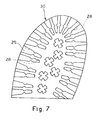
- Fig. 7 is a bottom view of a sole moulded according to the invention.
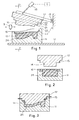
- Figures 1 to 4 show a open mould for the production of shoe soles in polyurethane material, obtained by pouring into the cavity of the mould a liquid polyurethane mixture produced in a suitable mixing head 9, from metered quantities of a polyole and an isocyanate for compact polyurethane.
- the mould 10 consists of a lower mould section 11 and an upper mould section or lid 12 to close the lower section 11.
- the lower section 11 of the mould comprises a shaped cavity 13 which reproduces the shape of the article to be produced, while the upper section or mould lid 12 presents a downwardly protruding male or plug member 14, capable of penetrating into the cavity 13 of the lower section of the mould.
- the plug member 14 may consist of a single piece or may be fixed in a interchangeable way to the closing lid 12 directly, or, as in figures 1 and 2, through an intermediate ram or piston member 15 which adapts into a compression chamber or cavity 16 at the lower mould section provided over and around the mould cavity 13 such as to constitute a widening extension of mould cavity capable of being totally or partially filled by an extra-charge of the polyurethane mixture.
- the lower section 11 of the mould may be fixed in a usual way to a support member or located on a turning table together with a respective lid or upper mould section 12, for example hinged at 18 to the turning table structure.
- Closing means 19 are provided for closing the lid 12 and looking the same against the lower part of the mould 11 said closing means being of any type, whether mechanical, hydraulic or pneumatic or other combination.
- Reference C in figure 1 indicates a settable time control device operatively connected to actuating means 19 to close the mould or to apply a pressure for compacting the semi-solid polyurethane material after a pre-fixed time delay from the feeding of the polyurethane into the mould.
- the polyurethane mixture provided by a mixing device 9 in liquid form is firstly poured or fed in the prescribed quantity into the mould cavity 13, with the mould in the open condition of figure 1; than the polyurethane mixture is let to change its physical state in an unrestrained condition to assume an intermediate polymeric or semi-solid state in which the polyurethane material may flow and may be compacted to assume and maintain the shape of the mould cavity.
- the mould When the polyurethane has reached the required semi-solid condition, well before the filament time, the mould is closed, and a pressure is applied to the material in the cavity 13 of the mould and in the compression chamber 16 by ram member 15, causing the same polyurethane to flow inside the mould cavity and to be compacted against the shaped surface of the mould cavity, thus removing or preventing the formations of air-bubbles or air cavities on the outer surface of the moulded article.
- the pressure on the polyurethane material is maintained for a length of time necessary for the polyurethane to polymerize and to harden, than the moulded article may by demoulded.
- the intermediate ram member 15 of the upper lid 12 carries out a double function acting as both a compressing member for the polyurethane mixture in the mould cavity, and as a sealing member along the opposite, nearby edges of both sections 11 and 12 of the mould.
- the smaller length and with dimensions of the ram member 15 with respect to the lid 12 also define peripheral steps 20 and 21, respectively 22 and 23 on the opposite edges of both sections of the mould which, when the mould is closed, create a labyrinth seal to allow a strong pressure to be applied on the polyurethane mixture. It is nevertheless clear that both the mould and the sealing system can be differently obtained and changed from the above embodiment.
- Figure 4 of the attached drawings shows an enlarged view of the lower mould section 11 and of the polyurethane mixture 24, while figure 7 shows the bottom face of a moulded sole 30.
- the bottom 25 of the cavity 13 of the mould in figure 4 include cavities or grooves 26 which determine protrusions 29 at the bottom surface of the sole facing the ground. Small air-bubbles 27 may be trapped in these cavities or grooves 26 of the bottom surface of the mould cavity during the feeding of liquid polyurethane mixture which, due to the strong surface tension of the polyurethane which prevent the liquid to penetrate and fill said grooves.
- air-bubbles 27 remain trapped between the surface 25 of the bottom of the mould cavity and the polyurethane material 24, causing the formation of imperfections or corresponding air-cavities 28 on the surface of the moulded article 30.
- the moment at which the compression of the polyurethane material in the mould should occur, the period for which the required pressure should be applied and the value of the pressure may vary from material to material and may also depend on the shape and dimensions of the of the articles to be moulded.
- compression parameters must be determined through preliminary trials, however it must occur within a time interval in the polymerization process of the polyurethane, which follows the end of the pouring or feeding step of the polyurethane into the mould cavity and which precedes the instant in which the filament forms, normally referred to as "filament time". It is in this time interval' specifically after the gelification phase or the formation of cream, in which one must act by compressing the polyurethane material into the mould in order to obtain the desired results. Better results may be obtained causing the polyurethane material to flow into the mould cavity during the closure of the mould as well as during the initial steps of the compression.
- the polyurethane material may by of a compact or anhydrous type, or alternatively of semi-compact type containing a certain quantity of water through the base formulation or through atmospheric humidity.
- the polyurethane material is obtained from a polyole for compact polyurethane, of polyether or polyester base, and from an isocyanate such as, for example, a phenylmethane - 4, 4' - diisocyanate prepolymer (MDI) which are mixed in the necessary quantities in order to obtain a required liquid mixture of polyurethane.
- MDI phenylmethane - 4, 4' - diisocyanate prepolymer
- the graph in figure 5 shows the characteristic periods of a compact anhydrous polyurethane, expressed in seconds.
- T 1 represents the end of pouring or feeding phase.
- the time interval T i -T o will vary from case to case and in general will depend on the quantity of the mixture to be fed into mould 11 and on the delivery of the mixing apparatus.
- T 2 the period necessary for gelification commonly called “gel time", indicated by T 2 which represents the starting moment of the gelidification phase of the polyurethane mixture.
- T 2 the time necessary for filament formation.
- filament time starts at T 3 , and is defined by moment T 3 in the diagram of figure 5 and, as known, the time before T 3 constitutes an intermediary critical phase in the polymerization or hardening process of the polyurethane material. Further characteristic time intervals of this process are the so-called “tack-free time” indicated by T 4, and the “pinch time” shown by T s , after which the moulded article can be removed from the mould.
- the starting point T for applying the pressure or the compacting compression of the polyurethane material in the mould cavity may vary, depending on specific parameters relating to the type of polyurethane, as well as the characteristics of the article to be produced, in general terms it can be stated that the moment for closing of the mould in figure 1, being the starting moment for the compression of the polyurethane material, will occur between 10% and 70% of the time interval T 2 -T 3 which runs from "gel time” T 2 and "filament time” T 3 .
- the graph in figure 6, as in figure 5, indicates the characteristic moments in the polymerization process for a semi-compact polyurethane material which has absorbed or contains a percentage of water.
- times To, Ti, T 3 , T 4 , and T 5 have the same meaning as the corresponding times indicated in figure 5; since the presence of water in the polyurethane composition brings about the formation of a cream, and given such cream to grow, or to expand by increasing its volume, the previously referred to time T 2 has been substituted by time T 6 being the instant cream begins to form, commonly called “cream time”, to which time T 7 must be added immediately thereafter, called “expansion time", from which the expansion phase of the mixture occurs in the mould; the expansion terminates at time T 8 following time T 5 referred above after which the moulded article may be removed from the mould.
- the time T x for exerting a pressure, or a compacting compression on the polyurethane material in the mould follows the time T 1 at the end of the pouring or feeding step of the mixture into the mould, and preferably falls between the "cream time” T 5 and the "filament time” T 3 , or, more precisely, after the expansion time T 7 of the polyurethane material.
- the starting point T for the compression of the polyurethane material or for the closing of the mould in a open mould pouring system will depend on the polyurethane material and on the characteristics of the article to be moulded.
- Such moment T x shall tend to occur, as a general guide, during a period again within 10% and 70% of the tine interval running from the "cream time” T 6 to the "filament time” T 3 .
- the amount of pressure to be applied to the material in the mould as well as the manner of applying such pressure may be important.
- pressures exceeding 2kg / sq. cm 0.,203 MPa
- the same pressure or the same compressing action on the polyurethane material in the conditions specified above may take place in a single phase, gradually increasing the pressure, or in several successive steps, acting contemporaneously with increasing pressure levels applied to the entire free surface of the material in the mould or beginning from one or more distinct points and then extending the pressure to the entire free surface of the material within the mould cavity in such a way as to produce a partial flow of the material from the cavity inside the mould, already in polymerization stage, causing in this way a plastic flow within the entire mass of material which assists in adhering to the deepest and smallest cavities of the mould, eliminating any air bubbles to be trapped and preventing the formation of air bubbles on the surface of the moulded article.
- FIG. 1 and 2 illustrate by way of example the starting of the polymerization process and the change of state occuring between the initial liquid state of the mixture and the semi-solid state when, the material swells slightly.
- the polyurethane material in the mould is in an evolving plastic state and is capable of being subjected to non-elastic or plastic deformations, maintaining a shape which ensures the perfect adhesion to the mould impression or design of the surface of the internal cavity of the mould.
- the invention further concerns a particular apparatus and mould structure conceived for the realization of shoe soles, though not limited to these, in which the male section of the mould is supported by the lid through an intermediate section having a ram-like action which applies final pressure to the material in the mould and to a greater surface area than that of the article under production, thus allowing a better seal during the compression phase.
Landscapes
- Engineering & Computer Science (AREA)
- Mechanical Engineering (AREA)
- Casting Or Compression Moulding Of Plastics Or The Like (AREA)
- Footwear And Its Accessory, Manufacturing Method And Apparatuses (AREA)
- Polyurethanes Or Polyureas (AREA)
- Processing And Handling Of Plastics And Other Materials For Molding In General (AREA)
Claims (14)
Priority Applications (1)
| Application Number | Priority Date | Filing Date | Title |
|---|---|---|---|
| AT87202400T ATE63852T1 (de) | 1986-11-27 | 1987-11-23 | Verfahren und vorrichtung zum formen von polyurethan-gegenstaenden. |
Applications Claiming Priority (2)
| Application Number | Priority Date | Filing Date | Title |
|---|---|---|---|
| IT2247286 | 1986-11-27 | ||
| IT22472/86A IT1198176B (it) | 1986-11-27 | 1986-11-27 | Procedimento e apparecchiatura perlo stampaggio di articoli in poliuretano |
Publications (3)
| Publication Number | Publication Date |
|---|---|
| EP0299117A1 EP0299117A1 (de) | 1989-01-18 |
| EP0299117B1 EP0299117B1 (de) | 1991-05-29 |
| EP0299117B2 true EP0299117B2 (de) | 1994-10-26 |
Family
ID=11196740
Family Applications (1)
| Application Number | Title | Priority Date | Filing Date |
|---|---|---|---|
| EP87202400A Expired - Lifetime EP0299117B2 (de) | 1986-11-27 | 1987-11-23 | Verfahren und Vorrichtung zum Formen von Polyurethan-Gegenständen |
Country Status (5)
| Country | Link |
|---|---|
| EP (1) | EP0299117B2 (de) |
| AT (1) | ATE63852T1 (de) |
| DE (1) | DE3770466D1 (de) |
| ES (1) | ES2022314T5 (de) |
| IT (1) | IT1198176B (de) |
Families Citing this family (1)
| Publication number | Priority date | Publication date | Assignee | Title |
|---|---|---|---|---|
| DE19648012A1 (de) * | 1996-11-20 | 1998-05-28 | Bayer Ag | Zweistufiges Verfahren zur Fertigung von halbharten massiven Polyurethan-Formkörpern |
Family Cites Families (4)
| Publication number | Priority date | Publication date | Assignee | Title |
|---|---|---|---|---|
| US3125617A (en) * | 1964-03-17 | Hoppe | ||
| US3291873A (en) * | 1963-10-21 | 1966-12-13 | Mobay Chemical Corp | Molding cellular polyurethane plastics |
| DE1685421A1 (de) * | 1965-03-10 | 1969-11-06 | Kokoku Kakaku Kogyo Kabushiki | Verfahren zum Herstellen von Schuhwerk mit Sohlen aus Polyurethan-Schaumstoff |
| US4160074A (en) * | 1975-09-12 | 1979-07-03 | Nihon Soflan Chemical & Engineering Co., Ltd. | Polyisocyanate foam having isotropic cells and method and apparatus for preparing same |
-
1986
- 1986-11-27 IT IT22472/86A patent/IT1198176B/it active
-
1987
- 1987-11-23 DE DE8787202400T patent/DE3770466D1/de not_active Expired - Fee Related
- 1987-11-23 ES ES87202400T patent/ES2022314T5/es not_active Expired - Lifetime
- 1987-11-23 EP EP87202400A patent/EP0299117B2/de not_active Expired - Lifetime
- 1987-11-23 AT AT87202400T patent/ATE63852T1/de not_active IP Right Cessation
Also Published As
| Publication number | Publication date |
|---|---|
| EP0299117B1 (de) | 1991-05-29 |
| ES2022314B3 (es) | 1991-12-01 |
| EP0299117A1 (de) | 1989-01-18 |
| DE3770466D1 (de) | 1991-07-04 |
| ES2022314T5 (es) | 1995-08-16 |
| ATE63852T1 (de) | 1991-06-15 |
| IT1198176B (it) | 1988-12-21 |
| IT8622472A0 (it) | 1986-11-27 |
| IT8622472A1 (it) | 1988-05-27 |
Similar Documents
| Publication | Publication Date | Title |
|---|---|---|
| US3137750A (en) | Injection molding of fabric reinforced plastics | |
| US3642975A (en) | Process for forming a stress-free article containing a depression from a polymer | |
| US4714579A (en) | Method and an apparatus for the production of shaped articles | |
| US4497763A (en) | Method for injection moulding coated parts from plastics material | |
| US3960996A (en) | Method of injection molding a thermoplastic article having a cellular core and integral skin involving use of reclaimed material | |
| US5002475A (en) | Reaction injection molding apparatus | |
| JPH0771564B2 (ja) | レジン義歯床の製造方法 | |
| US3802484A (en) | Apparatus for producing foundry cores | |
| US3871801A (en) | Machine for enclosing expanded plastic material for moulding parts | |
| WO2001043936A3 (de) | Verfahren zur herstellung von formteilen sowie eine vorrichtung zur durchführung dieses verfahrens | |
| EP0299117B1 (de) | Verfahren und Vorrichtung zum Formen von Polyurethan-Gegenständen | |
| NO315460B1 (no) | Fremgangsmåte for fremstilling av reaktive plastikkformede emner med en höyandel av grovmalt fyllstoff | |
| US3355526A (en) | Method of molding urethanes | |
| EP0318608A1 (de) | Verfahren und Vorrichtung zum Formen von Polyurethangegenständen | |
| US3677688A (en) | Cored slab wall panels | |
| SU579877A3 (ru) | Устройство дл формовани термопластичных отливок с твердой оболочкой и чеистым дром | |
| JPH05261752A (ja) | 液状高分子材料の成形用具と成形方法 | |
| JP3485142B2 (ja) | 発泡成形型及びインサートと一体発泡した成形体の製造方法 | |
| JPH08206783A (ja) | 鋳型列装置において粉末材料から鋳型を二方向に突き固める方法 | |
| US4058584A (en) | Method for manufacturing luminous hollow bodies for signs or the like | |
| US3439077A (en) | Process for making plastic articles having decorative surface effects | |
| JPS62122715A (ja) | 表皮材と発泡プラスチツク芯材との一体成形方法 | |
| JPS584606B2 (ja) | 屋根用役物の成形装置 | |
| EP0094375A1 (de) | Verfahren zur Herstellung einer elastischen Schuhsohle und Form zur Durchführung des Verfahrens | |
| JPS63176113A (ja) | フレ−ム一体発泡シ−トの製造方法 |
Legal Events
| Date | Code | Title | Description |
|---|---|---|---|
| PUAI | Public reference made under article 153(3) epc to a published international application that has entered the european phase |
Free format text: ORIGINAL CODE: 0009012 |
|
| AK | Designated contracting states |
Kind code of ref document: A1 Designated state(s): AT BE CH DE ES FR GB GR IT LI LU NL SE |
|
| 17P | Request for examination filed |
Effective date: 19890405 |
|
| 17Q | First examination report despatched |
Effective date: 19890829 |
|
| RAP1 | Party data changed (applicant data changed or rights of an application transferred) |
Owner name: GUSBI OFFICINA MECCANICA S.P.A. |
|
| GRAA | (expected) grant |
Free format text: ORIGINAL CODE: 0009210 |
|
| AK | Designated contracting states |
Kind code of ref document: B1 Designated state(s): AT BE CH DE ES FR GB GR IT LI LU NL SE |
|
| PG25 | Lapsed in a contracting state [announced via postgrant information from national office to epo] |
Ref country code: LI Effective date: 19910529 Ref country code: GR Free format text: LAPSE BECAUSE OF FAILURE TO SUBMIT A TRANSLATION OF THE DESCRIPTION OR TO PAY THE FEE WITHIN THE PRESCRIBED TIME-LIMIT Effective date: 19910529 Ref country code: CH Effective date: 19910529 Ref country code: BE Effective date: 19910529 Ref country code: AT Effective date: 19910529 Ref country code: NL Effective date: 19910529 |
|
| REF | Corresponds to: |
Ref document number: 63852 Country of ref document: AT Date of ref document: 19910615 Kind code of ref document: T |
|
| ITF | It: translation for a ep patent filed | ||
| ET | Fr: translation filed | ||
| REF | Corresponds to: |
Ref document number: 3770466 Country of ref document: DE Date of ref document: 19910704 |
|
| REG | Reference to a national code |
Ref country code: CH Ref legal event code: PL |
|
| NLV1 | Nl: lapsed or annulled due to failure to fulfill the requirements of art. 29p and 29m of the patents act | ||
| PG25 | Lapsed in a contracting state [announced via postgrant information from national office to epo] |
Ref country code: LU Free format text: LAPSE BECAUSE OF NON-PAYMENT OF DUE FEES Effective date: 19911130 |
|
| PLBI | Opposition filed |
Free format text: ORIGINAL CODE: 0009260 |
|
| 26 | Opposition filed |
Opponent name: BAYER AG, LEVERKUSEN KONZERNVERWALTUNG RP PATENTE Effective date: 19920226 Opponent name: KLOECKNER FERROMATIC DESMA GMBH Effective date: 19920228 |
|
| PLAB | Opposition data, opponent's data or that of the opponent's representative modified |
Free format text: ORIGINAL CODE: 0009299OPPO |
|
| R26 | Opposition filed (corrected) |
Opponent name: BAYER AG, LEVERKUSEN KONZERNVERWALTUNG RP PATENTE Effective date: 19920226 |
|
| PLAB | Opposition data, opponent's data or that of the opponent's representative modified |
Free format text: ORIGINAL CODE: 0009299OPPO |
|
| R26 | Opposition filed (corrected) |
Opponent name: BAYER AG, LEVERKUSEN KONZERNVERWALTUNG RP PATENTE Effective date: 19920226 |
|
| PUAH | Patent maintained in amended form |
Free format text: ORIGINAL CODE: 0009272 |
|
| STAA | Information on the status of an ep patent application or granted ep patent |
Free format text: STATUS: PATENT MAINTAINED AS AMENDED |
|
| 27A | Patent maintained in amended form |
Effective date: 19941026 |
|
| AK | Designated contracting states |
Kind code of ref document: B2 Designated state(s): AT BE CH DE ES FR GB GR IT LI LU NL SE |
|
| ITF | It: translation for a ep patent filed | ||
| ET3 | Fr: translation filed ** decision concerning opposition | ||
| EAL | Se: european patent in force in sweden |
Ref document number: 87202400.5 |
|
| REG | Reference to a national code |
Ref country code: ES Ref legal event code: DC2A Kind code of ref document: T5 Effective date: 19950816 |
|
| REG | Reference to a national code |
Ref country code: GB Ref legal event code: IF02 |
|
| APAH | Appeal reference modified |
Free format text: ORIGINAL CODE: EPIDOSCREFNO |
|
| PGFP | Annual fee paid to national office [announced via postgrant information from national office to epo] |
Ref country code: GB Payment date: 20051011 Year of fee payment: 19 |
|
| PGFP | Annual fee paid to national office [announced via postgrant information from national office to epo] |
Ref country code: FR Payment date: 20051018 Year of fee payment: 19 |
|
| PGFP | Annual fee paid to national office [announced via postgrant information from national office to epo] |
Ref country code: ES Payment date: 20051103 Year of fee payment: 19 |
|
| PGFP | Annual fee paid to national office [announced via postgrant information from national office to epo] |
Ref country code: SE Payment date: 20051108 Year of fee payment: 19 |
|
| PGFP | Annual fee paid to national office [announced via postgrant information from national office to epo] |
Ref country code: DE Payment date: 20051228 Year of fee payment: 19 |
|
| PG25 | Lapsed in a contracting state [announced via postgrant information from national office to epo] |
Ref country code: SE Free format text: LAPSE BECAUSE OF NON-PAYMENT OF DUE FEES Effective date: 20061124 |
|
| PGFP | Annual fee paid to national office [announced via postgrant information from national office to epo] |
Ref country code: IT Payment date: 20061130 Year of fee payment: 20 |
|
| PG25 | Lapsed in a contracting state [announced via postgrant information from national office to epo] |
Ref country code: DE Free format text: LAPSE BECAUSE OF NON-PAYMENT OF DUE FEES Effective date: 20070601 |
|
| EUG | Se: european patent has lapsed | ||
| GBPC | Gb: european patent ceased through non-payment of renewal fee |
Effective date: 20061123 |
|
| REG | Reference to a national code |
Ref country code: FR Ref legal event code: ST Effective date: 20070731 |
|
| PG25 | Lapsed in a contracting state [announced via postgrant information from national office to epo] |
Ref country code: GB Free format text: LAPSE BECAUSE OF NON-PAYMENT OF DUE FEES Effective date: 20061123 |
|
| REG | Reference to a national code |
Ref country code: ES Ref legal event code: FD2A Effective date: 20061124 |
|
| PG25 | Lapsed in a contracting state [announced via postgrant information from national office to epo] |
Ref country code: ES Free format text: LAPSE BECAUSE OF NON-PAYMENT OF DUE FEES Effective date: 20061124 Ref country code: FR Free format text: LAPSE BECAUSE OF NON-PAYMENT OF DUE FEES Effective date: 20061130 |