EP0295147A2 - High strength polyester yarn - Google Patents
High strength polyester yarn Download PDFInfo
- Publication number
- EP0295147A2 EP0295147A2 EP88305370A EP88305370A EP0295147A2 EP 0295147 A2 EP0295147 A2 EP 0295147A2 EP 88305370 A EP88305370 A EP 88305370A EP 88305370 A EP88305370 A EP 88305370A EP 0295147 A2 EP0295147 A2 EP 0295147A2
- Authority
- EP
- European Patent Office
- Prior art keywords
- tmf
- yarn
- dsc
- polyester
- less
- Prior art date
- Legal status (The legal status is an assumption and is not a legal conclusion. Google has not performed a legal analysis and makes no representation as to the accuracy of the status listed.)
- Granted
Links
- 229920000728 polyester Polymers 0.000 title claims abstract description 30
- 238000002844 melting Methods 0.000 claims abstract description 11
- 230000008018 melting Effects 0.000 claims abstract description 11
- -1 polyethylene terephthalate Polymers 0.000 claims abstract description 11
- 229920000139 polyethylene terephthalate Polymers 0.000 claims abstract description 8
- 239000005020 polyethylene terephthalate Substances 0.000 claims abstract description 8
- 229920001971 elastomer Polymers 0.000 claims abstract description 3
- 230000003014 reinforcing effect Effects 0.000 claims abstract 2
- 239000000835 fiber Substances 0.000 description 30
- 238000000034 method Methods 0.000 description 22
- 238000009987 spinning Methods 0.000 description 19
- 239000012779 reinforcing material Substances 0.000 description 8
- 238000001816 cooling Methods 0.000 description 5
- 238000010438 heat treatment Methods 0.000 description 5
- 238000005259 measurement Methods 0.000 description 5
- 239000004816 latex Substances 0.000 description 4
- 229920000126 latex Polymers 0.000 description 4
- 239000000243 solution Substances 0.000 description 4
- DUILGEYLVHGSEE-UHFFFAOYSA-N 2-(oxiran-2-ylmethyl)isoindole-1,3-dione Chemical compound O=C1C2=CC=CC=C2C(=O)N1CC1CO1 DUILGEYLVHGSEE-UHFFFAOYSA-N 0.000 description 3
- RYGMFSIKBFXOCR-UHFFFAOYSA-N Copper Chemical compound [Cu] RYGMFSIKBFXOCR-UHFFFAOYSA-N 0.000 description 3
- HEMHJVSKTPXQMS-UHFFFAOYSA-M Sodium hydroxide Chemical compound [OH-].[Na+] HEMHJVSKTPXQMS-UHFFFAOYSA-M 0.000 description 3
- 238000007664 blowing Methods 0.000 description 3
- 229910052802 copper Inorganic materials 0.000 description 3
- 239000010949 copper Substances 0.000 description 3
- 238000007598 dipping method Methods 0.000 description 3
- 229920000642 polymer Polymers 0.000 description 3
- QPFMBZIOSGYJDE-UHFFFAOYSA-N 1,1,2,2-tetrachloroethane Chemical compound ClC(Cl)C(Cl)Cl QPFMBZIOSGYJDE-UHFFFAOYSA-N 0.000 description 2
- LYCAIKOWRPUZTN-UHFFFAOYSA-N Ethylene glycol Chemical compound OCCO LYCAIKOWRPUZTN-UHFFFAOYSA-N 0.000 description 2
- 125000003178 carboxy group Chemical group [H]OC(*)=O 0.000 description 2
- 239000013078 crystal Substances 0.000 description 2
- 238000001035 drying Methods 0.000 description 2
- 238000004519 manufacturing process Methods 0.000 description 2
- 238000006116 polymerization reaction Methods 0.000 description 2
- GHMLBKRAJCXXBS-UHFFFAOYSA-N resorcinol Chemical compound OC1=CC=CC(O)=C1 GHMLBKRAJCXXBS-UHFFFAOYSA-N 0.000 description 2
- 239000007787 solid Substances 0.000 description 2
- VZGDMQKNWNREIO-UHFFFAOYSA-N tetrachloromethane Chemical compound ClC(Cl)(Cl)Cl VZGDMQKNWNREIO-UHFFFAOYSA-N 0.000 description 2
- 238000004804 winding Methods 0.000 description 2
- DSQWWSVOIGUHAE-UHFFFAOYSA-N 4-chloro-2-phenylphenol Chemical compound OC1=CC=C(Cl)C=C1C1=CC=CC=C1 DSQWWSVOIGUHAE-UHFFFAOYSA-N 0.000 description 1
- VHUUQVKOLVNVRT-UHFFFAOYSA-N Ammonium hydroxide Chemical group [NH4+].[OH-] VHUUQVKOLVNVRT-UHFFFAOYSA-N 0.000 description 1
- 101100234408 Danio rerio kif7 gene Proteins 0.000 description 1
- 101100221620 Drosophila melanogaster cos gene Proteins 0.000 description 1
- 239000004593 Epoxy Substances 0.000 description 1
- 235000003403 Limnocharis flava Nutrition 0.000 description 1
- 244000278243 Limnocharis flava Species 0.000 description 1
- OFOBLEOULBTSOW-UHFFFAOYSA-N Malonic acid Chemical compound OC(=O)CC(O)=O OFOBLEOULBTSOW-UHFFFAOYSA-N 0.000 description 1
- ISWSIDIOOBJBQZ-UHFFFAOYSA-N Phenol Chemical compound OC1=CC=CC=C1 ISWSIDIOOBJBQZ-UHFFFAOYSA-N 0.000 description 1
- 101100398237 Xenopus tropicalis kif11 gene Proteins 0.000 description 1
- 239000000853 adhesive Substances 0.000 description 1
- 230000001070 adhesive effect Effects 0.000 description 1
- 235000011114 ammonium hydroxide Nutrition 0.000 description 1
- 238000004458 analytical method Methods 0.000 description 1
- 239000012298 atmosphere Substances 0.000 description 1
- 230000015572 biosynthetic process Effects 0.000 description 1
- 239000007795 chemical reaction product Substances 0.000 description 1
- 239000003795 chemical substances by application Substances 0.000 description 1
- 230000000052 comparative effect Effects 0.000 description 1
- 150000001875 compounds Chemical class 0.000 description 1
- 238000007906 compression Methods 0.000 description 1
- 230000003750 conditioning effect Effects 0.000 description 1
- 238000002425 crystallisation Methods 0.000 description 1
- 230000008025 crystallization Effects 0.000 description 1
- 230000000694 effects Effects 0.000 description 1
- 238000011156 evaluation Methods 0.000 description 1
- 230000001747 exhibiting effect Effects 0.000 description 1
- 238000001125 extrusion Methods 0.000 description 1
- WGCNASOHLSPBMP-UHFFFAOYSA-N hydroxyacetaldehyde Natural products OCC=O WGCNASOHLSPBMP-UHFFFAOYSA-N 0.000 description 1
- 230000014759 maintenance of location Effects 0.000 description 1
- 238000002074 melt spinning Methods 0.000 description 1
- 239000011259 mixed solution Substances 0.000 description 1
- 239000012046 mixed solvent Substances 0.000 description 1
- 239000012299 nitrogen atmosphere Substances 0.000 description 1
- 230000000704 physical effect Effects 0.000 description 1
- 238000006068 polycondensation reaction Methods 0.000 description 1
- 230000002265 prevention Effects 0.000 description 1
- 238000004736 wide-angle X-ray diffraction Methods 0.000 description 1
Classifications
-
- D—TEXTILES; PAPER
- D01—NATURAL OR MAN-MADE THREADS OR FIBRES; SPINNING
- D01F—CHEMICAL FEATURES IN THE MANUFACTURE OF ARTIFICIAL FILAMENTS, THREADS, FIBRES, BRISTLES OR RIBBONS; APPARATUS SPECIALLY ADAPTED FOR THE MANUFACTURE OF CARBON FILAMENTS
- D01F6/00—Monocomponent artificial filaments or the like of synthetic polymers; Manufacture thereof
- D01F6/58—Monocomponent artificial filaments or the like of synthetic polymers; Manufacture thereof from homopolycondensation products
- D01F6/62—Monocomponent artificial filaments or the like of synthetic polymers; Manufacture thereof from homopolycondensation products from polyesters
Definitions
- This invention is related to polyester yarn which has high strength and excellent durability and is particularly suitable as a rubber-reinforcing material.
- the fiber made from polyethylene terephthalate, or from a polyester in which it is the main component, has excellent mechanical properties and thermal properties and it is widely used in the manufacture of tire cords, V belts, conveyor belts and hoses. In particular it takes the largest ratio in the application as the rubber-reinforcing material where polyester fibers of high strength and excellent durability with balanced heat shrinkage and modulus are required.
- polyester fiber when used as the rubber-reinforcing material, it is necessary to subject it to a twisting process and a dip process (process of applying adhesive and heat-treating). Thus, even if the original yarn has good performance, the resultant dipped cord frequently cannot satisfy the required performance.
- This invention seeks to provide a polyester fiber which has a high strength and excellent durability with balanced heat shrinkage and modulus and which exhibits excellent performance even after being made into a dipped cord.
- Polyester yarn which is made from polyethylene terephthalate or from a polyester in which polyethylene terephthalate is the main component, the polyester fiber satisfying the following property characteristics (a) - (f) simultaneously.
- the polyester in this invention is polyethylene terephthalate or a polyester in which polyethylene terephthalate is the main component (at least 90 mol percent) and various types of dicarboxylic acid and glycol component can be copolymerized therewith in an amount of up to about 10 mol percent.
- polyethylene terephthalate is the main component (at least 90 mol percent) and various types of dicarboxylic acid and glycol component can be copolymerized therewith in an amount of up to about 10 mol percent.
- the polyester fiber of this invention must have a high molecular weight having an intrinsic viscosity of at least 0.91 as measured by 20°C by use of an equal weight mixed solvent of phenol and tetrachloroethane.
- an intrinsic viscosity of at least 1.0 is preferred. This is the required condition for the fiber to exhibit high strength and for increasing the formation of tie molecules which participate in the improvement of durability.
- the strength is the value obtained using the method of JIS L-1017, i.e., the value obtained by dividing the load at breaking in a load-elongation test with the measured denier determined prior to the test. It needs to be at leat 8.0 g/d, preferably at least 8.4 g/d.
- E 2.25 indicates the elongation at a load of 2.25 g/d in the load-elongation curve at the strength measurement.
- the value is obtained by computer treatment. It needs to be 4.5 percent or less, preferably 3.5 percent or less.
- a low value of this property means a high intermediate modulus, and it is a necessary condition for reducing the dip elongation phenomenon in the dip treatment process and for achieving high strength and high Young's modulus.
- ⁇ H mf is measured by use of Perkin Elmers DSC-2C differential scanning calorimeter with 3 mg of sample (original yarn) at a rate of temperature increase of 20°C/minute in a nitrogen atmosphere. It needs to be at least 11.5 cal/g, preferably at least 12.0 cal/g. This value depends on the degree of crystallization of the fibers and it indicates the degree of perfection of the microstructure of fibers mainly in the crystalline section. A large value of this indicates that the fiber has high strength, high modulus and high durability.
- the melting points of fiber are measured as follows: 3 mg of the monofilament of original yarn is wound over a copper plate of length 10mm, width 3 mm and thickness of 0.5 mm, under a load of 0.05 g/d or under no load, to a width of 5mm; the front end of the sample is tied and the excess copper plate is cut off; then, the measurement is made under the same conditions as in the measurement of ⁇ H mf .
- a copper plate of the same shape is inserted.
- TmF is the ordinary melting point and Tmf indicates the super-heating property caused by the tie molecules.
- the value of ⁇ T is an important indicator of the amount of tie molecules formed.
- the fiber having a high ⁇ T has a strong connection of the crystalline section and amorphous section by the tie molecules, and this contributes effectively to the prevention of breading phenomenon which occurs at the boundary between crystalline and amorphous sections; as the result, high strength and high durability are exhibited.
- ⁇ n is determined by the Berek compensator method using an ordinary polarized microscope.
- f c is obtained from the following equation with the average orientation angle ⁇ measured by wide angle X ray diffraction, i.e.
- the f c of the polyester fiber of this invention there is no particular restriction but it generally exhibits a value of about 0.94.
- the value of X is generally about 0.40 to 0.45.
- the polyester fiber of this invention which satisfies the above-mentioned characteristics simultaneously has high strength and excellent durability and also has a balanced heat shrinkage and modulus. Even after being made into the dipped cord, it exhibits excellent performance.
- molten polyester of high intrinsic viscosity (at least 0.91) from a polycondensation apparatus is directly fed to a spinning machine or is first made into chips which are melted in an extruder and then is fed to a spinning machine.
- Spinning is effected in a manner known per se at a take-up rate of about 700 to 5000 m/minute.
- a polyester of somewhat higher viscosity than the desired intrinsic viscosity of the polyester in the fiber to be obtained is used.
- the stress on the spun yarn is 0.05 to 1.0 g/d.
- the method of increasing the stress of spun yarn one can use a method involving increasing the spinning speed (take-up speed) or a method involving increasing the rate of cooling of the spun yarn. In this way, the birefringence of the resultant undrawn yarn is made to over 15 x 10 ⁇ 3, preferably 25 x 10 ⁇ 3 to 70 x 10 ⁇ 3.
- this undrawn yarn is drawn in one stage or multiple stages while heating by heating roller, heating plate, steam jet.
- Drawing can be done by a spin draw method which is conducted as a continuation of the spinning or by a two-process method in which the undrawn yarn is first taken up and then drawn subsequently.
- an optimal condition is selected by combining the spinning stress at spinning and the drawing temperature and time.
- N-glycidyl phthalimide was added in an amount indicated in Table 1. This was fed to an extruder type melt spinning machine and was spun at a spinning temperature of 300 to 310°C (set to the optimal temperature in this range) using a spinning die having 252 holes of diameter 0.6 mm. Spun yarn was passed through a heated hood of 100 mm length at an atmosphere temperature of 300°C. Then, cooling air at 18°C was blown from the circumferential direction at 40 m/minute velocity over a length of 300 mm. Spinning oil agent was applied by use of an oiling roller.
- Birefringence of the undrawn yarn was measured by unheating the take-up roller and winding the undrawn yarn on this and taking a sample from this.
- the yarn was given a first stage drawing to a draw ratio of 1.45 between the above-mentioned heated take-up roller and an unheated No. 1 Nelson roller.
- the yarn was passed through 400°C steam jet apparatus to effect a second stage drawing.
- the yarn was subjected to a relation at a ratio as shown in Table 1.
- the yard is then wound up.
- the draw ratio in second stage drawing was adjusted to give a total draw ratio as indicated in Table 1 taking the relaxation ratio into consideration.
- the denier change produced by changing the relaxation ratio of drawn yarn was adjusted by adjusting the extrusion rate.
- the end carboxyl group content in the drawn yarn obtained was in the range of 9.5 to 10.8 g/eq/106 polymer in all cases.
- downward twisting of 49 twists/10 cm was applied in the Z direction by use of a ring twisting machine.
- two yarn strands were combined and upward twisting of 49/10 cm in S direction was applied to make a greige cord. This was dip-treated by use of a single dipping machine made by the Litzler Company to obtain a dipped cord.
- a mixed solution consisting of 83 weight parts of resorcinol-formalin-Gentac latex solution (1 weight part of the reaction product of resorcinol and fomaldehyde in a mol ratio of 1:1.2, mixed with 4.3 weight parts, in solid content, of latex to prepare a solution having 20 weight percent concentration; pH adjusted to 9.5 with NaOH) and 17 weight parts of Vulcabond E.
- Gentac latex is a trade name of General Tire Company; it is a butadiene-styrene-vinyl pyridine latex.
- Vulcabond E is a trade name of Vulnax Company; it is an ammonia-water solution of 2,6-bis(2′,4′-dihydroxyl phenyl-4-chlorophenol having a solid content of 20 weight percent,
- polyester fibers which simultaneously satisfy the properties defined in this invention have excellent total balance of the strength, heat shrinkage, modulus and fatigue resistance in the dip cord performance which expresses the performance as rubber-reinforcing material directly. Thus, they are good as rubber-reinforcing materials; No. 5 - 8 have particularly good performance.
- This invention provides polyester fiber which has high strength and excellent durability and balanced heat shrinkage and modulus and is suitable as rubber-reinforcing material exhibiting excellent performance even after being made into dipped cord.
Landscapes
- Chemical & Material Sciences (AREA)
- Chemical Kinetics & Catalysis (AREA)
- General Chemical & Material Sciences (AREA)
- Engineering & Computer Science (AREA)
- Textile Engineering (AREA)
- Artificial Filaments (AREA)
Abstract
(a) an intrinsic viscosity of at least 0.91,
(b) a tenacity of at least 8 g/d,
(c) E2.25 of 4.5 percent or less,
(d) ΔHmf of at least 11.5 cal/g,
(e) (Tmf - TmF) of at least 20°C, and
(f) an amorphous orientation function of 0.75 or less, wherein E2.25 is the elongation under a load of 2.25 g/d,
ΔHmf is the amount of heat at the melting peak in differential scanning calorimeter (DSC),
Tmf is the melting point measured by DSC under a tension of 0.05 g/d, and
TmF is the melting point measured by DSC under no tension.
Description
- This invention is related to polyester yarn which has high strength and excellent durability and is particularly suitable as a rubber-reinforcing material.
- The fiber made from polyethylene terephthalate, or from a polyester in which it is the main component, has excellent mechanical properties and thermal properties and it is widely used in the manufacture of tire cords, V belts, conveyor belts and hoses. In particular it takes the largest ratio in the application as the rubber-reinforcing material where polyester fibers of high strength and excellent durability with balanced heat shrinkage and modulus are required.
- As a method of obtaining a polyester fiber of high strength, for example as seen in US Patent No. 3216187, a method of spinning a polymer having a high degree of polymerization under a low stress to suppress the molecular orientation and drawing the resulting undrawn yarn to a maximum possible draw ratio has been previously proposed. However, although fiber of high strength is obtained by this method, the fiber has a large heat shrinkage because the amorphous section is highly oriented and one can obtain only the fiber with inadequate durability.
- For this reason, a method of spinning a polymer having relatively high degree of polymerization under a high stress and drawing to a low draw ratio to lower the degree of orientation in the amorphous section and reduce the heat shrinkage to obtain the fiber of good durability has also been proposed. (U.S. Patent No. 4195052). With this method, however, it is difficult to obtain fiber of high strength which is adequate for use as a rubber-reinforcing material.
- Also, when the polyester fiber is used as the rubber-reinforcing material, it is necessary to subject it to a twisting process and a dip process (process of applying adhesive and heat-treating). Thus, even if the original yarn has good performance, the resultant dipped cord frequently cannot satisfy the required performance.
- This invention seeks to provide a polyester fiber which has a high strength and excellent durability with balanced heat shrinkage and modulus and which exhibits excellent performance even after being made into a dipped cord.
- The embodiment of this invention is as follows:-
- Polyester yarn which is made from polyethylene terephthalate or from a polyester in which polyethylene terephthalate is the main component, the polyester fiber satisfying the following property characteristics (a) - (f) simultaneously.
- (a) Intrinsic viscosity of at least 0.91, preferably at least 1.0,
- (b) Tenacity of at least 8 g/d, preferably at least 8.4 g/d,
- (c) E2.25 of 4.5% or less, preferably 3.5% or less,
- (d) ΔHmf of at least 11.5 cal/g, preferably at least 12.0 cal/g,
- (e) (Tmf - TmF) of at least 20°C, preferably at least 22°C, and
- (f) Amorphous orientation (fa) of 0.75 or less, wherein E2.25 is the elongation under a load of 2.25 g/d,
- The polyester in this invention is polyethylene terephthalate or a polyester in which polyethylene terephthalate is the main component (at least 90 mol percent) and various types of dicarboxylic acid and glycol component can be copolymerized therewith in an amount of up to about 10 mol percent. In order to improve the heat resistance, it is preferred to reduce the end carboxyl group content of the polyester by reacting with epoxy compound, carbonate compound, carbodiimide compound, iminoether compound.
- In the following, the property characteristics of the polyester fiber of this invention are explained.
- First, the polyester fiber of this invention must have a high molecular weight having an intrinsic viscosity of at least 0.91 as measured by 20°C by use of an equal weight mixed solvent of phenol and tetrachloroethane. In particular, an intrinsic viscosity of at least 1.0 is preferred. This is the required condition for the fiber to exhibit high strength and for increasing the formation of tie molecules which participate in the improvement of durability.
- The strength is the value obtained using the method of JIS L-1017, i.e., the value obtained by dividing the load at breaking in a load-elongation test with the measured denier determined prior to the test. It needs to be at leat 8.0 g/d, preferably at least 8.4 g/d.
- Also, E2.25 indicates the elongation at a load of 2.25 g/d in the load-elongation curve at the strength measurement. The value is obtained by computer treatment. It needs to be 4.5 percent or less, preferably 3.5 percent or less. A low value of this property means a high intermediate modulus, and it is a necessary condition for reducing the dip elongation phenomenon in the dip treatment process and for achieving high strength and high Young's modulus.
- ΔHmf is measured by use of Perkin Elmers DSC-2C differential scanning calorimeter with 3 mg of sample (original yarn) at a rate of temperature increase of 20°C/minute in a nitrogen atmosphere. It needs to be at least 11.5 cal/g, preferably at least 12.0 cal/g. This value depends on the degree of crystallization of the fibers and it indicates the degree of perfection of the microstructure of fibers mainly in the crystalline section. A large value of this indicates that the fiber has high strength, high modulus and high durability.
- The melting points of fiber (Tmf and TmF) are measured as follows: 3 mg of the monofilament of original yarn is wound over a copper plate of length 10mm, width 3 mm and thickness of 0.5 mm, under a load of 0.05 g/d or under no load, to a width of 5mm; the front end of the sample is tied and the excess copper plate is cut off; then, the measurement is made under the same conditions as in the measurement of ΔHmf. In the reference side cell of DSC, a copper plate of the same shape is inserted.
- TmF is the ordinary melting point and Tmf indicates the super-heating property caused by the tie molecules. With the fibers of this invention, the value of Tmf-TmF (= ΔT) is at least 20°C, preferably at least 22°C characteristically. The value of ΔT is an important indicator of the amount of tie molecules formed. The fiber having a high ΔT has a strong connection of the crystalline section and amorphous section by the tie molecules, and this contributes effectively to the prevention of breading phenomenon which occurs at the boundary between crystalline and amorphous sections; as the result, high strength and high durability are exhibited.
- The amorphous degree of orientation (fa) is obtained by the following equation from the birefringence Δ n, degree of crustallization X, the intrinsic birefringence of crystal Δ nc (= 0.220), the intrinsic birefringence of amorphous section Δ na (0.275), and the crystalline orientation function fc:-

fc = 1/2 (3 cos² ϑ-1)
X is determined from the following equation from the sample density ρ measured at 25°C by a density gradient method using ligroin and carbon tetrachloride, the crystal density ρc (=1.455 g/cm³) and amorphous density ρ a (=1.335 g/cm³):-

- As to the fc of the polyester fiber of this invention, there is no particular restriction but it generally exhibits a value of about 0.94. The value of X is generally about 0.40 to 0.45.
- The polyester fiber of this invention which satisfies the above-mentioned characteristics simultaneously has high strength and excellent durability and also has a balanced heat shrinkage and modulus. Even after being made into the dipped cord, it exhibits excellent performance.
- In the following, the method of making the polyester fiber of this invention is described.
- First, molten polyester of high intrinsic viscosity (at least 0.91) from a polycondensation apparatus is directly fed to a spinning machine or is first made into chips which are melted in an extruder and then is fed to a spinning machine. Spinning is effected in a manner known per se at a take-up rate of about 700 to 5000 m/minute. In anticipation of the drop in the viscosity which usually occurs in spinning, there is used a polyester of somewhat higher viscosity than the desired intrinsic viscosity of the polyester in the fiber to be obtained.
- In the spinning, to achieve uniform cooling and enhance the uniformity of yarn strands, it is necessary to have optimal combinations of the following conditions in connection with the intrinsic viscosity of polyester and spinning speed: number of filaments in the yarn, denier of filament, diameter and arrangement of the discharge hole of spinning die, spinning temperature, length of the heated hood, length of the cooling zone, temperature, speed and mode of blowing (circumferential blowing or side blowing) of the cooling air.
- In order to obtain the polyester fiber of this invention, it is necessary to use the high stress spinning method and it is desirable that the stress on the spun yarn is 0.05 to 1.0 g/d. As for the method of increasing the stress of spun yarn, one can use a method involving increasing the spinning speed (take-up speed) or a method involving increasing the rate of cooling of the spun yarn. In this way, the birefringence of the resultant undrawn yarn is made to over 15 x 10⁻³, preferably 25 x 10⁻³ to 70 x 10⁻³.
- Next, this undrawn yarn is drawn in one stage or multiple stages while heating by heating roller, heating plate, steam jet. Drawing can be done by a spin draw method which is conducted as a continuation of the spinning or by a two-process method in which the undrawn yarn is first taken up and then drawn subsequently. As for the draw ratio, an optimal condition is selected by combining the spinning stress at spinning and the drawing temperature and time.
- In the following example, the invention is described in further detail.
- To the chips of polyethylene terephthalate having an intrinsic viscosity shown in Table 1, N-glycidyl phthalimide was added in an amount indicated in Table 1. This was fed to an extruder type melt spinning machine and was spun at a spinning temperature of 300 to 310°C (set to the optimal temperature in this range) using a spinning die having 252 holes of diameter 0.6 mm. Spun yarn was passed through a heated hood of 100 mm length at an atmosphere temperature of 300°C. Then, cooling air at 18°C was blown from the circumferential direction at 40 m/minute velocity over a length of 300 mm. Spinning oil agent was applied by use of an oiling roller. Then the yarn was taken up at a speed of 2000 m/minute to a take-up roller which was heated to 85°C. Thus, undrawn yarn having a birefringence as shown in Table 1 was obtained. (At this time, spinning stress was in the range of 0.08 to 0.20 g/d).
- Birefringence of the undrawn yarn was measured by unheating the take-up roller and winding the undrawn yarn on this and taking a sample from this.
- Also, without winding up the undrawn yarn, the yarn was given a first stage drawing to a draw ratio of 1.45 between the above-mentioned heated take-up roller and an unheated No. 1 Nelson roller. Next, between the No. 1 Nelson roller and a No. 2 Nelson roller which was heated to 240°C, the yarn was passed through 400°C steam jet apparatus to effect a second stage drawing. Then, between the No. 2 Nelson roller and a conditioning roller which was heated to 100°C, the yarn was subjected to a relation at a ratio as shown in Table 1. The yard is then wound up. The draw ratio in second stage drawing was adjusted to give a total draw ratio as indicated in Table 1 taking the relaxation ratio into consideration.
- The physical properties of the drawn yarn (original yarn) of 1000 d/252 f are shown in Table 1.
- The denier change produced by changing the relaxation ratio of drawn yarn was adjusted by adjusting the extrusion rate. The end carboxyl group content in the drawn yarn obtained was in the range of 9.5 to 10.8 g/eq/10⁶ polymer in all cases. To this original yarn, downward twisting of 49 twists/10 cm was applied in the Z direction by use of a ring twisting machine. Next, two yarn strands were combined and upward twisting of 49/10 cm in S direction was applied to make a greige cord. This was dip-treated by use of a single dipping machine made by the Litzler Company to obtain a dipped cord.
- The conditions of the dipping treatment and the method of evaluation of the performance of dipped cord were as follows:-
- A mixed solution consisting of 83 weight parts of resorcinol-formalin-Gentac latex solution (1 weight part of the reaction product of resorcinol and fomaldehyde in a mol ratio of 1:1.2, mixed with 4.3 weight parts, in solid content, of latex to prepare a solution having 20 weight percent concentration; pH adjusted to 9.5 with NaOH) and 17 weight parts of Vulcabond E.
- Gentac latex is a trade name of General Tire Company; it is a butadiene-styrene-vinyl pyridine latex. Vulcabond E is a trade name of Vulnax Company; it is an ammonia-water solution of 2,6-bis(2′,4′-dihydroxyl phenyl-4-chlorophenol having a solid content of 20 weight percent,
- Drying zone 80°C x 30 sec
Curing zone 240°C x 80 sec x 2 times
Dip tension 0.5 kg/cord
- Measurement was done by the JIS L 1017 method. However, heat shrinkage was measured under the condition of 180°C x 30 minutes.
-
- Measurement was made by the JIS L 1017, Goodyear's Mallory Tube Method with tube test angles of 60° and 90°at 850 rpm and the rotation was reversed at 30 minutes. When the angle was 60°, the cord was taken out carefully from rubber at 3 hours of fatigue and the tensile strength was measured to determine the strength retention ratio.
- Also, when the angle was 90°, the time (minutes) to the rupture of tube by fatigue was measured.
- The performance of the dipped cords is shown in Table 1.
- As can be seen from the results of Table 1, polyester fibers which simultaneously satisfy the properties defined in this invention have excellent total balance of the strength, heat shrinkage, modulus and fatigue resistance in the dip cord performance which expresses the performance as rubber-reinforcing material directly. Thus, they are good as rubber-reinforcing materials; No. 5 - 8 have particularly good performance.
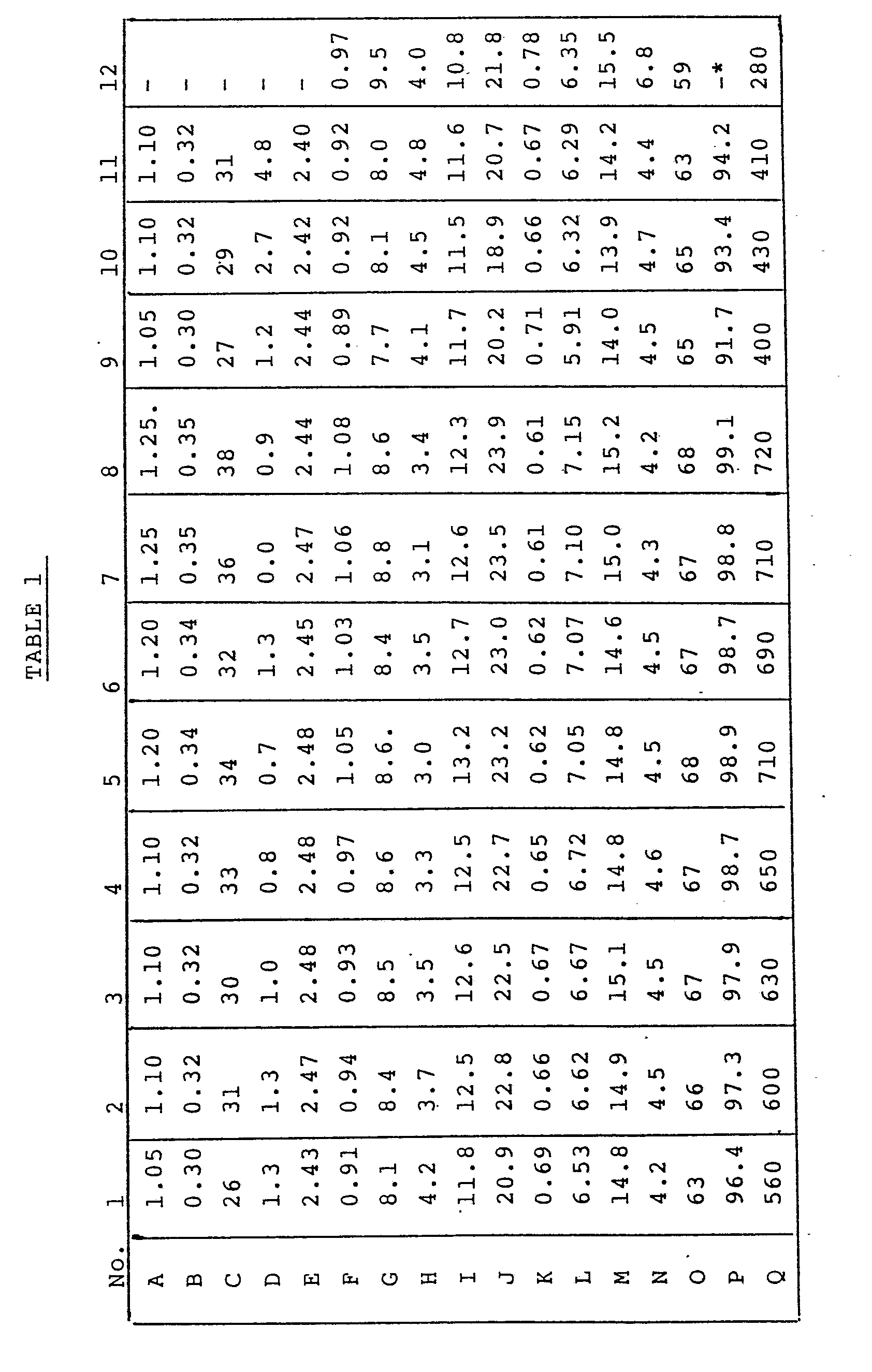
- A. IV of chips; B. Amount of N-glycidyl phthalimide added; C. Birefringence of undrawn yarn x 10³; D. Relaxation ratio (%); E. Total draw ratio; F-K. Original yarn properties; F. IV; G. Tenacity (g/d); H. E2.25 (%); I. ΔHmf (Cal/g); J. Tmf-TmF(°C); K. Amorphous orientation fa; L-Q. Dip cord performance; L. Tenacity (g/d); M. Elongation (%); N. Heat shrinkage (%); O. Modulus (g/d); P-Q. Fatigue properties; P. angle 60° (%); Q. Angle 90°(%).
*It was impossible to take the cord out.
Note:
(1) Unit of the amount of addition of N-glycidyl phthalimide is wt%.
(2) No. 1-8 are examples of application; No. 9-11 are comparative examples; No. 12 is a reference example showing the example of commercial high strength type polyester fiber. - This invention provides polyester fiber which has high strength and excellent durability and balanced heat shrinkage and modulus and is suitable as rubber-reinforcing material exhibiting excellent performance even after being made into dipped cord.
Tmf is the melting point measured by DSC under a tension of 0.05 g/d, and
TmF is the melting point measured by DSC under no tension.
Claims (5)
(a) an intrinsic viscosity of at least 0.91,
(b) a tenacity of at least 8 g/d,
(c) E2.25 of 4.5 percent or less,
(d) ΔHmf of at least 11.5 cal/g,
(e) (Tmf - TmF) of at least 20°C, and
(f) an amorphous orientation function of 0.75 or less, wherein E2.25 is the elongation under a load of 2.25 g/d,
ΔHmf is the amount of heat at the melting peak in differential scanning calorimeter (DSC),
Tmf is the melting point measured by DSC under a tension of 0.05 g/d, and
TmF is the melting point measured by DSC under no tension.
Applications Claiming Priority (2)
| Application Number | Priority Date | Filing Date | Title |
|---|---|---|---|
| JP147632/87 | 1987-06-12 | ||
| JP14763287A JPS63315608A (en) | 1987-06-12 | 1987-06-12 | Polyester fiber |
Publications (3)
| Publication Number | Publication Date |
|---|---|
| EP0295147A2 true EP0295147A2 (en) | 1988-12-14 |
| EP0295147A3 EP0295147A3 (en) | 1989-10-11 |
| EP0295147B1 EP0295147B1 (en) | 1993-08-18 |
Family
ID=15434720
Family Applications (1)
| Application Number | Title | Priority Date | Filing Date |
|---|---|---|---|
| EP88305370A Revoked EP0295147B1 (en) | 1987-06-12 | 1988-06-13 | High strength polyester yarn |
Country Status (3)
| Country | Link |
|---|---|
| EP (1) | EP0295147B1 (en) |
| JP (1) | JPS63315608A (en) |
| DE (1) | DE3883301T2 (en) |
Cited By (5)
| Publication number | Priority date | Publication date | Assignee | Title |
|---|---|---|---|---|
| EP0341920A3 (en) * | 1988-05-09 | 1990-04-25 | Toray Industries, Inc. | Polyester fiber for industrial use and process for preparation thereof |
| WO1990004667A1 (en) * | 1988-10-28 | 1990-05-03 | Allied-Signal Inc. | Dimensionally stable polyester yarn for highly dimensionally stable treated cords |
| EP0546859A3 (en) * | 1991-12-13 | 1993-09-15 | Kolon Industries Inc. | Polyester filamentary yarn, polyester tire cord and production thereof |
| EP0491947B1 (en) * | 1989-08-04 | 1998-01-14 | Kao Corporation | Polyester fiber |
| CN110004512A (en) * | 2017-11-15 | 2019-07-12 | 旭化成株式会社 | Ultra high molecular weight polyethylene fiber |
Family Cites Families (6)
| Publication number | Priority date | Publication date | Assignee | Title |
|---|---|---|---|---|
| US3966867A (en) * | 1968-08-31 | 1976-06-29 | Akzona Incorporated | Manufacture of unique polyethylene terephthalate fiber |
| US4070432A (en) * | 1975-02-13 | 1978-01-24 | Allied Chemical Corporation | Production of low shrink polyester fiber |
| JPS57154410A (en) * | 1981-03-13 | 1982-09-24 | Toray Ind Inc | Polyethylene terephthalate fiber and its production |
| JPS59116414A (en) * | 1982-12-24 | 1984-07-05 | Unitika Ltd | Polyester yarn for reinforcing rubber |
| JPH0663128B2 (en) * | 1983-10-20 | 1994-08-17 | 旭化成工業株式会社 | Polyester fiber for reinforcing rubber structure and method for producing the same |
| US4690866A (en) * | 1984-07-09 | 1987-09-01 | Teijin Limited | Polyester fiber |
-
1987
- 1987-06-12 JP JP14763287A patent/JPS63315608A/en active Pending
-
1988
- 1988-06-13 EP EP88305370A patent/EP0295147B1/en not_active Revoked
- 1988-06-13 DE DE19883883301 patent/DE3883301T2/en not_active Revoked
Cited By (10)
| Publication number | Priority date | Publication date | Assignee | Title |
|---|---|---|---|---|
| EP0341920A3 (en) * | 1988-05-09 | 1990-04-25 | Toray Industries, Inc. | Polyester fiber for industrial use and process for preparation thereof |
| US5049447A (en) * | 1988-05-09 | 1991-09-17 | Toray Industries, Inc. | Polyester fiber for industrial use and process for preparation thereof |
| WO1990004667A1 (en) * | 1988-10-28 | 1990-05-03 | Allied-Signal Inc. | Dimensionally stable polyester yarn for highly dimensionally stable treated cords |
| US5067538A (en) * | 1988-10-28 | 1991-11-26 | Allied-Signal Inc. | Dimensionally stable polyester yarn for highly dimensionally stable treated cords and composite materials such as tires made therefrom |
| EP0491947B1 (en) * | 1989-08-04 | 1998-01-14 | Kao Corporation | Polyester fiber |
| EP0546859A3 (en) * | 1991-12-13 | 1993-09-15 | Kolon Industries Inc. | Polyester filamentary yarn, polyester tire cord and production thereof |
| US5472781A (en) * | 1991-12-13 | 1995-12-05 | Kolon Industries, Inc. | High strength polyester filamentary yarn |
| USRE36698E (en) * | 1991-12-13 | 2000-05-16 | Kolon Industries, Inc. | High strength polyester filamentary yarn |
| CN110004512A (en) * | 2017-11-15 | 2019-07-12 | 旭化成株式会社 | Ultra high molecular weight polyethylene fiber |
| CN110004512B (en) * | 2017-11-15 | 2020-03-03 | 旭化成株式会社 | UHMWPE fiber |
Also Published As
| Publication number | Publication date |
|---|---|
| EP0295147A3 (en) | 1989-10-11 |
| DE3883301D1 (en) | 1993-09-23 |
| EP0295147B1 (en) | 1993-08-18 |
| DE3883301T2 (en) | 1993-12-09 |
| JPS63315608A (en) | 1988-12-23 |
Similar Documents
| Publication | Publication Date | Title |
|---|---|---|
| JP2914385B2 (en) | Dimensionally stable polyester yarn for high tenacity treatment cord | |
| CA1314673C (en) | High-tenacity conjugated fiber and process for preparation thereof | |
| EP0169415B1 (en) | Polyester fiber | |
| KR950007813B1 (en) | Industrial polyester fiber and its preparation | |
| US6511747B1 (en) | High strength polyethylene naphthalate fiber | |
| US7056461B2 (en) | Process of making polyester multifilament yarn | |
| PL184254B1 (en) | Yarn made of continuous polyester monofilaments, polyester tyre reinforcement cord and method of making them | |
| JP4132071B2 (en) | Manufacturing method of continuous polyester filament yarn | |
| EP0454868B1 (en) | Rubber-reinforcing polyester fiber and process for preparation thereof | |
| JPH06511293A (en) | High modulus polyester yarn for tire cord and composites | |
| EP0295147B1 (en) | High strength polyester yarn | |
| JPS6141320A (en) | Polyester fiber | |
| JPH0261109A (en) | Polyester fiber | |
| JPH0733610B2 (en) | Manufacturing method of polyester tire cord | |
| JPH0428806B2 (en) | ||
| KR100230899B1 (en) | High elongation(p-phenylene terephthalamide)fiber | |
| JPS62133108A (en) | Production of polyamide yarn having high strength and high toughness | |
| US6902803B2 (en) | Dimensionally stable yarns | |
| JPH0450407B2 (en) | ||
| US20050106389A1 (en) | Process of making a dimensionally stable yarn | |
| JP2960755B2 (en) | Manufacturing method of polyester fiber | |
| JPS6134216A (en) | Nylon 66 fiber having high strength and high fatigue resistance, and its manufacture | |
| CN100572625C (en) | High filament dtex yarn with improved fatigue properties | |
| JPH10251919A (en) | Polyester fiber and method for producing the same | |
| JPH0457914A (en) | Polyester yarn and its production |
Legal Events
| Date | Code | Title | Description |
|---|---|---|---|
| PUAI | Public reference made under article 153(3) epc to a published international application that has entered the european phase |
Free format text: ORIGINAL CODE: 0009012 |
|
| AK | Designated contracting states |
Kind code of ref document: A2 Designated state(s): DE GB |
|
| PUAL | Search report despatched |
Free format text: ORIGINAL CODE: 0009013 |
|
| AK | Designated contracting states |
Kind code of ref document: A3 Designated state(s): DE GB |
|
| 17P | Request for examination filed |
Effective date: 19900130 |
|
| 17Q | First examination report despatched |
Effective date: 19920213 |
|
| GRAA | (expected) grant |
Free format text: ORIGINAL CODE: 0009210 |
|
| AK | Designated contracting states |
Kind code of ref document: B1 Designated state(s): DE GB |
|
| REF | Corresponds to: |
Ref document number: 3883301 Country of ref document: DE Date of ref document: 19930923 |
|
| PLBI | Opposition filed |
Free format text: ORIGINAL CODE: 0009260 |
|
| PLBI | Opposition filed |
Free format text: ORIGINAL CODE: 0009260 |
|
| 26 | Opposition filed |
Opponent name: AKZO FASER AG FACHBEREICH PATENTWESEN Effective date: 19940504 |
|
| 26 | Opposition filed |
Opponent name: HOECHST AG Effective date: 19940518 Opponent name: RHONE-POULENC VISCOSUISSE SA PATENTABTEILUNG Effective date: 19940517 Opponent name: AKZO FASER AG FACHBEREICH PATENTWESEN Effective date: 19940504 |
|
| PLAB | Opposition data, opponent's data or that of the opponent's representative modified |
Free format text: ORIGINAL CODE: 0009299OPPO |
|
| R26 | Opposition filed (corrected) |
Opponent name: AKZO NOBEL FASER AG * 940517 RHONE-POULENC VISCOSU Effective date: 19940504 |
|
| PGFP | Annual fee paid to national office [announced via postgrant information from national office to epo] |
Ref country code: GB Payment date: 19950602 Year of fee payment: 8 |
|
| PGFP | Annual fee paid to national office [announced via postgrant information from national office to epo] |
Ref country code: DE Payment date: 19950607 Year of fee payment: 8 |
|
| RDAG | Patent revoked |
Free format text: ORIGINAL CODE: 0009271 |
|
| STAA | Information on the status of an ep patent application or granted ep patent |
Free format text: STATUS: PATENT REVOKED |
|
| 27W | Patent revoked |
Effective date: 19950706 |
|
| GBPR | Gb: patent revoked under art. 102 of the ep convention designating the uk as contracting state |
Free format text: 950706 |