EP0294641A2 - Polyaralkylierte Hydroxybenzamide, Verfahren zu ihrer Herstellung und ihre Verwendung - Google Patents
Polyaralkylierte Hydroxybenzamide, Verfahren zu ihrer Herstellung und ihre Verwendung Download PDFInfo
- Publication number
- EP0294641A2 EP0294641A2 EP88108232A EP88108232A EP0294641A2 EP 0294641 A2 EP0294641 A2 EP 0294641A2 EP 88108232 A EP88108232 A EP 88108232A EP 88108232 A EP88108232 A EP 88108232A EP 0294641 A2 EP0294641 A2 EP 0294641A2
- Authority
- EP
- European Patent Office
- Prior art keywords
- alkyl
- hydrogen
- formula
- aralkyl
- polyaralkylated
- Prior art date
- Legal status (The legal status is an assumption and is not a legal conclusion. Google has not performed a legal analysis and makes no representation as to the accuracy of the status listed.)
- Granted
Links
- YNQLUTRBYVCPMQ-UHFFFAOYSA-N CCc1ccccc1 Chemical compound CCc1ccccc1 YNQLUTRBYVCPMQ-UHFFFAOYSA-N 0.000 description 4
- 0 CCCCC*[C@@](C)C(CC1)C[C@]1(CCCC=C)C1CC1 Chemical compound CCCCC*[C@@](C)C(CC1)C[C@]1(CCCC=C)C1CC1 0.000 description 3
- NOKHEHFYTNFBEL-UHFFFAOYSA-N CCC1=CCCC=C1 Chemical compound CCC1=CCCC=C1 NOKHEHFYTNFBEL-UHFFFAOYSA-N 0.000 description 1
- BAGSBIKCNLYDJO-UHFFFAOYSA-N CCC1C=CCCC1 Chemical compound CCC1C=CCCC1 BAGSBIKCNLYDJO-UHFFFAOYSA-N 0.000 description 1
Classifications
-
- C—CHEMISTRY; METALLURGY
- C10—PETROLEUM, GAS OR COKE INDUSTRIES; TECHNICAL GASES CONTAINING CARBON MONOXIDE; FUELS; LUBRICANTS; PEAT
- C10L—FUELS NOT OTHERWISE PROVIDED FOR; NATURAL GAS; SYNTHETIC NATURAL GAS OBTAINED BY PROCESSES NOT COVERED BY SUBCLASSES C10G OR C10K; LIQUIFIED PETROLEUM GAS; USE OF ADDITIVES TO FUELS OR FIRES; FIRE-LIGHTERS
- C10L1/00—Liquid carbonaceous fuels
- C10L1/10—Liquid carbonaceous fuels containing additives
- C10L1/14—Organic compounds
- C10L1/22—Organic compounds containing nitrogen
- C10L1/222—Organic compounds containing nitrogen containing at least one carbon-to-nitrogen single bond
- C10L1/224—Amides; Imides carboxylic acid amides, imides
-
- C—CHEMISTRY; METALLURGY
- C09—DYES; PAINTS; POLISHES; NATURAL RESINS; ADHESIVES; COMPOSITIONS NOT OTHERWISE PROVIDED FOR; APPLICATIONS OF MATERIALS NOT OTHERWISE PROVIDED FOR
- C09K—MATERIALS FOR MISCELLANEOUS APPLICATIONS, NOT PROVIDED FOR ELSEWHERE
- C09K8/00—Compositions for drilling of boreholes or wells; Compositions for treating boreholes or wells, e.g. for completion or for remedial operations
- C09K8/54—Compositions for in situ inhibition of corrosion in boreholes or wells
-
- C—CHEMISTRY; METALLURGY
- C10—PETROLEUM, GAS OR COKE INDUSTRIES; TECHNICAL GASES CONTAINING CARBON MONOXIDE; FUELS; LUBRICANTS; PEAT
- C10M—LUBRICATING COMPOSITIONS; USE OF CHEMICAL SUBSTANCES EITHER ALONE OR AS LUBRICATING INGREDIENTS IN A LUBRICATING COMPOSITION
- C10M133/00—Lubricating compositions characterised by the additive being an organic non-macromolecular compound containing nitrogen
- C10M133/02—Lubricating compositions characterised by the additive being an organic non-macromolecular compound containing nitrogen having a carbon chain of less than 30 atoms
- C10M133/16—Amides; Imides
-
- C—CHEMISTRY; METALLURGY
- C10—PETROLEUM, GAS OR COKE INDUSTRIES; TECHNICAL GASES CONTAINING CARBON MONOXIDE; FUELS; LUBRICANTS; PEAT
- C10M—LUBRICATING COMPOSITIONS; USE OF CHEMICAL SUBSTANCES EITHER ALONE OR AS LUBRICATING INGREDIENTS IN A LUBRICATING COMPOSITION
- C10M2201/00—Inorganic compounds or elements as ingredients in lubricant compositions
- C10M2201/02—Water
-
- C—CHEMISTRY; METALLURGY
- C10—PETROLEUM, GAS OR COKE INDUSTRIES; TECHNICAL GASES CONTAINING CARBON MONOXIDE; FUELS; LUBRICANTS; PEAT
- C10M—LUBRICATING COMPOSITIONS; USE OF CHEMICAL SUBSTANCES EITHER ALONE OR AS LUBRICATING INGREDIENTS IN A LUBRICATING COMPOSITION
- C10M2215/00—Organic non-macromolecular compounds containing nitrogen as ingredients in lubricant Compositions
- C10M2215/08—Amides [having hydrocarbon substituents containing less than thirty carbon atoms]
-
- C—CHEMISTRY; METALLURGY
- C10—PETROLEUM, GAS OR COKE INDUSTRIES; TECHNICAL GASES CONTAINING CARBON MONOXIDE; FUELS; LUBRICANTS; PEAT
- C10M—LUBRICATING COMPOSITIONS; USE OF CHEMICAL SUBSTANCES EITHER ALONE OR AS LUBRICATING INGREDIENTS IN A LUBRICATING COMPOSITION
- C10M2215/00—Organic non-macromolecular compounds containing nitrogen as ingredients in lubricant Compositions
- C10M2215/08—Amides [having hydrocarbon substituents containing less than thirty carbon atoms]
- C10M2215/082—Amides [having hydrocarbon substituents containing less than thirty carbon atoms] containing hydroxyl groups; Alkoxylated derivatives
-
- C—CHEMISTRY; METALLURGY
- C10—PETROLEUM, GAS OR COKE INDUSTRIES; TECHNICAL GASES CONTAINING CARBON MONOXIDE; FUELS; LUBRICANTS; PEAT
- C10M—LUBRICATING COMPOSITIONS; USE OF CHEMICAL SUBSTANCES EITHER ALONE OR AS LUBRICATING INGREDIENTS IN A LUBRICATING COMPOSITION
- C10M2215/00—Organic non-macromolecular compounds containing nitrogen as ingredients in lubricant Compositions
- C10M2215/24—Organic non-macromolecular compounds containing nitrogen as ingredients in lubricant Compositions having hydrocarbon substituents containing thirty or more carbon atoms, e.g. nitrogen derivatives of substituted succinic acid
- C10M2215/28—Amides; Imides
-
- C—CHEMISTRY; METALLURGY
- C10—PETROLEUM, GAS OR COKE INDUSTRIES; TECHNICAL GASES CONTAINING CARBON MONOXIDE; FUELS; LUBRICANTS; PEAT
- C10N—INDEXING SCHEME ASSOCIATED WITH SUBCLASS C10M RELATING TO LUBRICATING COMPOSITIONS
- C10N2030/00—Specified physical or chemical properties which is improved by the additive characterising the lubricating composition, e.g. multifunctional additives
- C10N2030/12—Inhibition of corrosion, e.g. anti-rust agents or anti-corrosives
-
- C—CHEMISTRY; METALLURGY
- C10—PETROLEUM, GAS OR COKE INDUSTRIES; TECHNICAL GASES CONTAINING CARBON MONOXIDE; FUELS; LUBRICANTS; PEAT
- C10N—INDEXING SCHEME ASSOCIATED WITH SUBCLASS C10M RELATING TO LUBRICATING COMPOSITIONS
- C10N2040/00—Specified use or application for which the lubricating composition is intended
- C10N2040/08—Hydraulic fluids, e.g. brake-fluids
-
- C—CHEMISTRY; METALLURGY
- C10—PETROLEUM, GAS OR COKE INDUSTRIES; TECHNICAL GASES CONTAINING CARBON MONOXIDE; FUELS; LUBRICANTS; PEAT
- C10N—INDEXING SCHEME ASSOCIATED WITH SUBCLASS C10M RELATING TO LUBRICATING COMPOSITIONS
- C10N2040/00—Specified use or application for which the lubricating composition is intended
- C10N2040/20—Metal working
-
- C—CHEMISTRY; METALLURGY
- C10—PETROLEUM, GAS OR COKE INDUSTRIES; TECHNICAL GASES CONTAINING CARBON MONOXIDE; FUELS; LUBRICANTS; PEAT
- C10N—INDEXING SCHEME ASSOCIATED WITH SUBCLASS C10M RELATING TO LUBRICATING COMPOSITIONS
- C10N2040/00—Specified use or application for which the lubricating composition is intended
- C10N2040/20—Metal working
- C10N2040/22—Metal working with essential removal of material, e.g. cutting, grinding or drilling
Definitions
- the invention relates to new polyaralkylated hydroxybenzoic acid amides, processes for their preparation and their use as corrosion inhibitors.
- the new polyaralkylated hydroxybenzoic acid amides correspond to the formula in the n for an integer from 1 to 10 and y represents an integer from 1 to 4, with the proviso that the product n ⁇ y at most assumes the value 20, preferably a value of 2 to 10, particularly preferably a value of 3 to 8,
- R1 and R2 independently of one another are hydrogen or C1-C4-alkyl
- R3 represents hydrogen, hydroxy, O-C1-C18-alkyl, C1-C18-alkyl, C1-C18-alkoxycarbonyl, halogen, which represents carboxyl, carbonamide, sulfo, sulfonate or amino group
- R4 is hydrogen, C1-C18 alkyl, C7-C18 aralkyl or C1-C18 alkylcarbonyl
- R5 and R6 independently of one another represent hydrogen, hydroxy, halogen or C1-C18-alkyl
- a and B are the same
- Suitable alkyl radicals in formula (I) are preferably those having 1 to 12 carbon atoms, particularly preferably 1 to 6, in particular 1 to 4, carbon atoms. Mention may be made of: methyl, ethyl, propyl, n-butyl, isobutyl, hexyl, ethylhexyl, decyl and stearyl, preferably methyl, ethyl, n-butyl and ethylhexyl, particularly preferably methyl, ethyl and n-butyl.
- Preferred alkoxy radicals are those having 1 to 12 carbon atoms, particularly preferably 1 to 6 carbon atoms. The following may be mentioned: methoxy, ethoxy, propoxy, butoxy, hexoxy, cyclohexyloxy, dodecyloxy, preferably methoxy, ethoxy, propoxy and butoxy, particularly preferably methoxy, ethoxy and propoxy.
- Preferred alkoxycarbonyl radicals are those having 1 to 12 carbon atoms, particularly preferably 1 to 6 Carbon atoms in question.
- the following may be mentioned: methoxycarbonyl, ethoxycarbonyl, propoxycarbonyl, butoxycarbonyl, hexyloxycarbonyl, decyloxycarbonyl and stearyloxycarbonyl, preferably methoxycarbonyl, ethoxycarbonyl, propoxycarbonyl and butoxycarbonyl, particularly preferably methoxycarbonyl, ethoxycarbonyl and propoxycarbonyl.
- Preferred aryl radicals are those having 6 to 15, preferably 6 to 10, in particular 6, carbon atoms, for example the naphthyl, methylnaphthyl, diphenyl, tolyl, butylphenyl radical, preferably the phenyl radical.
- Suitable aralkyl radicals are preferably those with 7 to 12 carbon atoms, particularly preferably those with 7 to 9 carbon atoms.
- the following may be mentioned: benzyl, ⁇ -methylbenzyl and ⁇ -, ⁇ -dimethylbenzyl, 4-methylbenzyl, tert-butylbenzyl, methoxybenzyl and 3-chlorobenzyl, preferably benzyl and ⁇ -methylbenzyl.
- Halogen may be mentioned: fluorine, chlorine, bromine, preferably chlorine and bromine, particularly preferably chlorine.
- n is preferably 1 to 10, m 2 to 3, p 1 to 14 and y 1 to 4.
- New polyaralkylated hydroxybenzoic acid amides of the formula are preferred in the R1 to R6, R9 and R10 as well as n, p and y have the meaning given under formulas (I) and (II) and D for one - (CH2) 2-, or - (CH2) 3 radical is.
- the invention further relates to a process for the preparation of the new polyaralkylated hydroxybenzoic acid amides of the formula (I).
- the process is characterized in that aromatic hydroxycarboxylic acids or their esters of the formula wherein R3 and R4 have the meaning given under formula (I) and R12 is hydrogen or C1-C4-alkyl, with 1 to 20, preferably 2 to 10 moles of ⁇ -alkenylbenzenes of the formula in the R 1a and R 1b are hydrogen or C1-C3-alkyl and R2, R5 and R6 have the meaning given under formula (I), or with 1 to 20, preferably 2 to 10, moles of ⁇ -haloalkylbenzenes of the formula in the Hal stands for chlorine or bromine and R1, R2, R5 and R6 have the meaning given under formula (I), in the presence of acidic catalysts at 50 to 200 ° C and then the resulting aralkylated hydroxybenzoic acids or their esters with amines of the formula in the A and B have the meaning given under formula (I), further implemented at temperatures of 50 to 250 ° C.
- Suitable acidic catalysts for the process according to the invention are: Bronsted acids such as sulfuric acid, phosphoric acid and / or hydrochloric acid, and Lewis acids such as aluminum trichloride, zinc chloride, zinc stearate, boron trifluoride and / or tin tetrachloride.
- Bronsted acids such as sulfuric acid, phosphoric acid and / or hydrochloric acid
- Lewis acids such as aluminum trichloride, zinc chloride, zinc stearate, boron trifluoride and / or tin tetrachloride.
- the following are preferably used as acidic catalysts: sulfuric acid, phosphoric acid, aluminum trichloride, zinc chloride and / or zinc stearate.
- the acidic catalysts are usually used in amounts of 0.0001 to 0.3, preferably 0.01 to 0.1 mol, based on 1 mol of aromatic hydroxycarboxylic acid.
- 1 to 20, preferably 2 to 10, particularly preferably 3 to 8 moles of ⁇ -alkenylbenzenes of the formula (IX) or ⁇ -haloalkylbenzenes of the formula (X) are used per mole of hydroxycarboxylic acid or its ester.
- the reaction temperatures are preferably 50 to 180 ° C.
- Aromatic hydroxycarboxylic acids or their esters which may be mentioned are: salicylic acid, p-hydroxybenzoic acid, methylsalicylic acid, tert-butylsalicylic acid, 3-nonylsalicylic acid, 5-tert-octylsalicylic acid, 5-chlorosalicylic acid and 2,4-dihydroxybenzoic acid and their methyl, ethyl, Propyl and butyl esters, preferably p-hydroxybenzoic acid and salicylic acid and their methyl esters.
- ⁇ -alkenylbenzenes of the formula (IX) are: styrene, 4-chlorostyrene, 3- and 4-methylstyrene, 4-hydroxystyrene and ⁇ -methylstyrene. Styrene, 4-methylstyrene and ⁇ -methylstyrene are preferred.
- Possible ⁇ -halobenzenes of the formula (X) are: benzyl bromide, benzyl chloride, ⁇ -chloroethylbenzene, ⁇ -chloroisopropylbenzene, ⁇ -chlorobutylbenzene, 3- and 4-methylbenzyl chloride, 4-methoxybenzyl chloride and 4-chlorobenzyl chloride, preferably benzyl chloride.
- the amines of the formula (XI) which can be used in the process according to the invention are: aliphatic and aromatic amines having at least one primary or secondary amino group, such as ethylamine, butylamine, cyclohexylamine, benzylamine, stearylamine, diethylamine, dibenzylamine, ethanolamine, diethanolamine, aniline, N- Methylaniline, ethylenediamine, 1,2- or 1,3-propylenediamine, di-1,2-propylenetriamine, di-1,3-propylenetriamine, tetramethylenediamine, pentamethylenediamine, hexamethylenediamine, octamethylenediamine; Polyethylene polyamines of the formula H2N-CH2CH2 (NH-CH2CH2) b -NH2, in which b represents an integer from 1 to 50, such as diethylene triamine, triethylene tetramine and tetraethylene pentamine; Polyoxyethylene
- amines of the formula (XI) are preferably used: aminoethanol, ethylenediamine, propylenediamines, diethylene- and dipropylenetriamine, N-methyl- and N-cyclohexyl-dipropylenetriamine, triethylenetetramine, tetraethylenepentamine, pentaethylenehexamine, hexaethyleneheptamine, N, N′-bis- (aminopropyl) ethylenediamine, N, N'-bis (aminoethyl) propylenediamine, 3-aminomethyl-3,5,5-trimethylcyclohexylamine (isophoronediamine), N-2-aminoethylpiperazine and N, N′-bis- (2- aminoethyl) piperazine.
- ammonia can also be used.
- reaction of the aralkylated hydroxybenzoic acids or their esters with the amines can be carried out in a conventional manner by heating the components to 50 to 250 ° C., preferably 80 to 180 ° C., while distilling off alcohols (cf. Organikum, VEB German Publishing House of Sciences, Berlin 1967, page 394).
- the amines of the formula (XI) can be alkylated (quaternized) before or after the reaction according to the invention with alkyl halides such as methyl chloride and butyl chloride, aralkyl chlorides such as benzyl chloride, aryl sulfonates such as methyl toluenesulfonate or alkyl sulfates such as dimethyl sulfate.
- alkyl halides such as methyl chloride and butyl chloride
- aralkyl chlorides such as benzyl chloride
- aryl sulfonates such as methyl toluenesulfonate
- alkyl sulfates such as dimethyl sulfate.
- the new polyaralkylated hydroxybenzoic acid amides are oily to resinous products with softening points up to approx. 130 ° C.
- the average molecular weights are around 300 to 5000 (determined by gel permeation chromatography (GPC)).
- the invention further relates to the use of these new polyaralkylated hydroxybenzoic acid amides as corrosion inhibitors.
- These can be used, for example, as anti-corrosion agents in cleaning, heat transfer and hydraulic fluids, in fuels, metalworking oils and in drilling and flushing fluids in oil drilling rigs. In these liquids they cause a strong reduction in the corrosiveness to metals.
- the preferred use of the polyaralkylated hydroxybenzoic acid amides according to the invention lies in the use as an anticorrosive agent in acids, such as are used in petroleum production, especially in the acid treatment of boreholes.
- polyaralkylated hydroxybenzoic acid amides according to the invention reduce the corrosiveness of the acids used for the drilling to iron and iron alloys considerably more than the reaction products of benzyl chloride and imidazoline derivatives described in JA-A-74/10579 which have been used up to now in acids.
- polyaralkylated benzoic acid amides according to the invention are particularly effective corrosion inhibitors for iron and iron alloys, such as steel, but also for copper, copper alloys, such as Brass, also for zinc, lead and aluminum. They are preferably used as anti-corrosion agents for iron and iron alloys.
- the polyaralkylated hydroxybenzoic acid amides to be used according to the invention as corrosion inhibitors can be used alone or in combination with other known corrosion inhibitors, e.g. with quaternary ammonium salts and / or imidazolines; Combinations with acetylene alcohols, such as propargyl alcohol, hexinol, 2-ethylhexinol, butyn-1-ol-3 and / or 2-methyl-butyn-3-ol-2, have proven particularly useful because these combinations have the corrosion-inhibiting effects of the individual components reinforce synergistically.
- the amount in which the corrosion inhibitors according to the invention or their combination with other corrosion inhibitors are used depends on the type of the corrosive medium, the conditions prevailing at the point of use and the tolerable corrosion rates.
- the polyaralkylated hydroxybenzoic acid amides of the formula (I) according to the invention are used in the liquids whose corrosivity is to be reduced in an amount of about 100 to 20,000 ppm, preferably 500 to 4000 ppm. Amounts of approximately 5 to 200 ppm are sufficient to reduce the corrosiveness of weak acids, such as carbon dioxide or hydrogen sulfide.
- the polyaralkylated hydroxybenzoic acid amides of the formula (I) are preferably used in formulated form, ie in combination with customary formulation auxiliaries.
- Such formulations may contain, in addition to the corrosion inhibitors according to the invention, other inhibitors and surfactants and solvents.
- Suitable surfactants are ethoxylated derivatives of at least 8 carbon atoms, aliphatic or araliphatic alcohols or amines such as 2-ethylhexanol, lauryl alcohol, cetyl alcohol, dodecylamine, tallow fatty amine and / or nonylphenol.
- Suitable solvents are those which are miscible with water and acids, such as lower alcohols, mono- and oligoethylene glycol, lower ketones, formamide, dimethylformamide and / or N-methylpyrrolidone. Preferred are: isopropanol, formamide, dimethylformamide and N-methylpyrrolidone.
- Example 2 If, in Example 1, salicylic acid ester is replaced by 304 g of methyl p-hydroxybenzoate, approximately 2050 g of a highly viscous resin are obtained. N (basic): 2.83% OH number: 32
- Example 2 If 1250 g (12 mol) of styrene are used in Example 1, approximately 2400 g of a viscous resin are obtained. N (basic): 2.54% OH number: 22
- Example 10 Analogously to Example 10, 83.1 g of oil according to Example 6 are used instead of the oil from Example 5. 167.8 g (99.6%) of an orange-brown, viscous resin are obtained. C46H47N3O2 (673.9)
- the corrosion inhibitors to be tested were first mixed by mixing with 10% by weight of surfactant (a lauryl sulfate reacted with 30 mol of ethylene oxide) and diluting the mixtures thus obtained with dimethylformamide to 40% by weight. Solutions containing corrosion inhibitor, formulations which are readily soluble or readily dispersible in aqueous hydrochloric acid.
- the steel coupons were made from the steel grades K 50 and N 80, ie from low-carbon steels (mild steels), such as those used for piping in oil fields.
- the table below shows the corrosion inhibitors used, the amounts [ppm] in which they were used, the temperatures at which the corrosion tests were carried out, the strength of the aqueous hydrochloric acid used for the corrosion tests, the type of steel from which the test coupons were made and the surface removal rate (as a measure of the corrosion-inhibiting effect).
- the test is carried out in the manner of the so-called wheel test.
- a 1: 1 mixture of petroleum and artificial sea water is gassed for 30 minutes with the exclusion of oxygen with CO2 or a 1: 1 mixture of CO2 and H2S.
- the corrosion inhibitor and the degreased steel coupon are added to the mixture, the test vessel is sealed carefully and moved on a rotating wheel at 80 ° C for 7 days.
- the coupons are then cleaned and their weight loss determined.
- the protection factor is determined by comparison with a blank value. The following values are obtained: From the examples it can be seen that the compounds according to the invention are effective inhibitors both against strong mineral acids and against weakly acidic media.
Landscapes
- Chemical & Material Sciences (AREA)
- Oil, Petroleum & Natural Gas (AREA)
- Organic Chemistry (AREA)
- Life Sciences & Earth Sciences (AREA)
- General Chemical & Material Sciences (AREA)
- Engineering & Computer Science (AREA)
- Chemical Kinetics & Catalysis (AREA)
- General Life Sciences & Earth Sciences (AREA)
- Materials Engineering (AREA)
- Organic Low-Molecular-Weight Compounds And Preparation Thereof (AREA)
- Acyclic And Carbocyclic Compounds In Medicinal Compositions (AREA)
- Preventing Corrosion Or Incrustation Of Metals (AREA)
- Cleaning And De-Greasing Of Metallic Materials By Chemical Methods (AREA)
Abstract
Description
- Die Erfindung betrifft neue polyaralkylierte Hydroxybenzoesäureamide, Verfahren zu deren Herstellung sowie deren Verwendung als Korrosionsinhibitoren.
- Die neuen polyaralkylierten Hydroxybenzoesäureamide entsprechen der Formel

n für eine ganze Zahl von 1 bis 10 und
y für eine ganze Zahl von 1 bis 4 stehen, mit der Maßgabe, daß das Produkt n · y höchstens den Wert 20, vorzugsweise einen Wert von 2 bis 10, besonders bevorzugt einen Wert von 3 bis 8 annimmt,
R¹ und R² unabhängig voneinander Wasserstoff oder C₁-C₄-Alkyl bedeuten,
R³ für Wasserstoff, Hydroxy, O-C₁-C₁₈-Alkyl, C₁-C₁₈-Alkyl, C₁-C₁₈-Alkoxycarbonyl, Halogen, die Carboxyl-, Carbonamid-, Sulfo-, Sulfonat- oder Aminogruppe steht,
R⁴ Wasserstoff, C₁-C₁₈-Alkyl, C₇-C₁₈-Aralkyl oder C₁-C₁₈-Alkylcarbonyl bedeutet,
R⁵ und R⁶ unabhängig voneinander für Wasserstoff, Hydroxy, Halogen oder C₁-C₁₈-Alkyl steht,
A und B gleich oder verschieden sind und Wasserstoff, C₁-C₁₈-Alkyl, C₇-C₁₈-Aralkyl, C₆-C₁₅-Aryl, C₁-C₁₈-Alkylcarbonyl bedeuten oder für eine Gruppe der Formeln
R⁷ bis R¹¹ unabhängig voneinander Wasserstoff, C₁-C₁₈-Alkyl, C₇-C₁₈-Aralkyl oder C₆-C₁₅-Aryl bedeuten,
X⊖ ein Anion, vorzugsweise ein Halogenid-, ein Alkylsulfat- oder ein Arylsulfonat-Ion,
m eine Zahl von 2 bis 8 und
p eine Zahl von 1 bis 50
bedeuten. - Als Alkylreste in Formel (I) kommen bevorzugt solche mit 1 bis 12 Kohlenstoffatomen, besonders bevorzugt 1 bis 6, insbesondere 1 bis 4, Kohlenstoffatomen in Frage. Genannt seien: Methyl, Ethyl, Propyl, n-Butyl, Isobutyl, Hexyl, Ethylhexyl, Decyl und Stearyl, bevorzugt Methyl, Ethyl, n-Butyl und Ethylhexyl, besonders bevorzugt Methyl, Ethyl und n-Butyl.
- Als Alkoxyreste kommen bevorzugt solche mit 1 bis 12 Kohlenstoffatomen, besonders bevorzugt 1 bis 6 Kohlenstoffatomen in Frage. Genannt seien: Methoxy, Ethoxy, Propoxy, Butoxy, Hexoxy, Cyclohexyloxy, Dodecyloxy, bevorzugt Methoxy, Ethoxy, Propoxy und Butoxy, besonders bevorzugt Methoxy, Ethoxy und Propoxy.
- Als Alkoxycarbonylreste kommen bevorzugt solche mit 1 bis 12 Kohlenstoffatomen, besonders bevorzugt 1 bis 6 Kohlenstoffatomen in Frage. Genannt seien: Methoxycarbonyl, Ethyoxycarbonyl, Propoxycarbonyl, Butoxycarbonyl, Hexyloxycarbonyl, Decyloxycarbonyl und Stearyloxycarbonyl, bevorzugt Methoxycarbonyl, Ethoxycarbonyl, Propoxycarbonyl und Butoxycarbonyl, besonders bevorzugt Methoxycarbonyl, Ethoxycarbonyl und Propoxycarbonyl.
- Als Arylreste kommen bevorzugt solche mit 6 bis 15, bevorzugt 6 bis 10, insbesondere 6 Kohlenstoffatomen in Frage, beispielsweise der Naphthyl-, Methylnaphthyl, Diphenyl-, Tolyl-, Butylphenylrest, vorzugsweise der Phenylrest.
- Als Aralkylreste kommen in Frage bevorzugt solche mit 7 bis 12 Kohlenstoffatomen, besonders bevorzugt solche mit 7 bis 9 Kohlenstoffatomen. Genannt seien: Benzyl, α-Methylbenzyl und α-, α-Dimethylbenzyl, 4-Methylbenzyl, tert.-Butylbenzyl, Methoxybenzyl und 3-Chlorbenzyl, bevorzugt Benzyl und α-Methylbenzyl.
- Als Halogen seien genannt: Fluor, Chlor, Brom, bevorzugt Chlor und Brom, besonders bevorzugt Chlor.
- In der obengenannten Formel steht n bevorzugt für 1 bis 10, m für 2 bis 3, p für 1 bis 14 und y für 1 bis 4.
- Bevorzugt sind neue polyaralkylierte Hydroxybenzoesäureamide der Formel
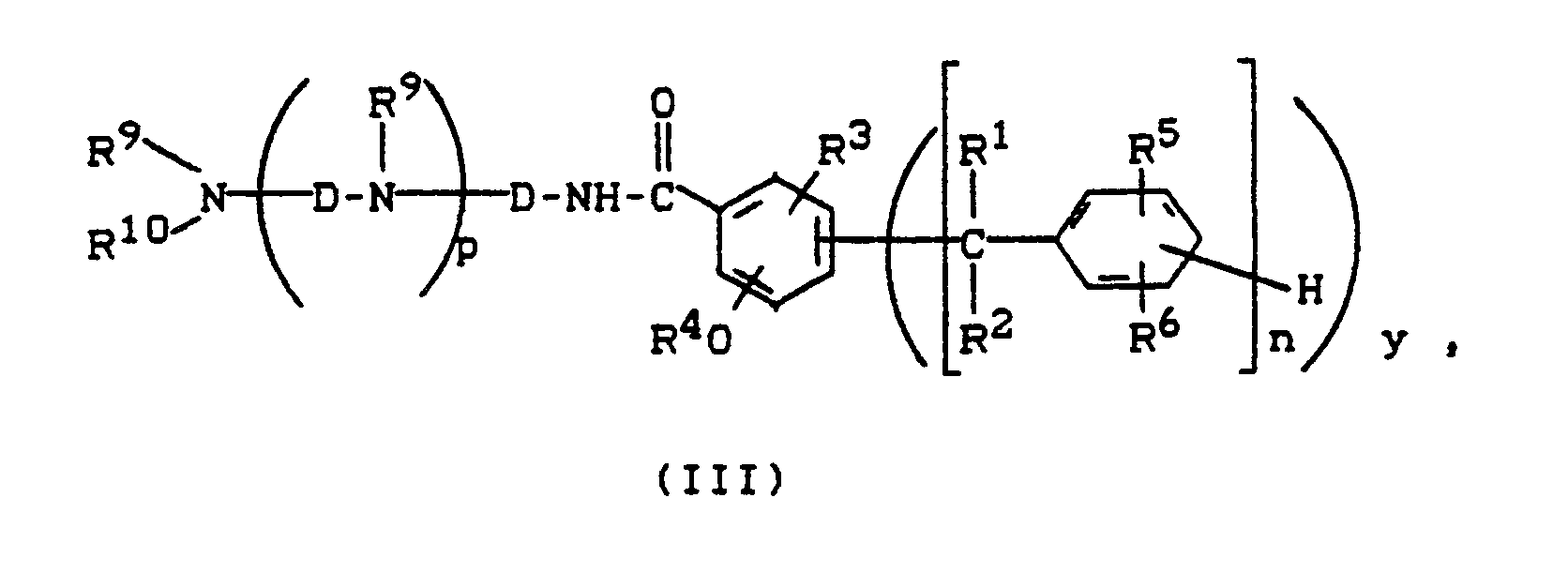
R¹ bis R⁶, R⁹ und R¹⁰ sowie n, p und y die unter Formeln (I) und (II) angegebene Bedeutung haben und D für einen -(CH₂)₂-,
- Besonders bevorzugt sind Verbindungen der unten angegebenen Formeln:


- Die Erfindung betrifft ferner ein Verfahren zur Herstellung der neuen polyaralkylierten Hydroxybenzoesäureamiden der Formel (I).
- Das Verfahren ist dadurch gekennzeichnet ist, daß man aromatische Hydroxycarbonsäuren oder deren Ester der Formel

R³ und R⁴ die unter Formel (I) angegebene Bedeutung haben und
R¹² Wasserstoff oder C₁-C₄-Alkyl bedeutet,
mit 1 bis 20, vorzugsweise 2 bis 10 Molen α-Alkenylbenzolen der Formel
R1a und R1b Wasserstoff oder C₁-C₃-Alkyl bedeuten und
R², R⁵ und R⁶ die unter Formel (I) angegebene Bedeutung haben,
oder mit 1 bis 20, vorzugsweise 2 bis 10 Molen α-Halogenalkylbenzolen der Formel
Hal für Chlor oder Brom steht und
R¹, R², R⁵ und R⁶ die unter Formel (I) angegebene Bedeutung besitzen,
in Gegenwart von sauren Katalysatoren bei 50 bis 200°C umsetzt und anschließend die erhaltenen aralkylierten Hydroxybenzoesäuren oder deren Ester mit Aminen der Formel
A und B die unter Formel (I) angegebene Bedeutung haben,
bei Temperaturen von 50 bis 250°C weiter umsetzt. - Das erfindungsgemäße Verfahren sei durch folgende Formelschemen dargestellt:


- Als saure Katalysatoren kommen für das erfindungsgemäße Verfahren in Frage: Brönsted-Säuren wie Schwefelsäure, Phosphorsäure und/oder Salzsäure, sowie Lewis-Säuren wie Aluminiumtrichlorid, Zinkchlorid, Zinkstearat, Bortrifluorid und/oder Zinntetrachlorid. Bevorzugt werden als saure Katalysatoren eingesetzt: Schwefelsäure, Phosphorsäure, Aluminiumtrichlorid, Zinkchlorid und/oder Zinkstearat.
- Die sauren Katalysatoren werden üblicherweise in Mengen von 0,0001 bis 0,3, bevorzugt 0,01 bis 0,1 Mol, bezogen auf 1 Mol aromatischer Hydroxycarbonsäure eingesetzt.
- Erfindungsgemäß setzt man pro Mol Hydroxycarbonsäure oder deren Ester 1 bis 20, bevorzugt 2 bis 10, besonders bevorzugt 3 bis 8 Mole α-Alkenylbenzole der Formel (IX) oder α-Halogenalkylbenzole der Formel (X) ein.
- Die Reaktionstemperaturen liegen bevorzugt bei 50 bis 180°C.
- Als aromatische Hydroxycarbonsäuren oder deren Ester seien genannt: Salicylsäure, p-Hydroxybenzoesäure, Methylsalicylsäure, tert.-Butylsalicylsäure, 3-Nonylsalicylsäure, 5-tert.-Octylsalicylsäure, 5-Chlorsalicylsäure und 2,4-Dihydroxybenzoesäure sowie deren Methyl-, Ethyl-, Propyl- und Butylester, bevorzugt p-Hydroxybenzoesäure und Salicylsäure sowie deren Methylester.
- Als α-Alkenylbenzole der Formel (IX) werden beispielsweise genannt: Styrol, 4-Chlorstyrol, 3- und 4-Methylstyrol, 4-Hydroxystyrol und α-Methylstyrol. Bevorzugt sind Styrol, 4-Methylstyrol und α-Methylstyrol.
- Als α-Halogenbenzole der Formel (X) kommen in Frage: Benzylbromid, Benzylchlorid, α-Chlorethylbenzol, α-Chlorisopropylbenzol, α-Chlorbutylbenzol, 3- und 4-Methylbenzylchlorid, 4-Methoxybenzylchlorid und 4-Chlorbenzylchlorid, bevorzugt Benzylchlorid.
- Bei zusätzlichem Einsatz von z.B. Divinylbenzol oder von z.B. Xylylenchlorid in die erfindungsgemäße Reaktion erhält man bifunktionelle Vertreter wie Bis-(hydroxybenzoesäureamide) der Formel (I).
- Als Amine der Formel (XI) können in das erfindungsgemäße Verfahren eingesetzt werden: aliphatische und aromatische Amine mit mindestens einer primären oder sekundären Aminogruppe, wie Ethylamin, Butylamin, Cyclohexylamin, Benzylamin, Stearylamin, Diethylamin, Dibenzylamin, Ethanolamin, Diethanolamin, Anilin, N-Methylanilin, Ethylendiamin, 1,2-oder 1,3-Propylendiamin, Di-1,2-propylentriamin, Di-1,3-propylentriamin, Tetramethylendiamin, Pentamethylendiamin, Hexamethylendiamin, Octamethylendiamin; Polyethylenpolyamine der Formel H₂N-CH₂CH₂(NH-CH₂CH₂)b-NH₂, in der b eine ganze Zahl von 1 bis 50 bedeutet, wie Diethylentriamin, Triethylentetramin und Tetraethylenpentamin; Polyoxyethylendiamine, Polyoxypropylendiamine, 3-(2-Aminoethyl)aminopropylamin, 1,2-Bis-(3-aminopropylamino)ethan, N,N′-Bis-(3-aminopropyl)-1,4-diaminobutan, 4,7,10-Trioxatridecan-1,13-diamin; cycloaliphatische und heterocyclische Amine, wie 1,2-oder 1,3-Diaminocyclopentan, 1,2-, 1,3- oder 1,4-Diaminocyclohexan, 3,3′-, 3,4′- oder 4,4′-Diaminodicyclohexylmethan, 2,2-Bis-(4′-aminocyclohexyl)-propan, 4,4′-Diamino-3,3′-dimethyldicyclohexylmethan, 3-Aminomethyl-3,5,5-trimethylcyclohexylamin (Isophorondiamin), N-2-Aminoethyl, N,N′-Bis(3-aminopropyl)-piperazin, N,N′-Bis(2-aminoethyl)-piperazin, 1,3- und 1,4-Bis-(aminomethyl)-cyclohexan und 3(4),8(9)-Bis-(aminomethyl)tricyclo[5,2,1,0²ʼ⁶]decan, sowie deren partiell am N alkylierten Derivate.
- Bevorzugt werden folgende Amine der Formel (XI) eingesetzt: Aminoethanol, Ethylendiamin, Propylendiamine, Diethylen- und Dipropylen-triamin, N-Methyl- und N-Cyclohexyl-dipropylentriamin, Triethylentetramin, Tetraethylenpentamin, Pentaethylenhexamin, Hexaethylenheptamin, N,N′-Bis-(aminopropyl)-ethylendiamin, N,N′-Bis-(aminoethyl)-propylendiamin, 3-Aminomethyl-3,5,5-trimethylcyclohexylamin (Isophorondiamin), N-2-Aminoethylpiperazin und N,N′-Bis-(2-aminoethyl)-piperazin.
- Außer den Aminen auch Ammoniak eingesetzt werden.
- Die Umsetzung der aralkylierten Hydroxybenzoesäuren oder deren Ester mit den Aminen kann in üblicher Weise durch Erhitzen der Komponenten auf 50 bis 250°C, bevorzugt 80 bis 180°C, unter Abdestillieren von Alkoholen erfolgen (vgl. Organikum, VEB Deutscher Verlag der Wissenschaften, Berlin 1967, Seite 394).
- Die Amine der Formel (XI) können vor oder nach der erfindungsgemäßen Umsetzung mit Alkylhalogeniden, wie Methylchlorid und Butylchlorid, Aralkylchloriden, wie Benzylchlorid, Arylsulfonaten, wie Toluolsulfonsäuremethylester oder Alkylsulfaten, wie Dimethylsulfat, alkyliert (quaterniert) werden.
- Die neuen polyaralkylierten Hydroxybenzoesäurenamide stellen ölige bis harzartige Produkte mit Erweichungspunkten bis ca. 130°C dar. Die mittleren Molekulargewichte liegen bei etwa 300 bis 5000 (bestimmt nach Gelpermeationschromatographie (GPC)).
- Die Erfindung betrifft ferner die Verwendung dieser neuen polyaralkylierten Hydroxybenzoesäureamide als Korrosionsinhibitoren. Diese können beispielsweise als Korrosionsschutzmittel in Reinigungs-, Wärmeüberträger- und Hydraulikflüssigkeiten, in Brennstoffen, Metallbearbeitungsölen und in Bohr- und Spülflüssigkeiten von Ölbohranlagen eingesetzt werden. Sie bewirken in diesen Flüssigkeiten eine starke Herabsetzung der Korrosivität gegen Metalle. Die bevorzugte Verwendung der erfindungsgemäßen polyaralkylierten Hydroxybenzoesäureamide liegt jedoch in der Verwendung als Korrosionsschutzmittel in Säuren, wie sie bei der Erdölförderung speziell bei der Säurebehandlung von Bohrlöchern angewendet werden. Es wurde gefunden, daß die erfindungsgemäßen polyaralkylierten Hydroxybenzoesäureamide die Korrosivität der für die Bohrungen verwendeten Säuren gegenüber Eisen und Eisenlegierungen wesentlich stärker herabsetzten als die bislang in Säuren verwendeten, in der JA-A-74/10579 beschriebenen Reaktionsprodukte von Benzylchlorid und Imidazolin-Derivaten.
- Es wurde gefunden, daß die erfindungsgemäßen polyaralkylierten Benzoesäureamide besondere wirksame Korrosionsschutzmittel für Eisen und Eisenlegierungen, wie Stahl, aber auch für Kupfer, Kupferlegierungen wie Messing, ferner für Zink, Blei und Aluminium sind. Bevorzugt werden sie als Korrosionsschutzmittel für Eisen und Eisenlegierungen eingesetzt.
- Die erfindungsgemäß als Korrosionsinhibitoren zu verwendenden polyaralkylierten Hydroxybenzoesäureamide können allein oder in Kombination mit anderen bekannten Korrosionsinhibitoren eingesetzt werden, z.B. mit quartären Ammoniumsalzen und/oder Imidazolinen; besonders bewährt haben sich Kombinationen mit Acetylenalkoholen, wie Propargylalkohol, Hexinol, 2-Ethylhexinol, Butin-1-ol-3 und/oder 2-Methyl-butin-3-ol-2, weil sich in diesen Kombinationen die korrosionsinhibierenden Wirkungen der einzelnen Komponenten synergistisch verstärken.
- Die Menge, in der die erfindungsgemäßen Korrosionsinhibitoren oder deren Kombination mit anderen Korrosionsinhibitoren eingesetzt werden, hängt ab von der Art des korrosiv wirkenden Mediums, den am Ort der Anwendung herrschenden Bedingungen und den tolerierbaren Korrosionsraten. In der Regel setzt man die erfindungsgemäßen polyaralkylierten Hydroxybenzoesäureamide der Formel (I) in den Flüssigkeiten, deren Korrosivität herabgesetzt werden soll, in einer Menge von etwa 100 bis 20 000 ppm, bevorzugt 500 bis 4000 ppm ein. Zur Herabsetzung der Korrosivität schwacher Säuren, wie Kohlendioxid oder Schwefelwasserstoff, sind Mengen von etwa 5 bis 200 ppm ausreichend.
- Die erfindungsgemäßen polyaralkylierten Hydroxybenzoesäureamide der Formel (I) werden vorzugsweise in formulierter Form, d.h. in Kombination mit üblichen Formulierungshilfsmitteln eingesetzt. Solche Formulierungen enthalten außer den erfindungsgemäßen Korrosionsinhibitoren gegebenenfalls noch andere Inhibitoren und Tenside und Lösungsmittel. Geeignete Tenside sind ethoxylierte Derivate von mindestens 8 Kohlenstoffatomen aufweisenden, aliphatischen oder araliphatischen Alkoholen oder Aminen, wie 2-Ethylhexanol, Laurylalkohol, Cetylalkohol, Dodecylamin, Talgfettamin und/oder Nonylphenol. Geeignete Lösungsmittel sind solche die mit Wasser und Säuren mischbar sind, wie niedere Alkohole, Mono- und Oligoethylenglykol, niedere Ketone, Formamid, Dimethylformamid und/oder N-Methylpyrrolidon. Bevorzugt sind: Isopropanol, Formamid, Dimethylformamid und N-Methylpyrrolidon.
- Eine Mischung von 304 g (2 Mol) Salicylsäuremethylester und 28 g konzentrierter Schwefelsäure wird bei 60°C mit 833 g (8 Mol) Styrol versetzt. Nach 1 h setzt man 206 g (2 Mol) Diethylentriamin hinzu und destilliert 64 g Methanol ab (Innentemperatur 160 bis 180°C). Darauf gibt man bei 140°C 1012 g (8 Mol) Benzylchlorid hinzu, rührt 2 h bei 150°C und setzt mit 1600 g 20 %iger Natronlauge durch 2-stündiges Erhitzen auf 100°C um. Nach dem Phasentrennen und Abdestillieren restlichen Wassers resultieren 1950 g hochviskosen Harzes.
Elementaranalyse: C 80, H 7,6, N 3,9 %
N (basisch): 2,76 %
OH-Zahl: 32 - Ersetzt man in Beispiel 1 Salicylsäureester durch 304 g p-Hydroxybenzoesäuremethylester, so erhält man ca. 2050 g eines hochviskosen Harzes.
N (basisch): 2,83 %
OH-Zahl: 32 - Verwendet man in Beispiel 1 1250 g (12 Mol) Styrol, so erhält man ca. 2400 g eines zähen Harzes.
N (basisch): 2,54 %
OH-Zahl: 22 - Verfährt man wie in Beispiel 2, setzt aber nicht mit Benzylchlorid und Natronlauge um, so erhält man 1280 g eines zähen Harzes.
N (basisch): 4,31 %
OH-Zahl: 64 - In 304 g (2 Mol) Salicylsäuremethylester und 0,5 g Zn-Stearat tropft man innerhalb 2 h 1012,8 g (8 Mol) Benzylchlorid ein. Die kräftige Abspaltung von Chlorwasserstoffgas wird anschließend durch Einleiten von trockenem Stickstoff (-2 h 130°C) komplettiert. Man erhält 1015 g (99 %) eines hellbräunlichen, viskosen Öles. C₃₆H₃₂O₃ (512,7)
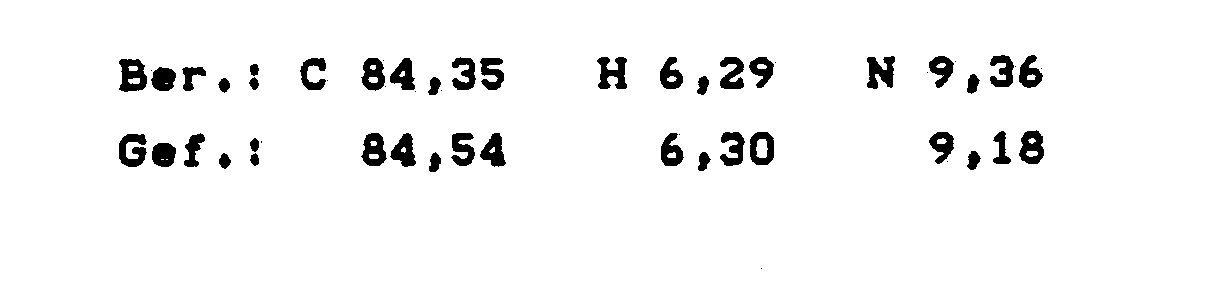
- Nach der Verfahrensweise gemäß Beispiel 5 erhält man bei Verwendung von 506,4 g (4 Mol) Benzylchlorid 645 g (97 %) eines hellorange gefärbten, viskosen Öles. C₂₂H₂₀O₃

- Nach der Verfahrensweise gemäß Beispiel 5 erhält man bei Einsatz von 759,6 g (6 Mol) Benzylchlorid 830 g (98,2 %) eines klebrigen, wiskosen Harzes. C₂₉H₂₆O₃ (422,5)

- 256,4 g (0,5 Mol) Öl aus Beispiel 5 werden zusammen mit 51,6 g (0,5 Mol) Diethylentriamin aufgeheizt, wobei >100°C die Abspaltung von Methanol einsetzt. Man hält ca. 1,5 h bei 150°C, zum Schluß im Vakuum und erhält 290 g (99,3 %) eines hellorange gefärbten, klebrigen Harzes. C₃₉H₄₁N₃O₂ (583,8)

- 128,2 g (0,25 Mol) Öl gemäß Beispiel 5 werden zusammen mit 16,8 g (0,275 Mol) 2-Aminoethanol ca. 3 1/2 h auf 150 bis 170°C erhitzt, wobei Methanol über Kopf abdestilliert wird. Nach Abziehen flüchtiger Komponenten im Vakuum bei 160°C erhält man 134,8 g (99,5 %) eines gelb-organen Harzes. C₃₇H₃₅NO₃ (541,7)

- 128,2 g (0,25 Mol) Öl aus Beispiel 5 werden zusammen mit 25,8 g (0,25 Mol) Diethylentriamin 2 h auf 130 bis 150°C erhitzt, das sich bildende Methanol über Kopf abdestilliert. Die noch warme Schmelze verdünnt man mit 250 ml Toluol, läßt 101,4 g (0,8 Mol) Benzylchlorid bei Rückflußtemperatur einlaufen, hält 2 h unter Rühren, gibt 32 g (0,8 Mol) Ätznatron, gelöst in 100 ml Wasser, zu und rührt weitere 1 1/2 h bei Siedetemperatur nach. Nach Abtrennen der organischen Phase, Waschen mit Waser und Einengen, zum Schluß im Vakuum bei 180°C werden 211,5 g (99 % der Theorie) eines braunen, viskosen Harzes gewonnen. C₆₀H₅₉N₃O₂ (854,2)

- Analog Beispiel 10 werden anstelle des Öles aus Beispiel 5 83,1 g Öl gemäß Beispiel 6 verwendet. Es werden 167,8 g (99,6 %) eines orange-braunen, viskosen Harzes gewonnen. C₄₆H₄₇N₃O₂ (673,9)

- Analog Beispiel 10 liefert der Einsatz von 105,6 g (0,25 Mol) des Harzes gemäß Beispiel 7 anstelle des Öls aus Beispiel 5 190,3 g (99,6 %) eines rötlichbraunen, zähen Harzes. C₅₃H₅₃N₃O₂ (764,03)

- Nach der Verfahrensweise von Beispiel 5 erhält man bei Verwendung von 304 g (2 Mol) p-Hydroxybenzoesäuremethylester anstelle des Salicylsäureesters 1012 g (98,7 %) eines hellbraunen, viskosen Harzes. C₃₆H₃₂O₃ (512,7)

- Setzt man analog Beispiel 10 anstelle des Öls aus Beispiel 5 die gleiche Menge des Harzes gemäß Beispiel 13 ein, so gewinnt man 203 g (95,1 %) eines braunen, viskosen Harzes. C₆₀H₅₉N₃O₂ (854,2)

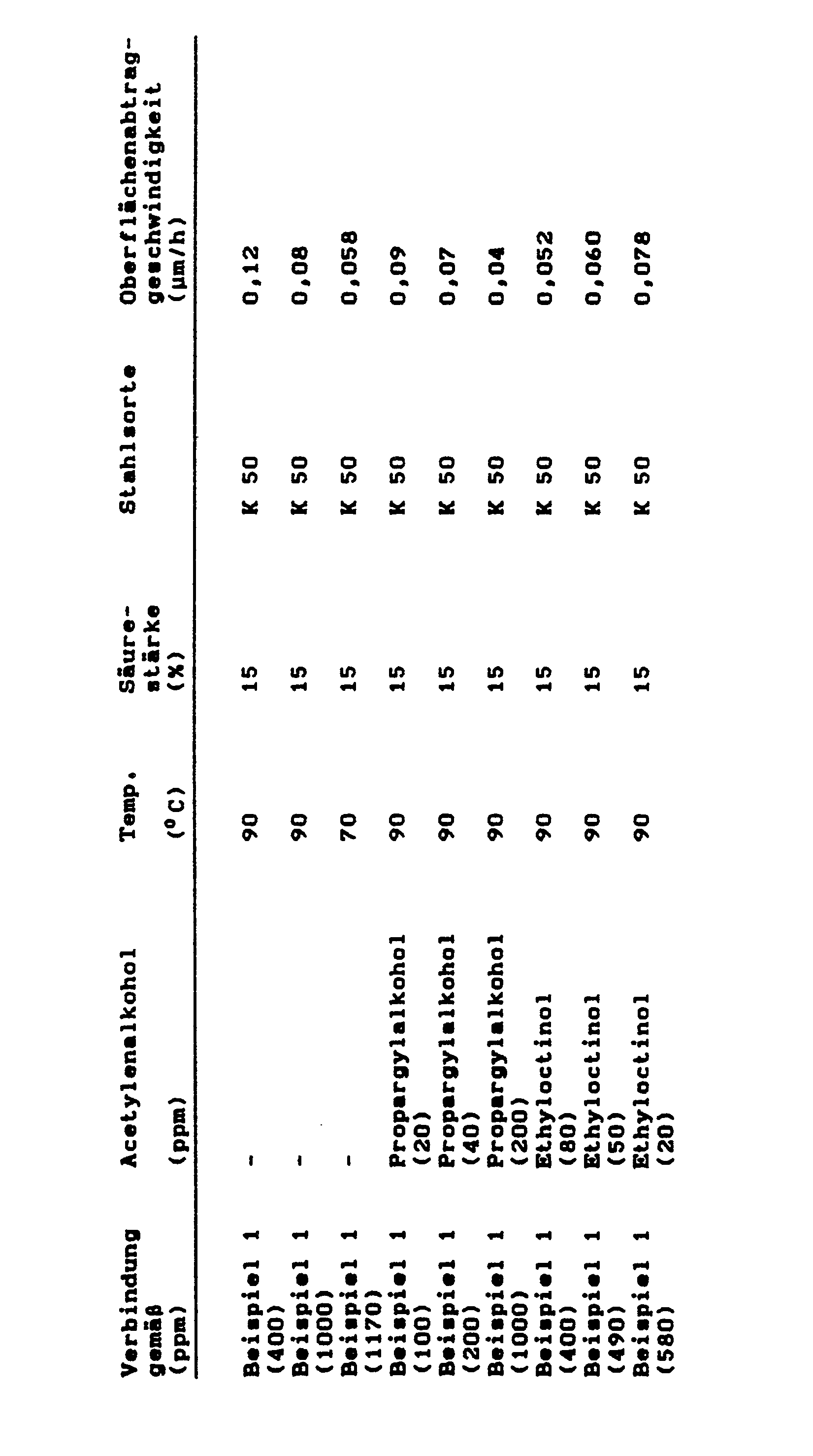
- (Prüfung der korrosionsinhibierenden Wirkung der neuen polyaralkylierten Hydroxybenzoesäureamide in Salzsäure) Die Versuche wurden die folgt durchgeführt:
- Aus den zu prüfenden Korrosionsinhibitoren (den erfindungsgemäßen polyaralkylierten Hydroxybenzoesäureamiden oder deren Gemischen mit Acetylenalkoholen) wurden zunächst durch Vermischen mit 10 Gew.-% Tensid (einem mit 30 Mol Ethylenoxid umgesetzten Laurylsulfat) und Verdünnen der so erhaltenen Mischungen mit Dimethylformamid auf 40 Gew.-% Korrosionsinhibitor enthaltende Lösungen, in wäßriger Chlorwasserstoffsäure leicht lösliche bzw. leicht dispergierbare Formulierungen hergestellt.
- Diese Lösungen (Formulierungen) wurden den wäßrigen Salzsäurelösungen, in denen die korrosionsinhibierende Wirkung geprüft werden sollte, zugesetzt. In die mit Korrosionsinhibitor versetzte wäßrige Salzsäure wurde ein entfetteter Stahlcoupon gegeben. Nach 6-stündiger Einwirkung der wäßrigen Salzsäure auf diesen Coupon wurde dessen Gewichtsverlust bestimmt und in eine Oberflächenabtragsgeschwindigkeit umgerechnet. Die Korrosionsversuche bei Temperaturen >90° wurden in Autoklaven durchgeführt, die noch zusätzlich mit 20 bar Stickstoff beaufschlagt waren.
- Die Stahlcoupons waren aus den Stahlsorten K 50 und N 80 gefertigt, d.h. aus kohlenstoffarmen Stählen (mild steels), wie sie für Verrohrungen in Ölfeldern eingesetzt werden.
- In der nachstehenden Tabelle sind die verwendeten Korrosionsinhibitoren, die Mengen [ppm], in denen sie eingesetzt wurden, die Temperaturen, bei denen die Korrosionsversuche durchgeführt wurden, die Stärke der für die Korrosionsversuche verwendeten wäßrigen Salzsäure, die Stahlsorte, aus der die Testcoupons gefertigt waren und die Oberflächenabtragsgeschwindigkeit (als Maß für die korrosionsinhibierende Wirkung) zusammengestellt.


- Die Prüfung wird nach Art des sogenannten Wheeltests durchgeführt. Eine 1:1 Mischung aus Petroleum und künstlichem Meerwasser wird 30 Min. unter Sauerstoffausschluß mit CO₂ oder einer 1:1 Mischung aus CO₂ und H₂S begast. Der Korrosionsinhibitor und der entfettete Stahlcoupon werden zur Mischung gegeben, das Testgefäß sorgfältig verschlossen und auf einem rotierenden Rad 7 Tage bei 80°C bewegt. Anschließend werden die Coupons gereinigt und ihr Gewichtsverlust bestimmt. Durch Vergleich mit einem Blindwert wird der Protektionsfaktor bestimmt. Es werden folgende Werte erhalten:

- Besonders bemerkenswert ist die sehr gute Schutzwirkung in 30 %iger Salzsäure.
Claims (3)

n für eine ganze Zahl von 1 bis 10 und
y für eine ganze Zahl von 1 bis 4 stehen, mit der Maßgabe, daß das Produkt n · y höchstens den Wert 20 annimmt,
R¹ und R² unabhängig voneinander Wasserstoff oder C₁-C₄-Alkyl bedeuten,
R³ für Wasserstoff, Hydroxy, O-C₁-C₁₈-Alkyl, C₁-C₁₈-Alkyl, C₁-C₁₈-Alkoxycarbonyl, Halogen, die Carboxyl-, Carbonamid-, Sulfo-, Sulfonat- oder Aminogruppe steht,
R⁴ Wasserstoff, C₁-C₁₈-Alkyl, C₇-C₁₈-Aralkyl oder C₁-C₁₈-Alkylcarbonyl bedeutet,
R⁵ und R⁶ unabhängig voneinander für Wasserstoff, Hydroxy, Halogen oder C₁-C₁₈-Alkyl steht,
A und B gleich oder verschieden sind und Wasserstoff, C₁-C₁₈-Alkyl, C₇-C₁₈-Aralkyl, C₆-C₁₅-Aryl, C₁-C₁₈-Alkylcarbonyl bedeuten oder für eine Gruppe der Formel

R⁷ bis R¹¹ unabhängig voneinander Wasserstoff, C₁-C₁₈-Alkyl, C₇-C₁₈-Aralkyl oder C₆-C₁₅-Aryl bedeuten,
X⊖ ein Anion, vorzugsweise ein Halogenid-, ein Alkylsulfat- oder ein Arylsulfonat-Ion,
m eine Zahl von 2 bis 8 und
p eine Zahl von 1 bis 50
bedeuten.

n für eine ganze Zahl von 1 bis 10 und
y für eine ganze Zahl von 1 bis 4 stehen, mit der Maßgabe, daß das Produkt n · y höchstens den Wert 20, vorzugsweise einen Wert von 2 bis 10, besonders bevorzugt einen Wert von 3 bis 8 annimmt,
R¹ und R² unabhängig voneinander Wasserstoff oder C₁-C₄-Alkyl bedeuten,
R³ für Wasserstoff, Hydroxy, O-C₁-C₁₈-Alkyl, C₁-C₁₈-Alkyl, C₁-C₁₈-Alkylcarbonyl, Halogen, die Carboxyl-, Carbonamid-, Sulfo-, Sulfonat- oder Aminogruppe steht,
R⁴ Wasserstoff, C₁-C₁₈-Alkyl, C₇-C₁₈-Aralkyl oder C₁-C₁₈-Alkylcarbonyl bedeutet,
R⁵ und R⁶ unabhängig voneinander für Wasserstoff, Hydroxy, Halogen oder C₁-C₁₈-Alkyl steht,
A und B gleich oder verschieden sind und Wasserstoff, C₁-C₁₈-Alkyl, C₇-C₁₈-Aralkyl, C₆-C₁₅-Aryl, C₁-C₁₈-Alkylcarbonyl bedeuten oder für eine Gruppe der Formel

R⁷ und R¹¹ unabhängig voneinander Wasserstoff, C₁-C₁₈-Alkyl, C₇-C₁₈-Aralkyl, C₆-C₁₅-Aryl bedeuten,
X⊖ ein Anion darstellt,
m eine Zahl von 2 bis 8 und
p eine Zahl von 1 bis 50 bedeuten,
dadurch gekennzeichnet, daß man aromatische Hydroxycarbonsäuren oder deren Ester der Formel

R³ und R⁴ die obengenannte Bedeutung haben und
R¹² Wasserstoff oder C₁-C₄-Alkyl bedeutet,
mit 1 bis 20 Molen α-Alkenylbenzolen der Formel
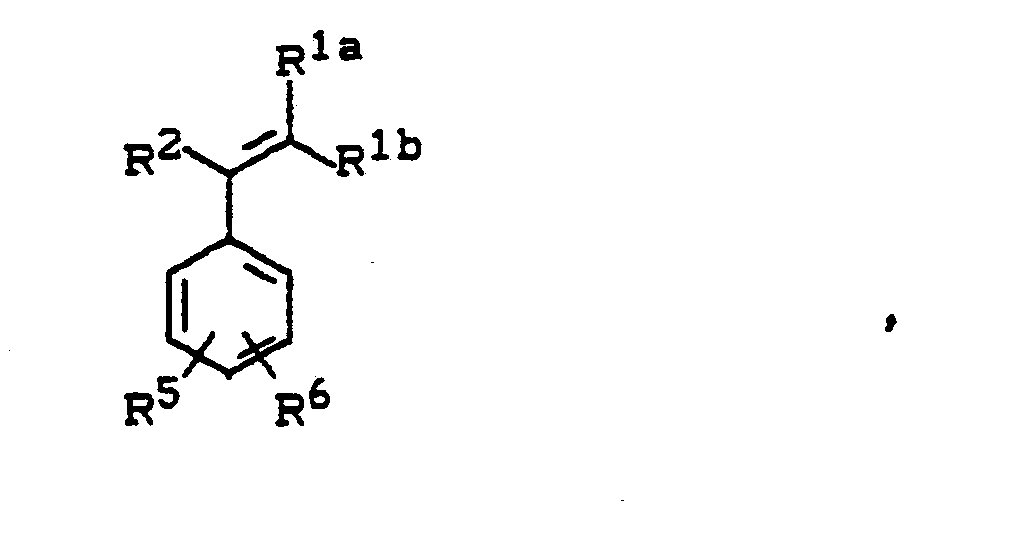
R1a and R1b oder C₁-C₃-Alkyl bedeuten,
R², R⁵ und R⁶ die obengenannte Bedeutung haben,
oder mit 1 bis 20 Molen α-Halogenalkylbenzolen der Formel
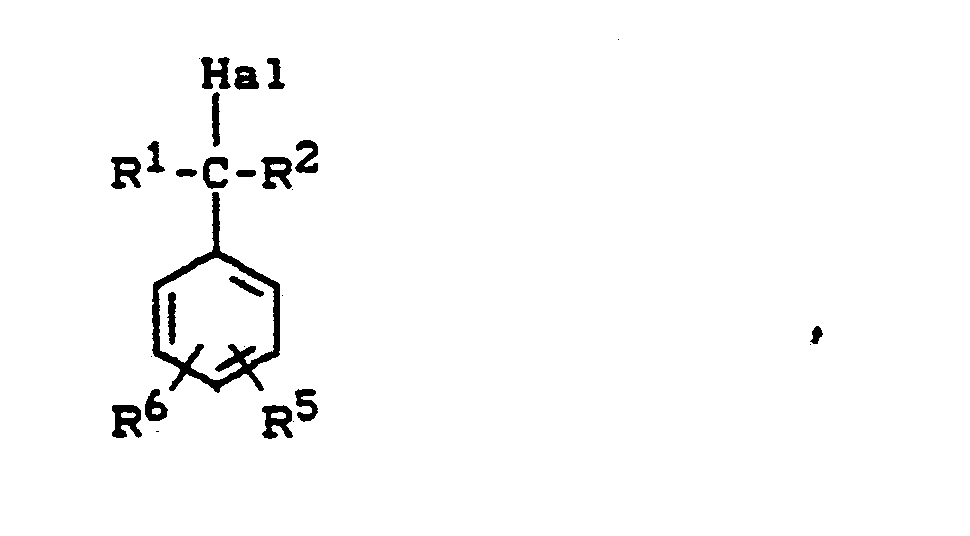
Hal für Chlor oder Brom steht und
R¹, R², R⁵ und R⁶ die obengenannte Bedeutung besitzen,
in Gegenwart von sauren Katalysatoren bei 50 bis 200°C umsetzt und anschließend die erhaltenen aralkylierten Hydroxybenzoesäuren oder deren Ester mit Aminen der Formel

A und B die obengenannte Bedeutung haben,
bei Temperaturen von 50 bis 250°C weiter umsetzt.
Priority Applications (1)
| Application Number | Priority Date | Filing Date | Title |
|---|---|---|---|
| AT88108232T ATE80156T1 (de) | 1987-06-06 | 1988-05-24 | Polyaralkylierte hydroxybenzamide, verfahren zu ihrer herstellung und ihre verwendung. |
Applications Claiming Priority (2)
| Application Number | Priority Date | Filing Date | Title |
|---|---|---|---|
| DE19873719101 DE3719101A1 (de) | 1987-06-06 | 1987-06-06 | Neue korrosionsinhibitoren |
| DE3719101 | 1987-06-06 |
Publications (3)
| Publication Number | Publication Date |
|---|---|
| EP0294641A2 true EP0294641A2 (de) | 1988-12-14 |
| EP0294641A3 EP0294641A3 (de) | 1990-08-08 |
| EP0294641B1 EP0294641B1 (en) | 1992-09-02 |
Family
ID=6329260
Family Applications (1)
| Application Number | Title | Priority Date | Filing Date |
|---|---|---|---|
| EP88108232A Expired - Lifetime EP0294641B1 (en) | 1987-06-06 | 1988-05-24 | Polyaralkylated hydroxybenzamides, process for their preparation and their use |
Country Status (6)
| Country | Link |
|---|---|
| US (1) | US4902830A (de) |
| EP (1) | EP0294641B1 (de) |
| AT (1) | ATE80156T1 (de) |
| DE (1) | DE3719101A1 (de) |
| DK (1) | DK304588A (de) |
| NO (1) | NO882292L (de) |
Cited By (4)
| Publication number | Priority date | Publication date | Assignee | Title |
|---|---|---|---|---|
| WO1998016600A1 (en) * | 1996-10-11 | 1998-04-23 | Infineum Usa L.P. | Lubricity additives for fuel oil compositions |
| FR2755152A1 (fr) * | 1996-10-29 | 1998-04-30 | Ceca Sa | Alcool propargylique et derives oxyethyles comme inhibiteurs de la corrosion carbonique du fer |
| EP0906969A1 (de) * | 1997-10-01 | 1999-04-07 | Degussa Aktiengesellschaft | Verfahren und Zusammensetzung zur Inhibierung von Korrosion |
| WO2009121947A1 (de) * | 2008-04-04 | 2009-10-08 | Basf Se | Saure polymerzusammensetzung und verfahren zu deren herstellung |
Families Citing this family (1)
| Publication number | Priority date | Publication date | Assignee | Title |
|---|---|---|---|---|
| DE3935478A1 (de) * | 1989-10-25 | 1991-05-02 | Wolfgang Ortlepp Industriebera | Verfahren zur vermeidung von schwefelwasserstoffkorrosion an rohrwerkstoffen, besonders in einem abwassersystem |
Family Cites Families (5)
| Publication number | Priority date | Publication date | Assignee | Title |
|---|---|---|---|---|
| US3282939A (en) * | 1963-04-29 | 1966-11-01 | Geigy Chem Corp | Stabilization of organic material with stabilizers containing a substituted phenol group |
| US4100082A (en) * | 1976-01-28 | 1978-07-11 | The Lubrizol Corporation | Lubricants containing amino phenol-detergent/dispersant combinations |
| US4231757A (en) * | 1978-06-02 | 1980-11-04 | The Lubrizol Corporation | Nitro phenol-amine condensates, methods of making same, fuels and additive concentrates containing them |
| DE2951542A1 (de) * | 1979-12-21 | 1981-07-02 | Basf Ag, 6700 Ludwigshafen | Verwendung von alkanolaminsalzen cyclischer amidsaeuren als korrosionsschutzmittel in waessrigen systemen |
| US4673765A (en) * | 1981-03-05 | 1987-06-16 | The Dow Chemical Company | Epoxy resins from hydroxy benzamides |
-
1987
- 1987-06-06 DE DE19873719101 patent/DE3719101A1/de not_active Withdrawn
-
1988
- 1988-05-24 EP EP88108232A patent/EP0294641B1/de not_active Expired - Lifetime
- 1988-05-24 AT AT88108232T patent/ATE80156T1/de not_active IP Right Cessation
- 1988-05-25 NO NO882292A patent/NO882292L/no unknown
- 1988-06-01 US US07/200,981 patent/US4902830A/en not_active Expired - Fee Related
- 1988-06-03 DK DK304588A patent/DK304588A/da not_active Application Discontinuation
Cited By (5)
| Publication number | Priority date | Publication date | Assignee | Title |
|---|---|---|---|---|
| WO1998016600A1 (en) * | 1996-10-11 | 1998-04-23 | Infineum Usa L.P. | Lubricity additives for fuel oil compositions |
| FR2755152A1 (fr) * | 1996-10-29 | 1998-04-30 | Ceca Sa | Alcool propargylique et derives oxyethyles comme inhibiteurs de la corrosion carbonique du fer |
| EP0839932A1 (de) * | 1996-10-29 | 1998-05-06 | Ceca S.A. | Propargylalkohol, seine Homologe und Oxyethylderivate als Kohlendioxidkorrosionsinhibitoren für Eisen |
| EP0906969A1 (de) * | 1997-10-01 | 1999-04-07 | Degussa Aktiengesellschaft | Verfahren und Zusammensetzung zur Inhibierung von Korrosion |
| WO2009121947A1 (de) * | 2008-04-04 | 2009-10-08 | Basf Se | Saure polymerzusammensetzung und verfahren zu deren herstellung |
Also Published As
| Publication number | Publication date |
|---|---|
| NO882292L (no) | 1988-12-07 |
| US4902830A (en) | 1990-02-20 |
| EP0294641A3 (de) | 1990-08-08 |
| EP0294641B1 (en) | 1992-09-02 |
| DK304588D0 (da) | 1988-06-03 |
| ATE80156T1 (de) | 1992-09-15 |
| DK304588A (da) | 1988-12-07 |
| NO882292D0 (no) | 1988-05-25 |
| DE3719101A1 (de) | 1988-12-15 |
Similar Documents
| Publication | Publication Date | Title |
|---|---|---|
| EP0161222B1 (de) | Heterocylische Mercaptocarbonsäureamide, -imide und -nitrile als Korrosionsinhibitoren | |
| US8999315B2 (en) | Bis-quaternary ammonium salt corrosion inhibitors | |
| USRE23227E (en) | Processes fob preventing corrosion | |
| EP0129506B1 (de) | Heterocyclisch substituierte Thio(cyclo)alkanpolycarbonsäuren | |
| EP0161219B1 (de) | Heterocyclische Mercaptocarbonsäure-ester und -anhydride als Korrosionsinhibitoren | |
| US4515708A (en) | Corrosion inhibitors | |
| US5247087A (en) | Epoxy modified water clarifiers | |
| EP0127132B1 (de) | Verwendung von Alkenylbernsteinsäurehalbamiden als Korrosionsschutzmittel | |
| US5059391A (en) | Use of polyaralkylamines as corrosion inhibitors | |
| US5226956A (en) | Surface coating compositions | |
| US3167554A (en) | Piperazino alkylamides of polybasic carboxylic acids | |
| DE3719101A1 (de) | Neue korrosionsinhibitoren | |
| DE2611187A1 (de) | Korrosionsschutzmittel und seine verwendung | |
| EP0846690B1 (de) | Melamin-polycarbonsäureamide und ihre Verwendung als Korrosionsschutzmittel | |
| US2914557A (en) | Polyamine naphthenates | |
| US3992306A (en) | Metal-working and corrosion protection agent | |
| US4174370A (en) | Substituted pyridines | |
| US2920040A (en) | Process for inhibiting corrosion of ferrous metals by oil well fluid | |
| RU2110613C1 (ru) | Средство защиты от коррозии | |
| US2914475A (en) | Protecting ferrous metals from corrosion | |
| US2902447A (en) | Composition and method for inhibition of corrosion | |
| JPS62167396A (ja) | アルキルベンゾイルアクリル酸系腐食防止剤 | |
| GB762228A (en) | Improvements in and relating to corrosion inhibitors and application thereof | |
| JPS61190083A (ja) | 2‐ベンゾチアゾリルチオカルボン酸アンモニウム塩を含有する水性防食剤 | |
| US3254141A (en) | Neutralized phosphate esters of pentadecylphenol as corrosion inhibitors and preparation thereof |
Legal Events
| Date | Code | Title | Description |
|---|---|---|---|
| PUAI | Public reference made under article 153(3) epc to a published international application that has entered the european phase |
Free format text: ORIGINAL CODE: 0009012 |
|
| 17P | Request for examination filed |
Effective date: 19880525 |
|
| AK | Designated contracting states |
Kind code of ref document: A2 Designated state(s): AT DE FR GB NL |
|
| PUAL | Search report despatched |
Free format text: ORIGINAL CODE: 0009013 |
|
| AK | Designated contracting states |
Kind code of ref document: A3 Designated state(s): AT DE FR GB NL |
|
| 17Q | First examination report despatched |
Effective date: 19920123 |
|
| GRAA | (expected) grant |
Free format text: ORIGINAL CODE: 0009210 |
|
| PUAB | Information related to the publication of an a document modified or deleted |
Free format text: ORIGINAL CODE: 0009199EPPU |
|
| PUAC | Information related to the publication of a b1 document modified or deleted |
Free format text: ORIGINAL CODE: 0009299EPPU |
|
| STAA | Information on the status of an ep patent application or granted ep patent |
Free format text: STATUS: THE APPLICATION HAS BEEN WITHDRAWN |
|
| AK | Designated contracting states |
Kind code of ref document: B1 Designated state(s): AT DE FR GB NL |
|
| REF | Corresponds to: |
Ref document number: 80156 Country of ref document: AT Date of ref document: 19920915 Kind code of ref document: T |
|
| DB1 | Publication of patent cancelled | ||
| RA1 | Application published (corrected) |
Date of ref document: 19881214 Kind code of ref document: A2 |
|
| 18W | Application withdrawn |
Withdrawal date: 19920814 |
|
| NLXE | Nl: other communications concerning ep-patents (part 3 heading xe) |
Free format text: IN PAT.BUL.20/92:SHOULD BE DELETED |