EP0292806B1 - Substituierte Vinylcephalosporine, Verfahren zu ihrer Herstellung und ihre Verwendung als Arzneimittel - Google Patents
Substituierte Vinylcephalosporine, Verfahren zu ihrer Herstellung und ihre Verwendung als Arzneimittel Download PDFInfo
- Publication number
- EP0292806B1 EP0292806B1 EP88107679A EP88107679A EP0292806B1 EP 0292806 B1 EP0292806 B1 EP 0292806B1 EP 88107679 A EP88107679 A EP 88107679A EP 88107679 A EP88107679 A EP 88107679A EP 0292806 B1 EP0292806 B1 EP 0292806B1
- Authority
- EP
- European Patent Office
- Prior art keywords
- general formula
- methyl
- formula
- carbon atoms
- compounds
- Prior art date
- Legal status (The legal status is an assumption and is not a legal conclusion. Google has not performed a legal analysis and makes no representation as to the accuracy of the status listed.)
- Expired - Lifetime
Links
- -1 vinyl cephalosporins Chemical class 0.000 title claims description 225
- 238000000034 method Methods 0.000 title claims description 34
- 230000008569 process Effects 0.000 title claims description 21
- 238000002360 preparation method Methods 0.000 title claims description 20
- 229940124587 cephalosporin Drugs 0.000 title claims description 18
- 229930186147 Cephalosporin Natural products 0.000 title claims description 17
- 239000003814 drug Substances 0.000 title claims description 7
- 229940079593 drug Drugs 0.000 title description 2
- 229920002554 vinyl polymer Polymers 0.000 title description 2
- 238000006243 chemical reaction Methods 0.000 claims description 47
- 125000000217 alkyl group Chemical group 0.000 claims description 44
- 150000001875 compounds Chemical class 0.000 claims description 41
- 229910052739 hydrogen Inorganic materials 0.000 claims description 38
- 239000001257 hydrogen Substances 0.000 claims description 38
- UFHFLCQGNIYNRP-UHFFFAOYSA-N Hydrogen Chemical compound [H][H] UFHFLCQGNIYNRP-UHFFFAOYSA-N 0.000 claims description 33
- 125000001997 phenyl group Chemical group [H]C1=C([H])C([H])=C(*)C([H])=C1[H] 0.000 claims description 31
- 125000004432 carbon atom Chemical group C* 0.000 claims description 30
- 125000002496 methyl group Chemical group [H]C([H])([H])* 0.000 claims description 30
- 150000002431 hydrogen Chemical class 0.000 claims description 25
- 150000002148 esters Chemical class 0.000 claims description 22
- 125000003545 alkoxy group Chemical group 0.000 claims description 21
- 150000003839 salts Chemical class 0.000 claims description 21
- 229910052736 halogen Inorganic materials 0.000 claims description 18
- 150000002367 halogens Chemical group 0.000 claims description 18
- QOSSAOTZNIDXMA-UHFFFAOYSA-N Dicylcohexylcarbodiimide Chemical compound C1CCCCC1N=C=NC1CCCCC1 QOSSAOTZNIDXMA-UHFFFAOYSA-N 0.000 claims description 16
- 241000282414 Homo sapiens Species 0.000 claims description 16
- 125000006239 protecting group Chemical group 0.000 claims description 14
- 125000004414 alkyl thio group Chemical group 0.000 claims description 13
- 125000002887 hydroxy group Chemical group [H]O* 0.000 claims description 13
- 150000003952 β-lactams Chemical class 0.000 claims description 13
- 239000002253 acid Substances 0.000 claims description 12
- 125000001797 benzyl group Chemical group [H]C1=C([H])C([H])=C(C([H])=C1[H])C([H])([H])* 0.000 claims description 12
- ZAMOUSCENKQFHK-UHFFFAOYSA-N Chlorine atom Chemical compound [Cl] ZAMOUSCENKQFHK-UHFFFAOYSA-N 0.000 claims description 11
- 230000004913 activation Effects 0.000 claims description 11
- 150000008064 anhydrides Chemical class 0.000 claims description 11
- 125000004093 cyano group Chemical group *C#N 0.000 claims description 11
- 125000002924 primary amino group Chemical group [H]N([H])* 0.000 claims description 11
- 125000002221 trityl group Chemical group [H]C1=C([H])C([H])=C([H])C([H])=C1C([*])(C1=C(C(=C(C(=C1[H])[H])[H])[H])[H])C1=C([H])C([H])=C([H])C([H])=C1[H] 0.000 claims description 11
- 125000003178 carboxy group Chemical group [H]OC(*)=O 0.000 claims description 10
- 150000001735 carboxylic acids Chemical class 0.000 claims description 10
- 239000000460 chlorine Substances 0.000 claims description 10
- 125000001495 ethyl group Chemical group [H]C([H])([H])C([H])([H])* 0.000 claims description 10
- 125000002023 trifluoromethyl group Chemical group FC(F)(F)* 0.000 claims description 10
- 229910052801 chlorine Inorganic materials 0.000 claims description 9
- 125000000449 nitro group Chemical group [O-][N+](*)=O 0.000 claims description 9
- ASOKPJOREAFHNY-UHFFFAOYSA-N 1-Hydroxybenzotriazole Chemical compound C1=CC=C2N(O)N=NC2=C1 ASOKPJOREAFHNY-UHFFFAOYSA-N 0.000 claims description 8
- 239000012442 inert solvent Substances 0.000 claims description 8
- 125000003903 2-propenyl group Chemical group [H]C([*])([H])C([H])=C([H])[H] 0.000 claims description 7
- 125000004217 4-methoxybenzyl group Chemical group [H]C1=C([H])C(=C([H])C([H])=C1OC([H])([H])[H])C([H])([H])* 0.000 claims description 7
- CPELXLSAUQHCOX-UHFFFAOYSA-M Bromide Chemical compound [Br-] CPELXLSAUQHCOX-UHFFFAOYSA-M 0.000 claims description 7
- WKBOTKDWSSQWDR-UHFFFAOYSA-N Bromine atom Chemical compound [Br] WKBOTKDWSSQWDR-UHFFFAOYSA-N 0.000 claims description 7
- VEXZGXHMUGYJMC-UHFFFAOYSA-M Chloride anion Chemical compound [Cl-] VEXZGXHMUGYJMC-UHFFFAOYSA-M 0.000 claims description 7
- 125000001584 benzyloxycarbonyl group Chemical group C(=O)(OCC1=CC=CC=C1)* 0.000 claims description 7
- GDTBXPJZTBHREO-UHFFFAOYSA-N bromine Substances BrBr GDTBXPJZTBHREO-UHFFFAOYSA-N 0.000 claims description 7
- 229910052794 bromium Inorganic materials 0.000 claims description 7
- 125000005982 diphenylmethyl group Chemical group [H]C1=C([H])C([H])=C(C([H])=C1[H])C([H])(*)C1=C([H])C([H])=C([H])C([H])=C1[H] 0.000 claims description 7
- 238000001727 in vivo Methods 0.000 claims description 7
- 125000006503 p-nitrobenzyl group Chemical group [H]C1=C([H])C(=C([H])C([H])=C1[N+]([O-])=O)C([H])([H])* 0.000 claims description 7
- UYWQUFXKFGHYNT-UHFFFAOYSA-N phenylmethyl ester of formic acid Natural products O=COCC1=CC=CC=C1 UYWQUFXKFGHYNT-UHFFFAOYSA-N 0.000 claims description 7
- 125000000999 tert-butyl group Chemical group [H]C([H])([H])C(*)(C([H])([H])[H])C([H])([H])[H] 0.000 claims description 7
- 241001465754 Metazoa Species 0.000 claims description 6
- 239000011737 fluorine Substances 0.000 claims description 6
- 229910052731 fluorine Inorganic materials 0.000 claims description 6
- 125000001153 fluoro group Chemical group F* 0.000 claims description 6
- XMBWDFGMSWQBCA-UHFFFAOYSA-N hydrogen iodide Chemical compound I XMBWDFGMSWQBCA-UHFFFAOYSA-N 0.000 claims description 6
- QARBMVPHQWIHKH-UHFFFAOYSA-N methanesulfonyl chloride Chemical compound CS(Cl)(=O)=O QARBMVPHQWIHKH-UHFFFAOYSA-N 0.000 claims description 6
- 150000004714 phosphonium salts Chemical class 0.000 claims description 6
- 125000003944 tolyl group Chemical group 0.000 claims description 6
- 125000000453 2,2,2-trichloroethyl group Chemical group [H]C([H])(*)C(Cl)(Cl)Cl 0.000 claims description 5
- 125000003236 benzoyl group Chemical group [H]C1=C([H])C([H])=C(C([H])=C1[H])C(*)=O 0.000 claims description 5
- RIFGWPKJUGCATF-UHFFFAOYSA-N ethyl chloroformate Chemical compound CCOC(Cl)=O RIFGWPKJUGCATF-UHFFFAOYSA-N 0.000 claims description 5
- 125000001731 2-cyanoethyl group Chemical group [H]C([H])(*)C([H])([H])C#N 0.000 claims description 4
- 125000006022 2-methyl-2-propenyl group Chemical group 0.000 claims description 4
- 150000007513 acids Chemical class 0.000 claims description 4
- 125000004218 chloromethyl group Chemical group [H]C([H])(Cl)* 0.000 claims description 4
- 238000011282 treatment Methods 0.000 claims description 4
- 125000000876 trifluoromethoxy group Chemical group FC(F)(F)O* 0.000 claims description 4
- 125000001340 2-chloroethyl group Chemical group [H]C([H])(Cl)C([H])([H])* 0.000 claims description 3
- YOETUEMZNOLGDB-UHFFFAOYSA-N 2-methylpropyl carbonochloridate Chemical compound CC(C)COC(Cl)=O YOETUEMZNOLGDB-UHFFFAOYSA-N 0.000 claims description 3
- 125000002777 acetyl group Chemical group [H]C([H])([H])C(*)=O 0.000 claims description 3
- 125000004390 alkyl sulfonyl group Chemical group 0.000 claims description 3
- 125000002485 formyl group Chemical group [H]C(*)=O 0.000 claims description 3
- 150000004820 halides Chemical class 0.000 claims description 3
- NPZTUJOABDZTLV-UHFFFAOYSA-N hydroxybenzotriazole Substances O=C1C=CC=C2NNN=C12 NPZTUJOABDZTLV-UHFFFAOYSA-N 0.000 claims description 3
- 125000001449 isopropyl group Chemical group [H]C([H])([H])C([H])(*)C([H])([H])[H] 0.000 claims description 3
- 125000000956 methoxy group Chemical group [H]C([H])([H])O* 0.000 claims description 3
- 125000001436 propyl group Chemical group [H]C([*])([H])C([H])([H])C([H])([H])[H] 0.000 claims description 3
- 125000002339 acetoacetyl group Chemical group O=C([*])C([H])([H])C(=O)C([H])([H])[H] 0.000 claims description 2
- CPPKAGUPTKIMNP-UHFFFAOYSA-N cyanogen fluoride Chemical compound FC#N CPPKAGUPTKIMNP-UHFFFAOYSA-N 0.000 claims description 2
- 125000000612 phthaloyl group Chemical group C(C=1C(C(=O)*)=CC=CC1)(=O)* 0.000 claims description 2
- 235000019730 animal feed additive Nutrition 0.000 claims 1
- 125000003739 carbamimidoyl group Chemical group C(N)(=N)* 0.000 claims 1
- 230000001225 therapeutic effect Effects 0.000 claims 1
- 125000003396 thiol group Chemical class [H]S* 0.000 claims 1
- YMWUJEATGCHHMB-UHFFFAOYSA-N Dichloromethane Chemical compound ClCCl YMWUJEATGCHHMB-UHFFFAOYSA-N 0.000 description 181
- OKKJLVBELUTLKV-UHFFFAOYSA-N Methanol Chemical compound OC OKKJLVBELUTLKV-UHFFFAOYSA-N 0.000 description 157
- 239000000243 solution Substances 0.000 description 90
- XEKOWRVHYACXOJ-UHFFFAOYSA-N Ethyl acetate Chemical compound CCOC(C)=O XEKOWRVHYACXOJ-UHFFFAOYSA-N 0.000 description 85
- XLYOFNOQVPJJNP-UHFFFAOYSA-N water Substances O XLYOFNOQVPJJNP-UHFFFAOYSA-N 0.000 description 80
- ZMXDDKWLCZADIW-UHFFFAOYSA-N N,N-Dimethylformamide Chemical compound CN(C)C=O ZMXDDKWLCZADIW-UHFFFAOYSA-N 0.000 description 66
- 239000000203 mixture Substances 0.000 description 61
- RTZKZFJDLAIYFH-UHFFFAOYSA-N Diethyl ether Chemical compound CCOCC RTZKZFJDLAIYFH-UHFFFAOYSA-N 0.000 description 54
- YXFVVABEGXRONW-UHFFFAOYSA-N Toluene Chemical compound CC1=CC=CC=C1 YXFVVABEGXRONW-UHFFFAOYSA-N 0.000 description 53
- CSCPPACGZOOCGX-UHFFFAOYSA-N Acetone Chemical compound CC(C)=O CSCPPACGZOOCGX-UHFFFAOYSA-N 0.000 description 46
- WEVYAHXRMPXWCK-UHFFFAOYSA-N Acetonitrile Chemical compound CC#N WEVYAHXRMPXWCK-UHFFFAOYSA-N 0.000 description 46
- 239000002904 solvent Substances 0.000 description 45
- QTBSBXVTEAMEQO-UHFFFAOYSA-N Acetic acid Chemical compound CC(O)=O QTBSBXVTEAMEQO-UHFFFAOYSA-N 0.000 description 36
- HEMHJVSKTPXQMS-UHFFFAOYSA-M Sodium hydroxide Chemical compound [OH-].[Na+] HEMHJVSKTPXQMS-UHFFFAOYSA-M 0.000 description 36
- HEDRZPFGACZZDS-MICDWDOJSA-N Trichloro(2H)methane Chemical compound [2H]C(Cl)(Cl)Cl HEDRZPFGACZZDS-MICDWDOJSA-N 0.000 description 32
- IAZDPXIOMUYVGZ-UHFFFAOYSA-N Dimethylsulphoxide Chemical compound CS(C)=O IAZDPXIOMUYVGZ-UHFFFAOYSA-N 0.000 description 30
- WYURNTSHIVDZCO-UHFFFAOYSA-N Tetrahydrofuran Chemical compound C1CCOC1 WYURNTSHIVDZCO-UHFFFAOYSA-N 0.000 description 28
- 230000014759 maintenance of location Effects 0.000 description 25
- 235000002639 sodium chloride Nutrition 0.000 description 20
- LFQSCWFLJHTTHZ-UHFFFAOYSA-N Ethanol Chemical compound CCO LFQSCWFLJHTTHZ-UHFFFAOYSA-N 0.000 description 19
- VYPSYNLAJGMNEJ-UHFFFAOYSA-N Silicium dioxide Chemical compound O=[Si]=O VYPSYNLAJGMNEJ-UHFFFAOYSA-N 0.000 description 19
- VEXZGXHMUGYJMC-UHFFFAOYSA-N Hydrochloric acid Chemical compound Cl VEXZGXHMUGYJMC-UHFFFAOYSA-N 0.000 description 17
- 238000004128 high performance liquid chromatography Methods 0.000 description 17
- 239000000706 filtrate Substances 0.000 description 16
- YLQBMQCUIZJEEH-UHFFFAOYSA-N tetrahydrofuran Natural products C=1C=COC=1 YLQBMQCUIZJEEH-UHFFFAOYSA-N 0.000 description 16
- 239000004480 active ingredient Substances 0.000 description 15
- 239000002585 base Substances 0.000 description 15
- FVAUCKIRQBBSSJ-UHFFFAOYSA-M sodium iodide Chemical compound [Na+].[I-] FVAUCKIRQBBSSJ-UHFFFAOYSA-M 0.000 description 15
- 0 O=C1O*CC1 Chemical compound O=C1O*CC1 0.000 description 13
- 150000001412 amines Chemical class 0.000 description 13
- BDAGIHXWWSANSR-PFUFQJKNSA-N formic acid-d2 Chemical compound [2H]OC([2H])=O BDAGIHXWWSANSR-PFUFQJKNSA-N 0.000 description 13
- 239000003921 oil Substances 0.000 description 13
- 235000019198 oils Nutrition 0.000 description 13
- IKHGUXGNUITLKF-UHFFFAOYSA-N Acetaldehyde Chemical compound CC=O IKHGUXGNUITLKF-UHFFFAOYSA-N 0.000 description 12
- DTQVDTLACAAQTR-UHFFFAOYSA-N Trifluoroacetic acid Chemical compound OC(=O)C(F)(F)F DTQVDTLACAAQTR-UHFFFAOYSA-N 0.000 description 12
- 229960000583 acetic acid Drugs 0.000 description 12
- 239000000126 substance Substances 0.000 description 11
- OKTJSMMVPCPJKN-UHFFFAOYSA-N Carbon Chemical compound [C] OKTJSMMVPCPJKN-UHFFFAOYSA-N 0.000 description 10
- HEDRZPFGACZZDS-UHFFFAOYSA-N Chloroform Chemical compound ClC(Cl)Cl HEDRZPFGACZZDS-UHFFFAOYSA-N 0.000 description 10
- PMZURENOXWZQFD-UHFFFAOYSA-L Sodium Sulfate Chemical compound [Na+].[Na+].[O-]S([O-])(=O)=O PMZURENOXWZQFD-UHFFFAOYSA-L 0.000 description 10
- RDOXTESZEPMUJZ-UHFFFAOYSA-N anisole Chemical compound COC1=CC=CC=C1 RDOXTESZEPMUJZ-UHFFFAOYSA-N 0.000 description 10
- 208000015181 infectious disease Diseases 0.000 description 10
- 239000000463 material Substances 0.000 description 10
- 239000012071 phase Substances 0.000 description 10
- 229910052938 sodium sulfate Inorganic materials 0.000 description 10
- 235000011152 sodium sulphate Nutrition 0.000 description 10
- VZGDMQKNWNREIO-UHFFFAOYSA-N tetrachloromethane Chemical compound ClC(Cl)(Cl)Cl VZGDMQKNWNREIO-UHFFFAOYSA-N 0.000 description 10
- KWYUFKZDYYNOTN-UHFFFAOYSA-M Potassium hydroxide Chemical compound [OH-].[K+] KWYUFKZDYYNOTN-UHFFFAOYSA-M 0.000 description 9
- UIIMBOGNXHQVGW-UHFFFAOYSA-M Sodium bicarbonate Chemical compound [Na+].OC([O-])=O UIIMBOGNXHQVGW-UHFFFAOYSA-M 0.000 description 9
- ZMANZCXQSJIPKH-UHFFFAOYSA-N Triethylamine Chemical compound CCN(CC)CC ZMANZCXQSJIPKH-UHFFFAOYSA-N 0.000 description 9
- 150000001299 aldehydes Chemical class 0.000 description 9
- 238000001816 cooling Methods 0.000 description 9
- 235000019441 ethanol Nutrition 0.000 description 9
- 239000000047 product Substances 0.000 description 9
- ZYLDQHILNOZKIF-AATZEOSQSA-N (6r)-7-amino-8-oxo-3-[(z)-prop-1-enyl]-5-thia-1-azabicyclo[4.2.0]oct-2-ene-2-carboxylic acid Chemical compound S1CC(\C=C/C)=C(C(O)=O)N2C(=O)C(N)[C@@H]12 ZYLDQHILNOZKIF-AATZEOSQSA-N 0.000 description 8
- 239000005909 Kieselgur Substances 0.000 description 8
- JUJWROOIHBZHMG-UHFFFAOYSA-N Pyridine Chemical compound C1=CC=NC=C1 JUJWROOIHBZHMG-UHFFFAOYSA-N 0.000 description 8
- CDBYLPFSWZWCQE-UHFFFAOYSA-L Sodium Carbonate Chemical compound [Na+].[Na+].[O-]C([O-])=O CDBYLPFSWZWCQE-UHFFFAOYSA-L 0.000 description 8
- 125000004453 alkoxycarbonyl group Chemical group 0.000 description 8
- 244000052769 pathogen Species 0.000 description 8
- 239000000741 silica gel Substances 0.000 description 8
- 229910002027 silica gel Inorganic materials 0.000 description 8
- 239000011734 sodium Substances 0.000 description 8
- 239000007858 starting material Substances 0.000 description 8
- 238000003756 stirring Methods 0.000 description 8
- 239000003826 tablet Substances 0.000 description 8
- 239000000969 carrier Substances 0.000 description 7
- 150000003018 phosphorus compounds Chemical class 0.000 description 7
- 239000000843 powder Substances 0.000 description 7
- RIOQSEWOXXDEQQ-UHFFFAOYSA-N triphenylphosphine Chemical class C1=CC=CC=C1P(C=1C=CC=CC=1)C1=CC=CC=C1 RIOQSEWOXXDEQQ-UHFFFAOYSA-N 0.000 description 7
- 125000004178 (C1-C4) alkyl group Chemical group 0.000 description 6
- UHOVQNZJYSORNB-UHFFFAOYSA-N Benzene Chemical compound C1=CC=CC=C1 UHOVQNZJYSORNB-UHFFFAOYSA-N 0.000 description 6
- DNIAPMSPPWPWGF-UHFFFAOYSA-N Propylene glycol Chemical compound CC(O)CO DNIAPMSPPWPWGF-UHFFFAOYSA-N 0.000 description 6
- UAOMVDZJSHZZME-UHFFFAOYSA-N diisopropylamine Chemical compound CC(C)NC(C)C UAOMVDZJSHZZME-UHFFFAOYSA-N 0.000 description 6
- 239000012362 glacial acetic acid Substances 0.000 description 6
- 239000000825 pharmaceutical preparation Substances 0.000 description 6
- 239000007787 solid Substances 0.000 description 6
- WAMZYJMUNSCWJN-CQYVIPJGSA-N (4-methoxyphenyl)methyl (6r)-8-oxo-7-[(2-phenylacetyl)amino]-3-[(z)-prop-1-enyl]-5-thia-1-azabicyclo[4.2.0]oct-2-ene-2-carboxylate Chemical compound C1=CC(OC)=CC=C1COC(=O)C1=C(\C=C/C)CS[C@H]2N1C(=O)C2NC(=O)CC1=CC=CC=C1 WAMZYJMUNSCWJN-CQYVIPJGSA-N 0.000 description 5
- XDTMQSROBMDMFD-UHFFFAOYSA-N Cyclohexane Chemical compound C1CCCCC1 XDTMQSROBMDMFD-UHFFFAOYSA-N 0.000 description 5
- PXGOKWXKJXAPGV-UHFFFAOYSA-N Fluorine Chemical compound FF PXGOKWXKJXAPGV-UHFFFAOYSA-N 0.000 description 5
- KFZMGEQAYNKOFK-UHFFFAOYSA-N Isopropanol Chemical compound CC(C)O KFZMGEQAYNKOFK-UHFFFAOYSA-N 0.000 description 5
- FAPWRFPIFSIZLT-UHFFFAOYSA-M Sodium chloride Chemical compound [Na+].[Cl-] FAPWRFPIFSIZLT-UHFFFAOYSA-M 0.000 description 5
- 239000002775 capsule Substances 0.000 description 5
- 150000001780 cephalosporins Chemical class 0.000 description 5
- 150000008280 chlorinated hydrocarbons Chemical class 0.000 description 5
- 201000010099 disease Diseases 0.000 description 5
- 208000037265 diseases, disorders, signs and symptoms Diseases 0.000 description 5
- 150000002170 ethers Chemical class 0.000 description 5
- 238000009472 formulation Methods 0.000 description 5
- UZKWTJUDCOPSNM-UHFFFAOYSA-N methoxybenzene Substances CCCCOC=C UZKWTJUDCOPSNM-UHFFFAOYSA-N 0.000 description 5
- 231100000252 nontoxic Toxicity 0.000 description 5
- 230000003000 nontoxic effect Effects 0.000 description 5
- 229910052698 phosphorus Inorganic materials 0.000 description 5
- 239000011574 phosphorus Substances 0.000 description 5
- 235000009518 sodium iodide Nutrition 0.000 description 5
- 238000001228 spectrum Methods 0.000 description 5
- PUPZLCDOIYMWBV-UHFFFAOYSA-N (+/-)-1,3-Butanediol Chemical compound CC(O)CCO PUPZLCDOIYMWBV-UHFFFAOYSA-N 0.000 description 4
- HFSKERDUBJTLOG-SNVBAGLBSA-N (2R)-2-(2-amino-1,3-benzothiazol-6-yl)-2-[(2-methylpropan-2-yl)oxycarbonylamino]acetic acid Chemical compound C(C)(C)(C)OC(=O)N[C@@H](C(=O)O)C1=CC2=C(N=C(S2)N)C=C1 HFSKERDUBJTLOG-SNVBAGLBSA-N 0.000 description 4
- RYHBNJHYFVUHQT-UHFFFAOYSA-N 1,4-Dioxane Chemical compound C1COCCO1 RYHBNJHYFVUHQT-UHFFFAOYSA-N 0.000 description 4
- PEDCQBHIVMGVHV-UHFFFAOYSA-N Glycerine Chemical compound OCC(O)CO PEDCQBHIVMGVHV-UHFFFAOYSA-N 0.000 description 4
- 241000282412 Homo Species 0.000 description 4
- DGAQECJNVWCQMB-PUAWFVPOSA-M Ilexoside XXIX Chemical compound C[C@@H]1CC[C@@]2(CC[C@@]3(C(=CC[C@H]4[C@]3(CC[C@@H]5[C@@]4(CC[C@@H](C5(C)C)OS(=O)(=O)[O-])C)C)[C@@H]2[C@]1(C)O)C)C(=O)O[C@H]6[C@@H]([C@H]([C@@H]([C@H](O6)CO)O)O)O.[Na+] DGAQECJNVWCQMB-PUAWFVPOSA-M 0.000 description 4
- GUBGYTABKSRVRQ-QKKXKWKRSA-N Lactose Chemical compound OC[C@H]1O[C@@H](O[C@H]2[C@H](O)[C@@H](O)C(O)O[C@@H]2CO)[C@H](O)[C@@H](O)[C@H]1O GUBGYTABKSRVRQ-QKKXKWKRSA-N 0.000 description 4
- OFBQJSOFQDEBGM-UHFFFAOYSA-N Pentane Chemical compound CCCCC OFBQJSOFQDEBGM-UHFFFAOYSA-N 0.000 description 4
- 206010039438 Salmonella Infections Diseases 0.000 description 4
- DTQVDTLACAAQTR-UHFFFAOYSA-M Trifluoroacetate Chemical compound [O-]C(=O)C(F)(F)F DTQVDTLACAAQTR-UHFFFAOYSA-M 0.000 description 4
- 238000007239 Wittig reaction Methods 0.000 description 4
- 239000003513 alkali Substances 0.000 description 4
- QMFDHRBUUPBCQU-UQYHSIEJSA-N benzhydryl (6r)-8-oxo-7-[(2-phenylacetyl)amino]-3-[(z)-prop-1-enyl]-5-thia-1-azabicyclo[4.2.0]oct-2-ene-2-carboxylate Chemical compound C1([C@@H]2N(C1=O)C(=C(CS2)\C=C/C)C(=O)OC(C=1C=CC=CC=1)C=1C=CC=CC=1)NC(=O)CC1=CC=CC=C1 QMFDHRBUUPBCQU-UQYHSIEJSA-N 0.000 description 4
- 239000002274 desiccant Substances 0.000 description 4
- 235000014113 dietary fatty acids Nutrition 0.000 description 4
- 239000000839 emulsion Substances 0.000 description 4
- 239000000194 fatty acid Substances 0.000 description 4
- 229930195729 fatty acid Natural products 0.000 description 4
- 239000000499 gel Substances 0.000 description 4
- 239000008187 granular material Substances 0.000 description 4
- XLYOFNOQVPJJNP-ZSJDYOACSA-N heavy water Substances [2H]O[2H] XLYOFNOQVPJJNP-ZSJDYOACSA-N 0.000 description 4
- 229930195733 hydrocarbon Natural products 0.000 description 4
- 150000002430 hydrocarbons Chemical class 0.000 description 4
- AMXOYNBUYSYVKV-UHFFFAOYSA-M lithium bromide Chemical compound [Li+].[Br-] AMXOYNBUYSYVKV-UHFFFAOYSA-M 0.000 description 4
- 244000005700 microbiome Species 0.000 description 4
- 239000002674 ointment Substances 0.000 description 4
- 238000005580 one pot reaction Methods 0.000 description 4
- 239000012074 organic phase Substances 0.000 description 4
- UHZYTMXLRWXGPK-UHFFFAOYSA-N phosphorus pentachloride Chemical compound ClP(Cl)(Cl)(Cl)Cl UHZYTMXLRWXGPK-UHFFFAOYSA-N 0.000 description 4
- 239000006187 pill Substances 0.000 description 4
- BWHMMNNQKKPAPP-UHFFFAOYSA-L potassium carbonate Chemical compound [K+].[K+].[O-]C([O-])=O BWHMMNNQKKPAPP-UHFFFAOYSA-L 0.000 description 4
- UMJSCPRVCHMLSP-UHFFFAOYSA-N pyridine Natural products COC1=CC=CN=C1 UMJSCPRVCHMLSP-UHFFFAOYSA-N 0.000 description 4
- 206010039447 salmonellosis Diseases 0.000 description 4
- 229910000030 sodium bicarbonate Inorganic materials 0.000 description 4
- 235000017557 sodium bicarbonate Nutrition 0.000 description 4
- 229910000029 sodium carbonate Inorganic materials 0.000 description 4
- 239000007921 spray Substances 0.000 description 4
- 150000003458 sulfonic acid derivatives Chemical class 0.000 description 4
- 239000000725 suspension Substances 0.000 description 4
- 125000001981 tert-butyldimethylsilyl group Chemical group [H]C([H])([H])[Si]([H])(C([H])([H])[H])[*]C(C([H])([H])[H])(C([H])([H])[H])C([H])([H])[H] 0.000 description 4
- ADFXKUOMJKEIND-UHFFFAOYSA-N 1,3-dicyclohexylurea Chemical compound C1CCCCC1NC(=O)NC1CCCCC1 ADFXKUOMJKEIND-UHFFFAOYSA-N 0.000 description 3
- PYSGFFTXMUWEOT-UHFFFAOYSA-N 3-(dimethylamino)propan-1-ol Chemical compound CN(C)CCCO PYSGFFTXMUWEOT-UHFFFAOYSA-N 0.000 description 3
- 229920001817 Agar Polymers 0.000 description 3
- KWIUHFFTVRNATP-UHFFFAOYSA-N Betaine Natural products C[N+](C)(C)CC([O-])=O KWIUHFFTVRNATP-UHFFFAOYSA-N 0.000 description 3
- 201000004813 Bronchopneumonia Diseases 0.000 description 3
- 206010012735 Diarrhoea Diseases 0.000 description 3
- 241000588724 Escherichia coli Species 0.000 description 3
- KWIUHFFTVRNATP-UHFFFAOYSA-O N,N,N-trimethylglycinium Chemical compound C[N+](C)(C)CC(O)=O KWIUHFFTVRNATP-UHFFFAOYSA-O 0.000 description 3
- JGFZNNIVVJXRND-UHFFFAOYSA-N N,N-Diisopropylethylamine (DIPEA) Chemical compound CCN(C(C)C)C(C)C JGFZNNIVVJXRND-UHFFFAOYSA-N 0.000 description 3
- SJRJJKPEHAURKC-UHFFFAOYSA-N N-Methylmorpholine Chemical compound CN1CCOCC1 SJRJJKPEHAURKC-UHFFFAOYSA-N 0.000 description 3
- 239000007832 Na2SO4 Substances 0.000 description 3
- 241000295644 Staphylococcaceae Species 0.000 description 3
- FNTXIZQWQQGJAR-OGCJCLQFSA-N [I-].C(C1=CC=CC=C1)(C1=CC=CC=C1)OC(=O)C1=C(C(S[C@H]2N1C(C2NC(CC1=CC=CC=C1)=O)=O)C)[P+](C1=CC=CC=C1)(C1=CC=CC=C1)C1=CC=CC=C1 Chemical compound [I-].C(C1=CC=CC=C1)(C1=CC=CC=C1)OC(=O)C1=C(C(S[C@H]2N1C(C2NC(CC1=CC=CC=C1)=O)=O)C)[P+](C1=CC=CC=C1)(C1=CC=CC=C1)C1=CC=CC=C1 FNTXIZQWQQGJAR-OGCJCLQFSA-N 0.000 description 3
- 235000010419 agar Nutrition 0.000 description 3
- 150000001408 amides Chemical class 0.000 description 3
- 230000000844 anti-bacterial effect Effects 0.000 description 3
- 239000008346 aqueous phase Substances 0.000 description 3
- 235000012216 bentonite Nutrition 0.000 description 3
- KGHADALWBFAJHM-SOSCOHMFSA-N benzhydryl (6r)-7-amino-8-oxo-3-[(z)-prop-1-enyl]-5-thia-1-azabicyclo[4.2.0]oct-2-ene-2-carboxylate Chemical compound S([C@H]1N2C(C1N)=O)CC(\C=C/C)=C2C(=O)OC(C=1C=CC=CC=1)C1=CC=CC=C1 KGHADALWBFAJHM-SOSCOHMFSA-N 0.000 description 3
- 229960003237 betaine Drugs 0.000 description 3
- 230000037396 body weight Effects 0.000 description 3
- CODNYICXDISAEA-UHFFFAOYSA-N bromine monochloride Chemical compound BrCl CODNYICXDISAEA-UHFFFAOYSA-N 0.000 description 3
- 125000005997 bromomethyl group Chemical group 0.000 description 3
- QYIYFLOTGYLRGG-GPCCPHFNSA-N cefaclor Chemical compound C1([C@H](C(=O)N[C@@H]2C(N3C(=C(Cl)CS[C@@H]32)C(O)=O)=O)N)=CC=CC=C1 QYIYFLOTGYLRGG-GPCCPHFNSA-N 0.000 description 3
- 229960005361 cefaclor Drugs 0.000 description 3
- 230000008859 change Effects 0.000 description 3
- 239000003795 chemical substances by application Substances 0.000 description 3
- 239000012141 concentrate Substances 0.000 description 3
- 239000000470 constituent Substances 0.000 description 3
- 230000008878 coupling Effects 0.000 description 3
- 238000010168 coupling process Methods 0.000 description 3
- 238000005859 coupling reaction Methods 0.000 description 3
- 239000006196 drop Substances 0.000 description 3
- 238000010828 elution Methods 0.000 description 3
- 238000010438 heat treatment Methods 0.000 description 3
- GNOIPBMMFNIUFM-UHFFFAOYSA-N hexamethylphosphoric triamide Chemical compound CN(C)P(=O)(N(C)C)N(C)C GNOIPBMMFNIUFM-UHFFFAOYSA-N 0.000 description 3
- 238000003760 magnetic stirring Methods 0.000 description 3
- 208000004396 mastitis Diseases 0.000 description 3
- 239000012528 membrane Substances 0.000 description 3
- VLKZOEOYAKHREP-UHFFFAOYSA-N n-Hexane Chemical compound CCCCCC VLKZOEOYAKHREP-UHFFFAOYSA-N 0.000 description 3
- 206010034674 peritonitis Diseases 0.000 description 3
- 229920001223 polyethylene glycol Polymers 0.000 description 3
- 239000002244 precipitate Substances 0.000 description 3
- 239000002243 precursor Substances 0.000 description 3
- 150000003254 radicals Chemical class 0.000 description 3
- 230000002829 reductive effect Effects 0.000 description 3
- 239000011347 resin Substances 0.000 description 3
- 229920005989 resin Polymers 0.000 description 3
- 230000000630 rising effect Effects 0.000 description 3
- 239000002002 slurry Substances 0.000 description 3
- 229910052708 sodium Inorganic materials 0.000 description 3
- 239000011780 sodium chloride Substances 0.000 description 3
- 239000011877 solvent mixture Substances 0.000 description 3
- 125000001424 substituent group Chemical group 0.000 description 3
- 239000000829 suppository Substances 0.000 description 3
- 238000003786 synthesis reaction Methods 0.000 description 3
- 230000009885 systemic effect Effects 0.000 description 3
- 239000000454 talc Substances 0.000 description 3
- 235000012222 talc Nutrition 0.000 description 3
- 229910052623 talc Inorganic materials 0.000 description 3
- 125000005931 tert-butyloxycarbonyl group Chemical group [H]C([H])([H])C(OC(*)=O)(C([H])([H])[H])C([H])([H])[H] 0.000 description 3
- 238000002560 therapeutic procedure Methods 0.000 description 3
- 238000004809 thin layer chromatography Methods 0.000 description 3
- WFZLVQWASCTJCL-LLVKDONJSA-N (2R)-2-(1,3-benzothiazol-6-yl)-2-[(2-methylpropan-2-yl)oxycarbonylamino]acetic acid Chemical compound C(C)(C)(C)OC(=O)N[C@@H](C(=O)O)C1=CC2=C(N=CS2)C=C1 WFZLVQWASCTJCL-LLVKDONJSA-N 0.000 description 2
- KUVXQUKHEFJYPR-BCDHGDHHSA-N (4-methoxyphenyl)methyl (6r)-7-amino-8-oxo-3-[(z)-prop-1-enyl]-5-thia-1-azabicyclo[4.2.0]oct-2-ene-2-carboxylate Chemical compound C1=CC(OC)=CC=C1COC(=O)C1=C(\C=C/C)CS[C@H]2N1C(=O)C2N KUVXQUKHEFJYPR-BCDHGDHHSA-N 0.000 description 2
- 125000004169 (C1-C6) alkyl group Chemical group 0.000 description 2
- CXBDYQVECUFKRK-UHFFFAOYSA-N 1-methoxybutane Chemical compound CCCCOC CXBDYQVECUFKRK-UHFFFAOYSA-N 0.000 description 2
- VBICKXHEKHSIBG-UHFFFAOYSA-N 1-monostearoylglycerol Chemical compound CCCCCCCCCCCCCCCCCC(=O)OCC(O)CO VBICKXHEKHSIBG-UHFFFAOYSA-N 0.000 description 2
- QGZKDVFQNNGYKY-UHFFFAOYSA-N Ammonia Chemical compound N QGZKDVFQNNGYKY-UHFFFAOYSA-N 0.000 description 2
- 241000416162 Astragalus gummifer Species 0.000 description 2
- 241000894006 Bacteria Species 0.000 description 2
- 208000035143 Bacterial infection Diseases 0.000 description 2
- AEZPJLJQGYENCV-FCBLIUAWSA-N CC1S[C@H](C(C2=O)NC(CC3=CC=CC=C3)=O)N2C(C([O-])=O)=C1[P+](C1=CC=CC=C1)(C1=CC=CC=C1)C1=CC=CC=C1 Chemical compound CC1S[C@H](C(C2=O)NC(CC3=CC=CC=C3)=O)N2C(C([O-])=O)=C1[P+](C1=CC=CC=C1)(C1=CC=CC=C1)C1=CC=CC=C1 AEZPJLJQGYENCV-FCBLIUAWSA-N 0.000 description 2
- VTYYLEPIZMXCLO-UHFFFAOYSA-L Calcium carbonate Chemical compound [Ca+2].[O-]C([O-])=O VTYYLEPIZMXCLO-UHFFFAOYSA-L 0.000 description 2
- CURLTUGMZLYLDI-UHFFFAOYSA-N Carbon dioxide Chemical compound O=C=O CURLTUGMZLYLDI-UHFFFAOYSA-N 0.000 description 2
- 241000192125 Firmicutes Species 0.000 description 2
- 206010048461 Genital infection Diseases 0.000 description 2
- DHMQDGOQFOQNFH-UHFFFAOYSA-N Glycine Chemical compound NCC(O)=O DHMQDGOQFOQNFH-UHFFFAOYSA-N 0.000 description 2
- 241000606768 Haemophilus influenzae Species 0.000 description 2
- NQTADLQHYWFPDB-UHFFFAOYSA-N N-Hydroxysuccinimide Chemical compound ON1C(=O)CCC1=O NQTADLQHYWFPDB-UHFFFAOYSA-N 0.000 description 2
- CTQNGGLPUBDAKN-UHFFFAOYSA-N O-Xylene Chemical compound CC1=CC=CC=C1C CTQNGGLPUBDAKN-UHFFFAOYSA-N 0.000 description 2
- 208000005141 Otitis Diseases 0.000 description 2
- 206010033645 Pancreatitis Diseases 0.000 description 2
- 206010034107 Pasteurella infections Diseases 0.000 description 2
- 229930182555 Penicillin Natural products 0.000 description 2
- 241000588769 Proteus <enterobacteria> Species 0.000 description 2
- 241000607142 Salmonella Species 0.000 description 2
- 206010040047 Sepsis Diseases 0.000 description 2
- 241000607768 Shigella Species 0.000 description 2
- WQDUMFSSJAZKTM-UHFFFAOYSA-N Sodium methoxide Chemical compound [Na+].[O-]C WQDUMFSSJAZKTM-UHFFFAOYSA-N 0.000 description 2
- 229920002472 Starch Polymers 0.000 description 2
- 229920001615 Tragacanth Polymers 0.000 description 2
- FZNCGRZWXLXZSZ-CIQUZCHMSA-N Voglibose Chemical compound OCC(CO)N[C@H]1C[C@](O)(CO)[C@@H](O)[C@H](O)[C@H]1O FZNCGRZWXLXZSZ-CIQUZCHMSA-N 0.000 description 2
- 241000607734 Yersinia <bacteria> Species 0.000 description 2
- XLOMVQKBTHCTTD-UHFFFAOYSA-N Zinc monoxide Chemical compound [Zn]=O XLOMVQKBTHCTTD-UHFFFAOYSA-N 0.000 description 2
- 230000009471 action Effects 0.000 description 2
- 239000008272 agar Substances 0.000 description 2
- 229910052784 alkaline earth metal Inorganic materials 0.000 description 2
- 229910001860 alkaline earth metal hydroxide Inorganic materials 0.000 description 2
- 150000003973 alkyl amines Chemical class 0.000 description 2
- 229910052782 aluminium Inorganic materials 0.000 description 2
- XAGFODPZIPBFFR-UHFFFAOYSA-N aluminium Chemical compound [Al] XAGFODPZIPBFFR-UHFFFAOYSA-N 0.000 description 2
- 150000001450 anions Chemical class 0.000 description 2
- 239000007864 aqueous solution Substances 0.000 description 2
- 208000022362 bacterial infectious disease Diseases 0.000 description 2
- RQPZNWPYLFFXCP-UHFFFAOYSA-L barium dihydroxide Chemical compound [OH-].[OH-].[Ba+2] RQPZNWPYLFFXCP-UHFFFAOYSA-L 0.000 description 2
- 229910001863 barium hydroxide Inorganic materials 0.000 description 2
- TZCXTZWJZNENPQ-UHFFFAOYSA-L barium sulfate Chemical compound [Ba+2].[O-]S([O-])(=O)=O TZCXTZWJZNENPQ-UHFFFAOYSA-L 0.000 description 2
- 239000000440 bentonite Substances 0.000 description 2
- 229910000278 bentonite Inorganic materials 0.000 description 2
- SVPXDRXYRYOSEX-UHFFFAOYSA-N bentoquatam Chemical compound O.O=[Si]=O.O=[Al]O[Al]=O SVPXDRXYRYOSEX-UHFFFAOYSA-N 0.000 description 2
- PBPKDMBQLUWMIO-OTOKDRCRSA-N benzhydryl (6r)-7-amino-3-(chloromethyl)-8-oxo-5-thia-1-azabicyclo[4.2.0]oct-2-ene-2-carboxylate Chemical compound S([C@@H]1C(C(N11)=O)N)CC(CCl)=C1C(=O)OC(C=1C=CC=CC=1)C1=CC=CC=C1 PBPKDMBQLUWMIO-OTOKDRCRSA-N 0.000 description 2
- SESFRYSPDFLNCH-UHFFFAOYSA-N benzyl benzoate Chemical compound C=1C=CC=CC=1C(=O)OCC1=CC=CC=C1 SESFRYSPDFLNCH-UHFFFAOYSA-N 0.000 description 2
- 230000015572 biosynthetic process Effects 0.000 description 2
- 239000012267 brine Substances 0.000 description 2
- 239000000872 buffer Substances 0.000 description 2
- 235000019437 butane-1,3-diol Nutrition 0.000 description 2
- 125000000484 butyl group Chemical group [H]C([*])([H])C([H])([H])C([H])([H])C([H])([H])[H] 0.000 description 2
- 235000011089 carbon dioxide Nutrition 0.000 description 2
- 150000001732 carboxylic acid derivatives Chemical class 0.000 description 2
- 150000001768 cations Chemical class 0.000 description 2
- FZFAMSAMCHXGEF-UHFFFAOYSA-N chloro formate Chemical compound ClOC=O FZFAMSAMCHXGEF-UHFFFAOYSA-N 0.000 description 2
- MVPPADPHJFYWMZ-UHFFFAOYSA-N chlorobenzene Chemical compound ClC1=CC=CC=C1 MVPPADPHJFYWMZ-UHFFFAOYSA-N 0.000 description 2
- AOGYCOYQMAVAFD-UHFFFAOYSA-N chlorocarbonic acid Chemical class OC(Cl)=O AOGYCOYQMAVAFD-UHFFFAOYSA-N 0.000 description 2
- 238000004587 chromatography analysis Methods 0.000 description 2
- 239000006071 cream Substances 0.000 description 2
- 239000013078 crystal Substances 0.000 description 2
- 238000002425 crystallisation Methods 0.000 description 2
- 230000008025 crystallization Effects 0.000 description 2
- JSYGRUBHOCKMGQ-UHFFFAOYSA-N dichloramine Chemical compound ClNCl JSYGRUBHOCKMGQ-UHFFFAOYSA-N 0.000 description 2
- WGLUMOCWFMKWIL-UHFFFAOYSA-N dichloromethane;methanol Chemical compound OC.ClCCl WGLUMOCWFMKWIL-UHFFFAOYSA-N 0.000 description 2
- IJKVHSBPTUYDLN-UHFFFAOYSA-N dihydroxy(oxo)silane Chemical compound O[Si](O)=O IJKVHSBPTUYDLN-UHFFFAOYSA-N 0.000 description 2
- 229940043279 diisopropylamine Drugs 0.000 description 2
- 239000003085 diluting agent Substances 0.000 description 2
- 239000008298 dragée Substances 0.000 description 2
- 239000003651 drinking water Substances 0.000 description 2
- 235000020188 drinking water Nutrition 0.000 description 2
- 238000001035 drying Methods 0.000 description 2
- 208000001848 dysentery Diseases 0.000 description 2
- 208000019258 ear infection Diseases 0.000 description 2
- 230000000694 effects Effects 0.000 description 2
- 125000004494 ethyl ester group Chemical group 0.000 description 2
- 239000003925 fat Substances 0.000 description 2
- 235000019197 fats Nutrition 0.000 description 2
- 239000000945 filler Substances 0.000 description 2
- 238000001914 filtration Methods 0.000 description 2
- 239000006260 foam Substances 0.000 description 2
- 235000011187 glycerol Nutrition 0.000 description 2
- 229940047650 haemophilus influenzae Drugs 0.000 description 2
- 150000008282 halocarbons Chemical class 0.000 description 2
- BXWNKGSJHAJOGX-UHFFFAOYSA-N hexadecan-1-ol Chemical compound CCCCCCCCCCCCCCCCO BXWNKGSJHAJOGX-UHFFFAOYSA-N 0.000 description 2
- 239000002198 insoluble material Substances 0.000 description 2
- PNDPGZBMCMUPRI-UHFFFAOYSA-N iodine Chemical compound II PNDPGZBMCMUPRI-UHFFFAOYSA-N 0.000 description 2
- 150000002497 iodine compounds Chemical class 0.000 description 2
- 238000002955 isolation Methods 0.000 description 2
- 239000007788 liquid Substances 0.000 description 2
- 229910052744 lithium Inorganic materials 0.000 description 2
- KWGKDLIKAYFUFQ-UHFFFAOYSA-M lithium chloride Chemical compound [Li+].[Cl-] KWGKDLIKAYFUFQ-UHFFFAOYSA-M 0.000 description 2
- HSZCZNFXUDYRKD-UHFFFAOYSA-M lithium iodide Chemical compound [Li+].[I-] HSZCZNFXUDYRKD-UHFFFAOYSA-M 0.000 description 2
- HQKMJHAJHXVSDF-UHFFFAOYSA-L magnesium stearate Chemical compound [Mg+2].CCCCCCCCCCCCCCCCCC([O-])=O.CCCCCCCCCCCCCCCCCC([O-])=O HQKMJHAJHXVSDF-UHFFFAOYSA-L 0.000 description 2
- HCBPHBQMSDVIPZ-UHFFFAOYSA-N methylcyclohexatriene Chemical compound CC1=CC=C=C[CH]1 HCBPHBQMSDVIPZ-UHFFFAOYSA-N 0.000 description 2
- 238000002156 mixing Methods 0.000 description 2
- 239000012452 mother liquor Substances 0.000 description 2
- 229910052757 nitrogen Inorganic materials 0.000 description 2
- 239000003960 organic solvent Substances 0.000 description 2
- 239000006072 paste Substances 0.000 description 2
- 201000005115 pasteurellosis Diseases 0.000 description 2
- 239000003208 petroleum Substances 0.000 description 2
- 239000000546 pharmaceutical excipient Substances 0.000 description 2
- 229920003023 plastic Polymers 0.000 description 2
- 239000004033 plastic Substances 0.000 description 2
- 229910000027 potassium carbonate Inorganic materials 0.000 description 2
- 201000007094 prostatitis Diseases 0.000 description 2
- 238000010992 reflux Methods 0.000 description 2
- 150000003335 secondary amines Chemical class 0.000 description 2
- 239000000377 silicon dioxide Substances 0.000 description 2
- HPALAKNZSZLMCH-UHFFFAOYSA-M sodium;chloride;hydrate Chemical compound O.[Na+].[Cl-] HPALAKNZSZLMCH-UHFFFAOYSA-M 0.000 description 2
- 235000019698 starch Nutrition 0.000 description 2
- 125000000020 sulfo group Chemical group O=S(=O)([*])O[H] 0.000 description 2
- 150000003512 tertiary amines Chemical class 0.000 description 2
- WROMPOXWARCANT-UHFFFAOYSA-N tfa trifluoroacetic acid Chemical compound OC(=O)C(F)(F)F.OC(=O)C(F)(F)F WROMPOXWARCANT-UHFFFAOYSA-N 0.000 description 2
- 235000010487 tragacanth Nutrition 0.000 description 2
- 239000000196 tragacanth Substances 0.000 description 2
- 229940116362 tragacanth Drugs 0.000 description 2
- VZCYOOQTPOCHFL-UHFFFAOYSA-N trans-butenedioic acid Natural products OC(=O)C=CC(O)=O VZCYOOQTPOCHFL-UHFFFAOYSA-N 0.000 description 2
- IMFACGCPASFAPR-UHFFFAOYSA-N tributylamine Chemical compound CCCCN(CCCC)CCCC IMFACGCPASFAPR-UHFFFAOYSA-N 0.000 description 2
- 241001148471 unidentified anaerobic bacterium Species 0.000 description 2
- 239000001993 wax Substances 0.000 description 2
- 239000008096 xylene Substances 0.000 description 2
- JVVXZOOGOGPDRZ-UHFFFAOYSA-N (1,4a-dimethyl-7-propan-2-yl-2,3,4,9,10,10a-hexahydrophenanthren-1-yl)methanamine Chemical compound NCC1(C)CCCC2(C)C3=CC=C(C(C)C)C=C3CCC21 JVVXZOOGOGPDRZ-UHFFFAOYSA-N 0.000 description 1
- VPUSBFWFGPUZBS-GFCCVEGCSA-N (2R)-2-(2-amino-1,3-benzothiazol-6-yl)-2-[(4-methoxy-4-oxobut-2-en-2-yl)amino]acetic acid Chemical compound COC(=O)C=C(C)N[C@@H](C(O)=O)C1=CC=C2N=C(N)SC2=C1 VPUSBFWFGPUZBS-GFCCVEGCSA-N 0.000 description 1
- JNYAEWCLZODPBN-JGWLITMVSA-N (2r,3r,4s)-2-[(1r)-1,2-dihydroxyethyl]oxolane-3,4-diol Chemical class OC[C@@H](O)[C@H]1OC[C@H](O)[C@H]1O JNYAEWCLZODPBN-JGWLITMVSA-N 0.000 description 1
- KFCMZNUGNLCSJQ-NFBKMPQASA-N (4-methoxyphenyl)methyl (6r,7r)-3-(chloromethyl)-8-oxo-7-[(2-phenylacetyl)amino]-5-thia-1-azabicyclo[4.2.0]oct-2-ene-2-carboxylate Chemical compound C1=CC(OC)=CC=C1COC(=O)C1=C(CCl)CS[C@H]2N1C(=O)[C@H]2NC(=O)CC1=CC=CC=C1 KFCMZNUGNLCSJQ-NFBKMPQASA-N 0.000 description 1
- WFZAVYVDKUGHMP-IWHINWBNSA-N (6r)-8-oxo-7-[(2-phenylacetyl)amino]-3-[(z)-prop-1-enyl]-5-thia-1-azabicyclo[4.2.0]oct-2-ene-2-carboxylic acid Chemical compound C1([C@@H]2N(C1=O)C(=C(CS2)\C=C/C)C(O)=O)NC(=O)CC1=CC=CC=C1 WFZAVYVDKUGHMP-IWHINWBNSA-N 0.000 description 1
- DYLIWHYUXAJDOJ-OWOJBTEDSA-N (e)-4-(6-aminopurin-9-yl)but-2-en-1-ol Chemical compound NC1=NC=NC2=C1N=CN2C\C=C\CO DYLIWHYUXAJDOJ-OWOJBTEDSA-N 0.000 description 1
- 229940058015 1,3-butylene glycol Drugs 0.000 description 1
- LBLYYCQCTBFVLH-UHFFFAOYSA-M 2-methylbenzenesulfonate Chemical compound CC1=CC=CC=C1S([O-])(=O)=O LBLYYCQCTBFVLH-UHFFFAOYSA-M 0.000 description 1
- 125000004172 4-methoxyphenyl group Chemical group [H]C1=C([H])C(OC([H])([H])[H])=C([H])C([H])=C1* 0.000 description 1
- 206010060921 Abdominal abscess Diseases 0.000 description 1
- QTBSBXVTEAMEQO-UHFFFAOYSA-M Acetate Chemical compound CC([O-])=O QTBSBXVTEAMEQO-UHFFFAOYSA-M 0.000 description 1
- 241000589291 Acinetobacter Species 0.000 description 1
- 241000251468 Actinopterygii Species 0.000 description 1
- 239000005995 Aluminium silicate Substances 0.000 description 1
- 206010003011 Appendicitis Diseases 0.000 description 1
- 206010053555 Arthritis bacterial Diseases 0.000 description 1
- 241000271566 Aves Species 0.000 description 1
- 241000606124 Bacteroides fragilis Species 0.000 description 1
- BVKZGUZCCUSVTD-UHFFFAOYSA-M Bicarbonate Chemical compound OC([O-])=O BVKZGUZCCUSVTD-UHFFFAOYSA-M 0.000 description 1
- 206010005940 Bone and joint infections Diseases 0.000 description 1
- 241000283690 Bos taurus Species 0.000 description 1
- 241000589562 Brucella Species 0.000 description 1
- HDQANPUIXLVUHD-UHFFFAOYSA-N C(#N)Br(Cl)(F)[N+](=O)[O-] Chemical compound C(#N)Br(Cl)(F)[N+](=O)[O-] HDQANPUIXLVUHD-UHFFFAOYSA-N 0.000 description 1
- SZEGOBAEJHNCGF-ONEGZZNKSA-N C/C(/SC)=C\N=N/N Chemical compound C/C(/SC)=C\N=N/N SZEGOBAEJHNCGF-ONEGZZNKSA-N 0.000 description 1
- NDXUTWMOPQBWCE-ISBLPWNXSA-N C/C=C\C1=C(N2[C@@H](C(C2=O)NC(=O)[C@@H](C3=CC4=C(C=C3)N=C(S4)N)O)SC1)C(=O)O Chemical compound C/C=C\C1=C(N2[C@@H](C(C2=O)NC(=O)[C@@H](C3=CC4=C(C=C3)N=C(S4)N)O)SC1)C(=O)O NDXUTWMOPQBWCE-ISBLPWNXSA-N 0.000 description 1
- MQULHHGPCRMEGA-UHFFFAOYSA-N CC1N=CSC1C Chemical compound CC1N=CSC1C MQULHHGPCRMEGA-UHFFFAOYSA-N 0.000 description 1
- LXYHDGHYFGKBMN-UHFFFAOYSA-N C[n]1nnnc1SC Chemical compound C[n]1nnnc1SC LXYHDGHYFGKBMN-UHFFFAOYSA-N 0.000 description 1
- OYPRJOBELJOOCE-UHFFFAOYSA-N Calcium Chemical compound [Ca] OYPRJOBELJOOCE-UHFFFAOYSA-N 0.000 description 1
- BHPQYMZQTOCNFJ-UHFFFAOYSA-N Calcium cation Chemical compound [Ca+2] BHPQYMZQTOCNFJ-UHFFFAOYSA-N 0.000 description 1
- 241000589876 Campylobacter Species 0.000 description 1
- 241000283707 Capra Species 0.000 description 1
- 206010007882 Cellulitis Diseases 0.000 description 1
- 208000014085 Chronic respiratory disease Diseases 0.000 description 1
- KRKNYBCHXYNGOX-UHFFFAOYSA-K Citrate Chemical compound [O-]C(=O)CC(O)(CC([O-])=O)C([O-])=O KRKNYBCHXYNGOX-UHFFFAOYSA-K 0.000 description 1
- 241000588923 Citrobacter Species 0.000 description 1
- SBUKLPSBNFWJCU-UHFFFAOYSA-N ClIBr Chemical compound ClIBr SBUKLPSBNFWJCU-UHFFFAOYSA-N 0.000 description 1
- HZZVJAQRINQKSD-UHFFFAOYSA-N Clavulanic acid Natural products OC(=O)C1C(=CCO)OC2CC(=O)N21 HZZVJAQRINQKSD-UHFFFAOYSA-N 0.000 description 1
- 241000193403 Clostridium Species 0.000 description 1
- 208000003322 Coinfection Diseases 0.000 description 1
- 102000008186 Collagen Human genes 0.000 description 1
- 108010035532 Collagen Proteins 0.000 description 1
- 241000272201 Columbiformes Species 0.000 description 1
- 208000035473 Communicable disease Diseases 0.000 description 1
- 201000003883 Cystic fibrosis Diseases 0.000 description 1
- FBPFZTCFMRRESA-FSIIMWSLSA-N D-Glucitol Natural products OC[C@H](O)[C@H](O)[C@@H](O)[C@H](O)CO FBPFZTCFMRRESA-FSIIMWSLSA-N 0.000 description 1
- FBPFZTCFMRRESA-KVTDHHQDSA-N D-Mannitol Chemical compound OC[C@@H](O)[C@@H](O)[C@H](O)[C@H](O)CO FBPFZTCFMRRESA-KVTDHHQDSA-N 0.000 description 1
- FBPFZTCFMRRESA-JGWLITMVSA-N D-glucitol Chemical compound OC[C@H](O)[C@@H](O)[C@H](O)[C@H](O)CO FBPFZTCFMRRESA-JGWLITMVSA-N 0.000 description 1
- 201000004624 Dermatitis Diseases 0.000 description 1
- FEWJPZIEWOKRBE-JCYAYHJZSA-N Dextrotartaric acid Chemical compound OC(=O)[C@H](O)[C@@H](O)C(O)=O FEWJPZIEWOKRBE-JCYAYHJZSA-N 0.000 description 1
- BWLUMTFWVZZZND-UHFFFAOYSA-N Dibenzylamine Chemical compound C=1C=CC=CC=1CNCC1=CC=CC=C1 BWLUMTFWVZZZND-UHFFFAOYSA-N 0.000 description 1
- XTHFKEDIFFGKHM-UHFFFAOYSA-N Dimethoxyethane Chemical compound COCCOC XTHFKEDIFFGKHM-UHFFFAOYSA-N 0.000 description 1
- 108090000204 Dipeptidase 1 Proteins 0.000 description 1
- 206010014561 Emphysema Diseases 0.000 description 1
- 208000004145 Endometritis Diseases 0.000 description 1
- 208000004232 Enteritis Diseases 0.000 description 1
- 241000588914 Enterobacter Species 0.000 description 1
- 241000305071 Enterobacterales Species 0.000 description 1
- 241000588921 Enterobacteriaceae Species 0.000 description 1
- 241000186811 Erysipelothrix Species 0.000 description 1
- 208000001860 Eye Infections Diseases 0.000 description 1
- 241000282326 Felis catus Species 0.000 description 1
- 239000004606 Fillers/Extenders Substances 0.000 description 1
- VZCYOOQTPOCHFL-OWOJBTEDSA-N Fumaric acid Chemical compound OC(=O)\C=C\C(O)=O VZCYOOQTPOCHFL-OWOJBTEDSA-N 0.000 description 1
- 241000287828 Gallus gallus Species 0.000 description 1
- 206010017964 Gastrointestinal infection Diseases 0.000 description 1
- 108010010803 Gelatin Proteins 0.000 description 1
- 241000206672 Gelidium Species 0.000 description 1
- CEAZRRDELHUEMR-URQXQFDESA-N Gentamicin Chemical compound O1[C@H](C(C)NC)CC[C@@H](N)[C@H]1O[C@H]1[C@H](O)[C@@H](O[C@@H]2[C@@H]([C@@H](NC)[C@@](C)(O)CO2)O)[C@H](N)C[C@@H]1N CEAZRRDELHUEMR-URQXQFDESA-N 0.000 description 1
- 229930182566 Gentamicin Natural products 0.000 description 1
- WQZGKKKJIJFFOK-GASJEMHNSA-N Glucose Natural products OC[C@H]1OC(O)[C@H](O)[C@@H](O)[C@@H]1O WQZGKKKJIJFFOK-GASJEMHNSA-N 0.000 description 1
- 239000004471 Glycine Substances 0.000 description 1
- 241000588731 Hafnia Species 0.000 description 1
- 208000004575 Infectious Arthritis Diseases 0.000 description 1
- 239000003810 Jones reagent Substances 0.000 description 1
- 241000588748 Klebsiella Species 0.000 description 1
- JVTAAEKCZFNVCJ-UHFFFAOYSA-M Lactate Chemical compound CC(O)C([O-])=O JVTAAEKCZFNVCJ-UHFFFAOYSA-M 0.000 description 1
- 241000186781 Listeria Species 0.000 description 1
- 206010024652 Liver abscess Diseases 0.000 description 1
- FYYHWMGAXLPEAU-UHFFFAOYSA-N Magnesium Chemical compound [Mg] FYYHWMGAXLPEAU-UHFFFAOYSA-N 0.000 description 1
- 229930195725 Mannitol Natural products 0.000 description 1
- 201000009906 Meningitis Diseases 0.000 description 1
- AFVFQIVMOAPDHO-UHFFFAOYSA-N Methanesulfonic acid Chemical compound CS(O)(=O)=O AFVFQIVMOAPDHO-UHFFFAOYSA-N 0.000 description 1
- 239000012359 Methanesulfonyl chloride Substances 0.000 description 1
- WRQNANDWMGAFTP-UHFFFAOYSA-N Methylacetoacetic acid Chemical compound COC(=O)CC(C)=O WRQNANDWMGAFTP-UHFFFAOYSA-N 0.000 description 1
- 229920000168 Microcrystalline cellulose Polymers 0.000 description 1
- 239000012901 Milli-Q water Substances 0.000 description 1
- 241000219470 Mirabilis Species 0.000 description 1
- 241000187479 Mycobacterium tuberculosis Species 0.000 description 1
- 241000204031 Mycoplasma Species 0.000 description 1
- 241000204048 Mycoplasma hominis Species 0.000 description 1
- 241000202934 Mycoplasma pneumoniae Species 0.000 description 1
- 241000588653 Neisseria Species 0.000 description 1
- 241000187654 Nocardia Species 0.000 description 1
- 206010031252 Osteomyelitis Diseases 0.000 description 1
- MUBZPKHOEPUJKR-UHFFFAOYSA-N Oxalic acid Chemical compound OC(=O)C(O)=O MUBZPKHOEPUJKR-UHFFFAOYSA-N 0.000 description 1
- 229910019142 PO4 Inorganic materials 0.000 description 1
- 206010033799 Paralysis Diseases 0.000 description 1
- 241000606860 Pasteurella Species 0.000 description 1
- 235000019483 Peanut oil Nutrition 0.000 description 1
- 241001494479 Pecora Species 0.000 description 1
- JGSARLDLIJGVTE-MBNYWOFBSA-N Penicillin G Chemical compound N([C@H]1[C@H]2SC([C@@H](N2C1=O)C(O)=O)(C)C)C(=O)CC1=CC=CC=C1 JGSARLDLIJGVTE-MBNYWOFBSA-N 0.000 description 1
- 241000206591 Peptococcus Species 0.000 description 1
- 241000191992 Peptostreptococcus Species 0.000 description 1
- 201000007100 Pharyngitis Diseases 0.000 description 1
- 241000286209 Phasianidae Species 0.000 description 1
- XYFCBTPGUUZFHI-UHFFFAOYSA-N Phosphine Chemical compound P XYFCBTPGUUZFHI-UHFFFAOYSA-N 0.000 description 1
- 206010035664 Pneumonia Diseases 0.000 description 1
- 229920003171 Poly (ethylene oxide) Polymers 0.000 description 1
- 239000004952 Polyamide Substances 0.000 description 1
- 208000036758 Postinfectious cerebellitis Diseases 0.000 description 1
- ZLMJMSJWJFRBEC-UHFFFAOYSA-N Potassium Chemical compound [K] ZLMJMSJWJFRBEC-UHFFFAOYSA-N 0.000 description 1
- 241000588768 Providencia Species 0.000 description 1
- 241000589516 Pseudomonas Species 0.000 description 1
- 206010037151 Psittacosis Diseases 0.000 description 1
- 206010037596 Pyelonephritis Diseases 0.000 description 1
- URWAJWIAIPFPJE-UHFFFAOYSA-N Rickamicin Natural products O1CC(O)(C)C(NC)C(O)C1OC1C(O)C(OC2C(CC=C(CN)O2)N)C(N)CC1N URWAJWIAIPFPJE-UHFFFAOYSA-N 0.000 description 1
- 241000282849 Ruminantia Species 0.000 description 1
- 208000007893 Salpingitis Diseases 0.000 description 1
- 241000607720 Serratia Species 0.000 description 1
- 229930192786 Sisomicin Natural products 0.000 description 1
- CZMRCDWAGMRECN-UGDNZRGBSA-N Sucrose Chemical compound O[C@H]1[C@H](O)[C@@H](CO)O[C@@]1(CO)O[C@@H]1[C@H](O)[C@@H](O)[C@H](O)[C@@H](CO)O1 CZMRCDWAGMRECN-UGDNZRGBSA-N 0.000 description 1
- 229930006000 Sucrose Natural products 0.000 description 1
- 208000031650 Surgical Wound Infection Diseases 0.000 description 1
- 244000299461 Theobroma cacao Species 0.000 description 1
- 235000009470 Theobroma cacao Nutrition 0.000 description 1
- 241000589886 Treponema Species 0.000 description 1
- 208000037386 Typhoid Diseases 0.000 description 1
- 206010046793 Uterine inflammation Diseases 0.000 description 1
- 206010048038 Wound infection Diseases 0.000 description 1
- 206010000269 abscess Diseases 0.000 description 1
- 239000003655 absorption accelerator Substances 0.000 description 1
- 238000010521 absorption reaction Methods 0.000 description 1
- VJHCJDRQFCCTHL-UHFFFAOYSA-N acetic acid 2,3,4,5,6-pentahydroxyhexanal Chemical compound CC(O)=O.OCC(O)C(O)C(O)C(O)C=O VJHCJDRQFCCTHL-UHFFFAOYSA-N 0.000 description 1
- 125000001539 acetonyl group Chemical group [H]C([H])([H])C(=O)C([H])([H])* 0.000 description 1
- 239000003929 acidic solution Substances 0.000 description 1
- 239000008186 active pharmaceutical agent Substances 0.000 description 1
- 239000013543 active substance Substances 0.000 description 1
- 230000001154 acute effect Effects 0.000 description 1
- 239000000654 additive Substances 0.000 description 1
- 239000003463 adsorbent Substances 0.000 description 1
- 239000000443 aerosol Substances 0.000 description 1
- 238000002814 agar dilution Methods 0.000 description 1
- 150000001298 alcohols Chemical class 0.000 description 1
- 235000010443 alginic acid Nutrition 0.000 description 1
- 229920000615 alginic acid Polymers 0.000 description 1
- 229910001854 alkali hydroxide Inorganic materials 0.000 description 1
- 229910000288 alkali metal carbonate Inorganic materials 0.000 description 1
- 150000008041 alkali metal carbonates Chemical class 0.000 description 1
- 229910000272 alkali metal oxide Inorganic materials 0.000 description 1
- 150000001340 alkali metals Chemical class 0.000 description 1
- WNROFYMDJYEPJX-UHFFFAOYSA-K aluminium hydroxide Chemical compound [OH-].[OH-].[OH-].[Al+3] WNROFYMDJYEPJX-UHFFFAOYSA-K 0.000 description 1
- 235000012211 aluminium silicate Nutrition 0.000 description 1
- 229960004821 amikacin Drugs 0.000 description 1
- LKCWBDHBTVXHDL-RMDFUYIESA-N amikacin Chemical compound O([C@@H]1[C@@H](N)C[C@H]([C@@H]([C@H]1O)O[C@@H]1[C@@H]([C@@H](N)[C@H](O)[C@@H](CO)O1)O)NC(=O)[C@@H](O)CCN)[C@H]1O[C@H](CN)[C@@H](O)[C@H](O)[C@H]1O LKCWBDHBTVXHDL-RMDFUYIESA-N 0.000 description 1
- 125000006242 amine protecting group Chemical group 0.000 description 1
- 150000001413 amino acids Chemical class 0.000 description 1
- 239000002647 aminoglycoside antibiotic agent Substances 0.000 description 1
- 239000004599 antimicrobial Substances 0.000 description 1
- 239000002246 antineoplastic agent Substances 0.000 description 1
- 244000052616 bacterial pathogen Species 0.000 description 1
- 150000007514 bases Chemical class 0.000 description 1
- UPABQMWFWCMOFV-UHFFFAOYSA-N benethamine Chemical compound C=1C=CC=CC=1CNCCC1=CC=CC=C1 UPABQMWFWCMOFV-UHFFFAOYSA-N 0.000 description 1
- JUHORIMYRDESRB-UHFFFAOYSA-N benzathine Chemical compound C=1C=CC=CC=1CNCCNCC1=CC=CC=C1 JUHORIMYRDESRB-UHFFFAOYSA-N 0.000 description 1
- SRSXLGNVWSONIS-UHFFFAOYSA-M benzenesulfonate Chemical compound [O-]S(=O)(=O)C1=CC=CC=C1 SRSXLGNVWSONIS-UHFFFAOYSA-M 0.000 description 1
- 229940077388 benzenesulfonate Drugs 0.000 description 1
- BCMPVBNNIHFSLU-ITCMONMYSA-N benzhydryl (6r)-3-(chloromethyl)-8-oxo-7-[(2-phenylacetyl)amino]-5-thia-1-azabicyclo[4.2.0]oct-2-ene-2-carboxylate Chemical compound C1([C@@H]2N(C1=O)C(=C(CS2)CCl)C(=O)OC(C=1C=CC=CC=1)C=1C=CC=CC=1)NC(=O)CC1=CC=CC=C1 BCMPVBNNIHFSLU-ITCMONMYSA-N 0.000 description 1
- YLOQFPCGJCRAPQ-ITCMONMYSA-N benzhydryl (6r)-3-(hydroxymethyl)-8-oxo-7-[(2-phenylacetyl)amino]-5-thia-1-azabicyclo[4.2.0]oct-2-ene-2-carboxylate Chemical compound C1([C@@H]2N(C1=O)C(=C(CS2)CO)C(=O)OC(C=1C=CC=CC=1)C=1C=CC=CC=1)NC(=O)CC1=CC=CC=C1 YLOQFPCGJCRAPQ-ITCMONMYSA-N 0.000 description 1
- PGRIZKHTKNBWQC-FBLFFUNLSA-N benzhydryl (6r)-7-amino-3-ethenyl-8-oxo-5-thia-1-azabicyclo[4.2.0]oct-2-ene-2-carboxylate Chemical compound S([C@@H]1C(C(N11)=O)N)CC(C=C)=C1C(=O)OC(C=1C=CC=CC=1)C1=CC=CC=C1 PGRIZKHTKNBWQC-FBLFFUNLSA-N 0.000 description 1
- AWWNZERXPAVXFW-VAVYLYDRSA-N benzhydryl (6r,7r)-3-ethenyl-8-oxo-7-[(2-phenylacetyl)amino]-5-thia-1-azabicyclo[4.2.0]oct-2-ene-2-carboxylate Chemical class N([C@H]1[C@@H]2N(C1=O)C(=C(CS2)C=C)C(=O)OC(C=1C=CC=CC=1)C=1C=CC=CC=1)C(=O)CC1=CC=CC=C1 AWWNZERXPAVXFW-VAVYLYDRSA-N 0.000 description 1
- WPYMKLBDIGXBTP-UHFFFAOYSA-N benzoic acid Chemical compound OC(=O)C1=CC=CC=C1 WPYMKLBDIGXBTP-UHFFFAOYSA-N 0.000 description 1
- 229960002903 benzyl benzoate Drugs 0.000 description 1
- 239000003782 beta lactam antibiotic agent Substances 0.000 description 1
- WQZGKKKJIJFFOK-VFUOTHLCSA-N beta-D-glucose Chemical compound OC[C@H]1O[C@@H](O)[C@H](O)[C@@H](O)[C@@H]1O WQZGKKKJIJFFOK-VFUOTHLCSA-N 0.000 description 1
- 102000006635 beta-lactamase Human genes 0.000 description 1
- 239000011230 binding agent Substances 0.000 description 1
- 230000003115 biocidal effect Effects 0.000 description 1
- 239000008280 blood Substances 0.000 description 1
- 210000004369 blood Anatomy 0.000 description 1
- 238000009835 boiling Methods 0.000 description 1
- 239000002639 bone cement Substances 0.000 description 1
- 206010006451 bronchitis Diseases 0.000 description 1
- 229910052791 calcium Inorganic materials 0.000 description 1
- 229910000019 calcium carbonate Inorganic materials 0.000 description 1
- 229910001424 calcium ion Inorganic materials 0.000 description 1
- 239000000378 calcium silicate Substances 0.000 description 1
- 229910052918 calcium silicate Inorganic materials 0.000 description 1
- 235000013539 calcium stearate Nutrition 0.000 description 1
- 239000008116 calcium stearate Substances 0.000 description 1
- OYACROKNLOSFPA-UHFFFAOYSA-N calcium;dioxido(oxo)silane Chemical compound [Ca+2].[O-][Si]([O-])=O OYACROKNLOSFPA-UHFFFAOYSA-N 0.000 description 1
- 150000001721 carbon Chemical group 0.000 description 1
- 229910052799 carbon Inorganic materials 0.000 description 1
- 150000004649 carbonic acid derivatives Chemical class 0.000 description 1
- NHWZQIYTQZEOSJ-UHFFFAOYSA-N carbonic acid;phosphoric acid Chemical compound OC(O)=O.OP(O)(O)=O NHWZQIYTQZEOSJ-UHFFFAOYSA-N 0.000 description 1
- 150000007942 carboxylates Chemical class 0.000 description 1
- 239000012876 carrier material Substances 0.000 description 1
- 239000004359 castor oil Substances 0.000 description 1
- 235000019438 castor oil Nutrition 0.000 description 1
- 238000006555 catalytic reaction Methods 0.000 description 1
- 229960004841 cefadroxil Drugs 0.000 description 1
- NBFNMSULHIODTC-CYJZLJNKSA-N cefadroxil monohydrate Chemical compound O.C1([C@@H](N)C(=O)N[C@H]2[C@@H]3N(C2=O)C(=C(CS3)C)C(O)=O)=CC=C(O)C=C1 NBFNMSULHIODTC-CYJZLJNKSA-N 0.000 description 1
- 239000001913 cellulose Substances 0.000 description 1
- 235000010980 cellulose Nutrition 0.000 description 1
- 229920002678 cellulose Polymers 0.000 description 1
- ZAIPMKNFIOOWCQ-UEKVPHQBSA-N cephalexin Chemical compound C1([C@@H](N)C(=O)N[C@H]2[C@@H]3N(C2=O)C(=C(CS3)C)C(O)=O)=CC=CC=C1 ZAIPMKNFIOOWCQ-UEKVPHQBSA-N 0.000 description 1
- 229940106164 cephalexin Drugs 0.000 description 1
- 229960000541 cetyl alcohol Drugs 0.000 description 1
- 239000007795 chemical reaction product Substances 0.000 description 1
- 238000002512 chemotherapy Methods 0.000 description 1
- 208000003167 cholangitis Diseases 0.000 description 1
- 201000001352 cholecystitis Diseases 0.000 description 1
- 229940117975 chromium trioxide Drugs 0.000 description 1
- WGLPBDUCMAPZCE-UHFFFAOYSA-N chromium trioxide Inorganic materials O=[Cr](=O)=O WGLPBDUCMAPZCE-UHFFFAOYSA-N 0.000 description 1
- GAMDZJFZMJECOS-UHFFFAOYSA-N chromium(6+);oxygen(2-) Chemical compound [O-2].[O-2].[O-2].[Cr+6] GAMDZJFZMJECOS-UHFFFAOYSA-N 0.000 description 1
- 230000001684 chronic effect Effects 0.000 description 1
- HZZVJAQRINQKSD-PBFISZAISA-N clavulanic acid Chemical compound OC(=O)[C@H]1C(=C/CO)/O[C@@H]2CC(=O)N21 HZZVJAQRINQKSD-PBFISZAISA-N 0.000 description 1
- 229960003324 clavulanic acid Drugs 0.000 description 1
- 238000000576 coating method Methods 0.000 description 1
- 229920001436 collagen Polymers 0.000 description 1
- 239000003086 colorant Substances 0.000 description 1
- 235000005687 corn oil Nutrition 0.000 description 1
- 239000002285 corn oil Substances 0.000 description 1
- 239000006184 cosolvent Substances 0.000 description 1
- 235000012343 cottonseed oil Nutrition 0.000 description 1
- 239000002385 cottonseed oil Substances 0.000 description 1
- 239000012043 crude product Substances 0.000 description 1
- 239000002178 crystalline material Substances 0.000 description 1
- 201000003146 cystitis Diseases 0.000 description 1
- 229940127089 cytotoxic agent Drugs 0.000 description 1
- 125000002704 decyl group Chemical group [H]C([H])([H])C([H])([H])C([H])([H])C([H])([H])C([H])([H])C([H])([H])C([H])([H])C([H])([H])C([H])([H])C([H])([H])* 0.000 description 1
- YFAGHNZHGGCZAX-JKIFEVAISA-N dicloxacillin Chemical compound N([C@@H]1C(N2[C@H](C(C)(C)S[C@@H]21)C(O)=O)=O)C(=O)C1=C(C)ON=C1C1=C(Cl)C=CC=C1Cl YFAGHNZHGGCZAX-JKIFEVAISA-N 0.000 description 1
- 229960001585 dicloxacillin Drugs 0.000 description 1
- 206010062952 diffuse panbronchiolitis Diseases 0.000 description 1
- XGTXYBOCSYLHCD-UHFFFAOYSA-N dihydrogen phosphate;dimethylazanium Chemical compound CNC.OP(O)(O)=O XGTXYBOCSYLHCD-UHFFFAOYSA-N 0.000 description 1
- 239000007884 disintegrant Substances 0.000 description 1
- 238000007876 drug discovery Methods 0.000 description 1
- 239000003221 ear drop Substances 0.000 description 1
- 229940047652 ear drops Drugs 0.000 description 1
- 239000003480 eluent Substances 0.000 description 1
- 239000003995 emulsifying agent Substances 0.000 description 1
- 206010014665 endocarditis Diseases 0.000 description 1
- 208000029182 enterotoxemia Diseases 0.000 description 1
- 201000010063 epididymitis Diseases 0.000 description 1
- 125000004185 ester group Chemical group 0.000 description 1
- CCIVGXIOQKPBKL-UHFFFAOYSA-M ethanesulfonate Chemical compound CCS([O-])(=O)=O CCIVGXIOQKPBKL-UHFFFAOYSA-M 0.000 description 1
- VFRSADQPWYCXDG-LEUCUCNGSA-N ethyl (2s,5s)-5-methylpyrrolidine-2-carboxylate;2,2,2-trifluoroacetic acid Chemical compound OC(=O)C(F)(F)F.CCOC(=O)[C@@H]1CC[C@H](C)N1 VFRSADQPWYCXDG-LEUCUCNGSA-N 0.000 description 1
- 229940093499 ethyl acetate Drugs 0.000 description 1
- 239000010642 eucalyptus oil Substances 0.000 description 1
- 229940044949 eucalyptus oil Drugs 0.000 description 1
- 238000000605 extraction Methods 0.000 description 1
- 208000011323 eye infectious disease Diseases 0.000 description 1
- 239000003885 eye ointment Substances 0.000 description 1
- 125000003983 fluorenyl group Chemical group C1(=CC=CC=2C3=CC=CC=C3CC12)* 0.000 description 1
- 235000003599 food sweetener Nutrition 0.000 description 1
- SZMNOLSLNRNAJC-UHFFFAOYSA-N formaldehyde;propane-1,2,3-triol Chemical compound O=C.OCC(O)CO SZMNOLSLNRNAJC-UHFFFAOYSA-N 0.000 description 1
- 239000012634 fragment Substances 0.000 description 1
- 210000001035 gastrointestinal tract Anatomy 0.000 description 1
- 229920000159 gelatin Polymers 0.000 description 1
- 239000008273 gelatin Substances 0.000 description 1
- 235000019322 gelatine Nutrition 0.000 description 1
- 235000011852 gelatine desserts Nutrition 0.000 description 1
- 229960002518 gentamicin Drugs 0.000 description 1
- 235000001727 glucose Nutrition 0.000 description 1
- 239000008103 glucose Substances 0.000 description 1
- YQEMORVAKMFKLG-UHFFFAOYSA-N glycerine monostearate Natural products CCCCCCCCCCCCCCCCCC(=O)OC(CO)CO YQEMORVAKMFKLG-UHFFFAOYSA-N 0.000 description 1
- SVUQHVRAGMNPLW-UHFFFAOYSA-N glycerol monostearate Natural products CCCCCCCCCCCCCCCCC(=O)OCC(O)CO SVUQHVRAGMNPLW-UHFFFAOYSA-N 0.000 description 1
- ZEMPKEQAKRGZGQ-XOQCFJPHSA-N glycerol triricinoleate Natural products CCCCCC[C@@H](O)CC=CCCCCCCCC(=O)OC[C@@H](COC(=O)CCCCCCCC=CC[C@@H](O)CCCCCC)OC(=O)CCCCCCCC=CC[C@H](O)CCCCCC ZEMPKEQAKRGZGQ-XOQCFJPHSA-N 0.000 description 1
- 239000001963 growth medium Substances 0.000 description 1
- CJNBYAVZURUTKZ-UHFFFAOYSA-N hafnium(IV) oxide Inorganic materials O=[Hf]=O CJNBYAVZURUTKZ-UHFFFAOYSA-N 0.000 description 1
- IPCSVZSSVZVIGE-UHFFFAOYSA-N hexadecanoic acid Chemical compound CCCCCCCCCCCCCCCC(O)=O IPCSVZSSVZVIGE-UHFFFAOYSA-N 0.000 description 1
- 239000003906 humectant Substances 0.000 description 1
- QAOWNCQODCNURD-UHFFFAOYSA-M hydrogensulfate Chemical compound OS([O-])(=O)=O QAOWNCQODCNURD-UHFFFAOYSA-M 0.000 description 1
- 230000007062 hydrolysis Effects 0.000 description 1
- 238000006460 hydrolysis reaction Methods 0.000 description 1
- 239000005457 ice water Substances 0.000 description 1
- 238000011534 incubation Methods 0.000 description 1
- 238000001802 infusion Methods 0.000 description 1
- 239000003112 inhibitor Substances 0.000 description 1
- 230000002401 inhibitory effect Effects 0.000 description 1
- 239000007924 injection Substances 0.000 description 1
- 238000002347 injection Methods 0.000 description 1
- 229930182823 kanamycin A Natural products 0.000 description 1
- NLYAJNPCOHFWQQ-UHFFFAOYSA-N kaolin Chemical compound O.O.O=[Al]O[Si](=O)O[Si](=O)O[Al]=O NLYAJNPCOHFWQQ-UHFFFAOYSA-N 0.000 description 1
- 230000000670 limiting effect Effects 0.000 description 1
- 239000006210 lotion Substances 0.000 description 1
- 231100000053 low toxicity Toxicity 0.000 description 1
- 239000000314 lubricant Substances 0.000 description 1
- 230000002101 lytic effect Effects 0.000 description 1
- 239000011777 magnesium Substances 0.000 description 1
- 229910001425 magnesium ion Inorganic materials 0.000 description 1
- 235000019359 magnesium stearate Nutrition 0.000 description 1
- 230000005291 magnetic effect Effects 0.000 description 1
- VZCYOOQTPOCHFL-UPHRSURJSA-N maleic acid Chemical compound OC(=O)\C=C/C(O)=O VZCYOOQTPOCHFL-UPHRSURJSA-N 0.000 description 1
- 239000000594 mannitol Substances 0.000 description 1
- 235000010355 mannitol Nutrition 0.000 description 1
- 238000004519 manufacturing process Methods 0.000 description 1
- 239000001525 mentha piperita l. herb oil Substances 0.000 description 1
- VNWKTOKETHGBQD-UHFFFAOYSA-N methane Natural products C VNWKTOKETHGBQD-UHFFFAOYSA-N 0.000 description 1
- 229940016286 microcrystalline cellulose Drugs 0.000 description 1
- 235000019813 microcrystalline cellulose Nutrition 0.000 description 1
- 239000008108 microcrystalline cellulose Substances 0.000 description 1
- 150000007522 mineralic acids Chemical class 0.000 description 1
- CQDGTJPVBWZJAZ-UHFFFAOYSA-N monoethyl carbonate Chemical compound CCOC(O)=O CQDGTJPVBWZJAZ-UHFFFAOYSA-N 0.000 description 1
- YZMHQCWXYHARLS-UHFFFAOYSA-N naphthalene-1,2-disulfonic acid Chemical compound C1=CC=CC2=C(S(O)(=O)=O)C(S(=O)(=O)O)=CC=C21 YZMHQCWXYHARLS-UHFFFAOYSA-N 0.000 description 1
- 210000000653 nervous system Anatomy 0.000 description 1
- 239000004006 olive oil Substances 0.000 description 1
- 235000008390 olive oil Nutrition 0.000 description 1
- 150000007524 organic acids Chemical group 0.000 description 1
- 201000000901 ornithosis Diseases 0.000 description 1
- UWYHMGVUTGAWSP-JKIFEVAISA-N oxacillin Chemical compound N([C@@H]1C(N2[C@H](C(C)(C)S[C@@H]21)C(O)=O)=O)C(=O)C1=C(C)ON=C1C1=CC=CC=C1 UWYHMGVUTGAWSP-JKIFEVAISA-N 0.000 description 1
- 229960001019 oxacillin Drugs 0.000 description 1
- 230000003647 oxidation Effects 0.000 description 1
- 238000007254 oxidation reaction Methods 0.000 description 1
- 239000012188 paraffin wax Substances 0.000 description 1
- 238000007911 parenteral administration Methods 0.000 description 1
- 239000002245 particle Substances 0.000 description 1
- 239000000312 peanut oil Substances 0.000 description 1
- 239000008188 pellet Substances 0.000 description 1
- 229940049954 penicillin Drugs 0.000 description 1
- 150000002960 penicillins Chemical class 0.000 description 1
- 235000019477 peppermint oil Nutrition 0.000 description 1
- WVDDGKGOMKODPV-ZQBYOMGUSA-N phenyl(114C)methanol Chemical compound O[14CH2]C1=CC=CC=C1 WVDDGKGOMKODPV-ZQBYOMGUSA-N 0.000 description 1
- NBIIXXVUZAFLBC-UHFFFAOYSA-K phosphate Chemical compound [O-]P([O-])([O-])=O NBIIXXVUZAFLBC-UHFFFAOYSA-K 0.000 description 1
- 239000010452 phosphate Substances 0.000 description 1
- VBQCHPIMZGQLAZ-UHFFFAOYSA-N phosphorane Chemical class [PH5] VBQCHPIMZGQLAZ-UHFFFAOYSA-N 0.000 description 1
- 229920002647 polyamide Polymers 0.000 description 1
- 229920000642 polymer Polymers 0.000 description 1
- 229920001296 polysiloxane Polymers 0.000 description 1
- 239000001267 polyvinylpyrrolidone Substances 0.000 description 1
- 229920000036 polyvinylpyrrolidone Polymers 0.000 description 1
- 235000013855 polyvinylpyrrolidone Nutrition 0.000 description 1
- 239000011591 potassium Substances 0.000 description 1
- RPDAUEIUDPHABB-UHFFFAOYSA-N potassium ethoxide Chemical compound [K+].CC[O-] RPDAUEIUDPHABB-UHFFFAOYSA-N 0.000 description 1
- TYJJADVDDVDEDZ-UHFFFAOYSA-M potassium hydrogencarbonate Chemical compound [K+].OC([O-])=O TYJJADVDDVDEDZ-UHFFFAOYSA-M 0.000 description 1
- 229910001414 potassium ion Inorganic materials 0.000 description 1
- BDAWXSQJJCIFIK-UHFFFAOYSA-N potassium methoxide Chemical compound [K+].[O-]C BDAWXSQJJCIFIK-UHFFFAOYSA-N 0.000 description 1
- LPNYRYFBWFDTMA-UHFFFAOYSA-N potassium tert-butoxide Chemical compound [K+].CC(C)(C)[O-] LPNYRYFBWFDTMA-UHFFFAOYSA-N 0.000 description 1
- 244000144977 poultry Species 0.000 description 1
- 230000001376 precipitating effect Effects 0.000 description 1
- 238000002953 preparative HPLC Methods 0.000 description 1
- 239000003755 preservative agent Substances 0.000 description 1
- MFDFERRIHVXMIY-UHFFFAOYSA-N procaine Chemical compound CCN(CC)CCOC(=O)C1=CC=C(N)C=C1 MFDFERRIHVXMIY-UHFFFAOYSA-N 0.000 description 1
- 229960004919 procaine Drugs 0.000 description 1
- 230000002035 prolonged effect Effects 0.000 description 1
- 230000001737 promoting effect Effects 0.000 description 1
- BDERNNFJNOPAEC-UHFFFAOYSA-N propan-1-ol Chemical compound CCCO BDERNNFJNOPAEC-UHFFFAOYSA-N 0.000 description 1
- 239000003380 propellant Substances 0.000 description 1
- 238000011321 prophylaxis Methods 0.000 description 1
- 229960004063 propylene glycol Drugs 0.000 description 1
- 150000003856 quaternary ammonium compounds Chemical class 0.000 description 1
- 239000011541 reaction mixture Substances 0.000 description 1
- 230000000384 rearing effect Effects 0.000 description 1
- CVHZOJJKTDOEJC-UHFFFAOYSA-N saccharin Chemical compound C1=CC=C2C(=O)NS(=O)(=O)C2=C1 CVHZOJJKTDOEJC-UHFFFAOYSA-N 0.000 description 1
- 229940081974 saccharin Drugs 0.000 description 1
- 235000019204 saccharin Nutrition 0.000 description 1
- 239000000901 saccharin and its Na,K and Ca salt Substances 0.000 description 1
- 229920006395 saturated elastomer Polymers 0.000 description 1
- 230000035945 sensitivity Effects 0.000 description 1
- 201000001223 septic arthritis Diseases 0.000 description 1
- UQDJGEHQDNVPGU-UHFFFAOYSA-N serine phosphoethanolamine Chemical compound [NH3+]CCOP([O-])(=O)OCC([NH3+])C([O-])=O UQDJGEHQDNVPGU-UHFFFAOYSA-N 0.000 description 1
- 239000008159 sesame oil Substances 0.000 description 1
- 235000011803 sesame oil Nutrition 0.000 description 1
- RMAQACBXLXPBSY-UHFFFAOYSA-N silicic acid Chemical compound O[Si](O)(O)O RMAQACBXLXPBSY-UHFFFAOYSA-N 0.000 description 1
- 235000012239 silicon dioxide Nutrition 0.000 description 1
- 239000004332 silver Substances 0.000 description 1
- 229910052709 silver Inorganic materials 0.000 description 1
- 229960005456 sisomicin Drugs 0.000 description 1
- URWAJWIAIPFPJE-YFMIWBNJSA-N sisomycin Chemical compound O1C[C@@](O)(C)[C@H](NC)[C@@H](O)[C@H]1O[C@@H]1[C@@H](O)[C@H](O[C@@H]2[C@@H](CC=C(CN)O2)N)[C@@H](N)C[C@H]1N URWAJWIAIPFPJE-YFMIWBNJSA-N 0.000 description 1
- 206010040872 skin infection Diseases 0.000 description 1
- QDRKDTQENPPHOJ-UHFFFAOYSA-N sodium ethoxide Chemical compound [Na+].CC[O-] QDRKDTQENPPHOJ-UHFFFAOYSA-N 0.000 description 1
- 229910001415 sodium ion Inorganic materials 0.000 description 1
- 159000000000 sodium salts Chemical class 0.000 description 1
- AKHNMLFCWUSKQB-UHFFFAOYSA-L sodium thiosulfate Chemical compound [Na+].[Na+].[O-]S([O-])(=O)=S AKHNMLFCWUSKQB-UHFFFAOYSA-L 0.000 description 1
- 235000019345 sodium thiosulphate Nutrition 0.000 description 1
- 239000012453 solvate Substances 0.000 description 1
- 239000000600 sorbitol Substances 0.000 description 1
- 241000894007 species Species 0.000 description 1
- 239000008107 starch Substances 0.000 description 1
- KDYFGRWQOYBRFD-UHFFFAOYSA-L succinate(2-) Chemical compound [O-]C(=O)CCC([O-])=O KDYFGRWQOYBRFD-UHFFFAOYSA-L 0.000 description 1
- 229960004793 sucrose Drugs 0.000 description 1
- 150000003871 sulfonates Chemical class 0.000 description 1
- 238000001356 surgical procedure Methods 0.000 description 1
- 239000000375 suspending agent Substances 0.000 description 1
- 239000003765 sweetening agent Substances 0.000 description 1
- 208000011580 syndromic disease Diseases 0.000 description 1
- 229940095064 tartrate Drugs 0.000 description 1
- IOGXOCVLYRDXLW-UHFFFAOYSA-N tert-butyl nitrite Chemical compound CC(C)(C)ON=O IOGXOCVLYRDXLW-UHFFFAOYSA-N 0.000 description 1
- 239000012414 tert-butyl nitrite Substances 0.000 description 1
- 125000000037 tert-butyldiphenylsilyl group Chemical group [H]C1=C([H])C([H])=C([H])C([H])=C1[Si]([H])([*]C(C([H])([H])[H])(C([H])([H])[H])C([H])([H])[H])C1=C([H])C([H])=C([H])C([H])=C1[H] 0.000 description 1
- HLZKNKRTKFSKGZ-UHFFFAOYSA-N tetradecan-1-ol Chemical compound CCCCCCCCCCCCCCO HLZKNKRTKFSKGZ-UHFFFAOYSA-N 0.000 description 1
- 229960000707 tobramycin Drugs 0.000 description 1
- NLVFBUXFDBBNBW-PBSUHMDJSA-N tobramycin Chemical compound N[C@@H]1C[C@H](O)[C@@H](CN)O[C@@H]1O[C@H]1[C@H](O)[C@@H](O[C@@H]2[C@@H]([C@@H](N)[C@H](O)[C@@H](CO)O2)O)[C@H](N)C[C@@H]1N NLVFBUXFDBBNBW-PBSUHMDJSA-N 0.000 description 1
- 206010044008 tonsillitis Diseases 0.000 description 1
- 125000000026 trimethylsilyl group Chemical group [H]C([H])([H])[Si]([*])(C([H])([H])[H])C([H])([H])[H] 0.000 description 1
- 201000008297 typhoid fever Diseases 0.000 description 1
- 208000019206 urinary tract infection Diseases 0.000 description 1
- 235000019871 vegetable fat Nutrition 0.000 description 1
- 239000000080 wetting agent Substances 0.000 description 1
- 239000011787 zinc oxide Substances 0.000 description 1
- 235000014692 zinc oxide Nutrition 0.000 description 1
- 239000002132 β-lactam antibiotic Substances 0.000 description 1
- 229940124586 β-lactam antibiotics Drugs 0.000 description 1
Classifications
-
- C—CHEMISTRY; METALLURGY
- C07—ORGANIC CHEMISTRY
- C07D—HETEROCYCLIC COMPOUNDS
- C07D403/00—Heterocyclic compounds containing two or more hetero rings, having nitrogen atoms as the only ring hetero atoms, not provided for by group C07D401/00
- C07D403/02—Heterocyclic compounds containing two or more hetero rings, having nitrogen atoms as the only ring hetero atoms, not provided for by group C07D401/00 containing two hetero rings
- C07D403/06—Heterocyclic compounds containing two or more hetero rings, having nitrogen atoms as the only ring hetero atoms, not provided for by group C07D401/00 containing two hetero rings linked by a carbon chain containing only aliphatic carbon atoms
-
- C—CHEMISTRY; METALLURGY
- C07—ORGANIC CHEMISTRY
- C07D—HETEROCYCLIC COMPOUNDS
- C07D501/00—Heterocyclic compounds containing 5-thia-1-azabicyclo [4.2.0] octane ring systems, i.e. compounds containing a ring system of the formula:, e.g. cephalosporins; Such ring systems being further condensed, e.g. 2,3-condensed with an oxygen-, nitrogen- or sulfur-containing hetero ring
- C07D501/14—Compounds having a nitrogen atom directly attached in position 7
- C07D501/16—Compounds having a nitrogen atom directly attached in position 7 with a double bond between positions 2 and 3
- C07D501/20—7-Acylaminocephalosporanic or substituted 7-acylaminocephalosporanic acids in which the acyl radicals are derived from carboxylic acids
-
- A—HUMAN NECESSITIES
- A23—FOODS OR FOODSTUFFS; TREATMENT THEREOF, NOT COVERED BY OTHER CLASSES
- A23K—FODDER
- A23K20/00—Accessory food factors for animal feeding-stuffs
- A23K20/10—Organic substances
- A23K20/195—Antibiotics
-
- A—HUMAN NECESSITIES
- A61—MEDICAL OR VETERINARY SCIENCE; HYGIENE
- A61P—SPECIFIC THERAPEUTIC ACTIVITY OF CHEMICAL COMPOUNDS OR MEDICINAL PREPARATIONS
- A61P31/00—Antiinfectives, i.e. antibiotics, antiseptics, chemotherapeutics
- A61P31/04—Antibacterial agents
-
- C—CHEMISTRY; METALLURGY
- C07—ORGANIC CHEMISTRY
- C07D—HETEROCYCLIC COMPOUNDS
- C07D501/00—Heterocyclic compounds containing 5-thia-1-azabicyclo [4.2.0] octane ring systems, i.e. compounds containing a ring system of the formula:, e.g. cephalosporins; Such ring systems being further condensed, e.g. 2,3-condensed with an oxygen-, nitrogen- or sulfur-containing hetero ring
- C07D501/14—Compounds having a nitrogen atom directly attached in position 7
- C07D501/16—Compounds having a nitrogen atom directly attached in position 7 with a double bond between positions 2 and 3
- C07D501/20—7-Acylaminocephalosporanic or substituted 7-acylaminocephalosporanic acids in which the acyl radicals are derived from carboxylic acids
- C07D501/22—7-Acylaminocephalosporanic or substituted 7-acylaminocephalosporanic acids in which the acyl radicals are derived from carboxylic acids with radicals containing only hydrogen and carbon atoms, attached in position 3
-
- C—CHEMISTRY; METALLURGY
- C07—ORGANIC CHEMISTRY
- C07D—HETEROCYCLIC COMPOUNDS
- C07D501/00—Heterocyclic compounds containing 5-thia-1-azabicyclo [4.2.0] octane ring systems, i.e. compounds containing a ring system of the formula:, e.g. cephalosporins; Such ring systems being further condensed, e.g. 2,3-condensed with an oxygen-, nitrogen- or sulfur-containing hetero ring
- C07D501/14—Compounds having a nitrogen atom directly attached in position 7
- C07D501/16—Compounds having a nitrogen atom directly attached in position 7 with a double bond between positions 2 and 3
- C07D501/20—7-Acylaminocephalosporanic or substituted 7-acylaminocephalosporanic acids in which the acyl radicals are derived from carboxylic acids
- C07D501/24—7-Acylaminocephalosporanic or substituted 7-acylaminocephalosporanic acids in which the acyl radicals are derived from carboxylic acids with hydrocarbon radicals, substituted by hetero atoms or hetero rings, attached in position 3
Definitions
- 3-alkenyl-substituted cephalosporins are described as orally active compounds in DE-OS 34 02 642 and US Pat. No. 4,619,925.
- Benzothiazolylglycylamido substituted vinyl cephalosporins are known from DE-OS 35.08.258.
- the present invention relates to a selection of the substances described in DE-OS 35.08.258.
- Amino protective group in the context of the definition given above generally represents a protective group from the series which is customary in ⁇ -lactam chemistry: benzyl, tert-butoxycarbonyl, benzyloxycarbonyl, 2-nitrobenzyloxycarbonyl, 4-nitrobenzyloxycarbonyl, 2,2,2-trichloroethoxycarbonyl, fluorenyl - (9) -methoxycarbonyl, N-diphenyl-methoxycarbonyl, acetoacetyl, 2-nitrobenzoyl, 2-nitrophenylsulfenyl, phthaloyl, trityl, vinyloxycarbonyl, formyl, benzoyl, allyloxycarbonyl, 2,4-dimethoxybenzyloxycarbonyl, 2-methylthio-ethoxycarbonyl -Dithian-2-ylmethoxycarbonyl (Dmoc), trimethyl-, triethyl-, triphenylsilyl,
- Carboxy protecting group in the context of the definition given above stands for the carboxy protecting groups customary in ⁇ -lactam chemistry. Easily cleavable groups are preferred to be mentioned such as: methyl, ethyl, tert-butyl, decyl, 2-chloroethyl, 2,2,2-trichloroethyl, cyanoethyl, diphenylmethyl, triphenylmethyl, acetoxymethyl, allyl, benzyl, 4-methoxyphenyl, 4-nitrobenzyl, 2- Nitrobenzyl, 4-methoxybenzyl, 2,4-dimethoxybenzyl, trimethylsilylethyl, trimethylsilyl, tert-butyldimethylsilyl, acetonyl, 1-phenoxyethyl or 2-methyl-2-propenyl.
- ester residues are well known in the ⁇ -lactam field. In most cases, they improve the absorption properties of the ⁇ -lactam compounds.
- the radical R4 should be of such a type that it gives a compound of formula (I) pharmaceutically acceptable properties and releases pharmaceutically acceptable fragments when cleaved in vivo.
- the compounds of the general formula (I) according to the invention can be used as free acids, as esters, as internal salts or as non-toxic, physiologically acceptable salts with a counter cation or if R4 is a positively charged residue as non-toxic, physiologically tolerable salts with a counter anion available.
- alkali or alkaline earth metal cations such as sodium, potassium, magnesium or calcium ions are preferred, or aluminum or ammonium ions, and non-toxic substituted ammonium ions from amines such as di-lower alkyl amines, tri-lower alkyl amines, procaine, dibenzylamine, N, N ' -Dibenzylethylenediamine, N-benzyl- ⁇ -phenyl-ethylamine, N-methylmorpholine, 1-ephenamine, dihydroabietylamine, N, N'-bisdihydroabietylethylenediamine, N-lower alkylpiperidines or other amines which can be used to form salts of ⁇ -lactam compounds.
- amines such as di-lower alkyl amines, tri-lower alkyl amines, procaine, dibenzylamine, N, N ' -Dibenzylethylenediamine, N-benzyl- ⁇
- the counter anions are preferably inorganic or organic acid residues such as chloride, bromide, iodide, sulfate, hydrogen sulfate, phosphate, hydrogen phosphate carbonate, hydrogen carbonate, or sulfonates such as methanesulfonate, ethanesulfonate, toluenesulfonate, benzenesulfonate, naphthalenedisulfonate, or carboxylates such as oxalate , Tartrate, citrate, maleate, fumarate, benzoate, succinate, lactate.
- the compounds of the general formula (I) exist (with respect to the double bond) in the Z (cis) and in the E (trans) configuration.
- the compounds with the Z (cis) configuration are preferred.
- the ⁇ -lactam antibiotics of the general formula (I) according to the invention include the D, L and D, L forms. Both the diastereomeric mixtures as well the D-form and L-form of the compounds according to the invention can be used for the treatment of bacterial infectious diseases.
- the D forms of the compounds according to the invention are particularly preferred.
- organic solvents which do not change under the reaction conditions are suitable as inert solvents for process variants A and B.
- These preferably include ethers such as diethyl ether, butyl methyl ether, dioxane or tetrahydrofuran, or hydrocarbons such as benzene, toluene, xylene or cyclohexane, or amides such as dimethylformamide or hexamethylphosphoric triamide, or alcohols such as methanol, ethanol, propanol or isopropanol, or chlorinated hydrocarbons such as methylene chloride, chloroform or carbon tetrachloride, or acetone, acetonitrile or ethyl acetate. It is also possible to use mixtures of the solvents mentioned.
- the usual basic compounds are suitable as bases for process variants A and B.
- bases preferably include alkali or alkaline earth metal hydroxides such as sodium hydroxide, potassium hydroxide or barium hydroxide, or alkali carbonates such as sodium carbonate, sodium hydrogen carbonate or potassium carbonate, or alkali alcoholates such as sodium methoxide, sodium ethanolate, potassium methoxide, potassium ethanolate or potassium tert-butoxide.
- solvent or base depends on the stability, sensitivity to hydrolysis or CH acidity of the corresponding phosphorus compound.
- Chlorinated hydrocarbons such as, for example, methylene chloride, chloroform or carbon tetrachloride are particularly preferably used as solvents in the presence of dimethylformamide as co-solvent.
- Alkali metal carbonates such as sodium carbonate, sodium hydrogen carbonate or potassium carbonate, or alkali metal or alkaline earth metal hydroxides such as sodium hydroxide, potassium hydroxide or barium hydroxide are particularly preferably used as bases, particularly preferably in the form of their aqueous solutions.
- the reaction is generally carried out in a temperature range from -30 ° C. to + 80 ° C., preferably from 0 ° C. to + 30 ° C.
- the reaction can be carried out at normal, elevated or reduced pressure (e.g. in a range from 0.5 to 5 bar). Generally one works at normal pressure.
- the phosphorus compounds (II) and (IV) are generally used in an amount of 1 to 3 mol, preferably in molar amounts, based on 1 mol of the aldehydes (III) and (V) .
- the bases are generally used in an amount of 1 to 5 mol, preferably 1 to 2 mol, based on 1 mol of the phosphorus compounds.
- Process variants A and B are particularly preferably carried out as a Wittig reaction.
- the reaction can also be carried out in the form of a phase transfer-catalyzed reaction, ethers, hydrocarbons and halogenated hydrocarbons being used as solvents and aqueous sodium hydroxide or potassium hydroxide solutions being used as bases.
- reaction is alternatively carried out in such a way that the corresponding phosphorane is isolated as an intermediate compound and is reacted with the aldehyde in a second step, it was also found that by adding a suitable lithium halide such as lithium chloride, lithium bromide or lithium iodide, the yield and the ratio of Z - / E isomer of the end products of the general formula (I) is improved.
- a suitable lithium halide such as lithium chloride, lithium bromide or lithium iodide
- the reaction is preferably carried out with 10 to 15 equivalents of lithium halide.
- process variants A and B as a one-pot reaction without isolating the intermediate.
- the process variants according to the invention can be carried out, for example are, by dissolving or suspending in a suitable solvent to the phosphonium compounds, adding the base and then a corresponding aldehyde, if appropriate in a suitable solvent, and optionally heating.
- Working up is carried out in the usual way by extraction, chromatography and / or crystallization.
- R15 is substituted, there are preferably 1 to 3 substituents, particularly preferably those mentioned above.
- R15 very particularly preferably represents a methyl or p-tolyl radical.
- the mixed anhydrides of the general formula (IXa, b) are prepared by dissolving the carboxylic acids of the general formula (VI) and 1 to 1.4 equivalents of an amine in a solvent and with 1 to 1.2 equivalents of a sulfonic acid derivative of the formula ( VIII) or a chloroformate can react.
- solvents which do not change under the reaction conditions are suitable as solvents.
- solvents preferably include ethers such as diethyl ether, dioxane or tetrahydrofuran, or chlorinated hydrocarbons such as methylene chloride, chloroform or carbon tetrachloride, or amides such as dimethylformamide or hexamethylphosphoric triamide, or acetonitrile or acetone. It is also possible to use mixtures of the solvents mentioned.
- Suitable amines are tertiary amines, such as triethylamine, ethyldiisopropylamine or tributylamine, but also sterically hindered secondary amines, such as diisopropylamine. Mixtures of the amines mentioned can also be used.
- the reactions can be carried out at temperatures between -80 ° C and room temperature.
- the activation with methanesulfonic acid chloride in dimethylformamide is advantageously carried out at -40 ° C. to -60 ° C. within 0.2 to 24 hours, preferably 0.5 to 5 hours.
- Suitable solvents are all solvents which are also suitable for the preparation of anhydrides of the general formula (IXa, b) and are already listed there.
- the reactions can be carried out at temperatures between -30 ° C and + 100 ° C. It is advantageously activated with 1-hydroxybenztriazole and dicyclohexylcarbodiimide in dimethylformamide at room temperature for 2 to 6 hours, then suctioned off from the precipitated dicyclohexylurea and reacted with the vinylcephalosporinamines of the formula (VII) in the form of a solution of their amine salt within 2 to 24 hours.
- the solvents mentioned in the preparation of the compounds of the formula (IX) and the amines mentioned there can be used as the base.
- aldehydes of the general formula (III) used as starting materials are known or can be according to known methods are produced [Houben-Weyl's "Methods of Organic Chemistry” Vol. VII / 1; E2].
- cephalosporin aldehydes of the general formula (V) used as starting compounds are known or can be prepared by known methods by oxidation of the corresponding 3-hydroxymethyl-cephalosporin compounds with chromium trioxide in acetone (Jones reagent), as described, for example, by JA Webber, JL Ott and RTieriff in J. Med. Chemistry 18 , 986 (1987).
- the phosphonium compounds of the general formula (IV) used as starting materials are known or can be prepared by known methods [Houben-Weyl's "Methods of Organic Chemistry” Vol. XII / 1, 33, 167; Vol. V / 1b, 383, 872].
- the process according to the invention can be illustrated by the following scheme:
- the usual organic solvents which are not changed under the reaction conditions are suitable as inert solvents. These preferably include ethers such as diethyl ether, butyl methyl ether, dioxane, tetrahydrofuran or glycol dimethyl ether, or hydrocarbons such as benzene, toluene, xylene, hexane, cyclohexane or petroleum fractions, or halogenated hydrocarbons such as methylene chloride, chloroform, carbon tetrachloride or chlorobenzene, or ethyl acetate, hexamethylamidoethylacetamethyl or dimethylformamide, methyl acetyl or dimethyl amide phosphate It is also possible to use mixtures of the solvents mentioned.
- the reaction is generally carried out in a temperature range from 0 ° C. to + 150 ° C., preferably from + 20 ° C. to + 180 ° C.
- the reaction can be carried out under normal, elevated or reduced pressure. Generally one works at normal pressure.
- the reaction is generally carried out by mixing the halomethyl cephalosporin compound and the phosphorus compound in an inert solvent and, if appropriate, heating.
- the phosphorus compound is generally used in an amount of 1 to 5, preferably 1 to 2, mol, based on 1 mol of the chloromethylcephalosporin compound.
- the corresponding bromomethyl or chloromethyl cephalosporin compounds are reacted with sodium iodide and the corresponding phosphorus compounds in a suitable solvent such as, for example, ether, ethyl acetate, hydrocarbons, chlorinated hydrocarbons, preferably acetone.
- a suitable solvent such as, for example, ether, ethyl acetate, hydrocarbons, chlorinated hydrocarbons, preferably acetone.
- halogenomethyl cephalosporin compounds of the general formula (X) used as starting materials are new.
- a process for the preparation of the halomethyl cephalosporins of the general formula (X) was found, which is characterized in that Carboxylic acids of the general formula (VI) in which R1 and R2 have the meaning given, and R 3 ′ represents an amino protecting group, after activation of the carboxyl group by conversion into a mixed anhydride, for example with ethyl chloroformate, isobutyl chloroformate or methanesulfonic acid chloride, or by conversion into the acid halide, or by conversion into an activated ester with, for example, N-hydroxybenzotriazole and dicyclohexylcarbodiimide with a ⁇ -lactam compound of the general formula (XII) in which R4 and Z have the meaning given above are reacted, protective groups are then optionally removed and the desired salts or the free acids are prepared from the salts.
- Carboxylic acids of the general formula (VI) in which R1 and R2 have the meaning given
- a large number of methods known from cephalosporin or penicillin chemistry can be used for the coupling of carboxylic acids (VI) to the ⁇ -lactam compound (XII). It has proven to be advantageous to activate the carboxylic acids of the general formula (VI) with an amine protecting group (R3) and then to couple them with the ⁇ -lactam compound of the formula (XII), which have been brought into solution as salts with an amine .
- R15 is substituted, there are preferably 1 to 3 substituents, particularly preferably those mentioned above.
- R16 very particularly preferably represents a methyl or p-tolyl radical.
- the mixed anhydrides of the general formula (IXa, b) are prepared by dissolving the carboxylic acids of the general formula (VI) and 1 to 1.4 equivalents of an amine in a solvent and with 1 to 1.2 equivalents of a sulfonic acid derivative of the formula ( VIII) or chloroformate can react.
- solvents which do not change under the reaction conditions are suitable as solvents.
- solvents preferably include ethers such as diethyl ether, dioxane or tetrahydrofuran, or chlorinated hydrocarbons such as methylene chloride, chloroform or carbon tetrachloride, or amides such as dimethylformamide or hexamethylphosphoric triamide, or acetonitrile or acetone. It is also possible to use mixtures of the solvents mentioned.
- Suitable amines are tertiary amines, such as, for example, triethylamine, ethyldiisoproplyamine or tributylamine, but also sterically hindered secondary amines, such as, for example, diisopropylamine. Mixtures of the amines mentioned can also be used.
- the reactions can be carried out at temperatures between -80 ° C and room temperature.
- the activation with methanesulfonic acid chloride in dimethylformamide is advantageously carried out at -40 ° C. to -60 ° C. within 0.2 to 24 hours, preferably 0.5 to 5 hours.
- the solvents mentioned in the preparation of the compounds of the formula (IX) can be used or water, and the amines mentioned there can be used as base.
- Activation of the carboxylic acids of the general formula (VI) by conversion into an activated ester with, for example, dicyclohexylcarbodiimide, optionally in the presence of N-hydroxysuccinimide or 1-hydroxybenzotriazole, is also particularly advantageous.
- Suitable solvents are all solvents which are also suitable for the preparation of anhydrides of the general type Formula (IXa, b) are suitable and are already listed there.
- the reactions can be carried out at temperatures between -30 ° C and + 100 ° C. It is advantageously activated with 1-hydroxybenztriazole and dicyclohexylcarbodiimide in dimethylformamide at room temperature for 2 to 6 hours, then suctioned off from the precipitated dicyclohexylurea and reacted with the ⁇ -lactam compound of the formula (XII) in the form of a solution of its amine salt within 2 to 24 hours. To dissolve the ⁇ -lactam compound of the formula (XII), the solvents mentioned in the preparation of the compounds of the formula (IX) and the amines mentioned there can be used as the base.
- the carboxylic acids of the general formula (VI) used as starting materials are known or can be prepared by known methods [DE-OS 35.08.258].
- ⁇ -lactam compounds of the general formula (XII) used as starting materials are known or can be prepared by known methods [US Pat. No. 4,639,448 and DE-OS 3,402,642].
- amino- ⁇ -lactams of the general formula (VII) used as starting materials are known or can be prepared by known methods [DE-OS 34.02.642; U.S. Patent 4,639,448].
- the compounds of the general formula I according to the invention have a broad antibacterial spectrum against gram-positive and gram-negative germs and anaerobic bacteria. These properties enable their use as chemotherapeutic agents in human and veterinary medicine.
- the compounds according to the invention are active against a very broad spectrum of microorganisms. With their help, gram-negative and gram-positive bacteria and bacteria-like microorganisms can be combated and the diseases caused by these pathogens can be prevented, improved and / or cured.
- the compounds according to the invention are particularly effective against bacteria and bacteria-like microorganisms. They are therefore particularly well suited for the prophylaxis and chemotherapy of local and systemic infections in human and veterinary medicine, which are caused by these pathogens.
- local and / or systemic diseases that are caused by the following pathogens or by mixtures of the following pathogens can be treated and / or prevented: Gram-positive cocci, eg staphylococci (Staph. Aureus, Staph. Epidermidis) and streptococci (Strept. Agalactiae, Strept. Faecalis, Strept. Pneumoniae, Strept. Pyogenes); gram-negative cocci (Neisseria genorrhoeae) and gram-negative rods such as enterobacteria, for example Escherichia coli, Haemophilus influenzae, Citrobacter (Citrob. freundii, Citrob.
- Gram-positive cocci eg staphylococci (Staph. Aureus, Staph. Epidermidis) and streptococci (Strept. Agalactiae, Strept. Faecalis, Strept. Pneumoniae, Strept. Py
- the antibacterial spectrum includes the genus Pseudomonas (Ps. Aeruginosa, Ps.
- Maltophilia and strictly anaerobic bacteria such as Bacteroides fragilis, representatives of the genus Peptococcus, Peptostreptococcus and the genus Clostridium; also mycoplasma (M. pneumoniae, M. hominis, M. urealyticum) and mycobacteria, for example Mycobacterium tuberculosis.
- mycoplasma M. pneumoniae, M. hominis, M. urealyticum
- mycobacteria for example Mycobacterium tuberculosis.
- the substances according to the invention act against staphylococci, streptococci, enterococci and Haemophilus influenzae.
- the new compounds When administered parenterally or in particular orally, the new compounds are very effective against microorganisms such as staphylococci, streptococci, enterobacteriaceae, Escherichia coli, Klebsiella, Salmonella, Shigella and Proteus.
- microorganisms such as staphylococci, streptococci, enterobacteriaceae, Escherichia coli, Klebsiella, Salmonella, Shigella and Proteus.
- pathogens examples include: Infectious diseases in humans such as otitis, pharyngitis, pneumonia, peritonitis, pyelonephritis, cystitis, endocarditis, systemic infections, bronchitis (acute, chronic), septic infections, diseases of the upper airways, diffuse panbronchiolitis, pulmonary emphysema, dysentery, enteritis, liver abscess , Prostatitis, epididymitis, gastrointestinal infections, bone and joint infections, cystic fibrosis, skin infections, post-operative wound infections, abscesses, phlegmon, wound infections, infected burns, burns, infections in the mouth area, infections after dental surgery, osteomyelitis, septic arthritis, cholecystiti
- bacterial infections can also be treated in other species.
- examples include: Pig: coli-diarrhea, enterotoxemia, sepsis, dysentery, salmonellosis, metritis-mastitis-agalaktiae syndrome, mastitis; Ruminants (cattle, sheep, goats): diarrhea, sepsis, bronchopneumonia, salmonellosis, pasteurellosis, mycoplasmosis, genital infections; Horse: bronchopneumonia, foal paralysis, puerperal and postpuerperal infections, salmonellosis; Dog and cat: bronchopneumonia, diarrhea, dermatitis, otitis, urinary tract infections, prostatitis; Poultry (chicken, turkey, quail, pigeon, ornamental birds and others): mycoplasmosis, E. coli infections, chronic respiratory diseases, salmonellosis, pasteurellosis, psittacosis.
- Bacterial diseases during rearing can also occur and keeping farmed and ornamental fish are treated, the antibacterial spectrum extending beyond the aforementioned pathogens to other pathogens such as Pasteurella, Brucella, Campylobacter, Listeria, Erysipelothrix, Corynebacteria, Borellia, Treponema, Nocardia, Rikettsien, Yersinia .
- the following tables show the minimum inhibitory concentrations (MIC values, ⁇ g / ml) for Example 6 in comparison with cefaclor [M. Gorman et al., Cefaclor, Chronicles of Drug Discovery, Vol. 2, 49, J. Wiley & Sons (1983)].
- the MIC values are determined by the agar dilution test using a multipoint inoculator, the reading being carried out after incubation at 37 ° C. for 18 to 24 hours. Isosensitest agar is used as growth medium.
- the present invention includes pharmaceutical preparations which, in addition to non-toxic, inert pharmaceutically suitable excipients, contain one or more compounds according to the invention or which consist of one or more active compounds according to the invention, and processes for the preparation of these preparations.
- the present invention also includes pharmaceutical preparations in dosage units.
- the preparation in the form of individual parts, e.g. Tablets, coated tablets, capsules, pills, suppositories and ampoules are present, the active ingredient content of which corresponds to a fraction or a multiple of a single dose.
- the dosage units can e.g. 1, 2, 3 or 4 single doses or 1/2, 1/3 or 1/4 of a single dose.
- a single dose preferably contains the amount of active ingredient which is administered in one application and which usually corresponds to a whole, a half or a third or a quarter of a daily dose.
- Non-toxic, inert pharmaceutically suitable carriers are to be understood as solid, semi-solid or liquid diluents, fillers and formulation auxiliaries of all kinds.
- Tablets, dragees, capsules, pills, granules, suppositories, solutions, suspensions and emulsions, pastes, ointments, gels, creams, lotions, powders and sprays may be mentioned as preferred pharmaceutical preparations.
- Tablets, coated tablets, capsules, pills and granules can contain the active ingredient (s) in addition to the usual carriers, such as (a) fillers and extenders, e.g. Starches, milk sugar, cane sugar, glucose, mannitol and silica, (b) binders, e.g. Carboxymethyl cellulose, alginates, gelatin, polyvinyl pyrrolidone, (c) humectants, e.g. Glycerin, (d) disintegrant, e.g. Agar-agar, calcium carbonate and sodium carbonate, (e) solution retarders, e.g. Paraffin and (f) absorption accelerators, e.g.
- fillers and extenders e.g. Starches, milk sugar, cane sugar, glucose, mannitol and silica
- binders e.g. Carboxymethyl cellulose, alginates, gelatin, polyvinyl pyrrolidone
- quaternary ammonium compounds (g) wetting agents, e.g. Cetyl alcohol, glycerol monostearate, (h) adsorbent e.g. Kaolin and bentonite and (i) lubricants e.g. Talc, calcium and magnesium stearate and solid polyethylene glycols or mixtures of the substances listed under (a) to (i).
- wetting agents e.g. Cetyl alcohol, glycerol monostearate
- adsorbent e.g. Kaolin and bentonite
- lubricants e.g. Talc, calcium and magnesium stearate and solid polyethylene glycols or mixtures of the substances listed under (a) to (i).
- the tablets, dragees, capsules, pills and granules can be provided with the usual coatings and casings, optionally containing opacifying agents, and can also be composed such that they release the active ingredient (s) only or preferably in a certain part of the intestinal tract, possibly with a delay, where as embedding compounds e.g. Polymer substances and waxes can be used.
- embedding compounds e.g. Polymer substances and waxes can be used.
- the active ingredient (s) can optionally also be in microencapsulated form with one or more of the above-mentioned carriers.
- suppositories can contain the usual water-soluble or water-insoluble carriers contain, for example polyethylene glycols, fats, for example cocoa fat and higher esters (for example C14 alcohol with C16 fatty acid) or mixtures of these substances.
- water-soluble or water-insoluble carriers contain, for example polyethylene glycols, fats, for example cocoa fat and higher esters (for example C14 alcohol with C16 fatty acid) or mixtures of these substances.
- ointments, pastes, creams and gels can contain the usual carriers, e.g. animal and vegetable fats, waxes, paraffins, starch, tragacanth, cellulose derivatives, polyethylene glycols, silicones, bentonites, silicic acid, talc and zinc oxide or mixtures of these substances.
- carriers e.g. animal and vegetable fats, waxes, paraffins, starch, tragacanth, cellulose derivatives, polyethylene glycols, silicones, bentonites, silicic acid, talc and zinc oxide or mixtures of these substances.
- Powders and sprays can contain the usual excipients in addition to the active ingredient (s), e.g. Milk sugar, talc, silica, aluminum hydroxide, calcium silicate and polyamide powder or mixtures of these substances.
- Sprays can also contain the usual propellants, e.g. Chlorofluorocarbons.
- solutions and emulsions can contain the usual carriers such as solvents, solubilizers and emulsifiers, e.g. Water, ethyl alcohol, isopropyl alcohol, ethyl carbonate, ethyl acetate, benzyl alcohol, benzyl benzoate, propylene glycol, 1,3-butylene glycol, dimethylformamide, oils, in particular cottonseed oil, peanut oil, corn oil, olive oil, castor oil and sesame oil, glycerin, glycerol formaldehyde, tetrahydrofuran fatty acid, tetrahydrofuran fatty acid, tetrahydrofuran fatty acid, tetrahydrofuran fatty acid, tetrahydrofuran or mixtures of these substances.
- solvents e.g. Water, ethyl alcohol, isopropyl alcohol, ethyl carbonate, ethyl acetate, benzy
- the solutions and Emulsions are also available in sterile and blood isotonic form.
- suspensions can contain the usual carriers such as liquid diluents, e.g. Water, ethyl alcohol, propylene glycol, suspending agents e.g. ethoxylated isostearyl alcohols, polyoxyethylene sorbitol and sorbitan esters, microcrystalline cellulose, aluminum metahydroxide, bentonite, agar and tragacanth or mixtures of these substances.
- liquid diluents e.g. Water, ethyl alcohol, propylene glycol
- suspending agents e.g. ethoxylated isostearyl alcohols, polyoxyethylene sorbitol and sorbitan esters, microcrystalline cellulose, aluminum metahydroxide, bentonite, agar and tragacanth or mixtures of these substances.
- the formulation forms mentioned can also contain colorants, preservatives and odor and taste-improving additives, e.g. Peppermint oil and eucalyptus oil and sweeteners, e.g. Saccharin.
- the therapeutically active compounds should be present in the pharmaceutical preparations listed above preferably in a concentration of about 0.1 to 99.5, preferably of about 0.5 to 95% by weight of the total mixture.
- the pharmaceutical preparations listed above can also contain further active pharmaceutical ingredients.
- the pharmaceutical preparations listed above are prepared in a conventional manner by known methods, for example by mixing the active ingredient (s) with the carrier (s).
- the preparations mentioned can be used in humans and animals either orally, rectally, parenterally (intravenously, intramuscularly, subcutaneously), intracisternally, intravaginally, intraperitoneally, locally (powder, ointment, drops) and for the treatment of infections in cavities, body cavities.
- Suitable solutions are injection solutions, solutions and suspensions for oral therapy, gels, infusion formulations, emulsions, ointments or drops.
- ophthalmic and dermatological formulations silver and other salts, ear drops, eye ointments, powder or solutions can be used.
- suitable formulations can also be ingested through feed or drinking water.
- gels, powders, powders, tablets, prolonged-release tablets, premixes, concentrates, granules, pellets, boluses, capsules, aerosols, sprays, inhalants can be used in humans and animals.
- the compounds according to the invention can be incorporated into other carrier materials such as plastics (plastic chains for local therapy), collagen or bone cement.
- the active ingredient (s) according to the invention in total amounts of about 0.5 to about 500, preferably 5 to 100 mg / kg of body weight per 24 hours, optionally in the form several single doses to achieve the desired results to administer.
- a single dose contains the active ingredient (s) according to the invention preferably in amounts of about 1 to about 80, in particular 3 to 30 mg / kg body weight.
- the new compounds can be given in the usual concentrations and preparations together with the feed or with feed preparations or with the drinking water. This can prevent, ameliorate and / or cure infection by gram-negative or gram-positive bacteria, thereby promoting growth and improving the utilization of the feed.
- the compounds according to the invention can be used for the purpose of widening the spectrum of action and increasing the action, in particular in the case of bacteria producing ⁇ -lactamase to be achieved with other antimicrobial agents and lactamase inhibitors, for example with penicillins, which are particularly resistant to penicillinas and which combine clavulanic acid.
- Such a combination would be, for example, that with oxacillin or dicloxacillin.
- the compounds according to the invention can also be combined with aminoglycoside antibiotics, such as, for example, gentamicin, sisomicin, kanamicin, amikacin or tobramicin, for the purpose of widening the activity spectrum and in order to achieve an increase in activity.
- aminoglycoside antibiotics such as, for example, gentamicin, sisomicin, kanamicin, amikacin or tobramicin
- the mixture is acidified to pH 1.5 with 2 N HCl with ice cooling, stirred for 5 minutes and then adjusted to pH 8.0 to 8.5 with 40% potassium carbonate solution.
- the aqueous phase is separated off, washed again with ethyl acetate and then acidified to pH 2.5 with 2N HCl at 0.degree.
- the acidic solution is extracted twice with ethyl acetate, washed with brine and dried over sodium sulfate.
- the ethyl acetate phase is concentrated to 50 ml and stirred in petroleum ether. Yield: 14.4 g (76% of theory) C14H16N2O4S (308.4) Ber. C 54.5 H 5.2 N 9.1 S 10.4 Gef.
- the oily residue of 4.2 g is taken up in 130 ml of methylene chloride (not a completely clear solution), 69.0 ml (1231.5 mmol) of acetaldehyde are added in a 500 ml three-necked flask and then 1N sodium hydroxide solution under pH-stat conditions treated with an autotitrator at pH 8.1. After 1 hour, 8.7 ml of 1 N sodium hydroxide solution are consumed. 72.5 ml of 1 N sodium hydroxide solution are then consumed at pH 8.3 within 20 hours. The aqueous phase is separated off, the methylene chloride phase is washed twice with water and dried over sodium sulfate.
- Fractions 7 to 11 are concentrated to a slightly reddish oil which cannot be assigned to the desired compound.
Landscapes
- Chemical & Material Sciences (AREA)
- Organic Chemistry (AREA)
- Health & Medical Sciences (AREA)
- Life Sciences & Earth Sciences (AREA)
- Polymers & Plastics (AREA)
- General Health & Medical Sciences (AREA)
- Veterinary Medicine (AREA)
- Nuclear Medicine, Radiotherapy & Molecular Imaging (AREA)
- General Chemical & Material Sciences (AREA)
- Pharmacology & Pharmacy (AREA)
- Chemical Kinetics & Catalysis (AREA)
- Animal Behavior & Ethology (AREA)
- Oncology (AREA)
- Public Health (AREA)
- Medicinal Chemistry (AREA)
- Animal Husbandry (AREA)
- Zoology (AREA)
- Communicable Diseases (AREA)
- Engineering & Computer Science (AREA)
- Food Science & Technology (AREA)
- Cephalosporin Compounds (AREA)
- Pharmaceuticals Containing Other Organic And Inorganic Compounds (AREA)
- Medicines That Contain Protein Lipid Enzymes And Other Medicines (AREA)
- Aiming, Guidance, Guns With A Light Source, Armor, Camouflage, And Targets (AREA)
- Saccharide Compounds (AREA)
Description
- Es ist bekannt, daß verschiedene Vertreter der 7-α-Aminoacylcephalosporine mit unterschiedlichen Substituenten in der 3-Stellung des Moleküls, so z.B. Cephalexin [7-(D-α-Phenylglycyclamido)-3-methyl-3-cephem-4-carbonsäure, vgl. DE-OS 24 32 485], Cefaclor [7-(D-α-Phenylglycylamido)-3-chlor-3-cephem-4-carbonsäure, vgl. DE-OS 24 08 698 und 27 28 578] und Cefadroxil [7-(D-α-p-Hydroxyphenylglycylamido)-3-methyl-3-cephem-4-carbonsäure, vgl. DE-OS 27 18 741] gute antibiotische Wirksamkeit haben.
- Weiterhin sind 3-Alkenyl-substituierte Cephalosporine als oral wirksame Verbindungen in DE-OS 34 02 642 und US-Patent 4 619 925 beschrieben.
- Benzothiazolylglycylamido substituierte Vinylcephalosporine sind aus DE-OS 35.08.258 bekannt. Die vorliegende Erfindung betrifft eine Auswahl der in DE-OS 35.08.258 beschriebenen Stoffe.
- Die Erfindung betrifft nun β-Lactam-Verbindungen der allgemeinen Formel (I)

in welcher - R¹
-
- für Wasserstoff steht, oder
- für ein geradkettiges, verzweigtes oder cyclisches Alkyl mit bis zu 8 Kohlenstoffatomen steht, das durch Halogen, Hydroxy, Alkoxy mit bis zu 4 Kohlenstoffatomen, Carboxy, Phenyl, Sulfo oder durch eine Gruppe der Formel

R⁶,R⁷- gleich oder verschieden sind und
- Wasserstoff oder Alkyl mit bis zu 6 Kohlenstoffatomen,
oder - für Phenyl, Halogen, Alkoxy, Alkylthio, Alkylsulfonyl mit jeweils bis zu 6 Kohlenstoffatomen, Sulfo, Sulfamoyl, Mercapto, Hydroxy, Phenylthio, Phenyloxy, Guanidino, Amidino, oder
- für eine Gruppe der Formel

R⁶, R⁷ die oben angegebene Bedeutung haben, - R²
-
- für Wasserstoff, Alkyl, Alkoxy, Alkylthio mit jeweils bis zu 6 Kohlenstoffatomen, Trifluormethyl, Trifluormethoxy, Hydroxy, Mercapto, Nitro, Cyano, oder Halogen steht,
- R³
-
- für Wasserstoff oder
- für eine in der β-Lactamchemie übliche Aminoschutzgruppe steht,
- R⁴
-
- für Wasserstoff,
- für eine in der β-Lactamchemie übliche Carboxyschutzgruppe oder
- für einen in vivo spaltbaren Ester steht,
- R⁵
-
- für Wasserstoff steht,
- für geradkettiges oder verzweigtes Alkyl mit bis zu 6 Kohlenstoffatomen steht, das substituiert sein kann durch Halogen, Alkoxy, Alkylthio mit jeweils bis zu 6 Kohlenstoffatomen, Hydroxy, Amino oder durch einen Rest der Formel
- Aminoschutzgruppe im Rahmen der oben angegebenen Definition steht im allgemeinen für eine in der β-Lactam-Chemie üblichen Schutzgruppe aus der Reihe: Benzyl, tert-Butoxycarbonyl, Benzyloxycarbonyl, 2-Nitrobenzyloxycarbonyl, 4-Nitrobenzyloxycarbonyl, 2,2,2-Trichlorethoxycarbonyl, Fluorenyl-(9)-methoxycarbonyl, N-Diphenyl-methoxycarbonyl, Acetoacetyl, 2-Nitrobenzoyl, 2-Nitrophenylsulfenyl, Phthaloyl, Trityl, Vinyloxycarbonyl, Formyl, Benzoyl, Allyloxycarbonyl, 2,4-Dimethoxybenzyloxycarbonyl, 2-Methylthio-ethoxycarbonyl, 1,3-Dithian-2-ylmethoxycarbonyl (Dmoc), Trimethyl-, Triethyl-, Triphenylsilyl, tert-Butyl-dimethylsilyl, tert-Butyl-diphenylsilyl, 1-Methyl-2-benzoyl-vinyl, 1-Methyl-2-ethoxycarbonyl-vinyl, 1-Methyl-2-methoxycarbonyl-vinyl, 1-Methyl-2-(2,6-dimethoxybenzoyl)-vinyl, 4-Methoxybenzyloxycarbonyl (siehe E. Wünsch, Methoden der Organischen Chemie, Houben-Weyl, Bd. 15/I (1974)).
- Carboxyschutzgruppe im Rahmen der oben angegebenen Definition steht für die in der β-Lactam-Chemie üblichen Carboxyschutzgruppen. Bevorzugt sind leicht abspaltbare Gruppen zu nennen wie zum Beispiel: Methyl, Ethyl, tert.Butyl, Decyl, 2-Chlorethyl, 2,2,2-Trichlorethyl, Cyanoethyl, Diphenylmethyl, Triphenylmethyl, Acetoxymethyl, Allyl, Benzyl, 4-Methoxyphenyl, 4-Nitrobenzyl, 2-Nitrobenzyl, 4-Methoxybenzyl, 2,4-Dimethoxybenzyl, Trimethylsilylethyl, Trimethylsilyl, tert.Butyl-dimethylsilyl, Acetonyl, 1-Phenoxyethyl oder 2-Methyl-2-propenyl. (Siehe a) E. Wünsch, Methoden der Organischen Chemie, Houben-Weyl, Bd. 15/I (1974) und b) Th. W. Greene, Protective Groupsin Organic Synthesis, J. Wiley & Sons (1981)).
- Steht R⁴ für einen in vivo leicht abspaltbaren Esterrest, so sind hiermit pharmazeutisch verträgliche Esterreste gemeint, die in vivo leicht zu freien Carboxylgruppen (R⁴ = H) hydrolysiert werden.
- Solche Esterreste sind auf dem β-Lactam-Gebiet gut bekannt. In den meisten Fällen bessern sie die Absorptionseigenschaften der β-Lactam-Verbindungen. Außerdem sollte der Rest R⁴ von solcher Art sein, daß er einer Verbindung der Formel (I) pharmazeutisch annehmbare Eigenschaften verleiht und bei Spaltung in vivo pharmazeutisch annehmbare Fragmente freisetzt.
- Beispiele für solche Gruppen befinden sich in der DE-OS 2 228 255 und DE-OS 2 350 230. Bevorzugte in vivo abspaltbare Estergruppen sind die der folgenden Formeln:


worin
R⁸ und R⁹ gleich oder verschieden sind und - für Wasserstoff, Phenyl oder
- für C₁-C₄-Alkyl, bevorzugt für Methyl stehen,
- für Wasserstoff oder
- für C₁-C₄-Alkyl, bevorzugt Methyl stehen
- für C₁-C₆-Alkyl, bevorzugt für C₁-C₄-Alkyl steht.
- Die erfindungsgemäßen Verbindungen der allgemeinen Formel (I) können als freie Säuren, als Ester, als innere Salze

oder als nicht-toxische, physiologisch verträgliche Salze mit einem Gegenkation
oder wenn R⁴ ein positiv geladener Rest ist als nichttoxisch, physiologisch verträgliche Salze mit einem Gegenanion
vorliegen. - Als Gegenkationen sind bevorzugt Alkali- oder Erdalkalikationen wie beispielsweise Natrium-, Kalium-, Magnesium- oder Calciumionen zu nennen, oder Aluminium-oder Ammoniumionen, sowie nicht-toxische substituierte Ammoniumionen aus Aminen wie Diniedrigalkylamine, Triniedrigalkylamine, Prokain, Dibenzylamin, N,N′-Dibenzylethylendiamin, N-Benzyl-β-phenyl-ethylamin, N-Methylmorpholin, 1-Ephenamin, Dihydroabietylamin, N,N′-Bisdihydroabietylethylendiamin, N-Niedrigalkylpiperidine oder andere Amine, die zur Bildung von Salzen von β-Lactamverbindungen verwendet werden können.
- Als Gegenanionen sind bevorzugt anorganische oder organische Säurereste zu nennen wie beispielsweise Chlorid, Bromid, Iodid, Sulfat, Hydrogensulfat, Phosphat, Hydrogenphosphat Carbonat, Hydrogencarbonat, oder Sulfonate wie Methansulfonat, Ethansulfonat, Toluolsulfonat, Benzolsulfonat, Naphthalindisulfonat, oder Carboxylate wie Acetat, Formiat, Oxalat, Tartrat, Citrat, Maleat, Fumarat, Benzoat, Succinat, Lactat.
- Die Verbindungen der allgemeinen Formel (I) existieren (bzgl. der Doppelbindung) in der Z-(cis)- sowie in der E-(trans)-Konfiguration. Bevorzugt sind die Verbindungen mit Z-(cis)-Konfiguration. Wegen der Anwesenheit des mit * bezeichneten asymmetrischen Kohlenstoffatoms (siehe Formel I) schließen die erfindungsgemäßen β-Lactamantibiotika der allgemeinen Formel (I) die D-, L- und D,L-Formen ein. Sowohl die Diastereomerengemische als auch die D-Form und L-Form der erfindungsgemäßen Verbindungen können zur Behandlung bakterieller Infektionskrankheiten eingesetzt werden. Besonders bevorzugt sind die D-Formen der erfindungsgemäßen Verbindungen.
- Bevorzugt seinen Verbindungen der allgemeinen Formel (I) genannt,
in welchen - R¹
-
- für Wasserstoff oder
- für geradkettiges, verzweigtes oder cyclisches Alkyl mit bis zu 6 Kohlenstoffatomen steht, oder
- für Phenyl steht, oder
- für eine Gruppe der Formel -NHR⁶ steht,
- R⁶
-
- Wasserstoff, Phenyl, Benzyl, Acetyl, Benzoyl oder Alkyl mit bis zu 6 Kohlenstoffatomen bedeutet,
- R²
-
- für Wasserstoff, Methyl, Methoxy, Trifluormethyl, Trifluormethoxy, Nitro, Cyano, Fluor, Chlor, Brom oder Hydroxy steht,
- R³
-
- für Wasserstoff oder
- für eine Aminoschutzgruppe aus der Reihe: tert-Butoxycarbonyl, Benzyloxycarbonyl, 2,2,2-Trichlorethoxycarbonyl, Trityl, Vinyloxycarbonyl, Allyloxycarbonyl, 2,4-Dimethoxybenzyloxycarbonyl, 1-Methyl-2-benzoyl-vinyl, 1-Methyl-2-ethoxy-carbonyl-vinyl, 1-Methyl-2-methoxy-carbonyl-vinyl, 4-Methoxy-benzyloxycarbonyl steht,
- R⁴
-
- für Wasserstoff steht, oder
- für Methyl, Ethyl, tert.Butyl, 2-Chlorethyl, 2,2,2-Trichlorethyl, Cyanoethyl, Diphenylmethyl, Triphenylmethyl, Acetoxymethyl, Allyl, Benzyl, 4-Methoxybenzyl, 2,4-Dimethoxybenzyl, 1-Phenoxyethyl, 2-Methyl-2-propenyl, 4-Nitrobenzyl, 2-Nitrobenzyl, Trimethylsilylethyl oder tert.Butyl-dimethylsilylethyl steht, oder
- für einen Rest der Formel

-CH(CH₃)-OCOOC₂H₅ oder
-CH₂-OCOCH₃ steht,
- R⁵
-
- für Wasserstoff steht, oder
- für geradkettiges oder verzweigtes Alkyl mit bis zu 4 Kohlenstoffatomen steht, das substituiert sein kann durch Fluor, Chlor, Brom, Iod, Alkoxy mit bis zu 3 Kohlenstoffatomen, Hydroxy, Amino oder durch einen Rest der Formel
- Besonders bevorzugt seien Verbindungen der allgemeinen Formel (I) genannt,
in welcher - R¹
-
- für Wasserstoff oder
- für geradkettiges oder verzweigtes Alkyl mit bis zu 4 Kohlenstoffatomen steht, oder
- für eine Gruppe der Formel -NHR⁶ steht,
- R⁶
-
- Wasserstoff, Methyl, Ethyl, Propyl oder Isopropyl bedeutet,
- R²
-
- für Wasserstoff oder Hydroxy steht,
- R³
-
- für Wasserstoff oder
- für Benzyloxycarbonyl, 1-Methyl-2-benzoylvinyl-, 4-Methoxybenzyloxycarbonyl, 2-Nitrophenylsulfenyl (NPS), Trityl, Allyloxycarbonyl, tert-Butyl-dimethylsilyl, 1-Methyl-2-methoxycarbonylvinyl (MMV) oder tert-Butoxycarbonyl(Boc) steht, oder
- R⁴
-
- für Wasserstoff steht, oder
- für Methyl, Ethyl, tert.Butyl, Diphenylmethyl, 2,2,2-Trichlorethyl, Allyl, Acetoxymethyl, 4-Nitrobenzyl, 2-Nitrobenzyl, 4-Methoxybenzyl, Benzyl oder Trimethylsilylethyl steht, oder
- für einen Rest der Formel

oder -CH₂-OCO-C(CH₃)₃ steht,
- R⁵
-
- für Wasserstoff, Methyl, Chlormethyl, Dihydroxyethyl, Iodmethyl, oder
- für einen Rest der Formel

- Ganz besonders bevorzugt sind darüberhinaus die in der folgenden Tabelle aufgeführten Verbindungen:


- Darüberhinaus wurde ein Verfahren zur Herstellung der erfindungemäßen substituierten Vinylcephalosporinverbindungen der allgemeinen Formel (I) gefunden, das dadurch gekennzeichnet ist, daß man
- [A] substituierte Cephalosporinverbindungen der allgemeinen Formel (II)

- R¹ und R²
- die oben angegebene Bedeutung hat,
- R3′
-
- für eine Aminoschutzgruppe steht,
- R4′
-
- für eine Carboxyschutzgruppe steht
- X
-
- für eine Gruppe der Formel

- für eine Gruppe der Formel
- R¹³ und R¹⁴
- gleich oder verschieden sind und Alkyl, Phenyl oder Tolyl bedeuten
- Z⊖
-
- ein Halogenidanion, bevorzugt Chlorid, Bromid oder Iodid bedeutet,
R⁵-CHO (III)
in welcher
R⁵ die oben angegebene Bedeutung hat
umsetzt,
oder daß man - [B] Phosphoniumverbindungen der allgemeinen Formel (IV)
R⁵-CH₂-X (IV)
in welcher
R⁵ die oben angegebene Bedeutung hat
und- X
-
- für eine Gruppe der Formel

- für eine Gruppe der Formel
- R¹³ und R¹⁴
- gleich oder verschieden sind und Alkyl, Phenyl oder Tolyl bedeuten
- Z⊖
-
- ein Halogenidanion, bevorzugt Chlorid, Bromid oder Iodid bedeutet,

R¹ und R² die oben angegebene Bedeutung haben,
R3′ für eine Aminoschutzgruppe steht
und
R4′ für eine Carboxyschutzgruppe steht,
umsetzt,
oder, daß man - [C] Carbonsäuren der allgemeinen Formel (VI)

R¹ und R² die oben angegebene Bedeutung haben,
und
R3′ für eine Aminoschutzgruppe steht,
nach Aktivierung der Carboxylgruppe durch Überführung in ein gemischtes Anhydrid, beispielsweise mit Chlorameisensäureethylester oder Chlorameisensäureisobutylester oder Methansulfonsäurechlorid, oder durch Überführen in das Säurehalogenid, oder durch Überführen in einen aktivierten Ester beispielsweise mit N-Hydroxybenztriazol und Dicyclohexylcarbodiimid (DCC),
mit den Vinylcephalosporinaminen der allgemeinen Formel (VII)
R⁴ und R⁵ die oben angegebene Bedeutung haben,
umsetzt,
dann gegebenenfalls Schutzgruppen abspaltet und die gewünschten Salze oder aus den Salzen die freien Säuren herstellt. - Das erfindungsgemäße Verfahren kann durch das folgende Formelschema erläutert werden:


- Als inerte Lösemittel für die Verfahrensvarianten A und B eignen sich die üblichen organischen Lösemittel, die sich unter den Reaktionsbedingungen nicht verändern. Hierzu gehören bevorzugt Ether wie Diethylether, Butylmethylether, Dioxan oder Tetrahydrofuran, oder Kohlenwasserstoffe wie Benzol, Toluol, Xylol oder Cyclohexan, oder Amide wie Dimethylformamid oder Hexamethylphosphorsäuretriamid, oder Alkohole wie Methanol, Ethanol, Propanol oder Isopropanol, oder Chlorkohlenwasserstoffe wie Methylenchlorid, Chloroform oder Tetrachlorkohlenstoff, oder Aceton, Acetonitril oder Essigester. Ebenso ist es möglich, Gemische der genannten Lösemittel zu verwenden.
- Als Basen für Verfahrensvarianten A und B eignen sich die üblichen basischen Verbindungen. Hierzu gehören bevorzugt Alkali- oder Erdalkalihydroxide wie beispielsweise Natriumhydroxid, Kaliumhydroxid oder Bariumhydroxid, oder Alkalicarbonate wie Natriumcarbonat, Natriumhydrogencarbonat oder Kaliumcarbonat, oder Alkalialkoholate wie Natriummethanolat, Natriumethanolat, Kaliummethanolat, Kaliumethanolat oder Kalium-tert.butylat.
- Die Wahl des Lösemittels bzw. der Base richtet sich nach Stabilität, Hydrolyssempfindlichkeit bzw. CH-Azidität der entsprechenden Phosphorverbindung. Besonders bevorzugt verwendet man als Lösemittel Chlorkohlenwasserstoffe wie beispielsweise Methylenchlorid, Chloroform oder Tetrachlorkohlenstoff in Anwesenheit von Dimethylformamid als Co-Solvens. Als Basen verwendet man besonders bevorzugt Alkalicarbonate wie Natriumcarbonat, Natriumhydrogencarbonat oder Kaliumcarbonat, oder Alkali- oder Erdalkalihydroxide wie beispielsweise Natriumhydroxid, Kaliumhydroxid oder Bariumhydroxid, besonders bevorzugt in Form ihrer wäßrigen Lösungen.
- Die Umsetzung wird im allgemeinen in einem Temperaturbereich von -30°C bis +80°C, bevorzugt von 0°C bis +30°C durchgeführt.
- Die Umsetzung kann bei normalem, erhöhtem oder bei erniedrigtem Druck durchgeführt werden (z.B. in einem Bereich von 0,5 bis 5 bar). Im allgemeinen arbeitet man bei Normaldruck.
- Bei der Durchführung der Verfahrensvarianten A und B werden im allgemeinen die Phosphorverbindungen (II) bzw. (IV) in einer Menge von 1 bis 3 mol, bevorzugt in molaren Mengen, bezogen auf 1 mol der Aldehyde (III) bzw. (V) eingesetzt. Die Basen werden im allgemeinen in einer Menge von 1 bis 5 mol, bevorzugt von 1 bis 2 mol, bezogen auf 1 mol der Phosphorverbindungen eingesetzt.
- Besonders bevorzugt werden die Verfahrensvarianten A und B als Wittig-Reaktion durchgeführt. Bei der Durchführung des erfindungsgemäßen Verfahrens ist es ebenso möglich, anstelle der Phosphoniumsalze [X = -P(R¹³)₃⊕Z⊖] die entsprechenden Phosphorane

direkt einzusetzten, die man zuvor aus den entsprechenden Phosphoniumsalzen und Base in einer gesonderten Umsetzung hergestellt hat. Es hat sich jedoch als günstig erwiesen, die Umsetzung mit den Triphenylphosphoniumsalzen ( X = P⊕(C₆H₅)₃Z⊖) in Anwesenheit von Basen als Eintopfverfahren durchzuführen. Als besondere Variante eines Eintopfverfahrens kann die Umsetzung je nach der Stabilität der Phosphorverbindungen auch in Form einer phasentransferkatalysierten Reaktion durchgeführt werden, wobei als Lösemittel Ether, Kohlenwasserstoffe sowie Halogenkohlenwasserstoffe verwendet werden und als Basen wäßrige Natriumhydroxid-oder Kaliumhydroxidlösungen eingesetzt werden. - Wird die Reaktion alternativ derart durchgeführt, daß das entsprechende Phosphoran als Zwischenverbindung isoliert wird und in einem zweiten Schritt mit dem Aldehyd umgesetzt wird, wurde darüberhinaus gefunden, daß durch Zugabe eines geeigneten Lithiumhalogenids wie beispielsweise Lithiumchlorid, Lithiumbromid oder Lithiumiodid die Ausbeute und das Verhältnis von Z-/E-Isomer der Endprodukte der allgemeinen Formel (I) verbessert wird. Die Umsetzung wird hierbei vorzugsweise mit 10 bis 15 Äquivalenten Lithiumhalogenid durchgeführt.
- Besonders bevorzugt ist jedoch die Durchführung der Verfahrensvarianten A und B als Eintopfreaktion ohne Isolierung des Zwischenproduktes. Die erfindungsgemäßen Verfahrensvarianten können beispielsweise durchgeführt werden, indem man zu den Phosphoniumverbindungen, in einem geeigneten Lösemittel gelöst oder suspendiert, die Base und dann einen entsprechenden Aldehyd, gegebenfalls in einem geeigneten Lösemittel, zugibt und gegebenenfalls erwärmt. Die Aufarbeitung erfolgt in üblicher Art und Weise durch Extraktion, Chromatographie und/oder Kristallisation.
- Weitere spezielle Verfahrenvarianten für die Wittig-Reaktion sind u.a. an den folgenden Stellen beschrieben: J. Fuhrhop und G. Penzlin: Organic Synthesis, Verlag Chemie, 1983, Seite 26 - 35; R.K. Mackie und D.M. Smith: Guidebook to Organic Synthesis, Longman Group Limited, 1982, Seite 93 - 99; H.O. House: Stereochemistry of the Wittig-Reaction with stabilized Ylides: J. Org. Chem. 29, 3327 - 3333 (1964).
- Es hat sich als vorteilhaft erwiesen, Aminosäuren zu aktivieren und dann mit β-Lactamen, die als Salze mit einem Amin in Lösung gebracht werden, zu kuppeln.
- Besonders vorteilhaft ist die Aktivierung von Carbonsäurederivaten der allgemeinen Formel (VI) mit (a) Sulfonsäurederivaten der allgemeinen Formel (VIII oder mit (b) Chlorameisensäureestern, bevorzugt -ethylester zu Anhydriden der allgemeinen Formel (IXa, b), wie im folgenden Reaktionsschema verdeutlicht wird:

Hierbei steht in der Formel (VIII) bzw. (IXa) - T
-
- für den Rest R¹⁵-SO₂-O- oder Halogen
- R¹⁵
-
- für Alkyl mit bis zu 10 Kohlenstoffatomen, das gegebenenfalls substituiert ist durch Fluor, Chlor, Cyano, Alkyl, Alkoxycarbonyl, Alkoxy oder Alkyl mit jeweils bis zu 4 Kohlenstoffatomen, oder
- für Phenyl, das gegebenenfalls substituiert ist durch Fluor, Chlor, Brom, Cyano, Alkyl, Alkoxy, Alkylthio, Alkoxycarbonyl mit jeweils bis zu 4 Kohlenstoffatomen, Nitro, Trifluormethyl oder Phenyl.
- Wenn R¹⁵ substituiert ist, sind bevorzugt 1 bis 3 Substituenten, besonders bevorzugt die oben genannten vorhanden.
- Ganz besonders bevorzugt stellt R¹⁵ einen Methyl- oder p-Tolylrest dar.
- Die gemischten Anhydride der allgemeinen Formel (IXa,b) werden hergestellt, indem man die Carbonsäuren der allgemeinen Formel (VI) und 1 bis 1,4 Äquivalente eines Amins in einem Lösemittel löst und mit 1 bis 1,2 Äquivalenten eines Sulfonsäurederivates der Formel (VIII) oder eines Chlorameisensäuresters reagieren läßt.
- Als Lösemittel eignen sich alle Solventien, die sich unter den Reaktionsbedingungen nicht verändern. Hierzu gehören bevorzugt Ether wie beispielsweise Diethylether, Dioxan oder Tetrahydrofuran, oder Chlorkohlenwasserstoffe wie Methylenchlorid, Chloroform oder Tetrachlormethan, oder Amide wie Dimethylformamid oder Hexamethylphosphorsäuretriamid, oder Acetonitril oder Aceton. Ebenso ist es möglich, Gemische der genannten Lösemittel einzusetzen.
- Als Amine eignen sich tertiäre Amine, wie beispielsweise Triethylamin, Ethyl-diisopropylamin oder Tributylamin, aber auch sterisch gehinderte sekundäre Amine, wie beispielsweise Diisopropylamin. Ebenso können Gemische der genannten Amine eingesetzt werden.
- Die Umsetzungen können bei Temperaturen zwischen -80°C und Raumtemperatur durchgeführt werden. Vorteilhaft wird die Aktivierung mit Methansulfonsäurechlorid in Dimethylformamid bei -40°C bis -60°C innerhalb von 0,2 bis 24 Stunden, vorzugsweise 0,5 bis 5 Stunden durchgeführt.
- Zum Lösen der Vinylcephalosporinamine der Formel (VII) für die Umsetzung mit den Verbindungen der Formel (IXa) oder (IXb) :zu den Verbindungen der Formel (I) können die bei der Herstellung der Verbindungen der Formel (IX) genannten Lösemittel oder Wasser, sowie als Base die dort genannten Amine verwendet werden. Besonders vorteilhaft ist auch eine Aktivierung der Carbonsäuren der allgemeinen Formel (VI) durch Überführung in einen aktivierten Ester mit beispielsweise Dicyclohexylcarbodiimid gegebenenfalls in Anwesenheit von N-Hydroxysuccinimid oder 1-Hydroxybenztriazol.
- Als Lösemittel eignen sich hierbei alle Solventien, die sich auch für die Herstellung von Anhydriden der allgemeinen Formel (IXa,b) eignen und dort bereits aufgeführt sind.
- Die Umsetzungen können bei Temperaturen zwischen -30°C und +100°C durchgeführt werden. Vorteilhaft wird mit 1-Hydroxybenztriazol und Dicyclohexylcarbodiimid in Dimethylformamid bei Raumtemperatur 2 bis 6 Stunden aktiviert, dann vom ausgefallenen Dicyclohexylharnstoff abgesaugt und mit den Vinylcephalosporinaminen der Formel (VII) in Form einer Lösung ihres Aminsalzes innerhalb von 2 bis 24 Stunden umsetzt. Zum Lösen der Vinylcephalosporinamine der Formel (VII) können die bei der Herstellung der Verbindungen der Formel (IX) genannten Lösemittel sowie als Base die dort genannten Amine verwendet werden.
- Die als Ausgangsstoffe eingesetzten Aldehyde der allgemeinen Formel (III) sind bekannt oder können nach bekannten Methoden hergestellt werden [Houben-Weyl's "Methoden der organischen Chemie" Bd. VII/1; E2].
- Die als Ausgangsverbindungen eingesetzten Cephalosporinaldehyde der allgemeinen Formel (V) sind bekannt oder können nach bekannten Methoden durch Oxidation der entsprechenden 3-Hydroxymethyl-cephalosporinverbindungen mit Chromtrioxid in Aceton (Jones-Reagenz) hergestellt werden, wie es beispielsweise von J.A. Webber, J. L. Ott and R.T. Vasileff in J. Med. Chemistry 18, 986 (1987) beschrieben wird.
- Die als Ausgangsstoffe eingesetzten Phosphoniumverbindungen der allgemeinen Formel (IV) sind bekannt oder können nach bekannten Methoden hergestellt werden [Houben-Weyl's "Methoden der organischen Chemie" Bd. XII/1, 33, 167; Bd. V/1b, 383, 872].
- Die als Ausgangsstoffe eingesetzten substituierten Cephalosporinverbindungen der allgemeinen Formel (II) sind teilweise neu und können hergestellt werden,
indem man
Halogenmethylcephalosporinverbindungen der allgemeinen Formel (X)
in welcher
R¹, R², R³ und R⁴ die oben angegebene Bedeutung haben,
und - Z
-
- für Halogen, bevorzugt für Chlor, Brom oder Iod steht,
- X|
-
- für eine Phosphorverbindung der Formel XIa, XIb, XIc

steht,
- für eine Phosphorverbindung der Formel XIa, XIb, XIc
- R¹³ und R¹⁴
- gleich oder verschieden sind und
- für Alkyl, Phenyl oder gegebenenfalls substituiertes Phenyl stehen,
- Das erfindungsgemäße Verfahren kann durch folgendes Schema verdeutlicht werden:

Als inerte Lösemittel eignen sich die üblichen organischen Lösemittel, die unter den Reaktionsbedingungen nicht verändert werden. Hierzu gehören bevorzugt Ether wie Diethylether, Butylmethylether, Dioxan, Tetrahydrofuran oder Glykoldimethylether, oder Kohlenwasserstoffe wie Benzol, Toluol, Xylol, Hexan, Cyclohexan oder Erdölfraktionen, oder Halogenkohlenwasserstoffe wie Methylenchlorid, Chloroform, Tetrachlorkohlenstoff oder Chlorbenzol, oder Essigester, Aceton, Dimethylformamid, Hexamethylphosphorsäuretriamid oder Dimethylacetamid. Ebenso ist es möglich, Gemische der genannten Lösemittel einzusetzen. - Die Umsetzung wird im allgemeinen in einem Temperaturbereich von 0° C bis +150°C, bevorzugt von +20°C bis +180°C, durchgeführt.
- Die Umsetzung kann bei normalem, erhöhtem oder erniedrigtem Druck durchgeführt werden. Im allgemeinen arbeitet man bei Normaldruck.
- Die Umsetzung erfolgt im allgemeinen derart, daß man die Halogenmethylcephalosporinverbindung und die Phosphorverbindung in einem inerten Lösemittel mischt und gegebenenfalls erwärmt. Hierbei wird die Phosphorverbindung im allgemeinen in einer Menge von 1 bis 5, bevorzugt von 1 bis 2 mol, bezogen auf 1 mol der Chlormethylcephalosporinverbindung eingesetzt.
- Bei der Durchführung des erfindungsgemäßen Verfahrens hat es sich als besonders günstig erwiesen, als Halogenmethylcephalosporinverbindungen die entsprechenden Iodverbindungen einzusetzen (X = I), die man aus den entsprechenden Chlormethyl- bzw. Brommethylverbindungen durch Behandeln mit Natriumiodid in Dimethylformamid oder Aceton erhält. Darüberhinaus ist es möglich, bei der Verwendung der Chlormethyl- bzw. Brommethylverbindungen die Umwandlung zur Iodverbindung und die Umsetzung mit der Phosphorverbindung als Eintopfreaktion durchzuführen. Hierzu werden die entsprechenden Brommethyl- bzw. Chlormethylcephalosporinverbindungen in einem geeigneten Lösemittel wie beispielsweise Ether, Essigester, Kohlenwasserstoffe, Chlorkohlenwasserstoffe, bevorzugt Aceton, mit Natriumiodid und der entsprechenden Phosphorverbindungen umgesetzt.
- Die als Ausgangsstoffe eingesetzten Halogenmethylcephalosporinverbindungen der allgemeinen Formel (X) sind neu.
- Es wurde ein Verfahren zur Herstellung der Halogenmethylcephalosporine der allgemeinen Formel (X) gefunden, das dadurch gekennzeichnet ist, daß man
Carbonsäuren der allgemeinen Formel (VI)
in welcher
R¹ und R² die angegebene Bedeutung haben,
und
R3′ für eine Aminoschutzgruppe steht,
nach Aktivierung der Carboxylgruppe durch Überführen in ein gemischtes Anhydrid, beispielsweise mit Chlorameisensäureethylester, Chlorameisensäureisobutylester oder Methansulfonsäurechlorid, oder durch Überführen in das Säurehalogenid, oder durch Überführen in einen aktivierten Ester mit beispielsweise N-Hydroxybenztriazol und Dicyclohexylcarbodiimid
mit einer β-Lactam-Verbindung der allgemeinen Formel (XII)
in welcher
R⁴ und Z die oben angegebene Bedeutung haben
umgesetzt werden, dann gegebenenfalls Schutzgruppen abgespaltet werden und die gewünschten Salze oder aus den Salzen die freien Säuren hergestellt werden. - Für die Kupplung von Carbonsäuren (VI) an die β-Lactam-Verbindung (XII) kann eine große Zahl von aus der Cephalosporin- bzw. Penicillinchemie bekannten Methoden verwendet werden. Es hat sich als vorteilhaft erwiesen, die Carbonsäuren der allgemeinen Formel (VI) mit Aminschutzgruppe (R₃) zu aktivieren und dann mit der β-Lactam-Verbindung der Formel (XII), die als Salze mit einem Amin in Lösung gebracht wurden, zu kuppeln.
- Besonders vorteilhaft ist die Aktivierung von Carbonsäurederivaten der allgemeinen Formel (VI) mit (a) Sulfonsäurederivaten der allgemeinen Formel (VIII) oder mit (b) Chlorameisensäureestern, bevorzugt -ethylester zu Anhydriden der allgemeinen Formel (IXa,b), wie im folgenden Reaktionsschema verdeutlicht wird:

Hierbei steht in der Formel (VIII) bzw. (IXa) - T
-
- für den Rest R¹⁵-SO₂-O- oder Halogen
- R¹⁵
-
- für Alkyl mit bis zu 10 Kohlenstoffatomen, das gegebenenfalls substituiert ist durch Fluor, Chlor, Cyano, Alkyl, Alkoxycarbonyl, Alkoxy oder Alkyl mit jeweils bis zu 4 Kohlenstoffatomen, oder
- für Phenyl, das gegebenenfalls substituiert ist durch Fluor, Chlor, Brom, Cyano, Alkyl, Alkoxy, Alkylthio, Alkoxycarbonyl mit jeweils bis zu 4 Kohlenstoffatomen, Nitro, Trifluormethyl oder Phenyl.
- Wenn R¹⁵ substituiert ist, sind bevorzugt 1 bis 3 Substituenten, besonders bevorzugt die oben genannten vorhanden.
- Ganz besonders bevorzugt stellt R¹⁶ einen Methyl- oder p-Tolylrest dar.
- Die gemischten Anhydride der allgemeinen Formel (IXa,b) werden hergestellt, indem man die Carbonsäuren der allgemeinen Formel (VI) und 1 bis 1,4 Äquivalente eines Amins in einem Lösemittel löst und mit 1 bis 1,2 Äquivalenten eines Sulfonsäurederivates der Formel (VIII) oder Chlorameisensäureester reagieren läßt.
- Als Lösemittel eignen sich alle Solventien, die sich unter den Reaktionsbedingungen nicht verändern. Hierzu gehören bevorzugt Ether wie beispielsweise Diethylether, Dioxan oder Tetrahydrofuran, oder Chlorkohlenwasserstoffe wie Methylenchlorid, Chloroform oder Tetrachlormethan, oder Amide wie Dimethylformamid oder Hexamethylphosphorsäuretriamid, oder Acetonitril oder Aceton. Ebenso ist es möglich, Gemische der genannten Lösemittel einzusetzen.
- Als Amine eignen sich tertiäre Amine, wie beispielsweise Triethylamin, Ethyl-diisoproplyamin oder Tributylamin, aber auch sterisch gehinderte sekundäre Amine, wie beispielsweise Diisopropylamin. Ebenso können Gemische der genannten Amine eingesetzt werden.
- Die Umsetzungen können bei Temperaturen zwischen -80°C und Raumtemperatur durchgeführt werden. Vorteilhaft wird die Aktivierung mit Methansulfonsäurechlorid in Dimethylformamid bei -40°C bis -60°C innerhalb von 0,2 bis 24 Stunden, vorzugsweise 0,5 bis 5 Stunden durchgeführt.
- Zum Lösen der β-Lactam-Verbindung der Formel (VII) für die Umsetzung mit den Verbindungen der Formel (IXa) oder (IXb) zu den Verbindungen der Formel (X) können die bei der Herstellung der Verbindungen der Formel (IX) genannten Lösemittel oder Wasser, sowie als Base die dort genannten Amine verwendet werden.
- Besonders vorteilhaft ist auch eine Aktivierung der Carbonsäuren der allgemeinen Formel (VI) durch Überführung in einen aktivierten Ester mit beispielsweise Dicyclohexylcarbodiimid gegebenenfalls in Anwesenheit von N-Hydroxysuccinimid oder 1-Hydroxybenztriazol.
- Als Lösemittel eignen sich hierbei alle Solventien, die sich auch für die Herstellung von Anhydriden der allgemeinen Formel (IXa, b) eignen und dort bereits aufgeführt sind.
- Die Umsetzungen können bei Temperaturen zwischen -30°C und +100°C durchgeführt werden. Vorteilhaft wird mit 1-Hydroxybenztriazol und Dicyclohexylcarbodiimid in Dimethylformamid bei Raumtemperatur 2 bis 6 Stunden aktiviert, dann vom ausgefallenen Dicyclohexylharnstoff abgesaugt und mit der β-Lactam-Verbindung der Formel (XII) in Form einer Lösung ihres Aminsalzes innerhalb von 2 bis 24 Stunden umsetzt. Zum Lösen der β-Lactam-Verbindung der Formel (XII) können die bei der Herstellung der Verbindungen der Formel (IX) genannten Lösemittel, sowie als Base die dort genannten Amine verwendet werden.
- Die als Ausgangsstoffe eingesetzten Carbonsäuren der allgemeinen Formel (VI) sind bekannt oder können nach bekannten Methoden hergestellt werden [DE-OS 35.08.258].
- Die als Ausgangsstoffe eingesetzten β-Lactam-Verbindungen der allgemeinen Formel (XII) sind bekannt oder können nach bekannten Methoden hergestellt werden [US-Patentschrift 4 639 448 und DE-OS 3 402 642].
- Die als Ausgangsstoffe eingesetzten Amino-β-Lactame der allgemeinen Formel (VII) sind bekannt oder können nach bekannten Methoden hergestellt werden [DE-OS 34.02.642; US-Patentschrift 4.639.448].
- Die erfindunsgemäßen Verbindungen der allgemeinen Formel I weisen bei geringer Toxizität ein breites antibakterielles Spektrum gegen gram-positive und gram-negative Keime und anaerobe Bakterien auf. Diese Eigenschaften ermöglichen ihre Verwendung als chemotherapeutische Wirkstoffe in der Human- und Tiermedizin.
- Die erfindungsgemäßen Verbindungen sind gegen ein sehr breites Spektrum von Mikroorganismen wirksam. Mit ihrer Hilfe können gram-negative und gram-positive Bakterien und bakterienähnliche Mikroorganismen bekämpft sowie die durch diese Erreger hervorgerufenen Erkrankungen verhindert, gebessert und/oder geheilt werden.
- Besonders wirksam sind die erfindungsgemäßen Verbindungen gegen Bakterien und bakterienähnliche Mikroorganismen. Sie sind daher besonders gut zur Prophylaxe und Chemotherapie von lokalen und systemischen Infektionen in der Human- und Tiermedizin geeignet, die durch diese Erreger hervorgerufen werden.
- Beispielsweise können lokale und/oder systemische Erkrankungen behandelt und/oder verhindert werden, die durch die folgenden Erreger oder durch Mischungen der folgenden Erreger verursacht werden:
Gram-positive Kokken, z.B. Staphylokokken (Staph. aureus, Staph. epidermidis) und Streptokokken (Strept. agalactiae, Strept. faecalis, Strept. pneumoniae, Strept. pyogenes); gram-negative Kokken (Neisseria genorrhoeae) sowie gram-negative Stäbchen wie Enterobakteriaceen, z.B. Escherichia coli, Hämophilus influenzae, Citrobacter (Citrob. freundii, Citrob. divernis), Salmonella und Shigella; ferner Klebsiellen (Klebs. pneumoniae, Klebs. oxytoca), Enterobacter (Ent. aerogenes, Ent. agglomerans), Hafnia, Serratia (Serr. marcescens), Proteus (Pr. mirabilis, Pr. rettgeri, Pr. vulgaris), Providencia, Yersinia, sowie die Gattung Acinetobacter. Darüber hinaus umfaßt das antibakterielle Spektrum die Gattung Pseudomonas (Ps. aeruginosa, Ps. maltophilia) sowie strikt anaerobe Bakterien wie z.B. Bacteroides fragilis, Vertreter der Gattung Peptococcus, Peptostreptococcus sowie die Gattung Clostridium; ferner Mykoplasmen (M. pneumoniae, M. hominis, M. urealyticum) sowie Mykobakterien, z.B. Mycobacterium tuberculosis. Insbesondere wirken die erfindungsgemäßen Stoffe gegen Staphylokokken, Streptokokken,Enterokokken und Haemophilus influenzae. Bei parenteraler oder insbesondere oraler Verabreichung sind die neuen Verbindungen gegen Mikroorganismen wie Staphylokokken, Streptokokken, Enterobakteriaceen, Escherichia coli, Klebsiella, Salmonella, Shigella und Proteus sehr gut wirksam. - Die obige Aufzählung von Erregern ist lediglich beispielhaft und keineswegs beschränkend aufzufassen. Als Krankheiten, die durch die genannten Erreger oder Mischinfektionen verursacht und durch die erfindungsgemäßen Verbindungen verhindert, gebessert oder geheilt werden können, seien beispielsweise genannt:
Infektionskrankheiten beim Menschen wie zum Beispiel Otitis, Pharyngitis, Pneumonie, Peritonitis, Pyelonephritis, Cystitis, Endocarditis, Systeminfektionen, Bronchitis (akut, chronisch), septische Infektionen, Erkrankungen der oberen Luftwege, diffuse Panbronchiolitis, pulmonäres Emphysem, Dysenterie, Enteritis, Leberabszesse, Urethritis, Prostatitis, Epididymitis, gastrointestinale Infektionen, Knochen- und Gelenkinfektionen, zystische Fibrose, Hautinfektionen, post-operative Wundinfektionen, Abszesse, Phlegmone, Wundinfektionen, infizierte Verbrennungen, Brandwunden, Infektionen im Mundbereich, Infektionen nach Zahnoperationen, Osteomyelitis, septische Arthritis, Cholecystitis, Peritonitis mit Appendicitis, Cholangitis, intraabdominale Abszesse, Pankreatitis, Sinusitis, Mastoiditis, Mastitis, Tonsillitis, Typhus, Meningitis und Infektionen des Nervensystems, Salpingitis, Endometritis, Genital-Infektionen, Pelveoperitonitis und Augeninfektionen. - Außer beim Menschen können bakterielle Infektionen auch bei anderen Spezies behandelt werden. Beispielhaft seien genannt:
Schwein: Coli-diarrhoe, Enterotoxämie, Sepsis, Dysenterie, Salmonellose, Metritis-Mastitis-Agalaktiae-Syndrom, Mastitis;
Wiederkäuer (Rind, Schaf, Ziege): Diarrhoe, Sepsis, Bronchopneumonie, Salmonellose, Pasteurellose, Mykoplasmose, Genitalinfektionen;
Pferd: Bronchopneumonien, Fohlenlähme, puerperale und postpuerperale Infektionen, Salmonellose;
Hund und Katze: Bronchopneumonie, Diarrhoe, Dermatitis, Otitis, Harnwegsinfekte, Prostatitis;
Geflügel (Huhn, Pute, Wachtel, Taube, Ziervögel und andere): Mycoplasmose, E. coli-Infektionen, chronische Luftwegserkrankungen, Salmonellose, Pasteurellose, Psittakose. - Ebenso können bakterielle Erkrankungen bei der Aufzucht und Haltung von Nutz- und Zierfischen behandelt werden, wobei sich das antibakterielle Spektrum über die vorher genannten Erreger hinaus auf weitere Erreger wie zum Beispiel Pasteurella, Brucella, Campylobacter, Listeria, Erysipelothrix, Corynebakterien, Borellia, Treponema, Nocardia, Rikettsien, Yersinia, erweitert.
- In den folgenden Tabellen sind die minimalen Hemmkonzentrationen (MHK-Werte, µg/ml) für das Beispiel 6 im Vergleich mit Cefaclor [M. Gorman et al., Cefaclor, Chronicles of Drug Discovery, Vol. 2, 49, J. Wiley & Sons (1983)] angegeben. Die MHK-Werte werden durch den Agarverdünnungstest mit Hilfe eines Multipoint-Inokulators bestimmt, wobei die Ablesung nach 18 bis 24-stündiger Bebrütung bei 37°C erfolgt. Als Wuchsmedium wird Isosensitest-Agar verwendet.


- Zur vorliegenden Erfindung gehören pharmazeutische Zubereitungen, die neben nicht-toxischen, inerten pharmazeutisch geeigneten Trägerstoffen eine oder mehrere erfindungsgemäße Verbindungen enthalten oder die aus einem oder mehreren erfindungsgemäßen Wirkstoffen bestehen, sowie Verfahren zur Herstellung dieser Zubereitungen.
- Zur vorliegenden Erfindung gehören auch pharmazeutische Zubereitungen in Dosierungseinheiten. Dies bedeutet, daß die Zubereitung in Form einzelner Teile, z.B. Tabletten, Dragees, Kapseln, Pillen, Suppositorien und Ampullen vorliegen, deren Wirkstoffgehalt einem Bruchteil oder einem Vielfachen einer Einzeldosis entspricht. Die Dosierungseinheiten können z.B. 1, 2, 3 oder 4 Einzeldosen oder 1/2, 1/3 oder 1/4 einer Einzeldosis enthalten. Eine Einzeldosis enthält vorzugsweise die Menge Wirkstoff, die bei einer Applikation verabreicht wird und die gewöhnlich einer ganzen, einer halben oder einem Drittel oder einem Viertel einer Tagesdosis entspricht.
- Unter nicht-toxischen, inerten pharmazeutisch geeigneten Trägerstoffen sind feste, halbfeste oder flüssige Verdünnungsmittel, Füllstoffe und Formulierungshilfsmittel jeder Art zu verstehen.
- Als bevorzugte pharmazeutische Zubereitungen seien Tabletten, Dragees, Kapseln, Pillen, Granulate, Suppositorien, Lösungen, Suspensionen und Emulsionen, Pasten, Salben, Gele, Cremes, Lotions, Puder und Sprays genannt.
- Tabletten, Dragees, Kapseln, Pillen und Granulate können den oder die Wirkstoffe neben den üblichen Trägerstoffen enthalten, wie (a) Füll- und Streckmittel, z.B. Stärken, Milchzucker, Rohrzucker, Glukose, Mannit und Kieselsäure, (b) Bindemittel, z.B. Carboxymethylcellulose, Alginate, Gelatine, Polyvinylpyrrolidon, (c) Feuchthaltemittel, z.B. Glycerin, (d) Sprengmittel, z.B. Agar-Agar, Calciumcarbonat und Natriumcarbonat, (e) Lösungsverzögerer, z.B. Paraffin und (f) Resorptionsbeschleuniger, z.B. quarternäre Ammoniumverbindungen, (g) Netzmittel, z.B. Cetyl-alkohol, Glycerinmonostearat, (h) Adsorptionsmittel, z.B. Kaolin und Bentonit und (i) Gleitmittel z.B. Talkum, Calcium- und Magnesiumstearat und feste Polyethylenglykole oder Gemische der unter (a) bis (i) aufgeführten Stoffe.
- Die Tabletten, Dragees, Kapseln, Pillen und Granulate können mit den üblichen, gegebenenfalls Opakisierungsmitteln enthaltenden, Überzügen und Hüllen versehen sein und auch so zusammengesetzt sein, daß sie den oder die Wirkstoffe nur oder bevorzugt in einem bestimmten Teil des Intestinaltraktes gegebenenfalls verzögert abgeben, wobei als Einbettungsmassen z.B. Polymersubstanzen und Wachse verwendet werden können.
- Der oder die Wirkstoffe können gegebenenfalls mit einem oder mehreren der oben angegebenen Trägerstoffe auch in mikroverkapselter Form vorliegen.
- Suppositorien können neben dem oder den Wirkstoffen die üblichen wasserlöslichen oder wasserunlöslichen Trägerstoffe enthalten, z.B. Polyethylenglykole, Fette, z.B. Kakaofett und höhere Ester (z.B. C₁₄-Alkohol mit C₁₆-Fettsäure) oder Gemische dieser Stoffe.
- Salben, Pasten, Cremes und Gele können neben dem oder den Wirkstoffen die üblichen Trägerstoffe enthalten, z.B. tierische und pflanzliche Fette, Wachse, Paraffine, Stärke, Tragant, Cellulosederivate, Polyethylenglykole, Silikone, Bentonite, Kieselsäure, Talkum und Zinkoxid oder Gemische dieser Stoffe.
- Puder und Sprays können neben dem oder den Wirkstoffen die üblichen Trägerstoffe enthalten, z.B. Milchzucker, Talkum, Kieselsäure, Aluminiumhydroxid, Calciumsilikat und Polyamidpulver oder Gemische dieser Stoffe. Sprays können zusätzlich die üblichen Treibmittel, z.B. Chlorfluorkohlenwasserstoffe, enthalten.
- Lösungen und Emulsionen können neben dem oder den Wirkstoffen die üblichen Trägerstoffe wie Lösungsmittel, Lösungsvermittler und Emulgatoren, z.B. Wasser, Ethylalkohol, Isopropylalkohol, Ethylcarbonat, Ethylacetat, Benzylalkohol, Benzylbenzoat, Propylenglykol, 1,3-Butylenglykol, Dimethylformamid, Öle, insbesondere Baumwollsaatöl, Erdnußöl, Maiskeimöl, Olivenöl, Ricinusöl und Sesamöl, Glycerin, Glycerinformal, Tetrahydofurfurylalkohol, Polyethylenglykole und Fettsäureester des Sorbitans oder Gemische dieser Stoffe enthalten.
- Zur parenteralen Applikation können die Lösungen und Emulsionen auch in steriler und blutisotonischer Form vorliegen.
- Suspensionen können neben dem oder den Wirkstoffen die üblichen Trägerstoffe wie flüssige Verdünnungsmittel, z.B. Wasser, Ethylalkohol, Propylenglykol, Suspendiermittel, z.B. ethoxylierte Isostearylalkohole, Polyoxyethylensorbit- und Sorbitan-Ester, mikrokristalline Cellulose, Aluminiummetahydroxid, Bentonit, Agar-Agar und Tragant oder Gemische dieser Stoffe enthalten.
- Die genannten Formulierungsformen können auch Färbemittel, Konservierungsstoffe sowie geruchs- und geschmacksverbessernde Zusätze, z.B. Pfefferminzöl und Eukalyptusöl und Süßmittel, z.B. Saccharin, enthalten.
- Die therapeutisch wirksamen Verbindungen sollen in den oben aufgeführten pharmazeutischen Zubereitungen vorzugsweise in einer Konzentration von etwa 0,1 bis 99,5, vorzugsweise von etwa 0,5 bis 95 Gew.-%, der Gesamtmischung vorhanden sein.
- Die oben aufgeführten pharmazeutischen Zubereitungen können außer den erfindungsgemäßen Verbindungen auch weitere pharmazeutische Wirkstoffe enthalten.
- Die Herstellung der oben aufgeführten pharmazeutischen Zubereitungen erfolgt in üblicher Weise nach bekannten Methoden, z.B. durch Mischen des oder der Wirkstoffe mit dem oder den Trägerstoffen.
- Die genannten Zubereitungen können bei Mensch und Tier entweder oral, rektal, parenteral (intravenös, intramuskulär, subkutan), intracisternal, intravaginal, intraperitoneal, lokal (Puder, Salbe, Tropfen) und zur Therapie von Infektionen in Hohlräumen, Körperhöhlen angewendet werden. Als geeignete Zubereitungen kommen Injektionlösungen, Lösungen und Suspensionen für die orale Therapie, Gele, Aufgußformulierungen, Emulsionen, Salben oder Tropfen in Frage. Zur lokalen Therapie können ophthalmologische und dermatologische Formulierungen, Silber- und andere Salze, Ohrentropfen, Augensalben, Puder oder Lösungen verwendet werden. Bei Tieren kann die Aufnahme auch über das Futter oder Trinkwasser in geeigneten Formulierungen erfolgen.
- Ferner können Gele, Pulver, Puder, Tabletten, Retard-Tabletten, Premixe, Konzentrate, Granulate, Pellets, Boli, Kapseln, Aerosole, Sprays, Inhalate bei Mensch und Tier angewendet werden. Ferner können die erfindungsgemäßen Verbindungen in andere Trägermaterialien wie zum Beispiel Kunststoffe (Kunststoffketten zur lokalen Therapie), Kollagen oder Knochenzement eingearbeitet werden.
- Im allgemeinen hat es sich sowohl in der Human- als auch in der Veterinärmedizin als vorteilhaft erwiesen, den oder die erfindungsgemäßen Wirkstoffe in Gesamtmengen von etwa 0,5 bis etwa 500, vorzugsweise 5 bis 100 mg/kg Körpergewicht je 24 Stunden, gegebenenfalls in Form mehrerer Einzelgaben, zur Erzielung der gewünschten Ergebnisse zu verabreichen. Eine Einzelgabe enthält den oder die erfindungsgemäßen Wirkstoffe vorzugsweise in Mengen von etwa 1 bis etwa 80, insbesondere 3 bis 30 mg/kg Körpergewicht. Es kann jedoch erforderlich sein, von den genannten Dosierungen abzuweichen, und zwar in Abhängigkeit von der Art und dem Körpergewicht des zu behandelnden Objekts, der Art und der Schwere der Erkrankung, der Art der Zubereitung und der Applikation des Arzneimittels sowie dem Zeitraum bzw. Intervall, innerhalb welchem die Verabreichung erfolgt.
- So kann es in einigen Fällen ausreichend sein, mit weniger als der obengenannten Menge Wirkstoff auszukommen, während in anderen Fällen die oben angeführte Wirkstoffmenge überschritten werden muß. Die Festlegung der jeweils erforderlichen optimalen Dosierung und Applikationsart der Wirkstoffe kann durch jeden Fachmann aufgrund seines Fachwissens leicht erfolgen.
- Die neuen Verbindungen können in den üblichen Konzentrationen und Zubereitungen zusammen mit dem Futter bzw. mit Futterzubereitungen oder mit dem Trinkwasser gegeben werden. Dadurch kann eine Infektion durch gram-negative oder gram-positive Bakterien verhindert, gebessert und/oder geheilt werden und dadurch eine Förderung des Wachstums und eine Verbesserung der Verwertung des Futters erreicht werden.
- Die erfindungsgemäßen Verbindungen können zum Zwecke der Erweiterung des Wirkungsspektrums und um eine Wirkungssteigerung speziell bei β-lactamasebildenden Bakterien zu erzielen mit anderen antimikrobiellen Wirkstoffen und Lactamaseinhibitoren z.B. mit Penicillinen, die besonders penicillinasefest sind und Clavulansäure kombiniert werden. Eine solche Kombination wäre z.B. die mit Oxacillin oder Dicloxacillin.
- Die erfindungsgemäßen Verbindungen können zum Zweck der Erweiterung des Wirkungsspektrums und um eine Wirkungssteigerung zu erreichen auch mit Aminoglykosidantibiotica, wie z.B. Gentamicin, Sisomicin, Kanamicin, Amikacin oder Tobramicin kombiniert werden.
-

Zu einer Suspension von 50 g (0,0972 mol) 7-Phenylacetamido-3-hydroxymethyl-3-cephem-4-carbonsäurebenzhydrylester in 500 ml Methylenchlorid gibt man bei Raumtemperatur 19,64 ml (0,242 mol) Pyridin. Nach Abkühlung auf -20°C werden 40,48 g (0,0972 mol) Phosphorpentachlorid zugegeben und 5 Minuten bei -20°C gerührt. Mit einem Eisbad wird auf 0° C erwärmt und 10 Minuten gerührt, anschließend wird mit einem Wasserbad auf 15°C erwärmt und 1 Stunde gerührt. Danach wird der Ansatz auf -70°C gekühlt und 720 ml kaltes Methanol schnell zugegeben. Dann wird 5 Minuten bei -70°C, 10 Minuten bei 0°C und 25 Minuten bei +15°C gerührt. Anschließend wird die Lösung im Vakuum stark eingeengt und
mit 1400 ml gesättigte Natriumhydrogencarbonat-Lösung versetzt. Man extrahiert diese Lösung dreimal mit Methylenchlorid, trocknet die organische Phase mit Natriumsulfat und engt im Vakuum ein. Das Rohprodukt wird an 500 g Kieselgel 60 (0,04 - 0,063 mm) mit Methylenchlorid chromatographiert. - Ausbeute:
- 29,0 g (72% der Theorie)
C₂₁H₁₉ClN₂O₃S (414,9) - NMR (CDCl₃):
- δ = 2,06 (s, 2H); 3,45 (d, 1H); 3,62 (d, 1H); 4,25 - 4,41 (q, 2H); 4,75 (d, 1H); 4,93 (d, 1H); 6,97 (s, 1H); 7,25 - 7,46 (m, 10H) ppm.
-

Zu einer Mischung von 28,3 g (0,0875 mol) D-α-t-Butoxycarbonylamino-α-(2-aminobenzothiazol-6-yl)essigsäure und 24,1 g (0,058 mol) 7-Amino-3-chlormethyl-3-cephem-4-carbonsäurebenzhydrylester (Beispiel 1) in 136 ml Tetrahydrofuran und 77 ml Dimethylformamid gibt man 18,07 g (0,0875 mol) N,N′-Dicyclohexylcarbodiimid (DCC) gelöst in 150 ml Tetrahydrofuran bei 0°C hinzu, rührt anschließend 2 Stunden bei Raumtemperatur und engt zur Trockne ein. Der Rückstand wird in 1200 ml Essigester suspendiert, 10 Minuten gerührt und danach ungelöste Bestandteile durch Absaugen abgetrennt. Nach Abdestillieren von Essigester wird der Rückstand an Kieselgel 60 (0,04 - 0,063 mm) mit Toluol / Essigester (1 : 1) chromatographiert. - Ausbeute:
- 17,6 g (42% der Theorie)
C₃₅H₃₄ClN₅S₂O₆ (720,3) - NMR (DMSO):
- δ = 1,37 (s, 9H); 3,46 (d, 1H); 3,64 (d, 1H); 4,32 - 4,43 (q, 2H); 5,11 (d, 5 Hz, 1H); 5,31 (d, 1H); 5,8 - 5,86 (q, 1H); 6,98 (s, 1H); 7,15 - 7,5 (mm, 14H); 7,67 (s, 1H) ppm
-

Eine Mischung von 20,3 g (0,0282 mol) D-7-[2-(t-Butoxycarbonylamino)-2-(2-aminobenzothiazol-6-yl)-glycylamido]-3-chlormethyl-3-cephem-4-carbonsäurebenzhydrylester (Beispiel 2) und 12,68 g (0,0846 mol) Natriumiodid in 300 ml Aceton wird 2 Stunden bei Raumtemperatur gerührt und zur Trockne eingedampft. Der Rückstand wird in 500 ml Essigester aufgenommen, mit einer wäßrigen Natriumthiosulfat-Lösung, Wasser und Natriumchlorid-Lösung gewaschen. Nach Trocknen über Natriumsulfat wird vom Lösemittel abdestilliert und der Rückstand in Ether digeriert. - Ausbeute:
- 22 g
-

Eine Mischung von 22 g (0,0271 mol) D-7-[2-(t-Butoxycarbonylamino)-2-(2-aminobenzothiazol-6-yl)glycylamido]-3- iodmethyl-3-cephem-4-carbonsäure-benzhydrylester (Beispiel 3) und 21,32 g (0,0813 mol) Triphenylphosphin in 500 ml Essigester rührt man 1 Stunde bei Raumtemperatur. Das Produkt fällt nach 30 Minuten aus. Man engt die Mischung bei vermindertem Druck auf etwa 150 ml ein und versetzt das Konzentrat mit 500 ml Ether. Der erhaltene Niederschlag wird abgesaugt und mit Ether nachgewaschen. - Ausbeute:
- 19,6 g (67% der Theorie)
C₅₃H₄₉IN₅O₆PS₂ (1074,1) - NMR (DMSO):
- δ = 1,35 (s, 9H); 3,32 - 3,42 (dd, 2H); 4,81 - 4,93 (t, 2H); 5,2 (d, 1H); 5,33 (d, 1H); 5,72 - 5,79 (q, 1H); 6,24 (s, 1H); 7,2 - 7,49 (mm, 15H); 7,6 - 7,79 (m, 15H) ppm.
-
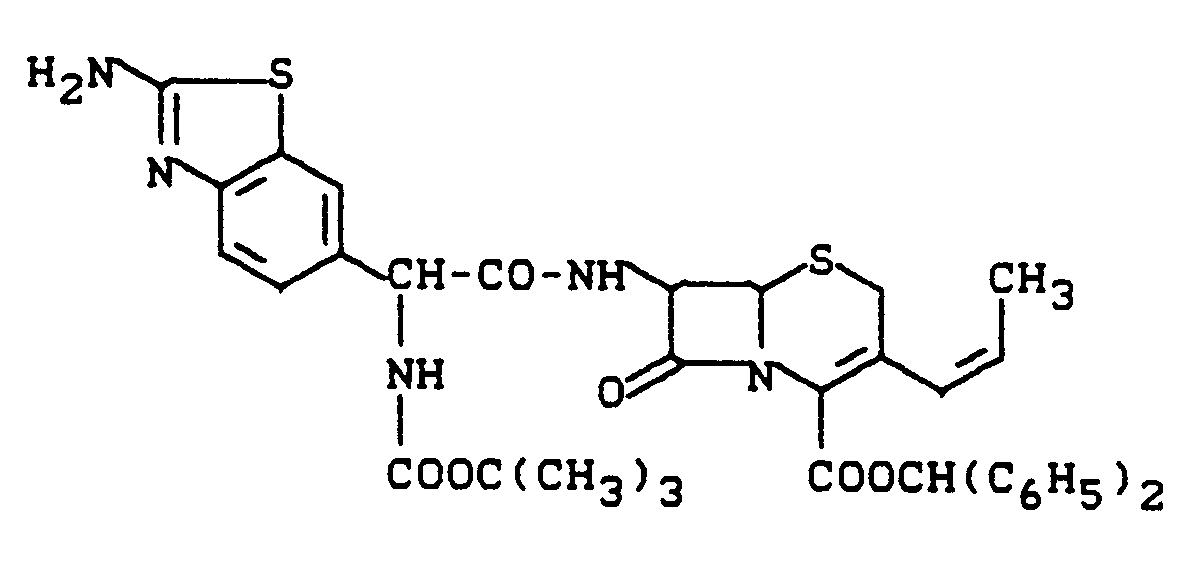
Zu einer kalten Lösung von 6,08 g (0,07 mol) Lithiumbromid in 50 ml Dimethylformamid und 150 ml Methylenchlorid gibt man bei -5°C 7,04 ml (0,126 mol) Acetaldehyd und 7,6 g (0,007 mol) D-7-[2-(t-Butoxycarbonylamino)-2-(2-aminobenzothiazol-6-yl)glycylamido]-3-(triphenylphosphonio)methyl-3-cephem-4-carbonsäurebenzhydrylester-iodid (Beispiel 4). Man rührt die Mischung 20 Stunden bei -5°C und danach 5 Stunden bei Raumtemperatur. Die Lösung wird im Vakuum auf ca. 50 ml eingeengt und in einem Lösemittelgemisch aus 200 ml Essigester und 200 ml Wasser verteilt. Die obere Schicht wird abgetrennt und einmal mit wäßriger Kochsalzlösung gewaschen. Nach Trocknen über Natriumsulfat und Abdestillieren des Lösemittels wird der Rückstand in Toluol aufgenommen und auf eine Säule, die mit Kieselgel (0,04 - 0,063 mm) gepackt ist, gegeben. Zunächst wird mit Toluol und danach mit dem Lösemittelgemisch Toluol / Essigester (5:1) und Toluol / Essigester (1:1) eluiert. - Ausbeute:
- 2,9 g (58% der Theorie)
C₃₇H₃₇N₅O₆S₂ (711,9) - NMR (CDCl₃).
- δ = 1,35 (dd, 3H); 1,43 (s, 9H); 3,15 (d, 1H); 3,31 (d, 1H); 4,97 (d, 1H); 5,3 (s, 1H); 5,46 - 5,55 (m, 1H); 5,71 (breites s, 2H); 5,78 - 5,85 (q, 1H); 6,03 (d, J = 11 Hz, 1H); 6,87 (s, 1H); 7,2 - 7,4 (mm, 12H); 7,5 (s, 1H) ppm.
-
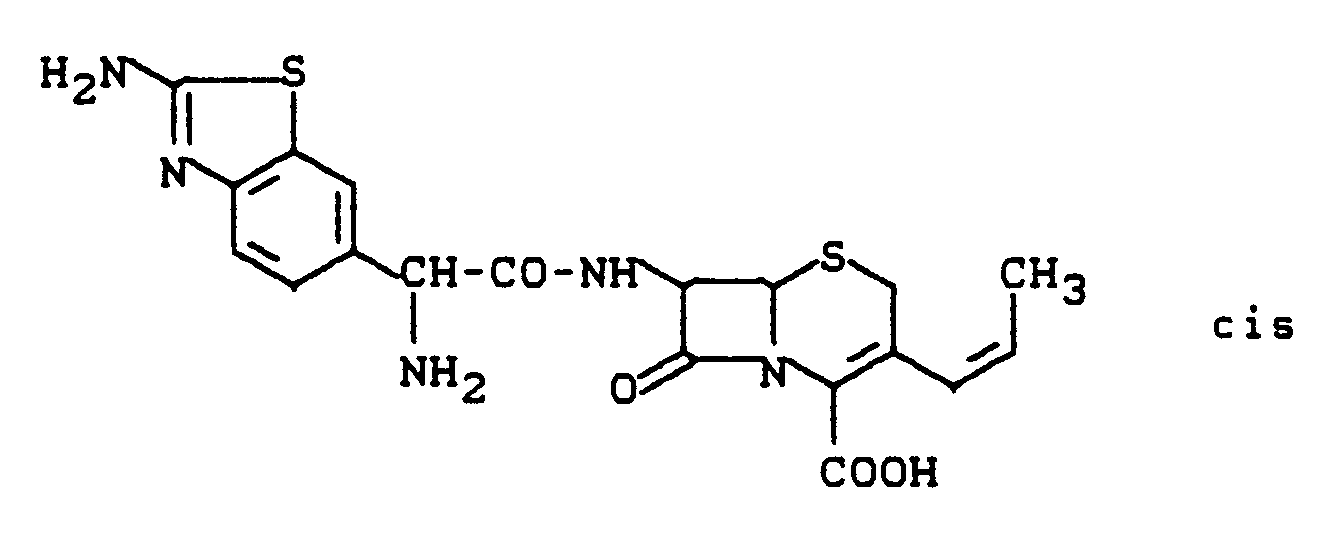
2,9 g (4,1 mmol) D-7-[2-(t-Butoxycarbonylamino)-2-(2-aminobenzothiazol-6-yl)glycylamido]-3-[(Z)-1-propen-1-yl]-3-cephem-4-carbonsäurebenzhydrylester (Beispiel 5) werden in 20 ml Methylenchlorid gelöst, mit 40 ml Trifluoressigsäure (TFA) versetzt und 60 Minuten magnetisch bei Raumtemperatur gerührt. Methylenchlorid und Trifluoressigsäure werden im Vakuum entfernt, das zurückbleibende, halbfeste rote Öl in Ether verrieben, abgesaugt und mit Ether gewaschen. Das hellgelbe Trifluoracetat wird im Vakuum getrocknet, anschließend in 100 ml Wasser suspendiert, von unlöslichen gelben Flocken über Kieselgur abgesaugt und mit 30 ml Wasser nachgewaschen. Die noch leicht trübe Lösung wird nochmals über ein Membranfilter (Millipore, 0,45 µm) filtriert. Das Filtrat wird auf eine RP 18-Säule (Hibar 250-25, Merck) gepumpt. Die Säule wird zunächst mit 200 ml Wasser (Fraktion 1), danach mit 400 ml 5%igem Methanol (Fraktion 2) und schließlich mit 10%igem Methanol eluiert, wobei jeweils 300 ml Fraktionen gesammelt werden (Fraktion 3 bis 12). Die Fraktionen werden mittels analytischer HPLC untersucht und die Fraktionen 6 bis 10, die den gewünschten Peak enthalten, vereinigt, Methanol im Vakuum abdestilliert und lyophilisiert. - Ausbeute:
- 400 mg
C₁₉H₁₉N₅O₄S₂ (445,5) - NMR (DCOOD):
- δ = 1,67 (dd, 3H); 3,41 (d, 1H); 3,55 (d, 1H); 5,3 (d, 1H); 5,78 (s, 1H); 5,81-5,91 (q und m, 2H); 6,25 (d, J = 11,6 Hz, 1H); 7,81 - 7,9 (q, 2H); 8,18 (s, 1H) ppm.
- HPLC-analytisch :
- Hibar 250-4, RP-8, 10 µm, 254 nm
- Laufmittel:
- 1000 ml CH₃CN - 30 ml Essigsäure - 870 ml Wasser
- Fluß:
- 4 ml/min, Konzentration: 1 mg/ml
- Retention:
- 3,22 (Gehalt: 97,3%)
-

Aus der präparativen Hochdruck-Flüssigkeits-Chromatographie der D-7-[(2-Aminobenzothiazol-6-yl)glycylamido]-3-[(Z)-1-propen-1-yl]-3-cephem-4-carbonsäure (cis-Isomer; Beispiel 6) gewinnt man durch weitere Elution mit 30%igem Methanol die E-isomere Verbindung. - Ausbeute:
- 137 mg
C₁₉H₁₉N₅O₄S₂ (445,5) - NMR (DCOOD):
- δ = 1,9 (d, 3H); 3,61 (s, 2H); 5,25 (d, 1H); 5,72 (s, 1H); 5,87 (d, 1H); 6,23-6,46 (m, 1H); 7,04 (d, J = 15,8 Hz, 1H); 7,8 - 7,88 (q, 2H); 8,18 (s, 1H) ppm.
- HPLC-analytisch:
- Hibar 250-4, RP-8 10 µm, 254 nm
- Laufmittel:
- 100 ml CH₃CN - 30 ml Essigsäure - 870 ml Wasser
- Fluß:
- 4 ml/min, Konzentration: 1 mg/ml
- Retention:
- 5,20 (Gehalt: 67,2%)
-
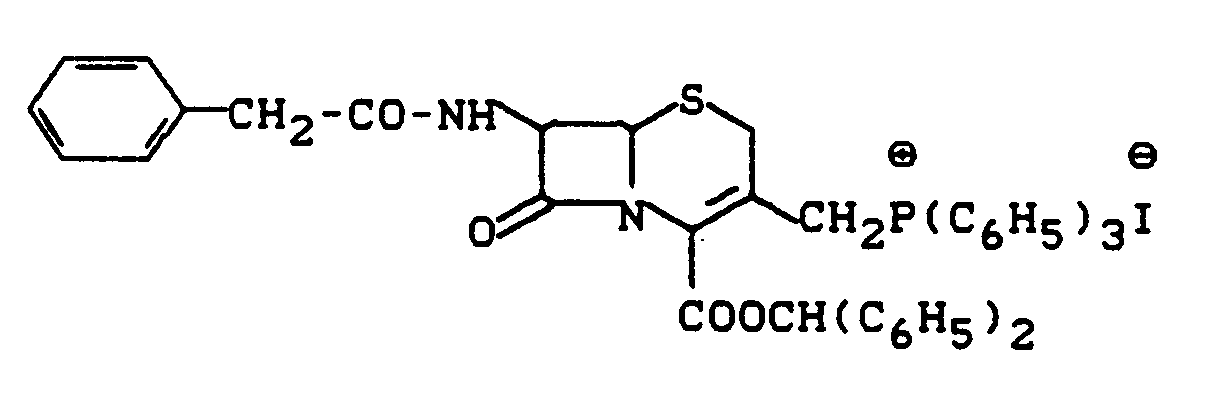
32,5 g (0,0609 mol) 7-Phenylacetamido-3-chlormethyl-3-cephem-4-carbonsäure-benzhydrylester werden in 330 ml Aceton gelöst und unter Rühren mit 10,1 g (0,0674 mol) NaI und 17,6 g (0,0671 mol) Triphenylphosphin nacheinander versetzt. Nach 1,5 Stunden Rühren bei Raumtemperatur wird das unlösliche Material durch Absaugen abgetrennt und die klare Mutterlauge in 1000 ml Ether eingerührt. Das ausfallende weiße flockige Material wird abgesaugt, mit 300 ml Ether gewaschen und im Vakuum getrocknet. - Ausbeute:
- 51 g (94% der Theorie)
C₄₇H₄₀IN₂O₄PS (886,8) - NMR (DMSO):
- δ = 3,51 - 3,61 (q, 4H); 4,93 - 5,05 (t, 1H); 5,22 - 5,33 (d und t, 2H); 5,7 - 5,76 (q, 1H); 6,26 (s, 1H); 7,21 - 7,46 (mm, 15H); 7,68 - 7,79 (m, 15H); 9,14 (d, 1H) ppm.
-

15,9 g (17,9 mmol) 7-Phenylacetamido-3-(triphenylphosphonio)methyl-3-cephem-4-carbonsäurebenzhydrylesteriodid (Beispiel 8) werden in einem 250 ml Dreihalskolben in 100 ml Methylenchlorid und 12,8 ml (229,6 mmol) Acetaldehyd vorgelegt. Man kühlt auf 0°C und gibt 100 ml Wasser hinzu. Anschließend läßt man unter Konstanthaltung des pH-Wertes bei 8,6 16,3 ml 1N NaOH innerhalb von 4 Stunden zutropfen. Die Reaktionslösung wird mit Methylenchlorid verdünnt, die organische Phase abgetrennt, einmal mit Wasser gewaschen und dann über Natriumsulfat getrocknet. Nach Abtrennen des Trockenmittels wird die Methylenchlorid-Lösung nochmals mit 13 ml (233 mmol) Acetaldehyd versetzt und über Nacht gerührt. Anschließend wird die Reaktionslösung bis zur Trockene eingeengt, erneut in wenig Methylenchlorid gelöst und auf eine Säule gegeben, die mit 500 ml Kieselgel (0,04 -0,063 mm) gefüllt ist. Es werden 400 ml Fraktionen gesammelt und mittels analytischer HPLC alle Fraktionen auf die cis-isomere Verbindung untersucht. - HPLC-analytisch:
- Hibar 250-4, Lichrosorb Si 60, 5 µm, 254 nm
- Laufmittel:
- 100 ml Methylenchlorid - 3 ml Methanol
- Fluß:
- 2 ml/min, Konzentration: 1 mg/ml
- Retention:
- 5,80 (Gehalt 73,1%)
- Ausbeute:
- 4,75 g (51% der Theorie)
C₃₁H₂₈N₂O₄S (524,6) - NMR (CDCl₃):
- δ = 1,4 (dd, 3H); 3,22 (d, 1H); 3,41 (d, 1H); 3,65 (q, 2H); 5,0 (d, 1H); 5,48 - 5,6 (m, 1H); 6,07 (d, 1H); 6,92 (s, 1H); 7,21 - 7,4 (m, 15H) ppm.
- 177,2 g (0,2 mol) 7-Phenylacetamido-3-(triphenylphosphonio)methyl-3-cephem-4-carbonsäurebenzhydrylester iodid werden in 800 ml CH₂Cl₂ und 80 ml CH₃OH fast vollständig gelöst, auf +5°C gekühlt und mit 167,8 ml (3,0 mol) Acetaldehyd versetzt; währenddessen die Temperatur nicht über 20°C ansteigen sollte.
- Danach werden langsam 26,4 g (0,25 mol) Natriumcarbonat gelöst in 200 ml Wasser innerhalb von 15 Min. bei 14°C zugegeben. Das Eisbad wird danach weggenommen und die Lösung 2 1/2 Stunden bei Raumtemperatur gerührt.
- Man kontrolliert den Ablauf der Reaktion mit der Dünnschichtchromatographie in Acetonitril: Wasser = 9:1 und Toluol: Essigester = 8:2. Nach Ablauf der Wittig-Reaktion wird die organische Phase abgetrennt und die wäßrige Phase nochmals mit CH₂Cl₂ gewaschen. Die vereinigten CH₂Cl₂-Phasen werden über 150 g Kieselgel (Merck, 0,04-0,063 mm) filtriert und mit CH₂Cl₂(ca. 1000 ml) solange nachgewaschen, bis das Filtrat farblos ist.
- Das CH₂Cl₂-Filtrat wird über Na₂SO₄ getrocknet, danach zu einem öligen Rückstand eingeengt und mit 800 ml Ethanol verrührt. Die ethanolische Lösung läßt man am Rotationsverdampfer 15 Min. rühren, wobei allmählich Produkt auskristallisiert. Ethanol wird weiter abdestilliert und der entstandene Kristallbrei mit ca. 90 ml Ether/100 ml n-Pentan verrührt, abgesaugt und mit 60 ml n-Pentan nachgewaschen. Das Produkt wird im Vakuum über P₄O₁₀ über Nacht getrocknet.
- Ausbeute:
- 41,2 g (39,2 % der Theorie) HPLC-analytisch: Hibar 250-4; Lichrosorb Si 60, 5 µm, 254 nm.
- Laufmittel:
- 850 ml Toluol - 150 ml Essigester
- Fluß:
- 2 ml Min⁻¹
- Retention:
- 4,73 (80,2 %; Z-Isomer)
4,00 (17,4 %; E-Isomer) -

6,4 g (12,2 mmol) 7-Phenylacetamido-3-[(Z)-propen-1-yl]-3-cephem-4-carbonsäurebenzhydrylester (Beispiel 9) werden in 64 ml Methylenchlorid gelöst, mit einem Trockeneisbad auf -40°C gekühlt und nacheinander 2,47 ml (30,5 mmol) Pyridin und 2,54 g (12,2 mmol) Phosphorpentachlorid zugesetzt. Nach 5 Minuten läßt man auf -20°C erwärmen, danach soll die Temperatur innerhalb von 20 Minuten auf -10°C und schließlich auf +10°C ansteigen. Man rührt nunmehr die Lösung 1 Stunde bei +10°C bis +15°C. Anschließend kühlt man den Ansatz auf -40°C, gibt 100 ml Methanol (-30°C) hinzu und rührt noch 30 Minuten bei +10°C. Die Reaktionslösung wird schonend eingeengt, das anfallende Öl in 600 ml Methylenchlorid gelöst, in 800 ml Natriumhydrogencarbonat- Lösung eingerührt und 10 Minuten gerührt. Die Methylenchlorid- Phase wird abgetrennt, einmal mit Wasser gewaschen und über Natriumsulfat getrocknet. Das Methylenchlorid- Filtrat wird an 400 ml Kieselgel (0,04 -0,063 mm) chromatographiert, wobei zunächst mit Methylenchlorid und danach mit Methylenchlorid unter Zusatz von Methanol (Gradient bis 10%) eluiert wird. Das Eluat wird mittels analytischer HPLC und DC (Dünnschichtchromatographie) (Methylenchlorid / Methanol = 100 :1) untersucht. - Ausbeute:
- 4,2 g
C₂₃H₂₂N₂O₃S (406,5) - NMR (CDCl₃):
- δ = 1,4 (dd, J = 2 Hz und 7 Hz, 3H); 3,3 (d, J = 17 Hz, 1H); 3,48 (d, J = 17 Hz, 1H); 4,75 (d, J = 4,5 Hz, 1H); 4,98 (d, J = 4,5 Hz, 1H); 5,45 - 5,55 (d und q, J = 10 Hz und 7 Hz, 1H); 6,07 (d, J = 11 Hz, 1H); 6,96 (s, 1H); 7,23 - 7,42 (m, 10H); 8,6 (d, 2H) ppm.
- HPLC-analytisch:
- Hibar 250-4, Merck, Lichrosorb Si 60, 5 µm, 254 nm
- Laufmittel:
- 1000 ml Methylenchlorid - 5 ml Methanol
- Fluß:
- 2 ml/min, Konzentration 1 mg/ml
- Retention:
- 12,75 (Gehalt: 70,4%)
- 187,05 g (0,8976 mol; 1,57 equiv.) Phosphorpentachlorid werden bei Raumtemperatur in 3300 ml CH₂Cl₂ in einem 4 l Dreihalskolben vorgelegt und innerhalb von 5-10 Min. 66,42 ml (0,821 mol; 1,44 equiv.) Pyridin gelöst in 330 ml CH₂Cl₂ hinzugetropft, wobei die Temperatur auf 24-27°C ansteigt und eine klare, farblose Lösung entsteht. Die Lösung wird auf -2°C gekühlt und 300 g (0,572 mol) 7-Phenylacetamido-3-[(Z)-propen-1-yl]-3-cephem-4-carbonsäurebenzhydrylester hinzugefügt, wobei die Temperatur nicht über +2°C ansteigen darf. Danach entfernt man das Kühlbad und rührt 40 Min., wobei die Temperatur der Reaktionslösung bis auf 10-12°C ansteigt (Iminochlorid-Lösung).
- In einen 6 l Dreihalskolben werden 255 ml (2,843 mol; 4,99 equiv.) 1,3-Butandiol gelöst in 1650 ml CH₂Cl₂ auf -20°C bis -25°C gekühlt (Aceton/Trockeneis) und die Iminochlorid-Lösung mittels Vakuum innerhalb von 5-10 Min. darin eingeleitet. Die Temperatur darf dabei nicht über -20°C ansteigen. Anschließend wird das Kältebad entfernt und die Reaktionslösung 2 Stunden gerührt, wobei die Temperatur auf 10°C ansteigt.
- Nun wird die Reaktionslösung mit 1200 ml Eiswasser, mit 1200 ml 2N HCl und 1200 ml gesättigter Kochsalzlösung gewaschen. Die CH₂Cl₂-Phase wird kurz über Na₂SO₄ getrocknet, vom Trockenmittel abgetrennt und das Filtrat bis zur Trockene eingeengt. Das ausgefallene kristalline Material wird mit 1200 ml bis 2000 ml Essigester verrührt, anschließend abgesaugt und mit Ether nachgewaschen. Das Produkt wird über Nacht im Hochvakuum getrocknet:
- Ausbeute:
- 173,9 g (68,7 % der Theorie)
C₂₃H₂₃ClN₂O₃S(442,96) - NMR (DMSO):
- δ = 1,48 (dd,3H); 3,56 (d,1H); 3,79 (d,1H); 5,2 (d,1H); 5,31 (d,1H); 5,56-5,72 (m,1H); 6,21 (schwaches d, 1H); 6,28 (schwaches d,1H); 6,91 (s,1H); 7,25-7,47 (m,10H)ppm.
- Das Produkt enthält neben dem Z-Isomer etwas E-Isomer (Z/E=91:9).
-
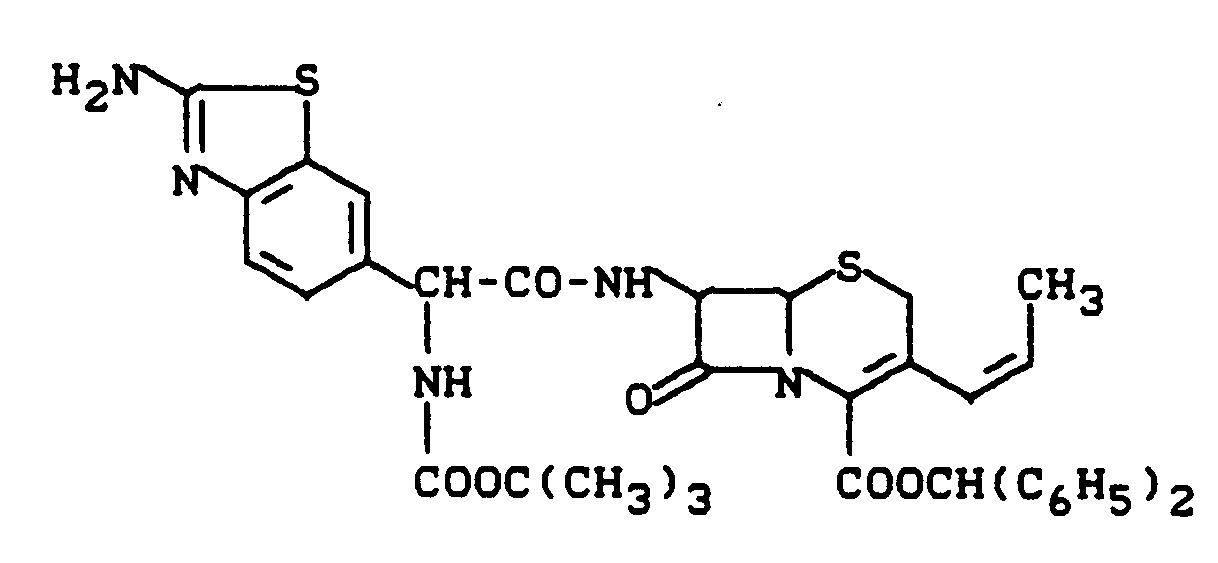
3,4 g (10,5 mmol) D-α-t-Butyloxycarbonylamino-α-(2-aminobenzothiazol-6-yl)essigsäure und 4,0 g (7 mmol) 7-Amino-3-[(Z)-1-propen-1-yl]-3-cephem-4-carbonsäurebenzhydrylester (Beispiel 10) werden in 100 ml Tetrahydrofuran gelöst. Die klare gelbe Lösung wird mit 2,2 g (10,5 mmol) DCC versetzt und dann 2 Stunden bei Raumtemperatur gerührt. Nach zweistündigem Rühren engt man die Mischung zur Trockene ein, der Rückstand wird in 150 ml Essigester suspendiert, 10 Minuten magnetisch gerührt und die unlöslichen Bestandteile durch Absaugen abgetrennt. Das Essigesterfiltrat wird zur Trockne eingeengt, der Rückstand in 50 ml Methylenchlorid gelöst und an 200 ml Kieselgel (0,04 - 0,063 mm) chromatographiert. Die Elution erfolgt mit Methylenchlorid und Methylenchlorid / Methanol -Gemischen in folgender Reihenfolge: - 1.) Methylenchlorid (Fraktion 1 bis 6): 200 mg, verworfen
- 2.) Methylenchlorid - 2% Methanol (Fraktion 7, 8): 200 mg, verworfen
- 3.) Methylenchlorid - 3% bis 4% Methanol (Fraktion 9, 10)
- 4.) Methylenchlorid - 4% bis 5% Methanol (Fraktion 11 bis 13) Ausbeute der Fraktion 9 bis 13 : 3,1 g
- 5.) Methylenchlorid - 5% bis 10% Methanol (Fraktion 14,15): 1,9 g
- 6.) Methylenchlorid - Methanol (1:1, Fraktion 16): 0,7 g, verworfen
- Ausbeute:
- 3,1 g (44% der Theorie)
C₃₇H₃₇N₅O₆S₂ (711,9) - NMR (CDCl₃):
- δ = 1,35 (dd, 3H); 1,43 (s, 9H); 3,15 (d, 1H); 3,31 (d, 1H); 4,97 (d, 1H); 5,3 (s, 1H); 5,46 - 5,55 (m, 1H); 5,71 (breites s, 2H); 5,78 - 5,85 (q, 1H); 6,03 (breites d, J = 11 Hz, 1H); 6,87 (s, 1H); 7,2 - 7,4 (mm, 12H); 7,5 (s, 1H) ppm.
-

3,1 g (4,35 mmol) D-7-[2-(t-Butyloxycarbonylamino)-2-(2-aminobenzothiazol-6-yl)glycylamido]-3-[(Z) -1-propen-1-yl]-3-cephem-4-carbonsäurediphenylmethylester (Beispiel 11) werden in 20 ml Methylenchlorid gelöst, mit 50 ml Trifluoressigsäure und 5 ml Anisol versetzt und 60 Minuten bei Raumtemperatur gerührt. Man engt die Mischung im Vakuum ein, gibt zu dem Konzentrat 200 ml Ether, filtriert den ausgefallenen Feststoff ab und wäscht mit 100 ml Ether nach. Das hellgelbe Trifluoracetat wird im Vakuum getrocknet. - Ausbeute:
- 2,7 g
C₂₁H₂₁F₃N₅O₆S₂ (560,6) - HPLC-analytisch:
- Hibar 250-4, Merck RP-8, 10 µm, 254 nm
- Laufmittel:
- 250 ml CH₃CN - 75 ml Eisessig - 2175 ml Wasser
- Fluß:
- 4 ml/min, Konzentration: 1 mg/ml
- Retention
- 3,33 (Gehalt: 76,4%)
-

2,6 g (4,64 mmol) D-7-[(2-Aminobenzothiazol-6-yl)glycylamido]-3-[(Z)-1-propen-1-yl]-3-cephem-4-carbonsäure-trifluoracetat (Beispiel 12) werden in 100 ml Wasser suspendiert, von gelben unlöslichen Partikelchen über Kieselgur abgetrennt und mit 30 ml Wasser nachgewaschen. - Die noch leicht getrübte Lösung wird über ein Membranfilter (Millipore, 0,45 µm) filtriert und aus dem Filtrat analog Beispiel 6 mittels präparativer HPLC das 3-Propenylcephalosporin isoliert.
- Ausbeute:
- 500 mg
C₁₉H₁₉N₅O₄S₂ (445,5) - NMR (DCOOD):
- δ = 1,67 (dd, 3H); 3,41 (d, 1H); 3,55 (d, 1H); 5,3 (d, 1H); 5,78 (s, 1H); 5,81 - 5,91 (q und m, 2H); 6,25 (breites d, J = 11,6 Hz, 1H); 7,81 - 7,9 (q, 2H); 8,18 (s, 1H) ppm.
-
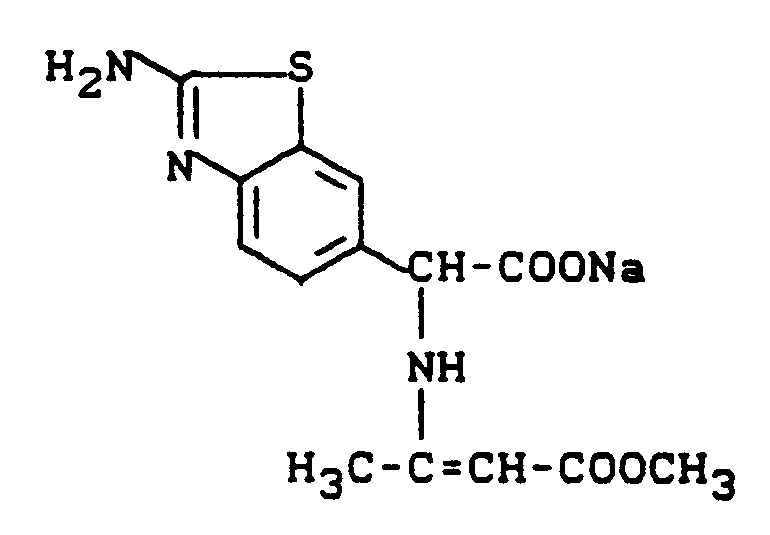
100 g [entspricht 97,2 g (0,435 mol)] D-2-Aminobenzothiazol-6-yl)glycin (Gehalt = 97,2%, ee = 89,7%) werden in methanolische Natronlauge, hergestellt aus 18,6 g (0,465 mol, d.h. 7% Überschuß) NaOH und 1000 ml Methanol, eingetragen. Unter Rückflußkochen und Rühren bildet sich eine klare Lösung, die mit 64 ml (0,59 mol, ca. 40% Überschuß) Acetessigsäuremethylester, gelöst in 100 ml Methanol, innerhalb von 40 min versetzt wird (nach beendetem Zutropfen pH = 10,3; Probe / Wasser = 1:1). Anschließend wird die Lösung 1 h unter Rückfluß erhitzt und danach mehrere Stunden ohne Heizung weiter gerührt. Das auskristallisierte Material wird abgesaugt und mit Toluol (zweimal 200 ml) gewaschen. Der Filtratrückstand wird in 1000 ml Toluol 30 - 40 min zum Sieden erhitzt, anschließend 300 ml Toluol abdestilliert und durch Zutropfen von frischem Toluol gewaschen und über Nacht im Frischluftschrank bei 70°C getrocknet.
Ausbeute: 81,9 g (52,1% der Theorie)C₁₄H₁₄N₃O₄SNa · H₂O (361,4) Ber. C 46,53 H 4,46 N 11,62 S 8,87 Na 6,36 Gef. C 46,2 H 4,4 N 11,9 S 8,4 Na 5,6 Br 0,1 Cl 0,5
NMR (DMSO): δ = 1,63 (s, 3H); 3,49 (s, 3H); 4,25 (s, 1H); 4,7 (d, J = 7,5 Hz, 1H); 7,12 (dd, 1H); 7,21 (d, 1H); 7,34 (s, 2H); 7,48 (s, 1H); 9,55 (d, 1H) ppm.
ee = 100% -

Zu einer gerührten Lösung von 500 ml Trifluoressigsäure (TFA) und 31 ml Anisol, die auf 0°C gekühlt wird, gibt man 54,5 g (0,123 mol) 7-Amino-3-[(Z)-1-propen-1-yl]-3-cephem-4-carbonsäurebenzhydrylester-hydrochlorid (Beispiel 10). Die Mischung wird 1 Stunde bei Raumtemperatur gerührt, anschließend bei 30°C im Vakuum eingeengt und der ölige Rückstand mit 600 ml Ether 1 Stunde verrührt. Der Niederschlag wird abgesaugt, mit 300 bis 400 ml Ether gewaschen und der Filterrückstand 3 Stunden im Vakuum getrocknet. Das Trifluoracetat wird in 300 ml Wasser suspendiert, die Aufschlämmung auf +5°C gekühlt und mit 12 N HCl der pH-Wert auf 0,2 - 0,4 gestellt. Die entstandene klare Lösung wird auf +5°C gekühlt und mit 4 g Aktivkohle 10 min gerührt. Man saugt über Kieselgur ab und wäscht mit ca. 50 ml 0,1 N HCl nach. Das Filtrat wird bei +5°C mit 20%iger NaOH bis pH 2,1 eingestellt und das ausgefallene Produkt 1 Stunde im Kühlschrank stehen gelassen, um die Kristallisation zu vervollständigen. Der Kristallbrei wird abgesaugt, mit 100 ml Wasser und 300 ml Aceton gewaschen und im Vakuum getrocknet. - Ausbeute:
- 16,4 g (55,4% der Theorie)
C₁₀H₁₂N₂O₃S (240,3) - NMR (DCOOD):
- δ = 1,8 (dd, 3H); 3,61 (d, 1H); 3,77 (d, 1H); 5,39 (d, 1H); 5,52 (d, 1H); 5,91 - 6,06 (q, 1H); 6,5 (d, 1H) ppm.
- HPLC-analytisch:
- Hibar 250-4, Merck RP-8, 10 µm, 254 nm
- Laufmittel:
- 100 ml CH₃CN - 30 ml Eisessig - 870 ml Wasser
- Fluß:
- 2 ml/min, Konzentration: 0,25 mg/ml
- Retention:
- 2,39 (85,7%; Z-Isomer)
3,16 (11,3%; E-Isomer) -
-
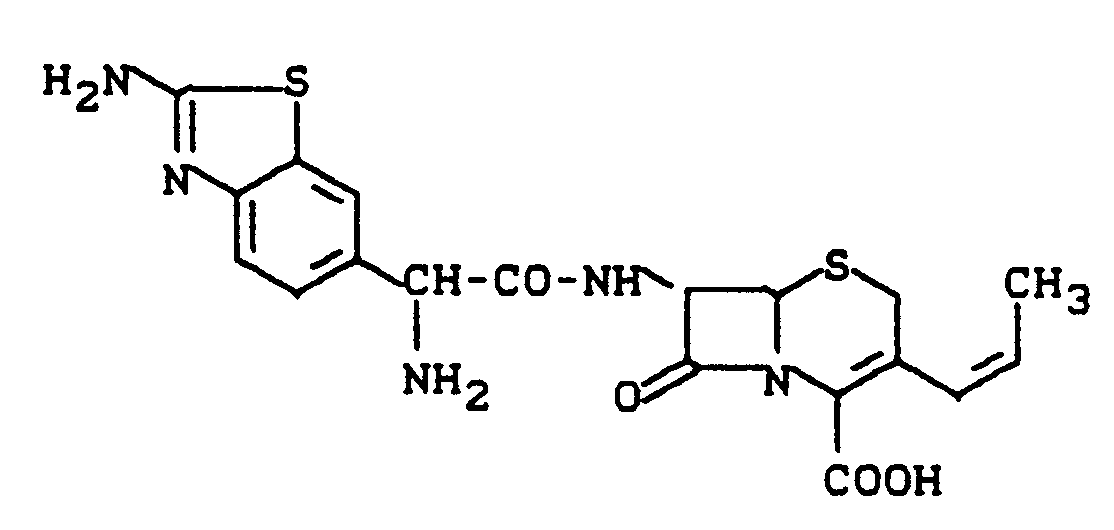
12,09 g [entspricht 11,48 g (33,4 mmol)] Natrium-D-α-[(1-Methyl-2-methoxycarbonyl-vinyl)-amino]-(2-aminobenzothiazol-6-yl)acetat (Gehalt = 95%, Beispiel 14) werden in 57 ml Dimethylformamid gelöst und danach 23 ml Acetonitril hinzugegeben. Man kühlt die Lösung auf -70°C und gibt hintereinander 115 µl 3-Dimethylaminopropanol und 3,30 ml (34,4 mmol) Chlorameisensäureethylester hinzu und rührt 20 min bei -70°C. - b) Zubereitung der Cephalosporinkomponente (7-APCA)
9,61 g (40 mmol) 7-Amino-3-[(Z)-1-propen-1-yl]-3-cephem-4-carbonsäure (Beispiel 15) werden in 57 ml Dimethylformamid und 23 ml Acetonitril suspendiert und durch Zugabe von 1 N Natronlauge (36,8 ml) bei Raumtemperatur bis pH 8,5 in eine klare Lösung verwandelt. Man kühlt die Lösung auf -20°C bis -30°C ab. - c) Kupplung, Deblockierung und Isolierung des Rohbetains
Die gekühlte 7-APCA-Lösung (-20°C bis -30°C) nach b) läßt man langsam zur Lösung des gemischten Anhydrids der Precursorsäure nach a) bei -70°C zutropfen und rührt 10 min bei -70°C nach. Anschließend läßt man die Temperatur der Lösung innerhalb von 45 min auf 0°C kommen (ohne Kühlung) und rührt mit 1,2 g Aktivkohle und 1,2 g Kieselgur noch weitere 10 min. Man filtriert die Reaktionsmischung über ein Seitz-Filter, wäscht mit wenig Dimethylformamid nach und versetzt das Filtrat mit 6,9 ml konzentrierter Salzsäure. Das Volumen der Lösung wird bis auf 115 ml konzentriert, wobei ausgefallene Salze abgetrennt werden. Das Filtrat wird über magnetischem Rühren mit 25% NH₃-Lösung auf pH 4,0 gestellt und mit 800 ml Aceton versetzt, wobei das Rohbetain ausfällt. Man rührt die Ausfällung 10 min, saugt ab und wäscht mit Aceton nach und trocknet das Material im Vakuum.- Ausbeute:
- 12,65 g
- HPLC-analytisch:
- Hibar 250-4, Merck RP-8, 10 µm, 254 nm
- Laufmittel:
- 100 ml CH₃CN - 30 ml Eisessig - 870 ml Wasser
- Fluß:
- 2 ml/min; Konzentration 1 mg/ml
- Retention:
- 7.06 (73,8%; Z-Isomer)
11,18 (11,5%; E-Isomer)
-
a) Aktivierung der Precursorsäure:
100 g [entspricht 95 g (0,277 mol) Reinmaterial; 1,2 equiv.] Natrium-D-α-[(1-Methyl-2-methoxycarbonylvinyl)-amino]-(2-aminobenzothiazol-6-yl)acetat (Gehalt = 95 %, Beispiel 14) werden in 500 ml Dimethylformamid und 200 ml Acetonitril klar gelöst. Man kühlt die Lösung auf -60°C und gibt nacheinander 1 ml 3-Dimethylamino-1-propanol und 27,7 ml (0,281 mol) Chlorameisensäureethylester hinzu und rührt 30 Min. bei -60°C.
b) Zubereitung der Cephalosporinkomponente:
102 g (0,2304 mol) 7-Amino-3-[(Z)-1-propen-1-yl]-3-cephem-4-carbonsäurebenzhydrylesterhydrochlorid (Beispiel 10/II) werden in 500 ml Dimethylformamid und 100 ml Acetonitril klar gelöst, bei Raumtemperatur mit 31 ml Wasser und 32,2 ml (0,2289 mol) Triethylamin versetzt und 5 Min. bei Eiskühlung gerührt.
c) Kupplung:
Die auf 0°C gekühlte Cephalosporin-Lösung (b) gibt man langsam zur Lösung des gemischten Anhydrids (a) bei -60°C hinzu, wobei die Temperatur von -60°C auf -30°C ansteigt. Man rührt insgesamt 30 Min. nach und läßt die Temperatur der Reaktionslösung auf 0°C kommen. Anschließend gibt man 57 ml konzentrierte Salzsäure hinzu und rührt die Lösung 15 Min. bei 0°C.
d) Isolierung des Trifluoracetatsalzes:
Man destilliert aus der Reaktionslösung Acetonitril ab und stellt mit 25 % NH₃-Lösung unter Eiskühlung auf pH 7,5. Man schüttet die Lösung in 5 l Essigester und 3 l 10 %ige NaHCO₃-Lösung, die Kochsalz enthält. Die Mischung wird 5 Min. intensiv gerührt und anschließend über ein Seitz-Filter abgesaugt. Die Essigester-Phase wird abgetrennt, einmal mit 4 l gesättigter NaHCO₃-Lösung und zweimal mit 4 l Wasser gewaschen. Danach wird die Essigesterphase über Na₂SO₄ getrocknet, vom Trockenmittel abgesaugt und zum Schluß im Vakuum zur Trockne eingeengt. Der entstandene Hartschaum wird 30 Min. im Hochvakuum getrocknet. Ausbeute: 170 g.
e) Deblockierung:
Der Hartschaum wird in 1600 ml CH₂Cl₂ gelöst, auf 0°C gekühlt und mit einer Mischung von 750 ml Trifluoressigsäure und 4 ml Anisol versetzt. Die Lösung wird danach 45 Min. bei Raumtemperatur gerührt, anschließend zu einem Öl eingeengt und der ölige Rückstand mit 6 l Ether digeriert. Das auskristallisierte Material wird abgesaugt, mit Ether gewaschen und über Nacht im Vakuum getrocknet. - Ausbeute:
- 125 g (97 % der Theorie)
C₁₉H₁₉N₅O₄S₂ · CF₃ COOH (559,55) HPLC-analytisch: Hibar 250-4, Merck RP-8, 254 nm - Laufmittel:
- 100 ml CH₃CN - 30 ml Eisessig - 870 ml Wasser
- Fluß:
- 4 ml/Min.
- Retention:
- 2,25 (90,1 %; Z-Isomer)
3,77 (8,3 %; E-Isomer). - Ausbeute:
- 47,7 g (43,0 % der Theorie) C₁₉H₁₉N₅O₄S₂ · 2H₂O (481,56)
- Ausbeute:
- 110,2 g (65,5 % der Theorie) HPLC-ana
- lytisch:
- Hibar 250-4, Merck RP-8, 10 µm, 254 nm
- Laufmittel:
- 100 ml CH₃CN - 30 ml Eisessig - 870 ml Wasser
- Fluß:
- 4 ml Min⁻¹; Konzentration: 1 mg ml⁻¹
- Retention:
- 3,58 (98,4 %; Z-Isomer)
6,54 (0,79 %; E-Isomer) -
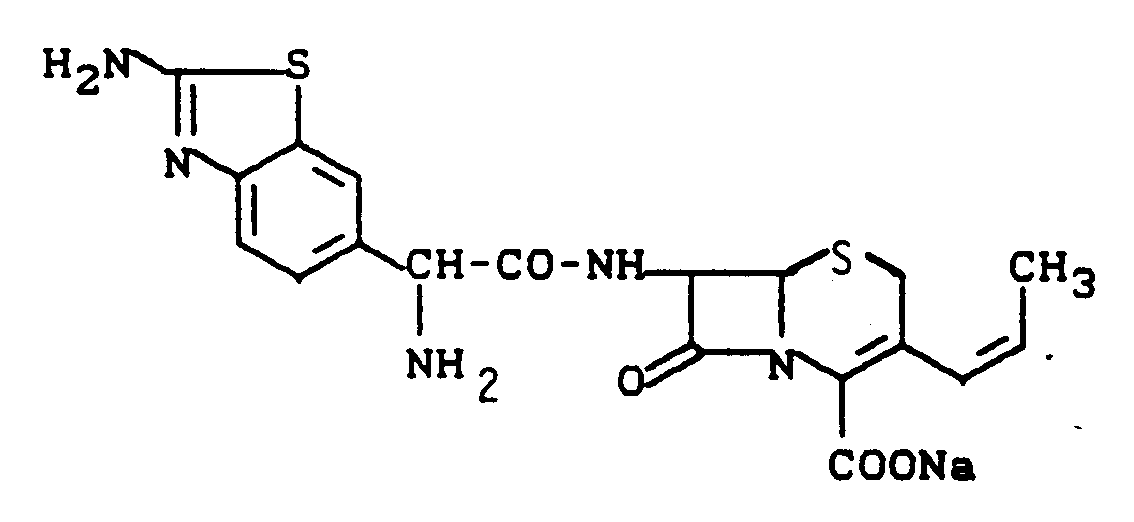
15,0 g (0,0324 mol) D-7-[(2-Aminobenzothiazol-6-yl)glycyl-amido]-3-[(Z)-1-propen-1-yl]-3-cephem-4-carbonsäure (Beispiel 16/II) werden in 300 ml Wasser unter Rühren suspendiert und mit 1 N Natronlauge auf pH = 8,56 unter pH-Stat-Bedingungen gestellt (Memo-Titrator DL 40 RC). Die entstandene hellgelbe Lösung wird über ein Papierfilter abgesaugt und das Filtrat lyophilisiert.
Ausbeute: 15,0 g (92,1 % der Theorie)C₁₉H₁₈N₅NaO₄S₂·2H₂O (503,54) Ber. C 45,32 H 4,40 N 13,91 S 12,74 Na 4,56 Gef. C 46,0, H 4,9 N 14,0 S 12,9 Na 4,3
NMR (DCOOD): δ = 1,64 (dd, 3H); 3,38 (d,1H); 3,51 (d,1H; 5,26 (d, 1H); 5,72 (s, 1H); 5,78-5,85 (m, 1H); 5,85 (d, 1H); 6,21 (d, 1H); 7,76-7,83 (q, 2H); 8,12 (s, 1H) ppm.
HPLC-analytisch: Hibar 250-4, RP-8, 10 µm, 254 nm
Laufmittel: 100 ml CH₃CN - 30 ml Essigsäure - 870 ml Wasser
Fluß: 2 ml/min,
Konzentration: 1 mg/ml
Retention: 4,36 (Gehalt: 98,7 %) -

Zu einer Lösung von 20 g (0,0618 mol) D-α-t-Butyloxycarbonylamino-α-(2-aminobenzothiazol-6-yl)essigsäure in 160 ml Tetrahydrofuran läßt man 12,2 ml (0,102 mol) tert.-Butylnitrit gelöst in 25 ml Tetrahydrofuran innerhalb von 30 Minuten bei +50°C bis +60°C zutropfen. Anschließend rührt man 30 Minuten bei +50°C bis +55°C nach, destilliert das Lösemittel ab und verteilt den Rückstand in 300 ml Wasser und 300 ml Essigester. Die Mischung wird bei Eiskühlung mit 2 N HCl auf pH 1,5 angesäuert, 5 Minuten gerührt und anschließend mit 40%iger Kaliumcarbonat-Lösung auf pH 8,0 bis 8,5 gestellt. Die wäßrige Phase wird abgetrennt, nochmals mit Essigester gewaschen und danach bei 0°C mit 2 N HCl auf pH 2,5 angesäuert. Die saure Lösung wird zweimal mit Essigester extrahiert, mit Kochsalzlösung gewaschen und über Natriumsulfat getrocknet. Die Essigesterphase wird bis auf 50 ml eingeengt und in Petrolether eingerührt.
Ausbeute: 14,4 g (76% der Theorie)C₁₄H₁₆N₂O₄S (308,4) Ber. C 54,5 H 5,2 N 9,1 S 10,4 Gef. C 54,1 H 5,6 N 8,9 S 9,7 
NMR (DMSO): δ = 1,43 (s, 9H); 5,31 (d, 1H); 7,6 (dd, 1H); 7,73 (d, 1H); 8,08 (d, 1H); 8,2 (schwaches d, 1H); 9,4 (s, 1H) ppm. -

40,0 g (82,1 mmol) 7-Phenylacetamido-3-chlormethyl-3-cephem-4-carbonsäure-p-methoxybenzylester und 22,66 g (86,4 mmol) Triphenylphosphin werden in 300 ml Dimethylformamid gelöst, mit 12,95 g (86,4 mmol) Natriumiodid versetzt und 2 Stunden bei Raumtemperatur gerührt. Die Reaktionslösung wird anschließend im Hochvakuum zur Trockne bis zu einem Öl eingeengt. - Der ölige Rückstand von 4,2 g wird in 130 ml Methylenchlorid aufgenommen (keine vollständige klare Lösung), in einem 500 ml Dreihalskolben mit 69,0 ml (1231,5 mmol) Acetaldehyd versetzt und anschließend mit 1 N Natronlauge unter pH-stat Bedingungen mittels Autotitrator bei pH 8,1 behandelt. Nach 1 Stunde sind 8,7 ml 1 N Natronlauge verbraucht. Anschließend werden bei pH 8,3 innerhalb von 20 Stunden noch 72,5 ml 1 N Natronlauge verbraucht. Die wäßrige Phase wird abgetrennt, die Methylenchlorid- Phase zweimal mit Wasser gewaschen und über Natriumsulfat getrocknet. Anschließend wird die Methylenchlorid- Phase erneut mit 20 ml (358 mmol) Acetaldehyd 2 Stunden bei Raumtemperatur gerührt, Methylenchlorid abdestilliert und das zurückbleibende Öl in Toluol aufgenommen und auf eine Säule mit 1 l Kieselgel (0,04 - 0,063 mm) gegeben.
- Die Elution erfolgt zunächst mit Toluol (Fraktion 1 bis 5) und anschließend mit Toluol / Essigester (5:1, Fraktion 6, 7), wobei 600 ml Fraktionen gesammelt werden. Die Fraktionen 3 bis 6 werden vereinigt, bis zur Trockene eingeengt und das erhaltene Öl mit 100 bis 150 ml Ether verrieben. Das ausgefällte weiße Material wird abgesaugt und mit Ether (50 bis 80 ml) gewaschen.
- Ausbeute:
- 12,1 g (31% der Theorie)
C₂₆H₂₆N₂O₅S (478,6) - NMR (CDCl₃):
- δ = 1,52 (d, 3H); 3,23 (d, 1H); 3,41 (d, 1H); 3,61 (q, 2H); 3,78 (s, 3H); 4,95 (d, 1H); 5,13 (s, 2H); 5,59 - 5,69 (dq, 1H); 5,75 - 5,81 (q, 1H); 6,08 (breites d, 1H); 6,45 (d, 1H); 6,87 (d, 2H); 7,25 - 7,36 (m, 7H) ppm.
- Die Fraktionen 7 bis 11 werden bis zu einem leicht rötlichen Öl eingeengt, das nicht der gewünschten Verbindung zugeordnet werden kann.
-

12,1 g (25,28 mmol) 7-Phenylacetamido-3-[(Z)-propen-1-yl]-3-cephem-4-carbonsäure-p-methoxybenzylester (Beispiel 15) werden in 133 ml Methylenchlorid gelöst, auf -50°C gekühlt und nacheinander 5,11 ml (63,2 mmol) Pyridin und 5,26 g (25,28 mmol) Phosphorpentachlorid zugesetzt. Danach läßt man die Temperatur innerhalb von 25 Minuten auf - 10°C ansteigen. Nach weiteren 20 Minuten beträgt die Temperatur der Lösung 0°C; danach rührt man noch 45 Minuten bis +15°C. Man kühlt den Ansatz jetzt auf -50°C, gibt in einem Guß 200 ml Methanol (ca. -30°C) hinzu und rührt ohne Kühlung 30 Minuten. Die Reaktionslösung wird eingeengt, der ölige Rückstand in Methylenchlorid gelöst und auf eine Säule gegeben, die mit 400 ml Kieselgel (0,04 - 0,063 mm) gepackt ist. Man eluiert die Säule zunächst mit Methylenchlorid, danach hintereinander mit den Lösemittelgemischen Methylenchlorid - 5% Methanol und Methylenchlorid - 10% Methanol. Die Fraktionen, die mit dem Gemisch Methylenchlorid - 10% Methanol eluiert werden, engt man zur Trockene ein. - Ausbeute:
- 10 g
- Ausbeute:
- 6,8 g (75% der Theorie)
C₁₈H₂₀N₂O₄S (360,4) - NMR (CDCl₃):
- δ = 1,55 (dd, 3H); 1,95 (schwaches dd, 2H); 3,3 (d, 1H); 3,5 (d, 1H); 3,76 (s, 3H); 4,72 (d, 1H); 4,98 (d, 1H); 5,18 (s, 1H); 5,58 - 5,69 (dq, 1H); 6,1 (breites d, 1H); 6,88 (d, 2H); 7,31 (d, 2H); 8,61 (d, 1H) ppm.
-

Zu einer Lösung von 5,83 g (18,9 mmol) D-α-t-Butyloxycarbonylamino-α-(benzothiazol-6-yl)essigsäure und 6,8 g (15,1 mmol) 7-Amino-3-[(Z)-1-propen-1-yl]-3-cephem-4-carbonsäure-p-methoxybenzylester (Beispiel 19) in 150 ml Tetrahydrofurn gibt man unter magnetischem Rühren 3,90 g (18,9 mmol) Dicyclohexylcarbodiimid bei Raumtemperatur hinzu und rührt anschließend 2 Stunden. Man saugt den gebildeten Dicyclohexylharnstoff ab, wäscht mit Tetrahydrofuran und engt die Mutterlauge bis zur Trockene ein. Das zurückbleibende Öl wird in 100 ml Methylenchlorid gelöst und an 600 ml Kieselgel (0,04 - 0,063 mm) chromatographiert, wobei man zunächst mit Methylenchlorid (2 x 300 ml) und anschließend mit 5%igem Methanol in Methylenchlorid unter Kontrolle mittels Dünnschichtchromatographie (Methylenchlorid : Methanol = 100:5) eluiert. Es werden jeweils 300 ml Fraktionen gesammelt. Die gewünschten Fraktionen des Eluates (11 und 12) mit 5%igem Methanol werden vereinigt und zur Trockene eingeengt. - Ausbeute:
- 8,8 g (89% der Theorie)
C₃₂H₃₄N₄O₇S₂ (650,8) - NMR (CDCl₃):
- δ = 1,4 (s, 9H); 1,5 (dd, 3H); 3,12 (d, 1H); 3,32 (d, 1H); 3,75 (s, 3H); 4,91 (d, 1H); 5,13 (s und d, 3H); 5,58 - 5,68 (m, 1H); 5,73 - 5,79 (q, 1H); 6,03 (breites d, 1H); 6,86 (d, 2H); 7,28 (d, 2H); 7,52 (d, 1H); 8,01 (s, 1H); 8,1 (d, 1H); 9,4 (s, 1H) ppm.
-

Eine Mischung von 8,8 g (13,5 mmol) D-7-[2-(t-Butyloxycarbonylamino)-2-(benzothiazol-6-yl)glycylamido]-3-[(Z)-1-propen-1-yl]-3-cephem-4-carbonsäure-p-methoxybenzylester (Beispiel 20), 3 ml Anisol und 100 ml Trifluoressigsäure wird 1 Stunde bei Raumtemperatur gerührt. Man engt die Mischung im Vakuum ein, gibt zu dem hellroten, leichtbeweglichen Öl 40 ml Toluol und engt erneut im Vakuum ein. Das zurückbleibende Öl wird mit 400 ml Ether verrieben, der ausgefallene Feststoff abgesaugt, mit Ether gewaschen und im Vakuum getrocknet. Man erhält 6,3 g Trifluoracetat, die in 800 ml Wasser gelöst und von unlöslichen Bestandteilen durch Filtrieren über Kieselgur abgetrennt werden. Die Lösung wird über eine HP-20-Säule (600 ml, Diaion-Adsorberharz, Mitsubishi) geleitet, die mit Wasser und danach mit einem Gemisch von Wasser und Methanol (Gradient bis 50%) eluiert wird. Das die gewünschte Verbindung enthaltende Eluat wird lyophilisiert. - Ausbeute:
- 1,9 g
- 1.) 500 ml Wasser
- 2.) 500 ml wasser mit 10% Methanol
- 3.) 1000 ml Wasser mit 10% bis 40% Methanol: Das Eluat wird hier in 50 - 100 ml Fraktionen gesammelt und anschließend mittels analytischer HPLC untersucht, wobei festgestellt wird, daß die Fraktionen 8 bis 10 das cis-isomere Derivat enthalten.
- Ausbeute:
- 468 mg
C₁₉H₁₈N₄O₄S₂ (430,5) - NMR (DCOOD):
- δ = 1,61 (dd, 3H); 3,31 (d, 1H); 3,48 (d, 1H); 5,25 (d, 1H); 5,75 - 5,9 (m und q, 3H); 6,2 (breites d, 1H); 8,13 (dd, 1H); 8,48 (d, 1H); 8,67 (s, 1H); 10,33 (s, 1H); ppm.
- HPLC-analytisch:
- Hibar 250-4, RP-8, 10 µm, 254 nm
- Laufmittelsystem:
- 790 ml Wasser - 200 ml Methanol - 10 ml Puffer pH 7,0
- Fluß:
- 2 ml/min, Konzentration: 1 mg/ml
- Retention:
- 7,53 (Gehalt: 92,4%)
-

Zu einer auf -50°C gekühlten Lösung von 512,5 mg (1,585 mmol) D-α-t-Butyloxycarbonylamino-α-(2-aminobenzothiazol-6-yl)essigsäure in 5 ml Dimethylformamid werden nacheinander 276,1 µl (1,585 mmol) Ethyldiisopropylamin und 122,7 µl (1,585 mmol) Mesylchlorid langsam zugespritzt. Man rührt 40 Minuten bei -50°C und tropft eine Lösung (-20°C) von 622 mg (1,585 mmol) 7-Amino-3-vinyl-3-cephem-4-carbonsäure-diphenylmethylester und 276,1 µl (1,585 mmol) Ethyldiisopropylamin in 5 ml Tetrahydrofuran and 3 ml Dimethylformamid zu. Es wird 5 Minuten bei -50°C und anschließend noch 50 Minuten ohne Kühlung nachgerührt. Danach wird die Reaktionslösung in 40 ml Wasser und 120 ml Essigester eingerührt, die Essigesterphase abgetrennt, die wäßrige Schicht nochmals mit 60 ml Essigester extrahiert, die organischen Phasen vereinigt, mit 0,1 N Salzsäure, Natriumhydrogencarbonat-Lösung und Kochsalzlösung gewaschen. Nach dem Trocknen und Abdestillieren des Lösemittels wird der Rückstand in 20 ml Methylenchlorid aufgenommen, 20 ml Trifluoressigsäure mit 1 Tropfen Anisol zugesetzt und 45 Minuten bei Raumtemperatur gerührt. Anschließend wird das Trifluoressigsäure / Methylenchlorid- Gemisch im Vakuum abdestilliert und der Rückstand in 15 ml 80%iger Essigsäure gelöst, auf eine RP-18-Säule (Hibar 250-25, Merck) gepumpt und mit 3%iger Essigsäure eluiert. Das Eluat, das die gewünschte Substanz enthält, wird gefriergetrocknet. - Ausbeute:
- 800 mg
- Ausbeute:
- 165 mg
C₁₈H₁₇N₅O₄S₂ · 3H₂O · 1/2CH₃COOH (505,5) - NMR (DCOOD):
- δ = 3,61 - 3,76 (dd, 2H); 5,28 (d, 1H); 5,52 (d, 1H); 5,69 (d, 1H); 5,75 (s, 1H); 5,91 (d, 1H); 7,18 - 7,28 (q, 1H); 7,84 (m, 2H); 8,18 (s, 1H) ppm.

und deren Salze.
R¹²

und deren Salze.
X| (XI)
wobei
Das Rohbetain wird in Wasser suspendiert, mit halbkonzentrierter Salzsäre bei pH 1,2 in Lösung gebracht und 15 min mit 1,2 g A-Kohle gerührt. Die Mischung wird über ein Kieselgur-Bett abgesaugt, mit 20 ml 0,1 N Salzsäure nachgewaschen und das Filtrat auf eine RP 18-Säule (Hibar 250-25, Merck) gepumpt. Die Säule wird zunächst mit Wasser, danach mit 5%igem Methanol eluiert. Die Fraktionen werden mittels analytischer HPLC untersucht und die Fraktionen, die das Z-isomere Derivat enthalten, vereinigt, Methanol im Vakuum abdestilliert und die wäßrige Lösung lyophilisiert.
Ausbeute: 5,2 g (32,3% der Theorie)
| C₁₉H₁₉N₅O₄S₂ · 2H₂O (481,56) | ||||
| Ber. | C 47,39 | H 4,81 | N 14,54 | S 13,22 |
| Gef. | C 47,7 | H 4,8 | N 14,3 | S 13,0 |
f) Reindarstellung mittels Adsorberharzchromatographie:
Man suspendiert 141 g D-7-[(2-Aminobenzothiazol-6-yl)glycyl-amido]-3-[(Z)-1-propen-1-yl]-3-cephem-4-carbonsäure-trifluoracetat [feuchtes Material = 128,8 g (100 % der Theorie)] in 1000 ml Wasser, rührt 15 Min. intensiv, saugt danach unlösliches Material ab und wäscht mit Wasser nach. Das Filtrat (pH 1,3) wird auf eine Säule gegeben, die mit 8 l Adsorberharz LGP 4429 (Lewatit OC 1062, BAYER AG) gefüllt ist. Man eluiert die Säule zunächst mit 5 l Wasser und anschließend mit jeweils 2 l-Portionen Wasser, zu denen man Aceton mit einem steigenden Anteil von 2 % bis 10 % hinzufügt. Man sammelt insgesamt 15 Fraktionen mit einem Volumen von jeweils 2000 ml:

Die Fraktionen von 3 bis 10, die das gewünschte Produkt in hochreiner Form enthalten, werden im Vakuum von Aceton abdestilliert und lypholisiert.
g) Methanol-Solbatbildung:
168,3 g D-7-[2-Aminobenzothiazol-6-yl)-glycylamido]-3-cephem-4-carbonsäure als Lyophilisat (f) werden in 1700 ml Methanol 90 Min. gerührt, abgesaugt und mit 500 ml Methanol auf der Nutsche nachgewaschen. Der Nutschenrückstand wird erneut in 1000 ml Methanol 45 Min. verrührt, abgesaugt und mit 500 ml Methanol auf der Nutsche nachgewaschen. Das Produkt wird über Nacht im Hochvakuum getrocknet.
h) Hydratbildung:
109,6 g D-7-[2-Aminobenzothiazol-6-yl)glycyl-amido]-3-[(Z)-1-propen-1-yl-3-cephem-4-carbonsäure-methanolsolvat (g) werden in 1100 ml Wasser (gewonnen aus Milli-Q Watersystem, Millipore GmbH) unter Rühren eingetragen und unter Vakuum 2 Stunden magnetisch gerührt. Das Produkt wird abgesaugt und dreimal mit etwa gleich großen Portionen Wasser (aus Milli-Q-Watersystem) gewaschen. Die Substanz wird 36 Stunden im Hochvakuum ohne Trockenmittel getrocknet.
Ausbeute: 94,7 g (86,4 %)
| C₁₉H₁₉N₅O₄S₂ · 2H₂O (463,541) | ||||
| Ber. | C 49,23 | H 4,57 | N 15,11 | S 13,83 |
| Gef. | C 48,8 | H 5,1 | N 14,9 | S 13,4 |
HPLC-analytisch: Hibar 250-4, Merck RP-8, 10 µm, 254 nm
Laufmittel: 100 ml CH₃CN - 30 ml Eisessig - 870 ml Wasser
Fluß: 4 ml Min⁻¹ ; Konzentration: 1 mg ml⁻¹
Retention: 3,56 (98,8 %).
Claims (8)
- β-Lactam-Verbindungen der allgemeinen Formel (I)
 R¹- für Wasserstoff steht, oder- für ein geradkettiges, verzweigtes oder cyclisches Alkyl mit bis zu 8 Kohlenstoffatomen steht, das durch Halogen, Hydroxy, Alkoxy mit bis zu 4 Kohlenstoffatomen, Carboxy, Phenyl, Sulfo oder durch eine Gruppe der Formelwobei
 R⁶,R⁷- gleich oder verschieden sind und- Wasserstoff oder Alkyl mit bis zu 6 Kohlenstoffatomen,
oder- für Phenyl, Halogen, Alkoxy, Alkylthio, Alkylsulfonyl mit jeweils bis zu 6 Kohlenstoffatomen, Sulfo, Sulfamoyl, Mercapto, Hydroxy, Phenylthio, Phenyloxy, Guanidino, Amidino, oder- für eine Gruppe der Formelwobei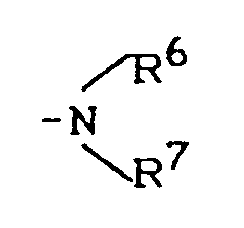
R⁶, R⁷ die oben angegebene Bedeutung haben,R²- für Wasserstoff, Alkyl, Alkoxy, Alkylthio mit jeweils bis zu 6 Kohlenstoffatomen, Trifluormethyl, Trifluormethoxy, Hydroxy, Mercapto, Nitro, Cyano, oder Halogen steht,R³- für Wasserstoff oder- für eine in der β-Lactamchemie übliche Aminoschutzgruppe steht,R⁴und- für Wasserstoff,- für eine in der β-Lactamchemie übliche Carboxyschutzgruppe oder- für einen in vivo spaltbaren Ester steht,R⁵- für Wasserstoff steht,- für geradkettiges oder verzweigtes Alkyl mit bis zu 6 Kohlenstoffatomen steht, das substituiert sein kann durch Halogen, Alkoxy, Alkylthio mit jeweils bis zu 6 Kohlenstoffatomen, Hydroxy, Amino oder durch einen Rest der Formel
- Verbindungen der allgemeinen Formel (I) nach Anspruch 1,
in welcherR¹- für Wasserstoff oder- für geradkettiges, verzweigtes oder cyclisches Alkyl mit bis zu 6 Kohlenstoffatomen steht,
oder- für Phenyl steht, oder- für eine Gruppe der Formel -NHR⁶ steht,worinR⁶- Wasserstoff, Phenyl, Benzyl, Acetyl, Benzoyl oder Alkyl mit bis zu 6 Kohlenstoffatomen bedeutet,R²- für Wasserstoff, Methyl, Methoxy, Trifluormethyl, Trifluormethoxy, Nitro, Cyano, Fluor, Chlor, Brom oder Hydroxy steht,R³- für Wasserstoff oder- für eine Aminoschutzgruppe aus der Reihe: Benzyl, tert-Butoxycarbonyl, Benzyloxycarbonyl, 2-Nitrobenzyloxycarbonyl, 4-Nitrobenzyloxycarbonyl, 2,2,2-Trichlorethoxycarbonyl, Fluorenyl-(9)-methoxycarbonyl, N-Diphenyl-methoxycarbonyl, Acetoacetyl, 2-Nitrobenzoyl, 2-Nitrophenylsulfenyl, Phthaloyl, Trityl, Vinyloxycarbonyl, Formyl, Benzoyl, Allyloxycarbonyl, 2,4-Dimethoxybenzyloxycarbonyl, 2-Methylthio-ethoxycarbonyl, 1,3-Dithian-2-ylmethoxycarbonyl (Dmoc), Trimethyl-, Triethyl-, Triphenylsilyl, tert-Butyl-dimethylsilyl, tert-Butyldiphenylsilyl, 1-Methyl-2-benzoyl-vinyl, 1-Methyl-2-ethoxycarbonyl-vinyl, 1-Methyl-2-methoxycarbonylvinyl, 1-Methyl-2-(2,6-dimethoxybenzoyl)-vinyl, 4-Methoxybenzyloxycarbonyl,R⁴und- für Wasserstoff steht, oder- für Methyl, Ethyl, tert.Butyl, 2-Chlorethyl, 2,2,2-Trichlorethyl, Cyanoethyl, Diphenylmethyl, Triphenylmethyl, Acetoxymethyl, Allyl, Benzyl, 4-Methoxybenzyl, 2,4-Dimethoxybenzyl, 1-Phenoxyethyl, 2-Methyl-2-propenyl, 4-Nitrobenzyl, 2-Nitrobenzyl, Trimethylsilylethyl oder tert.Butyl-dimethylsilylethyl steht,
oder- für einen Rest der Formel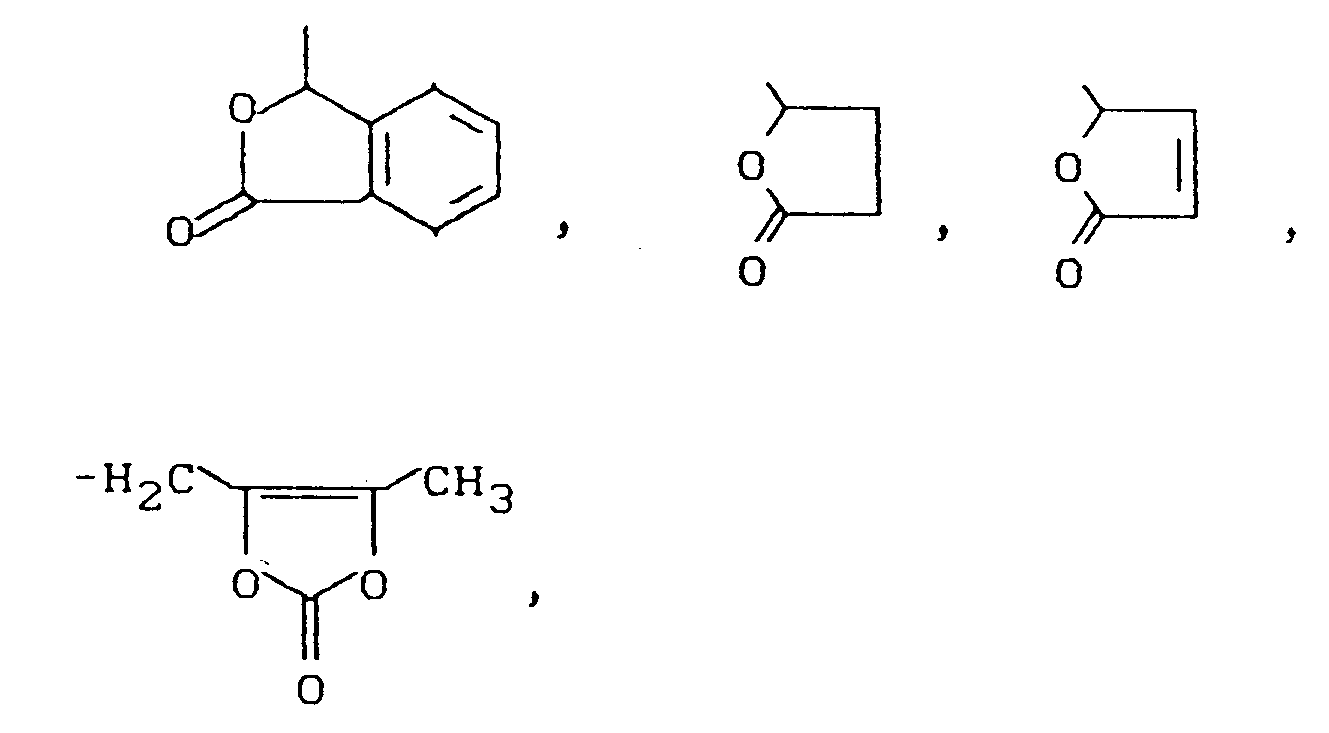
-CH(CH₃)-OCOOC₂H₅ oder
-CH₂-OCOCH₃ steht,R⁵- für Wasserstoff steht, oder- für geradkettiges oder verzweigtes Alkyl mit bis zu 4 Kohlenstoffatomen steht, das substituiert sein kann durch Fluor, Chlor, Brom, Iod, Alkoxy mit bis zu 3 Kohlenstoffatomen, Hydroxy oder Amino oder durch einen Rest der Formel
- Verbindungen der allgemeinen Formel (I) nach Anspruch 1,
in welcherR¹- für Wasserstoff oder- für geradkettiges oder verzweigtes Alkyl mit bis zu 4 Kohlenstoffatomen steht, oder- für eine Gruppe der Formel -NHR⁶ steht,worinR⁶- Wasserstoff, Methyl, Ethyl, Propyl oder Isopropyl bedeutet,R²- für Wasserstoff oder Hydroxy steht,R³- für Wasserstoff oder
für tert-Butoxycarbonyl, Benzyloxycarbonyl, Trityl, Allyloxycarbonyl, tert-Butyl-dimethylsilyl, 1-Methyl-2-benzoylvinyl, 1-Methyl-2-methoxycarbonylvinyl, 2-Nitrophenylsulfenyl, oderR⁴und- für Wasserstoff steht, oder- für Methyl, Ethyl, tert.Butyl, Diphenylmethyl, 2,2,2-Trichlorethyl, Allyl, Acetoxymethyl, 4-Nitrobenzyl, 2-Nitrobenzyl, 4-Methoxybenzyl, Benzyl oder Trimethylsilylethyl steht, oder- für einen Rest der Formel
oder -CH₂-OCO-C(CH₃)₃ steht,R⁵und deren Salze.- für Wasserstoff, Methyl, Dihydroxyethyl, Chlormethyl, Iodmethyl, oder- für einen Rest der Formel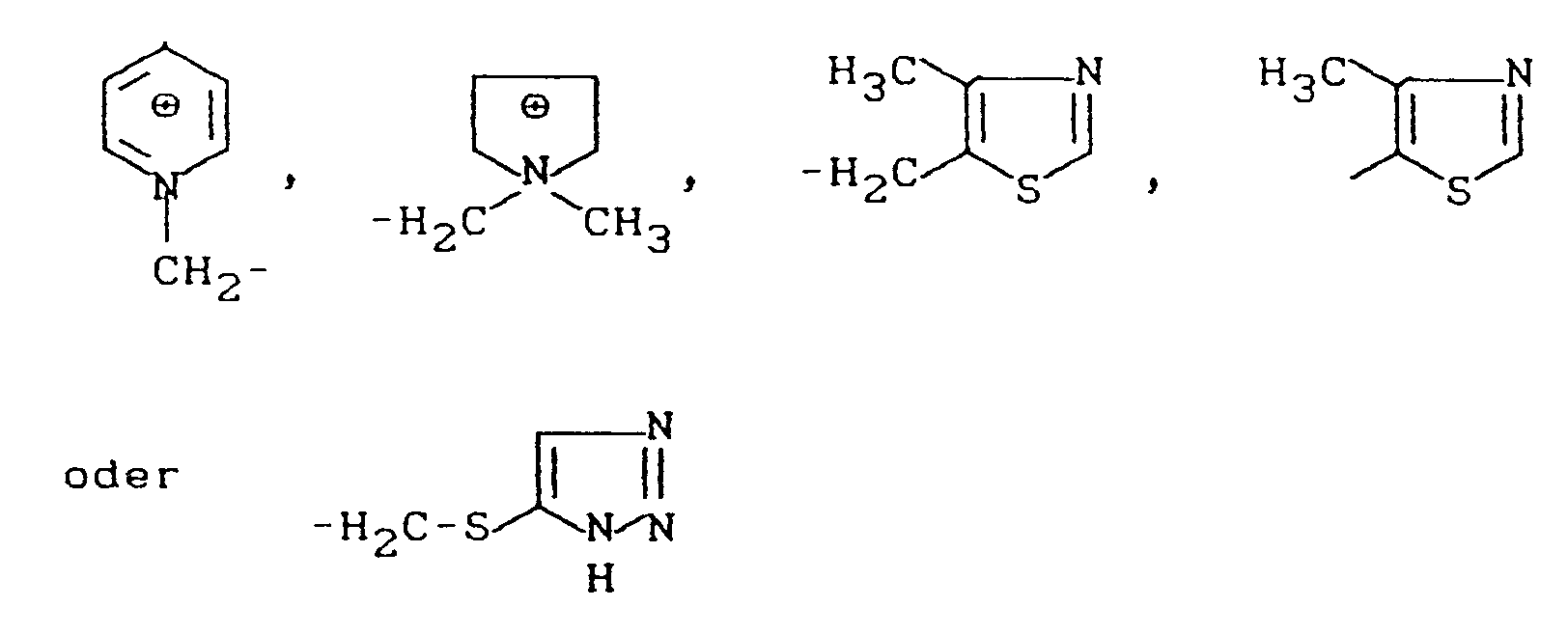
- Verfahren zur Herstellung von β-Lactam-Verbindungen der allgemeinen Formel (I)
 [A] substituierte Cephalosporinverbindungen der allgemeinen Formel (II)
R¹ und R² die oben angegebene Bedeutung hat,R3'- für eine in der β-Lactamchemie übliche Aminoschutzgruppe steht,R4'und- für eine in der β-Lactamchemie übliche Carboxyschutzgruppe steht,X- für eine Gruppe der Formel R¹³ und R¹⁴ gleich oder verschieden sind und Alkyl, Phenyl oder Tolyl bedeutenundZ⊖in inerten Lösemitteln in Anwesenheit von Basen, mit Aldehyden der allgemeinen Formel (III)- ein Halogenidanion, bevorzugt Chlorid, Bromid oder Iodid bedeutet,
R⁵-CHO (III)
in welcher
R⁵ die oben angegebene Bedeutung hat
umsetzt,
oder daß man[B] Phosphoniumverbindungen der allgemeinen Formel (IV)
R⁵-CH₂-X (IV)
in welcher
R⁵ die oben angegebene Bedeutung hat
undX- für eine Gruppe der Formelwobei R¹³ und R¹⁴ gleich oder verschieden sind und Alkyl, Phenyl oder Tolyl bedeutenundZ⊖in inerten Lösemitteln in Anwesenheit von Basen, mit Cephalosporinaldehyden der allgemeinen Formel (V)- ein Halogenidanion, bevorzugt Chlorid, Bromid oder Iodid bedeutet,
R¹ und R² die oben angegebene Bedeutung haben,R3' für eine in der β-Lactamchemie übliche Aminoschutzgruppe stehtundR4' für eine in der β-Lactamchemie übliche Carboxyschutzgruppe steht,umsetzt,
oder, daß man[C] Carbonsäuren der allgemeinen Formel (VI)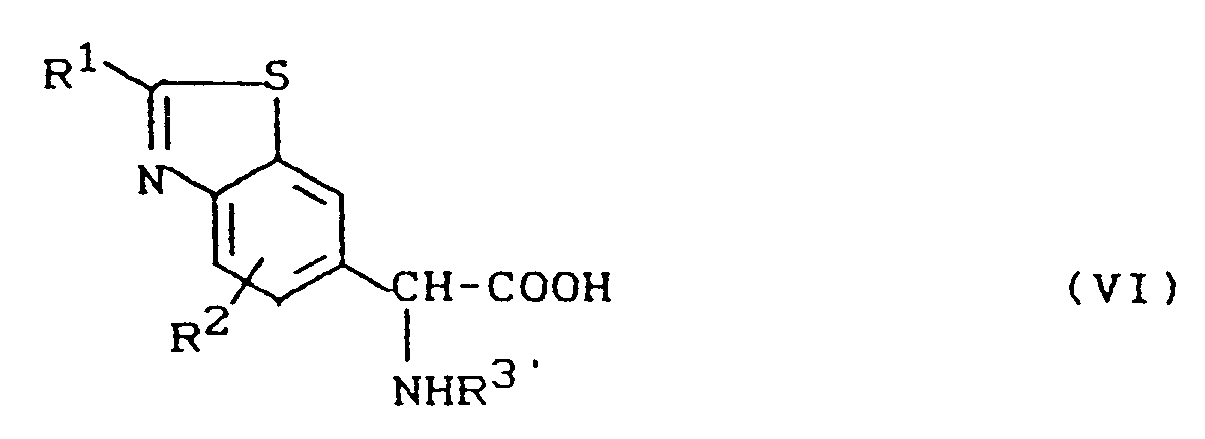
R¹ und R² die oben angegebene Bedeutung haben,
undR3' für eine in der β-Lactamchemie übliche Aminoschutzgruppe steht,nach Aktivierung der Carboxylgruppe durch Überführung in ein gemischtes Anhydrid, beispielsweise mit Chlorameisensäureethylester oder Chlorameisensäureisobutylester oder Methansulfonsäurechlorid, oder durch Überführen in das Säurehalogenid, oder durch Überführen in einen aktivierten Ester beispielsweise mit N-Hydroxybenztriazol und Dicyclohexylcarbodiimid (DCC),
mit den Vinylcephalosporinaminen der allgemeinen Formel (VII)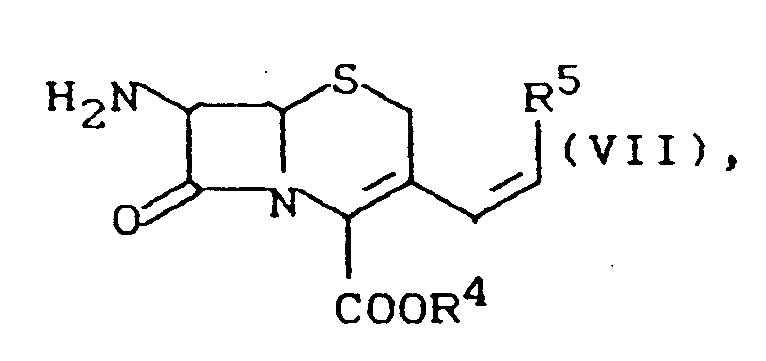
R⁴ und R⁵ die oben angegebene Bedeutung haben,
umsetzt,
dann gegebenenfalls Schutzgruppen abspaltet und die gewünschten Salze oder aus den Salzen die freien Säuren herstellt. - β-Lactam-Verbindungen der allgemeinen Formel (I)
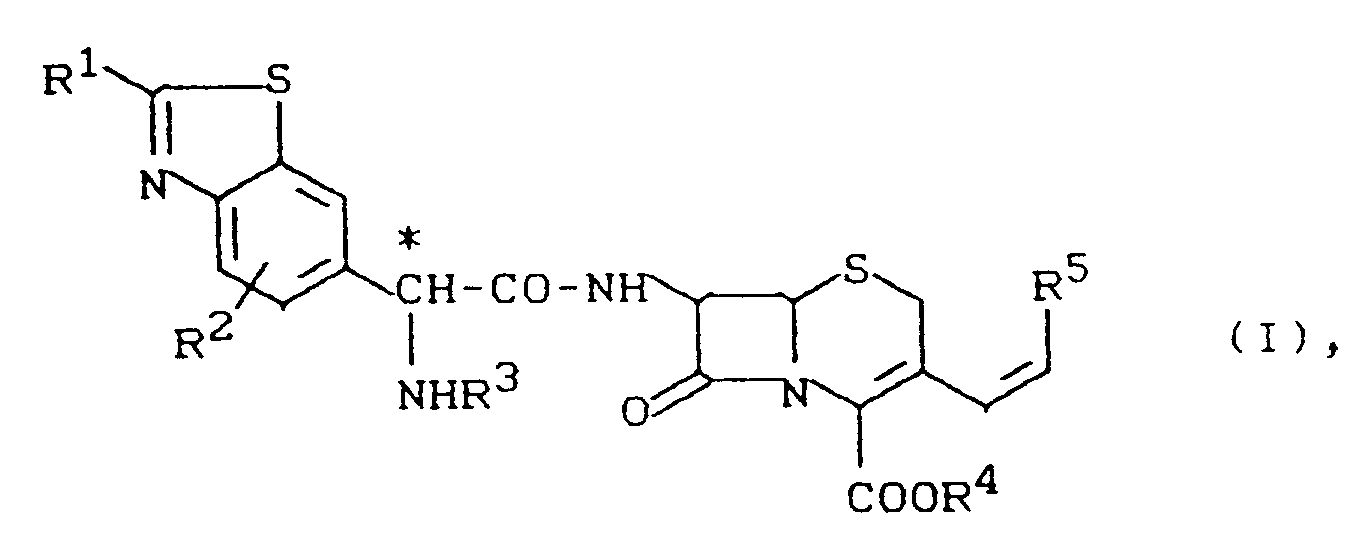
- Arzneimittel, enthaltend β-Lactamverbindungen der allgemeinen Formel (I)

- Verwendung von β-Lactam-Verbindungen der allgemeinen Formel (I) nach Anspruch 1 zur Herstellung von Arzneimitteln.
- Tierfutter und Tierfutterzusatzmittel, enthaltend β-Lactam-Verbindungen der allgemeinen Formel (I) nach Anspruch 1.
Applications Claiming Priority (4)
| Application Number | Priority Date | Filing Date | Title |
|---|---|---|---|
| DE3717663 | 1987-05-26 | ||
| DE3717663 | 1987-05-26 | ||
| DE3734005 | 1987-10-08 | ||
| DE19873734005 DE3734005A1 (de) | 1987-05-26 | 1987-10-08 | Substituierte vinylcephalosporine, verfahren zu ihrer herstellung und ihre verwendung als arzneimittel |
Publications (3)
| Publication Number | Publication Date |
|---|---|
| EP0292806A2 EP0292806A2 (de) | 1988-11-30 |
| EP0292806A3 EP0292806A3 (en) | 1990-10-17 |
| EP0292806B1 true EP0292806B1 (de) | 1994-11-02 |
Family
ID=25856023
Family Applications (1)
| Application Number | Title | Priority Date | Filing Date |
|---|---|---|---|
| EP88107679A Expired - Lifetime EP0292806B1 (de) | 1987-05-26 | 1988-05-13 | Substituierte Vinylcephalosporine, Verfahren zu ihrer Herstellung und ihre Verwendung als Arzneimittel |
Country Status (15)
| Country | Link |
|---|---|
| EP (1) | EP0292806B1 (de) |
| JP (1) | JPH0645628B2 (de) |
| KR (1) | KR880013925A (de) |
| CN (1) | CN1020732C (de) |
| AT (1) | ATE113598T1 (de) |
| AU (1) | AU1630288A (de) |
| CA (1) | CA1340424C (de) |
| DE (2) | DE3734005A1 (de) |
| DK (1) | DK284588A (de) |
| ES (1) | ES2061550T3 (de) |
| FI (1) | FI882444A7 (de) |
| HU (1) | HU205938B (de) |
| IL (1) | IL86479A (de) |
| NO (1) | NO170936C (de) |
| PT (1) | PT87563B (de) |
Families Citing this family (6)
| Publication number | Priority date | Publication date | Assignee | Title |
|---|---|---|---|---|
| DE3734004A1 (de) * | 1987-05-26 | 1988-12-15 | Bayer Ag | Substituierte vinylcephalosporine, verfahren zu ihrer herstellung und ihre verwendung als arzneimittel |
| DE3933934A1 (de) * | 1989-10-03 | 1991-04-11 | Bayer Ag | Verfahren zur herstellung von 7-amino-3-((z)-1-propen-1-yl)-3-cephem-4-carbonsaeure |
| AT399876B (de) * | 1992-02-05 | 1995-08-25 | Biochemie Gmbh | Verfahren zur abreicherung von 7-amino-3-((e)-1- propen-1-yl)-3-cephem-4-carbonsäure |
| ATE205214T1 (de) * | 1992-02-05 | 2001-09-15 | Biochemie Gmbh | Verfahren zur reinigung eines 3-cephem-4-carboxyl säure derivates |
| WO2009049086A1 (en) | 2007-10-09 | 2009-04-16 | Larry Sutton | Broad spectrum beta-lactamase inhibitors |
| JP6403289B2 (ja) | 2013-03-12 | 2018-10-10 | グラディウス ファーマシューティカルズ コーポレーションGladius Pharmaceuticals Corporation | 誘導体化3−スチリル−セファロスポリン |
Family Cites Families (8)
| Publication number | Priority date | Publication date | Assignee | Title |
|---|---|---|---|---|
| US3769277A (en) * | 1970-01-23 | 1973-10-30 | Glaxo Lab Ltd | Preparation of delta3-4 carboxy cephalosporins having a 3-vinyl or substituted 3-vinyl group |
| US4390693A (en) | 1977-07-27 | 1983-06-28 | Merck & Co., Inc. | Cephalosporin compounds |
| US4255423A (en) * | 1977-07-27 | 1981-03-10 | Merck & Co., Inc. | Cephalosporin compounds |
| US4520022A (en) * | 1983-01-28 | 1985-05-28 | Bristol-Myers Company | Substituted vinyl cephalosporins |
| DE3508258A1 (de) * | 1985-03-08 | 1986-09-18 | Bayer Ag, 5090 Leverkusen | Ss-lactamantibiotika, verfahren zur herstellung und ihre verwendung als und in arzneimitteln |
| US4619925A (en) * | 1985-11-08 | 1986-10-28 | Bristol-Myers Company | 3-Propenyl cephalosporin derivatives |
| JPS63126022A (ja) * | 1986-11-17 | 1988-05-30 | Hitachi Ltd | デイスプレイ装置 |
| DE3734004A1 (de) * | 1987-05-26 | 1988-12-15 | Bayer Ag | Substituierte vinylcephalosporine, verfahren zu ihrer herstellung und ihre verwendung als arzneimittel |
-
1987
- 1987-10-08 DE DE19873734005 patent/DE3734005A1/de not_active Withdrawn
-
1988
- 1988-05-13 AT AT88107679T patent/ATE113598T1/de active
- 1988-05-13 NO NO882113A patent/NO170936C/no unknown
- 1988-05-13 DE DE3851979T patent/DE3851979D1/de not_active Expired - Fee Related
- 1988-05-13 EP EP88107679A patent/EP0292806B1/de not_active Expired - Lifetime
- 1988-05-13 ES ES88107679T patent/ES2061550T3/es not_active Expired - Lifetime
- 1988-05-16 AU AU16302/88A patent/AU1630288A/en not_active Abandoned
- 1988-05-24 IL IL86479A patent/IL86479A/xx unknown
- 1988-05-24 PT PT87563A patent/PT87563B/pt not_active IP Right Cessation
- 1988-05-24 FI FI882444A patent/FI882444A7/fi not_active Application Discontinuation
- 1988-05-24 CA CA000567483A patent/CA1340424C/en not_active Expired - Fee Related
- 1988-05-25 JP JP63126023A patent/JPH0645628B2/ja not_active Expired - Lifetime
- 1988-05-25 KR KR1019880006099A patent/KR880013925A/ko not_active Ceased
- 1988-05-25 DK DK284588A patent/DK284588A/da not_active Application Discontinuation
- 1988-05-26 CN CN88103111A patent/CN1020732C/zh not_active Expired - Lifetime
- 1988-05-26 HU HU882685A patent/HU205938B/hu not_active IP Right Cessation
Also Published As
| Publication number | Publication date |
|---|---|
| FI882444A0 (fi) | 1988-05-24 |
| HU205938B (en) | 1992-07-28 |
| IL86479A0 (en) | 1988-11-15 |
| NO882113L (no) | 1988-11-28 |
| CN88103111A (zh) | 1988-12-28 |
| ATE113598T1 (de) | 1994-11-15 |
| EP0292806A2 (de) | 1988-11-30 |
| DK284588D0 (da) | 1988-05-25 |
| PT87563A (pt) | 1989-05-31 |
| NO170936B (no) | 1992-09-21 |
| DK284588A (da) | 1988-11-27 |
| NO882113D0 (no) | 1988-05-13 |
| DE3734005A1 (de) | 1988-12-15 |
| CA1340424C (en) | 1999-03-09 |
| CN1020732C (zh) | 1993-05-19 |
| EP0292806A3 (en) | 1990-10-17 |
| NO170936C (no) | 1993-01-06 |
| HUT48891A (en) | 1989-07-28 |
| FI882444A7 (fi) | 1988-11-27 |
| DE3851979D1 (de) | 1994-12-08 |
| AU1630288A (en) | 1988-12-01 |
| PT87563B (pt) | 1992-09-30 |
| JPS63307884A (ja) | 1988-12-15 |
| KR880013925A (ko) | 1988-12-22 |
| JPH0645628B2 (ja) | 1994-06-15 |
| IL86479A (en) | 1993-08-18 |
| ES2061550T3 (es) | 1994-12-16 |
Similar Documents
| Publication | Publication Date | Title |
|---|---|---|
| EP0195947B1 (de) | Beta-Lactamantibiotika, Verfahren zur Herstellung und ihre Verwendung als und in Arzneimitteln | |
| EP0292808B1 (de) | Substituierte Vinylcephalosporine, Verfahren zu ihrer Herstellung und ihre Verwendung als Arzneimittel | |
| EP0247431B1 (de) | Substituierte 6-Hydroxymethylcarbapenem-Antibiotika, Verfahren zu ihrer Herstellung und ihre Verwendung | |
| EP0163190A2 (de) | Beta-Lactamantibiotika, Verfahren zu deren Herstellung sowie ihre Verwendung als Arzneimittel oder Wachstumsförderer in der Tieraufzucht oder als Antioxidantien | |
| EP0197294B1 (de) | Beta-Lactam-Antibiotika, Verfahren zur Herstellung und ihre Verwendung als Arzneimittel | |
| US5171854A (en) | Substituted vinylcephalosporins | |
| EP0292806A2 (de) | Substituierte Vinylcephalosporine, Verfahren zu ihrer Herstellung und ihre Verwendung als Arzneimittel | |
| EP0162394B1 (de) | Neue Cephalosporine und Verfahren zu ihrer Herstellung | |
| DE3506159A1 (de) | Neue cephalosporine, verfahren zu ihrer herstellung und ihre verwendung in arzneimitteln | |
| EP0268963A1 (de) | Benzazolylthio-carbapenem-Antibiotika | |
| EP0326887B1 (de) | Beta-Lactam-Antibiotika, Verfahren zu ihrer Herstellung und ihre Verwendung als und in Arzneimitteln | |
| EP0405217A1 (de) | 2-Isocepheme und 2-Oxa-isocepheme, Verfahren zu ihrer Herstellung und ihre Verwendung als und in Arzneimitteln | |
| EP0223184A2 (de) | Neue Cephalosporine, Verfahren zu deren Herstellung sowie ihre Verwendung als Arzneimittel | |
| EP0098433B1 (de) | Beta-Lactamantibiotika, Verfahren zu deren Herstellung sowie sie enthaltende Mittel | |
| DE3711343A1 (de) | Cephalosporinderivate, verfahren zu ihrer herstellung und ihre verwendung in arzneimitteln | |
| DD274422A5 (de) | Verfahren zur herstellung von beta-lactam-verbindungen | |
| EP0310909A2 (de) | Heteroanellierte Phenylglycin-beta-Lactam-Antibiotika, Verfahren zu ihrer Herstellung und ihre Verwendung als Arzneimittel | |
| DE3342929A1 (de) | Ss-lactamantibiotika, verfahren zu deren herstellung sowie ihre verwendung als arzneimittel | |
| DD281601A5 (de) | Verfahren zur herstellung von beta-lactam-verbindungen |
Legal Events
| Date | Code | Title | Description |
|---|---|---|---|
| PUAI | Public reference made under article 153(3) epc to a published international application that has entered the european phase |
Free format text: ORIGINAL CODE: 0009012 |
|
| 17P | Request for examination filed |
Effective date: 19880513 |
|
| AK | Designated contracting states |
Kind code of ref document: A2 Designated state(s): AT BE CH DE ES FR GB GR IT LI NL SE |
|
| PUAL | Search report despatched |
Free format text: ORIGINAL CODE: 0009013 |
|
| RIN1 | Information on inventor provided before grant (corrected) |
Inventor name: ENDERMANN, RAINER, DR. Inventor name: ZEILER, HANS-JOACHIM, DR. Inventor name: METZGER, KARL GEORG, DR. Inventor name: SCHMIDT, GUNTER, DR. |
|
| AK | Designated contracting states |
Kind code of ref document: A3 Designated state(s): AT BE CH DE ES FR GB GR IT LI NL SE |
|
| 17Q | First examination report despatched |
Effective date: 19920909 |
|
| GRAA | (expected) grant |
Free format text: ORIGINAL CODE: 0009210 |
|
| AK | Designated contracting states |
Kind code of ref document: B1 Designated state(s): AT BE CH DE ES FR GB GR IT LI NL SE |
|
| REF | Corresponds to: |
Ref document number: 113598 Country of ref document: AT Date of ref document: 19941115 Kind code of ref document: T |
|
| GBT | Gb: translation of ep patent filed (gb section 77(6)(a)/1977) |
Effective date: 19941107 |
|
| REF | Corresponds to: |
Ref document number: 3851979 Country of ref document: DE Date of ref document: 19941208 |
|
| REG | Reference to a national code |
Ref country code: ES Ref legal event code: FG2A Ref document number: 2061550 Country of ref document: ES Kind code of ref document: T3 |
|
| ITF | It: translation for a ep patent filed | ||
| ET | Fr: translation filed | ||
| EAL | Se: european patent in force in sweden |
Ref document number: 88107679.8 |
|
| REG | Reference to a national code |
Ref country code: GR Ref legal event code: FG4A Free format text: 3013845 |
|
| PLBE | No opposition filed within time limit |
Free format text: ORIGINAL CODE: 0009261 |
|
| STAA | Information on the status of an ep patent application or granted ep patent |
Free format text: STATUS: NO OPPOSITION FILED WITHIN TIME LIMIT |
|
| 26N | No opposition filed | ||
| PGFP | Annual fee paid to national office [announced via postgrant information from national office to epo] |
Ref country code: GR Payment date: 19970421 Year of fee payment: 10 |
|
| PGFP | Annual fee paid to national office [announced via postgrant information from national office to epo] |
Ref country code: BE Payment date: 19970521 Year of fee payment: 10 |
|
| PGFP | Annual fee paid to national office [announced via postgrant information from national office to epo] |
Ref country code: AT Payment date: 19970526 Year of fee payment: 10 |
|
| PGFP | Annual fee paid to national office [announced via postgrant information from national office to epo] |
Ref country code: NL Payment date: 19970531 Year of fee payment: 10 |
|
| PGFP | Annual fee paid to national office [announced via postgrant information from national office to epo] |
Ref country code: SE Payment date: 19980324 Year of fee payment: 11 |
|
| PGFP | Annual fee paid to national office [announced via postgrant information from national office to epo] |
Ref country code: CH Payment date: 19980505 Year of fee payment: 11 |
|
| PG25 | Lapsed in a contracting state [announced via postgrant information from national office to epo] |
Ref country code: AT Free format text: LAPSE BECAUSE OF NON-PAYMENT OF DUE FEES Effective date: 19980513 |
|
| PGFP | Annual fee paid to national office [announced via postgrant information from national office to epo] |
Ref country code: ES Payment date: 19980519 Year of fee payment: 11 |
|
| PG25 | Lapsed in a contracting state [announced via postgrant information from national office to epo] |
Ref country code: GR Free format text: LAPSE BECAUSE OF NON-PAYMENT OF DUE FEES Effective date: 19980531 Ref country code: BE Free format text: LAPSE BECAUSE OF NON-PAYMENT OF DUE FEES Effective date: 19980531 |
|
| BERE | Be: lapsed |
Owner name: BAYER A.G. Effective date: 19980531 |
|
| PG25 | Lapsed in a contracting state [announced via postgrant information from national office to epo] |
Ref country code: NL Free format text: LAPSE BECAUSE OF NON-PAYMENT OF DUE FEES Effective date: 19981201 |
|
| NLV4 | Nl: lapsed or anulled due to non-payment of the annual fee |
Effective date: 19981201 |
|
| PG25 | Lapsed in a contracting state [announced via postgrant information from national office to epo] |
Ref country code: SE Free format text: LAPSE BECAUSE OF NON-PAYMENT OF DUE FEES Effective date: 19990514 Ref country code: ES Free format text: LAPSE BECAUSE OF NON-PAYMENT OF DUE FEES Effective date: 19990514 |
|
| PG25 | Lapsed in a contracting state [announced via postgrant information from national office to epo] |
Ref country code: LI Free format text: LAPSE BECAUSE OF NON-PAYMENT OF DUE FEES Effective date: 19990531 Ref country code: CH Free format text: LAPSE BECAUSE OF NON-PAYMENT OF DUE FEES Effective date: 19990531 |
|
| REG | Reference to a national code |
Ref country code: CH Ref legal event code: PL |
|
| EUG | Se: european patent has lapsed |
Ref document number: 88107679.8 |
|
| PGFP | Annual fee paid to national office [announced via postgrant information from national office to epo] |
Ref country code: DE Payment date: 20000413 Year of fee payment: 13 |
|
| PGFP | Annual fee paid to national office [announced via postgrant information from national office to epo] |
Ref country code: FR Payment date: 20000428 Year of fee payment: 13 |
|
| PGFP | Annual fee paid to national office [announced via postgrant information from national office to epo] |
Ref country code: GB Payment date: 20000510 Year of fee payment: 13 |
|
| PG25 | Lapsed in a contracting state [announced via postgrant information from national office to epo] |
Ref country code: GB Free format text: LAPSE BECAUSE OF NON-PAYMENT OF DUE FEES Effective date: 20010513 |
|
| REG | Reference to a national code |
Ref country code: ES Ref legal event code: FD2A Effective date: 20010503 |
|
| GBPC | Gb: european patent ceased through non-payment of renewal fee |
Effective date: 20010513 |
|
| PG25 | Lapsed in a contracting state [announced via postgrant information from national office to epo] |
Ref country code: FR Free format text: LAPSE BECAUSE OF NON-PAYMENT OF DUE FEES Effective date: 20020131 |
|
| PG25 | Lapsed in a contracting state [announced via postgrant information from national office to epo] |
Ref country code: DE Free format text: LAPSE BECAUSE OF NON-PAYMENT OF DUE FEES Effective date: 20020301 |
|
| PG25 | Lapsed in a contracting state [announced via postgrant information from national office to epo] |
Ref country code: IT Free format text: LAPSE BECAUSE OF NON-PAYMENT OF DUE FEES;WARNING: LAPSES OF ITALIAN PATENTS WITH EFFECTIVE DATE BEFORE 2007 MAY HAVE OCCURRED AT ANY TIME BEFORE 2007. THE CORRECT EFFECTIVE DATE MAY BE DIFFERENT FROM THE ONE RECORDED. Effective date: 20050513 |