EP0289193A1 - Pressure responsive electrically conductive materials - Google Patents
Pressure responsive electrically conductive materials Download PDFInfo
- Publication number
- EP0289193A1 EP0289193A1 EP88303516A EP88303516A EP0289193A1 EP 0289193 A1 EP0289193 A1 EP 0289193A1 EP 88303516 A EP88303516 A EP 88303516A EP 88303516 A EP88303516 A EP 88303516A EP 0289193 A1 EP0289193 A1 EP 0289193A1
- Authority
- EP
- European Patent Office
- Prior art keywords
- particles
- silicon
- electrically conductive
- material according
- conductive
- Prior art date
- Legal status (The legal status is an assumption and is not a legal conclusion. Google has not performed a legal analysis and makes no representation as to the accuracy of the status listed.)
- Withdrawn
Links
- 239000004020 conductor Substances 0.000 title claims abstract description 19
- 239000002245 particle Substances 0.000 claims abstract description 50
- 229910052710 silicon Inorganic materials 0.000 claims abstract description 22
- 239000010703 silicon Substances 0.000 claims abstract description 22
- 239000011159 matrix material Substances 0.000 claims abstract description 19
- 239000013536 elastomeric material Substances 0.000 claims abstract description 6
- 239000000463 material Substances 0.000 claims description 59
- XUIMIQQOPSSXEZ-UHFFFAOYSA-N Silicon Chemical compound [Si] XUIMIQQOPSSXEZ-UHFFFAOYSA-N 0.000 claims description 24
- OKTJSMMVPCPJKN-UHFFFAOYSA-N Carbon Chemical compound [C] OKTJSMMVPCPJKN-UHFFFAOYSA-N 0.000 claims description 13
- 229910002804 graphite Inorganic materials 0.000 claims description 13
- 239000010439 graphite Substances 0.000 claims description 13
- 229920002379 silicone rubber Polymers 0.000 claims description 7
- 239000000126 substance Substances 0.000 claims description 5
- BQCADISMDOOEFD-UHFFFAOYSA-N Silver Chemical compound [Ag] BQCADISMDOOEFD-UHFFFAOYSA-N 0.000 claims description 4
- 229910021383 artificial graphite Inorganic materials 0.000 claims description 4
- 239000011863 silicon-based powder Substances 0.000 claims description 4
- 239000004945 silicone rubber Substances 0.000 claims description 4
- 229910052709 silver Inorganic materials 0.000 claims description 3
- 239000004332 silver Substances 0.000 claims description 3
- CWQXQMHSOZUFJS-UHFFFAOYSA-N molybdenum disulfide Chemical compound S=[Mo]=S CWQXQMHSOZUFJS-UHFFFAOYSA-N 0.000 claims description 2
- 239000012811 non-conductive material Substances 0.000 claims description 2
- 229910052714 tellurium Inorganic materials 0.000 claims description 2
- PORWMNRCUJJQNO-UHFFFAOYSA-N tellurium atom Chemical compound [Te] PORWMNRCUJJQNO-UHFFFAOYSA-N 0.000 claims description 2
- 239000000203 mixture Substances 0.000 description 13
- YXFVVABEGXRONW-UHFFFAOYSA-N Toluene Chemical compound CC1=CC=CC=C1 YXFVVABEGXRONW-UHFFFAOYSA-N 0.000 description 12
- 239000002904 solvent Substances 0.000 description 10
- 229920001971 elastomer Polymers 0.000 description 9
- 238000000034 method Methods 0.000 description 7
- 239000000806 elastomer Substances 0.000 description 5
- 229920002799 BoPET Polymers 0.000 description 4
- 239000005041 Mylar™ Substances 0.000 description 4
- 230000000717 retained effect Effects 0.000 description 4
- 239000005060 rubber Substances 0.000 description 4
- RYGMFSIKBFXOCR-UHFFFAOYSA-N Copper Chemical compound [Cu] RYGMFSIKBFXOCR-UHFFFAOYSA-N 0.000 description 3
- 239000000853 adhesive Substances 0.000 description 3
- 230000001070 adhesive effect Effects 0.000 description 3
- 239000003795 chemical substances by application Substances 0.000 description 3
- 229910052802 copper Inorganic materials 0.000 description 3
- 239000010949 copper Substances 0.000 description 3
- 239000000945 filler Substances 0.000 description 3
- 238000011068 loading method Methods 0.000 description 3
- 229920001296 polysiloxane Polymers 0.000 description 3
- 239000011856 silicon-based particle Substances 0.000 description 3
- 239000000758 substrate Substances 0.000 description 3
- XEEYBQQBJWHFJM-UHFFFAOYSA-N Iron Chemical compound [Fe] XEEYBQQBJWHFJM-UHFFFAOYSA-N 0.000 description 2
- VYPSYNLAJGMNEJ-UHFFFAOYSA-N Silicium dioxide Chemical compound O=[Si]=O VYPSYNLAJGMNEJ-UHFFFAOYSA-N 0.000 description 2
- 238000013329 compounding Methods 0.000 description 2
- 239000011888 foil Substances 0.000 description 2
- 239000007788 liquid Substances 0.000 description 2
- 238000004519 manufacturing process Methods 0.000 description 2
- 229910052751 metal Inorganic materials 0.000 description 2
- 239000002184 metal Substances 0.000 description 2
- 229920003225 polyurethane elastomer Polymers 0.000 description 2
- 239000000843 powder Substances 0.000 description 2
- 238000007650 screen-printing Methods 0.000 description 2
- 230000035945 sensitivity Effects 0.000 description 2
- DEXFNLNNUZKHNO-UHFFFAOYSA-N 6-[3-[4-[2-(2,3-dihydro-1H-inden-2-ylamino)pyrimidin-5-yl]piperidin-1-yl]-3-oxopropyl]-3H-1,3-benzoxazol-2-one Chemical compound C1C(CC2=CC=CC=C12)NC1=NC=C(C=N1)C1CCN(CC1)C(CCC1=CC2=C(NC(O2)=O)C=C1)=O DEXFNLNNUZKHNO-UHFFFAOYSA-N 0.000 description 1
- 239000005995 Aluminium silicate Substances 0.000 description 1
- 239000004604 Blowing Agent Substances 0.000 description 1
- 239000004150 EU approved colour Substances 0.000 description 1
- VGGSQFUCUMXWEO-UHFFFAOYSA-N Ethene Chemical compound C=C VGGSQFUCUMXWEO-UHFFFAOYSA-N 0.000 description 1
- 239000005977 Ethylene Substances 0.000 description 1
- 244000043261 Hevea brasiliensis Species 0.000 description 1
- ZOKXTWBITQBERF-UHFFFAOYSA-N Molybdenum Chemical compound [Mo] ZOKXTWBITQBERF-UHFFFAOYSA-N 0.000 description 1
- 229920000459 Nitrile rubber Polymers 0.000 description 1
- 238000007259 addition reaction Methods 0.000 description 1
- 239000004411 aluminium Substances 0.000 description 1
- 229910052782 aluminium Inorganic materials 0.000 description 1
- XAGFODPZIPBFFR-UHFFFAOYSA-N aluminium Chemical compound [Al] XAGFODPZIPBFFR-UHFFFAOYSA-N 0.000 description 1
- PNEYBMLMFCGWSK-UHFFFAOYSA-N aluminium oxide Inorganic materials [O-2].[O-2].[O-2].[Al+3].[Al+3] PNEYBMLMFCGWSK-UHFFFAOYSA-N 0.000 description 1
- 235000012211 aluminium silicate Nutrition 0.000 description 1
- 230000015572 biosynthetic process Effects 0.000 description 1
- 150000004649 carbonic acid derivatives Chemical class 0.000 description 1
- 238000005266 casting Methods 0.000 description 1
- 230000001413 cellular effect Effects 0.000 description 1
- 238000006243 chemical reaction Methods 0.000 description 1
- 239000010941 cobalt Substances 0.000 description 1
- 229910017052 cobalt Inorganic materials 0.000 description 1
- GUTLYIVDDKVIGB-UHFFFAOYSA-N cobalt atom Chemical compound [Co] GUTLYIVDDKVIGB-UHFFFAOYSA-N 0.000 description 1
- 239000002131 composite material Substances 0.000 description 1
- 150000001875 compounds Chemical class 0.000 description 1
- 230000006835 compression Effects 0.000 description 1
- 238000007906 compression Methods 0.000 description 1
- 238000009833 condensation Methods 0.000 description 1
- 230000005494 condensation Effects 0.000 description 1
- 238000006482 condensation reaction Methods 0.000 description 1
- 238000004132 cross linking Methods 0.000 description 1
- 238000011161 development Methods 0.000 description 1
- 230000018109 developmental process Effects 0.000 description 1
- 229920003244 diene elastomer Polymers 0.000 description 1
- 239000006185 dispersion Substances 0.000 description 1
- 238000009826 distribution Methods 0.000 description 1
- 230000000694 effects Effects 0.000 description 1
- 230000005684 electric field Effects 0.000 description 1
- 230000001747 exhibiting effect Effects 0.000 description 1
- 239000010419 fine particle Substances 0.000 description 1
- 150000008282 halocarbons Chemical class 0.000 description 1
- 229920002681 hypalon Polymers 0.000 description 1
- 239000012535 impurity Substances 0.000 description 1
- 238000010348 incorporation Methods 0.000 description 1
- 239000004615 ingredient Substances 0.000 description 1
- 239000012212 insulator Substances 0.000 description 1
- 229910052742 iron Inorganic materials 0.000 description 1
- NLYAJNPCOHFWQQ-UHFFFAOYSA-N kaolin Chemical compound O.O.O=[Al]O[Si](=O)O[Si](=O)O[Al]=O NLYAJNPCOHFWQQ-UHFFFAOYSA-N 0.000 description 1
- 239000010445 mica Substances 0.000 description 1
- 229910052618 mica group Inorganic materials 0.000 description 1
- 229910052750 molybdenum Inorganic materials 0.000 description 1
- 239000011733 molybdenum Substances 0.000 description 1
- 229920003052 natural elastomer Polymers 0.000 description 1
- 229920001194 natural rubber Polymers 0.000 description 1
- 239000003921 oil Substances 0.000 description 1
- 229940006093 opthalmologic coloring agent diagnostic Drugs 0.000 description 1
- 238000010422 painting Methods 0.000 description 1
- 239000000049 pigment Substances 0.000 description 1
- 239000004014 plasticizer Substances 0.000 description 1
- 229920001084 poly(chloroprene) Polymers 0.000 description 1
- 229920001200 poly(ethylene-vinyl acetate) Polymers 0.000 description 1
- 229920001515 polyalkylene glycol Polymers 0.000 description 1
- 229920000728 polyester Polymers 0.000 description 1
- 229920006267 polyester film Polymers 0.000 description 1
- 229920000139 polyethylene terephthalate Polymers 0.000 description 1
- 239000005020 polyethylene terephthalate Substances 0.000 description 1
- 229920001228 polyisocyanate Polymers 0.000 description 1
- 239000005056 polyisocyanate Substances 0.000 description 1
- 229920000642 polymer Polymers 0.000 description 1
- 238000007639 printing Methods 0.000 description 1
- 239000004065 semiconductor Substances 0.000 description 1
- 150000004760 silicates Chemical class 0.000 description 1
- 239000000377 silicon dioxide Substances 0.000 description 1
- 239000007787 solid Substances 0.000 description 1
- 239000003381 stabilizer Substances 0.000 description 1
- 229920003048 styrene butadiene rubber Polymers 0.000 description 1
- 229920003051 synthetic elastomer Polymers 0.000 description 1
- 239000000454 talc Substances 0.000 description 1
- 229910052623 talc Inorganic materials 0.000 description 1
- 229920002725 thermoplastic elastomer Polymers 0.000 description 1
- 229920005992 thermoplastic resin Polymers 0.000 description 1
- MTPVUVINMAGMJL-UHFFFAOYSA-N trimethyl(1,1,2,2,2-pentafluoroethyl)silane Chemical compound C[Si](C)(C)C(F)(F)C(F)(F)F MTPVUVINMAGMJL-UHFFFAOYSA-N 0.000 description 1
- 125000000391 vinyl group Chemical group [H]C([*])=C([H])[H] 0.000 description 1
Images

Classifications
-
- H—ELECTRICITY
- H01—ELECTRIC ELEMENTS
- H01B—CABLES; CONDUCTORS; INSULATORS; SELECTION OF MATERIALS FOR THEIR CONDUCTIVE, INSULATING OR DIELECTRIC PROPERTIES
- H01B1/00—Conductors or conductive bodies characterised by the conductive materials; Selection of materials as conductors
- H01B1/20—Conductive material dispersed in non-conductive organic material
- H01B1/24—Conductive material dispersed in non-conductive organic material the conductive material comprising carbon-silicon compounds, carbon or silicon
-
- H—ELECTRICITY
- H01—ELECTRIC ELEMENTS
- H01C—RESISTORS
- H01C10/00—Adjustable resistors
- H01C10/10—Adjustable resistors adjustable by mechanical pressure or force
- H01C10/106—Adjustable resistors adjustable by mechanical pressure or force on resistive material dispersed in an elastic material
Definitions
- This invention relates to pressure sensitive electrically conductive materials.
- Many composite materials have now been proposed based on the mixing of electrically conductive particles into an electrically insulating elastomer which is subsequently shaped and cured.
- the resultant product is electrically non-conductive, but is rendered conductive when the material is deformed.
- GB-A-2192186 discloses a pressure sensitive electrically conductive material comprising a non-conductive matrix of flexible elastomeric material, the matrix containing electrically conductive particles, all such particles being particles of silicon.
- silicon-loaded elastomer in accordance with GB-A-2192186 can very simply be prepared to exhibit required resistance/pressure characteristics, merely by simple changes of such variables as filler loading and sheet thickness.
- Pressure sensitive elements may thus readily be prepared that will, for example, have high sensitivity at low pressures or low sensitivity over wide pressure ranges.
- a pressure sensitive electrically conductive material comprises a non-conductive matrix of flexible elastomeric material, the matrix containing electrically conductive particles, some of which particles are silicon and others of which are particles of at least one other electrically conductive material, in which at least 70% of the conductive particles are particles of silicon.
- the replacement particles desirably include at least some graphite particles.
- the preferred conductive particles that are now incorporated into the elastomeric matrix comprise, by weight, 70% to 99% silicon particles, 1% to 30% graphite particles, and 0% to 29% (more preferably 0% to 10%) of other electrically conductive particles.
- the aforesaid US patents Nos 3806471 and 4028276 do not teach the use of silicon in excess of 70% by weight, and do not suggest the silicon-graphite blends that have now been found particularly effective.
- the silicon used in the invention is preferably in powdered form with the particles having a size range of from 1 to 300 microns, although it may be more desirable to avoid particles having a size in excess of 200 microns.
- the preferred range of particle sizes is from 1 to 150 microns.
- the silicon is preferably undoped, i.e. it has not been treated to incorporate trace impurities of the materials usually used in silicon semi-conductors. Freely available chemical grade silicon powder has been found perfectly satisfactory for use in the invention.
- the graphite is desirably artificial graphite that has been ground to very fine particle sizes, desirably to a size range of from 0.1 to 100 microns, more preferably 0.1 to 50 microns.
- conductive (which term is used herein to include semi-conductive)powders that may be incorporated into the blend include silver, tellurium and molybdenum disulphide. Desirably they do not constitute more than 10% by weight of the conductive powder.
- the conductive particles make up between 30% and 60% of the volume of the material.
- the particles preferably are present in from 100 to 300 parts per hundred parts by weight of matrix material (phr). Below the preferred lower limits, it may be found that unacceptably high compression needs to be applied to the material to cause the required drop in resistance, while above the upper limit the material in its state of rest may be found to be too conductive due to contact between the conductive particles.
- the elastomeric matrix may be formed from any suitable polymeric material or blend thereof as long as it is electrically insulating and exhibits the required properties.
- suitable elastomers are silicone rubbers, whether of the condensation reaction, addition reaction or vinyl group-containing type, rubbery condensation polymers such as polyurethane rubber obtained by reaction of polyisocyanates with polyalkylene glycols, ethylene propylene-non-conjugated diene rubbers, natural rubber, synthetic polyisoprene rubber, styrene butadiene rubber, nitrile-butadiene rubber, halogenated hydrocarbon rubbers such as elastomeric chloroprene rubber, fluoroolefin rubber, chlorosulfonated polyethylene, thermoplastic elastomers such as ethylene-vinyl acetate copolymers, and plasticizer containing thermoplastic resins.
- non-conductive materials such as solvents, plasticising agents, stabilizers, pigments, colouring agents and extending oils may be incorporated into the matrix composition.
- Such composition may contain fillers such as silica, silicates, kaolin, mica, talc, carbonates or alumina.
- the matrix material should be compounded so that it can resist a high-intensity electric field, has good electrically insulating properties and the mechanical properties appropriate to the end use. In some cases these properties include low permanent set and high elongation at break. In other fields it may be advantageous for the matrix to be of cellular material, and any suitable blowing agent or other expanding system may then be compounded with the elastomer.
- Solvent levels may be adjusted to provide a material capable of being worked in a particular way to give a finished product.
- silicone elastomers without solvent may be moulded or spread, with moderate levels of solvent added they may be cast, and with high levels of solvent they may be screen printed or painted onto a suitable substrate.
- the conductive particles and any other required materials may be mixed with the elastomeric matrix material in any suitable manner. Mixing is facilitated if the matrix material is in liquid form, (whether using solvent or not) however, it is possible to effect mixing into a solid elastomer. The aim will often be to obtain a reasonably uniform dispersion of the conductive particles throughout the matrix. After mixing, a cross-linking system is added to the mixture which is then cured to any required shape. The cured material may be de-gassed if necessary. For many uses a room temperature vulcanising material is used, for ease in compounding and casting and for better control of particle distribution. When materials with better mechanical properties are required, however, high temperature vulcanising materials may be used. Alternatively, the properties of room temperature vulcanising materials may be improved by appropriate compounding ingredients.
- a silicone or a polyurethane rubber which can readily be compounded to give the required properties, and can be vulcanised at room temperature.
- the material will be cured in the form of a thin flat sheet, which may then be cut into individual elements of required size.
- Preferred sheet thicknesses are from 0.15 to 3 mm, more preferably from 0.2 to 1.5 mm. It is important that any given element be of substantially uniform thickness within a close tolerance, eg. 1%. Elements moulded from identical compositions and under identical conditions but to different thicknesses are found to have widely different electrical characteristics.
- the material can be applied by screen printing or painting, onto a suitable substrate where it is subsequently cured.
- the viscosity of the material must be low for this process to be successfully applied and this can be achieved by the addition of solvent.
- suitable substrates include polyethyleneterephthalate and polyester (e.g. Mylar) film and metal foils.
- a conductive layer such as conductive metal foil or a layer of conductive ink on a Mylar film. This results in a larger resistance range being achieved, together with a lower loaded resistance.
- the material can be cured on the inner surface of a revolving drum. If the drum surface is concentric with the axis of rotation then sheets of accurately controlled thickness can be obtained. The process is improved if the viscosity of the material is first reduced by the addition of solvent. The solvent allows the material to distribute evenly over the drum surface, and the solvent then evaporates before the material cures. The final properties of the sheet depend upon the material composition, the rotation speed, drum size, viscosity and relative densities of the different filler particles and matrix material.
- a batch of material was made up from Ambersil Silcoset 105 RTV (a room temperature vulcanising silicone rubber) together with undoped, chemical grade silicon powder supplied by BDH Chemicals Limited under their reference 30066 and synthetic graphite powder also supplied by BDH Chemicals Limited under their reference 26109.
- the particle size of the silicon powder was such that 1.9% by weight was retained on a 100 mesh sieve, 53.1% by weight retained on a 200 mesh sieve, 21.1% by weight retained on a 300 mesh sieve, 16.8% by weight retained on a 425 mesh sieve and the remaining 7.1% passed through the 425 mesh sieve.
- Mesh sizes are given according to ASTM E11. This represents a range of particle sizes that is roughly from 160 to 10 microns.
- the graphite had particle sizes in the range of 0.1 to 50 microns.
- the resulting mixture was then cast into a mould to produce sheets of nominal thickness 0.5 mm.
- PSA529 adhesive a silicone based liquid rubber
- cure systems available from Siltac Limited of Manchester, were diluted with 200 parts toluene, then 50 parts graphite and 150 parts silicone were mechanically mixed into the adhesive.
- the mixture was then applied to a Mylar film by a screen printing technique. This produced a layer of 0.07 mm which was allowed to cure.
- the electrode consisted of silver ink tracks 1 mm wide with 1 mm spacings. Each alternate pair of tracks were electrically connected, so that two electrically insulated electrodes were produced.
- Material was prepared and cast as in example 2 but with the addition of 20 parts of silver powder of nominal particle size 1 - 20 micron.
Landscapes
- Chemical & Material Sciences (AREA)
- Dispersion Chemistry (AREA)
- Physics & Mathematics (AREA)
- Spectroscopy & Molecular Physics (AREA)
- Engineering & Computer Science (AREA)
- Microelectronics & Electronic Packaging (AREA)
- Compositions Of Macromolecular Compounds (AREA)
Abstract
A pressure sensitive electrically conductive material comprising a non-conductive matrix of flexible elastomeric material, the matrix containing electrically conductive particles, some of which particles are silicon and others of which are particles of at least one other electrically conductive material, in which at least 70% of the conductive particles are particles of silicon.
Description
- This invention relates to pressure sensitive electrically conductive materials. Many composite materials have now been proposed based on the mixing of electrically conductive particles into an electrically insulating elastomer which is subsequently shaped and cured. The resultant product is electrically non-conductive, but is rendered conductive when the material is deformed.
- The principal workers in the field of these materials have all recognised the difficulties in providing an industrially acceptable material, and there are only a few manufacturers in the world who produce pressure responsive conductors on an industrial scale. Various problems that have been noted are lack of uniform electrical characteristics, inadequate mechanical strength and durability, undue variations in electrical properties of the material with repeated pressure applications and delay in electrical response. Such difficulties, and brief surveys of the developments of this type of material are described in the patent literature in such specifications as GB-A-1561189, US-A-4302361, US-A-4138369, US-A-4028276 and US-A-3806471.
- Those specifications are all concerned with the selection of electrically conductive materials for incorporation into an elastomeric matrix and the method of incorporating the conductive materials in order to obtain an acceptable product. Many of the products described therein will form a material that is suitable for use in a switching context, that is a material which exhibits a rapid and large drop in resistance when the pressure applied thereto reaches a certain level. Below that level the high resistance of the material makes it an effective insulator, while above the level the resistance drops to a figure such that the material is an effective conductor. Such materials are thus ideal for use as pressure-sensitive switches. However, none of the known prior art has put forward a practical proposal for an inexpensive pressure sensitive material that will exhibit a resistance or conductivity curve that exhibits a gradual change over a wide range of applied pressures, thus being capable of providing an electrical output signal that is a smooth function of applied pressure. The invention seeks to provide a pressure responsive electrically conductive material that possesses this important property, and that can also be compounded to meet common industrial requirements for this type of material.
- Our co-pending application published as GB-A-2192186 discloses a pressure sensitive electrically conductive material comprising a non-conductive matrix of flexible elastomeric material, the matrix containing electrically conductive particles, all such particles being particles of silicon.
- There had been earlier proposals to incorporate silicon into a pressure sensitive electrically conductive material, but only in combination with other electrically conductive particles. Thus, US-A-3806471 suggests that silicon particles can be combined with copper aluminium or iron particles, and US-A-4028276 discloses that silicon particles can be used in conjunction with particles of such conductive materials as titanium carbide and mixtures of cobalt and molybdenum. In each case the resulting materials were suitable for switch applications, exhibiting a rapid drop in resistance when a given pressure level is reached. There was no suggestion in either document that silicon could be used alone as the conductive material, and it was most surprising to find that when it is so used the resulting filled matrix has the property that resistance was a smooth function of applied pressure over a wide pressure range. Furthermore, it was found that silicon-loaded elastomer in accordance with GB-A-2192186 can very simply be prepared to exhibit required resistance/pressure characteristics, merely by simple changes of such variables as filler loading and sheet thickness. Pressure sensitive elements may thus readily be prepared that will, for example, have high sensitivity at low pressures or low sensitivity over wide pressure ranges.
- Further work has now unexpected established that equally good results can be obtained, and the useful range of elements extended, by replacing no more than 30% by weight of the conductive particles with particles of a material other than silicon.
- According to the present invention, therefore, a pressure sensitive electrically conductive material comprises a non-conductive matrix of flexible elastomeric material, the matrix containing electrically conductive particles, some of which particles are silicon and others of which are particles of at least one other electrically conductive material, in which at least 70% of the conductive particles are particles of silicon.
- The replacement particles desirably include at least some graphite particles. Thus, the preferred conductive particles that are now incorporated into the elastomeric matrix comprise, by weight, 70% to 99% silicon particles, 1% to 30% graphite particles, and 0% to 29% (more preferably 0% to 10%) of other electrically conductive particles. The aforesaid US patents Nos 3806471 and 4028276 do not teach the use of silicon in excess of 70% by weight, and do not suggest the silicon-graphite blends that have now been found particularly effective. The silicon used in the invention is preferably in powdered form with the particles having a size range of from 1 to 300 microns, although it may be more desirable to avoid particles having a size in excess of 200 microns. The preferred range of particle sizes is from 1 to 150 microns.
- The silicon is preferably undoped, i.e. it has not been treated to incorporate trace impurities of the materials usually used in silicon semi-conductors. Freely available chemical grade silicon powder has been found perfectly satisfactory for use in the invention.
- The graphite is desirably artificial graphite that has been ground to very fine particle sizes, desirably to a size range of from 0.1 to 100 microns, more preferably 0.1 to 50 microns.
- Other conductive (which term is used herein to include semi-conductive)powders that may be incorporated into the blend include silver, tellurium and molybdenum disulphide. Desirably they do not constitute more than 10% by weight of the conductive powder.
- Preferably the conductive particles make up between 30% and 60% of the volume of the material. Alternatively or additionally the particles preferably are present in from 100 to 300 parts per hundred parts by weight of matrix material (phr). Below the preferred lower limits, it may be found that unacceptably high compression needs to be applied to the material to cause the required drop in resistance, while above the upper limit the material in its state of rest may be found to be too conductive due to contact between the conductive particles.
- The elastomeric matrix may be formed from any suitable polymeric material or blend thereof as long as it is electrically insulating and exhibits the required properties. Representative of suitable elastomers are silicone rubbers, whether of the condensation reaction, addition reaction or vinyl group-containing type, rubbery condensation polymers such as polyurethane rubber obtained by reaction of polyisocyanates with polyalkylene glycols, ethylene propylene-non-conjugated diene rubbers, natural rubber, synthetic polyisoprene rubber, styrene butadiene rubber, nitrile-butadiene rubber, halogenated hydrocarbon rubbers such as elastomeric chloroprene rubber, fluoroolefin rubber, chlorosulfonated polyethylene, thermoplastic elastomers such as ethylene-vinyl acetate copolymers, and plasticizer containing thermoplastic resins.
- Other non-conductive materials such as solvents, plasticising agents, stabilizers, pigments, colouring agents and extending oils may be incorporated into the matrix composition. Such composition may contain fillers such as silica, silicates, kaolin, mica, talc, carbonates or alumina. Generally speaking, the matrix material should be compounded so that it can resist a high-intensity electric field, has good electrically insulating properties and the mechanical properties appropriate to the end use. In some cases these properties include low permanent set and high elongation at break. In other fields it may be advantageous for the matrix to be of cellular material, and any suitable blowing agent or other expanding system may then be compounded with the elastomer. Solvent levels may be adjusted to provide a material capable of being worked in a particular way to give a finished product. For example, silicone elastomers without solvent may be moulded or spread, with moderate levels of solvent added they may be cast, and with high levels of solvent they may be screen printed or painted onto a suitable substrate.
- The conductive particles and any other required materials may be mixed with the elastomeric matrix material in any suitable manner. Mixing is facilitated if the matrix material is in liquid form, (whether using solvent or not) however, it is possible to effect mixing into a solid elastomer. The aim will often be to obtain a reasonably uniform dispersion of the conductive particles throughout the matrix. After mixing, a cross-linking system is added to the mixture which is then cured to any required shape. The cured material may be de-gassed if necessary. For many uses a room temperature vulcanising material is used, for ease in compounding and casting and for better control of particle distribution. When materials with better mechanical properties are required, however, high temperature vulcanising materials may be used. Alternatively, the properties of room temperature vulcanising materials may be improved by appropriate compounding ingredients.
- It is particularly preferred to use a silicone or a polyurethane rubber, which can readily be compounded to give the required properties, and can be vulcanised at room temperature.
- Most usually the material will be cured in the form of a thin flat sheet, which may then be cut into individual elements of required size. Preferred sheet thicknesses are from 0.15 to 3 mm, more preferably from 0.2 to 1.5 mm. It is important that any given element be of substantially uniform thickness within a close tolerance, eg. 1%. Elements moulded from identical compositions and under identical conditions but to different thicknesses are found to have widely different electrical characteristics.
- As already stated, the material can be applied by screen printing or painting, onto a suitable substrate where it is subsequently cured. The viscosity of the material must be low for this process to be successfully applied and this can be achieved by the addition of solvent. Examples of suitable substrates include polyethyleneterephthalate and polyester (e.g. Mylar) film and metal foils. In some applications where the material is to be laid over a grid electrode there is advantage in printing the material onto a conductive layer such as conductive metal foil or a layer of conductive ink on a Mylar film. This results in a larger resistance range being achieved, together with a lower loaded resistance.
- In a further alternative, the material can be cured on the inner surface of a revolving drum. If the drum surface is concentric with the axis of rotation then sheets of accurately controlled thickness can be obtained. The process is improved if the viscosity of the material is first reduced by the addition of solvent. The solvent allows the material to distribute evenly over the drum surface, and the solvent then evaporates before the material cures. The final properties of the sheet depend upon the material composition, the rotation speed, drum size, viscosity and relative densities of the different filler particles and matrix material.
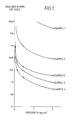
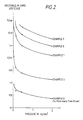
- The invention will now be described in more detail with reference to the following examples, and with reference to figures 1 to 3 of the accompanying drawings which are graphs of the pressure resistance characteristics of the exemplified materials.
- A batch of material was made up from Ambersil Silcoset 105 RTV (a room temperature vulcanising silicone rubber) together with undoped, chemical grade silicon powder supplied by BDH Chemicals Limited under their reference 30066 and synthetic graphite powder also supplied by BDH Chemicals Limited under their reference 26109. The particle size of the silicon powder was such that 1.9% by weight was retained on a 100 mesh sieve, 53.1% by weight retained on a 200 mesh sieve, 21.1% by weight retained on a 300 mesh sieve, 16.8% by weight retained on a 425 mesh sieve and the remaining 7.1% passed through the 425 mesh sieve. Mesh sizes are given according to ASTM E11. This represents a range of particle sizes that is roughly from 160 to 10 microns. The graphite had particle sizes in the range of 0.1 to 50 microns.
- Mixing was effected as follows: 100 parts by weight of the silicon rubber and curing agent were diluted with 100 parts of toluene. 30 parts of graphite and 150 parts of silicon were then added and mechanically mixed into the silicone rubber.
- The resulting mixture was then cast into a mould to produce sheets of nominal thickness 0.5 mm.
- When cured a 1 cm² piece of the material was placed over two copper track electrodes and the electrical resistance between the tracks monitored. The copper tracks were 1 mm wide with a 1 mm spacing between them and they had been laminated to a polyester film backing material. The resistance was monitored as loads were applied to the unit. The results are shown in table 1.
- The method of production and test of example 1 was repeated with graphite loadings ranging from 30 to 60 parts and silicon loadings ranging from 150 to 200 parts. The compositions and measured resistance values are shown in table 1.

- 100 parts of silicone rubber and curing agent were mixed with 100 parts of toluene, 100 parts silicon and 30 parts graphite. The resulting mixture was cast into a drum of diameter 25 cms which was rotating at 200 revolutions per minute.
- After the material had cured it was removed from the inner surface of the drum and tested in the same manner as example 1.
- It was found that the two surfaces of the material had different properties. The side which had been adjacent to the drum showed the higher resistance and the greater resistance range. The results for the two surfaces are shown in table 2.
- The method of production in
sample 6 was repeated with different toluene levels. - The sample surfaces which had been adjacent to the drum were tested as in example 1 and the results are shown in table 2.

- 100 parts of PSA529 adhesive (a silicone based liquid rubber) with cure systems added, available from Siltac Limited of Manchester, were diluted with 200 parts toluene, then 50 parts graphite and 150 parts silicone were mechanically mixed into the adhesive.
- The mixture was then applied to a Mylar film by a screen printing technique. This produced a layer of 0.07 mm which was allowed to cure.
- Following cure a 10 cm square was cut from the Mylar sheet. This piece was then placed adhesive side down over a grid electrode. The electrode consisted of
silver ink tracks 1 mm wide with 1 mm spacings. Each alternate pair of tracks were electrically connected, so that two electrically insulated electrodes were produced. - The resistance between the two electrodes was monitored as loads were applied to 1 cm² of the unit. The results are shown in table 3.

- Material was prepared and cast as in example 2 but with the addition of 20 parts of silver powder of nominal particle size 1 - 20 micron.
- The material was tested as for example 2 and the results shown in table 4.

- It will be appreciated from the examples that the compound, formation method and sheet thickness can readily be tailored for specific applications. The tables illustrate the smooth resistance variation over a wide load range that are obtainable with the materials of the invention.
Claims (13)
1. A pressure sensitive electrically conductive material comprising a non-conductive material of flexible elastomeric material, the matrix containing electrically conductive particles, some of which particles are silicon and others of which are particles of at least one other electrically conductive material, in which at least 70% of the conductive particles are particles of silicon.
2. A material according to claim 1 in which at least some of the other particles are particles of graphite.
3. A material according to claim 1 or claim 2 in which the electrically conductive particles comprise, by weight, 70% to 99% silicon, 1% to 30% graphite and 0% to 29% of other electrically conductive material.
4. A material according to claim 3 in which the other electrically conductive material is selected from silver, tellurium and molybdenum disulphide.
5. A material according to claim 1 in which the conductive particles comprise, by weight, 70% to 85% silicon and correspondingly 30% to 15% graphite.
6. A material according to any one of the preceding claims in which the silicon is in powdered form, the particles having a size range of from 1 to 300 microns, preferably from 1 to 150 microns.
7. A material according to any one of the preceding claims in which the silicon is doped.
8. A material according to claim any one of the preceding claims in which the silicon is in the form of chemical grade silicon powder.
9. A material according to claim 2 in which the graphite is artificial graphite.
10. A material according to claim 10 in which the artificial graphite is ground to a size range of from 0.1 to 100 microns.
11. A material according to any one of the preceding claims in which the conductive particles constitute from 30% to 60% by volume of the material.
12. A material according to any one of the preceding claims in which the conductive particles are present in from 100 to 300 parts, more preferably 150 to 270 parts per 100 parts by weight of elastomeric material.
13. A material according to claim 1 in which the elastomeric material is a silicone rubber.
Applications Claiming Priority (2)
| Application Number | Priority Date | Filing Date | Title |
|---|---|---|---|
| GB878709355A GB8709355D0 (en) | 1987-04-21 | 1987-04-21 | Electrically conductive materials |
| GB8709355 | 1987-04-21 |
Publications (1)
| Publication Number | Publication Date |
|---|---|
| EP0289193A1 true EP0289193A1 (en) | 1988-11-02 |
Family
ID=10616068
Family Applications (1)
| Application Number | Title | Priority Date | Filing Date |
|---|---|---|---|
| EP88303516A Withdrawn EP0289193A1 (en) | 1987-04-21 | 1988-04-19 | Pressure responsive electrically conductive materials |
Country Status (2)
| Country | Link |
|---|---|
| EP (1) | EP0289193A1 (en) |
| GB (1) | GB8709355D0 (en) |
Cited By (2)
| Publication number | Priority date | Publication date | Assignee | Title |
|---|---|---|---|---|
| WO1998033193A1 (en) * | 1997-01-25 | 1998-07-30 | Peratech Ltd | Polymer composition |
| US7186356B2 (en) | 2001-06-07 | 2007-03-06 | Peratech Ltd. | Analytical device |
Citations (4)
| Publication number | Priority date | Publication date | Assignee | Title |
|---|---|---|---|---|
| US3506607A (en) * | 1965-07-09 | 1970-04-14 | Gen Electric | Ablative compositions |
| US3806471A (en) * | 1968-04-29 | 1974-04-23 | R Mitchell | Pressure responsive resistive material |
| US4028276A (en) * | 1973-10-31 | 1977-06-07 | E. I. Du Pont De Nemours & Company | Pressure-sensitive elastic resistor compositions |
| GB2192186A (en) * | 1986-07-01 | 1988-01-06 | Uniroyal Ltd | Pressure responsive electrically conductive materials |
-
1987
- 1987-04-21 GB GB878709355A patent/GB8709355D0/en active Pending
-
1988
- 1988-04-19 EP EP88303516A patent/EP0289193A1/en not_active Withdrawn
Patent Citations (4)
| Publication number | Priority date | Publication date | Assignee | Title |
|---|---|---|---|---|
| US3506607A (en) * | 1965-07-09 | 1970-04-14 | Gen Electric | Ablative compositions |
| US3806471A (en) * | 1968-04-29 | 1974-04-23 | R Mitchell | Pressure responsive resistive material |
| US4028276A (en) * | 1973-10-31 | 1977-06-07 | E. I. Du Pont De Nemours & Company | Pressure-sensitive elastic resistor compositions |
| GB2192186A (en) * | 1986-07-01 | 1988-01-06 | Uniroyal Ltd | Pressure responsive electrically conductive materials |
Cited By (2)
| Publication number | Priority date | Publication date | Assignee | Title |
|---|---|---|---|---|
| WO1998033193A1 (en) * | 1997-01-25 | 1998-07-30 | Peratech Ltd | Polymer composition |
| US7186356B2 (en) | 2001-06-07 | 2007-03-06 | Peratech Ltd. | Analytical device |
Also Published As
| Publication number | Publication date |
|---|---|
| GB8709355D0 (en) | 1987-05-28 |
Similar Documents
| Publication | Publication Date | Title |
|---|---|---|
| KR100456045B1 (en) | Pressure Sensitive Ink, Pressure Sensitive Ink Device, and Methods of Use | |
| KR100616348B1 (en) | Electrically Conductive Thermoplastic Elastomers and Products Made therefrom | |
| US4054540A (en) | Pressure sensitive resistance and process of making same | |
| CN1291338A (en) | Polymer composition | |
| US4317265A (en) | Electrically conductive elastomers | |
| CN1248341A (en) | Polymer composition | |
| JP3564758B2 (en) | PTC composition | |
| CN1180664C (en) | Conductive floor surface layer and preparation method thereof | |
| WO2005029514A1 (en) | Variable conductance materials | |
| Das et al. | Conductive rubbers made by adding conductive carbon black to EVA, EPDM, and EVA–EPDM blends | |
| EP0410765A2 (en) | An electrically conductive ink | |
| EP0210002A1 (en) | Pressure responsive electrically conductive materials | |
| GB2192186A (en) | Pressure responsive electrically conductive materials | |
| JPS62112641A (en) | Pressure-sensitive, electrically conductive elastomer composition | |
| US4120828A (en) | Pressure sensitive resistance and process of making same | |
| US4600602A (en) | Low resistance resistor compositions | |
| US2813809A (en) | Wire covered with a hydrogenated rubbery butadiene polymer | |
| JPH0350792B2 (en) | ||
| JPH0581924A (en) | Electric conductive rubber | |
| JPS61293241A (en) | Electrically conductive elastomer composition containing vulcanized rubber powder | |
| Wessling | Electrical conductivity in heterogeneous polymer systems | |
| SU1758046A1 (en) | Composition for producing ebonite | |
| KR820000762B1 (en) | Sheet having heater | |
| JPH03108204A (en) | conductive composition | |
| JPH1087874A (en) | Production of conductive resin composition |
Legal Events
| Date | Code | Title | Description |
|---|---|---|---|
| PUAI | Public reference made under article 153(3) epc to a published international application that has entered the european phase |
Free format text: ORIGINAL CODE: 0009012 |
|
| AK | Designated contracting states |
Kind code of ref document: A1 Designated state(s): AT BE CH DE ES FR GB GR IT LI LU NL SE |
|
| STAA | Information on the status of an ep patent application or granted ep patent |
Free format text: STATUS: THE APPLICATION IS DEEMED TO BE WITHDRAWN |
|
| 18D | Application deemed to be withdrawn |
Effective date: 19890503 |