EP0278453A2 - Pyridin-2,4- und 2,5-dicarbonsäureamide, Verfahren zu ihrer Herstellung, Verwendung derselben sowie Arzneimittel auf Basis dieser Verbindungen - Google Patents
Pyridin-2,4- und 2,5-dicarbonsäureamide, Verfahren zu ihrer Herstellung, Verwendung derselben sowie Arzneimittel auf Basis dieser Verbindungen Download PDFInfo
- Publication number
- EP0278453A2 EP0278453A2 EP88101792A EP88101792A EP0278453A2 EP 0278453 A2 EP0278453 A2 EP 0278453A2 EP 88101792 A EP88101792 A EP 88101792A EP 88101792 A EP88101792 A EP 88101792A EP 0278453 A2 EP0278453 A2 EP 0278453A2
- Authority
- EP
- European Patent Office
- Prior art keywords
- alkyl
- hydrogen
- formula
- meanings
- pyridine
- Prior art date
- Legal status (The legal status is an assumption and is not a legal conclusion. Google has not performed a legal analysis and makes no representation as to the accuracy of the status listed.)
- Granted
Links
- 0 CC1C*CC1 Chemical compound CC1C*CC1 0.000 description 2
Classifications
-
- C—CHEMISTRY; METALLURGY
- C07—ORGANIC CHEMISTRY
- C07D—HETEROCYCLIC COMPOUNDS
- C07D213/00—Heterocyclic compounds containing six-membered rings, not condensed with other rings, with one nitrogen atom as the only ring hetero atom and three or more double bonds between ring members or between ring members and non-ring members
- C07D213/02—Heterocyclic compounds containing six-membered rings, not condensed with other rings, with one nitrogen atom as the only ring hetero atom and three or more double bonds between ring members or between ring members and non-ring members having three double bonds between ring members or between ring members and non-ring members
- C07D213/04—Heterocyclic compounds containing six-membered rings, not condensed with other rings, with one nitrogen atom as the only ring hetero atom and three or more double bonds between ring members or between ring members and non-ring members having three double bonds between ring members or between ring members and non-ring members having no bond between the ring nitrogen atom and a non-ring member or having only hydrogen or carbon atoms directly attached to the ring nitrogen atom
- C07D213/60—Heterocyclic compounds containing six-membered rings, not condensed with other rings, with one nitrogen atom as the only ring hetero atom and three or more double bonds between ring members or between ring members and non-ring members having three double bonds between ring members or between ring members and non-ring members having no bond between the ring nitrogen atom and a non-ring member or having only hydrogen or carbon atoms directly attached to the ring nitrogen atom with hetero atoms or with carbon atoms having three bonds to hetero atoms with at the most one bond to halogen, e.g. ester or nitrile radicals, directly attached to ring carbon atoms
- C07D213/78—Carbon atoms having three bonds to hetero atoms, with at the most one bond to halogen, e.g. ester or nitrile radicals
- C07D213/81—Amides; Imides
-
- A—HUMAN NECESSITIES
- A61—MEDICAL OR VETERINARY SCIENCE; HYGIENE
- A61P—SPECIFIC THERAPEUTIC ACTIVITY OF CHEMICAL COMPOUNDS OR MEDICINAL PREPARATIONS
- A61P3/00—Drugs for disorders of the metabolism
-
- A—HUMAN NECESSITIES
- A61—MEDICAL OR VETERINARY SCIENCE; HYGIENE
- A61P—SPECIFIC THERAPEUTIC ACTIVITY OF CHEMICAL COMPOUNDS OR MEDICINAL PREPARATIONS
- A61P37/00—Drugs for immunological or allergic disorders
- A61P37/02—Immunomodulators
- A61P37/06—Immunosuppressants, e.g. drugs for graft rejection
-
- A—HUMAN NECESSITIES
- A61—MEDICAL OR VETERINARY SCIENCE; HYGIENE
- A61P—SPECIFIC THERAPEUTIC ACTIVITY OF CHEMICAL COMPOUNDS OR MEDICINAL PREPARATIONS
- A61P43/00—Drugs for specific purposes, not provided for in groups A61P1/00-A61P41/00
-
- C—CHEMISTRY; METALLURGY
- C07—ORGANIC CHEMISTRY
- C07D—HETEROCYCLIC COMPOUNDS
- C07D213/00—Heterocyclic compounds containing six-membered rings, not condensed with other rings, with one nitrogen atom as the only ring hetero atom and three or more double bonds between ring members or between ring members and non-ring members
- C07D213/02—Heterocyclic compounds containing six-membered rings, not condensed with other rings, with one nitrogen atom as the only ring hetero atom and three or more double bonds between ring members or between ring members and non-ring members having three double bonds between ring members or between ring members and non-ring members
- C07D213/04—Heterocyclic compounds containing six-membered rings, not condensed with other rings, with one nitrogen atom as the only ring hetero atom and three or more double bonds between ring members or between ring members and non-ring members having three double bonds between ring members or between ring members and non-ring members having no bond between the ring nitrogen atom and a non-ring member or having only hydrogen or carbon atoms directly attached to the ring nitrogen atom
- C07D213/60—Heterocyclic compounds containing six-membered rings, not condensed with other rings, with one nitrogen atom as the only ring hetero atom and three or more double bonds between ring members or between ring members and non-ring members having three double bonds between ring members or between ring members and non-ring members having no bond between the ring nitrogen atom and a non-ring member or having only hydrogen or carbon atoms directly attached to the ring nitrogen atom with hetero atoms or with carbon atoms having three bonds to hetero atoms with at the most one bond to halogen, e.g. ester or nitrile radicals, directly attached to ring carbon atoms
- C07D213/78—Carbon atoms having three bonds to hetero atoms, with at the most one bond to halogen, e.g. ester or nitrile radicals
- C07D213/81—Amides; Imides
- C07D213/82—Amides; Imides in position 3
-
- C—CHEMISTRY; METALLURGY
- C07—ORGANIC CHEMISTRY
- C07D—HETEROCYCLIC COMPOUNDS
- C07D401/00—Heterocyclic compounds containing two or more hetero rings, having nitrogen atoms as the only ring hetero atoms, at least one ring being a six-membered ring with only one nitrogen atom
- C07D401/14—Heterocyclic compounds containing two or more hetero rings, having nitrogen atoms as the only ring hetero atoms, at least one ring being a six-membered ring with only one nitrogen atom containing three or more hetero rings
-
- C—CHEMISTRY; METALLURGY
- C07—ORGANIC CHEMISTRY
- C07D—HETEROCYCLIC COMPOUNDS
- C07D409/00—Heterocyclic compounds containing two or more hetero rings, at least one ring having sulfur atoms as the only ring hetero atoms
- C07D409/14—Heterocyclic compounds containing two or more hetero rings, at least one ring having sulfur atoms as the only ring hetero atoms containing three or more hetero rings
-
- C—CHEMISTRY; METALLURGY
- C07—ORGANIC CHEMISTRY
- C07D—HETEROCYCLIC COMPOUNDS
- C07D417/00—Heterocyclic compounds containing two or more hetero rings, at least one ring having nitrogen and sulfur atoms as the only ring hetero atoms, not provided for by group C07D415/00
- C07D417/14—Heterocyclic compounds containing two or more hetero rings, at least one ring having nitrogen and sulfur atoms as the only ring hetero atoms, not provided for by group C07D415/00 containing three or more hetero rings
Definitions
- proline and lysine hydroxylase cause a very selective inhibition of collagen biosynthesis by influencing the collagen-specific hydroxylation reactions.
- protein-bound proline or lysine is hydroxylated by the enzymes proline or lysine hydroxylase. If this reaction is prevented by inhibitors, a non-functional, under-hydroxylated collagen molecule arises that can only be released into the extracellular space in small amounts by the cell.
- the under-hydroxylated collagen can also not be built into the collagen matrix and is very easily proteolytically broken down. As a result of these effects, the total amount of extracellularly deposited collagen is reduced.
- proline hydroxylase is effectively inhibited by pyridine-2,4- and -2,5-dicarboxylic acid (K. Mayama et al., Eur. J. Biochem. 138 (1984) 239-245).
- these compounds are only effective as inhibitors in cell culture in very high concentrations (V. Günsler et al. Collagen and Rel. Research 3 , 71 1983).
- DE-A 34 32 094 describes pyridine-2,4- and -2,5-dicarboxylic acid diesters with 1-6 C atoms in the ester alkyl part as medicaments for inhibiting proline and lysine hydroxylase.
- the actual active ingredient, pyridine-2,4- or 2,5-dicarboxylic acid is only created by hydrolysis of the diamides in the cell. Due to their higher lipophilicity and the fact that they are surprisingly only very slowly hydrolyzed during transport, the diamides can be transported into the cells. Only here is the actual active ingredient, pyridine-2,4 or -2,5-dicarboxylic acid, released.
- the invention thus relates to: 1. Pyridine-2,4- and -2,5-dicarboxylic acid amides of the formula I. wherein R1 branched or unbranched C1-C12 alkyl, which is optionally mono- or in the case of C2-C12 alkyls is also substituted several times with Halogen, hydroxy, cyano, amino, carboxyl, alkoxy, alkoxycarbonyl, alkylcarbonyloxy, alkyl or dialkylamino, where the alkyl radicals have 1-4 carbon atoms, which in the case of the C3- and C3-alkyl radicals can also be branched, Indolyl or phenyl, which in turn is optionally substituted with halogen, nitro, C1-C4-alkyl or C1-C4-alkoxy, 1-, 2-, or 3-fold, whereby in the case of multiple substitutions the substituents can also be different from one another and independently in the case of the C3- and C Alk-
- the invention relates to pyridine-2,4- and -2,5-dicarboxamides of the formula I, in which R1 branched or unbranched C2-C12 alkyl which is optionally monosubstituted or, in the case of the C3-C12-alkyls, also substituted several times, with amino or C1-C3-alkoxy, where the C3-alkyl radicals can also be branched and / or indolyl and / or phenyl, which can be substituted with C1-C4 alkoxy or nitro or R1 benzo-fused cyclohexyl or R1 phenyl which is optionally substituted by 1, 2 or 3 times nitro, cyano, halogen or C1-C4 alkyl, where the substituents can also be different independently of one another in the case of multiple substitution, or R1 2-, 3- or 4-pyridyl, 2- or 3-thienyl or thiazolyl, where these heteroatoms can
- the invention relates to pyridine-2,4- and -2,5-dicarboxamides Formula I ⁇ , wherein R 1 ⁇ branched or unbranched C1-C12 alkyl, which is optionally mono- or in the case of C2-C12 alkyl also substituted several times with halogen, hydroxy, cyano, amino, carboxyl, alkoxy, alkoxycarbonyl, alkylcarbonyloxy, alkyl or dialkylamino, where the alkyl radicals have 1-4 carbon atoms, and in the case of the C3- and C4alkyls these can also be branched indolyl or phenyl, which in turn optionally with halogen, nitro, C1-C4alkoxy or C1-C4alkyl 1-, Is substituted twice or three times, where the C3 and C4-alkyl radicals mentioned can also be branched and, in the case of multiple substitutions, the substituents can also be different from one another independently or R
- pyridine-2,4- and -2,5-dicarboxylic acid amides according to formula I ⁇ according to claim 3, wherein R 1 ⁇ branched or unbranched C1-C4-alkyl which is substituted by C1-C3-alkoxy, where the alkyl radicals have 1-3 C atoms and can also be branched in the case of the C3-alkyl compounds, and R 2 ⁇ is independent of R 1 ⁇ is hydrogen or has one of the meanings as described for R 1 ⁇ , where R 2 ⁇ can also be identical to R 1 ⁇ and R 3 ⁇ is independent of R 1 ⁇ is hydrogen or has one of the meanings as described for R 1 ⁇ , where R 3 ⁇ can also be identical to R 1 ⁇ and / or R 2 ⁇ and R 4 ⁇ is independent of R 1 ⁇ , R 2 ⁇ and R 3 ⁇ is hydrogen or has one of the meanings as described for R 1 ⁇ , where R 4 ⁇ can also be identical to R 1 ⁇ and / or R 2 ⁇ and / or R 3 ⁇ , as
- the last-mentioned group of compounds is particularly effective in oral use, as are the very particularly preferred pyridine-2,4- and -2,5-dicarboxamides of the formula I ⁇ according to Claim 3, in which R 1 ⁇ and R 3 ⁇ are one Is isopropoxypropyl group and R 2 ⁇ and R 4 ⁇ is hydrogen (such as, for example, pyridine-2,5-dicarboxylic acid-N, N ⁇ -di (3-isopropoxypropyl) amide, Ex. 3) pyridine-2,4 -dicarboxylic acid-bis-3-isopropoxypropylamide (Ex.
- Halogen is understood to mean fluorine, chlorine, bromine and iodine, aryl phenyl and naphthyl and heteroaryl 5- and 6-membered aromatic rings with 1, 2 or 3 nitrogen and / or oxygen and / or sulfur atoms, which may also be fused to benzo could be; in particular, the heteroaryl radicals are pyridyl, pyridazyl, pyrimidyl, pyrazyl, 1,3,5-triazyl, pyrolyl, pyrazolyl, imidazolyl, triazolyl, thienyl, oxazolyl and thiazolyl radicals and optionally their benzo-fused compounds.
- multiply substituted means that at least 2 at most all the hydrogen atoms present in the alkyl radicals have been replaced by the substituents mentioned. It is preferably one substituent per methyl or methylene group.
- the substituents can also differ independently of one another.
- the invention further relates to a process for the preparation of compounds of the formula I ⁇ , which is characterized in that a compound of the formula II ⁇ with a compound of formula III is implemented, wherein R 1 ⁇ , R 2 ⁇ , R 3 ⁇ and R 4 ⁇ have the meanings given for formula I ⁇ and Y is halogen or hydroxyl or together with the carbonyl group forms an active ester or a mixed anhydride, and optionally converts the reaction products into their physiologically tolerable salts .
- R 1 ⁇ , R 2 ⁇ , R 3 ⁇ and R 4 ⁇ have the meanings given for formula I ⁇ and Y is halogen or hydroxyl or together with the carbonyl group forms an active ester or a mixed anhydride, and optionally converts the reaction products into their physiologically tolerable salts .
- the simplest way to prepare the compounds according to the invention is that the two components, the pyridine derivative according to formula (II) or formula (II ⁇ ) and the amine according to formula (III) in equimolar amounts or up to an about 5-fold excess to III, are mixed and reacted at temperatures between -30 to 150 ° C, preferably at 20 to 100 ° C until the reaction is complete.
- the completion of the reaction can be determined by means of thin layer chromatography (TLC control).
- a variant of this process consists in working in a suitable solvent such as diethyl ether or dimethoxyethane or tetrahydrofuran, chlorinated hydrocarbons such as methylene chloride, chloroform, tri- or tetrachlorethylene, benzene, toluene or polar solvents such as dimethylformamide or acetone or dimethyl sulfoxide.
- a suitable solvent such as diethyl ether or dimethoxyethane or tetrahydrofuran, chlorinated hydrocarbons such as methylene chloride, chloroform, tri- or tetrachlorethylene, benzene, toluene or polar solvents such as dimethylformamide or acetone or dimethyl sulfoxide.
- chlorinated hydrocarbons such as methylene chloride, chloroform, tri- or tetrachlorethylene
- benzene, toluene or polar solvents such as dimethylformamide or ace
- a mixed anhydride such as ethyl chloroformate
- the reaction can also take place in the presence of bases.
- Inorganic acid scavengers such as carbonates or hydrogen carbonates, for example sodium or potassium carbonate or sodium or potassium hydrogen carbonate, or organic acid scavengers such as come as additional bases
- Tertiary amines such as triethylamine, tributylamine, ethyldiisopropylamine or heterocyclic amines such as N-alkylmorpholine, pyridine, quinoline or dialkylanilines.
- the compounds of the formula (II) or formula (II ⁇ ) are preferably reacted with amines of the formula (III) with the addition of a water-releasing agent such as dialkylcarbodiimide, the alkyl radicals having 1 to 8 C atoms, which in the case of C3-C8 Compounds can also be branched or cyclic; Dicyclohexylcarbodiimide is preferably used.
- a water-releasing agent such as dialkylcarbodiimide, the alkyl radicals having 1 to 8 C atoms, which in the case of C3-C8 Compounds can also be branched or cyclic; Dicyclohexylcarbodiimide is preferably used.
- a corresponding method is described in Houben-Weyl, vol. XV / 2, pages 103-111, Methods of Organic Chemistry, 4th edition, Georg Thieme Verlag, Stuttgart, 1974.
- the products can be worked up, for example, by extraction or by chromatography, for example over silica gel.
- the isolated product can be recrystallized and, if appropriate, reacted with a suitable acid to give a physiologically tolerable salt.
- suitable acids are: Mineral acids, such as hydrochloric acid and hydrobromic acid, as well as sulfuric, phosphoric, nitric or perchloric acid or organic acids such as formic, vinegar, propionic, amber, glycolic, lactic, apple, wine, lemon, maleic , Fumaric, phenylacetic, benzoic, methanesulfonic, toluenesulfonic, oxalic, 4-aminobenzoic, naphthalene-1,5-disulfonic or ascorbic acid.
- the starting compounds of formula (III) can simply be synthesized (e.g. organic, basic organic chemical internship, 15th edition, VEB German Publishing House of Sciences, 1976; an overview of the various options can be found in the method register, P. 822).
- the starting compounds of the formula (II) are obtained, for example, by reacting pyridine-2,4- or -2,5-dicarboxylic acid to give the corresponding pyridine-2,4- or -2,5-dicarboxylic acid halide, preferably chloride (by processes known from the literature , eg organic, basic organic chemical internship, 15th edition, VEB German Publishing House of Sciences, 1976, p. 595 ff), which is then mixed with a suitable alcohol, e.g. Paranitrobenzylalkohol is implemented to the corresponding active ester.
- a suitable alcohol e.g. Paranitrobenzylalkohol
- the pyridine-2,4- or -2,5-dicarboxylic acid can also first be converted into a mixed anhydride with the addition of a suitable carboxylic acid or carboxylic acid ester, such as ethyl chloroformate, which is then reacted with the amines (III) to give the products according to the invention.
- a suitable carboxylic acid or carboxylic acid ester such as ethyl chloroformate
- the starting compounds of the formula (II ⁇ ) can be synthesized, for example, as follows: Reaction of a pyridine-2,4- or -2,5-dicarboxylic acid halide, preferably of the chloride, with benzyl alcohol to give the pyridine-2,4- or -2,5-dicarboxylic acid benzyl ester; Subsequent selective saponification of the ester in the 2-position (for example in the presence of a copper catalyst, Acta Helv. 44, 1963, p.
- the pyridine-2,4 or -2,5-dicarboxylic acid halide can be prepared by known methods, e.g. can be obtained by reacting pyridine-2,4- or -2,5-dicarboxylic acid with phosphorus trihalide (see e.g. Organikum, Organisch Chemisches Grundpraktikum, 15th edition, VEB Deutscher Verlag dermaschineen, 1976, pp. 527 and 595ff).
- the compounds of the formula I or I ⁇ according to the invention have valuable pharmacological properties and in particular show activity as inhibitors of proline and lysine hydroxylase, as a fibrosuppressant and immunosuppressant.
- the activity of fibrogenase can be determined by radioimmunological determination of the N-terminal propeptide of collagen type III or the N- or C-terminal cross-linking domain of collagen type IV (7s collagen or type IV collagen NC1) in the serum be determined.
- the compounds of the formula I or I ⁇ can be used as medicaments in the form of pharmaceutical preparations, which they may contain together with compatible pharmaceutical carriers.
- the compounds can be used as medicaments, for example in the form of pharmaceutical preparations, which contain these compounds in a mixture with a pharmaceutical, organic or inorganic carrier suitable for enteral, percutaneous or parenteral application, such as water, gum arabic, gelatin, lactose, starch, magnesium stearate, talc, vegetable oils, polyalkylene glycols, petroleum jelly etc.
- the pharmaceutical preparations can be in solid form, e.g. as tablets, coated tablets, suppositories or capsules; in semi-solid form, e.g. as ointments or in liquid form, e.g. as solutions, suspensions or emulsions. If appropriate, they are sterilized and / or contain auxiliaries, such as preservatives, stabilizers, wetting agents or emulsifiers, salts for changing the osmotic pressure or buffers. They can also contain other therapeutically active substances.
Landscapes
- Organic Chemistry (AREA)
- Chemical & Material Sciences (AREA)
- Health & Medical Sciences (AREA)
- Bioinformatics & Cheminformatics (AREA)
- Engineering & Computer Science (AREA)
- Life Sciences & Earth Sciences (AREA)
- Veterinary Medicine (AREA)
- Nuclear Medicine, Radiotherapy & Molecular Imaging (AREA)
- General Chemical & Material Sciences (AREA)
- Pharmacology & Pharmacy (AREA)
- Chemical Kinetics & Catalysis (AREA)
- Animal Behavior & Ethology (AREA)
- General Health & Medical Sciences (AREA)
- Public Health (AREA)
- Medicinal Chemistry (AREA)
- Immunology (AREA)
- Transplantation (AREA)
- Diabetes (AREA)
- Hematology (AREA)
- Obesity (AREA)
- Pharmaceuticals Containing Other Organic And Inorganic Compounds (AREA)
- Pyridine Compounds (AREA)
Abstract
Description
- Verbindungen, die die Prolin- und Lysinhydroxylase inhibieren, bewirken eine sehr selektive Hemmung der Kollagenbiosynthese durch Beeinflussung der kollagenspezifischen Hydroxylierungsreaktionen. In deren Verlauf wird Protein-gebundenes Prolin oder Lysin durch die Enzyme Prolin- bzw. Lysinhydroxylase hydroxyliert. Wird diese Reaktion durch Inhibitoren unterbunden, so entsteht ein nicht funktionsfähiges, unterhydroxyliertes Kollagenmolekül, das von der Zelle nur in geringer Menge in den extrazellulären Raum abgegeben werden kann. Das unterhydroxylierte Kollagen kann außerdem nicht in die Kollagenmatrix eingebaut werden und wird sehr leicht proteolytisch abgebaut. Als Folge dieser Effekte verringert sich insgesamt die Menge des extrazellulär abgelagerten Kollagens.
- Es ist bekannt, daß die Inhibierung der Prolinhydroxylase durch bekannte Inhibitoren wie α,αʹ-Dipyridyl zu einer Hemmung der C1q-Biosynthese von Makrophagen führt (W. Müller et al., FEBS Lett. 90 (1978), 218; Immunbiology 155 (1978) 47). Dadurch kommt es zu einem Ausfall des klassischen Weges der Komplementaktivierung. Inhibitoren der Prolinhydroxylase wirken daher auch als Immunsuppressiva, z.B. bei Immunkomplexkrankheiten.
- Es ist bekannt, daß Prolinhydroxylase durch Pyridin-2,4- und -2,5-dicarbonsäure effektiv gehemmt wird (K. Mayama et al., Eur. J. Biochem. 138 (1984) 239-245). Diese Verbindungen sind in der Zellkultur allerdings nur in sehr hohen Konzentrationen als Hemmstoffe wirksam (V. Günsler et al. Collagen and Rel. Research 3, 71 1983).
- In der DE-A 34 32 094 werden Pyridin-2,4- und -2,5-dicarbonsäurediester mit 1-6 C-Atomen im Esteralkylteil als Arzneimittel zur Inhibierung der Prolin- und Lysinhydroxylase beschrieben.
- Diese niedrig-alkylierten Diester haben jedoch den Nachteil, daß sie zu schnell im Organismus zu den Säuren gespalten werden und nicht in genügend hoher Konzentration an ihren Wirkort in der Zelle gelangen und damit für eine eventuelle Verabreichung als Arzneimittel weniger geeignet sind.
- Überraschenderweise wurde nun gefunden, daß die Diamide der Pyridin-2,4- und -2,5-dicarbonsäure ausgezeichnete Hemmstoffe der Kollagenbiosynthese im Tiermodell sind.
- Der eigentliche Wirkstoff, die Pyridin-2,4- oder 2,5-Dicarbonsäure entsteht erst durch Hydrolyse der Diamide in der Zelle. Die Diamide können auf Grund ihrer höheren Lipophilie und der Tatsache, daß sie während des Transports überaschenderweise nur sehr langsam hydrolysiert werden bis in die Zellen transportiert werden. Erst hier wird der eigentliche Wirkstoff, Pyridin-2,4 oder -2,5-dicarbonsäure, freigesetzt.
- Die Erfindung betrifft somit:
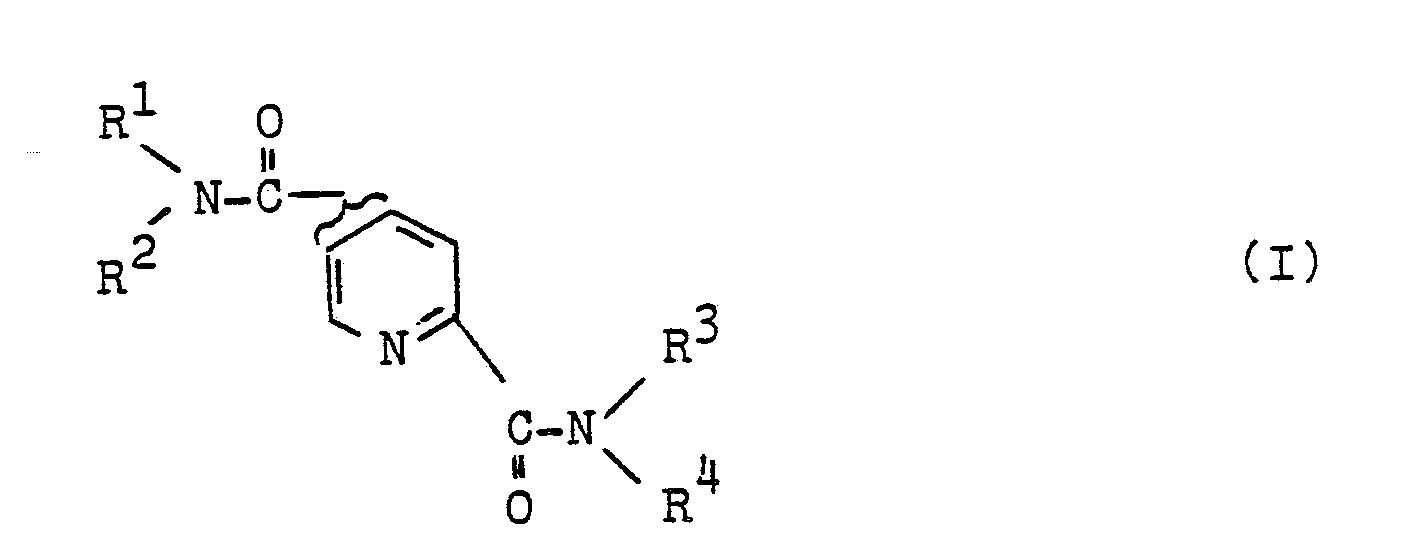
1. Pyridin-2,4- und -2,5-dicarbonsäure-Amide der Formel I
R¹ verzweigtes oder unverzweigtes C₁-C₁₂-Alkyl, welches gegebenenfalls einfach oder im Falle der C₂-C₁₂-Alkyle auch mehrfach substituiert ist mit
Halogen, Hydroxy, Cyano, Amino, Carboxyl, Alkoxy, Alkoxycarbonyl, Alkylcarbonyloxy, Alkyl- oder Dialkylamino, wobei die Alkylreste 1-4 C-Atome aufweisen, die im Falle der C₃- und C₄-Alkylreste auch verzweigt sein können,
Indolyl oder Phenyl, welches seinerseits gegebenenfalls mit Halogen, Nitro, C₁-C₄-Alkyl oder C₁-C₄-Alkoxy, 1-, 2-, oder 3-fach substituiert ist, wobei bei Mehrfachsubstitutionen die Substituenten auch voneinander unabhängig verschieden sein können und wobei im Falle der C₃- und C₄-Alkyle diese auch verzweigt sein können,
oder R¹ gesättigtes C₅-C₇-Cycloalkyl, welches gegebenenfalls benzoanneliert ist,
oder R¹ Aryl oder Heteroaryl, welches gegebenenfalls seinerseits mit Halogen, Nitro, Cyano, C₁-C₄-Alkyl oder C₁-C₄-Alkoxy 1-, 2-, oder 3-fach substituiert ist, wobei bei Mehrfachsubstitutionen die Substituenten auch voneinander unabhängig verschieden sein können und wobei im Falle der C₃-und C₄-Alkyle diese auch verzweigt sein können
und
R² unabhängig von R¹ Wasserstoff ist oder eine der Bedeutungen wie für R¹ beschrieben hat, wobei R² auch identisch mit R¹ sein kann, und
R³ unabhängig von R¹ und R² Wasserstoff ist oder eine der Bedeutungen für R¹ beschrieben hat, wobei R³ auch identisch mit R¹ und/oder R² sein kann und
R⁴ unabhängig von R¹, R² und R³ Wasserstoff ist oder eine der Bedeutungen wie für R¹ beschrieben hat wobei R⁴ auch identisch mit R¹ und/oder R² und/oder R³ sein kann
und wobei die Reste R¹ und R² und/oder R³ und R⁴ auch zusammen mit dem Stickstoffatom einen 5-, 6- oder 7-gliedrigen gesättigten heterocyclischen Ring bilden, wobei der heterocyclische Ring auch ein zweites Stickstoffatom beinhalten kann und wobei der heterocyclische Ring seinerseits mit Phenyl oder Phenyl-C₁-C₃-Alkyl substituiert sein kann,
bedeutet und deren physiologisch verträgliche Salze, zur Anwendung als Arzneimittel, ausgenommen die Verbindungen, in denen R¹=R³ mit Methyl und Brom disubstituiertes Phenyl und R²=R⁴ Wasserstoff bedeutet. - Im Besonderen betrifft die Erfindung Pyridin-2,4- und -2,5-dicarbonsäureamide gemäß Formel I, worin
R¹ verzweigtes oder unverzweigtes C₂-C₁₂-Alkyl welches gegebenenfalls einfach oder im Falle der C₃-C₁₂-Alkyle auch mehrfach substituiert ist, mit Amino oder C₁-C₃-Alkoxy, wobei die C₃-AlkylReste auch verzweigt sein können und/oder Indolyl und/oder Phenyl, welches substituiert sein kann mit C₁-C₄-Alkoxy oder Nitro
oder R¹ benzoanneliertes Cyclohexyl
oder R¹ Phenyl, das gegebenenfalls 1-, 2- oder 3-fach Nitro- Cyano-, Halogen- oder C₁-C₄-Alkyl substituiert ist, wobei bei Mehrfachsubstitution die Substituenten auch unabhängig voneinander verschieden sein können,
oder R¹ 2-, 3- oder 4-Pyridyl, 2- oder 3-Thienyl oder Thiazolyl, wobei diese Heteroatome auch mit C₁-C₄-Alkyl monosubstituiert sein können
bedeutet und
R² unabhängig von R¹ Wasserstoff ist oder eine der Bedeutungen wie für R¹ beschrieben hat, wobei R² auch identisch mit R¹ sein kann und
R³ unabhängig von R¹ und R² Wasserstoff ist oder eine der Bedeutungen wie für R¹ beschrieben hat, wobei R³ auch identisch mit R¹ und/oder R² sein kann und
R⁴ unabhängig von R¹, R² und R³ Wasserstoff ist oder eine der Bedeutungen wie für R¹ beschrieben hat, wobei R⁴ auch identisch mit R¹ und/oder R² und/oder R³ sein kann
bedeutet, sowie deren physiologisch verträgliche Salze, zur Anwendung als Arzneimittel ausgenommen die Verbindungen, in denen R¹ = R³ mit Methyl und Brom disubstituiertes Phenyl und R² = R⁴ Wasserstoff bedeutet. - Außerdem betriff die Erfindung Pyridin-2,4- und -2,5-dicarbonsäureamide Formel Iʹ,
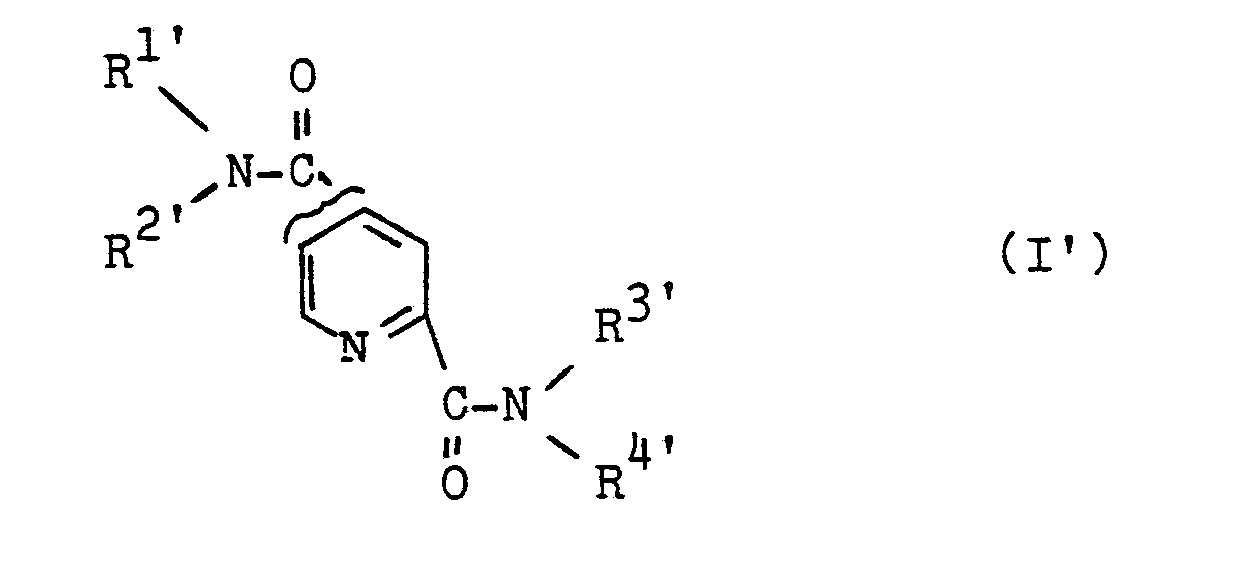
R1ʹ verzweigtes oder unverzweigtes C₁-C₁₂-Alkyl, welches gegebenenfalls einfach oder im Falle von C₂-C₁₂-Alkyl auch mehrfach substituiert ist mit Halogen, Hydroxy, Cyano, Amino, Carboxyl, Alkoxy, Alkoxycarbonyl, Alkylcarbonyloxy, Alkyl- oder Dialkylamino, wobei die Alkylreste 1-4 C-Atome aufweisen, und wobei im Falle der C₃- und C₄Alkyle diese auch verzweigt sein können Indolyl oder Phenyl, welches seinerseits gegebenenfalls mit Halogen, Nitro, C₁-C₄-Alkoxy oder C₁-C₄-Alkyl 1-, 2- oder 3-fach substituiert ist, wobei die genannten C₃- und C₄-Alkylreste auch verzweigt sein können und wobei bei Mehrfachsubstitutionen die Substituenten auch voneinander unabhängig verschieden sein können
oder R1ʹ gesättigtes C₅-C₇-Cycloalkyl, welches gegebenenfalls benzoanneliert ist
oder R1ʹ Aryl oder Heteroaryl, welches gegebenenfalls seinerseits mit Halogen, Nitro, Cyano, C₁-C₄-Alkyl oder C₁-C₄-Alkoxy 1-, 2- oder 3-fach substituiert ist, wobei bei Mehrfachsubstitutionen die Substituenten auch voneinander unabhängig verschieden sein können und wobei im Falle der C₃- und C₄-Alkyle diese auch verzweigt sein können,
und
R2ʹ unabhängig von R1ʹ Wasserstoff ist oder eine der Bedeutungen wie für R1ʹ beschrieben hat, wobei R2ʹ auch identisch mit R1ʹ sein kann
R3ʹ unabhängig von R1ʹ Wasserstoff ist oder eine der Bedeutungen wie für R1ʹ beschrieben hat, wobei R3ʹ auch identisch mit R1ʹ und/oder R2ʹ sein kann und
R4ʹ unabhängig von R1ʹ, R2ʹ und R3ʹ Wasserstoff ist oder eine der Bedeutungen wie für R1ʹ beschrieben hat, wobei R4ʹ auch identisch mit R1ʹ und/oder R2ʹ und/oder R3ʹ sein kann
und wobei die Reste R1ʹ und R2ʹ und/oder R3ʹ und R4ʹ auch zusammen mit dem Stickstoffatom einen 5-, 6- oder 7-gliedrigen gesättigten heterocyclischen Ring bilden können, wobei der heterocyclische Ring auch ein zweites Stickstoffatom beinhalten kann und wobei der heterocyclische Ring seinerseits mit Phenyl oder Phenyl-C₁-C₃-alkyl substituiert sein kann,
bedeutet,
sowie deren physiologisch verträgliche Salze, ausgenommen die Verbindungen, in denen R1ʹ = R3ʹ 2-Hydroxyethyl oder 2-(3,4-dimethoxyphenyl)ethyl oder mit Methyl und Brom disubstituiertes Phenyl und R2ʹ = R4ʹ Wassertoff bedeutet. - Bevorzugt sind Pyridin-2,4- und -2,5-dicarbonsäureamide gemäß Formel Iʹ, worin
R1ʹ verzweigtes oder unverzweigtes C₁-C₁₂-Alkyl, welches gegebenenfalls einfach oder im Falle der C₂-C₁₂-Alkyle auch mehrfach substituiert ist mit Amino oder C₁-C₃-Alkoxy, wobei die Alkylreste im Falle der C₃-Alkylverbindungen auch verzweigt sein können oder Indolyl oder Phenyl, welches substituiert sein kann mit C₁-C₄-Alkoxy oder Nitro
oder R1ʹ benzoanneliertes Cyclohexyl
oder R1ʹ Phenyl, welches gegebenenfalls mit 1, 2 oder 3 Cyano-, Halogen-, C₁-C₄-Alkyl- oder Nitrogruppen substituiert ist wobei bei Mehrfachsubstitutionen die Substituenten auch unabhängig voneinander verschieden sein können
oder R1ʹ 2-, 3- oder 4-Pyridyl, 3-Thienyl oder Thiazolyl,
und
R2ʹ unabhängig von R1ʹ, Wasserstoff ist oder eine der Bedeutungen wie für R1ʹ beschrieben hat, wobei R2ʹ auch identisch mit R1ʹ sein kann
R3ʹ unabhängig von R1ʹ und R2ʹ Wasserstoff ist oder eine der Bedeutungen wie für R1ʹ beschrieben hat, wobei R3ʹ auch identisch mit R1ʹ und/oder R2ʹ sein kann und
R4ʹ unabhängig von R1ʹ, R2ʹ und R3ʹ Wasserstoff ist oder eine der Bedeutungen wie für R1ʹ beschrieben hat, wobei R4ʹ auch identisch mit R1ʹ und/oder R2ʹ und/oder R3ʹ sein kann
bedeutet,
sowie deren physiologisch verträgliche Salze,
ausgenommen die Verbindung, in denen R1ʹ = R2ʹ 2-Hydroxyethyl oder 2-(3,4-Dimethoxyphenyl)ethyl oder mit Methyl und Brom disubstituiertes Phenyl und R2ʹ = R4ʹ Wasserstoff bedeutet. - Besonders bevorzugt sind Pyridin-2,4- und -2,5-dicarbonsäure-Amide gemäß Formel Iʹ nach Anspruch 3, worin
R1ʹ verzweigtes oder unverzweigtes C₁-C₄-Alkyl, welches substituiert ist mit C₁-C₃-Alkoxy, wobei die Alkylreste 1 - 3 C-Atome aufweisen und im Falle der C₃-Alkylverbindungen auch verzweigt sein können, und
R2ʹ unabhängig von R1ʹ Wasserstoff ist oder eine der Bedeutungen wie für R1ʹ beschrieben hat, wobei R2ʹ auch identisch mit R1ʹ sein kann und
R3ʹ unabhängig von R1ʹ Wasserstoff ist oder eine der Bedeutungen wie für R1ʹ beschrieben hat, wobei R3ʹ auch identisch mit R1ʹ und/oder R2ʹ sein kann und
R4ʹ unabhängig von R1ʹ, R2ʹ und R3ʹ Wasserstoff ist oder eine der Bedeutungen wie für R1ʹ beschrieben hat, wobei R4ʹ auch identisch mit R1ʹ und/oder R2ʹ und/oder R3ʹ sein kann, sowie deren physiologisch verträgliche Salze. - Die zuletzt genannte Gruppe von Verbindungen besitzt u. a. bei der oralen Anwendung eine besondere Wirksamkeit, wie auch die ganz besonders bevorzugten Pyridin-2,4- und -2,5-dicarbonsäureamide gemäß Formel Iʹ nach Anspruch 3, worin R1ʹ und R3 ʹ eine Isopropoxypropyl-Gruppe ist und R2ʹ und R4ʹ Wasserstoff ist, (wie z. B. Pyridin-2,5-dicarbonsäure-N,Nʹ-di(3-isopropoxy-propyl)amid, Bsp. 3) Pyridin-2,4-dicarbonsäure-bis-3-isopropoxypropylamid (Bsp. 20))und
Pyridin-2,4- und -2,5-dicarbonsäureamide gemäß Formel Iʹ nach Anspruch 3, worin R1ʹ und R3ʹ eine 2-Methoxyethyl-Gruppe ist und R2ʹ und R4ʹ Wasserstoff ist, wie z. B. N,Nʹ-Bis(2-methoxy-ethyl)pyridin-2,4-dicarbonsäureamid (Bsp. 19), sowie deren physiologisch verträgliche Salze. - Unter Halogen werden Fluor, Chlor, Brom und Jod, unter Aryl Phenyl und Naphthyl und unter Heteroaryl 5- und 6-gliedrige aromatische Ringe mit 1, 2 oder 3 Stickstoff- und/oder Sauerstoff- und/oder Schwefelatomen verstanden, die gegebenenfalls noch benzoanneliert sein können; insbesondere handelt es sich bei den Heteroarylresten um Pyridyl-, Pyridazyl-, Pyrimidyl-, Pyrazyl-, 1,3,5-Triazyl-, Pyrolyl-, Pyrazolyl-, Imidazolyl-, Triazolyl-, Thienyl-, Oxazolyl- und Thiazolyl-Reste und gegebenenfalls deren benzoannelierte Verbindungen.
- "Mehrfach substituiert" bedeutet im Vorstehenden und Folgenden, daß mindetens 2 höchstens alle in den Alkylresten vorhandenen Wasserstoffatome durch die genannten Substituenten ersetzt sind. Bevorzugt handelt es sich dabei um einen Substituenten pro Methyl- bzw. Methylengruppe.
- Bei Mehrfachsubstitutionen können die Substituenten auch voneinander unabhängig verschieden sein.
- Weiterhin betrifft die Erfindung ein Verfahren zur Herstellung von Verbindungen der Formel Iʹ, das dadurch gekennzeichnet ist, daß man
eine Verbindung der Formel II

- Weiterhin betrifft die Erfindung ein Verfahren zur Herstellung von Verbindungen der Formel Iʹ, das dadurch gekennzeichnet ist, daß man eine Verbindung der Formel IIʹ


Im folgenden wird die Herstellung von Verbindungen gemäß Formel I und die Herstellung der dafür benötigten Ausgangssubstanzen - sofern sie nicht käuflich sind - näher beschrieben. - Die Herstellung der erfindungsgemäßen Verbindungen gelingt am einfachsten dadurch, daß die beiden Komponenten, das Pyridin-Derivat gemäß Formel (II) bzw. Formel (IIʹ) und das Amin gemäß Formel (III) in äquimolaren Mengen oder bis zu einem etwa 5-fachen Überschuß an III, vermengt werden und bei Temperaturen zwischen -30 bis 150 °C, bevorzugt bei 20 bis 100°C bis zur Beendigung der Reaktion umgesetzt werden. Die Beendigung der Reaktion läßt sich mittels Dünnschichtchromatographie (DC-Kontrolle) bestimmen. Eine Variante dieses Verfahrens besteht darin, daß man in einem geeigneten Lösungsmittel, wie Diäthyläther oder Dimethoxyäthan oder Tetrahydrofuran, chlorierten Kohlenwasserstoffen wie Methylenchlorid, Chloroform, Tri- oder Tetrachloräthylen, Benzol, Toluol oder auch polaren Lösungsmitteln wie Dimethylformamid oder Aceton oder Dimethylsulfoxid arbeitet. Auch hier kann ein Überschuß von Amin gemäß Formel (III), der bis zur etwa 5-fachen Mengen betragen kann, angewandt werden. Die Reaktionstemperaturen liegen dabei zwischen Raumtemperatur und dem Siedepunkt des Lösungsmittels, wobei Temperaturen im Bereich von Raumtemperatur bis 130°C besonders bevorzugt sind.
- Ebenso kann die Umsetzung über ein gemisches Anhydrid wie Chlorameisensäureethylester oder über einen aktivierten Ester wie Paranitrophenylester (Y= ClCH₂-COO oder NO₂-C₆H₄-O) erfolgen. Entsprechende Methoden sind in Houben-Weyl, Methoden der Organischen Chemie, Band XV/2, Seiten 169-183 (gemischte Anhydridmethode) bzw. Seiten 13ff. (Aktivestermethode), vierteAuflage, Georg Thieme Verlag, Stuttgart 1974, beschrieben.
- Gegebenenfalls kann die Umsetzung auch in Gegenwart von Basen erfolgen. Als zusätzliche Basen kommen anorganische Säurefänger wie Carbonate oder Hydrogencarbonate z.B. Natrium- oder Kaliumcarbonat oder Natrium- oder Kaliumhydrogencarbonat, oder organische Säurefänger wie tertiäre Amine, wie Triäthylamin, Tributylamin, Äthyldiisopropylamin oder heterocyclische Amine wie N-Alkylmorpholin, Pyridin, Chinolin oder Dialkylaniline in Betracht.
- Bevorzugt erfolgt die Umsetzung der Verbindungen gemäß Formel (II) bzw. Formel (IIʹ) mit Aminen gemäß Formel (III) unter Zusatz eines wasserabspaltenden Mittels wie Dialkylcarbodiimid, wobei die Alkylreste 1 bis 8 C-Atome aufweisen, die im Falle der C₃-C₈-Verbindungen auch verzweigt oder cyclisch sein können; bevorzugt wird Dicyclohexylcarbodiimid eingesetzt. Eine entsprechende Methode ist in Houben-Weyl, Bd. XV/2, Seiten 103-111, Methoden der Organischen Chemie, 4. Aufl., Georg Thieme Verlag, Stuttgart, 1974, beschrieben.
- Gegebenenfalls kann die Aufarbeitung der Produkte beispielsweise durch Extraktion oder durch Chromatographie z.B. über Kieselgel erfolgen. Das isolierte Produkte kann umkristallisiert und gegebenenfalls mit einer geeigneten Säure zu einem physiologisch verträglichen Salz umgesetzt werden. Als geeignete Säuren kommen beispielsweise in Betracht:
Mineralsäuren, wie Chlorwasserstoff- und Bromwasserstoffsäure sowie Schwefel-, Phosphor-, Salpeter- oder Perchlorsäure oder organische Säuren wie Ameisen-, Essig-, Propion-, Bernstein- Glykol-, Milch-, Äpfel-, Wein-, Zitronen-, Malein-, Fumar-, Phenylessig-, Benzoe-, Methansulfon-, Toluolsulfon-, Oxal-, 4-Aminobenzoe-, Naphthalin-1,5-disulfon- oder Ascorbinsäure. - Die Ausgangsverbindungen der Formel (III) können, soweit sie nicht käuflich sind, einfach synthetisiert werden (z.B. Organikum, Organisch Chemisches Grundpraktikum, 15. Aufl., VEB Deutscher Verlag der Wissenschaften, 1976; eine Übersicht über die verschiedenen Möglichkeiten findet sich im Methodenregister, S. 822).
- Die Ausgangsverbindungen der Formel (II) erhält man beispielsweise durch Umsetzung von Pyridin-2,4- oder -2,5-dicarbonsäure zu dem entsprechenden Pyridin-2,4- oder -2,5-dicarbonsäurehalogenid, bevorzugt -chlorid (nach literaturbekannten Verfahren, z.B. Organikum, Organisch Chemisches Grundpraktikum, 15. Aufl., VEB Deutscher Verlag der Wissenschaften, 1976, S. 595 ff), welches dann mit einem geeigneten Alkohol, z.B. Paranitrobenzylalkohol zu dem entsprechenden Aktivester umgesetzt wird. Ebenso kann die Pyridin-2,4- oder -2,5-dicarbonsäure auch zunächst unter Zusatz einer geeigneten Carbonsäure oder Carbonsäureester wie Chlorameisensäureethylester in ein gemischtes Anhydrid überführt werden, welches dann mit den Aminen (III) zu den erfindungsgemäßen Produkten umgesetzt wird. Eine entsprechende Methode ist z.B. in Houben-Weyl, Methoden der organischen Chemie, Band XV/2, Seiten 169-183, vierte Auflage, 1974, Georg Thieme Verlag Stuttgart, beschrieben.
- Die Ausgangsverbindungen der Formel (IIʹ) können beispielsweise folgendermaßen synthetisiert werden:
Umsetzung eines Pyridin-2,4- oder -2,5-Dicarbonsäurehalogenids, vorzugsweise des -chlorids, mit Benzylalkohol zum Pyridin-2,4- oder -2,5-dicarbonsäurebenzylester; anschließende selektive Verseifung des Esters in 2-Position (z.B. in Gegenwart in Gegenwart eines Kupferkatalysators, Acta Helv. 44, 1963, S. 637, überführen der freien Säure in 2-Stellung in das Säurehalogenid, Umsetzung mit einer Verbindung der Formel (III) zum Pyridin-4- oder 5-Carbonsäurebenzylester-2-carbonsäure-amid, hydrogenolytischer Abspaltung der verbliebenen Benzylschutzgruppe (z.B. mit H₂/Pt, s.Houben-Weyl Bd. IV/1c (1980), s. 381-82) und anschließender Überführung der freien Säure in 4- bzw. 5-Position des Pyridinrings in das Säurehalogenid (IIʹ). - Das Pyridin-2,4 oder -2,5-dicarbonsäurehalogenid kann nach bekannten Methoden, z.B. durch Umsetzung von Pyridin-2,4- oder -2,5-dicarbonsäure mit Phosphortrihalogenid erhalten werden (s. z.B. Organikum, Organisch Chemisches Grundpraktikum, 15. Aufl., VEB Deutscher Verlag der Wissenschaften, 1976, S. 527 und 595ff).
- Die erfindungsgemäßen Verbindungen der Formel I bzw. Iʹ besitzen wertvolle pharmakologische Eigenschaften und zeigen insbesondere Wirksamkeit als Hemmer der Prolin- und Lysinhydroxylase, als Fibrosuppressivum und Immunsuppressivum.
- Die Aktivität der Fibrogenase kann durch radioimmunologische Bestimmung des N-terminalen Propeptids des Kollagens Typ-III oder der N- bzw. C-terminalen Quervernetzungsdomäne des Kollagens-Typ-IV (7s-Kollagen bzw. Typ-IV-Kollagen-NC₁) im Serum bestimmt werden.
- Zu diesem Zweck wurden die Hydroxyprolin-, Prokollagen-III-Peptid-, 7s-Kollagen- und Typ-IV-Kollagen-NC₁-Konzentrationen in der Leber von
- a) unbehandelten Ratten (Kontrolle)
- b) Ratten, denen Tetrachlorkohlenstoff verabreicht wurde (CCl₄-Kontrolle)
- c) Ratten, denen zunächst CCl₄ und anschließend eine erfindungsgemäße Verbindung verabreicht wurde
- Die pharmakologische Wirksamkeit der erfindungsgemäßen Substanzen wurde in zwei Versuchsreihen (s. Tabelle 1 und 2) untersucht. Dabei zeigte sich eine deutliche Hemmung der Prolin- und Lysinhydroxylase.

- Die Verbindungen der Formel I bzw. Iʹ können als Medikamente in Form pharmazeutischer Präparate Verwendung finden, welche sie gegebenenfalls zusammen mit verträglichen pharmazeutischen Trägern enthalten. Die Verbindungen können als Heilmittel, z.B. in Form pharmazeutischer Präparate Verwendung finden, welche diese Verbindungen in Mischung mit einem für die enterale, perkutane oder parenterale Applikation geeigneten pharmazeutischen, organischen oder anorganischen Träger, wie z.B. Wasser, Gummi arabicum, Gelatine, Milchzucker, Stärke, Magnesiumstearat, Talk, pflanzliche Öle, Polyalkylenglykole, Vaseline usw. enthalten.
- Die pharmazeutischen Präparate können in fester Form, z.B. als Tabletten, Dragees, Suppositorien oder Kapseln; in halbfester Form, z.B. als Salben, oder in flüssiger Form, z.B. als Lösungen, Suspensionen oder Emulsionen, vorliegen. Gegebenenfalls sind sie sterilisiert und/oder enthalten Hilfsstoffe, wie Konservierungs-, Stabilisierungs-, Netz- oder Emulgiermittel, Salze zur Veränderung des osmotischen Drucks oder Puffer. Sie können auch noch andere therapeutisch wirksame Stoffe enthalten.
- Im folgenden wird die Erfindung anhand von Beispielen näher erläutert:
- 100 g Pyridin-2,5-dicarbonsäure werden in 600 ml trockenem Methylenchlorid vorgelegt und mit 800 ml frisch frisch destilliertem Thionylchlorid und 4 ml trockenem Dimethylformamid versetzt. Die Mischung wird drei Stunden unter Rückfluß gekocht und anschließend wird das überschüssige Thionylchlorid und das Methylenchlorid abdestilliert und der Rückstand einmal mit trockenem Toluol abgeraucht. Zu der Reaktionsmischung wird eine Lösung von 108 g Ethylamin gelöst in 1000 ml Methylenchlorid bei -30 bis -20°C zugetropft. Man läßt die Mischung langsam auf Raumtemperatur erwärmen, rührt über Nacht bei Raumtemperatur und filtriert vom ausgefallenen Produkt ab. Die Mutterlauge wird mit Natriumbicarbonat Lösung gewaschen und die organische Phase nach dem Trocknen vom Lösungsmittel befreit. die vereinigten Produkte werden aus Essigester umrkristallisiert.
Schmelzpunkt 182°C Ausbeute 114 g - 100 g Pyridin-2,4-dicarbonsäure werden analog dem Beispiel 1 umgesetzt und entsprechend aufgearbeitet.
Schmelzpunkt 117°C Ausbeute 135 g - 10 g Pyridin-2,5-dicarbonsäure werden in 60 ml trockenem Methylenchlorid vorgelegt und mit 80 ml frisch destilliertem Thionylchlorid und 2 ml trockenem Dimethylformamid versetzt. Die Mischung wird drei Stunden unter Rückfluß gekocht und anschließend wird das überschüssige Thionylchlorid und das Methylenchlorid abdestilliert und der Rückstand einmal mit trockenem Toluol abgeraucht. Zu der Reaktionsmischung wird eine Lösung von 17,5 g 3-Isopropoxypropylamin gelöst in 200 ml Methylenchlorid bei -30 bis -20°C zugetropft. Man läßt die Mischung langsam auf Raumtemperatur erwärmen, rührt über Nacht bei Raumtemperatur und wäscht die reaktionsmischung mit Natriumbicarbonat Lösung und befreit die organische Phase nach dem Trocknen vom Lösungsmittel. Das Produkt wird über Kieselgel chromatographiert.
Schmelzpunkt 92°C Ausbeute 8,5 g - 10 g Pyridin-2,5-dicarbonsäure werden gemäß Beispiel 3 in das Säurechlorid überführt und dann mit 22,0 g 1,2,3,4-Tetrahydro-1-naphthylamin umgesetzt. Zur Reinigung wird das Produkt mit Ethanol ausgekocht.
Schmelzpunkt 206 °C Ausbeute 14.8 g - 10 g Pyridin-2,5-dicarbonsäure werden gemäß Beispiel 3 zunächst in das Säurechlorid überführt und anschließend mit 16.04 g Benzylamid umgesetzt. Zur Reinigung wird das Produkt nach dem Waschen mit Bicarbonatlösung über Kieselgel chromatographiert und anschließend aus Ethanol umkristallisiert.
Schmelzpunkt 188-89°C Ausbeute 2.5 g - 10 g Pyridin-2,5-dicarbonsäure werden gemäß Beispiel 3 in das Säurechlorid überführt und dann mit 8.85 g wasserfreiem Isopropylamin umgesetzt. Zur Reinigung wird das Produkt nach dem Waschen mit Bicarbonatlösung über Kieselgel chromatographiert und aus Ethanol umkristallisiert.
Schmelzpunkt 175-6°C Ausbeute 3.9 g - 10 g Pyridin-2,5-dicarbonsäure werden gemäß Beispiel 3 in das Säurechlorid überführt und anschließend mit 14.1 g 2-Aminopyridin umgesetzt. Zur Reinigung wird nach dem Waschen des Produktes mit Bicarbonatlösung über Kieselgel chromatographiert und aus Ethanol umkristallisiert.
Schmelzpunkt 216-17°C Ausbeute 2.4 g - 10 g Pyridin-2,5-dicarbonsäure werden gemäß Beispiel 3 in das Säurechlorid überführt und anschließend mit 17 g 3-Phenylpropylamin umgesetzt. Zur Reinigung wird das Produkt aus Ethanol umkristallisiert.
Schmelzpunkt 139°C Ausbeute 13.6 g - 10 g Pyridin-2,5-dicarbonsäure werden gemäß Beispiel 3 in das Säurechlorid überführt und anschließend mit 10.7 g 2-Amino-1-methoxy-propan umgesetzt. Das Produkt wird zur Reinigung über Kieselgel mit Essigester chromatographiert.
Schmelzpunkt 112-113°C Ausbeute 6.4 g - 10 g Pyridin-2,5-dicarbonsäure werden gemäß Beispiel 3 in das Säurechlorid überführt und anschließend mit 9 g 2-Methoxy-ethylamin umgesetzt. Zur Reinigung wird das Produkt über Kieselgel mit einer Mischung aus Methylenchlorid und Aceton chromatographiert.
Schmelzpunkt 97°C Ausbeute 2.2 g - 1.02 g Pyridin-2,4-dicarbonsäure-di(4-nitrophenyl)ester werden in 30 ml trockenem Dimethylformamid gelöst und mit 0.5 g 2-Aminothiazol und 0.45 ml Triethylamin drei Stunden bei Raumtemperatur umgesetzt. Die Reaktionsmischung wird in Diethylether aufgenommen und mehrfach mit Wasser gewaschen. Die wäßrige Phase wird einmal mit Essigester extrahiert, die organischen Phasen vereinigt, getrocknet und über Kieselgel mit einer 4:1 Mischung von Toluol und Essigester chromatographiert.
Schmelzpunkt 249°C Ausbeute 0.176 g - 5 g Pyridin-2,5-dicarbonsäure werden gemäß Beispiel 3 in das Säurechlorid überführt und mit 11.2 g N,Nʹ-Dibutyl-1,3-propandiamin in Methylenchlorid umgesetzt. Die Reaktionsmischung wird mit Natriumbicarbonatlösung verrührt, die Phasen werden getrennt und die wäßrige Phase wird mit Methylenchlorid extrahiert. Die vereinigten organischen Phasen werden getrocknet und vom Lösungsmittel befreit. Das Produkt wird in Aceton aufgenommen und mit Oxalsäure versetzt. Das gebildete Oxalat wird zuerst aus Essigester-Methanol und ein zweites Mal aus Isopropanol-Aceton umkristallisiert.
Schmelzpunkt 139°C Ausbeute 8.2 g - 5 g Pyridin-2,5-dicarbonsäure werden gemäß Beispiel 3 in das Säurechlorid überführt und mit 9.1 g 2-(2-Methoxyphenyl)ethylamin in Methylenchlorid umgesetzt. Die Reaktionsmischung wird mit Natriumbicarbonatlösung verrührt, die Phasen werden getrennt und die wäßrige Phase wird mit Methylenchlorid extrahiert. Die vereinigten organischen Phasen werden getrocknet und vom Lösungsmittel befreit. Das Produkt wird zweimal aus Essigester umkristallisiert und mit Diethylether gewaschen.
Schmelzpunkt 139-40°C Ausbeute 2.5 g - 5 g Pyridin-2,5-dicarbonsäure werden gemäß Beispiel 3 in das Säurechlorid überführt und mit 6.8 g 3-Amino-4-methylthiophen in Methylenchlorid umgesetzt. Die Reaktionsmischung wird mit Natriumbicarbonatlösung verrührt, die Phasen werden getrennt und die wäßrige Phase wird mit Methylenchlorid extrahiert. Die vereinigten organischen Phasen werden getrocknet und vom Lösungsmittel befreit. Das Produkt wird zweimal aus Essigester-Methanol umkristallisiert.
Schmelzpunkt 209°C Ausbeute 3.0 g - 5 g Pyridin-2,5-dicarbonsäure werden gemäß Beispiel 3 in das Säurechlorid überführt und mit 10.4 g α,α-Dimethyl-tryptamin in Methylenchlorid umgesetzt. Die Reaktionsmischung wird mit Natriumbicarbonatlösung verrührt, die Phasen werden getrennt und die wäßrige Phase wird mit Methylenchlorid extrahiert. Die vereinigten organischen Phasen werden getrocknet und vom Lösungsmittel befreit.
Schmelzpunkt 129-30°C Ausbeute 1.0 g - 5 g Pyridin-2,5-dicarbonsäure werden gemäß Beispiel 3 in das Säurechlorid überführt und mit 11.1 g Dodecylamin in Methylenchlorid umgesetzt. Die Reaktionsmischung wird mit Natriumbicarbonatlösung verrührt, die Phasen werden getrennt und die wäßrige Phase wird mit Methylenchlorid extrahiert. Die vereinigten organischen Phasen werden getrocknet und vom Lösungsmittel befreit.
Schmelzpunkt 122°C Ausbeute 3.8 g - 2 g Pyridin-2,5-di(4-nitrophenyl)carbonsäureester werden in 60 ml Dimethylformamid vorgelegt, mit 4 ml Triethylamin und 1.98 g 2-(4-Nitrophenyl)ethylamin versetzt und drei Stunden bei Raumtemperatur gerührt. Die Reaktionsmischung wird mit Essigester versetzt mehrfach mit Wasser und mit Natriumbicarbonatlösung gewaschen. Die organische Phase wird getrocknet und vom Lösungsmittel befreit. Das Produkt wird zweimal aus Essigester umkristallisiert und mit Diethylether gewaschen.
Schmelzpunkt 211-12°C Ausbeute 1.1 g - 5 g Pyridin-2,5-dicarbonsäure werden gemäß Beispiel 3 in das Säurechlorid überführt und mit 7.1 g 2-Aminobenzonitril in Methylenchlorid umgesetzt. Die Reaktionsmischung wird mit Natriumbicarbonatlösung verrührt, die Phasen werden getrennt und die wäßrige Phase wird mit Methylenchlorid extrahiert. Die vereinigten organischen Phasen werden getrocknet und vom Lösungsmittel befreit. Der Rückstand wird mit Diethylether verrührt, abgesaugt und mit Essigester/Methanol ausgekocht und nach dem Abkühlen abgesaugt und mit Diethylether gewaschen.
Schmelzpunkt 252°C Ausbeute 1.67 g - 10 g Pyridin-2,4-dicarbonsäure werden gemäß Beispiel 3 in das Säurechlorid überführt und mit 8.98 g 2-Methoxyethylamin in Methylenchlorid umgesetzt. Die Reaktionsmischung wird mit Natriumbicarbonatlösung verrührt, die organische Phase wird abgetrennt, getrocknet und vom Lösungsmitel befreit. Der Rückstand wird über Kieselgel mit einer 3:1 Mischung von Essigester und Methanol chromatographiert. Das resultierende Öl wird mit Essigester/Petrolether verrührt und nach Kristallisation abgesaugt.
Schmelzpunkt 86°C Ausbeute 0.8 g - 10 g Pyridin-2,4-dicarbonsäure werden in 60 ml trockenem Methylenchlorid vorgelegt und mit 80 ml frisch destilliertem Thionylchlorid und 2 ml trockenem Dimethylformamid versetzt. Die Mischung wird drei Stunden unter Rückfluß gekocht und anschließend wird das überschüssige Thionylchlorid und das Methylenchlorid abdestilliert und der Rückstand einmal mit trockenem Toluol abgeraucht. Zu der Reaktionsmischung wird eine Lösung von 17,5 g 3-Isopropoxypropylamin gelöst in 200 ml Methylenchlorid bei -30 bis -20°C zugetropft. Man läßt die Mischung langsam auf Raumtemperatur erwärmen, rührt über Nacht bei Raumtemperatur und wäscht die Reaktionsmischung mit Natriumbicarbonat Lösung und befreit die organische Phase nach dem Trocknen vom Lösungsmittel. Das Produkt wird über Kieselgel chromatographiert.
Schmelzpunkt 49°C Ausbeute 12,9 g - 1 g Pyridin-5-carbonsäure-2-(3-isopropoxypropyl)carbonsäureamid werden in 20 ml Thionylchlorid unter Rückfluß gekocht bis eine klare Lösung entstanden ist. Man läßt eine Stunde bei Raumtemperatur stehen, destilliert das Thionylchlorid ab und tropft 0,7 g N-N-Dibutyl-1,3-propandiamin in 30 ml Methylenchlorid zu. Die Reaktionsmischung wird 30 min bei Raumtemperatur gerührt, vom Lösungsmittel befreit und über Kieselgel mit einer 1:1 Mischung von Essigester und Methanol chromatographiert.
Ausbeute 0.22 g Öl
Claims (16)

R¹ verzweigtes oder unverzweigtes C₁-C₁₂-Alkyl, welches gegebenenfalls einfach oder im Falle der C₂-C₁₂-Alkyle auch mehrfach substituiert ist mit
Halogen, Hydroxy, Cyano, Amino, Carboxyl, Alkoxy, Alkoxycarbonyl, Alkylcarbonyloxy, Alkyl- oder Dialkylamino, wobei die Alkylreste 1-4 C-Atome aufweisen, die im Falle der C₃- und C₄-Alkylreste auch verzweigt sein können,
Indolyl oder Phenyl, welches seinerseits gegebenenfalls mit Halogen, Nitro, C₁-C₄-Alkyl oder C₁-C₄-Alkoxy, 1-, 2-, oder 3-fach substituiert ist, wobei bei Mehrfachsubstitutionen die Substituenten auch voneinander unabhängig verschieden sein können und wobei im Falle der C₃- und C₄-Alkyle diese auch verzweigt sein können,
oder R¹ gesättigtes C₅-C₇-Cycloalkyl, welches gegebenenfalls benzoanneliert ist,
oder R¹ Aryl oder Heteroaryl, welches gegebenenfalls seinerseits mit Halogen, Nitro, Cyano, C₁-C₄-Alkyl oder C₁-C₄-Alkoxy 1-, 2-, oder 3-fach substituiert ist, wobei bei Mehrfachsubstitutionen die Substituenten auch voneinander unabhängig verschieden sein können und wobei im Falle der C₃- und C₄-Alkyle diese auch verzweigt sein können
und
R² unabhängig von R¹ Wasserstoff ist oder eine der Bedeutungen wie für R¹ beschrieben hat, wobei R² auch identisch mit R¹ sein kann, und
R³ unabhängig von R¹ und R² Wasserstoff ist oder eine der Bedeutungen wie für R¹ beschrieben hat, wobei R³ auch identisch mit R¹ und/oder R² sein kann und
R⁴ unabhängig von R¹, R² und R³ Wasserstoff ist oder eine der Bedeutungen wie für R¹ beschrieben hat, wobei R⁴ auch identisch mit R¹ und/oder R² und/oder R³ sein kann
und wobei die Reste R¹ und R² und/oder R³ und R⁴ auch zusammen mit dem Stickstoffatom einen 5-, 6- oder 7-gliedrigen gesättigten heterocyclischen Ring bilden, können, wobei der heterocyclische Ring auch ein zweites Stickstoffatom beinhalten kann und wobei der heterocyclische Ring seinerseits mit Phenyl oder Phenyl-C₁-C₃-Alkyl substituiert sein kann,
bedeutet und deren physiologisch verträgliche Salze, ausgenommen die Verbindungen, in denen R¹=R³ mit Methyl und Brom disubstituiertes Phenyl und R²=R⁴ Wasserstoff bedeutet, in eine geeignete Darreichungsform bringt.
R¹ verzweigtes oder unverzweigtes C₁-C₁₂-Alkyl, welches gegebenenfalls einfach oder im Falle der C₃-C₁₂-Alkyle auch mehrfach substituiert ist mit Amino oder C₁-C₃-Alkoxy wobei die C₃-AlkylReste auch verzweigt sein können und/oder Indolyl und/oder Phenyl, welches substituiert sein kann mit C₁-C₄-Alkoxy oder Nitro
oder R¹ benzoanneliertes Cyclohexyl
oder R¹ Phenyl, das gegebenenfalls 1-, 2- oder 3-fach Nitro- Cyano-, Halogen, oder C₁-C₄-Alkyl substituiert ist, wobei bei Mehrfachsubstitutionen die Substituenten auch unabhängig voneinander verschieden sein können
oder R¹ 2-, 3- oder 4-Pyridyl, 2- oder 3-Thienyl oder Thiazolyl wobei diese Heteroaromaten auch mit C₁-C₄-Alkyl monosubstituiert sein können
bedeutet und
R² unabhängig von R¹ Wasserstoff ist oder eine der Bedeutungen wie für R¹ beschrieben hat, wobei R² auch identisch mit R¹ sein kann, und
R³ unabhängig von R¹ und R² Wasserstoff ist oder eine der Bedeutungen für R¹ beschrieben hat, wobei R³ auch identisch mit R¹ und/oder R² sein kann und
R⁴ unabhängig von R¹, R² und R³ Wasserstoff ist oder eine der Bedeutungen wie für R¹ beschrieben hat, wobei R⁴ auch identisch mit R¹ und/oder R² und/oder R³ sein kann
bedeutet, sowie deren physiologisch verträgliche Salze, ausgenommen die Verbindungen, in denen R¹ = R³ mit Methyl und Brom disubstituiertes Phenyl und R² = R⁴ Wasserstoff bedeutet, in eine geeignete Darreichungsform bringt.
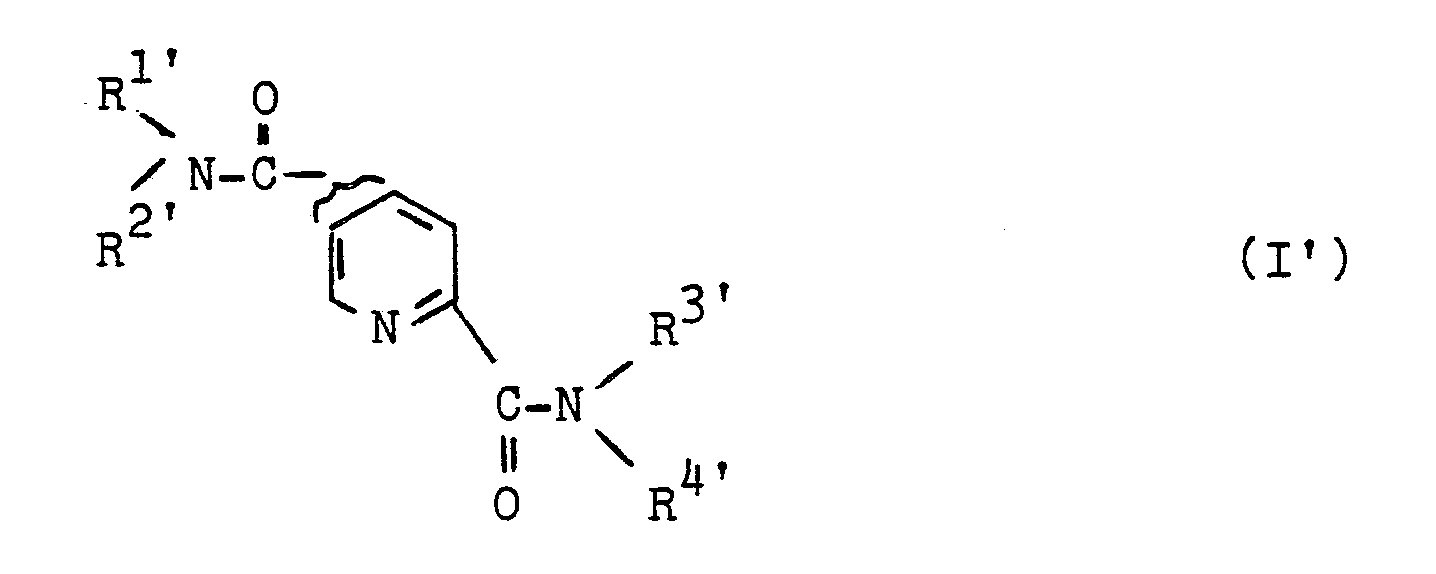
R1ʹ verzweigtes oder unverzweigtes C₁-C₁₂-Alkyl, welches gegebenenfalls einfach oder im Falle von C₂-C₁₂-Alkyl auch mehrfach substituiert ist mit Halogen, Hydroxy, Cyano, Amino, Carboxyl, Alkoxy, Alkoxycarbonyl, Alkylcarbonyloxy, Alkyl- oder Dialkylamino, wobei die Alkylreste 1-4 C-Atome aufweisen, und wobei im Falle der C₃- und C₄Alkyle diese auch verzweigt sein können, Indolyl oder Phenyl, welches seinerseits gegebenenfalls mit Halogen, Nitro, C₁-C₄-Alkoxy oder C₁-C₄-Alkyl 1-, 2- oder 3-fach substituiert ist, wobei die genannten C₃- und C₄-Alkylreste auch verzweigt sein können und wobei bei Mehrfachsubstitutionen die Substituenten auch voneinander unabhängig verschieden sein können
oder R1ʹ gesättigtes C₅-C₇-Cycloalkyl, welches gegebenenfalls benzoanneliert ist
oder R1ʹ Aryl oder Heteroaryl, welches gegebenenfalls seinerseits mit Halogen, Nitro, Cyano, C₁-C₄-Alkyl oder C₁-C₄-Alkoxy 1-, 2- oder 3-fach substituiert ist, wobei bei Mehrfachsubstitutionen die Substituenten auch voneinander unabhängig verschieden sein können und wobei im Falle der C₃- und C₄-Alkyle diese auch verzweigt sein können,
R2ʹ unabhängig von R1ʹ Wasserstoff ist oder eine der Bedeutungen wie für R1ʹ beschrieben hat, wobei R2ʹ auch identisch mit R1ʹ sein kann und
R3ʹ unabhängig von R1ʹ Wasserstoff ist oder eine der Bedeutungen wie für R1ʹ beschrieben hat, wobei R3ʹ auch identisch mit R1ʹ und/oder R2ʹ sein kann und
R4ʹ unabhängig von R1ʹ, R2ʹ und R3ʹ Wasserstoff ist oder eine der Bedeutungen wie für R1ʹ beschrieben hat wobei R4ʹ auch identisch mit R1ʹ und/oder R2ʹ und/oder R3ʹ sein kann
und wobei die Reste R1ʹ und R2ʹ und/oder R3ʹ und R4ʹ auch zusammen mit dem Stickstoffatom einen 5-, 6- oder 7-gliedrigen gesättigten heterocyclischen Ring bilden können, wobei der heterocyclische Ring auch ein zweites Stickstoffatom beinhalten kann und wobei der heterocyclische Ring seinerseits mit Phenyl oder Phenyl-C₁-C₃-alkyl substituiert sein kann,
bedeutet,
sowie deren physiologisch verträglichen Salzen, ausgenommen die Verbindungen, in denen R1ʹ = R3ʹ 2-Hydroxyethyl oder 2-(3,4-dimethoxyphenyl)ethyl oder mit Methyl und Brom disubstituiertes Phenyl und R2ʹ = R4ʹ Wassertoff bedeutet, dadurch gekennzeichnet, daß man
eine Verbindung der Formel II


eine Verbindung der Formel II


R1ʹ verzweigtes oder unverzweigtes C₁-C₁₂-Alkyl, welches gegebenenfalls einfach oder im Falle von C₂-C₁₂-Alkyle auch mehrfach substituiert ist mit Amino oder C₁-C₃-Alkoxy, wobei die Alkylreste 1-3 C-Atome aufweisen und im Falle der C₃-Alkylverbindungen auch verzweigt sein können oder
Indolyl oder Phenyl, welches substituiert sein kann mit C₁-C₄-Alkoxy oder Nitro
oder R1ʹ benzoanneliertes Cyclohexyl
oder R1ʹ Phenyl, welches gegebenenfalls mit 1, 2 oder 3 Cyano-, Halogen-, C₁-C₄-Alkyl- oder Nitrogruppen substituiert ist und wobei bei Mehrfachsubstitutionen die Substituenten auch unabhängig voneinander verschieden sein können
oder R1ʹ 2-, 3- oder 4-Pyridyl, 3-Thienyl oder Thiazolyl,
und
R2ʹ unabhängig von R1ʹ, Wasserstoff ist oder eine der Bedeutungen wie für R1ʹ beschrieben hat, wobei R2ʹ auch identisch mit R1ʹ sein kann und
R3ʹ unabhängig von R1ʹ und R2ʹ Wasserstoff ist oder eine der Bedeutungen wie für R1ʹ beschrieben hat, wobei R3ʹ auch identisch mit R1ʹ und/oder R2ʹ sein kann und
R4ʹ unabhängig von R1ʹ, R2ʹ und R3ʹ Wasserstoff ist oder eine der Bedeutungen wie für R1ʹ beschrieben hat, wobei R4ʹ auch identisch mit R1ʹ und/oder R2ʹ und/oder R3ʹ sein kann
bedeutet,
sowie deren physiologisch verträglichen Salzen, ausgenommen die Verbindungen, in denen R1ʹ = R3ʹ 2-Hydroxyethyl oder 2-(3,4-dimethoxyphenyl)ethyl oder mit Methyl und Brom disubstituiertes Phenyl und R2ʹ = R4ʹ Wasserstoff bedeutet.
R1ʹ verzweigtes oder unverzweigtes C₁-C₄-Alkyl, welches substituiert ist mit C₁-C₃-Alkoxy, wobei die Alkylreste 1 - 3 C-Atome aufweisen und im Falle der C₃-Alkylverbindungen auch verzweigt sein können, und
R2ʹ unabhängig von R1ʹ Wasserstoff ist oder eine der Bedeutungen wie für R1ʹ beschrieben hat, wobei R2ʹ auch identisch mit R1ʹ sein kann, und
R3ʹ unabhängig von R1ʹWasserstoff ist oder eine der Bedeutungen für R1ʹ beschrieben hat, wobei R3ʹ auch identisch mit R1ʹ und/oder R2ʹ sein kann und
R4ʹ unabhängig von R1ʹ, R2ʹ und R3ʹ Wasserstoff ist oder eine der Bedeutungen wie für R1ʹ beschrieben hat, wobei R4ʹ auch identisch mit R1ʹ und/oder R2ʹ und/oder R3ʹ sein kann
sowie deren physiologisch verträglichenSalzen.
Applications Claiming Priority (2)
| Application Number | Priority Date | Filing Date | Title |
|---|---|---|---|
| DE19873703959 DE3703959A1 (de) | 1987-02-10 | 1987-02-10 | Pyridin-2,4- und 2,5-dicarbonsaeureamide, verfahren zu ihrer herstellung, verwendung derselben sowie arzneimittel auf basis dieser verbindungen |
| DE3703959 | 1987-02-10 |
Publications (3)
| Publication Number | Publication Date |
|---|---|
| EP0278453A2 true EP0278453A2 (de) | 1988-08-17 |
| EP0278453A3 EP0278453A3 (en) | 1989-10-25 |
| EP0278453B1 EP0278453B1 (de) | 1994-12-28 |
Family
ID=6320590
Family Applications (1)
| Application Number | Title | Priority Date | Filing Date |
|---|---|---|---|
| EP88101792A Expired - Lifetime EP0278453B1 (de) | 1987-02-10 | 1988-02-08 | Pyridin-2,4- und 2,5-dicarbonsäureamide, Verfahren zu ihrer Herstellung, Verwendung derselben sowie Arzneimittel auf Basis dieser Verbindungen |
Country Status (20)
| Country | Link |
|---|---|
| US (1) | US5037839A (de) |
| EP (1) | EP0278453B1 (de) |
| JP (1) | JPH0641450B2 (de) |
| KR (1) | KR960011372B1 (de) |
| AR (1) | AR247732A1 (de) |
| AT (1) | ATE116299T1 (de) |
| AU (1) | AU599746B2 (de) |
| CA (1) | CA1334972C (de) |
| DE (2) | DE3703959A1 (de) |
| DK (1) | DK167804B1 (de) |
| ES (1) | ES2067448T3 (de) |
| FI (1) | FI91525C (de) |
| GR (1) | GR3014958T3 (de) |
| HU (1) | HU205905B (de) |
| IE (1) | IE65348B1 (de) |
| IL (1) | IL85362A (de) |
| NO (1) | NO174420C (de) |
| NZ (1) | NZ223433A (de) |
| PT (1) | PT86736B (de) |
| ZA (1) | ZA88896B (de) |
Cited By (16)
| Publication number | Priority date | Publication date | Assignee | Title |
|---|---|---|---|---|
| EP0409119A1 (de) * | 1989-07-20 | 1991-01-23 | Hoechst Aktiengesellschaft | N,N'-Bis(alkoxy-alkyl)-pyridin-2,4-dicarbonsäurediamide, Verfahren zu deren Herstellung sowie deren Verwendung |
| EP0438795A1 (de) * | 1990-01-16 | 1991-07-31 | Hoechst Aktiengesellschaft | Pyridin-2,4- und 2,5-dicarbonsäuredi(nitroxyalkyl) amide, Verfahren zu deren Herstellung sowie deren Verwendung |
| EP0430029A3 (en) * | 1989-11-23 | 1991-11-13 | Hoechst Aktiengesellschaft | Pyridin-2,4- and 2,5-dicarboxylic acid diamides, process for their preparation and their use |
| EP0414216A3 (en) * | 1989-08-25 | 1991-12-27 | Hoechst Aktiengesellschaft | Cyclic pyridin-2,4- and 2,5-dicarboxylic acid diamides, process for their preparation and their use |
| EP0463592A1 (de) * | 1990-06-28 | 1992-01-02 | Hoechst Aktiengesellschaft | y,4- und 2,5-substituierte Pyridin-N-oxide, Verfahren zu deren Herstellung sowie deren Verwendung |
| EP0498334A1 (de) * | 1991-02-05 | 1992-08-12 | Hoechst Aktiengesellschaft | 2,4- und 2,5-Bis-tetrazolylpyridine, Verfahren zu deren Herstellung sowie deren Verwendung als Arzneimittel |
| EP0504799A1 (de) * | 1991-03-18 | 1992-09-23 | Hoechst Aktiengesellschaft | Gemischte Pyridin-2,4- und 2,5-dicarbonsäurediamide, Verfahren zu ihrer Herstellung, Verwendung derselben sowie Arzneimittel auf Basis dieser Verbindungen |
| EP0479177A3 (en) * | 1990-10-01 | 1992-10-28 | Hoechst Aktiengesellschaft | 4- or 5-substituted pyridine-2-carboxylic acids, process for their preparation and their use as medicaments |
| EP0541042A1 (de) * | 1991-11-05 | 1993-05-12 | Hoechst Aktiengesellschaft | Pyridin-2,4- und 2,5-dicarbonsäureamide und deren Derivate, Verfahren zu ihrer Herstellung sowie deren Verwendung als Arzneimittel |
| EP0548883A1 (de) * | 1991-12-24 | 1993-06-30 | Hoechst Aktiengesellschaft | Substituierte Pyridin-N-oxide, Verfahren zu ihrer Herstellung sowie ihre Verwendung als Arzneimittel |
| EP0562512A1 (de) * | 1992-03-24 | 1993-09-29 | Hoechst Aktiengesellschaft | Sulfonamido- und Sulfonamidocarbonyl-pyridin-2-carbonsäureamide sowie ihre Pyridin-N-oxide, Verfahren zu ihrer Herstellung und ihre Verwendung als Arzneimittel |
| EP0567997A1 (de) * | 1992-04-30 | 1993-11-03 | Hoechst Aktiengesellschaft | 4- oder 5-(Sulf)imido- und (Sulfon)amidopyridine, sowie ihre Pyridin-N-oxide, Verfahren zu ihrer Herstellung und ihre Verwendung als Arzneimittel |
| US5260323A (en) * | 1990-06-28 | 1993-11-09 | Hoechst Aktiengesellschaft | 2,4- and 2,5-substituted pyridine-N-oxides, processes for their preparation and their use |
| EP0590520A1 (de) * | 1992-10-02 | 1994-04-06 | Hoechst Aktiengesellschaft | Acylsulfonamido-und Sulfonamidopyridin-2-carbonsäureester sowie ihre Pyridin-N-oxide, Verfahren zur ihrer Herstellung und ihre Verwendung als Arzneimittel |
| EP0353668B1 (de) * | 1988-08-04 | 1994-10-19 | Hoechst Aktiengesellschaft | Verbessertes Verfahren zur Herstellung von N,N-Bis(alkoxyalkyl)-pyridin -2,4-dicarbonsäurediamiden |
| WO1999021860A1 (en) * | 1997-10-24 | 1999-05-06 | Fibrogen, Inc. | Phenanthroline derivatives |
Families Citing this family (9)
| Publication number | Priority date | Publication date | Assignee | Title |
|---|---|---|---|---|
| US5153208A (en) * | 1987-02-10 | 1992-10-06 | Hoechst Aktiengesellschaft | Pyridine-2,4- and -2,5-dicarboxylic acid amides and their medicinal compositions and methods of use |
| US5512586A (en) * | 1987-02-10 | 1996-04-30 | Hoechst Aktiengesellschaft | Medicaments based on pyridine-2,4- and 2,5-dicarboxylic acid amides |
| DE3707429A1 (de) * | 1987-03-07 | 1988-09-15 | Hoechst Ag | Substituierte pyridin-2,4-dicarbonsaeure-derivate, verfahren zu ihrer herstellung, verwendung derselben sowie arzneimittel auf basis dieser verbindungen |
| US5425289A (en) * | 1993-10-21 | 1995-06-20 | Snap-On Incorporated | Bung tool |
| DE3931432A1 (de) * | 1989-09-21 | 1991-04-04 | Hoechst Ag | Pyrimidin-4,6-dicarbonsaeurediamide, verfahren zu deren herstellung sowie verwendung derselben sowie arzneimittel auf basis dieser verbindungen |
| US5789426A (en) * | 1995-01-20 | 1998-08-04 | Cornell Research Foundation, Inc. | Method for the treatment of fibroproliferative disorders by application of inhibitors of protein hydroxylation |
| US6046219A (en) * | 1995-01-20 | 2000-04-04 | Cornell Research Foundation, Inc. | Method for the treatment of conditions mediated by collagen formation together with cell proliferation by application of inhibitors of protein hydroxylation |
| FR2766187B1 (fr) * | 1997-07-17 | 2000-06-02 | Rhone Poulenc Rorer Sa | Derives de pyrazine, leur preparation et les medicaments les contenant |
| EP1932834B1 (de) * | 2006-12-11 | 2011-04-27 | The Genetics Company, Inc. | Aromatische 1,4-DI-Carboxylamide und deren Verwendung |
Family Cites Families (7)
| Publication number | Priority date | Publication date | Assignee | Title |
|---|---|---|---|---|
| US2852519A (en) * | 1954-12-27 | 1958-09-16 | Phillips Petroleum Co | Method for producing esters of heterocyclic nitrogen carboxylic acids |
| DE2803592A1 (de) * | 1978-01-27 | 1979-08-02 | Scott Eugene J Van | Therapeutisches mittel |
| DE3174885D1 (en) * | 1981-02-03 | 1986-07-31 | Ici Plc | Process for the extraction of metal values and novel metal extractants |
| DE3432094A1 (de) * | 1984-08-31 | 1986-03-06 | Hoechst Ag, 6230 Frankfurt | Ester der pyridin-2,4- und -2,5- dicarbonsaeure als arzneimittel zur inhibierung der prolin- und lysinhydroxylase |
| EP0198202B1 (de) * | 1985-03-09 | 1991-07-17 | Mitsubishi Corporation | N-Cyklohexyl-polycarboxamide Verbindung und ihre Derivate, Verfahren zu ihrer Herstellung und ihre Verwendung zur Herstellung von Acceptor-Donor-Komplexen |
| GB8702890D0 (en) * | 1987-02-10 | 1987-03-18 | Zyma Sa | Heterocyclic compounds |
| ATE113036T1 (de) * | 1988-08-04 | 1994-11-15 | Hoechst Ag | Verbessertes verfahren zur herstellung von n,n- bis(alkoxyalkyl)-pyridin -2,4- dicarbonsäurediamiden. |
-
1987
- 1987-02-10 DE DE19873703959 patent/DE3703959A1/de not_active Withdrawn
-
1988
- 1988-02-08 AR AR88310031A patent/AR247732A1/es active
- 1988-02-08 EP EP88101792A patent/EP0278453B1/de not_active Expired - Lifetime
- 1988-02-08 DE DE3852554T patent/DE3852554D1/de not_active Expired - Fee Related
- 1988-02-08 ES ES88101792T patent/ES2067448T3/es not_active Expired - Lifetime
- 1988-02-08 FI FI880556A patent/FI91525C/fi not_active IP Right Cessation
- 1988-02-08 NZ NZ223433A patent/NZ223433A/xx unknown
- 1988-02-08 IL IL8536288A patent/IL85362A/en not_active IP Right Cessation
- 1988-02-08 AT AT88101792T patent/ATE116299T1/de not_active IP Right Cessation
- 1988-02-09 AU AU11452/88A patent/AU599746B2/en not_active Ceased
- 1988-02-09 CA CA000558496A patent/CA1334972C/en not_active Expired - Fee Related
- 1988-02-09 ZA ZA880896A patent/ZA88896B/xx unknown
- 1988-02-09 IE IE35288A patent/IE65348B1/en not_active IP Right Cessation
- 1988-02-09 PT PT86736A patent/PT86736B/pt not_active IP Right Cessation
- 1988-02-09 DK DK065988A patent/DK167804B1/da not_active IP Right Cessation
- 1988-02-09 JP JP63026723A patent/JPH0641450B2/ja not_active Expired - Lifetime
- 1988-02-09 KR KR1019880001200A patent/KR960011372B1/ko not_active Expired - Fee Related
- 1988-02-09 NO NO880558A patent/NO174420C/no not_active IP Right Cessation
- 1988-02-10 HU HU88609A patent/HU205905B/hu not_active IP Right Cessation
-
1989
- 1989-11-13 US US07/434,402 patent/US5037839A/en not_active Expired - Fee Related
-
1995
- 1995-02-03 GR GR950400026T patent/GR3014958T3/el unknown
Cited By (17)
| Publication number | Priority date | Publication date | Assignee | Title |
|---|---|---|---|---|
| EP0353668B1 (de) * | 1988-08-04 | 1994-10-19 | Hoechst Aktiengesellschaft | Verbessertes Verfahren zur Herstellung von N,N-Bis(alkoxyalkyl)-pyridin -2,4-dicarbonsäurediamiden |
| EP0409119A1 (de) * | 1989-07-20 | 1991-01-23 | Hoechst Aktiengesellschaft | N,N'-Bis(alkoxy-alkyl)-pyridin-2,4-dicarbonsäurediamide, Verfahren zu deren Herstellung sowie deren Verwendung |
| EP0414216A3 (en) * | 1989-08-25 | 1991-12-27 | Hoechst Aktiengesellschaft | Cyclic pyridin-2,4- and 2,5-dicarboxylic acid diamides, process for their preparation and their use |
| US5240921A (en) * | 1989-08-25 | 1993-08-31 | Hoechst Aktiengesellschaft | Cyclic pyridine-2,4- and -2,5-dicarboxylic acid diamides, processes for their preparation and their use |
| EP0430029A3 (en) * | 1989-11-23 | 1991-11-13 | Hoechst Aktiengesellschaft | Pyridin-2,4- and 2,5-dicarboxylic acid diamides, process for their preparation and their use |
| EP0438795A1 (de) * | 1990-01-16 | 1991-07-31 | Hoechst Aktiengesellschaft | Pyridin-2,4- und 2,5-dicarbonsäuredi(nitroxyalkyl) amide, Verfahren zu deren Herstellung sowie deren Verwendung |
| US5260323A (en) * | 1990-06-28 | 1993-11-09 | Hoechst Aktiengesellschaft | 2,4- and 2,5-substituted pyridine-N-oxides, processes for their preparation and their use |
| EP0463592A1 (de) * | 1990-06-28 | 1992-01-02 | Hoechst Aktiengesellschaft | y,4- und 2,5-substituierte Pyridin-N-oxide, Verfahren zu deren Herstellung sowie deren Verwendung |
| EP0479177A3 (en) * | 1990-10-01 | 1992-10-28 | Hoechst Aktiengesellschaft | 4- or 5-substituted pyridine-2-carboxylic acids, process for their preparation and their use as medicaments |
| EP0498334A1 (de) * | 1991-02-05 | 1992-08-12 | Hoechst Aktiengesellschaft | 2,4- und 2,5-Bis-tetrazolylpyridine, Verfahren zu deren Herstellung sowie deren Verwendung als Arzneimittel |
| EP0504799A1 (de) * | 1991-03-18 | 1992-09-23 | Hoechst Aktiengesellschaft | Gemischte Pyridin-2,4- und 2,5-dicarbonsäurediamide, Verfahren zu ihrer Herstellung, Verwendung derselben sowie Arzneimittel auf Basis dieser Verbindungen |
| EP0541042A1 (de) * | 1991-11-05 | 1993-05-12 | Hoechst Aktiengesellschaft | Pyridin-2,4- und 2,5-dicarbonsäureamide und deren Derivate, Verfahren zu ihrer Herstellung sowie deren Verwendung als Arzneimittel |
| EP0548883A1 (de) * | 1991-12-24 | 1993-06-30 | Hoechst Aktiengesellschaft | Substituierte Pyridin-N-oxide, Verfahren zu ihrer Herstellung sowie ihre Verwendung als Arzneimittel |
| EP0562512A1 (de) * | 1992-03-24 | 1993-09-29 | Hoechst Aktiengesellschaft | Sulfonamido- und Sulfonamidocarbonyl-pyridin-2-carbonsäureamide sowie ihre Pyridin-N-oxide, Verfahren zu ihrer Herstellung und ihre Verwendung als Arzneimittel |
| EP0567997A1 (de) * | 1992-04-30 | 1993-11-03 | Hoechst Aktiengesellschaft | 4- oder 5-(Sulf)imido- und (Sulfon)amidopyridine, sowie ihre Pyridin-N-oxide, Verfahren zu ihrer Herstellung und ihre Verwendung als Arzneimittel |
| EP0590520A1 (de) * | 1992-10-02 | 1994-04-06 | Hoechst Aktiengesellschaft | Acylsulfonamido-und Sulfonamidopyridin-2-carbonsäureester sowie ihre Pyridin-N-oxide, Verfahren zur ihrer Herstellung und ihre Verwendung als Arzneimittel |
| WO1999021860A1 (en) * | 1997-10-24 | 1999-05-06 | Fibrogen, Inc. | Phenanthroline derivatives |
Also Published As
Similar Documents
| Publication | Publication Date | Title |
|---|---|---|
| EP0278453B1 (de) | Pyridin-2,4- und 2,5-dicarbonsäureamide, Verfahren zu ihrer Herstellung, Verwendung derselben sowie Arzneimittel auf Basis dieser Verbindungen | |
| EP0418797B1 (de) | Pyrimidin-4,6-dicarbonsäurediamide, Verfahren zu deren Herstellung sowie Verwendung derselben sowie Arzneimittel auf Basis dieser Verbindungen | |
| EP0463592B1 (de) | y,4- und 2,5-substituierte Pyridin-N-oxide, Verfahren zu deren Herstellung sowie deren Verwendung | |
| EP0278452B1 (de) | Pyridin-2,4- und 2,5-dicarbonsäure-Derivate, Verfahren zu ihrer Herstellung, Verwendung derselben sowie Arzneimittel auf Basis dieser Verbindungen | |
| EP1455790B1 (de) | Verwendung von pyridin-2,4-dicarbons urediamiden und pyrimid in-4,6-dicarbons urediamiden zur selektiven inhibierung von kollagenasen | |
| EP0278454B1 (de) | Pyridin-2,4- und 2,5-dicarbonsäure-Derivate, Verfahren zu ihrer Herstellung, Verwendung derselben sowie Arzneimittel auf Basis dieser Verbindungen | |
| EP0281943B1 (de) | Substituierte Pyridin-2,4-dicarbonsäure-Derivate, Verfahren zu ihrer Herstellung, Verwendung derselben sowie Arzneimittel auf Basis dieser Verbindungen | |
| EP0409119B1 (de) | N,N'-Bis(alkoxy-alkyl)-pyridin-2,4-dicarbonsäurediamide, Verfahren zu deren Herstellung sowie deren Verwendung | |
| EP0479177A2 (de) | 4- Oder 5-substituierte Pyridin-2-carbonsäuren, Verfahren zu deren Herstellung sowie deren Verwendung als Arzneimittel | |
| DE3928144A1 (de) | Zyklische pyridin-2,4- und -2,5-dicarbonsaeurediamide, verfahren zu deren herstellung sowie deren verwendung | |
| US5153208A (en) | Pyridine-2,4- and -2,5-dicarboxylic acid amides and their medicinal compositions and methods of use | |
| US5672614A (en) | Pharmaceutical use of pyridine-2,4- and -2,5-dicarboxylic acid amides | |
| DE4001002A1 (de) | Pyridin-2,4-und 2,5-dicarbonsaeuredi-(nitroxyalkyl)amide, verfahren zu ihrer herstellung sowie deren verwendung | |
| US5238948A (en) | Pyridine-2,4- and -2,5-dicarboxylic acid derivatives and medicaments based on these compounds | |
| DE4233124A1 (de) | Acylsulfonamido- und Sulfonamidopyridin-2-carbonsäureester sowie ihre Pyridin-N-oxide, Verfahren zu ihrer Herstellung und ihre Verwendung als Arzneimittel | |
| EP0427160B1 (de) | Benzylselenobenzamide von Aminopyridinen und Picolylaminen | |
| DE3938805A1 (de) | Pyridin-2,4- und 2,5-dicarbonsaeurediamide, verfahren zu deren herstellung sowie deren verwendung | |
| EP0479178A2 (de) | 4- oder 5-substituierte Pyridin-2-carbonsäuren, Verfahren zu deren Herstellung sowie deren Verwendung als Arzneimittel | |
| EP0504799A1 (de) | Gemischte Pyridin-2,4- und 2,5-dicarbonsäurediamide, Verfahren zu ihrer Herstellung, Verwendung derselben sowie Arzneimittel auf Basis dieser Verbindungen | |
| EP0498334A1 (de) | 2,4- und 2,5-Bis-tetrazolylpyridine, Verfahren zu deren Herstellung sowie deren Verwendung als Arzneimittel |
Legal Events
| Date | Code | Title | Description |
|---|---|---|---|
| PUAI | Public reference made under article 153(3) epc to a published international application that has entered the european phase |
Free format text: ORIGINAL CODE: 0009012 |
|
| AK | Designated contracting states |
Kind code of ref document: A2 Designated state(s): AT BE CH DE ES FR GB GR IT LI LU NL SE |
|
| PUAL | Search report despatched |
Free format text: ORIGINAL CODE: 0009013 |
|
| AK | Designated contracting states |
Kind code of ref document: A3 Designated state(s): AT BE CH DE ES FR GB GR IT LI LU NL SE |
|
| 17P | Request for examination filed |
Effective date: 19900314 |
|
| 17Q | First examination report despatched |
Effective date: 19920407 |
|
| GRAA | (expected) grant |
Free format text: ORIGINAL CODE: 0009210 |
|
| AK | Designated contracting states |
Kind code of ref document: B1 Designated state(s): AT BE CH DE ES FR GB GR IT LI LU NL SE |
|
| REF | Corresponds to: |
Ref document number: 116299 Country of ref document: AT Date of ref document: 19950115 Kind code of ref document: T |
|
| REF | Corresponds to: |
Ref document number: 3852554 Country of ref document: DE Date of ref document: 19950209 |
|
| ET | Fr: translation filed | ||
| ITF | It: translation for a ep patent filed | ||
| REG | Reference to a national code |
Ref country code: ES Ref legal event code: FG2A Ref document number: 2067448 Country of ref document: ES Kind code of ref document: T3 |
|
| GBT | Gb: translation of ep patent filed (gb section 77(6)(a)/1977) |
Effective date: 19950303 |
|
| REG | Reference to a national code |
Ref country code: GR Ref legal event code: FG4A Free format text: 3014958 |
|
| PLBE | No opposition filed within time limit |
Free format text: ORIGINAL CODE: 0009261 |
|
| STAA | Information on the status of an ep patent application or granted ep patent |
Free format text: STATUS: NO OPPOSITION FILED WITHIN TIME LIMIT |
|
| 26N | No opposition filed | ||
| PGFP | Annual fee paid to national office [announced via postgrant information from national office to epo] |
Ref country code: LU Payment date: 20001201 Year of fee payment: 14 |
|
| PGFP | Annual fee paid to national office [announced via postgrant information from national office to epo] |
Ref country code: DE Payment date: 20001212 Year of fee payment: 14 |
|
| PGFP | Annual fee paid to national office [announced via postgrant information from national office to epo] |
Ref country code: SE Payment date: 20001218 Year of fee payment: 14 Ref country code: NL Payment date: 20001218 Year of fee payment: 14 Ref country code: FR Payment date: 20001218 Year of fee payment: 14 Ref country code: AT Payment date: 20001218 Year of fee payment: 14 |
|
| PGFP | Annual fee paid to national office [announced via postgrant information from national office to epo] |
Ref country code: GB Payment date: 20001219 Year of fee payment: 14 |
|
| PGFP | Annual fee paid to national office [announced via postgrant information from national office to epo] |
Ref country code: CH Payment date: 20001221 Year of fee payment: 14 |
|
| PGFP | Annual fee paid to national office [announced via postgrant information from national office to epo] |
Ref country code: GR Payment date: 20001229 Year of fee payment: 14 |
|
| PGFP | Annual fee paid to national office [announced via postgrant information from national office to epo] |
Ref country code: ES Payment date: 20010117 Year of fee payment: 14 |
|
| PGFP | Annual fee paid to national office [announced via postgrant information from national office to epo] |
Ref country code: BE Payment date: 20010315 Year of fee payment: 14 |
|
| REG | Reference to a national code |
Ref country code: GB Ref legal event code: IF02 |
|
| PG25 | Lapsed in a contracting state [announced via postgrant information from national office to epo] |
Ref country code: LU Free format text: LAPSE BECAUSE OF NON-PAYMENT OF DUE FEES Effective date: 20020208 Ref country code: GB Free format text: LAPSE BECAUSE OF NON-PAYMENT OF DUE FEES Effective date: 20020208 Ref country code: AT Free format text: LAPSE BECAUSE OF NON-PAYMENT OF DUE FEES Effective date: 20020208 |
|
| PG25 | Lapsed in a contracting state [announced via postgrant information from national office to epo] |
Ref country code: SE Free format text: LAPSE BECAUSE OF NON-PAYMENT OF DUE FEES Effective date: 20020209 Ref country code: ES Free format text: LAPSE BECAUSE OF NON-PAYMENT OF DUE FEES Effective date: 20020209 |
|
| PG25 | Lapsed in a contracting state [announced via postgrant information from national office to epo] |
Ref country code: LI Free format text: LAPSE BECAUSE OF NON-PAYMENT OF DUE FEES Effective date: 20020228 Ref country code: CH Free format text: LAPSE BECAUSE OF NON-PAYMENT OF DUE FEES Effective date: 20020228 Ref country code: BE Free format text: LAPSE BECAUSE OF NON-PAYMENT OF DUE FEES Effective date: 20020228 |
|
| BERE | Be: lapsed |
Owner name: HOECHST A.G. Effective date: 20020228 |
|
| PG25 | Lapsed in a contracting state [announced via postgrant information from national office to epo] |
Ref country code: NL Free format text: LAPSE BECAUSE OF NON-PAYMENT OF DUE FEES Effective date: 20020901 |
|
| PG25 | Lapsed in a contracting state [announced via postgrant information from national office to epo] |
Ref country code: DE Free format text: LAPSE BECAUSE OF NON-PAYMENT OF DUE FEES Effective date: 20020903 |
|
| PG25 | Lapsed in a contracting state [announced via postgrant information from national office to epo] |
Ref country code: GR Free format text: LAPSE BECAUSE OF NON-PAYMENT OF DUE FEES Effective date: 20020909 |
|
| EUG | Se: european patent has lapsed |
Ref document number: 88101792.5 |
|
| GBPC | Gb: european patent ceased through non-payment of renewal fee |
Effective date: 20020208 |
|
| REG | Reference to a national code |
Ref country code: CH Ref legal event code: PL |
|
| PG25 | Lapsed in a contracting state [announced via postgrant information from national office to epo] |
Ref country code: FR Free format text: LAPSE BECAUSE OF NON-PAYMENT OF DUE FEES Effective date: 20021031 |
|
| NLV4 | Nl: lapsed or anulled due to non-payment of the annual fee |
Effective date: 20020901 |
|
| REG | Reference to a national code |
Ref country code: FR Ref legal event code: ST |
|
| REG | Reference to a national code |
Ref country code: ES Ref legal event code: FD2A Effective date: 20030922 |
|
| PG25 | Lapsed in a contracting state [announced via postgrant information from national office to epo] |
Ref country code: IT Free format text: LAPSE BECAUSE OF NON-PAYMENT OF DUE FEES;WARNING: LAPSES OF ITALIAN PATENTS WITH EFFECTIVE DATE BEFORE 2007 MAY HAVE OCCURRED AT ANY TIME BEFORE 2007. THE CORRECT EFFECTIVE DATE MAY BE DIFFERENT FROM THE ONE RECORDED. Effective date: 20050208 |