EP0278024A1 - Procédé et dispositif pour déterminer objectivement et mesurer quantitivement le niveau d'intérêt de personnes, testées, en présence de materiel visuel ou de parties d'un tel materiel - Google Patents
Procédé et dispositif pour déterminer objectivement et mesurer quantitivement le niveau d'intérêt de personnes, testées, en présence de materiel visuel ou de parties d'un tel materiel Download PDFInfo
- Publication number
- EP0278024A1 EP0278024A1 EP87101762A EP87101762A EP0278024A1 EP 0278024 A1 EP0278024 A1 EP 0278024A1 EP 87101762 A EP87101762 A EP 87101762A EP 87101762 A EP87101762 A EP 87101762A EP 0278024 A1 EP0278024 A1 EP 0278024A1
- Authority
- EP
- European Patent Office
- Prior art keywords
- image
- test
- image material
- computer
- light
- Prior art date
- Legal status (The legal status is an assumption and is not a legal conclusion. Google has not performed a legal analysis and makes no representation as to the accuracy of the status listed.)
- Granted
Links
Images

Classifications
-
- G—PHYSICS
- G09—EDUCATION; CRYPTOGRAPHY; DISPLAY; ADVERTISING; SEALS
- G09B—EDUCATIONAL OR DEMONSTRATION APPLIANCES; APPLIANCES FOR TEACHING, OR COMMUNICATING WITH, THE BLIND, DEAF OR MUTE; MODELS; PLANETARIA; GLOBES; MAPS; DIAGRAMS
- G09B19/00—Teaching not covered by other main groups of this subclass
Definitions
- the present invention relates to a method for objectively ascertaining or quantitatively measuring the level of interest of test persons in submitted image material and its parts, and a device for carrying out this method.
- this method can be used in advertising effectiveness research on advertising materials such as advertisements, images of packs and the like.
- the method and the device are not limited to this, but can also be used in the field of medicine (neurology and psychology) and in the broad area of research into the world of work.
- the present invention is therefore based on the object of improving the known, more or less subjective methods in such a way that one can speak of an objective determination or quantitative measurement of the level of interest of test persons in submitted image material and its parts.
- the aim is to achieve a new quality of results determination and thus of the results themselves, which enables an excellent assessment of analog real conditions.
- the aim of the invention is therefore to provide a method and a device for carrying out the method, with which knowledge can be obtained which serves to check theoretical assumptions of perception psychology by documenting actual perception processes on real objects. This task or the goal are achieved by the in claim 1 characterized method or solved by the device characterized in more detail in claim 10.
- the method according to the invention thus allows not only short-term presentations, such as the existing electrical tachistoscopes, but an actual quantitative measurement of what the test person or the viewer is interested in, what he has looked at in the image material and which parts or elements thereof for him or are of interest to him and which are not, so that this can then be related to the concept behind the design.
- the method according to the invention delivers the following results: conclusions can be drawn about the interest, understanding and attention of test subjects, so that after evaluation has been carried out, corrections can be made to the real advertisement to be placed or the poster actually set up, in order to achieve even higher and better awareness and recognizability for the desired detail or a certain image area or motif.
- a situation is thus created in which visual material, such as advertisements and the like, is presented as a test object to a test person in a precisely defined time, so that they can "perceive" the image information, ie the visual material is illuminated for an extremely short time, so that only one extremely fleeting impression is produced.
- the image material is then darkened in such a way that the test person can no longer extract any further information from the submitted image.
- this test person is now given the possibility, using a movable light source or lighting device, of generating a light cone in order to illuminate those parts or partial aspects of the image which are "of interest” to them. In this way it becomes possible to physically grasp the individual interest or level of interest and thus quantify.
- the time for improved illumination of the desired partial image areas is so short that the test person can only illuminate the coordinate points that are important to them with prominent content.
- the test person executes at a slower speed compared to the very fast, fleeting eye, ie exactly what otherwise happens when "viewing" an advertisement or a poster.
- a plurality of coordinates of the projected light cone surfaces and their duration of stay are digitally recorded by a light-sensitive scanning device or a suitable camera.
- the digitized coordinate and time data are stored in a computer with an interface and can be selected according to the selection criteria.
- This computer or computer can output the stored information numerically and graphically per individual viewer as well as about all viewers or test subjects of an advertisement, as a result of which the focal points of observation, the course of the gaze between them and the length of stay in the main focal points can be reproduced.
- the method and device according to the invention shows that any direct or indirect influence by the test leader or evaluating person is excluded on the basis of the exactly collected data, so that the statistical evaluation according to the invention can be considered objectively unaffected. It should be clear that, on the basis of the ascertained and stored digital data, the statistician or computer scientist as a specialist can readily process and process this data material in order to achieve certain specific statements.
- the system or device for performing the method according to the invention is generally designated 10. It consists of a device 12 for holding and positioning image material 14, which rotates in a plane perpendicular to the axis of the scanning device / camera 18 in front of a test person, not shown, in an interval control by means of a motor 15 on an endless conveyor.
- the image material 14 comprises a so-called test block of twelve displays, in which the test display is contained at a specific point. This test block is presented to each test person absolutely identically. This not only enables an exact recording of what the Test subjects, but also how the viewing and viewing of one ad differs from the other or the rest.
- the number of consecutive ads in the test block is in no way critical, but can be chosen in any frame.
- the displays of the image material 14 are the usual magazine formats. Larger and smaller formats are, however, also conceivable, for example when researching the advertising effectiveness of packs or posters.
- the amount of light falling on the display is regulated for short-term illumination by the lighting devices 16 so that the viewer perceives the display only very imperfectly, but - for rough orientation - in its entirety. Short-term illumination over a period of 0.25 seconds has proven to be particularly suitable. Following this "perception", the image material 14 or the display is darkened by the lighting device 16 in such a way that the metered light intensity is no longer sufficient for the test person to continue recording the image information.
- the test person can then use a movable lighting device 18, in particular a light beam, to illuminate the desired partial image area of the display in an improved manner within the predetermined fixed interval time per image of about 5-7 seconds, i.e. to view the information that interested him or her must also find in order to understand the image information as a whole as a whole.
- the diameter of the light cone has proven to be favorable for displays of approximately 3 cm.
- the lighting device 18 has a handle 19. Both the lighting device 16 and 18 are connected via corresponding lines to a relay control 30 for regulating the lighting and its intensity.
- the Relay control 30 and also motor 15 are connected via interface 25 to computer 24, which controls the entire process.
- the display image with the light spot moving on it - corresponding to the eye-moving light spot - is recorded by a camera / light-sensitive scanner 20 connected to the relay control 30 and the computer 24.
- the camera 20 has or is connected to a digitizing device 22 in order to record the digital acquisition of a plurality of coordinates of the projected light cone surfaces and their duration of stay, as well as the path between the points under consideration.
- the camera (20) is commercially available and can be from the Bosch brand, for example.
- the digitizing device (22) can also be part of the computer (24). The digitizing device converts the video signals from the camera into digital ones and checks the level. It determines how many light points are registered per scanning process.
- the computer 24 with an interface 25 with a screen 28 connected to it and the printers 26 and 27, which are devices from Compaq, Philips, Star, Sekonic, are also commercially available.
- the statistical evaluation of the stored and selected data can then be carried out by numerical and / or graphic printing or by reproduction on the screen 28, the main points of observation, the course of the gaze between them and the length of stay in the main points of observation being determined.
- the computer 24 can output this information numerically and / or graphically per test person as well as about all test persons in an advertisement.
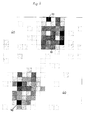
- FIG. 2 for example, such focal points of observation of 27 test persons are shown for an advertisement image, the heavily hatched squares 40 being the actual difficulties represent dots, while the less hatched squares 50 are of less interest to the test subjects and the white areas 60 were not illuminated and were therefore not noticed by the test subjects.
- This objective graphic evaluation shows five observation focal points 40 in the upper right area and in the lower left area of the display, and in the surrounding area there are also such quadrants with interest, which is, however, somewhat smaller (50), while in the upper left and lower right half the Practical white areas 60 indicate that the large number of test subjects saw and felt uninteresting text and / or motif information.
- the person skilled in the art can easily change the size of the quadrants and their number by modifying the stored parameters in order to arrive at coarse, clearer on the one hand and detailed representations on the other hand. It is also conceivable that the quadrants are represented in a circular shape. The diameter of the circles or the edge length of the quadrants can be selected depending on the coordinate density. Certain values can be specified to what density the observations should still be recorded.
- the representation of the gaze course of individual, several or all test subjects poses no problem.
- Fixed points represent the focal points of observation, whereby the order in which the test subjects looked at these focal points is determined. From this, a frequency distribution per focus can easily be displayed. The maximum of this distribution then indicates at which point in time this focus was observed. A number can then be assigned to each focus so that the chronological, graphical linking of these focal points results in a representative gaze course for all test subjects.
- the length of stay in the main points of observation can be shown separately and / or graphically for the individual test subjects based on the determined times or for all of them.
Landscapes
- Business, Economics & Management (AREA)
- Engineering & Computer Science (AREA)
- Entrepreneurship & Innovation (AREA)
- Physics & Mathematics (AREA)
- Educational Administration (AREA)
- Educational Technology (AREA)
- General Physics & Mathematics (AREA)
- Theoretical Computer Science (AREA)
- Illuminated Signs And Luminous Advertising (AREA)
- Investigating Materials By The Use Of Optical Means Adapted For Particular Applications (AREA)
Priority Applications (2)
| Application Number | Priority Date | Filing Date | Title |
|---|---|---|---|
| DE8787101762T DE3771205D1 (de) | 1987-02-09 | 1987-02-09 | Verfahren und vorrichtung zum objektiven ermitteln, bzw. quantitativen messen des interessenniveaus von testpersonen an vorgelegtem bildmaterial und dessen teilen. |
| EP19870101762 EP0278024B1 (fr) | 1987-02-09 | 1987-02-09 | Procédé et dispositif pour déterminer objectivement et mesurer quantitivement le niveau d'intérêt de personnes, testées, en présence de materiel visuel ou de parties d'un tel materiel |
Applications Claiming Priority (1)
| Application Number | Priority Date | Filing Date | Title |
|---|---|---|---|
| EP19870101762 EP0278024B1 (fr) | 1987-02-09 | 1987-02-09 | Procédé et dispositif pour déterminer objectivement et mesurer quantitivement le niveau d'intérêt de personnes, testées, en présence de materiel visuel ou de parties d'un tel materiel |
Publications (2)
| Publication Number | Publication Date |
|---|---|
| EP0278024A1 true EP0278024A1 (fr) | 1988-08-17 |
| EP0278024B1 EP0278024B1 (fr) | 1991-07-03 |
Family
ID=8196736
Family Applications (1)
| Application Number | Title | Priority Date | Filing Date |
|---|---|---|---|
| EP19870101762 Expired - Lifetime EP0278024B1 (fr) | 1987-02-09 | 1987-02-09 | Procédé et dispositif pour déterminer objectivement et mesurer quantitivement le niveau d'intérêt de personnes, testées, en présence de materiel visuel ou de parties d'un tel materiel |
Country Status (2)
| Country | Link |
|---|---|
| EP (1) | EP0278024B1 (fr) |
| DE (1) | DE3771205D1 (fr) |
Cited By (1)
| Publication number | Priority date | Publication date | Assignee | Title |
|---|---|---|---|---|
| US8249931B2 (en) | 1999-12-17 | 2012-08-21 | Promovu, Inc. | System for selectively communicating promotional information to a person |
Citations (2)
| Publication number | Priority date | Publication date | Assignee | Title |
|---|---|---|---|---|
| CH130039A (de) * | 1927-01-29 | 1928-11-15 | Adolf Sulger | Reklameapparat. |
| FR2448757A1 (fr) * | 1979-02-08 | 1980-09-05 | Centre Nat Etd Spatiales | Dispositif pour reconstituer l'image d'un phenomene anterieurement observe par un temoin, compositeur d'images s'y rapportant, et procede pour sa mise en oeuvre |
-
1987
- 1987-02-09 EP EP19870101762 patent/EP0278024B1/fr not_active Expired - Lifetime
- 1987-02-09 DE DE8787101762T patent/DE3771205D1/de not_active Expired - Fee Related
Patent Citations (2)
| Publication number | Priority date | Publication date | Assignee | Title |
|---|---|---|---|---|
| CH130039A (de) * | 1927-01-29 | 1928-11-15 | Adolf Sulger | Reklameapparat. |
| FR2448757A1 (fr) * | 1979-02-08 | 1980-09-05 | Centre Nat Etd Spatiales | Dispositif pour reconstituer l'image d'un phenomene anterieurement observe par un temoin, compositeur d'images s'y rapportant, et procede pour sa mise en oeuvre |
Non-Patent Citations (2)
| Title |
|---|
| ELEKTOR, Band 3, Nr. 10, Oktober 1977, Elektor Publishers Ltd., GB; "Subliminal perception tester" * |
| MEDICAL & BIOLOGICAL ENGINEERING & COMPUTING, Band 22, Nr. 4, Juli 1984, Seiten 353-360, IFMBE, Stevenage, Herts, GB; J.P.J. DE VALK et al.: "Analysis of eye fixations during the diagnostic interpretation of chest radiographs" * |
Cited By (2)
| Publication number | Priority date | Publication date | Assignee | Title |
|---|---|---|---|---|
| US8249931B2 (en) | 1999-12-17 | 2012-08-21 | Promovu, Inc. | System for selectively communicating promotional information to a person |
| US8458032B2 (en) | 1999-12-17 | 2013-06-04 | Promovu, Inc. | System for selectively communicating promotional information to a person |
Also Published As
| Publication number | Publication date |
|---|---|
| EP0278024B1 (fr) | 1991-07-03 |
| DE3771205D1 (de) | 1991-08-08 |
Similar Documents
| Publication | Publication Date | Title |
|---|---|---|
| DE19544178B4 (de) | Vorrichtung zum scannenden Digitalisieren von Bildvorlagen sowie Verfahren zu deren Betrieb | |
| DE4403496B4 (de) | Verfahren und Vorrichtung zur Verarbeitung von Antworten zu Testfragen | |
| DE602004008681T2 (de) | Mikroskop-System und Verfahren | |
| EP1056046B1 (fr) | Procédé de traitement d'images radiographiques | |
| DE3020687C2 (fr) | ||
| DE10034606A1 (de) | Verfahren zur Bereitstellung von fertigungsbezogenen Daten in einer Serienfertigung von Fertigungsobjekten, insbesondere von Kraftfahrzeugen | |
| EP1263545B1 (fr) | Procede et dispositif pour guider un rayon laser sur un objet | |
| DE10007705A1 (de) | Verfahren zur Anpassung einer Brille | |
| DE2507174A1 (de) | Verfahren und vorrichtung zur erzeugung digitaler repraesentationen eines objektes | |
| DE69116543T2 (de) | Anordnung zur intelligenz-prüfung | |
| DE10320268B4 (de) | Vorrichtung und Verfahren zum Auffinden und Darstellen von Informationen | |
| EP0278024B1 (fr) | Procédé et dispositif pour déterminer objectivement et mesurer quantitivement le niveau d'intérêt de personnes, testées, en présence de materiel visuel ou de parties d'un tel materiel | |
| EP1983450A2 (fr) | Procédé et dispositif de détermination et de préparation d'informations sur une image | |
| EP1300108B1 (fr) | Méthode permettant d'obtenir, d'évaluer et d'analyser les sequences de vision | |
| DE3603920C2 (fr) | ||
| WO1986005374A1 (fr) | Procede et dispositif de presentation optique de montures de lunettes | |
| DE19647341C1 (de) | Verfahren und Anordnung zur Projektion und Rezeption von visuellen und audiovisuellen Botschaften und deren Analyse für die Ermittlung der Reichweite und des Käuferverhaltens | |
| DE102017009153A1 (de) | Anordnung und Verfahren zur Inspektion von bewegten plattenförmigen Objekten | |
| DE19538004A1 (de) | Verfahren zur Grobklassifizierung von Objekten | |
| DE2322773C3 (de) | Anzeigevorrichtung eines Mikrobildlesegerätes | |
| DE20321163U1 (de) | Vorrichtung zum Untersuchen von Bildern | |
| CH679082A5 (fr) | ||
| DE2443410B2 (de) | Vorrichtung zum Zählen mikrobiologischer Kolonien | |
| EP0710883B1 (fr) | Méthode d'addition d'un support d'information au résultat d'une commande produite par un labo photo | |
| DE102008012187A1 (de) | Darstellung von Bildschirminhalten in Abhängigkeit von Kompetenzfunktionen |
Legal Events
| Date | Code | Title | Description |
|---|---|---|---|
| PUAI | Public reference made under article 153(3) epc to a published international application that has entered the european phase |
Free format text: ORIGINAL CODE: 0009012 |
|
| AK | Designated contracting states |
Kind code of ref document: A1 Designated state(s): AT BE CH DE ES FR GB GR IT LI LU NL SE |
|
| RBV | Designated contracting states (corrected) |
Designated state(s): DE FR GB |
|
| RBV | Designated contracting states (corrected) |
Designated state(s): DE FR GB |
|
| 17P | Request for examination filed |
Effective date: 19880907 |
|
| 17Q | First examination report despatched |
Effective date: 19901130 |
|
| GRAA | (expected) grant |
Free format text: ORIGINAL CODE: 0009210 |
|
| AK | Designated contracting states |
Kind code of ref document: B1 Designated state(s): DE FR GB |
|
| REF | Corresponds to: |
Ref document number: 3771205 Country of ref document: DE Date of ref document: 19910808 |
|
| GBT | Gb: translation of ep patent filed (gb section 77(6)(a)/1977) | ||
| ET | Fr: translation filed | ||
| PLBE | No opposition filed within time limit |
Free format text: ORIGINAL CODE: 0009261 |
|
| STAA | Information on the status of an ep patent application or granted ep patent |
Free format text: STATUS: NO OPPOSITION FILED WITHIN TIME LIMIT |
|
| 26N | No opposition filed | ||
| REG | Reference to a national code |
Ref country code: GB Ref legal event code: IF02 |
|
| PGFP | Annual fee paid to national office [announced via postgrant information from national office to epo] |
Ref country code: DE Payment date: 20030113 Year of fee payment: 17 |
|
| PGFP | Annual fee paid to national office [announced via postgrant information from national office to epo] |
Ref country code: GB Payment date: 20030116 Year of fee payment: 17 |
|
| PGFP | Annual fee paid to national office [announced via postgrant information from national office to epo] |
Ref country code: FR Payment date: 20030218 Year of fee payment: 17 |
|
| PG25 | Lapsed in a contracting state [announced via postgrant information from national office to epo] |
Ref country code: GB Free format text: LAPSE BECAUSE OF NON-PAYMENT OF DUE FEES Effective date: 20040209 |
|
| PG25 | Lapsed in a contracting state [announced via postgrant information from national office to epo] |
Ref country code: DE Free format text: LAPSE BECAUSE OF NON-PAYMENT OF DUE FEES Effective date: 20040901 |
|
| GBPC | Gb: european patent ceased through non-payment of renewal fee |
Effective date: 20040209 |
|
| PG25 | Lapsed in a contracting state [announced via postgrant information from national office to epo] |
Ref country code: FR Free format text: LAPSE BECAUSE OF NON-PAYMENT OF DUE FEES Effective date: 20041029 |
|
| REG | Reference to a national code |
Ref country code: FR Ref legal event code: ST |