EP0276128A2 - Shrinkable film and shrinkable articles prepared therefrom - Google Patents
Shrinkable film and shrinkable articles prepared therefrom Download PDFInfo
- Publication number
- EP0276128A2 EP0276128A2 EP88300422A EP88300422A EP0276128A2 EP 0276128 A2 EP0276128 A2 EP 0276128A2 EP 88300422 A EP88300422 A EP 88300422A EP 88300422 A EP88300422 A EP 88300422A EP 0276128 A2 EP0276128 A2 EP 0276128A2
- Authority
- EP
- European Patent Office
- Prior art keywords
- shrinkable
- film
- temperature
- heat
- low
- Prior art date
- Legal status (The legal status is an assumption and is not a legal conclusion. Google has not performed a legal analysis and makes no representation as to the accuracy of the status listed.)
- Withdrawn
Links
- 229920002943 EPDM rubber Polymers 0.000 claims abstract description 13
- 239000000454 talc Substances 0.000 claims abstract description 11
- 229910052623 talc Inorganic materials 0.000 claims abstract description 11
- 230000001681 protective effect Effects 0.000 claims description 20
- 229920000181 Ethylene propylene rubber Polymers 0.000 claims description 10
- 238000010438 heat treatment Methods 0.000 claims description 9
- 238000000034 method Methods 0.000 claims description 5
- 238000001816 cooling Methods 0.000 claims description 2
- 239000000945 filler Substances 0.000 claims description 2
- 229920001971 elastomer Polymers 0.000 claims 1
- 239000000806 elastomer Substances 0.000 claims 1
- 229920006254 polymer film Polymers 0.000 abstract description 5
- 239000005038 ethylene vinyl acetate Substances 0.000 description 9
- 229920001200 poly(ethylene-vinyl acetate) Polymers 0.000 description 9
- 238000007789 sealing Methods 0.000 description 9
- XLYOFNOQVPJJNP-UHFFFAOYSA-N water Substances O XLYOFNOQVPJJNP-UHFFFAOYSA-N 0.000 description 7
- 229920006257 Heat-shrinkable film Polymers 0.000 description 6
- 239000010440 gypsum Substances 0.000 description 6
- 229910052602 gypsum Inorganic materials 0.000 description 6
- 208000024335 physical disease Diseases 0.000 description 6
- XTXRWKRVRITETP-UHFFFAOYSA-N Vinyl acetate Chemical compound CC(=O)OC=C XTXRWKRVRITETP-UHFFFAOYSA-N 0.000 description 5
- 238000009998 heat setting Methods 0.000 description 5
- 238000004806 packaging method and process Methods 0.000 description 5
- 230000007423 decrease Effects 0.000 description 4
- 238000009736 wetting Methods 0.000 description 4
- 238000012360 testing method Methods 0.000 description 3
- VTYYLEPIZMXCLO-UHFFFAOYSA-L Calcium carbonate Chemical compound [Ca+2].[O-]C([O-])=O VTYYLEPIZMXCLO-UHFFFAOYSA-L 0.000 description 2
- TZCXTZWJZNENPQ-UHFFFAOYSA-L barium sulfate Chemical compound [Ba+2].[O-]S([O-])(=O)=O TZCXTZWJZNENPQ-UHFFFAOYSA-L 0.000 description 2
- 238000004519 manufacturing process Methods 0.000 description 2
- 239000000203 mixture Substances 0.000 description 2
- 229920003023 plastic Polymers 0.000 description 2
- 239000004033 plastic Substances 0.000 description 2
- 229920006255 plastic film Polymers 0.000 description 2
- 239000002985 plastic film Substances 0.000 description 2
- -1 polyethylene Polymers 0.000 description 2
- 230000002265 prevention Effects 0.000 description 2
- 238000009958 sewing Methods 0.000 description 2
- 238000003860 storage Methods 0.000 description 2
- OJOWICOBYCXEKR-KRXBUXKQSA-N (5e)-5-ethylidenebicyclo[2.2.1]hept-2-ene Chemical compound C1C2C(=C/C)/CC1C=C2 OJOWICOBYCXEKR-KRXBUXKQSA-N 0.000 description 1
- PPWUTZVGSFPZOC-UHFFFAOYSA-N 1-methyl-2,3,3a,4-tetrahydro-1h-indene Chemical compound C1C=CC=C2C(C)CCC21 PPWUTZVGSFPZOC-UHFFFAOYSA-N 0.000 description 1
- HECLRDQVFMWTQS-RGOKHQFPSA-N 1755-01-7 Chemical compound C1[C@H]2[C@@H]3CC=C[C@@H]3[C@@H]1C=C2 HECLRDQVFMWTQS-RGOKHQFPSA-N 0.000 description 1
- WTQBISBWKRKLIJ-UHFFFAOYSA-N 5-methylidenebicyclo[2.2.1]hept-2-ene Chemical compound C1C2C(=C)CC1C=C2 WTQBISBWKRKLIJ-UHFFFAOYSA-N 0.000 description 1
- WKWWISMSTOFOGJ-UHFFFAOYSA-N 5-propylidenebicyclo[2.2.1]hept-2-ene Chemical compound C1C2C(=CCC)CC1C=C2 WKWWISMSTOFOGJ-UHFFFAOYSA-N 0.000 description 1
- 206010016322 Feeling abnormal Diseases 0.000 description 1
- 239000004698 Polyethylene Substances 0.000 description 1
- 239000004743 Polypropylene Substances 0.000 description 1
- 229920001328 Polyvinylidene chloride Polymers 0.000 description 1
- 238000000137 annealing Methods 0.000 description 1
- 230000003796 beauty Effects 0.000 description 1
- 230000000903 blocking effect Effects 0.000 description 1
- 239000008280 blood Substances 0.000 description 1
- 210000004369 blood Anatomy 0.000 description 1
- 229910000019 calcium carbonate Inorganic materials 0.000 description 1
- 230000003749 cleanliness Effects 0.000 description 1
- 238000004040 coloring Methods 0.000 description 1
- 150000001875 compounds Chemical class 0.000 description 1
- 230000003247 decreasing effect Effects 0.000 description 1
- 150000001993 dienes Chemical class 0.000 description 1
- 238000007598 dipping method Methods 0.000 description 1
- 239000000428 dust Substances 0.000 description 1
- 230000000694 effects Effects 0.000 description 1
- 238000004049 embossing Methods 0.000 description 1
- 238000003912 environmental pollution Methods 0.000 description 1
- 238000009472 formulation Methods 0.000 description 1
- AHAREKHAZNPPMI-UHFFFAOYSA-N hexa-1,3-diene Chemical compound CCC=CC=C AHAREKHAZNPPMI-UHFFFAOYSA-N 0.000 description 1
- 208000015181 infectious disease Diseases 0.000 description 1
- 239000000463 material Substances 0.000 description 1
- 238000005259 measurement Methods 0.000 description 1
- 238000012986 modification Methods 0.000 description 1
- 230000004048 modification Effects 0.000 description 1
- 230000000704 physical effect Effects 0.000 description 1
- 229920000573 polyethylene Polymers 0.000 description 1
- 229920001155 polypropylene Polymers 0.000 description 1
- 239000004800 polyvinyl chloride Substances 0.000 description 1
- 229920000915 polyvinyl chloride Polymers 0.000 description 1
- 239000005033 polyvinylidene chloride Substances 0.000 description 1
- 238000011160 research Methods 0.000 description 1
- 229920006300 shrink film Polymers 0.000 description 1
- 238000010186 staining Methods 0.000 description 1
- 239000000126 substance Substances 0.000 description 1
- 229920001897 terpolymer Polymers 0.000 description 1
- 238000004804 winding Methods 0.000 description 1
Images

Classifications
-
- C—CHEMISTRY; METALLURGY
- C08—ORGANIC MACROMOLECULAR COMPOUNDS; THEIR PREPARATION OR CHEMICAL WORKING-UP; COMPOSITIONS BASED THEREON
- C08J—WORKING-UP; GENERAL PROCESSES OF COMPOUNDING; AFTER-TREATMENT NOT COVERED BY SUBCLASSES C08B, C08C, C08F, C08G or C08H
- C08J5/00—Manufacture of articles or shaped materials containing macromolecular substances
- C08J5/18—Manufacture of films or sheets
-
- A—HUMAN NECESSITIES
- A61—MEDICAL OR VETERINARY SCIENCE; HYGIENE
- A61B—DIAGNOSIS; SURGERY; IDENTIFICATION
- A61B42/00—Surgical gloves; Finger-stalls specially adapted for surgery; Devices for handling or treatment thereof
-
- A—HUMAN NECESSITIES
- A61—MEDICAL OR VETERINARY SCIENCE; HYGIENE
- A61F—FILTERS IMPLANTABLE INTO BLOOD VESSELS; PROSTHESES; DEVICES PROVIDING PATENCY TO, OR PREVENTING COLLAPSING OF, TUBULAR STRUCTURES OF THE BODY, e.g. STENTS; ORTHOPAEDIC, NURSING OR CONTRACEPTIVE DEVICES; FOMENTATION; TREATMENT OR PROTECTION OF EYES OR EARS; BANDAGES, DRESSINGS OR ABSORBENT PADS; FIRST-AID KITS
- A61F15/00—Auxiliary appliances for wound dressings; Dispensing containers for dressings or bandages
- A61F15/004—Bandage protectors
-
- B—PERFORMING OPERATIONS; TRANSPORTING
- B29—WORKING OF PLASTICS; WORKING OF SUBSTANCES IN A PLASTIC STATE IN GENERAL
- B29C—SHAPING OR JOINING OF PLASTICS; SHAPING OF MATERIAL IN A PLASTIC STATE, NOT OTHERWISE PROVIDED FOR; AFTER-TREATMENT OF THE SHAPED PRODUCTS, e.g. REPAIRING
- B29C55/00—Shaping by stretching, e.g. drawing through a die; Apparatus therefor
- B29C55/005—Shaping by stretching, e.g. drawing through a die; Apparatus therefor characterised by the choice of materials
-
- B—PERFORMING OPERATIONS; TRANSPORTING
- B29—WORKING OF PLASTICS; WORKING OF SUBSTANCES IN A PLASTIC STATE IN GENERAL
- B29C—SHAPING OR JOINING OF PLASTICS; SHAPING OF MATERIAL IN A PLASTIC STATE, NOT OTHERWISE PROVIDED FOR; AFTER-TREATMENT OF THE SHAPED PRODUCTS, e.g. REPAIRING
- B29C61/00—Shaping by liberation of internal stresses; Making preforms having internal stresses; Apparatus therefor
- B29C61/003—Shaping by liberation of internal stresses; Making preforms having internal stresses; Apparatus therefor characterised by the choice of material
-
- B—PERFORMING OPERATIONS; TRANSPORTING
- B29—WORKING OF PLASTICS; WORKING OF SUBSTANCES IN A PLASTIC STATE IN GENERAL
- B29K—INDEXING SCHEME ASSOCIATED WITH SUBCLASSES B29B, B29C OR B29D, RELATING TO MOULDING MATERIALS OR TO MATERIALS FOR MOULDS, REINFORCEMENTS, FILLERS OR PREFORMED PARTS, e.g. INSERTS
- B29K2023/00—Use of polyalkenes or derivatives thereof as moulding material
- B29K2023/04—Polymers of ethylene
- B29K2023/06—PE, i.e. polyethylene
-
- B—PERFORMING OPERATIONS; TRANSPORTING
- B29—WORKING OF PLASTICS; WORKING OF SUBSTANCES IN A PLASTIC STATE IN GENERAL
- B29K—INDEXING SCHEME ASSOCIATED WITH SUBCLASSES B29B, B29C OR B29D, RELATING TO MOULDING MATERIALS OR TO MATERIALS FOR MOULDS, REINFORCEMENTS, FILLERS OR PREFORMED PARTS, e.g. INSERTS
- B29K2023/00—Use of polyalkenes or derivatives thereof as moulding material
- B29K2023/04—Polymers of ethylene
- B29K2023/08—Copolymers of ethylene
- B29K2023/083—EVA, i.e. ethylene vinyl acetate copolymer
-
- B—PERFORMING OPERATIONS; TRANSPORTING
- B29—WORKING OF PLASTICS; WORKING OF SUBSTANCES IN A PLASTIC STATE IN GENERAL
- B29K—INDEXING SCHEME ASSOCIATED WITH SUBCLASSES B29B, B29C OR B29D, RELATING TO MOULDING MATERIALS OR TO MATERIALS FOR MOULDS, REINFORCEMENTS, FILLERS OR PREFORMED PARTS, e.g. INSERTS
- B29K2023/00—Use of polyalkenes or derivatives thereof as moulding material
- B29K2023/16—EPM, i.e. ethylene-propylene copolymers; EPDM, i.e. ethylene-propylene-diene copolymers; EPT, i.e. ethylene-propylene terpolymers
-
- B—PERFORMING OPERATIONS; TRANSPORTING
- B29—WORKING OF PLASTICS; WORKING OF SUBSTANCES IN A PLASTIC STATE IN GENERAL
- B29K—INDEXING SCHEME ASSOCIATED WITH SUBCLASSES B29B, B29C OR B29D, RELATING TO MOULDING MATERIALS OR TO MATERIALS FOR MOULDS, REINFORCEMENTS, FILLERS OR PREFORMED PARTS, e.g. INSERTS
- B29K2031/00—Use of polyvinylesters or derivatives thereof as moulding material
-
- B—PERFORMING OPERATIONS; TRANSPORTING
- B29—WORKING OF PLASTICS; WORKING OF SUBSTANCES IN A PLASTIC STATE IN GENERAL
- B29K—INDEXING SCHEME ASSOCIATED WITH SUBCLASSES B29B, B29C OR B29D, RELATING TO MOULDING MATERIALS OR TO MATERIALS FOR MOULDS, REINFORCEMENTS, FILLERS OR PREFORMED PARTS, e.g. INSERTS
- B29K2105/00—Condition, form or state of moulded material or of the material to be shaped
- B29K2105/06—Condition, form or state of moulded material or of the material to be shaped containing reinforcements, fillers or inserts
- B29K2105/16—Fillers
-
- C—CHEMISTRY; METALLURGY
- C08—ORGANIC MACROMOLECULAR COMPOUNDS; THEIR PREPARATION OR CHEMICAL WORKING-UP; COMPOSITIONS BASED THEREON
- C08J—WORKING-UP; GENERAL PROCESSES OF COMPOUNDING; AFTER-TREATMENT NOT COVERED BY SUBCLASSES C08B, C08C, C08F, C08G or C08H
- C08J2323/00—Characterised by the use of homopolymers or copolymers of unsaturated aliphatic hydrocarbons having only one carbon-to-carbon double bond; Derivatives of such polymers
- C08J2323/02—Characterised by the use of homopolymers or copolymers of unsaturated aliphatic hydrocarbons having only one carbon-to-carbon double bond; Derivatives of such polymers not modified by chemical after treatment
- C08J2323/16—Ethene-propene or ethene-propene-diene copolymers
-
- C—CHEMISTRY; METALLURGY
- C08—ORGANIC MACROMOLECULAR COMPOUNDS; THEIR PREPARATION OR CHEMICAL WORKING-UP; COMPOSITIONS BASED THEREON
- C08J—WORKING-UP; GENERAL PROCESSES OF COMPOUNDING; AFTER-TREATMENT NOT COVERED BY SUBCLASSES C08B, C08C, C08F, C08G or C08H
- C08J2331/00—Characterised by the use of copolymers of compounds having one or more unsaturated aliphatic radicals, each having only one carbon-to-carbon double bond, and at least one being terminated by an acyloxy radical of a saturated carboxylic acid, or carbonic acid, or of a haloformic acid
- C08J2331/02—Characterised by the use of omopolymers or copolymers of esters of monocarboxylic acids
- C08J2331/04—Homopolymers or copolymers of vinyl acetate
Definitions
- the present invention relates to shrinkable films and to shrinkable articles prepared therefrom, and more particularly, it relates to films which shrink up to about 50% or more at a low temperature.
- the present invention relates to a process for producing and articles produced from low-temperature shrinkable film which exhibits a heat shrinkage close to 50% at temperatures ranging from the heat-set temperature to the stretching temperature, said process comprising stretching a polymer film composed of EPDM or EPM, EVA, and talc in a specific ratio more than 1.5 times in at least one direction at a temperature lower than 50°C and heat-setting the stretched film at a temperature lower than the stretching temperature.
- the conventional known process for producing the above-mentioned heat shrinkable film involves the stretching (in one direction or two directions) and winding without heat setting.
- the conventional heat shrinkable film therefore, shrinks at a temperature range at which stretching has been accomplished.
- polyethylene film stretched at 100-150°C begins to shrink at about 120°C.
- Polypropylene film stretched at about 120°C begins to shrink at about 130°C.
- Polyvinyl chloride film stretched at 100-120°C begins to shrink at 120°C.
- Polyvinylidene chloride film stretched at 20-50°C begins to shrink at 50-100°C. The last one is one example which shrinks at low temperatures; but the shrinkage at 50-60°C is rather small.
- Heat shrinkable film which exhibits a great shrinkage at low temperatures is expected to find diverse uses as exemplified in the following.
- gloves are commonly used at the time of blood collecting, operation, and examination. These gloves are required to be disposable for the prevention of infection.
- Disposable gloves are finding more uses in barber shops and beauty parlors and households where cleanliness is required.
- Protective covers made of plastics are available in the form of bags in different sizes; but most of them are on the large side so that they suit many different people. Such protective covers are loose and uncomfortable; and they are imperfect to protect bandage or gypsum from wetting and prone to decrease work efficiency.
- the shrinkable film of the present invention shrinks at least 5% or more when heated to a temperature of 50°C.
- the shrinkable articles pertaining to the present invention are formed from film which shrinks at least 5% or more when heated to a temperature of 50°C, they fit hands tightly when they are heated to 30-50°C after they have been put on, even though they are slightly oversized at the start. Therefore, they do not give the fingers a feeling of physical disorder and decrease work efficiency. Moreover, they are inexpensive and disposable.
- the low-temperature shrinkable film is produced by stretching a polymer film, composed of EPDM or EPM, EVA, and talc, as shown below in (A), more than 1.5 times in at least one direction under the temperature conditions shown below in (B).
- EPDM or EPM refers to ethylene-propylene-diene elastomer terpolymer or ethylene-propylene elastomer copolymer, respectively.
- the EPDM contains as a third component a non-conjugated diene such as hexadiene, dicyclopentadiene, ethylidenenorbornene, methylenenorbornene, propylidenenorbornene, and methyltetrahydroindene.
- a non-conjugated diene such as hexadiene, dicyclopentadiene, ethylidenenorbornene, methylenenorbornene, propylidenenorbornene, and methyltetrahydroindene.
- EPDM or EPM can be used in the present device.
- the amount of EPDM or EPM in the shrinkable film should be 40-70 wt.% as mentioned above. With an amount less than 40 wt.%, the resulting film is undesirably sticky. Conversely, with an amount in excess of 70 wt.%, the film formability is undesirably poor.
- EVA refers to ethylene-vinyl acetate copolymer.
- the one containing more than 10 wt.% of vinyl acetate (VA) is desirable. With a VA content lower than 10 wt.%, the resulting film is undesirably poor in low-temperature stretchability.
- the amount of EVA in the shrinkable film should be 30-60 wt.% as mentioned above. With an amount less than 30 wt.%, the film formability is undesirably poor. Conversely, with an amount in excess of 60 wt.%, the resulting film has an undesirably low elasticity.
- the talc used in the present device is a typical substance as a filler (usually in the leafy or flaky form) having the composition of 3MgO . 4SiO H2O.
- the amount of talc in the shrinkable film should be 5-15 wt.% as mentioned above. With an amount less than 5 wt.%, the resulting film is prone to blocking. Conversely, with an amount in excess of 15%, the resulting film is poor in stretchability.
- the talc may be replaced by calcium carbonate or barium sulfate.
- the above-mentioned EPDM or EPM, EVA and talc are mixed in a predetermined ratio, the resulting compound is formed into a polymer film (unstretched film), and the film is stretched under the temperature condition (B) specified above. In this way there is obtained the low-temperature shrinkable film of the present invention.
- unstretched film 1 is passed through a pair of pre-heating rolls 2a and 2b, a pair of heat-stretching rolls 3a and 3b, and finally a pair of cooling (heat-setting) rolls 4a and 4b, and the thus stretched film 12 is wound up onto the take-up roll 5.
- the film stretching ratio can be controlled by changing the rotational speeds of heat-stretching rolls 3a and 3b. In other words, the heat-stretching roll 3a is run slow and the heat-stretching roll 3b is run fast.
- the low-temperature shrinkable film of the present invention exhibits a shrinkage as high as about 50% at 50°C in the case where the stretching is 5.0.
- a shrinkable glove 10 is formed from low-temperature shrinkable film 12 which, upon heating to a temperature of 50°C with hot water or hot air, shrinks more than 50% and at least more than 5%, preferably more than 10%, and more desirably more than 15%.
- the shrinkable protective glove 10 made of the low-temperature shrinkable film 12 should be heated to a temperature of about 30-50°C at the time of use.
- the shrinkable glove 10 of the present invention is produced from two sheets of the above-mentioned low-temperature shrinkable film 12 by heat sealing in hand shape. (When heat sealing is performed, the entire film except the sealing part is insulated from heat.)
- the shrinkable glove can also be produced from the low-temperature shrinkable film 12 by sewing instead of heat sealing.
- the above-obtained low-temperature shrinkable film was made into a shrinkable glove measuring 28 cm long and 25 cm wide.
- the glove was dipped in hot water at 40°C for 5 seconds, whereupon it shrank to 25 cm in length and 22 cm in width.
- the shrinkage in the lengthwise direction was 12.0% and the shrinkage in the widthwise direction was 10.7%.
- the shrinkable glove After use, the shrinkable glove can be easily removed by tearing the plastic film.
- the above-mentioned low-temperature shrinkable glove 10 tightly fits the hand, giving a soft feeling. It prevents the grasped object from slipping off and helps to work smoothly. Moreover, it is inexpensive and can be made into disposable gloves. It is suitable for coloring and secondary fabrication such as embossing.
- the shrinkable gloves pertaining to the present invention are formed from plastic film which shrinks more than 5% when heated to a temperature of 50°C, they tightly fit the hands when they are heated to 30-50°C after they have been put on the hands, even though they are slightly oversized. Therefore, they do not give the fingers a feeling of physical disorder and do not decrease work efficiency. Moreover, they are inexpensive and disposable.
- a shrinkable protective cover 14 is formed from film 12 which, upon heating to a temperature of 50°C with hot water or hot air, shrinks more than 5%, preferably more than 10%, and more desirably more than 15%.
- the shrinkable protective cover 14 made of the low-temperature shrinkable film should be heated to a temperature of about 30 to 50°C at the time of use.
- the shrinkable protective cover 14 of the present invention is produced from the above-described low-temperature shrinkable film 12, with the ends thereof joined together by heat sealing. (When heat sealing is performed, the entire film except the sealing part is insulated from heat.)
- the shrinkable protective cover 14 can also be produced from the low-temperature shrinkable film 12 by sewing instead of heat sealing.
- a low-temperature shrinkable film prepared in the manner described above was made into a shrinkable protective cover in bag form measuring 60 cm long and 25 cm wide.
- the protective cover was dipped in hot water at 45°C for 3 seconds, whereupon it shrank to 48 cm in length and 19 cm in width.
- the shrinkage in the lengthwise direction was 20% and the shrinkage in the widthwise direction was 24%.
- the shrinkable protective cover was put on bandage and then dipped in hot water at 45°C for 3 seconds. It uniformly shrank to tightly cover the bandage.
- the protective cover can be easily removed by tearing the plastics film in the MD direction.
- the shrinkable protective cover pertaining to the present device is formed from film which shrinks more than 5% when heated to a temperature of 50°C, it tightly fits the object (such as bandage and gypsum) when it is heated to 30-50°C after it has been put on the object even though it is slightly oversized. Therefore, it protects the object from wetting, without giving the wearer a feeling of looseness and physical disorder and decreasing work efficiency. Moreover, it is inexpensive and disposable.
Landscapes
- Health & Medical Sciences (AREA)
- Engineering & Computer Science (AREA)
- Life Sciences & Earth Sciences (AREA)
- Chemical & Material Sciences (AREA)
- Surgery (AREA)
- Biomedical Technology (AREA)
- Heart & Thoracic Surgery (AREA)
- Animal Behavior & Ethology (AREA)
- General Health & Medical Sciences (AREA)
- Public Health (AREA)
- Veterinary Medicine (AREA)
- Manufacturing & Machinery (AREA)
- Medical Informatics (AREA)
- Vascular Medicine (AREA)
- Molecular Biology (AREA)
- Mechanical Engineering (AREA)
- Epidemiology (AREA)
- Materials Engineering (AREA)
- Chemical Kinetics & Catalysis (AREA)
- Medicinal Chemistry (AREA)
- Polymers & Plastics (AREA)
- Organic Chemistry (AREA)
- Manufacture Of Macromolecular Shaped Articles (AREA)
- Shaping By String And By Release Of Stress In Plastics And The Like (AREA)
Abstract
Description
- The present invention relates to shrinkable films and to shrinkable articles prepared therefrom, and more particularly, it relates to films which shrink up to about 50% or more at a low temperature.
- More particularly, the present invention relates to a process for producing and articles produced from low-temperature shrinkable film which exhibits a heat shrinkage close to 50% at temperatures ranging from the heat-set temperature to the stretching temperature, said process comprising stretching a polymer film composed of EPDM or EPM, EVA, and talc in a specific ratio more than 1.5 times in at least one direction at a temperature lower than 50°C and heat-setting the stretched film at a temperature lower than the stretching temperature.
- The conventional known process for producing the above-mentioned heat shrinkable film involves the stretching (in one direction or two directions) and winding without heat setting. The conventional heat shrinkable film, therefore, shrinks at a temperature range at which stretching has been accomplished. However, there has been no heat shrinkable film which exhibits a great heat shrinkage at a temperature below 50°C.
- For example, polyethylene film stretched at 100-150°C begins to shrink at about 120°C. Polypropylene film stretched at about 120°C begins to shrink at about 130°C. Polyvinyl chloride film stretched at 100-120°C begins to shrink at 120°C. Polyvinylidene chloride film stretched at 20-50°C begins to shrink at 50-100°C. The last one is one example which shrinks at low temperatures; but the shrinkage at 50-60°C is rather small.
- In other words, there has not yet been developed heat-shrinkable film which shrinks more than 50% at a temperature below 50°C.
- Heat shrinkable film which exhibits a great shrinkage at low temperatures is expected to find diverse uses as exemplified in the following.
- (1) Shrink packaging and sealing of medical and research materials which need low temperature storage or freeze storage (e.g., cap seal of frozen stock tube).
- (2) Contact packaging for those products which are not suitable for heating after packaging. Film for contact packaging should conform itself to the size or shape of the object upon heating at a low temperature (e.g., packaging of fresh produce).
- (3) Disposable gloves which tightly fit hands upon slight heating of gloved hands. Tight-fitting gloves improve work efficiency.
- (4) Protection of gypsum and bandage from wetting and staining, utilizing the ability of shrink film to tightly fit them with ease.
- In the field of medical service, gloves are commonly used at the time of blood collecting, operation, and examination. These gloves are required to be disposable for the prevention of infection.
- In the field of electronics industry, too, disposable gloves are used for the prevention of environmental pollution.
- Disposable gloves are finding more uses in barber shops and beauty parlors and households where cleanliness is required.
- For the above-mentioned uses, there are several kinds of disposable gloves, but most of them are on the large side so that they suit many different people. Such gloves are loose and uncomfortable and give the wearer a feeling of physical disorder which decreases work efficiency.
- For this reason, there has been a demand for inexpensive, disposable gloves which tightly fit the hands of individuals, without giving the fingers a feeling of physical disorder.
- It is a common practice to protect an injured hand or leg with bandage or gypsum, and it is desirable that the bandage or gypsum should be provided with a protective cover when the injured person takes a bath.
- It is desirable that those who work in a dusty environment should put protective covers on their hands and legs to keep off dusts. Some machine parts also need protective covers for the same purpose. For safety and hygiene, protective covers which tightly fit the objects are necessary.
- Protective covers made of plastics are available in the form of bags in different sizes; but most of them are on the large side so that they suit many different people. Such protective covers are loose and uncomfortable; and they are imperfect to protect bandage or gypsum from wetting and prone to decrease work efficiency.
- For this reason, there has been a demand for inexpensive disposable protective covers which tightly fit the objects (such as bandage and gypsum), without giving the wearer a feeling of looseness and physical disorder.
- It is an object of the present device to provide a heat shrinkable film capable of increased shrinking at a low temperature. Another object of the present invention is to provide inexpensive, disposable gloves which tightly fit the hands of different sizes of individuals permitting sensitive use of the fingers and improved working efficiency. Another object of the present invention is to provide an inexpensive, disposable, shrinkable protective cover which fits an object and protects it from wetting and dust.
- The shrinkable film of the present invention shrinks at least 5% or more when heated to a temperature of 50°C.
- Since the shrinkable articles pertaining to the present invention are formed from film which shrinks at least 5% or more when heated to a temperature of 50°C, they fit hands tightly when they are heated to 30-50°C after they have been put on, even though they are slightly oversized at the start. Therefore, they do not give the fingers a feeling of physical disorder and decrease work efficiency. Moreover, they are inexpensive and disposable.
-
- Fig. 1 illustrates the process for producing the low-temperature shrinkable film which is used in the present device.
- Fig. 2 illustrates a shrinkable glove pertaining to the present device.
- Fig. 3 illustrates a shrinkable protective cover pertaining to the present device.
- Shrinkable film and articles produced therefrom will now be described in detail.
- According to the present invention, the low-temperature shrinkable film is produced by stretching a polymer film, composed of EPDM or EPM, EVA, and talc, as shown below in (A), more than 1.5 times in at least one direction under the temperature conditions shown below in (B).
- (A) The formulation of EPDM or EPM, EVA, and talc EPDM or EPM: 40-70 wt.%
EVA (containing more than 10 wt.% of VA) : 30-60 wt.%
Talc: 5-15 wt.% - (B) Temperature conditions
Preliminary heating temperature: 40-45°C
Heat-stretching temperature: 45-55°C
Cooling temperature (heat-setting and annealing) : lower than the heat-stretching temperature (specifically 20-40°C. - The term EPDM or EPM as used herein refers to ethylene-propylene-diene elastomer terpolymer or ethylene-propylene elastomer copolymer, respectively.
- The EPDM contains as a third component a non-conjugated diene such as hexadiene, dicyclopentadiene, ethylidenenorbornene, methylenenorbornene, propylidenenorbornene, and methyltetrahydroindene.
- Any known EPDM or EPM can be used in the present device.
- The amount of EPDM or EPM in the shrinkable film should be 40-70 wt.% as mentioned above. With an amount less than 40 wt.%, the resulting film is undesirably sticky. Conversely, with an amount in excess of 70 wt.%, the film formability is undesirably poor.
- The term EVA as used herein refers to ethylene-vinyl acetate copolymer. The one containing more than 10 wt.% of vinyl acetate (VA) is desirable. With a VA content lower than 10 wt.%, the resulting film is undesirably poor in low-temperature stretchability.
- The amount of EVA in the shrinkable film should be 30-60 wt.% as mentioned above. With an amount less than 30 wt.%, the film formability is undesirably poor. Conversely, with an amount in excess of 60 wt.%, the resulting film has an undesirably low elasticity.
- The talc used in the present device is a typical substance as a filler (usually in the leafy or flaky form) having the composition of 3MgO.4SiOH₂O.

- The amount of talc in the shrinkable film should be 5-15 wt.% as mentioned above. With an amount less than 5 wt.%, the resulting film is prone to blocking. Conversely, with an amount in excess of 15%, the resulting film is poor in stretchability. The talc may be replaced by calcium carbonate or barium sulfate.
- According to the present invention, the above-mentioned EPDM or EPM, EVA and talc are mixed in a predetermined ratio, the resulting compound is formed into a polymer film (unstretched film), and the film is stretched under the temperature condition (B) specified above. In this way there is obtained the low-temperature shrinkable film of the present invention.
- To be more specific. as shown in Fig. 1, unstretched film 1 is passed through a pair of
pre-heating rolls rolls film 12 is wound up onto the take-up roll 5. - The film stretching ratio can be controlled by changing the rotational speeds of heat-stretching
rolls roll 3a is run slow and the heat-stretchingroll 3b is run fast. - The production of the low-
temperature shrinkable film 12 of the present invention is explained with reference to the following example and the physical properties of the shrinkable film are shown in the following. - A 150-mm thick unstretched polymer film composed of 55 wt.% of EPDM, 35 wt.% of EVA (containing more than 28 wt.% of VA), and 10 wt.% of talc was stretched 2.0 to 5.0 times under the following temperature conditions to give low-temperature shrinkable film:
Preliminary heating temperature: 40°C
Heat-stretching temperature: 50°C
Cooling temperature (heat-setting): 20°C
- The shrinkage of the resulting low-temperature shrinkable film was measured in the following manner. The results are shown in Table 1.
- (1.) Dimension of test piece
120 mm (in stretch direction) × 15 mm (for MD stretching)
120 mm (in stretch direction) × 15 mm (for TD stretching)
(MD denotes the longitudinal direction parallel to the film running direction, and TD denotes the crosswise direction perpendicular to MD.) - (2.) A water bath was used to effect shrinkage, and the dipping time was 3 seconds.
- (3.) The shrinkage was calculated according to the following formula.
MD shrinkage (%) =* 100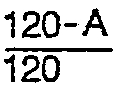
where A is the length of the test piece measured in MD direction after shrinkage.
TD shrinkage (%) =* 100
where B is the length of the test piece measured in TD direction after shrinkage. - As shown by the results of the measurement of shrinkage, the low-temperature shrinkable film of the present invention exhibits a shrinkage as high as about 50% at 50°C in the case where the stretching is 5.0.
- According to the present invention, a
shrinkable glove 10 is formed from low-temperature shrinkable film 12 which, upon heating to a temperature of 50°C with hot water or hot air, shrinks more than 50% and at least more than 5%, preferably more than 10%, and more desirably more than 15%. - It is desirable that the shrinkable
protective glove 10 made of the low-temperature shrinkable film 12 should be heated to a temperature of about 30-50°C at the time of use. - As shown in Figure 2, the
shrinkable glove 10 of the present invention is produced from two sheets of the above-mentioned low-temperature shrinkable film 12 by heat sealing in hand shape. (When heat sealing is performed, the entire film except the sealing part is insulated from heat.) The shrinkable glove can also be produced from the low-temperature shrinkable film 12 by sewing instead of heat sealing. - The above-obtained low-temperature shrinkable film was made into a shrinkable glove measuring 28 cm long and 25 cm wide. The glove was dipped in hot water at 40°C for 5 seconds, whereupon it shrank to 25 cm in length and 22 cm in width. The shrinkage in the lengthwise direction was 12.0% and the shrinkage in the widthwise direction was 10.7%.
- When the hand wearing the shrinkable glove was dipped in hot water at 40°C for 5 seconds, it uniformly shrank to tightly fit the hand and fingers.
- After use, the shrinkable glove can be easily removed by tearing the plastic film.
- The above-mentioned low-
temperature shrinkable glove 10 tightly fits the hand, giving a soft feeling. It prevents the grasped object from slipping off and helps to work smoothly. Moreover, it is inexpensive and can be made into disposable gloves. It is suitable for coloring and secondary fabrication such as embossing. - Since the shrinkable gloves pertaining to the present invention are formed from plastic film which shrinks more than 5% when heated to a temperature of 50°C, they tightly fit the hands when they are heated to 30-50°C after they have been put on the hands, even though they are slightly oversized. Therefore, they do not give the fingers a feeling of physical disorder and do not decrease work efficiency. Moreover, they are inexpensive and disposable.
- According to the present invention, a shrinkable
protective cover 14 is formed fromfilm 12 which, upon heating to a temperature of 50°C with hot water or hot air, shrinks more than 5%, preferably more than 10%, and more desirably more than 15%. - It is desirable that the shrinkable
protective cover 14 made of the low-temperature shrinkable film should be heated to a temperature of about 30 to 50°C at the time of use. - The shrinkable
protective cover 14 of the present invention is produced from the above-described low-temperature shrinkable film 12, with the ends thereof joined together by heat sealing. (When heat sealing is performed, the entire film except the sealing part is insulated from heat.) The shrinkableprotective cover 14 can also be produced from the low-temperature shrinkable film 12 by sewing instead of heat sealing. - A low-temperature shrinkable film prepared in the manner described above was made into a shrinkable protective cover in bag form measuring 60 cm long and 25 cm wide. The protective cover was dipped in hot water at 45°C for 3 seconds, whereupon it shrank to 48 cm in length and 19 cm in width. The shrinkage in the lengthwise direction was 20% and the shrinkage in the widthwise direction was 24%.
- The shrinkable protective cover was put on bandage and then dipped in hot water at 45°C for 3 seconds. It uniformly shrank to tightly cover the bandage.
- After use, the protective cover can be easily removed by tearing the plastics film in the MD direction.
- Since the shrinkable protective cover pertaining to the present device is formed from film which shrinks more than 5% when heated to a temperature of 50°C, it tightly fits the object (such as bandage and gypsum) when it is heated to 30-50°C after it has been put on the object even though it is slightly oversized. Therefore, it protects the object from wetting, without giving the wearer a feeling of looseness and physical disorder and decreasing work efficiency. Moreover, it is inexpensive and disposable.
- While the illustrative embodiments of the invention have been described with particularity, it will be understood that various other modifications will be apparent to and can be readily made by those skilled in the art without departing from the spirit and scope of the invention. Accordingly, it is not intended that the scope of the claims appended hereto be limited to the examples and descriptions set forth herein but rather that the claims be construed as encompassing all the features of patentable novelty which reside in the present invention, including all features which would be treated as equivalents thereof by those skilled in the art to which this invention pertains.

Claims (5)
Applications Claiming Priority (6)
| Application Number | Priority Date | Filing Date | Title |
|---|---|---|---|
| JP951987A JPS63178026A (en) | 1987-01-19 | 1987-01-19 | Manufacture of low-temperature shrinkable film |
| JP9519/87 | 1987-01-19 | ||
| JP1987005640U JPH052173Y2 (en) | 1987-01-19 | 1987-01-19 | |
| JP1987005639U JPH0417Y2 (en) | 1987-01-19 | 1987-01-19 | |
| JP5639/87 | 1987-01-19 | ||
| JP5640/87 | 1987-01-19 |
Publications (2)
| Publication Number | Publication Date |
|---|---|
| EP0276128A2 true EP0276128A2 (en) | 1988-07-27 |
| EP0276128A3 EP0276128A3 (en) | 1990-05-02 |
Family
ID=27276834
Family Applications (1)
| Application Number | Title | Priority Date | Filing Date |
|---|---|---|---|
| EP88300422A Withdrawn EP0276128A3 (en) | 1987-01-19 | 1988-01-19 | Shrinkable film and shrinkable articles prepared therefrom |
Country Status (2)
| Country | Link |
|---|---|
| EP (1) | EP0276128A3 (en) |
| CA (1) | CA1312184C (en) |
Cited By (4)
| Publication number | Priority date | Publication date | Assignee | Title |
|---|---|---|---|---|
| EP0409567A3 (en) * | 1989-07-17 | 1992-02-12 | Tonen Sekiyukagaku Kabushiki Kaisha | Elastomer film |
| US5252385A (en) * | 1989-07-17 | 1993-10-12 | Tonen Sekiyukagaku Kabushiki Kaisha | Elastomer film and composite containing same |
| WO1995010842A1 (en) * | 1993-10-08 | 1995-04-20 | Minnesota Mining And Manufacturing Company | Electrically insulating film backing |
| WO1998022036A1 (en) * | 1996-11-18 | 1998-05-28 | Munn Charles S | Rubbery products that shrink due to the application of energy and hypo-allergenic rubbery products |
Family Cites Families (4)
| Publication number | Priority date | Publication date | Assignee | Title |
|---|---|---|---|---|
| FR1533280A (en) * | 1967-05-26 | 1968-07-19 | Soft synthetic dressing cover | |
| US4336212A (en) * | 1977-10-11 | 1982-06-22 | Asahi-Dow Limited | Composition for drawn film, cold drawn film made of said composition and process for manufacture of said film |
| US4303571A (en) * | 1980-01-17 | 1981-12-01 | Exxon Research & Engineering Co. | Film-forming thermoplastic elastomeric polymer compositions |
| US4714735A (en) * | 1985-05-08 | 1987-12-22 | Exxon Chemical Patents Inc. | Oriented elastomeric film and method of manufacture |
-
1988
- 1988-01-12 CA CA000556338A patent/CA1312184C/en not_active Expired - Fee Related
- 1988-01-19 EP EP88300422A patent/EP0276128A3/en not_active Withdrawn
Cited By (6)
| Publication number | Priority date | Publication date | Assignee | Title |
|---|---|---|---|---|
| EP0409567A3 (en) * | 1989-07-17 | 1992-02-12 | Tonen Sekiyukagaku Kabushiki Kaisha | Elastomer film |
| US5252385A (en) * | 1989-07-17 | 1993-10-12 | Tonen Sekiyukagaku Kabushiki Kaisha | Elastomer film and composite containing same |
| WO1995010842A1 (en) * | 1993-10-08 | 1995-04-20 | Minnesota Mining And Manufacturing Company | Electrically insulating film backing |
| WO1998022036A1 (en) * | 1996-11-18 | 1998-05-28 | Munn Charles S | Rubbery products that shrink due to the application of energy and hypo-allergenic rubbery products |
| US6221447B1 (en) | 1996-11-18 | 2001-04-24 | Charles S. Munn | Rubber products that shrink due to the application of energy and hypo-allergenic rubbery products |
| US6946172B2 (en) | 1996-11-18 | 2005-09-20 | Charles S. Munn | Rubbery products that shrink due to the application of energy and hypo-allergic rubbery products |
Also Published As
| Publication number | Publication date |
|---|---|
| CA1312184C (en) | 1993-01-05 |
| EP0276128A3 (en) | 1990-05-02 |
Similar Documents
| Publication | Publication Date | Title |
|---|---|---|
| US5218036A (en) | Shrinkable film from ethylene-vinyl acetate polymer talc and ethylene-propylene copolymers blend | |
| KR920007728B1 (en) | Heat-shrinkable elastomer method of producing the elastomer and articles utilizing the elastomer | |
| EP1011966B1 (en) | Breathable elastic film and laminate | |
| US3329143A (en) | Shrinkable plastic bandage cover | |
| EP0910608B1 (en) | Elastomeric laminate film | |
| US3076232A (en) | Process for orienting polyethylene film | |
| EP0107819A1 (en) | Method for making balanced low shrink tension polyolefin film | |
| US5254393A (en) | Biaxially oriented multi-layer polyolefin film | |
| MXPA04000258A (en) | Humidity activated materials having shape-memory. | |
| EP0201331A2 (en) | Oriented elastomeric film and method of manufacture | |
| CA1312184C (en) | Shrinkable film and shrinkable articles prepared therefrom | |
| US3003903A (en) | Stretched laminated film | |
| AU558830B2 (en) | Polypropylene strap and method of making the same | |
| EP0060037A1 (en) | Heat-sealable polypropylene films, methods for their manufacture and packages including such films | |
| JPH05104618A (en) | Manufacture for polyester film having favorable tear property and twisting property | |
| US12144388B2 (en) | Adjustable fit glove, kit, and methods therefor | |
| JPH03172329A (en) | Thermally contractable film and its manufacture | |
| JPS625060B2 (en) | ||
| JPH0417Y2 (en) | ||
| JPH052173Y2 (en) | ||
| JPS5651329A (en) | Manufacture of tempered polypropylene film | |
| JPS60259602A (en) | Rubber plastic glove | |
| JP2002036358A (en) | Packaging film | |
| JPS5630827A (en) | Preparation of ethylene-vinyl alcoholic copolymer film | |
| JPH0631833A (en) | Manufacture of elastic composite body |
Legal Events
| Date | Code | Title | Description |
|---|---|---|---|
| PUAI | Public reference made under article 153(3) epc to a published international application that has entered the european phase |
Free format text: ORIGINAL CODE: 0009012 |
|
| 17P | Request for examination filed |
Effective date: 19880204 |
|
| AK | Designated contracting states |
Kind code of ref document: A2 Designated state(s): AT BE CH DE FR GB IT LI LU NL SE |
|
| PUAL | Search report despatched |
Free format text: ORIGINAL CODE: 0009013 |
|
| AK | Designated contracting states |
Kind code of ref document: A3 Designated state(s): AT BE CH DE FR GB IT LI LU NL SE |
|
| RHK1 | Main classification (correction) |
Ipc: B29C 61/00 |
|
| RAP1 | Party data changed (applicant data changed or rights of an application transferred) |
Owner name: TONEN CHEMICAL CORPORATION |
|
| 17Q | First examination report despatched |
Effective date: 19910926 |
|
| STAA | Information on the status of an ep patent application or granted ep patent |
Free format text: STATUS: THE APPLICATION IS DEEMED TO BE WITHDRAWN |
|
| 18D | Application deemed to be withdrawn |
Effective date: 19930504 |