EP0275946B1 - Veterinary composition for preventing diarrhoea in animals - Google Patents
Veterinary composition for preventing diarrhoea in animals Download PDFInfo
- Publication number
- EP0275946B1 EP0275946B1 EP88100554A EP88100554A EP0275946B1 EP 0275946 B1 EP0275946 B1 EP 0275946B1 EP 88100554 A EP88100554 A EP 88100554A EP 88100554 A EP88100554 A EP 88100554A EP 0275946 B1 EP0275946 B1 EP 0275946B1
- Authority
- EP
- European Patent Office
- Prior art keywords
- dried powder
- veterinary composition
- animals
- saccharides
- acid
- Prior art date
- Legal status (The legal status is an assumption and is not a legal conclusion. Google has not performed a legal analysis and makes no representation as to the accuracy of the status listed.)
- Expired - Lifetime
Links
Classifications
-
- A—HUMAN NECESSITIES
- A23—FOODS OR FOODSTUFFS; TREATMENT THEREOF, NOT COVERED BY OTHER CLASSES
- A23K—FODDER
- A23K20/00—Accessory food factors for animal feeding-stuffs
- A23K20/10—Organic substances
- A23K20/163—Sugars; Polysaccharides
-
- A—HUMAN NECESSITIES
- A23—FOODS OR FOODSTUFFS; TREATMENT THEREOF, NOT COVERED BY OTHER CLASSES
- A23K—FODDER
- A23K10/00—Animal feeding-stuffs
- A23K10/10—Animal feeding-stuffs obtained by microbiological or biochemical processes
- A23K10/16—Addition of microorganisms or extracts thereof, e.g. single-cell proteins, to feeding-stuff compositions
- A23K10/18—Addition of microorganisms or extracts thereof, e.g. single-cell proteins, to feeding-stuff compositions of live microorganisms
-
- A—HUMAN NECESSITIES
- A23—FOODS OR FOODSTUFFS; TREATMENT THEREOF, NOT COVERED BY OTHER CLASSES
- A23K—FODDER
- A23K10/00—Animal feeding-stuffs
- A23K10/30—Animal feeding-stuffs from material of plant origin, e.g. roots, seeds or hay; from material of fungal origin, e.g. mushrooms
-
- A—HUMAN NECESSITIES
- A23—FOODS OR FOODSTUFFS; TREATMENT THEREOF, NOT COVERED BY OTHER CLASSES
- A23K—FODDER
- A23K20/00—Accessory food factors for animal feeding-stuffs
- A23K20/10—Organic substances
- A23K20/105—Aliphatic or alicyclic compounds
Definitions
- This invention relates to veterinary compositions for preventing diarrhea in animals which is used alone or in admixure with water or with a base feed stuff.
- EP-A-0 058 651 describes a method of processing cattle-feed products.
- Different agricultural materials such as sugar beet pulp, citrus fruit pulp and material obtained by fermentating of agricultural material are heated and desintegrated to achieve products which are used as cattle feed, having a highly nourishing effect.
- GB-A-2 031 258 describes food supplements for animals which act as a highly desirable tonic for animals.
- the food supplements are based on vinegar and sugar based substances.
- a veterinary composition for animals which is based on safe natural materials and which can step up the growth of the animals by the prevention of the frequent occurrence of diarrhea of animals.
- a further object is to provide a veterinary composition favored by animals.
- Another object is to provide a a veterinary composition for animals being safe for people who take meats, eggs and milks of the animals.
- the present invention relates to a veterinary composition for preventing diarrhea in animals, which comprises
- the present invention relates to a veterinary composition for preventing diarrhea in animals, which comprises
- the present invention relates to the use of a mixture which comprises
- the veterinary composition of the present invention may be fed to animals such as domestic animals, e.g. cattle, horse, pig, sheep and goat; poultries, e.g. hen, cock, chicken, turkey, duck, guinea fowl and quail; pets, e.g. dog and cat; fishes, e.g. yellowtail, horse mackerel, flat fish, sea bream, red sea bream, eel, carp, rainbow trout, sweet fish and tilapia.
- domestic animals e.g. cattle, horse, pig, sheep and goat
- poultries e.g. hen, cock, chicken, turkey, duck, guinea fowl and quail
- pets e.g. dog and cat
- fishes e.g. yellowtail, horse mackerel, flat fish, sea bream, red sea bream, eel, carp, rainbow trout, sweet fish and tilapia.
- both of a fermented vinegar and a synthesized vinegar may be used as the vinegar in component (A).
- a fermented vinegar which, e.g., includes rice vinegar, molt vinegar, alcohol vinegar, cider vinegar or wine vinegar, is preferable.
- Both of liquid and solid vinegars may be used.
- a powdery vinegar is more preferable in the view point of easy handling and easy feeding to animals.
- the flesh of Japanese apricot used in said component (A) is used in the form of a dried powder.
- the flesh of Japanese apricot may be one previously salted or dipped in alcohol.
- the oranges, tomatoes and strawberrys are used in the form of dried powder.
- a powdery rind of oranges may be used.
- oranges there may be used, e.g., lemons, satsuma mandarins, oranges and citron fruits.
- vinegars, flesh of Japanese apricot, oranges, tomatoes and strawberrys may be used alone or in admixture of two or more of then. They provide the composition of the present invention with a good taste to make the animals take the composition readily. Especially, vinegars and the flesh of the Japanese apricot are preferable, and they may be used alone or in combination of them.
- saccharides in said component (B) there may be used, e.g., sugar, glucose, lactose and fruit sugar, which may be used alone or in combination of them. Especially, sugar and glucose are preferable in view of the animal's favorite.
- any of animal-edible organic acids may be used.
- carboxylic acids such as citric acid, malic acid, fumaric acid, formic acid, succinic acid, tartaric acid and lactic acid, which may be used alone or in combination of them.
- citric acid, fumaric acid and lactic acid are more preferable in the view point of the prevention of diarrhea and other diseases of animals and animal's favorite.
- carboxylic acids are the same as carboxylic acids included in said vinegars, flesh of Japanese apricot, oranges, tomatoes and strawberrys used as component (A) in the present invention.
- said "edible organic acid” used as component (B) in the present invention means a refined organic acid and is added into the feed composition of the present invention independently of said component (A).
- saccharides may be used alone or in admixture with the edible organic acid.
- Lactobacillus bifidus The occurrence of diseases of animals is more effectively prevented by the addition of Lactobacillus bifidus to the feed composition comprising said components (A) and (B). Both of dried and undried Lactobacillus bifidus may be used.
- a mix proportion of each component may vary depending on animal's kind, age and body weight.
- the feed composition of the present invention comprises 0.1-50% of at least one of the vinegar, flesh of Japanese apricot, oranges tomatoes and strawberrys, 10-99.9% of the saccharides and 1-60% of the edible organic acid based on the total weight of the feed composition.
- Lactobacillus bifidus is further added, in general, it is added in amount of about 2.5 x 10⁶ -8 cells per 100g of the dried feed composition.
- Each component element is mixed according to any conventional methods.
- the veterinary composition for animals of the present invention may be solely fed to animals.
- the composition is more preferably fed to aminals in the form of a solution or dispersion in water, or in admixture with a base feed stuff such as corns, wheat bran, wheat, wheat flour, soybean meal, milo, fish meal, fish powder or their mixture.
- a base feed stuff such as corns, wheat bran, wheat, wheat flour, soybean meal, milo, fish meal, fish powder or their mixture.
- 0.1-10% of the composition is generally added to water or the base feed stuff based on the weight of water or the feed stuff.
- composition may previously be mixed with the feed stuff.
- composition of the invention is fed to animals in the amount of 0.01-10g per 1 Kg of the body weight of the animal.
- the amount may be varied.
- composition of the invention may be used in admixture with other therapeutic agents.
- the veterinary composition for animals of the invention can prevent more effectively the frequent occurrence of diarrhea, loose feces and other diseases than a composition consisting of saccharides and an edible organic acid. As the result, the composition of the present invention can step up the growth of the animals.
- composition of the present invention is based on only safe natural materials and thus is safe to animals and people who take meats, eggs and milk of the animals, and animals take it favorably.
- the animals which take the composition of the present invention provide us with good meats.
- the composition of the present invention is fed to cows, the production of milk increases, and the proportion of the milk fat in milk increases.
- composition for animals can be fed to animals in admixture with other therapeutic agents.
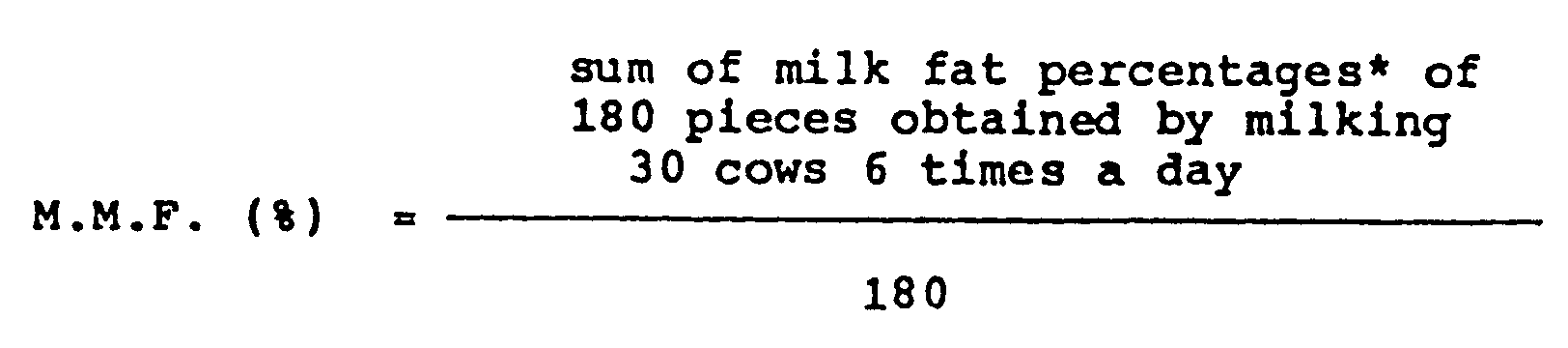
- M.M.F.% Milk Fat percentage
- P.G.A Proportion of Grown Animals
- I.W./a.d. Ingestion amount/animal-day
- a powdery rice vinegar (Mitsukansu Co.) was used as the vinegar
- a powdery flesh of Japanese apricot produced by Ikeda Touka Co. was used as the flesh of Japanese apricot
- powdery rind of lemon Nakeda Touka Co.
- tomato powder produced by Spreader Co. was used as the tomato powder
- dried Lactobacillus bifidus (Oriental Koubo Co.) was used as the Lactobacillus bifidus.
- compositions for animals of the present Examples 1-94 and Comparative Examples 1-38 were mixed in accordance with weight proportions shown in Table 1 to prepare compositions for animals of the present Examples 1-94 and Comparative Examples 1-38.
- total D & L total number of animals suffering from diarrhea and loose feces
- said broilers were butchered and the quality of their bodies and meats was observed, and the yield of meats was determined.
- said Base Feed Stuff H not containing the feed composition of the present invention was feed to other 2500 broilers in the same manner as above. These broilers were butchered, and the quality of their bodies and meats was also observed and the yield was determined.
- the yield of butchered broilers' bodies of the present broilers was 1.5% larger than that of the comparative broilers.
- the thigh and breast of the present broilers had a beautiful pinkish color and were less fatty and were more resilient than those of the comparative broilers.
- the stomachs of the present broilers were less fatty.
- the total of fatty livers of present 1200 broilers was 1.6 kg, and this was one third of that of 1200 comparative broilers.
- the yield of dissectioned bodies, which were dissectioned according to IV type- dissection of Japanese Agriculture Standard, was 40.0% in case of the present broilers.
- the comparative broilers that was 37.6%.
- the feed composition for broilers prepared in the above Example 211 was used for beef cattles.
- the feed composition was fed to beef cattles of 490 days old 36g per beef cattle per day together with the Base Feed Stuff I shown below.
- the beef cattles were butchered and dissectioned, and then the quality of the beef was observed.
- the beef of the present beef cattles had clearer red color than the comparative beef cattles.
- fatts were contained in dense and marble-like states.
- Lactobacillus bifidus referred to in the description and claims and used in the examples is a usual known microorganism accessible to the public without restriction.
Landscapes
- Life Sciences & Earth Sciences (AREA)
- Chemical & Material Sciences (AREA)
- Polymers & Plastics (AREA)
- Engineering & Computer Science (AREA)
- Animal Husbandry (AREA)
- Zoology (AREA)
- Food Science & Technology (AREA)
- Microbiology (AREA)
- Health & Medical Sciences (AREA)
- Biotechnology (AREA)
- Molecular Biology (AREA)
- Physiology (AREA)
- Biochemistry (AREA)
- Biomedical Technology (AREA)
- Botany (AREA)
- Mycology (AREA)
- Fodder In General (AREA)
Description
- This invention relates to veterinary compositions for preventing diarrhea in animals which is used alone or in admixure with water or with a base feed stuff.
- In the breeding of animals, there are problems such as the frequent occurrence of diarrhea and other diseases. In general, there has been supplied to animals an antibiotic or a feed stuff containing an antibiotic to avoid those diseases. However, in such cases, it has been fairly difficult to prevent such diseases. Further, the application of a large quantity of the antibiotics to animals causes the remaining of the antibiotics in the body, eggs, milk and the like of animals. The remaining antibiotics bring harmful influences on people who take meats, eggs and milk containing the antibiotics to produce sometimes anti-drugs bacilli in the bodies of the people.
- EP-A-0 058 651 describes a method of processing cattle-feed products. Different agricultural materials, such as sugar beet pulp, citrus fruit pulp and material obtained by fermentating of agricultural material are heated and desintegrated to achieve products which are used as cattle feed, having a highly nourishing effect.
- GB-A-2 031 258 describes food supplements for animals which act as a highly desirable tonic for animals. The food supplements are based on vinegar and sugar based substances.
- From US-A-3 873 733 carbohydrate materials are known which are valuable as a protein substitute in ruminant feeding, and as a slow-release fertilizer for growing plants. This ruminant feed may contain different pulps and molasses.
- Now, we have found a safe veterinary composition for animals which is based on natural materials and can prevent the frequent occurrence of diarrhea of animals.
- Therefore, it is an object of the present invention to provide a veterinary composition for animals which is based on safe natural materials and which can step up the growth of the animals by the prevention of the frequent occurrence of diarrhea of animals. A further object is to provide a veterinary composition favored by animals. Another object is to provide a a veterinary composition for animals being safe for people who take meats, eggs and milks of the animals.
- The present invention relates to a veterinary composition for preventing diarrhea in animals, which comprises
- (A) at least one selected from the group consisting of a vinegar, a dried powder of the flesh of mume (Japanese apricot) fruit, a dried powder of oranges, a dried powder of tomatoes and a dried powder of strawberries, and
- (B) saccharides alone or a combination of saccharides with one or more edible organic acids.
- Further, the present invention relates to a veterinary composition for preventing diarrhea in animals, which comprises
- (A) at least one selected from the group consisting of a vinegar, a dried powder of the flesh of a mume (Japanese apricot) fruit, a dried powder of oranges, a dried powder of tomatoes and a dried powder of strawberries,
- (B) saccharides alone or a combination of saccharides with one or more edible organic acids and
- (C) Lactobacillus bifidus.
- Still further, the present invention relates to the use of a mixture which comprises
- (A) at least one selected from the group consisting of a vinegar, a dried powder of the flesh of a mume (Japanese apricot) fruit, a dried powder of oranges, a dried powder of tomatoes and a dried powder of strawberries, and
- (B) saccarides alone or a combination of saccharides with one or more edible organic acids
for the preparation of veterinary compositions for preventing diarrhea in animals. - The veterinary composition of the present invention may be fed to animals such as domestic animals, e.g. cattle, horse, pig, sheep and goat; poultries, e.g. hen, cock, chicken, turkey, duck, guinea fowl and quail; pets, e.g. dog and cat; fishes, e.g. yellowtail, horse mackerel, flat fish, sea bream, red sea bream, eel, carp, rainbow trout, sweet fish and tilapia.
- In the present invention, both of a fermented vinegar and a synthesized vinegar may be used as the vinegar in component (A). A fermented vinegar, which, e.g., includes rice vinegar, molt vinegar, alcohol vinegar, cider vinegar or wine vinegar, is preferable.
- Both of liquid and solid vinegars may be used. A powdery vinegar is more preferable in the view point of easy handling and easy feeding to animals.
- The flesh of Japanese apricot used in said component (A) is used in the form of a dried powder. The flesh of Japanese apricot may be one previously salted or dipped in alcohol.
- The oranges, tomatoes and strawberrys are used in the form of dried powder.
- Further, a powdery rind of oranges may be used. As the oranges, there may be used, e.g., lemons, satsuma mandarins, oranges and citron fruits.
- The vinegars, flesh of Japanese apricot, oranges, tomatoes and strawberrys may be used alone or in admixture of two or more of then. They provide the composition of the present invention with a good taste to make the animals take the composition readily. Especially, vinegars and the flesh of the Japanese apricot are preferable, and they may be used alone or in combination of them.
- In the present invention, as the saccharides in said component (B), there may be used, e.g., sugar, glucose, lactose and fruit sugar, which may be used alone or in combination of them. Especially, sugar and glucose are preferable in view of the animal's favorite.
- As edible organic acid in said component (B), any of animal-edible organic acids may be used. As examples of them, there may be used carboxylic acids such as citric acid, malic acid, fumaric acid, formic acid, succinic acid, tartaric acid and lactic acid, which may be used alone or in combination of them. Among of them, citric acid, fumaric acid and lactic acid are more preferable in the view point of the prevention of diarrhea and other diseases of animals and animal's favorite.
- Some of those carboxylic acids are the same as carboxylic acids included in said vinegars, flesh of Japanese apricot, oranges, tomatoes and strawberrys used as component (A) in the present invention. However, said "edible organic acid" used as component (B) in the present invention means a refined organic acid and is added into the feed composition of the present invention independently of said component (A). As said component (B), saccharides may be used alone or in admixture with the edible organic acid.
- The occurrence of diseases of animals is more effectively prevented by the addition of Lactobacillus bifidus to the feed composition comprising said components (A) and (B). Both of dried and undried Lactobacillus bifidus may be used.
- In the present invention, a mix proportion of each component may vary depending on animal's kind, age and body weight. However, in general, the feed composition of the present invention comprises 0.1-50% of at least one of the vinegar, flesh of Japanese apricot, oranges tomatoes and strawberrys, 10-99.9% of the saccharides and 1-60% of the edible organic acid based on the total weight of the feed composition. When Lactobacillus bifidus is further added, in general, it is added in amount of about 2.5 x 10⁶ -8 cells per 100g of the dried feed composition.
- The preferable embodiments of the present invention are as follows:
- In the following embodiments, "%" is based on the total weight of the veterinary composition.
- (1) A composition comprising 1-25% of the vinegar, 1-20% of the flesh of Japanese apricot, 15-95.5% of saccharide and 2.5-40% of the edible organic acid.
- (2) A composition comprising 1-25% of the vinegar and 75-99% of saccharides.
- (3) A composition comprising 1-20% of the flesh of the Japanese apricot and 80-99% of saccharides.
- (4) A composition of comprising 1-25% of the vinegar, 1-20% of the flesh of the Japanese apricot and 55-98% of saccharides.
- (5) A composition comprising 1-25% of the vinegar, 1-20% of the flesh of Japanese apricot, 15-95.5% of saccharide and 2.5-40% of the edible organic acid and 2.5 x 10⁸-10 cells of the Lactobacillus bifidus per 100g of the mixed composition.
- (6) A composition comprising 1-25% of the vinegar, 35-96.5% of saccharides and 2.5-40% of the edible organic acid and 2.5 x 10⁸-10 cells of the Lactobacillus bifidus per 100g of the composition.
- (7) A composition comprising 1-20% of the flesh of the Japanese apricot, 40-96.5% of saccharides and 2.5-40% of the edible organic acid and 2.5 x 10⁸-10 cells of the Lactobacillus bifidus per 100g of the composition.
- Each component element is mixed according to any conventional methods.
- The veterinary composition for animals of the present invention may be solely fed to animals. However, the composition is more preferably fed to aminals in the form of a solution or dispersion in water, or in admixture with a base feed stuff such as corns, wheat bran, wheat, wheat flour, soybean meal, milo, fish meal, fish powder or their mixture. In such cases, 0.1-10% of the composition is generally added to water or the base feed stuff based on the weight of water or the feed stuff.
- Further, the composition may previously be mixed with the feed stuff.
- In general, the composition of the invention is fed to animals in the amount of 0.01-10g per 1 Kg of the body weight of the animal. However, the amount may be varied.
- Further, the composition of the invention may be used in admixture with other therapeutic agents.
- The veterinary composition for animals of the invention can prevent more effectively the frequent occurrence of diarrhea, loose feces and other diseases than a composition consisting of saccharides and an edible organic acid. As the result, the composition of the present invention can step up the growth of the animals.
- The composition of the present invention is based on only safe natural materials and thus is safe to animals and people who take meats, eggs and milk of the animals, and animals take it favorably. The animals which take the composition of the present invention provide us with good meats. When the composition of the present invention is fed to cows, the production of milk increases, and the proportion of the milk fat in milk increases.
- Further, the present composition for animals can be fed to animals in admixture with other therapeutic agents.
- The present invention described herein is illustrated by the following examples.
- In the following examples, "Mean Milk Fat percentage" (called hereinafter "M.M.F.%"), "Proportion of Grown Animals" (called hereinafter "P.G.A."), "Increased Body Weight/animal-day" (called hereinafter "I.W./a.d.") and "Ingestion amount/animal-day" (called hereinafter "Ingestion") are calculated according to the following equations.


- In the following examples, a powdery rice vinegar (Mitsukansu Co.) was used as the vinegar, and a powdery flesh of Japanese apricot produced by Ikeda Touka Co. was used as the flesh of Japanese apricot, and powdery rind of lemon (Nankaikako Co.) was used as the lemon powder, and tomato powder produced by Spreader Co. was used as the tomato powder, and dried Lactobacillus bifidus (Oriental Koubo Co.) was used as the Lactobacillus bifidus.
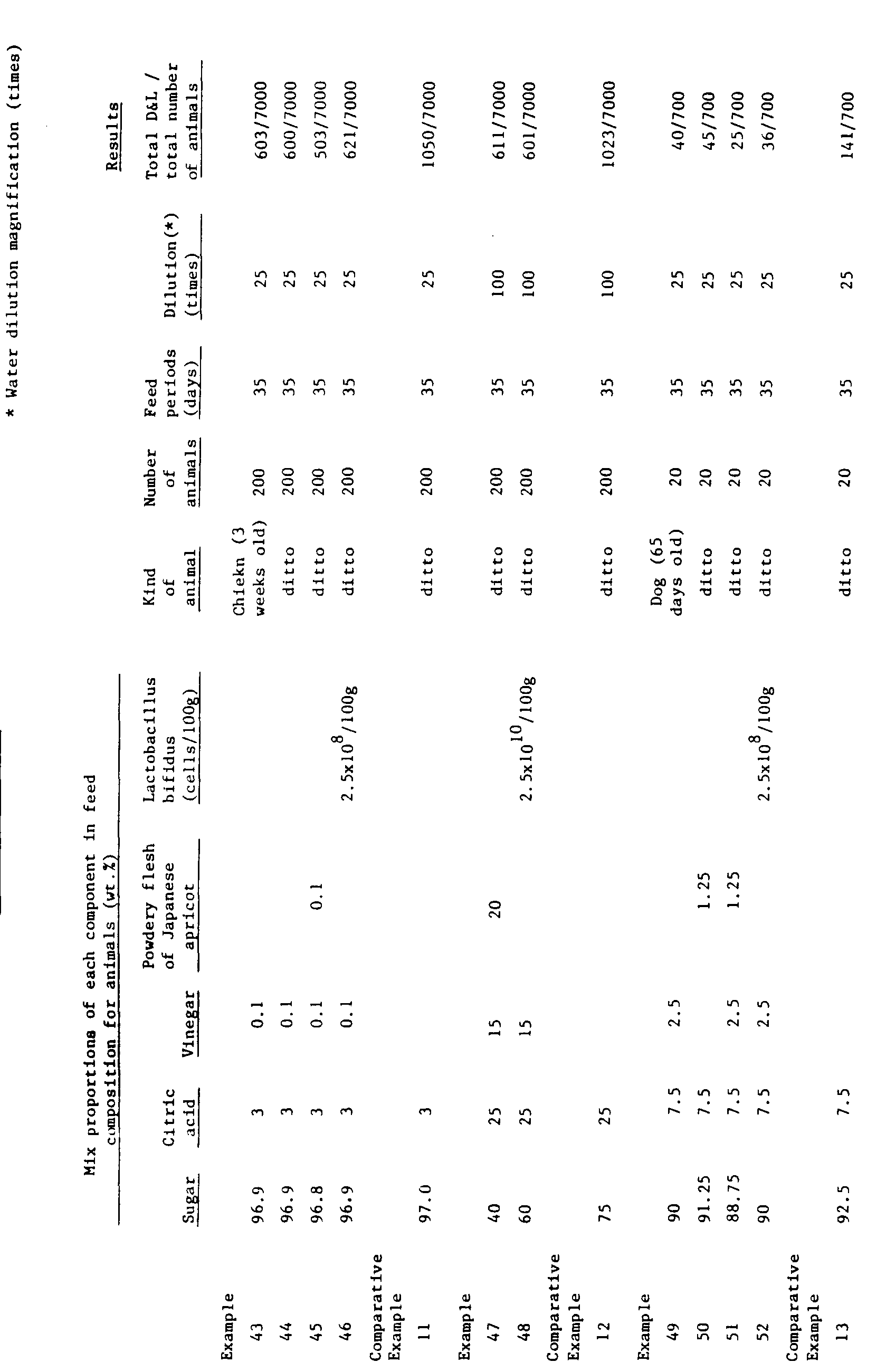
- Components shown in Table 1 below were mixed in accordance with weight proportions shown in Table 1 to prepare compositions for animals of the present Examples 1-94 and Comparative Examples 1-38.
- Each composition was diluted with water by way of a given magnification shown in Table 1, and then fed freely to animals instead of water. After a given test period, the total number of animals suffering from diarrhea and loose feces (called hereinafter "total D & L") was counted. The results are shown in Table 1 below.




- Components shown in Table 2 below were mixed in accordance with weight proportions shown in Table 2 to prepare feed compositions for animals of the present Examples 95-114 and Comparative Examples 39-44.
- Each of the feed composition for animals was added to Base Feed Stuff A or B shown below at a given weight proportion shown in Table 2 to prepare test feed stuffs. Each of the test feed stuffs was fed to animals freely. "I.W./a.d." and "Ingestion" were determined. The results are shown in Table 2 below.


- Components shown in Table 3 below were mixed in accordance with weight proportions shown in Table 3 to prepare feed compositions for animals of the present Examples 115-157 and Comparative Examples 45-63.
- Each of the feed compositions for animals was added to Base Feed Stuff C shown below at a given weight proportion shown in Table 3 to prepare test feed stuffs. Each of the test feed stuff was fed to animals freely. The results are shown in Table 3 below.


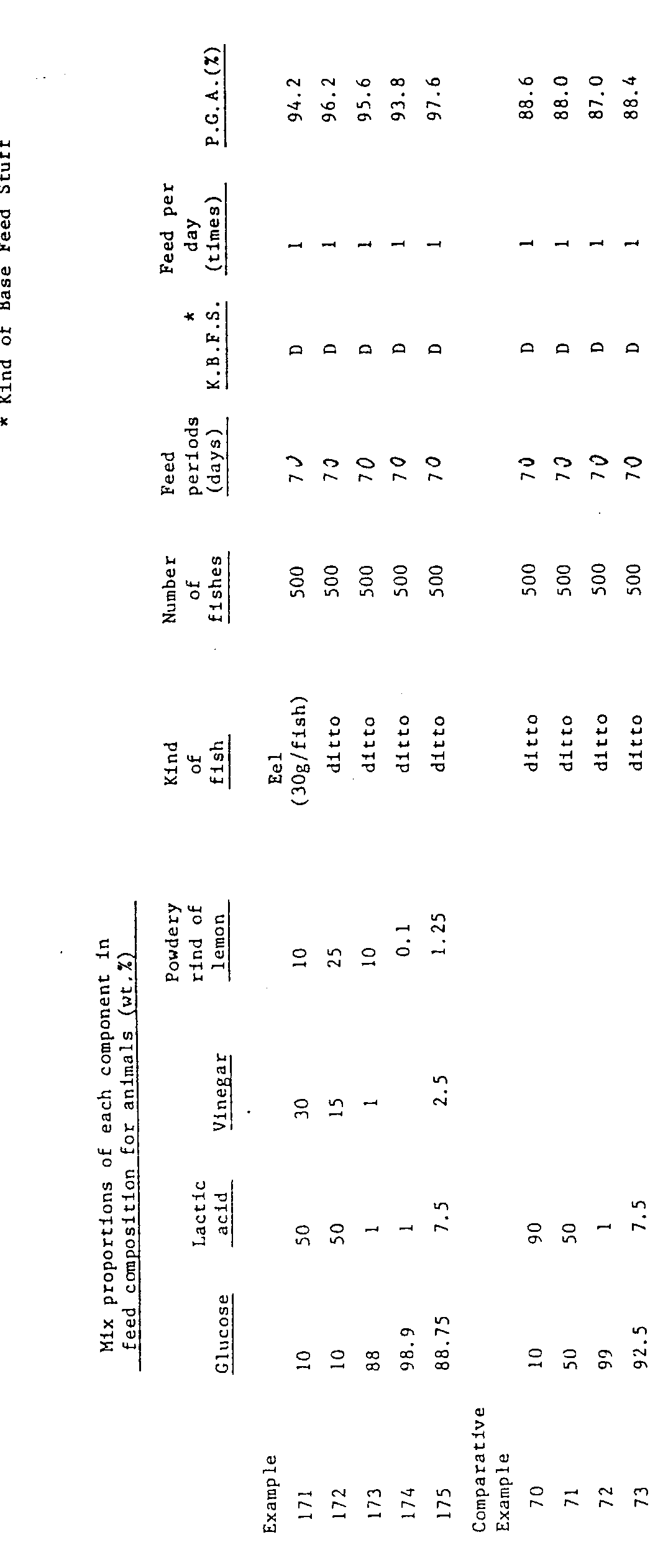
- Components shown in Table 4 below were mixed in accordance with weight proportions shown in Table 4 to prepare feed compositions for animals of the present Examples 158-220 and Comparative Examples 64-82. 1 g Of each of the feed compositions for animals was added to 100g of Base Feed Stuff D, E or F shown below to prepare test feed stuffs. Each of the test feed stuffs was fed to animals freely. "Growth %" is shown in Table 4 below.




- Components shown in Table 5 below were mixed in accordance with weight proportions shown in Table 5 to prepare feed compositions for animals of the present Examples 201-210 and Comparative Examples 83-85. 0.5g Of each of the feed compositions was added to 100g of Base Feed Stuff G shown below to prepare test feed stuffs. Each of the test feed stuffs was fed freely to milk cows of one month old for 60 days. The amount of milk obtained was determined every day and the mean milk fat was determined every ten days. The results are shown in Table 5 below.


- 88.75 Weight parts of sugar, 7.5 weight parts of citric acid, 2.5 weight parts of vinegar and 1.25 weight parts of powdery flesh of Japanese apricot were mixed to prepare a feed composition for broilers. 0.7g Of the feed composition was added to 100g of Base Feed Stuff H shown below, and the mixture was then fed freely to 2500 heads of broilers from 15 to 8 days before their forwarding.
- Then, 1.28g of said feed composition was added to 100g of said Base Feed Stuff H, and fed freely to said 2500 heads of broilers during 7 days before their forwarding.

- Said broilers were butchered and the quality of their bodies and meats was observed, and the yield of meats was determined. On the other hand, said Base Feed Stuff H not containing the feed composition of the present invention was feed to other 2500 broilers in the same manner as above. These broilers were butchered, and the quality of their bodies and meats was also observed and the yield was determined.
- The results are as follows:
- Bodies of butchered broilers bred with the feed composition of the present invention (called hereinafter "present broilers") had better skin color and had tighter bodies than those of the comparative broilers.
- The yield of butchered broilers' bodies of the present broilers was 1.5% larger than that of the comparative broilers.
- The thigh and breast of the present broilers had a beautiful pinkish color and were less fatty and were more resilient than those of the comparative broilers. The stomachs of the present broilers were less fatty.
- The total of fatty livers of present 1200 broilers was 1.6 kg, and this was one third of that of 1200 comparative broilers. The yield of dissectioned bodies, which were dissectioned according to IV type- dissection of Japanese Agriculture Standard, was 40.0% in case of the present broilers. On the other hand, in case of the comparative broilers, that was 37.6%.
- Breasts of the broilers were frozen in the temperature range of -3 ° C to -8 ° C for 81 hours, and then were thawed. Breasts of the present broilers were not hard. On the other hand, those of the comparative broilers were hard. Then, these thawed breasts were maintained at 16°C for 20 minutes. The breats of the present broilers had less drips than those of the comparative broilers.
- In this example, the feed composition for broilers prepared in the above Example 211 was used for beef cattles.
- The feed composition was fed to beef cattles of 490 days old 36g per beef cattle per day together with the Base Feed Stuff I shown below.

- The beef cattles were butchered and dissectioned, and then the quality of the beef was observed. The beef of the present beef cattles had clearer red color than the comparative beef cattles. In the beef of the present beef cattles, fatts were contained in dense and marble-like states.
- Lactobacillus bifidus referred to in the description and claims and used in the examples is a usual known microorganism accessible to the public without restriction.
Claims (17)
for the preparation of veterinary compositions for preventing diarrhea in animals.
Applications Claiming Priority (4)
| Application Number | Priority Date | Filing Date | Title |
|---|---|---|---|
| JP8186/87 | 1987-01-19 | ||
| JP818687 | 1987-01-19 | ||
| JP62315092A JP2542655B2 (en) | 1987-01-19 | 1987-12-15 | Mixed feed for animals |
| JP315092/87 | 1987-12-15 |
Publications (3)
| Publication Number | Publication Date |
|---|---|
| EP0275946A2 EP0275946A2 (en) | 1988-07-27 |
| EP0275946A3 EP0275946A3 (en) | 1990-01-31 |
| EP0275946B1 true EP0275946B1 (en) | 1993-06-09 |
Family
ID=26342653
Family Applications (1)
| Application Number | Title | Priority Date | Filing Date |
|---|---|---|---|
| EP88100554A Expired - Lifetime EP0275946B1 (en) | 1987-01-19 | 1988-01-16 | Veterinary composition for preventing diarrhoea in animals |
Country Status (5)
| Country | Link |
|---|---|
| EP (1) | EP0275946B1 (en) |
| JP (1) | JP2542655B2 (en) |
| AU (1) | AU604287B2 (en) |
| CA (1) | CA1330271C (en) |
| DE (1) | DE3881533T2 (en) |
Cited By (1)
| Publication number | Priority date | Publication date | Assignee | Title |
|---|---|---|---|---|
| WO2010031602A1 (en) * | 2008-05-30 | 2010-03-25 | Dsm Ip Assets B.V. | Use of succinic acid |
Families Citing this family (11)
| Publication number | Priority date | Publication date | Assignee | Title |
|---|---|---|---|---|
| WO1994028740A1 (en) * | 1991-08-14 | 1994-12-22 | Kazuo Uranaka | Feed additives for farm animals and the like |
| JPH0779632B2 (en) * | 1991-08-14 | 1995-08-30 | 浦中一雄 | Feed additives for livestock |
| ES2070785B1 (en) * | 1993-11-25 | 1996-01-01 | Zoster Sa | NEW FEED FOR INDUSTRIAL FISH FARMING. |
| GB9807287D0 (en) * | 1998-04-03 | 1998-06-03 | Verdugt Bv | Biocidal compositions |
| JP2001314159A (en) * | 2000-03-01 | 2001-11-13 | Nishi Nippon Sangyo Kk | Feed additive and method for producing the same |
| JP3607181B2 (en) * | 2000-07-24 | 2005-01-05 | 浦中一雄 | Feed additives such as livestock |
| KR100398478B1 (en) * | 2002-01-30 | 2003-09-19 | 주식회사 한빛바이오 | Fermented Feeds Containing Ume and Their Preparation Method |
| JP4854226B2 (en) * | 2005-07-05 | 2012-01-18 | 神協産業株式会社 | Feed additives |
| JP6920069B2 (en) * | 2016-03-07 | 2021-08-18 | 明治飼糧株式会社 | How to increase the milk yield and milk fat content of ruminant livestock |
| JP2018078888A (en) * | 2016-11-05 | 2018-05-24 | Fsk三昭株式会社 | Feed, feed production method, and feed production apparatus |
| JP2025071899A (en) * | 2023-10-24 | 2025-05-09 | 株式会社紀州ほそ川飼料 | Livestock Supplements |
Family Cites Families (7)
| Publication number | Priority date | Publication date | Assignee | Title |
|---|---|---|---|---|
| US3873733A (en) * | 1972-03-13 | 1975-03-25 | Allied Chem | Method of producing a pelleted slow release NPN feed for ruminants |
| US3904768A (en) * | 1973-09-13 | 1975-09-09 | Frank J Hruby | Method of increasing protein content of a waste food product |
| US4059695A (en) * | 1974-02-14 | 1977-11-22 | Kanari Hirosaki | Method for manufacturing a tonic composition for man and other animals |
| DE2541685A1 (en) * | 1975-09-18 | 1977-03-24 | Toepfer Gmbh | PROCESS FOR ENABLING THE RESORPTION OF ACTIVE SUBSTANCES FROM THE GOMARINAL CANAL WHICH USUALLY ARE NOT EFFECTIVE BY OS OR ANUM |
| GB2031258A (en) * | 1978-10-06 | 1980-04-23 | Wright & Co Ltd J | Animal food supplements and/or plant foods |
| SE442023B (en) * | 1981-02-11 | 1985-11-25 | Svensk Exergiteknik Ab | PROCEDURE FOR PREPARING BETMAS FROM SUGAR BEETER AND DEVICE FOR IMPLEMENTATION OF THE PROCEDURE |
| HU184420B (en) * | 1981-04-06 | 1984-08-28 | Peter Honti | Process for preparing a feed additive in order to increase the extent of the intake of the reed |
-
1987
- 1987-12-15 JP JP62315092A patent/JP2542655B2/en not_active Expired - Fee Related
-
1988
- 1988-01-14 CA CA000556557A patent/CA1330271C/en not_active Expired - Fee Related
- 1988-01-15 AU AU10299/88A patent/AU604287B2/en not_active Ceased
- 1988-01-16 DE DE8888100554T patent/DE3881533T2/en not_active Expired - Fee Related
- 1988-01-16 EP EP88100554A patent/EP0275946B1/en not_active Expired - Lifetime
Non-Patent Citations (1)
| Title |
|---|
| Rasic and Kurmann: Yoghurt, Vol. 1, 1978, p. 362 * |
Cited By (1)
| Publication number | Priority date | Publication date | Assignee | Title |
|---|---|---|---|---|
| WO2010031602A1 (en) * | 2008-05-30 | 2010-03-25 | Dsm Ip Assets B.V. | Use of succinic acid |
Also Published As
| Publication number | Publication date |
|---|---|
| DE3881533D1 (en) | 1993-07-15 |
| DE3881533T2 (en) | 1993-09-16 |
| AU1029988A (en) | 1988-07-21 |
| JPS63301755A (en) | 1988-12-08 |
| AU604287B2 (en) | 1990-12-13 |
| EP0275946A3 (en) | 1990-01-31 |
| EP0275946A2 (en) | 1988-07-27 |
| JP2542655B2 (en) | 1996-10-09 |
| CA1330271C (en) | 1994-06-21 |
Similar Documents
| Publication | Publication Date | Title |
|---|---|---|
| Harmon et al. | Ensiled broiler litter and corn forage. I. Fermentation characteristics | |
| MXPA00009567A (en) | Application of phytase in feed having low content of phytate | |
| Ondiek et al. | Use of Leucaena leucocephala and Gliricidia sepium as nitrogen sources in supplementary concentrates for dairy goats offered Rhodes grass hay | |
| EP2457450A1 (en) | Edible composition with stevia rebaudiana | |
| KR102224213B1 (en) | Manufacturing method of raw material feed composition with excellent preference and preservation | |
| EP0275946A2 (en) | Veterinary composition for preventing diarrhoea in animals | |
| Belal et al. | Replacing dietary starch with pitted date fruit in Nile tilapia Oreochromis niloticus (L.) feed | |
| US5171575A (en) | Process for preventing diarrhea in animals | |
| KR102247973B1 (en) | Raw material feed composition with excellent preference and preservation | |
| CN108782964A (en) | It is a kind of for black pig growth feed formula with and preparation method thereof | |
| CN1200605C (en) | Food animal feeding method | |
| Titcomb et al. | The nutritional requirements and growth rates of brook trout | |
| KR100198727B1 (en) | Alcohol-fermented molasses for beef or pig feed | |
| Pastorelli et al. | Opuntia Spp. as Alternative Fodder for Sustainable Livestock Production. Animals 2022, 12, 1597 | |
| JP2004329073A (en) | Poultry feed additives and feed | |
| JP3285630B2 (en) | Chicken feed | |
| Pius et al. | Effect of rations with fresh leaves of Gmelina arborea on growth performance and organ weights of rabbit bucks. | |
| McCay et al. | The nutritional requirements of trout | |
| EP0502931B1 (en) | Method for raising and/or fattening pigs and mixed fodder | |
| Barlaya | Growth response of common carp, Cyprinus carpio (Linn.) to varied levels of Livol, a non-hormonal growth promoter | |
| JPH0231651A (en) | Feed | |
| Anya et al. | PERFORMANCE OF SHEEP FED NAPIER GRASS HAY SUPPLEMENTED WITH NYMPHAEA LOTUS LEAF MEAL FOR SUSTAINABLE PRODUCTION | |
| Elabdeen | Effect of Dried Sugar Cane Tops on Performance and Carcass Characteristics of Sudanese Desert Goats | |
| SU917829A1 (en) | Method of preparing fodder for animals | |
| Sadiku et al. | Digestibility and nutrient utilization of soybean milk concentrate based diets in Oreochromis niloticus |
Legal Events
| Date | Code | Title | Description |
|---|---|---|---|
| PUAI | Public reference made under article 153(3) epc to a published international application that has entered the european phase |
Free format text: ORIGINAL CODE: 0009012 |
|
| AK | Designated contracting states |
Kind code of ref document: A2 Designated state(s): DE FR GB |
|
| PUAL | Search report despatched |
Free format text: ORIGINAL CODE: 0009013 |
|
| AK | Designated contracting states |
Kind code of ref document: A3 Designated state(s): DE FR GB |
|
| 17P | Request for examination filed |
Effective date: 19900705 |
|
| 17Q | First examination report despatched |
Effective date: 19910620 |
|
| GRAA | (expected) grant |
Free format text: ORIGINAL CODE: 0009210 |
|
| AK | Designated contracting states |
Kind code of ref document: B1 Designated state(s): DE FR GB |
|
| REF | Corresponds to: |
Ref document number: 3881533 Country of ref document: DE Date of ref document: 19930715 |
|
| ET | Fr: translation filed | ||
| PLBE | No opposition filed within time limit |
Free format text: ORIGINAL CODE: 0009261 |
|
| STAA | Information on the status of an ep patent application or granted ep patent |
Free format text: STATUS: NO OPPOSITION FILED WITHIN TIME LIMIT |
|
| 26N | No opposition filed | ||
| REG | Reference to a national code |
Ref country code: GB Ref legal event code: IF02 |
|
| REG | Reference to a national code |
Ref country code: GB Ref legal event code: 732E |
|
| REG | Reference to a national code |
Ref country code: FR Ref legal event code: TP |
|
| PGFP | Annual fee paid to national office [announced via postgrant information from national office to epo] |
Ref country code: FR Payment date: 20040108 Year of fee payment: 17 |
|
| PGFP | Annual fee paid to national office [announced via postgrant information from national office to epo] |
Ref country code: GB Payment date: 20040114 Year of fee payment: 17 |
|
| PGFP | Annual fee paid to national office [announced via postgrant information from national office to epo] |
Ref country code: DE Payment date: 20040129 Year of fee payment: 17 |
|
| REG | Reference to a national code |
Ref country code: FR Ref legal event code: AU |
|
| PG25 | Lapsed in a contracting state [announced via postgrant information from national office to epo] |
Ref country code: GB Free format text: LAPSE BECAUSE OF NON-PAYMENT OF DUE FEES Effective date: 20050116 |
|
| PG25 | Lapsed in a contracting state [announced via postgrant information from national office to epo] |
Ref country code: DE Free format text: LAPSE BECAUSE OF NON-PAYMENT OF DUE FEES Effective date: 20050802 |
|
| GBPC | Gb: european patent ceased through non-payment of renewal fee |
Effective date: 20050116 |
|
| PG25 | Lapsed in a contracting state [announced via postgrant information from national office to epo] |
Ref country code: FR Free format text: LAPSE BECAUSE OF NON-PAYMENT OF DUE FEES Effective date: 20050930 |
|
| REG | Reference to a national code |
Ref country code: FR Ref legal event code: ST |