EP0272856B1 - Method of manufacturing molded products and laminated structure including the molded products manufactured according to the method - Google Patents
Method of manufacturing molded products and laminated structure including the molded products manufactured according to the method Download PDFInfo
- Publication number
- EP0272856B1 EP0272856B1 EP87310943A EP87310943A EP0272856B1 EP 0272856 B1 EP0272856 B1 EP 0272856B1 EP 87310943 A EP87310943 A EP 87310943A EP 87310943 A EP87310943 A EP 87310943A EP 0272856 B1 EP0272856 B1 EP 0272856B1
- Authority
- EP
- European Patent Office
- Prior art keywords
- asphalt
- layer
- sound
- foamed
- urethane foam
- Prior art date
- Legal status (The legal status is an assumption and is not a legal conclusion. Google has not performed a legal analysis and makes no representation as to the accuracy of the status listed.)
- Expired
Links
Images

Classifications
-
- B—PERFORMING OPERATIONS; TRANSPORTING
- B32—LAYERED PRODUCTS
- B32B—LAYERED PRODUCTS, i.e. PRODUCTS BUILT-UP OF STRATA OF FLAT OR NON-FLAT, e.g. CELLULAR OR HONEYCOMB, FORM
- B32B11/00—Layered products comprising a layer of bituminous or tarry substances
- B32B11/04—Layered products comprising a layer of bituminous or tarry substances comprising such bituminous or tarry substance as the main or only constituent of a layer, which is next to another layer of the same or of a different material
-
- B—PERFORMING OPERATIONS; TRANSPORTING
- B32—LAYERED PRODUCTS
- B32B—LAYERED PRODUCTS, i.e. PRODUCTS BUILT-UP OF STRATA OF FLAT OR NON-FLAT, e.g. CELLULAR OR HONEYCOMB, FORM
- B32B5/00—Layered products characterised by the non- homogeneity or physical structure, i.e. comprising a fibrous, filamentary, particulate or foam layer; Layered products characterised by having a layer differing constitutionally or physically in different parts
- B32B5/18—Layered products characterised by the non- homogeneity or physical structure, i.e. comprising a fibrous, filamentary, particulate or foam layer; Layered products characterised by having a layer differing constitutionally or physically in different parts characterised by features of a layer of foamed material
-
- B—PERFORMING OPERATIONS; TRANSPORTING
- B32—LAYERED PRODUCTS
- B32B—LAYERED PRODUCTS, i.e. PRODUCTS BUILT-UP OF STRATA OF FLAT OR NON-FLAT, e.g. CELLULAR OR HONEYCOMB, FORM
- B32B27/00—Layered products comprising a layer of synthetic resin
- B32B27/06—Layered products comprising a layer of synthetic resin as the main or only constituent of a layer, which is next to another layer of the same or of a different material
- B32B27/065—Layered products comprising a layer of synthetic resin as the main or only constituent of a layer, which is next to another layer of the same or of a different material of foam
-
- B—PERFORMING OPERATIONS; TRANSPORTING
- B32—LAYERED PRODUCTS
- B32B—LAYERED PRODUCTS, i.e. PRODUCTS BUILT-UP OF STRATA OF FLAT OR NON-FLAT, e.g. CELLULAR OR HONEYCOMB, FORM
- B32B27/00—Layered products comprising a layer of synthetic resin
- B32B27/30—Layered products comprising a layer of synthetic resin comprising vinyl (co)polymers; comprising acrylic (co)polymers
- B32B27/304—Layered products comprising a layer of synthetic resin comprising vinyl (co)polymers; comprising acrylic (co)polymers comprising vinyl halide (co)polymers, e.g. PVC, PVDC, PVF, PVDF
-
- B—PERFORMING OPERATIONS; TRANSPORTING
- B32—LAYERED PRODUCTS
- B32B—LAYERED PRODUCTS, i.e. PRODUCTS BUILT-UP OF STRATA OF FLAT OR NON-FLAT, e.g. CELLULAR OR HONEYCOMB, FORM
- B32B27/00—Layered products comprising a layer of synthetic resin
- B32B27/40—Layered products comprising a layer of synthetic resin comprising polyurethanes
-
- B—PERFORMING OPERATIONS; TRANSPORTING
- B32—LAYERED PRODUCTS
- B32B—LAYERED PRODUCTS, i.e. PRODUCTS BUILT-UP OF STRATA OF FLAT OR NON-FLAT, e.g. CELLULAR OR HONEYCOMB, FORM
- B32B3/00—Layered products comprising a layer with external or internal discontinuities or unevennesses, or a layer of non-planar shape; Layered products comprising a layer having particular features of form
- B32B3/26—Layered products comprising a layer with external or internal discontinuities or unevennesses, or a layer of non-planar shape; Layered products comprising a layer having particular features of form characterised by a particular shape of the outline of the cross-section of a continuous layer; characterised by a layer with cavities or internal voids ; characterised by an apertured layer
- B32B3/30—Layered products comprising a layer with external or internal discontinuities or unevennesses, or a layer of non-planar shape; Layered products comprising a layer having particular features of form characterised by a particular shape of the outline of the cross-section of a continuous layer; characterised by a layer with cavities or internal voids ; characterised by an apertured layer characterised by a layer formed with recesses or projections, e.g. hollows, grooves, protuberances, ribs
-
- C—CHEMISTRY; METALLURGY
- C08—ORGANIC MACROMOLECULAR COMPOUNDS; THEIR PREPARATION OR CHEMICAL WORKING-UP; COMPOSITIONS BASED THEREON
- C08J—WORKING-UP; GENERAL PROCESSES OF COMPOUNDING; AFTER-TREATMENT NOT COVERED BY SUBCLASSES C08B, C08C, C08F, C08G or C08H
- C08J9/00—Working-up of macromolecular substances to porous or cellular articles or materials; After-treatment thereof
- C08J9/0061—Working-up of macromolecular substances to porous or cellular articles or materials; After-treatment thereof characterized by the use of several polymeric components
-
- C—CHEMISTRY; METALLURGY
- C08—ORGANIC MACROMOLECULAR COMPOUNDS; THEIR PREPARATION OR CHEMICAL WORKING-UP; COMPOSITIONS BASED THEREON
- C08L—COMPOSITIONS OF MACROMOLECULAR COMPOUNDS
- C08L75/00—Compositions of polyureas or polyurethanes; Compositions of derivatives of such polymers
- C08L75/04—Polyurethanes
- C08L75/08—Polyurethanes from polyethers
-
- B—PERFORMING OPERATIONS; TRANSPORTING
- B32—LAYERED PRODUCTS
- B32B—LAYERED PRODUCTS, i.e. PRODUCTS BUILT-UP OF STRATA OF FLAT OR NON-FLAT, e.g. CELLULAR OR HONEYCOMB, FORM
- B32B2266/00—Composition of foam
- B32B2266/02—Organic
- B32B2266/0214—Materials belonging to B32B27/00
- B32B2266/0278—Polyurethane
-
- B—PERFORMING OPERATIONS; TRANSPORTING
- B32—LAYERED PRODUCTS
- B32B—LAYERED PRODUCTS, i.e. PRODUCTS BUILT-UP OF STRATA OF FLAT OR NON-FLAT, e.g. CELLULAR OR HONEYCOMB, FORM
- B32B2307/00—Properties of the layers or laminate
- B32B2307/10—Properties of the layers or laminate having particular acoustical properties
- B32B2307/102—Insulating
-
- B—PERFORMING OPERATIONS; TRANSPORTING
- B32—LAYERED PRODUCTS
- B32B—LAYERED PRODUCTS, i.e. PRODUCTS BUILT-UP OF STRATA OF FLAT OR NON-FLAT, e.g. CELLULAR OR HONEYCOMB, FORM
- B32B2605/00—Vehicles
- B32B2605/08—Cars
-
- C—CHEMISTRY; METALLURGY
- C08—ORGANIC MACROMOLECULAR COMPOUNDS; THEIR PREPARATION OR CHEMICAL WORKING-UP; COMPOSITIONS BASED THEREON
- C08J—WORKING-UP; GENERAL PROCESSES OF COMPOUNDING; AFTER-TREATMENT NOT COVERED BY SUBCLASSES C08B, C08C, C08F, C08G or C08H
- C08J2375/00—Characterised by the use of polyureas or polyurethanes; Derivatives of such polymers
- C08J2375/04—Polyurethanes
-
- C—CHEMISTRY; METALLURGY
- C08—ORGANIC MACROMOLECULAR COMPOUNDS; THEIR PREPARATION OR CHEMICAL WORKING-UP; COMPOSITIONS BASED THEREON
- C08J—WORKING-UP; GENERAL PROCESSES OF COMPOUNDING; AFTER-TREATMENT NOT COVERED BY SUBCLASSES C08B, C08C, C08F, C08G or C08H
- C08J2495/00—Bituminous materials, e.g. asphalt, tar or pitch
-
- Y—GENERAL TAGGING OF NEW TECHNOLOGICAL DEVELOPMENTS; GENERAL TAGGING OF CROSS-SECTIONAL TECHNOLOGIES SPANNING OVER SEVERAL SECTIONS OF THE IPC; TECHNICAL SUBJECTS COVERED BY FORMER USPC CROSS-REFERENCE ART COLLECTIONS [XRACs] AND DIGESTS
- Y10—TECHNICAL SUBJECTS COVERED BY FORMER USPC
- Y10T—TECHNICAL SUBJECTS COVERED BY FORMER US CLASSIFICATION
- Y10T428/00—Stock material or miscellaneous articles
- Y10T428/23907—Pile or nap type surface or component
- Y10T428/23979—Particular backing structure or composition
-
- Y—GENERAL TAGGING OF NEW TECHNOLOGICAL DEVELOPMENTS; GENERAL TAGGING OF CROSS-SECTIONAL TECHNOLOGIES SPANNING OVER SEVERAL SECTIONS OF THE IPC; TECHNICAL SUBJECTS COVERED BY FORMER USPC CROSS-REFERENCE ART COLLECTIONS [XRACs] AND DIGESTS
- Y10—TECHNICAL SUBJECTS COVERED BY FORMER USPC
- Y10T—TECHNICAL SUBJECTS COVERED BY FORMER US CLASSIFICATION
- Y10T428/00—Stock material or miscellaneous articles
- Y10T428/24—Structurally defined web or sheet [e.g., overall dimension, etc.]
- Y10T428/24273—Structurally defined web or sheet [e.g., overall dimension, etc.] including aperture
- Y10T428/24322—Composite web or sheet
- Y10T428/24331—Composite web or sheet including nonapertured component
-
- Y—GENERAL TAGGING OF NEW TECHNOLOGICAL DEVELOPMENTS; GENERAL TAGGING OF CROSS-SECTIONAL TECHNOLOGIES SPANNING OVER SEVERAL SECTIONS OF THE IPC; TECHNICAL SUBJECTS COVERED BY FORMER USPC CROSS-REFERENCE ART COLLECTIONS [XRACs] AND DIGESTS
- Y10—TECHNICAL SUBJECTS COVERED BY FORMER USPC
- Y10T—TECHNICAL SUBJECTS COVERED BY FORMER US CLASSIFICATION
- Y10T428/00—Stock material or miscellaneous articles
- Y10T428/249921—Web or sheet containing structurally defined element or component
- Y10T428/249953—Composite having voids in a component [e.g., porous, cellular, etc.]
- Y10T428/249982—With component specified as adhesive or bonding agent
-
- Y—GENERAL TAGGING OF NEW TECHNOLOGICAL DEVELOPMENTS; GENERAL TAGGING OF CROSS-SECTIONAL TECHNOLOGIES SPANNING OVER SEVERAL SECTIONS OF THE IPC; TECHNICAL SUBJECTS COVERED BY FORMER USPC CROSS-REFERENCE ART COLLECTIONS [XRACs] AND DIGESTS
- Y10—TECHNICAL SUBJECTS COVERED BY FORMER USPC
- Y10T—TECHNICAL SUBJECTS COVERED BY FORMER US CLASSIFICATION
- Y10T428/00—Stock material or miscellaneous articles
- Y10T428/249921—Web or sheet containing structurally defined element or component
- Y10T428/249953—Composite having voids in a component [e.g., porous, cellular, etc.]
- Y10T428/249987—With nonvoid component of specified composition
- Y10T428/249991—Synthetic resin or natural rubbers
- Y10T428/249992—Linear or thermoplastic
-
- Y—GENERAL TAGGING OF NEW TECHNOLOGICAL DEVELOPMENTS; GENERAL TAGGING OF CROSS-SECTIONAL TECHNOLOGIES SPANNING OVER SEVERAL SECTIONS OF THE IPC; TECHNICAL SUBJECTS COVERED BY FORMER USPC CROSS-REFERENCE ART COLLECTIONS [XRACs] AND DIGESTS
- Y10—TECHNICAL SUBJECTS COVERED BY FORMER USPC
- Y10T—TECHNICAL SUBJECTS COVERED BY FORMER US CLASSIFICATION
- Y10T428/00—Stock material or miscellaneous articles
- Y10T428/31504—Composite [nonstructural laminate]
- Y10T428/31551—Of polyamidoester [polyurethane, polyisocyanate, polycarbamate, etc.]
-
- Y—GENERAL TAGGING OF NEW TECHNOLOGICAL DEVELOPMENTS; GENERAL TAGGING OF CROSS-SECTIONAL TECHNOLOGIES SPANNING OVER SEVERAL SECTIONS OF THE IPC; TECHNICAL SUBJECTS COVERED BY FORMER USPC CROSS-REFERENCE ART COLLECTIONS [XRACs] AND DIGESTS
- Y10—TECHNICAL SUBJECTS COVERED BY FORMER USPC
- Y10T—TECHNICAL SUBJECTS COVERED BY FORMER US CLASSIFICATION
- Y10T428/00—Stock material or miscellaneous articles
- Y10T428/31504—Composite [nonstructural laminate]
- Y10T428/31815—Of bituminous or tarry residue
-
- Y—GENERAL TAGGING OF NEW TECHNOLOGICAL DEVELOPMENTS; GENERAL TAGGING OF CROSS-SECTIONAL TECHNOLOGIES SPANNING OVER SEVERAL SECTIONS OF THE IPC; TECHNICAL SUBJECTS COVERED BY FORMER USPC CROSS-REFERENCE ART COLLECTIONS [XRACs] AND DIGESTS
- Y10—TECHNICAL SUBJECTS COVERED BY FORMER USPC
- Y10T—TECHNICAL SUBJECTS COVERED BY FORMER US CLASSIFICATION
- Y10T442/00—Fabric [woven, knitted, or nonwoven textile or cloth, etc.]
- Y10T442/50—FELT FABRIC
- Y10T442/59—At least three layers
Definitions
- the present invention relates to a method of manufacturing foamed and molded asphalt/urethane products. More particularly, it relates to molded products most suitable for sound-proof structures for cars, for example. Still more particularly, it relates to a method of manufacturing molded products most suitable for sound-proof structures for cars used as the dash board, floor panel, in the tire house and rear baggage chamber of the cars to shield any sound coming from outside and generated from the car body panel, said products being made flatter at their surface. It also relates to laminated structures including the molded products and manufactured according to the method.
- Fig. 2 shows a conventional sound-proof structure for cars.
- the conventional sound-proof interior material has a simple structure comprising an acoustical layer and a sound insulation layer.
- a vibration control material 20 which is usually a sheet of asphalt is closely stuck to the car body panel 10.
- Numeral 30 represents an acoustical layer made of flat felt or the like.
- Numeral 40 denotes a sound insulation surface layer, which is a carpet lined with a thermoplastic resin layer to enhance its sound insulation and molding capacities when it is used as the floor insulator.
- the acoustical layer 30 and the sound insulation surface layer 40 are stuck to each other by common adhering means.
- Fig. 3 is a sectional view showing another conventional sound-proof structure for cars, which is used as a dashboard insulator.
- the vibration control material 20 which comprises a sheet of asphalt is welded to the car body panel 10. It is often found that felt is used as the acoustical layer 30 and that a sheet of PVC (polyvinyl chloride) is used as the sound insulation surface layer 40.
- PVC polyvinyl chloride
- the vibration control material 20 consisting of asphalt sheet is intended to deal with vibration
- the sound insulation surface layer 40 consisting of carpet or asphalt sheet combined with the acoustical layer 30 is used as the sound insulation structure.
- the vibration control material of asphalt used to control the vibration of the car body panel is different in function from the insulator of felt combined with carpet or PVC sheet to insulate sounds. They are therefore processed independently on the car assembly line, thereby increasing the number of processes on the assembly line.
- the vibration control material of asphalt is cheap but heavy and it is not sufficiently welded to a vertical wall such as the dashboard panel.
- the acoustical material of felt cannot be molded to sufficiently meet any unevenness of the car body panel. As a result, its sound-proofness cannot be sufficient and it cannot be made flat at its surface. Appearance and feeling from the viewpoint of its flatness cannot be kept high in quality, particularly when it is used as a floor insulator.
- foamed urethane is immersed with asphalt or asphalt is added at the time of foaming urethane to form the foamed asphalt/urethane product.
- foamed urethane is immersed with asphalt or asphalt is added at the time of foaming urethane to form the foamed asphalt/urethane product.
- the conventional methods of manufacturing foamed asphalt/urethane products include:
- any of the above-mentioned methods is intended for the manufacture of foamed slabs and when molding is done using these methods, the following problems are caused. Molding is impossible when the immersion manner is employed.
- the foaming method A When the foaming method A is used, products thus molded contain a lot of water. When they are thick as a product, therefore, their drying takes a long time and their dimension stability is poor because they contract remarkably when they are dried. In addition, they are humidified and swelled because of hydrophilic polyol used. They are not therefore practical.
- the foaming method B specific polyol used is expensive and curing of products thus manufactured is unpractically slow at the time of their molding.
- foaming method C polyalkylene polyol used is more common than those used in the foaming methods A and B and it can therefore make the cost cheaper but the foaming stability and curing of the product thus manufactured are not good. In addition, contamination of asphalt is caused at the molding process. The product produced according to the foaming method C is therefore impractical.
- the present invention provides a method of manufacturing foamed and molded polyurethane products wherein polyoxyalkylene polyol having two or more hydroxyls in the molecule and polyisocyanate having two or more isocyanate radicals in the molecule are injected into a mold together with a catalyst and a foaming agent and they are reacted there with one another.
- This method of the present invention is characterized in that the polyoxyalkylene polyol includes asphalt previously emulsified and dispersed.
- the present invention also provides laminated structures including products manufactured according to the method,and the laminated structures include a sound-proof structure for cars comprising a first layer of foamed asphalt/urethane molded in a mold of a car body panel, floor panel, or dashboard, for example, a second or intermediate layer of PVC sheet for example placed on the foamed asphalt/ urethane layer, and a third layer of for example an acoustical material placed on the second layer, wherein the foamed asphalt/urethane is molded in the mold into which polyoxyalkylene polyol having two or more hydroxyls in one molecule and including asphalt previously emulsified and dispersed and polyisocyanate having two or more isocyanate radicals in the molecule are injected together with a catalyst and a foaming agent.
- a sound-proof structure for cars comprising a first layer of foamed asphalt/urethane molded in a mold of a car body panel, floor panel, or dashboard, for example, a second or intermediate
- the acoustical layer also serves as a vibration-proof layer to prevent vibration from being transmitted.
- the intermediate layer of for example PVC sheet and the foamed asphalt/urethane layer are laminated adjacent to each other to have the ability of controlling vibration. Therefore, the vibration of the car body panel can be controlled without any vibration control material of asphalt type.
- the foamed asphalt/urethane layer can be foamed and molded by a suitable mold to meet the form of a car body panel, floor panel or dashboard, thereby enabling it to closely adhere to the car body panel to enhance the vibration control effect.
- the laminated structure of the intermediate and acoustical surface layers serves to insulate any sound and when it is combined with the PVC sheet and foamed asphalt/ urethane layer, the product thus formed needs no vibration control material of asphalt type and it is light in weight and high in sound-proof effect.
- the product When it is molded, it is a sound-proof structure smooth at its surface and good in its appearance and quality.
- the foamed asphalt/urethane product which is used as the above-described foamed asphalt/urethane layer is manufactured as follows: Polyoxyalkylene polyol in which asphalt was previously emulsified and dispersed is mixed with polyisocyanate, a catalyst and a foaming agent, injected into and molded by a mold. Foamed polyurethane thus produced includes asphalt dispersed like particulates. As a result, the foamed and molded asphalt/urethane product has good foaming stability, curing and molding capacities and it can serve as a sound-proof structure having high practicality from the viewpoint of manufacture.
- the present invention thus provides a manufacturing method of molded products capable of eliminating the drawbacks of the above-mentioned immersion method, and foaming methods A, B and C
- the invention provides a manufacturing method of molded products most suitable for sound-proof structures which can enhance the sound-proofness against those sounds whose frequencies are lower than 500Hz, for example, and which can also enhance the feeling of flatness, without significantly changing the thickness and weight of the sound-proof material used.
- the invention provides molded products most suitable for sound-proof structures for cars, for example, having high practicality from the viewpoint of manufacture because the foamed asphalt/urethane layer has good foaming stability and curing ability and because contamination of asphalt is not caused at the molding process.
- numeral 1 represents a car body panel
- 2 a foamed asphalt/urethane layer
- 3 an intermediate layer comprising a sheet of PVC for example
- 4 an acoustical layer comprising felt, foamed urethane, or molded urethane chips
- 5 a sound insulation surface layer made of a carpet
- 5A a thermoplastic resin layer lined on the carpet 5.
- the acoustical layer 4 and the intermediate layer 3 are previously bonded to each other by a bonding agent, then placed in a mold and molded together with the foamed asphalt/urethane layer 2 at the time when the layer 2 is foamed.
- the intermediate layer 3 is provided with openings 3A
- the foamed asphalt/ urethane layer 2 and the acoustical layer 4 may be bonded at the foaming time, interposing the intermediate layer 3 between them.
- Molding of the urethane chips is carried out by mixing polyurethane chips with a binder whose main agent is urethane polymer, reacting and hardening them under compressed state.
- the foamed asphalt/urethane layer 2 may be provided with openings. When such openings are provided like this, the sound insulation ability can be enhanced.
- the opened area is preferably in a range of 5 - 40% relative to the whole area of the layer 2.
- thermoplastic resin layer 5A lined on the carpet 5 a sheet of PVC or EPT (ethylene propylene terpolymer) may be interposed between the thermoplastic layer 5A and the acoustical layer 4.
- PVC or EPT ethylene propylene terpolymer
- a thick sheet of PVC or EPT may be used instead of the carpet 5. This is effective when it is incorporated into the structure of the dashboard silencer.
- foamed asphalt/urethane which is used as the foamed asphalt/urethane layer in the present invention.
- Polyoxyalkylene polyol which is used to produce polyurethane foam of polyether type is preferable as polyol which is used to create the emulsion of asphalt and polyol because of its molding capacity and cost.
- Alkylene oxide is added to and polymerized with polyhydric alcohol and amine compound, for example, and the compound thus created is used as polyoxyalkylene polyol.
- Polyhydric alcohols include divalent alcohols such as ethylene glycol, propylene glycol and 1,4-butanediol diethylene glycol; trivalent alcohols such as glycerin and trimethylol propane; and tetra- or more valent alcohols such as pentaerythritol, sorbitol and sucrose.
- Amine compounds include fatty polyamines such as ethylene amine and hexamethylene diamine; aromatic polyamines such as phenylenediamine and toluenediamine; and alkanol amine such as monoethanolamine diethanolamine and triethanolamine.
- Alkylene oxides include ethylene oxide, propylene oxide, and butylene oxide. Ethylene oxide and propylene oxide are particularly preferred.
- Both ethylene and propylene oxides are used as polyol because of their molding and curing capacities, and tri-functional polyether polyol having a primary OH at its terminal and a molecular weight of 3000 - 5000 is more preferable.
- Straight asphalt, blown asphalt, semi-blown asphalt, and cut-back asphalt are used as asphalt components which are dispersed as fine particulates in the polyols.
- the weight ratio of polyoxyalkylene polyol and asphalt is preferably in a range of 100 : 10 - 200 and more preferably 100 : 50 - 150 in view of the sound vibration characteristic of the form thus molded. As the contained amount of emulsified and dispersed asphalt is increased, the damping characteristic of the foam is enhanced.
- the polyoxyalkylene polyol and asphalt may be emulsified by any suitable method, but it is preferable to use a surface-active agent.
- a surface-active agent such as polyoxyethylene (9) nonyl phenol and polyoxyethylene (40) stearate
- polyoxyalkylene polyol which has been heated to about 100°C
- asphalt which has been heated and melted at 100 - 200°C is emulsified and dispersed in it using a stirrer such as an homogenizer.
- each of fine asphalt particulates which have been emulsified and dispersed in polyoxyalkylene polyol is preferably in a range of 2 - 50 ⁇ m and more preferably 5 - 20 ⁇ m. This is because molding surfaces and others cannot be contaminated by asphalt bleeding.
- Foaming and molding of polyoxyalkylene polyol in which asphalt has been emulsified and dispersed as described above can be achieved by mixing and stirring this asphalt-emulsified and -dispersed polyoxyalkylene polyol and polyisocyanate having two or more isocyanate radicals together with a catalyst and a foaming agent and then introducing the same into a mold.
- Suitable polyisocyanates used include aromatic polyisocyanates such as toluene diisocyanate and diphenyl methane diisocyanate; alicyclic polyisocyanates such as dicycrohexyl methane diisocyanate and isophorone diisocyanate; fatty polyisocyanates such as hexamethylene diisocyanate; and two or more of these polyisocyanates.
- Components which can be added at the foaming and molding process include those which are used to manufacture common polyurethane foams. Catalysts of amine and tin type, water and Freon serving as the foaming agent, and surface-active agents of silicon type to control foamed cells can be cited, for example. If necessary, an inorganic filler or fire retardant can be added.
- Glycerin was used as a starting material; propylene oxide and ethylene oxide were added and polymerized; 200 weight parts of polyol (Voranol 4701 made by Dow Chemical Corporation) having a molecular weight less than 4700 and a primary OH, and 6 weight parts of each of the surface- active agents polyoxyethylene (9) nonyl phenol which was in a range of HLB 13.1 and polyoxyethylene (40) stearate which was in a range of HLB 16.9 were added; the mixture thus created was heated to 100°C; 200g of straight asphalt 80/ 100 which was heated to 100°C and melted was added and mixed using an homogenizer; and polyalkylene polyol in which asphalt was emulsified and dispersed was thus produced.
- polyol Vinyl 4701 made by Dow Chemical Corporation
- polyoxyethylene (9) nonyl phenol which was in a range of HLB 13.1
- polyoxyethylene (40) stearate which was in a range of HLB 16.9
- This raw material (A) was introduced into a mold having a form corresponding to the car body panel which will be mentioned later, or a mold (molding temperature was 50°C) made of aluminium and having a maximum height (H) of 30m/m, a minimum height (h) of 5m/m, a width of 300m/m and a length of 300m/m (five convexes and five concaves were provided and their intermediate length (l) was 30m/m), cured for ten minutes at a temperature of 70°C in an oven, and a foamed and molded asphalt/urethane foam product (A) was then taken out.
- a mold molding temperature was 50°C
- the product (A) could be easily released from the mold without contaminating the mold with asphalt and it had a good appearance.
- the product (A) had values as shown in Table 1.
- Table 1 Density (g/cm3) 0.140 Elongation (%) 120
- Sound-proof structures for cars were manufactured using the above-mentioned foamed and molded asphalt/urethane foam product (A) and the following materials.
- Iron plate 0.8t (car body panel, 300m/m wide and 300m/m long, provided with five convexes and five concaves; their intermediate length (l) was 30m/m and the height (m) of each of the convexes was 25m/m; and this was hereinafter referred to as iron plate (A)) + layer of the foamed and molded asphalt/urethane foam product (A) + PVC sheet 1t + urethane chips 15t molded + PE (poly ethylene) backing carpet (see Fig. 1).
- Iron plate 0.8t + layer of the foamed and molded asphalt/urethane foam product (A) + PVC sheet 1t + felt 15t + PE backing carpet.
- Iron plate 0.8t + layer* of the foamed and molded asphalt/urethane foam product (A) + PVC sheet 1t + urethane chips 15t molded + PE backing carpet. * Ratio of opened area was 16%.
- Iron plate (A) 0.8t + asphalt sheet 2t (uneven to fit to the iron plate) + felt 25t + PE backing carpet (see Fig. 2).
- Numeral 11 represents a sound-proof box in which samples are to be fixed and which is made by a material, large in mass and sufficient in sound insulation ability.
- An acoustical material 12 is stuck to the inner face of the box 11.
- An iron plate 13 of 0.8t corresponds to the one of the car body and mounted on the top of the sound-proof box 11 in such a way that its circumferential rim portion is fixed to the box 11.
- the iron plate 13 is vibrated by a vibrator 14 to cause sound.
- the sound thus caused is measured by a microphone 15.
- a sound-proof structure (or sound-proof material sample) 16 is placed on the iron plate 13 and the sound caused from the iron plate 13 is insulated by the sound-proof material sample 16.
- the comparative structure example employed felt and the conventional vibration control material of asphalt type.
- Fig. 5 shows results thus measured.
- any of examples 1, 2 and 3 can achieve better sound-proof effect than the comparative structure example.
- example 1 in which the urethane chips molded were used is better in sound-proofing those sounds whose frequencies are higher than 500Hz, as compared with example 2 in which felt was employed.
- Example 3 provided with openings is better in sound-proofing those sounds whose frequencies are in medium and low bands, that is, lower than 800Hz, as compared with example 1 provided with no opening.
- Fig. 6 shows results obtained using the following examples to evaluate what effects the thickness of the PVC sheet has.
- Iron plate (A) 0.8t + asphalt sheet 2t (uneven to fit to the iron plate) + felt 25t + PE backing carpet.
- Iron plate 0.8t + layer of foamed and molded asphalt/urethane foam product (A) + PVC sheet 0.5t + urethane chips molded 15t + PE backing carpet.
- Iron plate 0.8t + layer of foamed and molded asphalt/urethane foam product (A) + PVC sheet 2t + urethane chips molded 15t + PE backing carpet.
- the sound pressure level is made lower and lower at a frequency band lower than 500Hz as the PVC sheet becomes thicker and thicker.
- the vibration control ability (or sound vibration characteristic) of the foamed and molded asphalt/urethane foam product itself was checked for reference according to the following measuring manner.
- Fig. 7 shows results thus measured.
- B in Fig. 7 denotes results obtained about our molded product and C represents those obtained about the common urethane foam.
- C represents those obtained about the common urethane foam.
- our foamed and molded foam product has higher loss factors and better vibration control ability (or sound vibration characteristic).
- a sound-proof structure capable of enhancing its sound-proof ability relative to those sounds whose frequencies are low (or lower than 500Hz) without changing the thickness and weight of its sound-proof material, and also improving the feeling of its flatness.
- our molded product which forms the foamed asphalt/urethane foam layer has higher foaming stability and better curing ability.
- the mold cannot be contaminated with asphalt at the foaming process. This therefore makes it possible to provide a sound-proof structure for cars, for example, which is more practical in its manufacture.
Landscapes
- Chemical & Material Sciences (AREA)
- Health & Medical Sciences (AREA)
- Chemical Kinetics & Catalysis (AREA)
- Medicinal Chemistry (AREA)
- Polymers & Plastics (AREA)
- Organic Chemistry (AREA)
- Engineering & Computer Science (AREA)
- Materials Engineering (AREA)
- Laminated Bodies (AREA)
- Vehicle Interior And Exterior Ornaments, Soundproofing, And Insulation (AREA)
- Building Environments (AREA)
- Manufacture Of Porous Articles, And Recovery And Treatment Of Waste Products (AREA)
- Compositions Of Macromolecular Compounds (AREA)
Description
- The present invention relates to a method of manufacturing foamed and molded asphalt/urethane products. More particularly, it relates to molded products most suitable for sound-proof structures for cars, for example. Still more particularly, it relates to a method of manufacturing molded products most suitable for sound-proof structures for cars used as the dash board, floor panel, in the tire house and rear baggage chamber of the cars to shield any sound coming from outside and generated from the car body panel, said products being made flatter at their surface. It also relates to laminated structures including the molded products and manufactured according to the method.
- Fig. 2 shows a conventional sound-proof structure for cars. As shown in Fig. 2, the conventional sound-proof interior material has a simple structure comprising an acoustical layer and a sound insulation layer. A
vibration control material 20 which is usually a sheet of asphalt is closely stuck to thecar body panel 10. Numeral 30 represents an acoustical layer made of flat felt or the like. Numeral 40 denotes a sound insulation surface layer, which is a carpet lined with a thermoplastic resin layer to enhance its sound insulation and molding capacities when it is used as the floor insulator. Theacoustical layer 30 and the soundinsulation surface layer 40 are stuck to each other by common adhering means. - Fig. 3 is a sectional view showing another conventional sound-proof structure for cars, which is used as a dashboard insulator. The
vibration control material 20 which comprises a sheet of asphalt is welded to thecar body panel 10. It is often found that felt is used as theacoustical layer 30 and that a sheet of PVC (polyvinyl chloride) is used as the soundinsulation surface layer 40. Theacoustical layer 30 and the soundinsulation surface layer 40 are also stuck to each other by common adhering means in this case. In any case, where it is used as a dashboard or floor insulator, thevibration control material 20 consisting of asphalt sheet is intended to deal with vibration, and the soundinsulation surface layer 40 consisting of carpet or asphalt sheet combined with theacoustical layer 30 is used as the sound insulation structure. - In the case of these conventional sound-proof structures for cars, however, the vibration control material of asphalt used to control the vibration of the car body panel is different in function from the insulator of felt combined with carpet or PVC sheet to insulate sounds. They are therefore processed independently on the car assembly line, thereby increasing the number of processes on the assembly line.
- The vibration control material of asphalt is cheap but heavy and it is not sufficiently welded to a vertical wall such as the dashboard panel.
- The acoustical material of felt cannot be molded to sufficiently meet any unevenness of the car body panel. As a result, its sound-proofness cannot be sufficient and it cannot be made flat at its surface. Appearance and feeling from the viewpoint of its flatness cannot be kept high in quality, particularly when it is used as a floor insulator.
- Those car body panel portions to which it is difficult to weld or stick the vibration control material cannot be made sufficiently sound-proof when only the acoustical material of felt and the sound insulation surface layer are used.
- In the case of the conventional sound-proof structures for cars, it is required to deal with "discomfort sounds" transmitted into the car room. In the case of those structures shown in Figs. 2 and 3, the following measures are well known to enhance their ability of shielding those sounds whose frequencies are lower than 500Hz, for example, and to reduce noises in the car room:
- 1) Making the vibration control material of asphalt type thicker,
- 2) making the acoustical layer thicker, and
- 3) making the sound insulation surface layer heavier.
- When the measures 1) and 3) are employed, however, car weight is increased and efficiency of fuel is made lower. Even when the measure 2) is used, room space in the car is made smaller.
- On the other hand, cars are increasingly required to have higher sound-proof and vibration control abilities. In addition to proposing the above-described layer structures, therefore, various kinds of materials themselves which can be used to form these layers have been discussed and proposed in relation to these layer structures.
- As one of these proposals, foamed urethane is immersed with asphalt or asphalt is added at the time of foaming urethane to form the foamed asphalt/urethane product. These products have good sound-proofness and damping characteristics.
- Each of these products are supplied as a flat sheet and they cannot completely fit the unevenness of the car floor, dashboard or the like, thereby worsening their sound-proof and vibration control abilities.
- The conventional methods of manufacturing foamed asphalt/urethane products include:
- 1) melting asphalt in soft urethane having successive foams, immersing the soft urethane with the melted asphalt, and drying it, or immersing soft urethane, which has successive foams, with water base emulsion of asphalt and drying it, or immersing soft urethane, which has successive foams, in solvent-solved asphalt solution and drying it (which will be hereinafter referred to as immersion method);
- 2) reacting hydrophilic polyether polyol (which includes ethylene oxide more than 15%) with organic isocyanate to produce urethane pre-polymer and reacting and foaming the thus-produced urethane pre-polymer with water base emulsion of asphalt (which will be hereinafter referred to as foaming method A);
- 3) previously solving and blending asphalt in polyol such as polybutadiene polyol which is solvable with asphalt, and mixing and foaming it with organic isocyanate, catalyst and foaming agent (which will be hereinafter referred to as foaming method B); and
- 4) previously reacting polyalkylene polyol of polyether type, which is not solved with asphalt, with organic isocyanate to produce urethane pre-polymer, solving asphalt with it, and mixing and foaming it with catalyst and foaming agent (which will be hereinafter referred to as foaming method C).
- However, any of the above-mentioned methods is intended for the manufacture of foamed slabs and when molding is done using these methods, the following problems are caused. Molding is impossible when the immersion manner is employed. When the foaming method A is used, products thus molded contain a lot of water. When they are thick as a product, therefore, their drying takes a long time and their dimension stability is poor because they contract remarkably when they are dried. In addition, they are humidified and swelled because of hydrophilic polyol used. They are not therefore practical. When the foaming method B is employed, specific polyol used is expensive and curing of products thus manufactured is unpractically slow at the time of their molding. When the foaming method C is employed, polyalkylene polyol used is more common than those used in the foaming methods A and B and it can therefore make the cost cheaper but the foaming stability and curing of the product thus manufactured are not good. In addition, contamination of asphalt is caused at the molding process. The product produced according to the foaming method C is therefore impractical.
- The present invention provides a method of manufacturing foamed and molded polyurethane products wherein polyoxyalkylene polyol having two or more hydroxyls in the molecule and polyisocyanate having two or more isocyanate radicals in the molecule are injected into a mold together with a catalyst and a foaming agent and they are reacted there with one another. This method of the present invention is characterized in that the polyoxyalkylene polyol includes asphalt previously emulsified and dispersed. The present invention also provides laminated structures including products manufactured according to the method,and the laminated structures include a sound-proof structure for cars comprising a first layer of foamed asphalt/urethane molded in a mold of a car body panel, floor panel, or dashboard, for example, a second or intermediate layer of PVC sheet for example placed on the foamed asphalt/ urethane layer, and a third layer of for example an acoustical material placed on the second layer, wherein the foamed asphalt/urethane is molded in the mold into which polyoxyalkylene polyol having two or more hydroxyls in one molecule and including asphalt previously emulsified and dispersed and polyisocyanate having two or more isocyanate radicals in the molecule are injected together with a catalyst and a foaming agent.
- In the case of the sound-proof structure for cars according to the present invention, the acoustical layer also serves as a vibration-proof layer to prevent vibration from being transmitted. The intermediate layer of for example PVC sheet and the foamed asphalt/urethane layer are laminated adjacent to each other to have the ability of controlling vibration. Therefore, the vibration of the car body panel can be controlled without any vibration control material of asphalt type. Further, the foamed asphalt/urethane layer can be foamed and molded by a suitable mold to meet the form of a car body panel, floor panel or dashboard, thereby enabling it to closely adhere to the car body panel to enhance the vibration control effect. Furthermore, the laminated structure of the intermediate and acoustical surface layers serves to insulate any sound and when it is combined with the PVC sheet and foamed asphalt/ urethane layer, the product thus formed needs no vibration control material of asphalt type and it is light in weight and high in sound-proof effect. When it is molded, it is a sound-proof structure smooth at its surface and good in its appearance and quality.
- The foamed asphalt/urethane product which is used as the above-described foamed asphalt/urethane layer is manufactured as follows: Polyoxyalkylene polyol in which asphalt was previously emulsified and dispersed is mixed with polyisocyanate, a catalyst and a foaming agent, injected into and molded by a mold. Foamed polyurethane thus produced includes asphalt dispersed like particulates. As a result, the foamed and molded asphalt/urethane product has good foaming stability, curing and molding capacities and it can serve as a sound-proof structure having high practicality from the viewpoint of manufacture.
- The present invention thus provides a manufacturing method of molded products capable of eliminating the drawbacks of the above-mentioned immersion method, and foaming methods A, B and C
- Secondly, the invention provides a manufacturing method of molded products most suitable for sound-proof structures which can enhance the sound-proofness against those sounds whose frequencies are lower than 500Hz, for example, and which can also enhance the feeling of flatness, without significantly changing the thickness and weight of the sound-proof material used.
- Thirdly, the invention provides molded products most suitable for sound-proof structures for cars, for example, having high practicality from the viewpoint of manufacture because the foamed asphalt/urethane layer has good foaming stability and curing ability and because contamination of asphalt is not caused at the molding process.
- The invention will be further described, by way of example, with reference to the accompanying drawings :
- Fig. 1 is a sectional view showing an example of a sound-proof structure for cars according to the present invention;
- Fig. 2 is a sectional view showing a conventional sound-proof structure for cars applied to a car body panel;
- Fig. 3 is a sectional view showing another conventional sound-proof structure for cars applied to a dashboard;
- Fig. 4 is a sectional view showing a device for measuring sound-proof effect;
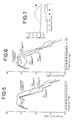
- Figs. 5 and 6 are graphs showing results, which were measured by the device of Fig. 4, in relation to frequency and sound pressure level; and
- Fig. 7 is a graph showing results of vibration control capability (or sound vibration characteristic).
- The present invention will be described in detail citing a sound-proof structure for cars and referring to the accompanying drawings.
- In Fig. 1,
numeral 1 represents a car body panel, 2 a foamed asphalt/urethane layer, 3 an intermediate layer comprising a sheet of PVC for example, 4 an acoustical layer comprising felt, foamed urethane, or molded urethane chips, 5 a sound insulation surface layer made of a carpet, and 5A a thermoplastic resin layer lined on thecarpet 5. Theacoustical layer 4 and the intermediate layer 3 are previously bonded to each other by a bonding agent, then placed in a mold and molded together with the foamed asphalt/urethane layer 2 at the time when thelayer 2 is foamed. When the intermediate layer 3 is provided withopenings 3A, the foamed asphalt/urethane layer 2 and theacoustical layer 4 may be bonded at the foaming time, interposing the intermediate layer 3 between them. - Molding of the urethane chips is carried out by mixing polyurethane chips with a binder whose main agent is urethane polymer, reacting and hardening them under compressed state.
- The foamed asphalt/
urethane layer 2 may be provided with openings. When such openings are provided like this, the sound insulation ability can be enhanced. The opened area is preferably in a range of 5 - 40% relative to the whole area of thelayer 2. - In order to further enhance sound-proof and vibration control effects achieved by the
thermoplastic resin layer 5A lined on thecarpet 5, a sheet of PVC or EPT (ethylene propylene terpolymer) may be interposed between thethermoplastic layer 5A and theacoustical layer 4. - A thick sheet of PVC or EPT may be used instead of the
carpet 5. This is effective when it is incorporated into the structure of the dashboard silencer. - There will be described the foamed asphalt/urethane which is used as the foamed asphalt/urethane layer in the present invention.
- Polyoxyalkylene polyol which is used to produce polyurethane foam of polyether type is preferable as polyol which is used to create the emulsion of asphalt and polyol because of its molding capacity and cost.
- Alkylene oxide is added to and polymerized with polyhydric alcohol and amine compound, for example, and the compound thus created is used as polyoxyalkylene polyol.
- Polyhydric alcohols include divalent alcohols such as ethylene glycol, propylene glycol and 1,4-butanediol diethylene glycol; trivalent alcohols such as glycerin and trimethylol propane; and tetra- or more valent alcohols such as pentaerythritol, sorbitol and sucrose. Amine compounds include fatty polyamines such as ethylene amine and hexamethylene diamine; aromatic polyamines such as phenylenediamine and toluenediamine; and alkanol amine such as monoethanolamine diethanolamine and triethanolamine.
- Alkylene oxides include ethylene oxide, propylene oxide, and butylene oxide. Ethylene oxide and propylene oxide are particularly preferred.
- Both ethylene and propylene oxides are used as polyol because of their molding and curing capacities, and tri-functional polyether polyol having a primary OH at its terminal and a molecular weight of 3000 - 5000 is more preferable.
- Straight asphalt, blown asphalt, semi-blown asphalt, and cut-back asphalt are used as asphalt components which are dispersed as fine particulates in the polyols.
- The weight ratio of polyoxyalkylene polyol and asphalt is preferably in a range of 100 : 10 - 200 and more preferably 100 : 50 - 150 in view of the sound vibration characteristic of the form thus molded. As the contained amount of emulsified and dispersed asphalt is increased, the damping characteristic of the foam is enhanced.
- The polyoxyalkylene polyol and asphalt may be emulsified by any suitable method, but it is preferable to use a surface-active agent. For example, a surface-active agent (such as polyoxyethylene (9) nonyl phenol and polyoxyethylene (40) stearate) which is in a range of HLB 13 - 18 is added to polyoxyalkylene polyol which has been heated to about 100°C, and asphalt which has been heated and melted at 100 - 200°C is emulsified and dispersed in it using a stirrer such as an homogenizer.
- The size of each of fine asphalt particulates which have been emulsified and dispersed in polyoxyalkylene polyol is preferably in a range of 2 - 50µm and more preferably 5 - 20µm. This is because molding surfaces and others cannot be contaminated by asphalt bleeding.
- Foaming and molding of polyoxyalkylene polyol in which asphalt has been emulsified and dispersed as described above can be achieved by mixing and stirring this asphalt-emulsified and -dispersed polyoxyalkylene polyol and polyisocyanate having two or more isocyanate radicals together with a catalyst and a foaming agent and then introducing the same into a mold.
- Suitable polyisocyanates used include aromatic polyisocyanates such as toluene diisocyanate and diphenyl methane diisocyanate; alicyclic polyisocyanates such as dicycrohexyl methane diisocyanate and isophorone diisocyanate; fatty polyisocyanates such as hexamethylene diisocyanate; and two or more of these polyisocyanates.
- Components which can be added at the foaming and molding process include those which are used to manufacture common polyurethane foams. Catalysts of amine and tin type, water and Freon serving as the foaming agent, and surface-active agents of silicon type to control foamed cells can be cited, for example. If necessary, an inorganic filler or fire retardant can be added.
- Glycerin was used as a starting material; propylene oxide and ethylene oxide were added and polymerized; 200 weight parts of polyol (Voranol 4701 made by Dow Chemical Corporation) having a molecular weight less than 4700 and a primary OH, and 6 weight parts of each of the surface- active agents polyoxyethylene (9) nonyl phenol which was in a range of HLB 13.1 and polyoxyethylene (40) stearate which was in a range of HLB 16.9 were added; the mixture thus created was heated to 100°C; 200g of straight asphalt 80/ 100 which was heated to 100°C and melted was added and mixed using an homogenizer; and polyalkylene polyol in which asphalt was emulsified and dispersed was thus produced.
- Added to 400g of this asphalt-emulsified and -dispersed polyalkylene polyol were 2.5g of water, 3.0g of a catalyst of amine type Dabco 33LV made by Sankyo Aero Products Corporation) and 2.5g of a surface-active agent of silicon type (L-520 made by Japan Unika Corporation), and 32g of toluene diisocyanate (Coronate T-80 made by Japan Polyurethane Corporation) was then added and mixed and stirred to produce a raw material (A) for the foamed asphalt/urethane form. This raw material (A) was introduced into a mold having a form corresponding to the car body panel which will be mentioned later, or a mold (molding temperature was 50°C) made of aluminium and having a maximum height (H) of 30m/m, a minimum height (h) of 5m/m, a width of 300m/m and a length of 300m/m (five convexes and five concaves were provided and their intermediate length (ℓ) was 30m/m), cured for ten minutes at a temperature of 70°C in an oven, and a foamed and molded asphalt/urethane foam product (A) was then taken out.
- The product (A) could be easily released from the mold without contaminating the mold with asphalt and it had a good appearance.
- The product (A) had values as shown in Table 1.
Table 1 Density (g/cm³) 0.140 Elongation (%) 120 Tensile strength (Kg/cm³) 1.2 Hardness *60 * Hardness was measured using a hardness tester of Ascar F type, produced by Kobunshi Keiki Co., Ltd., a Japanese company. - Sound-proof structures for cars were manufactured using the above-mentioned foamed and molded asphalt/urethane foam product (A) and the following materials.
- Iron plate 0.8t (car body panel, 300m/m wide and 300m/m long, provided with five convexes and five concaves; their intermediate length (ℓ) was 30m/m and the height (m) of each of the convexes was 25m/m; and this was hereinafter referred to as iron plate (A)) + layer of the foamed and molded asphalt/urethane foam product (A) + PVC sheet 1t + urethane chips 15t molded + PE (poly ethylene) backing carpet (see Fig. 1).
- Iron plate (A) 0.8t + layer of the foamed and molded asphalt/urethane foam product (A) + PVC sheet 1t + felt 15t + PE backing carpet.
- Iron plate (A) 0.8t + layer* of the foamed and molded asphalt/urethane foam product (A) + PVC sheet 1t + urethane chips 15t molded + PE backing carpet.
* Ratio of opened area was 16%. -
Specific gravity Foamed asphalt/urethane foam layer 0.1 Urethane chips molded 0.1 PVC sheet 1.7 Felt 0.05 Poly ethylene backing carpet 0.85kg/m² - Iron plate (A) 0.8t + asphalt sheet 2t (uneven to fit to the iron plate) + felt 25t + PE backing carpet (see Fig. 2).
- Evaluation was done using the device shown in Fig. 4.
Numeral 11 represents a sound-proof box in which samples are to be fixed and which is made by a material, large in mass and sufficient in sound insulation ability. Anacoustical material 12 is stuck to the inner face of thebox 11. Aniron plate 13 of 0.8t corresponds to the one of the car body and mounted on the top of the sound-proof box 11 in such a way that its circumferential rim portion is fixed to thebox 11. Theiron plate 13 is vibrated by avibrator 14 to cause sound. The sound thus caused is measured by amicrophone 15. A sound-proof structure (or sound-proof material sample) 16 is placed on theiron plate 13 and the sound caused from theiron plate 13 is insulated by the sound-proof material sample 16. When theiron plate 13 is vibrated by a certain vibrating input, therefore, it can be understood that the lower the sound pressure level measured by themicrophone 15 becomes, the better the sound-proof ability of the sound-proof structure 16 is. - The comparative structure example employed felt and the conventional vibration control material of asphalt type.
- Fig. 5 shows results thus measured. As apparent from Fig. 5, any of examples 1, 2 and 3 can achieve better sound-proof effect than the comparative structure example. Particularly, example 1 in which the urethane chips molded were used is better in sound-proofing those sounds whose frequencies are higher than 500Hz, as compared with example 2 in which felt was employed. Example 3 provided with openings is better in sound-proofing those sounds whose frequencies are in medium and low bands, that is, lower than 800Hz, as compared with example 1 provided with no opening.
- Fig. 6 shows results obtained using the following examples to evaluate what effects the thickness of the PVC sheet has.
- Iron plate (A) 0.8t + asphalt sheet 2t (uneven to fit to the iron plate) + felt 25t + PE backing carpet.
- Iron plate (A) 0.8t + layer of foamed and molded asphalt/urethane foam product (A) + PVC sheet 0.5t + urethane chips molded 15t + PE backing carpet.
- Iron plate (A) 0.8t + layer of foamed and molded asphalt/urethane foam product (A) + PVC sheet 2t + urethane chips molded 15t + PE backing carpet.
- As apparent from Fig. 6, the sound pressure level is made lower and lower at a frequency band lower than 500Hz as the PVC sheet becomes thicker and thicker.
- On the other hand, our example in which PVC sheet 0.5t was employed shows a soundproof ability equal to or better than that of the example to be compared.
- The vibration control ability (or sound vibration characteristic) of the foamed and molded asphalt/urethane foam product itself was checked for reference according to the following measuring manner.
- The center of a sample which is made by bonding the foamed and molded flat asphalt/urethane foam product, 10mm thick, to a flat iron plate, 0.8mm thick, is vibrated by a vibrator. Loss factors (
temperature 20°C) are calculated from a resonance curve obtained by forces outputted from the impedance head and vibration speeds accelerated. - Fig. 7 shows results thus measured. B in Fig. 7 denotes results obtained about our molded product and C represents those obtained about the common urethane foam. As shown in Fig. 7, it can be understood that our foamed and molded foam product has higher loss factors and better vibration control ability (or sound vibration characteristic).
- According to the present invention, there can be provided a sound-proof structure capable of enhancing its sound-proof ability relative to those sounds whose frequencies are low (or lower than 500Hz) without changing the thickness and weight of its sound-proof material, and also improving the feeling of its flatness. Further, our molded product which forms the foamed asphalt/urethane foam layer has higher foaming stability and better curing ability. In addition, the mold cannot be contaminated with asphalt at the foaming process. This therefore makes it possible to provide a sound-proof structure for cars, for example, which is more practical in its manufacture.
Claims (7)
- A method of manufacturing molded polyurethane foam products comprising introducing polyoxyalkylene polyol having two or more hydroxyls in the molecule, and polyisocyanate having two or more isocyanate radicals into a mold together with a catalyst and a foaming agent, and reacting them in it, characterized in that said polyoxyalkylene polyol contains asphalt previously emulsified and dispersed therein.
- A laminated structure including a layer of foamed asphalt/urethane foam, characterized in that said asphalt/urethane foam is a foamed and molded product prepared according to claim 1.
- A laminated structure comprising a sound-proof structure for cars, comprising a first layer (2) of foamed asphalt/urethane foam, an intermediate (or second) layer (3) such as a sheet of PVC placed on the foamed asphalt/urethane foam layer, and a third layer (4) such as an acoustical material, characterized in that said foamed asphalt/urethane foam is a foamed and molded product prepared according to claim 1.
- A laminated structure as claimed in claim 2 or 3, characterized in that the foamed asphalt/urethane foam layer (2) is molded to fit the uneven surface of a car body panel.
- A laminated structure as claimed in claim 3 or 4, characterized in that said acoustical material layer (4) is made by urethane foam or molded urethane foam chips.
- A laminated structure as claimed in any of claims 3, 4 and 5, characterized in that said foamed asphalt/urethane foam layer (2) is provided with openings.
- A laminated structure as claimed in any of claims 3, 4, 5 and 6, characterized by further comprising a sound insulation surface layer (5) lined with a thermoplastic resin layer (5A).
Applications Claiming Priority (2)
| Application Number | Priority Date | Filing Date | Title |
|---|---|---|---|
| JP61312618A JPS63159468A (en) | 1986-12-23 | 1986-12-23 | Production of molded item |
| JP312618/86 | 1986-12-23 |
Publications (3)
| Publication Number | Publication Date |
|---|---|
| EP0272856A2 EP0272856A2 (en) | 1988-06-29 |
| EP0272856A3 EP0272856A3 (en) | 1989-05-10 |
| EP0272856B1 true EP0272856B1 (en) | 1992-07-22 |
Family
ID=18031368
Family Applications (1)
| Application Number | Title | Priority Date | Filing Date |
|---|---|---|---|
| EP87310943A Expired EP0272856B1 (en) | 1986-12-23 | 1987-12-11 | Method of manufacturing molded products and laminated structure including the molded products manufactured according to the method |
Country Status (4)
| Country | Link |
|---|---|
| US (1) | US4830916A (en) |
| EP (1) | EP0272856B1 (en) |
| JP (1) | JPS63159468A (en) |
| DE (1) | DE3780599T2 (en) |
Families Citing this family (14)
| Publication number | Priority date | Publication date | Assignee | Title |
|---|---|---|---|---|
| US4892891A (en) * | 1988-12-02 | 1990-01-09 | Syn-Coat Enterprises | Novel foam compositions |
| US5096764A (en) * | 1990-09-12 | 1992-03-17 | Heuga Holding Bv | Printable carpet tile and method |
| JP2500873Y2 (en) * | 1991-03-29 | 1996-06-12 | 池田物産株式会社 | Chip Mold for Automotive Interior |
| JP2940720B2 (en) * | 1991-05-13 | 1999-08-25 | 日本ゼオン株式会社 | Vibration damping rigid structure for vehicles |
| JP2581358B2 (en) * | 1991-10-31 | 1997-02-12 | 住友化学工業株式会社 | Laminated molded article and method for producing the same |
| US5204155A (en) * | 1991-11-12 | 1993-04-20 | Interface, Inc. | Resilient foam-backed carpet and method of preparation |
| JPH10508623A (en) * | 1994-10-20 | 1998-08-25 | エフ., ザ サード サガード,ジョージ | Asphalt foam |
| DE19631516A1 (en) * | 1996-08-03 | 1998-02-05 | Wacker Werke Kg | Device for receiving formwork elements for components made of concrete in the manufacture of the components |
| WO1998009807A1 (en) * | 1996-09-03 | 1998-03-12 | Shaw Industries, Inc. | Vinyl-backed carpet structure |
| US5962089A (en) * | 1997-01-31 | 1999-10-05 | Simco Automotive Trim, Inc. | Automotive trim panel and method of making same |
| JP4107710B2 (en) * | 1998-04-30 | 2008-06-25 | 三井化学ポリウレタン株式会社 | Modified polyisocyanate and process for producing the same |
| US5932331A (en) * | 1998-10-08 | 1999-08-03 | Simco Automotive Trim, Inc. | Automotive trim panel having dual density foam support layer |
| US6986547B2 (en) * | 2002-09-30 | 2006-01-17 | Lear Corporation | Hybrid vehicle interior component |
| US20130099055A1 (en) * | 2011-10-24 | 2013-04-25 | Schneller, Inc. | Integrated lavatory pan for commercial aircraft |
Family Cites Families (6)
| Publication number | Priority date | Publication date | Assignee | Title |
|---|---|---|---|---|
| GB1038009A (en) * | 1964-06-29 | 1966-08-03 | Ici Ltd | Improvements in or relating to the manufacture of foamed isocyanate reaction products |
| GB1530185A (en) * | 1976-08-24 | 1978-10-25 | Coal Ind | Filled polyurethane foam compositions |
| US4495240A (en) * | 1981-12-31 | 1985-01-22 | Usm Corporation | Heat-fusible-expandable mastic for automobile floor pans |
| JPS5915433A (en) * | 1982-07-19 | 1984-01-26 | Toyo Rubber Chem Ind Co Ltd | Production of asphalt foam |
| JPS61258822A (en) * | 1985-05-13 | 1986-11-17 | Inoue Mtp Co Ltd | Molded article of tar-containing polyurethane foam |
| JPH0723418B2 (en) * | 1986-07-15 | 1995-03-15 | 株式会社ブリヂストン | Method for producing polyurethane foam containing asphalt |
-
1986
- 1986-12-23 JP JP61312618A patent/JPS63159468A/en active Pending
-
1987
- 1987-12-11 DE DE8787310943T patent/DE3780599T2/en not_active Expired - Lifetime
- 1987-12-11 US US07/131,722 patent/US4830916A/en not_active Expired - Fee Related
- 1987-12-11 EP EP87310943A patent/EP0272856B1/en not_active Expired
Also Published As
| Publication number | Publication date |
|---|---|
| JPS63159468A (en) | 1988-07-02 |
| EP0272856A2 (en) | 1988-06-29 |
| DE3780599T2 (en) | 1992-12-10 |
| US4830916A (en) | 1989-05-16 |
| EP0272856A3 (en) | 1989-05-10 |
| DE3780599D1 (en) | 1992-08-27 |
Similar Documents
| Publication | Publication Date | Title |
|---|---|---|
| US4830916A (en) | Method of manufacturing molded products and laminated structure including the molded products manufactured according to the method | |
| JP2711671B2 (en) | Polyurethane-based flexible foam having soundproofing and vibration-damping properties and method for producing the same | |
| KR101005985B1 (en) | Manufacturing method of three-dimensional shape base material for noise reduction | |
| KR101137527B1 (en) | Fabrication method of inner material for automobile by compression molding | |
| US5088576A (en) | Mass and spring systems for soundproofing | |
| CN100509902C (en) | Flexible polyurethane foam and preparation process thereof | |
| US20080050574A1 (en) | Lower density, thermoformable, sound absorbing polyurethane foams | |
| JP2011178169A (en) | Foam laminate product and method for production thereof | |
| EP1456013A1 (en) | Sound attenuating/absorbing laminates and methods of making same | |
| EP1080671B1 (en) | Seat cushion pad | |
| GB2138012A (en) | Flexible polyurethane foam for sound insulation purposes, process for the production and use thereof | |
| JP2005120247A (en) | Flexible polyurethane foam used for soundproofing material for automobile and method for producing the same | |
| JPS63270261A (en) | Sound insulating construction of car | |
| CN114829237B (en) | Method for manufacturing fender lining | |
| JPH072329Y2 (en) | Soundproof structure for automobile | |
| JPH0542935Y2 (en) | ||
| JPS62289446A (en) | Material for laminated anti-vibration sound insulator and manufacture therof | |
| CN114829238B (en) | Fender liner and vehicle | |
| JP2528639B2 (en) | Soundproof material | |
| JP2835429B2 (en) | Method for producing skin-integrated polyurethane foam | |
| JP2662878B2 (en) | Method of manufacturing soundproofing material for automobile dashboard | |
| JP2024033211A (en) | Laminate and vehicle ceiling materials | |
| JPS61235418A (en) | Sound-and vibration-proof foam | |
| CN120266200A (en) | Sound insulation material and method for manufacturing the same | |
| WO2022158266A1 (en) | Fender liner and method for producing same |
Legal Events
| Date | Code | Title | Description |
|---|---|---|---|
| PUAI | Public reference made under article 153(3) epc to a published international application that has entered the european phase |
Free format text: ORIGINAL CODE: 0009012 |
|
| AK | Designated contracting states |
Kind code of ref document: A2 Designated state(s): DE FR |
|
| PUAL | Search report despatched |
Free format text: ORIGINAL CODE: 0009013 |
|
| AK | Designated contracting states |
Kind code of ref document: A3 Designated state(s): DE FR |
|
| 17P | Request for examination filed |
Effective date: 19890615 |
|
| 17Q | First examination report despatched |
Effective date: 19910325 |
|
| GRAA | (expected) grant |
Free format text: ORIGINAL CODE: 0009210 |
|
| AK | Designated contracting states |
Kind code of ref document: B1 Designated state(s): DE FR |
|
| REF | Corresponds to: |
Ref document number: 3780599 Country of ref document: DE Date of ref document: 19920827 |
|
| ET | Fr: translation filed | ||
| PLBE | No opposition filed within time limit |
Free format text: ORIGINAL CODE: 0009261 |
|
| STAA | Information on the status of an ep patent application or granted ep patent |
Free format text: STATUS: NO OPPOSITION FILED WITHIN TIME LIMIT |
|
| 26N | No opposition filed | ||
| PG25 | Lapsed in a contracting state [announced via postgrant information from national office to epo] |
Ref country code: FR Effective date: 19930831 |
|
| PG25 | Lapsed in a contracting state [announced via postgrant information from national office to epo] |
Ref country code: DE Effective date: 19930901 |
|
| REG | Reference to a national code |
Ref country code: FR Ref legal event code: ST |