EP0268567A2 - Chirurgisches Abdecktuch für Kopfoperationen - Google Patents
Chirurgisches Abdecktuch für Kopfoperationen Download PDFInfo
- Publication number
- EP0268567A2 EP0268567A2 EP87850280A EP87850280A EP0268567A2 EP 0268567 A2 EP0268567 A2 EP 0268567A2 EP 87850280 A EP87850280 A EP 87850280A EP 87850280 A EP87850280 A EP 87850280A EP 0268567 A2 EP0268567 A2 EP 0268567A2
- Authority
- EP
- European Patent Office
- Prior art keywords
- head
- sheet
- folded
- drape
- protective sheet
- Prior art date
- Legal status (The legal status is an assumption and is not a legal conclusion. Google has not performed a legal analysis and makes no representation as to the accuracy of the status listed.)
- Withdrawn
Links
Images




Classifications
-
- A—HUMAN NECESSITIES
- A61—MEDICAL OR VETERINARY SCIENCE; HYGIENE
- A61B—DIAGNOSIS; SURGERY; IDENTIFICATION
- A61B46/00—Surgical drapes
Definitions
- the present invention relates to a surgical drape for use when performing head surgery.
- the object of the invention is to provide a surgical drape of the aforesaid kind which is easy to manufacture and to manipulate or drape, and to form the protective sheet so that in addition to forming an underlying support for the head sheet it will also protect the shoulders and chest region of a patient.
- the protective sheet comprises two parts which extend free from the patient's head and neck, these parts can be placed over the patient's chest. In many cases this obviates the need for further protective sheets.
- the head sheet is not glued to the protective sheet, which means that a soft material can be chosen for the head sheet, since relative displacement or twisting of the sheets will not induce any tension or stresses in the head sheet. This will enhance patient comfort. Because, when applied, the head sheet and the protective sheet are held together solely by the particular manner in which the sheets are folded, it is possible to combine together head sheets and protective sheets of mutually different shapes and sizes which affords a highly flexible surgical drape construction.
- the drape of the present invention can be readily manipulated, or draped, since rearward folding of the protective sheet from its head-sheet holding position to its position of use is effected by an oblique fowards-outwards-upwards movement of the hands of a theatre assistant, from a hand position beneath the folded corner flaps of the concertina-like folds of the lower part of the protective sheet. Insertion and arrangement of the sheet in its position of use can thus be effected in one single continuous movement.
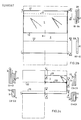
- the surgical drape for use with head surgery illustrated in the drawings comprises two rectangular sheets, a head sheet 1 and a protective sheet 2, the head sheet being placed on the protective sheet prior to the folding the drape, as illustrated in Figure 1.
- the head sheet can be made from a soft material which will readily mould to the head contours and which can be readily draped, whereas the protective sheet can be made from a conventional surgical drape material.
- suitable head-sheet material is so-called Sontara, which is spun-laced-fibre cloth manufactured and sold by E.I. Du Pont de Nemours and Company.
- the sheets 1 and 2 may, of course, have a form different to that illustrated in Figure 1.
- the protective sheet may have the shape of an iscoceles trapezoid, which further facilitates manipulation from the use configuration of the drape, as described hereinafter.
- the head sheet need not extend over the whole width of the protective sheet, even though this is preferivelyred so as to ensure that the head sheet will always reach around the head of the patient.
- the relative dimensions of the sheets may also vary in the direction of their longitudinal extensions.
- the inventive surgical drape has formed therein an elongated slit 3, which divides the lower part of the protective sheet into two equal parts and which extends from the bottom edge 22 of the protective sheet to a point located somewhat inwardly of the head sheet 1.
- the slit 3 has two functions. It enables the lower part of the protective sheet to be used to cover the chest region of the patient and also facilitates manipulation of the drape when the drape is developed from its insertion configuration to its use configuration, as will be made more apparent in the following.
- the prime function of the protective sheet 2 in other regards is to ensure the sterility of at least the rear side of the head sheet 1 resting loosely on the protective sheet, said rear side lying against the protective sheet until the head sheet is wrapped around the patient's head, whereupon the front side of the head sheet is brought into contact with the non-sterile hair of the patient while the rear side of said head sheet will be turned outwards and thus constitute the sterile part of the head sheet.
- the surgical drape must, of course, be capable of being draped without the theatre assistant touching the patient's hair.
- Figures 2a-3e illustrate the steps taken when folding the head surgery drape from the configuration illustarted in Figure 1 to the drape insertion configuration, i.e. the configuration in which the two sheets together can be pushed in beneath the head of a patient in one single movement, without touching the patient's hair.
- the contours of the drape prior to being folded in the manner intended are shown in chain lines in these Figures, whereas the arrows drawn in the Figures indicated the lines about which the folds are effected and in which direction.
- the Figures also show sectional side views of the folded drape.
- the upper part of the surgical drape has a so-called concertina-fold, whereby the folded upper part of the surgical drape can be unfolded or extended, simply by pulling upwards on the upper edge portion 21 of the protective sheet.
- the protective sheet either alone or together with the head sheet can be folded in a manner to produce a multiple of concertina-like folds, depending on the relative lengths of the sheets and on the desired length of the head sheet folded in said upper portion in relation to the length of the lower slitted part of the protective sheet.
- the thus folded lower portion of the protective sheet, together with the slitted portion of the head sheet, is folded in over the remaining part of the head sheet along a transverse line which extends through the end point of the slit 3 (see the left hand side of Figure 2c).
- a part of the lower portion of the protective sheet is then folded back along a fold line which is located at a distance from the end point of the slit, this distance being approximately equal to one third of the total length of the slit (see the right hand part of Figure 2c).
- the lower part of the protective sheet has been folded back along the transverse fold line extending through the end point of the slit (see the left hand part of the Figure).
- the side view D2-D2 shows that this lower part is folded in concertina fashion.
- the right hand part of the Figure shows that the corner flaps of the lower part of the protective sheet located nearest the slit are folded along a fold line which is inclined to the longitudinal extension. In this case the line should be chosen so that at least a part of the folded-over flap will cover the lowermost part of the head sheet.
- the lower part of the protective sheet with inwardly folded corner flaps is then folded in, back over the head sheet 1 along the fold line extending through the point at which the slit terminates. Subsequent to being folded in this manner, the surgical drape has the configuration illustrated in Figure 2e, which corresponds to the insertion configuration.
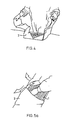
- Figure 4 illustrates the unfolding or development of the side concertina-like folds of a transport-folded surgical drape, such as to bring the drape to its insertion configuration.
- Figures 5a-5f illustrate the various steps taken when positioning an inventive surgical drape which has been folded to its insertion configuration.
- Figure 5a shows that a member of the theatre staff shall insert his hands beneath the inwardly folded corner flaps.
- the surgical drape is then lifted with the lower part of the head sheet facing upwards, as illustrated in Figure 5b, so that the folds of the concertina-folded upper part of the drape fall out naturally, i.e. gravitationally, as indicated by an arrow in Figure 5b.
- the inwardly folded corner flaps ensure herewith that the lower part of the surgical drape is not extended and consequently the head sheet is unable to fall down.
- the surgical drape is then placed on an operating table and inserted beneath the head of the patient, whilst the patient's head is held raised by another member of the theatre staff, as illustrated in Figure 5c. It should be mentioned that if some part of the drape comes into contact with the patient's hair when inserting the drape, which should normally not occur, this part of the drape will not face outwards when finally arranging the drape.
- the patient's head is lowered onto the head sheet exposed by the presence of the inwardly folded corner flaps.
- the staff member then moves his hands, which are still inserted beneath the corner flaps, obliquely forwards-upwards-outwards, such as to fold back the lower part of the protective sheet to the position shown on the right of Figure 2.
- the corner flaps are then folded out, so that the lower part of the drape obtains the configuration shown in Figure 2d.
- the surgical drape is therewith in its position of use, which differs from the position illustrated on the left in Figure 2d solely by the fact that the upper part of the drape has been extended, or developed. In this configuration of the drape, the head sheet rests loosely on the protective sheet.
- Manipulation of the surgical drape from its use configuration is preferably effected by first positioning the lower part of the protective sheet over the patient's chest region, by grasping the lower edge portion 22 of one half of the concertina-folded lower part of the protective sheet, and moving said edge portion downwards over the patient's chest, so as to unfold said lower part of the sheet, as shown in Figure 5d.
- the folds of the other lower, concertina-folded half of the protective sheet are then extended in a similar manner and said sheet half brought over the patient's chest region, whereafter the two sheet halves are taped together with adhesive tape.
- Figures 5e and 5f illustrate how the head sheet can be wrapped or wound around the patient's head and then secured in its wrapped position by means of adhesive tape.
- the adhesive tapes required to secure the sheet parts are preferably pre-packed in the transport package enclosing the surgical drape.
- Figure 6 illustrates a surgical drape which incorporates a longer head sheet in the finally arranged state of the drape.
- This longer head sheet is intended to cover a breathing tube which extends towards the head end of the operating table.
- the patient's trunk and legs are covered with a conventional surgical sheet L.
- the protective sheet may have a trapezoidal shape.
- the outermost ends of the bottom edge portion 22 of the lower slitted portion of the protective sheet will not be covered by overlying folded parts when the surgical drape is in its folded use configuration, so that these ends can be readily gripped.
- the slit 3 extend into the head sheet.
- the line along which the drape is folded from its insertion configuration to its configuration to use must lie somewhat inwardly of the head sheet.
- the apex of the V formed by the inwardly folded corner flaps of the lower part of the protective sheet will be located at a distance from the bottom edge of the surgical drape in the folded insertion configuration of the drape.
- the present invention provides a surgical drape for head surgery which is very simple to fabricate and the lower part of which will cover the chest region of a patient and therewith in the case of many operations obviate the need for additional conventional surgery drapes.
- the head sheet is freely moveable in relation to the protective sheet when the drape is extended to its configuration of use, thereby enabling the head sheet to be draped more readily than in the case of a drape where the head sheet is fastened to the protective sheet, and moreover can be made from a thinner or softer material, since unavoidable movements of the patient's head will not induce tensile stresses in the head sheet.
- the invention provides a well functioning and readily manipulated head surgical drape which comprises solely but a few parts and which can be manufactured inexpensively.
Landscapes
- Health & Medical Sciences (AREA)
- Surgery (AREA)
- Life Sciences & Earth Sciences (AREA)
- Engineering & Computer Science (AREA)
- Biomedical Technology (AREA)
- Heart & Thoracic Surgery (AREA)
- Medical Informatics (AREA)
- Molecular Biology (AREA)
- Animal Behavior & Ethology (AREA)
- General Health & Medical Sciences (AREA)
- Public Health (AREA)
- Veterinary Medicine (AREA)
- Surgical Instruments (AREA)
- Professional, Industrial, Or Sporting Protective Garments (AREA)
- Bedding Items (AREA)
Applications Claiming Priority (2)
| Application Number | Priority Date | Filing Date | Title |
|---|---|---|---|
| SE8603902 | 1986-09-16 | ||
| SE8603902A SE459466B (sv) | 1986-09-16 | 1986-09-16 | Operationslakan foer huvudoperationer |
Publications (2)
| Publication Number | Publication Date |
|---|---|
| EP0268567A2 true EP0268567A2 (de) | 1988-05-25 |
| EP0268567A3 EP0268567A3 (de) | 1990-12-12 |
Family
ID=20365612
Family Applications (1)
| Application Number | Title | Priority Date | Filing Date |
|---|---|---|---|
| EP19870850280 Withdrawn EP0268567A3 (de) | 1986-09-16 | 1987-09-14 | Chirurgisches Abdecktuch für Kopfoperationen |
Country Status (5)
| Country | Link |
|---|---|
| EP (1) | EP0268567A3 (de) |
| DK (1) | DK479187A (de) |
| FI (1) | FI874021A7 (de) |
| NO (1) | NO873781L (de) |
| SE (1) | SE459466B (de) |
Cited By (1)
| Publication number | Priority date | Publication date | Assignee | Title |
|---|---|---|---|---|
| US5778889A (en) * | 1996-08-30 | 1998-07-14 | Kimberly-Clark Worldwide, Inc. | Craniotomy drape |
Family Cites Families (3)
| Publication number | Priority date | Publication date | Assignee | Title |
|---|---|---|---|---|
| US3911912A (en) * | 1974-10-15 | 1975-10-14 | Kimberly Clark Co | Combination surgical drape |
| US3952738A (en) * | 1975-01-29 | 1976-04-27 | Johnson & Johnson | Folded surgical drape |
| US4457026A (en) * | 1983-09-30 | 1984-07-03 | Surgikos, Inc. | Surgical head drape |
-
1986
- 1986-09-16 SE SE8603902A patent/SE459466B/sv not_active IP Right Cessation
-
1987
- 1987-09-10 NO NO873781A patent/NO873781L/no unknown
- 1987-09-14 DK DK479187A patent/DK479187A/da not_active Application Discontinuation
- 1987-09-14 EP EP19870850280 patent/EP0268567A3/de not_active Withdrawn
- 1987-09-15 FI FI874021A patent/FI874021A7/fi not_active Application Discontinuation
Cited By (3)
| Publication number | Priority date | Publication date | Assignee | Title |
|---|---|---|---|---|
| US5778889A (en) * | 1996-08-30 | 1998-07-14 | Kimberly-Clark Worldwide, Inc. | Craniotomy drape |
| US6129085A (en) * | 1996-08-30 | 2000-10-10 | Kimberly-Clark Worldwide, Inc. | Craniotomy drape |
| US6269815B1 (en) | 1996-08-30 | 2001-08-07 | Kimberly-Clark Worldwide, Inc. | Craniotomy drape |
Also Published As
| Publication number | Publication date |
|---|---|
| NO873781D0 (no) | 1987-09-10 |
| DK479187A (da) | 1988-03-17 |
| FI874021A7 (fi) | 1988-03-17 |
| SE8603902D0 (sv) | 1986-09-16 |
| SE8603902L (sv) | 1988-03-17 |
| DK479187D0 (da) | 1987-09-14 |
| SE459466B (sv) | 1989-07-10 |
| FI874021A0 (fi) | 1987-09-15 |
| NO873781L (no) | 1988-03-17 |
| EP0268567A3 (de) | 1990-12-12 |
Similar Documents
| Publication | Publication Date | Title |
|---|---|---|
| US7160246B2 (en) | System and method for removing a protective cover from a medical instrument | |
| US4944312A (en) | Disposable face shield | |
| US4913138A (en) | Adhesive bandage for personal use | |
| US4027665A (en) | Cardiovascular drape | |
| JP3073209B2 (ja) | 外科用縫合糸の改良保持器 | |
| US3952738A (en) | Folded surgical drape | |
| US3955569A (en) | Surgical drape | |
| US4783854A (en) | Folded protective garment | |
| US8533868B2 (en) | Sterile glove with touchless donning | |
| US4173042A (en) | Head covering garment | |
| JP7749604B2 (ja) | 腕保護器キット及びその作成方法及び使用方法 | |
| JP7672022B2 (ja) | ロボットデバイス用の手術用ドレープ | |
| WO2009110325A1 (ja) | フェイスマスク | |
| WO2008100760A2 (en) | Portable balloon tying device, station and caddy | |
| US3777749A (en) | Folded surgical drape | |
| US4326300A (en) | Belt package with temporarily secured detachable belt end | |
| US3923052A (en) | Conformable surgical drape | |
| EP0268567A2 (de) | Chirurgisches Abdecktuch für Kopfoperationen | |
| CA1132420A (en) | Surgical drape | |
| JP3469564B2 (ja) | 医療用器材の包装方法 | |
| EP0185002A2 (de) | Anordnung für Operationslaken | |
| JPS6128567Y2 (de) | ||
| JPH038264Y2 (de) | ||
| WO1999016376A1 (en) | Ophthalmic drape and methods | |
| JPS6121058Y2 (de) |
Legal Events
| Date | Code | Title | Description |
|---|---|---|---|
| PUAI | Public reference made under article 153(3) epc to a published international application that has entered the european phase |
Free format text: ORIGINAL CODE: 0009012 |
|
| AK | Designated contracting states |
Kind code of ref document: A2 Designated state(s): AT BE CH DE ES FR GB IT LI NL SE |
|
| PUAL | Search report despatched |
Free format text: ORIGINAL CODE: 0009013 |
|
| AK | Designated contracting states |
Kind code of ref document: A3 Designated state(s): AT BE CH DE ES FR GB IT LI NL SE |
|
| STAA | Information on the status of an ep patent application or granted ep patent |
Free format text: STATUS: THE APPLICATION IS DEEMED TO BE WITHDRAWN |
|
| 18D | Application deemed to be withdrawn |
Effective date: 19910613 |
|
| RIN1 | Information on inventor provided before grant (corrected) |
Inventor name: FRISK, JOHAN Inventor name: SALLETS, IGNACE |