EP0260513A2 - Verfahren zur Herstellung einer dauerbruchbeständigen Nickelbasissuperlegierung und nach dem Verfahren hergestelltes Erzeugnis - Google Patents
Verfahren zur Herstellung einer dauerbruchbeständigen Nickelbasissuperlegierung und nach dem Verfahren hergestelltes Erzeugnis Download PDFInfo
- Publication number
- EP0260513A2 EP0260513A2 EP87112661A EP87112661A EP0260513A2 EP 0260513 A2 EP0260513 A2 EP 0260513A2 EP 87112661 A EP87112661 A EP 87112661A EP 87112661 A EP87112661 A EP 87112661A EP 0260513 A2 EP0260513 A2 EP 0260513A2
- Authority
- EP
- European Patent Office
- Prior art keywords
- alloy
- precipitate
- stress
- alloys
- anneal
- Prior art date
- Legal status (The legal status is an assumption and is not a legal conclusion. Google has not performed a legal analysis and makes no representation as to the accuracy of the status listed.)
- Ceased
Links
Images






Classifications
-
- C—CHEMISTRY; METALLURGY
- C22—METALLURGY; FERROUS OR NON-FERROUS ALLOYS; TREATMENT OF ALLOYS OR NON-FERROUS METALS
- C22C—ALLOYS
- C22C19/00—Alloys based on nickel or cobalt
- C22C19/03—Alloys based on nickel or cobalt based on nickel
- C22C19/05—Alloys based on nickel or cobalt based on nickel with chromium
- C22C19/051—Alloys based on nickel or cobalt based on nickel with chromium and Mo or W
- C22C19/056—Alloys based on nickel or cobalt based on nickel with chromium and Mo or W with the maximum Cr content being at least 10% but less than 20%
-
- C—CHEMISTRY; METALLURGY
- C22—METALLURGY; FERROUS OR NON-FERROUS ALLOYS; TREATMENT OF ALLOYS OR NON-FERROUS METALS
- C22F—CHANGING THE PHYSICAL STRUCTURE OF NON-FERROUS METALS AND NON-FERROUS ALLOYS
- C22F1/00—Changing the physical structure of non-ferrous metals or alloys by heat treatment or by hot or cold working
- C22F1/10—Changing the physical structure of non-ferrous metals or alloys by heat treatment or by hot or cold working of nickel or cobalt or alloys based thereon
Definitions
- nickel based superalloys are extensively employed in high performance environments. Such alloys have been used extensively in jet engines and in gas turbines where they must retain high strength and other desirable physical properties at elevated temperatures of a 1000F or more.
- phase Chemistries in Precipitation-Strengthening Superalloy by E. L. Hall, Y. M. Kouh, and K. M. Chang [Proceedings of 41st. Annual Meeting of Electron Microscopy Society of America, August 1983 (p. 248)].
- the objectives for forgeable nickel-base superalloys of this invention are three-fold: (1) to minimize the time dependence of fatigue cracking resistance, (2) to secure (a) values for strenght at room and elevated temperatures and (b) creep properties that are reasonably comparable to those of powder-processed alloys, and (3) to reduce or obviate the processing difficulties encounted heretofore.
- a problem which has been recognized to a greater and greater degree with many such nickel based superalloys is that they are subject to formation of cracks or incipient cracks, either in fabrication or in use, and that the cracks can actually propagate or grow while under stress as during use of the alloys in such structures as gas turbines and jet engines.
- the propagation or enlargement of cracks can lead to part fracture or other failure.
- the consequence of the failure of the moving mechanical part due to crack formation and propagation is well understood. In jet engines it can be particularly hazardous or even catastrophic.
- a principal unique finding of the NASA sponsored study was that the rate of propagation based on fatigue phenomena or in other words the rate of fatigue crack propagation (FCP) was not uniform for all stresses applied nor to all manners of applications of stress. More impor strictlytantly, the finding was that fatigue crack propagation actually varied with the frequency of the application of stress to the member where the stress was applied in a manner to enlarge the crack. More surprising still, was the finding from the NASA sponsored study that the application of stress of lower frequencies rather than at the higher frequencies previously employed in studies, actually increased the rate of crack propagation. In other words the NASA study revealed that there was a time dependence in fatigue crack propagation. Further the time dependence of fatigue crack propagation was found to depend not on frequency alone but on the time during which the member was held under stress for a so-called hold-time.
- Crack growth i.e., the crack propagation rate, in high-strength alloy bodies is known to depend upon the applied stress ( ⁇ ) as well as the crack length (a). These two factors are combined by fracture mechanics to form one single crack growth driving force; namely, stress intensity K, which is proprotional to ⁇ a.
- stress intensity K which is proprotional to ⁇ a.
- the stress intensity in a fatigue cycle may consist of two components, cyclic and static.
- the former represents the maximum variation of cyclic stress intensity ( ⁇ K), i.e., the difference between K max and K min .
- ⁇ K cyclic stress intensity
- IC static fracture toughness
- Crack growth rate is expressed mathematically as da/dN ⁇ ( ⁇ K) n .
- N represents the number of cycles and n is a constant which is between 2 and 4.
- the cyclic frequency and the shape of the waveform are the important parameters determining the crack growth rate. For a given cyclic stress intensity, a slower cyclic frequency can result in a faster crack growth rate. This undesirable time-dependent behavior of fatigue crack propagation can occur in most existing high strength superalloys.
- the design objective is to make the value of da/dN as small and as free of time-dependency as possible.
- Another object is to provide a method for reducing the tendency of nickel-base superalloys to undergo cracking.
- Another object is to provide articles for use under cyclic high stress which are more resistant to fatigue crack propagation.
- Another object is to provide a composition and method which permits nickel-base superalloys to have imparted thereto resistance to cracking under stress which is applied cyclically over a range of frequencies.
- objects of the invention can be achieved by providing a composition of the following approximate content in weight %: Ingredient Concentration in weight % Ni balance Cr 16 Co 12 Mo 5 W 5 Al 2.5 Ti 5 Zr 0.05 B 0.03 C 0.075 melting the compsition to form a melt, cooling the melt to form an alloy with a ⁇ precipitate content of about 45% by volume solution, annealing the alloy at 125°C for 1 hour, and cooling the alloy.
- the components of a novel composition should preferably be within the following ranges:
- Titanium can be partially replaced by Nb or Ta on an atomic percentage basis to a level less than or equal to 1.5 atomic percent.
- a superalloy which can be cast and wrought and also a method for processing this superalloy to produce materials with a superior set or combination of properties for use in advanced engine disk applications.
- the properties which are conventionally needed for materials used in disk applications include high tensile strength and high stress rupture strength.
- the alloy of the subject invention exhibits a desirable property of resisting crack growth propagation. Such ability to resist crack growth is essential for the component LCF or low cycle fatigue life of the part.
- the alloy of the present invention displays good forgeability and such forgeability permits greater flexibility in the use of various manufacturing processes needed in formation of parts such as disks for jet engines.
- a set of five alloy compositions, identified as HW-1 for example 1 and HW-5 for example 5 were prepared.
- the compositions had different alloy content and the alloy content is as listed in Table I below.
- the individual alloys HW-1 to HW-5 of the five examples were prepared by conventional casting and extrusion processing.
- the individual alloys were each then successively heat treated by a schedule which included a solution anneal plus an aging some details of which are discussed below.
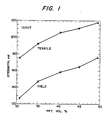
- Fatigue crack growth rate was measured for these samples of Examples 1-5 and the data is plotted in Figure 4 for the respective samples HW-1 through HW-5. This data indicates that there is a tendency for a better crack growth resistance to be found in alloys containing higher volume fractions of percipitate.
- the good disk and the preferred disk and, in fact, the ideal disk alloy preferably has a high content of precipitate phase but only to the extent that the ductility remains above the level which permits reliable mechanical manufacture. From the experiments performed in these examples and from the data plotted on the respective figures and listed in the respective tables, the optimum content of precipitate was identified to be about 45%. What has also been found and what is very important to the qualification of such mechanical tests for disk alloy use is that the approximate 45% precipitate level is the one which does permit highly successful forging of a case disk alloy to a structure suitable for use in an aircraft engine.
- composition that has a precipitate content corresponding to that of HW-4 of Example 4 above was prepared and the processing parameters of this composition were studied.
- the composition had a different set of ingredients but had a precipitate content corresponding closely to that of HW-4.
- the composition was identified as CH-60 and had the following ingredient content: Ingredient Concentration in weight % Ni balance Cr 16 Co 12 Mo 5 W 5 Al 2.5 Ti 5.0 Zr 0.05 B 0.03 C 0.075
- An ingot of this alloy was first prepared by vacuum induction melting.
- the ingot had a 4" diameter. It was forged into a 2" thick pancake.
- the final forging temperature was set at 1100°C and the height of the ingot was reduced by 50%.
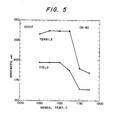
- Example 6 Based on the studies conducted in Example 6 further tests of anneal temperatures were carried out. Samples of the CH-60 alloy were prepared and annealed at temperatures of 1050°C, 1100°C and 1125°C. It was found that the annealing at 1125°C produces a fine equiaxed structure of grains having an average diameter of about 20 ⁇ m. It was also observed for the other annealed samples that different degrees of partial recrystallization had occurred for the samples annealed at 1050°C and 1100°C. It was further observed that a typical "necklace" metallographic structure was developed for the sample which was annealed at 1100°C.
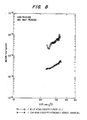
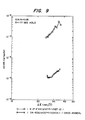
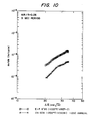
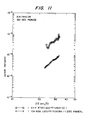
- Fatigue cracking resistance was evaluated at 1200°F for the samples using three cyclic waveforms.
- the cyclic waveforms used and the sequence of the periods are similar to those employed in the NASA study referred to above in the background statement of this application.
- Three cyclic waveforms are as follows. First, a three second period of application of stress and removal of stress in a sinusoidal pattern. Next, a 180 second period of application and removal of stress in a sinusoidal pattern The third cycle is a three second period of application of stress and 177 second period of holding the sample at maximum load stress on the sinusoidal curve.
- Figure 7 displays the results obtained for the three second period.
- Figure 8 displays the results obtained for the 180 second period and
- Figure 9 displays the results obtained for the three second plus the 177 second hold periods.
- the data plotted is for a sample as prepared above and a comparative sample is a sample of Rene ⁇ 95 metal well known in the industry as a superalloy.
Landscapes
- Chemical & Material Sciences (AREA)
- Engineering & Computer Science (AREA)
- Materials Engineering (AREA)
- Mechanical Engineering (AREA)
- Metallurgy (AREA)
- Organic Chemistry (AREA)
- Physics & Mathematics (AREA)
- Thermal Sciences (AREA)
- Crystallography & Structural Chemistry (AREA)
- Manufacture And Refinement Of Metals (AREA)
- Turbine Rotor Nozzle Sealing (AREA)
Applications Claiming Priority (2)
| Application Number | Priority Date | Filing Date | Title |
|---|---|---|---|
| US06/907,271 US4820353A (en) | 1986-09-15 | 1986-09-15 | Method of forming fatigue crack resistant nickel base superalloys and product formed |
| US907271 | 1986-09-15 |
Publications (2)
| Publication Number | Publication Date |
|---|---|
| EP0260513A2 true EP0260513A2 (de) | 1988-03-23 |
| EP0260513A3 EP0260513A3 (de) | 1989-08-16 |
Family
ID=25423802
Family Applications (1)
| Application Number | Title | Priority Date | Filing Date |
|---|---|---|---|
| EP87112661A Ceased EP0260513A3 (de) | 1986-09-15 | 1987-08-31 | Verfahren zur Herstellung einer dauerbruchbeständigen Nickelbasissuperlegierung und nach dem Verfahren hergestelltes Erzeugnis |
Country Status (4)
| Country | Link |
|---|---|
| US (1) | US4820353A (de) |
| EP (1) | EP0260513A3 (de) |
| JP (1) | JPS63145737A (de) |
| IL (1) | IL83636A (de) |
Cited By (8)
| Publication number | Priority date | Publication date | Assignee | Title |
|---|---|---|---|---|
| EP0361084A1 (de) * | 1988-09-26 | 1990-04-04 | General Electric Company | Ermüdungsrissbeständige Nickelbasissuperlegierungen und hersgestelltes Erzeugnis |
| FR2640285A1 (fr) * | 1988-12-13 | 1990-06-15 | Gen Electric | Article et alliage a base de nickel resistant a la croissance des fendillements par fatigue et leur procede de fabrication |
| US5130086A (en) * | 1987-07-31 | 1992-07-14 | General Electric Company | Fatigue crack resistant nickel base superalloys |
| US5156808A (en) * | 1988-09-26 | 1992-10-20 | General Electric Company | Fatigue crack-resistant nickel base superalloy composition |
| WO1992018659A1 (en) * | 1991-04-15 | 1992-10-29 | United Technologies Corporation | Superalloy forging process and related composition |
| WO2000044949A1 (en) * | 1999-01-28 | 2000-08-03 | Siemens Aktiengesellschaft | Nickel base superalloy with good machinability |
| CN105189794A (zh) * | 2013-07-17 | 2015-12-23 | 三菱日立电力系统株式会社 | Ni基合金制品及其制造方法和Ni基合金构件及其制造方法 |
| US10557189B2 (en) | 2014-06-18 | 2020-02-11 | Mitsubishi Hitachi Power Systems, Ltd. | Ni based superalloy, member of Ni based superalloy, and method for producing same |
Families Citing this family (16)
| Publication number | Priority date | Publication date | Assignee | Title |
|---|---|---|---|---|
| JP2778705B2 (ja) * | 1988-09-30 | 1998-07-23 | 日立金属株式会社 | Ni基超耐熱合金およびその製造方法 |
| US5019179A (en) * | 1989-03-20 | 1991-05-28 | Mitsubishi Metal Corporation | Method for plastic-working ingots of heat-resistant alloy containing boron |
| US5161950A (en) * | 1989-10-04 | 1992-11-10 | General Electric Company | Dual alloy turbine disk |
| US5393483A (en) * | 1990-04-02 | 1995-02-28 | General Electric Company | High-temperature fatigue-resistant nickel based superalloy and thermomechanical process |
| US5693159A (en) * | 1991-04-15 | 1997-12-02 | United Technologies Corporation | Superalloy forging process |
| US5527402A (en) * | 1992-03-13 | 1996-06-18 | General Electric Company | Differentially heat treated process for the manufacture thereof |
| US5269857A (en) * | 1992-03-31 | 1993-12-14 | General Electric Company | Minimization of quench cracking of superalloys |
| US6974508B1 (en) | 2002-10-29 | 2005-12-13 | The United States Of America As Represented By The United States National Aeronautics And Space Administration | Nickel base superalloy turbine disk |
| US20060292105A1 (en) * | 2005-06-28 | 2006-12-28 | Lever O W Jr | Topical preservative compositions |
| US20070151639A1 (en) * | 2006-01-03 | 2007-07-05 | Oruganti Ramkumar K | Nanostructured superalloy structural components and methods of making |
| JP2008179845A (ja) * | 2007-01-23 | 2008-08-07 | General Electric Co <Ge> | ナノ構造化超合金構造部材及び製造方法 |
| JP4982340B2 (ja) * | 2007-11-30 | 2012-07-25 | 株式会社日立製作所 | Ni基合金、ガスタービン静翼及びガスタービン |
| US8992700B2 (en) * | 2009-05-29 | 2015-03-31 | General Electric Company | Nickel-base superalloys and components formed thereof |
| US8992699B2 (en) * | 2009-05-29 | 2015-03-31 | General Electric Company | Nickel-base superalloys and components formed thereof |
| CN109789457A (zh) * | 2016-09-30 | 2019-05-21 | 日立金属株式会社 | Ni基超耐热合金挤出材的制造方法及Ni基超耐热合金挤出材 |
| JP6728282B2 (ja) * | 2018-08-02 | 2020-07-22 | 三菱日立パワーシステムズ株式会社 | Ni基合金軟化材の製造方法およびNi基合金部材の製造方法 |
Family Cites Families (6)
| Publication number | Priority date | Publication date | Assignee | Title |
|---|---|---|---|---|
| US3146136A (en) * | 1961-01-24 | 1964-08-25 | Rolls Royce | Method of heat treating nickel base alloys |
| US3615376A (en) * | 1968-11-01 | 1971-10-26 | Gen Electric | Cast nickel base alloy |
| US3976480A (en) * | 1974-09-18 | 1976-08-24 | Hitachi Metals, Ltd. | Nickel base alloy |
| US4140555A (en) * | 1975-12-29 | 1979-02-20 | Howmet Corporation | Nickel-base casting superalloys |
| US4093476A (en) * | 1976-12-22 | 1978-06-06 | Special Metals Corporation | Nickel base alloy |
| US4685977A (en) * | 1984-12-03 | 1987-08-11 | General Electric Company | Fatigue-resistant nickel-base superalloys and method |
-
1986
- 1986-09-15 US US06/907,271 patent/US4820353A/en not_active Expired - Lifetime
-
1987
- 1987-08-25 IL IL83636A patent/IL83636A/xx not_active IP Right Cessation
- 1987-08-31 EP EP87112661A patent/EP0260513A3/de not_active Ceased
- 1987-09-16 JP JP62229924A patent/JPS63145737A/ja active Pending
Cited By (9)
| Publication number | Priority date | Publication date | Assignee | Title |
|---|---|---|---|---|
| US5130086A (en) * | 1987-07-31 | 1992-07-14 | General Electric Company | Fatigue crack resistant nickel base superalloys |
| EP0361084A1 (de) * | 1988-09-26 | 1990-04-04 | General Electric Company | Ermüdungsrissbeständige Nickelbasissuperlegierungen und hersgestelltes Erzeugnis |
| US5156808A (en) * | 1988-09-26 | 1992-10-20 | General Electric Company | Fatigue crack-resistant nickel base superalloy composition |
| FR2640285A1 (fr) * | 1988-12-13 | 1990-06-15 | Gen Electric | Article et alliage a base de nickel resistant a la croissance des fendillements par fatigue et leur procede de fabrication |
| WO1992018659A1 (en) * | 1991-04-15 | 1992-10-29 | United Technologies Corporation | Superalloy forging process and related composition |
| WO2000044949A1 (en) * | 1999-01-28 | 2000-08-03 | Siemens Aktiengesellschaft | Nickel base superalloy with good machinability |
| CN105189794A (zh) * | 2013-07-17 | 2015-12-23 | 三菱日立电力系统株式会社 | Ni基合金制品及其制造方法和Ni基合金构件及其制造方法 |
| US10487384B2 (en) | 2013-07-17 | 2019-11-26 | Mitsubishi Hitachi Power Systems, Ltd. | Ni-based alloy product and method for producing same, and Ni-based alloy member and method for producing same |
| US10557189B2 (en) | 2014-06-18 | 2020-02-11 | Mitsubishi Hitachi Power Systems, Ltd. | Ni based superalloy, member of Ni based superalloy, and method for producing same |
Also Published As
| Publication number | Publication date |
|---|---|
| JPS63145737A (ja) | 1988-06-17 |
| EP0260513A3 (de) | 1989-08-16 |
| IL83636A0 (en) | 1988-01-31 |
| US4820353A (en) | 1989-04-11 |
| IL83636A (en) | 1991-01-31 |
Similar Documents
| Publication | Publication Date | Title |
|---|---|---|
| US4820353A (en) | Method of forming fatigue crack resistant nickel base superalloys and product formed | |
| US4888064A (en) | Method of forming strong fatigue crack resistant nickel base superalloy and product formed | |
| US4814023A (en) | High strength superalloy for high temperature applications | |
| US5087305A (en) | Fatigue crack resistant nickel base superalloy | |
| US4685977A (en) | Fatigue-resistant nickel-base superalloys and method | |
| EP0403682B1 (de) | Ermüdungsrissbeständige Nickelbasissuperlegierungen und hergestelltes Erzeugnis | |
| US4983233A (en) | Fatigue crack resistant nickel base superalloys and product formed | |
| US5156808A (en) | Fatigue crack-resistant nickel base superalloy composition | |
| EP0403681B1 (de) | Ermüdungsrissbeständige Nickelbasissuperlegierung und hergestelltes Erzeugnis | |
| EP0260510B1 (de) | Thermomechanisches Verfahren zur Herstellung einer dauerbruchbeständigen Nickelbasissuperlegierung und nach dem Verfahren hergestelltes Erzeugnis | |
| EP0260512B1 (de) | Verfahren zur Herstellung einer dauerbruchbeständigen Nickelbasissuperlegierung und nach dem Verfahren hergestelltes Erzeugnis | |
| US5124123A (en) | Fatigue crack resistant astroloy type nickel base superalloys and product formed | |
| US5129970A (en) | Method of forming fatigue crack resistant nickel base superalloys and product formed | |
| US5130089A (en) | Fatigue crack resistant nickel base superalloy | |
| US5129969A (en) | Method of forming in100 fatigue crack resistant nickel base superalloys and product formed | |
| US5130088A (en) | Fatigue crack resistant nickel base superalloys | |
| US5171380A (en) | Method of forming fatigue crack resistant Rene' 95 type nickel base superalloys and product formed | |
| US5130086A (en) | Fatigue crack resistant nickel base superalloys | |
| US5129968A (en) | Fatigue crack resistant nickel base superalloys and product formed | |
| US5037495A (en) | Method of forming IN-100 type fatigue crack resistant nickel base superalloys and product formed | |
| EP0381828B1 (de) | Ermüdungsrissbeständige Nickelbasissuperlegierung |
Legal Events
| Date | Code | Title | Description |
|---|---|---|---|
| PUAI | Public reference made under article 153(3) epc to a published international application that has entered the european phase |
Free format text: ORIGINAL CODE: 0009012 |
|
| AK | Designated contracting states |
Kind code of ref document: A2 Designated state(s): DE ES FR GB IT |
|
| PUAL | Search report despatched |
Free format text: ORIGINAL CODE: 0009013 |
|
| AK | Designated contracting states |
Kind code of ref document: A3 Designated state(s): DE ES FR GB IT |
|
| 17P | Request for examination filed |
Effective date: 19900123 |
|
| 17Q | First examination report despatched |
Effective date: 19910719 |
|
| STAA | Information on the status of an ep patent application or granted ep patent |
Free format text: STATUS: THE APPLICATION HAS BEEN REFUSED |
|
| 18R | Application refused |
Effective date: 19931112 |