EP0258946A2 - Zweiteilige Winkelstützen und Verfahren zur Anwendung bei den Kathodenstrahlröhren - Google Patents
Zweiteilige Winkelstützen und Verfahren zur Anwendung bei den Kathodenstrahlröhren Download PDFInfo
- Publication number
- EP0258946A2 EP0258946A2 EP87201646A EP87201646A EP0258946A2 EP 0258946 A2 EP0258946 A2 EP 0258946A2 EP 87201646 A EP87201646 A EP 87201646A EP 87201646 A EP87201646 A EP 87201646A EP 0258946 A2 EP0258946 A2 EP 0258946A2
- Authority
- EP
- European Patent Office
- Prior art keywords
- band
- basal
- attached
- crt
- flange
- Prior art date
- Legal status (The legal status is an assumption and is not a legal conclusion. Google has not performed a legal analysis and makes no representation as to the accuracy of the status listed.)
- Withdrawn
Links
Images


Classifications
-
- H—ELECTRICITY
- H01—ELECTRIC ELEMENTS
- H01J—ELECTRIC DISCHARGE TUBES OR DISCHARGE LAMPS
- H01J29/00—Details of cathode-ray tubes or of electron-beam tubes of the types covered by group H01J31/00
- H01J29/02—Electrodes; Screens; Mounting, supporting, spacing or insulating thereof
-
- H—ELECTRICITY
- H04—ELECTRIC COMMUNICATION TECHNIQUE
- H04N—PICTORIAL COMMUNICATION, e.g. TELEVISION
- H04N5/00—Details of television systems
- H04N5/64—Constructional details of receivers, e.g. cabinets or dust covers
- H04N5/65—Holding-devices for protective discs or for picture masks
-
- H—ELECTRICITY
- H01—ELECTRIC ELEMENTS
- H01J—ELECTRIC DISCHARGE TUBES OR DISCHARGE LAMPS
- H01J29/00—Details of cathode-ray tubes or of electron-beam tubes of the types covered by group H01J31/00
- H01J29/86—Vessels; Containers; Vacuum locks
- H01J29/87—Arrangements for preventing or limiting effects of implosion of vessels or containers
Definitions
- This invention relates to a method for applying tube mounting brackets to cathode ray tubes (CRTs), and more particularly relates to a method for attachment of these mounting brackets to the implosion bands of such tubes.
- CRTs cathode ray tubes
- Color CRTs for color television and allied display applications basically comprise an evacuated glass envelope including a face panel portion and a funnel portion, a phosphor screen on the interior surface of the face panel, and an electron gun in the neck of the funnel portion, for generating electron beams to excite the phosphor elements on the screen.
- implosion bands A particular type of implosion band is the so-called tension band, which is applied by wrapping it around the panel skirt, overlapping the ends and fastening these overlapped ends with a tension device.
- shrink band A new type of implosion band which is coming into increasing use is the shrink band.
- This is a steel band which is joined end-to-end and preformed prior to placement on the CRT panel. The formed band is then heated to cause thermal expansion sufficient to allow placement of the band around the panel skirt, and then allowed to cool and "shrink" onto the panel, thereby placing the band in tension and the panel in compression.
- Implosion bands often perform an added function of supporting tube mounting brackets, used to mount the tubes in a display cabinet.
- the brackets may be placed under the band and thereby held in place by compression against the glass surface, or may be welded to the outer surface of the band. In either case, accurate placement of the brackets is difficult to achieve, due to uncontrollable variations in panel size and shape, and final band location on the panel.
- bracket slippage during and after band placement is a problem.
- brackets are welded to the outer surface of the band, the slippage problem is avoided, but welding must be carried out prior to attachment of the band to the panel, in order to avoid the risk of panel breakage during welding.
- accurate placement of the brackets is difficult to achieve, due to the inability to compensate for the random variations among panels and bands, as well as the position of the bands on the panels after assembly.
- ears mounting brackets
- the positioning brackets are oversized to allow band movement during heating, tube placement, and shrink fit. This method results in X, Y positioning of the ears to an accuracy of only plus or minus 78 thousandths of an inch.
- a two-piece mounting bracket for CRTs comprising a basal flange and an apertured top plate, as well as a method for attaching the mounting bracket to the implosion band of a CRT, the method comprising the steps of: attaching the basal flange to the implosion band; attaching the implosion band to the CRT face panel; positioning the banded CRT accurately with respect to X, Y and Z reference axes; positioning the top plate accurately on the basal flanges with respect to desired x, y, z locations; and attaching the top plate to the basal flange.
- basal flanges with a raised lip on one edge of each flange are attached to shrink bands prior to shrink fit.
- the bands are then expanded by heating and positioned for shrink fit by locating means which engage the raised lips of the basal flanges.
- the top plates of the brackets are attached as described above.
- the top plates may be omitted where the TV set manufacturer employs tube mounting means other than brackets.
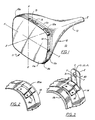
- Fig. 1 there is shown in perspective an implosion-banded cathode ray tube 10 oriented in space with reference to X, Y, and Z axes.
- the glass face panel 11, including face 11a and sidewall or skirt 11b, is joined to funnel 12, having a neck portion 13, by a frit seal 11c, located to the rear of implosion band 14.
- Band 14 is a shrink band, so-called because it is pre-formed, and then expanded by heating to fit around the panel skirt, and finally allowed to cool, thereby shrinking around the skirt to place the panel in mechanical compression.
- the band is formed by first cutting a length of steel strip from a roll, straightening end portions of the strip and then butt welding the straightened ends together to form an egg-shaped hoop. This hoop is then passed between rollers which form a shallow longitudinal bend in the hoop. This bend effectively raises the central portion 80 of the band 14 slightly above the glass surface, to provide clearance for the mold match line 81 on skirt 11b, as shown in Fig.8. Bend angle alpha ( ⁇ ) is typically about 5°.
- the hoop After bending, the hoop is stretched into a rectangular shape corresponding to the outline of the face panel, and the forward edge of the corner portions are rolled over slightly to provide a snug fit with the corners of the face panel.
- This rolled edge, 82 in Fig.8, is sometimes referred to as an "eyebrow".
- fishplate 15 an elongated metal plate, is welded onto the band 14 across the butt weld 16 for added strength, as shown in Fig.1.
- four basal flanges three of which, 18a, 18b, and 18c, are shown) are welded to the corner portions of band 14.
- coarse locator blocks 40a, 40b, 40c and 40d shown in Fig.4, which position the band with sufficient accuracy to allow engagement of raised lips 20a, 20b, 20c and 20d of basal flanges 18a, 18a, 18b, 18c and 18d by fine locators 41a, 41b, 41c and 41d.
- coarse locators 40 swing out of the way, about pivot points indicated as 50 for locator 40d in Fig.5, to allow the band to drop onto the fine locators, which then position the band accurately in the X-Y plane for subsequent heating.
- the fine locator feed mechanisms are disengaged to allow these locators to float during heating, band expansion, and application.
- the tube is inserted into the band.
- the band is then allowed to shrink into place on the panel skirt.
- ear 30 is welded onto basal flange at a location where the center of aperture 31 corresponds to point x1, y1, z1.
- ear may be mounted with an accuracy on the order of plus or minus 10 thousandths of an inch.
- the ears may be omitted in cases in which other mounting arrangements are contemplated.
- bracket mounting apertures leads to other advantages, including: greater flexibility in cabinet design due to large permissible variation in Z axis placement of top plates on basal flanges: ability to use the same parts interchangeably on different tube sizes and shapes, leading to reduced inventory; increased allowable tolerances on parts and glass leading to lower tooling and material costs; and ability to inexpensively roughen (e.g., by coining) one or both sides of the top plate, thus avoiding the need for separate lock washers.
- basal flanges are shown in Figs. 6 and 7.
- Fig. 6 shows basal flange 60 having no raised lip.
- Such an embodiment is suitable for use with conventional tension bands, which bands do not require engagement with separate locating means.
- Such bands are stretched around the face panel and affixed by a mechanical tensioning or strapping tool.
- the basal flange serves only as an attachment surface, not as a holder for band location.
- Fig. 7 shows a U-shaped basal flange 70 attached to band 71. Such an embodiment may be useful where large variations in specifications for location in the Z axis direction are anticipated.
- Figs. 9 through 11 show other embodiments of two-piece mounting brackets of the invention.
- basal flange 90 has two projections from the rear edge of the flange, 90a and 90b, which projections are resistance welded to top plate 91. These projections are advantageous in that in some cases X, Y location is more critical than Z location.
- basal flange 99 includes upstanding portion 100 having a central saddle 100a. This saddle enables placement of the aperture 101a of top plate 101 closer to the face panel than would otherwise be possible. Attachment, such as by resistance welding, is at locations 102 and 103, surrounding coincident spring mounting apertures 104 and 105 in both the basal flange and top plate.
- upstanding portion 110 of basal flange 111 is located between spring mounting apertures 112 and 113.
- Basal flange 111 is attached to top plate 114 by resistance welds 115 and 116.
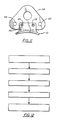
- Fig. 12 is a block diagram of the basic steps of the described process.
Landscapes
- Engineering & Computer Science (AREA)
- Multimedia (AREA)
- Signal Processing (AREA)
- Vessels, Lead-In Wires, Accessory Apparatuses For Cathode-Ray Tubes (AREA)
- Manufacture Of Electron Tubes, Discharge Lamp Vessels, Lead-In Wires, And The Like (AREA)
Applications Claiming Priority (2)
| Application Number | Priority Date | Filing Date | Title |
|---|---|---|---|
| US902822 | 1986-09-02 | ||
| US06/902,822 US4668993A (en) | 1986-09-02 | 1986-09-02 | Two-piece mounting brackets and method for applying them to cathode ray tubes |
Publications (2)
| Publication Number | Publication Date |
|---|---|
| EP0258946A2 true EP0258946A2 (de) | 1988-03-09 |
| EP0258946A3 EP0258946A3 (de) | 1989-06-14 |
Family
ID=25416451
Family Applications (1)
| Application Number | Title | Priority Date | Filing Date |
|---|---|---|---|
| EP87201646A Withdrawn EP0258946A3 (de) | 1986-09-02 | 1987-08-31 | Zweiteilige Winkelstützen und Verfahren zur Anwendung bei den Kathodenstrahlröhren |
Country Status (4)
| Country | Link |
|---|---|
| US (1) | US4668993A (de) |
| EP (1) | EP0258946A3 (de) |
| JP (1) | JPS6369129A (de) |
| KR (1) | KR950011705B1 (de) |
Cited By (1)
| Publication number | Priority date | Publication date | Assignee | Title |
|---|---|---|---|---|
| GB2249866A (en) * | 1990-09-28 | 1992-05-20 | Videocolor Spa | Cathode-ray tube having implosion protection band |
Families Citing this family (5)
| Publication number | Priority date | Publication date | Assignee | Title |
|---|---|---|---|---|
| US5448316A (en) * | 1989-10-02 | 1995-09-05 | U.S. Philips Corporation | Assembly of anti-implosion bands, anti-implosion band for such an assembly and display tube comprising such an anti-implosion band |
| US5036577A (en) * | 1989-11-30 | 1991-08-06 | Thomson Consumer Electronics, Inc. | Method of forming a shrink fit implosion protection band |
| US5233432A (en) * | 1991-11-04 | 1993-08-03 | Thomson Consumer Electronics | Cathode-ray tube having implosion protection means with a structure and method to facilitate attachment of tube mounting means |
| JP3196273B2 (ja) * | 1991-12-26 | 2001-08-06 | ソニー株式会社 | 防爆バンド並びに陰極線管 |
| ATE153176T1 (de) * | 1993-02-03 | 1997-05-15 | Philips Electronics Nv | Implosionsschutzband für eine elektronenstrahlröhre |
Family Cites Families (3)
| Publication number | Priority date | Publication date | Assignee | Title |
|---|---|---|---|---|
| US3271516A (en) * | 1962-10-22 | 1966-09-06 | Owens Illinois Inc | Implosion resistant cathode ray tube with integral mounting elements to facilitate installation |
| US3651257A (en) * | 1970-10-19 | 1972-03-21 | Motorola Inc | Mounting bracket for television picture tube |
| US4360837A (en) * | 1980-07-11 | 1982-11-23 | North American Philips Consumer Electronics Corp. | Cathode ray tube support system |
-
1986
- 1986-09-02 US US06/902,822 patent/US4668993A/en not_active Expired - Fee Related
-
1987
- 1987-08-31 JP JP62215531A patent/JPS6369129A/ja active Pending
- 1987-08-31 EP EP87201646A patent/EP0258946A3/de not_active Withdrawn
- 1987-08-31 KR KR1019870009554A patent/KR950011705B1/ko not_active Expired - Lifetime
Cited By (3)
| Publication number | Priority date | Publication date | Assignee | Title |
|---|---|---|---|---|
| GB2249866A (en) * | 1990-09-28 | 1992-05-20 | Videocolor Spa | Cathode-ray tube having implosion protection band |
| US5241393A (en) * | 1990-09-28 | 1993-08-31 | Videocolor S.P.A. | Cathode-ray tube having implosion protection band |
| GB2249866B (en) * | 1990-09-28 | 1994-08-17 | Videocolor Spa | Cathode-ray tube having implosion protection band |
Also Published As
| Publication number | Publication date |
|---|---|
| KR950011705B1 (ko) | 1995-10-07 |
| JPS6369129A (ja) | 1988-03-29 |
| EP0258946A3 (de) | 1989-06-14 |
| US4668993A (en) | 1987-05-26 |
| KR880004535A (ko) | 1988-06-07 |
Similar Documents
| Publication | Publication Date | Title |
|---|---|---|
| US4668993A (en) | Two-piece mounting brackets and method for applying them to cathode ray tubes | |
| US6890237B2 (en) | Shadow mask assembly manufacturing method and cathode ray tube manufacturing method | |
| US5057929A (en) | Cathode ray tube having implosion band with raised tabs and method | |
| US5443410A (en) | Getter fixing device for a cathode ray tube | |
| US4295574A (en) | Banded-type implosion protection cathode ray tubes | |
| JPH01274343A (ja) | Crtテンションマスクおよびその基準および支持システム | |
| US5347367A (en) | Cathode-ray tube having implosion protection means with openings | |
| EP0878821B1 (de) | Kathodenstrahlröhre mit Befestigungselementen für den Schattenmaskenrahmen | |
| US5036577A (en) | Method of forming a shrink fit implosion protection band | |
| US5064394A (en) | Method of forming a shrinkfit implosion protection band having a concavity therein | |
| US5348506A (en) | Method of assembling a shadow mask and an apparatus for carrying out the same | |
| US6089937A (en) | Cathode-ray tube dividing apparatus and cathode-ray tube dividing method | |
| CA2134509C (en) | Color picture tube with shadow mask having skirt with reverse bend | |
| JP3433147B2 (ja) | 平面陰極線管用シャドーマスクの溶接方法 | |
| US4206534A (en) | Implosion-resistant cathode ray tube and fabricating process | |
| KR100206269B1 (ko) | 음극선관의 분할형 프레임과 그 블랭크 및 그 블랭킹 방법 | |
| CN1023041C (zh) | 改进荫罩框架组件支架的彩色显象管 | |
| JP3368813B2 (ja) | カラー受像管 | |
| GB2319887A (en) | Cathode ray tubes | |
| JPH0623148U (ja) | 防爆形ブラウン管 | |
| JPS6035953Y2 (ja) | 防爆形陰極線管 | |
| EP0881661B1 (de) | Bildanzeigevorrichtung und Verfahren zu ihrer Herstellung | |
| KR100189413B1 (ko) | 음극선관용 프레임과 마스크의 결합방법 및 장치 | |
| KR200148979Y1 (ko) | 음극선관의 새도우마스크 지지프레임 | |
| JPH08124501A (ja) | 防爆形ブラウン管およびその製造方法 |
Legal Events
| Date | Code | Title | Description |
|---|---|---|---|
| PUAI | Public reference made under article 153(3) epc to a published international application that has entered the european phase |
Free format text: ORIGINAL CODE: 0009012 |
|
| AK | Designated contracting states |
Kind code of ref document: A2 Designated state(s): DE FR GB IT |
|
| PUAL | Search report despatched |
Free format text: ORIGINAL CODE: 0009013 |
|
| AK | Designated contracting states |
Kind code of ref document: A3 Designated state(s): DE FR GB IT |
|
| 17P | Request for examination filed |
Effective date: 19891204 |
|
| RAP1 | Party data changed (applicant data changed or rights of an application transferred) |
Owner name: NORTH AMERICAN PHILIPS CORPORATION |
|
| 17Q | First examination report despatched |
Effective date: 19900626 |
|
| STAA | Information on the status of an ep patent application or granted ep patent |
Free format text: STATUS: THE APPLICATION IS DEEMED TO BE WITHDRAWN |
|
| 18D | Application deemed to be withdrawn |
Effective date: 19930120 |
|
| RIN1 | Information on inventor provided before grant (corrected) |
Inventor name: HERMANN, KENNETH WILLIAM |