EP0257969A2 - Zirkonoxid-modifizierte Aluminiumoxid-Faser - Google Patents
Zirkonoxid-modifizierte Aluminiumoxid-Faser Download PDFInfo
- Publication number
- EP0257969A2 EP0257969A2 EP87307315A EP87307315A EP0257969A2 EP 0257969 A2 EP0257969 A2 EP 0257969A2 EP 87307315 A EP87307315 A EP 87307315A EP 87307315 A EP87307315 A EP 87307315A EP 0257969 A2 EP0257969 A2 EP 0257969A2
- Authority
- EP
- European Patent Office
- Prior art keywords
- zirconia
- fiber
- fibers
- alumina
- transmittance
- Prior art date
- Legal status (The legal status is an assumption and is not a legal conclusion. Google has not performed a legal analysis and makes no representation as to the accuracy of the status listed.)
- Withdrawn
Links
- 239000000835 fiber Substances 0.000 title claims abstract description 79
- PNEYBMLMFCGWSK-UHFFFAOYSA-N aluminium oxide Inorganic materials [O-2].[O-2].[O-2].[Al+3].[Al+3] PNEYBMLMFCGWSK-UHFFFAOYSA-N 0.000 title claims abstract description 32
- MCMNRKCIXSYSNV-UHFFFAOYSA-N Zirconium dioxide Chemical compound O=[Zr]=O MCMNRKCIXSYSNV-UHFFFAOYSA-N 0.000 claims description 100
- 238000002834 transmittance Methods 0.000 claims description 27
- 239000000919 ceramic Substances 0.000 claims description 10
- RKTYLMNFRDHKIL-UHFFFAOYSA-N copper;5,10,15,20-tetraphenylporphyrin-22,24-diide Chemical compound [Cu+2].C1=CC(C(=C2C=CC([N-]2)=C(C=2C=CC=CC=2)C=2C=CC(N=2)=C(C=2C=CC=CC=2)C2=CC=C3[N-]2)C=2C=CC=CC=2)=NC1=C3C1=CC=CC=C1 RKTYLMNFRDHKIL-UHFFFAOYSA-N 0.000 claims description 9
- 239000012530 fluid Substances 0.000 claims description 7
- 239000003381 stabilizer Substances 0.000 claims description 7
- RUDFQVOCFDJEEF-UHFFFAOYSA-N yttrium(III) oxide Inorganic materials [O-2].[O-2].[O-2].[Y+3].[Y+3] RUDFQVOCFDJEEF-UHFFFAOYSA-N 0.000 claims description 4
- 230000014759 maintenance of location Effects 0.000 abstract description 3
- 229910002076 stabilized zirconia Inorganic materials 0.000 abstract 1
- 238000000034 method Methods 0.000 description 18
- 239000002245 particle Substances 0.000 description 14
- 239000000203 mixture Substances 0.000 description 11
- -1 Aluminum chlorohydroxide Chemical compound 0.000 description 7
- 238000005259 measurement Methods 0.000 description 6
- 239000006185 dispersion Substances 0.000 description 5
- 238000010438 heat treatment Methods 0.000 description 5
- 238000002360 preparation method Methods 0.000 description 5
- 238000005245 sintering Methods 0.000 description 5
- 239000002002 slurry Substances 0.000 description 5
- 239000007787 solid Substances 0.000 description 5
- ATUOYWHBWRKTHZ-UHFFFAOYSA-N Propane Chemical compound CCC ATUOYWHBWRKTHZ-UHFFFAOYSA-N 0.000 description 4
- 238000009826 distribution Methods 0.000 description 4
- 238000004626 scanning electron microscopy Methods 0.000 description 4
- XLYOFNOQVPJJNP-UHFFFAOYSA-N water Substances O XLYOFNOQVPJJNP-UHFFFAOYSA-N 0.000 description 4
- VEXZGXHMUGYJMC-UHFFFAOYSA-N Hydrochloric acid Chemical compound Cl VEXZGXHMUGYJMC-UHFFFAOYSA-N 0.000 description 3
- 239000000463 material Substances 0.000 description 3
- SIWVEOZUMHYXCS-UHFFFAOYSA-N oxo(oxoyttriooxy)yttrium Chemical compound O=[Y]O[Y]=O SIWVEOZUMHYXCS-UHFFFAOYSA-N 0.000 description 3
- LYTNHSCLZRMKON-UHFFFAOYSA-L oxygen(2-);zirconium(4+);diacetate Chemical compound [O-2].[Zr+4].CC([O-])=O.CC([O-])=O LYTNHSCLZRMKON-UHFFFAOYSA-L 0.000 description 3
- 241000276498 Pollachius virens Species 0.000 description 2
- VYPSYNLAJGMNEJ-UHFFFAOYSA-N Silicium dioxide Chemical compound O=[Si]=O VYPSYNLAJGMNEJ-UHFFFAOYSA-N 0.000 description 2
- QCWXUUIWCKQGHC-UHFFFAOYSA-N Zirconium Chemical compound [Zr] QCWXUUIWCKQGHC-UHFFFAOYSA-N 0.000 description 2
- 238000012937 correction Methods 0.000 description 2
- 239000003822 epoxy resin Substances 0.000 description 2
- 238000001125 extrusion Methods 0.000 description 2
- QWPPOHNGKGFGJK-UHFFFAOYSA-N hypochlorous acid Chemical compound ClO QWPPOHNGKGFGJK-UHFFFAOYSA-N 0.000 description 2
- 238000005286 illumination Methods 0.000 description 2
- 239000007788 liquid Substances 0.000 description 2
- 230000003287 optical effect Effects 0.000 description 2
- 238000005498 polishing Methods 0.000 description 2
- 229920000647 polyepoxide Polymers 0.000 description 2
- 239000002243 precursor Substances 0.000 description 2
- 230000008569 process Effects 0.000 description 2
- 239000001294 propane Substances 0.000 description 2
- 238000009987 spinning Methods 0.000 description 2
- 238000010561 standard procedure Methods 0.000 description 2
- 239000000126 substance Substances 0.000 description 2
- 239000003039 volatile agent Substances 0.000 description 2
- 229910052726 zirconium Inorganic materials 0.000 description 2
- BNGXYYYYKUGPPF-UHFFFAOYSA-M (3-methylphenyl)methyl-triphenylphosphanium;chloride Chemical compound [Cl-].CC1=CC=CC(C[P+](C=2C=CC=CC=2)(C=2C=CC=CC=2)C=2C=CC=CC=2)=C1 BNGXYYYYKUGPPF-UHFFFAOYSA-M 0.000 description 1
- DUFCMRCMPHIFTR-UHFFFAOYSA-N 5-(dimethylsulfamoyl)-2-methylfuran-3-carboxylic acid Chemical compound CN(C)S(=O)(=O)C1=CC(C(O)=O)=C(C)O1 DUFCMRCMPHIFTR-UHFFFAOYSA-N 0.000 description 1
- OKTJSMMVPCPJKN-UHFFFAOYSA-N Carbon Chemical compound [C] OKTJSMMVPCPJKN-UHFFFAOYSA-N 0.000 description 1
- MYMOFIZGZYHOMD-UHFFFAOYSA-N Dioxygen Chemical compound O=O MYMOFIZGZYHOMD-UHFFFAOYSA-N 0.000 description 1
- 238000002441 X-ray diffraction Methods 0.000 description 1
- 238000002835 absorbance Methods 0.000 description 1
- 230000001133 acceleration Effects 0.000 description 1
- 230000009471 action Effects 0.000 description 1
- AZDRQVAHHNSJOQ-UHFFFAOYSA-N alumane Chemical class [AlH3] AZDRQVAHHNSJOQ-UHFFFAOYSA-N 0.000 description 1
- MADFGXYYGXDVDA-UHFFFAOYSA-K aluminum;2-chloroacetate Chemical compound [Al+3].[O-]C(=O)CCl.[O-]C(=O)CCl.[O-]C(=O)CCl MADFGXYYGXDVDA-UHFFFAOYSA-K 0.000 description 1
- 238000004458 analytical method Methods 0.000 description 1
- 235000013405 beer Nutrition 0.000 description 1
- 230000009286 beneficial effect Effects 0.000 description 1
- 230000008033 biological extinction Effects 0.000 description 1
- 230000005540 biological transmission Effects 0.000 description 1
- 230000015572 biosynthetic process Effects 0.000 description 1
- 230000000903 blocking effect Effects 0.000 description 1
- ODINCKMPIJJUCX-UHFFFAOYSA-N calcium oxide Inorganic materials [Ca]=O ODINCKMPIJJUCX-UHFFFAOYSA-N 0.000 description 1
- 229910052799 carbon Inorganic materials 0.000 description 1
- CETPSERCERDGAM-UHFFFAOYSA-N ceric oxide Chemical compound O=[Ce]=O CETPSERCERDGAM-UHFFFAOYSA-N 0.000 description 1
- 229910000422 cerium(IV) oxide Inorganic materials 0.000 description 1
- 150000001805 chlorine compounds Chemical class 0.000 description 1
- 238000013329 compounding Methods 0.000 description 1
- 150000001875 compounds Chemical class 0.000 description 1
- 239000013078 crystal Substances 0.000 description 1
- 238000013480 data collection Methods 0.000 description 1
- 230000003247 decreasing effect Effects 0.000 description 1
- 230000001419 dependent effect Effects 0.000 description 1
- 238000001514 detection method Methods 0.000 description 1
- 229910003460 diamond Inorganic materials 0.000 description 1
- 239000010432 diamond Substances 0.000 description 1
- 238000010304 firing Methods 0.000 description 1
- 239000011521 glass Substances 0.000 description 1
- 230000010354 integration Effects 0.000 description 1
- CPLXHLVBOLITMK-UHFFFAOYSA-N magnesium oxide Inorganic materials [Mg]=O CPLXHLVBOLITMK-UHFFFAOYSA-N 0.000 description 1
- 229910052751 metal Inorganic materials 0.000 description 1
- 239000002184 metal Substances 0.000 description 1
- 150000002739 metals Chemical class 0.000 description 1
- 238000002156 mixing Methods 0.000 description 1
- 238000005457 optimization Methods 0.000 description 1
- 239000007800 oxidant agent Substances 0.000 description 1
- TWNQGVIAIRXVLR-UHFFFAOYSA-N oxo(oxoalumanyloxy)alumane Chemical compound O=[Al]O[Al]=O TWNQGVIAIRXVLR-UHFFFAOYSA-N 0.000 description 1
- CMOAHYOGLLEOGO-UHFFFAOYSA-N oxozirconium;dihydrochloride Chemical compound Cl.Cl.[Zr]=O CMOAHYOGLLEOGO-UHFFFAOYSA-N 0.000 description 1
- 229910052760 oxygen Inorganic materials 0.000 description 1
- 239000001301 oxygen Substances 0.000 description 1
- 239000011236 particulate material Substances 0.000 description 1
- 230000000704 physical effect Effects 0.000 description 1
- 229920001084 poly(chloroprene) Polymers 0.000 description 1
- 229920000642 polymer Polymers 0.000 description 1
- 239000000843 powder Substances 0.000 description 1
- 230000005855 radiation Effects 0.000 description 1
- 229910052761 rare earth metal Inorganic materials 0.000 description 1
- 230000004044 response Effects 0.000 description 1
- 238000000550 scanning electron microscopy energy dispersive X-ray spectroscopy Methods 0.000 description 1
- 238000004062 sedimentation Methods 0.000 description 1
- 239000000377 silicon dioxide Substances 0.000 description 1
- 241000894007 species Species 0.000 description 1
- 239000012258 stirred mixture Substances 0.000 description 1
- 238000005728 strengthening Methods 0.000 description 1
- 238000009864 tensile test Methods 0.000 description 1
- 238000010998 test method Methods 0.000 description 1
- 230000009466 transformation Effects 0.000 description 1
- IINACGXCEZNYTF-UHFFFAOYSA-K trichloroyttrium;hexahydrate Chemical compound O.O.O.O.O.O.[Cl-].[Cl-].[Cl-].[Y+3] IINACGXCEZNYTF-UHFFFAOYSA-K 0.000 description 1
- WFKWXMTUELFFGS-UHFFFAOYSA-N tungsten Chemical compound [W] WFKWXMTUELFFGS-UHFFFAOYSA-N 0.000 description 1
- 229910052721 tungsten Inorganic materials 0.000 description 1
- 239000010937 tungsten Substances 0.000 description 1
- 150000003746 yttrium Chemical class 0.000 description 1
- 150000003754 zirconium Chemical class 0.000 description 1
Images
Classifications
-
- C—CHEMISTRY; METALLURGY
- C03—GLASS; MINERAL OR SLAG WOOL
- C03C—CHEMICAL COMPOSITION OF GLASSES, GLAZES OR VITREOUS ENAMELS; SURFACE TREATMENT OF GLASS; SURFACE TREATMENT OF FIBRES OR FILAMENTS MADE FROM GLASS, MINERALS OR SLAGS; JOINING GLASS TO GLASS OR OTHER MATERIALS
- C03C13/00—Fibre or filament compositions
- C03C13/06—Mineral fibres, e.g. slag wool, mineral wool, rock wool
-
- D—TEXTILES; PAPER
- D01—NATURAL OR MAN-MADE THREADS OR FIBRES; SPINNING
- D01F—CHEMICAL FEATURES IN THE MANUFACTURE OF ARTIFICIAL FILAMENTS, THREADS, FIBRES, BRISTLES OR RIBBONS; APPARATUS SPECIALLY ADAPTED FOR THE MANUFACTURE OF CARBON FILAMENTS
- D01F9/00—Artificial filaments or the like of other substances; Manufacture thereof; Apparatus specially adapted for the manufacture of carbon filaments
- D01F9/08—Artificial filaments or the like of other substances; Manufacture thereof; Apparatus specially adapted for the manufacture of carbon filaments of inorganic material
-
- C—CHEMISTRY; METALLURGY
- C04—CEMENTS; CONCRETE; ARTIFICIAL STONE; CERAMICS; REFRACTORIES
- C04B—LIME, MAGNESIA; SLAG; CEMENTS; COMPOSITIONS THEREOF, e.g. MORTARS, CONCRETE OR LIKE BUILDING MATERIALS; ARTIFICIAL STONE; CERAMICS; REFRACTORIES; TREATMENT OF NATURAL STONE
- C04B35/00—Shaped ceramic products characterised by their composition; Ceramics compositions; Processing powders of inorganic compounds preparatory to the manufacturing of ceramic products
- C04B35/622—Forming processes; Processing powders of inorganic compounds preparatory to the manufacturing of ceramic products
- C04B35/62227—Forming processes; Processing powders of inorganic compounds preparatory to the manufacturing of ceramic products obtaining fibres
- C04B35/62231—Forming processes; Processing powders of inorganic compounds preparatory to the manufacturing of ceramic products obtaining fibres based on oxide ceramics
- C04B35/62236—Fibres based on aluminium oxide
-
- C—CHEMISTRY; METALLURGY
- C04—CEMENTS; CONCRETE; ARTIFICIAL STONE; CERAMICS; REFRACTORIES
- C04B—LIME, MAGNESIA; SLAG; CEMENTS; COMPOSITIONS THEREOF, e.g. MORTARS, CONCRETE OR LIKE BUILDING MATERIALS; ARTIFICIAL STONE; CERAMICS; REFRACTORIES; TREATMENT OF NATURAL STONE
- C04B35/00—Shaped ceramic products characterised by their composition; Ceramics compositions; Processing powders of inorganic compounds preparatory to the manufacturing of ceramic products
- C04B35/622—Forming processes; Processing powders of inorganic compounds preparatory to the manufacturing of ceramic products
- C04B35/62227—Forming processes; Processing powders of inorganic compounds preparatory to the manufacturing of ceramic products obtaining fibres
- C04B35/62231—Forming processes; Processing powders of inorganic compounds preparatory to the manufacturing of ceramic products obtaining fibres based on oxide ceramics
- C04B35/6225—Fibres based on zirconium oxide, e.g. zirconates such as PZT
Definitions
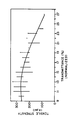
- the Figure is a graph showing the relationship between tensile strength in Kpsi (thousand pounds per square inch) and percent (%) normalized transmittance of visible light for a series of single fibers of zirconia-modified alumina.
- the present invention provides a ceramic fiber of from 10 to 25 microns in diameter containing at least 60% by weight of alpha alumina, between 15 and 25% by weight of zirconia in the tetragonal phase and from 0.4 to 12 mole %, based on zirconia, of a zirconia stabilizer, the zirconia having a grain size of less than 0.5 microns in daimeter, said fiber having a light transmittance of 19% or less when normalized, as measured in an inert fluid having a refraction index of 1.72.
- the fiber of the invention is a ceramic fiber, containing at least 60% by weight of alpha alumina. In addition to the alumina, there is between 15 and 25% by weight of zirconia and between 0.4 and 12 mole percent, based on zirconia, of a zirconia stabilizer. Preferably the fiber consists essentially of alpha alumina, zirconia and yttria and is about 10 to 25 microns in diameter.
- the alumina in the fiber is derived from a dispersion of alumina particles and from a soluble alumina precursor.
- the alumina particle size distribution should be as follows: 99% smaller than 1 micron, 95% smaller than 0.5 micron, as determined by standard "Sedigraph" measurement.
- Particulate materials can be classified by any of a variety of known techniques. In one method for preparing such particles, alpha alumina (Alcoa A-16SG) is dispersed in water at 15% solids at a pH of 4.0 and allowed to settle in a tank. Portions of the dispersion are removed from the top of the sedimentation tank and concentrated to the desired solids level for use. This technique was employed in preparing the slurry of Example 1 below.
- Preferred soluble alumina precursors include the basic aluminum salts, such as alumina chlorohydroxide, basic aluminum nitrate, and basic aluminum chloroacetate, which have a basicity of 0.33 to 0.83.
- Aluminum chlorohydroxide is most preferred.
- Basicity can be adjusted by addition of HCl or other chemicals.
- the zirconia content can be derived from a variety of zirconium containing chemicals, including zirconium oxychloride, zirconium acetate, and zirconia particulate.
- the zirconia particles are commerically available with yttrium oxide and with other stabilizers already added.
- zirconia particles (“Zircar” Type ZYP) are dispersed in water at 15% solids at pH 2.5 in a four-liter beaker. The dispersion is allowed to settle for 24 hours, and the top 5 centimeters of liquid out of the total 20 centimeters in the beaker are removed and concentrated for use.
- the zirconia stabilizer can be incorporated as any of a variety of alkaline earth or rare earth compounds such as chlorides and oxides. These would include MgO, CaO, Y2O3, CeO2, and mixtures thereof. These should be present in quantities between 0.4 and 12 mole % based on zirconia.
- an aqueous dispersion of alumina particles may be combined, in appropriate quantities, with a solution of a zirconium salt, aluminum chlorohydroxide and an yttrium salt.
- Another method involves combining a slurry of zirconia particles containing yttrium oxide with an alumina slurry and aluminum chlorohydroxide. The mix is stirred, heated, and dewatered for sufficient time to obtain 45 to 65% solids at a useful viscosity. Too much heating must be avoided as this can cause the mix to lose its extensible viscosity.
- the mix can be converted into fiber in a variety of ways, including drawing from a beaker with a spatula, centrifugal spinning, and extrusion through spinneret holes. For extrusion through a spinneret a viscosity of 400 to 1200 poise is useful. As fibers are formed, they are partially dried to provide the strength necessary to further process the fibers. The fibers can be collected in a variety of ways including being wound up on a bobbin or piddled into a basket. The fibers are further dried and volatiles removed by heating to 400 to 1000°C.
- the fibers of the invention are prepared by sintering the dried fibers at high temperature to complete the formation of the microstructure and achieve full density and strength.
- This sintering can be accomplished by placing the fiber in a furnace or flame, or drawing it through a furnace or flame as in Seufert above.
- individual fibers are held in the flame of a propane/air torch for a length of time between one and ten seconds.
- the fibers treated by this method become white hot.
- the higher the temperature the shorter the time required for treatment.
- the type of flame in terms of the fuel-to-oxidant ratio is important.
- the zirconia in the fired fibers is in the tetragonal form and consists of grains with a maximum size of 0.5 microns or less in diameter.
- the alumina grain size in the fired fiber is also less than 0.5 microns in diameter.
- the technique used to measure zirconia grain sizes relies on the images obtained using a backscattered electron detector of a scanning electron microscope (SEM).
- SEM scanning electron microscope
- the zirconia containing grains appear in photomicorgraphs as bright areas which can be measured against the magnification dependent calibration bar appearing on the photomicrograph.
- the samples are prepared by mounting in epoxy resin and polishing to a smooth surface with diamond compounds using standard techniques. Once placed in the instrument, a signal is generated from the sample and is enhanced by adjusting the SEM instrument's backscattered electron detector for maxium atomic number contrast. In this manner, one can easily distinguish the zirconia grains from the alumina grains and the size of the zirconia grains can be measured directly from their images.
- the fibers of the invention may be coated with silica which has been shown in Tietz, U.S. 3,837,891, to have a beneficial effect on alumina fiber strength.
- alumina and zirconia remain as separate phases in the fiber of the invention and since the most important microstructural features of the fiber appears to be the size, distribution, and phase composition of the zirconia particles, observation of the transmittance of light through the fibers immersed in a fluid of refractive index 1.72 provides a convenient tool for describing the microstructure. Any standard technique for measuring light transmittances may be used where the scattered light due to alumina surfaces is removed by immersing the fibers in a fluid of refractive index 1.72.
- One method for quantifying the difference between microstructures based on the level of transmitted light relies on the use of a microscope equipped with a photo multiplier to quantify the percent transmittance of light through the fibers.
- Fibers to be tested are carefully placed approximately parallel on a microscope slide.
- filaments are first tested for tensile strength and the broken filament is recovered, placed on the microscope slide and labelled for identification.
- a glass cover slip (No. 1/2, 18 mm square) is placed over the fibers, and a drop of fluid is placed at an edge of the cover slip.
- a Leitz MPV Compact Microscope Photometer attached to a Leitz Laborlus 12 Pol (or equivalent) microscope with a light source in which the intensity is controlled by a stabilized power supply is used to measure the light transmission through the fibers relative to the background.
- the microscope is adjusted for Koehler illumination.
- the fibers are screened at approximately X400 to find the fiber judged to have the smallest diameter.
- a X63 objective is swung into the optic train, providing a magnification of approximately X630, and the fiber is brought into focus.
- a measure of the diameter is obtained by counting the number of eyepiece reticle divisions occupied by the fiber diameter.
- the photometer housing contains a rectangular diaphragm which is set to approximately two-thirds of the fiber diameter, i.e., if the smallest diameter fiber corresponds to 12 reticle divisions, the diaphragm which would be set to 8 reticle divisions.
- the length of the rectangular diaphragm is set to twice the width.
- the slide preparation is moved so that the diaphragm occupies a field free of fibers and the intensity of the light source is adjusted until the digital display unit of the control panel reads 110.
- the zero adjustment is obtained by blocking the light path into the photometer housing.
- the range of 0-110 was chosen because 110 is the upper limit at which the photomultiplier response is linear.
- the light transmittance determination is not measurably affected by variations in the amount of zirconia in the composition over the range of 15 to 25 weight %.
- a correction is applied to normalize the transmittance values for variations in fiber diameter.
- the transmittances reported throughout this specification and claims were normalized to a fiber diameter of 20 microns, as follows: where T a is the actual measured transmittance and T n is the normalized transmittance.
- single fibers are selected at random and their diameters are measured using a calibrated optical microscope.
- the gauge length used is one-quarter of one inch.
- the clamps of the Instron tensile tester are covered with "Neoprene”.
- the head speed (or strain rate) is 0.02 in/min.
- the tensile strength results are the average of ten individual fiber breaks from each sample.
- X-ray diffraction analysis was used to determine the zirconia crystal phase.
- a Philips single-axis (horizontal) goniometer in reflection mode (CuK ⁇ radiation) with digital data collection is employed for this purpose.
- the most intense X-ray reflection for tetragonal zirconia occurs at the two-theta scattering angle 30.3°; for the monoclinic form, the strongest two reflections occur at 28.3° and 31.6°. Determination of the tetragonal: monoclinic ratio is accomplished by scanning the 25°-35° range.
- Images of the cross-sections of zirconia containing alumina fiber are used to measure the grain size and spatial distribution of the zirconia.
- the samples are prepared by mounting in epoxy resin and polishing to a smooth surface.
- the mounted samples are vapor coated with carbon to provide a conductive surface and placed in a JEOL JXA 840 Scanning Electron Microscope. Optimization of the backscattered electron signal is obtained on each sample by biasing for maximum contrast between the alumina and zirconia phases and recording the images on Polaroid Type 52 film.
- the instrument settings include an acceleration voltage of 20 kV, current of 1 x 10 to the power of minus 8 amps, final aperture of 70 microns, filament consisting of a tungsten hairpin, working distance of 15 millimeters, and a magnification of about 10,000 X. From the images made by this technique, the size and distribution of the zirconia containing grains are determined.
- This example illustrates preparation of a continuous yarn of zirconia-modified alumina fibers.
- alumina-particulate slurry Into a mixing vessel 41.4 parts (by weight) of 56.9% solids alumina-particulate slurry are added. To this stirred slurry, 37.6 parts of zirconyl acetate solution are added. The zirconyl acetate solution could be converted into approximately 21.7% zirconia. Also, to this stirred mixture are added 0.9 parts of 37% hydrochloric acid and 18.6 parts of aluminum chlorohydroxide powder. The aluminum chlorohydroxide could be converted into approximately 47.3% aluminum oxide. Finally, 0.8 parts of yttrium chloride hexahydrate in 0.7 parts of water are added. The mixture is stirred overnight. Water is removed by vacuum and heating to obtain a viscosity of approximately 450 poises. The spin mix is then pumped through a filter assembly and a spinneret with 200, 4.5 mil diameter holes.
- Fibers are extruded from the spinneret at a rate of 110 grams/min. into a heated spinning column and dried by a flow of heated (80-110°C), dried air. A spin finish is applied to the yarn at the bottom of the column. The fibers are drawn at the bottom of the column by two attenuating rolls and would up at a rate of 250 to 320 meters/min. To allow for later shrinkage, microfoam sheeting is first wrapped around the wind-up bobbin. Fiber is wound on a bobbin for 9 to 15 minutes.
- Volatiles are driven out of the fiber in a furnace by incremental heating to 600°C and then held at that temperature for one hour.
- the bobbin of yarn is backwound through a propane/oxygen flame (residence time approximately one second) so that the yarn becomes white hot.
- the yarn had a temperature of about 1940°C as measured with an infrared optical pyrometer. Different backwinding speeds required different amounts of heating to obtain optimum fiber properties.
- the resulting fibers had an average diameter of 18 to 20 microns, greater than 60 weight % alumina, 20 weight % zirconia, substantially all in the tetragonal phase, 2 mole % yttrium oxide, based on zirconia, zirconia grain size of less than 0.5 microns, a transmittance of 18%, and a tensile strength of 305 kpsi when well sintered.
- a dispersion of zirconia particles can be used.
- the amount of alumina particles would be decreased by an amount equal to the amount of zirconia particles.
- the aluminum chlorohydroxide would be increased so that the total amount of alumina in the fiber (alumina from particles and chlorohydroxide) would not be changed.
- the Figure is a curve representing a plot of normalized transmittance versus tensile strength values for 88 fibers of alumina containing 20% of zirconia and small amounts of yttria.
- the table below shows the number of filaments examined between levels of transmittance, the average tensile value as well as the maximum and minimum tensile values for filaments in that transmittance category.
- the table shows that the filaments in the category having a normalized transmittance of between 12 and 14 percent exhibited the highest average tensile strength of filaments in any other category. Further, the strengthening benefits due to the use of zirconia disappear or are greatly reduced as the transmittance value exceeds 19 percent.
Landscapes
- Chemical & Material Sciences (AREA)
- Engineering & Computer Science (AREA)
- Manufacturing & Machinery (AREA)
- Ceramic Engineering (AREA)
- Organic Chemistry (AREA)
- Materials Engineering (AREA)
- Chemical Kinetics & Catalysis (AREA)
- General Chemical & Material Sciences (AREA)
- Inorganic Chemistry (AREA)
- Structural Engineering (AREA)
- Textile Engineering (AREA)
- Life Sciences & Earth Sciences (AREA)
- General Life Sciences & Earth Sciences (AREA)
- Geochemistry & Mineralogy (AREA)
- Inorganic Fibers (AREA)
- Compositions Of Oxide Ceramics (AREA)
Applications Claiming Priority (2)
| Application Number | Priority Date | Filing Date | Title |
|---|---|---|---|
| US06/898,119 US4753904A (en) | 1986-08-20 | 1986-08-20 | Zirconia-modified alumina fiber |
| US898119 | 1986-08-20 |
Publications (2)
| Publication Number | Publication Date |
|---|---|
| EP0257969A2 true EP0257969A2 (de) | 1988-03-02 |
| EP0257969A3 EP0257969A3 (de) | 1989-08-30 |
Family
ID=25408974
Family Applications (1)
| Application Number | Title | Priority Date | Filing Date |
|---|---|---|---|
| EP87307315A Withdrawn EP0257969A3 (de) | 1986-08-20 | 1987-08-19 | Zirkonoxid-modifizierte Aluminiumoxid-Faser |
Country Status (5)
| Country | Link |
|---|---|
| US (1) | US4753904A (de) |
| EP (1) | EP0257969A3 (de) |
| JP (1) | JPS6350527A (de) |
| KR (1) | KR900003342B1 (de) |
| CA (1) | CA1274858A (de) |
Cited By (3)
| Publication number | Priority date | Publication date | Assignee | Title |
|---|---|---|---|---|
| US4960441A (en) * | 1987-05-11 | 1990-10-02 | Norton Company | Sintered alumina-zirconia ceramic bodies |
| WO2010130272A1 (en) * | 2009-05-12 | 2010-11-18 | Siemens Aktiengesellschaft | Ceramic carbide fiber, method for making the ceramic carbide fiber and application of the ceramic carbide fiber |
| WO2019019365A1 (zh) * | 2017-07-28 | 2019-01-31 | 山东大学 | 一种氧化铝-氧化锆复合陶瓷连续纤维的制备方法 |
Families Citing this family (8)
| Publication number | Priority date | Publication date | Assignee | Title |
|---|---|---|---|---|
| CA1317978C (en) * | 1987-06-05 | 1993-05-18 | Thomas E. Wood | Microcrystalline alumina-based ceramic articles |
| US4921819A (en) * | 1987-09-24 | 1990-05-01 | E. I. Dupont De Nemours And Company | Hafnia modified alumina fibers |
| US4937212A (en) * | 1988-12-19 | 1990-06-26 | Minnesota Mining And Manufacturing Company | Zirconium oxide fibers and process for their preparation |
| US5002906A (en) * | 1989-09-29 | 1991-03-26 | E. I. Du Pont De Nemours And Company | Process for making modified alumina fibers |
| JP2500639Y2 (ja) * | 1990-09-26 | 1996-06-12 | 日産ディーゼル工業株式会社 | 直噴式ディ―ゼルエンジン吸気ポ―トのスワ―ル制御装置 |
| IT1292193B1 (it) * | 1997-06-20 | 1999-01-25 | Enirisorse Spa | Fibre ceramiche di zirconia parzialmente stabilizzate con ittria e funzionalizzate per applicazioni catalitiche con un rivestimento |
| CN118439790B (zh) * | 2024-04-02 | 2025-04-04 | 河南交院工程技术集团有限公司 | 一种基于氧化锆相变增韧的玄武岩纤维及其制备方法 |
| CN120666470B (zh) * | 2025-08-20 | 2025-11-25 | 江苏惠沣环保科技有限公司 | 一种基于静电纺丝制备氧化铝合成纤维的方法 |
Family Cites Families (12)
| Publication number | Priority date | Publication date | Assignee | Title |
|---|---|---|---|---|
| GB1264973A (de) * | 1968-12-23 | 1972-02-23 | ||
| IE35325B1 (en) * | 1970-06-19 | 1976-01-07 | Ici Ltd | Fibres |
| US3992498A (en) * | 1970-06-19 | 1976-11-16 | Imperial Chemical Industries Limited | Refractory fiber preparation with use of high humidity atmosphere |
| US3808015A (en) * | 1970-11-23 | 1974-04-30 | Du Pont | Alumina fiber |
| GB1360198A (en) * | 1971-05-21 | 1974-07-17 | Ici Ltd | Zirconia fibres |
| GB1425934A (en) * | 1972-03-15 | 1976-02-25 | Ici Ltd | Alumina |
| ZA731336B (en) * | 1972-03-15 | 1973-11-28 | Ici Ltd | Alumina |
| NL178586C (nl) * | 1973-07-05 | 1986-04-16 | Minnesota Mining & Mfg | Werkwijze voor het vervaardigen van vuurvaste vezels. |
| JPS584096B2 (ja) * | 1976-07-23 | 1983-01-25 | 東芝モノフラツクス株式会社 | 酸化物多結晶繊維の製造方法 |
| US4316964A (en) * | 1980-07-14 | 1982-02-23 | Rockwell International Corporation | Al2 O3 /ZrO2 ceramic |
| EP0119028A3 (de) * | 1983-02-25 | 1985-11-21 | Hitachi Metals, Ltd. | Gesintertes alumimiumoxidhaltiges Material mit hoher Härte und Zähigkeit |
| JPS59202239A (ja) * | 1983-04-30 | 1984-11-16 | Denki Kagaku Kogyo Kk | アルミナジルコニア繊維の紡糸原液の製法 |
-
1986
- 1986-08-20 US US06/898,119 patent/US4753904A/en not_active Expired - Fee Related
-
1987
- 1987-08-18 CA CA000544799A patent/CA1274858A/en not_active Expired - Lifetime
- 1987-08-19 KR KR1019870009044A patent/KR900003342B1/ko not_active Expired
- 1987-08-19 EP EP87307315A patent/EP0257969A3/de not_active Withdrawn
- 1987-08-20 JP JP62205291A patent/JPS6350527A/ja active Pending
Cited By (3)
| Publication number | Priority date | Publication date | Assignee | Title |
|---|---|---|---|---|
| US4960441A (en) * | 1987-05-11 | 1990-10-02 | Norton Company | Sintered alumina-zirconia ceramic bodies |
| WO2010130272A1 (en) * | 2009-05-12 | 2010-11-18 | Siemens Aktiengesellschaft | Ceramic carbide fiber, method for making the ceramic carbide fiber and application of the ceramic carbide fiber |
| WO2019019365A1 (zh) * | 2017-07-28 | 2019-01-31 | 山东大学 | 一种氧化铝-氧化锆复合陶瓷连续纤维的制备方法 |
Also Published As
| Publication number | Publication date |
|---|---|
| JPS6350527A (ja) | 1988-03-03 |
| KR880002764A (ko) | 1988-05-11 |
| CA1274858A (en) | 1990-10-02 |
| EP0257969A3 (de) | 1989-08-30 |
| US4753904A (en) | 1988-06-28 |
| KR900003342B1 (ko) | 1990-05-14 |
Similar Documents
| Publication | Publication Date | Title |
|---|---|---|
| US4753904A (en) | Zirconia-modified alumina fiber | |
| Insley et al. | Microscopy of ceramics and cements: including glasses, slags, and foundry sands | |
| US3808015A (en) | Alumina fiber | |
| US3853688A (en) | Continuous filaments and yarns | |
| Klug et al. | Alumina‐silica phase diagram in the mollite region | |
| Navias | Preparation and properties of spinel made by vapor transport and diffusion in the system MgO‐Al2O3 | |
| WEI et al. | Transformation kinetics of diphasic aluminosilicate gels | |
| US4285732A (en) | Alumina ceramic | |
| Cinibulk et al. | Characterization of oxidized polymer‐derived SiBCN fibers | |
| Kaae | Structure and mechanical properties of isotropic pyrolytic carbons deposited below 1600 C | |
| US3837891A (en) | Process of strengthening polycrystalline refractory oxide fibers | |
| Saylor | Accuracy of microscopical methods for determining refractive index by immersion | |
| EP2687501B1 (de) | Magnetooptisches keramikmaterial und auswahlverfahren dafür | |
| Zubrzycka et al. | MgAl2O4 spinel with transmittance approaching theoretical value at reduced sintering temperatures | |
| Gehman et al. | Measurement of average particle size of fine pigments | |
| Cho et al. | Effect of phase fraction and grain size on translucency of 3 mol% yttria-stabilized tetragonal zirconia polycrystal | |
| Stutz et al. | Particle Size, Distribution and its function in paints and enamels: a relative method of determining particle size of pigments1 | |
| Butler et al. | Development of an extended-range fiber optic pH sensor using evanescent wave absorption of sol-gel-entrapped pH indicators | |
| Krishnan | Scattering of light in optical glasses | |
| Leow | Reflectivity measurements on molybdenite | |
| Hartridge et al. | Synthesis and characterization of partially and fully stabilized zirconia fibers made from an inorganic precursor | |
| Wilcox | Refractive index determination using the central focal masking technique with dispsersion colors | |
| US4921819A (en) | Hafnia modified alumina fibers | |
| Fox | Refractive indices of textile fibres: double variation method for the determination of | |
| Luo et al. | Mechanical, low temperature degradation and biocompatibility of Ce-doped dental 3Y-TZP ceramics |
Legal Events
| Date | Code | Title | Description |
|---|---|---|---|
| PUAI | Public reference made under article 153(3) epc to a published international application that has entered the european phase |
Free format text: ORIGINAL CODE: 0009012 |
|
| AK | Designated contracting states |
Kind code of ref document: A2 Designated state(s): BE CH DE FR GB IT LI LU NL SE |
|
| PUAL | Search report despatched |
Free format text: ORIGINAL CODE: 0009013 |
|
| AK | Designated contracting states |
Kind code of ref document: A3 Designated state(s): BE CH DE FR GB IT LI LU NL SE |
|
| 17P | Request for examination filed |
Effective date: 19900205 |
|
| 17Q | First examination report despatched |
Effective date: 19920127 |
|
| STAA | Information on the status of an ep patent application or granted ep patent |
Free format text: STATUS: THE APPLICATION IS DEEMED TO BE WITHDRAWN |
|
| 18D | Application deemed to be withdrawn |
Effective date: 19920610 |
|
| RIN1 | Information on inventor provided before grant (corrected) |
Inventor name: WOLFE, MICHAEL STEPHEN |