EP0252682A2 - Tetrazines - Google Patents
Tetrazines Download PDFInfo
- Publication number
- EP0252682A2 EP0252682A2 EP87305846A EP87305846A EP0252682A2 EP 0252682 A2 EP0252682 A2 EP 0252682A2 EP 87305846 A EP87305846 A EP 87305846A EP 87305846 A EP87305846 A EP 87305846A EP 0252682 A2 EP0252682 A2 EP 0252682A2
- Authority
- EP
- European Patent Office
- Prior art keywords
- group
- carbon atoms
- optionally substituted
- branched
- straight
- Prior art date
- Legal status (The legal status is an assumption and is not a legal conclusion. Google has not performed a legal analysis and makes no representation as to the accuracy of the status listed.)
- Withdrawn
Links
- 150000004905 tetrazines Chemical class 0.000 title claims abstract description 27
- 125000000217 alkyl group Chemical group 0.000 claims abstract description 68
- 125000001997 phenyl group Chemical group [H]C1=C([H])C([H])=C(*)C([H])=C1[H] 0.000 claims abstract description 54
- 229910052757 nitrogen Inorganic materials 0.000 claims abstract description 41
- 238000000034 method Methods 0.000 claims abstract description 40
- 125000000753 cycloalkyl group Chemical group 0.000 claims abstract description 39
- 125000004435 hydrogen atom Chemical group [H]* 0.000 claims abstract description 34
- 125000001424 substituent group Chemical group 0.000 claims abstract description 29
- 125000003342 alkenyl group Chemical group 0.000 claims abstract description 28
- 238000002360 preparation method Methods 0.000 claims abstract description 24
- -1 azidocarbonyl group Chemical group 0.000 claims abstract description 20
- 125000004093 cyano group Chemical group *C#N 0.000 claims abstract description 15
- 150000003839 salts Chemical class 0.000 claims abstract description 15
- 125000000304 alkynyl group Chemical group 0.000 claims abstract description 11
- QVGXLLKOCUKJST-UHFFFAOYSA-N atomic oxygen Chemical group [O] QVGXLLKOCUKJST-UHFFFAOYSA-N 0.000 claims abstract description 11
- 229910052760 oxygen Inorganic materials 0.000 claims abstract description 11
- 239000001301 oxygen Substances 0.000 claims abstract description 11
- NINIDFKCEFEMDL-UHFFFAOYSA-N Sulfur Chemical group [S] NINIDFKCEFEMDL-UHFFFAOYSA-N 0.000 claims abstract description 8
- 230000002378 acidificating effect Effects 0.000 claims abstract description 8
- 239000005864 Sulphur Chemical group 0.000 claims abstract description 6
- 150000001875 compounds Chemical class 0.000 claims description 98
- 125000004432 carbon atom Chemical group C* 0.000 claims description 78
- 125000004433 nitrogen atom Chemical group N* 0.000 claims description 32
- 238000006243 chemical reaction Methods 0.000 claims description 26
- 125000003545 alkoxy group Chemical group 0.000 claims description 25
- 125000005843 halogen group Chemical group 0.000 claims description 18
- 125000001797 benzyl group Chemical group [H]C1=C([H])C([H])=C(C([H])=C1[H])C([H])([H])* 0.000 claims description 17
- 229910052736 halogen Inorganic materials 0.000 claims description 13
- 125000004453 alkoxycarbonyl group Chemical group 0.000 claims description 12
- 125000004390 alkyl sulfonyl group Chemical group 0.000 claims description 10
- 125000004414 alkyl thio group Chemical group 0.000 claims description 10
- 125000002496 methyl group Chemical group [H]C([H])([H])* 0.000 claims description 10
- 241001465754 Metazoa Species 0.000 claims description 8
- 229910052783 alkali metal Inorganic materials 0.000 claims description 8
- 125000003178 carboxy group Chemical group [H]OC(*)=O 0.000 claims description 8
- 125000000623 heterocyclic group Chemical group 0.000 claims description 8
- 150000001340 alkali metals Chemical group 0.000 claims description 7
- 206010025323 Lymphomas Diseases 0.000 claims description 6
- 125000001495 ethyl group Chemical group [H]C([H])([H])C([H])([H])* 0.000 claims description 6
- 208000032839 leukemia Diseases 0.000 claims description 6
- 125000000449 nitro group Chemical group [O-][N+](*)=O 0.000 claims description 6
- 125000000951 phenoxy group Chemical group [H]C1=C([H])C([H])=C(O*)C([H])=C1[H] 0.000 claims description 6
- 201000009030 Carcinoma Diseases 0.000 claims description 5
- 206010039491 Sarcoma Diseases 0.000 claims description 5
- 125000004644 alkyl sulfinyl group Chemical group 0.000 claims description 5
- 208000026278 immune system disease Diseases 0.000 claims description 5
- 201000001441 melanoma Diseases 0.000 claims description 5
- 210000000056 organ Anatomy 0.000 claims description 5
- 125000004430 oxygen atom Chemical group O* 0.000 claims description 5
- 239000000825 pharmaceutical preparation Substances 0.000 claims description 5
- 229940127557 pharmaceutical product Drugs 0.000 claims description 5
- 239000002253 acid Substances 0.000 claims description 4
- 239000008194 pharmaceutical composition Substances 0.000 claims description 4
- 229910052700 potassium Inorganic materials 0.000 claims description 4
- 125000001340 2-chloroethyl group Chemical group [H]C([H])(Cl)C([H])([H])* 0.000 claims description 3
- 239000004480 active ingredient Substances 0.000 claims description 3
- 125000005236 alkanoylamino group Chemical group 0.000 claims description 3
- 125000003917 carbamoyl group Chemical group [H]N([H])C(*)=O 0.000 claims description 3
- 150000004820 halides Chemical class 0.000 claims description 3
- 125000002887 hydroxy group Chemical group [H]O* 0.000 claims description 3
- 101100509371 Arabidopsis thaliana CHR11 gene Proteins 0.000 claims description 2
- 238000000576 coating method Methods 0.000 claims description 2
- 239000003937 drug carrier Substances 0.000 claims description 2
- 239000008016 pharmaceutical coating Substances 0.000 claims description 2
- 238000006264 debenzylation reaction Methods 0.000 claims 1
- 230000007717 exclusion Effects 0.000 claims 1
- IJGRMHOSHXDMSA-UHFFFAOYSA-N Atomic nitrogen Chemical compound N#N IJGRMHOSHXDMSA-UHFFFAOYSA-N 0.000 abstract description 10
- 229910052739 hydrogen Inorganic materials 0.000 abstract description 6
- 239000001257 hydrogen Substances 0.000 abstract description 6
- PXBRQCKWGAHEHS-UHFFFAOYSA-N dichlorodifluoromethane Chemical group FC(F)(Cl)Cl PXBRQCKWGAHEHS-UHFFFAOYSA-N 0.000 abstract description 5
- 239000000543 intermediate Substances 0.000 abstract description 5
- 125000000547 substituted alkyl group Chemical group 0.000 abstract 2
- 239000003814 drug Substances 0.000 abstract 1
- XEKOWRVHYACXOJ-UHFFFAOYSA-N Ethyl acetate Chemical class CCOC(C)=O XEKOWRVHYACXOJ-UHFFFAOYSA-N 0.000 description 78
- CSCPPACGZOOCGX-UHFFFAOYSA-N Acetone Chemical compound CC(C)=O CSCPPACGZOOCGX-UHFFFAOYSA-N 0.000 description 75
- 239000000243 solution Substances 0.000 description 58
- IAZDPXIOMUYVGZ-WFGJKAKNSA-N Dimethyl sulfoxide Chemical compound [2H]C([2H])([2H])S(=O)C([2H])([2H])[2H] IAZDPXIOMUYVGZ-WFGJKAKNSA-N 0.000 description 55
- YMWUJEATGCHHMB-UHFFFAOYSA-N Dichloromethane Chemical compound ClCCl YMWUJEATGCHHMB-UHFFFAOYSA-N 0.000 description 54
- 239000007787 solid Substances 0.000 description 47
- 239000000203 mixture Substances 0.000 description 41
- 238000000921 elemental analysis Methods 0.000 description 37
- XLYOFNOQVPJJNP-UHFFFAOYSA-N water Substances O XLYOFNOQVPJJNP-UHFFFAOYSA-N 0.000 description 32
- RTZKZFJDLAIYFH-UHFFFAOYSA-N Diethyl ether Chemical compound CCOCC RTZKZFJDLAIYFH-UHFFFAOYSA-N 0.000 description 30
- 239000000460 chlorine Substances 0.000 description 25
- WYURNTSHIVDZCO-UHFFFAOYSA-N Tetrahydrofuran Chemical compound C1CCOC1 WYURNTSHIVDZCO-UHFFFAOYSA-N 0.000 description 24
- ZMXDDKWLCZADIW-UHFFFAOYSA-N N,N-Dimethylformamide Chemical compound CN(C)C=O ZMXDDKWLCZADIW-UHFFFAOYSA-N 0.000 description 21
- 239000000047 product Substances 0.000 description 20
- ZMANZCXQSJIPKH-UHFFFAOYSA-N Triethylamine Chemical compound CCN(CC)CC ZMANZCXQSJIPKH-UHFFFAOYSA-N 0.000 description 18
- LPXPTNMVRIOKMN-UHFFFAOYSA-M sodium nitrite Chemical compound [Na+].[O-]N=O LPXPTNMVRIOKMN-UHFFFAOYSA-M 0.000 description 16
- VEXZGXHMUGYJMC-UHFFFAOYSA-N Hydrochloric acid Chemical compound Cl VEXZGXHMUGYJMC-UHFFFAOYSA-N 0.000 description 14
- 238000000354 decomposition reaction Methods 0.000 description 14
- 239000003208 petroleum Substances 0.000 description 12
- YLQBMQCUIZJEEH-UHFFFAOYSA-N tetrahydrofuran Natural products C=1C=COC=1 YLQBMQCUIZJEEH-UHFFFAOYSA-N 0.000 description 12
- VYPSYNLAJGMNEJ-UHFFFAOYSA-N Silicium dioxide Chemical compound O=[Si]=O VYPSYNLAJGMNEJ-UHFFFAOYSA-N 0.000 description 11
- 150000002367 halogens Chemical class 0.000 description 11
- 229910052801 chlorine Inorganic materials 0.000 description 10
- 239000000741 silica gel Substances 0.000 description 10
- 229910002027 silica gel Inorganic materials 0.000 description 10
- ZAMOUSCENKQFHK-UHFFFAOYSA-N Chlorine atom Chemical compound [Cl] ZAMOUSCENKQFHK-UHFFFAOYSA-N 0.000 description 9
- LFQSCWFLJHTTHZ-UHFFFAOYSA-N Ethanol Chemical compound CCO LFQSCWFLJHTTHZ-UHFFFAOYSA-N 0.000 description 9
- 238000004587 chromatography analysis Methods 0.000 description 9
- 239000003921 oil Substances 0.000 description 9
- 235000019198 oils Nutrition 0.000 description 9
- FOGTXLLWVRUBDH-UHFFFAOYSA-N 3-(2-chloroethyl)-4-oxoimidazo[5,1-d][1,2,3,5]tetrazine-8-carboxylic acid Chemical compound N1=NN(CCCl)C(=O)N2C1=C(C(=O)O)N=C2 FOGTXLLWVRUBDH-UHFFFAOYSA-N 0.000 description 8
- HEDRZPFGACZZDS-UHFFFAOYSA-N Chloroform Chemical compound ClC(Cl)Cl HEDRZPFGACZZDS-UHFFFAOYSA-N 0.000 description 8
- JUJWROOIHBZHMG-UHFFFAOYSA-N Pyridine Chemical compound C1=CC=NC=C1 JUJWROOIHBZHMG-UHFFFAOYSA-N 0.000 description 8
- 235000010288 sodium nitrite Nutrition 0.000 description 8
- 239000002904 solvent Substances 0.000 description 8
- 230000006978 adaptation Effects 0.000 description 7
- 125000004429 atom Chemical group 0.000 description 7
- 239000002775 capsule Substances 0.000 description 7
- 239000013078 crystal Substances 0.000 description 7
- YWSKAMFYVCIPPW-UHFFFAOYSA-N ethyl 3-methyl-4-oxopyrazolo[5,1-d][1,2,3,5]tetrazine-8-carboxylate Chemical compound N1=NN(C)C(=O)N2C1=C(C(=O)OCC)C=N2 YWSKAMFYVCIPPW-UHFFFAOYSA-N 0.000 description 7
- 239000002244 precipitate Substances 0.000 description 7
- 239000000725 suspension Substances 0.000 description 7
- ROSDSFDQCJNGOL-UHFFFAOYSA-N Dimethylamine Chemical compound CNC ROSDSFDQCJNGOL-UHFFFAOYSA-N 0.000 description 6
- OKKJLVBELUTLKV-UHFFFAOYSA-N Methanol Chemical compound OC OKKJLVBELUTLKV-UHFFFAOYSA-N 0.000 description 6
- YXFVVABEGXRONW-UHFFFAOYSA-N Toluene Chemical compound CC1=CC=CC=C1 YXFVVABEGXRONW-UHFFFAOYSA-N 0.000 description 6
- DTQVDTLACAAQTR-UHFFFAOYSA-N Trifluoroacetic acid Chemical compound OC(=O)C(F)(F)F DTQVDTLACAAQTR-UHFFFAOYSA-N 0.000 description 6
- VVTMIOYTNALQAW-UHFFFAOYSA-N 3-methyl-4-oxoimidazo[5,1-d][1,2,3,5]tetrazine-8-carboxylic acid Chemical compound O=C1N(C)N=NC2=C(C(O)=O)N=CN21 VVTMIOYTNALQAW-UHFFFAOYSA-N 0.000 description 5
- 241000220438 Arachis Species 0.000 description 5
- 235000003911 Arachis Nutrition 0.000 description 5
- IAZDPXIOMUYVGZ-UHFFFAOYSA-N Dimethylsulphoxide Chemical compound CS(C)=O IAZDPXIOMUYVGZ-UHFFFAOYSA-N 0.000 description 5
- 230000037396 body weight Effects 0.000 description 5
- 239000003054 catalyst Substances 0.000 description 5
- 229960001760 dimethyl sulfoxide Drugs 0.000 description 5
- 239000000706 filtrate Substances 0.000 description 5
- 238000001819 mass spectrum Methods 0.000 description 5
- 239000011541 reaction mixture Substances 0.000 description 5
- 239000008247 solid mixture Substances 0.000 description 5
- BCMYXYHEMGPZJN-UHFFFAOYSA-N 1-chloro-2-isocyanatoethane Chemical compound ClCCN=C=O BCMYXYHEMGPZJN-UHFFFAOYSA-N 0.000 description 4
- DGAQECJNVWCQMB-PUAWFVPOSA-M Ilexoside XXIX Chemical compound C[C@@H]1CC[C@@]2(CC[C@@]3(C(=CC[C@H]4[C@]3(CC[C@@H]5[C@@]4(CC[C@@H](C5(C)C)OS(=O)(=O)[O-])C)C)[C@@H]2[C@]1(C)O)C)C(=O)O[C@H]6[C@@H]([C@H]([C@@H]([C@H](O6)CO)O)O)O.[Na+] DGAQECJNVWCQMB-PUAWFVPOSA-M 0.000 description 4
- CSNNHWWHGAXBCP-UHFFFAOYSA-L Magnesium sulfate Chemical compound [Mg+2].[O-][S+2]([O-])([O-])[O-] CSNNHWWHGAXBCP-UHFFFAOYSA-L 0.000 description 4
- 206010028980 Neoplasm Diseases 0.000 description 4
- KDLHZDBZIXYQEI-UHFFFAOYSA-N Palladium Chemical compound [Pd] KDLHZDBZIXYQEI-UHFFFAOYSA-N 0.000 description 4
- QAOWNCQODCNURD-UHFFFAOYSA-N Sulfuric acid Chemical compound OS(O)(=O)=O QAOWNCQODCNURD-UHFFFAOYSA-N 0.000 description 4
- 239000007864 aqueous solution Substances 0.000 description 4
- 239000003701 inert diluent Substances 0.000 description 4
- HAMGRBXTJNITHG-UHFFFAOYSA-N methyl isocyanate Chemical compound CN=C=O HAMGRBXTJNITHG-UHFFFAOYSA-N 0.000 description 4
- 150000004682 monohydrates Chemical class 0.000 description 4
- 239000003960 organic solvent Substances 0.000 description 4
- 238000007911 parenteral administration Methods 0.000 description 4
- UMJSCPRVCHMLSP-UHFFFAOYSA-N pyridine Natural products COC1=CC=CN=C1 UMJSCPRVCHMLSP-UHFFFAOYSA-N 0.000 description 4
- 229910052708 sodium Inorganic materials 0.000 description 4
- 239000011734 sodium Substances 0.000 description 4
- 239000001117 sulphuric acid Substances 0.000 description 4
- 235000011149 sulphuric acid Nutrition 0.000 description 4
- FYSNRJHAOHDILO-UHFFFAOYSA-N thionyl chloride Chemical compound ClS(Cl)=O FYSNRJHAOHDILO-UHFFFAOYSA-N 0.000 description 4
- WOHJVWMEKKUYHC-UHFFFAOYSA-N (e)-(3-diazoniopyrazol-4-ylidene)-ethoxymethanolate Chemical compound CCOC([O-])=C1C=NN=C1[N+]#N WOHJVWMEKKUYHC-UHFFFAOYSA-N 0.000 description 3
- AWYQWKVKRAXJOX-UHFFFAOYSA-N (e)-(5-diazonioimidazol-4-ylidene)-phenylmethoxymethanolate Chemical compound N\1=CN=C([N+]#N)C/1=C(/[O-])OCC1=CC=CC=C1 AWYQWKVKRAXJOX-UHFFFAOYSA-N 0.000 description 3
- IIQFAQWGCPMUDF-UHFFFAOYSA-N 3-(2-chloroethyl)-4-oxo-n-phenylmethoxyimidazo[5,1-d][1,2,3,5]tetrazine-8-carboxamide Chemical compound N1=CN2C(=O)N(CCCl)N=NC2=C1C(=O)NOCC1=CC=CC=C1 IIQFAQWGCPMUDF-UHFFFAOYSA-N 0.000 description 3
- ZCYVEMRRCGMTRW-UHFFFAOYSA-N 7553-56-2 Chemical compound [I] ZCYVEMRRCGMTRW-UHFFFAOYSA-N 0.000 description 3
- WEVYAHXRMPXWCK-UHFFFAOYSA-N Acetonitrile Chemical class CC#N WEVYAHXRMPXWCK-UHFFFAOYSA-N 0.000 description 3
- WVDDGKGOMKODPV-UHFFFAOYSA-N Benzyl alcohol Chemical compound OCC1=CC=CC=C1 WVDDGKGOMKODPV-UHFFFAOYSA-N 0.000 description 3
- WKBOTKDWSSQWDR-UHFFFAOYSA-N Bromine atom Chemical compound [Br] WKBOTKDWSSQWDR-UHFFFAOYSA-N 0.000 description 3
- 108010010803 Gelatin Proteins 0.000 description 3
- UFHFLCQGNIYNRP-UHFFFAOYSA-N Hydrogen Chemical compound [H][H] UFHFLCQGNIYNRP-UHFFFAOYSA-N 0.000 description 3
- 241000699670 Mus sp. Species 0.000 description 3
- 239000013543 active substance Substances 0.000 description 3
- 230000000118 anti-neoplastic effect Effects 0.000 description 3
- XYMABSWSDSFDIV-UHFFFAOYSA-N benzyl 3-(2-chloroethyl)-4-oxoimidazo[5,1-d][1,2,3,5]tetrazine-8-carboxylate Chemical compound N1=CN2C(=O)N(CCCl)N=NC2=C1C(=O)OCC1=CC=CC=C1 XYMABSWSDSFDIV-UHFFFAOYSA-N 0.000 description 3
- GDTBXPJZTBHREO-UHFFFAOYSA-N bromine Substances BrBr GDTBXPJZTBHREO-UHFFFAOYSA-N 0.000 description 3
- 229910052794 bromium Inorganic materials 0.000 description 3
- 239000003610 charcoal Substances 0.000 description 3
- 239000003795 chemical substances by application Substances 0.000 description 3
- 125000001309 chloro group Chemical group Cl* 0.000 description 3
- JNGZXGGOCLZBFB-IVCQMTBJSA-N compound E Chemical compound N([C@@H](C)C(=O)N[C@@H]1C(N(C)C2=CC=CC=C2C(C=2C=CC=CC=2)=N1)=O)C(=O)CC1=CC(F)=CC(F)=C1 JNGZXGGOCLZBFB-IVCQMTBJSA-N 0.000 description 3
- 239000006071 cream Substances 0.000 description 3
- 239000000284 extract Substances 0.000 description 3
- 125000001153 fluoro group Chemical group F* 0.000 description 3
- 239000008273 gelatin Substances 0.000 description 3
- 229920000159 gelatin Polymers 0.000 description 3
- 235000019322 gelatine Nutrition 0.000 description 3
- 235000011852 gelatine desserts Nutrition 0.000 description 3
- 230000002519 immonomodulatory effect Effects 0.000 description 3
- 229910052740 iodine Inorganic materials 0.000 description 3
- 239000011630 iodine Substances 0.000 description 3
- QXYYYPFGTSJXNS-UHFFFAOYSA-N mitozolomide Chemical compound N1=NN(CCCl)C(=O)N2C1=C(C(=O)N)N=C2 QXYYYPFGTSJXNS-UHFFFAOYSA-N 0.000 description 3
- HKOOXMFOFWEVGF-UHFFFAOYSA-N phenylhydrazine Chemical compound NNC1=CC=CC=C1 HKOOXMFOFWEVGF-UHFFFAOYSA-N 0.000 description 3
- 229940067157 phenylhydrazine Drugs 0.000 description 3
- 239000003755 preservative agent Substances 0.000 description 3
- 230000035484 reaction time Effects 0.000 description 3
- 238000003756 stirring Methods 0.000 description 3
- YBRBMKDOPFTVDT-UHFFFAOYSA-N tert-butylamine Chemical compound CC(C)(C)N YBRBMKDOPFTVDT-UHFFFAOYSA-N 0.000 description 3
- 239000000080 wetting agent Substances 0.000 description 3
- PDSXUDBYKBJDTK-UHFFFAOYSA-N (5z)-5-diazoimidazole-4-carbonitrile Chemical compound [N-]=[N+]=C1N=CN=C1C#N PDSXUDBYKBJDTK-UHFFFAOYSA-N 0.000 description 2
- HJDOPBGQUOAOCQ-UHFFFAOYSA-N (z)-(5-diazonioimidazol-4-ylidene)-ethoxymethanolate Chemical compound CCOC([O-])=C1N=CN=C1[N+]#N HJDOPBGQUOAOCQ-UHFFFAOYSA-N 0.000 description 2
- TWAUOLAJPJBRLW-UHFFFAOYSA-N 3-(2-chloroethyl)-4-oxo-N-propan-2-ylimidazo[5,1-d][1,2,3,5]tetrazine-8-carboxamide Chemical compound C(C)(C)NC(=O)C=1N=CN2C1N=NN(C2=O)CCCl TWAUOLAJPJBRLW-UHFFFAOYSA-N 0.000 description 2
- KOEDKJUSKVKXLC-UHFFFAOYSA-N 3-(2-chloroethyl)-4-oxo-n'-phenylimidazo[5,1-d][1,2,3,5]tetrazine-8-carbohydrazide Chemical compound N1=CN2C(=O)N(CCCl)N=NC2=C1C(=O)NNC1=CC=CC=C1 KOEDKJUSKVKXLC-UHFFFAOYSA-N 0.000 description 2
- QODFDMULPJXWGM-UHFFFAOYSA-N 3-(2-chloroethyl)-4-oxo-n-phenylimidazo[5,1-d][1,2,3,5]tetrazine-8-carboxamide Chemical compound N1=CN2C(=O)N(CCCl)N=NC2=C1C(=O)NC1=CC=CC=C1 QODFDMULPJXWGM-UHFFFAOYSA-N 0.000 description 2
- DVQGLONXGRFBNX-UHFFFAOYSA-N 3-(2-chloroethyl)-4-oxo-n-propylimidazo[5,1-d][1,2,3,5]tetrazine-8-carboxamide Chemical compound N1=NN(CCCl)C(=O)N2C1=C(C(=O)NCCC)N=C2 DVQGLONXGRFBNX-UHFFFAOYSA-N 0.000 description 2
- WZSZWAREQTXPHZ-UHFFFAOYSA-N 3-(2-chloroethyl)-4-oxoimidazo[5,1-d][1,2,3,5]tetrazine-8-carbonitrile Chemical compound O=C1N(CCCl)N=NC2=C(C#N)N=CN21 WZSZWAREQTXPHZ-UHFFFAOYSA-N 0.000 description 2
- YTTLQGLRDMTNNK-UHFFFAOYSA-N 3-(2-chloroethyl)-4-oxoimidazo[5,1-d][1,2,3,5]tetrazine-8-carbonyl azide Chemical compound O=C1N(CCCl)N=NC2=C(C(=O)N=[N+]=[N-])N=CN21 YTTLQGLRDMTNNK-UHFFFAOYSA-N 0.000 description 2
- QWCLPWXSOOKEJX-UHFFFAOYSA-N 3-(2-chloroethyl)-8-(2-diazoacetyl)imidazo[5,1-d][1,2,3,5]tetrazin-4-one Chemical compound ClCCN1N=NC=2N(C1=O)C=NC2C(C=[N+]=[N-])=O QWCLPWXSOOKEJX-UHFFFAOYSA-N 0.000 description 2
- LIIAMZYYZAFEMU-UHFFFAOYSA-N 3-(2-chloroethyl)-8-propanethioylimidazo[5,1-d][1,2,3,5]tetrazin-4-one Chemical compound C(C)C(=S)C=1N=CN2C1N=NN(C2=O)CCCl LIIAMZYYZAFEMU-UHFFFAOYSA-N 0.000 description 2
- ORITUHOHZIFMRJ-UHFFFAOYSA-N 3-(2-chloroethyl)-N'-(2,4-difluorophenyl)-4-oxoimidazo[5,1-d][1,2,3,5]tetrazine-8-carbohydrazide Chemical compound ClCCN1N=NC=2N(C1=O)C=NC2C(NNC2=C(C=C(C=C2)F)F)=O ORITUHOHZIFMRJ-UHFFFAOYSA-N 0.000 description 2
- OMUDWEBSOQBFST-UHFFFAOYSA-N 3-(2-chloroethyl)-n,n-dimethyl-4-oxoimidazo[5,1-d][1,2,3,5]tetrazine-8-carboxamide Chemical compound N1=NN(CCCl)C(=O)N2C1=C(C(=O)N(C)C)N=C2 OMUDWEBSOQBFST-UHFFFAOYSA-N 0.000 description 2
- HGNVEICZRZJWEO-UHFFFAOYSA-N 3-(2-chloroethyl)-n-cyclohexyl-4-oxoimidazo[5,1-d][1,2,3,5]tetrazine-8-carboxamide Chemical compound N1=CN2C(=O)N(CCCl)N=NC2=C1C(=O)NC1CCCCC1 HGNVEICZRZJWEO-UHFFFAOYSA-N 0.000 description 2
- AJZMRYJJXOLYNG-UHFFFAOYSA-N 3-(2-chloroethyl)-n-methoxy-4-oxoimidazo[5,1-d][1,2,3,5]tetrazine-8-carboxamide Chemical compound N1=NN(CCCl)C(=O)N2C1=C(C(=O)NOC)N=C2 AJZMRYJJXOLYNG-UHFFFAOYSA-N 0.000 description 2
- VVSHZIRQNZADET-UHFFFAOYSA-N 3-methyl-4-oxoimidazo[5,1-d][1,2,3,5]tetrazine-8-carbonitrile Chemical compound O=C1N(C)N=NC2=C(C#N)N=CN21 VVSHZIRQNZADET-UHFFFAOYSA-N 0.000 description 2
- VVJKKWFAADXIJK-UHFFFAOYSA-N Allylamine Chemical compound NCC=C VVJKKWFAADXIJK-UHFFFAOYSA-N 0.000 description 2
- QGZKDVFQNNGYKY-UHFFFAOYSA-N Ammonia Chemical compound N QGZKDVFQNNGYKY-UHFFFAOYSA-N 0.000 description 2
- PAYRUJLWNCNPSJ-UHFFFAOYSA-N Aniline Chemical compound NC1=CC=CC=C1 PAYRUJLWNCNPSJ-UHFFFAOYSA-N 0.000 description 2
- VTYYLEPIZMXCLO-UHFFFAOYSA-L Calcium carbonate Chemical compound [Ca+2].[O-]C([O-])=O VTYYLEPIZMXCLO-UHFFFAOYSA-L 0.000 description 2
- KFZMGEQAYNKOFK-UHFFFAOYSA-N Isopropanol Chemical compound CC(C)O KFZMGEQAYNKOFK-UHFFFAOYSA-N 0.000 description 2
- BAVYZALUXZFZLV-UHFFFAOYSA-N Methylamine Chemical compound NC BAVYZALUXZFZLV-UHFFFAOYSA-N 0.000 description 2
- SECXISVLQFMRJM-UHFFFAOYSA-N N-Methylpyrrolidone Chemical class CN1CCCC1=O SECXISVLQFMRJM-UHFFFAOYSA-N 0.000 description 2
- BGWBTXMLUWAZBF-UHFFFAOYSA-N O.C(=O)(O)C=1N=CN2C1N=NN(C2=O)CCCl Chemical compound O.C(=O)(O)C=1N=CN2C1N=NN(C2=O)CCCl BGWBTXMLUWAZBF-UHFFFAOYSA-N 0.000 description 2
- CDBYLPFSWZWCQE-UHFFFAOYSA-L Sodium Carbonate Chemical compound [Na+].[Na+].[O-]C([O-])=O CDBYLPFSWZWCQE-UHFFFAOYSA-L 0.000 description 2
- PMZURENOXWZQFD-UHFFFAOYSA-L Sodium Sulfate Chemical compound [Na+].[Na+].[O-]S([O-])(=O)=O PMZURENOXWZQFD-UHFFFAOYSA-L 0.000 description 2
- PXIPVTKHYLBLMZ-UHFFFAOYSA-N Sodium azide Chemical compound [Na+].[N-]=[N+]=[N-] PXIPVTKHYLBLMZ-UHFFFAOYSA-N 0.000 description 2
- 239000005708 Sodium hypochlorite Substances 0.000 description 2
- 238000010521 absorption reaction Methods 0.000 description 2
- QTBSBXVTEAMEQO-UHFFFAOYSA-N acetic acid Substances CC(O)=O QTBSBXVTEAMEQO-UHFFFAOYSA-N 0.000 description 2
- 239000002671 adjuvant Substances 0.000 description 2
- 239000003708 ampul Substances 0.000 description 2
- RDOXTESZEPMUJZ-UHFFFAOYSA-N anisole Chemical compound COC1=CC=CC=C1 RDOXTESZEPMUJZ-UHFFFAOYSA-N 0.000 description 2
- 239000008346 aqueous phase Substances 0.000 description 2
- XBFSPCMJIBVOLP-UHFFFAOYSA-N benzyl 3-methyl-4-oxoimidazo[5,1-d][1,2,3,5]tetrazine-8-carboxylate Chemical compound N1=CN2C(=O)N(C)N=NC2=C1C(=O)OCC1=CC=CC=C1 XBFSPCMJIBVOLP-UHFFFAOYSA-N 0.000 description 2
- XGVGTUYAASUNQT-UHFFFAOYSA-N benzyl 4-amino-1h-imidazole-5-carboxylate Chemical compound N1=CNC(C(=O)OCC=2C=CC=CC=2)=C1N XGVGTUYAASUNQT-UHFFFAOYSA-N 0.000 description 2
- YDYXRMIBASHWMS-UHFFFAOYSA-N benzyl 4-nitro-1h-imidazole-5-carboxylate Chemical compound N1=CNC(C(=O)OCC=2C=CC=CC=2)=C1[N+](=O)[O-] YDYXRMIBASHWMS-UHFFFAOYSA-N 0.000 description 2
- 201000011510 cancer Diseases 0.000 description 2
- SLQAZSIJHHRGCR-UHFFFAOYSA-N chembl31499 Chemical compound N1=NN(CCCl)C(=O)N2C1=C(C(=O)NO)N=C2 SLQAZSIJHHRGCR-UHFFFAOYSA-N 0.000 description 2
- 239000003153 chemical reaction reagent Substances 0.000 description 2
- PAFZNILMFXTMIY-UHFFFAOYSA-N cyclohexylamine Chemical compound NC1CCCCC1 PAFZNILMFXTMIY-UHFFFAOYSA-N 0.000 description 2
- 239000003085 diluting agent Substances 0.000 description 2
- 239000000839 emulsion Substances 0.000 description 2
- DNJIEGIFACGWOD-UHFFFAOYSA-N ethanethiol Chemical compound CCS DNJIEGIFACGWOD-UHFFFAOYSA-N 0.000 description 2
- XNDKNULUSKNEDA-UHFFFAOYSA-N ethyl 2-[[3-(2-chloroethyl)-4-oxoimidazo[5,1-d][1,2,3,5]tetrazine-8-carbonyl]amino]acetate Chemical compound N1=NN(CCCl)C(=O)N2C1=C(C(=O)NCC(=O)OCC)N=C2 XNDKNULUSKNEDA-UHFFFAOYSA-N 0.000 description 2
- IXFIBXQXPGNVJA-UHFFFAOYSA-N ethyl 3-(2-chloroethyl)-4-oxoimidazo[5,1-d][1,2,3,5]tetrazine-8-carboxylate Chemical compound N1=NN(CCCl)C(=O)N2C1=C(C(=O)OCC)N=C2 IXFIBXQXPGNVJA-UHFFFAOYSA-N 0.000 description 2
- ABSRDJHBWWTYID-UHFFFAOYSA-N ethyl 3-(2-chloroethyl)-4-oxopyrazolo[5,1-d][1,2,3,5]tetrazine-8-carboxylate Chemical compound ClCCN1N=NC=2N(C1=O)N=CC2C(=O)OCC ABSRDJHBWWTYID-UHFFFAOYSA-N 0.000 description 2
- 238000001914 filtration Methods 0.000 description 2
- 239000000796 flavoring agent Substances 0.000 description 2
- 238000001802 infusion Methods 0.000 description 2
- 239000004615 ingredient Substances 0.000 description 2
- 239000007788 liquid Substances 0.000 description 2
- HQKMJHAJHXVSDF-UHFFFAOYSA-L magnesium stearate Chemical compound [Mg+2].CCCCCCCCCCCCCCCCCC([O-])=O.CCCCCCCCCCCCCCCCCC([O-])=O HQKMJHAJHXVSDF-UHFFFAOYSA-L 0.000 description 2
- 229910052943 magnesium sulfate Inorganic materials 0.000 description 2
- 235000019341 magnesium sulphate Nutrition 0.000 description 2
- 239000000463 material Substances 0.000 description 2
- BPKMKAUUBLTSEE-UHFFFAOYSA-N methyl 3-(2-chloroethyl)-4-oxoimidazo[5,1-d][1,2,3,5]tetrazine-8-carboxylate Chemical compound N1=NN(CCCl)C(=O)N2C1=C(C(=O)OC)N=C2 BPKMKAUUBLTSEE-UHFFFAOYSA-N 0.000 description 2
- MDSIXANRNOUAMB-UHFFFAOYSA-N methyl N-[[3-(2-chloroethyl)-4-oxoimidazo[5,1-d][1,2,3,5]tetrazine-8-carbonyl]amino]carbamate Chemical compound ClCCN1N=NC=2N(C1=O)C=NC2C(NNC(=O)OC)=O MDSIXANRNOUAMB-UHFFFAOYSA-N 0.000 description 2
- ARGGCNRLHWIBRS-UHFFFAOYSA-N n,3-bis(2-chloroethyl)-4-oxoimidazo[5,1-d][1,2,3,5]tetrazine-8-carboxamide Chemical compound N1=NN(CCCl)C(=O)N2C1=C(C(=O)NCCCl)N=C2 ARGGCNRLHWIBRS-UHFFFAOYSA-N 0.000 description 2
- ITCSSQHXIMMGKH-UHFFFAOYSA-N n,n,3-trimethyl-4-oxoimidazo[5,1-d][1,2,3,5]tetrazine-8-carboxamide Chemical compound N1=NN(C)C(=O)N2C1=C(C(=O)N(C)C)N=C2 ITCSSQHXIMMGKH-UHFFFAOYSA-N 0.000 description 2
- AAHHIAHEQQAJMM-UHFFFAOYSA-N n-tert-butyl-3-(2-chloroethyl)-4-oxoimidazo[5,1-d][1,2,3,5]tetrazine-8-carboxamide Chemical compound N1=NN(CCCl)C(=O)N2C1=C(C(=O)NC(C)(C)C)N=C2 AAHHIAHEQQAJMM-UHFFFAOYSA-N 0.000 description 2
- 239000000843 powder Substances 0.000 description 2
- CNAJDMMIPCCXSS-UHFFFAOYSA-N propyl 3-(2-chloroethyl)-4-oxoimidazo[5,1-d][1,2,3,5]tetrazine-8-carboxylate Chemical compound C(CC)OC(=O)C=1N=CN2C1N=NN(C2=O)CCCl CNAJDMMIPCCXSS-UHFFFAOYSA-N 0.000 description 2
- WGYKZJWCGVVSQN-UHFFFAOYSA-N propylamine Chemical compound CCCN WGYKZJWCGVVSQN-UHFFFAOYSA-N 0.000 description 2
- 239000012429 reaction media Substances 0.000 description 2
- SUKJFIGYRHOWBL-UHFFFAOYSA-N sodium hypochlorite Chemical compound [Na+].Cl[O-] SUKJFIGYRHOWBL-UHFFFAOYSA-N 0.000 description 2
- 239000012453 solvate Substances 0.000 description 2
- 239000007858 starting material Substances 0.000 description 2
- 230000001225 therapeutic effect Effects 0.000 description 2
- 238000009736 wetting Methods 0.000 description 2
- RLZUIPTYDYCNQI-UHFFFAOYSA-N (2,4-difluorophenyl)hydrazine Chemical compound NNC1=CC=C(F)C=C1F RLZUIPTYDYCNQI-UHFFFAOYSA-N 0.000 description 1
- TXTWXQXDMWILOF-UHFFFAOYSA-N (2-ethoxy-2-oxoethyl)azanium;chloride Chemical compound [Cl-].CCOC(=O)C[NH3+] TXTWXQXDMWILOF-UHFFFAOYSA-N 0.000 description 1
- XDIAMRVROCPPBK-UHFFFAOYSA-N 2,2-dimethylpropan-1-amine Chemical compound CC(C)(C)CN XDIAMRVROCPPBK-UHFFFAOYSA-N 0.000 description 1
- 125000004215 2,4-difluorophenyl group Chemical group [H]C1=C([H])C(*)=C(F)C([H])=C1F 0.000 description 1
- ONRREFWJTRBDRA-UHFFFAOYSA-N 2-chloroethanamine;hydron;chloride Chemical compound [Cl-].[NH3+]CCCl ONRREFWJTRBDRA-UHFFFAOYSA-N 0.000 description 1
- OQSGPXBCMFZTRJ-UHFFFAOYSA-N 3-(2-chloroethyl)-4h-imidazo[5,1-d][1,2,3,5]tetrazine-8-carbonyl chloride Chemical compound N1=NN(CCCl)CN2C=NC(C(Cl)=O)=C21 OQSGPXBCMFZTRJ-UHFFFAOYSA-N 0.000 description 1
- RPKWGQKIFZDMCX-UHFFFAOYSA-N 3-(2-chloroethyl)-N-cyclopropyl-4-oxoimidazo[5,1-d][1,2,3,5]tetrazine-8-carboxamide Chemical compound C1(CC1)NC(=O)C=1N=CN2C1N=NN(C2=O)CCCl RPKWGQKIFZDMCX-UHFFFAOYSA-N 0.000 description 1
- ZIBAAYKCNSFPRL-UHFFFAOYSA-N 3-(2-chloroethyl)-n-methyl-4-oxoimidazo[5,1-d][1,2,3,5]tetrazine-8-carboxamide Chemical compound N1=NN(CCCl)C(=O)N2C1=C(C(=O)NC)N=C2 ZIBAAYKCNSFPRL-UHFFFAOYSA-N 0.000 description 1
- KAPIOIDKPNTELI-UHFFFAOYSA-N 3-(2-chloroethyl)-n-methyl-4-oxoimidazo[5,1-d][1,2,3,5]tetrazine-8-carboxamide;hydrate Chemical compound O.N1=NN(CCCl)C(=O)N2C1=C(C(=O)NC)N=C2 KAPIOIDKPNTELI-UHFFFAOYSA-N 0.000 description 1
- ZGWFUXGWPPEIOG-UHFFFAOYSA-N 3-methyl-4-oxoimidazo[5,1-d][1,2,3,5]tetrazine-8-carboxylic acid hydrate Chemical compound O.C(=O)(O)C=1N=CN2C1N=NN(C2=O)C ZGWFUXGWPPEIOG-UHFFFAOYSA-N 0.000 description 1
- 125000004195 4-methylpiperazin-1-yl group Chemical group [H]C([H])([H])N1C([H])([H])C([H])([H])N(*)C([H])([H])C1([H])[H] 0.000 description 1
- 125000002373 5 membered heterocyclic group Chemical group 0.000 description 1
- IQADWEQLYZUURU-UHFFFAOYSA-N 5-nitro-1h-imidazole-4-carboxylic acid Chemical compound OC(=O)C=1NC=NC=1[N+]([O-])=O IQADWEQLYZUURU-UHFFFAOYSA-N 0.000 description 1
- 125000004070 6 membered heterocyclic group Chemical group 0.000 description 1
- 125000003341 7 membered heterocyclic group Chemical group 0.000 description 1
- GUBGYTABKSRVRQ-XLOQQCSPSA-N Alpha-Lactose Chemical compound O[C@@H]1[C@@H](O)[C@@H](O)[C@@H](CO)O[C@H]1O[C@@H]1[C@@H](CO)O[C@H](O)[C@H](O)[C@H]1O GUBGYTABKSRVRQ-XLOQQCSPSA-N 0.000 description 1
- BVKZGUZCCUSVTD-UHFFFAOYSA-M Bicarbonate Chemical compound OC([O-])=O BVKZGUZCCUSVTD-UHFFFAOYSA-M 0.000 description 1
- BVKZGUZCCUSVTD-UHFFFAOYSA-L Carbonate Chemical compound [O-]C([O-])=O BVKZGUZCCUSVTD-UHFFFAOYSA-L 0.000 description 1
- 206010009944 Colon cancer Diseases 0.000 description 1
- 229940126062 Compound A Drugs 0.000 description 1
- HTJDQJBWANPRPF-UHFFFAOYSA-N Cyclopropylamine Chemical compound NC1CC1 HTJDQJBWANPRPF-UHFFFAOYSA-N 0.000 description 1
- YXHKONLOYHBTNS-UHFFFAOYSA-N Diazomethane Chemical compound C=[N+]=[N-] YXHKONLOYHBTNS-UHFFFAOYSA-N 0.000 description 1
- 239000004150 EU approved colour Substances 0.000 description 1
- LVGKNOAMLMIIKO-UHFFFAOYSA-N Elaidinsaeure-aethylester Natural products CCCCCCCCC=CCCCCCCCC(=O)OCC LVGKNOAMLMIIKO-UHFFFAOYSA-N 0.000 description 1
- 241000196324 Embryophyta Species 0.000 description 1
- 244000166102 Eucalyptus leucoxylon Species 0.000 description 1
- 235000004694 Eucalyptus leucoxylon Nutrition 0.000 description 1
- 208000001382 Experimental Melanoma Diseases 0.000 description 1
- NLDMNSXOCDLTTB-UHFFFAOYSA-N Heterophylliin A Natural products O1C2COC(=O)C3=CC(O)=C(O)C(O)=C3C3=C(O)C(O)=C(O)C=C3C(=O)OC2C(OC(=O)C=2C=C(O)C(O)=C(O)C=2)C(O)C1OC(=O)C1=CC(O)=C(O)C(O)=C1 NLDMNSXOCDLTTB-UHFFFAOYSA-N 0.000 description 1
- 208000005045 Interdigitating dendritic cell sarcoma Diseases 0.000 description 1
- 239000005909 Kieselgur Substances 0.000 description 1
- GUBGYTABKSRVRQ-QKKXKWKRSA-N Lactose Natural products OC[C@H]1O[C@@H](O[C@H]2[C@H](O)[C@@H](O)C(O)O[C@@H]2CO)[C@H](O)[C@@H](O)[C@H]1O GUBGYTABKSRVRQ-QKKXKWKRSA-N 0.000 description 1
- 208000006552 Lewis Lung Carcinoma Diseases 0.000 description 1
- 238000003820 Medium-pressure liquid chromatography Methods 0.000 description 1
- 206010027476 Metastases Diseases 0.000 description 1
- GMPKIPWJBDOURN-UHFFFAOYSA-N Methoxyamine Chemical compound CON GMPKIPWJBDOURN-UHFFFAOYSA-N 0.000 description 1
- 208000015914 Non-Hodgkin lymphomas Diseases 0.000 description 1
- NZFQUAQJITXEGX-UHFFFAOYSA-N O.C1(CC1)NC(=O)C=1N=CN2C1N=NN(C2=O)CCCl Chemical compound O.C1(CC1)NC(=O)C=1N=CN2C1N=NN(C2=O)CCCl NZFQUAQJITXEGX-UHFFFAOYSA-N 0.000 description 1
- 239000002202 Polyethylene glycol Substances 0.000 description 1
- BPEGJWRSRHCHSN-UHFFFAOYSA-N Temozolomide Chemical compound O=C1N(C)N=NC2=C(C(N)=O)N=CN21 BPEGJWRSRHCHSN-UHFFFAOYSA-N 0.000 description 1
- 108010021119 Trichosanthin Proteins 0.000 description 1
- 235000010443 alginic acid Nutrition 0.000 description 1
- 239000000783 alginic acid Substances 0.000 description 1
- 229920000615 alginic acid Polymers 0.000 description 1
- 229960001126 alginic acid Drugs 0.000 description 1
- 150000004781 alginic acids Chemical class 0.000 description 1
- 150000001335 aliphatic alkanes Chemical class 0.000 description 1
- 229910000102 alkali metal hydride Inorganic materials 0.000 description 1
- 150000008046 alkali metal hydrides Chemical class 0.000 description 1
- 150000008044 alkali metal hydroxides Chemical class 0.000 description 1
- KCNKJCHARANTIP-SNAWJCMRSA-N allyl-{4-[3-(4-bromo-phenyl)-benzofuran-6-yloxy]-but-2-enyl}-methyl-amine Chemical compound C=1OC2=CC(OC/C=C/CN(CC=C)C)=CC=C2C=1C1=CC=C(Br)C=C1 KCNKJCHARANTIP-SNAWJCMRSA-N 0.000 description 1
- 150000001412 amines Chemical class 0.000 description 1
- 229910021529 ammonia Inorganic materials 0.000 description 1
- 239000002246 antineoplastic agent Substances 0.000 description 1
- 229940041181 antineoplastic drug Drugs 0.000 description 1
- 239000002221 antipyretic Substances 0.000 description 1
- 239000003125 aqueous solvent Substances 0.000 description 1
- 235000019445 benzyl alcohol Nutrition 0.000 description 1
- 239000011230 binding agent Substances 0.000 description 1
- 229910000019 calcium carbonate Inorganic materials 0.000 description 1
- 150000001735 carboxylic acids Chemical class 0.000 description 1
- 238000009903 catalytic hydrogenation reaction Methods 0.000 description 1
- MOCKWYUCPREFCZ-UHFFFAOYSA-N chondroitin sulfate E (GalNAc4,6diS-GlcA), precursor 5a Chemical compound NNC(=O)NC1=CC=CC=C1 MOCKWYUCPREFCZ-UHFFFAOYSA-N 0.000 description 1
- 239000007891 compressed tablet Substances 0.000 description 1
- 238000001816 cooling Methods 0.000 description 1
- 239000002270 dispersing agent Substances 0.000 description 1
- 239000002934 diuretic Substances 0.000 description 1
- 229940030606 diuretics Drugs 0.000 description 1
- 239000002552 dosage form Substances 0.000 description 1
- 230000000694 effects Effects 0.000 description 1
- 239000003995 emulsifying agent Substances 0.000 description 1
- 230000001804 emulsifying effect Effects 0.000 description 1
- NJMORFFDAXJHHM-UHFFFAOYSA-N ethyl 4-amino-1h-imidazole-5-carboxylate Chemical compound CCOC(=O)C=1NC=NC=1N NJMORFFDAXJHHM-UHFFFAOYSA-N 0.000 description 1
- YPXGHKWOJXQLQU-UHFFFAOYSA-N ethyl 5-amino-1h-pyrazole-4-carboxylate Chemical compound CCOC(=O)C=1C=NNC=1N YPXGHKWOJXQLQU-UHFFFAOYSA-N 0.000 description 1
- LVGKNOAMLMIIKO-QXMHVHEDSA-N ethyl oleate Chemical compound CCCCCCCC\C=C/CCCCCCCC(=O)OCC LVGKNOAMLMIIKO-QXMHVHEDSA-N 0.000 description 1
- 229940093471 ethyl oleate Drugs 0.000 description 1
- 238000001704 evaporation Methods 0.000 description 1
- 230000008020 evaporation Effects 0.000 description 1
- 238000003818 flash chromatography Methods 0.000 description 1
- 239000000417 fungicide Substances 0.000 description 1
- FVIZARNDLVOMSU-UHFFFAOYSA-N ginsenoside K Natural products C1CC(C2(CCC3C(C)(C)C(O)CCC3(C)C2CC2O)C)(C)C2C1C(C)(CCC=C(C)C)OC1OC(CO)C(O)C(O)C1O FVIZARNDLVOMSU-UHFFFAOYSA-N 0.000 description 1
- ZTQSADJAYQOCDD-UHFFFAOYSA-N ginsenoside-Rd2 Natural products C1CC(C2(CCC3C(C)(C)C(OC4C(C(O)C(O)C(CO)O4)O)CCC3(C)C2CC2O)C)(C)C2C1C(C)(CCC=C(C)C)OC(C(C(O)C1O)O)OC1COC1OCC(O)C(O)C1O ZTQSADJAYQOCDD-UHFFFAOYSA-N 0.000 description 1
- 239000008187 granular material Substances 0.000 description 1
- 230000012010 growth Effects 0.000 description 1
- 239000004009 herbicide Substances 0.000 description 1
- 125000005842 heteroatom Chemical group 0.000 description 1
- GNOIPBMMFNIUFM-UHFFFAOYSA-N hexamethylphosphoric triamide Chemical class CN(C)P(=O)(N(C)C)N(C)C GNOIPBMMFNIUFM-UHFFFAOYSA-N 0.000 description 1
- IXCSERBJSXMMFS-UHFFFAOYSA-N hydrogen chloride Substances Cl.Cl IXCSERBJSXMMFS-UHFFFAOYSA-N 0.000 description 1
- 229910000041 hydrogen chloride Inorganic materials 0.000 description 1
- 238000010348 incorporation Methods 0.000 description 1
- 230000005764 inhibitory process Effects 0.000 description 1
- 238000002347 injection Methods 0.000 description 1
- 239000007924 injection Substances 0.000 description 1
- 239000011872 intimate mixture Substances 0.000 description 1
- 238000001990 intravenous administration Methods 0.000 description 1
- 238000002955 isolation Methods 0.000 description 1
- JJWLVOIRVHMVIS-UHFFFAOYSA-N isopropylamine Chemical compound CC(C)N JJWLVOIRVHMVIS-UHFFFAOYSA-N 0.000 description 1
- 239000008101 lactose Substances 0.000 description 1
- 229940057995 liquid paraffin Drugs 0.000 description 1
- 239000000314 lubricant Substances 0.000 description 1
- 235000019359 magnesium stearate Nutrition 0.000 description 1
- 230000009401 metastasis Effects 0.000 description 1
- 125000000956 methoxy group Chemical group [H]C([H])([H])O* 0.000 description 1
- UZKWTJUDCOPSNM-UHFFFAOYSA-N methoxybenzene Substances CCCCOC=C UZKWTJUDCOPSNM-UHFFFAOYSA-N 0.000 description 1
- WFJRIDQGVSJLLH-UHFFFAOYSA-N methyl n-aminocarbamate Chemical compound COC(=O)NN WFJRIDQGVSJLLH-UHFFFAOYSA-N 0.000 description 1
- 239000013081 microcrystal Substances 0.000 description 1
- 125000001971 neopentyl group Chemical group [H]C([*])([H])C(C([H])([H])[H])(C([H])([H])[H])C([H])([H])[H] 0.000 description 1
- 239000012457 nonaqueous media Substances 0.000 description 1
- HYDZPXNVHXJHBG-UHFFFAOYSA-N o-benzylhydroxylamine;hydron;chloride Chemical compound Cl.NOCC1=CC=CC=C1 HYDZPXNVHXJHBG-UHFFFAOYSA-N 0.000 description 1
- 235000008390 olive oil Nutrition 0.000 description 1
- 239000004006 olive oil Substances 0.000 description 1
- 229940006093 opthalmologic coloring agent diagnostic Drugs 0.000 description 1
- 150000002895 organic esters Chemical class 0.000 description 1
- MUMZUERVLWJKNR-UHFFFAOYSA-N oxoplatinum Chemical compound [Pt]=O MUMZUERVLWJKNR-UHFFFAOYSA-N 0.000 description 1
- 230000020477 pH reduction Effects 0.000 description 1
- 239000002304 perfume Substances 0.000 description 1
- 239000000546 pharmaceutical excipient Substances 0.000 description 1
- 229910052698 phosphorus Inorganic materials 0.000 description 1
- 239000011574 phosphorus Substances 0.000 description 1
- UHZYTMXLRWXGPK-UHFFFAOYSA-N phosphorus pentachloride Chemical compound ClP(Cl)(Cl)(Cl)Cl UHZYTMXLRWXGPK-UHFFFAOYSA-N 0.000 description 1
- 239000006187 pill Substances 0.000 description 1
- 125000004194 piperazin-1-yl group Chemical group [H]N1C([H])([H])C([H])([H])N(*)C([H])([H])C1([H])[H] 0.000 description 1
- 125000000587 piperidin-1-yl group Chemical group [H]C1([H])N(*)C([H])([H])C([H])([H])C([H])([H])C1([H])[H] 0.000 description 1
- 239000005648 plant growth regulator Substances 0.000 description 1
- 229910003446 platinum oxide Inorganic materials 0.000 description 1
- 229920001223 polyethylene glycol Polymers 0.000 description 1
- 239000001267 polyvinylpyrrolidone Substances 0.000 description 1
- 235000013855 polyvinylpyrrolidone Nutrition 0.000 description 1
- 229920001592 potato starch Polymers 0.000 description 1
- BDERNNFJNOPAEC-UHFFFAOYSA-N propan-1-ol Chemical compound CCCO BDERNNFJNOPAEC-UHFFFAOYSA-N 0.000 description 1
- KJFLHBJHQOGZKF-UHFFFAOYSA-N propan-2-yl 3-(2-chloroethyl)-4-oxoimidazo[5,1-d][1,2,3,5]tetrazine-8-carboxylate Chemical compound N1=NN(CCCl)C(=O)N2C1=C(C(=O)OC(C)C)N=C2 KJFLHBJHQOGZKF-UHFFFAOYSA-N 0.000 description 1
- LVTJOONKWUXEFR-FZRMHRINSA-N protoneodioscin Natural products O(C[C@@H](CC[C@]1(O)[C@H](C)[C@@H]2[C@]3(C)[C@H]([C@H]4[C@@H]([C@]5(C)C(=CC4)C[C@@H](O[C@@H]4[C@H](O[C@H]6[C@@H](O)[C@@H](O)[C@@H](O)[C@H](C)O6)[C@@H](O)[C@H](O[C@H]6[C@@H](O)[C@@H](O)[C@@H](O)[C@H](C)O6)[C@H](CO)O4)CC5)CC3)C[C@@H]2O1)C)[C@H]1[C@H](O)[C@H](O)[C@H](O)[C@@H](CO)O1 LVTJOONKWUXEFR-FZRMHRINSA-N 0.000 description 1
- 238000010992 reflux Methods 0.000 description 1
- 208000029922 reticulum cell sarcoma Diseases 0.000 description 1
- 229920006395 saturated elastomer Polymers 0.000 description 1
- 229940125723 sedative agent Drugs 0.000 description 1
- 239000000932 sedative agent Substances 0.000 description 1
- 239000002002 slurry Substances 0.000 description 1
- 229910000029 sodium carbonate Inorganic materials 0.000 description 1
- 229910052938 sodium sulfate Inorganic materials 0.000 description 1
- 235000011152 sodium sulphate Nutrition 0.000 description 1
- 239000008223 sterile water Substances 0.000 description 1
- 230000001954 sterilising effect Effects 0.000 description 1
- 239000000126 substance Substances 0.000 description 1
- 239000000829 suppository Substances 0.000 description 1
- 239000000375 suspending agent Substances 0.000 description 1
- 239000003765 sweetening agent Substances 0.000 description 1
- 239000006188 syrup Substances 0.000 description 1
- 235000020357 syrup Nutrition 0.000 description 1
- 150000003512 tertiary amines Chemical class 0.000 description 1
- 235000015112 vegetable and seed oil Nutrition 0.000 description 1
- 239000008158 vegetable oil Substances 0.000 description 1
- 239000003981 vehicle Substances 0.000 description 1
Classifications
-
- C—CHEMISTRY; METALLURGY
- C07—ORGANIC CHEMISTRY
- C07D—HETEROCYCLIC COMPOUNDS
- C07D487/00—Heterocyclic compounds containing nitrogen atoms as the only ring hetero atoms in the condensed system, not provided for by groups C07D451/00 - C07D477/00
- C07D487/02—Heterocyclic compounds containing nitrogen atoms as the only ring hetero atoms in the condensed system, not provided for by groups C07D451/00 - C07D477/00 in which the condensed system contains two hetero rings
- C07D487/04—Ortho-condensed systems
-
- A—HUMAN NECESSITIES
- A61—MEDICAL OR VETERINARY SCIENCE; HYGIENE
- A61P—SPECIFIC THERAPEUTIC ACTIVITY OF CHEMICAL COMPOUNDS OR MEDICINAL PREPARATIONS
- A61P35/00—Antineoplastic agents
-
- A—HUMAN NECESSITIES
- A61—MEDICAL OR VETERINARY SCIENCE; HYGIENE
- A61P—SPECIFIC THERAPEUTIC ACTIVITY OF CHEMICAL COMPOUNDS OR MEDICINAL PREPARATIONS
- A61P35/00—Antineoplastic agents
- A61P35/02—Antineoplastic agents specific for leukemia
-
- A—HUMAN NECESSITIES
- A61—MEDICAL OR VETERINARY SCIENCE; HYGIENE
- A61P—SPECIFIC THERAPEUTIC ACTIVITY OF CHEMICAL COMPOUNDS OR MEDICINAL PREPARATIONS
- A61P37/00—Drugs for immunological or allergic disorders
Definitions
- This invention relates to tetrazine derivatives, to processes for their preparation and to pharmaceutical compositions containing them.
- the present invention provides the use of tetrazine derivatives of the general formula shown in Figure I of the drawings assembled at the end of the present specification [wherein R1 represents a cycloalkyl group, or a straight- or branched-chain alkyl, alkenyl or alkynyl group containing up to 6 carbon atoms, each such alkyl, alkenyl or alkynyl group being unsubstituted or substituted by from one to three substituents selected from halogen (i.e.
- the optional substituents on the phenyl and phenoxy moieties may be selected from, for example, halogen atoms and alkyl and alkoxy groups containing up to 4 carbon atoms, and nitro groups.
- Cycloalkyl groups within the definition of the formula shown in Figure I contain 3 to 8, preferably 6, carbon atoms.
- a heterocyclic group within the definition of the formula shown in Figure I is a 5-, 6- or 7-membered heterocyclic ring which may optionally contain a further heteroatom, i.e. nitrogen, oxygen or sulphur, and which may carry one of two straight- or branched-chain alkyl substituents each containing up to 4 carbon atoms, e.g.
- R1 represents, inter alia , a cycloalkyl group, or a straight- or branched-chain alkyl group containing up to 6 carbon atoms, optionally substituted by halogen or alkoxy containing up to 3 carbon atoms, or represents a methyl or ethyl group substituted by a phenyl group
- R2 represents, inter alia , a cyano group or an alkoxycarbonyl group containing up to 5 carbon atoms
- R1 represents a cycloalkyl group, or a straight- or branched-chain alkyl group containing up to 6 carbon atoms, optionally substituted by halogen or alkoxy containing up to 3 carbon atoms, or represents a methyl or ethyl group substituted by a phenyl group
- R2 represents a cyano group of an alkoxycarbonyl group containing up to 5 carbon atoms
- Important individual compounds of the general formula shown in Figure I include the following:- 8-benzyloxycarbonyl-3-methyl-[3 H ]-imidazo[5,1-d]-1,2,3,5-tetrazin-4-one, A 8-carboxy-3-methyl-[3 H ]-imidazo[5,1-d]-1,2,3,5-tetrazin-4-one, B 8-benzyloxycarbonyl-3-(2-chloroethyl)-[3 H ]-imidazo[5,1-d]-1,2,3,5-tetrazin-4-one, C 8-carboxy-3-(2-chloroethyl)-[3 H ]-imidazo[5,1-d]-1,2,3,5-tetrazin-4-one, D 3-(2-chloroethyl)-8-( N -methoxycarbamoyl)-[3 H ]-imidazo[5,1-d]-1,2,3,5-te
- Compounds of particular importance include compounds D, E, G, K, N and Q.
- tetrazine derivatives of the general formula shown in Figure I have proved particularly active in mice at daily doses between 0.2 and 320mg/kg animal body weight, administered intraperitoneally, against TLX5(S) lymphoma according to the procedure of Gescher et al. , Biochem. Pharmacol. (1981), 30 , 89, and ADJ/PC6A and M5076 (reticulum cell sarcoma).
- the compounds were active intraperitoneally at doses of between 6.25 and 40 mg/kg animal body weight.
- the compounds were active orally at doses of between 2 and 40mg/kg animal body weight.
- acid halides of the general formula shown in Figure X wherein A1, A2, R1 and Z1 are as hereinbefore defined and X1 represents a halogen, e.g. chlorine, atom, which are useful as intermediates in the preparation of compounds of the formula shown in Figure I and also in the preparation of compounds described in the specifications of British Patents Nos. 2104522B and 2125402B, which also possess antineoplastic and immunomodulatory activity and the said West German Patent Application No. 2932305.
- the compounds of the general formula shown in Figure I may be prepared by the reaction of a compound of the general formula shown in Figure XI of the drawings [wherein A1 and A2 are as hereinbefore defined and R15 represents a group within the above definition of R2, more especially a cyano group or an optionally substituted alkoxycarbonyl group] with a compound of the general formula:- R1NCZ1 XII wherein R1 and Z1 are as hereinbefore defined, and for the novel compounds of the general formula shown in Figure I, as hereinbefore defined, this constitutes a feature of the invention.
- the reaction may be effected in the absence or presence of an anhydrous organic solvent, for example a chlorinated alkane, e.g. dichloromethane, or ethyl acetate, acetonitrile, N -methylpyrrolidin-2-one or hexamethylphosphoramide, at a temperature between 0° and 120°C.
- an anhydrous organic solvent for example a chlorinated alkane, e.g. dichloromethane, or ethyl acetate, acetonitrile, N -methylpyrrolidin-2-one or hexamethylphosphoramide, at a temperature between 0° and 120°C.
- the reaction may be continued for up to 30 days. Light should preferably be excluded from the reaction mixture.
- compounds of the general formula shown in Figure I wherein R2 represents a carboxy or hydroxycarbamoyl group, R1, A1, A2 and Z1 being as hereinbefore defined are prepared from corresponding compounds, within the general formula shown in Figure I, wherein R2 represents a group of the formula -COOR16 or -CONHOR16 (wherein R16 represents an optionally substituted benzyl group) by the application or adaptation of methods known per se for the replacement of optionally substituted benzyl groups by hydrogen atoms.
- Suitable reaction conditions include, for example, catalytic hydrogenation (using a catalyst such as palladium on charcoal and in a solvent such as ethyl acetate or dimethylformamide); or when R16 represents a substituted benzyl group in which the substituent or at least one of the substituents carried by the benzyl group is an alkoxy (e.g. methoxy) group in the o - or p -position, preferably by reaction with trifluoroacetic acid, preferably in the presence of anisole, and usually at or near room temperature.
- catalytic hydrogenation using a catalyst such as palladium on charcoal and in a solvent such as ethyl acetate or dimethylformamide
- R16 represents a substituted benzyl group in which the substituent or at least one of the substituents carried by the benzyl group is an alkoxy (e.g. methoxy) group in the o - or p -position, preferably by reaction with trifluoro
- compounds of the general formula shown in Figure I wherein R2 represents a carboxy group are prepared from compounds of the general formula shown in Figure XIII (wherein A1, A2, R1 and Z1 are as hereinbefore defined).
- the compound of the formula shown in Figure XIII is reacted with an aqueous solution of an alkali metal hypohalite, e.g. sodium hypochlorite, generally at between 0°C and room temperature, followed by acidification, e.g. with concentrated hydrochloric acid.
- an alkali metal hypohalite e.g. sodium hypochlorite
- acidification e.g. with concentrated hydrochloric acid.
- the compound of the formula shown in Figure XIII is reacted with an alkali metal nitrite, e.g. sodium nitrite, and concentrated sulphuric acid or trifluoroacetic acid in the presence of water, generally at between room temperature and 60°C, followed by treatment with water, e.g. in the form of crushed ice.
- an alkali metal nitrite e.g. sodium nitrite
- concentrated sulphuric acid or trifluoroacetic acid in the presence of water, generally at between room temperature and 60°C
- reaction is carried out in an inert organic solvent medium, e.g. tetrahydrofuran, acetone or dichloromethane, optionally containing some water, at or below room temperature, optionally in the presence of an acid-binding agent, for example a tertiary amine, e.g. triethylamine, or pyridine.
- an inert organic solvent medium e.g. tetrahydrofuran, acetone or dichloromethane
- an acid-binding agent for example a tertiary amine, e.g. triethylamine, or pyridine.
- the aforementioned salts of certain compounds of the formula shown in Figure I are prepared by the application of adaptation of methods known per se , for example by reaction of the parent compound of the formula shown in Figure I with an alkali metal hydroxide, carbonate or, preferably, bicarbonate, in an aqueous or aqueous-organic medium, or an alkali metal hydride in a suitable solvent, e.g. dimethylformamide, followed by isolation of the salt by methods known per se .
- a suitable solvent e.g. dimethylformamide
- compounds of the general formula shown in Figure X are prepared from compounds of the general formula shown in Figure I wherein R2 represents a carboxy group, A1, A2, R1 and Z1 being as hereinbefore defined, by the application or adaptation of known methods for the preparation of acid halides from carboxylic acids, for example by reaction with the appropriate phosphorus halide.
- R2 represents a carboxy group
- A1, A2, R1 and Z1 being as hereinbefore defined
- reaction is carried out in an inert organic solvent medium, e.g. tetrahydrofuran, acetone or dichloromethane, at or below room temperature.
- organic solvent medium e.g. tetrahydrofuran, acetone or dichloromethane
- reaction is carried out without any extra organic solvents, at or below room temperature.
- this method is especially suitable for the preparation of the following compounds:- 3-(2-chloroethyl)-8-ethoxycarbonyl-[3 H ]-imidazo[5,1-d]-1,2,3,5-tetrazin-4-one, H 8-ethoxycarbonyl-3-methyl-[3 H ]-pyrazolo[5,1-d]-1,2,3,5-tetrazin-4-one, I 3-(2-chloroethyl)-8-ethoxycarbonyl-[3 H ]-pyrazolo[5,1-d]-1,2,3,5-tetrazin-4-one, J 8-dimethylcarbamoyl-3-methyl-[3 H ]-imidazo [5,1-d]-1,2,3,5-tetrazin-4-one, X 8-tert-butylcarbamoyl-3-(2-chloroethyl)-[3 H ]-imidazo[5,1-d]-1,2,
- the compounds 3-(2-chloroethyl)-8-cyano-[3 H ]-imidazo[5,1-d]-1,2,3,5-tetrazin-4-one and L 8-cyano-3-methyl-[3 H ]-imidazo[5,1-d]-1,2,3,5-tetrazin-4-one M also form a feature of the present invention, especially when used for the preparation of a pharmaceutical product for the treatment of the human or animal body against carcinomas, melanomas, sarcomas, lymphomas and leukaemias, and for the treatment of organ grafts and skin grafts and for the treatment of immunological diseases,
- a shaking solution of 8-benzyloxycarbonyl-3-methyl-[3 H ]-imidazo[5,1-d]-1,2,3,5-tetrazin-4-one (0.4g; prepared as hereinbefore described in Example 1) in dimethylformamide (8ml) was hydrogenated at room temperature and atmospheric pressure, using a catalyst of palladium on charcoal (5%; 40mg). After 10 minutes, hydrogen absorption (40.1ml) was complete.
- Ethyl 3-diazopyrazole-4-carboxylate (2g; prepared as described in Reference Example 3) was dissolved in 2-chloroethyl isocyanate (2ml), and the solution was left to stand at room temperature for 7 days. The solution was triturated with excess petroleum ether (b.p. 60-80°C) and the gum which precipitated was collected. This gum was dissolved in a minimum volume of dichloromethane and subjected to medium pressure chromatography on silica gel, eluting with a mixture of petroleum ether (b.p.
- Methylamine (40% aqueous solution in tetrahydrofuran; reaction time 30 minutes; and recrystallising the product from aqueous acetone) gave 8-methylcarbamoyl-3-(2-chloroethyl)-[3 H ]-imidazo-[5,1-d]-1,2,3,5-tetrazin-4-one monohydrate in the form of a white solid.
- elemental analysis C, 35.0; H, 3.84; N, 30.8%; calculated for the monohydrate: C, 34.98; H, 4.04; N, 30.60%; I.R.
- compositions which comprise, as active ingredient, at least one compound of the general formula shown in Figure I, together with a pharmaceutical carrier or coating.
- pharmaceutical compositions which comprise, as active ingredient, at least one compound of the general formula shown in Figure I, together with a pharmaceutical carrier or coating.
- the compounds of the general formula shown in Figure I will normally be administered orally, rectally, parenterally, for example intraperitoneally or intravenously, e.g. by infusion, or vaginally.
- compositions may also contain, as is usual in the art, such materials as solid or liquid diluents, wetting agents, preservatives, flavouring and colouring agents and the like.
- Solid compositions for oral administration include compressed tablets, pills, dispersible powders, and granules.
- one or more of the active compounds is, or are, admixed with at least one inert diluent such as calcium carbonate, potato starch, alginic acid, or lactose.
- the compositions may also comprise, as is normal practice, additional substances other than inert diluents, e.g. lubricating agents, such as magnesium stearate.
- Liquid compositions for oral administration include pharmaceutically-acceptable emulsions, solutions, suspensions, syrups and elixirs containing inert diluents commonly used in the art, such as water and liquid paraffin.
- compositions may also comprise adjuvants, such as wetting and suspending agents, e.g. polyvinylpyrrolidone, and sweetening, flavouring, perfuming and preserving agents.
- adjuvants such as wetting and suspending agents, e.g. polyvinylpyrrolidone, and sweetening, flavouring, perfuming and preserving agents.
- the compositions according to the invention, for oral administration also include capsules of absorbable material such as gelatin containing one or more of the active substances with or without the addition of diluents or excipients.
- Solid compositions for vaginal administration include pessaries formulated in manner known per se and containing one or more of the active compounds.
- Solid compositions for rectal administration include suppositories formulated in manner known per se and containing one or more of the active compounds.
- Preparations according to the invention for parenteral administration include sterile aqueous or non-aqueous solutions, suspensions, or emulsions.
- non-aqueous solvents or suspending media are polyethylene glycol, dimethyl sulphoxide, vegetable oils such as olive oil and arachis oil, and injectable organic esters such as ethyl oleate.
- These compositions may also include adjuvants such as preserving, wetting, emulsifying and dispersing agents. They may be sterilised, for example, by filtration through a bacteria-retaining filter, by incorporation of sterilising agents in the compositions, or by irradiation. They may also be manufactured in the form of sterile solid compositions, which can be dissolved in sterile water or some other sterile injectable medium immediately before use.
- the percentage of active ingredient in the compositions of the invention may be varied, it being necessary that it should constitute a proportion such that a suitable dosage for the therapeutic effect desired shall be obtained. Obviously several unit dosage forms may be administered at about the same time.
- the preparations should normally contain at least 0.025% by weight of active substance when rquired for administration by injection, including administration by infusion; for oral administration the preparation will normally contain at least 0.1% by weight of active substance.
- the dose employed depends upon the desired therapeutic effect, the route of administration and the duration of the treatment.
- the tetrazine derivatives of the general formula shown in Figure I are useful in the treatment of malignant neoplasms, for example carcinomas, melanomas, sarcomas, lymphomas and leukaemias, and in the treatment of organ grafts and skin grafts and in the treatment of immunological diseases at doses which are generally between 0.1 and 200, preferably between 1 and 20, mg/kg body weight per day preferably by intravenous administration, to ameliorate the condition of a patient.
- the treatment is useful to prevent or reduce the growth of malignant neoplasms.
- compositions according to the present invention illustrate pharmaceutical compositions according to the present invention.
- a solution suitable for parenteral administration was prepared from the following ingredients:- 8-carboxy-3-(2-chloroethyl)-[3 H ]- imidazo[5,1-d]-1,2,3,5-tetrazin-4-one 1.0g dimethyl sulphoxide 10ml arachis oil 90ml by dissolving the 8-carboxy-3-(2-chloroethyl)-[3 H ]-imidazo[5,1-d]-1,2,3,5-tetrazin-4-one in the dimethyl sulphoxide and adding the arachis oil. The resulting solution was divided, under aseptic conditions, into ampoules at an amount of 10ml per ampoule.
- ampoules were sealed, to give 10 ampoules each containing 100mg of 8-carboxy-3-(2-chloroethyl)-[3 H ]-imidazo[5,1-d]-1,2,3,5-tetrazin-4-one.
- a solution suitable for parenteral administration was prepared from the following ingredients:- 8-ethoxycarbonyl-3-methyl-[3 H ]-pyrazolo[5,1-d]-1,2,3,5-tetrazin-4-one 1.0g dimethyl sulphoxide 10ml arachis oil 90ml by dissolving the 8-ethoxycarbonyl-3-methyl-[3 H ]-pyrazolo[5,1-d]-1,2,3,5-tetrazin-4-one in the dimethyl sulphoxide and adding the arachis oil. The resulting solution was divided, under aseptic conditions, into ampoules at an amount of 10ml per ampoule.
- the ampoules were sealed, to give 10 ampoules each containing 100mg of 8-ethoxycarbonyl-3-methyl-[3 H ]-pyrazolo[5,1-d]-1,2,3,5-tetrazin-4-one .
- Similar ampoules containing solutions suitable for parenteral administration may be prepared by proceeding in a similar manner but replacing the 8-ethoxycarbonyl-3-methyl-[3 H ]-pyrazolo[5,1-d]-1,2,3,5-tetrazin-4-one by another compound of the general formula shown in Figure I, for example compound E, G, K, N or Q.
- Capsules suitable for oral administration were prepared by placing 8-ethoxycarbonyl-3-methyl-[3 H ]-pyrazolo[5,1-d]-1,2,3,5-tetrazin-4-one into gelatin shells of number 2 size at a rate of 10mg per capsule.
- Capsules suitable for oral administration were prepared by placing 8-carboxy-3-(2-chloroethyl)-[3 H ]-imidazo[5,1-d]-1,2,3,5-tetrazin-4-one into gelatin shells of number 2 size at a rate of 10mg per capsule.
- Similar capsules may be prepared by using another compound of the general formula shown in Figure I, for example compound E, G, K, N or Q, or any other conveniently sized capsule shells.
Landscapes
- Health & Medical Sciences (AREA)
- Chemical & Material Sciences (AREA)
- Organic Chemistry (AREA)
- Pharmacology & Pharmacy (AREA)
- Animal Behavior & Ethology (AREA)
- Chemical Kinetics & Catalysis (AREA)
- General Chemical & Material Sciences (AREA)
- Medicinal Chemistry (AREA)
- Nuclear Medicine, Radiotherapy & Molecular Imaging (AREA)
- Veterinary Medicine (AREA)
- Public Health (AREA)
- Life Sciences & Earth Sciences (AREA)
- General Health & Medical Sciences (AREA)
- Immunology (AREA)
- Engineering & Computer Science (AREA)
- Bioinformatics & Cheminformatics (AREA)
- Hematology (AREA)
- Oncology (AREA)
- Pharmaceuticals Containing Other Organic And Inorganic Compounds (AREA)
- Nitrogen Condensed Heterocyclic Rings (AREA)
Abstract
Description
- This invention relates to tetrazine derivatives, to processes for their preparation and to pharmaceutical compositions containing them.
- The present invention provides the use of tetrazine derivatives of the general formula shown in Figure I of the drawings assembled at the end of the present specification [wherein R¹ represents a cycloalkyl group, or a straight- or branched-chain alkyl, alkenyl or alkynyl group containing up to 6 carbon atoms, each such alkyl, alkenyl or alkynyl group being unsubstituted or substituted by from one to three substituents selected from halogen (i.e. bromine, iodine or, preferably, chlorine or fluorine) atoms, straight- or branched-chain alkoxy, alkylthio, alkylsulphinyl and alkylsulphonyl groups each containing up to 4 carbon atoms, and optionally substituted phenyl groups, A¹ represents a nitrogen atom or a group -CR³= wherein R³ represents a hydrogen atom or a substituent R⁴ wherein R⁴ represents a halogen atom, or a straight- or branched-chain alkyl or alkenyl group, containing up to 6 carbon atoms, which may carry up to 3 substituents selected from halogen atoms, optionally substituted phenyl groups, and straight- or branched-chain alkoxy, alkylthio and alkylsulphonyl groups containing up to 3 carbon atoms, or R⁴ represents a cycloalkyl, cyano, hydroxy, nitro or optionally substituted phenoxy group of a group of the formula -COR⁵ (wherein R⁵ represents an alkyl or alkoxy group of up to 4 carbon atoms, or a hydroxy group, or an optionally substituted phenyl group) or an alkanoylamino group containing up to 6 carbon atoms, or R⁴ represents a group of the formula
-S(O) n R⁶, -SO₂NR⁷R⁸ or -CZ²NR⁷R⁸
(wherein n represents 0, 1 or 2, R⁶ represents a straight- or branched-chain alkyl or alkenyl group, containing up to 4 carbon atoms, which may carry an optionally substituted phenyl substituent, a cycloalkyl group or an optionally substituted phenyl group, R⁷ and R⁸, which may be the same or different, each represents a hydrogen atom or a straight- or branched-chain alkyl or alkenyl group, containing up to 4 carbon atoms, which may carry an optionally substituted phenyl substituent, or a cycloalkyl group or an optionally substituted phenyl group or the group -NR⁷R⁸ represents a heterocyclic group, and Z² represents an oxygen or sulphur atom), A² represents a nitrogen atom or, when A¹ represents a nitrogen atom, A² represents a nitrogen atom or a group -CR³= wherein R³ is as hereinbefore defined, Z¹ represents an oxygen or sulphur atom, and R² represents a cyano or azidocarbonyl group or a group of the formulae II to IX:-
-COZ²R⁹ II
-CONHOR⁹ III
-CONHNR⁹R¹⁰ IV
-CONHNHCOOR⁹ V
-CONHNHCONHR⁹ VI
-COCR¹¹=N₂ VII
-CONHR¹² VIII or
-CON=S(O)R¹³R¹⁴ IX,
wherein Z² is as hereinbefore defined and R⁹ and R¹⁰ each represents a hydrogen atom or a straight- or branched-chain alkyl group containing from 1 to 4 carbon atoms, which may carry an optionally substituted phenyl substituent, or represents an optionally substituted phenyl group, R¹¹ represents a hydrogen atom or a straight- or branched-chain alkyl group containing from 1 to 4 carbon atoms, and R¹² represents a straight- or branched-chain alkyl group, containing from 1 to 4 carbon atoms, substituted by one or more halogen, e.g. chlorine, atoms or by a straight- or branched-chain alkoxycarbonyl group containing from 1 to 4 carbon atoms in the alkoxy moiety, or represents a straight- or branched-chain alkyl group containing 5 to 8 carbon atoms, optionally substituted by one or more halogen, e.g. chlorine, atoms and R¹³ and R¹⁴ each represent a straight- or branched-chain alkyl group containing from 1 to 4 carbon atoms, preferably methyl], and when R¹, R², or R³ represents or contains an acidic group, salts thereof, more especially alkali metal, e.g. sodium, salts, for the preparation of a pharmaceutical product for the treatment of the human or animal body against carcinomas, melanomas, sarcomas, lymphomas and leukaemias, and for the treatment of organ grafts and skin grafts and for the treatment of immunological diseases. - Whenever the context so permits reference in this specification to the compounds of the general formula shown in Figure I is meant to include reference to the said salts. The salts are particularly useful as intermediates.
- Within the definition of the formula shown in Figure I the optional substituents on the phenyl and phenoxy moieties may be selected from, for example, halogen atoms and alkyl and alkoxy groups containing up to 4 carbon atoms, and nitro groups. Cycloalkyl groups within the definition of the formula shown in Figure I contain 3 to 8, preferably 6, carbon atoms. A heterocyclic group within the definition of the formula shown in Figure I is a 5-, 6- or 7-membered heterocyclic ring which may optionally contain a further heteroatom, i.e. nitrogen, oxygen or sulphur, and which may carry one of two straight- or branched-chain alkyl substituents each containing up to 4 carbon atoms, e.g. a piperidino group or a 2-methyl-, 3-methyl-, 4-methyl-, 2,4-dimethyl-, or 3,5-dimethylpiperidino group, or a morpholino, pyrrolidin-1-yl, perhydroazepin-1-yl, piperazin-1-yl, 4-methylpiperazin-1-yl or 1,4-thiazin-4-yl group.
- The specification of West German Patent Application No. 2932305 describes compounds of the formula shown in Figure I wherein R¹ represents, inter alia, a cycloalkyl group, or a straight- or branched-chain alkyl group containing up to 6 carbon atoms, optionally substituted by halogen or alkoxy containing up to 3 carbon atoms, or represents a methyl or ethyl group substituted by a phenyl group, R² represents, inter alia, a cyano group or an alkoxycarbonyl group containing up to 5 carbon atoms, A¹ represents, inter alia, a nitrogen atom or a group -CR³= wherein R³ represents a hydrogen atom or a substituent R⁴ wherein R⁴ represents an alkyl, cycloalkyl or benzyl group, A² represents, inter alia, a nitrogen atom or a group -CR³= wherein R³ represents a hydrogen atom or a substituent R⁴ wherein R⁴ represents an alkyl, cycloalkyl or benzyl group; and Z¹ represents an oxygen atom: the compounds are described as being useful in the protection of plants, as herbicides or fungicides or as plant growth regulators; they are also stated to possess properties indicative of utility as diuretics, sedatives, tranquillisers and antifebrile agents; some of the compounds are said to be useful as dyestuffs or as intermediates for dyestuffs; nowhere in this document is suggested their valuable antineoplastic and immunomodulatory activities.
- Thus, as a further feature of the invention, there are provided new tetrazine derivatives of the general formula shown in Figure I of the drawings assembled at the end of the present specification [wherein R¹ represents a cycloalkyl group, or a straight- or branched-chain alkyl, alkenyl or alkynyl group containing up to 6 carbon atoms, each such alkyl, alkenyl or alkynyl group being unsubstituted or substituted by from one to three substituents selected from halogen (i.e. bromine, iodine or, preferably, chlorine or fluorine) atoms, straight- or branched-chain alkoxy, alkylthio, alkylsulphinyl and alkylsulphonyl groups each containing up to 4 carbon atoms, and optionally substituted phenyl groups, A¹ represents a nitrogen atom or a group -CR³= wherein R³ represents a hydrogen atom or a substituent R⁴ wherein R⁴ represents a halogen atom, or a straight- or branched-chain alkyl or alkenyl group, containing up to 6 carbon atoms, which may carry up to 3 substituents selected from halogen atoms, optionally substituted phenyl groups, and straight- 10 branched-chain alkoxy, alkylthio and alkylsulphonyl groups containing up to 3 carbon atoms, or R⁴ represents a cycloalkyl, cyano, hydroxy, nitro or optionally substituted phenoxy group or a group of the formula -COR⁵ (wherein R⁵ represents an alkyl or alkoxy group of up to 4 carbon atoms, or a hydroxy group, or an optionally substituted phenyl group) or an alkanoylamino group containing up to 6 carbon atoms, or R⁴ represents a group of the formula
-S(O) n R⁶, -SO₂NR⁷R⁸ or -CZ²NR⁷R⁸
(wherein n represents 0, 1 or 2, R⁶ represents a straight- or branched-chain alkyl or alkenyl group, containing up to 4 carbon atoms, which may carry an optionally substituted phenyl substituent, a cycloalkyl group or an optionally substituted phenyl group, R⁷ and R⁸, which may be the same or different, each represents a hydrogen atom or a straight- or branched-chain alkyl or alkenyl group, containing up to 4 carbon atoms, which may carry an optionally substituted phenyl substituent, or a cycloalkyl group or an optionally substituted phenyl group or the group -NR⁷R⁸ represents a heterocyclic group, and Z² represents an oxygen or sulphur atom), A² represents a nitrogen atom or, when A¹ represents a nitrogen atom, A² represents a nitrogen atom or a group -CR³= wherein R³ is as hereinbefore defined, Z¹ represents an oxygen or sulphur atom, and R² represents a cyano or azidocarbonyl group or a group of the formulae II to IX:-
-COZ²R⁹ II
-CONHOR⁹ III
-CONHNR⁹R¹⁰ IV
-CONHNHCOOR⁹ V
-CONHNHCONHR⁹ VI
-COCR¹¹=N₂ VII
-CONHR¹² VIII or
-CON=S(O)R¹³R¹⁴ IX,
wherein Z² is as hereinbefore defined and R⁹ and R¹⁰ each represents a hydrogen atom or a straight- or branched-chain alkyl group containing from 1 to 4 carbon atoms, which may carry an optionally substituted phenyl substituent, or represents an optionally substituted phenyl group, R¹¹ represents a hydrogen atom or a straight- or branched-chain alkyl group containing from 1 to 4 carbon atoms, and R¹² represents a straight- or branched-chain alkyl group, containing from 1 to 4 carbon atoms, substituted by one or more halogen, e.g. chlorine, atoms or by a straight- or branched-chain alkoxycarbonyl group containing from 1 to 4 carbon atoms in the alkoxy moiety, or represents a straight- or branched-chain alkyl group containing 5 or more carbon atoms, optionally substituted by one or more halogen, e.g. chlorine, atoms and R¹³ and R¹⁴ each represent a straight- or branched-chain alkyl group containing from 1 to 4 carbon atoms, preferably methyl], and when R¹, R², or R³ represents or contains an acidic group, salts thereof, more especially alkali metal, e.g. sodium, salts, with the proviso that compounds wherein R¹ represents a cycloalkyl group, or a straight- or branched-chain alkyl group containing up to 6 carbon atoms, optionally substituted by halogen or alkoxy containing up to 3 carbon atoms, or represents a methyl or ethyl group substituted by a phenyl group, R² represents a cyano group of an alkoxycarbonyl group containing up to 5 carbon atoms, A¹ represents a nitrogen atom or a group -CR³= wherein R³ represents a hydrogen atom or a substituent R⁴ wherein R⁴ represents an alkyl, cycloalkyl or benzyl group, A² represents a nitrogen atom or a group -CR³= wherein R³ represents a hydrogen atom or a substituent R⁴ wherein R⁴ represents an alkyl, cycloalkyl or benzyl group, and Z¹ represents an oxygen atom, are excluded. - Particularly important classes of compounds of the formula shown in Figure I include those which exhibit one or more of the following features:-
- (i) R¹ represents a methyl or, more especially, a 2-haloethyl group, in particular a 2-chloroethyl group;
- (ii) R² represents a cyano or azidocarbonyl group or a group of the formulae II to IX wherein R⁹ and R¹⁰ each represents a hydrogen atom or a methyl, ethyl, phenyl, 2,4-difluorophenyl or benzyl group, R¹¹ represents a hydrogen atom, R¹² represents a 2-chloroethyl, ethoxycarbonylmethyl or 2,2-dimethylpropyl group and R¹³ and R¹⁴ each represents a methyl group;
- (iii) one of A¹ and A² represents a nitrogen atom and the other represents a group -CR³=;
- (iv) R³ represents a hydrogen atom;
- (v) A² represents a nitrogen atom;
- (vi) Z¹ represents an oxygen atom; and/or
- (vii) Z² represents an oxygen atom;
- Important individual compounds of the general formula shown in Figure I include the following:-
8-benzyloxycarbonyl-3-methyl-[3H]-imidazo[5,1-d]-1,2,3,5-tetrazin-4-one, A
8-carboxy-3-methyl-[3H]-imidazo[5,1-d]-1,2,3,5-tetrazin-4-one, B
8-benzyloxycarbonyl-3-(2-chloroethyl)-[3H]-imidazo[5,1-d]-1,2,3,5-tetrazin-4-one, C
8-carboxy-3-(2-chloroethyl)-[3H]-imidazo[5,1-d]-1,2,3,5-tetrazin-4-one, D
3-(2-chloroethyl)-8-(N-methoxycarbamoyl)-[3H]-imidazo[5,1-d]-1,2,3,5-tetrazin-4-one, E
8-(N-benzyloxycarbamoyl)-3-(2-chloroethyl)-[3H]-imidazo[5,1-d]-1,2,3,5-tetrazin-4-one, F
8-(N-hydroxycarbamoyl)-3-(2-chloroethyl)-[3H]-imidazo[5,1-d]-1,2,3,5-tetrazin-4-one, G
3-(2-chloroethyl)-8-[N-(2-chloroethyl)carbamoyl]-[3H]-imidazo[5,1-d]-1,2,3,5-tetrazin-4-one, K
3-(2-chloroethyl)-8-phenylaminocarbamoyl-[3H]-imidazo[5,1-d]-1,2,3,5-tetrazin-4-one, N
3-(2-chloroethyl)-8-(2,4-difluorophenylamino carbamoyl)-[3H]-imidazo[5,1-d]-1,2,3,5-tetrazin-4-one, O
3-(2-chloroethyl)-8-methoxycarbonylaminocarbamoyl-[3H]-imidazo[5,1-d]-1,2,3,5-tetrazin-4-one, P
3-(2-chloroethyl)-8-diazoacetyl-[3H]-imidazo[5,1-d]-1,2,3,5-tetrazin-4-one, Q
1-[3-(2-chloroethyl)-[3H]-4-oxoimidazo[5,1-d]-1,2,3,5-tetrazine-8-carbonyl]-4-phenylsemicarbazide, R
8-carboxy-3-methyl-[3H]-imidazo[5,1-d]-1,2,3,5-tetrazin-4-one, S
8-[N-(ethoxycarbonylmethyl)carbamoyl]-3-(2-chloroethyl)-[3H]-imidazo[5,1-d]-1,2,3,5-tetrazin-4-one, T
S,S-dimethyl-N-[3-(2-chloroethyl)-[3H]-4-oxoimidazo[5,1-d]-1,2,3,5-tetrazin-8-ylcarbonyl]sulphoximide, U
8-azidocarbonyl-3-(2-chloroethyl)-[3H]-imidazo[5,1-d]-1,2,3,5-tetrazin-4-one, V
8-(2,2-dimethylpropylcarbamoyl-3-(2-chloroethyl)-[3H]-imidazo[5,1-d]-1,2,3,5-tetrazin-4-one, and W
8-ethylthiocarbonyl-3-(2-chloroethyl)-[3H]-imidazo[5,1-d]-1,2,3,5-tetrazin-4-one. AA - The letters A etc. are allocated to the compounds for easy reference later in the specification.
- Compounds of particular importance include compounds D, E, G, K, N and Q.
- The said tetrazine derivatives of the formula shown in Figure I possess valuable antineoplastic activity, and they also possess valuable immunomodulatory activity.
- The tetrazine derivatives of the general formula shown in Figure I have proved particularly active in mice at daily doses between 0.2 and 320mg/kg animal body weight, administered intraperitoneally, against TLX5(S) lymphoma according to the procedure of Gescher et al., Biochem. Pharmacol. (1981), 30, 89, and ADJ/PC6A and M5076 (reticulum cell sarcoma). Against leukaemia L1210, grafted intraperitoneally, intracerebrally and intravenously, and P388, according to the procedure described in "Methods of Development of New Anticancer Drugs" (NCI Monograph 45, March 1977, pages 147-149, National Cancer Institute, Bethesda, United States), the compounds were active both intraperitoneally and orally at doses of between 1 and 320mg/kg animal body weight. Inhibition of both primary tumour and metastasis was obtained against the Lewis lung carcinoma by similar dosage regimes. Against the B16 melanoma and C38 tumour in mice (NCI Monograph 45, op. cit.) the compounds were active intraperitoneally at doses of between 6.25 and 40 mg/kg animal body weight. Against colon carcinoma C₂₆ in mice, grafted subcutaneously, the compounds were active orally at doses of between 2 and 40mg/kg animal body weight.
- According to a further feature of the invention there are provided acid halides of the general formula shown in Figure X, wherein A¹, A², R¹ and Z¹ are as hereinbefore defined and X¹ represents a halogen, e.g. chlorine, atom, which are useful as intermediates in the preparation of compounds of the formula shown in Figure I and also in the preparation of compounds described in the specifications of British Patents Nos. 2104522B and 2125402B, which also possess antineoplastic and immunomodulatory activity and the said West German Patent Application No. 2932305.
- The compounds of the general formula shown in Figure I may be prepared by the application or adaptation of methods known per se.
- For example, the compounds of the general formula shown in Figure I, especially those wherein R² represents a cyano group or an optionally substituted alkoxycarbonyl group, may be prepared by the reaction of a compound of the general formula shown in Figure XI of the drawings [wherein A¹ and A² are as hereinbefore defined and R¹⁵ represents a group within the above definition of R², more especially a cyano group or an optionally substituted alkoxycarbonyl group] with a compound of the general formula:-
R¹NCZ¹ XII
wherein R¹ and Z¹ are as hereinbefore defined, and for the novel compounds of the general formula shown in Figure I, as hereinbefore defined, this constitutes a feature of the invention. - The reaction may be effected in the absence or presence of an anhydrous organic solvent, for example a chlorinated alkane, e.g. dichloromethane, or ethyl acetate, acetonitrile, N-methylpyrrolidin-2-one or hexamethylphosphoramide, at a temperature between 0° and 120°C. The reaction may be continued for up to 30 days. Light should preferably be excluded from the reaction mixture.
- According to a further feature of the present invention, compounds of the general formula shown in Figure I wherein R² represents a carboxy or hydroxycarbamoyl group, R¹, A¹, A² and Z¹ being as hereinbefore defined, are prepared from corresponding compounds, within the general formula shown in Figure I, wherein R² represents a group of the formula -COOR¹⁶ or -CONHOR¹⁶ (wherein R¹⁶ represents an optionally substituted benzyl group) by the application or adaptation of methods known per se for the replacement of optionally substituted benzyl groups by hydrogen atoms. Suitable reaction conditions include, for example, catalytic hydrogenation (using a catalyst such as palladium on charcoal and in a solvent such as ethyl acetate or dimethylformamide); or when R¹⁶ represents a substituted benzyl group in which the substituent or at least one of the substituents carried by the benzyl group is an alkoxy (e.g. methoxy) group in the o- or p-position, preferably by reaction with trifluoroacetic acid, preferably in the presence of anisole, and usually at or near room temperature.
- According to a further feature of the present invention, compounds of the general formula shown in Figure I wherein R² represents a carboxy group are prepared from compounds of the general formula shown in Figure XIII (wherein A¹, A², R¹ and Z¹ are as hereinbefore defined).
- In one variant of this process the compound of the formula shown in Figure XIII is reacted with an aqueous solution of an alkali metal hypohalite, e.g. sodium hypochlorite, generally at between 0°C and room temperature, followed by acidification, e.g. with concentrated hydrochloric acid.
- In another variant of this process the compound of the formula shown in Figure XIII is reacted with an alkali metal nitrite, e.g. sodium nitrite, and concentrated sulphuric acid or trifluoroacetic acid in the presence of water, generally at between room temperature and 60°C, followed by treatment with water, e.g. in the form of crushed ice.
- According to a further feature of the invention, novel compounds of the general formula shown in Figure I wherein R² is other than a cyano group (A¹, A², R¹, R² and Z¹ being otherwise as hereinbefore defined) are prepared by the reaction of compounds of the general formula shown in Figure X (A¹, A², R¹, X¹ and Z¹ being as hereinbefore defined) with the appropriate compounds of the formulae XIV to XXII:-
MN₃ XIV
R¹⁷Z²R⁹ XV
NH₂OR⁹ XVI
NH₂NR⁹R¹⁰ XVII
NH₂NHCOOR⁹ XVIII
NH₂NHCONHR⁹ XIX
CHR¹¹=N₂ XX
NH₂R¹² XXI
HN=S(O)R¹³R¹⁴ XXII
wherein R⁹, R¹⁰, R¹¹, R¹², R¹³, R¹⁴ and Z² are as hereinbefore defined, M represents an alkali metal, e.g. sodium, atom, and R¹⁷ represents a hydrogen atom or an alkali metal, e.g. sodium, atom. - Typically the reaction is carried out in an inert organic solvent medium, e.g. tetrahydrofuran, acetone or dichloromethane, optionally containing some water, at or below room temperature, optionally in the presence of an acid-binding agent, for example a tertiary amine, e.g. triethylamine, or pyridine.
- The aforementioned salts of certain compounds of the formula shown in Figure I are prepared by the application of adaptation of methods known per se, for example by reaction of the parent compound of the formula shown in Figure I with an alkali metal hydroxide, carbonate or, preferably, bicarbonate, in an aqueous or aqueous-organic medium, or an alkali metal hydride in a suitable solvent, e.g. dimethylformamide, followed by isolation of the salt by methods known per se.
- When a mixture of products is obtained in any of the abovementioned processes they may be separated by the application or adaptation of methods known per se, e.g. chromatography.
- According to a further feature of the invention, compounds of the general formula shown in Figure X are prepared from compounds of the general formula shown in Figure I wherein R² represents a carboxy group, A¹, A², R¹ and Z¹ being as hereinbefore defined, by the application or adaptation of known methods for the preparation of acid halides from carboxylic acids, for example by reaction with the appropriate phosphorus halide. When X¹ represents a chlorine atom, a particularly suitable method is the reaction with thionyl chloride.
- Compounds of the general formula shown in Figure XI may be prepared by the application or adaptation of methods known per se, for example methods described by Shealy et al., J. Org. Chem. (1961), 26, 2396, and Cheng et al., J. Pharm. Sci. (1968), 57, 1044, and methods described hereinafter in the Reference Examples.
- Compounds of the general formula shown in Figure XIII may be prepared by the application or adaptation of methods known per se, for example methods described in the said specifications of British Patents Nos. 2104522B and 2125402B.
- By the term 'methods known per se' as used in the present specification is meant methods heretofore used or described in the literature.
- According to a further feature of the invention, there is provided a method for the preparation of compounds described in the specifications of British Patents Nos. 2104522B and 2125402B carrying a carbamoyl, monosubstituted carbamoyl or disubstituted carbamoyl group in the 8-position and compounds described in the specification of West German Patent Application No. 2932305 carrying an alkoxycarbonyl group in the 8-position by the reaction of compounds of the general formula shown in Figure X with ammonia or the appropriate amine, or the appropriate alkanol, in conditions similar to those described in the present specification for the reaction of compounds of the general formula shown in Figure X with compounds of formula XIV to XXII that is to say, as a feature of the present invention, compounds of the general formula shown in Figure XXIII, wherein R¹⁸ represents a cycloalkyl group, or a straight- or branched-chain alkyl, alkenyl or alkynyl group containing up to 6 carbon atoms, each such alkyl, alkenyl or alkynyl group being unsubstituted or substituted by from one to three substituents selected from halogen (i.e. bromine, iodine or, preferably, chlorine or fluorine) atoms, straight- or branched-chain alkoxy, alkylthio, alkylsulphinyl and alkylsulphonyl groups each containing up to 4 carbon atoms, and optionally substituted phenyl groups, A³ represents a nitrogen atom or a group -CR²⁰= wherein R²⁰ represents a hydrogen atom or a substituent R²¹ wherein R²¹ represents a halogen atom, or a straight- or branched-chain alkyl or alkenyl group, containing up to 6 carbon atoms, which may carry up to 3 substituents selected from halogen atoms, optionally substituted phenyl groups, and straight- or branched-chain alkoxy, alkylthio and alkylsulphonyl groups containing up to 3 carbon atoms, or R²¹ represents a cycloalkyl, cyano, nitro or optionally substituted phenoxy group or a group of the formula -COR²² (wherein R²² represents an alkyl or alkoxy group of up to 4 carbon atoms or an optionally substituted phenyl group), or R²¹ represents a group of the formula:-
-S(O) n R²³, -SO₂NR²⁴R²⁵ or -CONR²⁴R²⁵
(wherein n represents 0 or 2, R²³ represents a straight- or branched-chain alkyl or alkenyl group, containing up to 4 carbon atoms, which may carry an optionally substituted phenyl substituent, a cycloalkyl group or an optionally substituted phenyl group, R²⁴ and R²⁵, which may be the same or different, each represents a straight- or branched-chain alkyl or alkenyl group, containing up to 4 carbon atoms, which may carry an optionally substituted phenyl substituent, or a cycloalkyl group or an optionally substituted phenyl group or the group -NR²⁴R²⁵ represents a heterocyclic group, A⁴ represents a nitrogen atom or, when A³ represents a nitrogen atom, A⁴ represents a nitrogen atom or a group -CR³= wherein R³ is as hereinbefore defined, Z¹ represents an oxygen or sulphur atom, and R² represents a group of the formula:-
-CONR²⁴R²⁵
(wherein R²⁴ and R²⁵, which may be the same or different, each represents a straight- or branched-chain alkyl or alkenyl group, containing up to 4 carbon atoms, which may carry an optionally substituted phenyl substituent, or a cycloalkyl group or an optionally substituted phenyl group or the group -NR²⁴R²⁵ represents a heterocyclic group) are prepared by the reaction of compounds of the general formula shown in Figure XXIV (A³, A⁴, R¹⁸, X¹ and Z¹ being as hereinbefore defined) with a compound of the general formula:-
HNR²⁴R²⁵ XXV
wherein R²⁴ and R²⁵ are as hereinbefore defined. - Typically the reaction is carried out in an inert organic solvent medium, e.g. tetrahydrofuran, acetone or dichloromethane, at or below room temperature.
- As a feature of the present invention, compounds of the general formula shown in Figure XXVI, wherein R²⁶ represents a cycloalkyl group, or a straight- or branched-chain alkyl group containing up to 6 carbon atoms, optionally substituted by halogen or alkoxy containing up to 3 carbon atoms, or represents a methyl or ethyl group substituted by a phenyl group, R²⁷ represents an alkoxycarbonyl group containing up to 5 carbon atoms, A⁵ represents a nitrogen atom or a group -CR²⁸= wherein R²⁹ represents a hydrogen atom or a substituent R²⁹ wherein R²⁹ represents an alkyl, cycloalkyl or benzyl group, A⁶ represents a nitrogen atom or a group -CR²⁸= wherein R²⁸ represents a hydrogen atom or a substituent R²⁹ wherein R²⁹ represents an alkyl, cycloalkyl or benzyl group, are prepared by the reaction of compounds of the general formula shown in Figure XXVII (A⁵, A⁶, R²⁶ and X¹ being as hereinbefore defined) with a compound of the general formula:-
R³⁰OH XXVIII
wherein R³⁰ represents an alkyl group containing up to 4 carbon atoms. - Typically the reaction is carried out without any extra organic solvents, at or below room temperature.
- For example, this method is especially suitable for the preparation of the following compounds:-
3-(2-chloroethyl)-8-ethoxycarbonyl-[3H]-imidazo[5,1-d]-1,2,3,5-tetrazin-4-one, H
8-ethoxycarbonyl-3-methyl-[3H]-pyrazolo[5,1-d]-1,2,3,5-tetrazin-4-one, I
3-(2-chloroethyl)-8-ethoxycarbonyl-[3H]-pyrazolo[5,1-d]-1,2,3,5-tetrazin-4-one, J
8-dimethylcarbamoyl-3-methyl-[3H]-imidazo [5,1-d]-1,2,3,5-tetrazin-4-one, X
8-tert-butylcarbamoyl-3-(2-chloroethyl)-[3H]-imidazo[5,1-d]-1,2,3,5-tetrazin-4-one, Y
8-methoxycarbonyl-3-(2-chloroethyl)-[3H]-imidazo[5,1-d]-1,2,3,5-tetrazin-4-one, Z
8-propoxycarbonyl-3-(2-chloroethyl)-[3H]-imidazo[5,1-d]-1,2,3,5-tetrazin-4-one, AB
8-isopropoxycarbonyl-3-(2-chloroethyl)-[3H]-imidazo[5,1-d]-1,2,3,5-tatrazin-4-one, AC
8-propylcarbamoyl-3-(2-chloroethyl)-[3H]-imidazo[5,1-d]-1,2,3,5-tetrazin-4-one, AD
8-allylcarbamoyl-3-(2-chloroethyl)-[3H]-imidazo[5,1-d]-1,2,3,5-tetrazin-4-one, AE
8-isopropylcarbamoyl-3-(2-chloroethyl)-[3H]-imidazo[5,1-d]-1,2,3,5-tetrazin-4-one, AF
8-cyclopropylcarbamoyl-3-(2-chloroethyl)-[3H]-imidazo[5,1-d]-1,2,3,5-tetrazin-4-one, and AH
8-cyclohexylcarbamoyl-3-(2-chloroethyl)-[3H]-imidazo[5,1-d]-1,2,3,5-tetrazin-4-one, AI
which form a feature of the present invention, especially when prepared by the said process, and 8-ethoxycarbonyl- 3-methyl-[3H]-pyrazolo[5,1-d]-1,2,3,5-tetrazin-4-one I
which also forms a feature of the present invention, when prepared by the said process, or for the preparation of a pharmaceutical product for the treatment of the human or animal body against carcinomas, melanomas, sarcomas, lymphomas and leukaemias, and for the treatment of organ grafts and skin grafts and for the treatment of immunological diseases, and
8-phenylcarbamoyl-3-(2-chloroethyl)-[3H]-imidazo[5,1-d]-1,2,3,5-tetrazin-4-one, AG
8-dimethylcarbamoyl-3-(2-chloroethyl)-[3H]-imidazo[5,1-d]-1,2,3,5-tetrazin-4-one, and AJ
8-methylcarbamoyl-3-(2-chloroethyl)-[3H]-imidazo[5,1-d]-1,2,3,5-tetrazin-4-one, AK
which form a feature of the present invention when prepared by the said process. - The compounds
3-(2-chloroethyl)-8-cyano-[3H]-imidazo[5,1-d]-1,2,3,5-tetrazin-4-one and L
8-cyano-3-methyl-[3H]-imidazo[5,1-d]-1,2,3,5-tetrazin-4-one M
also form a feature of the present invention, especially when used for the preparation of a pharmaceutical product for the treatment of the human or animal body against carcinomas, melanomas, sarcomas, lymphomas and leukaemias, and for the treatment of organ grafts and skin grafts and for the treatment of immunological diseases, - The following Examples illustrate the preparation of compounds of the general formula shown in Figures I, XXIII and XXVI according to the present invention, and the Reference Examples illustrate the preparation of intermediates.
- A solution of crude benzyl 5-diazoimidazole-4-carboxylate (4.73g; prepared as described in Reference Example 1) in ethyl acetate (134ml) was treated with methyl isocyanate (11.6g) and the mixture was left to stand in the dark at room temperature overnight. The solution was then evaporated at 30°C/10mmHg. The residual solid was purified by medium pressure liquid chromatography on silica gel, eluting with ethyl acetate, and the product was triturated with petroleum ether, to give 8-benzyloxycarbonyl-3-methyl-[3H]-imidazo[5,1-d]-1,2,3,5-tetrazin-4-one (1.91g), in the form of colourless crystals, m.p. 171-173°C (with decomposition) [Elemental analysis: C,54.5;H,3.76;N,24.4%; calculated: C,54.7;H,3.89;N,24.6%].
- A shaking solution of 8-benzyloxycarbonyl-3-methyl-[3H]-imidazo[5,1-d]-1,2,3,5-tetrazin-4-one (0.4g; prepared as hereinbefore described in Example 1) in dimethylformamide (8ml) was hydrogenated at room temperature and atmospheric pressure, using a catalyst of palladium on charcoal (5%; 40mg). After 10 minutes, hydrogen absorption (40.1ml) was complete. The mixture was filtered and the filtrate was evaporated, and the resulting solid was triturated with ethyl acetate (4ml), to give 8-carboxy-3-methyl-[3H]-imidazo[5,1-d]-1,2,3,5-tetrazin-4-one in the form of a dimethylformamide solvate (0.22g), a light brown solid, m.p. 146-148°C (with decomposition) [NMR (in DMSO-d₆): singlets at 8.5 and 3.7ppm; I.R. (KBr disc): 1760, 1700cm⁻¹].
- The said solvate (0.15g) was dissolved in acetone, treated with charcoal, filtered and evaporated, to give 8-carboxy-3-methyl-[3H]-imidazo[5,1-d]-1,2,3,5-tetrazin-4-one hydrate (0.09g) in the form of a colourless solid, m.p. 173-174°C (with decomposition) [Elemental analysis: C,34.7;H,3.31;N,32.4%; C₆H₅N₅O₃:H₂O requires: C,33.8;H,3.31;N,32.9%; NMR (in DMSO-d₆): singlets at 8.7 and 3.8ppm; I.R. (KBr disc): 1760, 1685cm⁻¹].
- A solution of crude benzyl 5-diazoimidazole-4-carboxylate (0.88g; prepared as described in Reference Example 1) in ethyl acetate (23ml) was treated with 2-chloroethyl isocyanate (3.68g) and was left to stand in the dark at room temperature overnight. The solution was then evaporated at 35°C and pressures down to 0.1mmHg. The resulting solid residue was purified by medium pressure chromatography on silica gel, eluting with a mixture of petroleum ether (b.p. 60-80°C) and ethyl acetate (1:1 v/v) and the product was washed with petroleum ether (b.p. 40-60°C), to give crude 8-benzyloxycarbonyl-3-(2-chloroethyl)-[3H]-imidazo[5,1-d]-1,2,3,5-tetrazin-4-one (0.43g), in the form of pale yellow crystals, m.p. 110-112°C. [NMR (in DMSO-d₆): singlets at 8.7 and 5.4ppm, multiplet at 7.3ppm, triplets at 4.6 and 4.0ppm; I.R. (KBr disc): 1745, 1725cm⁻¹]. [Elemental analysis: C,50.6;H,3.64;N,21.0%; calculated: C,50.4;H,3.63;N,21.0%].
- A shaking solution of crude 8-benzyloxycarbonyl-3-(2-chloroethyl)-[3H]-imidazo[5,1-d]-1,2,3,5-tetrazin-4-one (0.36g; prepared as hereinbefore described in Example 3) in ethyl acetate (7ml) was hydrogenated at room temperature and atmospheric pressure, using a catalyst of palladium on charcoal (5%; 36mg) for 90 minutes, during which time 24.4ml of hydrogen was absorbed. The mixture was then diluted with acetone (7ml) and filtered, and the filtrate was evaporated. The resulting residue was washed with ethyl acetate (5ml), to give 8-carboxy-3-(2-chloroethyl)-[3H]-imidazo[5,1-d]-1,2,3,5-tetrazin-4-one (0.14g), in the form of a colourless solid, m.p. 145°C (with decomposition). [NMR (in DMSO-d₆): singlet at 8.7ppm, triplets at 4.6 and 4.0ppm; I.R. (KBr disc): 1755, 1710cm⁻¹].
- A stirred, ice-cooled suspension of 8-carbamoyl-3-(2-chloroethyl)-[3H]-imidazo[5,1-d]-1,2,3,5-tetrazin-4-one (2.0g; prepared as described in the specification of British Patent No. 2104522B) in water (30ml) was treated with aqueous sodium hypochlorite solution (10.5% w/v available chlorine), maintaining the reaction temperature at 10° to 15°C. Unreacted starting material (0.29g) was filtered off and the filtrate was acidified to pH 1 by treatment with concentrated hydrochloric acid. The resulting precipitate was collected and washed with water, to give 8-carboxy-3-(2-chloroethyl)-[3H]-imidazo[5,1-d]-1,2,3,5-tetrazin-4-one hydrate (0.79g), in the form of colourless crystals, m.p. 162°C (with decomposition). [Elemental analysis: C,32.4;H,2.97;Cl,13.7;N,26.8;H₂O,6.2%; C₇H₆O₃ClN₅:H₂O requires: C,32.1;H,3.06;Cl,13.6;N,26.8;H₂O,6.9%].
- A stirred solution of 3-(2-chloroethyl)-[3H]-4-oxoimidazo[5,1-d]-1,2,3,5-tetrazine-8-carbonyl chloride (2.26g; prepared as described in Example 21) in dry tetrahydrofuran (12.5ml) was treated dropwise with O-methyl hydroxylamine (0.8g). The mixture was allowed to stand at room temperature overnight and then it was concentrated to dryness in vacuo. The residual solid was subjected to medium pressure chromatography on silica gel, eluting with ethyl acetate, to give 3-(2-chloroethyl)-8-(N-methoxycarbamoyl)-[3H]-imidazo[5,1-d]-1,2,3,5-tetrazin-4-one (1.89g), in the form of colourless crystals, m.p. 124-126°C (with decomposition). [Elemental analysis: C,34.5;H,3.24;Cl,12.2;N,30.9%; calculated: C,35.24;H,3.33;Cl,13.0;N,30.83%; I.R. (KBr disc): 3290, 1750, 1690cm⁻¹, NMR (in DMSO-d₆): singlets at 3.8 and 8.85ppm, triplets at 4.07ppm (J = 6Hz) and 4.70ppm (J = 6Hz)].
- A stirred solution of 3-(2-chloroethyl)-[3H]-4-oxoimidazo[5,1-d]-1,2,3,5-tetrazin-8-carbonyl chloride (2.26g; prepared as described in Example 21) in dry tetrahydrofuran (12.5ml) was treated with O-benzyl hydroxylamine hydrochloride (1.37g). The mixture was stirred and cooled in an ice bath while treating dropwise with triethylamine (1.7g), and was then stirred at 0°C for one hour then it was left to stand at room temperature overnight. The mixture was then evaporated to dryness in vacuo, to give a gum which was subjected to medium pressure chromatography on silica gel, eluting with a mixture of toluene and ethyl acetate (1:1 v/v). The product was recrystallised from a mixture of petroleum ether (b.p. 60-80°C) and ethyl acetate, to give 8-(N-benzyloxycarbamoyl)-3-(2-chloroethyl)-[3H]-imidazo[5,1-d]-1,2,3,5-tetrazin-4-one (0.57g), in the form of a colourless solid, m.p. 139-141°C (with decomposition). [Elemental analysis: C,49.4;H,3.84;Cl,9.9;N,23.9%; calculated: C,48.2; H,3.76;Cl,10.2;N,24.1%; I.R. (KBr disc): 3380, 3130, 1750 and 1690cm⁻¹; NMR (in DMSO-d₆):- singlets at 4.90 and 8.75ppm, broad singlet at 11.7ppm, triplets at 3.95ppm (J = 6Hz) and 4.60ppm (J = 6Hz), multiplet at 7.2-7.4ppm].
- A solution of 8-(N-benzyloxycarbamoyl)-3-(2-chloroethyl)-[3H]-imidazo[5,1-d]-1,2,3,5-tetrazin-4-one (0.8g; prepared as described in Example 7) in ethyl acetate (120ml) and dimethylformamide (55ml) was hydrogenated at room temperature and atmospheric pressure, using a catalyst of palladium on charcoal (5%). The mixture was filtered and evaporated to dryness and the resulting solid was triturated with ethyl acetate, to give 8-(N-hydroxycarbamoyl)-3-(2-chloroethyl)-[3H]-imidazo[5,1-d]-1,2,3,5-tetrazin-4-one (0.4g), in the form of a colourless solid, m.p. 139-141°C (with decomposition). [Elemental analysis:- C,32.5;H,2.53;Cl,13.3;N,32.1%; calculated: C,32.51;H,2.73;Cl,13.71;N,32.5%; I.R. (KBr disc): 3300, 3160, 1750 and 1660cm⁻¹; NMR (in DMSO-d₆): singlet at 8.85ppm, broad singlets exchangeable with D₂O at 9.25 and 11.27ppm, triplets at 4.03ppm (J = 6Hz) and 4.65ppm (J = 6Hz)].
- A solution of ethyl 5-diazoimidazole-4-carboxylate (1.27g; prepared as described in Reference Example 2) and 2-chloroethyl isocyanate (5.1ml) in ethyl acetate (46ml) was stirred in the dark for 3 days. The solution was concentrated in vacuo and the residue was triturated with petroleum ether (b.p. 60-80°), to give 3-(2-chloroethyl)-8-ethoxycarbonyl-[3H]-imidazo[5,1-d]-1,2,3,5-tetrazin-4-one (0.75g), in the form of a colourless solid, m.p. 77-79°C [Elemental analysis: C,39.6;H,3.64;Cl,13.2; N,25.5%; calculated: C,39.8;H,3.71;Cl,13.1;N,25.8%].
- A solution of ethyl 3-diazopyrazole-4-carboxylate (0.77g; prepared as described in Reference Example 3) in methyl isocyanate (0.7g) was left to stand at room temperature overnight. The resulting gum was subjected to medium pressure chromatography on silica gel, eluting with a mixture of petroleum ether (b.p. 60-80°C) and ethyl acetate (2:1 v/v), to give 8-ethoxycarbonyl-3-methyl-[3H]-pyrazolo[5,1-d]-1,2,3,5-tetrazin-4-one (0.36g), in the form of a white solid, m.p. 136-137°C [Elemental analysis: C,43.3;H,4.13;N,31.4%; calculated: 43.05;H,4.06;N,31.4%; I.R. (KBr disc): 1760, 1710cm⁻¹; NMR (in DMSO-d₆): singlets at 4.0 and 8.65ppm, triplet at 1.35ppm (J = 8Hz), quartet at 4.38ppm (J = 8Hz)].
- Ethyl 3-diazopyrazole-4-carboxylate (2g; prepared as described in Reference Example 3) was dissolved in 2-chloroethyl isocyanate (2ml), and the solution was left to stand at room temperature for 7 days. The solution was triturated with excess petroleum ether (b.p. 60-80°C) and the gum which precipitated was collected. This gum was dissolved in a minimum volume of dichloromethane and subjected to medium pressure chromatography on silica gel, eluting with a mixture of petroleum ether (b.p. 60-80°C) and ethyl acetate (2:1 v/v) to give 3-(2-chloroethyl)-8-ethoxycarbonyl-[3H]-pyrazolo[5,1-d]-1,2,3,5-tetrazin-4-one (1.5g), in the form of colourless crystals, m.p. 98-99°C. [Elemental analysis: C,39.9;H,3.64;Cl,13.0;N,25.8% calculated: C,39.8;H,3.7;Cl,13.05;N,25.8%; I.R. (KBr disc): 3000, 1770, 1735 and 1595cm⁻¹; NMR (in DMSO-d₆): singlet at 8.45ppm, triplets at 1.37ppm (J= 6Hz), 4.0ppm (J = 6Hz) and 4.68ppm (J = 6Hz), quartet at 4.3ppm (J = 6Hz)].
- A solution of 3-(2-chloroethyl)-[3H]-4-oxoimidazo[5,1-d]-1,2,3,5-tetrazine-8-carbonyl chloride (5.5g; prepared as described in Example 21) in dry tetrahydrofuran (100ml) was treated with 2-chloroethylamine hydrochloride (2.42g) in one portion, and then with triethylamine (4.24g). The mixture was stirred at room temperature overnight and it was then heated on the steam bath for 1 hour. The mixture was then evaporated to dryness in vacuo and subjected to medium pressure chromatography on silica gel, eluting with a mixture of petroleum ether (b.p. 60-80°C) and ethyl acetate (1:1 v/v). The product was recrystallised from ethyl acetate, to give 3-(2-chloroethyl)-8-[N-(2-chloroethyl)carbamoyl]-[3H]-imidazo[5,1-d]-1,2,3,5-tetrazin-4-one (1.13g) in the form of colourless microneedles, m.p. 130-132°C (with decomposition). [Elemental analysis: C,35.1;H,3.22;N,27.4;Cl,23.01%; calculated: C,35.43;H,3.30;N,27.54;Cl,23.24%; I.R. (KBr disc): 3360, 1730 and 1655cm⁻¹; NMR (in DMSO-d₆): singlets at 8.2 and 8.5ppm, triplets at 4.05 and 4.75ppm, multiplet at 3.7-3.9ppm].
- A stirred solution of 4-cyano-5-diazoimidazole [0.85g; prepared by methods described by Shealey et al., J. Pharm. Sci., (1975), 64, 954] in ethyl acetate (43ml) was treated with 2-chloroethyl isocyanate (4.7ml) and the resulting solution was stirred at 25°C in the dark for 3 days. The solution was concentrated in vacuo and the residue was triturated with petroleum ether (b.p. 60-80°C). The resulting insoluble residue was subjected to medium pressure chromatography on silica gel, eluting with ethyl acetate, to give 3-(2-chloroethyl)-8-cyano-[3H]-imidazo[5,1-d]-1,2,3,5-tetrazin-4-one (1.1g), in the form of a colourless solid, m.p. 108-110°C. [I.R. (in chloroform): 1755cm⁻¹; NMR (in DMSO-d₆):- singlet at 9.0ppm, triplets centred at 4.05 and 4.75ppm].
- A stirred solution of 4-cyano-5-diazoimidazole (2.2g) in ethyl acetate (110ml) was treated with methyl isocyanate (5.25g) and the resulting solution was stirred at room temperature for 4 days. A further portion of methyl isocyanate (5ml) was then added, and the solution was stirred at 40°C for a further period of 2 days. The dark solution was concentrated in vacuo and the residue was subjected to medium pressure chromatography on silica gel, eluting with a mixture of petroleum ether (b.p. 60-80°C) and ethyl acetate (1:1 v/v), to give 8-cyano-3-methyl-[3H]-imidazo[5,1-d]-1,2,3,5-tetrazin-4-one (0.85g), in the form of a pinkish-white solid, m.p. 185-188°C [Elemental analysis: C,40.8;H,2.22;N,48.0%; calculated: C,40.91;H,2.29;N,47.72%].
- A stirred solution of 8-carbamoyl-3-(2-chloroethyl)-[3H]-imidazo[5,1-d]-1,2,3,5-tetrazin-4-one (1.0g; prepared as described in the specification of British Patent No. 2104522B) in concentrated sulphuric acid (8.0ml) at room temperature was treated with sodium nitrite (0.8g) and then with water (5 drops). The mixture was heated at 35°C for 90 minutes and then it was poured onto crushed ice. The resulting white solid was filtered off, to give 8-carboxy-3-(2-chloroethyl)-[3H]-imidazo[5,1-d]-1,2,3,5-tetrazin-4-one (0.85g), m.p.160-162°C (with decomposition).
- 3-(2-Chloroethyl)-[3H]-imidazo[5,1-d]-1,2,3,5-tetrazine-8-carbonyl chloride (1.54g; prepared as described in Example 21) in tetrahydrofuran (5ml) was treated dropwise with phenylhydrazine (0.81g) in pyridine (3.5ml). The mixture was stirred at room temperature for 10 minutes and then it was poured into ice-cold dilute hydrochloric acid (100ml; 2.2N) and stirred. The resulting precipitate was recrystallised from aqueous acetone, to give 3-(2-chloroethyl)-8-phenylaminocarbamoyl-[3H]-imidazo[5,1-d]-1,2,3,5- tetrazin-4-one (0.55g) in the form of a yellow solid, m.p.140°C. [Elemental analysis: C,47.1;H,3.63;N,29.2%; calculated C,46.79;H,3.62; N,29.38%; I.R. (KBr disc): 3340, 3300, 1750, 1680, 1590, 1560, 1500, 1450cm⁻¹; NMR (in DMSO-d₆): singlets at 7.9, 8.85 and 10.4 ppm, triplets at 4.0 and 4.63, quartet at 7.0 ppm].
- By proceeding in a manner similar to that described hereinbefore in Example 16, but replacing the phenylhydrazine by the appropriate quantity of 2,4-difluorophenylhydrazine, there was prepared 3-(2-chloroethyl)-8-(2,4-difluorophenylaminocarbamoyl)-[3H]-imidazo[5,1-d]-1,2,3,5-tetrazin-4-one in the form of a bright yellow solid [Elemental analysis: C,41.6;H,2.40;N,26.3%; calculated: C,42.2;H,2.72;N,26.5%; I.R. (KBr disc): 3320, 3180, 1740, 1650, 1500, 1450, 1250, 960cm⁻¹; NMR (in DMSO-d₆): singlets at 8.9 and 10.4 ppm, triplets at 4.0 and 4.6 ppm, broad band at 7.0 ppm].
- By proceeding in a manner similar to that described hereinbefore in Example 16, but replacing the phenylhydrazine by the appropriate quantity of methyl carbazate, there was prepared 3-(2-chloro ethyl)-8-methoxycarbonylaminocarbamoyl-[3H]-imidazo[5,1-d]-1,2,3,5-tetrazin-4-one in the form of a white solid, m.p. 170°C [Elemental analysis: C,34.6;H,3.12;N,30.7%; calculated: C,34.24;H,3.19;N,31.06%; I.R. (KBr disc): 3280, 3240, 1730, 1680, 1560, 1450, 1240, 1220cm⁻¹; NMR (in DMSO-d₆): singlets at 3.6, 8.86, 9.2 and 10.26 ppm, triplets at 4.0 and 4.63 ppm].
- 3-(2-Chloroethyl)-[3H]-4-oxoimidazo[5,1-d]-1,2,3,5-tetrazine-8-carbonyl chloride (1g; prepared as described in Example 21), cooled in an ice bath in the dark, was treated slowly with diazomethane (1g) in diethyl ether (75ml) and the reaction was allowed to continue in these conditions for 30 minutes. The resulting yellow solid was recrystallised from aqueous acetone, to give 3-(2-chloroethyl)-8-diazoacetyl-[3H]-imidazo[5,1-d]- 1,2,3,5-tetrazin-4-one (0.72g) in the form of a buff solid, m.p. 90°C [Elemental analysis: C,34.1;H,2.9;N,34.8%, calculated: C,33.6;H,2,8;N,34.3%; I.R. (KBr disc): 3600, 3440, 3100, 3030, 2100, 1750, 1730, 1580, 1340, 1130 cm⁻¹; NMR (in DMSO-d₆): singlets at 6.76 and 8.8 ppm, triplets at 3.96 and 4.56 ppm].
- 4-Phenylsemicarbazide (1.13g) in pyridine (3.5ml) and tetrahydrofuran (5ml) was treated dropwise with 3-(2-chloroethyl)-[3H]-4-oxoimidazo[5,1-d]-1,2,3,5-tetrazine-8-carbonyl chloride (1.53g; prepared as described in Example 21) in tetrahydro- furan (5ml). The mixture was stirred at room temperature for 15 minutes and then it was poured into dilute hydrochloric acid (100ml; 2.2N) and stirred. The resulting precipitate was recrystallised from aqueous acetone, to give 1-[3-(2-chloroethyl)-[3H]-4-oxoimidazo[5,1-d]-1,2,3,5-tetrazine-8-carbonyl]-4-phenylsemicarbazide (0.76g) in the form of a buff solid, m.p. 169°C, thought to be the monohydrate [Elemental analysis: C,42.6;H,37.8;N,28.4%; calculated for monohydrate: C,42.59;H,3.80;N,28.40%; I.R. (KBr disc): 3360, 3240, 3140, 1745, 1665, 1660, 1540, 1320, 1240, 900cm⁻¹; NMR (in DMSO-d₆): singlets at 8.26, 8.84 and 10.24 ppm, doublet at 7.48 ppm, triplets at 4.06, 4.68, 6.98 and 7.28 ppm].
- A suspension of 8-carboxy-3-(2-chloroethyl)-[3H]-imidazo[5,1-d]-1,2,3,5-tetrazin-4-one hydrate (2.2g; prepared as described in Example 5) in thionyl chloride (50 ml) was heated at reflux until complete solution was achieved. The solution was then concentrated in vacuo, treated with toluene and concentrated in vacuo again, to give 3-(2-chloroethyl)-[3H]-4-oxoimidazo[5,1-d]-1,2,3,5-tetrazine-8-carbonyl chloride (2.5g), in the form of a yellow gum which was used directly in the next stage.
- 8-Carbamoyl-3-(2-chloroethyl)-[3H]-imidazo[5,1-d]-1,2,3,5-tetrazin-4-one (10 g; prepared as described in the specification of British Patent No. 2104522B) was treated with concentrated sulphuric acid (50 ml) with stirring. When the solid had dissolved the solution was carefully treated with a solution of sodium nitrite (10 g) in water (25 ml) over 30 minutes, keeping the temperature below 60°C. The resulting yellow solution was stirred at between 35° and 40°C for 2.5 hours and then it was poured onto ice (300 g). The solid was filtered off, washed well with water and dried in vacuo, to give 8-carboxy-3-(2-chloroethyl)-[3H]-imidazo[5,1-d]-1,2,3,5-tetrazin-4-one (7.1 g). [I.R. (KBr disc) : 3500,1760, 1710, 1570, 1460 cm⁻¹; mass spectrum 243/245 (M⁺)].
- A suspension of 8-carbamoyl-3-(2-chloroethyl)-(3H]-imidazo-[4,1-d]-1,2,3,5-tetrazin-4-one (5.0 g)in trifluoroacetic acid (20 ml) was treated dropwise with a solution of sodium nitrite (5.0 g) in water (10 ml). The mixture was stirred at 35°C for 2 hours. The yellow solution obtained was poured onto crushed ice to give a cream solid, which was filtered off, to give 8-carboxy-3-(2-chloroethyl)-[3H]-imidazo-[5,1-d]-1,2,3,5-tetrazin-4-one (4.77g).
- A stirred solution of 8-carbamoyl-3-methylimidazo-[5,1-d]-1,2,3,5-tetrazin-4-one (1.0 g) in concentrated sulphuric acid (8.0 ml) was treated with sodium nitrite (0.5 g) at room temperature. The reaction mixture was treated with water (five drops). It was stirred for 15 minutes at 35°C and then poured onto crushed ice, to give 8-carboxy-3-methyl-[3H]-imidazo-[5,1-d]-1,2,3,5-tetrazin-4-one (0.9 g) in the form of white micro-crystals, which were collected by filtration. [m.p. 178-180°C (from aqueous acetone). Elemental analysis: C, 35.9; H, 2.75; N, 35.5%; C₆H₅N₅O₃. 0.25 H₂O requires: C, 36.08; H, 2.75; N, 35.1%; I.R. (KBr disc): 3640, 3350, 3160, 1745, 1670 cm⁻¹;U.V.(in 95%ethanol)325 nm; N.M.R. (in deuterated dimethylsulphoxide) : singlets at 8.62 and 3.90 p.p.m; mass spectrum 195 (M⁺)].
- A solution of 3-(2-chloroethyl)-[3H]-4-oxoimidazo-[5,1-d]-1,2,3,5-tetrazine-8-carbonyl chloride (0.52 g) in dichloromethane (8 ml) was treated with a mixture of glycine ethyl ester hydrochloride (0.28 g) and triethylamine (0.28 g) in dichloromethane (10 ml). The mixture was stirred at ambient temperature for 1 hour, and then the dichloromethane solvent was removed by evaporation. The residue was treated with water and the resulting solution was stirred for 30 minutes. The precipitate was filtered off and recrystallised from ethyl acetate to give 8-[N-(ethoxycarbonylmethyl)carbamoyl]-3-(2-chloroethyl)-[3H]-imidazo-[5,1-d]-1,2,3,5-tetrazin-4-one in the form of a pink solid (0.28 g). [Elemental analysis: C, 39.7; H, 4.05; N, 24.3%; calculated C, 40.1; H, 3.99; N, 25.5%; I.R. (KBr disc): 3400, 1750, 1670, 1590, 1540, 1470 cm⁻¹; N.M.R. (in deuterated dimethylsulphoxide) : singlets at 8.0, 8.85, triplet at 4.65, multiplets at 1.2 and 4.05 p.p.m.].
- A solution of 3-(2-chloroethyl)-[3H]-4-oxoimidazo-[5,1-d]-1,2,3,5-tetrazine-8-carbonyl chloride (1.5 g) in dichloromethane (5 ml) was treated dropwise with a solution of S,S-dimethylsulphoximide (0.53 g) and triethylamine (0.58 g) in dichloromethane (5 ml). The reaction flask was suspended in an ice/acetone bath and the reaction was allowed to proceed for 20 minutes. A precipitate formed which was filtered off and recrystallised from aqueous acetone, to give S,S-dimethyl-N-[3-(2-chloroethyl)-[3H]-4-oxoimidazo-[5,1-d]-1,2,3,5-tetrazin-8-ylcarbonyl]sulphoximide (1.42 g) in the form of a buff coloured solid. [Elemental analysis: C, 34.1; H, 3.38; N, 26.3%; calculated: C, 33.91; H, 3.48; N, 26.4%; I.R. (KBr disc) 3000, 2910, 1730, 1600, 1440, 1225, 1180 cm⁻¹; N.M.R. (in deuterated dimethylsulphoxide) : singlets at 3.5 and 8.7, triplets at 4.0 and 4.6 p.p.m.].
- By proceeding in a similar manner but replacing the S,S-dimethylsulphoximide by the appropriate quantity of sodium azide, using aqueous acetone as the reaction medium and working at the ambient temperature, there was prepared 8-azidocarbonyl-3-(2-chloroethyl)-[3H]-imidazo-[5,1-d]-1,2,3,5-tetrazin-4-one in the form of a white solid. [Elemental analysis: C, 31.3; H, 1.72; N, 41.7%; Calculated: C, 31.3; H, 1.88; N, 41.7%); I.R. (KBr disc) 3150, 2175, 1760, 1720, 1580, 1480, 1210 cm⁻¹; N.M.R. (in deuterated dimethylsulphoxide) : singlet at 8.95, triplets at 4.05 and 4.65 p.p.m.].
- By again proceeding in a similar manner but replacing the S,S-dimethylsulphoximide by the appropriate quantity of 2,2-dimethylpropylamine, using tetrahydrofuran as the reaction medium and working at the ambient temperature, there was prepared 8-(2,2-dimethylpropylcarbamoyl-3-(2-chloroethyl)-[3H]-imidazo-[5,1-d]-1,2,3,5-tetrazin-4-one in the form of a cream solid. [Elemental analysis: C, 45.7; H, 5.21; N, 26.8%; calculated: C, 46.08; H, 5.48; N, 26.87%; N.M.R. (in deuterated dimethylsulphoxide) : singlets at 0.9 and 8.83, triplets at 3.1, 4.0 and 4.6, broad at 8.13 p.p.m.].
- By proceeding as hereinbefore described in Example 21, but with the inclusion of a trace of dimethylformamide in the reaction mixture, 3-(2-chloroethyl)-[3H]-4-oxoimidazo-[5,1-d]-1,2,3,5-tetrazine-8-carbonyl chloride was obtained in the form of a light brown crystalline solid, m.p. 69°C. [I.R. (KBr disc): 1730, 1520, 1450, 1320, 1230 cm⁻¹; mass spectrum 261/263 (M⁺)].
- By proceeding as hereinbefore in Example 27, but using the appropriate quantity of 8-carboxy-3-methyl-[3H]-imidazo-[5,1-d]-1,2,3,5-tetrazin-4-one (prepared as described in Example 24) as the starting material, there was prepared 3-methyl-[3H]-oxoimidazo-[5,1-d]-1,2,3,5-tetrazine-8-carbonyl chloride, in the form of a yellow solid, m.p. 70-75°C. [I.R. (KBr disc) 1735 cm⁻¹; mass spectrum 213/215 (M⁺)].
- A suspension of 3-methyl-[3H]-oxoimidazo-[5,1-d]-1,2,3,5-tetrazine-8-carbonylchloride (0.4 g; prepared as described in Example 28) in dichloromethane (10 ml) was treated with a solution of dimethylamine in dichloromethane (extracted from 40% aqueous dimethylamine solution), dropwise with constant stirring, until the reaction mixture was slightly alkaline. The solution was stirred for a further 20 minutes. The dichloromethane was removed under reduced pressure and the remaining brown oil was triturated with a mixture of acetone and petroleum ether (b.p. 60-80°C) to give 8-dimethylcarbamoyl-3-methyl-[3H]-imidazo-[5,1-d]-1,2,3,5-tetrazin-4-one (0.3 g) in the form of a yellowish brown solid, m.p. 130-135°C (with decomposition). [I.R. (KBr disc) 1730⁻¹; mass spectrum 222 (M⁺)].
- A stirred solution of 3(2-chloroethyl)-[3H]-4-oxoimidazo-[5,1-d]-1,2,3,5- tetrazine-8-carbonyl chloride (2.5 g; prepared as described in Example 21) in dry tetrahydrofuran was treated with tert-butylamine (1.3 g) dropwise, cooling in an ice bath. Stirring was continued for 5 minutes at 10°C to 12°C and then for one hour at room temperature. The mixture was then concentrated in vacuo and the residue was subjected to flash chromatography on silica gel using ethyl acetate as the eluant, to give 8-tert-butylcarbamoyl-3-(2-chloroethyl)-[3H]-imidazo-[5,1-d]-1,2,3,5-tetrazin-4-one (2.2 g) in the form of colourless crystals, m.p. 126-128°C (with decomposition). [Elemental analysis: C, 44.4; H, 5.12; Cl, 12.0; N, 28.4%; calculated: C, 44.23; H, 5.06; Cl,11.87; N, 28.13%; I.R. (KBr disc) 3410, 3130, 1750 and 1675 cm⁻¹. N.M.R. (in deuterated dimethylsulphoxide) : singlets at 1.45, 8.9, broad singlet at 7.6 and triplets at 4.05 and 4.65 p.p.m.].
- By proceeding in a similar manner, but replacing the tert-butylamine with the appropriate quantities of the reagents indicated, the following products were obtained.
- Ethanethiol (without solvent; and recrystallising the product from aqueous acetone) gave 8-ethylthiocarbonyl-3-(2-chloroethyl)-[3H]-imidazo-[5,1-d]-1,2,3,5-tetrazin-4-one in the form of a white solid. [Elemental analysis: C, 37.4; H, 3.32; N, 24.2%; calculated C, 37.57; H, 3.50; N, 24.34%; I.R. (KBr disc): 1760, 1640, 1460, 1330, 1290, 1250 cm⁻¹; N.M.R. (in deuterated dimethylsulphoxide) : singlet at 8.95, triplets at 1.3, 4.05, 4.65, quartet at 3.05 p.p.m.].
- Propylamine (in dichloromethane; and recrystallising the product from aqueous acetone) gave 8-propylcarbamoyl-3-(2-chloroethyl)-[3H]-imidazo-[5,1-d]-1,2,3,5-tetrazin-4-one in the form of a pale purple solid. [Elemental analysis: C, 42.1; H, 4.7; N, 29.6%; calculated: C, 42.19; H, 4.60; N, 29.52%; I.R. (KBr disc): 3450, 3150, 3000, 1760, 1650, 1590, 1470 cm⁻¹; N.M.R. (in deuterated dimethylsulphoxide) : singlets at 8.45, 8.85, triplets at 0.8, 4.0, 4.6, quartets at 1.5, 3.3 p.p.m.].
- Allylamine (in dichloromethane; and recrystallising the product from aqueous acetone) gave 8-allylcarbamoyl-3-(2-chloroethyl)-[3H]-imidazo-[5,1-d]-1,2,3,5-tetrazin-4-one in the form of a pale purple solid. [Elemental analysis: C, 42.5; H, 3.79; N, 29.9%; calculated: 42.49; H, 3.92; N, 29.73%; I.R. (KBr disc): 3300, 1780, 1660, 1580, 1480, 1260 cm⁻¹; N.M.R. (in deuterated dimethylsulphoxide) : singlets at 5.95, 8.6, 8.8, triplets at 4.75, 5.25, quartet at 4.15 p.p.m.].
- Isopropylamine (in dichloromethane; and recrystallising the product from aqueous acetone) gave 8-isopropylcarbamoyl-3-(2-chloroethyl)-[3H]-imidazo-[5,1-d]-1,2,3,5-tetrazin-4-one in the form of a cream solid. [Elemental analysis: C, 42.4; H, 4.52; N, 29.2%; calculated: C, 42.19; H, 4.60; N, 29.52%; I.R. (KBr disc): 3450, 3150, 1760, 1690, 1590, 1540 cm⁻¹; N.M.R. (in deuterated dimethylsulphoxide) : singlet at 8.9, doublets at 1.2, 8.15, triplet at 4.65, quartet at 4.1 p.p.m.].
- Aniline (in dichloromethane; and recrystallising the product from aqueous acetone) gave 8-phenylcarbamoyl-3-(2-chloroethyl)-[3H]-imidazo-[5,1-d]-1,2,3,5-tetrazin-4-one in the form of a deep yellow solid. [Elemental analysis: C, 48.4; H, 3.29; N, 26.1%; calculated: C, 48.9; H, 3.48; N, 26.3%; I.R. (KBr disc): 3400, 3150, 1750, 1700, 1610, 1530, 1460 cm⁻¹; N.M.R. (in deuterated dimethylsulphoxide) : singlets at 9.0, 10.35, doublet at 8.85, triplets at 4.05, 4.65, quartet at 7.25 p.p.m.]
- Cyclopropylamine (in dichloromethane; and recrystallising the product from aqueous acetone) gave 8-cyclopropylcarbamoyl-3-(2-chloroethyl)-[3H]-imidazo-[5,1-d]-1,2,3,5-tetrazin-4-one monohydrate in the form of a white solid, m.p. 132°C. [Elemental analysis: C, 39.6; H, 4.21; N, 28.2%; calculated for the monohydrate:- C, 39. ; H, 4.36; N, 27.94%; I.R. (KBr disc): 3600, 3450, 3300, 1760, 1630, 1580, 1470, 1270 cm⁻¹; N.M.R. (in deuterated dimethylsulphoxide) : singlet at 8.8, doublet at 8.5, triplets at 4.1, 4.6 p.p.m.].
- Cyclohexylamine [in pyridine; reaction time 10 minutes; reaction mixture poured into cold hydrochloric acid (2N) and recrystallising the precipitate from aqueous acetone] gave 8-cyclohexylcarbamoyl-3-(2-chloroethyl)-[3H]-imidazo-[5,1-d]-1,2,3,5-tetrazin-4-one in the form of a white solid, m.p. 130°C. [Elemental analysis: C, 48.3; H, 5.31; N, 25.8%; calculated: C, 48.08; H, 5.3; N, 25.88%; I.R. (KBr disc): 3400, 3110, 2940, 2850, 1750, 1660, 1570, 1500, 1450, 1250 cm⁻¹; N.M.R. (in deuterated dimethylsulphoxide) : singlet at 8.8, doublet at 8.1, triplets at 4.0, 4.6, broad band at 1.5 p.p.m..
- Dimethylamine (40% aqueous solution in tetrahydrofuran; reaction time 20 minutes; and recrystallising the product from aqueous acetone) gave 8-dimethylcarbamoyl-3-(2-chloroethyl)-[3H]-imidazo-[5,1-d]-1,2,3,5-tetrazin-4-one in the form of a white solid. [Elemental analysis: C, 39.5; H, 4.00; N, 30.9%; calculated: C, 39.94; H, 4.09; N, 31.05%; I.R. (KBr disc): 3050, 2920, 1720, 1610, 1450, 1350, 1225 cm⁻¹; N.M.R. (in deuterated dimethylsulphoxide) : singlet at 8.0, doublets at 1.0, 7.4, triplets at 3.63, 4.2 p.p.m.].
- Methylamine (40% aqueous solution in tetrahydrofuran; reaction time 30 minutes; and recrystallising the product from aqueous acetone) gave 8-methylcarbamoyl-3-(2-chloroethyl)-[3H]-imidazo-[5,1-d]-1,2,3,5-tetrazin-4-one monohydrate in the form of a white solid. [Elemental analysis: C, 35.0; H, 3.84; N, 30.8%; calculated for the monohydrate: C, 34.98; H, 4.04; N, 30.60%; I.R. (KBr disc): 3540, 3450, 3280, 1750, 1640, 1570, 1460, 1260 cm⁻¹; N.M.R. (in deuterated dimethylsulphoxide) : singlets at 8.8, doublets at 2.8, triplets at 4.0, 4.6, broad band at 8.4 p.p.m.].
- By proceeding in a manner similar to that hereinbefore described in Example 30, but replacing the tert-butylamine with the appropriate quantities of the reagents indicated, the following products were obtained.
- Methanol (without solvent; and recrystallising the product from aqueous acetone) gave 8-methoxycarbonyl-3-(2-chloroethyl)-[3H]-imidazo-[5,1-d]-1,2,3,5-tetrazin-4-one in the form of a white solid. [Elemental analysis: C, 37.1; H, 3.0; N, 27.0%; calculated: C, 37.3; H, 3.13; N, 27.2%; I.R. (KBr disc): 1780, 1750, 1480, 1370, 1280, 1190 cm⁻¹; N.M.R. (in deuterated dimethylsulphoxide) : singlet at 8.9, triplet at 4.65, multiplet at 4.0 p.p.m.].
- Ethanol (without solvent; and recrystallising the product from aqueous acetone) gave 8-ethoxycarbonyl-3-(2-chloroethyl)-[3H]-imidazo-[5,1-d]-1,2,3,5-tetrazin-4-one in the form of a white solid. [Elemental analysis: C, 39.6; H, 3.65; N, 25.9%; calculated: C, 39.79; H, 3.71; N, 25.78%; I.R. (KBr disc): 1780, 1740, 1480, 1260, 1210 cm⁻¹; N.M.R. (in deuterated dimethylsulphoxide) : singlet at 8.9, triplets at 1.35, 4.0, 4.65, quartet at 4.35 p.p.m.].
- Propanol (without solvent; and recrystallising the product from aqueous acetone) gave 8-propoxycarbonyl-3-(2-chloroethyl)-[3H]-imidazo-[5,1-d]-1,2,3,5-tetrazin-4-one in the form of a fine white powder. [Elemental analysis: C, 42.1; H, 4.15; N, 24.6%; calculated: C, 42.04; H, 4.23; N, 24.51%; I.R. (KBr disc): 1760, 1730, 1580, 1480, 1350, 1280 cm⁻¹; N.M.R. (in deuterated dimethylsulphoxide) : singlet at 8.9, triplets at 1.0, 4.05, 4.3, 4.65, quartet at 1.7 p.p.m.].
- Isopropanol (without solvent; and recrystallising the product from aqueous acetone) gave 8-isopropoxycarbonyl-3-(2-chloroethyl)-[3H]-imidazo-[5,1-d]-1,2,3,5-tetrazin-4-one in the form of a white solid. [Elemental analysis: C, 42.2; H, 4.18 N, 24.6%; Cl, 12.3%; calculated: C, 42.04; H, 4.23; N, 24.51;Cl, 12.4%; I.R. (KBr disc): 1760, 1740, 1580, 1340, 1280 cm⁻¹; N.M.R. (in deuterated dimethylsulphoxide) : singlet at 8.85, doublet at 1.35, triplets at 4.0, 4.56, quartet at 5.2 p.p.m.].
-
- (i) An intimate mixture of 5-nitroimidazole-4-carboxylic acid (2.0g) and phosphorus pentachloride (2.67g) was stirred and heated in an oil bath at 120°C for 1 hour. The resulting yellow slurry was evaporated at 60°C/0.1mmHg for 30 minutes, to give 1,6-dinitro-5H,10H-diimidazo[1,5-a:1ʹ,5ʹ-d]pyrazine-5,10-dione (1.90g) in the form of a yellow solid, m.p. 249-251°C (with decomposition). [I.R. (KBr disc) 1750cm⁻¹; m/e 278 (M⁺)].
Windaus, Ber., 1923, 56, 684 and Gireva, Chem. Abs. 59, 1622e, using the same method, describe their products as "5-nitroimidazole-4-carbonyl chloride". - (ii) A stirred solution of triethylamine (9.1ml) in benzyl alcohol (91ml) was treated portionwise with 1,6-dinitro-5H,10H-diimidazo[1,5-a:1ʹ,5ʹ-d]pyrazine-5,10-dione (9.07g) during 5 minutes, while the temperature rose to 50°C. The temperature was maintained at 60°C for 15 minutes to obtain complete solution. The solution was then cooled, acidified with saturated ethereal hydrogen chloride solution (45ml), and diluted with diethyl ether (400ml). The resulting colourless precipitate was filtered off, washed with water, and recrystallised from ethanol, to give benzyl 5-nitroimidazole-4-carboxylate (9.95g), in the form of pale yellow crystals, m.p. 205-207°C (with decomposition) [Elemental analysis: C,53.7;H,3.62;N,17.0%; calculated: C,53.4;H,3.67;N,17.0%].
- (iii) A shaking solution of benzyl 5-nitroimidazole-4-carboxylate (1.0g) in methanol (18ml) and dimethylformamide (12ml) was hydrogenated at room temperature and atmospheric pressure, using a catalyst of platinum oxide (0.1g). After 20 minutes hydrogen absorption (260ml) was complete. The mixture was treated with charcoal and filtered with the aid of diatomaceous earth. The filtrate was evaporated, to give crude benzyl 5-aminoimidazole-4-carboxylate (0.97g), in the form of a brown oil. [NMR (in DMSO-d₆): singlets at 7.2 and 5.2ppm, multiplet at 7.3ppm].
- (iv) Crude benzyl 5-aminoimidazole-4-carboxylate (4.89g; prepared as hereinbefore described) was dissolved in dilute hydrochloric acid (1N;54ml), and the solution was treated with charcoal and filtered. The yellow filtrate was added dropwise to a stirred solution of sodium nitrite (2.04g) in water (15ml) during 5 minutes at between 5° and 10°C. The resulting gummy suspension was extracted with ethyl acetate (3 x 125ml), the extract was dried over magnesium sulphate and evaporated at 35°C/10mmHg, to give crude benzyl 5-diazoimidazole-4-carboxylate (4.73g), in the form of a yellow oil. [I.R. (film): 2200cm⁻¹].
- A solution of ethyl 5-aminoimidazole-4-carboxylate [1.1g; prepared by methods described by Davis et al., J. Chem. Soc., (1949) 1071] in hydrochloric acid (1N; 27.1ml) was treated dropwise with a solution of sodium nitrite (0.55g) in water (5ml), maintaining the temperature at 0°C. The resulting solution was left to stand at 0°C for 90 minutes, and then it was extracted with chloroform (4 x 25ml). The combined extracts were dried over magnesium sulphate and concentrated in vacuo, to give ethyl 5-diazoimidazole-4-carboxylate (1.27g) in the form of a solid.
- A solution of ethyl 3-aminopyrazole-4-carboxylate [0.78g; prepared by methods described by Schmidt et al., Helv. Chim. Acta, (1956), 39 986] in water (10ml) and concentrated hydrochloric acid (5ml) was cooled to 0°C and treated dropwise with a solution of sodium nitrite (0.35g) in water (2ml). The mixture was stirred for 30 minutes at 0°C and then it was poured into chloroform (60ml). The mixture was treated gradually with solid sodium carbonate until the aqueous phase was at a pH between 7 and 8. The layers were separated and the aqueous phase was extracted four times with methylene chloride. The combined extracts were dried over sodium sulphate and evaporated to dryness, to give ethyl 3-diazopyrazole-4-carboxylate (0.77g), in the form of pale yellow crystalline needles [I.R. (in chloroform): 2180cm⁻¹; NMR (in DMSO-d₆): singlet at 8.12ppm, triplet at 1.4ppm (J = 7Hz), quartet at 4.36ppm (J = 6Hz)].
- The present invention includes within its scope pharmaceutical compositions which comprise, as active ingredient, at least one compound of the general formula shown in Figure I, together with a pharmaceutical carrier or coating. In clinical practice the compounds of the general formula shown in Figure I will normally be administered orally, rectally, parenterally, for example intraperitoneally or intravenously, e.g. by infusion, or vaginally.
- Methods of presentation of pharmaceutically active compounds are well known in the art and a suitable vehicle may be determined by the physician or pharmacist, depending upon such factors as the effect sought, the size, age, sex and condition of the patient and on the properties of the active compound. The compositions may also contain, as is usual in the art, such materials as solid or liquid diluents, wetting agents, preservatives, flavouring and colouring agents and the like.
- Solid compositions for oral administration include compressed tablets, pills, dispersible powders, and granules. In such solid compositions one or more of the active compounds is, or are, admixed with at least one inert diluent such as calcium carbonate, potato starch, alginic acid, or lactose. The compositions may also comprise, as is normal practice, additional substances other than inert diluents, e.g. lubricating agents, such as magnesium stearate. Liquid compositions for oral administration include pharmaceutically-acceptable emulsions, solutions, suspensions, syrups and elixirs containing inert diluents commonly used in the art, such as water and liquid paraffin. Besides inert diluents such compositions may also comprise adjuvants, such as wetting and suspending agents, e.g. polyvinylpyrrolidone, and sweetening, flavouring, perfuming and preserving agents. The compositions according to the invention, for oral administration, also include capsules of absorbable material such as gelatin containing one or more of the active substances with or without the addition of diluents or excipients.
- Solid compositions for vaginal administration include pessaries formulated in manner known per se and containing one or more of the active compounds.
- Solid compositions for rectal administration include suppositories formulated in manner known per se and containing one or more of the active compounds.
- Preparations according to the invention for parenteral administration include sterile aqueous or non-aqueous solutions, suspensions, or emulsions. Examples of non-aqueous solvents or suspending media are polyethylene glycol, dimethyl sulphoxide, vegetable oils such as olive oil and arachis oil, and injectable organic esters such as ethyl oleate. These compositions may also include adjuvants such as preserving, wetting, emulsifying and dispersing agents. They may be sterilised, for example, by filtration through a bacteria-retaining filter, by incorporation of sterilising agents in the compositions, or by irradiation. They may also be manufactured in the form of sterile solid compositions, which can be dissolved in sterile water or some other sterile injectable medium immediately before use.
- The percentage of active ingredient in the compositions of the invention may be varied, it being necessary that it should constitute a proportion such that a suitable dosage for the therapeutic effect desired shall be obtained. Obviously several unit dosage forms may be administered at about the same time. In general, the preparations should normally contain at least 0.025% by weight of active substance when rquired for administration by injection, including administration by infusion; for oral administration the preparation will normally contain at least 0.1% by weight of active substance. The dose employed depends upon the desired therapeutic effect, the route of administration and the duration of the treatment.
- The tetrazine derivatives of the general formula shown in Figure I are useful in the treatment of malignant neoplasms, for example carcinomas, melanomas, sarcomas, lymphomas and leukaemias, and in the treatment of organ grafts and skin grafts and in the treatment of immunological diseases at doses which are generally between 0.1 and 200, preferably between 1 and 20, mg/kg body weight per day preferably by intravenous administration, to ameliorate the condition of a patient. The treatment is useful to prevent or reduce the growth of malignant neoplasms.
- The following Composition Examples illustrate pharmaceutical compositions according to the present invention.
- A solution suitable for parenteral administration was prepared from the following ingredients:-
8-carboxy-3-(2-chloroethyl)-[3H]- imidazo[5,1-d]-1,2,3,5-tetrazin-4-one 1.0g
dimethyl sulphoxide 10ml
arachis oil 90ml
by dissolving the 8-carboxy-3-(2-chloroethyl)-[3H]-imidazo[5,1-d]-1,2,3,5-tetrazin-4-one in the dimethyl sulphoxide and adding the arachis oil. The resulting solution was divided, under aseptic conditions, into ampoules at an amount of 10ml per ampoule. The ampoules were sealed, to give 10 ampoules each containing 100mg of 8-carboxy-3-(2-chloroethyl)-[3H]-imidazo[5,1-d]-1,2,3,5-tetrazin-4-one. - A solution suitable for parenteral administration was prepared from the following ingredients:-
8-ethoxycarbonyl-3-methyl-[3H]-pyrazolo[5,1-d]-1,2,3,5-tetrazin-4-one 1.0g
dimethyl sulphoxide 10ml
arachis oil 90ml
by dissolving the 8-ethoxycarbonyl-3-methyl-[3H]-pyrazolo[5,1-d]-1,2,3,5-tetrazin-4-one in the dimethyl sulphoxide and adding the arachis oil. The resulting solution was divided, under aseptic conditions, into ampoules at an amount of 10ml per ampoule. The ampoules were sealed, to give 10 ampoules each containing 100mg of 8-ethoxycarbonyl-3-methyl-[3H]-pyrazolo[5,1-d]-1,2,3,5-tetrazin-4-one . - Similar ampoules containing solutions suitable for parenteral administration may be prepared by proceeding in a similar manner but replacing the 8-ethoxycarbonyl-3-methyl-[3H]-pyrazolo[5,1-d]-1,2,3,5-tetrazin-4-one by another compound of the general formula shown in Figure I, for example compound E, G, K, N or Q.
- Capsules suitable for oral administration were prepared by placing 8-ethoxycarbonyl-3-methyl-[3H]-pyrazolo[5,1-d]-1,2,3,5-tetrazin-4-one into gelatin shells of number 2 size at a rate of 10mg per capsule.
- Capsules suitable for oral administration were prepared by placing 8-carboxy-3-(2-chloroethyl)-[3H]-imidazo[5,1-d]-1,2,3,5-tetrazin-4-one into gelatin shells of number 2 size at a rate of 10mg per capsule.
- Similar capsules may be prepared by using another compound of the general formula shown in Figure I, for example compound E, G, K, N or Q, or any other conveniently sized capsule shells.


Claims (15)

-COZ²R⁹ II
-CONHOR⁹ III
-CONHNR⁹R¹⁰ IV
-CONHNHCOOR⁹ V
-CONHNHCONHR⁹ VI
-COCR¹¹=N₂ VII
-CONHR¹² VIII or
-CON=S(O)R¹³R¹⁴ IX
wherein Z² is as hereinbefore defined and R⁹ and R¹⁰ each represents a hydrogen atom or a straight- or branched-chain alkyl group containing from 1 to 4 carbon atoms, which may carry an optionally substituted phenyl substituent, or represents an optionally substituted phenyl group, R¹¹ represents a hydrogen atom or a straight- or branched-chain alkyl group containing from 1 to 4 carbon atoms, and R¹² represents a straight- or branched-chain alkyl group, containing from 1 to 4 carbon atoms, substituted by one or more halogen atoms or by a straight- or branched-chain alkoxycarbonyl group containing from 1 to 4 carbon atoms in the alkoxy moiety, or represents a straight- or branched-chain alkyl group containing 5 to 8 carbon atoms optionally substituted by one or more halogen atoms and R¹³ and R¹⁴ each represent a straight or branched chain alkyl group containing from 1 to 4 carbon atoms, and when R¹, R², or R³ represents or contains an acidic group, salts thereof.

R¹NCZ¹ XII
wherein R¹ and Z¹ are as defined in claim 3, optionally followed, when the tetrazine derivative obtained is a compound wherein R¹, R² or R³ represents or contains an acidic group, by the step of converting the tetrazine derivative into a salt thereof.


MN₃ XIV
R¹⁷Z²R⁹ XV
NH₂OR⁹ XVI
NH₂NR⁹R¹⁰ XVII
NH₂NHCOOR⁹ XVIII
NH₂NHCONHR⁹ XIX
CHR¹¹=N₂ XX
NH₂R¹² XXI
HN=S(O)R¹³R¹⁴ XXII
wherein R⁹, R¹⁰, R¹¹, R¹², R¹³, R¹⁴ and Z² are as defined in claim 3, M represents an alkali metal atom and R¹⁷ represents a hydrogen atom or an alkali metal atom, optionally followed, when the tetrazine derivative obtained is a compound wherein R¹, R² or R³ represents or contains an acidic group, by the step of converting the tetrazine derivative into a salt thereof.


-S(O)nR²³, -SO₂NR²⁴R²⁵ or -CONR²⁴R²⁵
(wherein n represents 0 or 2, R²³ represents a straight- or branched-chain alkyl or alkenyl group, containing up to 4 carbon atoms, which may carry an optionally substituted phenyl substituent, a cycloalkyl group or an optionally substituted phenyl group, R²⁴ and R²⁵, which may be the same or different, each represent a straight- or branched-chain alkyl or alkenyl group, containing up to 4 carbon atoms, which may carry an optionally substituted phenyl substituent, or a cycloalkyl group or an optionally substituted phenyl group or the group -NR²⁴R²⁵ represents a heterocyclic group, A⁴ represents a nitrogen atom or, when A³ represents a nitrogen atom, A⁴ represents a nitrogen atom or a group -CR³= wherein R³ is as hereinbefore defined, Z¹ represents an oxygen or sulphur atom, and R² represents a group of the formula:-
-CONR²⁴R²⁵
(wherein R²⁴ and R²⁵, which may be the same or different, each represents a straight- or branched-chain alkyl or alkenyl group, containing up to 4 carbon atoms, which may carry an optionally substituted phenyl substituent, or a cycloalkyl group or an optionally substituted phenyl group or the group -NR²⁴R²⁵ represents a heterocyclic group) which comprises the reaction of a compound of the general formula:

HNR²⁴R²⁵ XXV
wherein R²⁴ and R²⁵ are as hereinbefore defined.
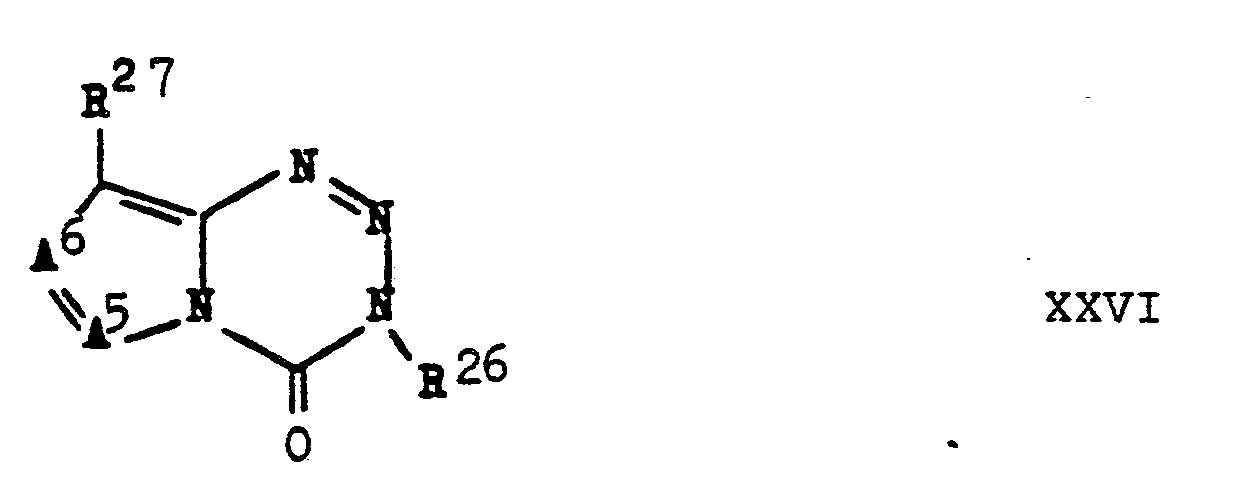

R³⁰OH XXVIII
wherein R³⁰ represents an alkyl group containing up to 4 carbon atoms.
Applications Claiming Priority (2)
| Application Number | Priority Date | Filing Date | Title |
|---|---|---|---|
| GB8616125 | 1986-07-02 | ||
| GB868616125A GB8616125D0 (en) | 1986-07-02 | 1986-07-02 | Compositions of matter |
Publications (2)
| Publication Number | Publication Date |
|---|---|
| EP0252682A2 true EP0252682A2 (en) | 1988-01-13 |
| EP0252682A3 EP0252682A3 (en) | 1990-01-10 |
Family
ID=10600432
Family Applications (1)
| Application Number | Title | Priority Date | Filing Date |
|---|---|---|---|
| EP87305846A Withdrawn EP0252682A3 (en) | 1986-07-02 | 1987-07-01 | Tetrazines |
Country Status (3)
| Country | Link |
|---|---|
| EP (1) | EP0252682A3 (en) |
| JP (1) | JPS6366182A (en) |
| GB (1) | GB8616125D0 (en) |
Cited By (12)
| Publication number | Priority date | Publication date | Assignee | Title |
|---|---|---|---|---|
| US5498774A (en) * | 1989-06-23 | 1996-03-12 | Takeda Chemical Industries, Ltd. | Condensed heterocyclic compounds, their production and use |
| WO2002057269A1 (en) * | 2001-01-18 | 2002-07-25 | Schering Corporation | Synthesis of temozolomide and analogs |
| WO2002057268A1 (en) * | 2001-01-18 | 2002-07-25 | Schering Corporation | Synthesis of temozolomide and analogs |
| WO2006032190A1 (en) | 2004-09-22 | 2006-03-30 | Tian Jin Tasly Group Co., Ltd. | Pharmaceutical composition comprising temozolomide ester |
| US7173021B2 (en) * | 2004-09-02 | 2007-02-06 | Tianjin North Pharm Sci-Tech Co., Ltd. | Synthesis of temozolomide esters as potent anticancer pro-drugs for topical and transdermal applications in treatments of cancers |
| CN1727340B (en) * | 2004-07-29 | 2011-05-18 | 天津帝士力投资控股集团有限公司 | Temozolomide 8-carboxylic ester, and combination |
| CN101190917B (en) * | 2006-11-30 | 2011-07-13 | 天津天士力集团有限公司 | 3,4-dihydro-3-methyl-4-oxomidazo[5,1-d]-1,2,3,5-tetrazine-8-formic acid benzenesulfonyl furoxan esters compound, preparation method and use thereof |
| US20120083513A1 (en) * | 2009-06-23 | 2012-04-05 | Pharminox Limited | 3-Substituted-8-Substituted-3H-Imidazo[5,1-d][1,2,3,5]tetrazin-4-one Compounds and Their Use |
| WO2018081475A1 (en) | 2016-10-27 | 2018-05-03 | Celgene Quanticel Research, Inc. | Bromodomain and extra-terminal protein inhibitor combination therapy |
| US20210315886A1 (en) * | 2018-08-09 | 2021-10-14 | The Board Of Trustees Of The University Of Illinois | Imidazotetrazine compounds |
| CN115260113A (en) * | 2022-07-25 | 2022-11-01 | 浙江工业大学 | Substituted phenyldimethyltetrazinecarboxamides and their preparation and application |
| CN115286589A (en) * | 2022-07-25 | 2022-11-04 | 浙江工业大学 | Cinnamoyl tetrazine compound and preparation and application thereof |
Family Cites Families (4)
| Publication number | Priority date | Publication date | Assignee | Title |
|---|---|---|---|---|
| DE2932305A1 (en) * | 1979-08-09 | 1981-02-26 | Basf Ag | Pyrrolo-, pyrazolo-, imidazo- and thiazolo-tetrazin-4-one derivs. - prepd. from amino-azole cpds. by diazotisation and reaction with isocyanate |
| OA07174A (en) * | 1981-08-24 | 1984-04-30 | May & Baker Ltd | New imidazotetrazionones, their preparation and medicines containing them. |
| GB2125402B (en) * | 1982-08-17 | 1985-11-13 | May & Baker Ltd | New tetrazine derivatives |
| US4517182A (en) * | 1983-05-24 | 1985-05-14 | Warner-Lambert Company | 3-(Haloethyl)-4-oxopyrazolo-[5,1-d]-1,2,3,5-tetrazine-8-carboxamide composition |
-
1986
- 1986-07-02 GB GB868616125A patent/GB8616125D0/en active Pending
-
1987
- 1987-07-01 EP EP87305846A patent/EP0252682A3/en not_active Withdrawn
- 1987-07-01 JP JP62162529A patent/JPS6366182A/en active Pending
Cited By (22)
| Publication number | Priority date | Publication date | Assignee | Title |
|---|---|---|---|---|
| US5498774A (en) * | 1989-06-23 | 1996-03-12 | Takeda Chemical Industries, Ltd. | Condensed heterocyclic compounds, their production and use |
| WO2002057269A1 (en) * | 2001-01-18 | 2002-07-25 | Schering Corporation | Synthesis of temozolomide and analogs |
| WO2002057268A1 (en) * | 2001-01-18 | 2002-07-25 | Schering Corporation | Synthesis of temozolomide and analogs |
| US6844434B2 (en) | 2001-01-18 | 2005-01-18 | Schering Corporation | Synthesis of temozolomide and analogs |
| US7087751B2 (en) | 2001-01-18 | 2006-08-08 | Schering Corporation | Synthesis of temozolomide and analogs |
| CN1294132C (en) * | 2001-01-18 | 2007-01-10 | 先灵公司 | Synthesis of temozolomide and analogs |
| CN100372852C (en) * | 2001-01-18 | 2008-03-05 | 先灵公司 | Synthesis of Temozolomide and Analogues |
| US7446209B2 (en) | 2001-01-18 | 2008-11-04 | Schering Corporation | Synthesis of temozolomide and analogs |
| CN1727340B (en) * | 2004-07-29 | 2011-05-18 | 天津帝士力投资控股集团有限公司 | Temozolomide 8-carboxylic ester, and combination |
| US7173021B2 (en) * | 2004-09-02 | 2007-02-06 | Tianjin North Pharm Sci-Tech Co., Ltd. | Synthesis of temozolomide esters as potent anticancer pro-drugs for topical and transdermal applications in treatments of cancers |
| RU2393160C2 (en) * | 2004-09-22 | 2010-06-27 | Тян Джин Тасли Груп Ко., Лтд. | Pharmaceutical composition containing temozolomide ester |
| WO2006032190A1 (en) | 2004-09-22 | 2006-03-30 | Tian Jin Tasly Group Co., Ltd. | Pharmaceutical composition comprising temozolomide ester |
| CN101190917B (en) * | 2006-11-30 | 2011-07-13 | 天津天士力集团有限公司 | 3,4-dihydro-3-methyl-4-oxomidazo[5,1-d]-1,2,3,5-tetrazine-8-formic acid benzenesulfonyl furoxan esters compound, preparation method and use thereof |
| US20120083513A1 (en) * | 2009-06-23 | 2012-04-05 | Pharminox Limited | 3-Substituted-8-Substituted-3H-Imidazo[5,1-d][1,2,3,5]tetrazin-4-one Compounds and Their Use |
| US9024018B2 (en) * | 2009-06-23 | 2015-05-05 | Pharminox Limited | 3-substituted-8-substituted-3H-imidazo[5,1-d][1,2,3,5]tetrazin-4-one compounds and their use |
| WO2018081475A1 (en) | 2016-10-27 | 2018-05-03 | Celgene Quanticel Research, Inc. | Bromodomain and extra-terminal protein inhibitor combination therapy |
| US20210315886A1 (en) * | 2018-08-09 | 2021-10-14 | The Board Of Trustees Of The University Of Illinois | Imidazotetrazine compounds |
| US12234240B2 (en) | 2018-08-09 | 2025-02-25 | The Board Of Trustees Of The University Of Illinois | Substituted imidazo[5,1-d][1,2,3,5]tetrazines for the treatment of cancer |
| CN115260113A (en) * | 2022-07-25 | 2022-11-01 | 浙江工业大学 | Substituted phenyldimethyltetrazinecarboxamides and their preparation and application |
| CN115286589A (en) * | 2022-07-25 | 2022-11-04 | 浙江工业大学 | Cinnamoyl tetrazine compound and preparation and application thereof |
| CN115286589B (en) * | 2022-07-25 | 2024-04-09 | 浙江工业大学 | Cinnamoyl tetrazine compound, and preparation and application thereof |
| CN115260113B (en) * | 2022-07-25 | 2024-04-09 | 浙江工业大学 | Substituted phenyl dimethyl tetrazine formamide compound and preparation and application thereof |
Also Published As
| Publication number | Publication date |
|---|---|
| GB8616125D0 (en) | 1986-08-06 |
| EP0252682A3 (en) | 1990-01-10 |
| JPS6366182A (en) | 1988-03-24 |
Similar Documents
| Publication | Publication Date | Title |
|---|---|---|
| US5260291A (en) | Tetrazine derivatives | |
| EA003924B1 (en) | Arylsulfonanilide ureas | |
| FI73434C (en) | PROFESSIONAL FRAMSTATION OF AV / 3H / -IMIDAZO- / 5,1-D / -1,2,3,5-TETRAZIN-4-ONDERIVAT MED THERAPEUTIC NETWORK. | |
| GB2243832A (en) | 2-substituted 4-acetamido-5-chloro-n-[2-(diethylamino)ethyl]-benzamide derivative | |
| EP0226508A1 (en) | Indolo[3,2-c]quinoline derivatives, process for their preparation and their anti-tumour activity | |
| HK131897A (en) | Disulfur analogs of LL-E33288 antitumor agents | |
| EP0239476B1 (en) | Pyridoindole derivatives, their use as medicaments and compositions containing them | |
| JPS6366182A (en) | Tetrazine derivative | |
| GB2125402A (en) | New tetrazine derivatives | |
| CZ282249B6 (en) | Derivative of 5h-benzodiazepine, process of its preparation and a pharmaceutical which it contains | |
| DK170733B1 (en) | Tetracyclic biocidal alkyl alkanolamines, intermediates for their preparation and pharmaceutical preparations containing them | |
| CS196357B2 (en) | Process for preparing new basic substituted derivatives of xanthine | |
| EP0432209A1 (en) | PHENYLPYROLE, USEFUL AS MEDICINAL PRODUCT, METHOD FOR THE PRODUCTION THEREOF AND THEIR USE. | |
| CN114437114B (en) | Application and preparation of diketopiperazine natural product and derivative and obtained derivative | |
| EP0294238A1 (en) | Novel 1-alkyl-1-sulfonyl-2-alkoxycarbonylsulfenylhydrazines having antineoplastic activity | |
| HUP9900088A2 (en) | Pyrimidine derivatives, pharmaceutical compositions containing them and process for producing them | |
| PL184728B1 (en) | Novel intermediate compounds as their application in production of bisindoliloamaleimides with a n,n'-bridge | |
| GB2078736A (en) | Indole and indoline derivatives | |
| HU218660B (en) | Anti-tumor indole derivatives, their preparation and pharmaceutical compositions containing them | |
| US4562200A (en) | 5(Indolyl) and 5(2,3-dihydroindolyl) substituted aminoethanols and their use as anti-hypertensives | |
| WO1988008840A1 (en) | Anti-tumoral targetting agents, preparation thereof and applications | |
| CA1254563A (en) | Imidazo ¬5,1-d| tetrazin-1,2,3,5 one-derivatives and related products, processes for their preparation and composition containing said derivatives | |
| EP0107963A1 (en) | Indole derivatives | |
| EP0090681B1 (en) | Novel 1,2-dihydropyrido-(3,4-b)pyrazines | |
| EP0197829A1 (en) | 5H-pyrido[3',4':4,5]pyrrolo[3,2-c]pyridine derivatives, process for their preparation and their antitunour activity |
Legal Events
| Date | Code | Title | Description |
|---|---|---|---|
| PUAI | Public reference made under article 153(3) epc to a published international application that has entered the european phase |
Free format text: ORIGINAL CODE: 0009012 |
|
| AK | Designated contracting states |
Kind code of ref document: A2 Designated state(s): AT BE CH DE ES FR GB GR IT LI LU NL SE |
|
| PUAL | Search report despatched |
Free format text: ORIGINAL CODE: 0009013 |
|
| AK | Designated contracting states |
Kind code of ref document: A3 Designated state(s): AT BE CH DE ES FR GB GR IT LI LU NL SE |
|
| STAA | Information on the status of an ep patent application or granted ep patent |
Free format text: STATUS: THE APPLICATION IS DEEMED TO BE WITHDRAWN |
|
| 18D | Application deemed to be withdrawn |
Effective date: 19900711 |
|
| RIN1 | Information on inventor provided before grant (corrected) |
Inventor name: BAIG, GHOUSE UNISSA Inventor name: LUNT, EDWARD Inventor name: NEWTON, CHRISTOPHER GREGORY Inventor name: HORSPOOL, KEITH RONALD Inventor name: WALSH, ROGER JOHN AITCHISON Inventor name: STEVENS, MALCOLM FRACIS GRAHAM |