EP0252276A2 - Disinfectants and detergents - Google Patents
Disinfectants and detergents Download PDFInfo
- Publication number
- EP0252276A2 EP0252276A2 EP87107879A EP87107879A EP0252276A2 EP 0252276 A2 EP0252276 A2 EP 0252276A2 EP 87107879 A EP87107879 A EP 87107879A EP 87107879 A EP87107879 A EP 87107879A EP 0252276 A2 EP0252276 A2 EP 0252276A2
- Authority
- EP
- European Patent Office
- Prior art keywords
- use according
- alkyl glycosides
- mixed
- alkyl
- alcohols
- Prior art date
- Legal status (The legal status is an assumption and is not a legal conclusion. Google has not performed a legal analysis and makes no representation as to the accuracy of the status listed.)
- Granted
Links
Classifications
-
- A—HUMAN NECESSITIES
- A01—AGRICULTURE; FORESTRY; ANIMAL HUSBANDRY; HUNTING; TRAPPING; FISHING
- A01N—PRESERVATION OF BODIES OF HUMANS OR ANIMALS OR PLANTS OR PARTS THEREOF; BIOCIDES, e.g. AS DISINFECTANTS, AS PESTICIDES OR AS HERBICIDES; PEST REPELLANTS OR ATTRACTANTS; PLANT GROWTH REGULATORS
- A01N43/00—Biocides, pest repellants or attractants, or plant growth regulators containing heterocyclic compounds
- A01N43/02—Biocides, pest repellants or attractants, or plant growth regulators containing heterocyclic compounds having rings with one or more oxygen or sulfur atoms as the only ring hetero atoms
- A01N43/04—Biocides, pest repellants or attractants, or plant growth regulators containing heterocyclic compounds having rings with one or more oxygen or sulfur atoms as the only ring hetero atoms with one hetero atom
- A01N43/14—Biocides, pest repellants or attractants, or plant growth regulators containing heterocyclic compounds having rings with one or more oxygen or sulfur atoms as the only ring hetero atoms with one hetero atom six-membered rings
- A01N43/16—Biocides, pest repellants or attractants, or plant growth regulators containing heterocyclic compounds having rings with one or more oxygen or sulfur atoms as the only ring hetero atoms with one hetero atom six-membered rings with oxygen as the ring hetero atom
-
- A—HUMAN NECESSITIES
- A61—MEDICAL OR VETERINARY SCIENCE; HYGIENE
- A61P—SPECIFIC THERAPEUTIC ACTIVITY OF CHEMICAL COMPOUNDS OR MEDICINAL PREPARATIONS
- A61P31/00—Antiinfectives, i.e. antibiotics, antiseptics, chemotherapeutics
- A61P31/04—Antibacterial agents
Definitions
- the invention relates to the use of alkyl glycosides as potentiating agents in alcohol- or carboxylic acid-containing antiseptic agents and to such disinfectants and cleaning agents containing alcohols or carboxylic acids with an increased bactericidal action.
- Alkyl glycosides their preparation and their use, in particular as surfactants, have been known for a long time. Reference is made, for example, to US Pat. Nos. 3,839,318, 3,707,535 and 3,547,828, DE-OSes 19 05 523, 19 43 689, 20 36 472 and 30 01 064 and EP-OS 0 077 167.
- the preparation Alkylglycosides are in particular carried out by reacting glucose or oligosaccharides with alcohols having 8 to 25 carbon atoms in the alkyl radical. In this way bio is created logically degradable surface-active substances that can be used in a variety of ways.
- alkylglycosides When the microbiological, in particular antimicrobial, properties of alkylglycosides were examined, it was found that even at high application concentrations of up to 10,000 ppm these alone have no significant antimicrobial effects. Even their combination with quaternary ammonium compounds does not lead to any remarkable effects, although quaternary ammonium compounds as such have a bactericidal effect.
- the combined use of alkyl glycosides and quaternary ammonium compounds, as described, for example, in US Pat. No. 3,547,828, does not lead to any unexpected technical effects.
- the antimicrobial effect of alcohols or carboxylic acids has also been known for a long time. To a limited extent, it is also used in practice.
- the use of alcohols or carboxylic acids in antimicrobial agents has numerous disadvantages which have been repeatedly found in practice. For example, the relatively high vapor pressure of the alcohols used in the antimicrobial agents results in a risk to those working with such agents. In addition, the agents become poorer on the antimicrobial alcohol when they are stored for a long time, especially at elevated temperatures.
- alcohols only develop a satisfactory antimicrobial effect in relatively high concentrations: alcohol concentrations in the range between 20 and 30% are generally found.
- the use of carboxylic acids in antimicrobial agents repeatedly cause unacceptable odor nuisance if they have to be used in the concentration required for the microbial effectiveness of the agents.
- the object of the invention was therefore to find simple, readily biodegradable chemical compounds, the combination of which with known antimicrobial compounds leads to an increase in the activity of the antimicrobials, so that their use concentration in antimicrobial agents is reduced and thus the disadvantages listed above can be reduced, if not completely eliminated.
- it made sense to search for simple, biodegradable substances which, in combination with the antimicrobial compounds mentioned, lead to a synergistic increase in the performance of these active substances, in particular with regard to certain microbicidal effects.
- alkyl glycosides as potentiating agents in alcohol- or carboxylic acid-containing antiseptic agents leads to a significant increase in the bactericidal activity of the alcohols or carboxylic acids, which is particularly evident in a marked improvement in the microbicidal activity against gram-positive bacteria.
- an equally good microbicidal action ie the killing of certain germs, could be achieved even at concentrations much lower than those known from the prior art, which has the direct consequence that the use concentrations of the alcohols acting as microbicidal agents hole or carboxylic acids significantly reduced and thus not only economic benefits can be achieved, but also side effects or disadvantages of the type mentioned above can be eliminated.
- the invention relates to the use of alkyl glycosides in admixture with alcohols or carboxylic acids having a bactericidal action in aqueous treatment solutions to potentiate the microbicidal action of these compounds.
- the invention also relates to water-containing disinfectants and cleaning agents with bactericidal activity, which are characterized by a content of active substance mixtures of alkyl glycosides and bactericidal alcohols or carboxylic acids.
- microbicidal active ingredients for blending with alkyl glycosides are alcohols or carboxylic acids, it being possible to use individually bactericidally active compounds from the respective groups or to mix several compounds of the same class with one another.
- Alcohols known as bactericidal are aliphatic and phenylaliphatic, i.e. aliphatic alcohols which are substituted by phenyl groups in the aliphatic C chain and which may contain one or more hydroxyl groups in the context of the use according to the invention.
- aliphatic alcohols straight-chain or branched, unsubstituted or mono- or disubsti are preferred in the use according to the invention tuiert aliphatic alcohols containing 1 to 6 carbon atoms in the alkyl or alkylene radical.
- One or more of the alcohols mentioned are mixed with alkyl glycosides in the manner specified according to the invention.
- the alcohols mentioned have excellent solubility in aqueous media and, as is already known, have pronounced bactericidal properties.
- straight-chain or branched unsubstituted aliphatic alcohols having 2 to 4 carbon atoms in the alkyl or alkylene radical are particularly preferred, ethanol, n-propanol, isopropanol being particularly advantageous, ie achieving a particularly good bactericidal action or their mixtures with one another in admixture with alkyl glycosides can be used.
- phenylalipha Alcohols are understood to mean those alcohols in which the alcohol function is bound to the alkyl chain and the alkyl radical additionally contains a phenyl radical as a substituent.
- benzyl alcohol is particularly advantageous as bactericidal alcohol, since it shows an excellent bactericidal action even in relatively small application concentrations.
- carboxylic acids which have an antimicrobial activity can also be mixed with alkylglycosides.
- carboxylic acids which have an antimicrobial activity can also be mixed with alkylglycosides.
- an antimicrobial carboxylic acid in admixture with the alkyl glycosides or, alternatively, the use of several carboxylic acids in admixture with the alkyl glycosides is also possible.
- aliphatic or aromatic carboxylic acids containing one or more carboxyl groups or their water-soluble salts are used in mixtures with the alkyl glycosides.
- carboxylic acids - or their water-soluble salts - from the group consisting of straight-chain or branched, mono- or poly-unsaturated, aliphatic monocarboxylic acids having 3 to 6 carbon atoms in mixtures with alkyl glycosides.
- carboxylic acids - or their water-soluble salts - from the group consisting of straight-chain or branched, mono- or poly-unsaturated, aliphatic monocarboxylic acids having 3 to 6 carbon atoms.
- sorbic acid or its water-soluble salts are used with particular advantage in mixtures with alkylglycosides, the bactericidal or preservative action of sorbic acid being known per se.
- straight-chain or branched, saturated or unsaturated aliphatic carboxylic acids having 3 to 6 carbon atoms, which are substituted by one or two substituents from the group Cl, Br, NO2 and OH, or their water-soluble salts, can be used in mixtures with alkyl glycosides. Lactic acid is of particular importance in this group.
- bactericidal compounds which are unsubstituted or substituted with one or two substituents from the group Cl, Br and OH gene to use with alkyl glycosides.
- the compounds mentioned can be used individually or in any mixtures with one another in mixtures with the alkylglycosides.
- Preferred from the group of these compounds are benzoic acid, salicylic acid and their water-soluble salts, which - as is known per se - have bactericidal activity in comparatively low concentrations and are also used in corresponding antimicrobial agents.
- the water-soluble salts which can also be used in the context of the antimicrobially active carboxylic acids which can be used according to the invention are primarily alkali metal salts, of which the sodium salts are preferably used in practice because of their easy accessibility.
- alkyl glycosides which are readily biodegradable as such, enables the antimicrobial action of the alcohols or carboxylic acids to be specifically increased or potentiated, the action of other constituents not being influenced in any way.
- the alkylglycosides are used in the first-mentioned aspect of the invention to accelerate the antimicrobial action of the bactericidal alcohols and carboxylic acids
- the alcohols and carboxylic acids mentioned are used in the known and customary concentrations.
- the alkyl glycosides according to the second aspect of the invention mentioned above are to be used, the concentrations customary when using bactericidally active alcohols and carboxylic acids can be considerably undercut. In numerical terms, these use concentrations - depending on the very different effectiveness of the bactericidally active components - can vary within wide limits, so that concentrations of 0.01 to 30% by weight, based on the total treatment solution, come into consideration for the bactericidally active components.
- the preferred aliphatic monoalcohols such as ethanol, n-propanol and isopropanol, are used in particular in concentrations of 8 to 30% by weight, based on the total treatment solution.
- Alcohols with a higher bactericidal activity for example benzyl alcohol, are preferably used in concentrations of 1 to 3% by weight, and bactericidal carboxylic acids are preferably used in concentrations of 0.01 to 3% by weight, in each case based on the total treatment solution.
- alkyl glycosides used according to the invention as potentiating agents are known from the prior art, for example from the publications mentioned at the outset. They are also produced in a known manner from fatty alcohols and sugars by direct reaction. In the context of the use according to the invention in admixture with the bactericidal alcohols or carboxylic acids, one or more alkyl glycosides are used which consist in the saccharide part of a glycoside residue (alkyl monoglycosides) or several glycoside residues (alkyl oligoglycosides).
- alkyl glycosides used according to the invention up to 8 saccharide residues are glycosidically linked to one another and the resulting alkyl mono- or oligoglycosides are mixed with alcohols or carboxylic acids of the above-mentioned type which have a bactericidal action.
- Alkyl monoglycosides having 1 to 3 saccharide residues which are glycosidically linked are preferably used. These can be any saccharide residues; however, alkyl glycosides are preferably used which contain 1 to 3 glucose or maltose residues in the glycoside part.
- alkyl radicals with 1 to 18 carbon atoms there are alkyl radicals with 1 to 18 carbon atoms, as are known from synthetic and / or fatty alcohols derived from native sources. Alkyl radicals having 6 to 18 carbon atoms are preferably found. The fatty alcohols on which these alkyl glycosides are based are available in inexpensive form from native sources.
- alkyl glycosides When stating the alcohols or carboxylic acids having a bactericidal action according to the invention
- the alkyl glycosides used the specification of the number of saccharide residues - as usual - is to be regarded as a statistical mean value, which is based on the distribution customary for products of this type.
- alkyl glycosides with 10 to 14 carbon atoms in the alkyl radical and with up to 2 glycoside radicals, preferably with up to 1.5 glycoside radicals are particularly suitable.
- the concentrations of the alkyl glycosides used according to the invention to potentiate the microbicidal action of the compounds mentioned are in the range from 10 to 2000 ppm, preferably in the range from 50 to 500 ppm, based on the total Treatment solution. In certain blends, however, very low concentrations, for example 10 ppm, in combination with the corresponding bactericidal alcohols or carboxylic acids can lead to a significant increase in activity.
- the disinfectants and cleaning agents according to the invention with bactericidal activity which are characterized by a content of active substance mixtures of alkyl glycosides of the type mentioned and bactericidal alcohols or carboxylic acids in the range mentioned above, normally have a pH in the range from 4.5 to 9, 5 on; a preferred range is between 6 and 8.
- the active ingredient combination of alkyl glycosides and bactericidal alcohols or carboxylic acids used according to the invention is countered if necessary, used together with suitable carrier and auxiliary materials, which in turn assume functions known per se of such disinfectants or cleaning agents.
- the carrier component of such a mouth and / or dentifrice or similar disinfectant and cleaning agent can be a conventional toothpaste, mouthwash preparation, aqueous solution, chewing gum, a jelly or the like.
- dentifrices or dentifrices contain a grinding or abrasive polishing agent and usually foam formers, flavors and sweeteners. Toothpastes also usually contain humectants, binders and water.
- suitable polishing agents are, for example, calcium carbonate, dicalcium orthophosphate dihydrate, calcium pyrophosphate, calcium polymetaphosphate and insoluble sodium polymetaphosphate, aluminum trihydroxide, alpha-aluminum oxide and silicas, in particular gel silicas and precipitated silicas.
- abrasives or abrasives that are compatible with the bactericidal alcohols or carboxylic acids can be particularly preferred. In this regard, too, reference is made to the information in the prior art, as specified, for example, in DE-OS 26 27 548.
- the total proportion of abrasives or abrasives in the disinfectants and cleaning agents according to the invention which are suitable as dentifrices and which have a bactericidal action can amount to approximately 0.5 to 95% of the weight of the total agent.
- Their proportion is usually in the range from 6 to 60% by weight for toothpastes and in the range from 20 to 95% for tooth powders.
- Dental care or dentifrices usually contain surfactants as foaming agents.
- Conventional, non-soap-like, nonionic, cationic, zwitterionic and amphoteric organic synthetic surfactants can be used for this.
- the alkyl glycosides used according to the invention as activity enhancers, the surfactant properties of which are also known from the prior art are particularly suitable.
- Suitable nonionic detergents are condensation products of alkylene oxides with organic hydrophobic compounds which contain, for example, an aliphatic or alkylaromatic radical.
- foaming agents are usually used in amounts of 0.5 to 5% by weight in dentifrices or dentifrices.
- suitable flavors can also be added to the disinfectants and cleaning agents according to the invention, in particular to the agents suitable for dental and oral care.
- suitable flavors are, for example, methyl salicylate, peppermint oil, sassafras oil and anise oil.
- Flavorings are usually used in amounts of 0.01 to 2.0% by weight.
- sweeteners or sweeteners can also be used, the amount of which is usually in the range from 0.05 to 2% by weight.
- Thickeners which may also be used are the usual thickeners, such as hydroxyethyl cellulose and water-soluble salts of cellulose ethers, natural gums or plant slime. Colloidal inorganic components such as finely divided silicon dioxide can also be used or colloidal magnesium aluminum silicate. For the possible concomitant use of such substances, reference is made to the prior art publication already cited.
- the amounts of thickeners are usually in the range from 0.1 to 5.0% by weight of the respective agent, for example toothpaste. If desired, humectants can also be added. Glycerol, sorbitol and other polyhydric alcohols and mixtures thereof are suitable as such. They can be present in amounts of about 1 to 50% by weight of the respective agent, for example the toothpaste preparation, and are usually mixed with water.
- Mouthwashes usually contain a water / ethyl alcohol solution and, if desired, further components, such as flavors, sweeteners and humectants of the type mentioned.
- further components such as flavors, sweeteners and humectants of the type mentioned.
- they contain the combination of antimicrobial alcohols or carboxylic acids and alkylglycosides described, the active components in the amounts mentioned above are available.
- test solutions were prepared which contained the amounts of alkyl glycoside given in the tables and the amounts of alcohol or carboxylic acid having a bactericidal action, also given.
- comparative solutions were prepared which on the one hand only contained compounds having a bactericidal action in the stated concentrations and, on the other hand, only alkylglycosides in a concentration of 10,000 ppm.
- test germ suspension was pipetted into test tubes and mixed with 10 ml of the test or comparison solutions described above. After different exposure times (up to 60 min), approximately 0.05 ml of material was removed from the test tubes with the aid of an inoculation loop and spread on a nutrient agar which contained 3% Tween 80 and 0.3% lecithin as a stripper.
- the nutrient medium consisted of 2.5% by weight standard I broth (Merck) for the germs (a) to (d) and pH 5 (Merck) for the germ (e), which was used for solidification each contained 1.2% by weight of agar.
- the samples were incubated at 37 ° C and 30 ° C, respectively. After 3 days at the earliest, the cultures were assessed macroscopically for growth and in this way the killing time or the residual germ content was determined.
Landscapes
- Life Sciences & Earth Sciences (AREA)
- Health & Medical Sciences (AREA)
- General Health & Medical Sciences (AREA)
- Environmental Sciences (AREA)
- Zoology (AREA)
- Wood Science & Technology (AREA)
- Dentistry (AREA)
- Engineering & Computer Science (AREA)
- Plant Pathology (AREA)
- Pest Control & Pesticides (AREA)
- Agronomy & Crop Science (AREA)
- Nuclear Medicine, Radiotherapy & Molecular Imaging (AREA)
- Chemical & Material Sciences (AREA)
- Public Health (AREA)
- Veterinary Medicine (AREA)
- Pharmacology & Pharmacy (AREA)
- Organic Chemistry (AREA)
- Medicinal Chemistry (AREA)
- General Chemical & Material Sciences (AREA)
- Chemical Kinetics & Catalysis (AREA)
- Animal Behavior & Ethology (AREA)
- Oncology (AREA)
- Communicable Diseases (AREA)
- Agricultural Chemicals And Associated Chemicals (AREA)
- Detergent Compositions (AREA)
- Cosmetics (AREA)
- Saccharide Compounds (AREA)
- Pharmaceuticals Containing Other Organic And Inorganic Compounds (AREA)
- Acyclic And Carbocyclic Compounds In Medicinal Compositions (AREA)
Abstract
Description
Die Erfindung betrifft die Verwendung von Alkylglycosiden als Potenzierungsmittel in alkohol- oder carbonsäurehaltigen antiseptischen Mitteln sowie derartige, Alkohole oder Carbonsäure enthaltende Desinfektions- und Reinigungsmittel mit verstärkter bakterizider Wirkung.The invention relates to the use of alkyl glycosides as potentiating agents in alcohol- or carboxylic acid-containing antiseptic agents and to such disinfectants and cleaning agents containing alcohols or carboxylic acids with an increased bactericidal action.
Alkylglycoside, ihre Herstellung und ihre Verwendung, insbesondere als Tenside, sind seit langer Zeit bekannt. Verwiesen wird beispielsweise auf die US-PSen 3 839 318, 3 707 535 und 3 547 828, die DE-OSen 19 05 523, 19 43 689, 20 36 472 und 30 01 064 sowie die EP-OS 0 077 167. Die Herstellung von Alkylglycosiden erfolgt insbesondere durch Umsetzung von Glucose oder Oligosacchariden mit Alkoholen mit 8 bis 25 C-Atomen im Alkylrest. Es entstehen auf diesem Wege bio logisch abbaubare oberflächenaktive Stoffe, die vielseitige Verwendung finden können.Alkyl glycosides, their preparation and their use, in particular as surfactants, have been known for a long time. Reference is made, for example, to US Pat. Nos. 3,839,318, 3,707,535 and 3,547,828, DE-OSes 19 05 523, 19 43 689, 20 36 472 and 30 01 064 and EP-OS 0 077 167. The preparation Alkylglycosides are in particular carried out by reacting glucose or oligosaccharides with alcohols having 8 to 25 carbon atoms in the alkyl radical. In this way bio is created logically degradable surface-active substances that can be used in a variety of ways.
Bei der Untersuchung der mikrobiologischen, insbesondere antimikrobiellen Eigenschaften von Alkylglycosiden zeigte sich, daß diese selbst bei hohen Anwendungskonzentrationen bis zu 10 000 ppm alleine keine wesentlichen antimikrobiellen Wirkungen aufweisen. Auch ihre Kombination mit quartären Ammoniumverbindungen führt zu keinen bemerkenswerten Effekten, obwohl quartäre Ammoniumverbindungen als solche bakterizide Wirkung haben. Der kombinierte Einsatz von Alkylglycosiden und quartären Ammoniumverbindungen, wie er beispielsweise in der US-PS 3 547 828 beschrieben ist, führt zu keinen unerwarteten technischen Effekten.When the microbiological, in particular antimicrobial, properties of alkylglycosides were examined, it was found that even at high application concentrations of up to 10,000 ppm these alone have no significant antimicrobial effects. Even their combination with quaternary ammonium compounds does not lead to any remarkable effects, although quaternary ammonium compounds as such have a bactericidal effect. The combined use of alkyl glycosides and quaternary ammonium compounds, as described, for example, in US Pat. No. 3,547,828, does not lead to any unexpected technical effects.
Die antimikrobielle Wirkung von Alkoholen bzw. Carbonsäuren ist ebenfalls seit längerer Zeit bekannt. Im begrenzten Bereich findet sie auch in der Praxis Anwendung. Die Verwendung von Alkoholen bzw. Carbonsäuren in antimikrobiell wirkenden Mitteln hat jedoch zahlreiche, in der Praxis immer wieder festgestellte Nachteile. So führt beispielsweise der relativ hohe Dampfdruck der in den antimikrobiell wirkenden Mitteln verwendeten Alkohole zu einer Gefährdung der mit derartigen Mitteln Arbeitenden. Außerdem verarmen die Mittel bei längerer Lagerzeit, insbesondere unter erhöhten Temperaturen, an dem antimikrobiell wirkenden Alkohol. Ergänzend ist als Nachteil immer wieder festgestellt worden, daß Alkohole erst in relativ hohen Konzentrationen eine befriedigende antimikrobielle Wirkung entfalten: In der Regel werden Alkoholkonzentrationen im Bereich zwischen 20 und 30 % angetroffen. Andererseits führt die Verwendung von Carbonsäuren in antimikrobiell wirkenden Mitteln immer wieder zu unzumutbarer Geruchsbelästigung, wenn sie in den für eine mikrobielle Wirksamkeit der Mittel erforderlichen Konzentration eingesetzt werden müssen.The antimicrobial effect of alcohols or carboxylic acids has also been known for a long time. To a limited extent, it is also used in practice. However, the use of alcohols or carboxylic acids in antimicrobial agents has numerous disadvantages which have been repeatedly found in practice. For example, the relatively high vapor pressure of the alcohols used in the antimicrobial agents results in a risk to those working with such agents. In addition, the agents become poorer on the antimicrobial alcohol when they are stored for a long time, especially at elevated temperatures. In addition, it has been repeatedly found as a disadvantage that alcohols only develop a satisfactory antimicrobial effect in relatively high concentrations: alcohol concentrations in the range between 20 and 30% are generally found. On the other hand, the use of carboxylic acids in antimicrobial agents repeatedly cause unacceptable odor nuisance if they have to be used in the concentration required for the microbial effectiveness of the agents.
Die Erfindung stellte sich somit die Aufgabe, einfache, biologisch leicht abbaubare chemische Verbindungen zu finden, deren Kombination mit an sich bekannten, antimikrobiell wirkenden Verbindungen zu einer Wirkungsverstärkung der Antimikrobika führt, so daß deren Einsatzkonzentration in antimikrobiell wirkenden Mitteln verringert und damit die oben aufgezählten Nachteile vermindert, wenn nicht gar ganz beseitigt werden können. Auch aus ökonomischen Gründen war es sinnvoll, nach einfachen, biologisch abbaubaren Substanzen zu suchen, die in Kombination mit den genannten antimikrobiellen Verbindungen zu einer synergistischen Leistungssteigerung dieser Wirkstoffe, insbesondere bezüglich bestimmter mikrobizider Wirkungen, führen.The object of the invention was therefore to find simple, readily biodegradable chemical compounds, the combination of which with known antimicrobial compounds leads to an increase in the activity of the antimicrobials, so that their use concentration in antimicrobial agents is reduced and thus the disadvantages listed above can be reduced, if not completely eliminated. For economic reasons, too, it made sense to search for simple, biodegradable substances which, in combination with the antimicrobial compounds mentioned, lead to a synergistic increase in the performance of these active substances, in particular with regard to certain microbicidal effects.
Überraschend wurde nun gefunden, daß die Verwendung von Alkylglycosiden als Potenzierungsmittel in alkohol- oder carbonsäurehaltigen antiseptischen Mitteln zu einer deutlichen Verstärkung der bakteriziden Wirkung der Alkohole bzw. Carbonsäuren führt, was sich insbesondere in einer deutlichen Verbesserung der mikrobiziden Wirkung gegenüber grampositiven Bakterien zeigt. Umgekehrt konnte eine gleich gute mikrobizide Wirkung, d.h. die Abtötung bestimmter Keime, schon bei sehr viel niedrigeren Konzentrationen als diese aus dem Stand der Technik bekannt sind, erreicht werden, was unmittelbar zur Folge hat, daß die Einsatzkonzentrationen der als mikrobizide Mittel wirkenden Alko hole bzw. Carbonsäuren deutlich reduziert und damit nicht nur ökonomische Vorteile erzielt, sondern auch Nebenwirkungen bzw. Nachteile der oben genannten Art beseitigt werden können.Surprisingly, it has now been found that the use of alkyl glycosides as potentiating agents in alcohol- or carboxylic acid-containing antiseptic agents leads to a significant increase in the bactericidal activity of the alcohols or carboxylic acids, which is particularly evident in a marked improvement in the microbicidal activity against gram-positive bacteria. Conversely, an equally good microbicidal action, ie the killing of certain germs, could be achieved even at concentrations much lower than those known from the prior art, which has the direct consequence that the use concentrations of the alcohols acting as microbicidal agents hole or carboxylic acids significantly reduced and thus not only economic benefits can be achieved, but also side effects or disadvantages of the type mentioned above can be eliminated.
Die Erfindung betrifft die Verwendung von Alkylglycosiden in Abmischung mit bakterizid wirkenden Alkoholen oder Carbonsäuren in wasserhaltigen Behandlungslösungen zur Potenzierung der mikrobiziden Wirkung dieser Verbindungen.The invention relates to the use of alkyl glycosides in admixture with alcohols or carboxylic acids having a bactericidal action in aqueous treatment solutions to potentiate the microbicidal action of these compounds.
Die Erfindung betrifft außerdem wasserhaltige Desinfektions- und Reinigungsmittel mit bakterizider Wirkung, die durch einen Gehalt an Wirkstoffgemischen aus Alkylglycosiden und bakteriziden Alkoholen oder Carbonsäuren gekennzeichnet sind.The invention also relates to water-containing disinfectants and cleaning agents with bactericidal activity, which are characterized by a content of active substance mixtures of alkyl glycosides and bactericidal alcohols or carboxylic acids.
Mikrobizide Wirkstoffe für die Abmischung mit Alkylglycosiden sind im Rahmen der erfindungsgemäßen Verwendung Alkohole oder Carbonsäuren, wobei aus den jeweiligen Gruppen bakterizid wirksame Verbindungen einzeln eingesetzt oder auch mehrere Verbindungen der gleichen Klasse miteinander gemischt werden können.In the context of the use according to the invention, microbicidal active ingredients for blending with alkyl glycosides are alcohols or carboxylic acids, it being possible to use individually bactericidally active compounds from the respective groups or to mix several compounds of the same class with one another.
Als bakterizid bekannte Alkohole sind dabei aliphatische und phenylaliphatische, d.h. durch Phenylgruppen in der aliphatischen C-Kette substituierte aliphatische Alkohole bekannt, die im Rahmen der erfindungsgemäßen Verwendung eine oder mehrere Hydroxylgruppen enthalten können.Alcohols known as bactericidal are aliphatic and phenylaliphatic, i.e. aliphatic alcohols which are substituted by phenyl groups in the aliphatic C chain and which may contain one or more hydroxyl groups in the context of the use according to the invention.
Von den aliphatischen Alkoholen sind bei der erfindungsgemäßen Verwendung bevorzugt geradkettige oder verzweigte, unsubstituierte oder mono- oder disubsti tuierte aliphatische Alkohole, die im Alkyl- oder Alkylenrest 1 bis 6 C-Atome enthalten. Einer oder mehrere der genannten Alkohole werden, in der erfindungsgemäß angegebenen Art und Weise, mit Alkylglycosiden abgemischt. Die genannten Alkohole besitzen in eine ausgezeichnete Löslichkeit in wässrigen Medien und weisen - wie bereits bekannt ist - ausgeprägte bakterizide Eigenschaften auf. Aus der genannten Gruppe sind als besonders bevorzugt geradkettige oder verzweigte unsubstituierte aliphatische Alkohole mit 2 bis 4 C-Atomen im Alkyl- oder Alkylenrest zu nennen, wobei mit besonderem Vorteil, d.h. unter Erzielung einer besonders guten bakteriziden Wirkung, Ethanol, n-Propanol, Isopropanol oder deren Mischungen untereinander in Abmischung mit Alkylglycosiden verwendet werden können.Of the aliphatic alcohols, straight-chain or branched, unsubstituted or mono- or disubsti are preferred in the use according to the invention tuiert aliphatic alcohols containing 1 to 6 carbon atoms in the alkyl or alkylene radical. One or more of the alcohols mentioned are mixed with alkyl glycosides in the manner specified according to the invention. The alcohols mentioned have excellent solubility in aqueous media and, as is already known, have pronounced bactericidal properties. From the group mentioned, straight-chain or branched unsubstituted aliphatic alcohols having 2 to 4 carbon atoms in the alkyl or alkylene radical are particularly preferred, ethanol, n-propanol, isopropanol being particularly advantageous, ie achieving a particularly good bactericidal action or their mixtures with one another in admixture with alkyl glycosides can be used.
Es ist jedoch auch möglich, anstelle der genannten Alkohole oder in Abmischung mit ihnen geradkettige oder verzweigte, mit einem oder zwei Substituenten aus der Gruppe Cl, Br oder NO₂ substituierte aliphatische Alkohole mit 2 bis 4 C-Atomen als bakterizid wirksame Substanzen einzusetzen. Aus der Gruppe dieser Verbindungen ist wegen seiner guten bakteriziden Eigenschaften 2-Bromo-2-nitro-1.3-propandiol besonders hervorzuheben, das im Handel unter der Bezeichnung "Bronopol" angeboten wird.However, it is also possible to use straight-chain or branched, straight-chain or branched, with one or two substituents from the group Cl, Br or NO₂ substituted aliphatic alcohols having 2 to 4 carbon atoms as bactericidally active substances instead of the alcohols mentioned. From the group of these compounds, 2-bromo-2-nitro-1,3-propanediol, which is commercially available under the name "Bronopol", is particularly noteworthy because of its good bactericidal properties.
In einer weiteren Ausführungsform der Erfindung ist es auch möglich, anstelle rein aliphatischer Alkohole auch geradkettige oder verzweigte, unsubsitutierte oder mono- oder disubstituierte phenylaliphatische Alkohole mit 1 bis 3 C-Atomen im Alkylenrest als bakterizid wirksame Alkohole zu verwenden. Im Rahmen der vorliegenden Offenbarung werden unter "phenylalipha tische" Alkohole solche Alkohole verstanden, in denen die Alkoholfunktion an die Alkylkette gebunden ist und der Alkylrest zusätzlich einen Phenylrest als Substituenten enthält. Aus der Gruppe derartiger Alkohole werden in Abmischung mit Alkylglycosiden insbesondere geradkettige, unsubstituierte oder mit einem oder zwei Substituenten aus der Gruppe Cl, Br oder NO₂ substituierte phenylaliphatische Alkohole mit 1 bis 3 C-Atomen im Alkylenrest bevorzugt. Als besonders vorteilhaft bakterizid wirksamer Alkohol dieser Klasse ist beispielsweise Benzylalkohol zu nennen, da er eine ausgezeichnete bakterizide Wirkung schon in verhältnismäßig kleinen Anwendungskonzentrationen zeigt.In a further embodiment of the invention, it is also possible to use straight-chain or branched, unsubstituted or mono- or disubstituted phenylaliphatic alcohols having 1 to 3 carbon atoms in the alkylene radical as bactericidally active alcohols instead of purely aliphatic alcohols. In the context of the present disclosure, "phenylalipha "Alcohols are understood to mean those alcohols in which the alcohol function is bound to the alkyl chain and the alkyl radical additionally contains a phenyl radical as a substituent. In particular, straight-chain, unsubstituted or with one or two substituents from the group C1 , Br or NO₂-substituted phenylaliphatic alcohols with 1 to 3 carbon atoms in the alkylene radical are preferred, for example benzyl alcohol is particularly advantageous as bactericidal alcohol, since it shows an excellent bactericidal action even in relatively small application concentrations.
Entsprechend der erfindungsgemäßen Verwendung können auch Carbonsäuren, die antimikrobiell wirksam sind, mit Alkylglycosiden abgemischt werden. Auch hierbei ist die Verwendung einer antimikrobiell wirksamen Carbonsäure in Abmischung mit den Alkylglycosiden oder, alternativ dazu, auch die Verwendung mehrerer Carbonsäuren in Abmischung mit den Alkylglycosiden möglich.In accordance with the use according to the invention, carboxylic acids which have an antimicrobial activity can also be mixed with alkylglycosides. Here too, the use of an antimicrobial carboxylic acid in admixture with the alkyl glycosides or, alternatively, the use of several carboxylic acids in admixture with the alkyl glycosides is also possible.
Im Zuge der erfindungsgemäßen Verwendung kommen dabei insbesondere aliphatische oder aromatische, eine oder mehrere Carboxylgruppen enthaltende Carbonsäuren oder deren wasserlösliche Salze in Abmischungen mit den Alkylglycosiden zum Einsatz. Bevorzugt sind dabei geradkettige oder verzweigte, gesättigte oder ungesättigte, unsubstituierte oder mono- oder disubstituierte aliphatische Mono- oder Dicarbonsäuren mit 1 bis 12 C-Atomen, einzeln oder in Mischungen miteinander, wobei im Rahmen der erfindungsgemäßen Verwendung wiederum auch deren wasserlösliche Salze verwendet werden können. Aus der genannten Gruppe werden aufgrund ihrer guten Wasserlöslichkeit und der - an sich bekannten - antimikrobiellen Wirkung geradkettige oder verzweigte unsubstituierte aliphatische Monocarbonsäuren mit 3 bis 6 C-Atomen und deren wasserlösliche Salze bevorzugt, wobei mit besonderem Vorteil, d.h. mit guter bakterizider Wirkung schon bei vergleichsweise niedrigen Konzentrationen, Propionsäure, Buttersäure, Valeriansäure oder deren wasserlösliche Salze in Abmischungen mit den Alkylglycosiden verwendet werden.In the course of the use according to the invention, in particular aliphatic or aromatic carboxylic acids containing one or more carboxyl groups or their water-soluble salts are used in mixtures with the alkyl glycosides. Straight-chain or branched, saturated or unsaturated, unsubstituted or mono- or disubstituted aliphatic mono- or dicarboxylic acids having 1 to 12 carbon atoms, individually or in mixtures with one another, are preferred, the water-soluble salts of which can in turn also be used in the context of the use according to the invention . From the group mentioned, due to their good solubility in water and the - known per se - preferred straight-chain or branched unsubstituted aliphatic monocarboxylic acids with 3 to 6 carbon atoms and their water-soluble salts - with a particular advantage, ie with good bactericidal action even at comparatively low concentrations, propionic acid, butyric acid, Valeric acid or its water-soluble salts can be used in mixtures with the alkyl glycosides.
Es ist jedoch auch möglich, eine oder mehrere Carbonsäuren - oder deren wasserlösliche Salze - aus der Gruppe geradkettiger oder verzweigter, einfach oder mehrfach ungesättigter, aliphatischer Monocarbonsäuren mit 3 bis 6 C-Atomen in Abmischungen mit Alkylglycosiden erfindungsgemäß zu verwenden. Mit besonderem Vorteil werden aus dieser Gruppe Sorbinsäure oder deren wasserlösliche Salze in Abmischungen mit Alkylglycosiden verwendet, wobei auch die bakterizide bzw. konservierende Wirkung von Sorbinsäure an sich bekannt ist.However, it is also possible to use one or more carboxylic acids - or their water-soluble salts - from the group consisting of straight-chain or branched, mono- or poly-unsaturated, aliphatic monocarboxylic acids having 3 to 6 carbon atoms in mixtures with alkyl glycosides. From this group, sorbic acid or its water-soluble salts are used with particular advantage in mixtures with alkylglycosides, the bactericidal or preservative action of sorbic acid being known per se.
Weiterhin können geradkettige oder verzweigte, gesättigte oder ungesättigte aliphatische Carbonsäuren mit 3 bis 6 C-Atomen, die mit einem oder zwei Substituenten aus der Gruppe Cl, Br, NO₂ und OH substituiert sind, oder deren wasserlösliche Salze, in Abmischungen mit Alkylglykosiden verwendet werden. In dieser Gruppe ist Milchsäure von besonderer Bedeutung.Furthermore, straight-chain or branched, saturated or unsaturated aliphatic carboxylic acids having 3 to 6 carbon atoms, which are substituted by one or two substituents from the group Cl, Br, NO₂ and OH, or their water-soluble salts, can be used in mixtures with alkyl glycosides. Lactic acid is of particular importance in this group.
Als weitere vorteilhafte Ausführungsform der Erfindung ist es anzusehen, als bakterizid wirkende Verbindungen unsbustituierte oder mit einem oder zwei Substituenten aus der Gruppe Cl, Br und OH subsitutierte, einringige aromatische Carbonsäuren oder deren Salze in Abmischun gen mit Alkylglycosiden zu verwenden. Auch innerhalb dieser Ausführungsform können die genannten Verbindungen einzeln oder in beliebigen Mischungen miteinander in Abmischungen mit den Alkylglycosiden verwendet werden. Als bevorzugt sind aus der Gruppe dieser Verbindungen Benzoesäure, Salicylsäure und deren wasserlösliche Salze anzusehen, die - wie an sich bekannt - schon in vergleichsweise geringen Konzentrationen bakterizid wirksam sind und auch in entsprechenden antimikrobiell wirkenden Mitteln eingesetzt werden.As a further advantageous embodiment of the invention, it is to be regarded as monocyclic aromatic carboxylic acids or their salts in admixture as bactericidal compounds which are unsubstituted or substituted with one or two substituents from the group Cl, Br and OH gene to use with alkyl glycosides. Within this embodiment, too, the compounds mentioned can be used individually or in any mixtures with one another in mixtures with the alkylglycosides. Preferred from the group of these compounds are benzoic acid, salicylic acid and their water-soluble salts, which - as is known per se - have bactericidal activity in comparatively low concentrations and are also used in corresponding antimicrobial agents.
Die im Rahmen der erfindungsgemäß verwendbaren antimikrobiell wirksamen Carbonsäuren genannten, ebenfalls verwendbaren wasserlöslichen Salze sind in erster Linie Alkalimetallsalze, wobei von diesen in der Praxis bevorzugt die Natriumsalze aufgrund ihrer leichten Zugänglichkeit verwendet werden.The water-soluble salts which can also be used in the context of the antimicrobially active carboxylic acids which can be used according to the invention are primarily alkali metal salts, of which the sodium salts are preferably used in practice because of their easy accessibility.
Der überraschende Vorteil der erfindungsgemäßen Verwendung von Alkylglycosiden in Abmischung mit den genannten, bakterizid wirkenden Alkoholen oder Carbonsäuren ist darin zu sehen, daß bei üblichen Einsatzmengen der antimikrobiell wirkenden Verbindungen die mikrobizide Wirkung durch Zusatz von Alkylglycosiden sehr viel schneller erreicht wird oder daß, alternativ, die üblichen Einsatzmengen zum Erreichen einer gleich guten bakteriziden Wirkung deutlich gesenkt werden können. Unter dem zuletzt genannten Aspekt der Erfindung wird es in überraschender Weise möglich, die Einsatzmengen für die praktische Anwendung deutlich zu reduzieren und dabei zu erreichen, daß die ökonomischen und durch die Verwendung der jeweiligen Mittel bedingten Nachteile, wie deren hoher Dampfdruck, die mit den Verbindungen verbundene Geruchsbelästigung usw., in einfacher Weise beseitigt werden. Zudem ist es möglich, durch die Verwendung der Alkylglycoside, die als solche biologisch leicht abbaubar sind, gezielt die antimikrobielle Wirkung der Alkohole bzw. Carbonsäuren zu verstärken bzw. zu potenzieren, wobei die Wirkung anderer Bestandteile in keiner Weise beeinflußt wird.The surprising advantage of the use according to the invention of alkyl glycosides in admixture with the abovementioned alcohols or carboxylic acids having a bactericidal action is to be seen in the fact that the usual use of the antimicrobial compounds gives the microbicidal action very quickly by adding alkyl glycosides or, alternatively, that usual amounts to achieve an equally good bactericidal effect can be significantly reduced. Under the last-mentioned aspect of the invention, it becomes surprisingly possible to significantly reduce the amounts used for practical use and thereby achieve that the economic disadvantages caused by the use of the respective agents, such as their high vapor pressure, are associated with the compounds associated odor nuisance etc., can be eliminated in a simple manner. In addition, the use of the alkyl glycosides, which are readily biodegradable as such, enables the antimicrobial action of the alcohols or carboxylic acids to be specifically increased or potentiated, the action of other constituents not being influenced in any way.
Werden die Alkylglykoside unter dem zuerst genannten Aspekt der Erfindung zur Beschleunigung der antimikrobiellen Wirkung der bakterizid wirkenden Alkohole und Carbonsäuren eingesetzt, so kommen die genannten Alkohole und Carbonsäuren in den an sich bekannten und üblichen Konzentrationen zur Anwendung. Sollen dagegen die Alkylglykoside nach dem oben erwähnten zweiten Aspekt der Erfindung eingesetzt werden, so können die bei der Anwendung von bakterizid wirksamen Alkoholen und Carbonsäuren üblichen Konzentrationen beträchtlich unterschritten werden. Zahlenmäßig können diese Einsatzkonzentrationen - entsprechend der sehr unterschiedlichen Wirksamkeit der bakterizid wirksamen Komponenten - in weiten Grenzen schwanken, so daß für die bakterizid wirksamen Komponenten Konzentrationen von 0,01 bis 30 Gew.-%, bezogen auf die gesamte Behandlungslösung, in Betracht kommen.If the alkylglycosides are used in the first-mentioned aspect of the invention to accelerate the antimicrobial action of the bactericidal alcohols and carboxylic acids, the alcohols and carboxylic acids mentioned are used in the known and customary concentrations. If, on the other hand, the alkyl glycosides according to the second aspect of the invention mentioned above are to be used, the concentrations customary when using bactericidally active alcohols and carboxylic acids can be considerably undercut. In numerical terms, these use concentrations - depending on the very different effectiveness of the bactericidally active components - can vary within wide limits, so that concentrations of 0.01 to 30% by weight, based on the total treatment solution, come into consideration for the bactericidally active components.
Die bevorzugten aliphatischen Monoalkohole wie Ethanol n-Propanol und Isopropanol werden insbesondere in Konzentrationen von 8 bis 30 Gew.-%, bezogen auf die gesamte Behandlungslösung eingesetzt. Stärker bakterizid wirksame Alkohole, beispielsweise Benzylalkohol kommen bevorzugt in Konzentrationen von 1 bis 3 Gew.-% und bakterizid wirksame Carbonsäuren bevorzugt in Konzentrationen von 0,01 bis 3 Gew.-%, jeweils bezogen auf die gesamte Behandlungslösung zur Anwendung.The preferred aliphatic monoalcohols, such as ethanol, n-propanol and isopropanol, are used in particular in concentrations of 8 to 30% by weight, based on the total treatment solution. Alcohols with a higher bactericidal activity, for example benzyl alcohol, are preferably used in concentrations of 1 to 3% by weight, and bactericidal carboxylic acids are preferably used in concentrations of 0.01 to 3% by weight, in each case based on the total treatment solution.
Die erfindungsgemäß als Potenzierungsmittel eingesetzten Alkylglycoside sind aus dem Stand der Technik, beispielsweise aus den eingangs genannten Druckschriften, bekannt. Sie werden in ebenfalls bekannter Weise aus Fettalkoholen und Zuckern durch direkte Umsetzung hergestellt. Im Rahmen der erfindungsgemäßen Verwendung in Abmischung mit den bakterizid wirkenden Alkoholen oder Carbonsäuren finden ein oder mehrere Alkylglycoside Anwendung, die im Saccharidteil aus einem Glycosidrest (Alkylmonoglycoside) oder mehreren Glycosidresten (Alkyloligoglycoside) bestehen. Bei den erfindungsgemäß verwendeten Alkylglycosiden werden bis zu 8 Saccharidreste glycosidisch miteinander verbunden und die daraus entstehenden Alkylmono- oder -oligoglycoside mit bakterizid wirkenden Alkoholen oder Carbonsäuren der oben genannten Art abgemischt. Bevorzugt finden dabei Alkylmonoglycoside mit 1 bis 3 Saccharidresten, die glycosidisch miteinander verbunden sind, Verwendung. Dabei können dies beliebige Saccharidreste sein; bevorzugt werden jedoch Alkylglycoside verwendet, die 1 bis 3 Glucose- oder Maltosereste im Glycosidteil enthalten.The alkyl glycosides used according to the invention as potentiating agents are known from the prior art, for example from the publications mentioned at the outset. They are also produced in a known manner from fatty alcohols and sugars by direct reaction. In the context of the use according to the invention in admixture with the bactericidal alcohols or carboxylic acids, one or more alkyl glycosides are used which consist in the saccharide part of a glycoside residue (alkyl monoglycosides) or several glycoside residues (alkyl oligoglycosides). In the alkyl glycosides used according to the invention, up to 8 saccharide residues are glycosidically linked to one another and the resulting alkyl mono- or oligoglycosides are mixed with alcohols or carboxylic acids of the above-mentioned type which have a bactericidal action. Alkyl monoglycosides having 1 to 3 saccharide residues which are glycosidically linked are preferably used. These can be any saccharide residues; however, alkyl glycosides are preferably used which contain 1 to 3 glucose or maltose residues in the glycoside part.
Im Alkylteil der erfindungsgemäß in Abmischung mit bakterizid wirkenden Alkoholen oder Carbonsäuren verwendeten Alkylglycoside finden sich Alkylreste mit 1 bis 18 C-Atomen, wie sie von synthetischen und/oder aus nativen Quellen stammenden Fettalkoholen bekannt sind. Bevorzugt findet man Alkylreste mit 6 bis 18 C-Atomen. Die diesen Alkylglycosiden zugrundeliegenden Fettalkohole stehen in preiswerter Form aus nativen Quellen zur Verfügung.In the alkyl part of the alkyl glycosides used according to the invention in a mixture with bactericidal alcohols or carboxylic acids, there are alkyl radicals with 1 to 18 carbon atoms, as are known from synthetic and / or fatty alcohols derived from native sources. Alkyl radicals having 6 to 18 carbon atoms are preferably found. The fatty alcohols on which these alkyl glycosides are based are available in inexpensive form from native sources.
Bei der Angabe der erfindungsgemäß in Abmischung mit den bakterizid wirkenden Alkoholen oder Carbonsäuren verwendeten Alkylglycoside ist die Angabe der Zahl der Saccharidreste - wie üblich - als ein statistischer Mittelwert anzusehen, dem die bei derartigen Produkten übliche Verteilung zugrundeliegt. Im Rahmen der erfindungsgemäßen Verwendung sind Alkylglycoside mit 10 bis 14 C-Atomen im Alkylrest und mit bis zu 2 Glycosidresten, vorzugsweise mit bis zu 1,5 Glycosidresten, besonders geeignet.When stating the alcohols or carboxylic acids having a bactericidal action according to the invention The alkyl glycosides used, the specification of the number of saccharide residues - as usual - is to be regarded as a statistical mean value, which is based on the distribution customary for products of this type. In the context of the use according to the invention, alkyl glycosides with 10 to 14 carbon atoms in the alkyl radical and with up to 2 glycoside radicals, preferably with up to 1.5 glycoside radicals, are particularly suitable.
Bei der Verwendung der Alkylglycoside in Abmischung mit den bakterizid wirkenden Alkoholen oder Carbonsäuren liegen die zur Potenzierung der mikrobiziden Wirkung der genannten Verbindungen erfindungsgemäß verwendeten Konzentrationen der Alkylglycoside im Bereich von 10 bis 2000 ppm, bevorzugt im Bereich von 50 bis 500 ppm, bezogen auf die gesamte Behandlungslösung. In bestimmten Abmischungen können jedoch auch sehr geringe Konzentrationen, beispielsweise 10 ppm, in Verbindung mit entsprechenden bakterizid wirkenden Alkoholen oder Carbonsäuren zu einer deutlichen Wirkungsverstärkung führen. Für den Einsatz der genannten antimikrobiellen Wirkstoffe auf wichtigen Anwendungsgebieten erschließt sich damit die Möglichkeit, schon bei geringen Mengen an Alkylglycosiden als Potenzierungsmittel mit deutlich verringerten Wirkstoffgehalten arbeiten zu können und gleichwohl eine befriedigende mikrobizide Wirkung zu erzielen.When using the alkyl glycosides in admixture with the bactericidal alcohols or carboxylic acids, the concentrations of the alkyl glycosides used according to the invention to potentiate the microbicidal action of the compounds mentioned are in the range from 10 to 2000 ppm, preferably in the range from 50 to 500 ppm, based on the total Treatment solution. In certain blends, however, very low concentrations, for example 10 ppm, in combination with the corresponding bactericidal alcohols or carboxylic acids can lead to a significant increase in activity. For the use of the above-mentioned antimicrobial active substances in important fields of application, this opens up the possibility of being able to work with significantly reduced active substance contents even with small amounts of alkyl glycosides as a potentiating agent, and nevertheless achieving a satisfactory microbicidal effect.
Dies zeigt sich insbesondere im Bereich der Bekämpfung grampositiver Keime. Es hat sich gezeigt, daß in Desinfektions- und Reinigungsmitteln mit bakterizider Wirkung gegen grampositive Keime eine besonders deutliche Wirkungssteigerung der antiseptischen Mittel zu erzielen ist. Dies spielt eine besondere Rolle auf dem Gebiet der Mittel zur Körperpflege. Als solche kommen in erster Linie Zahnpasten, Zahnpulver und Mundwässer in Frage. Es können jedoch auch andere Desinfektions- und Reinigungsmittel in ihrer bakteriziden Wirkung deutlich verstärkt werden.This is particularly evident in the area of controlling gram-positive germs. It has been shown that a particularly marked increase in the effectiveness of the antiseptic agents can be achieved in disinfectants and cleaning agents with bactericidal activity against gram-positive germs. This plays a special role in the field of personal care products. As such come primarily toothpastes, tooth powder and mouthwashes in question. However, other disinfectants and cleaning agents can be significantly enhanced in their bactericidal effect.
Gerade auf diesem Gebiet kommt der Vorteil der erfindungsgemäßen Verwendung von Alkylglycosiden in Abmischung mit bakterizid wirkenden Alkoholen oder Carbonsäuren zur Potenzierung der mikrobiziden Wirkung der genannten Verbindungen besonders gut zum tragen, da die in derartigen Mitteln, beispielsweise Zahnpasten, zugelassenen bakteriostatischen Mittel in den erlaubten Konzentrationen eine echte anti-Plaque-Wirkung derzeit nicht erzielen können. Es ist jedoch bekannt, daß bei der Bildung des Zahnbelags und der dadurch mit ausgelösten Kariesentwicklung grampositive Bakterien eine besondere Rolle spielen und dabei deren Bekämfpung besondere Aufmerksamkeit geschenkt wird. Die erfindungsgemäße Möglichkeit der Wirkungsverstärkung gerade gegenüber den grampositiven Bakterien erschließt hier den Zugang zu weitaus wirkungsvolleren Mitteln als sie bisher zur Verfügung standen, ohne daß es dazu einer Erhöhung der Wirkstoffkonzentration bedarf.It is precisely in this area that the advantage of the use of alkylglycosides according to the invention in admixture with alcohols or carboxylic acids having a bactericidal action for potentiating the microbicidal action of the compounds mentioned comes into play particularly well, since the bacteriostatic agents approved in such agents, for example toothpastes, have a permitted concentration in the permitted concentrations cannot achieve a real anti-plaque effect at the moment. However, it is known that gram-positive bacteria play a special role in the formation of dental plaque and the caries development which is triggered thereby, and special attention is paid to combating them. The possibility of enhancing the effect according to the invention, especially in relation to the gram-positive bacteria, opens up access to far more effective agents than were previously available, without requiring an increase in the active substance concentration.
Die erfindungsgemäßen Desinfektions- und Reinigungsmittel mit bakterizider Wirkung, die durch einen im oben genannten Bereich liegenden Gehalt an Wirkstoffgemischen aus Alkylglycosiden der genannten Art und bakteriziden Alkoholen oder Carbonsäuren gekennzeichnet sind, weisen im Normalfall einen pH-Wert im Bereich von 4,5 bis 9,5 auf; ein bevorzugter Bereich liegt zwischen 6 und 8. Die erfindungsgemäß verwendete Wirkstoffkombination aus Alkylglycosiden und bakterizid wirkenden Alkoholen oder Carbonsäuren wird gege benenfalls zusammen mit geeigneten Träger- und Hilfsmaterialien eingesetzt, die ihrerseits an sich bekannte Funktionen derartiger Desinfektions- oder Reinigungsmittel übernehmen. Im Einzelfall kann die Trägerkomponente eines derartigen Mund- und/oder Zahnpflegemittels oder ähnlichen Desinfektions- und Reinigungsmittels eine übliche Zahnpaste, Mundspülzubereitung, wässrige Lösung, Kaugummimasse, ein Gelee oder dergleichen sein.The disinfectants and cleaning agents according to the invention with bactericidal activity, which are characterized by a content of active substance mixtures of alkyl glycosides of the type mentioned and bactericidal alcohols or carboxylic acids in the range mentioned above, normally have a pH in the range from 4.5 to 9, 5 on; a preferred range is between 6 and 8. The active ingredient combination of alkyl glycosides and bactericidal alcohols or carboxylic acids used according to the invention is countered if necessary, used together with suitable carrier and auxiliary materials, which in turn assume functions known per se of such disinfectants or cleaning agents. In individual cases, the carrier component of such a mouth and / or dentifrice or similar disinfectant and cleaning agent can be a conventional toothpaste, mouthwash preparation, aqueous solution, chewing gum, a jelly or the like.
Beispielsweise enthalten Zahnpflege- bzw. Zahnputzmittel ein schleifend bzw. scheuernd wirkendes Poliermittel und normalerweise Schaumbildner, Geschmacksstoffe und Süßmittel. Zahnpasten enthalten außerdem meist Feuchthaltemittel, Bindemittel und Wasser. Bekannte geeignete Poliermittel sind beispielsweise Calciumcarbonat, Dicalciumorthophosphat-dihydrat, Calciumpyrophosphat, Calciumpolymetaphosphat und unlösliches Natriumpolymetaphosphat, Aluminiumtrihydroxid, alpha-Aluminiumoxid und Kieselsäuren, insbesondere Gelkieselsäuren und Fällungskieselsäuren. Die Verwendung von Schleif- bzw. Scheuermitteln, die mit den bakterizid wirkenden Alkoholen bzw. Carbonsäuren kompatibel sind, kann besonders bevorzugt sein. Auch hierzu wird auf die Angaben des Standes der Technik verwiesen, wie sie beispielsweise in der DE-OS 26 27 548 angegeben sind.For example, dentifrices or dentifrices contain a grinding or abrasive polishing agent and usually foam formers, flavors and sweeteners. Toothpastes also usually contain humectants, binders and water. Known suitable polishing agents are, for example, calcium carbonate, dicalcium orthophosphate dihydrate, calcium pyrophosphate, calcium polymetaphosphate and insoluble sodium polymetaphosphate, aluminum trihydroxide, alpha-aluminum oxide and silicas, in particular gel silicas and precipitated silicas. The use of abrasives or abrasives that are compatible with the bactericidal alcohols or carboxylic acids can be particularly preferred. In this regard, too, reference is made to the information in the prior art, as specified, for example, in DE-OS 26 27 548.
Der Gesamtanteil an Schleif- bzw. Scheuermitteln kann in den als Zahnputzmittel geeigneten erfindungsgemäßen Desinfektions- und Reinigungsmitteln mit bakterizider Wirkung etwa 0,5 bis 95 % des Gewichts des gesamten Mittels betragen. Üblicherweise liegt ihr Anteil bei Zahnpasten im Bereich von 6 bis 60 Gew.-%, bei Zahnpulvern im Bereich von 20 bis 95 %.The total proportion of abrasives or abrasives in the disinfectants and cleaning agents according to the invention which are suitable as dentifrices and which have a bactericidal action can amount to approximately 0.5 to 95% of the weight of the total agent. Their proportion is usually in the range from 6 to 60% by weight for toothpastes and in the range from 20 to 95% for tooth powders.
Zahnpflege- bzw. Zahnputzmittel enthalten üblicherweise Tenside als Schaumbildner. Es können dazu übliche, nicht-seifenartige, nichtionische, kationischen, zwitterionische und amphotere organische synthetische Tenside verwendet werden. Besonders geeignet sind jedoch die erfindungsgemäß als Wirkungsverstärker verwendeten Alkylglycoside, deren Tensideigenschaften ebenfalls aus dem Stand der Technik bekannt sind. Geeignete nichtionische Detergentien sind Kondensationsprodukte von Alkylenoxiden mit organischen hydrophoben Verbindungen, die beispielsweise einen aliphatischen oder alkylaromatischen Rest enthalten. Schaumbildner werden, soweit sie eingesetzt werden, in Zahnputz- bzw. Zahnpflegemitteln üblicherweise in Mengen von 0,5 bis 5 Gew.-% verwendet.Dental care or dentifrices usually contain surfactants as foaming agents. Conventional, non-soap-like, nonionic, cationic, zwitterionic and amphoteric organic synthetic surfactants can be used for this. However, the alkyl glycosides used according to the invention as activity enhancers, the surfactant properties of which are also known from the prior art, are particularly suitable. Suitable nonionic detergents are condensation products of alkylene oxides with organic hydrophobic compounds which contain, for example, an aliphatic or alkylaromatic radical. As far as they are used, foaming agents are usually used in amounts of 0.5 to 5% by weight in dentifrices or dentifrices.
Sofern erwünscht, können auch den erfindungsgemäßen Desinfektions- und Reinigungsmitteln, insbesondere den für die Zahn- bzw. Mundpflege geeigneten Mitteln geeignete Geschmacksstoffe zugesetzt werden. Derartige Geschmacksstoffe sind beispielsweise Methylsalicylat, Pfefferminzöl, Sassafras-Öl und Anisöl. Geschmacksstoffe werden üblicherweise in Mengen von 0,01 bis 2,0 Gew.-% verwendet. In Ergänzung dazu bzw. stattdessen können gegebenenfalls auch Süßmittel bzw. Süßstoffe verwendet werden, deren Menge üblicherweise im Bereich von 0,05 bis 2 Gew.-% liegt.If desired, suitable flavors can also be added to the disinfectants and cleaning agents according to the invention, in particular to the agents suitable for dental and oral care. Such flavors are, for example, methyl salicylate, peppermint oil, sassafras oil and anise oil. Flavorings are usually used in amounts of 0.01 to 2.0% by weight. In addition to or instead of this, sweeteners or sweeteners can also be used, the amount of which is usually in the range from 0.05 to 2% by weight.
Ebenfalls möglicherweise mitverwendbare Verdickungsmittel sind die üblichen Verdickungsmittel wie Hydroxyethylcellulose und wasserlösliche Salze von Celluloseethern, natürlichen Gummen bzw. Pflanzenschleimen. Verwendbar sind auch kolloidale anorganische Komponenten, wie feinzerteiltes Siliciumdioxid oder kolloidales Magnesiumaluminiumsilikat. Für die möglicherweise in Betracht zu ziehende Mitverwendung derartiger Substanzen wird auf den bereits zitierten druckschriftlichen Stand der Technik verwiesen. Die Mengen an Verdickungsmitteln liegen üblicherweise im Bereich von 0,1 bis 5,0 Gew.-% des jeweiligen Mittels, beispielsweise der Zahnpasta. Sofern erwünscht, können auch Feuchthaltemittel zugesetzt werden. Als solche geeignet sind beispielsweise Glycerin, Sorbit und andere mehrwertige Alkohole sowie deren Mischungen. Sie können in Mengen von etwa 1 bis 50 Gew.-% des jeweiligen Mittels, beispielsweise der Zahnpastenzubereitung, vorliegen und sind üblicherweise mit Wasser abgemischt.Thickeners which may also be used are the usual thickeners, such as hydroxyethyl cellulose and water-soluble salts of cellulose ethers, natural gums or plant slime. Colloidal inorganic components such as finely divided silicon dioxide can also be used or colloidal magnesium aluminum silicate. For the possible concomitant use of such substances, reference is made to the prior art publication already cited. The amounts of thickeners are usually in the range from 0.1 to 5.0% by weight of the respective agent, for example toothpaste. If desired, humectants can also be added. Glycerol, sorbitol and other polyhydric alcohols and mixtures thereof are suitable as such. They can be present in amounts of about 1 to 50% by weight of the respective agent, for example the toothpaste preparation, and are usually mixed with water.
Mundspülmittel enthalten meist eine Wasser-/Ethylalkohol-Lösung und gewünschtenfalls weitere Komponenten, wie Geschmacksstoffe, Süßmittel und Feuchthaltemittel der erwähnten Art. Im erfindungsgemäßen Sinn enthalten sie die geschilderte Kombination von antimikrobiell wirksamen Alkoholen oder Carbonsäuren und Alkylglycosiden, wobei die Wirkkomponenten in den oben genannten Mengen vorliegen.Mouthwashes usually contain a water / ethyl alcohol solution and, if desired, further components, such as flavors, sweeteners and humectants of the type mentioned. In the sense of the invention, they contain the combination of antimicrobial alcohols or carboxylic acids and alkylglycosides described, the active components in the amounts mentioned above are available.
Die Erfindung wird durch die nachfolgenden Beispiele näher erläutert.The invention is illustrated by the following examples.
Die mikrobizide Wirksamkeit der erfindungsgemäß verwendeten Abmischungen aus bakterizid wirksamen Alkoholen oder Carbonsäuren und Alkylglycosiden wurde gegenüber folgenden Testkeimsuspensionen bestimmt:
- a) Staphylococcus aureus: 2 × 10⁹ Keime/ml;
- b) Streptococcus mutans: 1 × 10⁹ Keime/ml;
- c) Escherichia coli: 2 × 10⁹ Keime/ml;
- d) Candida albicans: 2 × 10⁸ Keime/ml.
- a) Staphylococcus aureus: 2 × 10⁹ germs / ml;
- b) Streptococcus mutans: 1 × 10⁹ germs / ml;
- c) Escherichia coli: 2 × 10⁹ germs / ml;
- d) Candida albicans: 2 × 10⁸ germs / ml.
Die Abtötungszeiten der zu untersuchenden Kombinationen wurden mit Hilfe des Suspensionstests ermittelt. Unter Verwendung von Wasser einer Härte von 17 °dH wurden Testlösungen hergestellt, die die in den Tabellen angegebenen Mengen an Alkylglycosid sowie die ebenfalls angegebenen Mengen an bakterizid wirkendem Alkohol bzw. an Carbonsäure enthielten. Daneben wurden Vergleichslösungen hergestellt, die einerseits nur bakterizid wirkende Verbindungen in den angegebenen Konzentrationen und andererseits nur Alkylglycoside in einer Konzentration von 10 000 ppm enthielten.The killing times of the combinations to be examined were determined using the suspension test. Using water with a hardness of 17 ° dH, test solutions were prepared which contained the amounts of alkyl glycoside given in the tables and the amounts of alcohol or carboxylic acid having a bactericidal action, also given. In addition, comparative solutions were prepared which on the one hand only contained compounds having a bactericidal action in the stated concentrations and, on the other hand, only alkylglycosides in a concentration of 10,000 ppm.
Bei Raumtemperatur wurden jeweils 0,1 ml Testkeimsuspension in Reagenzgläser pipettiert und mit jeweils 10 ml der oben beschriebenen Test- oder Vergleichslösungen vermischt. Nach unterschiedlichen Einwirkungszeiten (bis zu 60 min) wurden den Reagenzgläsern mit Hilfe einer Impföse ca. 0,05 ml Material entnommen und auf einem Nähragar, das als Enthemmer 3 % Tween 80 und 0,3 % Lecithin enthielt, ausgestrichen. Das Nährmedium bestand für die Keime (a) bis (d) aus 2,5 gew.-%iger Standard-I-Bouillon (Merck) und für den Keim (e) aus Würze-Bouillon pH 5 (Merck), die zur Verfestigung jeweils 1,2 Gew.-% Agar enthielten. Die Proben wurden bei 37°C bzw. 30°C bebrütet. Nach frühestens 3 Tagen wurden die Kulturen makroskopisch auf Wachstum beurteilt und auf diesem Weg die Abtötungszeit oder der Restkeimgehalt ermittelt.At room temperature, 0.1 ml of test germ suspension was pipetted into test tubes and mixed with 10 ml of the test or comparison solutions described above. After different exposure times (up to 60 min), approximately 0.05 ml of material was removed from the test tubes with the aid of an inoculation loop and spread on a nutrient agar which contained 3% Tween 80 and 0.3% lecithin as a stripper. The nutrient medium consisted of 2.5% by weight standard I broth (Merck) for the germs (a) to (d) and pH 5 (Merck) for the germ (e), which was used for solidification each contained 1.2% by weight of agar. The samples were incubated at 37 ° C and 30 ° C, respectively. After 3 days at the earliest, the cultures were assessed macroscopically for growth and in this way the killing time or the residual germ content was determined.
In den nachfolgenden Tabellen bedeuten:
"+" weniger als 50,
"++" weniger als 200,
"+++" mehr als 200 Restkeime nach 60 Minuten Einwirkungszeit.In the following tables mean:
"+" less than 50,
"++" less than 200,
"+++" more than 200 residual germs after 60 minutes of exposure.
Zur Feststellung der Steigerung der mikrobiziden Wirkung von Alkoholen durch eine Abmischung mit
- A. C12/14-Alkyl-oligoglukosid (Oligomerisierungsgrad 1,5), dessen Alkylreste sich von einem n-Dodecanol/n-Tetradecanolgemisch im Gewichtsverhältnis 70 : 30 ableiten bzw.
- B. Undecenyl-monoglucosid


- A. C 12/14 alkyl oligoglucoside (degree of oligomerization 1.5), the alkyl residues of which are derived from an n-dodecanol / n-tetradecanol mixture in a weight ratio of 70:30 or
- B. Undecenyl monoglucoside
Wie sich den Tabellen 1 und 2 entnehmen läßt, ergeben sich bei der Verwendung von Alkylglycosiden in Abmischungen mit Alkoholen deutliche Wirkungssteigerungen hinsichtlich der mikrobiziden Wirkung der jeweiligen Alkohole. Diese zeigen sich am deutlichsten für Ethanol und n-Propanol.As can be seen in Tables 1 and 2, the use of alkyl glycosides in mixtures with alcohols results in significant increases in activity with regard to the microbicidal activity of the respective alcohols. These are most evident for ethanol and n-propanol.
Zur Überprüfung der Steigerung der mikrobiziden Wirkung organischer Carbonsäuren durch Abmischung mit den Alkylglycosiden
- A. C12/14-Alkyl-oligoglucosid (Oligomerisierungsgrad 1,4) dessen Alkylreste sich von einem n-Dodecanol/n-Tetradecanolgemisch im Gewichtsverhältnis 70 : 30 und
- B. Undecenyl-monoglucosid

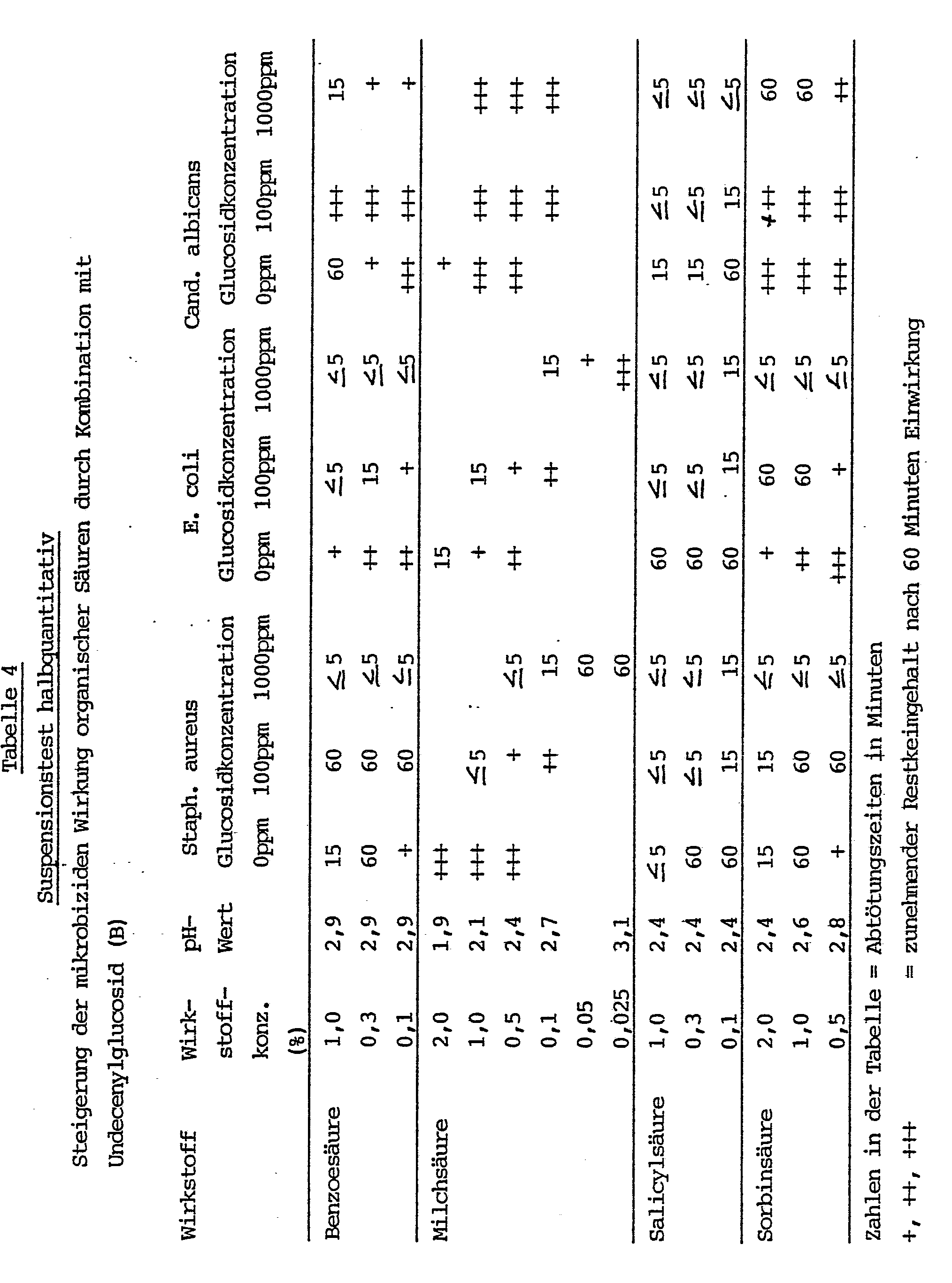
- A. C 12/14 alkyl oligoglucoside (degree of oligomerization 1.4) whose alkyl residues differ from an n-dodecanol / n-tetradecanol mixture in a weight ratio of 70:30 and
- B. Undecenyl monoglucoside
Wirkungssteigerungen sind bei allen genannten Carbonsäuren festzustellen, wobei Steigerungsfaktoren bis zu 10 beobachtet werden.Increases in activity can be found for all the carboxylic acids mentioned, with increases of up to 10 being observed.
Der halbquantitative Suspensionstest des Beispiels 2 wurde mit Benzoesäure und Milchsäure als mikrobizid wirkenden Carbonsäuren gegenüber Staphylococcus aureus (a) und Escherichia coli (e) wiederholt, wobei zu Beispiel 2 unterschiedliche Wirkstoffkonzentrationen in den Abmischungen eingesetzt wurden. Die Ergebnisse sind der nachfolgenden Tabelle 5 zu entnehmen.

Auch bei Konzentrationen der mikrobiziden Wirkstoffe in den in Tabelle 5 angegebenen Bereichen führte der Zusatz von 1000 ppm des Glucosids zu einer beträchtlichen Steigerung der mikrobiziden Wirksamkeit von Benzoesäure bzw. Milchsäure. Während ohne Glucosidzusatz bei 2000 bzw. 5000 ppm allenfalls schwache mikrobizide Effekte der Benzoesäure bzw. der Milchsäure erkennbar sind, wird durch Zusatz von 1000 ppm des Glucosids schon bei Bakterizidkonzentrationen von 500 bis 1000 ppm eine befriedigende Abtötung der Prüfkeime bewirkt.Even at concentrations of the microbicidal active ingredients in the ranges given in Table 5, the addition of 1000 ppm of the glucoside led to a considerable increase in the microbicidal activity of benzoic acid or lactic acid. Weak microbicidal effects of benzoic acid or lactic acid can be seen at 2000 or 5000 ppm without the addition of glucoside, however, the addition of 1000 ppm of the glucoside already satisfactorily kills the test germs at bactericide concentrations of 500 to 1000 ppm.
Claims (30)
Priority Applications (1)
| Application Number | Priority Date | Filing Date | Title |
|---|---|---|---|
| AT87107879T ATE79213T1 (en) | 1986-06-09 | 1987-06-01 | DISINFECTANT AND CLEANING AGENTS. |
Applications Claiming Priority (2)
| Application Number | Priority Date | Filing Date | Title |
|---|---|---|---|
| DE3619375 | 1986-06-09 | ||
| DE19863619375 DE3619375A1 (en) | 1986-06-09 | 1986-06-09 | USE OF ALKYLGLYCOSIDES AS A POTENTIZING AGENT IN ANTISEPTIC AGENTS CONTAINING ALCOHOLIC OR CARBONIC ACID, AND DISINFECTING AND CLEANING AGENTS CONTAINING ALKOHOLIC OR CARBONIC ACID WITH REINFORCED BACTICIDE |
Publications (3)
| Publication Number | Publication Date |
|---|---|
| EP0252276A2 true EP0252276A2 (en) | 1988-01-13 |
| EP0252276A3 EP0252276A3 (en) | 1990-12-05 |
| EP0252276B1 EP0252276B1 (en) | 1992-08-12 |
Family
ID=6302621
Family Applications (1)
| Application Number | Title | Priority Date | Filing Date |
|---|---|---|---|
| EP87107879A Expired - Lifetime EP0252276B1 (en) | 1986-06-09 | 1987-06-01 | Disinfectants and detergents |
Country Status (7)
| Country | Link |
|---|---|
| US (1) | US4920100A (en) |
| EP (1) | EP0252276B1 (en) |
| JP (1) | JP2693952B2 (en) |
| AT (1) | ATE79213T1 (en) |
| CA (1) | CA1277900C (en) |
| DE (2) | DE3619375A1 (en) |
| ES (1) | ES2033735T3 (en) |
Cited By (6)
| Publication number | Priority date | Publication date | Assignee | Title |
|---|---|---|---|---|
| WO1992021239A1 (en) * | 1991-06-04 | 1992-12-10 | Ecolab Inc. | Blended carboxylic acid sanitizer |
| US5234719A (en) * | 1991-06-04 | 1993-08-10 | Ecolab Inc. | Food additive sanitizing compositions |
| US5436008A (en) * | 1992-12-11 | 1995-07-25 | Ecolab Inc. | Sanitizing compositions |
| US6302968B1 (en) | 1994-04-19 | 2001-10-16 | Ecolab Inc. | Precarboxylic acid rinse method |
| FR2827763A1 (en) * | 2001-07-24 | 2003-01-31 | Cs | Topical compositions containing alkylosides to prevent fixation of microorganism on corneocytes, for treatment of acne |
| WO2012062473A1 (en) * | 2010-11-11 | 2012-05-18 | Betatec Hopfenprodukte Gmbh | Method for inhibition of activity of undesired microorganisms or bacteria by using hop acids in combination with apg |
Families Citing this family (45)
| Publication number | Priority date | Publication date | Assignee | Title |
|---|---|---|---|---|
| DE3835199A1 (en) * | 1988-10-15 | 1990-04-19 | Basf Ag | SUBSTITUTED GLUCOSIDES |
| DE3903348A1 (en) * | 1989-02-04 | 1990-08-30 | Henkel Kgaa | MOUTH AND TOOTH CARE WITH POLYSACCHARIDE COLLECTING ENZYMES |
| DE4101515A1 (en) * | 1991-01-19 | 1992-07-23 | Henkel Kgaa | ETHERSULFATES FOR MOUTH AND TOOTH CARE |
| JP2706593B2 (en) * | 1991-05-16 | 1998-01-28 | 花王株式会社 | Alkyl glycoside aqueous solution with excellent microbial stability |
| EP0513813B1 (en) * | 1991-05-16 | 1996-10-09 | Kao Corporation | Alkyl glycoside aqueous solution stable to microbial activity |
| JPH0543403A (en) * | 1991-08-08 | 1993-02-23 | Kao Corp | Agent for promoting activity of biocide and agricultural chemical composition |
| US5409902A (en) * | 1991-12-31 | 1995-04-25 | Lever Brothers Company | Oral hygiene compositions containing glyceroglycolipids as antiplaque compounds |
| DE4225795C2 (en) * | 1992-07-31 | 1994-09-01 | Schuelke & Mayr Gmbh | Disinfectant based on carboxylic acid |
| US5330674A (en) * | 1992-09-09 | 1994-07-19 | Henkel Corporation | Method for increasing the efficiency of a disinfectant cleaning composition using alkyl polyglycosides |
| US5401723A (en) * | 1992-12-02 | 1995-03-28 | Colgate-Palmolive Company | Glycoconjugate inhibition of Streptococcus pyrogenes adhesion |
| US5683724A (en) * | 1993-03-17 | 1997-11-04 | Ecolab Inc. | Automated process for inhibition of microbial growth in aqueous food transport or process streams |
| US5409713A (en) * | 1993-03-17 | 1995-04-25 | Ecolab Inc. | Process for inhibition of microbial growth in aqueous transport streams |
| US5296215A (en) * | 1993-06-16 | 1994-03-22 | Colgate-Palmolive Company | High foaming rheologically stable non-irritating oral composition |
| US6257253B1 (en) | 1994-04-19 | 2001-07-10 | Ecolab Inc. | Percarboxylic acid rinse method |
| US5578134A (en) * | 1994-04-19 | 1996-11-26 | Ecolab Inc. | Method of sanitizing and destaining tableware |
| CA2189018C (en) * | 1994-06-20 | 2001-01-02 | Alexander Allan | Improvements relating to antimicrobial cleaning compositions |
| US5576284A (en) * | 1994-09-26 | 1996-11-19 | Henkel Kommanditgesellschaft Auf Aktien | Disinfecting cleanser for hard surfaces |
| WO1996017918A1 (en) * | 1994-12-09 | 1996-06-13 | Unilever Plc | Improvements relating to antimicrobial cleaning compositions |
| JPH0920630A (en) * | 1995-07-06 | 1997-01-21 | Nippon Zetotsuku Kk | Cosmetic material |
| CN1104196C (en) * | 1995-12-08 | 2003-04-02 | 花王株式会社 | Germicidal composition |
| US5833956A (en) * | 1997-04-02 | 1998-11-10 | Colgate-Palmolive Company | Oral composition containing an anionic, a nonionic and an amphoteric surfactant system |
| DE19957739A1 (en) * | 1999-12-01 | 2001-06-28 | Henkel Ecolab Gmbh & Co Ohg | Hand wash lotion for refillable foam generator |
| WO2001082694A1 (en) * | 2000-04-28 | 2001-11-08 | Ecolab Inc. | Antimicrobial composition |
| ES2455270T5 (en) * | 2002-08-12 | 2017-08-03 | Lonza Inc. | Antimicrobial compositions comprising sodium benzoate |
| WO2005002340A1 (en) * | 2003-07-01 | 2005-01-13 | Towa Chemical Industry Co., Ltd. | Pesticide of environmental preservation type |
| US7407623B2 (en) * | 2003-12-09 | 2008-08-05 | Ge Betz, Inc. | Steam condensate corrosion inhibitor compositions and methods |
| US8673865B2 (en) * | 2005-03-03 | 2014-03-18 | Kao Corporation | Agent for enhancing antiseptic power |
| JP4620498B2 (en) * | 2005-03-03 | 2011-01-26 | 花王株式会社 | Antiseptic enhancer |
| EP1772055A1 (en) * | 2005-10-04 | 2007-04-11 | Rohm and Haas France SAS | Synergistic microbicidal compositions comprising a N-alkyl-1,2-benzoisothiazolin-3-one |
| IL190181A (en) | 2008-03-16 | 2015-08-31 | Altos Medical Llc | Cleaning, sanitising and sterilising preparations |
| CA2796721C (en) * | 2010-06-01 | 2015-08-04 | Odete Tieko Yamane | Oral care compositions resistant to microbial growth |
| EP2436754A1 (en) | 2011-09-30 | 2012-04-04 | Basf Se | Antimicrobial cleaning compound |
| US20140308162A1 (en) | 2013-04-15 | 2014-10-16 | Ecolab Usa Inc. | Peroxycarboxylic acid based sanitizing rinse additives for use in ware washing |
| US9752105B2 (en) | 2012-09-13 | 2017-09-05 | Ecolab Usa Inc. | Two step method of cleaning, sanitizing, and rinsing a surface |
| WO2014060755A1 (en) | 2012-10-17 | 2014-04-24 | Arcis Biotechnology Holdings Limited | Cleaning, sanitizing and sterilizing preparations |
| JP6420027B2 (en) * | 2013-05-28 | 2018-11-07 | 日産化学株式会社 | Composition for controlling plant diseases and method for controlling plant diseases |
| BR102013030640B8 (en) | 2013-11-28 | 2023-04-25 | Tuper S A | DECONTAMINANT COMPOSITION, DECONTAMINATION METHOD, DECONTAMINATION PROTOCOL FOR TOOTHBRUSHES AND DECONTAMINANT PRODUCT |
| BR102013030653B8 (en) * | 2013-11-28 | 2023-04-25 | Tuper S A | DECONTAMINANT COMPOSITION, DECONTAMINATION METHOD, DECONTAMINATION PROTOCOL FOR TOOTHBRUSHES AND DECONTAMINANT PRODUCT |
| CA3012227C (en) | 2015-01-23 | 2023-05-23 | Biocidium Biopharmaceuticals Inc. | Anti-bacterial compositions |
| GB201512135D0 (en) * | 2015-07-10 | 2015-08-19 | Ipabc Ltd | Biodegradable antimicrobial compositions and uses thereof to combat microorganisms |
| JP6941489B2 (en) * | 2016-07-13 | 2021-09-29 | 大日本除蟲菊株式会社 | Aqueous sterilization composition |
| EP3522707A1 (en) * | 2016-10-07 | 2019-08-14 | Evonik Degussa GmbH | Composition containing glycolipids and preservatives |
| AU2020271558B2 (en) | 2019-04-12 | 2023-03-02 | Ecolab Usa Inc. | Hard surface cleaning solution with rapid viricidal activity |
| MX2023012528A (en) * | 2021-04-23 | 2023-10-31 | Thomas Meneghini | Disinfectant and use thereof. |
| WO2025197864A1 (en) * | 2024-03-22 | 2025-09-25 | 積水化学工業株式会社 | Anti-biofilm agent, anti-biofilm resin composition, and anti-biofilm coating material |
Family Cites Families (11)
| Publication number | Priority date | Publication date | Assignee | Title |
|---|---|---|---|---|
| US3598865A (en) * | 1968-02-07 | 1971-08-10 | Atlas Chem Ind | Polyglycosides and process of preparing mono and polyglycosides |
| US3547828A (en) * | 1968-09-03 | 1970-12-15 | Rohm & Haas | Alkyl oligosaccharides and their mixtures with alkyl glucosides and alkanols |
| US3707535A (en) * | 1969-07-24 | 1972-12-26 | Atlas Chem Ind | Process for preparing mono- and polyglycosides |
| US3772269A (en) * | 1969-07-24 | 1973-11-13 | Ici America Inc | Glycoside compositions and process for the preparation thereof |
| US3839318A (en) * | 1970-09-27 | 1974-10-01 | Rohm & Haas | Process for preparation of alkyl glucosides and alkyl oligosaccharides |
| US4198392A (en) * | 1975-06-23 | 1980-04-15 | The Procter & Gamble Company | Oral compositions containing bis-biguanides with reduced staining tendencies |
| FR2397185A1 (en) * | 1977-05-18 | 1979-02-09 | Oreal | NON-IRRITANT COMPOSITION FOR EYE MAKE-UP REMOVAL |
| DE3001064A1 (en) * | 1980-01-12 | 1981-07-16 | Basf Ag, 6700 Ludwigshafen | METHOD FOR PURIFYING ALKYL GLYCOSIDES BY DISTILLATIVE DETERMINATION OF UNACTIVATED ALCOHOLS |
| DE3266210D1 (en) * | 1981-10-08 | 1985-10-17 | Rohm & Haas France | A process for preparing surface-active glycosides and the use of the glycosides in cosmetic, pharmaceutical and household products |
| JPS6089402A (en) * | 1983-10-24 | 1985-05-20 | Yoshitomi Pharmaceut Ind Ltd | Germicide composition |
| DE3444958A1 (en) * | 1984-12-10 | 1986-06-12 | Henkel KGaA, 4000 Düsseldorf | USE OF ALKYL GLYCOSIDES AS A POTENTIZING AGENT IN ANTISEPTIC AGENTS AND DISINFECTANT AND CLEANING AGENTS WITH AN INCREASED BACTERICIDAL EFFECT |
-
1986
- 1986-06-09 DE DE19863619375 patent/DE3619375A1/en not_active Withdrawn
-
1987
- 1987-06-01 EP EP87107879A patent/EP0252276B1/en not_active Expired - Lifetime
- 1987-06-01 AT AT87107879T patent/ATE79213T1/en not_active IP Right Cessation
- 1987-06-01 DE DE8787107879T patent/DE3781052D1/en not_active Expired - Fee Related
- 1987-06-01 ES ES198787107879T patent/ES2033735T3/en not_active Expired - Lifetime
- 1987-06-09 CA CA000539180A patent/CA1277900C/en not_active Expired - Fee Related
- 1987-06-09 JP JP62145023A patent/JP2693952B2/en not_active Expired - Lifetime
- 1987-07-09 US US07/060,137 patent/US4920100A/en not_active Expired - Lifetime
Cited By (7)
| Publication number | Priority date | Publication date | Assignee | Title |
|---|---|---|---|---|
| WO1992021239A1 (en) * | 1991-06-04 | 1992-12-10 | Ecolab Inc. | Blended carboxylic acid sanitizer |
| US5234719A (en) * | 1991-06-04 | 1993-08-10 | Ecolab Inc. | Food additive sanitizing compositions |
| US5436008A (en) * | 1992-12-11 | 1995-07-25 | Ecolab Inc. | Sanitizing compositions |
| US6302968B1 (en) | 1994-04-19 | 2001-10-16 | Ecolab Inc. | Precarboxylic acid rinse method |
| FR2827763A1 (en) * | 2001-07-24 | 2003-01-31 | Cs | Topical compositions containing alkylosides to prevent fixation of microorganism on corneocytes, for treatment of acne |
| EP1283033A1 (en) * | 2001-07-24 | 2003-02-12 | Cs | Combination of alkylglycoside and pyridine carboxamide |
| WO2012062473A1 (en) * | 2010-11-11 | 2012-05-18 | Betatec Hopfenprodukte Gmbh | Method for inhibition of activity of undesired microorganisms or bacteria by using hop acids in combination with apg |
Also Published As
| Publication number | Publication date |
|---|---|
| DE3619375A1 (en) | 1987-12-10 |
| US4920100A (en) | 1990-04-24 |
| EP0252276A3 (en) | 1990-12-05 |
| EP0252276B1 (en) | 1992-08-12 |
| DE3781052D1 (en) | 1992-09-17 |
| CA1277900C (en) | 1990-12-18 |
| JP2693952B2 (en) | 1997-12-24 |
| JPS62298517A (en) | 1987-12-25 |
| ATE79213T1 (en) | 1992-08-15 |
| ES2033735T3 (en) | 1993-04-01 |
Similar Documents
| Publication | Publication Date | Title |
|---|---|---|
| EP0252276B1 (en) | Disinfectants and detergents | |
| EP0185971B1 (en) | Use of alkylglycosides as potentiators in antiseptic agents, and disinfectant and clearing agents with a bactericidal activity | |
| DE3855140T2 (en) | Disinfectant composition and process for its manufacture | |
| EP0304627B1 (en) | Antimicrobial active aromatic compositions | |
| EP0252278B1 (en) | Disinfecting agents and their use in disinfecting the skin and mucous membranes | |
| DE68913239T2 (en) | Preservative composition for wet wipers. | |
| DE69520639T2 (en) | Disinfectant composition | |
| DE69737532T2 (en) | COMPOSITIONS FOR CONTROLLING ORAL MICROBIAL OXIDATION REDUCTION (E h) MIRRORS | |
| DE69713904T2 (en) | COSMETIC, DERMOPHARMACEUTICAL OR VETERINARY COMPOSITIONS FOR ANTISEPTIC TREATMENT OF HUMAN OR ANIMAL SKIN | |
| DE60022636T2 (en) | ZINC CONTAINING TOOTHPASTE COMPOSITIONS | |
| DE69005247T2 (en) | Oral preparations against plaque. | |
| EP0297310A2 (en) | Deodorant and antimicrobial composition for use in cosmetic or topical preparations | |
| DE60320087T2 (en) | AQUEOUS ANTISEPTIC BASED ON BISPYRIDINIUM ALKANESE | |
| DE69836464T2 (en) | Oral composition for the treatment of foul-smelling breath | |
| DE2900740C2 (en) | Dermatologically effective cream | |
| EP0026252A1 (en) | Oral hygiene composition | |
| DE102012208291A1 (en) | Antimicrobial compositions based on zinc compound, glycerol monoalkyl ether and antioxidant | |
| DE60213361T2 (en) | LIQUID ANTIMICROBIAL COMPOSITIONS | |
| EP0117905A2 (en) | Oral care composition | |
| DE2338323C2 (en) | Antiseptic aqueous preparation for the treatment of the skin | |
| DE69709317T2 (en) | ANTISEPTIC COMPOSITIONS BASED ON CHLOROBUTANOL AND CHLORHEXIDINE | |
| DE2426393C3 (en) | Ready-to-use liquid gargle with antimicrobial effectiveness | |
| DE2811522C2 (en) | Dentifrices | |
| DE2415750A1 (en) | MEANS OF CONTROLLING MICRO-ORGANISMS | |
| EP0998912B1 (en) | Use of peracids for hand's disinfection or decontamination |
Legal Events
| Date | Code | Title | Description |
|---|---|---|---|
| PUAI | Public reference made under article 153(3) epc to a published international application that has entered the european phase |
Free format text: ORIGINAL CODE: 0009012 |
|
| AK | Designated contracting states |
Kind code of ref document: A2 Designated state(s): AT BE CH DE ES FR GB IT LI NL SE |
|
| PUAL | Search report despatched |
Free format text: ORIGINAL CODE: 0009013 |
|
| AK | Designated contracting states |
Kind code of ref document: A3 Designated state(s): AT BE CH DE ES FR GB IT LI NL SE |
|
| 17P | Request for examination filed |
Effective date: 19901221 |
|
| 17Q | First examination report despatched |
Effective date: 19910510 |
|
| GRAA | (expected) grant |
Free format text: ORIGINAL CODE: 0009210 |
|
| AK | Designated contracting states |
Kind code of ref document: B1 Designated state(s): AT BE CH DE ES FR GB IT LI NL SE |
|
| REF | Corresponds to: |
Ref document number: 79213 Country of ref document: AT Date of ref document: 19920815 Kind code of ref document: T |
|
| REF | Corresponds to: |
Ref document number: 3781052 Country of ref document: DE Date of ref document: 19920917 |
|
| GBT | Gb: translation of ep patent filed (gb section 77(6)(a)/1977) | ||
| ET | Fr: translation filed | ||
| ITF | It: translation for a ep patent filed | ||
| REG | Reference to a national code |
Ref country code: ES Ref legal event code: FG2A Ref document number: 2033735 Country of ref document: ES Kind code of ref document: T3 |
|
| PLBE | No opposition filed within time limit |
Free format text: ORIGINAL CODE: 0009261 |
|
| STAA | Information on the status of an ep patent application or granted ep patent |
Free format text: STATUS: NO OPPOSITION FILED WITHIN TIME LIMIT |
|
| 26N | No opposition filed | ||
| REG | Reference to a national code |
Ref country code: GB Ref legal event code: 711B |
|
| REG | Reference to a national code |
Ref country code: GB Ref legal event code: 711H |
|
| EAL | Se: european patent in force in sweden |
Ref document number: 87107879.6 |
|
| PGFP | Annual fee paid to national office [announced via postgrant information from national office to epo] |
Ref country code: GB Payment date: 19980526 Year of fee payment: 12 |
|
| PGFP | Annual fee paid to national office [announced via postgrant information from national office to epo] |
Ref country code: DE Payment date: 19980608 Year of fee payment: 12 |
|
| PGFP | Annual fee paid to national office [announced via postgrant information from national office to epo] |
Ref country code: FR Payment date: 19980609 Year of fee payment: 12 |
|
| PGFP | Annual fee paid to national office [announced via postgrant information from national office to epo] |
Ref country code: AT Payment date: 19980615 Year of fee payment: 12 |
|
| PGFP | Annual fee paid to national office [announced via postgrant information from national office to epo] |
Ref country code: SE Payment date: 19980616 Year of fee payment: 12 |
|
| PGFP | Annual fee paid to national office [announced via postgrant information from national office to epo] |
Ref country code: ES Payment date: 19980619 Year of fee payment: 12 |
|
| PGFP | Annual fee paid to national office [announced via postgrant information from national office to epo] |
Ref country code: NL Payment date: 19980629 Year of fee payment: 12 |
|
| PGFP | Annual fee paid to national office [announced via postgrant information from national office to epo] |
Ref country code: CH Payment date: 19980702 Year of fee payment: 12 |
|
| PGFP | Annual fee paid to national office [announced via postgrant information from national office to epo] |
Ref country code: BE Payment date: 19980813 Year of fee payment: 12 |
|
| PG25 | Lapsed in a contracting state [announced via postgrant information from national office to epo] |
Ref country code: GB Free format text: LAPSE BECAUSE OF NON-PAYMENT OF DUE FEES Effective date: 19990601 Ref country code: AT Free format text: LAPSE BECAUSE OF NON-PAYMENT OF DUE FEES Effective date: 19990601 |
|
| PG25 | Lapsed in a contracting state [announced via postgrant information from national office to epo] |
Ref country code: ES Free format text: THE PATENT HAS BEEN ANNULLED BY A DECISION OF A NATIONAL AUTHORITY Effective date: 19990602 |
|
| PG25 | Lapsed in a contracting state [announced via postgrant information from national office to epo] |
Ref country code: SE Free format text: THE PATENT HAS BEEN ANNULLED BY A DECISION OF A NATIONAL AUTHORITY Effective date: 19990629 |
|
| PG25 | Lapsed in a contracting state [announced via postgrant information from national office to epo] |
Ref country code: LI Free format text: LAPSE BECAUSE OF NON-PAYMENT OF DUE FEES Effective date: 19990630 Ref country code: FR Free format text: THE PATENT HAS BEEN ANNULLED BY A DECISION OF A NATIONAL AUTHORITY Effective date: 19990630 Ref country code: CH Free format text: LAPSE BECAUSE OF NON-PAYMENT OF DUE FEES Effective date: 19990630 Ref country code: BE Free format text: LAPSE BECAUSE OF NON-PAYMENT OF DUE FEES Effective date: 19990630 |
|
| BERE | Be: lapsed |
Owner name: HENKEL K.G.A.A. Effective date: 19990630 |
|
| PG25 | Lapsed in a contracting state [announced via postgrant information from national office to epo] |
Ref country code: NL Free format text: LAPSE BECAUSE OF NON-PAYMENT OF DUE FEES Effective date: 20000101 |
|
| GBPC | Gb: european patent ceased through non-payment of renewal fee |
Effective date: 19990601 |
|
| REG | Reference to a national code |
Ref country code: CH Ref legal event code: PL |
|
| EUG | Se: european patent has lapsed |
Ref document number: 87107879.6 |
|
| NLV4 | Nl: lapsed or anulled due to non-payment of the annual fee |
Effective date: 20000101 |
|
| PG25 | Lapsed in a contracting state [announced via postgrant information from national office to epo] |
Ref country code: DE Free format text: LAPSE BECAUSE OF NON-PAYMENT OF DUE FEES Effective date: 20000503 |
|
| REG | Reference to a national code |
Ref country code: FR Ref legal event code: ST |
|
| REG | Reference to a national code |
Ref country code: ES Ref legal event code: FD2A Effective date: 20020204 |
|
| PG25 | Lapsed in a contracting state [announced via postgrant information from national office to epo] |
Ref country code: IT Free format text: LAPSE BECAUSE OF NON-PAYMENT OF DUE FEES;WARNING: LAPSES OF ITALIAN PATENTS WITH EFFECTIVE DATE BEFORE 2007 MAY HAVE OCCURRED AT ANY TIME BEFORE 2007. THE CORRECT EFFECTIVE DATE MAY BE DIFFERENT FROM THE ONE RECORDED. Effective date: 20050601 |