EP0251412B1 - Mobile combining apparatus for harvesting and separating a mixture of agricultural products - Google Patents
Mobile combining apparatus for harvesting and separating a mixture of agricultural products Download PDFInfo
- Publication number
- EP0251412B1 EP0251412B1 EP87201236A EP87201236A EP0251412B1 EP 0251412 B1 EP0251412 B1 EP 0251412B1 EP 87201236 A EP87201236 A EP 87201236A EP 87201236 A EP87201236 A EP 87201236A EP 0251412 B1 EP0251412 B1 EP 0251412B1
- Authority
- EP
- European Patent Office
- Prior art keywords
- impact
- stones
- mixture
- orientation
- impact surface
- Prior art date
- Legal status (The legal status is an assumption and is not a legal conclusion. Google has not performed a legal analysis and makes no representation as to the accuracy of the status listed.)
- Expired - Lifetime
Links
Images




Classifications
-
- B—PERFORMING OPERATIONS; TRANSPORTING
- B07—SEPARATING SOLIDS FROM SOLIDS; SORTING
- B07B—SEPARATING SOLIDS FROM SOLIDS BY SIEVING, SCREENING, SIFTING OR BY USING GAS CURRENTS; SEPARATING BY OTHER DRY METHODS APPLICABLE TO BULK MATERIAL, e.g. LOOSE ARTICLES FIT TO BE HANDLED LIKE BULK MATERIAL
- B07B13/00—Grading or sorting solid materials by dry methods, not otherwise provided for; Sorting articles otherwise than by indirectly controlled devices
- B07B13/003—Separation of articles by differences in their geometrical form or by difference in their physical properties, e.g. elasticity, compressibility, hardness
-
- A—HUMAN NECESSITIES
- A01—AGRICULTURE; FORESTRY; ANIMAL HUSBANDRY; HUNTING; TRAPPING; FISHING
- A01D—HARVESTING; MOWING
- A01D17/00—Digging machines with sieving and conveying mechanisms
- A01D17/10—Digging machines with sieving and conveying mechanisms with smooth conveyor belts, lath bands or rake bands
-
- A—HUMAN NECESSITIES
- A01—AGRICULTURE; FORESTRY; ANIMAL HUSBANDRY; HUNTING; TRAPPING; FISHING
- A01D—HARVESTING; MOWING
- A01D33/00—Accessories for digging harvesters
- A01D33/04—Stone-separating mechanisms
-
- B—PERFORMING OPERATIONS; TRANSPORTING
- B07—SEPARATING SOLIDS FROM SOLIDS; SORTING
- B07B—SEPARATING SOLIDS FROM SOLIDS BY SIEVING, SCREENING, SIFTING OR BY USING GAS CURRENTS; SEPARATING BY OTHER DRY METHODS APPLICABLE TO BULK MATERIAL, e.g. LOOSE ARTICLES FIT TO BE HANDLED LIKE BULK MATERIAL
- B07B13/00—Grading or sorting solid materials by dry methods, not otherwise provided for; Sorting articles otherwise than by indirectly controlled devices
- B07B13/10—Grading or sorting solid materials by dry methods, not otherwise provided for; Sorting articles otherwise than by indirectly controlled devices using momentum effects
Definitions
- the present invention relates to agricultural apparatus generally and more particularly to mobile combines for separating agricultural produce from spurious matter such as clods and stones.
- the present invention seeks to provide an improved mobile combine apparatus for separation of agricultural products from spurious matter such as clods and stones by bouncing.
- mobile combine apparatus for harvesting and separating a mixture of agricultural produce such as potatoes from other materials such as clods and stones including an impact element defining an impact surface, characterized by means for causing the mixture of agricultural products and stones to impinge on the impact surface in a predetermined direction relative to the direction of the force of gravity irrespective of the orientation of the combine apparatus within a given range of operative orientations.
- the impact element comprises a generally cylindrical separation roller.
- the impact element is operative to absorb appreciable kinetic energy from stones but to absorb a significantly lower amount of kinetic energy from agricultural products sought to be separated therefrom.
- the impact element comprises a plate element.
- the term "plate” is used to denote a relatively thin element which is susceptible to bending and is not used here in its limiting sense to refer only to planar elements. Rather, the plate element may comprise a planar or somewhat curved slab of material or, alternatively, for example, such a slab curved into a continuous ring defining a cylindrical surface.
- the phenomenon of energy absorption by the element is not fully understood by applicants, it is understood that the primary mechanism for kinetic energy absorption by the plate element is through bending thereof and the propagation of vibrations therethrough.
- stones which are characterized by greater density and hardness than agricultural produce such as potatoes, lose relatively more energy to the impact element than do such potatoes and the like, whose softer structure allows more compression and spreading out of the impact forces over a longer contact time, with the result that the potatoes bounce further from the impact surface than do stones and are separated thereby.
- the impact element comprises a plate element which is resiliently mounted, whereby during the characteristic dwell time of stones in contact with the impact surface, significant energy absorption occurs, while during the longer dwell time of agricultural produce thereon, the net energy absorption is relatively insignificant, thereby causing the restitution coefficient of the agricultural produce to exceed that of the stones.
- the impact element comprises a plurality of independently mounted sections, each of which is arranged to be impacted by a single stone or item of agricultural produce at any given instant.
- an apparatus characterized by first collection means disposed in a first region with respect to the impact surface for receiving agricultural produce bounced from the impact surface within a first range of distances and second collection means disposed alongside the first region for receiving a mixture of unseparated agricultural produce, clods and stones bounced from the impact surface, and means for resupplying the mixture of unseparated agricultural produce from the second collection means back to an impact surface for repeated separation.
- the above described apparatus for separating stones and clods from agricultural produce includes means for limiting the resupply from the second collection means to one resupply cycle.
- Figs. 1A, 1B, 1C and 1D are respective top, side, back and partial view illustrations of a separation combine constructed and operative in accordance with a preferred embodiment of the present invention
- Fig. 2 is a pictorial illustration of apparatus for maintaining desired orientation of the impact element in accordance with the present invention
- Figs. 3A and 3B are respective plan and side view illustrations of a resiliently-mounted cylindrical impact element constructed and operative in accordance with an embodiment of the present invention
- Fig. 4 is a pictorial illustration of multi-stage separation apparatus constructed and operative in accordance with an embodiment of the present invention
- Fig. 5 is a pictorial illustration of multi-stage separation apparatus constructed and operative in accordance with an alternative embodiment of the present invention
- Fig. 6 is a pictorial illustration of multi-stage separation apparatus constructed and operative in accordance with another alternative embodiment of the present invention.
- Fig. 7 is a pictorial illustration of multi-stage separation apparatus constructed and operative in accordance with yet another alternative embodiment of the present invention.
- the present invention will be described in the context of a preferred embodiment thereof, combine apparatus for the harvesting and separation of agricultural products, such as potatoes, from clods and stones. It is appreciated that the present invention has application in various other contexts and is not limited to the context described hereinbelow.
- FIG. 1D is a partial view taken along the line D-D in Fig. 1B.
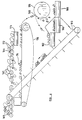
- the combine apparatus generally indicated by reference numeral 10, comprises a chassis 12, which may be arranged as shown with a towing attachment 14 to be towed by a tractor, (not shown), or alternatively, may be self propelled.
- Cutting apparatus 15 is operative to lift a layer of potato-containing earth onto an inclined initial raising conveyor 18.
- Conveyor 18 is typically a bar-type conveyor, which allows loose earth to fall therethrough onto the ground.
- Conveyor 18 supplies a mixture of plant material, clods, stones and potatoes to a plant removal conveyor 19.
- the clods, stones and potatoes roll down conveyor 19 onto a transverse conveyor 20 which raises the mixture onto a generally horizontal feed conveyor 22.
- the plant material engages spikes 23 on conveyer 19 and is removed thereby and allowed to fall on the ground.
- An additional conveyor 21 feeds said mixture onto conveyor 20 and also is operative to prevent potatoes from becoming disengaged from conveyor 20 when conveyor 20 is in a perpendicular orientation relative to the ground.
- Conveyor 22 feeds the mixture onto an impact element 24, whose characteristics and operation will be described hereinafter in detail.
- the potatoes which tend to bounce further are carried away on a conveyor 26, which leads to a storage container (not shown).
- the mixture of stones and clods which may contain a few potatoes is carried by a conveyor 28, which leads to a resupply raising conveyor 30 which feeds the mixture from conveyor 28 onto a generally horizontal feed conveyor 32 which feeds this resupplied mixture back onto a portion of impact element 24, for further separation.
- the potatoes culled from this separation are supplied on conveyor 26 to a storage container.
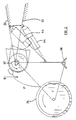
- Fig. 2 It is a particular feature of the present invention that notwithstanding differing orientations of conveyer 22, the direction of impingement of the mixture of clods, stones and potatoes P is maintained in a predetermined fixed relationship with respect to the gravitational force vector g providing that the direction of motion D does not deviate substantially from the horizontal, i.e. not more than 7°. This is necessary in order to maintain uniformity of separation notwithstanding variations in the orientation of the chassis 12.
- this is accomplished by mounting the impact element 24, and a separation divider 38 on a fixed support 40 which rotates about point 41 so as to constantly maintain its desired orientation relative to the gravitational force vector g, in response to the sensed orientation of the support 40.
- An orientation sensor 42 such as a pendulum, with associated microswitches , is preferably mounted onto support 40 for sensing the orientation thereof.
- Orientation sensor 42 provides an electrical output indication of the orientation of support 40 to conventional orientation control apparatus (not shown), such as electrically controlled hydraulic valves, which operate a positioning piston 44, which is operative to determine the orientation of support 40 relative to the gravitational force vector g.
- An additional piston 46 may also receive orientation information from sensor 42 and may provide orientation correction for conveyors 22 and 32 and possible additional apparatus in a plane perpendicular to the direction of motion D.
- Fig. 2 shows two different relative orientations of the conveyor and the different extent that piston 44 is extended to maintain the desired orientation of impact element 24 and divider 38.
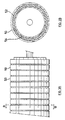
- Figs. 3A and 3B illustrate a preferred embodiment of impact element comprising a plurality of cylindrical rings 50 which are supported on a cylindrical layer of foam rubber 52, which in turn is supported on a cylinder 54, typically formed of steel.
- the specifications of the impact surface assembly shown in Figs. 3A and 3B are as follows:
- Each ring 50 is made of steel, 8 mm thick and 50 mm wide, having an outer diameter of 320 mm.
- the foam rubber layer 52 is 16 mm thick and of 35 shore (ASTM RE 43).
- This embodiment has provided efficient separation of potatoes and stones having the following characteristics (given approximately): Stone Density : 2.0 - 3.0 gr/cm3 Stone Weight : 120 - 470 gr Potato Density: 0.9 gr/cm3 Potato Weight : 40 - 300 gr
- the assembly of Figs. 3A and 3B is designed such that each of rings 50 is generally impinged upon by no more than one falling object at any given time since time is a continous dimension, and impingement occurs at a discrete point along that dimension. Since stones are more rigid and are of a higher density than agricultural produce such as potatoes and other perishable products having a relatilely high water content, they impact on a given ring 50 harder, i.e. with greater force, than do potatoes and the like. This impact produces compression of the foam rubber 52, and consequent retraction of the impact surface.
- Compression of the foam rubber is mainly a function of the mass of the impinging item. Since a usual mixture of agricultural produce and stones includes items of both types of varying sizes and masses, a distinction based on mass alone normally is not sufficient for efficient separation, although it does provide separation of heavy stones from relatively light produce items.
- the impact force of stones on the impact surface also causes internal vibrations in the ring 50. These vibrations, and bending of the impact element as well as compression of the foam rubber 52, all serve to absorb kinetic energy from the impinging stone and thus to decrease its rebound velocity.
- the impact of potatoes and similar agricultural produce on the impact surface does not produce as much bending or internal vibrations in the strip as does the impact of stones. This is due to the relative softness and longer dwell time of the agricultural produce in contact with the impact surface, which prevents a high instantaneous impact force from being developed, since the agricultural produce undergoes compression upon impact, which a stone does not. Furthermore, the agricultural produce may have a sufficiently long dwell time in contact with the impact surface to receive kinetic energy back from the spring support as it rebounds.
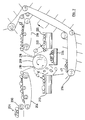
- Fig. 4 illustrates a high capacity multiple stage separation device constructed and operative according to a preferred embodiment of the present invention.
- a conveyor 100 supplies a mixture of potatoes 102, and stones and clods 103, to an impact element 104, which may be similar to the impact element 24 illustrated in Figs. 1A - 3B.
- the mixture impinges on the element 104 at an impact surface location 106 having a tangent approximately 45 degrees from the vertical and having a horizontal component of motion opposite to that of the mixture and a downward vertical component of motion.
- the potatoes which bounce relatively far from the impact surface location, impinge on a conveyor 108 and are directed into a collection bin (not shown).
- a second conveyor 100 which supplies a mixture of potatoes 102, and stones and clods 103, to a second identical impact element 104.
- the potatoes impinge on a second conveyor 108 and are directed into a collection bin (not shown).
- conveyor 114 supplies the stones, clods, and some potatoes to a second stage impact element 116.
- the mixture impinges on the element 116 at an impact surface location 118 having a tangent approximately 45 degrees from the vertical and having a horizontal component of motion opposite to that of the mixture and a downward vertical component of motion.
- the potatoes which bounce relatively far from the impact surface location, impinge on a conveyor 120 and are directed into a collection bin (not shown).
- the stones and clods and some potatoes which bounce to a region relatively near to the impact surface location impinge on a slide 121 and are directed to a conveyor 122.
- Fig. 5 illustrates a high capacity multiple stage separation device constructed and operative according to another preferred embodiment of the present invention.
- a pair of conveyors 130 each supply a mixture of potatoes 132 and stones and clods 133 to respective opposite sides of rotating impact element 134, which may be similar to the impact element 24 illustrated in Figs. 1A - 3B.
- the mixture impinges on the element 134 at impact surface locations 136 and 138 each having a tangent approximately 45 degrees from the vertical.
- Location 136 has a horizontal component of motion opposite to that of the mixture and a downward vertical component of motion, while location 138 has a horizontal component of motion in the same direction as that of the mixture and an upward vertical component of motion.
- the potatoes which bounce relatively far from the impact surface location, impinge on respective conveyors 140 and 142 and are directed into a collection bin (not shown).
- conveyor 148 supplies the stones, clods, and some potatoes to a second stage impact element 150.
- the mixture impinges on the element 150 at an impact surface location 152 having a tangent approximately 45 degrees from the vertical and having a horizontal component of motion opposite to that of the mixture and a downward vertical component of motion.
- the potatoes which bounce relatively far from the impact surface location, impinge on a conveyor 160 and are directed into a collection bin (not shown).
- the stones and clods which bounce to a region relatively near to the impact surface location impinge on a slide 161 and are directed to a conveyor 162.
- a roller conveyor 164 carries a mixture of potatoes 160 and clods and stones 168 and defines spaces of adjustable dimensions between individual rollers 172 through which a mixture 174 of potatoes small enough to fall between said rollers, stones and clods, falls onto a conveyor 176.
- Conveyor 176 supplies the mixture to a rotating impact element 178, which may be similar to the impact element 24 illustrated in Figs. 1A - 3B. This embodiment obviates the necessity of impinging the potatoes too large to fall between said rods, on said impact element 178.
- the mixture impinges on the element 178 at an impact surface location 180 having a tangent approximately 45 degrees from the vertical.
- Location 180 has a horizontal component of motion opposite to that of the mixture and a downward vertical component of motion.
- conveyor 186 resupplies the stones, clods, and some of the smaller potatoes, via a lifting conveyor 190 back to conveyor 176 for repeated reimpingement onto impact element 178. Clods and stones fall below the impact element 178 and are removed by a conveyor 188.
- a conveyor 200 carries a mixture 204 of potatoes and stones and clods onto a conveyor 206.
- Conveyor 206 supplies the mixture to a rotating impact element 208, which may be similar to the impact element 24 illustrated in Figs. 1A - 3B.
- the mixture impinges on the element 208 at an impact surface location 210 having a tangent approximately is- degrees from the vertical.
- Location 210 has a horizontal component of motion opposite to that of the mixture and a downward vertical component of motion.
- the potatoes which bounce relatively far from the impact surface location, impinge on a conveyor 212 and and arc directed into a collection bin (not shown).
- conveyor 214 resupplies the stones clods and some potatoes, via a feed conveyor 216 to impact element 208.
- the mixture impinges on the element 208 at an impact surface location 218 having a tangent approximately 45 degrees from the vertical.
- Location 218 lies opposite to location 210 and has a horizontal component of motion in the same direction as that of the mixture and an upward vertical component of motion.
- the potatoes which bounce relatively far from the impact surface location, impinge on a conveyor 220 and are directed into a collection bin (not shown).
- the stones and clods which bounce to a region relatively near to the impact surface locations impinge on a slide 222 and are removed by a conveyor 224.
Landscapes
- Life Sciences & Earth Sciences (AREA)
- Environmental Sciences (AREA)
- Harvesting Machines For Root Crops (AREA)
- Apparatuses For Bulk Treatment Of Fruits And Vegetables And Apparatuses For Preparing Feeds (AREA)
- Preparation Of Fruits And Vegetables (AREA)
- Medicines Containing Plant Substances (AREA)
Abstract
Description
- The present invention relates to agricultural apparatus generally and more particularly to mobile combines for separating agricultural produce from spurious matter such as clods and stones.
- Certain agricultural products, such as potatoes, which grow under the ground, may need to be separated from clods and stones before being marketed. There is described in DE-A- 33 06 769 in the name of applicant apparatus for separation of a mixture of soil clods from potatoes by bouncing the mixture to be separated on a cylindrical drum. This apparatus operates on the basis of a difference of about 0.4 in the restitution coefficient of the potatoes and soil clods. The aforesaid apparatus has met with considerable commercial success.
- The separation of potatoes from stones is not always achieved in a satisfying way, by the apparatus of the aforesaid German Patent Application, since the restitution coefficients of potatoes and stones against a rigid surface are nearly the same, and the restitution coefficient of the stones normally may even exceed that of the potatoes. Only at certain conditions with respect to the orientation of this apparatus relative to the direction of the force of gravity satisfying results are achieved.
- The present invention seeks to provide an improved mobile combine apparatus for separation of agricultural products from spurious matter such as clods and stones by bouncing.
- There is thus provided in accordance with the present invention, mobile combine apparatus for harvesting and separating a mixture of agricultural produce such as potatoes from other materials such as clods and stones including an impact element defining an impact surface, characterized by means for causing the mixture of agricultural products and stones to impinge on the impact surface in a predetermined direction relative to the direction of the force of gravity irrespective of the orientation of the combine apparatus within a given range of operative orientations.
- According to one embodiment of the invention, the impact element comprises a generally cylindrical separation roller.
- According to another, preferred embodiment of the invention, the impact element is operative to absorb appreciable kinetic energy from stones but to absorb a significantly lower amount of kinetic energy from agricultural products sought to be separated therefrom.
- In accordance with the foregoing preferred embodiment of the present invention, the impact element comprises a plate element. The term "plate" is used to denote a relatively thin element which is susceptible to bending and is not used here in its limiting sense to refer only to planar elements. Rather, the plate element may comprise a planar or somewhat curved slab of material or, alternatively, for example, such a slab curved into a continuous ring defining a cylindrical surface. Although the phenomenon of energy absorption by the element is not fully understood by applicants, it is understood that the primary mechanism for kinetic energy absorption by the plate element is through bending thereof and the propagation of vibrations therethrough.
- According to this aspect of the present invention, whose effectiveness has been demonstrated empirically, stones, which are characterized by greater density and hardness than agricultural produce such as potatoes, lose relatively more energy to the impact element than do such potatoes and the like, whose softer structure allows more compression and spreading out of the impact forces over a longer contact time, with the result that the potatoes bounce further from the impact surface than do stones and are separated thereby.
- Selection of an appropriate element and mounting therefore for separation of a given agricultural product having given characteristics of density, elasticity, hardness and mass from stones and clods of known characteristics is achieved empirically, based on the teachings of the present invention, provided herein.
- Additionally in accordance with a preferred embodiment of the invention, the impact element comprises a plate element which is resiliently mounted, whereby during the characteristic dwell time of stones in contact with the impact surface, significant energy absorption occurs, while during the longer dwell time of agricultural produce thereon, the net energy absorption is relatively insignificant, thereby causing the restitution coefficient of the agricultural produce to exceed that of the stones.
- Further in accordance with an embodiment of the present invention, the impact element comprises a plurality of independently mounted sections, each of which is arranged to be impacted by a single stone or item of agricultural produce at any given instant.
- Further in accordance with a preferred embodiment of the present invention, there is provided an apparatus characterized by first collection means disposed in a first region with respect to the impact surface for receiving agricultural produce bounced from the impact surface within a first range of distances and second collection means disposed alongside the first region for receiving a mixture of unseparated agricultural produce, clods and stones bounced from the impact surface, and means for resupplying the mixture of unseparated agricultural produce from the second collection means back to an impact surface for repeated separation.
- Additionally in accordance with an embodiment of the present invention, the above described apparatus for separating stones and clods from agricultural produce includes means for limiting the resupply from the second collection means to one resupply cycle.
- The present invention will be understood and appreciated more fully from the following detailed description, taken in conjunction with the drawings in which:
- Figs. 1A, 1B, 1C and 1D are respective top, side, back and partial view illustrations of a separation combine constructed and operative in accordance with a preferred embodiment of the present invention;
- Fig. 2 is a pictorial illustration of apparatus for maintaining desired orientation of the impact element in accordance with the present invention;
- Figs. 3A and 3B are respective plan and side view illustrations of a resiliently-mounted cylindrical impact element constructed and operative in accordance with an embodiment of the present invention;
- Fig. 4 is a pictorial illustration of multi-stage separation apparatus constructed and operative in accordance with an embodiment of the present invention;
- Fig. 5 is a pictorial illustration of multi-stage separation apparatus constructed and operative in accordance with an alternative embodiment of the present invention;
- Fig. 6 is a pictorial illustration of multi-stage separation apparatus constructed and operative in accordance with another alternative embodiment of the present invention; and
- Fig. 7 is a pictorial illustration of multi-stage separation apparatus constructed and operative in accordance with yet another alternative embodiment of the present invention.
- The present invention will be described in the context of a preferred embodiment thereof, combine apparatus for the harvesting and separation of agricultural products, such as potatoes, from clods and stones. It is appreciated that the present invention has application in various other contexts and is not limited to the context described hereinbelow.
- Reference is now made to Figs. 1A - 1D which illustrate combine apparatus for the harvesting and separation of agricultural produce, such as potatoes, from clods and stones constructed and operative in accordance with a preferred embodiment of the present invention. Fig. 1D is a partial view taken along the line D-D in Fig. 1B. The combine apparatus, generally indicated by
reference numeral 10, comprises achassis 12, which may be arranged as shown with a towingattachment 14 to be towed by a tractor, (not shown), or alternatively, may be self propelled. - Mounted on the
chassis 12 isconventional cutting apparatus 15, includingcutters 16,depth control roller 17, anddisks 19 which cut up plant material and prevent potatoes from becoming disengaged from the sides ofcutters 16. Cuttingapparatus 15 is operative to lift a layer of potato-containing earth onto an inclinedinitial raising conveyor 18.Conveyor 18 is typically a bar-type conveyor, which allows loose earth to fall therethrough onto the ground.Conveyor 18 supplies a mixture of plant material, clods, stones and potatoes to aplant removal conveyor 19. The clods, stones and potatoes roll downconveyor 19 onto atransverse conveyor 20 which raises the mixture onto a generallyhorizontal feed conveyor 22. The plant material engagesspikes 23 onconveyer 19 and is removed thereby and allowed to fall on the ground. Anadditional conveyor 21 feeds said mixture ontoconveyor 20 and also is operative to prevent potatoes from becoming disengaged fromconveyor 20 whenconveyor 20 is in a perpendicular orientation relative to the ground. -
Conveyor 22 feeds the mixture onto animpact element 24, whose characteristics and operation will be described hereinafter in detail. Depending on the distance which the elements of the mixture, i.e. the potatoes on one hand, and the stones and clods on the other, are bounced, they land on different conveyor belts. The potatoes, which tend to bounce further are carried away on aconveyor 26, which leads to a storage container (not shown). The mixture of stones and clods which may contain a few potatoes is carried by aconveyor 28, which leads to aresupply raising conveyor 30 which feeds the mixture fromconveyor 28 onto a generallyhorizontal feed conveyor 32 which feeds this resupplied mixture back onto a portion ofimpact element 24, for further separation. The potatoes culled from this separation are supplied onconveyor 26 to a storage container. - Reference is now additionally made to Fig. 2. It is a particular feature of the present invention that notwithstanding differing orientations of
conveyer 22, the direction of impingement of the mixture of clods, stones and potatoes P is maintained in a predetermined fixed relationship with respect to the gravitational force vector g providing that the direction of motion D does not deviate substantially from the horizontal, i.e. not more than 7°. This is necessary in order to maintain uniformity of separation notwithstanding variations in the orientation of thechassis 12. In accordance with a preferred embodiment of the present invention, this is accomplished by mounting theimpact element 24, and aseparation divider 38 on a fixedsupport 40 which rotates aboutpoint 41 so as to constantly maintain its desired orientation relative to the gravitational force vector g, in response to the sensed orientation of thesupport 40. Anorientation sensor 42, such as a pendulum, with associated microswitches , is preferably mounted ontosupport 40 for sensing the orientation thereof.Orientation sensor 42 provides an electrical output indication of the orientation ofsupport 40 to conventional orientation control apparatus (not shown), such as electrically controlled hydraulic valves, which operate apositioning piston 44, which is operative to determine the orientation ofsupport 40 relative to the gravitational force vector g. - An
additional piston 46 may also receive orientation information fromsensor 42 and may provide orientation correction forconveyors - The maintenance of the orientation of
impact element 24 anddivider 38, explained hereinabove is illustrated in Fig. 2, which shows two different relative orientations of the conveyor and the different extent thatpiston 44 is extended to maintain the desired orientation ofimpact element 24 anddivider 38. - Figs. 3A and 3B illustrate a preferred embodiment of impact element comprising a plurality of
cylindrical rings 50 which are supported on a cylindrical layer offoam rubber 52, which in turn is supported on acylinder 54, typically formed of steel. According to a preferred embodiment of the present invention, the specifications of the impact surface assembly shown in Figs. 3A and 3B are as follows: Eachring 50 is made of steel, 8 mm thick and 50 mm wide, having an outer diameter of 320 mm. Thefoam rubber layer 52 is 16 mm thick and of 35 shore (ASTM RE 43). This embodiment has provided efficient separation of potatoes and stones having the following characteristics (given approximately):
Stone Density : 2.0 - 3.0 gr/cm³
Stone Weight : 120 - 470 gr
Potato Density: 0.9 gr/cm³
Potato Weight : 40 - 300 gr
The assembly of Figs. 3A and 3B is designed such that each ofrings 50 is generally impinged upon by no more than one falling object at any given time since time is a continous dimension, and impingement occurs at a discrete point along that dimension. Since stones are more rigid and are of a higher density than agricultural produce such as potatoes and other perishable products having a relatilely high water content, they impact on a givenring 50 harder, i.e. with greater force, than do potatoes and the like. This impact produces compression of thefoam rubber 52, and consequent retraction of the impact surface. - Compression of the foam rubber is mainly a function of the mass of the impinging item. Since a usual mixture of agricultural produce and stones includes items of both types of varying sizes and masses, a distinction based on mass alone normally is not sufficient for efficient separation, although it does provide separation of heavy stones from relatively light produce items.
- The impact force of stones on the impact surface also causes internal vibrations in the
ring 50. These vibrations, and bending of the impact element as well as compression of thefoam rubber 52, all serve to absorb kinetic energy from the impinging stone and thus to decrease its rebound velocity. - The impact of potatoes and similar agricultural produce on the impact surface does not produce as much bending or internal vibrations in the strip as does the impact of stones. This is due to the relative softness and longer dwell time of the agricultural produce in contact with the impact surface, which prevents a high instantaneous impact force from being developed, since the agricultural produce undergoes compression upon impact, which a stone does not. Furthermore, the agricultural produce may have a sufficiently long dwell time in contact with the impact surface to receive kinetic energy back from the spring support as it rebounds.
- Reference is now made to Fig. 4, which illustrates a high capacity multiple stage separation device constructed and operative according to a preferred embodiment of the present invention. Here it is seen that a
conveyor 100 supplies a mixture ofpotatoes 102, and stones andclods 103, to animpact element 104, which may be similar to theimpact element 24 illustrated in Figs. 1A - 3B. - The mixture impinges on the
element 104 at animpact surface location 106 having a tangent approximately 45 degrees from the vertical and having a horizontal component of motion opposite to that of the mixture and a downward vertical component of motion. - The potatoes, which bounce relatively far from the impact surface location, impinge on a
conveyor 108 and are directed into a collection bin (not shown). The stones and clods, and some potatoes, typically 10%-20% of the total potatoes, which bounce to a region relatively near to the impact surface location impinge on aslide 112 and are directed to aconveyor 114. - In order to provide high capacity processing there is also provided a
second conveyor 100 which supplies a mixture ofpotatoes 102, and stones andclods 103, to a secondidentical impact element 104. The potatoes impinge on asecond conveyor 108 and are directed into a collection bin (not shown). The stones and clods, and some potatoes, impinge on asecond slide 112 and are directed toconveyor 114. - In order to enhance the efficiency of separation,
conveyor 114 supplies the stones, clods, and some potatoes to a secondstage impact element 116. The mixture impinges on theelement 116 at animpact surface location 118 having a tangent approximately 45 degrees from the vertical and having a horizontal component of motion opposite to that of the mixture and a downward vertical component of motion. - The potatoes, which bounce relatively far from the impact surface location, impinge on a
conveyor 120 and are directed into a collection bin (not shown). The stones and clods and some potatoes which bounce to a region relatively near to the impact surface location impinge on aslide 121 and are directed to aconveyor 122. - Reference is now made to Fig. 5, which illustrates a high capacity multiple stage separation device constructed and operative according to another preferred embodiment of the present invention. Here it is seen that a pair of
conveyors 130 each supply a mixture ofpotatoes 132 and stones andclods 133 to respective opposite sides ofrotating impact element 134, which may be similar to theimpact element 24 illustrated in Figs. 1A - 3B. - The mixture impinges on the
element 134 atimpact surface locations Location 136 has a horizontal component of motion opposite to that of the mixture and a downward vertical component of motion, whilelocation 138 has a horizontal component of motion in the same direction as that of the mixture and an upward vertical component of motion. - The potatoes, which bounce relatively far from the impact surface location, impinge on
respective conveyors slides - In order to enhance the efficiency of separation, conveyor 148 supplies the stones, clods, and some potatoes to a second
stage impact element 150. The mixture impinges on theelement 150 at animpact surface location 152 having a tangent approximately 45 degrees from the vertical and having a horizontal component of motion opposite to that of the mixture and a downward vertical component of motion. - The potatoes, which bounce relatively far from the impact surface location, impinge on a
conveyor 160 and are directed into a collection bin (not shown). The stones and clods, which bounce to a region relatively near to the impact surface location impinge on aslide 161 and are directed to aconveyor 162. - Reference is now made to Fig. 6, which illustrates a high capacity multiple stage separation device constructed and operative according to yet another preferred embodiment of the present invention. Here it is seen that a
roller conveyor 164 carries a mixture ofpotatoes 160 and clods andstones 168 and defines spaces of adjustable dimensions betweenindividual rollers 172 through which amixture 174 of potatoes small enough to fall between said rollers, stones and clods, falls onto aconveyor 176. Large potatoes which do not fall between the rollers are carried to aconveyer 173.Conveyor 176 supplies the mixture to arotating impact element 178, which may be similar to theimpact element 24 illustrated in Figs. 1A - 3B. This embodiment obviates the necessity of impinging the potatoes too large to fall between said rods, on saidimpact element 178. - The mixture impinges on the
element 178 at animpact surface location 180 having a tangent approximately 45 degrees from the vertical.Location 180 has a horizontal component of motion opposite to that of the mixture and a downward vertical component of motion. - The potatoes which have fallen between the rollers, and which bounce relatively far from the impact surface location, impinge on a
conveyor 182 and and are directed into a collection bin (not shown). The stones and clods and some of said potatoes, typically about 20% of the total said potatoes, which bounce to a region relatively near to the impact surface location, are directed to aconveyor 186. - In order to enhance the efficiency of separation,
conveyor 186 resupplies the stones, clods, and some of the smaller potatoes, via a liftingconveyor 190 back toconveyor 176 for repeated reimpingement ontoimpact element 178. Clods and stones fall below theimpact element 178 and are removed by aconveyor 188. - Reference is now made to Fig. 7, which illustrates a high capacity multiple stage separation device constructed and operative according to yet another preferred embodiment of the present invention. Here it is seen that a
conveyor 200 carries amixture 204 of potatoes and stones and clods onto aconveyor 206.Conveyor 206 supplies the mixture to arotating impact element 208, which may be similar to theimpact element 24 illustrated in Figs. 1A - 3B. - The mixture impinges on the
element 208 at animpact surface location 210 having a tangent approximately is- degrees from the vertical.Location 210 has a horizontal component of motion opposite to that of the mixture and a downward vertical component of motion. - The potatoes, which bounce relatively far from the impact surface location, impinge on a
conveyor 212 and and arc directed into a collection bin (not shown). The stones and clods and some potatoes, typically about 20% of the total potatoes, which bounce to a region relatively near to the impact surface location, are directed to aconveyor 214. - In order to enhance the efficiency of separation,
conveyor 214 resupplies the stones clods and some potatoes, via afeed conveyor 216 to impactelement 208. The mixture impinges on theelement 208 at animpact surface location 218 having a tangent approximately 45 degrees from the vertical.Location 218 lies opposite tolocation 210 and has a horizontal component of motion in the same direction as that of the mixture and an upward vertical component of motion. - The potatoes, which bounce relatively far from the impact surface location, impinge on a
conveyor 220 and are directed into a collection bin (not shown). The stones and clods which bounce to a region relatively near to the impact surface locations impinge on aslide 222 and are removed by aconveyor 224.
Claims (9)
- Mobile combine apparatus for harvesting and separating a mixture of agricultural produce such as potatoes from other materials such as clods and stones comprising
an impact element (24;50,52,54;104,116;134,150;178;208), defining an impact surface,
characterized by means(42,44) causing the mixture of agricultural products and stones to impinge on the impact surface in a predetermined direction relative to the direction of the force of gravity irrespective of the orientation of the combine apparatus within a given range of operative orientations. - Apparatus according to claim 1,characterized in that, said means for causing the mixture of agricultural products and stones to impinge on the impact surface in a predetermined direction relative to the direction of the irrespective of the orientation of the force of gravity combine apparatus within a given range of operative orientations comprises means (42,44) for maintaining the impact surface in predetermined orientation notwithstanding variations in the orientation of the combine.
- Apparatus according to claim 2, characterized in that means for maintaining comprises an orientation sensor(42) associated with said impact element (24;50,52,54,;104,116;134,150;178;208)and means(44) for varying the orientation of said impact element relative to the ground surface underlying the mobile combine apparatus for maintaining the orientation of the impact element relative to the gravitational force vector of the earth in a predetermined orientation.
- Mobile combine apparatus according to claims 1-3, characterized in that said impact element comprises a generally cylindrical separation roller(24;50,52,54;104,116;134,150;178;208)
- Mobile combine apparatus according to one of claims1-4, characterized in that said impact element comprises:
a plurality of cylindrical rings(50);
a cylindrical layer of foam rubber(52)disposed inwardly of the plurality of cylindrical rings for resilient support thereof; and
an inner cylinder(54)disposed inwardly of the cylindrical layer of foam rubber for rigid support thereof, and wherein
said impact element is operative to absorb appreciable kinetic energy from stones but to absorb a significantly lower amount of kinetic energy from agricultural products sought to be separated therefrom - Apparatus according to any of the preceding claims, characterized in that said impact element comprises a plurality of independently mounted sections(104,116;134,150). each of which is arranged to be normally impacted by a single stone or item of agricultural produce at any given instant.
- Apparatus according to one of claims 1-6,
characterized by first collection means(20;186;214) disposed in a first region with respect to the impact surface for receiving agricultural produce bounced from the impact surface within a first range of distances; and
second collection means(20,186;214)disposed alongside the first region for receiving a mixture of unseparated agricultural produce, clods and stones bounced from the impact surface; and
means (30,32;190;216) for resupplying the mixture of unseparated agricultural produce from the second collection means back to an impact surface for repeated separation. - Apparatus according to claim 7 ,characterized by
third means disposed below the impact element for receiving clods and stones bounced from the impact surface and returning them to the ground. - Apparatus according to claim 7,characterized by
means (222,224) for limiting the resupply from the second collection means to one resupply cycle.
Priority Applications (1)
| Application Number | Priority Date | Filing Date | Title |
|---|---|---|---|
| AT87201236T ATE61011T1 (en) | 1986-06-29 | 1987-06-29 | MOBILE DEVICE FOR HARVESTING AND SEPARATING A MIXTURE OF AGRICULTURAL PRODUCTS. |
Applications Claiming Priority (2)
| Application Number | Priority Date | Filing Date | Title |
|---|---|---|---|
| IL79276A IL79276A (en) | 1986-06-29 | 1986-06-29 | Potato combine |
| IL79276 | 1986-06-29 |
Publications (3)
| Publication Number | Publication Date |
|---|---|
| EP0251412A2 EP0251412A2 (en) | 1988-01-07 |
| EP0251412A3 EP0251412A3 (en) | 1988-11-09 |
| EP0251412B1 true EP0251412B1 (en) | 1991-02-27 |
Family
ID=11056902
Family Applications (1)
| Application Number | Title | Priority Date | Filing Date |
|---|---|---|---|
| EP87201236A Expired - Lifetime EP0251412B1 (en) | 1986-06-29 | 1987-06-29 | Mobile combining apparatus for harvesting and separating a mixture of agricultural products |
Country Status (6)
| Country | Link |
|---|---|
| US (1) | US4895209A (en) |
| EP (1) | EP0251412B1 (en) |
| AT (1) | ATE61011T1 (en) |
| DE (1) | DE3768154D1 (en) |
| ES (1) | ES2021695B3 (en) |
| IL (1) | IL79276A (en) |
Families Citing this family (7)
| Publication number | Priority date | Publication date | Assignee | Title |
|---|---|---|---|---|
| FR2652707B1 (en) * | 1989-10-11 | 1993-06-18 | Matrot Louis | IMPROVED HOPPER HARVESTING MACHINE. |
| US5259510A (en) * | 1992-03-31 | 1993-11-09 | Edward Lowe Industries, Inc. | Apparatus for separating and removing fine particulates from a particle flow |
| DE10352526B4 (en) * | 2003-11-05 | 2005-10-27 | select Ingenieurgesellschaft für Optoelektronik, Bilderkennung und Qualitätsprüfung mbH | Process for separating off-type additives from a product stream |
| US7584859B2 (en) * | 2006-08-24 | 2009-09-08 | The State Of Israel, Ministry Of Agriculture & Rural Development Agricultural Research Organization, Volcani Center | Agricultural produce separator |
| CN103934191B (en) * | 2014-03-11 | 2015-09-30 | 哈尔滨工程大学 | For the double acting screening plant that different building stones are separated |
| US10894273B1 (en) * | 2018-12-13 | 2021-01-19 | Donna Maria Roberts | Metal separation system and method |
| DE102020112427A1 (en) | 2020-05-07 | 2021-11-11 | Grimme Landmaschinenfabrik Gmbh & Co. Kg | Root crop harvester |
Citations (1)
| Publication number | Priority date | Publication date | Assignee | Title |
|---|---|---|---|---|
| EP0201155A1 (en) * | 1985-04-11 | 1986-11-12 | State Of Israel-Ministry Of Agriculture | Apparatus for separating agricultural produce from spurious matter |
Family Cites Families (30)
| Publication number | Priority date | Publication date | Assignee | Title |
|---|---|---|---|---|
| US3125097A (en) * | 1964-03-17 | Leon r | ||
| GB189905783A (en) * | 1899-03-16 | 1899-04-29 | Hermann Schwinning | Apparatus for Sorting Bricks, Stones, and the like according to their Weight. |
| GB190904684A (en) * | 1909-02-25 | 1909-04-22 | Carl Seck | Improved Process and Apparatus for Separating and Sorting Materials. |
| FR480686A (en) * | 1916-01-15 | 1916-09-07 | Joseph Eugene Yernaux | Bagging screen, special device for removing dust, screening, calibrating, bagging and weighing hard coal, limestone, etc. |
| US1641492A (en) * | 1923-12-19 | 1927-09-06 | Jasperson Charlie | Potato picker, cleaner, sorter, and bagger |
| US1692343A (en) * | 1924-03-25 | 1928-11-20 | Moller Carl Fredrik | Potato digger and separator |
| GB350497A (en) * | 1929-12-07 | 1931-06-08 | Colin William Higham Holmes | Improvements in and relating to the separation of dry materials |
| US2114263A (en) * | 1934-10-16 | 1938-04-12 | James G Heaslet | Apparatus for separation of vegetables |
| DE872685C (en) * | 1943-02-19 | 1953-04-02 | Siemens Ag | Method and device for sifting tree, field and ground crops, e.g. B. Potatoes |
| US2698506A (en) * | 1951-06-04 | 1955-01-04 | Haldur J Johnson | Adjustably disposed potato pickup and conveyer therefor |
| GB708024A (en) * | 1951-10-19 | 1954-04-28 | William Robert Cairns | An improved potato harvester or machine for separating potatoes and similar crops from stones and other materials |
| US2666524A (en) * | 1952-01-31 | 1954-01-19 | Socony Vacuum Oil Co Inc | Process for separating gel particles |
| GB776567A (en) * | 1953-11-28 | 1957-06-12 | Axel Rasmussen | Digging or gathering and classifying machine for potatoes and other similar crops |
| CH329637A (en) * | 1953-11-28 | 1958-05-15 | Rasmussen Axel | Device for separating the stones and the herbs from the potatoes in a harvesting machine |
| US2932393A (en) * | 1955-08-24 | 1960-04-12 | Eugene H Leslic | Process and apparatus for beneficiating mineral aggregates |
| DE1126661B (en) * | 1958-01-03 | 1962-03-29 | Troester A J Fa | Device for separating stones, clods or the like of potatoes |
| GB890031A (en) * | 1959-10-08 | 1962-02-21 | William Thomas Teagle | Improvements in or relating to potato harvesters |
| CH462748A (en) * | 1966-03-10 | 1968-09-30 | Ferrero Giacomo | Device for the separation of solid, loose, heterogeneous and differently elastic materials |
| DE2312111C2 (en) * | 1973-03-10 | 1982-07-01 | Franz Grimme Landmaschinenfabrik, 2845 Damme | Potato harvester |
| FR2261075A1 (en) * | 1974-02-15 | 1975-09-12 | Etel Sa | Machine for sorting potatoes from stones and lumps of earth - utilises differences in impact characteristics |
| SU755283A1 (en) * | 1977-04-26 | 1980-08-15 | Kaunassk Polt Inst Antanasa | LEADING ROLLER DEVICES FOR MOVING ON SUPPORTS1 |
| GB2037186B (en) * | 1978-12-06 | 1982-08-18 | Constantine A | Sorting bodies of different densities |
| FR2443292A1 (en) * | 1978-12-06 | 1980-07-04 | Constantine Alan | METHOD AND APPARATUS FOR SORTING BODIES HAVING DIFFERENT DENSITIES |
| SU755238A1 (en) * | 1979-03-01 | 1980-08-15 | Vnii Selskokhoz Mash | DEVICE FOR SEPARATING ROOTFLOWER FROM STONES AND GROUND GROUND1 |
| SU887038A1 (en) * | 1979-06-29 | 1981-12-07 | Ордена Трудового Красного Знамени Научно-Исследовательский Институт Технологии Автомобильной Промышленности | Apparatus for sorting bodies of revolution by mechanical properties |
| IL65872A0 (en) * | 1982-05-25 | 1982-08-31 | Israel Mini Agricult | Apparatus and method for separation of agricultural products from clods and other spurious materials |
| SU1055390A1 (en) * | 1982-09-17 | 1983-11-23 | Западная Государственная Машино-Испытательная Станция | Apparatus for separating root vegetables from stones and soil lumps |
| NL8301221A (en) * | 1983-04-07 | 1984-11-01 | Bijlsma B V Maschf | Root crop soil lump separator - has conveyor belt and angle adjustable rebound plate |
| SU1210704A1 (en) * | 1983-07-28 | 1986-02-15 | Рязанский сельскохозяйственный институт им.проф.П.А.Костычева | Method of separating root vegetables from soil clots and stones |
| US4535891A (en) * | 1983-08-23 | 1985-08-20 | International Paper Company | Taco tray |
-
1986
- 1986-06-29 IL IL79276A patent/IL79276A/en not_active IP Right Cessation
-
1987
- 1987-06-29 DE DE8787201236T patent/DE3768154D1/en not_active Expired - Lifetime
- 1987-06-29 US US07/068,151 patent/US4895209A/en not_active Expired - Lifetime
- 1987-06-29 AT AT87201236T patent/ATE61011T1/en not_active IP Right Cessation
- 1987-06-29 ES ES87201236T patent/ES2021695B3/en not_active Expired - Lifetime
- 1987-06-29 EP EP87201236A patent/EP0251412B1/en not_active Expired - Lifetime
Patent Citations (1)
| Publication number | Priority date | Publication date | Assignee | Title |
|---|---|---|---|---|
| EP0201155A1 (en) * | 1985-04-11 | 1986-11-12 | State Of Israel-Ministry Of Agriculture | Apparatus for separating agricultural produce from spurious matter |
Also Published As
| Publication number | Publication date |
|---|---|
| ATE61011T1 (en) | 1991-03-15 |
| EP0251412A2 (en) | 1988-01-07 |
| EP0251412A3 (en) | 1988-11-09 |
| US4895209A (en) | 1990-01-23 |
| IL79276A0 (en) | 1986-09-30 |
| ES2021695B3 (en) | 1991-11-16 |
| IL79276A (en) | 1991-06-30 |
| DE3768154D1 (en) | 1991-04-04 |
Similar Documents
| Publication | Publication Date | Title |
|---|---|---|
| US3435950A (en) | Materials separation devices | |
| US4895209A (en) | Combine apparatus | |
| CA2869635A1 (en) | Sorting apparatus | |
| US4865720A (en) | Debris separator system | |
| US4744470A (en) | Apparatus for separating agricultural produce from spurious matter | |
| US4548275A (en) | Device for separating clods and stone from the soil | |
| US4076124A (en) | Mechanical earthworm harvester | |
| US2589762A (en) | Potato feeding machine | |
| US4569188A (en) | Harvesting apparatus | |
| GB2222507A (en) | A lifting conveyor for a root-crop or bulb harvester | |
| GB2118412A (en) | Breaking up soil | |
| US3844411A (en) | Object segregating mechanism | |
| RU2018383C1 (en) | Vibrating separator | |
| GB2121322A (en) | Separating agricultural produce from other materials | |
| US4281766A (en) | Method and apparatus for sorting bodies of different densities | |
| KR102900561B1 (en) | Self propelled type crop harvesting apparatus with sorting device | |
| KR100993261B1 (en) | Bucket Wheel Guide Liner Support Structure of Raw Material Dispenser | |
| SU574347A1 (en) | Shaping machine for laying-out wood particle mat | |
| RU2166268C1 (en) | Apparatus for recovering friability of caked granulated materials | |
| RU2004095C1 (en) | Separating and conveying device | |
| RU2004112C1 (en) | Device for separation of soil clods from root crops and tomatoes | |
| SU1708176A1 (en) | Machine for harvesting root tubers and onions | |
| SU1545983A1 (en) | Device for separating soil clods from root and tuber crops and tomatoes | |
| EP1121849A2 (en) | Apparatus for harvesting herbaceous plants | |
| Mizrach et al. | Peanut salvage machine for sandy loam and clay soils |
Legal Events
| Date | Code | Title | Description |
|---|---|---|---|
| PUAI | Public reference made under article 153(3) epc to a published international application that has entered the european phase |
Free format text: ORIGINAL CODE: 0009012 |
|
| AK | Designated contracting states |
Kind code of ref document: A2 Designated state(s): AT BE CH DE ES FR GB GR IT LI LU NL SE |
|
| PUAL | Search report despatched |
Free format text: ORIGINAL CODE: 0009013 |
|
| AK | Designated contracting states |
Kind code of ref document: A3 Designated state(s): AT BE CH DE ES FR GB GR IT LI LU NL SE |
|
| 17P | Request for examination filed |
Effective date: 19890106 |
|
| 17Q | First examination report despatched |
Effective date: 19891116 |
|
| GRAA | (expected) grant |
Free format text: ORIGINAL CODE: 0009210 |
|
| AK | Designated contracting states |
Kind code of ref document: B1 Designated state(s): AT BE CH DE ES FR GB GR IT LI LU NL SE |
|
| PG25 | Lapsed in a contracting state [announced via postgrant information from national office to epo] |
Ref country code: LI Effective date: 19910227 Ref country code: GR Free format text: LAPSE BECAUSE OF FAILURE TO SUBMIT A TRANSLATION OF THE DESCRIPTION OR TO PAY THE FEE WITHIN THE PRESCRIBED TIME-LIMIT Effective date: 19910227 Ref country code: CH Effective date: 19910227 |
|
| REF | Corresponds to: |
Ref document number: 61011 Country of ref document: AT Date of ref document: 19910315 Kind code of ref document: T |
|
| REF | Corresponds to: |
Ref document number: 3768154 Country of ref document: DE Date of ref document: 19910404 |
|
| ITF | It: translation for a ep patent filed | ||
| ET | Fr: translation filed | ||
| REG | Reference to a national code |
Ref country code: CH Ref legal event code: PL |
|
| PG25 | Lapsed in a contracting state [announced via postgrant information from national office to epo] |
Ref country code: LU Free format text: LAPSE BECAUSE OF NON-PAYMENT OF DUE FEES Effective date: 19910630 |
|
| PLBE | No opposition filed within time limit |
Free format text: ORIGINAL CODE: 0009261 |
|
| STAA | Information on the status of an ep patent application or granted ep patent |
Free format text: STATUS: NO OPPOSITION FILED WITHIN TIME LIMIT |
|
| 26N | No opposition filed | ||
| EAL | Se: european patent in force in sweden |
Ref document number: 87201236.4 |
|
| REG | Reference to a national code |
Ref country code: GB Ref legal event code: IF02 |
|
| PGFP | Annual fee paid to national office [announced via postgrant information from national office to epo] |
Ref country code: NL Payment date: 20020628 Year of fee payment: 16 Ref country code: AT Payment date: 20020628 Year of fee payment: 16 |
|
| PGFP | Annual fee paid to national office [announced via postgrant information from national office to epo] |
Ref country code: GB Payment date: 20020715 Year of fee payment: 16 |
|
| PGFP | Annual fee paid to national office [announced via postgrant information from national office to epo] |
Ref country code: SE Payment date: 20020717 Year of fee payment: 16 Ref country code: DE Payment date: 20020717 Year of fee payment: 16 |
|
| PGFP | Annual fee paid to national office [announced via postgrant information from national office to epo] |
Ref country code: FR Payment date: 20020718 Year of fee payment: 16 |
|
| PGFP | Annual fee paid to national office [announced via postgrant information from national office to epo] |
Ref country code: ES Payment date: 20020722 Year of fee payment: 16 |
|
| PGFP | Annual fee paid to national office [announced via postgrant information from national office to epo] |
Ref country code: BE Payment date: 20020725 Year of fee payment: 16 |
|
| PG25 | Lapsed in a contracting state [announced via postgrant information from national office to epo] |
Ref country code: GB Free format text: LAPSE BECAUSE OF NON-PAYMENT OF DUE FEES Effective date: 20030629 Ref country code: AT Free format text: LAPSE BECAUSE OF NON-PAYMENT OF DUE FEES Effective date: 20030629 |
|
| PG25 | Lapsed in a contracting state [announced via postgrant information from national office to epo] |
Ref country code: SE Free format text: LAPSE BECAUSE OF NON-PAYMENT OF DUE FEES Effective date: 20030630 Ref country code: ES Free format text: LAPSE BECAUSE OF NON-PAYMENT OF DUE FEES Effective date: 20030630 Ref country code: BE Free format text: LAPSE BECAUSE OF NON-PAYMENT OF DUE FEES Effective date: 20030630 |
|
| BERE | Be: lapsed |
Owner name: *STATE OF ISRAEL-MINISTRY OF AGRICULTURE Effective date: 20030630 |
|
| PG25 | Lapsed in a contracting state [announced via postgrant information from national office to epo] |
Ref country code: NL Free format text: LAPSE BECAUSE OF NON-PAYMENT OF DUE FEES Effective date: 20040101 Ref country code: DE Free format text: LAPSE BECAUSE OF NON-PAYMENT OF DUE FEES Effective date: 20040101 |
|
| EUG | Se: european patent has lapsed | ||
| GBPC | Gb: european patent ceased through non-payment of renewal fee |
Effective date: 20030629 |
|
| PG25 | Lapsed in a contracting state [announced via postgrant information from national office to epo] |
Ref country code: FR Free format text: LAPSE BECAUSE OF NON-PAYMENT OF DUE FEES Effective date: 20040227 |
|
| NLV4 | Nl: lapsed or anulled due to non-payment of the annual fee |
Effective date: 20040101 |
|
| REG | Reference to a national code |
Ref country code: FR Ref legal event code: ST |
|
| REG | Reference to a national code |
Ref country code: ES Ref legal event code: FD2A Effective date: 20030630 |
|
| PG25 | Lapsed in a contracting state [announced via postgrant information from national office to epo] |
Ref country code: IT Free format text: LAPSE BECAUSE OF NON-PAYMENT OF DUE FEES;WARNING: LAPSES OF ITALIAN PATENTS WITH EFFECTIVE DATE BEFORE 2007 MAY HAVE OCCURRED AT ANY TIME BEFORE 2007. THE CORRECT EFFECTIVE DATE MAY BE DIFFERENT FROM THE ONE RECORDED. Effective date: 20050629 |