EP0250004B1 - Rundballenpresse - Google Patents
Rundballenpresse Download PDFInfo
- Publication number
- EP0250004B1 EP0250004B1 EP19870110586 EP87110586A EP0250004B1 EP 0250004 B1 EP0250004 B1 EP 0250004B1 EP 19870110586 EP19870110586 EP 19870110586 EP 87110586 A EP87110586 A EP 87110586A EP 0250004 B1 EP0250004 B1 EP 0250004B1
- Authority
- EP
- European Patent Office
- Prior art keywords
- press
- scraper
- roller
- roll
- belts
- Prior art date
- Legal status (The legal status is an assumption and is not a legal conclusion. Google has not performed a legal analysis and makes no representation as to the accuracy of the status listed.)
- Expired - Lifetime
Links
- 238000005096 rolling process Methods 0.000 claims 1
- 230000037452 priming Effects 0.000 description 23
- 238000004804 winding Methods 0.000 description 7
- 230000015572 biosynthetic process Effects 0.000 description 6
- 230000005540 biological transmission Effects 0.000 description 3
- 241000209082 Lolium Species 0.000 description 2
- 230000006835 compression Effects 0.000 description 2
- 238000007906 compression Methods 0.000 description 2
- 230000008878 coupling Effects 0.000 description 1
- 238000010168 coupling process Methods 0.000 description 1
- 238000005859 coupling reaction Methods 0.000 description 1
- 238000012423 maintenance Methods 0.000 description 1
- 230000035515 penetration Effects 0.000 description 1
- 239000010902 straw Substances 0.000 description 1
- 230000001960 triggered effect Effects 0.000 description 1
Images

Classifications
-
- A—HUMAN NECESSITIES
- A01—AGRICULTURE; FORESTRY; ANIMAL HUSBANDRY; HUNTING; TRAPPING; FISHING
- A01F—PROCESSING OF HARVESTED PRODUCE; HAY OR STRAW PRESSES; DEVICES FOR STORING AGRICULTURAL OR HORTICULTURAL PRODUCE
- A01F15/00—Baling presses for straw, hay or the like
- A01F15/07—Rotobalers, i.e. machines for forming cylindrical bales by winding and pressing
-
- A—HUMAN NECESSITIES
- A01—AGRICULTURE; FORESTRY; ANIMAL HUSBANDRY; HUNTING; TRAPPING; FISHING
- A01F—PROCESSING OF HARVESTED PRODUCE; HAY OR STRAW PRESSES; DEVICES FOR STORING AGRICULTURAL OR HORTICULTURAL PRODUCE
- A01F15/00—Baling presses for straw, hay or the like
- A01F15/07—Rotobalers, i.e. machines for forming cylindrical bales by winding and pressing
- A01F2015/078—Pressing chamber formed exclusively by flexible elements, e.g. belts
-
- A—HUMAN NECESSITIES
- A01—AGRICULTURE; FORESTRY; ANIMAL HUSBANDRY; HUNTING; TRAPPING; FISHING
- A01F—PROCESSING OF HARVESTED PRODUCE; HAY OR STRAW PRESSES; DEVICES FOR STORING AGRICULTURAL OR HORTICULTURAL PRODUCE
- A01F15/00—Baling presses for straw, hay or the like
- A01F15/07—Rotobalers, i.e. machines for forming cylindrical bales by winding and pressing
- A01F2015/0795—Pressing chamber with variable volume
Definitions
- the present invention relates to cylindrical or round balers comprising sets of bands or belts providing a chamber for forming a bale by winding, as well as a collector intended to take the harvested products from the ground for their transfer to the bale forming chamber through a gap or inlet for the products, a non-circular cross-section priming roller being arranged on the other side of this orifice relative to the pick-up to which a member is adjacent.
- Such presses known for example from GB-A-2 010 654 form by winding inside their chamber formed in the body of the press, a generally cylindrical bale from harvested products, in particular fodder or hay, picked up on the spot during the press progress.
- a generally cylindrical bale from harvested products, in particular fodder or hay, picked up on the spot during the press progress.
- the bale has reached the desired diameter and has been tied, the rear door of the press is opened and the bale is unloaded on the ground.
- the formation of another bale by winding can then be triggered inside the press.
- the products intended to form the ball are collected from the ground by means of a collector. They are transferred by the latter into the press chamber, between the strands of the bands or belts, which occupy at the start of the operation neighboring positions. Due to this approximation and the opposite directions of movement of these strands of the bands or belts, the products picked up at the start of the formation of a bale tend to roll up and form the core of a new bale, the diameter of which will increase, the strands of bands or belts moving away from each other according to this increase in diameter of the ball. These bands or belts are then kept under tension by tension rollers which are themselves subjected to the action of springs or hydraulic cylinders.
- a roller As a known manner, towards the front part of the interval or orifice for penetration of the products into the press chamber, a roller called a priming roller, close to a fixed press roller on which the belts or belts pass and which generally serves as a drive roller, see EP-A-076 502.
- the object of the invention is to remedy this drawback of existing presses with a priming roller and, to do this, provision is made for the member adjacent to the priming roller to be a doctor blade placed below said roller and mounted on the press frame pivotally in the vicinity of the priming roller towards which it is resiliently biased.
- This doctor blade is advantageously a lever with two arms of which one arm extends in the vicinity of the priming roller while the other arm, oriented opposite this roller with respect to the pivoting mounting point, is connected to a drive device which subjects the doctor blade to a pivoting movement in synchronism with the rotation of the priming rollers.
- the means ensuring this pivoting of the doctor blade may consist, for example, of a crank, cam or eccentric system.
- the doctor blade extends continuously over the entire width of the press or is formed by separate elements or by teeth close to each other.
- FIG. 1 is a schematic profile representation of a cylindrical baler with priming roller, comprising a doctor blade and fingers associated with this roller, according to main application EP-A-0150 630.
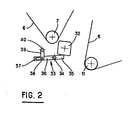
- Figure 2 is a partial view on a larger scale showing a possible embodiment of the invention.
- the reference 1 designates a cylindrical baler of the general conventional type, comprising a fixed front chassis indicated diagrammatically at 2 and supported by wheels 3, this chassis itself carrying a drawbar 4 intended for its coupling to a tractor for example.
- a rear door indicated generally at 5 On the fixed front part 2 forming a frame is articulated in the usual manner a rear door indicated generally at 5, which can pivot on the front part around an upper horizontal transverse axis (not shown), the opening and the closure of this prote being controlled in a conventional manner by hydraulic cylinders or equivalent means (also not shown).
- a set of belts 6 is provided on the press.
- This game includes, in the usual way, a certain number of parallel belts distributed over the width of the press and passing over idler rollers 7-17.
- Some of these deflection rollers are mounted on the fixed front part 2 of the chassis, while others are supported by the rear door 5.
- the strips or belts 6 completely delimit the winding, and a single set of belts is accordingly provided.
- the invention is also applicable in the case of a cylindrical baler comprising a set of belts on the front part of the press and a second set of belts on its rear part or door.
- Some of the deflection rollers are conventionally supported at the end of arms which are themselves pivotally mounted and which are subjected in the usual manner to the action of springs or hydraulic cylinders, in order to ensure the maintenance in tension of the press belts.
- the deflection roller 7 is a drive roller for belts or belts. It is itself driven by a transmission by belts or chains 21 from a return box 22 itself attacked by the transmission shaft 23 connected to the PTO shaft of the tractor. One could also provide a transmission between the roller 7 and another deflection roller, for example the upper roller, to distribute the drive of the bands or belts over two rollers.
- the collector which is mounted in the vicinity of the rear lower roller 11 and which is used to collect from the ground the harvested products which generally lie there in swaths, with a view to their introduction the press chamber through an interval or inlet for the products indicated at 25.
- a priming roller 26 On the other side of this interval 25 relative to the pick-up 24, there is provided in a known manner a priming roller 26.
- the strands of belts which delimit the winding chamber of the press are very close to each other.
- the products picked up by the picker 24 penetrate between these strands of belts through the gap 25. They tend to wind on themselves and this winding is favored by the presence of the priming roller 26, which is driven so positive by means not shown from the drive roller 7.
- FIG. 2 which is a view in partial representation, there has been indicated at 7 the return roller for the strips or belts 6, and at 32 the priming roller, here in square cross section.
- This section could also be different, for example hexagonal, or have any other desired profile.
- This priming roller is associated with a doctor blade 33.
- this doctor blade is, in this case, constituted by a lever with two arms 33 which is pivotally mounted on the front part 2 of the press frame at 34.
- the front end 35 of the doctor blade is in the immediate vicinity of the periphery of the priming roller 32 and the rear part 36 of the doctor blade has a slot 37 which is attacked by a finger 38 mounted on a crank arm 39 rotating around an axis 40.
- Its drive is a positive training. It is provided by means not shown, the movement being taken from the deflection or drive roller 7 for example.
- the doctor blade provided according to the invention may extend continuously over the entire width of the press or else it may be formed by separate elements or by teeth brought together.
- a control crank on each side of the press.
- the invention thus remedies the drawbacks mentioned and makes it possible to obtain correct priming in the formation of a ball inside the press chamber, whatever the conditions of the harvested harvested products.
Landscapes
- Life Sciences & Earth Sciences (AREA)
- Environmental Sciences (AREA)
- Harvester Elements (AREA)
- Apparatuses For Bulk Treatment Of Fruits And Vegetables And Apparatuses For Preparing Feeds (AREA)
Description
La présente invention concerne les presses à balles cylindriques ou rondes comprenant des jeux de bandes ou courroies ménageant une chambre de formation d'un balle par enroulement, ainsi qu'un ramasseur destiné à reprendre les produits de récolte sur le sol pour leur transfert à la chambre de formation de la balle à travers un intervalle ou orifice d'entrée des produits, un rouleau d'amorçage à section droite non circulaire étant disposé de l'autre côté de cet orifice par rapport au ramasseur auquel est adjacent un organe.The present invention relates to cylindrical or round balers comprising sets of bands or belts providing a chamber for forming a bale by winding, as well as a collector intended to take the harvested products from the ground for their transfer to the bale forming chamber through a gap or inlet for the products, a non-circular cross-section priming roller being arranged on the other side of this orifice relative to the pick-up to which a member is adjacent.
De telles presses connues par exemple par GB-A-2 010 654 forment, par enroulement à l'intérieur de leur chambre ménagée dans le corps de la presse, une balle de forme générale cylindrique à partir de produits de récolte, notamment de fourrage ou de foin, ramassés sur le champ au cours de la progression de la presse. Quand la balle a atteint le diamètre désiré et a été liée, la porte arriére de la presse est ouverte et la balle est déchargée sur le sol. La formation d'une autre balle par enroulement peut être déclenchée ensuite à l'intérieur de la presse.Such presses known for example from GB-A-2 010 654 form, by winding inside their chamber formed in the body of the press, a generally cylindrical bale from harvested products, in particular fodder or hay, picked up on the spot during the press progress. When the bale has reached the desired diameter and has been tied, the rear door of the press is opened and the bale is unloaded on the ground. The formation of another bale by winding can then be triggered inside the press.
Les produits destinés à former la balle sont ramassés sur le sol au moyen d'un ramasseur. Ils sont transférés par celui-ci dans la chambre de la presse, entre les brins des bandes ou courroies, qui occupent au début de l'opération des positions voisines. Du fait de ce rapprochement et des sens de déplacement opposés de ces brins des bandes ou courroies, les produits ramassés au début de la formation d'une balle onttendance à s'enrouler et à former le noyau d'une nouvelle balle, dont le diamètre va aller en augmentant, les brins de bandes ou courroies s'écartant l'un de l'autre en fonction de cette augmentation de diamètre de la balle. Ces bandes ou courroies sont alors maintenues sous tension par des rouleaux de tension qui sont eux-mêmes soumis à l'action de ressorts ou de cylindres hydrauliques.The products intended to form the ball are collected from the ground by means of a collector. They are transferred by the latter into the press chamber, between the strands of the bands or belts, which occupy at the start of the operation neighboring positions. Due to this approximation and the opposite directions of movement of these strands of the bands or belts, the products picked up at the start of the formation of a bale tend to roll up and form the core of a new bale, the diameter of which will increase, the strands of bands or belts moving away from each other according to this increase in diameter of the ball. These bands or belts are then kept under tension by tension rollers which are themselves subjected to the action of springs or hydraulic cylinders.
Pour favoriser ce début de formation de la balle, il est prévu de manière connue, vers la partie avant de l'intervalle ou orifice de pénétration des produits dans la chambre de la presse, un rouleau dénommé rouleau d'amorçage, voisin d'un rouleau fixe de la presse sur lequel passent les bandes ou courroies et qui sert généralement de rouleau d'entraînement, voir EP-A-076 502.To promote this beginning of ball formation, there is provided in a known manner, towards the front part of the interval or orifice for penetration of the products into the press chamber, a roller called a priming roller, close to a fixed press roller on which the belts or belts pass and which generally serves as a drive roller, see EP-A-076 502.
Dans le cas de certains produits de récolte, notamment de produits destinés à former du fourrage, par exemple de ray-grass, et en particulier dans des conditions humides, des difficultés apparaissent du fait que ces produits ont tendance à s'enrouler autour du rouleau d'amorçage classique, ce qui s'oppose à la formation d'un noyau de balle correct et est, en outre, à l'origine de bourrages qui peuvent exiger l'arrêt de la presse et qui, en conséquence, ralentissent le rythme du travail.In the case of certain harvested products, in particular products intended to form fodder, for example ryegrass, and in particular in wet conditions, difficulties arise from the fact that these products tend to wrap around the roller. of conventional priming, which is opposed to the formation of a correct ball core and is, moreover, at the origin of jams which can require the stop of the press and which, consequently, slow down the rate work.
Il est également connu que, dans des machines agricoles à éléments rotatifs, des foins de paille s'enroulent autour de ces éléments, par exemple le rouleau de compression supérieur de l'entrée d'un presse à balles cylindriques et l'on a déjà proposé dans US-A-4155 298 de s'affranchir de cet inconvénient en utilisant une racle coopérant avec ce rouleau.It is also known that, in agricultural machines with rotary elements, hay of straw is wound around these elements, for example the upper compression roller of the inlet of a cylindrical baler and we have already proposed in US-A-4155 298 to overcome this drawback by using a doctor blade cooperating with this roller.
Lorsque ce dernier, toutefois, est le rouleau d'amorçage (et non pas de compression) d'une presse selon EP-A-076 502, une racle usuelle disposée comme dans US-A-4155 298, ne permet pas d'assurer avec certitude la formation satisfaisante d'un noyau de balle et cela, vraisemblablement, parce que la racle du brevet US fait tomber les produits déposés sur le rouleau dans la chambre de formation de balle.When the latter, however, is the priming roller (and not of compression) of a press according to EP-A-076 502, a usual doctor blade arranged as in US-A-4155 298, does not make it possible to ensure with certainty the satisfactory formation of a bullet core and this, probably, because the doctor blade of the US patent drops the products deposited on the roller in the ball forming chamber.
Le but de l'invention est de remédier à cet inconvénient des presses existantes à rouleau d'amorçage et on prévoit, pour ce faire que l'organe adjacent au rouleau d'amorçage soit une racle placée au-dessous dudit rouleau et montée sur le châssis de la presse de façon pivotante au voisinage du rouleau d'amorçage vers lequel elle est sollicitée de façon élastique.The object of the invention is to remedy this drawback of existing presses with a priming roller and, to do this, provision is made for the member adjacent to the priming roller to be a doctor blade placed below said roller and mounted on the press frame pivotally in the vicinity of the priming roller towards which it is resiliently biased.
Cette racle est avantageusement un levier à deux bras dont un bras s'étend au voisinage du rouleau d'amorçage tandis que l'autre bras, orienté à l'opposé de ce rouleau par rapport au point de montage à pivotement, est relié à un dispositif d'entraînement qui soumet la racle à un mouvement de pivotement en synchronisme avec la rotation du rouleaux d'amorçage.This doctor blade is advantageously a lever with two arms of which one arm extends in the vicinity of the priming roller while the other arm, oriented opposite this roller with respect to the pivoting mounting point, is connected to a drive device which subjects the doctor blade to a pivoting movement in synchronism with the rotation of the priming rollers.
Les moyens assurant ce pivotement de la racle peuvent être constitués par exemple par un système de manivelle, de came ou d'excentrique.The means ensuring this pivoting of the doctor blade may consist, for example, of a crank, cam or eccentric system.
La racle s'étend de façon continue sur toute la largeur de la presse ou bien est constituée par des éléments séparés ou par des dents rapprochées les unes des autres.The doctor blade extends continuously over the entire width of the press or is formed by separate elements or by teeth close to each other.
La description qui va suivre, faite au regard des dessins annexés donnés à titre non limitatif permettra de mieux comprendre l'invention.The following description, made with reference to the accompanying drawings given without limitation, will allow a better understanding of the invention.
La figure 1 est une représentation schématique de profil d'une presse à balles cylindriques avec rouleau d'amorçage, comportant une racle et des doigts associés à ce rouleau, selon la Demande principale EP-A-0150 630.FIG. 1 is a schematic profile representation of a cylindrical baler with priming roller, comprising a doctor blade and fingers associated with this roller, according to main application EP-A-0150 630.
La figure 2 est une vue partielle à plus grande échelle montrant un mode de réalisation possible de l'invention.Figure 2 is a partial view on a larger scale showing a possible embodiment of the invention.
Sur les dessins on a désigné par la référence 1 une presse à balles cylindriques de type général classique, comportant un châssis avant fixe indiqué schématiquement en 2 et supporté par des roues 3, ce châssis portant lui-même un timon 4 destiné à son attelage à un tracteur par exemple. Sur la partie avant fixe 2 formant châssis est articulée de la manière habituelle une porte arrière indiquée de façon générale en 5, qui peut pivoter sur la partie avant autour d'un axe transversal horizontal supérieur (non représenté), l'ou- veture et la fermeture de cette prote étant coman- dées de façon en soi classique par des vérins hydrauliques ou des moyens équivalents (également non représentés).In the drawings, the reference 1 designates a cylindrical baler of the general conventional type, comprising a fixed front chassis indicated diagrammatically at 2 and supported by wheels 3, this chassis itself carrying a drawbar 4 intended for its coupling to a tractor for example. On the fixed front part 2 forming a frame is articulated in the usual manner a rear door indicated generally at 5, which can pivot on the front part around an upper horizontal transverse axis (not shown), the opening and the closure of this prote being controlled in a conventional manner by hydraulic cylinders or equivalent means (also not shown).
Un jeu de courroies 6 est prévu sur la presse. Ce jeu comprend, de la façon usuelle, un certain nombre de courroies parallèles réparties sur la largeur de la presse et passant sur des rouleaux de renvoi 7-17. Certains de ces rouleaux de renvoi sont montés sur la partie avant fixe 2 du châssis, tandis que d'autres sont supportés par la porte arrière 5. Dans le cas du mode de réalisation représenté, les bandes ou courroies 6 délimitent complètement le chambre d'enroulement, et il est prévu en conséquence un seul jeu de courroies. Il va de soi toutefois que l'invention est également applicable dans le cas d'une presse à balles cylindriques comportant un jeu de courroies sur la partie avant de la presse et un second jeu de courroies sur sa partie arrière ou porte. Certains des rouleaux de renvoi sont supportés de façon classique à l'extrémité de bras qui sont eux-mêmes montés de façon pivotante et qui sont soumis de la manière habituelle à l'action de ressorts ou de cylindres hydrauliques, afin d'assurer le maintien en tension des courroies de la presse.A set of
Le rouleau de renvoi 7 est un rouleau d'entraînement des bandes ou courroies. Il est lui-même entraîné par une transmission par courroies ou chaînes 21 à partir d'une boîte de renvoi 22 attaquée elle-même par l'arbre de transmission 23 relié à l'arbre de prise de force du tracteur. On pourrait également prévoir une transmission entre le rouleau 7 et un autre rouleau de renvoi, par exemple le rouleau supérieur, pour répartir sur deux rouleaux l'entraînement des bandes ou courroies.The deflection roller 7 is a drive roller for belts or belts. It is itself driven by a transmission by belts or
On a indiqué en 24, à la partie inférieure de la presse le ramasseur qui est monté au voisinage du rouleau inférieur arrière 11 et qui sert à ramasser sur le sol les produits de récolte qui y reposent généralement en andains, en vue de leur introduction dans la chambre de la presse à travers un intervalle ou orifice d'entrée des produits indiqué en 25. De l'autre côté de cet intervalle 25 par rapport au ramasseur 24, il est prévu d'une manière en soi connue un rouleau d'amorçage 26.It was indicated at 24, at the lower part of the press, the collector which is mounted in the vicinity of the rear
Au début de l'opération de formation d'un balle à l'intérieur de la presse, les brins de courroies qui délimitent la chambre d'enroulement de la presse sont très rapprochés l'un de l'autre. Les produits ramassés par le ramasseur 24 pénètrent entre ces brins de courroies par l'intervalle 25. Ils ont tendance à d'enrouler sur eux-mêmes et cet enroulement est favorisé par la présence du rouleau d'amorçage 26, qui est entraîné de façon positive par des moyens non représentés à partir du rouleau d'entraînement 7.At the start of the bale-forming operation inside the press, the strands of belts which delimit the winding chamber of the press are very close to each other. The products picked up by the
Toutefois, comme indiqué précédemment, pour certains produits de récolte, notamment pour les fourrages tels que le ray-grass très humide, des difficultés peuvent apparaître du fait de la tendance à l'enroulement de ces produits de récolte autour du rouleau d'amorçage. Il en résulte éventuellement des bourrages qui exigent un arrêt de la presse.However, as indicated above, for certain harvested products, in particular for fodder such as very wet ryegrass, difficulties may arise due to the tendency for these harvested products to be wound around the priming roller. This eventually results in jams which require a stop of the press.
On se reportera maintenant à la figure 2, qui montre un mode de réalisation de l'invention.Referring now to Figure 2, which shows an embodiment of the invention.
Sur cette figure 2, qui est une vue en représentation partielle, on a indiqué en 7 le rouleau de renvoi des bandes ou courroies 6, et en 32 le rouleau d'amorçage, ici à section droite carrée. Cette section pourrait d'ailleurs être différente, par exemple hexagonale, ou avoir tout autre profil désiré.In this FIG. 2, which is a view in partial representation, there has been indicated at 7 the return roller for the strips or
A ce rouleau d'amorçage est associée un racle 33.This priming roller is associated with a
Etant donné que la section du rouleau d'amorçage s'écarte dans le cas présent d'une section circulaire et compte tenu du fait que l'efficacité de la racle est liée à son positionnement au voisinage immédiat de la périphérie de ce rouleau d'amorçage, cette racle est, dans le cas présent, constitutée par un levier à deux bras 33 qui est monté à pivotement sur la partie avant 2 du châssis de la presse en 34. Comme indiqué, l'extrémité avant 35 de la racle se trouve au voisinage immédiat de la périphérie du rouleau d'amorcage 32 et la partie arrière 36 de la racle présente une fente 37 qui est attaquée par un doigt 38 monté sur un bras de manivelle 39 tournant autour d'un axe 40. Son entraînement est un entraînement positif. Il est assuré par des moyens non représentés, le mouvement étant prélevé au rouleau de renvoi ou d'entraînement 7 par exemple.Since the section of the priming roller deviates in this case from a circular section and taking into account that the effectiveness of the doctor blade is linked to its positioning in the immediate vicinity of the periphery of this roller priming, this doctor blade is, in this case, constituted by a lever with two
Ainsi, si on assure un entraînement de l'arbre ou axe 40 à une vitesse qui représente dans le cas d'un rouleau d'amorçage 32 polygonal un multiple de la vitesse de rotation de ce rouleau d'amorçage 32, correspondant au nombre de ses faces, on obtient un mouvement de pivotement de la racle 33 dont l'extrémité 35 suit parfaitement la périphérie du rouleau d'amorçage 32 et demeure à son voisinage immédiat.Thus, if the shaft or
L'enroulement préjudiciable de produits de récolte même humides autour du rouleau d'amorçage 32 est évité par la présence de cette racle.The harmful winding of even wet crop products around the
La racle prévue suivant l'invention peut s'étendre de façon continue sur toute la largeur de la presse ou bien elle peut être constituée par des éléments séparés ou par des dents rapprochées les unes des autres. Dans le cas d'une racle continue, il est prévu de préférence une manivelle de commande sur chaque côté de la presse.The doctor blade provided according to the invention may extend continuously over the entire width of the press or else it may be formed by separate elements or by teeth brought together. In the case of a continuous doctor blade, there is preferably provided a control crank on each side of the press.
On voit que l'invention remédie ainsi aux inconvénients mentionnés et permet d'obtenir un amorçage correct dans la formation d'une balle à l'intérieur de la chambre de la presse, quelles que soient les conditions des produits de récolte ramassés.It can be seen that the invention thus remedies the drawbacks mentioned and makes it possible to obtain correct priming in the formation of a ball inside the press chamber, whatever the conditions of the harvested harvested products.
Claims (4)
Priority Applications (2)
| Application Number | Priority Date | Filing Date | Title |
|---|---|---|---|
| DE8787110586T DE3484020D1 (en) | 1984-01-27 | 1984-01-27 | ROTOBALER. |
| EP19870110586 EP0250004B1 (en) | 1984-01-27 | 1984-01-27 | Rundballenpresse |
Applications Claiming Priority (2)
| Application Number | Priority Date | Filing Date | Title |
|---|---|---|---|
| EP84400188A EP0150630B1 (en) | 1984-01-27 | 1984-01-27 | Roundbaler |
| EP19870110586 EP0250004B1 (en) | 1984-01-27 | 1984-01-27 | Rundballenpresse |
Related Parent Applications (2)
| Application Number | Title | Priority Date | Filing Date |
|---|---|---|---|
| EP84400188A Division-Into EP0150630B1 (en) | 1984-01-27 | 1984-01-27 | Roundbaler |
| EP84400188A Division EP0150630B1 (en) | 1984-01-27 | 1984-01-27 | Roundbaler |
Publications (3)
| Publication Number | Publication Date |
|---|---|
| EP0250004A2 EP0250004A2 (en) | 1987-12-23 |
| EP0250004A3 EP0250004A3 (en) | 1988-06-08 |
| EP0250004B1 true EP0250004B1 (en) | 1991-01-23 |
Family
ID=26094749
Family Applications (1)
| Application Number | Title | Priority Date | Filing Date |
|---|---|---|---|
| EP19870110586 Expired - Lifetime EP0250004B1 (en) | 1984-01-27 | 1984-01-27 | Rundballenpresse |
Country Status (1)
| Country | Link |
|---|---|
| EP (1) | EP0250004B1 (en) |
Family Cites Families (4)
| Publication number | Priority date | Publication date | Assignee | Title |
|---|---|---|---|---|
| DE2443838C3 (en) * | 1974-09-13 | 1982-09-02 | Gebrüder Welger GmbH & Co KG, 3340 Wolfenbüttel | Pick-up Roll Baler |
| US4155298A (en) * | 1977-03-21 | 1979-05-22 | Hesston Corporation | Bale starting gate for rotary baler |
| US4182101A (en) * | 1977-12-01 | 1980-01-08 | Hesston Corporation | Machine for coiling fibrous crop materials into large round bales |
| FR2546368B1 (en) * | 1983-05-27 | 1986-03-28 | Hesston Sa | LIFTING DEVICE FOR MACHINES FOR PICKING UP AND PRESSING IN ROUND BALES OF ALL TYPES OF HARVESTING |
-
1984
- 1984-01-27 EP EP19870110586 patent/EP0250004B1/en not_active Expired - Lifetime
Also Published As
| Publication number | Publication date |
|---|---|
| EP0250004A2 (en) | 1987-12-23 |
| EP0250004A3 (en) | 1988-06-08 |
Similar Documents
| Publication | Publication Date | Title |
|---|---|---|
| EP0150630B1 (en) | Roundbaler | |
| EP0149368B1 (en) | Rotobaler | |
| BE1007190A5 (en) | Harvest machine to form round bales. | |
| FR2549688A1 (en) | MACHINE FOR PICKING UP AND FORMING ROUND BALLS OF FIBROUS MATERIALS DISPOSED IN ANDAINS | |
| EP0064117B1 (en) | Continuously operable hay-rolling machine | |
| EP0046426B1 (en) | Roll baler | |
| EP0228944B1 (en) | Apparatus for forming round bales of an agricultural produce in a rotobaler | |
| EP0064112B1 (en) | Rotary baler | |
| EP0150629A1 (en) | Roundbaler with torque limiter | |
| EP0090120B1 (en) | Binding device by means of two twines for rotobalers | |
| EP0726026B1 (en) | Fodder press | |
| FR2511838A1 (en) | ROTATING MACHINE FOR HARVESTING BALLS | |
| EP0150631B1 (en) | Rotobaler with driven bale starter roll | |
| EP0130258A1 (en) | Rotobaler | |
| EP0250004B1 (en) | Rundballenpresse | |
| EP0064116B1 (en) | Continuously operable hay-rolling machine | |
| EP0041444B1 (en) | Tying device for round-baler | |
| FR2604856A1 (en) | BULK PRESS FOR AGRICULTURAL HARVESTING PRODUCTS | |
| EP0298798A2 (en) | Apparatus for narrowing the breadth of a swath in front of an agricultural pick-up | |
| FR2604857A1 (en) | METHOD AND DEVICE FOR CONTROLLING GUIDING ARM OF TWIN BINDING CYLINDRICAL BALES IN A HARVESTER PRESS | |
| EP0150628B1 (en) | Rotobaler with means for raising the tension in the belts | |
| FR2575362A1 (en) | Machine intended for the formation of cylindrical bales | |
| US5408925A (en) | Trash removal apparatus for a round baler | |
| EP3612016B1 (en) | Swath aerator device and agricultural machine equipped with such a device | |
| EP0131078B1 (en) | Rotobaler incorporating a mower |
Legal Events
| Date | Code | Title | Description |
|---|---|---|---|
| PUAI | Public reference made under article 153(3) epc to a published international application that has entered the european phase |
Free format text: ORIGINAL CODE: 0009012 |
|
| AC | Divisional application: reference to earlier application |
Ref document number: 150630 Country of ref document: EP |
|
| AK | Designated contracting states |
Kind code of ref document: A2 Designated state(s): DE FR GB IT NL |
|
| PUAL | Search report despatched |
Free format text: ORIGINAL CODE: 0009013 |
|
| AK | Designated contracting states |
Kind code of ref document: A3 Designated state(s): DE FR GB IT NL |
|
| 17P | Request for examination filed |
Effective date: 19880702 |
|
| 17Q | First examination report despatched |
Effective date: 19891025 |
|
| ITF | It: translation for a ep patent filed | ||
| GRAA | (expected) grant |
Free format text: ORIGINAL CODE: 0009210 |
|
| AC | Divisional application: reference to earlier application |
Ref document number: 150630 Country of ref document: EP |
|
| AK | Designated contracting states |
Kind code of ref document: B1 Designated state(s): DE FR GB IT NL |
|
| PGFP | Annual fee paid to national office [announced via postgrant information from national office to epo] |
Ref country code: NL Payment date: 19910131 Year of fee payment: 8 |
|
| GBT | Gb: translation of ep patent filed (gb section 77(6)(a)/1977) | ||
| REF | Corresponds to: |
Ref document number: 3484020 Country of ref document: DE Date of ref document: 19910228 |
|
| PGFP | Annual fee paid to national office [announced via postgrant information from national office to epo] |
Ref country code: DE Payment date: 19910319 Year of fee payment: 8 |
|
| PLBE | No opposition filed within time limit |
Free format text: ORIGINAL CODE: 0009261 |
|
| STAA | Information on the status of an ep patent application or granted ep patent |
Free format text: STATUS: NO OPPOSITION FILED WITHIN TIME LIMIT |
|
| PGFP | Annual fee paid to national office [announced via postgrant information from national office to epo] |
Ref country code: GB Payment date: 19911211 Year of fee payment: 9 |
|
| 26N | No opposition filed | ||
| PGFP | Annual fee paid to national office [announced via postgrant information from national office to epo] |
Ref country code: FR Payment date: 19920117 Year of fee payment: 9 |
|
| PG25 | Lapsed in a contracting state [announced via postgrant information from national office to epo] |
Ref country code: NL Effective date: 19920801 |
|
| NLV4 | Nl: lapsed or anulled due to non-payment of the annual fee | ||
| PG25 | Lapsed in a contracting state [announced via postgrant information from national office to epo] |
Ref country code: DE Effective date: 19921001 |
|
| PG25 | Lapsed in a contracting state [announced via postgrant information from national office to epo] |
Ref country code: GB Effective date: 19930127 |
|
| GBPC | Gb: european patent ceased through non-payment of renewal fee |
Effective date: 19930127 |
|
| PG25 | Lapsed in a contracting state [announced via postgrant information from national office to epo] |
Ref country code: FR Effective date: 19930930 |
|
| REG | Reference to a national code |
Ref country code: FR Ref legal event code: ST |