EP0249957A1 - Bestimmungssystem in einem Gelmaterial - Google Patents
Bestimmungssystem in einem Gelmaterial Download PDFInfo
- Publication number
- EP0249957A1 EP0249957A1 EP87108686A EP87108686A EP0249957A1 EP 0249957 A1 EP0249957 A1 EP 0249957A1 EP 87108686 A EP87108686 A EP 87108686A EP 87108686 A EP87108686 A EP 87108686A EP 0249957 A1 EP0249957 A1 EP 0249957A1
- Authority
- EP
- European Patent Office
- Prior art keywords
- gel body
- gel
- analyte
- light beam
- container
- Prior art date
- Legal status (The legal status is an assumption and is not a legal conclusion. Google has not performed a legal analysis and makes no representation as to the accuracy of the status listed.)
- Withdrawn
Links
Images

Classifications
-
- G—PHYSICS
- G01—MEASURING; TESTING
- G01N—INVESTIGATING OR ANALYSING MATERIALS BY DETERMINING THEIR CHEMICAL OR PHYSICAL PROPERTIES
- G01N21/00—Investigating or analysing materials by the use of optical means, i.e. using sub-millimetre waves, infrared, visible or ultraviolet light
- G01N21/17—Systems in which incident light is modified in accordance with the properties of the material investigated
- G01N21/55—Specular reflectivity
- G01N21/552—Attenuated total reflection
-
- C—CHEMISTRY; METALLURGY
- C12—BIOCHEMISTRY; BEER; SPIRITS; WINE; VINEGAR; MICROBIOLOGY; ENZYMOLOGY; MUTATION OR GENETIC ENGINEERING
- C12Q—MEASURING OR TESTING PROCESSES INVOLVING ENZYMES, NUCLEIC ACIDS OR MICROORGANISMS; COMPOSITIONS OR TEST PAPERS THEREFOR; PROCESSES OF PREPARING SUCH COMPOSITIONS; CONDITION-RESPONSIVE CONTROL IN MICROBIOLOGICAL OR ENZYMOLOGICAL PROCESSES
- C12Q1/00—Measuring or testing processes involving enzymes, nucleic acids or microorganisms; Compositions therefor; Processes of preparing such compositions
-
- G—PHYSICS
- G01—MEASURING; TESTING
- G01N—INVESTIGATING OR ANALYSING MATERIALS BY DETERMINING THEIR CHEMICAL OR PHYSICAL PROPERTIES
- G01N33/00—Investigating or analysing materials by specific methods not covered by groups G01N1/00 - G01N31/00
- G01N33/48—Biological material, e.g. blood, urine; Haemocytometers
- G01N33/50—Chemical analysis of biological material, e.g. blood, urine; Testing involving biospecific ligand binding methods; Immunological testing
- G01N33/53—Immunoassay; Biospecific binding assay; Materials therefor
- G01N33/558—Immunoassay; Biospecific binding assay; Materials therefor using diffusion or migration of antigen or antibody
- G01N33/559—Immunoassay; Biospecific binding assay; Materials therefor using diffusion or migration of antigen or antibody through a gel, e.g. Ouchterlony technique
-
- G—PHYSICS
- G01—MEASURING; TESTING
- G01N—INVESTIGATING OR ANALYSING MATERIALS BY DETERMINING THEIR CHEMICAL OR PHYSICAL PROPERTIES
- G01N21/00—Investigating or analysing materials by the use of optical means, i.e. using sub-millimetre waves, infrared, visible or ultraviolet light
- G01N21/17—Systems in which incident light is modified in accordance with the properties of the material investigated
- G01N2021/1738—Optionally different kinds of measurements; Method being valid for different kinds of measurement
-
- G—PHYSICS
- G01—MEASURING; TESTING
- G01N—INVESTIGATING OR ANALYSING MATERIALS BY DETERMINING THEIR CHEMICAL OR PHYSICAL PROPERTIES
- G01N21/00—Investigating or analysing materials by the use of optical means, i.e. using sub-millimetre waves, infrared, visible or ultraviolet light
- G01N21/75—Systems in which material is subjected to a chemical reaction, the progress or the result of the reaction being investigated
- G01N21/77—Systems in which material is subjected to a chemical reaction, the progress or the result of the reaction being investigated by observing the effect on a chemical indicator
- G01N21/7703—Systems in which material is subjected to a chemical reaction, the progress or the result of the reaction being investigated by observing the effect on a chemical indicator using reagent-clad optical fibres or optical waveguides
-
- Y—GENERAL TAGGING OF NEW TECHNOLOGICAL DEVELOPMENTS; GENERAL TAGGING OF CROSS-SECTIONAL TECHNOLOGIES SPANNING OVER SEVERAL SECTIONS OF THE IPC; TECHNICAL SUBJECTS COVERED BY FORMER USPC CROSS-REFERENCE ART COLLECTIONS [XRACs] AND DIGESTS
- Y10—TECHNICAL SUBJECTS COVERED BY FORMER USPC
- Y10S—TECHNICAL SUBJECTS COVERED BY FORMER USPC CROSS-REFERENCE ART COLLECTIONS [XRACs] AND DIGESTS
- Y10S435/00—Chemistry: molecular biology and microbiology
- Y10S435/808—Optical sensing apparatus
-
- Y—GENERAL TAGGING OF NEW TECHNOLOGICAL DEVELOPMENTS; GENERAL TAGGING OF CROSS-SECTIONAL TECHNOLOGIES SPANNING OVER SEVERAL SECTIONS OF THE IPC; TECHNICAL SUBJECTS COVERED BY FORMER USPC CROSS-REFERENCE ART COLLECTIONS [XRACs] AND DIGESTS
- Y10—TECHNICAL SUBJECTS COVERED BY FORMER USPC
- Y10S—TECHNICAL SUBJECTS COVERED BY FORMER USPC CROSS-REFERENCE ART COLLECTIONS [XRACs] AND DIGESTS
- Y10S435/00—Chemistry: molecular biology and microbiology
- Y10S435/81—Packaged device or kit
-
- Y—GENERAL TAGGING OF NEW TECHNOLOGICAL DEVELOPMENTS; GENERAL TAGGING OF CROSS-SECTIONAL TECHNOLOGIES SPANNING OVER SEVERAL SECTIONS OF THE IPC; TECHNICAL SUBJECTS COVERED BY FORMER USPC CROSS-REFERENCE ART COLLECTIONS [XRACs] AND DIGESTS
- Y10—TECHNICAL SUBJECTS COVERED BY FORMER USPC
- Y10S—TECHNICAL SUBJECTS COVERED BY FORMER USPC CROSS-REFERENCE ART COLLECTIONS [XRACs] AND DIGESTS
- Y10S435/00—Chemistry: molecular biology and microbiology
- Y10S435/975—Kit
-
- Y—GENERAL TAGGING OF NEW TECHNOLOGICAL DEVELOPMENTS; GENERAL TAGGING OF CROSS-SECTIONAL TECHNOLOGIES SPANNING OVER SEVERAL SECTIONS OF THE IPC; TECHNICAL SUBJECTS COVERED BY FORMER USPC CROSS-REFERENCE ART COLLECTIONS [XRACs] AND DIGESTS
- Y10—TECHNICAL SUBJECTS COVERED BY FORMER USPC
- Y10S—TECHNICAL SUBJECTS COVERED BY FORMER USPC CROSS-REFERENCE ART COLLECTIONS [XRACs] AND DIGESTS
- Y10S436/00—Chemistry: analytical and immunological testing
- Y10S436/805—Optical property
-
- Y—GENERAL TAGGING OF NEW TECHNOLOGICAL DEVELOPMENTS; GENERAL TAGGING OF CROSS-SECTIONAL TECHNOLOGIES SPANNING OVER SEVERAL SECTIONS OF THE IPC; TECHNICAL SUBJECTS COVERED BY FORMER USPC CROSS-REFERENCE ART COLLECTIONS [XRACs] AND DIGESTS
- Y10—TECHNICAL SUBJECTS COVERED BY FORMER USPC
- Y10S—TECHNICAL SUBJECTS COVERED BY FORMER USPC CROSS-REFERENCE ART COLLECTIONS [XRACs] AND DIGESTS
- Y10S436/00—Chemistry: analytical and immunological testing
- Y10S436/807—Apparatus included in process claim, e.g. physical support structures
- Y10S436/808—Automated or kit
Definitions
- This invention relates to the determination of analytes, and more particularly to an apparatus, product and process for detecting or determining analytes.
- the analyte interacts with a reagent system to produce a color change, and the rate of color change or intensity of color after a fixed time is measured as a measure of analyte.
- a product which is useful for determining an analyte, wherein an optically transparent gel body is provided with a reagent system, which in the presence of a sample portion which diffuses into the gel body changes the transmissive properties of the gel body, and wherein the . gel body is supported by a support in a manner such that sample is applied to a first surface portion of the gel body, and a light source is directed for entry into the gel body through a second surface portion of the gel body for transmission through the gel for subsequent measurement and determination of analyte.
- the gel body is provided with an index of refraction such that the relative index of refraction of the gel body at its interface with the surrounding medium (e.g. air) is less than unity whereby upon a beam of light passing through the gel body and contacting the interface at an incident angle above the critical angle, the beam of light is reflected back into the gel body.
- the gel body may be provided with a shape, such as a prismatic shape in the form of a dove prism, to permit the beam of light to enter and exit the gel body perpendicularly with respect thereto to substantially eliminate refractance during entry and exit in addition to contacting the interface above the critical angle.
- a process for determining an analyte which employs a gel body which includes a reagent system which changes at least one of the transmissive properties of the gel.
- a process for determining an analyte by an immunoassay wherein an unbound labeled ligand portion (tracer portion) produced in the assay is diffused into a gel body which contains a reagent system which in the presence of the tracer, changes the transmissive properties of the gel.
- kits or packages for determining an analyte by an immunoassay procedure wherein the kit includes a tracer and a gel body, which gel body includes a reagent system, which in the presence of the tracer changes at least one of the transmissive properties of the gel body.
- a gel through which light can be transmitted, and there is incorporated into the gel a reagent system, which in the presence of a sample portion, which diffuses into the gel, changes at least one of the transmissive properties of the gel.
- the gel is supported in a manner such that a sample can be applied to first surface portion of the gel body, and light directed for entry into the gel body through a second surface portion of the gel body for transmission through the gel body, whereby an assay may be conducted without removing the sample which has been applied to the gel body.
- sample may be applied to the gel, and a portion of the sample, which diffuses into the gel, interacts with the reagent system in the gel, and light transmitted through the gel is measured for determining analyte.
- the change in at least one of the transmissive properties of the gel by use of a reagent system may be accomplished in a variety of ways, including for example, a change in light absorption, for example, a visible color . change (formation of color or deletion of color), a change in UV absorption, etc.; change in turbidity, etc.
- a change in light absorption for example, a visible color . change (formation of color or deletion of color), a change in UV absorption, etc.; change in turbidity, etc.
- the selection of a suitable reagent system should be apparent to those skilled in the art from the teachings herein.
- a "change in the transmissive property of the gel” refers to the amount of light scattered or absorbed when a beam of light is directed through the gel, and generally depends on a change in turbidity or a change in energy absorption of the gel. Such change in iransmissive property is generally measured by passing light through the gel, and determining the ratio of the intensity of transmitted or scattered light to the intensity of the incident light. The change in the transmissive property, i.e., the change in the amount of light absorbed or scattered in the gel is measured as a measure of analyte.
- the sample portion which is diffused into the gel is the analyte or a portion thereof, then as the concentration of the analyte increases, the change in transmissive property of the gel increases or decreases whereby the amount of light absorbed or scattered in the gel is proportional to the concentration of the analyte in the sample applied to the gel.
- an optically transparent container and optically transparent gel body including a reagent system, which reagent system in the presence of a sample portion which diffuses into the gel body changes at least one of the transmissive properties of the gel body, wherein a beam of light is transmitted through the gel body such that the angle of incidence of the light beam at the gel body-container interface, or the container-air interface, is above the critical angle for total internal reflectance at the interface and transmitted through the body of gel body by total internal reflectance.
- n 12 is the relative index of refraction at the interface I between the internal medium M 1 and the external medium M 2 and is less than unity;
- n 12 n l /n 2' and where n 1 is the index of refraction of the internal medium M 1 through which the beam of light L is transmitted obliquely, and
- n 2 is the index of refraction of the external medium M 2 towards which the beam of light is being transmitted obliquely.
- the inner and outer surfaces of the container and the gel body are given a prismatic shape (e.g. dove prism shape) to permit the beam of light to enter and exit the container and gel body perpendicularly with respect thereto and also contact the interface of interest at an incident angle greater than the critical angle.
- a prismatic shape e.g. dove prism shape
- the reagent system which is included within the gel is a chromogen system which produces a change in light absorption (in the visible or UV region) in the presence of a sample portion which diffuses into the gel.
- the sample portion which diffuses into the gel is the analyte, whereby measuring a change in transmissive property of the gel caused by interaction of the analyte and the chromogen reagent system may be used to measure the presence and or quantity of analyte in a sample applied to the gel.
- the sample portion which is diffused into the gel may be a tracer used in an immunoassay procedure, whereby the change in the transmissive properties of the gel caused by interaction between the tracer and the reagent system within the gel is used to measure the presence and/or concentration of analyte in an original sample, rather than the presence and/or concentration of the tracer which directly contacts the reagent system within the gel.
- the gel which is used is one which has a clarity such that there is a minimum scattering of light, and should also be stable so that there is minimal syneresis.
- the gel should have a porosity such that the material which is to change at least one of the transmissive properties of the gel in the presence of the reagent system diffuses into the gel within the time period in which the assay is to be conducted.
- Such gels are generally known in the art, and include polyacrylamide, plant and animal gels such as agarose, gelatin, etc.
- Gels are formed from polymers or long chain molecules crosslinked to create a tangled network in which a liquid medium is entrapped, the liquid prevents the network from collapsing into a compact mass and the network prevents the liquid from flowing away.
- the reagent system which is within the gel may be dissolved in the liquid medium, may be suspended therein or bound to the gel matrix. In many cases, the solvent portion of the gel is water. The selection of an appropriate gel is deemed to be within the scope of those skilled in the art from the teachings herein.
- the support or container which may be in the form of a cuvette or container for the gel, can be formed from a wide variety of optically transparent materials which transmit light, including, but not limited to, glass, quartz, various plastics, and the like.
- the selection of a suitable support or container for the gel body, which includes the reagent system, is deemed to be within the scope of those skilled in the art from the teachings herein.
- the support holds the gel body in a manner such that a sample may be applied to a first surface of the gel, and light directed for entry into the gel body through a second surfa.ce of the gel, whereby the sample need not be removed from the gel prior to completion of the assay.
- the second surface is generally a surface of the gel which is not opposite the first surface of the gel whereby the first and second surfaces are angularly positioned with respect to each other, most preferably at an angle other than 90° (acute or obtuse).
- the gels are capable of selectively diffusing portions of an entire sample into the gel, , whereby samples, such as whole blood, or saliva may be applied to the gel, without the necessity of removing particulates from such samples, and without the necessity for removing such sample from the gel prior to completion of the assay.
- samples such as whole blood, or saliva
- whole blood it is not necessary to separate plasma or serum from cells, prior to conducting the assay, and whole blood may be appiied to the gel, and the assay conducted without removing the blood sample from the gel surface.
- the analyte present in whole blood is diffused into the gel, and the cells remain on the gel surface.
- the assay may be accomplished by transmitting light through a surface of the gel different from the surface of the gel to which sample was applied, thereby eliminating serum (or plasma) - cell separation and also eliminating sample removal from the gel. It is to be understood that it is possible for the first and second surface portions to be different portions of the same surface; however, in the preferred embodiment the first and second surface portions are on different surfaces.
- the gel body may be employed for determining a wide variety of analytes which are capable of interacting with a reagent system which will produce a detectable change in the transmissive properties of the gel body.
- the reagent system placed in the gel is a chemical system which contains one or more reagents which in the presence of a sample portion which diffuses into the gel produces a change in at least one of the transmissive properties of the gel.
- the reagent system will depand on the analyte to be determined, and whether the change in the transmissive properties to be measured is due to a change in color, UV absorption or turbidity of the gel.
- a colormetric assay where the change in transmissive properties is due to a change in light absorption, a chromogenic reagent system is employed.
- a turbidmetric or nephelometric system where the change in the transmissive properties results from light being blocked or scattered by a suspension of particles, a turbidmetric reagent system is incorporated into the gel.
- the colorimetric reagent system which is incorporated into the gel body may be any one of a wide variety of chromogenic reagent systems which are conventionally utilized for colorimetrically determining analytes and such systems are generally described in the literature, and are also commercially available.
- chromogenic reagent systems including both end point and kinetic determinations, there may be mentioned oxidase reaction systems, NADH - NAD reaction systems, hydrolytic reaction systems etc.
- oxidative enzymes react with the sample portion which diffuses into the gel body to produce a change in the colorimetric properties of the gel body as an indication of presence and/or amount of analyte..
- An NADH/NAD reaction system relies upon the reduction of NAD to NADH or the oxidation of NADH to NAD, which can be determined in the UV range, or in the alternative, NADH is caused to react with a dye system to produce a visible change in the color properties of the gel body as a measure of analyte.
- a colorimetric reagent system there may be mentioned a chromogen which directly interacts with a sample portion to produce a color change, such as interaction between alkaline phosphatase and a chromophore containing a hydrolyzable phosphate group, with hydrolysis of the phosphate group by the phosphatase producing a change in color.
- a peroxide and an oxidizable chromogen there may be mentioned a peroxide and an oxidizable chromogen.
- colorimetric systems are known in the art, and such colorimetric reagent systems may be incorporated into the gel body in accordance with the present invention. Such reagent systems are incorporated into the gel body in an amount which is effective to produce a detectable change in the coloriinetric properties of the gel in the presence of the sample portion which is diffused into the gel. Such effective amounts may be determined by those skilled in the art from the teachings herein.
- the reagent system will include suitable buffers and the like to provide for interaction between the sample portion which diffuses into the gel, and the reagent system.
- suitable buffers and the like to provide for interaction between the sample portion which diffuses into the gel, and the reagent system.
- suitable amounts and concentrations, as well as optimum pH for various colorimetric systems is deemed to be within the scope of those skilled in the art from the teachings herein.
- the gel indicator system is produced by forming a solution, (preferably in water) of the reagents which are to be used as the reagent system for changing the transmissive properties of the gel, combining such a solution witn a gel stock, such as agarose in water, and placing the mixture on or in a suitable support, such as a container or cuvette, having the desired refractive index and shape.
- a suitable support such as a container or cuvette, having the desired refractive index and shape.
- the support for the gel preferably supports the gel body, including the reagent system, in a manner such that a sample is applied to a first surface of the gel, and a light source is directed against a second surface of the gel.
- a sample is applied to a surface of the gel body, and all or a portion of the sample diffuses into the gel. As hereinabove indicated, at least the portion of the sample which interacts with the reagent system diffuses into the gel.
- a beam of light is then directed against a surface portion of the gel body different than the surface portion to which sample is applied, and in accordance with a preferred embodiment, the light is transmitted through the gel by total internal reflectance.
- a detector is positioned with respect to the gel body in the optical light path of the light transmitted through the gel in order to detect the change in the transmissive properties of the gel.
- a "yes-no" assay may be effected without directing light in a specific manner and without using an optical detector.
- the assay may be a kinetic assay (detecting rate of change of the transmissive properties of the gel) or may be an end point assay, (change of the transmissive properties of the gel after a fixed period of time). In accordance with a preferred embodiment, the assay is effected kinetically.
- the present invention may be employed to determine the presence of analyte in a sample, rather that quantity of analyte in a sample.
- a preferred embodiment of the present invention involves changing at least one transmissive property of the gel body by change in color
- the transmissive property or properties of the gel body may be changed by turbidity by use of a reagent system which interacts with a portion of the sample to change turbidity.
- a reagent system which interacts with a portion of the sample to change turbidity.
- gamma globulin may be employed as the reagent in the gel.
- a sample containing rheumatoid factor will interact with the gamma globulin and increase turbidity. This assay and others are within the scope of the invention.
- chromogens which produce color in the visible range may be effectively incorporated into a gel body, and when so incorporated, such chromogens have improved stability.
- chromogens which provide color in the visible range such as 2,2'-Azino-bis-(3-ethylbenzthiazoline sulphonic Acid) often referred to as ABTS, or a tetrazolium salt, such as, 2, 2 , 0 Di-p-nitrophenyl-5, 5'-diphenyl-3,3' [3,3'-dimethoxy-4,4'-diphenylene] ditetrazolium chloride into a gel so as to provide a color change in the visible range, without the stability problems heretofore encountered in using such chromogens in an aqueous state.
- an immunoassay which utilizes a gel body containing a reagent system which interacts with tracer to change at least one of the transmissive properties of the gel body.
- immunoassay is employed in a generic sense, and encompasses competitive protein binding assays which strictly speaking are not immunoassays.
- an immunoassay in an immunoassay, there is produced a bound tracer portion, and an unbound (free) tracer portion, and analyte is assayed by determining at least one of the free and bound tracer portions produced in the assay.
- the free tracer portion formed in the assay is allowed to diffuse into the gel body, wherein the free tracer portion interacts with a reagent system incorporated into the gel which changes at least one of the transmissive properties of the gel.
- analyte may be qualitatively determined by the procedure of the invention; e.g. a "yes-no" assay.
- the tracer which is used in the assay is a ligand coupled or conjugated to a detectable marker, and in accordance with this aspect of the present invention, the detectable marker of the tracer interacts with the reagent system in the gel body to produce a change in at least one of the transmissive properties of the gel body.
- analyte and tracer compete for binding sites on a binder for the analyte and tracer, such as an antibody or a naturally occuring binder, with the amount of tracer which becomes bound to the binder being inversely proportional to the amount of analyte in the sample.
- the amount of tracer which remains unbound (free) is directly proportional to the amount of analyte in the sample.
- the free tracer portion is allowed to diffuse into the gel body wherein the free tracer portion interacts with the reagent - . system to change at least one of the transmissive properties of the gel.
- the change in the transmissive properties of the gel body is directly proportional to the amount of analyte in the sample in that the amount of tracer in the free tracer portion is directly proportional to the amount of analyte in the sample.
- the assay may be a so called solid phase assay wherein the binder is bound to a solid support, whereby the tracer which is bound to the binder may be easily separated from the unbound tracer by separating the solid phase from the sample, and applying the sample to the gel so as to permit the free tracer to diffuse into the gel body.
- a competitive assay may be effected in solution to form both a bound and free phase, and the entire sample applied to the gel, with the properties of the gel being such that the free tracer diffuses into the gel body, with the bound tracer remaining on the gel surface; for example, by appropriate selection of gel porosity.
- analyte in the sample may be determined, as hereinabove described, without prior separation of the bound and free phases formed in the assay.
- a binder for the analyte and a tracer, wherein the tracer is bound by the analyte i.e., the tracer is comprised of a binder for the analyte conjugated to a detectable marker.
- the analyte is bound to the binder, and the tracer is bound to the analyte, bound to the binder.
- the amount of tracer which is in the bound phase is directly proportional to the amount of analyte in the sample, and the amount of tracer which remains unbound is indirectly proportional to the amount of analyte in the sample.
- the free tracer portion is diffused into the gel body to interact with the reagent system to produce a change in at least one of the transmissive properties of the gel body.
- the change in transmissive property or properties of the gel body is indirectly proportional to the amount of analyte in the sample.
- the bound and free phases may be separated by techniques in the art, such as by supporting the binder on a solid support.
- the bound and free phases may be separated on the gel in that by controlling the porosity of the gel, essentially only the free tracer diffuses into the gel body under the assay conditions, with the bound tracer phase essentially remaining on the surface of the gel.
- the present invention has been described generally with respect to so called sandwich and competitive assays, it is to be understood that the procedure of the present invention is also applicable to . other assay procedures.
- the present invention may be used for a sequential assay in which a binder for both the analyte and tracer is sequentially contacted with the analyte and tracer; a reverse sandwich assay, a simultaneous sandwich assay, etc.
- the free tracer portion is caused to interact with the reagent system in the gel body to change at least one of the transmissive properties ot the gel body, which change is measured to determine analyte (qualitative or quantitative) in the sample being assayed.
- the detectable marker which is preferrably employed in forming the tracer is an enzyme in that an enzyme may be colorimetrically determined in the gel body by reagent systems generally known in the art.
- the reagent system which is included within the body of the gel will be a reagent system which interacts with the enzyme used as the marker of the tracer to produce a change in the transmissive property or properties of the gel body by a change in light absorption.
- a peroxidase enzyme marker may be detected by use of hydrogen peroxide and an appropriate chromogen which is oxidized by the oxygen generated by interaction between the peroxidase and hydrogen peroxide.
- a phosphatase enzyme marker may be detected by use of a chromogen of the type hereinabove described which produces a color change by interaction with alkaline phosphatase.
- a chromogen of the type hereinabove described which produces a color change by interaction with alkaline phosphatase.
- the immunoassay technique of the present invention may be employed for determining a wide variety of analytes.
- analytes such as T4; T3; steroids, such as digoxin, digoxegenin; various bacteria and viruses; CEA; various antibodies associated with bacteria and viruses; drugs, including drugs of abuse and therapeutic drugs; for example, theophylline; etc.
- the analytes which can be determined by the procedure of the present invention should be apparent to those skilled in the art from the teachings herein.
- the gel body contains a reagent system which includes hydrogen peroxide and a suitable chromogen which produces color upon being oxidized by oxygen released by interaction of the hydrogen peroxide and the peroxidase marker of the tracer.
- the hydrogen peroxide would be preferrably incorporated into the gel body in a stabilized form such as, for example, mannitol, urea, etc. stabilized hydrogen peroxide.
- the enzyme labeled ligand which is either the analyte or appropriate analog of the analyte (an appropriate analog is a ligand which is bound by the binder for the analyte) is combined with sample containing or suspected of containing the analyte and a binder for both the analyte and the tracer such as, for example, an antibody.
- sample containing or suspected of containing the analyte and a binder for both the analyte and the tracer such as, for example, an antibody.
- the entire sample is then applied to a surface of the gel body, with the free tracer phase diffusing into the gel body and interacting with the reagent system to produce a change in the transmissive property or properties of the gel by development of color.
- the rate at which the color is formed, or tile intehsity of the color is directly proportional to the amount of analyte in the sample in that the free tracer which diffuses into the gel body is directly proportional to the amount of analyte in the sample; i.e., as the concentration of analyte in the sample increases, the concentration of free tracer in the sample increases.
- the gel body functions to provide a stable environment for the reagent system, and avoids the necessity of mixing reagents for colorimetrically determining the enzyme labeled tracer. Moreover, the gel body can function to separate the bound and free phases formed in the assay.
- the concentration of analyte in the sample can be determined.
- a sample portion which diffuses into the gel may be the analyte or a material which is indicative of the presence and/or amount of analyte.
- the buffer used for this example is 0.1M acetate buffer which is made by carefully weighing 8.2 g. sodium acetate, anhydrous, and dissolving it in about 900 ml. reagent grade water in an analytical volumetric flask. The sodium acetate must be dissolved completely and the pH at 30° C should be adjusted to 4.4 by the addition of acetic acid. After the correct pH has been achieved, the volume of buffer should be brought to exactly 1000 ml. with reagent grade water. The buffer must be stored in a closed container to minimize carbon dioxide absorption.
- ABTS stock solution weigh out 11.0 mg of ABTS and place it in a 10 ml. analytical volumetric flask. Carefully add 0.1 M acetate buffer and adjust the volume to exactly 10 ml. This reagent should be oxygenated by bubbling oxygen through the solution for at least five minutes.
- the buffer used for this example is 0.1M potassium phosphate pH 6.0 + 0.05. Carefully weigh 13.61 g potassium phosphate monobasic and dissolve it in a 1000 ml capacity analytical volumetric flask containing about 900 ml reagent grade water. To this add a few crystals of dibasic potassium phosphate to adjust the pH to 6.0. After adjustment dilute the volume with reagent grade water to exactlv 1000.0 ml. To prepare peroxidase stock solution weigh 6.0 mg peroxidase having a unitage of about 150-200 units per mg solid, dissolve in approximately 8 ml reagent grade water contained in a 10 ml analytical volumetric flask and then bring the volume to exactly 10.0 ml with reagent grade water. To prepare glucose oxidose stock solution, weigh 0.2 mg glucose oxidase in approximately 8 ml reagent grade water contained in a 10 ml analytical volumetric flask and then bring the volume to exactly 10 ml with reagent grade water.
- ABTS stock solution weigh 20 mg ABTS, dissolve in approximately 8 ml of the 0.1 M potassium phosphate buffer contained in a 10 ml analytical volumetric flask and then bring the volume to exactly 10 ml with 0.1 M potassium phosphate buffer.
- Variations in the amounts and ratios of stock reagents may be made if desired, e.g., one half the amount or concentration of ABTS, glucose oxidase and/or peroxidase may be employed while still retaining excellent reactivity.
- a sample of the material such as a drop of blood
- diffusion of the non-particulates will occur into the porous reagent gel.
- a change in at least one of the transmissive characteristics of the gel will occur resulting in a change of color that may be rapidly detected at 412 nm by instrumentation employing internal reflectance. This change will also be detectable by visual means.
- a phosphate buffer pH 8.0 + 0.05, weigh out 3.522 g potassium phosphate, monobasic and 5.742 g sodium phosphate, dibasic and place the salts in a 1000 ml capacity analytical volumetric flask with about 900 ml reagent grade water to dissolve. After solution is achieved, adjust the pH to 8.0 by adding 1N sodium hydroxide solution and bring the volume to exactly 1000 ml with additional reagent grade water.
- agarose or other gelling medium
- reactant antigen dissolve a quantity of gamma globulin in phosphate buffer sufficient for detection of the antibody analyte.
- a predetermined dilution of reactant for example, 1 part of liquid gamma globulin to 3 parts phosphate buffer.
- a sample of analyte is placed on a gel surface and diffusion of the analyte will occur into the porous reagent gel.
- a change in the transmissive characteristic or characteristics of the gel will occur that is detectable by instrumentation employing internal reflectance.
- the transmissive characteristic or characteristics of the gel are relatively unchanged.
- the present invention is advantagous in that there is provided a product and process in which various assays may be easily accomplished.
- the system provides improved stability for reagents.
- the assays may be conveniently and reliably accomplished.
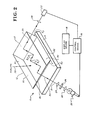
- FIGS. 2 and 3 there is illustrated an apparatus embodiment of the present invention particularly useful for practicing the process of the present invention for detecting or determining analyte;
- FIG. 2 is a diagrammatical illustration of such apparatus and
- FIG. 3 is a side view of FIG. 2.
- the apparatus is indicated by general numerical designation 10 and may include an optically transparent gel body 12, a suitable support 14 for the gel body, control means 16, display or indicating means 18, light beam source 20, and a light beam detector 22; as shown in FIG. 2, the light beam source 20 may be provided, if desired or required, with suitable collimating lenses 24, a filter 26, and the detector 22 may be provided, if desired or required, with suitable collecting lens 28, all as shown.
- the gel body 12 may be provided with a suitable stand alone prismatic shape, such as by molding, and as is further shown may be provided with a dove prism shape having parallel top and bottom surfaces 31 and 32, parallel side surfaces 33 and 34, and inclinded end surfaces 36 and 37; the gel comprising the gel body 12 may be chosen to permit such molding and stand alone characteristic.
- the critical angle ⁇ c for the total internal reflectance of the light beam 21 through the gel body 12 may be determined as taught above, and by transmitting the light beam 21 from the light beam source 20 such that the incident angles 9 1 and 9 2 at which the light beam 21 strikes or contacts the gel body-air interface is above the critical angle ⁇ c , the light beam 21 will be confined within the gel body and transmitted therethrough by total internal reflectance.
- the gel body is given a prismatic shape (e.g. dove prism shape) and the angle of inclination 9 3 of the entry and exit surfaces is chosen so as to permit the beam of light 21 to enter and exit the gel body perpendicularly with respect to the entry and exit gel surfaces 36 and 37 as well as strike or contact the gel body-air interface above the critical angle 9 c ; this may be better seen in FIG.
- the gel body 12 is provided with a reagent system as taught above and due to the manner of supporting of the gel body by the support 14 a sample portion of an analyte or a portion to be determined or identified, indicated by arrow 39, may be applied to a different surface of the gel body 12 (applied to the top surface 31 of the gel body) than the light beam 21 (applied to the inclined surface 36 of the gel body) thereby overcoming the prior art problem associated with a gel body for determining analyte wherein the analyte and light beam are applied to the same surface which, inter alia, can
- a sample portion or at least a portion of an analyte is applied to the top surface 31 and which diffuses into the gel body changing at least one optical transmissive property of the gel body (changing color, causing or producing a change in turbidity, etc.)
- the control means 16 operates the light beam source 20 to produce and transmit light beam 21 through the gel body by total internal reflectance as described above whereupon the light beam 21 is modified by the change in transmissive property of the gel body and the light detector 22 receives the modified light beam and transmits a signal to the control means 16 which in turn provides a signal to the display or indicating means 18 to display an indication of the determination of the analyte as determined by the control means 16.
- control means 16 may be suitably constructed and operated to provide an end-point determination of the analyte.
- the control means 16 prior to diffusing of the sample portion or at least a portion of the analyte into the gel body, the control means 16 oeprates the light beam 20 to transmit and pass the light beam 21 into and through the gel body 12 by total internal reflectance for receipt by the light beam detector 22 to provide a first signal to the control means which is suitably stored, and at a latter predetermined time subsequent to diffusing of the sample portion or at least a portion of the analyte into the gel body causing a change in optical transmissive property of the gel body, the control means 16 again operates the light beam source 20 to transmit and pass the light beam 21 into and through the gel body by total internal reflectance with the light beam being modified by the change in transmissive property of the gel body, the modified light beam is received by the light beam detector 22 which provides a second signal to the control means 16 which compares the first and second signals to provide
- the apparatus 10 of FIGS. 2 and 3 may be operated in a mode to provide a kinetic determination of the analyte; it will be understood by those skilled in the art that the term "kinetic" is used in the sense that the analyte determination is made on the basis of a measure of the rate of change of optical transmissive property of the gel body or while such change is "in motion.”
- a sample portion, or at least a portion of the analyte is diffused into the gel body and reacts varyingly with the reagent system therein during a predetermined period of time causing the gel body in turn to undergo a varying change in optical transmissive property during the predetermined period of time.
- control means 16 operate the light beam source 20 to cause the light beam 21 to pass into and through the gel by total internal reflectance with the light beam being varyingly modified during such period of time by the varying change in transmissive property of the gel; the varyingly modified light beam is received by the light detector 22 to produce and apply a varying signal to the control means during this predetermined period.
- the control means computes or measures the rate of change of the varying change in transmissive property of the gel body which rate of change, for example, may be compared with rates of change stored in the control means 16 that different analytes produce upon reaction with the reagent system within the gel body and thereby the analyte may be determined. This ditermination will cause the control means to provide a signal to the display means indicative, for example, of either the final analyte determination or a varying signal indicative of the rate of change.
- control means 16 may be comprised of suitable control elements known to the art and assembled in the manner known to the art to provide either the above- described end-point mode of analyte determination or measure of rate of change analyte determination. It is believed that patentability resides in the combination of such elements within the control means 16 in further combination with the other structure shown in FIGS. 2 and 3 and combined in accordance with the teachings herein.
- the top of the support 14 may be provided with suitable upwardly extending, parallel rails (not shown) for supporting the gel body 12 and with the rails extending parallel to the path of the light beam 21 through the gel body and spaced apart so as to reside on either side of the light beam path.
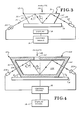
- FIG. 4 there is illlustrated diagrammatically another embodiment, apparatus 10A, embodying the present apparatus invention; structure in this FIG. corresponding to structure shown in FIGS. 2 and 3 is numbered correspondingly; the gel body 12A and container 40 are shown in good vertical cross-section, and it will be understood that the container 40 has parallel top and bottom inner and outer surfaces, parallel inner and outer side surfaces, and parallel inclined inner and outer surfaces at either end as shown.
- the gel body 12 having a reagent system within is contained within the prismatically shaped cuvette or container 40 of suitable prismatic shape, such as being provided with a dove prism shape.
- the prismatically shaped container or cuvette 40 provide a chamber for receiving the gel body 12A and for providing the gel body with the same prismatic shape; the top of the container 40 may be provided with a suitable opening 42 for permitting entry of a sample portion or at least a portion of the analyte into the cuvette to diffuse with the gel body 12 and react with the reagent system therein causing a change in at least one optical transmissive property of the gel body as described above.
- the respective ends 43 and 44 of the container or cuvette 40 are inclined at an angle 9 3 for the same reasons described above with regard to the inclination of end surfaces 36 and 37 of gel body 12 in FIGS. 2 and 3; also to assure an air-container interface at the bottom surface of the container 40, the container may be supported at its bottom surface as described above with respect to gel body 12 of FIGS. 2 and 3.
- the light beam 21A for total internal reflectance through the gel body 12A, is reflected at the interface between the top and bottom surfaces of the gel body and the top and bottom inner surfaces of the container or cuvette 40 as shown, with the light beam 21A striking these interfaces at angles of incidence, 9 1 and 0 2 greater than the critical angle ⁇ c taught above; the material (e.g. plastic) of which the container 40 is made is less dense than the gel body 12A and the relative index of refraction at the gel body 12A interface with the top and bottom inner surfaces of the container 40 is less than unity.
- apparatus 10A may be operated in either the end point mode or the kinetic mode for analyte determined as described above with regard to apparatus 10.
- FIG. 5 A still further alternate embodiment of analyte determination apparatus embodying the teachings of the present invention is illustrated diagrammatically in FIG. 5; it will be understood that this embodiment is substantially the same as the embodiment 10A illustrated in FIG. 4 except that in this embodiment the total reflectance of the light beam 21A occurs not at the gel body 12A container inner surfaces interface but instead occurs at the interface between the top and bottom outer surfaces of the container 50 with a surrounding medium, such as air.
- the gel body 12A is less dense than the material which the container 50 is made and hence the gel body 12A-container 50 interface has a relative index of refraction greater than unity (thus no critical angle for reflectance is possible at this interface), (ii) the container material is more dense than the surrounding air and the relative index of refraction between the top and bottom outer surfaces of the container 50 and the surrounding air is less than unity and hence has a critical angle 9 c for internal reflectance, and (iii) the angle of incidence 9 1 of the beam of light 21A at the interface between the outer top and bottom surfaces of the container 50 and air is below the critical angle 9 c for internal reflectance; whereupon, as shown, the light beam 21A is refracted at the interfaces between the gel body 12A and the top and bottom inner surfaces of the container 50 and passes through the container top and bottom walls 52 and 54 and contacts the interfaces between the top and bottom outer surfaces of the container 50 and air at angles of incidence 9 1 and 9 2 above the critical angle ⁇ c and is
- an alternative for total internal reflectance of the beam of light 21A through the gel body 12A is to mirror the inner top and bottom surfaces of the container 40 with a suitable mirroring material not reactive with the gel body and reagent system therein; this may be done for example by coating the inner surfaces of the container 40 with a layer of Mylar having one surface aluminized and with the un-aluminized Mylar surface being exposed to the gel body.
- sample portion when used in the present application and claims refers to either all or a pert ion of the sample which contains the analyte.
- the sample portion which diffuses into the gel may or may not contain the analyte depending on the particular assay.
- the sample portion which diffuses into the gel may include the analyte and the analyte interacts with the reagent system in the gel to change at least one transmissive property; for example, a glucose assay.
- sample portion which diffuses into the gel may contain a material other than the analyte, which material interacts with the reagent system to change at least one transmissive property which is used to determine analyte; for example, an immunoassay where tracer interacts with the reagent system to determine analyte.
- sample portion encompasses a sample portion which may or may not include the analyte.
- determining analyte or “determination of analyte” or terms of similar import encompasses both a qualitative determination and/or a quantitative determination.
Landscapes
- Health & Medical Sciences (AREA)
- Life Sciences & Earth Sciences (AREA)
- Chemical & Material Sciences (AREA)
- Immunology (AREA)
- Engineering & Computer Science (AREA)
- Molecular Biology (AREA)
- Analytical Chemistry (AREA)
- General Health & Medical Sciences (AREA)
- Biochemistry (AREA)
- Physics & Mathematics (AREA)
- Organic Chemistry (AREA)
- Zoology (AREA)
- Biomedical Technology (AREA)
- Wood Science & Technology (AREA)
- Biotechnology (AREA)
- Proteomics, Peptides & Aminoacids (AREA)
- Microbiology (AREA)
- Pathology (AREA)
- General Physics & Mathematics (AREA)
- Urology & Nephrology (AREA)
- Hematology (AREA)
- Bioinformatics & Cheminformatics (AREA)
- Cell Biology (AREA)
- Dispersion Chemistry (AREA)
- Genetics & Genomics (AREA)
- Food Science & Technology (AREA)
- Medicinal Chemistry (AREA)
- Biophysics (AREA)
- General Engineering & Computer Science (AREA)
- Investigating Or Analysing Materials By The Use Of Chemical Reactions (AREA)
Applications Claiming Priority (2)
| Application Number | Priority Date | Filing Date | Title |
|---|---|---|---|
| US07/876,473 US4962021A (en) | 1986-06-20 | 1986-06-20 | Analyte determination using gel including a reagent system reacts with analyte to change transmissive property of gel detectable by light beam transmitted through gel by total internal reflectance |
| US876473 | 2001-06-07 |
Publications (1)
| Publication Number | Publication Date |
|---|---|
| EP0249957A1 true EP0249957A1 (de) | 1987-12-23 |
Family
ID=25367797
Family Applications (1)
| Application Number | Title | Priority Date | Filing Date |
|---|---|---|---|
| EP87108686A Withdrawn EP0249957A1 (de) | 1986-06-20 | 1987-06-16 | Bestimmungssystem in einem Gelmaterial |
Country Status (2)
| Country | Link |
|---|---|
| US (1) | US4962021A (de) |
| EP (1) | EP0249957A1 (de) |
Families Citing this family (13)
| Publication number | Priority date | Publication date | Assignee | Title |
|---|---|---|---|---|
| US4935346A (en) | 1986-08-13 | 1990-06-19 | Lifescan, Inc. | Minimum procedure system for the determination of analytes |
| US5874216A (en) | 1996-02-23 | 1999-02-23 | Ensys Environmental Products, Inc. | Indirect label assay device for detecting small molecules and method of use thereof |
| US6602719B1 (en) | 1999-03-26 | 2003-08-05 | Idexx Laboratories, Inc. | Method and device for detecting analytes in fluids |
| US6551842B1 (en) | 1999-03-26 | 2003-04-22 | Idexx Laboratories, Inc. | Method and device for detecting analytes in fluids |
| US6511814B1 (en) | 1999-03-26 | 2003-01-28 | Idexx Laboratories, Inc. | Method and device for detecting analytes in fluids |
| US6458326B1 (en) | 1999-11-24 | 2002-10-01 | Home Diagnostics, Inc. | Protective test strip platform |
| US6525330B2 (en) | 2001-02-28 | 2003-02-25 | Home Diagnostics, Inc. | Method of strip insertion detection |
| US6562625B2 (en) | 2001-02-28 | 2003-05-13 | Home Diagnostics, Inc. | Distinguishing test types through spectral analysis |
| US6541266B2 (en) | 2001-02-28 | 2003-04-01 | Home Diagnostics, Inc. | Method for determining concentration of an analyte in a test strip |
| JP2007248367A (ja) * | 2006-03-17 | 2007-09-27 | Atsumi Tec:Kk | 水素ガス検知装置 |
| US8699025B2 (en) * | 2010-04-01 | 2014-04-15 | Stephen H. Hall | Method and apparatus for measuring hexavalent chromium in water |
| US9926519B2 (en) | 2012-06-08 | 2018-03-27 | S. C. Johnson & Son, Inc. | Self-adhesive detergent compositions with color-changing systems |
| US10901228B2 (en) * | 2017-06-27 | 2021-01-26 | The Boeing Company | Cavity with curved beam replicator and method of determining a characteristic of a medium therein |
Citations (3)
| Publication number | Priority date | Publication date | Assignee | Title |
|---|---|---|---|---|
| US4241176A (en) * | 1975-12-02 | 1980-12-23 | Etablissement declare d'Utilite Publique diti Institut Pasteur | Magnetic gel suitable to immunoenzymatic determinations |
| US4298687A (en) * | 1978-10-31 | 1981-11-03 | Roland Maes | Process for the determination of compounds showing among themselves specific binding affinities by the use of a solid phase |
| GB2138131A (en) * | 1983-04-07 | 1984-10-17 | Daryl Lab Inc | Substrate for fluoroassay of biological fluids |
Family Cites Families (9)
| Publication number | Priority date | Publication date | Assignee | Title |
|---|---|---|---|---|
| US3992158A (en) * | 1973-08-16 | 1976-11-16 | Eastman Kodak Company | Integral analytical element |
| US4041932A (en) * | 1975-02-06 | 1977-08-16 | Fostick Moshe A | Method for monitoring blood gas tension and pH from outside the body |
| DE2606991A1 (de) * | 1976-02-20 | 1977-08-25 | Nils Dr Med Kaiser | Geraet zur bestimmung des gehaltes von stoffwechselprodukten im blut |
| CA1095819A (en) * | 1977-01-14 | 1981-02-17 | Eastman Kodak Company | Element for analysis of liquids |
| US4250257A (en) * | 1978-08-24 | 1981-02-10 | Technicon Instruments Corporation | Whole blood analyses in porous media |
| US4399099A (en) * | 1979-09-20 | 1983-08-16 | Buckles Richard G | Optical fiber apparatus for quantitative analysis |
| JPS57200862A (en) * | 1981-06-05 | 1982-12-09 | Fuji Photo Film Co Ltd | Mutilayer analysis element utilizing unique binding reaction |
| US4411989A (en) * | 1981-08-13 | 1983-10-25 | Midwest Research Institute | Processes and devices for detection of substances such as enzyme inhibitors |
| US4461829A (en) * | 1981-09-14 | 1984-07-24 | Miles Laboratories, Inc. | Homogeneous specific binding assay element and lyophilization production method |
-
1986
- 1986-06-20 US US07/876,473 patent/US4962021A/en not_active Expired - Fee Related
-
1987
- 1987-06-16 EP EP87108686A patent/EP0249957A1/de not_active Withdrawn
Patent Citations (3)
| Publication number | Priority date | Publication date | Assignee | Title |
|---|---|---|---|---|
| US4241176A (en) * | 1975-12-02 | 1980-12-23 | Etablissement declare d'Utilite Publique diti Institut Pasteur | Magnetic gel suitable to immunoenzymatic determinations |
| US4298687A (en) * | 1978-10-31 | 1981-11-03 | Roland Maes | Process for the determination of compounds showing among themselves specific binding affinities by the use of a solid phase |
| GB2138131A (en) * | 1983-04-07 | 1984-10-17 | Daryl Lab Inc | Substrate for fluoroassay of biological fluids |
Also Published As
| Publication number | Publication date |
|---|---|
| US4962021A (en) | 1990-10-09 |
Similar Documents
| Publication | Publication Date | Title |
|---|---|---|
| EP0088636B1 (de) | Verfahren und Vorrichtung zur quantitativen Analyse | |
| US5674699A (en) | Two-phase optical assay | |
| Valkirs et al. | ImmunoConcentration--a new format for solid-phase immunoassays. | |
| CA2131146C (en) | Method for the determination of urinary protein and creatinine | |
| US4240751A (en) | Method and apparatus for specific binding substances | |
| US4791461A (en) | Portable analyzer | |
| US4962021A (en) | Analyte determination using gel including a reagent system reacts with analyte to change transmissive property of gel detectable by light beam transmitted through gel by total internal reflectance | |
| US6284472B1 (en) | Method for extending the range of an immunoassay | |
| EP0075353A1 (de) | Verfahren und Vorrichtung zur Bestimmung von gelösten Stoffen mit Hilfe eines optischen Wellenleiters | |
| JPS61182556A (ja) | フローセル中に位置した固定材料と放射線との相互作用を基にした非セグメント化連続流動分析方法 | |
| EP0183524A2 (de) | Tragbares Analysegerät | |
| EP0222341B1 (de) | Immunotestverfahren und Reagenz dafür | |
| US6602719B1 (en) | Method and device for detecting analytes in fluids | |
| EP1096248B1 (de) | Verfahren zur Messung der Konzentration einer Lösung | |
| EP0254430B1 (de) | Immunassaysystem mit Verwendung von Licht-Streuung | |
| WO1993025892A1 (en) | Sensor for optical assay | |
| US4753531A (en) | Flat container type analytical instrument | |
| Sutherland et al. | Preliminary results obtained with a no-label, homogeneous, optical immunoassay for human immunoglobulin G | |
| US5093271A (en) | Method for the quantitative determination of antigens and antibodies by ratio of absorbances at different wavelengths | |
| JPH09138195A (ja) | 多孔性材料中の液体の光学的測定法 | |
| US20060276975A1 (en) | Quantitative method and quantitative chip for target substance | |
| RU2008688C1 (ru) | Способ количественного определения иммуноглобулина в сыворотке крови человека | |
| JPH0843393A (ja) | 免疫学的測定方法及び分析装置 | |
| MXPA00011697A (en) | Method and device for detecting analytes in fluids | |
| JPH01221668A (ja) | 抗原−抗体反応測定法およびその測定装置 |
Legal Events
| Date | Code | Title | Description |
|---|---|---|---|
| PUAI | Public reference made under article 153(3) epc to a published international application that has entered the european phase |
Free format text: ORIGINAL CODE: 0009012 |
|
| AK | Designated contracting states |
Kind code of ref document: A1 Designated state(s): CH DE FR GB IT LI NL SE |
|
| 17P | Request for examination filed |
Effective date: 19880602 |
|
| 17Q | First examination report despatched |
Effective date: 19900426 |
|
| STAA | Information on the status of an ep patent application or granted ep patent |
Free format text: STATUS: THE APPLICATION IS DEEMED TO BE WITHDRAWN |
|
| 18D | Application deemed to be withdrawn |
Effective date: 19910711 |
|
| RIN1 | Information on inventor provided before grant (corrected) |
Inventor name: GUPTA, GARGI Inventor name: MESEROL, PETER M. Inventor name: BERNSTEIN, PHILIP Inventor name: PRODELL, RITA C. |