EP0249043B1 - Quinolinecarboxylic acid derivatives - Google Patents
Quinolinecarboxylic acid derivatives Download PDFInfo
- Publication number
- EP0249043B1 EP0249043B1 EP87106953A EP87106953A EP0249043B1 EP 0249043 B1 EP0249043 B1 EP 0249043B1 EP 87106953 A EP87106953 A EP 87106953A EP 87106953 A EP87106953 A EP 87106953A EP 0249043 B1 EP0249043 B1 EP 0249043B1
- Authority
- EP
- European Patent Office
- Prior art keywords
- carbon atoms
- oxo
- methyl
- quinoline
- thiaceto
- Prior art date
- Legal status (The legal status is an assumption and is not a legal conclusion. Google has not performed a legal analysis and makes no representation as to the accuracy of the status listed.)
- Expired - Lifetime
Links
- 125000000217 alkyl group Chemical group 0.000 claims abstract description 31
- 229910052736 halogen Inorganic materials 0.000 claims abstract description 15
- 125000002887 hydroxy group Chemical group [H]O* 0.000 claims abstract description 15
- 150000002367 halogens Chemical class 0.000 claims abstract description 14
- 229910052739 hydrogen Inorganic materials 0.000 claims abstract description 13
- 239000001257 hydrogen Substances 0.000 claims abstract description 13
- 150000003839 salts Chemical class 0.000 claims abstract description 12
- LOAUVZALPPNFOQ-UHFFFAOYSA-N quinaldic acid Chemical class C1=CC=CC2=NC(C(=O)O)=CC=C21 LOAUVZALPPNFOQ-UHFFFAOYSA-N 0.000 claims abstract description 9
- 125000002768 hydroxyalkyl group Chemical group 0.000 claims abstract description 8
- 125000001997 phenyl group Chemical group [H]C1=C([H])C([H])=C(*)C([H])=C1[H] 0.000 claims abstract description 8
- 125000002924 primary amino group Chemical group [H]N([H])* 0.000 claims abstract description 8
- 229910052757 nitrogen Inorganic materials 0.000 claims abstract description 7
- 125000000449 nitro group Chemical group [O-][N+](*)=O 0.000 claims abstract description 6
- 125000004433 nitrogen atom Chemical group N* 0.000 claims abstract description 4
- 125000004432 carbon atom Chemical group C* 0.000 claims description 58
- 150000001875 compounds Chemical class 0.000 claims description 53
- -1 pyrrolidino, piperidino Chemical group 0.000 claims description 38
- 125000003545 alkoxy group Chemical group 0.000 claims description 12
- 150000001412 amines Chemical class 0.000 claims description 12
- 125000001424 substituent group Chemical group 0.000 claims description 11
- 125000004435 hydrogen atom Chemical group [H]* 0.000 claims description 10
- 238000004519 manufacturing process Methods 0.000 claims description 10
- 125000002252 acyl group Chemical group 0.000 claims description 7
- 125000004183 alkoxy alkyl group Chemical group 0.000 claims description 7
- PXGOKWXKJXAPGV-UHFFFAOYSA-N Fluorine Chemical compound FF PXGOKWXKJXAPGV-UHFFFAOYSA-N 0.000 claims description 6
- 229910052731 fluorine Inorganic materials 0.000 claims description 6
- 239000011737 fluorine Substances 0.000 claims description 6
- 125000005354 acylalkyl group Chemical group 0.000 claims description 5
- 125000004423 acyloxy group Chemical group 0.000 claims description 5
- 125000003342 alkenyl group Chemical group 0.000 claims description 5
- 125000000304 alkynyl group Chemical group 0.000 claims description 5
- 239000008194 pharmaceutical composition Substances 0.000 claims description 5
- 241001465754 Metazoa Species 0.000 claims description 4
- 125000003282 alkyl amino group Chemical group 0.000 claims description 4
- 125000004103 aminoalkyl group Chemical group 0.000 claims description 4
- 125000003710 aryl alkyl group Chemical group 0.000 claims description 4
- 125000003118 aryl group Chemical group 0.000 claims description 4
- 125000004966 cyanoalkyl group Chemical group 0.000 claims description 4
- 125000004663 dialkyl amino group Chemical group 0.000 claims description 4
- 125000004043 oxo group Chemical group O=* 0.000 claims description 3
- 125000002023 trifluoromethyl group Chemical group FC(F)(F)* 0.000 claims description 3
- 208000035143 Bacterial infection Diseases 0.000 claims description 2
- 206010017533 Fungal infection Diseases 0.000 claims description 2
- 208000031888 Mycoses Diseases 0.000 claims description 2
- 230000001580 bacterial effect Effects 0.000 claims description 2
- 208000022362 bacterial infectious disease Diseases 0.000 claims description 2
- 238000006798 ring closing metathesis reaction Methods 0.000 claims description 2
- 208000035473 Communicable disease Diseases 0.000 abstract description 9
- 241000894006 Bacteria Species 0.000 abstract description 8
- 239000003814 drug Substances 0.000 abstract description 8
- IJGRMHOSHXDMSA-UHFFFAOYSA-N Atomic nitrogen Chemical compound N#N IJGRMHOSHXDMSA-UHFFFAOYSA-N 0.000 abstract description 6
- QVGXLLKOCUKJST-UHFFFAOYSA-N atomic oxygen Chemical compound [O] QVGXLLKOCUKJST-UHFFFAOYSA-N 0.000 abstract description 2
- 229910052760 oxygen Inorganic materials 0.000 abstract description 2
- 239000001301 oxygen Substances 0.000 abstract description 2
- 229910052717 sulfur Inorganic materials 0.000 abstract description 2
- 230000009885 systemic effect Effects 0.000 abstract description 2
- 150000002431 hydrogen Chemical class 0.000 abstract 2
- UFHFLCQGNIYNRP-UHFFFAOYSA-N Hydrogen Chemical compound [H][H] UFHFLCQGNIYNRP-UHFFFAOYSA-N 0.000 abstract 1
- NINIDFKCEFEMDL-UHFFFAOYSA-N Sulfur Chemical compound [S] NINIDFKCEFEMDL-UHFFFAOYSA-N 0.000 abstract 1
- 229940126573 antibacterial therapeutic Drugs 0.000 abstract 1
- 125000005843 halogen group Chemical group 0.000 abstract 1
- 125000005842 heteroatom Chemical group 0.000 abstract 1
- 239000011593 sulfur Substances 0.000 abstract 1
- DJXNJVFEFSWHLY-UHFFFAOYSA-N quinoline-3-carboxylic acid Chemical compound C1=CC=CC2=CC(C(=O)O)=CN=C21 DJXNJVFEFSWHLY-UHFFFAOYSA-N 0.000 description 87
- DJXNJVFEFSWHLY-UHFFFAOYSA-M quinoline-3-carboxylate Chemical compound C1=CC=CC2=CC(C(=O)[O-])=CN=C21 DJXNJVFEFSWHLY-UHFFFAOYSA-M 0.000 description 79
- 125000001495 ethyl group Chemical group [H]C([H])([H])C([H])([H])* 0.000 description 70
- ZMXDDKWLCZADIW-UHFFFAOYSA-N N,N-Dimethylformamide Chemical compound CN(C)C=O ZMXDDKWLCZADIW-UHFFFAOYSA-N 0.000 description 39
- 238000000034 method Methods 0.000 description 36
- 239000000243 solution Substances 0.000 description 34
- 239000013078 crystal Substances 0.000 description 33
- LFQSCWFLJHTTHZ-UHFFFAOYSA-N Ethanol Chemical compound CCO LFQSCWFLJHTTHZ-UHFFFAOYSA-N 0.000 description 32
- VEXZGXHMUGYJMC-UHFFFAOYSA-N Hydrochloric acid Chemical compound Cl VEXZGXHMUGYJMC-UHFFFAOYSA-N 0.000 description 27
- XLYOFNOQVPJJNP-UHFFFAOYSA-N water Chemical compound O XLYOFNOQVPJJNP-UHFFFAOYSA-N 0.000 description 26
- HEMHJVSKTPXQMS-UHFFFAOYSA-M Sodium hydroxide Chemical compound [OH-].[Na+] HEMHJVSKTPXQMS-UHFFFAOYSA-M 0.000 description 24
- 238000006243 chemical reaction Methods 0.000 description 24
- 239000000203 mixture Substances 0.000 description 23
- HEDRZPFGACZZDS-UHFFFAOYSA-N Chloroform Chemical compound ClC(Cl)Cl HEDRZPFGACZZDS-UHFFFAOYSA-N 0.000 description 22
- OKKJLVBELUTLKV-UHFFFAOYSA-N Methanol Chemical compound OC OKKJLVBELUTLKV-UHFFFAOYSA-N 0.000 description 22
- 238000003756 stirring Methods 0.000 description 21
- 239000002904 solvent Substances 0.000 description 20
- 239000002253 acid Substances 0.000 description 16
- 125000004494 ethyl ester group Chemical group 0.000 description 16
- XEKOWRVHYACXOJ-UHFFFAOYSA-N Ethyl acetate Chemical compound CCOC(C)=O XEKOWRVHYACXOJ-UHFFFAOYSA-N 0.000 description 15
- RTZKZFJDLAIYFH-UHFFFAOYSA-N Diethyl ether Chemical compound CCOCC RTZKZFJDLAIYFH-UHFFFAOYSA-N 0.000 description 14
- BWHMMNNQKKPAPP-UHFFFAOYSA-L potassium carbonate Chemical compound [K+].[K+].[O-]C([O-])=O BWHMMNNQKKPAPP-UHFFFAOYSA-L 0.000 description 12
- QAOWNCQODCNURD-UHFFFAOYSA-N Sulfuric acid Chemical compound OS(O)(=O)=O QAOWNCQODCNURD-UHFFFAOYSA-N 0.000 description 11
- 238000001816 cooling Methods 0.000 description 11
- 238000001914 filtration Methods 0.000 description 11
- 239000000155 melt Substances 0.000 description 11
- KWYUFKZDYYNOTN-UHFFFAOYSA-M Potassium hydroxide Chemical compound [OH-].[K+] KWYUFKZDYYNOTN-UHFFFAOYSA-M 0.000 description 10
- QAOWNCQODCNURD-UHFFFAOYSA-L Sulfate Chemical compound [O-]S([O-])(=O)=O QAOWNCQODCNURD-UHFFFAOYSA-L 0.000 description 10
- 230000000844 anti-bacterial effect Effects 0.000 description 10
- 239000005457 ice water Substances 0.000 description 10
- 0 *Cc1cc(C(C(C=C(CN2)*3C2O)N)=O)c3c(O)c1** Chemical compound *Cc1cc(C(C(C=C(CN2)*3C2O)N)=O)c3c(O)c1** 0.000 description 9
- QTBSBXVTEAMEQO-UHFFFAOYSA-N Acetic acid Chemical compound CC(O)=O QTBSBXVTEAMEQO-UHFFFAOYSA-N 0.000 description 9
- CSCPPACGZOOCGX-UHFFFAOYSA-N Acetone Chemical compound CC(C)=O CSCPPACGZOOCGX-UHFFFAOYSA-N 0.000 description 9
- VLKZOEOYAKHREP-UHFFFAOYSA-N n-Hexane Chemical compound CCCCCC VLKZOEOYAKHREP-UHFFFAOYSA-N 0.000 description 8
- 239000000126 substance Substances 0.000 description 8
- PMZURENOXWZQFD-UHFFFAOYSA-L Sodium Sulfate Chemical compound [Na+].[Na+].[O-]S([O-])(=O)=O PMZURENOXWZQFD-UHFFFAOYSA-L 0.000 description 7
- 238000004458 analytical method Methods 0.000 description 7
- 239000003795 chemical substances by application Substances 0.000 description 7
- 150000002148 esters Chemical class 0.000 description 7
- 229910052938 sodium sulfate Inorganic materials 0.000 description 7
- 235000011152 sodium sulphate Nutrition 0.000 description 7
- VZCYOOQTPOCHFL-UHFFFAOYSA-N trans-butenedioic acid Natural products OC(=O)C=CC(O)=O VZCYOOQTPOCHFL-UHFFFAOYSA-N 0.000 description 7
- AFVFQIVMOAPDHO-UHFFFAOYSA-N Methanesulfonic acid Chemical compound CS(O)(=O)=O AFVFQIVMOAPDHO-UHFFFAOYSA-N 0.000 description 6
- 241000699670 Mus sp. Species 0.000 description 6
- WYURNTSHIVDZCO-UHFFFAOYSA-N Tetrahydrofuran Chemical compound C1CCOC1 WYURNTSHIVDZCO-UHFFFAOYSA-N 0.000 description 6
- ZMANZCXQSJIPKH-UHFFFAOYSA-N Triethylamine Chemical compound CCN(CC)CC ZMANZCXQSJIPKH-UHFFFAOYSA-N 0.000 description 6
- 150000001732 carboxylic acid derivatives Chemical class 0.000 description 6
- 238000004440 column chromatography Methods 0.000 description 6
- IDYZIJYBMGIQMJ-UHFFFAOYSA-N enoxacin Chemical compound N1=C2N(CC)C=C(C(O)=O)C(=O)C2=CC(F)=C1N1CCNCC1 IDYZIJYBMGIQMJ-UHFFFAOYSA-N 0.000 description 6
- VZCYOOQTPOCHFL-UPHRSURJSA-N maleic acid Chemical compound OC(=O)\C=C/C(O)=O VZCYOOQTPOCHFL-UPHRSURJSA-N 0.000 description 6
- 229910000027 potassium carbonate Inorganic materials 0.000 description 6
- NLKNQRATVPKPDG-UHFFFAOYSA-M potassium iodide Chemical compound [K+].[I-] NLKNQRATVPKPDG-UHFFFAOYSA-M 0.000 description 6
- 238000012360 testing method Methods 0.000 description 6
- GSDSWSVVBLHKDQ-UHFFFAOYSA-N 9-fluoro-3-methyl-10-(4-methylpiperazin-1-yl)-7-oxo-2,3-dihydro-7H-[1,4]oxazino[2,3,4-ij]quinoline-6-carboxylic acid Chemical compound FC1=CC(C(C(C(O)=O)=C2)=O)=C3N2C(C)COC3=C1N1CCN(C)CC1 GSDSWSVVBLHKDQ-UHFFFAOYSA-N 0.000 description 5
- 230000000694 effects Effects 0.000 description 5
- 229960002549 enoxacin Drugs 0.000 description 5
- HIFJUMGIHIZEPX-UHFFFAOYSA-N sulfuric acid;sulfur trioxide Chemical compound O=S(=O)=O.OS(O)(=O)=O HIFJUMGIHIZEPX-UHFFFAOYSA-N 0.000 description 5
- IAZDPXIOMUYVGZ-UHFFFAOYSA-N Dimethylsulphoxide Chemical compound CS(C)=O IAZDPXIOMUYVGZ-UHFFFAOYSA-N 0.000 description 4
- LRHPLDYGYMQRHN-UHFFFAOYSA-N N-Butanol Chemical compound CCCCO LRHPLDYGYMQRHN-UHFFFAOYSA-N 0.000 description 4
- GLUUGHFHXGJENI-UHFFFAOYSA-N Piperazine Chemical compound C1CNCCN1 GLUUGHFHXGJENI-UHFFFAOYSA-N 0.000 description 4
- FAPWRFPIFSIZLT-UHFFFAOYSA-M Sodium chloride Chemical class [Na+].[Cl-] FAPWRFPIFSIZLT-UHFFFAOYSA-M 0.000 description 4
- 230000002378 acidificating effect Effects 0.000 description 4
- 229940088710 antibiotic agent Drugs 0.000 description 4
- CCIVGXIOQKPBKL-UHFFFAOYSA-M ethanesulfonate Chemical compound CCS([O-])(=O)=O CCIVGXIOQKPBKL-UHFFFAOYSA-M 0.000 description 4
- 125000001449 isopropyl group Chemical group [H]C([H])([H])C([H])(*)C([H])([H])[H] 0.000 description 4
- BDAGIHXWWSANSR-UHFFFAOYSA-N methanoic acid Natural products OC=O BDAGIHXWWSANSR-UHFFFAOYSA-N 0.000 description 4
- 125000002496 methyl group Chemical group [H]C([H])([H])* 0.000 description 4
- 229960001699 ofloxacin Drugs 0.000 description 4
- 229920000137 polyphosphoric acid Polymers 0.000 description 4
- 159000000000 sodium salts Chemical class 0.000 description 4
- 239000007858 starting material Substances 0.000 description 4
- MNFSSEUNEZGWRS-UHFFFAOYSA-N thiazetidine Chemical group C1CSN1 MNFSSEUNEZGWRS-UHFFFAOYSA-N 0.000 description 4
- FYSNRJHAOHDILO-UHFFFAOYSA-N thionyl chloride Chemical compound ClS(Cl)=O FYSNRJHAOHDILO-UHFFFAOYSA-N 0.000 description 4
- JOXIMZWYDAKGHI-UHFFFAOYSA-N toluene-4-sulfonic acid Chemical compound CC1=CC=C(S(O)(=O)=O)C=C1 JOXIMZWYDAKGHI-UHFFFAOYSA-N 0.000 description 4
- BMYNFMYTOJXKLE-UHFFFAOYSA-N 3-azaniumyl-2-hydroxypropanoate Chemical compound NCC(O)C(O)=O BMYNFMYTOJXKLE-UHFFFAOYSA-N 0.000 description 3
- QOXOZONBQWIKDA-UHFFFAOYSA-N 3-hydroxypropyl Chemical group [CH2]CCO QOXOZONBQWIKDA-UHFFFAOYSA-N 0.000 description 3
- WEVYAHXRMPXWCK-UHFFFAOYSA-N Acetonitrile Chemical compound CC#N WEVYAHXRMPXWCK-UHFFFAOYSA-N 0.000 description 3
- QGJOPFRUJISHPQ-UHFFFAOYSA-N Carbon disulfide Chemical compound S=C=S QGJOPFRUJISHPQ-UHFFFAOYSA-N 0.000 description 3
- YMWUJEATGCHHMB-UHFFFAOYSA-N Dichloromethane Chemical compound ClCCl YMWUJEATGCHHMB-UHFFFAOYSA-N 0.000 description 3
- 241000588724 Escherichia coli Species 0.000 description 3
- KRHYYFGTRYWZRS-UHFFFAOYSA-N Fluorane Chemical compound F KRHYYFGTRYWZRS-UHFFFAOYSA-N 0.000 description 3
- PEDCQBHIVMGVHV-UHFFFAOYSA-N Glycerine Chemical compound OCC(O)CO PEDCQBHIVMGVHV-UHFFFAOYSA-N 0.000 description 3
- DGAQECJNVWCQMB-PUAWFVPOSA-M Ilexoside XXIX Chemical compound C[C@@H]1CC[C@@]2(CC[C@@]3(C(=CC[C@H]4[C@]3(CC[C@@H]5[C@@]4(CC[C@@H](C5(C)C)OS(=O)(=O)[O-])C)C)[C@@H]2[C@]1(C)O)C)C(=O)O[C@H]6[C@@H]([C@H]([C@@H]([C@H](O6)CO)O)O)O.[Na+] DGAQECJNVWCQMB-PUAWFVPOSA-M 0.000 description 3
- VYPSYNLAJGMNEJ-UHFFFAOYSA-N Silicium dioxide Chemical compound O=[Si]=O VYPSYNLAJGMNEJ-UHFFFAOYSA-N 0.000 description 3
- 235000011054 acetic acid Nutrition 0.000 description 3
- 125000003277 amino group Chemical group 0.000 description 3
- 230000037396 body weight Effects 0.000 description 3
- KRKNYBCHXYNGOX-UHFFFAOYSA-N citric acid Chemical compound OC(=O)CC(O)(C(O)=O)CC(O)=O KRKNYBCHXYNGOX-UHFFFAOYSA-N 0.000 description 3
- NZZFYRREKKOMAT-UHFFFAOYSA-N diiodomethane Chemical compound ICI NZZFYRREKKOMAT-UHFFFAOYSA-N 0.000 description 3
- 201000010099 disease Diseases 0.000 description 3
- 208000037265 diseases, disorders, signs and symptoms Diseases 0.000 description 3
- 229940079593 drug Drugs 0.000 description 3
- 238000010438 heat treatment Methods 0.000 description 3
- 125000004108 n-butyl group Chemical group [H]C([H])([H])C([H])([H])C([H])([H])C([H])([H])* 0.000 description 3
- 239000000741 silica gel Substances 0.000 description 3
- 229910002027 silica gel Inorganic materials 0.000 description 3
- 239000011734 sodium Substances 0.000 description 3
- 229910052708 sodium Inorganic materials 0.000 description 3
- FVAUCKIRQBBSSJ-UHFFFAOYSA-M sodium iodide Chemical compound [Na+].[I-] FVAUCKIRQBBSSJ-UHFFFAOYSA-M 0.000 description 3
- 239000000725 suspension Substances 0.000 description 3
- YLQBMQCUIZJEEH-UHFFFAOYSA-N tetrahydrofuran Natural products C=1C=COC=1 YLQBMQCUIZJEEH-UHFFFAOYSA-N 0.000 description 3
- 230000001225 therapeutic effect Effects 0.000 description 3
- APQIUTYORBAGEZ-UHFFFAOYSA-N 1,1-dibromoethane Chemical compound CC(Br)Br APQIUTYORBAGEZ-UHFFFAOYSA-N 0.000 description 2
- 125000000954 2-hydroxyethyl group Chemical group [H]C([*])([H])C([H])([H])O[H] 0.000 description 2
- OSWFIVFLDKOXQC-UHFFFAOYSA-N 4-(3-methoxyphenyl)aniline Chemical compound COC1=CC=CC(C=2C=CC(N)=CC=2)=C1 OSWFIVFLDKOXQC-UHFFFAOYSA-N 0.000 description 2
- 229920001817 Agar Polymers 0.000 description 2
- WKBOTKDWSSQWDR-UHFFFAOYSA-N Bromine atom Chemical compound [Br] WKBOTKDWSSQWDR-UHFFFAOYSA-N 0.000 description 2
- GAWIXWVDTYZWAW-UHFFFAOYSA-N C[CH]O Chemical group C[CH]O GAWIXWVDTYZWAW-UHFFFAOYSA-N 0.000 description 2
- ZAMOUSCENKQFHK-UHFFFAOYSA-N Chlorine atom Chemical compound [Cl] ZAMOUSCENKQFHK-UHFFFAOYSA-N 0.000 description 2
- IAZDPXIOMUYVGZ-WFGJKAKNSA-N Dimethyl sulfoxide Chemical compound [2H]C([2H])([2H])S(=O)C([2H])([2H])[2H] IAZDPXIOMUYVGZ-WFGJKAKNSA-N 0.000 description 2
- VZCYOOQTPOCHFL-OWOJBTEDSA-N Fumaric acid Chemical compound OC(=O)\C=C\C(O)=O VZCYOOQTPOCHFL-OWOJBTEDSA-N 0.000 description 2
- 241000699666 Mus <mouse, genus> Species 0.000 description 2
- FXHOOIRPVKKKFG-UHFFFAOYSA-N N,N-Dimethylacetamide Chemical compound CN(C)C(C)=O FXHOOIRPVKKKFG-UHFFFAOYSA-N 0.000 description 2
- PCLIMKBDDGJMGD-UHFFFAOYSA-N N-bromosuccinimide Chemical compound BrN1C(=O)CCC1=O PCLIMKBDDGJMGD-UHFFFAOYSA-N 0.000 description 2
- JRNVZBWKYDBUCA-UHFFFAOYSA-N N-chlorosuccinimide Chemical compound ClN1C(=O)CCC1=O JRNVZBWKYDBUCA-UHFFFAOYSA-N 0.000 description 2
- NBIIXXVUZAFLBC-UHFFFAOYSA-N Phosphoric acid Chemical compound OP(O)(O)=O NBIIXXVUZAFLBC-UHFFFAOYSA-N 0.000 description 2
- 241000589517 Pseudomonas aeruginosa Species 0.000 description 2
- CDBYLPFSWZWCQE-UHFFFAOYSA-L Sodium Carbonate Chemical compound [Na+].[Na+].[O-]C([O-])=O CDBYLPFSWZWCQE-UHFFFAOYSA-L 0.000 description 2
- UIIMBOGNXHQVGW-UHFFFAOYSA-M Sodium bicarbonate Chemical class [Na+].OC([O-])=O UIIMBOGNXHQVGW-UHFFFAOYSA-M 0.000 description 2
- WQDUMFSSJAZKTM-UHFFFAOYSA-N Sodium methoxide Chemical compound [Na+].[O-]C WQDUMFSSJAZKTM-UHFFFAOYSA-N 0.000 description 2
- DKGAVHZHDRPRBM-UHFFFAOYSA-N Tert-Butanol Chemical compound CC(C)(C)O DKGAVHZHDRPRBM-UHFFFAOYSA-N 0.000 description 2
- 150000007513 acids Chemical class 0.000 description 2
- 239000008272 agar Substances 0.000 description 2
- 239000007864 aqueous solution Substances 0.000 description 2
- GDTBXPJZTBHREO-UHFFFAOYSA-N bromine Substances BrBr GDTBXPJZTBHREO-UHFFFAOYSA-N 0.000 description 2
- 229910052794 bromium Inorganic materials 0.000 description 2
- VQFAIAKCILWQPZ-UHFFFAOYSA-N bromoacetone Chemical compound CC(=O)CBr VQFAIAKCILWQPZ-UHFFFAOYSA-N 0.000 description 2
- 229910052799 carbon Inorganic materials 0.000 description 2
- 230000003197 catalytic effect Effects 0.000 description 2
- 239000000460 chlorine Substances 0.000 description 2
- 229910052801 chlorine Inorganic materials 0.000 description 2
- ZUOUZKKEUPVFJK-UHFFFAOYSA-N diphenyl Chemical compound C1=CC=CC=C1C1=CC=CC=C1 ZUOUZKKEUPVFJK-UHFFFAOYSA-N 0.000 description 2
- USIUVYZYUHIAEV-UHFFFAOYSA-N diphenyl ether Chemical compound C=1C=CC=CC=1OC1=CC=CC=C1 USIUVYZYUHIAEV-UHFFFAOYSA-N 0.000 description 2
- 230000032050 esterification Effects 0.000 description 2
- 238000005886 esterification reaction Methods 0.000 description 2
- 235000019253 formic acid Nutrition 0.000 description 2
- 238000006460 hydrolysis reaction Methods 0.000 description 2
- 239000012442 inert solvent Substances 0.000 description 2
- 208000015181 infectious disease Diseases 0.000 description 2
- 125000000959 isobutyl group Chemical group [H]C([H])([H])C([H])(C([H])([H])[H])C([H])([H])* 0.000 description 2
- JVTAAEKCZFNVCJ-UHFFFAOYSA-N lactic acid Chemical compound CC(O)C(O)=O JVTAAEKCZFNVCJ-UHFFFAOYSA-N 0.000 description 2
- 239000007788 liquid Substances 0.000 description 2
- 125000004123 n-propyl group Chemical group [H]C([H])([H])C([H])([H])C([H])([H])* 0.000 description 2
- 239000003921 oil Substances 0.000 description 2
- XHXFXVLFKHQFAL-UHFFFAOYSA-N phosphoryl trichloride Chemical compound ClP(Cl)(Cl)=O XHXFXVLFKHQFAL-UHFFFAOYSA-N 0.000 description 2
- FGIUAXJPYTZDNR-UHFFFAOYSA-N potassium nitrate Chemical compound [K+].[O-][N+]([O-])=O FGIUAXJPYTZDNR-UHFFFAOYSA-N 0.000 description 2
- 239000000843 powder Substances 0.000 description 2
- 239000000047 product Substances 0.000 description 2
- BDERNNFJNOPAEC-UHFFFAOYSA-N propan-1-ol Chemical compound CCCO BDERNNFJNOPAEC-UHFFFAOYSA-N 0.000 description 2
- 238000000746 purification Methods 0.000 description 2
- 239000011541 reaction mixture Substances 0.000 description 2
- 238000007363 ring formation reaction Methods 0.000 description 2
- 230000035945 sensitivity Effects 0.000 description 2
- 125000004434 sulfur atom Chemical group 0.000 description 2
- 238000010998 test method Methods 0.000 description 2
- VZGDMQKNWNREIO-UHFFFAOYSA-N tetrachloromethane Chemical compound ClC(Cl)(Cl)Cl VZGDMQKNWNREIO-UHFFFAOYSA-N 0.000 description 2
- 229940124597 therapeutic agent Drugs 0.000 description 2
- FWPIDFUJEMBDLS-UHFFFAOYSA-L tin(II) chloride dihydrate Chemical compound O.O.Cl[Sn]Cl FWPIDFUJEMBDLS-UHFFFAOYSA-L 0.000 description 2
- 231100000419 toxicity Toxicity 0.000 description 2
- 230000001988 toxicity Effects 0.000 description 2
- 238000005406 washing Methods 0.000 description 2
- MIOPJNTWMNEORI-GMSGAONNSA-N (S)-camphorsulfonic acid Chemical compound C1C[C@@]2(CS(O)(=O)=O)C(=O)C[C@@H]1C2(C)C MIOPJNTWMNEORI-GMSGAONNSA-N 0.000 description 1
- SVZKYXSJICYUOH-UHFFFAOYSA-N 1,2-difluoro-4-isothiocyanatobenzene Chemical compound FC1=CC=C(N=C=S)C=C1F SVZKYXSJICYUOH-UHFFFAOYSA-N 0.000 description 1
- KEQGZUUPPQEDPF-UHFFFAOYSA-N 1,3-dichloro-5,5-dimethylimidazolidine-2,4-dione Chemical compound CC1(C)N(Cl)C(=O)N(Cl)C1=O KEQGZUUPPQEDPF-UHFFFAOYSA-N 0.000 description 1
- RYHBNJHYFVUHQT-UHFFFAOYSA-N 1,4-Dioxane Chemical compound C1COCCO1 RYHBNJHYFVUHQT-UHFFFAOYSA-N 0.000 description 1
- CBNXMWAHUGHCNO-UHFFFAOYSA-N 1-(2-fluoro-6-methoxyphenyl)-4-methylpiperazine Chemical compound COC1=CC=CC(F)=C1N1CCN(C)CC1 CBNXMWAHUGHCNO-UHFFFAOYSA-N 0.000 description 1
- FNYYIKRCDSATNB-UHFFFAOYSA-N 1-(2-fluoro-6-methoxyphenyl)piperazine Chemical compound COC1=CC=CC(F)=C1N1CCNCC1 FNYYIKRCDSATNB-UHFFFAOYSA-N 0.000 description 1
- IAKJAFLYVCGWAU-UHFFFAOYSA-N 1-(3-bromo-2-fluoro-6-methoxy-5-nitrophenyl)-4-methylpiperazine Chemical compound COC1=C([N+]([O-])=O)C=C(Br)C(F)=C1N1CCN(C)CC1 IAKJAFLYVCGWAU-UHFFFAOYSA-N 0.000 description 1
- SZVRYLYNTOFQGD-UHFFFAOYSA-N 1-(3-bromo-2-fluoro-6-methoxyphenyl)-4-methylpiperazine Chemical compound COC1=CC=C(Br)C(F)=C1N1CCN(C)CC1 SZVRYLYNTOFQGD-UHFFFAOYSA-N 0.000 description 1
- PVOAHINGSUIXLS-UHFFFAOYSA-N 1-Methylpiperazine Chemical compound CN1CCNCC1 PVOAHINGSUIXLS-UHFFFAOYSA-N 0.000 description 1
- YUZTXDTZXNPERC-UHFFFAOYSA-N 1-[4-(2-fluoro-5-isothiocyanatophenyl)piperazin-1-yl]ethanone Chemical compound C1CN(C(=O)C)CCN1C1=CC(N=C=S)=CC=C1F YUZTXDTZXNPERC-UHFFFAOYSA-N 0.000 description 1
- 125000000530 1-propynyl group Chemical group [H]C([H])([H])C#C* 0.000 description 1
- KXZSVYHFYHTNBI-UHFFFAOYSA-N 1h-quinoline-2-thione Chemical group C1=CC=CC2=NC(S)=CC=C21 KXZSVYHFYHTNBI-UHFFFAOYSA-N 0.000 description 1
- LTMRRSWNXVJMBA-UHFFFAOYSA-L 2,2-diethylpropanedioate Chemical compound CCC(CC)(C([O-])=O)C([O-])=O LTMRRSWNXVJMBA-UHFFFAOYSA-L 0.000 description 1
- YQTCQNIPQMJNTI-UHFFFAOYSA-N 2,2-dimethylpropan-1-one Chemical group CC(C)(C)[C]=O YQTCQNIPQMJNTI-UHFFFAOYSA-N 0.000 description 1
- LBLYYCQCTBFVLH-UHFFFAOYSA-N 2-Methylbenzenesulfonic acid Chemical compound CC1=CC=CC=C1S(O)(=O)=O LBLYYCQCTBFVLH-UHFFFAOYSA-N 0.000 description 1
- 125000000022 2-aminoethyl group Chemical group [H]C([*])([H])C([H])([H])N([H])[H] 0.000 description 1
- YHHKEXPNBPDPOW-UHFFFAOYSA-N 2-bromo-n-(2-bromoethyl)ethanamine;hydrobromide Chemical compound Br.BrCCNCCBr YHHKEXPNBPDPOW-UHFFFAOYSA-N 0.000 description 1
- 125000004974 2-butenyl group Chemical group C(C=CC)* 0.000 description 1
- 125000001731 2-cyanoethyl group Chemical group [H]C([H])(*)C([H])([H])C#N 0.000 description 1
- VHHKZASLPJMWJI-UHFFFAOYSA-N 2-fluoro-6-methoxyaniline Chemical compound COC1=CC=CC(F)=C1N VHHKZASLPJMWJI-UHFFFAOYSA-N 0.000 description 1
- LBLYYCQCTBFVLH-UHFFFAOYSA-M 2-methylbenzenesulfonate Chemical compound CC1=CC=CC=C1S([O-])(=O)=O LBLYYCQCTBFVLH-UHFFFAOYSA-M 0.000 description 1
- ZQXSFZAMFNRZOQ-UHFFFAOYSA-N 2-methylpropan-2-ol;hydrate Chemical compound O.CC(C)(C)O ZQXSFZAMFNRZOQ-UHFFFAOYSA-N 0.000 description 1
- 229940080296 2-naphthalenesulfonate Drugs 0.000 description 1
- 125000000094 2-phenylethyl group Chemical group [H]C1=C([H])C([H])=C(C([H])=C1[H])C([H])([H])C([H])([H])* 0.000 description 1
- 125000003903 2-propenyl group Chemical group [H]C([*])([H])C([H])=C([H])[H] 0.000 description 1
- 125000001494 2-propynyl group Chemical group [H]C#CC([H])([H])* 0.000 description 1
- AXNUZKSSQHTNPZ-UHFFFAOYSA-N 3,4-difluoroaniline Chemical compound NC1=CC=C(F)C(F)=C1 AXNUZKSSQHTNPZ-UHFFFAOYSA-N 0.000 description 1
- JXSJBLHUYIKAJI-UHFFFAOYSA-N 3-[3-(4-acetylpiperazin-1-yl)-4-fluoroanilino]sulfanyl-2-ethoxycarbonylprop-2-enoic acid Chemical compound CCOC(=O)C(C(O)=O)=CSNC1=CC=C(F)C(N2CCN(CC2)C(C)=O)=C1 JXSJBLHUYIKAJI-UHFFFAOYSA-N 0.000 description 1
- 125000004975 3-butenyl group Chemical group C(CC=C)* 0.000 description 1
- 125000004042 4-aminobutyl group Chemical group [H]C([*])([H])C([H])([H])C([H])([H])C([H])([H])N([H])[H] 0.000 description 1
- POYCBSPHCOQBQM-UHFFFAOYSA-N 4-fluoro-2-methoxy-3-(4-methylpiperazin-1-yl)aniline Chemical compound COC1=C(N)C=CC(F)=C1N1CCN(C)CC1 POYCBSPHCOQBQM-UHFFFAOYSA-N 0.000 description 1
- QWPDMFVRIAHBHQ-UHFFFAOYSA-N 5-bromo-4-fluoro-2-methoxy-3-(4-methylpiperazin-1-yl)aniline Chemical compound COC1=C(N)C=C(Br)C(F)=C1N1CCN(C)CC1 QWPDMFVRIAHBHQ-UHFFFAOYSA-N 0.000 description 1
- UCPKCFZDOFSYNK-UHFFFAOYSA-N 6-fluoro-1-methyl-7-(4-methyl-1,4-diazepan-1-yl)-4-oxo-1h-[1,3]thiazeto[3,2-a]quinoline-3-carboxylic acid Chemical compound C1=C2N3C(C)SC3=C(C(O)=O)C(=O)C2=CC(F)=C1N1CCCN(C)CC1 UCPKCFZDOFSYNK-UHFFFAOYSA-N 0.000 description 1
- ZCYVEMRRCGMTRW-UHFFFAOYSA-N 7553-56-2 Chemical compound [I] ZCYVEMRRCGMTRW-UHFFFAOYSA-N 0.000 description 1
- VHUUQVKOLVNVRT-UHFFFAOYSA-N Ammonium hydroxide Chemical compound [NH4+].[OH-] VHUUQVKOLVNVRT-UHFFFAOYSA-N 0.000 description 1
- BXQOEHAHPWYIMC-UHFFFAOYSA-N CCOC(=O)C(C(O)=O)=C1SCN1C1=CC=C(F)C(N2CCN(CC2)C(C)=O)=C1 Chemical compound CCOC(=O)C(C(O)=O)=C1SCN1C1=CC=C(F)C(N2CCN(CC2)C(C)=O)=C1 BXQOEHAHPWYIMC-UHFFFAOYSA-N 0.000 description 1
- OYPRJOBELJOOCE-UHFFFAOYSA-N Calcium Chemical compound [Ca] OYPRJOBELJOOCE-UHFFFAOYSA-N 0.000 description 1
- XJUZRXYOEPSWMB-UHFFFAOYSA-N Chloromethyl methyl ether Chemical compound COCCl XJUZRXYOEPSWMB-UHFFFAOYSA-N 0.000 description 1
- FEWJPZIEWOKRBE-JCYAYHJZSA-N Dextrotartaric acid Chemical compound OC(=O)[C@H](O)[C@@H](O)C(O)=O FEWJPZIEWOKRBE-JCYAYHJZSA-N 0.000 description 1
- QOSSAOTZNIDXMA-UHFFFAOYSA-N Dicylcohexylcarbodiimide Chemical compound C1CCCCC1N=C=NC1CCCCC1 QOSSAOTZNIDXMA-UHFFFAOYSA-N 0.000 description 1
- 241000192125 Firmicutes Species 0.000 description 1
- WSFSSNUMVMOOMR-UHFFFAOYSA-N Formaldehyde Chemical compound O=C WSFSSNUMVMOOMR-UHFFFAOYSA-N 0.000 description 1
- BDAGIHXWWSANSR-UHFFFAOYSA-M Formate Chemical compound [O-]C=O BDAGIHXWWSANSR-UHFFFAOYSA-M 0.000 description 1
- 241000282412 Homo Species 0.000 description 1
- 229910002651 NO3 Inorganic materials 0.000 description 1
- NHNBFGGVMKEFGY-UHFFFAOYSA-N Nitrate Chemical compound [O-][N+]([O-])=O NHNBFGGVMKEFGY-UHFFFAOYSA-N 0.000 description 1
- GRYLNZFGIOXLOG-UHFFFAOYSA-N Nitric acid Chemical compound O[N+]([O-])=O GRYLNZFGIOXLOG-UHFFFAOYSA-N 0.000 description 1
- 229920000388 Polyphosphate Polymers 0.000 description 1
- ZLMJMSJWJFRBEC-UHFFFAOYSA-N Potassium Chemical compound [K] ZLMJMSJWJFRBEC-UHFFFAOYSA-N 0.000 description 1
- OFOBLEOULBTSOW-UHFFFAOYSA-N Propanedioic acid Natural products OC(=O)CC(O)=O OFOBLEOULBTSOW-UHFFFAOYSA-N 0.000 description 1
- 241000085494 Pseudomonas aeruginosa E2 Species 0.000 description 1
- KEAYESYHFKHZAL-UHFFFAOYSA-N Sodium Chemical compound [Na] KEAYESYHFKHZAL-UHFFFAOYSA-N 0.000 description 1
- UIIMBOGNXHQVGW-DEQYMQKBSA-M Sodium bicarbonate-14C Chemical compound [Na+].O[14C]([O-])=O UIIMBOGNXHQVGW-DEQYMQKBSA-M 0.000 description 1
- KDYFGRWQOYBRFD-UHFFFAOYSA-N Succinic acid Natural products OC(=O)CCC(O)=O KDYFGRWQOYBRFD-UHFFFAOYSA-N 0.000 description 1
- FEWJPZIEWOKRBE-UHFFFAOYSA-N Tartaric acid Natural products [H+].[H+].[O-]C(=O)C(O)C(O)C([O-])=O FEWJPZIEWOKRBE-UHFFFAOYSA-N 0.000 description 1
- 125000000738 acetamido group Chemical group [H]C([H])([H])C(=O)N([H])[*] 0.000 description 1
- 125000002777 acetyl group Chemical group [H]C([H])([H])C(*)=O 0.000 description 1
- 230000007059 acute toxicity Effects 0.000 description 1
- 231100000403 acute toxicity Toxicity 0.000 description 1
- 125000004442 acylamino group Chemical group 0.000 description 1
- 229910052783 alkali metal Inorganic materials 0.000 description 1
- 150000001340 alkali metals Chemical class 0.000 description 1
- 229910052784 alkaline earth metal Inorganic materials 0.000 description 1
- 150000001350 alkyl halides Chemical class 0.000 description 1
- 125000002947 alkylene group Chemical group 0.000 description 1
- HSFWRNGVRCDJHI-UHFFFAOYSA-N alpha-acetylene Natural products C#C HSFWRNGVRCDJHI-UHFFFAOYSA-N 0.000 description 1
- 229910000147 aluminium phosphate Inorganic materials 0.000 description 1
- 125000004202 aminomethyl group Chemical group [H]N([H])C([H])([H])* 0.000 description 1
- 235000011114 ammonium hydroxide Nutrition 0.000 description 1
- 239000012752 auxiliary agent Substances 0.000 description 1
- SRSXLGNVWSONIS-UHFFFAOYSA-M benzenesulfonate Chemical compound [O-]S(=O)(=O)C1=CC=CC=C1 SRSXLGNVWSONIS-UHFFFAOYSA-M 0.000 description 1
- SRSXLGNVWSONIS-UHFFFAOYSA-N benzenesulfonic acid Chemical compound OS(=O)(=O)C1=CC=CC=C1 SRSXLGNVWSONIS-UHFFFAOYSA-N 0.000 description 1
- 229940092714 benzenesulfonic acid Drugs 0.000 description 1
- 125000003236 benzoyl group Chemical group [H]C1=C([H])C([H])=C(C([H])=C1[H])C(*)=O 0.000 description 1
- 125000001797 benzyl group Chemical group [H]C1=C([H])C([H])=C(C([H])=C1[H])C([H])([H])* 0.000 description 1
- 239000004305 biphenyl Substances 0.000 description 1
- 235000010290 biphenyl Nutrition 0.000 description 1
- 230000036765 blood level Effects 0.000 description 1
- KDYFGRWQOYBRFD-NUQCWPJISA-N butanedioic acid Chemical compound O[14C](=O)CC[14C](O)=O KDYFGRWQOYBRFD-NUQCWPJISA-N 0.000 description 1
- 239000006227 byproduct Substances 0.000 description 1
- 239000011575 calcium Substances 0.000 description 1
- 229910052791 calcium Inorganic materials 0.000 description 1
- 238000010531 catalytic reduction reaction Methods 0.000 description 1
- 239000007795 chemical reaction product Substances 0.000 description 1
- 230000000973 chemotherapeutic effect Effects 0.000 description 1
- WORJEOGGNQDSOE-UHFFFAOYSA-N chloroform;methanol Chemical compound OC.ClC(Cl)Cl WORJEOGGNQDSOE-UHFFFAOYSA-N 0.000 description 1
- XTHPWXDJESJLNJ-UHFFFAOYSA-N chlorosulfonic acid Substances OS(Cl)(=O)=O XTHPWXDJESJLNJ-UHFFFAOYSA-N 0.000 description 1
- 238000004587 chromatography analysis Methods 0.000 description 1
- 230000001684 chronic effect Effects 0.000 description 1
- 235000015165 citric acid Nutrition 0.000 description 1
- 239000012230 colorless oil Substances 0.000 description 1
- 238000009833 condensation Methods 0.000 description 1
- 230000005494 condensation Effects 0.000 description 1
- 238000002425 crystallisation Methods 0.000 description 1
- 230000008025 crystallization Effects 0.000 description 1
- 238000000354 decomposition reaction Methods 0.000 description 1
- 150000004985 diamines Chemical class 0.000 description 1
- VCJZTATVUDMNLU-UHFFFAOYSA-N dibromomethylbenzene Chemical compound BrC(Br)C1=CC=CC=C1 VCJZTATVUDMNLU-UHFFFAOYSA-N 0.000 description 1
- 125000004177 diethyl group Chemical group [H]C([H])([H])C([H])([H])* 0.000 description 1
- 239000003085 diluting agent Substances 0.000 description 1
- 238000003113 dilution method Methods 0.000 description 1
- 239000001177 diphosphate Substances 0.000 description 1
- XPPKVPWEQAFLFU-UHFFFAOYSA-J diphosphate(4-) Chemical compound [O-]P([O-])(=O)OP([O-])([O-])=O XPPKVPWEQAFLFU-UHFFFAOYSA-J 0.000 description 1
- 235000011180 diphosphates Nutrition 0.000 description 1
- 239000003937 drug carrier Substances 0.000 description 1
- 238000001035 drying Methods 0.000 description 1
- 125000005448 ethoxyethyl group Chemical group [H]C([H])([H])C([H])([H])OC([H])([H])C([H])([H])* 0.000 description 1
- 125000005745 ethoxymethyl group Chemical group [H]C([H])([H])C([H])([H])OC([H])([H])* 0.000 description 1
- KASDVUHOUFJQJI-UHFFFAOYSA-N ethyl 6,7-difluoro-4-oxo-2-sulfanyl-1h-quinoline-3-carboxylate Chemical compound C1=C(F)C(F)=CC2=C(O)C(C(=O)OCC)=C(S)N=C21 KASDVUHOUFJQJI-UHFFFAOYSA-N 0.000 description 1
- MHHACGCQQVOITC-UHFFFAOYSA-N ethyl 7-(4-acetylpiperazin-1-yl)-6-chloro-4-oxo-2-sulfanyl-1h-quinoline-3-carboxylate Chemical compound ClC=1C=C2C(=O)C(C(=O)OCC)=C(S)NC2=CC=1N1CCN(C(C)=O)CC1 MHHACGCQQVOITC-UHFFFAOYSA-N 0.000 description 1
- RIFGWPKJUGCATF-UHFFFAOYSA-N ethyl chloroformate Chemical compound CCOC(Cl)=O RIFGWPKJUGCATF-UHFFFAOYSA-N 0.000 description 1
- UKFXDFUAPNAMPJ-UHFFFAOYSA-N ethylmalonic acid Chemical compound CCC(C(O)=O)C(O)=O UKFXDFUAPNAMPJ-UHFFFAOYSA-N 0.000 description 1
- 125000002534 ethynyl group Chemical group [H]C#C* 0.000 description 1
- 238000001704 evaporation Methods 0.000 description 1
- 230000008020 evaporation Effects 0.000 description 1
- 230000001747 exhibiting effect Effects 0.000 description 1
- 238000002474 experimental method Methods 0.000 description 1
- 238000000605 extraction Methods 0.000 description 1
- 239000000945 filler Substances 0.000 description 1
- 239000000706 filtrate Substances 0.000 description 1
- 125000002485 formyl group Chemical group [H]C(*)=O 0.000 description 1
- 238000004508 fractional distillation Methods 0.000 description 1
- 239000001530 fumaric acid Substances 0.000 description 1
- 235000011087 fumaric acid Nutrition 0.000 description 1
- 150000004820 halides Chemical class 0.000 description 1
- 150000008282 halocarbons Chemical class 0.000 description 1
- 230000002140 halogenating effect Effects 0.000 description 1
- XLYOFNOQVPJJNP-ZSJDYOACSA-N heavy water Substances [2H]O[2H] XLYOFNOQVPJJNP-ZSJDYOACSA-N 0.000 description 1
- 239000012456 homogeneous solution Substances 0.000 description 1
- 230000007062 hydrolysis Effects 0.000 description 1
- 230000003301 hydrolyzing effect Effects 0.000 description 1
- XLYOFNOQVPJJNP-UHFFFAOYSA-M hydroxide Chemical compound [OH-] XLYOFNOQVPJJNP-UHFFFAOYSA-M 0.000 description 1
- 125000004029 hydroxymethyl group Chemical group [H]OC([H])([H])* 0.000 description 1
- 238000000338 in vitro Methods 0.000 description 1
- 238000001727 in vivo Methods 0.000 description 1
- 239000004615 ingredient Substances 0.000 description 1
- 230000002401 inhibitory effect Effects 0.000 description 1
- 229910052500 inorganic mineral Inorganic materials 0.000 description 1
- 229910052740 iodine Inorganic materials 0.000 description 1
- 239000011630 iodine Substances 0.000 description 1
- 125000004491 isohexyl group Chemical group C(CCC(C)C)* 0.000 description 1
- 125000001972 isopentyl group Chemical group [H]C([H])([H])C([H])(C([H])([H])[H])C([H])([H])C([H])([H])* 0.000 description 1
- 125000000555 isopropenyl group Chemical group [H]\C([H])=C(\*)C([H])([H])[H] 0.000 description 1
- 239000004310 lactic acid Substances 0.000 description 1
- 235000014655 lactic acid Nutrition 0.000 description 1
- 231100000053 low toxicity Toxicity 0.000 description 1
- 239000011976 maleic acid Substances 0.000 description 1
- 238000005259 measurement Methods 0.000 description 1
- 238000002844 melting Methods 0.000 description 1
- 230000008018 melting Effects 0.000 description 1
- UKVIEHSSVKSQBA-UHFFFAOYSA-N methane;palladium Chemical compound C.[Pd] UKVIEHSSVKSQBA-UHFFFAOYSA-N 0.000 description 1
- 229940098779 methanesulfonic acid Drugs 0.000 description 1
- 235000010755 mineral Nutrition 0.000 description 1
- 239000011707 mineral Substances 0.000 description 1
- 239000011259 mixed solution Substances 0.000 description 1
- 239000012046 mixed solvent Substances 0.000 description 1
- 125000001280 n-hexyl group Chemical group C(CCCCC)* 0.000 description 1
- 125000000740 n-pentyl group Chemical group [H]C([H])([H])C([H])([H])C([H])([H])C([H])([H])C([H])([H])* 0.000 description 1
- 229960000210 nalidixic acid Drugs 0.000 description 1
- MHWLWQUZZRMNGJ-UHFFFAOYSA-N nalidixic acid Chemical compound C1=C(C)N=C2N(CC)C=C(C(O)=O)C(=O)C2=C1 MHWLWQUZZRMNGJ-UHFFFAOYSA-N 0.000 description 1
- PSZYNBSKGUBXEH-UHFFFAOYSA-M naphthalene-1-sulfonate Chemical compound C1=CC=C2C(S(=O)(=O)[O-])=CC=CC2=C1 PSZYNBSKGUBXEH-UHFFFAOYSA-M 0.000 description 1
- PSZYNBSKGUBXEH-UHFFFAOYSA-N naphthalene-1-sulfonic acid Chemical compound C1=CC=C2C(S(=O)(=O)O)=CC=CC2=C1 PSZYNBSKGUBXEH-UHFFFAOYSA-N 0.000 description 1
- KVBGVZZKJNLNJU-UHFFFAOYSA-M naphthalene-2-sulfonate Chemical compound C1=CC=CC2=CC(S(=O)(=O)[O-])=CC=C21 KVBGVZZKJNLNJU-UHFFFAOYSA-M 0.000 description 1
- 125000004923 naphthylmethyl group Chemical group C1(=CC=CC2=CC=CC=C12)C* 0.000 description 1
- 229910017604 nitric acid Inorganic materials 0.000 description 1
- 231100000252 nontoxic Toxicity 0.000 description 1
- 230000003000 nontoxic effect Effects 0.000 description 1
- WTPLTCNWCHTUAL-UHFFFAOYSA-N o-ethyl 6,7-difluoro-2-(methoxymethyl)-4-oxo-1h-quinoline-3-carbothioate Chemical compound FC1=C(F)C=C2C(=O)C(C(=S)OCC)=C(COC)NC2=C1 WTPLTCNWCHTUAL-UHFFFAOYSA-N 0.000 description 1
- 150000007524 organic acids Chemical class 0.000 description 1
- 235000005985 organic acids Nutrition 0.000 description 1
- 210000003200 peritoneal cavity Anatomy 0.000 description 1
- 239000000825 pharmaceutical preparation Substances 0.000 description 1
- 230000000144 pharmacologic effect Effects 0.000 description 1
- 125000004344 phenylpropyl group Chemical group 0.000 description 1
- UHZYTMXLRWXGPK-UHFFFAOYSA-N phosphorus pentachloride Chemical compound ClP(Cl)(Cl)(Cl)Cl UHZYTMXLRWXGPK-UHFFFAOYSA-N 0.000 description 1
- FAIAAWCVCHQXDN-UHFFFAOYSA-N phosphorus trichloride Chemical compound ClP(Cl)Cl FAIAAWCVCHQXDN-UHFFFAOYSA-N 0.000 description 1
- JOHZPMXAZQZXHR-UHFFFAOYSA-N pipemidic acid Chemical compound N1=C2N(CC)C=C(C(O)=O)C(=O)C2=CN=C1N1CCNCC1 JOHZPMXAZQZXHR-UHFFFAOYSA-N 0.000 description 1
- 229960001732 pipemidic acid Drugs 0.000 description 1
- RCIMBBZXSXFZBV-UHFFFAOYSA-N piromidic acid Chemical compound N1=C2N(CC)C=C(C(O)=O)C(=O)C2=CN=C1N1CCCC1 RCIMBBZXSXFZBV-UHFFFAOYSA-N 0.000 description 1
- 229960004444 piromidic acid Drugs 0.000 description 1
- 239000001205 polyphosphate Substances 0.000 description 1
- 235000011176 polyphosphates Nutrition 0.000 description 1
- 239000011591 potassium Substances 0.000 description 1
- 229910052700 potassium Inorganic materials 0.000 description 1
- 239000004323 potassium nitrate Substances 0.000 description 1
- 235000010333 potassium nitrate Nutrition 0.000 description 1
- 159000000001 potassium salts Chemical class 0.000 description 1
- 125000001501 propionyl group Chemical group O=C([*])C([H])([H])C([H])([H])[H] 0.000 description 1
- WGYKZJWCGVVSQN-UHFFFAOYSA-N propylamine Chemical group CCCN WGYKZJWCGVVSQN-UHFFFAOYSA-N 0.000 description 1
- 125000006239 protecting group Chemical group 0.000 description 1
- 125000002943 quinolinyl group Chemical group N1=C(C=CC2=CC=CC=C12)* 0.000 description 1
- 239000000376 reactant Substances 0.000 description 1
- 238000001953 recrystallisation Methods 0.000 description 1
- 210000000664 rectum Anatomy 0.000 description 1
- 238000010992 reflux Methods 0.000 description 1
- 125000002914 sec-butyl group Chemical group [H]C([H])([H])C([H])([H])C([H])(*)C([H])([H])[H] 0.000 description 1
- 238000000926 separation method Methods 0.000 description 1
- 238000010898 silica gel chromatography Methods 0.000 description 1
- YPNVIBVEFVRZPJ-UHFFFAOYSA-L silver sulfate Chemical compound [Ag+].[Ag+].[O-]S([O-])(=O)=O YPNVIBVEFVRZPJ-UHFFFAOYSA-L 0.000 description 1
- 229910000367 silver sulfate Inorganic materials 0.000 description 1
- 229910000029 sodium carbonate Inorganic materials 0.000 description 1
- 239000012312 sodium hydride Substances 0.000 description 1
- 229910000104 sodium hydride Inorganic materials 0.000 description 1
- 235000009518 sodium iodide Nutrition 0.000 description 1
- 239000007787 solid Substances 0.000 description 1
- 238000001228 spectrum Methods 0.000 description 1
- 238000010561 standard procedure Methods 0.000 description 1
- 230000004083 survival effect Effects 0.000 description 1
- 239000011975 tartaric acid Substances 0.000 description 1
- 235000002906 tartaric acid Nutrition 0.000 description 1
- 125000000999 tert-butyl group Chemical group [H]C([H])([H])C(*)(C([H])([H])[H])C([H])([H])[H] 0.000 description 1
- 210000001519 tissue Anatomy 0.000 description 1
- 238000012546 transfer Methods 0.000 description 1
- 125000004044 trifluoroacetyl group Chemical group FC(C(=O)*)(F)F 0.000 description 1
- 210000001635 urinary tract Anatomy 0.000 description 1
- 125000003774 valeryl group Chemical group O=C([*])C([H])([H])C([H])([H])C([H])([H])C([H])([H])[H] 0.000 description 1
- 125000000391 vinyl group Chemical group [H]C([*])=C([H])[H] 0.000 description 1
- 229920002554 vinyl polymer Polymers 0.000 description 1
Classifications
-
- C—CHEMISTRY; METALLURGY
- C07—ORGANIC CHEMISTRY
- C07D—HETEROCYCLIC COMPOUNDS
- C07D513/00—Heterocyclic compounds containing in the condensed system at least one hetero ring having nitrogen and sulfur atoms as the only ring hetero atoms, not provided for in groups C07D463/00, C07D477/00 or C07D499/00 - C07D507/00
- C07D513/02—Heterocyclic compounds containing in the condensed system at least one hetero ring having nitrogen and sulfur atoms as the only ring hetero atoms, not provided for in groups C07D463/00, C07D477/00 or C07D499/00 - C07D507/00 in which the condensed system contains two hetero rings
- C07D513/04—Ortho-condensed systems
-
- A—HUMAN NECESSITIES
- A61—MEDICAL OR VETERINARY SCIENCE; HYGIENE
- A61P—SPECIFIC THERAPEUTIC ACTIVITY OF CHEMICAL COMPOUNDS OR MEDICINAL PREPARATIONS
- A61P31/00—Antiinfectives, i.e. antibiotics, antiseptics, chemotherapeutics
- A61P31/04—Antibacterial agents
Definitions
- the present invention relates to novel quinolinecarboxylic acid derivatives exhibiting antibacterial action and useful as therapeutic agents for various infectious diseases. More particularly, it relates to quinolinecarboxylic acid derivatives represented by the following general formula (I) and physiologically-acceptable salts thereof.
- R1 is hydrogen, alkyl having 1 to 6 carbon atoms or phenyl unsubstituted or substituted with alkyl having 1 to 6 carbon atoms, alkoxy having 1 to 4 carbon atoms, hydroxy, halogen, trifluoromethyl or nitro
- R2 is hydrogen, alkyl having 1 to 6 carbon atoms, alkoxy having 1 to 4 carbon atoms, hydroxy, halogen, nitro or amino unsubstituted or substituted with acyl having 2 to 3 carbon atoms
- R3 is hydrogen or alkyl having 1 to 6 carbon atoms unsubstituted or substituted with hydroxy, acyloxy having 2 to 6 carbon atoms or alkoxy having 1 to 4 carbon atoms
- R4 and R5 are same or different and are alkyl having 1 to 4 carbon atoms or hydroxyalkyl having 1 to 4 carbon atoms or R4 and R5 may be combined and may form a 4- to 8-membered cyclic amino together with the
- the present invention relates to a method of manufacturing quinolinecarboxylic acid derivatives represented by the general formula (I) and physiologically salts thereof and a pharmaceutical composition useful for treating bacterial or fungal infections in humans and animals comprising a therapeutically effective amount of a compound having the general formula (I).
- the present inventors have synthesized various compounds too, found quinolinecarboxylic acid having excellent antibacterial action, and filed patent applications already (cf. Japanese Laid Open Applications 57/136,588 and 58/103,393).
- thiazoloquinolinecarboxylic acids are mainly disclosed and, as a compound similar to the present invention compounds, 7-chloro-6-fluoro-4-oxo-4H-[1,3]thiaceto[3,2-a]quinoline-3-carboxylic acid is disclosed as a starting material.
- an object of the present invention is to develop novel pharmaceuticals which are markedly better than the conventional synthetic antibacterials as already mentioned.
- Preferred alkyl represented by R1 in the general formula (I) is straight or branched lower alkyl having 1 to 6 carbon atoms and, for example, methyl, ethyl, n-propyl, isopropyl, n-butyl, isobutyl, sec-butyl, tert-butyl, n-pentyl, isopentyl, n-hexyl, isohexyl, etc.
- substituents of phenyl represented by R1 are alkyl, alkoxy, hydroxy, halogen, trifluoromethyl, nitro, etc.
- alkyls as such substituents are those exemplified as hereinabove.
- alkoxy straight or branched lower alkoxy with 1 to 4 carbon atoms is preferred and is, for example, methoxy, ethoxy, n-propoxy, isopropoxy, n-butoxy, isobutoxy, sec-butoxy, tert-butoxy, and the like.
- halogen chlorine, bromine, iodine and fluorine may be listed and, among them, fluorine is especially preferred.
- alkyl, alkoxy and halogen represented by R2 are those exemplified as subtituents for phenyl hereinabove.
- substituted amino are acylamino (e.g. acetylamino and propionylamino).
- alkyl represented by R3, those exemplified by R1 may be listed. Such an alkyl may be substituted with hydroxy, alkoxy, acyloxy, etc. As to a substituent for the alkyl, the above-exemplified ones may be used. Examples of acyloxy are acetyloxy, propionyloxy, butyryloxy, pivaroyloxy, and other ones with 2 to 6 carbon atoms. As to halogen represented by X, fluorine or chlorine may be listed.
- Alkyl represented by R4 and R5 is preferably straight or branched lower alkyl having 1 to 4 carbon atoms, e.g. methyl, ethyl, n-propyl, isopropyl, n-butyl, isobutyl, etc.
- Preferred hydroxylalkyl represented by R4 and R5 is that with 1 to 4 carbon atoms and is, e.g., 2-hydroxyethyl, 3-hydroxypropyl, 2-hydroxypropyl, etc.
- Examples of cyclic amino represented by it is, for example, 4 to 8 membered one and it may further contain nitrogen, oxygen or sulfur atoms therein.
- cyclic amino is azetidino, pyrrolidino, piperidino, azepino, azocino, piperazino, homopiperazino, pyrrolino, morpholino, thiomorpholino, imidazolino, imidazolidino, imidazolinino, pyrazolidino, pyrazolino, etc.
- Such a cyclic amino may also have one to three substituent(s) which may be same or different.
- substituents are alkyl, alkenyl, alkynyl, aryl, aralkyl, hydroxyalkyl, alkoxyalkyl, aminoalkyl, cyanoalkyl, carboalkoxyalkyl, acylalkyl, acyl, hydroxy, oxo, amino, alkylamino, dialkylamino etc.
- the alkyl of such a substituent may include those exemplified for R1 hereinabove.
- alkenyl straight or branched lower alkenyl having 2 to 6 carbon atoms are preferred and is, for example, vinyl, allyl, isopropenyl, 2-methallyl, 2-butenyl, 3-butenyl, etc.
- alkynyl are straight or branched lower alkynyl with 2 to 6 carbon atoms and are, for example, ethynyl, 1-propynyl, and 2-propynyl.
- aryl are phenyl, alpha-naphthyl, beta-naphthyl, biphenyl, etc., and among them, phenyl is especially preferred.
- aralkyl are preferably those with 7 to 12 carbon atoms and are, for example, benzyl, phenethyl, phenylpropyl, naphthylmethyl, and the like.
- hydroxyalkyl that with 1 to 4 carbons is preferred and is, for example, hydroxymethyl, 2-hydroxyethyl, 3-hydroxypropyl, 2-hydroxypropyl, etc.
- alkoxyalkyl that with 2 to 6 carbon atoms is preferred and is, for example, methoxyethyl, methoxypropyl, ethoxymethyl, and ethoxyethyl.
- Such an alkoxyalkyl may be further substituted with hydroxyl.
- aminoalkyl that with 1 to 4 carbons is preferred and is, for example, aminomethyl, 2-aminoethyl, 3-aminopropyl, 4-aminobutyl, etc.
- cyanoalkyl that with 2 to 4 carbons is preferred and is, for example, cyanomethyl, 2-cyanoethyl, and 3-cyanopropyl.
- acylalkyl that with 3 to 8 carbons is preferred and is, for example, benzoyl or the acyl (as exemplified in the acyloxy for R3) to which alkylene of 1 to 4 carbons is combined.
- Such an acylalkyl may be further substituted with carboxy, carbomethoxy, carboethoxy, etc.
- acyl that with 1 to 6 carbons is preferred and is, for example, formyl, acetyl, propionyl, n-butyryl, isobutyryl, valeryl, isovaleryl, pivaloyl, n-hexanoyl, trifluoroacetyl, etc.
- alkylamino that with 1 to 4 carbon atoms is preferred and is, for example, methylamino, ethylamino, n-propylamino, isopropylamino, n-butylamino, etc.
- dialkylamino are dimethylamino, diethylamino, di-(n-propyl)-amino, etc.
- Examples of the salts of the compound (I) of the present invention are salts with mineral acids such as hydrochloric acid, sulfuric acid, nitric acid, phosphoric acid, hydrofluoric acid, hydrobromic acid, etc., salts with organic acids such as formic acid, acetic acid, tartaric acid, lactic acid, citric acid, fumaric acid, maleic acid, succinic acid, methanesulfonic acid, ethanesulfonic acid, benzenesulfonic acid, toluenesulfonic acid, naphthalenesulfonic acid, camphorsulfonic acid, etc., and salts with alkali metal or alkali earth metal such as sodium, potassium, calcium, etc.
- mineral acids such as hydrochloric acid, sulfuric acid, nitric acid, phosphoric acid, hydrofluoric acid, hydrobromic acid, etc.
- salts with organic acids such as formic acid, acetic acid, tartaric acid, lactic acid
- the present invention compound may, for example, be manufactured by the following methods:
- R1, R2, R4, R5 and X are the same as those already defined; Y and Z are same or different halogens; and R3 is alkyl.
- R1, R2, R3, R4, R5, X, Y and Z are the same as those in the Method A.
- Method A (II) and dihalide (e.g. methylene iodide, ethylidene bromide, benzylidene bromide, etc.) are made to react usually at 0 to 120°C in the presence of an acid removing agent (e.g. sodium carbonate, potassium carbonate, triethylamine, etc.) in a solvent which is inactive to the reaction whereupon a cyclization is resulted giving (Ia).
- an acid removing agent e.g. sodium carbonate, potassium carbonate, triethylamine, etc.
- solvent nonprotonic solvent such as N,N-dinethylformamide, N,N-dimethylacetamide, dimethyl sulfoxide, sulphorane, etc. is preferred.
- the amounts of dihalide and acid removing agent are preferably not less than equimole and, more preferably 1.1 to 2.5 moles, to 1 mole of (II).
- the reaction may be conducted by addition of catalytic amount (0.01 to 0.1 molar equivalent) of sodium iodide or potassium iodide.
- Method B (II) and the halide (ZCH2R1) are generally made to react at 0 to 80°C using the same solvent and acid removing agent as in the Method A to manufacture (IV). Then the (IV) is halogenated with a halogenating agent (e.g. N-bromosuccinimide, N-chlorosuccinimide, etc.) in an inert solvent (e.g. chloroform, dichloromethane, carbon tetrachloride and other halogenated hydrocarbon type solvent) to give (V). Then (V) is cyclized generally at 0 to 80°C by the use of the same solvent and acid removing agent as in the Method A to afford (Ia).
- a halogenating agent e.g. N-bromosuccinimide, N-chlorosuccinimide, etc.
- an inert solvent e.g. chloroform, dichloromethane, carbon tetrachloride and other halogenated hydrocarbon
- Method C (VI) is reacted with an amine to give (Ia).
- amine is made to react in a solvent which is inactive to the reaction (e.g. N,N-dimethylformamide, N,N-dimethylacetamide, dimethyl sulfoxide, sulforane, acetonitrile, and other nonprotonic solvent) usually at 0 to 80°C (e.g. 40 to 60°C).
- the amount of the amine is 1.5 to 2.5 moles to one mole of (VI).
- Method D is hydrolyzed using an acid (e.g. concentrated sulfuric acid, fuming sulfuric acid or a mixture thereof) to give (VII).
- This reaction is conducted using an excess (e.g. 1 to 30 times excess by weight and, more preferably, 5 to 10 times excess by weight) of acid as a solvent usually at 0 to 60°C.
- This hydrolysis reaction may also be conducted in 20 to 40 times excess by weight (preferably 5 to 10 times excess by weight) of 1-5% potassium hydroxide or sodium hydroxide in aqueous alcohol (methanol, ethanol, propanol, butanol etc.) generally at room temperature to 60° C.
- (VII) is made to react with amine in the same solvent as used in Method C to give (Ib).
- the reaction is usually conducted at 0 to 60°C and, more preferably, 0°C to room temperature.
- (VIII) and a dihalide are made to react in the presence of an acid removing agent (e.g. potassium carbonate) in an inert solvent (e.g. N,N-dimethylformamide).
- an acid removing agent e.g. potassium carbonate
- an inert solvent e.g. N,N-dimethylformamide
- (IX) is subjected to a ring closure to manufacture (Ia).
- This ring closure reaction can be done by a known method per se such as, for example, a method by heating and a method using acidic substance such as phosphorus oxychloride, phosphorus pentachloride, phosphorus trichloride, thionyl chloride, fuming sulfuric acid, concentrated sulfuric acid, polyphosphoric acid, polyphosphate, etc.
- 8-Substituted derivative can also be manufactured by introduction of desired substituent(s) to the compound obtained hereinabove (where R2 is hydrogen) by a known method per se.
- ester i.e. R3 is alkyl
- R3 is hydrogen
- This hydrolysing reaction is conducted by the use of a large excess of acid (e.g. sulfuric acid, fuming sulfuric acid, hydrochloric acid, hydrobromic acid, hydrobromic acid/acetic acid, chlorosulfonic acid, polyphosphoric acid, etc.) and, more preferably 10 to 20 times excess of acid as a solvent, at room temperature to 110°C.
- acid e.g. sulfuric acid, fuming sulfuric acid, hydrochloric acid, hydrobromic acid, hydrobromic acid/acetic acid, chlorosulfonic acid, polyphosphoric acid, etc.
- the hydrolysis may also be conducted by stirring, at room temperature to 60°C, in a 1 to 5% aqueous alcohol (e.g., methanol, ethanol, propanol and butanol; among them, tert-butanol is preferred) of 20 to 30 times excess (preferably 5 to 10 times excess) of potassium hydroxide or sodium hydroxide.
- a 1 to 5% aqueous alcohol e.g., methanol, ethanol, propanol and butanol; among them, tert-butanol is preferred
- ester is heated with stirring at 60-150°C, preferably at 100 to 110°C, in 10 to 100 times excess of alcohol corresponding to desired ester in the presence of catalytic amount of concentrated sulfuric acid whereupon desired ester can be afforded.
- carboxylic acid In the case of carboxylic acid (R3 is hydrogen), it is, if desired, esterified to give an ester (i.e. R3 is alkyl).
- an esterification method known per se such as, for example, the use of thionyl chloride and alcohol; alcohol and condensing agent (e.g. dicyclohexylcarbodiimide); or alkyl halide and alcoholate.
- carboxylic acid it may be used in a form of pharmacologically-acceptable salt (e.g. sodium or potassium salts) by a known method per se.
- Some of the starting compounds (II) and (VIII) are novel and such novel compounds are manufactured by a known method (e.g. a method disclosed in Japanese Laid Open Application 57/136588) or by the same method as the Reference Examples given later.
- Novel starting compounds (VI) are given later in the Reference Examples and they are manufactured by the same or similar manner as in the above Method A or Method B.
- the amine is a known substance or can be manufactured by the similar manner in the known methods.
- the desired compound (I) prepared as such can be separated and purified by various means known per se such as, for example, concentration, conversion of liquid properties, transfer to another solvent, extraction with a solvent, crystallization, recrystallization, fractional distillation, chromatography, and the like.
- the compounds of the present invention are administered as drugs, they are given to animal including human being as they are or as a pharmaceutical composition containing 0.1 to 99.5%, more preferably 0.5 to 90%, of the present invention compound in nontoxic and inert pharmaceutically-acceptable carrier.
- one or more solid, semisolid or liquid diluent, filler, or other auxiliary agents for pharmaceutical preparations can be used. It is desired that the pharmaceutical compositions are given in a unit dose form.
- the pharmaceutical composition of the present invention can be administered from mouth, tissue, local place (via skin), or rectum. It is needless to say that the administration is done by a form suitable to each administration method. Oral administration is especially preferred.
- the dose as a remedy for infectious diseases is adjusted taking the state of the patients (e.g. age, body weight, etc.), administration route, type and degree of diseases, and the like into consideration.
- the dose is 50 to 1000 mg/day/human being (more preferably, 100 to 330 mg/day/human being) calculated as an amount of the effective ingredient of the present invention. In some cases, less dose will do while, in some other case, more dose may be required. It is desired that the dose is divided into two or three times a day.
- Methanolic solution of sodium methylate was prepared from 0.126 g of sodium and 30 ml of anhydrous methanol and 2.0 g of the carboxylic acid as obtained above was added thereto followed by stirring for about 2 hours.
- the crystals separated out were collected by filtration after evaporation of methanol.
- the crystals were washed with methanol, acetone and ether and dried to give 2.1 g of sodium salt, m.p. 306-309°C (decompn.)
- 6-Fluoro-7-(4-methyl-1-piperazinyl)-4-oxo-4H-[1,3]thiaceto[3,2-a]quinoline-3-carboxylic acid M.p. not lower than 300°C (decompn,). 3400, 2800, 1700, 1625, 1600, 1485, 1375, 1300, 1250, 1230, 1110, 1010, 890, 805.
- 6-Fluoro-7-(4-methyl-1-piperazinyl)-4-oxo-1-phenyl-4H-[1,3]thiaceto[3,2-a]quinoline-3-carboxylic acid M.p. 216-217°C (decompn.). Hydrochloride, m.p. 270°C (decompn.); methanesulfonate, m.p. 205- 210°C (decompn.); p-toluenesulfonate, m.p. 160-166°C; maleate, m.p.108-182°C (decompn.); sodium salt, m.p. 290-300°C (decompn.).
- Test method The MIC was measured by an agar plate dilution method in accordance with a standard method of Japan Chemotherapeutic Society (cf. Nippon Kagaku Ryoho Gakkaishi, 29(1), 76-79, 1981). Thus, the organisms incubated at 37°C for 18 hours using sensitivity test broth (Nissei) was diluted to 106 CFU/ml using the same broth. This was inoculated, using a microplanter, to a drug-containing sensitivity test agar (Nissei), cultured at 37 o C for 18 hours, and the MIC was measured. As a control, enoxacin and ofloxacin were used in Tests 1 and 2, respectively. The result is given in Table 1. The present invention compounds exhibited very strong antibacterial activity against Gram-positive and negative bacteria including Pseudomonas aeruginosa.
- the numbers of the inoculated bacteria were 106 in all cases and the unit of the MIC was micrograms/ml.
- Escherichia coli KC-14 and Psudomonas aeruginosa E-2 were suspended in 4% mucin and 0.25 ml of it was inoculated into peritoneal cavity of ddY-strain male mice (body weight about 20 g; 4 weeks age; 10 mice per group).
- the numbers of the inoculated bacteria were 5.1 x 10⁴ CFU/mouse and 7.5 x 10⁴ CFU/mouse for E. coli and P. aeruginosa, respectively.
- the drug was administered orally once 2 hours after the infection of the bacteria and, out of the survival rate after one week, the ED50 values were calculated by a Behrens-Karber method.
- Bacteria used for calculating ED50 were E. coli KC-14 for (1) and P. aeruginosa E-2 for (2).
- the compounds of the present invention used were as follows.
- Compounds of the present invention showed strong therepeutic effect to infectious diseases to mice. They especially showed stronger activity to P. aeruginosa than enoxacin which has been said to exhibit strong action thereto.
- mice The result of oral administration to ddY-strain male mice (7 weeks age; body weight ca. 35 g; 3 mice per group) for 2 weeks was given. All of the present invention compounds tested showed low toxicity. For instance, LD50 values of the following compounds were not lower than 3 g/kg at all times.
- 6-fluoro-1-methyl-4-oxo-7-(1-piperazinyl)-4H-[1,3]thiaceto[3,2-a]quinoline-3-carboxylic acid ethyl 7-(3,4-dimethyl-1-piperazinyl)-6-fluoro-1-methyl-4-oxo-4H-[1,3]thiaceto[3,2-a]quinoline-3-carboxylate; ethyl 7-(4-acetonyl-1-piperazinyl)-6-fluoro-1-methyl-4-oxo-4H-[1,3]thiaceto[3,2-a]quinoline-3-carboxylate; and 6-fluoro-1-methyl-7-(4-methyl-1-piperazinyl)-4-oxo-4H-[1,3]thiaceto[3,2-a]quinoline-3-carboxylic acid.
- Both carboxylic acid type and ester type of the compounds of the present invention showed therapeutic effect to infectious diseases in the test in vivo.
- Compounds of the ester type exhibited especially good absorbability after oral administration, maintained high blood levels for long time, and showed sufficient therepeutic effect.
- the compounds of the present invention can be safely used to mammalian animals including human being as a therapeutic agent for both systemic diseases and local diseases such as, for example, infectious diseases in urinary tract and bilary tract.
Landscapes
- Chemical & Material Sciences (AREA)
- Organic Chemistry (AREA)
- Health & Medical Sciences (AREA)
- General Health & Medical Sciences (AREA)
- Veterinary Medicine (AREA)
- General Chemical & Material Sciences (AREA)
- Medicinal Chemistry (AREA)
- Nuclear Medicine, Radiotherapy & Molecular Imaging (AREA)
- Oncology (AREA)
- Pharmacology & Pharmacy (AREA)
- Life Sciences & Earth Sciences (AREA)
- Animal Behavior & Ethology (AREA)
- Communicable Diseases (AREA)
- Public Health (AREA)
- Chemical Kinetics & Catalysis (AREA)
- Pharmaceuticals Containing Other Organic And Inorganic Compounds (AREA)
- Plural Heterocyclic Compounds (AREA)
- Nitrogen And Oxygen Or Sulfur-Condensed Heterocyclic Ring Systems (AREA)
- Saccharide Compounds (AREA)
- Solid-Sorbent Or Filter-Aiding Compositions (AREA)
- Steroid Compounds (AREA)
- Liquid Carbonaceous Fuels (AREA)
- Financial Or Insurance-Related Operations Such As Payment And Settlement (AREA)
- Electrophonic Musical Instruments (AREA)
- Quinoline Compounds (AREA)
- Medicines Containing Antibodies Or Antigens For Use As Internal Diagnostic Agents (AREA)
- Organic Low-Molecular-Weight Compounds And Preparation Thereof (AREA)
Abstract
Description
- The present invention relates to novel quinolinecarboxylic acid derivatives exhibiting antibacterial action and useful as therapeutic agents for various infectious diseases. More particularly, it relates to quinolinecarboxylic acid derivatives represented by the following general formula (I) and physiologically-acceptable salts thereof.

wherein R¹ is hydrogen, alkyl having 1 to 6 carbon atoms or phenyl unsubstituted or substituted with alkyl having 1 to 6 carbon atoms, alkoxy having 1 to 4 carbon atoms, hydroxy, halogen, trifluoromethyl or nitro; R² is hydrogen, alkyl having 1 to 6 carbon atoms, alkoxy having 1 to 4 carbon atoms, hydroxy, halogen, nitro or amino unsubstituted or substituted with acyl having 2 to 3 carbon atoms; R³ is hydrogen or alkyl having 1 to 6 carbon atoms unsubstituted or substituted with hydroxy, acyloxy having 2 to 6 carbon atoms or alkoxy having 1 to 4 carbon atoms; R⁴ and R⁵ are same or different and are alkyl having 1 to 4 carbon atoms or hydroxyalkyl having 1 to 4 carbon atoms or R⁴ and R⁵ may be combined and may form a 4- to 8-membered cyclic amino together with the adjacent nitrogen atom, selected from the group consisting of azetidino, pyrrolidino, piperidino, azepino, azocino, piperazino, homopiperazino, pyrrolino, morpholino, thiomorpholino, imidazolino, imidazolidino, imidazolinino, pyrazolidino and pyrazolino, and said cyclic amino may also be substituted with 1 to 3 substituents selected from the group consisting of alkyl having 1 to 6 carbon atoms, alkenyl having 2 to 6 carbon atoms, alkynyl having 2 to 6 carbon atoms, aryl having 6 to 12 carbon atoms, aralkyl having 7 to 12 carbon atoms, hydroxyalkyl having 1 to 4 carbon atoms, alkoxyalkyl having 2 to 6 carbon atoms (said alkoxyalkyl optionally substituted by hydroxyl), aminoalkyl having 1 to 4 carbon atoms, cyanoalkyl having 2 to 4 carbon atoms, carboethoxymethyl, acylalkyl having 3 to 8 carbon atoms, acyl having 1 to 6 carbon atoms, hydroxyl, oxo, amino, alkylamino having 1 to 4 carbon atoms or dialkylamino having 1 to 4 carbon atoms and X is halogen. - Furthermore, the present invention relates to a method of manufacturing quinolinecarboxylic acid derivatives represented by the general formula (I) and physiologically salts thereof and a pharmaceutical composition useful for treating bacterial or fungal infections in humans and animals comprising a therapeutically effective amount of a compound having the general formula (I).
- As to synthetic antibacterials as remedies for infectious diseases caused by Gram negative bacteria, nalidixic acid, piromidic acid, pipemidic acid, enoxacin (AT-2266), ofloxacin (DL-8280) etc have been widely used but they are not satisfactory as remedies for infectious diseases caused by Gram positive bacteria and those by Pseudomonas aeruginosa (chronic) which have been increasing in recent days and are hard to be cured. In solving such a problem, various compounds have been synthesized and many patent applications have been filed.
- The present inventors have synthesized various compounds too, found quinolinecarboxylic acid having excellent antibacterial action, and filed patent applications already (cf. Japanese Laid Open Applications 57/136,588 and 58/103,393). In those applications, thiazoloquinolinecarboxylic acids are mainly disclosed and, as a compound similar to the present invention compounds, 7-chloro-6-fluoro-4-oxo-4H-[1,3]thiaceto[3,2-a]quinoline-3-carboxylic acid is disclosed as a starting material.
- Also there is a disclosure in U. S. Patent No.4,550,104 as to thiazoloquinolinecarboxylic acid derivatives.
- There is a certain limit as to the effect in those antibacterials and, as to the safety, there is no satisfactory result at all times. In overcoming those difficulties, the present inventors continued the studies, found a series of compounds which exhibit far better pharmacological effect than the prior art ones with less toxicity, and accomplished the present invention.
- Accordingly, an object of the present invention is to develop novel pharmaceuticals which are markedly better than the conventional synthetic antibacterials as already mentioned.
- Compounds of the present invention are novel substances which have not been described in the prior art literatures yet. The characteristic features in chemical structure are in the following two points:
- (1) A ring formed between the nitrogen and sulfur atom of the 2-mercaptoquinoline skeleton is a thiazetidine ring; and
- (2) 6-position of the quinoline skeleton and 7-position of it are substituted with halogen and with amine, respectively.
- Preferred alkyl represented by R¹ in the general formula (I) is straight or branched lower alkyl having 1 to 6 carbon atoms and, for example, methyl, ethyl, n-propyl, isopropyl, n-butyl, isobutyl, sec-butyl, tert-butyl, n-pentyl, isopentyl, n-hexyl, isohexyl, etc.
- Examples of substituents of phenyl represented by R¹ are alkyl, alkoxy, hydroxy, halogen, trifluoromethyl, nitro, etc. Examples of the alkyls as such substituents are those exemplified as hereinabove. As to alkoxy, straight or branched lower alkoxy with 1 to 4 carbon atoms is preferred and is, for example, methoxy, ethoxy, n-propoxy, isopropoxy, n-butoxy, isobutoxy, sec-butoxy, tert-butoxy, and the like. As to halogen, chlorine, bromine, iodine and fluorine may be listed and, among them, fluorine is especially preferred.
- Examples of the alkyl, alkoxy and halogen represented by R² are those exemplified as subtituents for phenyl hereinabove. Examples of the substituted amino are acylamino (e.g. acetylamino and propionylamino).
- Examples of alkyl represented by R³, those exemplified by R¹ may be listed. Such an alkyl may be substituted with hydroxy, alkoxy, acyloxy, etc. As to a substituent for the alkyl, the above-exemplified ones may be used. Examples of acyloxy are acetyloxy, propionyloxy, butyryloxy, pivaroyloxy, and other ones with 2 to 6 carbon atoms. As to halogen represented by X, fluorine or chlorine may be listed.
- Alkyl represented by R⁴ and R⁵ is preferably straight or branched lower alkyl having 1 to 4 carbon atoms, e.g. methyl, ethyl, n-propyl, isopropyl, n-butyl, isobutyl, etc. Preferred hydroxylalkyl represented by R⁴ and R⁵ is that with 1 to 4 carbon atoms and is, e.g., 2-hydroxyethyl, 3-hydroxypropyl, 2-hydroxypropyl, etc. Examples of cyclic amino represented by

it is, for example, 4 to 8 membered one and it may further contain nitrogen, oxygen or sulfur atoms therein. Examples of such cyclic amino is azetidino, pyrrolidino, piperidino, azepino, azocino, piperazino, homopiperazino, pyrrolino, morpholino, thiomorpholino, imidazolino, imidazolidino, imidazolinino, pyrazolidino, pyrazolino, etc. - Such a cyclic amino may also have one to three substituent(s) which may be same or different. Examples of such substituents are alkyl, alkenyl, alkynyl, aryl, aralkyl, hydroxyalkyl, alkoxyalkyl, aminoalkyl, cyanoalkyl, carboalkoxyalkyl, acylalkyl, acyl, hydroxy, oxo, amino, alkylamino, dialkylamino etc. The alkyl of such a substituent may include those exemplified for R¹ hereinabove. As to the alkenyl, straight or branched lower alkenyl having 2 to 6 carbon atoms are preferred and is, for example, vinyl, allyl, isopropenyl, 2-methallyl, 2-butenyl, 3-butenyl, etc. Examples of alkynyl are straight or branched lower alkynyl with 2 to 6 carbon atoms and are, for example, ethynyl, 1-propynyl, and 2-propynyl. Examples of the aryl are phenyl, alpha-naphthyl, beta-naphthyl, biphenyl, etc., and among them, phenyl is especially preferred. Examples of aralkyl are preferably those with 7 to 12 carbon atoms and are, for example, benzyl, phenethyl, phenylpropyl, naphthylmethyl, and the like.
- As to hydroxyalkyl, that with 1 to 4 carbons is preferred and is, for example, hydroxymethyl, 2-hydroxyethyl, 3-hydroxypropyl, 2-hydroxypropyl, etc. As to alkoxyalkyl, that with 2 to 6 carbon atoms is preferred and is, for example, methoxyethyl, methoxypropyl, ethoxymethyl, and ethoxyethyl. Such an alkoxyalkyl may be further substituted with hydroxyl. As to aminoalkyl, that with 1 to 4 carbons is preferred and is, for example, aminomethyl, 2-aminoethyl, 3-aminopropyl, 4-aminobutyl, etc. As to cyanoalkyl, that with 2 to 4 carbons is preferred and is, for example, cyanomethyl, 2-cyanoethyl, and 3-cyanopropyl. As to acylalkyl, that with 3 to 8 carbons is preferred and is, for example, benzoyl or the acyl (as exemplified in the acyloxy for R³) to which alkylene of 1 to 4 carbons is combined. Such an acylalkyl may be further substituted with carboxy, carbomethoxy, carboethoxy, etc. As to acyl, that with 1 to 6 carbons is preferred and is, for example, formyl, acetyl, propionyl, n-butyryl, isobutyryl, valeryl, isovaleryl, pivaloyl, n-hexanoyl, trifluoroacetyl, etc. As to alkylamino, that with 1 to 4 carbon atoms is preferred and is, for example, methylamino, ethylamino, n-propylamino, isopropylamino, n-butylamino, etc. Examples of dialkylamino are dimethylamino, diethylamino, di-(n-propyl)-amino, etc.
- When those substituents have benzene rings, the rings may be further substituted with alkoxy or amino which is exemplified as hereinabove.
- Examples of the salts of the compound (I) of the present invention are salts with mineral acids such as hydrochloric acid, sulfuric acid, nitric acid, phosphoric acid, hydrofluoric acid, hydrobromic acid, etc., salts with organic acids such as formic acid, acetic acid, tartaric acid, lactic acid, citric acid, fumaric acid, maleic acid, succinic acid, methanesulfonic acid, ethanesulfonic acid, benzenesulfonic acid, toluenesulfonic acid, naphthalenesulfonic acid, camphorsulfonic acid, etc., and salts with alkali metal or alkali earth metal such as sodium, potassium, calcium, etc.
- As to representative examples of the present invention, the following compounds, for example, may be listed in addition to the compounds given in the Examples.
- Ethyl 6-fluoro-1-(4-fluorophenyl)-7-(4-methyl-1-1piperazinyl)-4-oxo-4H-[1,3]thiaceto[3,2-a]quinoline-3-carboxylate; ethyl 6-fluoro-1-(4-fluorophenyl)-4-oxo-7-(1-piperazinyl)-4H-[1,3]thiaceto[3,2-a]quinoline-3-carboxylate; ethyl 6-fluoro-1-(4-fluorophenyl)-7-(3-methyl-1-piperazinyl)-4-oxo- 4H -[1,3]thiaeto[3,2-a]quinoline-3-carboxylate; ethyl 6-fluoro-1-(4-fluoro-phenyl)-7-(3,4-dimethyl-1-piperzinyl)-4-oxo-4H-[1,3]thiaceto[3,2-a]quinoline-3-carboxylate; ethyl 1-(4-chlorophenyl) -6-fluoro-7-(4-methyl-1-piperazinyl)-4-oxo-4H-[1,3]thiaceto[3,2-a]quinoline-3-carboxylate; ethyl 1-(4-chlorophenyl)-6-fluoro-4-oxo-7-(1-piperazinyl)- 4H-[1,3]thiaceto[3,2-a]quinoline-3-carboxylate; ethyl 1-(4-chlorophenyl)-6-fluoro-7-(3-methyl-1-piperazinyl)-4-oxok-4H-[1,3]thiaceto[3,2-a]quinoline-3-carboxylate; ethyl 1-(4-chlorophenyl)-6-fluoro-7-(3,4-dimethyl-1-piperazinyl)-4-oxo-4H-[1,3]thiaceto[3,2-a]quinoline-3-carboylate; and 6-fluoro-8-methoxy-1-methyl-4-oxo-7-(1-piperazinyl)-4H-[1,3]thiaceto[3,2-a]quinoline-3-carboxylic acid (m.p. 193°C (decompn.); ethyl ester, m.p. 190oC (decompn.)).
- The present invention compound may, for example, be manufactured by the following methods:
-

- In the formulae, R¹, R², R⁴, R⁵ and X are the same as those already defined; Y and Z are same or different halogens; and R³ is alkyl.
-

- In the formulae, R¹, R², R³, R⁴, R⁵, X, Y and Z are the same as those in the Method A.
-

- In the formulae, X, R¹, R², R³, R⁴, and R⁵ are the same as those in the Method A.
-

- In the formulae, X, R¹, R², R⁴ and R⁵ are the same as those hereinabove.
- It will be apparent from the above descriptions that the present invention compounds are manufactured, when roughly classified, by two routes. One is to manufacture thiazetidine ring using quinolinecarboxylic acid substituted with amino group at 7-position as a starting material (Methods A and B) and another is to produce thiazetidine ring followed by introducing amino group at 7-position (Methods C and D). As hereunder, each method will be illustrated in some more detail.
- Method A: (II) and dihalide (e.g. methylene iodide, ethylidene bromide, benzylidene bromide, etc.) are made to react usually at 0 to 120°C in the presence of an acid removing agent (e.g. sodium carbonate, potassium carbonate, triethylamine, etc.) in a solvent which is inactive to the reaction whereupon a cyclization is resulted giving (Ia). As to the solvent, nonprotonic solvent such as N,N-dinethylformamide, N,N-dimethylacetamide, dimethyl sulfoxide, sulphorane, etc. is preferred. The amounts of dihalide and acid removing agent are preferably not less than equimole and, more preferably 1.1 to 2.5 moles, to 1 mole of (II). In order to accelerate the reaction, the reaction may be conducted by addition of catalytic amount (0.01 to 0.1 molar equivalent) of sodium iodide or potassium iodide.
- Method B: (II) and the halide (ZCH₂R¹) are generally made to react at 0 to 80°C using the same solvent and acid removing agent as in the Method A to manufacture (IV). Then the (IV) is halogenated with a halogenating agent (e.g. N-bromosuccinimide, N-chlorosuccinimide, etc.) in an inert solvent (e.g. chloroform, dichloromethane, carbon tetrachloride and other halogenated hydrocarbon type solvent) to give (V). Then (V) is cyclized generally at 0 to 80°C by the use of the same solvent and acid removing agent as in the Method A to afford (Ia).
- Method C: (VI) is reacted with an amine to give (Ia). In this reaction, amine is made to react in a solvent which is inactive to the reaction (e.g. N,N-dimethylformamide, N,N-dimethylacetamide, dimethyl sulfoxide, sulforane, acetonitrile, and other nonprotonic solvent) usually at 0 to 80°C (e.g. 40 to 60°C). The amount of the amine is 1.5 to 2.5 moles to one mole of (VI).
- Method D: (VI) is hydrolyzed using an acid (e.g. concentrated sulfuric acid, fuming sulfuric acid or a mixture thereof) to give (VII). This reaction is conducted using an excess (e.g. 1 to 30 times excess by weight and, more preferably, 5 to 10 times excess by weight) of acid as a solvent usually at 0 to 60°C. This hydrolysis reaction may also be conducted in 20 to 40 times excess by weight (preferably 5 to 10 times excess by weight) of 1-5% potassium hydroxide or sodium hydroxide in aqueous alcohol (methanol, ethanol, propanol, butanol etc.) generally at room temperature to 60° C. Then (VII) is made to react with amine in the same solvent as used in Method C to give (Ib). The reaction is usually conducted at 0 to 60°C and, more preferably, 0°C to room temperature.
- There are some other uethods and one of them is that, starting from a compound of general formula (VIII), the product can be manufactured by the following route.


In the formulae, definitions for R¹, R², R³, R⁴, R⁵ and X are the same as those in the Method A. - Thus, (VIII) and a dihalide are made to react in the presence of an acid removing agent (e.g. potassium carbonate) in an inert solvent (e.g. N,N-dimethylformamide). Then (IX) is subjected to a ring closure to manufacture (Ia). This ring closure reaction can be done by a known method per se such as, for example, a method by heating and a method using acidic substance such as phosphorus oxychloride, phosphorus pentachloride, phosphorus trichloride, thionyl chloride, fuming sulfuric acid, concentrated sulfuric acid, polyphosphoric acid, polyphosphate, etc. When an acidic substance is applied, its amount is 1 mole to large excess (more preferably 20 to 30 moles) of acidic substance to 1 mole of (IX) and the reaction is usually conducted at 0 to 100°C (more preferably at 0 to 60°C). It is also possible that a thiazetidine ring is formed starting from 3,4-difluoro substance and then condensed with an amine by the same way as in the Method C to give (Ia). When R² is hydrogen, (X) is produced as a side product and, after removing it from the reaction mixture, the residue is made to react with an amine. Or the separation is carried out after the condensation with an amine.
- When diamine such as piperazine is used as a reactant in the above manufacturing methods, one of the amine groups is protected, if necessary, by a known method. The amine is made to react with (VI) and then the protective groups are detached to afford the desired compound (N-nonsubstituted compound). It is also possible that substituent(s) is (are) introduced to the nitrogen atom to the N-nonsubstituted compound by a known method per se to manufacture N-substituted diamino compound.
- 8-Substituted derivative can also be manufactured by introduction of desired substituent(s) to the compound obtained hereinabove (where R² is hydrogen) by a known method per se.
- When the compound manufactured by the above methods is ester (i.e. R³ is alkyl), it is hydrolyzed, if desired, to give a carboxylic acid (i.e. R³ is hydrogen). This hydrolysing reaction is conducted by the use of a large excess of acid (e.g. sulfuric acid, fuming sulfuric acid, hydrochloric acid, hydrobromic acid, hydrobromic acid/acetic acid, chlorosulfonic acid, polyphosphoric acid, etc.) and, more preferably 10 to 20 times excess of acid as a solvent, at room temperature to 110°C. Alternatively, the hydrolysis may also be conducted by stirring, at room temperature to 60°C, in a 1 to 5% aqueous alcohol (e.g., methanol, ethanol, propanol and butanol; among them, tert-butanol is preferred) of 20 to 30 times excess (preferably 5 to 10 times excess) of potassium hydroxide or sodium hydroxide.
- Another manner will be that the ester is heated with stirring at 60-150°C, preferably at 100 to 110°C, in 10 to 100 times excess of alcohol corresponding to desired ester in the presence of catalytic amount of concentrated sulfuric acid whereupon desired ester can be afforded.
- In the case of carboxylic acid (R³ is hydrogen), it is, if desired, esterified to give an ester (i.e. R³ is alkyl). In this esterification, an esterification method known per se such as, for example, the use of thionyl chloride and alcohol; alcohol and condensing agent (e.g. dicyclohexylcarbodiimide); or alkyl halide and alcoholate. In the case of carboxylic acid, it may be used in a form of pharmacologically-acceptable salt (e.g. sodium or potassium salts) by a known method per se.
- Some of the starting compounds (II) and (VIII) are novel and such novel compounds are manufactured by a known method (e.g. a method disclosed in Japanese Laid Open Application 57/136588) or by the same method as the Reference Examples given later.
- Novel starting compounds (VI) are given later in the Reference Examples and they are manufactured by the same or similar manner as in the above Method A or Method B. The amine is a known substance or can be manufactured by the similar manner in the known methods.
- The desired compound (I) prepared as such can be separated and purified by various means known per se such as, for example, concentration, conversion of liquid properties, transfer to another solvent, extraction with a solvent, crystallization, recrystallization, fractional distillation, chromatography, and the like.
- When the compounds of the present invention are administered as drugs, they are given to animal including human being as they are or as a pharmaceutical composition containing 0.1 to 99.5%, more preferably 0.5 to 90%, of the present invention compound in nontoxic and inert pharmaceutically-acceptable carrier.
- As to the carrier, one or more solid, semisolid or liquid diluent, filler, or other auxiliary agents for pharmaceutical preparations can be used. It is desired that the pharmaceutical compositions are given in a unit dose form. The pharmaceutical composition of the present invention can be administered from mouth, tissue, local place (via skin), or rectum. It is needless to say that the administration is done by a form suitable to each administration method. Oral administration is especially preferred.
- It is desired that the dose as a remedy for infectious diseases is adjusted taking the state of the patients (e.g. age, body weight, etc.), administration route, type and degree of diseases, and the like into consideration. Usually, the dose is 50 to 1000 mg/day/human being (more preferably, 100 to 330 mg/day/human being) calculated as an amount of the effective ingredient of the present invention. In some cases, less dose will do while, in some other case, more dose may be required. It is desired that the dose is divided into two or three times a day.
- As hereunder, several reference examples for the manufacture of the present invention, example, and test examples of the present invention compounds are given for further illustration of the present invention.
-
- (1) 3,4-Difluoroaniline (600 g) and 1410 g of triethylamine were mixed and, with ice cooling and stirring, 389 g of carbon disulfide was dropped in during 2.5 hours. The mixture was stirred at the same temperature for 2 hours more whereupon crystals gradually appeared. The mixture was gradually warmed up to the room temperature, stirred for 2 hours, and kept in a refrigerator for two nights. Chloroform (2 liters) was added to the reaction mixture in which crystals were solidified, the mixture was stirred to make it suspended, and ethyl chloroformate was dropped in at 10°C (inner temperature) during 2 hours. The mixture was stirred for 3.5 hours more at room temperature. After the reaction, the reaction solution was poured over into ice water, the mixture was made weakly acidic with concentrated hydrochloric acid, and the chloroforn layer was collected. This was washed with water, dried and concentrated and the residue was purified by a column chromatography (n-hexane/silica gel) to give 558.6 g of 3,4-difluorophenyl isothiocyanate in colorless oil.
- (2) Ethyl malonate (200.3 g) was dropped into a stirring mixture of 2850 ml of dioxane and finely-powdered potassiun hydroxide (70.2 g) during 3 hours. After the dropping was completed, 186.2 g of oil obtained in (1) was dropped in at room temperature with stirring and then the mixture was stirred for 18 hours. Methoxymethyl chloride (100.2 g) was gradually dropped in with ice cooling and stirring, then stirred at room temperature for 3 hours, poured over into ice water, extracted with ethyl acetate, and the extract was washed with water and dried. The resulting residue was purified by a silica gel column chromatography (n-hexane/ethyl acetate (2:1) was used as an eluting solution) to give 383.8 g of oily diethyl 1-(3,4-difluorophenylamino)-1-(methoxymethylthio)-methylenemalonate.
- (3) The oily substance (85.5 g) obtained in the above (2) was dissolved in 250 g of diphenyl ether and the solution was heated with stirring at 240°C for 5 to 10 minutes. This was cooled to 80°C, poured over into 1 liter of n-hexane, and allowed to stand overnight in a cool place. Crystals separated out therefrom were collected by filtration and washed with n-hexane, to give 195 g of ethyl 6,7-difluoro-4-hydroxy-2-methoxymethylthioquinoline-3-carboxylate, pale yellow crystals, m.p. 126-129°C.
- (4) Concentrated hydrochloric acid (600 ml) was dropped into a suspension of 195g of the crystals obtained in (3) in 1 liter of ethanol at room temperature with stirring. After the dropping was completed, the mixture was stirred for 2 hours, ice water was added thereto, the crystals separated out therefrom were collected by filtration, washed with water and air-dried to give 166.6 g of ethyl 6,7-difluoro-4-hydroxy-2-mercaptoquinoline-3-carboxylate, yellow crystals, m.p. 201-203°C (decomposition).
- (5) Ethylidene bromide (110.0 g), 77.4 g of potassium carbonate, 4.6 g of potassium iodide and 540 ml of N,N-dimethylformamide were placed in a flask and heated with stirring at 105-110°C. A solution of 80 g of crystals obtained in (4) in 1400 ml of N,N-dimethylformamide was dropped into the above solution. After the dropping was completed, the mixture was stirred at the same temperature for 2.5 hours. After the reaction was completed, the mixture was concentrated in vacuo. The concentrated solution was poured over into ice water and crystals separated out were collected with filtration followed by washing with water and drying with air to give 61.4 g of ethyl 6,7-difluoro-1-methyl-4-oxo-4H-[1,3]thiaceto[3,2-a]quinoline-3-carboxylate as crude crystals. This was recrystallised from a 10:1 mixture of chloroform and methanol to give 41.2 g of colorless crystals. Melting point: 200-202°C.
-
Elementary analysis calculated for C₁₄H₁₁F₂NO₃S. Calcd (%): C 54.02, H 3.56, N 4.50 Found (%): C 54.54, H 3.42, N 4.29 -
- (1) 2-Fluoro-6-methoxyaniline (7.80 g) and 17.23 g of di-(2-bromoethyl)amine hydrobromide were dissolved in 5 ml of water and, by heating at about 110°C on a bath, 10 ml of 30% potassium hydroxide solution was added thereto (each about 3.5 ml once an hour). Heating was further continued (7 hours in total). After cooled, the reaction solution was made alkaline with aqueous solution of sodium hydroxide to salt out and extracted with chloroform twice. The extract was washed with saturated sodium chloride solution, dried over sodium sulfate, the solvent was evaporated therefrom, and the residue was purified by a column chromatography to give 8.95 g of oily 1-(2-fluoro-6-methoxyphenyl)piperazine in 34.94 g yield or 94%.
- (2) The compound (34.89 g) obtained by the same manner as in the above (1) was dissolved in 50 g of formic acid and 135 g of 37% formaline and the solution was heated to reflux for 75 minutes at the bath temperature of 110°C. The reaction solution was concentrated in vacuo and dissolved in diluted hydrochloric acid. Insoluble matters were removed, the residue was washed with ethyl acetate, made alkaline with aqueous solution of sodium hydroxide, salted out, and extracted with chloroform. The extract was dried over sodium sulfate and the solvent was evaporated therefrom. The residue was dissolved in ether, hydrochloric acid/ethanol was added thereto, and the hydrochloride was separated out therefrom. The crystals were washed with ether, dried, dissolved in water, sodium hydroxide solution was added, and extracted with ether. The extract was washed with saturated sodium chloride solution, dried over sodium sulfate, and the solvent was evaporated therefrom to give 26.18 g of oily 1-(2-fluoro-6-methoxyphenyl)-4-methyl-piperazine, yield 70%.
- (3) The compound (27.56 g) obtained by the same manner as in the above (2) and 42.14 g of silver sulfate were dissolved in 600 ml of concentrated sulfuric acid, a solution of 21.60g of bromine in 1200 ml of concentrated sulfuric acid was dropped therein during aoout 30 minutes with ice-cooling, and the stirring was continued for another 90 minutes. The reaction solution was poured over into ice, the mixture was made alkaline with sodium hydroxide with ice cooling, and extracted with chloroform twice. The extract was washed with saturated sodium chloride solution and dried over sodium sulfate. The solvent was evaporated therefrom and purified by a column chromatography to give 14.12 g of 1-(3-bromo-2-fluoro-6-methoxyphenyl)-4-methylpiperazine. Yield 38%.
- (4) The compound (13.42 g) obtained by the same manner as in the above (3) was dissolved in 500 ml of concentrated sulfuric acid and a solution of 4.70 g of potassium nitrate in 70 ml of concentrated sulfuric acid was dropped in during 20 minutes with ice-cooling (temperature being 4 to 6°C). This was stirred for 30 minutes more, then poured over into ice water, the mixture was made weakly alkaline with sodium bicarbonate, and extracted with ethyl acetate. The extract was washed with saturated sodium chloride solution and dried over sodium sulfate. The solvent was evaported therefrom and purified with a column chromatography to give 3.29g of 1-(3-bromo-2-fluoro-5-nitro-6-methoxyphenyl)-4-methylpiperazine. Yield 21%.
- (5) The compound (2.778 g) obtained by the same manner as in the above (4) was dissolved in 60 ml of concentrated hydrochloric acid and a solution of 7.38 g of stannous chloride dihydrate in 80 ml of concentrated hydrochloric acid was dropped in with ice-cooling. After completion of the dropping, the mixture was stirred for 30 minutes more, poured over into ice, neutralized with diluted sodium hydroxide, and extracted with chloroform. The extract was washed with saturated sodium bicarbonate solution, dried over sodium sulfate, and the solvent was evaporated therefrom in vacuo. As a residue was obtained 2.432 g of 1-(5-amino-3-bromo-2-fluoro-6-methoxyphenyl)-4-methylpiperazine. Yield 96%.
- (6) The compound (2.33 g) obtained by the same manner as in the above (5) was dissolved in 150 ml of ethanol, then 0.30 g of sodium hydroxide and 200mg of 5% palladium-carbon were added, and the catalytic reduction was conducted at room temperature and ordinary pressure. The reaction solution was filtered and the filtrate was concentrated in vacuo. This was extracted with chloroform, the extract was washed with saturated sodium bicarbonate solution, dried over sodium sulfate and the solvent was evaporated therefrom to give 1.68 g of 1-(5-amino-2-fluoro-6-methoxyphenyl)-4-methylpiperazine.
-
- (1) 6-Fuoro-1-methyl-7-(4-methyl-1-piperazinyl)-4-oxo-4H-[1,3]thiaceto[3,2-a]quinoline-3-carboxylic acid.
To 50.0 g of cooled and stirred fuming sulfuric acid was little by little and gradually added 4.73 g of crystals of ethyl 6,7-difluoro-1-methyl-4-oxo-4H-[1,3]-thiaceto[3,2-a]quinoline-3-carboxylate manufactured by the same manner as in (5) of the Reference Example 1 and dissolved in. The resulting solution was stirred at 60oC for 30 minutes. The reaction solution was poured over into ice, the milky crystals separated out were centrifuged, washed with water, and air-dried to give 4.02 g of powdery crystals of 6,7-difluoro-1-methyl-4-oxo-4H-[1,3]thiaceto[3,2-a]quinoline-3-carboxylic acid. M.p. 269-272°C (decompn). - (2) A mixture of 14.1 g of crystals obtained in the above (1) and 300 ml of N,N-dimethylformamide was cooled in ice water and, with stirring, 10.6 g of N-methylpiperazine was gradually dropped in. After that, the mixture was stirred for 22 hours at room temperature. After the reaction, N,N-dimethylformamide was evaporated in vacuo. To the residue was added acetone and the crystals separated out were collected by filtration followed by washing with acetone, chloroform and ether to give 12.63 g of crystals of desired compound, m.p. 262°C (decompn.).
-
Elementary analysis calculated for C₁₃H₁₈FN₃O₃S: Calcd (%): C 56.18, H 4.99, N 11.56 Found (%): C 56.17, H 5.18, N 11.48 - Hydochloride melts at 288-290°C (decompn); sulfate melts at 252°C; methanesulfonate melts at 251-253°C (decompn); toluenesulfonate melts at 265-268°C (decompn); 2-naphthalenesulfonate melts at 207-210°C (decompn); 1-naphthalenesulfonate melts at 223-225°C (decompn); ethanesulfonate melts at 273-275°C (decompn); d-10-camphorsulfonate melts at 257-259°C (decompn); benzensulfonate melts at 246- 248°C (decompn); maleate melts at 238-240°C (decompn,); and trlphosphate melts at 201-203°C (decompn,).
- Methanolic solution of sodium methylate was prepared from 0.126 g of sodium and 30 ml of anhydrous methanol and 2.0 g of the carboxylic acid as obtained above was added thereto followed by stirring for about 2 hours. The crystals separated out were collected by filtration after evaporation of methanol. The crystals were washed with methanol, acetone and ether and dried to give 2.1 g of sodium salt, m.p. 306-309°C (decompn.)
- Into 50 ml of N,N-dimethylformamide were placed 2.35 g of methylene iodide and 2.5 g of potassium carbonate and a solution of 3.0 g of ethyl 7-(4-acetyl-1-piperazinyl)-6-chloro-4-hydroxy-2-mercaptoquinoline-3-carboxylate in 30 ml of N,N-dimethylformamide was gradually dropped in with stirring. After that, the mixture was stirred at room temperature for 1 hour, concentrated in vacuo, water was added to the residue, and insoluble crystals were collected by filtration. They were washed with water, dried, and recrystallized from a mixed solvent of ethanol and chloroform to give 2.49 g of colorless powdery crystals,m.p. 266-268°C (decompn).
Elementary analysis calculated for C₁₉H₂₀ClN₃O₄S.1/2H₂O: Calcd (%): C 52.96. H 4.91, N 9.75 Found (%): C 53.16, H 4.69, N 9.69 - A mixture of 610 mg of ethyl 7-(4-acetyl-1-piperazinyl)-6-chloro-1-methyl-4-oxo-4H-[1,3]thiaceto[3,2-a]quinoline-3-carboxylate, 12 ml of 5% hydrochloric acid and 3 ml of ethanol was heated with stirring on an oil bath of 100-110°C for 2 hours. After cooling to about 50°C, this was neutralized with 5% ammonia water. Crystals separated out were collected by filtration, washed with water, dried and recrystallized from N,N-dimethylformamide to give pale yellow crystals, m.p. not lower than 300°C (decompn).
Elementary analysis calculated for C₁₆H₁₆ClN₃O₃S.1.5 H₂O: Calcd (%): C 48.92, H 4.87, N 10.70 Found (%): C 49.27, H 4.46, N 10.66 - NMR δ (DMSO-d₆): 2.10 (d, 3H), 2.90 (m,4H), 3.10 (m,4H), 6.40 (q, 1H), 7.01 (s,1H), 8.10 (s, 1H), 8.00-9.00 (br, 1H).
- Ethyl 6,7-difluoro-1-methyl-4-oxo-4H-[1,3]thiaceto[3,2-a]quinoline-3-carboxylate (5.0 g) was suspended in 150 ml of N,N-dimethylformamide and the suspension was stirred with 4.6 g of piperazine at room temperature for 48 hours. N,N-Dimethylformamide was evaporated in vacuo and to the residue was added ice water to collect the crystals by filtration. Purification by a column chromatography (silica gel/chloroform-methanol (1:1)) gave 3.0 g of desired compound, m.p. 224°C (decompn,).
Elementary analysis calculated for C₁₈H₂₀FN₃O₃S.3/4 H₂O. Calcd (%): C 55.30, H 5.54, N 10.74 Found (%): C 55.29, H 5.52, N 10.37. - Ethyl 6-fluoro-1-methyl-7-(1-piperazinyl)-4-oxo-4H-[1,3]-thiaceto[3,2-a]quinoline-3-carboxylate (3.8 g) was suspended in 50 ml of N,N-dimethylformamide, 1.66 g of potassium carbonate was added thereto, 1.65 g of bromoacetone was dropped in with ice cooling and stirring, and the mixture was stirred at room temperature for 20 hours. The reaction solution was poured over into ice water and the crystals separated out were collected by filtration, washed with water, dried and recrystallized from ethanol to give 3.7 g of desired compound in colorless powdery crystals, m.p. 196-200°C (decompn.).
Elementary analysis calculated for C₂₁H₂₄FN₃O₄S: Calcd (%): C 58.18, H 5.58, N 9.69 Found(%): C 57.93, H 5.39, N 9.46 -
- (1) Sodium salt of ethyl 3-(4-acetyl-1-piperazinyl)-4-fluorophenylaminomercaptomethylenemalonate.
In 5 ml of dry tetrahydrofuran was suspended 0.173 g of sodium hydride, 0.57 g of diethyl malonate was dropped in with cooling and stirring, and the mixture was stirred for 30 minutes at room temperature. To this was added a solution of 1.0 g of 3-(4-acetyl-1-piperazinyl)-4-fluorophenyl isothiocyanate in 5.0 ml of dry tetrahydrofuran and the mixture was stirred at room temperature. After the reaction, the reaction solution was concentrated in vacuo and washed with ether to give 1.93 g of hygroscopic powder. - (2) Ethyl 3-[3-(4-acetyl-1-piperazinyl)-4-fluorophenyl]-[1,3]-thiazetidin-2-ylidenemalonate.
The powder (1.66 g) obtained in (1) was dissolved in 10 ml of dry tetrahydrofuran. The solution was dropped into a solution of 1.16 g of methylene iodide and 0.60 g of potassium carbonate in 20 ml of N,N-dimethylformamide with stirring. The mixture was stirred at about 60°C for 2 hours. The reaction solutions was diluted with ice water and extracted with ethyl acetate. The extract was washed with water, dried and concentrated followed by crystallizing from ether to give 810 mg of colorless crystals, m.p. 136-137°C. - (3) 7-(4-Acetyl-1-poperazinyl)-6-fluro-4-oxo-4H-[1,3]thiaceto[3,2-a]quinoline-3-carboxylic acid and ethyl 7-(4-acetyl-1-pierazinyl)-6-fluoro-4-oxo-4H-[1,3]thiaceto[3,2-a]quinoline-3-carboxylate.
The crystals (800 mg) obtained in the above (2) were mixed with 30 g of polyphosphoric acid (PPA) and heated at 120oC for 1 hour with stirring. The reaction solution was poured over into ice water and the crystals separated out were collected by filtration and washed with water and air-dried. Purification by a column chromatography (silica gel, chloroform-methanol (40:1 → 4:1)) gave 130 mg of the carboxylic,acid (m.p. 247-249°C, decompn.) and 180 mg of ethyl ester (m.p. 278-280°C, decompn.). - (4) 7-(4-Acetyl-1-piperazinyl)-6-fluoro-4-oxo-4H-[1,3]thiaceto[3,2-a]quinoline-3-carboxylic acid.
Crystals (670 mg) obtained in the above (2) were dissolved in 10g of fuming sulfuric acid with stirring and cooling and the solution was heated with stirring at 100° for 5 minutes. After cooling, the reaction product was poured over into ice, crystals separated out were collected by filtration, washed with water and dried to give 520 mg of colorless powdery crystals, m.p. 247-249°C (decompn.). -
Elementary analysis calculated for C₁₇H₁₆FN₃O₄S.1/2 H₂O: Calcd (%): C 52.84, H 4.43, N 10.87 Found (%): C 53.04, H 4.53, N 10.79 - 6-Fluoro-7-(4-methyl-1-piperazinyl)-4-oxo-1-phenyl-4H-[1,3]thiaceto[3,2-a]quinoline-3-carboxylic acid.
- Three grams of ethyl 6-fluoro-7-(4-methyl-1-piperazinyl)-4-oxo-1-phenyl-4H-[1,3]thiaceto[3,2-a]quinoline-3-carboxylate was suspended in 30 ml of mixed solution of 5% potassium hydroxide/tert-butanol-water (75:25) and the suspension was heated at 50°C for 4 hours with stirring. To this was added 30 to 40 ml of water to prepare homogeneous solution. The solution was, neutralized with acetic acid and extracted with chloroform to which small amount of methanol was added. The extract was dried, concentrated, and the resulting residue was recrystallized from ethanol to give desired product. Yield: 2.23 g. M.p. 216-217°C (decomp.).
- The following compounds were prepared by similar manner as given in Examples 1 to 7.
- 6-Fluoro-7-(4-methyl-1-piperazinyl)-4-oxo-4H-[1,3]thiaceto[3,2-a]quinoline-3-carboxylic acid. M.p. not lower than 300°C (decompn,).

3400, 2800, 1700, 1625, 1600, 1485, 1375, 1300, 1250, 1230, 1110, 1010, 890, 805. - 1-Ethyl-6-fluro-7-(4-methyl-1-piperazinyl)-4-oxo-4H-[1,3]thiaceto[3,2-a]quinoline-3-carboxylic acid. M.p. 233-234°C (decompn.).
- 6-Fluoro-7-(1-piperazinyl)-4-oxo-4H-[1,3]thiaceto[3,2-a]quinoline-3-carboxylic acid. Hydrochloride. M.p. not lower than 300°C (decompn.).

3500, 2700, 1690, 1620, 1500, 1390, 1270, 1115, 800. - 6-Fluoro-7-morpholino-4-oxo-4H-[1,3]thiaceto[3,2-a]quinoline-3-carboxylic acid. M.p. 244-248°C (decompn.). Diphosphate m.p. 182-190°C (decompn.).
- 6-Fluoro-7-thiomorpholino-4-oxo-4H-[1,3]thiaceto[3,2-a]quinoline-3-carboxylic acid. M.p. 220-242°C (decompn.).
- 7-(4-Allyl-1-piperazinyl)-6-fluoro-1-methyl-4-oxo-4H-[1,3]thiaceto[3,2-a]quinoline-3-carboxylic acid. M.p. 216-218°C (decompn.).
- 7-(4-Ethyl-1-piperazinyl)-6-fluoro-1-methyl-4-oxo-4H-[1,3]thiaceto[3,2-a]quinoline-3-carboxylic acid. Hydrofluoride, m.p. 211-214°C (decompn.).
- 6-Fluoro-7-(4-isopropyl-1-piperazinyl)-1-methyl-4-oxo-4H-[1,3]thiaceto[3,2-a]quinoline-3-carboxylic acid. M.p. 227-228°C (decompn.).
- 6-Fluoro-7-(4-(2-hyroxyethyl)-1-piperazinyl)-1-methyl-4-oxo-4H-[1,3]thiaceto[3,2-a]quinoline-3-carboxylic acid. M.p. 230-232°C (decompn.).
- 7-(3-Aminomethyl-1-pyrrolidinyl)-6-fluoro-1-methyl-4-oxo-4H-[1,3]thiaceto[3,2-a]quinoline-3-carboxylic acid. M.p. 213°C (decompn.).
- 6-Fluoro-7-(3-hydroxy-1-pyrrolidinyl)-1-methyl-4-oxo-4H-[1,3]thiaceto[3,2-a]quinoline-3-carboxylic acid. M.p. 253°C (decompn.). Sulfate, m.p. 206-208°C (decompn.).
- 6-Fluoro-7-(imidazol-1-yl)-1-methyl-4-oxo-4H-[1,3]thiaceto[3,2-a]quinoline-3-carboxylic acid. M.p.248-251°C (decompn.).
- 6-Fluoro-7-(3-hydroxmethyl-1-pyrrolidinyl)-1-methyl-4-oxo-4H-[1,3]thiaceto[3,2-]quinoline-3-carboxylic acid. M.p. 268-270°C (decompn.).
- 7-(4-Acetyl-1-piperazinyl)-6-fluoro-1-methyl-4-oxo-4H-[1,3]thiaceto[3,2-a]quinoline-3-carboxylic acid. M.p. 263-265°C (decompn.).
- 6-Fluoro-1-methyl-7-morpholino-4-oxo-4H-[1,3]thiaceto[3,2-a]quinoline-3-carboxylic acid. M.p. 250-252°C (decompn.). Sulfate, m.p. 192-198°C (decompn.).
- 6-Fluoro-1-methtyl-7-thiomorpholino-4-oxo-4H-[1,3]thiaceto[3,2-a]quinoline-3-carboxylic acid. M.p. 258-260°C (decompn.). Sulfate, m.p. 229-231°C (decompn.).
- 6-Fluoro-7-(4-methyl-1-homopiperazinyl)-1-methyl-4-oxo-4H-[1,3]-thiazeto[3,2-a]quinoline-3-carboxylic acid. M.p. 158-164°C (decompn.).
- 6-Fluoro-7-(3-hydroxypiperidino)-1-methyl-4-oxo-4H-[1,3]thiaceto[3,2-a]quinoline-3-carboxylic acid. M.p. 255-257°C (decompn.).
- 7-(4-(4-aminobenzyl)-1-piperazinyl)-6-fluoro-1-methyl-4-oxo-4H-[1,3]thiaceto[3,2-a]quinoline-3-carboxylic acid. M.p.209-211°C (decompn.).
- 6-Fluoro-7-(2-methylimidazol-1-yl)-1-methyl-4-oxo-4H-[1,3]thiaceto[3,2-a]quinoline-3-carboxylic acid. M.p. 282-284°C (decompn.).
- 6-Fluoro-7-(4-hydroxypiperidino)-1-methyl-4-oxo-4H-[1,3]thiaceto[3,2-a]quinoline-3-carboxylic acid. M.p. 266-268°C (decompn.).
- 6-Fluoro-7-piperidino-1-methyl-4-oxo-4H-[1,3]thiaceto[3,2-a]quinoline-3-carboxylic acid. M.p. 246-248°C (decompn.).
- 6-Fluoro-1-methyl-7-(1-pyrrolindinyl)-4-oxo-4H-[1,3]thiaceto[3,2-a]quinoline-3-carboxylic acid. M.p. 275-277°C (decompn.).
- 6-Fluoro-7-(4-(4-methoxyphenyl)-1-piperazinyl)-1-methyl-4-oxo-4H-[1,3]thiaceto[3,2-a]quinoline-3-carboxylic acid. M.p. 258-260°C (decompn.).
- 6-Fluoro-7-(4-phenyl-1-piperazinyl)-1-methyl-4-oxo-4H-[1,3]thiaceto[3,2-a]quinoline-3-carboxylic acid. M.p. 267-269°C (decompn.).
- 6-Fluoro-7-(3-hydroxy -4-hydroxymethyl-1-pyrrolindyl)-1-methyl-4-oxo-4H-[1,3]thiaceto[3,2-a]quinoline-3-carboxylic acid. M.p. 245-246°C (decompn.).
- 6-Fluoro-7-(3,4-di(2-hydroxyethyl)-1-pyrrolidinyl)-1-methyl-4-oxo-4H-[1,3]thiaceto[3,2-a]quinoline-3-carboxylic acid. Mp. 220-221°C (decompn.).
- 7-(N,N-Dihydroxyethylsmino)-6-fluro-1-methyl-4-oxo-4H-[1,3]thiaceto[3,2-a]quinoline-3-carboxylic acid. M.p. 227-230°C (decompn).
- 6-Fluoro-1-methyl-7-(3-amino-1-pyrrolidinyl)-4-oxo-4H-[1,3]thiaceto[3,2-a]quinoline-3-carboxylic acid. M.p. 222-230°C (decompn.). Ethanesulfonate, m.p. 250-251°C (decampn.). d-10-Camphorsulfonate, m.p. 238-240°C (decompn.).
- 6-Fluoro-1-methyl-7-(4-methyl-1-piperidino)-4-oxo-4H-[1,3]thiaceto[3,2-a]quinoline-3-carboxylic acid. M.p. 249-251°C (decompn.).
- 7-(3-Dimethylamino-1-pyrrolidinyl)-6-fluoro-1-methyl-4-oxo-4H-[1,3]thiaceto[3,2-a]quinoline-3-carboxylic acid. Hydrochloride, m.p. 275-276°C (decompn.).
- 6-Fluoro-1-methyl-7-(3-oxo-1-piperazinyl)-4-oxo-4H-[1,3]thiaceto[3,2-a]quinoline-3-carboxylic acid. M.p. 254-256°C (decompn.). Sulfate, m.p.198-200°C (decompn.).
- 6-Fluoro-1-methyl-7-(3-methylamino-1-pyrrolidinyl)-4-oxo-4H-[1,3]thiaceto[3,2-a]quinoline-3-carboxylic acid. Hydrochloride, m.p. 213-216°C (decompn.).
- 6-Fluoro-1-methyl-7-(4-methyl-1-piperazinyl)-8-nitro-4-oxo-4H-[1,3]thiaceto[3,2-a]quinoline-3-carboxylic acid. Nitrate, m.p. not lower than 300°C (decompn.).

3400, 1700, 1620, 1595, 1530, 1480, 1450, 1380, 1270, 1125, 1070, 970, 800. - 6-Fluoro-1-methyl-7-(4-methyl-3-oxo-1-piperazinyl)-4-oxo-4H-[1,3]thiaceto[3,2-a]quinoline-3-carboxylic acid. Mp. 254-255°C (decompn.).
- 8-Amino-6-fluoro-1-methyl-7-(4-methyl-1-piperazinyl)-4-oxo-4H-[1,3]thiaceto[3,2-a]quinoline-3-carboxylic acid. M.p. 240°C (decompn.).
- Ethyl 8-chloro-6-fluro-1-methyl-7-(4-methyl-1-piperazinyl)-4-oxo-4H-[1,3]thiaceto[3,2-a]quinoline-3-carboxylate. M.p. 196-197°C.
- Ethyl 6-fluoro-1-methyl-7-(4-methyl-1-piperazinyl)-8-nitro-4-oxo-4H-[1,3]thiaceto[3,2-a]quinoline-3-carboxylic acid. M.p. 185-188°C (decompn.).
- Ethyl 6-fluoro-1-methyl-7-(4-methyl-1-piperazinyl)-4-oxo-4H-[1,3]thiaceto[3,2-a]quinoline-3-carboxylate. M.p. 223-225°C.
- Ethyl 8-bromo-6-fluoro-1-methyl-7-(4-methyl-1-piperazinyl)-4-oxo-4H-[1,3]thiaceto[3,2-a]quinoline-3-carboxylate. M.p. 191-192°C (decompn.).
- 8-Chloro-6-fluoro-1-methyl-7-(4-methyl-1-piperazinyl)-4-oxo-4H-[1,3]thiaceto[3,2-a]quinoline-3-carboxylic acid. M.p.189-190°C (decompn.).
- 8-Bromo-6-fluoro-1-methyl-7-(4-methyl-1-piperazinyl)-4-oxo-4H-[1,3]thiaceto[3,2-a]quinoline-3-carboxylic acid. M.p. 198-200°C (decompn.).
- Ethyl 8-amino-6-fluoro-1-methyl-7-(4-methyl-1-piperazinyl)-4-oxo-4H-[1,3]thiaceto[3,2-a]quinoline-3-carboxylate. M.p. 200-205°C (decompn.).
- Ethyl 6-fluoro-7-(4-methyl-1-piperazinyl)-4-oxo-4H-[1,3]thiaceto[3,2-a]quinoline-3-carboxylate. M.p. 260-265°C (decompn.).
- Ethyl 8-acetamido-6-fluoro-1-methyl-7-(4-methyl-1-piperazinyl)-4-oxo-4H-[1,3]thiaceto[3,2-a]quinoline-3-carboxylate. M.p. 192-195°C (decompn.).
- Ethyl 8-diacetylamino-6-fluoro-1-methyl-7-(4-methyl-1-piperazinyl)-4-oxo-4H-[1,3]thiaceto[3,2-a]quinoline-3-carboxylate. M.p. 212-214°C (decompn.).
- 6-Fluoro-1-methyl-4-oxo-7-(1-piperazinyl)-4H-[1,3]thiaceto[3,2-a]quinoline-3-carboxylic acid. M.p. 215-218°C (decompn.). 1/2 Sulfate, m.p. 285°C (decompn.); hydrochloride, m.p. 295-300°C (decompn.); methanesulfonate, m.p. 236-239°C (decompn.); p-toluenesulfonate, m.p. 196-200°C (decompn.); maleate, m.p. 225-227°C (decompn.).
- Ethyl 7-dimethylamino-6-fluoro-1-methyl-4-oxo-4H-[1,3]thiaceto[3,2-a]quinoline-3-carboxylate. M.p. 194°C
- Ethyl 6-fluoro-1-methyl-7-(3-methyl-1-piperazinyl)-4-oxo-4H-[1,3]thiaceto[3,2-a]quinoline-3-carboxylate. M.p. 113-135°C.
- Ethyl 6-fluoro-7-(4-isopropyl-1-piperazinyl)-1-methyl-4-oxo-4H-[1,3]thiaceto[3,2-a]quinoline-3-carboxylate. M.p. 230-231°C.
- Ethyl 1-ethyl-6-fluoro-7-(4-methyl-1-piperazinyl)-4-oxo-4H-[1,3]thiaceto[3,2-a]quinoline-3-carboxylate. M.p. 211-212°C.
- Ethyl 6-fluoro-7-(3-methyl-1-piperazinyl)-4-oxo-4H-[1,3]thiaceto[3,2-a]quinoline-3-carboxylate. M.p. not lower than 300°C. (decompn.).

3400, 2950, 1705, 1625, 1595, 1500, 1370, 1320, 1250, 1155, 1050, 895, 850, 795. - Ethyl 7-(3,4-dimethyl-1-piperazinyl)-6-fluoro-4-oxo-4H-[1,3]thiaceto[3,2-a]quinoline-3-carboxylate. M.p. 262°C (decompn.).
- Ethyl 6-fluoro-1-methyl-7-morpholino-4-oxo-4H-[1,3]thiaceto[3,2-a]quinoline-3-carboxylate. M.p. 257-258°C (decompn.).
- Ethyl 7-(3,4-dimethyl-1-piperazinyl)-6-fluoro-1-methyl-4-oxo-4H-[1,3]thiaceto[3,2-a]quinoline-3-carboxylate. M.p. 204-206°C.
- Ethyl 6-fluoro-7-(3-hydroxymethyl-1-pyrrolidinyl)-1-methyl-4-oxo-4H-[1,3]thiaceto[3,2-a]quinoline-3-carboxylate. M.p. 230-233°C (decompn.).
- Ethyl 6-fluoro-4-oxo-7-(1-piperazinyl)-4H-[1,3]thiaceto[3,2-a]quinoline-3-carboxylate. M.p. not lower than 300°C (decompn.).

3400, 3260, 1705, 1625, 1595, 1540, 1500, 1370, 1325, 1250, 1160, 1090, 1040, 795. - Ethyl 6-fluoro-1-methyl-7-(4-methyl-3-oxo-1-piperazinyl)-4-oxo-4H-[1,3]thiaceto[3,2-a]quinoline-3-carboxylate. M.p. 195-198°C.
- Ethyl 6-fluoro-7-(4-methyl-1-piperazinyl)-4-oxo-1-phenyl-4H-[1,3]-thiaceto[3,2-a]quinoline-3-carboxylate. M.p. 208-209°C.
- Ethyl 6-fluoro-4-oxo-1-phenyl-7-(1-piperazinyl)-4H-[1,3]thiaceto[3,2-a]quinoline-3-carboxylate. M.p. 189-191°C (decompn.).
- Ethyl 6-fluoro-7-(3-methyl-1-piperazinyl)-4-oxo-4H-phenyl-4H-[1,3]thiaceto[3,2-a]quinoline-3-carboxylate. M.p. 153°C.
- Ethyl 7-(3,4-dimethyl-1-piperazinyl)-6-fluoro-4-oxo-1-phenyl-4H-[1,3]thiaceto[3,2-a]quinoline-3-carboxylate. M.p. 165°C
- Isopropyl 6-fluoro-1-methyl-4-oxo-7-(1-piperazinyl)-4H-[1,3]thiaceto[3,2-a]quinoline-3-carboxylate. M.p. 200°C (decompn.).
- 7-(3,4-Dimethyl-1-piperazinyl)-6-fluoro-1-methyl-4-oxo-4H-[1,3]thiaceto-[3,2-a]quinoline-3-carboxylic acid. M.p. 198-201°C (decompn.). Formate, m.p. 220oC (decompn.).
- Methyl 6-fluoro-1-methyl-4-oxo-7-(1-piperazinyl)-4H-[1,3]thiaceto[3,2-a]quinoline-3-carboxylate. M.p. 208°C (decompn.).
- 6-Chloro-4-oxo-7-(1-piperazinyl)-4H-[1,3]thiaceto[3,2-a]quinoline-3-carboxylic acid. M.p. 235 -240°C (decompn.).
- 6-Chloro-7-(4-methyl-1-piperazinyl)-4-oxo-4H-[1,3]thiaceto[3,2-a]quinoline-3-carboxylic acid. M.p. 220-230°C (decompn.).
- 6-Chloro-1-methyl-7-(4-methyl-1-piperazinyl)-4-oxo-4H-[1,3]thiaceto[3,2-a]quinoline-3-carboxylic acid. M.p. 257-259°C (decompn.). Hydrochloride, m.p. 250-255°C (decompn.). Sulfate, m.p. 225-230°C (decompn.).
- Ethyl 7-(4-acetonyl-3-methyl-1-piperazinyl)-6-fluoro-1-methyl-4-oxo-4H-[1,3]thiaceto[3,2-a]quinoline-3-carboxylate. M.p. 190-192°C.
- Methyl 7-(3,4-dimethyl-1-piperazinyl)-6-fluoro-1-methyl-4-oxo-4H-[1,3]thiaceto[3,2-a]quinoline-3-carboxylate. M.p. 199-204°C (decompn.).
- Isopropyl 7-(3,4-dimethyl-1-piperazinyl)-6-fluoro-1-methyl-4-oxo-4H-[1,3]thiaceto[3,2-a]quinoline-3-carboxylate. M.p. 194-197°C (decompn.).
- Ethyl, 7-(4-acetonyl-1-piperazinyl)-6-fluoro-1-phenyl-4-oxo-4H-[1,3]thiaceto[3,2-a]quinoline-3-carboxylate. M.p. 190-191°C (decompn.).
- 7-(4-Acetonyl-1-piperazinyl)-6-fluoro-1-methyl-4-oxo-4H-[1,3]thiaceto[3,2-a]quinoline-3-carboxylic acid. M.p. 208-209°C (decompn.). Hydrochloride, m.p. 255-257oC (decompn.); methanesulfonate, m.p. 215-218oC (decompn.); maleate, m.p. 156-158oC (decompn.); p-toluenesulfonate, m.p. 245-248oC (decompn.); sodium salt, m.p.>300oC (decompn.).
- Ethyl 7-(4-acetonyl-1-piperazinyl)-6-fluoro-4-oxo-4H-[1,3]thiaceto[3,2-a]quinoline-3-carboxylate. M.p. 248-250°C (decompn.).
- 6-Fluoro-1-methyl-7-(3-methyl-1-piperazinyl)-4-oxo-4H-[1,3]thiaceto[3,2-a]quinoline-3-carboxylic acid. M.p. 170-172°C (decompn.).
- Ethyl 6-fluoro-methoxy-1-methyl-7-(4-methyl-1-piperazinyl)-4-oxo-4H-[1,3]thiaceto[3,2-a]quinoline-3-carboxylate. M.p. 213°C (decompn.).
- Glycerol 6-fluoro-1-methyl-7-(1-piperazinyl-4-oxo-4H-[1,3]thiaceto[3,2-a]quinoline-3-carboxylate. M.p. 155-160°C.
- n-Butyl 6-fluoro-1-methyl-7-(1-piperazinyl)-4-oxo-4H-[1,3]-thiaceto[3,2-a]quinoline-3-carboxylate. M.p. 212-213°C (decompn.).
- Ethyl 6-fluoro-1-methyl-7-(4-(3-methyl-2-oxobutyl)-1-piperazinyl)-4-oxo-4H-[1,3]thiaceto[3,2-a]quinoline-3-carboxylate. M.p. 183°C.
- Ethyl 1-(4-chlorophenyl)-6-fluoro-7-(4-methyl-1-piperazinyl)-4-oxo-4H-[1,3]thiaceto[3,2-a]quinoline-3-carboxylate. M.p. 142-143°C.
- 3-Hydroxypropyl 6-fluoro-1-methyl-7-(1-piperazinyl)-4-oxo-4H-[1,3]thiaceto[3,2-a]quinoline-3-carboxylate. M.p. 208-209°C (decompn.).
- Methoxyethyl 6-fluoro-1-methyl-7-(1-piperazinyl)-4-oxo-4H-[1,3]thiaceto[3,2-a]quinoline-3-carboxylate. M.p. 198-201°C(decompn.).
- Hydroxyethyl 6-fluoro-1-methyl-7-(1-piperazinyl)-4-oxo-4H-[1,3]thiaceto[3,2-a]quinoline-3-carboxylate. M.p. 164-168° (decompn.).
- Ethyl 6-fluoro-1-methyl-4-oxo-7-(4-(2-oxo-2-phenylethyl)-1-piperazinyl)-4H-[1,3]thiaceto[3,2-a]quinoline-3-carboxylate. M.p. 203-205°C (decompn.).
- Ethyl 7-(4-(3,3-dimethyl-3-oxobutyl)-1-piperazinyl)-6-fluoro-1-methyl-4-oxo-4H-[1,3]thiaceto[3,2-a]quinoline-3-carboxylate. M.p. 180-182°C (decompn.).
- Ethyl 6-fluro-1-methyl-4-oxo-4H-7-(4-(3-oxobutyl)-1-piperazinyl)-4H-[1,3]thiaceot[3,2-a]quinoline-3-carboxylate. M.p. 169-171°C (decompn.).
- Ethyl 6-fluoro-1-methyl-4-oxo-7-(4-trifluoroacetyl-1-piperazinyl)-4H-[1,3]thiaceto[3,2-a]quinoline-3-carboxylate. M.p. 241-242°C (decompn.).
- Hydroxyethyl 7-(4-ethyl-1-piperazinyl-6-fluoro-1-methyl-4-oxo-4H-[1,3]thiaceto[3,2-a]quinoline-3-carboxylate. M.p. 159-162°C (decompn.).
- Ethyl 7-(4-ethyl-1-piperazinyl)-6-fluoro-1-methyl-4-oxo-4H-[1,3]thiaceto[3,2-a]quinoline-3-carboxylate. M.p. 236-238°C (decompn.).
- Ethyl 6-fluoro-7-(4-(2-methoxyethyl)-1-piperazinyl)-1-methyl-4-oxo-4H-[1,3]thiaceto[3,2-a]quinoline-3-carboxylate. M.p. 188-189°C.
- Ethyl 7-(4-carboethoxymethyl-1-piperazinyl)-6-fluoro-1-methyl-4-oxo-4H-[1,3]thiaceto[3,2-a]quinoline-3-carboxylate. M.p. 205-207°C (decompn.).
- Ethyl 6-fluoro-7-(4-hydroxyethyl-1-piperazinyl)-1-methyl-4-oxo-4H-[1,3]thiaceto[3,2-a]quinoline-3-carboxylate. M.p. 215-216°C (decompn.).
- Ethyl 7-(4-cyanomethyl-1-piperazinyl)-6-fluoro-1-methyl-4-oxo-4H-[1,3]thiaceto[3,2-a]quinoline-3-carboxylate. M.p. 252-253°C (decompn.).
- Ethyl 6-fluoro-1-methyl-7-(4-(2-propynyl)-1-piperazinyl-4-oxo-4H-[1,3]thiaceto[3,2-a]quinoline-3-carboxylate. M.p. 209-210°C (decompn.).
- Ethyl 6-fluoro-7-morpholino-4-oxo-1-phenyl-4H-[1,3]thiaceto[3,2-a] quinoline-3-carboxylate. M.p. 211°C
- Ethyl 6-fluoro-7-(4-(2-hydroxyethoxyethyl)-1-piperazinyl)-1-methyl-4-oxo-4H-[1,3]thiaceto[3,2-a]quinoline-3-carboxylate. M.p. 196-198°C.
- 6-Fluoro-1-(4-fluorophenyl)-4-oxo-7-(1-piperazinyl)-4H-[1,3]thiaceto[3,2-a]quinoline-3-carboxylic acid. M.p. 298-304°C (decompn.). Ethyl ester, m.p. 192°C (decompn.).
- 1-(2,4-Difluorophenyl)-6-fluoro-4-oxo-7-(1-piperazinyl)-4H-[1,3]thiaceto[3,2-a]quinoline-3-carboxylate. M.p. >300°C (decompn.). Ethyl ester, m.p. 180°C (decompn.).
- 1-(2,5-Difluorophenyl)-6-fluoro-4-oxo-7-(1-piperazinyl)-4H-[1,3]thiaceto[3,2-a]quinoline-3-carboxylic acid. M.p. 280-284°C (decompn.).
- 6-Fluoro-7-(4-methyl-1-piperazinyl)-4-oxo-1-phenyl-4H-[1,3]thiaceto[3,2-a]quinoline-3-carboxylic acid. M.p. 216-217°C (decompn.). Hydrochloride, m.p. 270°C (decompn.); methanesulfonate, m.p. 205- 210°C (decompn.); p-toluenesulfonate, m.p. 160-166°C; maleate, m.p.108-182°C (decompn.); sodium salt, m.p. 290-300°C (decompn.).
- 6-Fluoro-4-oxo-1-phenyl-7-(1-piperazinyl)-4H-[1,3]thiaceto[3,2-a]quinoline-3-carboxyilc acid. M.p. 210-230°C (decompn.); hydrochloride, m.p. 220°C (decompn.); p-toluenesulfonate, m.p. 200-205°C (decompn.); maleate, m.p. 210°C (decompn.).
- Pivaloyloxymethyl 6-fluoro-7-(4-methyl-1-piperazinyl)-4-oxo-1-phenyl-4H-[1,3]thiaceto[3,2-a]quinoline-3-carboxylate. M.p. 169-172°C.
- Pivaloyloxymethyl 7-(4-acetonyl-1-piperazinyl)-6-fluoro-1-methyl-4-oxo-4H-[1,3]thiaceto[3,2-a]quinoline-3-carboxylate. M.p. 132-135°C.
- 6-Fluoro-8-methoxy-1-methyl-7-(4-methyl-1-piperazinyl)-4-oxo-4H-[1,3]thiaceto[3,2-a]quinoline-3-carboxyic acid. M.p. 220°C (decompn.).
- 6-Fluoro-8-methoxy-7-(4-methyl-1-piperazinyl)-4-oxo-1-phenyl-4H-[1,3]thiaceto[3,2-a]quinoline-3-carboxylic acid. M.p. 176-177°C. Ethyl ester, m.p. 96-98°C (decompn.).
- Ethyl 6-fluoro-8-methoxy-7-(4-methyl-1-piperazinyl)-4-oxo-4H-[1,3]thiaceto[3,2-a]quinoline-3-carboxylate. M.p. 219°C (decompn.).
- 1-(2,4-Difluorophenyl)-6-fluoro-7-(4-methyl-1-piperazinyl)-4-oxo-4H-[1,3]thiaceto[3,2-a]quinoline-3-carboxylic acid. M.p. 209-211°C (decompn.). Ethyl ester, m.p. 212-214°C.
- 1-(2,5-Difluorophenyl)-6-fluoro-7-(4-fluoro-1-piperazinyl)-4-oxo-4H-[1,3]thiaceto[3,2-a]quinoline-3-carboxylic acid. M.p. 213-215°C (decompn.). Ethyl ester, m.p. 218-220°C.
- 1-(2,6-Difluorophenyl)-6-fluoro-7-(4-methyl-1-piperazinyl)-4-oxo-4H-[1,3]thiaceto[3,2-a]quinoline-3-carboxylic acid. M.p. 229-232°C (decompn.). Ethyl ester, m.p. 144-147°C (decompn.).
- 1-(3,4-Difluorophenyl)-6-fluoro-7-(4-methyl-1-piperazinyl)-4-oxo-4H-[1,3]thiaceto[3,2-a]quinoline-3-carboxylic acid. M.p. 277-280°C (decompn.). Ethyl ester, m.p. 170-173°C.
- 6-Fluoro-1-(4-fluorophenyl)-7-(-methyl-1-piperazinyl)-4-oxo-4H-[1,3]thiaceto[3,2-a]quinoline-3-carboxylic acid. M.p. 208-215°C (decompn.). Ethyl ester, m.p. 121-122°C.
- 6-Fluoro-1-(3-fluorophenyl)-7-(4-methyl-1-piperazinyl)-4-oxo-4H-[1,3]thiaceto[3,2-a]quinoline-3-carboxylic acid. M.p. 222-225°C (decompn.). Ethyl ester, m.p. 180-183°C.
- 6-Fluoro-1-(2-fluorophenyl)-7-(4-methyl-1-piperazinyl)-4-oxo-4H-[1,3]thiaceto[3,2-a]quinoline-3-carboxyic acid. M.p. 203-205°C (decompn.). Ethyl ester, m.p. 198-201°C.
- 6-fluoro-1-(4-methylphenyl)-7-(4-methyl-1-piperazinyl)-4-oxo-4H-[1,3]thiaceto[3,2-a]quinoline-3-carboxylic acid. M.p. 191-193°C (decompn.). Ethyl ester, m.p. 156-160°C.
- 6-Fluoro-1-(2-methylphenyl)-7-(4-methyl-1-piperazinyl)-4-oxo-4H-[1,3]thiaceto[3,2-a]quinoline-3-carboxylic acid. M.p. 185-187°C (decompn.). Ethyl ester, m.p. 162-165°C.
- Ethyl 6-fluoro-7-(4-methyl-1-piperazinyl)-1-(4-nitrophenyl)-4-oxo-4H-[1,3]thiaceto[3,2-a]quinoline-3-carboxylate. M.p. 228-231°C (decompn.).
- 6-Fluoro-7-(4-methyl-1-piperazinyl)-1-(4-trifluorophenyl)-4-oxo-4H-[1,3]thiaceto[3,2-a]quinoline-3-carboxylic acid. M.p. 239-242°C (decompn.). Ethyl ester, m.p. 200-203°C.
- 6-Fluoro-7-(4-methyl-1-piperazinyl)-1-(3-trifluorophenyl)-4-oxo-4H-[1,3]thiaceto[3,2-a]quinoline-3-carboxylic acid. M.p. 223-226°C (decompn.). Ethyl ester, m.p. 206-209°C.
- As hereinafter, the result of antibacterial experiments of the representative examples of the present invention compounds on their utility is given.
- Test method: The MIC was measured by an agar plate dilution method in accordance with a standard method of Japan Chemotherapeutic Society (cf. Nippon Kagaku Ryoho Gakkaishi, 29(1), 76-79, 1981). Thus, the organisms incubated at 37°C for 18 hours using sensitivity test broth (Nissei) was diluted to 10⁶ CFU/ml using the same broth. This was inoculated, using a microplanter, to a drug-containing sensitivity test agar (Nissei), cultured at 37oC for 18 hours, and the MIC was measured. As a control, enoxacin and ofloxacin were used in Tests 1 and 2, respectively. The result is given in Table 1. The present invention compounds exhibited very strong antibacterial activity against Gram-positive and negative bacteria including Pseudomonas aeruginosa.


- The compounds of the present invention in the above table are as given below.
- (1): 6-Fluoro-7-(4-methyl-1-piperazinyl)-4-oxo-4H-[1,3]thiaceto[3,2-a]quinoline-3-carboxylic acid;
- (2): 6-Fluoro-1-methyl-7-(4-methyl-1-piperazinyl)-4-oxo-4H-[1,3]thiaceto[3,2-a]quinoline-3-carboxylic acid;
- (3): 6-Fluoro-7-morpholino-4-oxo-4H-[1,3]thiaceto[3,2-a]quinoline-3-carboxylic acid;
- (4): 7-(4-Allyl-1-piperazinyl)-6-fluoro-1-methyl-4-oxo-4H[1,3]thiaceto[3,2-a]quinoline-3-carboxylic acid;
- (5): 6-Fluoro-1-methyl-7-(4-methyl-1-piperazinyl)-4-oxo-4H-[1,3]thiaceto[3,2-a]quinoline-3-carboxylic acid sulfate;
- (6): 6-Fluoro-1-methyl-7-thiamorpholino-4-oxo-4H-[1,3]-thiaceto[3,2-a]quinoline-3-carboxylic acid sulfate;
- (7): 6-Chloro-1-methyl-4-oxo-7-(1-piperazinyl)-4H-[1,3]thiaceto[3,2-a]quinoline-3-carboxylic acid;
- (8): 6-Fluoro-1-methyl-7-(3-amino-1-pyrrolidinyl)-4-oxo-4H-[1,3]thiaceto[3,2-a]quinoline-3-carboxylic acid ethanesulfonate;
- (9): 8-Amino-6-fluro-1-methyl-7-(4-methyl-1-piperazinyl)-4-oxo-4H-[1,3]thiaceto[3,2-a]quinoline-3-carboxylic acid;
- (10): 7-(4-(4-Aminobenzyl)-1-piperazinyl)-6-fluoro-1-methyl-4-oxo-4H-[1,3]thiaceto[3,2-a]quinoline-3-carboxylic acid;
- (11): 6-Fluoro-4-oxo-1-phenyl-7-(1-piperazinyl)-4H-[1,3]thiaceto[3,2-a]quinoline-3-carboxylic acid;
- (12): 6-Fluoro-1-(4-flurophenyl)-4-oxo-7-(1-piperazinyl)-4H-[1,3]thiaceto[3,2-a]quinoline-3-carboxylic acid;
- (13): 6-Fluro-1-methyl-4-oxo-7-(1-piperazinyl)-4H-[1,3]thiaceto[3,2-a]quinoline-3-carboxylic acid; and
- (14): 6-Fluoro-8-methoxy-1-methyl-7-(4-methyl-1-piperazinyl)-4-oxo-4H-[1,3]thiaceto[3,2-a]quinoline-3-carboxylic acid.
- The numbers of the inoculated bacteria were 10⁶ in all cases and the unit of the MIC was micrograms/ml.
- Test Method: Escherichia coli KC-14 and Psudomonas aeruginosa E-2 were suspended in 4% mucin and 0.25 ml of it was inoculated into peritoneal cavity of ddY-strain male mice (body weight about 20 g; 4 weeks age; 10 mice per group). The numbers of the inoculated bacteria were 5.1 x 10⁴ CFU/mouse and 7.5 x 10⁴ CFU/mouse for E. coli and P. aeruginosa, respectively. The drug was administered orally once 2 hours after the infection of the bacteria and, out of the survival rate after one week, the ED₅₀ values were calculated by a Behrens-Karber method. As controls, ofloxacin and enoxacin were used. The result is given in Table 2.
Table 2 Compound ED₅₀ (mg/kg) (1) (2) Ofloxacin 0.8 16.0 Enoxacin 1.8 13.1 (1) 0.5 4.2 (2) 0.5 4.0 (3) 0.6 5.0 (4) 0.5 4.4 (5) 0.4 4.5 (6) 0.6 5.0 (7) 0.5 4.0 - Bacteria used for calculating ED₅₀ were E. coli KC-14 for (1) and P. aeruginosa E-2 for (2). The compounds of the present invention used were as follows.
- (1): 6-Fluoro-1-methyl-7-(4-methyl-1-piperazinyl)-4-oxo-4H-[1,3]thiaceto[3,2-a]quinoline-3-carboxylic acid;
- (2): Ethyl 6-fluoro-1-methyl-7-(4-methyl-1-piperazinyl)-4-oxo-4H-[1,3]thiaceto[3,2-a]quinoline-3-carboxylate;
- (3): Ethyl 7- (3,4-dimethyl-1-piperazinyl)-6-fluoro-1-methyl-4-oxo-4H-[1,3]thiaceto[3,2-a]quinoline-3-carboxylate;
- (4): Ethyl 6-fluoro-7-(4-methyl-1-piperazinyl-4-oxo-1-phenyl-4H-[1,3]thiaceto[3,2-a]quinoline-3-carboxylate;
- (5): Ethyl 7-(4-acetonyl-1-piperazinyl)-6-fluoro-1-methyl-4-oxo-4H-[1,3]thiaceto[3,2-a]quinoline-3-carboxylate;
- (6): 7-(4-Acetonyl-1-piperazinyl)-6-fluoro-1-methyl-4-oxo-4H-[1,3]thiaceto[3,2-a]quinoline-3-carboxylic acid; and
- (7): 6-Fluoro-1-methyl-7-(4-methyl-1-piperazinyl)-4-oxo-4H-[1,3]thiaceto[3,2-a]quinoline-3-carboxylic acid sulfate.
- Compounds of the present invention showed strong therepeutic effect to infectious diseases to mice. They especially showed stronger activity to P. aeruginosa than enoxacin which has been said to exhibit strong action thereto.
- The result of oral administration to ddY-strain male mice (7 weeks age; body weight ca. 35 g; 3 mice per group) for 2 weeks was given. All of the present invention compounds tested showed low toxicity. For instance, LD₅₀ values of the following compounds were not lower than 3 g/kg at all times. Thus, 6-fluoro-1-methyl-4-oxo-7-(1-piperazinyl)-4H-[1,3]thiaceto[3,2-a]quinoline-3-carboxylic acid; ethyl 7-(3,4-dimethyl-1-piperazinyl)-6-fluoro-1-methyl-4-oxo-4H-[1,3]thiaceto[3,2-a]quinoline-3-carboxylate; ethyl 7-(4-acetonyl-1-piperazinyl)-6-fluoro-1-methyl-4-oxo-4H-[1,3]thiaceto[3,2-a]quinoline-3-carboxylate; and 6-fluoro-1-methyl-7-(4-methyl-1-piperazinyl)-4-oxo-4H-[1,3]thiaceto[3,2-a]quinoline-3-carboxylic acid.
- It is quite apparent from the afore-mentioned facts that the compounds of the present invention are effective in much less doses than those of the conventional antibacterials to not only P. aeruginosa but also both Gram-positive and negative bacteria and exhibit antibacterial spectra of wide range.
- Many of the conventional pharmaceuticals are in free carboxylic acid type and, in general, their bioavailability is not satisfactory. Accordingly, it is often observed that they do not show so much therapeutic effect to infectious diseases as expected from their antibacterial activity in vitro.
- Both carboxylic acid type and ester type of the compounds of the present invention showed therapeutic effect to infectious diseases in the test in vivo. Compounds of the ester type exhibited especially good absorbability after oral administration, maintained high blood levels for long time, and showed sufficient therepeutic effect.
- In addition, toxicity of the compounds of the present invention are quite low. Accordingly, the compounds of the present invention can be safely used to mammalian animals including human being as a therapeutic agent for both systemic diseases and local diseases such as, for example, infectious diseases in urinary tract and bilary tract.
Claims (7)
- Quinolinecarboxylic acid derivatives represented by the following general formula (I) and physiologically acceptable salts thereof

- A method of manufacturing quinolinecarboxylic acid derivatives represented by the general formula (I) and physiologically-acceptable salts thereof wherein R¹ R², R³, R⁴, R⁵ and X defined as in claim 1 characterized in that a compound of the general formula (III)


- A method of manufacturing a compound of the general formula (IXa)
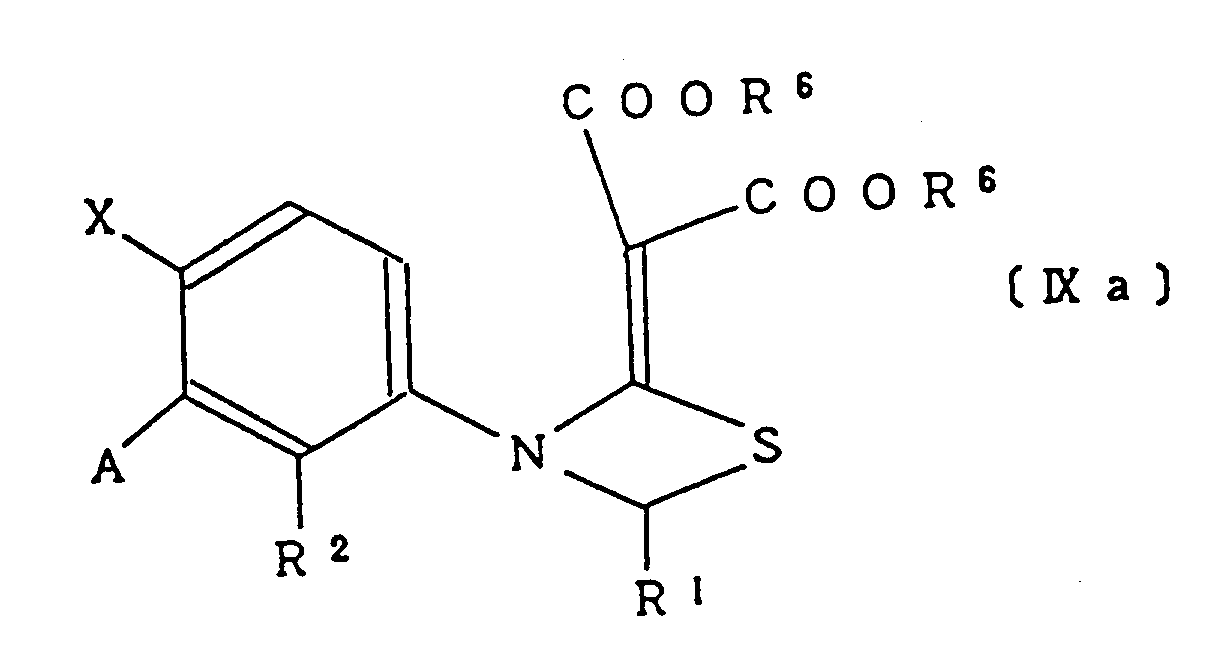


- A method of manufacturing quinolinecarboxylic acid derivatives of the general formula (I) and physiologically-acceptable salt thereof


- A pharmaceutical composition useful for treating bacterial or fungal infections in humans and animals which comprises a therapeutically effective amount of a compound according to Claim 1.
Priority Applications (1)
| Application Number | Priority Date | Filing Date | Title |
|---|---|---|---|
| AT87106953T ATE92493T1 (en) | 1986-05-14 | 1987-05-13 | QUINOLINECARBONIC ACID DERIVATIVES. |
Applications Claiming Priority (2)
| Application Number | Priority Date | Filing Date | Title |
|---|---|---|---|
| JP11162086 | 1986-05-14 | ||
| JP111620/86 | 1986-05-14 |
Publications (3)
| Publication Number | Publication Date |
|---|---|
| EP0249043A2 EP0249043A2 (en) | 1987-12-16 |
| EP0249043A3 EP0249043A3 (en) | 1988-03-02 |
| EP0249043B1 true EP0249043B1 (en) | 1993-08-04 |
Family
ID=14565935
Family Applications (1)
| Application Number | Title | Priority Date | Filing Date |
|---|---|---|---|
| EP87106953A Expired - Lifetime EP0249043B1 (en) | 1986-05-14 | 1987-05-13 | Quinolinecarboxylic acid derivatives |
Country Status (19)
| Country | Link |
|---|---|
| US (1) | US4843070A (en) |
| EP (1) | EP0249043B1 (en) |
| JP (1) | JPS63107990A (en) |
| KR (1) | KR870011145A (en) |
| AT (1) | ATE92493T1 (en) |
| BE (1) | BE1002102A4 (en) |
| CA (1) | CA1272482A (en) |
| CH (1) | CH674368A5 (en) |
| DE (1) | DE3786843T2 (en) |
| DK (1) | DK171967B1 (en) |
| ES (1) | ES2006142A6 (en) |
| FI (1) | FI87076C (en) |
| FR (1) | FR2598709B1 (en) |
| GB (1) | GB2190376B (en) |
| IL (1) | IL82395A (en) |
| IT (1) | IT1205958B (en) |
| NL (1) | NL193319C (en) |
| NO (1) | NO173445C (en) |
| ZA (1) | ZA873179B (en) |
Families Citing this family (23)
| Publication number | Priority date | Publication date | Assignee | Title |
|---|---|---|---|---|
| DE3881146T2 (en) * | 1987-09-22 | 1993-10-21 | Nippon Shinyaku Co Ltd | Thiazetidine derivatives. |
| EP0315827B1 (en) * | 1987-11-07 | 1992-04-08 | Nippon Shinyaku Company, Limited | Derivatives of quinolinecarboxylic acid |
| JPH0751579B2 (en) * | 1987-11-07 | 1995-06-05 | 日本新薬株式会社 | Quinolinecarboxylic acid derivative |
| GB8907865D0 (en) * | 1989-04-07 | 1989-05-24 | Wyeth John & Brother Ltd | Tetrahydroquinoline derivatives |
| CA2013720A1 (en) * | 1989-04-18 | 1990-10-18 | Yasuo Ito | Thiazetoquinoline-3-carboxylic acid derivative, method for preparation thereof, and a pharmaceutical composition comprising the same |
| AU6641190A (en) * | 1989-11-17 | 1991-06-13 | Nippon Shinyaku Co. Ltd. | Quinolinecarboxylic acid derivative |
| US5194439A (en) * | 1990-04-06 | 1993-03-16 | John Wyeth & Brother Limited | N-(2,3-dihydro-1,4-benzodioxinyl)-N-substituted aminopyrido-fused cycloalkanes |
| WO1992000280A1 (en) * | 1990-06-22 | 1992-01-09 | Nippon Shinyaku Co., Ltd. | Quinoline derivative and production thereof |
| WO1992006099A1 (en) * | 1990-10-03 | 1992-04-16 | Nippon Shinyaku Co., Ltd. | Quinolinecarboxylic acid derivative |
| DE4315625A1 (en) * | 1993-05-11 | 1994-11-17 | Hoechst Ag | New 3-fluorophenol derivatives, process for their preparation and their use |
| JP3329572B2 (en) * | 1994-04-15 | 2002-09-30 | 福田金属箔粉工業株式会社 | Copper foil for printed circuit and surface treatment method thereof |
| WO1996000217A1 (en) * | 1994-06-27 | 1996-01-04 | Nippon Shinyaku Co., Ltd. | Optically active quinolinecarboxylic acid derivative and process for producing the same |
| CN1321997C (en) * | 2004-03-03 | 2007-06-20 | 刘玉辉 | Application of stable thiabutyldine quinoline carboxylate in preparing anti-infective |
| CN100386081C (en) * | 2005-12-23 | 2008-05-07 | 重庆生物制品有限公司 | A kind of injection containing tricyclic fluoroquinolone mesylate and its preparation method and application |
| WO2007082472A1 (en) * | 2006-01-18 | 2007-07-26 | Guangzhou Baiyunshan Pharmaceutical Co., Ltd. Guangzhou Baiyunshan Pharmaceutical Factory | Anti-infective quinolone compound, preparation method thereof and use thereof |
| CN101003540A (en) * | 2006-01-18 | 2007-07-25 | 广州白云山制药股份有限公司广州白云山制药总厂 | Anti infectious compound and usage |
| WO2011031745A1 (en) | 2009-09-09 | 2011-03-17 | Achaogen, Inc. | Antibacterial fluoroquinolone analogs |
| CN102424688B (en) * | 2011-12-31 | 2014-08-20 | 广州医药工业研究院 | Levoulifloxacin mesylate crystal, its preparation method and application |
| CN102424689B (en) * | 2011-12-31 | 2014-05-28 | 广州医药工业研究院 | Levo ulifloxacin mesylate crystal as well as preparation method and application thereof |
| JP6313685B2 (en) | 2014-05-01 | 2018-04-18 | キヤノン株式会社 | Imaging apparatus and control method thereof |
| JP6478496B2 (en) | 2014-07-03 | 2019-03-06 | キヤノン株式会社 | Imaging apparatus and control method thereof |
| JP6429546B2 (en) | 2014-09-11 | 2018-11-28 | キヤノン株式会社 | Imaging apparatus, control method, program, and storage medium |
| KR102123365B1 (en) * | 2015-07-28 | 2020-06-16 | 바이옴 테라퓨틱스 리미티드 | Antibacterial treatment and prevention |
Citations (1)
| Publication number | Priority date | Publication date | Assignee | Title |
|---|---|---|---|---|
| JPS59210093A (en) * | 1983-05-13 | 1984-11-28 | Nippon Shinyaku Co Ltd | Pyridopyrimidine derivative |
Family Cites Families (6)
| Publication number | Priority date | Publication date | Assignee | Title |
|---|---|---|---|---|
| US3592811A (en) * | 1967-08-09 | 1971-07-13 | Du Pont | 2-hexafluoroisopropylidene-1,3-thiazetidines and the preparation thereof |
| US4620007A (en) * | 1980-09-03 | 1986-10-28 | Bayer Aktiengesellschaft | 6-fluoro-7-chloro-1-cyclopropyl-4-oxo-1,4-dihydro-quinoline-3-carboxylic acid |
| DE3267485D1 (en) * | 1981-02-18 | 1986-01-02 | Nippon Shinyaku Co Ltd | Substituted carboxylic acid derivatives |
| JPS57136588A (en) * | 1981-02-18 | 1982-08-23 | Nippon Shinyaku Co Ltd | Carboxylic acid derivative |
| US4659734A (en) * | 1983-08-15 | 1987-04-21 | Nippon Shinyaku Co., Ltd. | Olinecarboxylic acid derivatives |
| US4550104A (en) * | 1984-07-20 | 1985-10-29 | Warner-Lambert Company | Antibacterial thiazolo-quinolines and thiazolo-naphthyridines |
-
1987
- 1987-03-31 JP JP62079993A patent/JPS63107990A/en active Granted
- 1987-04-30 IL IL82395A patent/IL82395A/en not_active IP Right Cessation
- 1987-04-30 GB GB8710340A patent/GB2190376B/en not_active Expired - Lifetime
- 1987-05-04 ZA ZA873179A patent/ZA873179B/xx unknown
- 1987-05-07 NL NL8701071A patent/NL193319C/en not_active IP Right Cessation
- 1987-05-07 CH CH1746/87A patent/CH674368A5/fr not_active IP Right Cessation
- 1987-05-11 BE BE8700508A patent/BE1002102A4/en not_active IP Right Cessation
- 1987-05-11 FR FR878706569A patent/FR2598709B1/en not_active Expired - Lifetime
- 1987-05-12 FI FI872091A patent/FI87076C/en not_active IP Right Cessation
- 1987-05-13 AT AT87106953T patent/ATE92493T1/en not_active IP Right Cessation
- 1987-05-13 DE DE87106953T patent/DE3786843T2/en not_active Expired - Lifetime
- 1987-05-13 US US07/049,814 patent/US4843070A/en not_active Expired - Lifetime
- 1987-05-13 EP EP87106953A patent/EP0249043B1/en not_active Expired - Lifetime
- 1987-05-13 ES ES8701431A patent/ES2006142A6/en not_active Expired
- 1987-05-13 NO NO871990A patent/NO173445C/en unknown
- 1987-05-13 IT IT47926/87A patent/IT1205958B/en active
- 1987-05-13 CA CA000537028A patent/CA1272482A/en not_active Expired - Lifetime
- 1987-05-14 DK DK248387A patent/DK171967B1/en not_active IP Right Cessation
- 1987-05-14 KR KR870004728A patent/KR870011145A/en not_active Withdrawn
Patent Citations (1)
| Publication number | Priority date | Publication date | Assignee | Title |
|---|---|---|---|---|
| JPS59210093A (en) * | 1983-05-13 | 1984-11-28 | Nippon Shinyaku Co Ltd | Pyridopyrimidine derivative |
Also Published As
Similar Documents
| Publication | Publication Date | Title |
|---|---|---|
| EP0249043A2 (en) | Quinolinecarboxylic acid derivatives | |
| US4880806A (en) | 1-Cyclopropyl-6-fluoro-7-piperazinyl-1,4-Dihydro-4-oxo-quinoline-3-carboxylic acid derivatives | |
| EP0047005B1 (en) | Benzoxazine derivatives | |
| Segawa et al. | Studies on pyridonecarboxylic acids. 1. Synthesis and antibacterial evaluation of 7-substituted-6-halo-4-oxo-4H-[1, 3] thiazeto [3, 2-a] quinoline-3-carboxylic acids | |
| PT760819E (en) | DICARBONILIC TRICYCLIC DERIVED | |
| US5086049A (en) | 7[4-(5 methyl-2-oxo-1,3-dioxalen-4-yl)methyl 1-piperzinyl]-4-oxo-4H-[1,3]thiazeto[3,2-a]quinoline-3-carboxylic acids | |
| FI77855C (en) | FOERFARANDE FOER FRAMSTAELLNING AV THERAPEUTISKT ANVAENDBARA 6-FLUOR-1,4-DIHYDRO-4-OXO-3-KINOLINKARBOXYLSYRADERIVAT. | |
| EP0208210A1 (en) | Pyridonecarboxylic acid derivatives and process for their preparation | |
| HU197907B (en) | Process for producing new 4-pyridone derivatives, their physiologically tolerable acid addition salts and esters | |
| FI86428B (en) | PROFESSIONAL FORM OF THERAPEUTIC ACTIVATION ACTIVE 10-SUBSTITUTES-9-FLUORO-7-OXO-2,3-DIHYDRO-7H-PYRIDO - / 3,2,1-IJ / -1,3,4-BENZOXADIAZINE-6-CARBOXYL SYRADER | |
| IL44815A (en) | 3-(piperazin-1-yl) carbonyloxy (naphthyridin-2-yl) isoindolinones pyrrolo (3,4-b) pyrazines and pyrrolo (3,4-b) pyridines processes for the preparation thereof and pharmaceutical compositions containing the same | |
| SK37394A3 (en) | 1,8-benzonaphthyridine derivatives, method of their preparation and compositions containing these derivatives | |
| KR970002641B1 (en) | Derivatives of quinoline carboxylic acid | |
| JP2865761B2 (en) | Benzo [b] [1,8] naphthyridine derivatives and their preparation | |
| KR950002886B1 (en) | Quinoline carboxylic acid derivatives | |
| HU186028B (en) | Process for preparing pyrrolo-benzoidiazepines | |
| EP0312794B1 (en) | Thiazetidine derivatives | |
| US3562268A (en) | 3-morpholino- and 3-piperazino-1,2,8,9-tetraazaphenalenes | |
| JPH037674B2 (en) | ||
| EP0311948A2 (en) | Quinolonecarboxylic acid compounds and pharmaceutical use thereof | |
| JPH0441151B2 (en) | ||
| JPH01230585A (en) | Thiazetidine derivative | |
| JPH07113029B2 (en) | Derivatives of quinolinecarboxylic acid | |
| US3886175A (en) | 9H-Dibenzo(b,f)-s-triazolo(4,3-d)(1,4)diazepines | |
| EP0551518A1 (en) | Quinolinecarboxylic acid derivative |
Legal Events
| Date | Code | Title | Description |
|---|---|---|---|
| PUAI | Public reference made under article 153(3) epc to a published international application that has entered the european phase |
Free format text: ORIGINAL CODE: 0009012 |
|
| AK | Designated contracting states |
Kind code of ref document: A2 Designated state(s): AT DE SE |
|
| PUAL | Search report despatched |
Free format text: ORIGINAL CODE: 0009013 |
|
| AK | Designated contracting states |
Kind code of ref document: A3 Designated state(s): AT DE SE |
|
| 17P | Request for examination filed |
Effective date: 19880408 |
|
| 17Q | First examination report despatched |
Effective date: 19891031 |
|
| GRAA | (expected) grant |
Free format text: ORIGINAL CODE: 0009210 |
|
| AK | Designated contracting states |
Kind code of ref document: B1 Designated state(s): AT DE SE |
|
| REF | Corresponds to: |
Ref document number: 92493 Country of ref document: AT Date of ref document: 19930815 Kind code of ref document: T |
|
| REF | Corresponds to: |
Ref document number: 3786843 Country of ref document: DE Date of ref document: 19930909 |
|
| PLBE | No opposition filed within time limit |
Free format text: ORIGINAL CODE: 0009261 |
|
| STAA | Information on the status of an ep patent application or granted ep patent |
Free format text: STATUS: NO OPPOSITION FILED WITHIN TIME LIMIT |
|
| 26N | No opposition filed | ||
| EAL | Se: european patent in force in sweden |
Ref document number: 87106953.0 |
|
| PGFP | Annual fee paid to national office [announced via postgrant information from national office to epo] |
Ref country code: SE Payment date: 20060505 Year of fee payment: 20 |
|
| PGFP | Annual fee paid to national office [announced via postgrant information from national office to epo] |
Ref country code: DE Payment date: 20060511 Year of fee payment: 20 Ref country code: AT Payment date: 20060511 Year of fee payment: 20 |
|
| EUG | Se: european patent has lapsed |