EP0248680A2 - Vorrichtung zur Messung der Blutzucker-Konzentration - Google Patents
Vorrichtung zur Messung der Blutzucker-Konzentration Download PDFInfo
- Publication number
- EP0248680A2 EP0248680A2 EP87305016A EP87305016A EP0248680A2 EP 0248680 A2 EP0248680 A2 EP 0248680A2 EP 87305016 A EP87305016 A EP 87305016A EP 87305016 A EP87305016 A EP 87305016A EP 0248680 A2 EP0248680 A2 EP 0248680A2
- Authority
- EP
- European Patent Office
- Prior art keywords
- membrane
- oxygen
- glucose
- electrode
- holder
- Prior art date
- Legal status (The legal status is an assumption and is not a legal conclusion. Google has not performed a legal analysis and makes no representation as to the accuracy of the status listed.)
- Ceased
Links
Images


Classifications
-
- A—HUMAN NECESSITIES
- A61—MEDICAL OR VETERINARY SCIENCE; HYGIENE
- A61B—DIAGNOSIS; SURGERY; IDENTIFICATION
- A61B5/00—Measuring for diagnostic purposes; Identification of persons
- A61B5/145—Measuring characteristics of blood in vivo, e.g. gas concentration or pH-value ; Measuring characteristics of body fluids or tissues, e.g. interstitial fluid or cerebral tissue
- A61B5/1468—Measuring characteristics of blood in vivo, e.g. gas concentration or pH-value ; Measuring characteristics of body fluids or tissues, e.g. interstitial fluid or cerebral tissue using chemical or electrochemical methods, e.g. by polarographic means
- A61B5/1486—Measuring characteristics of blood in vivo, e.g. gas concentration or pH-value ; Measuring characteristics of body fluids or tissues, e.g. interstitial fluid or cerebral tissue using chemical or electrochemical methods, e.g. by polarographic means using enzyme electrodes, e.g. with immobilised oxidase
-
- A—HUMAN NECESSITIES
- A61—MEDICAL OR VETERINARY SCIENCE; HYGIENE
- A61B—DIAGNOSIS; SURGERY; IDENTIFICATION
- A61B5/00—Measuring for diagnostic purposes; Identification of persons
- A61B5/68—Arrangements of detecting, measuring or recording means, e.g. sensors, in relation to patient
- A61B5/6801—Arrangements of detecting, measuring or recording means, e.g. sensors, in relation to patient specially adapted to be attached to or worn on the body surface
- A61B5/6813—Specially adapted to be attached to a specific body part
- A61B5/6814—Head
- A61B5/682—Mouth, e.g., oral cavity; tongue; Lips; Teeth
-
- C—CHEMISTRY; METALLURGY
- C12—BIOCHEMISTRY; BEER; SPIRITS; WINE; VINEGAR; MICROBIOLOGY; ENZYMOLOGY; MUTATION OR GENETIC ENGINEERING
- C12Q—MEASURING OR TESTING PROCESSES INVOLVING ENZYMES, NUCLEIC ACIDS OR MICROORGANISMS; COMPOSITIONS OR TEST PAPERS THEREFOR; PROCESSES OF PREPARING SUCH COMPOSITIONS; CONDITION-RESPONSIVE CONTROL IN MICROBIOLOGICAL OR ENZYMOLOGICAL PROCESSES
- C12Q1/00—Measuring or testing processes involving enzymes, nucleic acids or microorganisms; Compositions therefor; Processes of preparing such compositions
- C12Q1/001—Enzyme electrodes
- C12Q1/005—Enzyme electrodes involving specific analytes or enzymes
- C12Q1/006—Enzyme electrodes involving specific analytes or enzymes for glucose
-
- G—PHYSICS
- G01—MEASURING; TESTING
- G01N—INVESTIGATING OR ANALYSING MATERIALS BY DETERMINING THEIR CHEMICAL OR PHYSICAL PROPERTIES
- G01N33/00—Investigating or analysing materials by specific methods not covered by groups G01N1/00 - G01N31/00
- G01N33/48—Biological material, e.g. blood, urine; Haemocytometers
- G01N33/50—Chemical analysis of biological material, e.g. blood, urine; Testing involving biospecific ligand binding methods; Immunological testing
- G01N33/66—Chemical analysis of biological material, e.g. blood, urine; Testing involving biospecific ligand binding methods; Immunological testing involving blood sugars, e.g. galactose
-
- A—HUMAN NECESSITIES
- A61—MEDICAL OR VETERINARY SCIENCE; HYGIENE
- A61B—DIAGNOSIS; SURGERY; IDENTIFICATION
- A61B5/00—Measuring for diagnostic purposes; Identification of persons
- A61B5/145—Measuring characteristics of blood in vivo, e.g. gas concentration or pH-value ; Measuring characteristics of body fluids or tissues, e.g. interstitial fluid or cerebral tissue
- A61B5/1495—Calibrating or testing of in-vivo probes
Definitions
- This invention relates to a method and apparatus for measuring blood glucose concentration using glucose which is present at the buccal mucosal surface, and more particularly to an apparatus and method for measuring blood glucose concentration by means of the peroxidative enzyme glucose oxidase.
- an enzymatic electrode is often used to measure the level of a blood substance.
- a typical enzymatic electrode combines enzymatic and polarographic technologies.
- the enzyme is usually bound, physically or chemically, to an inert support.
- Many enzymatic electrodes utilize enzymes which catalyze the peroxidative oxidation of a substrate and generate hydrogen peroxide.
- the specificity of the electrode is determined by the substrate specificity of the enzyme.
- Two types of analytical measurements are possible, each one using the polarographic technique. Specifically, either the consumption of free oxygen or the production of hydrogen peroxide may be measured. Both serve as stoichiometric indicators of substrate oxidation.
- the enzyme electrode is used after it has been calibrated using known concentrations of the substrate, the electrode becomes a tool for the quantitative analysis of unknown concentrations of that same substrate.
- Enzymatic peroxidation requires two substrates: oxygen, which is usually present in excess, and the unknown, for which the enzyme is specific and which is usually present in a limited amount.
- the enzyme is placed in an oxidized state before reacting with a substrate. Then, after enzyme-substrate interaction, the enzyme is reduced. This reduced enzyme is re-oxidized in order to produce hydrogen peroxide. If oxygen were not present, the catalytic enzyme cycle would be inhibited.
- an enzyme electrode apparatus for the analysis of glucose in an animal or human using the enzyme glucose oxidase.
- Such a device would be very useful in a program of diabetes management, relieving the diabetic of the need to obtain blood samples for glucose analysis.
- a glucose oxidase-containing enzyme electrode apparatus has been previously constructed which is suitable for intravenous implanation. Such an apparatus, however, is not fully satisfactory since fibrous tissue growth and immune system rejection may inhibit proper functioning of the apparatus over long periods of time.
- the measurement of blood glucose concentration at a body surface may be used. This is achieved without the necessity of obtaining a blood sample.
- Body surface areas that may be suitable include the skin and the mucous membranes.
- Still a further object of the present invention is to provide a method for measuring blood glucose concentration which is non-invasive.
- Yet another object of the present invention is to provide a method of measuring blood glucose concentration using an excess oxygen supply.
- a method of measuring blood glucose concentration using glucose which is present at a mucosal surface of a living being includes the steps of positioning a glucose oxidase membrane on the mucosal surface, providing oxygen to the surface in order to peroxidatively oxidize the glucose and produce hydrogen peroxide as a product, electrically measuring the amount of hydrogen peroxide produced, and calibrating the measured amount of hydrogen peroxide in order to determine blood glucose concentration.
- the method can be achieved by using an electrode apparatus which supports a glucose oxidase membrane at one end and which supplies oxygen to the region of the membrane, either from the atmosphere or from the air in the orifice containing the mucosal surface.
- the membrane is placed against the mucosal surface of the living being in order to initiate a peroxidative oxidation reaction. Then, by means of electrodes in communication with the membrane, the amount of hydrogen peroxide produced during peroxidative oxidation is electrically measured and calibrated in order to determine blood glucose concentration.
- glucose concentration is measured at the buccal mucosal surface.
- the invention accordingly comprises the several steps and the relation of one or more of such steps with respect to each of the others, and the apparatus embodying the features of construction, combination of elements and arrangement of parts which are adapted to effect such steps, all as exemplified in the following detailed disclosure, and the scope of the invention will be indicated in the claims.
- the oxygen deficiency is overcome by providing an electrode apparatus in which the components are arranged so that oxygen is transmitted to a membrane/electrode interface. Consequently, when placed in an oxygen-deficient environment, such as on the buccal mucosal surface, an oxygen concentration gradient is formed in order to drive oxygen into and through the membrane which covers the face of the electrode.
- Apparatus 11 includes a handle 13, an electrode holder 15, a cap member 17, a membrane member 19 and an O-ring 21.
- Handle 13 of apparatus 11 is substantially tubular in shape and has a top member 41, a bottom 33, and four sides 35a-d. As shown in FIGS. 2 and 3, handle 13 also includes ridge members 37 extending laterally from side 35c adjacent top member 41. During use of the apparatus, ridge members 37 abut the lingual surface of the teeth to hold apparatus 11 securely in position in the mouth.
- Handle 13 also includes a cylindrical housing side arm 23 on side 35a proximate top member 41. Side arm 23 receives electrode holder 15 during assembly of apparatus 11, as best shown in FIG. 2.
- Electrode wire pathway 25 communicates with the outside by means of an electrode wire opening 29 formed in bottom member 33.
- Electrode wire pathway 25 houses a plurality of electrode wires.
- two wires 43 are illustrated, one of which is made of platinum and the other of which is made of silver.
- Each wire 43 is provided with a conventional insulating material 45 thereabout.
- An additional insulating material 46 which is preferably a Teflon shrink tubing, but which alternatively may be an epoxy resin, may be used within wire pathway 25.
- Air pathway 27 communicates with the outside by means of an air opening 31 formed in bottom member 33.
- the other end of air pathway 27 is in communication with an air space 39 formed below top member 41 of handle 13.
- electrode holder 15 of apparatus 11 is detachably receivable in side arm 23 of handle 13 and includes a plug portion 51, a disc portion 49 integrally formed therewith and a central pillar 47 extending from disc portion 49 opposite plug portion 51.
- Pillar 47 includes a face 48 and a cylindrical wall 50, both of which are preferably fabricated of or coated with a non-wettable material, such as Teflon.
- plug portion 51 of holder 15 is preferably formed with a circumferential ridge 55 which matingly engages circumferential groove 53 disposed along the inside of side arm 23.
- Holder 15 is formed with centrally positioned orifices 57 for receiving electrode wires 43. Orifices 57 extend through pillar 47, including face 48 thereof. During assembly, electrode wires 43 are inserted into wire opening 29 of bottom member 33, through wire pathway 25 of handle 13, outside arm 29 and into orifices 57.
- Holder 15 is also formed with a plurality of circumferentially positioned air orifices 59.
- Orifices 59 extend through plug portion 51 and disc portion 49 of holder 15, but do not extend through and are circumferentially positioned with respect to pillar 47, preferably, as shown best in FIG. 2, in a semi-circular arrangement. This construction is advantageous since it enables uniform diffusion of oxygen to the membrane surface when the apparatus of the invention is operatively positioned on the buccal mucosal of a living being.
- Orifices 59 communicate with air space 39 of handle 13 so that air which enters air space 39 from air channel 27 can pass therethrough.
- cap member 17 of apparatus 11 includes a central cut-out 65, an annular face 70, a circumferential groove 68 and a protruding annular lip 20.
- Lip 20 includes a circumferential rib 22 which engages the rim of disc portion 49 when cap member 17 is attached to holder 15.
- Cut-out 65 includes an internal wall 66 which is preferably fabricated of or coated with a non-wettable material, such as Teflon.
- Cap member 17 is attached to and matingly engaged with holder 15 such that central pillar 47 of holder 15 projects through cut-out 65, as FIG. 4 illustrates.
- annular interior space 63 is formed therebetween which communicates with air orifices 59 of holder 15.
- cut-out 65 has a diameter larger than the diameter of pillar 47, a circumferential air chamber 67 is formed around pillar 47 which communicates with interior space 63.
- membrane member 19 of apparatus 11 is stretchingly fit across cap member 17. This is achieved by positioning the perimeter of membrane member 19 along circumferential grove 68 of cap member 17 and then fitting elastic O-ring 21 thereabout. Moreover, since pillar 47 projects beyond cap member 17, forcing membrane member 19 to assume a somewhat convex shape, an annular aqueous reservoir 69 ⁇ is formed between membrane member 19 and cap member 17. Because membrane member 19 must be maintained in a physiological isotonic solution, or alternatively in a preservative liquid, when the apparatus of the invention is not being used, reservoir 69 ⁇ becomes filled with that liquid and remains filled with that liquid when the device is operatively positioned on the buccal mucosal surface of the user. Accordingly, air which enters the apparatus through the various air pathways previously described will ultimately pass into aqueous reservoir 69 ⁇ and contact membrane member 19. As a result, a sufficient oxygen supply is provided for the peroxidative oxidation reaction in membrane member 19.
- membrane member 19 preferably comprises three layers: an outermost protective layer 67, a central glucose oxidase layer 69, and an inner limiting membrane layer 71.
- Outermost layer 67 extends along the entire surface of cap member 17, and is preferably made of cellulose.
- Layer 67 serves to stabilize membrane member 19 since it is the thickest and strongest of the three layers.
- Layer 67 also serves to exclude all substances having a molecular weight greater than 3500, while offering little resistance to molecules of a much lower molecular weight.
- Central layer 69 is not coextensive with outermost layer 67, but extends only along face 48 of pillar 47.
- Layer 69 contains covalently-immobilized glucose oxidase and may be made of any material which has free reactive groups suitable for attaching the glucose oxidase molecules.
- a natural membranous material which has free -NH2 groups such as bovine mesentery (obtainable from a slaughter house or butcher shop), is used.
- the membranous material is first incubated with glucose oxidase and the coupling reagent glutaraldehyde (which both attaches the enzyme to the membrane and crosslinks residual membrane -NH2 groups).
- Layer 69 is then extensively washed and dried. Thereafter, layer 69 is rehydrated before use with the invention.
- Layer 69 occupies an area overlying electrode wires 43 at their tips.
- glucose diffuses through outer membrane layer 67 from the buccal mucosal surface, while oxygen diffuses across inner layer 71, which is positioned between layer 69 and pillar 47 of holder 15.
- Glucose oxidase catalyzes the following reaction: glucose + O2 -------- H2O2 + gluconate
- Inner membrane layer 71 is made preferably of cellulose acetate by means of a cast film, and prevents the passage of molecules having a molecular weight greater than 100.
- Hydrogen peroxide which is a product of the glucose oxidase catalyzed reaction, diffuses through membrane layer 71 to electrode wires 43, where it is detected polarographically, yielding a current proportional to concentration as a result of the following reaction: H2O2 -------- O2 + 2H+ + 2e ⁇
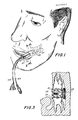
- FIGS. 1, 3, and 5 apparatus 11 is illustratively shown in FIG. l operatively positioned in the mouth of a human user.
- Cap member 17, which has membrane member 19 disposed thereover, is placed on the rinsed buccal mucosal surface.
- glucose molecules G diffuse from a subdermal capillary 73 through interstitial tissue 75 and mucosal tissue 76 to membrane member 17 along a concentration gradient.
- the presence of excess oxygen in the region of membrane member 17 enables the peroxidative oxidation reaction to take place with glucose as the limiting factor. Accordingly, the concentration of hydrogen peroxide produced bears a direct stoichiometric relationship to the concentration of glucose which was initially present.
- Electrode wires 43 which extend through the device and contact membrane member 19, transmit an electrical signal when apparatus 11 is operatively placed on the buccal mucosal surface. Specifically, the presence of hydrogen peroxide, the product of peroxidative oxidation, is detected polarographically by electrode wires 43. This is achieved by the platinum electrode wire detecting the negative potential (electron migration) produced by the reaction. The strength of the signal generated is proportional to the concentration of hydrogen peroxide produced and the wires transmit the electrical signal to an external device (a readout means) which amplifies the signal and displays and records changes in concentration as a function of time. Significantly, since membrane member 19 is pliable, it adheres tightly to face 48 of pillar 47 so that no gap is formed between face 48 and membrane member 19 which would otherwise inhibit peroxide diffusion towards wires 43.
- FIG. 6 illustrates a second embodiment of the electrode holder, generally designated at 81, in accordance with the invention.
- Holder 81 includes a disc portion 79 and a plug portion 83 integrally formed therewith.
- Holder 81 also includes a pillar 87 which projects opposite plug portion 83.
- holder 81 includes a plurality (four) of holes 85 disposed at equally spaced intervals about the circumference. This construction is also advantageous since it enables uniform diffusion of oxygen to the membrane surface.
- the handle of the apparatus has the following functions:
- the electrode holder serves the following functions:
- the oxygen-transmitting glucose electrode apparatus in accordance with the invention yields steady-state signals wherein the amount of glucose measured at the buccal mucosal surface equals the amount of glucose in the capillaries minus the amount taken up by the cells in transit from the capillaries to the buccal mucosal surface.
- the glucose concentration at the buccal mucosal surface equals that of the interstitial fluid which bathes the living cells. Therefore, these signals in turn can be correlated with blood glucose under both preprandial and glucose tolerance test conditions.
- the glucose-related signal During operation, between 5 and 10 minutes is required for the glucose-related signal to attain a steady-state level. At this steady-state level, the glucose concentration equilibrium between the membrane and the buccal mucosal surface is achieved. Maintaining a constant contact, however, between the electrode face and the mucosal surface for that time period is difficult and requires training. Accordingly, since the relationship between the initial rate of an enzyme-catalyzed reaction, at a given temperature, and the concentration of substrate is well known, that relationship may be substituted for a steady state analysis. Thus, the initial rate of change of the electrode signal is preferably used to indicate buccal glucose concentration.
- the electrode of the inventive apparatus may be calibrated at room temperature (25 degrees Celsius), using known concentrations of glucose.
- the face of the electrode may be warmed by contact with the body. Since the rate of an enzyme-catalyzed reaction is temperature-dependent, measurements of temperature are made (such as by a thermistor), both in vitro and in vivo, to allow calibration and analysis at known temperatures. This allows the user to calibrate the electrode at any temperature within 20-40 degrees Celsius (68-104 degrees Fahrenheit), and then to measure buccal mucosal glucose concentration at any other temperature within this range, multiplying the measured amperage by a constant in order to compensate for the effect of temperature. The rate at which the electrode-membrane interface comes to thermal equilibrium after being placed on the buccal mucosal may also be measured.
- an output signal is produced which increases in proportion to the amount of glucose present at the mucosa. Both the rate at which the signal increases and the steady state which is ultimately obtained are directly proportional to the concentration of glucose in the capillaries.
- the membrane As soon as the membrane is applied to the buccal mucosa, a concentration gradient for oxygen is formed (this gradient can range between approximately 8.6mM in the air and about 0.2mM at the interface). Consequently, oxygen from the atmosphere is conducted through the oxygen pathway of the apparatus to the membrane retained against the buccal mucosal surface.
- the electrode system thus uses the atmosphere as a reservoir to supply oxygen for the peroxidative enzymatic reaction at the membrane-electrode interface.
- the principles embodied in the present invention extend beyond glucose analysis to all applications involving the use of oxygen-requiring enzyme electrodes in oxygen-deficient environments.
- each electrode is calibrated by first immersing the membrane in a physiological buffer solution and then adding aliquots of Beta-D-glucose. The current from the electrodes increases in proportion to increasing glucose concentration.
- the presence of glucose at the buccal surface is analyzed after each subject first rinses his mouth thoroughly with distilled water to cleanse the mouth of surface glucose, including salivary glucose. Thereafter, an abrasive material (such as a piece of gauze) is used to wipe the surface to which the membrane is to be applied in order to remove mucosal residue and other contaminants. Placement of the membrane onto the buccal mucosal yields a current which increases to a plateau level over a time interval of about 5 minutes.
- Apparatus 101 includes a handle 107, a stem 105 connected to handle 107, a base member 109, and an electrode or probe member generally designated at 102 supported by base member 109.
- Apparatus 101 also includes a ridge member 103 extending laterally from base member 109 and stem 105.
- ridge member 103 is securely gripped between the user's upper molar 121 and lower molar 123 in order to hold apparatus 101 securely in position in the mouth.
- Apparatus 101 is formed with an electrode wire pathway 125 longitudinally extending through handle 107 and stem 105. Electrode wire pathway 125 communicates with the outside by means of an electrode wire opening (not shown) formed at one end of handle 107. Electrode wire pathway 125 receives and houses an electrical cable 112 containing a plurality of electrical wires 127. Electrical wires 127 extend through apparatus 125 and can transmit an electrical signal when apparatus 101 is operatively placed on the buccal mucosal surface of a patient's mouth.
- Electrode member 102 which is supported by base member 109, is shown in contact with the buccal mucosa 129 of a patient's mouth.
- Electrode member 102 includes a face region 117 and an anode 111, preferably made from platinum, centrally positioned on face 117 and protruding slightly therefrom.
- Electrode member 102 also includes a substantially annular cathode 115 preferably made of silver and disposed substantially along the peripheral region of face 117.
- Anode 111 and cathode 115 are electrically connected to electrical wires 127 inside electrode member 102 (not shown).
- a membrane member 119 of apparatus 101 is stretchingly fit across face 117 of electrode member 102. This is achieved by positioning the perimeter of membrane member 119 along circumferential groove 124 of electrode member 102 and then fitting an elastic O-ring 113 thereabout. Since anode 111 protrudes beyond face 117, thereby forcing membrane member 119 to assume a somewhat convex shape, an annular gap 128 is formed between membrane member 119 and face 117, as best shown in FIGS. 10 and 12. Moreover, annular cathode 115 protrudes somewhat beyond the periphery of face 119 and also contacts membrane member 119.
- electrode member 102 includes a reference electrode 120 which is positioned beneath O-ring 113, as illustrated in FIG. 10.
- Reference electrode 120 is preferably made of platinum and has the function of increasing electrical stability; electrode member 120 is normally kept at 0 volts.
- membrane member 119 is shown operatively positioned over face 117 of electrode member 102 and abutting anode 111 and cathode 115.
- Membrane member 119 is preferably made from three layers: an outermost protective layer 135, a central glucose oxidase layer 133 and an inner membrane layer 131.
- Outermost layer 135 extends along the entire surface of electrode member 102 and is made of polycarbonate.
- Inner membrane layer 131 which overlies both anode 111 and cathode 115, is made of cellulose acetate. This material is chosen since it is selectively permeable and will enable diffusion of H2O2 more readily than other substances having a greater molecular weight than H2O2.
- Central layer 133 contains covalently-immobilized glucose oxidase and may be made of any material which has free reactive groups suitable for attaching glucose oxidase molecules, similar to central layer 69 of the first embodiment.
- three-layer membrane member 119 Before placing apparatus 101 in the mouth of a patient, three-layer membrane member 119 is saturated with an aqueous electrolyte or buffer solution. The buffer solution then becomes saturated with atmospheric oxygen. For optimal performance, annular gap 128 formed between membrane member 119 and face 117 is filled with the buffer solution.
- the central region of membrane member 119 contacts bucccal mucosa 129, as shown in FIG. 10.
- the peripheral region of membrane member 119 does not contact the buccal mucosa, but remains in communication with the air in the patient's mouth. Because of the glucose oxidase reaction which occurs in the region of membrane member contact with the buccal mucosa, the oxygen level in the buffer solution which has saturated membrane member 119 decreases. As a result, oxygen will diffuse from the air in the patient's mouth through the peripheral region of membrane member 119 and toward the central region of membrane member 119, as arrows A in FIGS. 10 and 11 illustrate.
- an oxygen gradient is formed in membrane member 119, and can be characterized as the difference between the oxygen concentration in the saturated buffer solution (approximately 0.21mM) at the periphery and that at the buccal mucosa (approximately 0.08mM to 0.13mM). This enables a sufficient quantity of oxygen to be supplied to the buccal mucosal region in order to peroxidatively oxidize all of the glucose present thereat, and thereby produce hydrogen peroxide as a product.
- electrode wires 127 which extend through apparatus 101, and which are electrically connected to cathode 115 and anode 111, as well as to reference electrode 120, transmit an electrical signal when electrode member 102 is operatively positioned on the buccal mucosal surface. More particularly, the presence of hydrogen peroxide, the product of peroxidative oxidation, is detected polarographically by cathode 115 and anode 111, and is transmitted along electrode wires 127 to an external device (a readout means) which amplifies the signal and displays and records changes in concentration as a function of time. Electrical detection of hydrogen peroxide is similar to detection in the first embodiment of the electrode apparatus.
- Electrode apparatus 101 has certain advantages over the first embodiment. Specifically, its sensitivity is at least five times greater, the noise level is reduced at least ten times and the signal to noise ratio is increased at least fifty times. This is because of the following structural and functional changes:
- the method in accordance with the invention preferably includes measuring hydrogen peroxide production in order to determine glucose concentration
- the method can alternatively include measuring oxygen loss in order to determine glucose concentration. This may be achieved by reversing the polarity of the electrodes and measuring the decrease in current as molecular oxygen is reduced to peroxide.
- the method described herein is for measuring blood glucose concentration using glucose which is present at the buccal mucosal
- the method is suitable for measuring blood glucose concentration using glucose which is present at other mucosal surfaces such as the rectal, vaginal and nasal mucosal surfaces of a living being.
- an electrode apparatus in accordance with the invention does not include a readout means, a readout means for interpreting the electrical signals carried along the wiring may be part of the apparatus.
Landscapes
- Health & Medical Sciences (AREA)
- Life Sciences & Earth Sciences (AREA)
- Engineering & Computer Science (AREA)
- Chemical & Material Sciences (AREA)
- Molecular Biology (AREA)
- Physics & Mathematics (AREA)
- General Health & Medical Sciences (AREA)
- Biomedical Technology (AREA)
- Pathology (AREA)
- Hematology (AREA)
- Immunology (AREA)
- Organic Chemistry (AREA)
- Biophysics (AREA)
- Medical Informatics (AREA)
- Urology & Nephrology (AREA)
- Biotechnology (AREA)
- Analytical Chemistry (AREA)
- Biochemistry (AREA)
- Zoology (AREA)
- Wood Science & Technology (AREA)
- Proteomics, Peptides & Aminoacids (AREA)
- Veterinary Medicine (AREA)
- Public Health (AREA)
- Animal Behavior & Ethology (AREA)
- Heart & Thoracic Surgery (AREA)
- Microbiology (AREA)
- Surgery (AREA)
- Medicinal Chemistry (AREA)
- General Physics & Mathematics (AREA)
- Dentistry (AREA)
- Chemical Kinetics & Catalysis (AREA)
- General Chemical & Material Sciences (AREA)
- Optics & Photonics (AREA)
- Oral & Maxillofacial Surgery (AREA)
- Emergency Medicine (AREA)
- Cell Biology (AREA)
- Diabetes (AREA)
- Food Science & Technology (AREA)
- Bioinformatics & Cheminformatics (AREA)
- General Engineering & Computer Science (AREA)
Applications Claiming Priority (4)
| Application Number | Priority Date | Filing Date | Title |
|---|---|---|---|
| US87111486A | 1986-06-05 | 1986-06-05 | |
| US07/007,776 US4750496A (en) | 1987-01-28 | 1987-01-28 | Method and apparatus for measuring blood glucose concentration |
| US871114 | 1997-06-09 | ||
| US7776 | 1998-01-16 |
Publications (2)
| Publication Number | Publication Date |
|---|---|
| EP0248680A2 true EP0248680A2 (de) | 1987-12-09 |
| EP0248680A3 EP0248680A3 (de) | 1989-11-15 |
Family
ID=26677369
Family Applications (1)
| Application Number | Title | Priority Date | Filing Date |
|---|---|---|---|
| EP87305016A Ceased EP0248680A3 (de) | 1986-06-05 | 1987-06-05 | Vorrichtung zur Messung der Blutzucker-Konzentration |
Country Status (3)
| Country | Link |
|---|---|
| EP (1) | EP0248680A3 (de) |
| CA (1) | CA1255753A (de) |
| IL (1) | IL82558A (de) |
Cited By (3)
| Publication number | Priority date | Publication date | Assignee | Title |
|---|---|---|---|---|
| EP0304304A3 (en) * | 1987-08-18 | 1990-02-07 | Dermal Systems International | Transdermal detection system |
| FR2640643A1 (fr) * | 1988-12-16 | 1990-06-22 | Oreal | Biocapteur a enzyme destine a la mesure directe d'au moins un parametre biochimique de la peau, procede de preparation de la membrane enzymatique associee et procede de mesure correspondant |
| US5328847A (en) * | 1990-02-20 | 1994-07-12 | Case George D | Thin membrane sensor with biochemical switch |
Family Cites Families (5)
| Publication number | Priority date | Publication date | Assignee | Title |
|---|---|---|---|---|
| US3542662A (en) * | 1967-04-18 | 1970-11-24 | Du Pont | Enzyme electrode |
| US4340448A (en) * | 1978-08-28 | 1982-07-20 | University Of Pittsburgh | Potentiometric detection of hydrogen peroxide and apparatus therefor |
| US4535778A (en) * | 1983-05-13 | 1985-08-20 | Ancet Corporation | Method and apparatus for detecting blood gas |
| US4484987A (en) * | 1983-05-19 | 1984-11-27 | The Regents Of The University Of California | Method and membrane applicable to implantable sensor |
| US4517291A (en) * | 1983-08-15 | 1985-05-14 | E. I. Du Pont De Nemours And Company | Biological detection process using polymer-coated electrodes |
-
1987
- 1987-05-18 IL IL82558A patent/IL82558A/xx unknown
- 1987-06-04 CA CA000538791A patent/CA1255753A/en not_active Expired
- 1987-06-05 EP EP87305016A patent/EP0248680A3/de not_active Ceased
Cited By (4)
| Publication number | Priority date | Publication date | Assignee | Title |
|---|---|---|---|---|
| EP0304304A3 (en) * | 1987-08-18 | 1990-02-07 | Dermal Systems International | Transdermal detection system |
| FR2640643A1 (fr) * | 1988-12-16 | 1990-06-22 | Oreal | Biocapteur a enzyme destine a la mesure directe d'au moins un parametre biochimique de la peau, procede de preparation de la membrane enzymatique associee et procede de mesure correspondant |
| EP0384090A1 (de) * | 1988-12-16 | 1990-08-29 | L'oreal | Enzym-Biosensor zur direkten Messung von mindestens einem biochemischen Parameter der Haut |
| US5328847A (en) * | 1990-02-20 | 1994-07-12 | Case George D | Thin membrane sensor with biochemical switch |
Also Published As
| Publication number | Publication date |
|---|---|
| EP0248680A3 (de) | 1989-11-15 |
| CA1255753A (en) | 1989-06-13 |
| IL82558A0 (en) | 1987-11-30 |
| IL82558A (en) | 1991-11-21 |
Similar Documents
| Publication | Publication Date | Title |
|---|---|---|
| US4750496A (en) | Method and apparatus for measuring blood glucose concentration | |
| US5605152A (en) | Optical glucose sensor | |
| EP0127958B2 (de) | Sensor-Elektroden | |
| US4671288A (en) | Electrochemical cell sensor for continuous short-term use in tissues and blood | |
| US5509410A (en) | Strip electrode including screen printing of a single layer | |
| US6893552B1 (en) | Microsensors for glucose and insulin monitoring | |
| US5820551A (en) | Strip electrode with screen printing | |
| US4680268A (en) | Implantable gas-containing biosensor and method for measuring an analyte such as glucose | |
| US4685463A (en) | Device for continuous in vivo measurement of blood glucose concentrations | |
| US5130009A (en) | Sensor device | |
| JP2620236B2 (ja) | ブドウ糖モニタリング用電気化学システム | |
| US4185620A (en) | Oxygen measuring electrode assembly | |
| EP0525127B1 (de) | Implantierbarer glukose-fühler | |
| US4467811A (en) | Method of polarographic analysis of lactic acid and lactate | |
| Pfeiffer et al. | Amperometric lactate oxidase catheter for real-time lactate monitoring based on thin film technology | |
| CA1255753A (en) | Method and apparatus for measuring blood glucose concentration | |
| US4006061A (en) | Lactate dehydrogenase determination method | |
| AU594159B2 (en) | Method and apparatus for measuring blood glucose concentration | |
| DK170103B1 (da) | Elektrokemisk biosensor samt biosensormembran | |
| US3682159A (en) | Catheter electrode for oxygen polarography | |
| JPS62133937A (ja) | 経皮センサ | |
| GB2197486A (en) | Enzyme electrode sensor | |
| JPS5933389B2 (ja) | ポ−ラログラフイ−センサ− | |
| JPS62139629A (ja) | 経皮センサ | |
| JPH055493Y2 (de) |
Legal Events
| Date | Code | Title | Description |
|---|---|---|---|
| PUAI | Public reference made under article 153(3) epc to a published international application that has entered the european phase |
Free format text: ORIGINAL CODE: 0009012 |
|
| 17P | Request for examination filed |
Effective date: 19870714 |
|
| AK | Designated contracting states |
Kind code of ref document: A2 Designated state(s): AT BE CH DE ES FR GB GR IT LI LU NL SE |
|
| PUAL | Search report despatched |
Free format text: ORIGINAL CODE: 0009013 |
|
| AK | Designated contracting states |
Kind code of ref document: A3 Designated state(s): AT BE CH DE ES FR GB GR IT LI LU NL SE |
|
| 17Q | First examination report despatched |
Effective date: 19910731 |
|
| RAP1 | Party data changed (applicant data changed or rights of an application transferred) |
Owner name: PHARMACONTROL CORPORATION |
|
| STAA | Information on the status of an ep patent application or granted ep patent |
Free format text: STATUS: THE APPLICATION HAS BEEN REFUSED |
|
| 18R | Application refused |
Effective date: 19931023 |
|
| RIN1 | Information on inventor provided before grant (corrected) |
Inventor name: RITTER, CARL Inventor name: LUBRANO, GLENN Inventor name: GUILBAULT, JERRY Inventor name: FEISTEL, CHRISTOPHER Inventor name: PUGLIESE, PETER Inventor name: LETTERIO, FRED Inventor name: REINHART, RICHARD |