EP0247784A2 - Process for forming a sheet of material - Google Patents
Process for forming a sheet of material Download PDFInfo
- Publication number
- EP0247784A2 EP0247784A2 EP87304470A EP87304470A EP0247784A2 EP 0247784 A2 EP0247784 A2 EP 0247784A2 EP 87304470 A EP87304470 A EP 87304470A EP 87304470 A EP87304470 A EP 87304470A EP 0247784 A2 EP0247784 A2 EP 0247784A2
- Authority
- EP
- European Patent Office
- Prior art keywords
- dispersion
- forming
- sheet
- elements
- particles
- Prior art date
- Legal status (The legal status is an assumption and is not a legal conclusion. Google has not performed a legal analysis and makes no representation as to the accuracy of the status listed.)
- Granted
Links
- 238000000034 method Methods 0.000 title claims abstract description 21
- 239000000463 material Substances 0.000 title description 8
- 239000006185 dispersion Substances 0.000 claims abstract description 29
- XLYOFNOQVPJJNP-UHFFFAOYSA-N water Substances O XLYOFNOQVPJJNP-UHFFFAOYSA-N 0.000 claims abstract description 16
- 239000002245 particle Substances 0.000 claims description 24
- 230000037230 mobility Effects 0.000 claims description 9
- 239000000203 mixture Substances 0.000 claims description 8
- 239000013528 metallic particle Substances 0.000 claims description 3
- 238000000151 deposition Methods 0.000 claims description 2
- 230000015572 biosynthetic process Effects 0.000 description 9
- 239000006260 foam Substances 0.000 description 8
- 239000004094 surface-active agent Substances 0.000 description 6
- 238000009472 formulation Methods 0.000 description 5
- 239000003365 glass fiber Substances 0.000 description 5
- 239000000843 powder Substances 0.000 description 3
- 239000011435 rock Substances 0.000 description 3
- 229910001369 Brass Inorganic materials 0.000 description 2
- 229910000906 Bronze Inorganic materials 0.000 description 2
- 239000004743 Polypropylene Substances 0.000 description 2
- 239000004793 Polystyrene Substances 0.000 description 2
- 239000013504 Triton X-100 Substances 0.000 description 2
- 229920004890 Triton X-100 Polymers 0.000 description 2
- 239000010951 brass Substances 0.000 description 2
- 239000010974 bronze Substances 0.000 description 2
- 238000001816 cooling Methods 0.000 description 2
- KUNSUQLRTQLHQQ-UHFFFAOYSA-N copper tin Chemical compound [Cu].[Sn] KUNSUQLRTQLHQQ-UHFFFAOYSA-N 0.000 description 2
- 239000002612 dispersion medium Substances 0.000 description 2
- 238000001035 drying Methods 0.000 description 2
- 239000004794 expanded polystyrene Substances 0.000 description 2
- 238000005189 flocculation Methods 0.000 description 2
- 230000016615 flocculation Effects 0.000 description 2
- 238000009291 froth flotation Methods 0.000 description 2
- 239000002184 metal Substances 0.000 description 2
- 229910052751 metal Inorganic materials 0.000 description 2
- -1 polypropylene Polymers 0.000 description 2
- 229920001155 polypropylene Polymers 0.000 description 2
- 229920002223 polystyrene Polymers 0.000 description 2
- 239000000725 suspension Substances 0.000 description 2
- IAYPIBMASNFSPL-UHFFFAOYSA-N Ethylene oxide Chemical compound C1CO1 IAYPIBMASNFSPL-UHFFFAOYSA-N 0.000 description 1
- 229920002430 Fibre-reinforced plastic Polymers 0.000 description 1
- 239000004677 Nylon Substances 0.000 description 1
- 230000001464 adherent effect Effects 0.000 description 1
- 238000002474 experimental method Methods 0.000 description 1
- 239000000835 fiber Substances 0.000 description 1
- 239000011151 fibre-reinforced plastic Substances 0.000 description 1
- 239000012530 fluid Substances 0.000 description 1
- 230000010354 integration Effects 0.000 description 1
- 239000007788 liquid Substances 0.000 description 1
- 239000002923 metal particle Substances 0.000 description 1
- 229920001778 nylon Polymers 0.000 description 1
- UYDLBVPAAFVANX-UHFFFAOYSA-N octylphenoxy polyethoxyethanol Chemical compound CC(C)(C)CC(C)(C)C1=CC=C(OCCOCCOCCOCCO)C=C1 UYDLBVPAAFVANX-UHFFFAOYSA-N 0.000 description 1
- 239000011236 particulate material Substances 0.000 description 1
- 235000019362 perlite Nutrition 0.000 description 1
- 239000010451 perlite Substances 0.000 description 1
- 238000011020 pilot scale process Methods 0.000 description 1
- 239000004033 plastic Substances 0.000 description 1
- 229920003023 plastic Polymers 0.000 description 1
- 229920006327 polystyrene foam Polymers 0.000 description 1
- 239000002243 precursor Substances 0.000 description 1
- 238000010008 shearing Methods 0.000 description 1
- HFQQZARZPUDIFP-UHFFFAOYSA-M sodium;2-dodecylbenzenesulfonate Chemical compound [Na+].CCCCCCCCCCCCC1=CC=CC=C1S([O-])(=O)=O HFQQZARZPUDIFP-UHFFFAOYSA-M 0.000 description 1
- 239000000126 substance Substances 0.000 description 1
- 238000009827 uniform distribution Methods 0.000 description 1
Classifications
-
- D—TEXTILES; PAPER
- D21—PAPER-MAKING; PRODUCTION OF CELLULOSE
- D21F—PAPER-MAKING MACHINES; METHODS OF PRODUCING PAPER THEREON
- D21F11/00—Processes for making continuous lengths of paper, or of cardboard, or of wet web for fibre board production, on paper-making machines
-
- D—TEXTILES; PAPER
- D21—PAPER-MAKING; PRODUCTION OF CELLULOSE
- D21F—PAPER-MAKING MACHINES; METHODS OF PRODUCING PAPER THEREON
- D21F11/00—Processes for making continuous lengths of paper, or of cardboard, or of wet web for fibre board production, on paper-making machines
- D21F11/002—Processes for making continuous lengths of paper, or of cardboard, or of wet web for fibre board production, on paper-making machines by using a foamed suspension
-
- D—TEXTILES; PAPER
- D21—PAPER-MAKING; PRODUCTION OF CELLULOSE
- D21F—PAPER-MAKING MACHINES; METHODS OF PRODUCING PAPER THEREON
- D21F1/00—Wet end of machines for making continuous webs of paper
- D21F1/34—Construction or arrangement of spraying pipes
Definitions
- This invention relates to a process for forming particulate, and especially fibrous, material into a layer to form a sheet in which they are well distributed both in the planar direction and the thickness. More particularly, the invention is concerned with the formation of such layers from fluid dispersions, especially aqueous dispersions, of particles or fibres which are vertically mobile in the dispersion medium.
- the fibres or particulate material being dispersed and laid down from the dispersions have only an insignificant tendency to vertical mobility in water in the sense that they will tend to either settle or float. Indeed, they can be dispersed sufficiently in water to be capable of formation into a web even though this leads to the disadvantages discussed above.
- a foamed dispersion possesses sufficient integrity and mechanical strength, if correctly formulated, to trap within its structure relatively heavy or light particles or fibres which would tend to settle or float in an aqueous dispersion. Not only does this lead to very even formation of the sheet laid down on the Fourdrinier wire, but, where as is frequently the case, the furnish is comprised of particles and fibres having different inherent vertical mobilities, it leads to the formation of a homogeneous sheet structure.
- the invention therefore provides a process for forming a homogeneous sheet from particulate elements (as herein defined), at least some of which have an inherent vertical mobility (as herein defined) in water at normal temperature and pressure of from about 1 to about 21 cms/sec, comprising the steps of forming a foamed dispersion of said particulate elements, and depositing and draining said dispersion on a foraminous support.
- the process of the invention is particularly effective for particles having vertical mobilities of from 5 to 13 cms/sec.
- Particulate elements are defined as particles, particulate aggregates, fibres, fibrous flocs or mixtures of these and different kinds thereof.
- inherent vertical mobility is used herein to define the rate at which a particulate element moves in a downward or an upward direction in water and will depend upon the weight and surface area of the particulate elements and the extent to which air is entrapped in the elements or is adherent thereto.
- the particulate elements are metallic particles.
- particulate elements may comprise a mixture of elements which rise and elements which settle in water.
- the foamed dispersion is aqueous and has a viscosity of at least 22 seconds when measured by Ford Cup Type B-4 at 20° C according to British Standard No. BS1733 or an equivalent viscosity as determined according to British Standard BS3900-A6. Still more preferably, the foamed dispersion has an air content of at least 55% and is comprised of bubbles having an everage size of 0.2 mm. Especially preferred are air contents of at least about 65%.
- the invention also includes a sheet made by the process set forth.
- Various materials were used in evaluating the inventive concept, including lead shot, chopped metal rod, wire and fibres of various diameters and grit to exemplify materials tending to settle in water.
- a light material which floats in water polystyrene foam was used having a density of 0.023 gram.centimetre ⁇ 3 and was broken down by means of a wire brush into particles in the size range 2 to 5 mm.
- expanded heat treated volcanic rock particles sold under the trade name Perlite were used.
- the settling rate for each particle was determined by timing the vertical movement of a particle over a distance of 25 cm in a 45 cm high column of water after an initial movement of 18 cm. For filamentary particles the settling rate was noted for those particles (the substantial majority) which assumed a substantially horizontal orientation during settling.
- a suitable apparatus for producing foam having the required properties is a modified froth flotation cell of the type made by Denver Equipment Co. of Denver, Colorado, U.S.A.
- a cell comprises a casing having means for admission of air thereto and having a bladed impeller mounted for rotation therein, the distance between the impeller and an inner surface of the casing being set such that a liquid containing a surface active agent within the casing, is subjected to a vigorous shearing action between the impeller, when rotating relative to the casing, and the inner surface of the casing, the action being such as to provide bubbles of the required size.
- a vortex is produced in such a cell, bubbles of the required size being present at the base of the vortex and larger bubbles being present at the top of the vortex, which larger bubbles are sucked down to the base of the vortex together with air admitted to the casing, and there formed into bubbles of the required size.
- the fibres or particles to be used can be added to the foam so that they become well dispersed in the foam by the action of the cell.
- the use of such a foam-producing cell is not essential, and any other suitable apparatus can be used.
- Foamed dispersions were generated in the Denver cell using 7 litres of water.
- a surfactant Triton X-100 a water soluble octylphenoxypolyethoxyethanol containing an average of 10 moles of ethylene oxide
- grit particles 15 millilitres of the same surfactant.
- polystyrene particles 25 millilitres of a surfactant sold under the trade name Nansa (a 30% solution of sodium dodecylbenzenesulphonate) by Albright and Wilson added.
- the material was all carried across because of its proclivity to float and the evenness and degree of integration of the dispersion of particles in the sheet was the characteristic particularly evaluated.
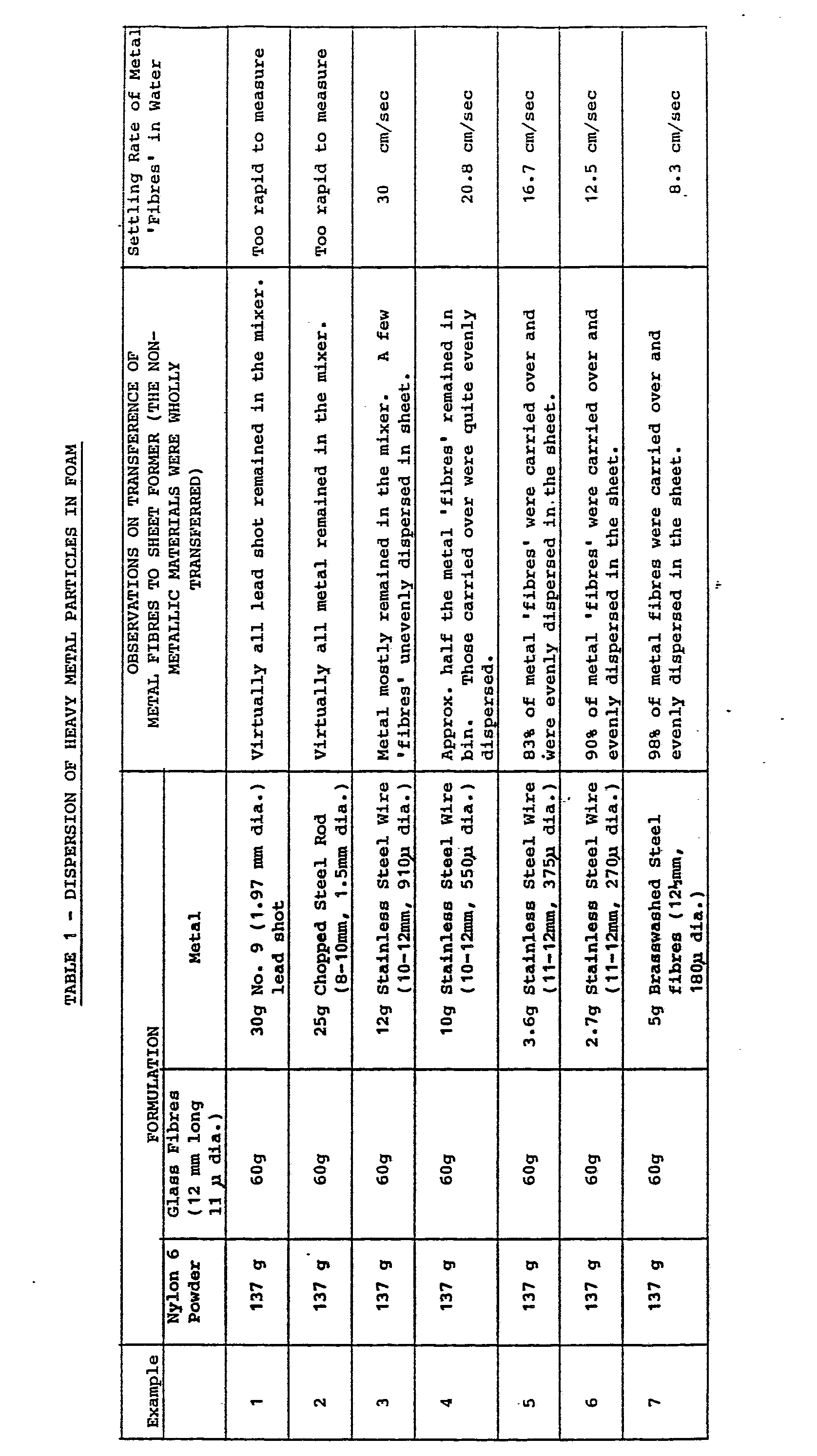
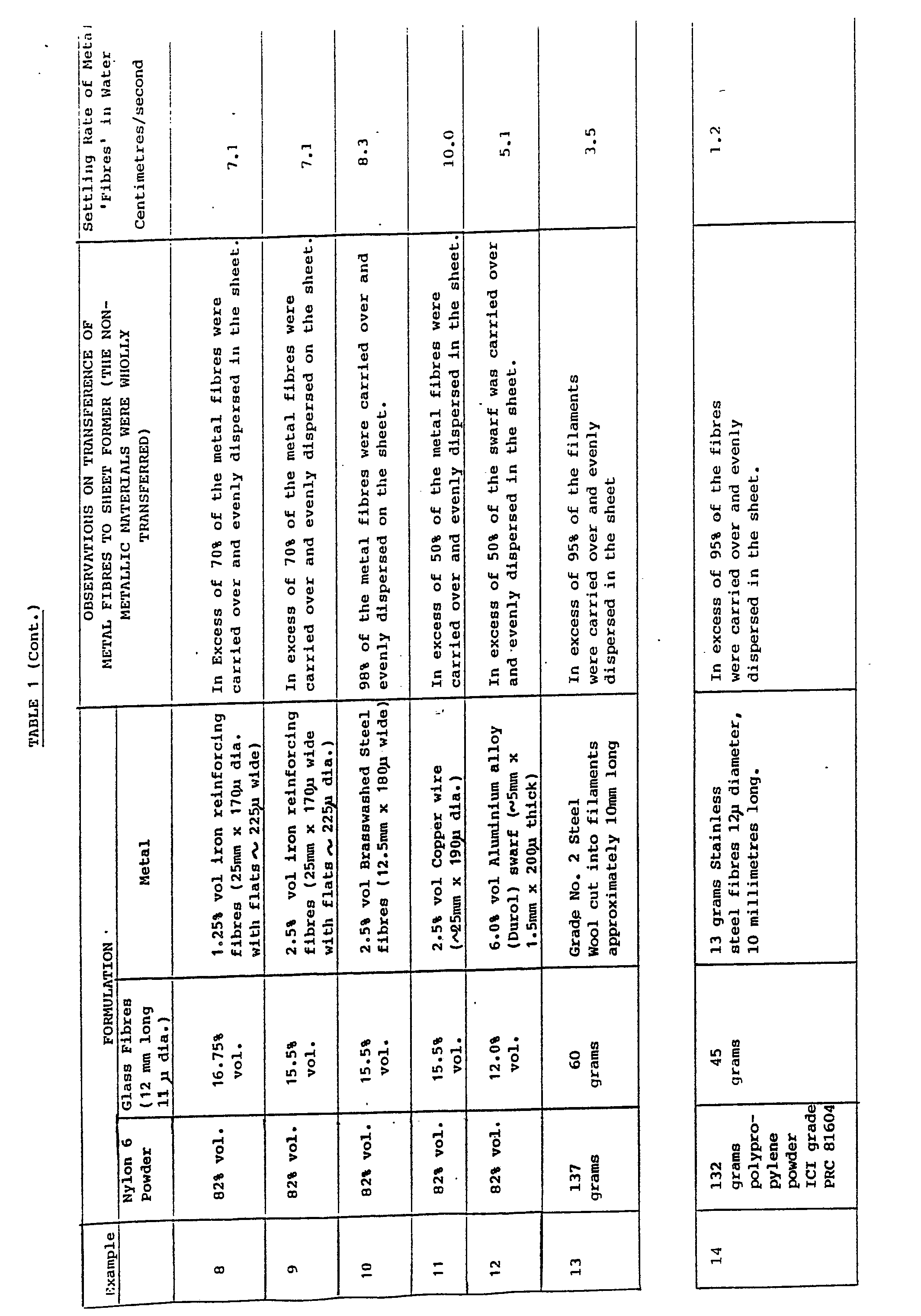
- Table 1 sets out the results for metal particles and it will be seen that, although very heavy particles could not satisfactorily be incorporated in the sheet, a surprisingly high level of transference was achieved with particles as large as 550 microns diameter and up to 12 mm long.
- Table 2 it will be seen that in excess of 90% transference to the sheet was achieved of grit particles of up to 2.8 mm in diameter.
- particles of polystyrene and expanded volcanic rock were successfully trapped in the foam dispersion and transferred so as to produce a sheet in which materials having varying settling rates were evenly distributed.
- the suspension was pumped to the headbox of the pilot plant paper machine wet end on which a web was then formed. After drying the web weighed 1040 grams per square metre and exhibited a uniform distribution of fibres.
- the web was then consolidated under heat and pressure to produce, after cooling, a rigid reinforced sheet in which the brass fibres were clearly seen to be evenly and uniformly distributed.
- a consolidated sheet was formed in the same manner as that described in Example 20 but using the following formulation 4.2 Kilograms of crescent section Bronze fibres having an effective diamter of 40 ⁇ , 3 millimetres long and having a settling rate of 1.5 centimetres/second 5.3 Kilograms of Glass Fibres 11 ⁇ diameter, 13 millimetres long 11.9 Kilograms of polypropylene powder sold by ICI as grade PXC81604 450 litres of water 1.3 litres of a surfactant sold under the trade name Nansa by Albright and Wilson Ltd.
Landscapes
- Paper (AREA)
- Laminated Bodies (AREA)
- Medicinal Preparation (AREA)
- Extrusion Moulding Of Plastics Or The Like (AREA)
- Machines For Laying And Maintaining Railways (AREA)
- Forging (AREA)
- Multicomponent Fibers (AREA)
- Moulding By Coating Moulds (AREA)
- Manufacture Of Porous Articles, And Recovery And Treatment Of Waste Products (AREA)
- Compositions Of Oxide Ceramics (AREA)
- Chemical Vapour Deposition (AREA)
- Polarising Elements (AREA)
- Nitrogen And Oxygen Or Sulfur-Condensed Heterocyclic Ring Systems (AREA)
- Dental Preparations (AREA)
- Mechanical Treatment Of Semiconductor (AREA)
- Compositions Of Macromolecular Compounds (AREA)
- Powder Metallurgy (AREA)
Abstract
Description
- This invention relates to a process for forming particulate, and especially fibrous, material into a layer to form a sheet in which they are well distributed both in the planar direction and the thickness. More particularly, the invention is concerned with the formation of such layers from fluid dispersions, especially aqueous dispersions, of particles or fibres which are vertically mobile in the dispersion medium.
- In United Kingdom Patents Nos. 1129757 and 1329409, processes are described for forming a paper web from, conventional cellulosic or synthetic papermaking fibres. For complex electro-chemical and mechanical reasons, such fibres tend to flocculate or clump together when in aqueous dispersion, and in consequence tend to give rise to an uneven or "wild" formation in the paper web when formed. The aforementioned UK Patents address this problem and disclose processes which achieve a substantial improvement in formation by the use of a foamed dispersion medium having specified characteristics. The bubble structure of the foam acts to delay and inhibit the flocculation, so that as the foam is broken down by drainage on a Fourdrinier wire of a paper machine, the fibres deposit on the wire before flocculation can occur.
- In European Patent Application No. 85.300031, a process is described for forming a precursor for a fibre reinforced plastics material from a foamed dispersion of glass fibres and plastics particles. In this case, the use of a foamed dispersion overcame the disadvantages of using a conventional aqueous unfoamed dispersion. Due to the exceptional tendency of glass fibres to flocculate, a satisfactory web can only be formed using an aqueous dispersion if very low consistencies (of less than 0.1% of fibre) are used. With such dispersions, a web can only be formed very slowly due to the large volumes of water which need to be handled in drainage. The use of a foamed dispersion overcomes this problem.
- In the aforementioned disclosures, the fibres or particulate material being dispersed and laid down from the dispersions have only an insignificant tendency to vertical mobility in water in the sense that they will tend to either settle or float. Indeed, they can be dispersed sufficiently in water to be capable of formation into a web even though this leads to the disadvantages discussed above.
- It has now been found unexpectedly that a foamed dispersion possesses sufficient integrity and mechanical strength, if correctly formulated, to trap within its structure relatively heavy or light particles or fibres which would tend to settle or float in an aqueous dispersion. Not only does this lead to very even formation of the sheet laid down on the Fourdrinier wire, but, where as is frequently the case, the furnish is comprised of particles and fibres having different inherent vertical mobilities, it leads to the formation of a homogeneous sheet structure. Any attempt to produce a sheet from such a furnish using an unfoamed aqueous dispersion resultes in relative vertical movement of the particulate and fibrous components in dependence upon their particular settling or floating characteristics, and leads to the formation of layers rather than a homogeneous sheet.
- The invention therefore provides a process for forming a homogeneous sheet from particulate elements (as herein defined), at least some of which have an inherent vertical mobility (as herein defined) in water at normal temperature and pressure of from about 1 to about 21 cms/sec, comprising the steps of forming a foamed dispersion of said particulate elements, and depositing and draining said dispersion on a foraminous support. The process of the invention is particularly effective for particles having vertical mobilities of from 5 to 13 cms/sec.
- Particulate elements are defined as particles, particulate aggregates, fibres, fibrous flocs or mixtures of these and different kinds thereof.
- The term "inherent vertical mobility" is used herein to define the rate at which a particulate element moves in a downward or an upward direction in water and will depend upon the weight and surface area of the particulate elements and the extent to which air is entrapped in the elements or is adherent thereto.
- In a preferred process the particulate elements are metallic particles.
- If desired a plurality of kinds of particulate elements can be included and which have different inherent vertical mobilities, thus the particulate elements may comprise a mixture of elements which rise and elements which settle in water.
- Preferably the foamed dispersion is aqueous and has a viscosity of at least 22 seconds when measured by Ford Cup Type B-4 at 20° C according to British Standard No. BS1733 or an equivalent viscosity as determined according to British Standard BS3900-A6. Still more preferably, the foamed dispersion has an air content of at least 55% and is comprised of bubbles having an everage size of 0.2 mm. Especially preferred are air contents of at least about 65%.
- The invention also includes a sheet made by the process set forth.
- The invention is illustrated by the following experiments and examples.
- Various materials were used in evaluating the inventive concept, including lead shot, chopped metal rod, wire and fibres of various diameters and grit to exemplify materials tending to settle in water. As one example of a light material which floats in water, polystyrene foam was used having a density of 0.023 gram.centimetre⁻³ and was broken down by means of a wire brush into particles in the size range 2 to 5 mm. As another example, expanded heat treated volcanic rock particles sold under the trade name Perlite were used.
- The settling rate for each particle was determined by timing the vertical movement of a particle over a distance of 25 cm in a 45 cm high column of water after an initial movement of 18 cm. For filamentary particles the settling rate was noted for those particles (the substantial majority) which assumed a substantially horizontal orientation during settling.
- A suitable apparatus for producing foam having the required properties is a modified froth flotation cell of the type made by Denver Equipment Co. of Denver, Colorado, U.S.A. Such a cell comprises a casing having means for admission of air thereto and having a bladed impeller mounted for rotation therein, the distance between the impeller and an inner surface of the casing being set such that a liquid containing a surface active agent within the casing, is subjected to a vigorous shearing action between the impeller, when rotating relative to the casing, and the inner surface of the casing, the action being such as to provide bubbles of the required size. In use a vortex is produced in such a cell, bubbles of the required size being present at the base of the vortex and larger bubbles being present at the top of the vortex, which larger bubbles are sucked down to the base of the vortex together with air admitted to the casing, and there formed into bubbles of the required size. During formation of the foam in the cell the fibres or particles to be used can be added to the foam so that they become well dispersed in the foam by the action of the cell. However, the use of such a foam-producing cell is not essential, and any other suitable apparatus can be used.
- Foamed dispersions were generated in the Denver cell using 7 litres of water. For metal fibres and particles 20 millimetres of a surfactant Triton X-100 (a water soluble octylphenoxypolyethoxyethanol containing an average of 10 moles of ethylene oxide) made by Rohm and Haas was added, and for grit particles 15 millilitres of the same surfactant. In the case of polystyrene particles, 25 millilitres of a surfactant sold under the trade name Nansa (a 30% solution of sodium dodecylbenzenesulphonate) by Albright and Wilson added.
- Various formulations were then made up using as a basis nylon powder and glass fibres to which was added specific metallic particles or fibres, grit expanded polystyrene, or expanded volcanic rock particles. After generation of a foamed dispersion including each formulation in a Denver cell, each dispersion was then, in the cases of Examples 1 to 19, transferred to a laboratory sheet former. After draining, the sheet former and the sheet were examined to determine the proportion of the metallic or grit particles which had been carried by the foam into the sheet. The sheet was also examined to determine the extent to which the three components of the formulation were evenly or homogeneously dispersed both in the planar direction and the thickness.
- In the cases of Examples 20 and 21 the sheets were formed on a pilot scale paper machine wet end 0.35 metres wide and running at 5 metres per minute.
- In the case of the expanded polystyrene, the material was all carried across because of its proclivity to float and the evenness and degree of integration of the dispersion of particles in the sheet was the characteristic particularly evaluated.
- Table 1 sets out the results for metal particles and it will be seen that, although very heavy particles could not satisfactorily be incorporated in the sheet, a surprisingly high level of transference was achieved with particles as large as 550 microns diameter and up to 12 mm long. In Table 2 it will be seen that in excess of 90% transference to the sheet was achieved of grit particles of up to 2.8 mm in diameter. In addition, particles of polystyrene and expanded volcanic rock were successfully trapped in the foam dispersion and transferred so as to produce a sheet in which materials having varying settling rates were evenly distributed.

- The following formulation was loaded into a Denver froth flotation cell of the kind herein described
3.0 Kilograms of brass fibres 90 µ diameter 12.5 millimetres long and having a settling rate of 5 centimetres per second.
4.2 Kilograms of Glass Fibres 11 diameter, 13 millimetres long
11.3 Kilograms of polypropylene powder sold by ICI as grade PXC81604
450 litres of water
450 millimetres of s surfactant sold under the trade name Triton X-100 by Rohm and Haas. - After formation of a foamed suspension in the manner herein described, the suspension was pumped to the headbox of the pilot plant paper machine wet end on which a web was then formed. After drying the web weighed 1040 grams per square metre and exhibited a uniform distribution of fibres.
- The web was then consolidated under heat and pressure to produce, after cooling, a rigid reinforced sheet in which the brass fibres were clearly seen to be evenly and uniformly distributed.
- A consolidated sheet was formed in the same manner as that described in Example 20 but using the following formulation
4.2 Kilograms of crescent section Bronze fibres having an effective diamter of 40 µ, 3 millimetres long and having a settling rate of 1.5 centimetres/second
5.3 Kilograms of Glass Fibres 11 µ diameter, 13 millimetres long
11.9 Kilograms of polypropylene powder sold by ICI as grade PXC81604
450 litres of water
1.3 litres of a surfactant sold under the trade name Nansa by Albright and Wilson Ltd. - The web formed on the pilot plant wet end weighed, after drying, 830 grams per square metre. When the web was consolidated under heat and pressure it produced, on cooling, a rigid reinforced sheet in which the bronze fibres could be seen to be evenly and uniformly distributed.
Claims (11)
Priority Applications (1)
| Application Number | Priority Date | Filing Date | Title |
|---|---|---|---|
| AT87304470T ATE82605T1 (en) | 1986-05-27 | 1987-05-20 | METHOD OF FORMING A WEB OF MATERIAL. |
Applications Claiming Priority (2)
| Application Number | Priority Date | Filing Date | Title |
|---|---|---|---|
| GB868612813A GB8612813D0 (en) | 1986-05-27 | 1986-05-27 | Layer forming technique |
| GB8612813 | 1986-05-27 |
Publications (3)
| Publication Number | Publication Date |
|---|---|
| EP0247784A2 true EP0247784A2 (en) | 1987-12-02 |
| EP0247784A3 EP0247784A3 (en) | 1989-03-01 |
| EP0247784B1 EP0247784B1 (en) | 1992-11-19 |
Family
ID=10598475
Family Applications (1)
| Application Number | Title | Priority Date | Filing Date |
|---|---|---|---|
| EP87304470A Expired - Lifetime EP0247784B1 (en) | 1986-05-27 | 1987-05-20 | Process for forming a sheet of material |
Country Status (18)
| Country | Link |
|---|---|
| US (1) | US4969975A (en) |
| EP (1) | EP0247784B1 (en) |
| JP (1) | JP2666137B2 (en) |
| KR (1) | KR950000079B1 (en) |
| AT (1) | ATE82605T1 (en) |
| AU (1) | AU606340B2 (en) |
| BR (1) | BR8702664A (en) |
| CA (1) | CA1282912C (en) |
| DE (1) | DE3782682T2 (en) |
| DK (1) | DK169630B1 (en) |
| ES (1) | ES2035052T3 (en) |
| FI (1) | FI872308L (en) |
| GB (1) | GB8612813D0 (en) |
| GR (1) | GR3006538T3 (en) |
| IE (1) | IE61059B1 (en) |
| NO (1) | NO175296C (en) |
| PT (1) | PT84906B (en) |
| ZA (1) | ZA873344B (en) |
Families Citing this family (13)
| Publication number | Priority date | Publication date | Assignee | Title |
|---|---|---|---|---|
| GB8618736D0 (en) * | 1986-07-31 | 1986-09-10 | Wiggins Teape Group Ltd | Electro magnetic interference shielding |
| ES2099119T3 (en) * | 1990-12-05 | 1997-05-16 | Ppg Industries Inc | FIBER THERMOPLASTIC MATERIAL FORMED WET AND AQUEOUS DISPERSION FOR ITS PREPARATION. |
| EP0912293B1 (en) * | 1996-05-03 | 2003-03-26 | Minnesota Mining And Manufacturing Company | Method of making a foraminous abrasive article |
| DE69627538T2 (en) * | 1996-05-03 | 2004-04-08 | Minnesota Mining And Manufacturing Company, St. Paul | NON-WOVEN ABRASIVES |
| JP4150077B2 (en) * | 1996-05-03 | 2008-09-17 | スリーエム カンパニー | Method and apparatus for manufacturing abrasive products |
| US6261679B1 (en) * | 1998-05-22 | 2001-07-17 | Kimberly-Clark Worldwide, Inc. | Fibrous absorbent material and methods of making the same |
| US7790292B2 (en) * | 1999-05-18 | 2010-09-07 | Sabic Innovative Plastics Ip B.V. | Polysiloxane copolymers, thermoplastic composition, and articles formed therefrom |
| US6572736B2 (en) | 2000-10-10 | 2003-06-03 | Atlas Roofing Corporation | Non-woven web made with untreated clarifier sludge |
| EP3371368B1 (en) | 2015-11-03 | 2021-03-17 | Kimberly-Clark Worldwide, Inc. | Paper tissue with high bulk and low lint |
| MX376250B (en) | 2016-12-22 | 2025-03-07 | Kimberly Clark Co | PROCESS AND SYSTEM FOR REORIENTING FIBERS IN THE FOAM FORMATION PROCESS. |
| US12331465B2 (en) | 2017-04-28 | 2025-06-17 | Kimberly-Clark Worldwide, Inc. | Foam-formed fibrous sheets with crimped staple fibers |
| MX2020004101A (en) | 2017-11-29 | 2020-07-24 | Kimberly Clark Co | Fibrous sheet with improved properties. |
| CN112469857B (en) | 2018-07-25 | 2022-06-17 | 金伯利-克拉克环球有限公司 | Method for producing three-dimensional foam-laid nonwovens |
Family Cites Families (30)
| Publication number | Priority date | Publication date | Assignee | Title |
|---|---|---|---|---|
| US2388187A (en) * | 1941-02-24 | 1945-10-30 | Thermoid Company | Method of manufacturing friction facing and like materials |
| US2653870A (en) * | 1949-10-22 | 1953-09-29 | Richard P Kast | High-strength paper and method of making |
| US2892107A (en) * | 1953-12-21 | 1959-06-23 | Clevite Corp | Cellular ceramic electromechanical transducers |
| US2795524A (en) * | 1954-11-02 | 1957-06-11 | Du Pont | Process of preparing a compacted nonwoven fibrous web embedded in a copolymer of butadiene and acrylonitrile and product |
| US2962414A (en) * | 1956-03-05 | 1960-11-29 | Hurlbut Paper Company | High strength specialty papers and processes for producing the same |
| US3216841A (en) * | 1962-04-30 | 1965-11-09 | Clevite Corp | Metal slip casting composition |
| GB1058932A (en) * | 1962-08-04 | 1967-02-15 | Bayer Ag | Paper-like elements |
| NL296324A (en) * | 1962-08-06 | |||
| GB1113792A (en) * | 1964-04-17 | 1968-05-15 | Bunzl & Biach Ag | A process for the production of composite material |
| US3494824A (en) * | 1965-12-27 | 1970-02-10 | United States Gypsum Co | Foamed water felted insulation and building product |
| GB1129757A (en) * | 1966-05-31 | 1968-10-09 | Wiggins Teape Res Dev | Method of producing a thixotropic liquid suspending medium particularly for the forming of non-woven fibrous webs |
| DE1959757U (en) * | 1967-02-13 | 1967-05-03 | Frenzelit Asbestwerk | ASBESTOS SOFT MATERIAL SEALING SHEET OR PANEL. |
| DE1619252C3 (en) * | 1967-10-19 | 1978-04-06 | Enka Ag, 5600 Wuppertal | Artificial leather and method of making the same |
| US3607500A (en) * | 1969-06-04 | 1971-09-21 | Du Pont | A molding fibrous webs |
| BE755406A (en) * | 1969-08-27 | 1971-03-01 | Wiggins Teape Res Dev | |
| GB1329400A (en) * | 1971-05-14 | 1973-09-05 | Gen Motors Corp | Headlamp wiper systems for motor vehicles |
| GB1347071A (en) * | 1971-07-01 | 1974-02-13 | Starch Products Ltd | Paper fillers |
| GB1329409A (en) * | 1972-04-06 | 1973-09-05 | Wiggins Teape Research Dev Ltd | Method of and apparatus for manufacturing paper or other non- woven fibrous material |
| US4007083A (en) * | 1973-12-26 | 1977-02-08 | International Paper Company | Method for forming wet-laid non-woven webs |
| NO762394L (en) * | 1976-07-16 | 1977-01-18 | Aku Goodrich Chem Ind | |
| JPS5823573B2 (en) * | 1978-07-05 | 1983-05-16 | 株式会社京三製作所 | Separate shelves with weighing device |
| JPS5540878A (en) * | 1978-09-19 | 1980-03-22 | Takasaki Paper Mfg | Method and apparatus for producing porous thick fibrous composite material |
| CA1153512A (en) * | 1979-06-04 | 1983-09-13 | Armstrong World Industries, Inc. | Asbestos-free rubberized flooring felt |
| US4286977A (en) * | 1979-10-15 | 1981-09-01 | Max Klein | High efficiency particulate air filter |
| GB2093474B (en) * | 1981-02-10 | 1984-10-24 | Texon Inc | High temperature resistant gasketing material incorporating organic fibers |
| US4503116A (en) * | 1981-02-23 | 1985-03-05 | Combe Incorporated | Dental adhesive device and method of producing same |
| FR2508842A1 (en) * | 1981-07-02 | 1983-01-07 | Arjomari Prioux | SURFACE SHEETS FOR COATING PLASTIC PARTS |
| US4383154A (en) * | 1982-09-03 | 1983-05-10 | Carlingswitch, Inc. | Positive action rocker switch |
| DE3420195A1 (en) * | 1984-05-30 | 1985-12-12 | Friedrich 2807 Achim Priehs | Process for producing insulating material from scrap paper and/or cardboard |
| US4643940A (en) * | 1984-08-06 | 1987-02-17 | The Dow Chemical Company | Low density fiber-reinforced plastic composites |
-
1986
- 1986-05-27 GB GB868612813A patent/GB8612813D0/en active Pending
-
1987
- 1987-05-11 ZA ZA873344A patent/ZA873344B/en unknown
- 1987-05-11 IE IE119587A patent/IE61059B1/en not_active IP Right Cessation
- 1987-05-19 PT PT84906A patent/PT84906B/en unknown
- 1987-05-20 ES ES198787304470T patent/ES2035052T3/en not_active Expired - Lifetime
- 1987-05-20 AT AT87304470T patent/ATE82605T1/en not_active IP Right Cessation
- 1987-05-20 DE DE8787304470T patent/DE3782682T2/en not_active Expired - Lifetime
- 1987-05-20 EP EP87304470A patent/EP0247784B1/en not_active Expired - Lifetime
- 1987-05-21 KR KR1019870005045A patent/KR950000079B1/en not_active Expired - Lifetime
- 1987-05-25 CA CA000537921A patent/CA1282912C/en not_active Expired - Lifetime
- 1987-05-25 FI FI872308A patent/FI872308L/en not_active Application Discontinuation
- 1987-05-25 BR BR8702664A patent/BR8702664A/en not_active IP Right Cessation
- 1987-05-26 DK DK266287A patent/DK169630B1/en active IP Right Grant
- 1987-05-26 NO NO872194A patent/NO175296C/en unknown
- 1987-05-27 AU AU73459/87A patent/AU606340B2/en not_active Expired
- 1987-05-27 JP JP62131052A patent/JP2666137B2/en not_active Expired - Lifetime
-
1989
- 1989-02-24 US US07/314,265 patent/US4969975A/en not_active Expired - Lifetime
-
1992
- 1992-12-14 GR GR920402912T patent/GR3006538T3/el unknown
Also Published As
| Publication number | Publication date |
|---|---|
| KR950000079B1 (en) | 1995-01-09 |
| FI872308A0 (en) | 1987-05-25 |
| JPS636189A (en) | 1988-01-12 |
| DE3782682D1 (en) | 1992-12-24 |
| NO175296B (en) | 1994-06-20 |
| EP0247784B1 (en) | 1992-11-19 |
| ZA873344B (en) | 1988-01-27 |
| NO872194L (en) | 1987-11-30 |
| IE61059B1 (en) | 1994-09-21 |
| PT84906A (en) | 1987-06-01 |
| AU7345987A (en) | 1987-12-03 |
| CA1282912C (en) | 1991-04-16 |
| NO175296C (en) | 1994-10-05 |
| ES2035052T3 (en) | 1993-04-16 |
| GR3006538T3 (en) | 1993-06-30 |
| AU606340B2 (en) | 1991-02-07 |
| JP2666137B2 (en) | 1997-10-22 |
| DK266287D0 (en) | 1987-05-26 |
| PT84906B (en) | 1990-02-08 |
| NO872194D0 (en) | 1987-05-26 |
| IE871195L (en) | 1987-11-27 |
| KR870011310A (en) | 1987-12-22 |
| FI872308A7 (en) | 1987-11-28 |
| US4969975A (en) | 1990-11-13 |
| ATE82605T1 (en) | 1992-12-15 |
| EP0247784A3 (en) | 1989-03-01 |
| GB8612813D0 (en) | 1986-07-02 |
| DK169630B1 (en) | 1994-12-27 |
| DK266287A (en) | 1987-11-28 |
| DE3782682T2 (en) | 1993-04-01 |
| FI872308L (en) | 1987-11-28 |
| BR8702664A (en) | 1988-02-23 |
Similar Documents
| Publication | Publication Date | Title |
|---|---|---|
| EP0247784B1 (en) | Process for forming a sheet of material | |
| US5013405A (en) | Method of making a low density frothed mineral wool | |
| US3716449A (en) | Method and apparatus for forming a non-woven fibrous web from a foamed fiber furnish | |
| US5277762A (en) | Composite fiberboard and process of manufacture | |
| US5250153A (en) | Method for manufacturing a mineral wool panel | |
| US3871952A (en) | Manufacture of non-woven fibrous material from a foamed furnish | |
| JPH0341798A (en) | Emi shielding fiber reinforcing polymer structure and its manufacture | |
| US4009119A (en) | Aqueous antifoaming emulsions | |
| WO1999045198A9 (en) | Method for producing a non-woven glass fiber mat comprising bundles of fibers | |
| US5047120A (en) | Method for manufacture of lightweight frothed mineral wool panel | |
| CA1118292A (en) | Method of encreasing the strength of wet glass fiber mats made by the wet-laid process | |
| US3494824A (en) | Foamed water felted insulation and building product | |
| WO1991001356A1 (en) | Method for cleaning up liquids, absorbent pellets for use in such method, and method for making such pellets | |
| ZA200203215B (en) | Method for producing a glass mat. | |
| EP0002002A1 (en) | Method of making uniform glass fiber mats by the wet-laid process from an aqueous dispersion | |
| CA1231208A (en) | Whitewater formulation containing a cationic polyacrylamide | |
| EP0003475A1 (en) | Manufacture of uniform glass mats by the wet-laid process, a glass-fiber dispersion used in this process and coated glass fibers | |
| CA2003204C (en) | Composite fiberboard and process of manufacture | |
| EP0296242A1 (en) | Low density mineral wool panel and method | |
| AU606132B2 (en) | Low density frothed mineral wool panel and method | |
| AU601546B2 (en) | Method for manufacture of lightweight frothed mineral wool panel | |
| US5409574A (en) | Propoxylated fatty amine ethoxylate surfactants as glass fiber dispersants for the manufacture of uniform glass fiber mats | |
| EP0537018A1 (en) | Foam control compositions | |
| AU608463B2 (en) | Low density mineral wool panel and method | |
| US2722869A (en) | Making felt containing cork granules |
Legal Events
| Date | Code | Title | Description |
|---|---|---|---|
| PUAI | Public reference made under article 153(3) epc to a published international application that has entered the european phase |
Free format text: ORIGINAL CODE: 0009012 |
|
| AK | Designated contracting states |
Kind code of ref document: A2 Designated state(s): AT BE CH DE ES FR GB GR IT LI LU NL SE |
|
| PUAL | Search report despatched |
Free format text: ORIGINAL CODE: 0009013 |
|
| AK | Designated contracting states |
Kind code of ref document: A3 Designated state(s): AT BE CH DE ES FR GB GR IT LI LU NL SE |
|
| 17P | Request for examination filed |
Effective date: 19890804 |
|
| 17Q | First examination report despatched |
Effective date: 19910208 |
|
| ITTA | It: last paid annual fee | ||
| GRAA | (expected) grant |
Free format text: ORIGINAL CODE: 0009210 |
|
| AK | Designated contracting states |
Kind code of ref document: B1 Designated state(s): AT BE CH DE ES FR GB GR IT LI LU NL SE |
|
| REF | Corresponds to: |
Ref document number: 82605 Country of ref document: AT Date of ref document: 19921215 Kind code of ref document: T |
|
| ITF | It: translation for a ep patent filed | ||
| ET | Fr: translation filed | ||
| REF | Corresponds to: |
Ref document number: 3782682 Country of ref document: DE Date of ref document: 19921224 |
|
| REG | Reference to a national code |
Ref country code: ES Ref legal event code: FG2A Ref document number: 2035052 Country of ref document: ES Kind code of ref document: T3 |
|
| REG | Reference to a national code |
Ref country code: GR Ref legal event code: FG4A Free format text: 3006538 |
|
| PLBE | No opposition filed within time limit |
Free format text: ORIGINAL CODE: 0009261 |
|
| STAA | Information on the status of an ep patent application or granted ep patent |
Free format text: STATUS: NO OPPOSITION FILED WITHIN TIME LIMIT |
|
| 26N | No opposition filed | ||
| EPTA | Lu: last paid annual fee | ||
| EAL | Se: european patent in force in sweden |
Ref document number: 87304470.5 |
|
| REG | Reference to a national code |
Ref country code: GB Ref legal event code: IF02 |
|
| PGFP | Annual fee paid to national office [announced via postgrant information from national office to epo] |
Ref country code: AT Payment date: 20060406 Year of fee payment: 20 |
|
| PGFP | Annual fee paid to national office [announced via postgrant information from national office to epo] |
Ref country code: FR Payment date: 20060411 Year of fee payment: 20 |
|
| PGFP | Annual fee paid to national office [announced via postgrant information from national office to epo] |
Ref country code: GB Payment date: 20060412 Year of fee payment: 20 |
|
| PGFP | Annual fee paid to national office [announced via postgrant information from national office to epo] |
Ref country code: NL Payment date: 20060413 Year of fee payment: 20 Ref country code: CH Payment date: 20060413 Year of fee payment: 20 |
|
| PGFP | Annual fee paid to national office [announced via postgrant information from national office to epo] |
Ref country code: DE Payment date: 20060419 Year of fee payment: 20 |
|
| PGFP | Annual fee paid to national office [announced via postgrant information from national office to epo] |
Ref country code: SE Payment date: 20060421 Year of fee payment: 20 |
|
| PGFP | Annual fee paid to national office [announced via postgrant information from national office to epo] |
Ref country code: GR Payment date: 20060428 Year of fee payment: 20 |
|
| PGFP | Annual fee paid to national office [announced via postgrant information from national office to epo] |
Ref country code: LU Payment date: 20060503 Year of fee payment: 20 |
|
| PGFP | Annual fee paid to national office [announced via postgrant information from national office to epo] |
Ref country code: ES Payment date: 20060505 Year of fee payment: 20 |
|
| PGFP | Annual fee paid to national office [announced via postgrant information from national office to epo] |
Ref country code: BE Payment date: 20060516 Year of fee payment: 20 |
|
| PGFP | Annual fee paid to national office [announced via postgrant information from national office to epo] |
Ref country code: IT Payment date: 20060531 Year of fee payment: 20 |
|
| PG25 | Lapsed in a contracting state [announced via postgrant information from national office to epo] |
Ref country code: NL Free format text: LAPSE BECAUSE OF EXPIRATION OF PROTECTION Effective date: 20070520 |
|
| PG25 | Lapsed in a contracting state [announced via postgrant information from national office to epo] |
Ref country code: ES Free format text: LAPSE BECAUSE OF EXPIRATION OF PROTECTION Effective date: 20070521 |
|
| REG | Reference to a national code |
Ref country code: GB Ref legal event code: PE20 |
|
| REG | Reference to a national code |
Ref country code: CH Ref legal event code: PL Ref country code: CH Ref legal event code: PFA Owner name: THE WIGGINS TEAPE GROUP LIMITED Free format text: THE WIGGINS TEAPE GROUP LIMITED#GATEWAY HOUSE, BASING VIEW P.O. BOX 88#BASINGSTOKE/HANTS (GB) -TRANSFER TO- THE WIGGINS TEAPE GROUP LIMITED#GATEWAY HOUSE, BASING VIEW P.O. BOX 88#BASINGSTOKE/HANTS (GB) |
|
| NLV7 | Nl: ceased due to reaching the maximum lifetime of a patent |
Effective date: 20070520 |
|
| EUG | Se: european patent has lapsed | ||
| REG | Reference to a national code |
Ref country code: ES Ref legal event code: FD2A Effective date: 20070521 |
|
| PG25 | Lapsed in a contracting state [announced via postgrant information from national office to epo] |
Ref country code: GB Free format text: LAPSE BECAUSE OF EXPIRATION OF PROTECTION Effective date: 20070519 |
|
| BE20 | Be: patent expired |
Owner name: THE *WIGGINS TEAPE GROUP LTD Effective date: 20070520 |