EP0247428A2 - Carbohydrate containing dichloromethylenimino radicals, and method for their preparation - Google Patents
Carbohydrate containing dichloromethylenimino radicals, and method for their preparation Download PDFInfo
- Publication number
- EP0247428A2 EP0247428A2 EP87106837A EP87106837A EP0247428A2 EP 0247428 A2 EP0247428 A2 EP 0247428A2 EP 87106837 A EP87106837 A EP 87106837A EP 87106837 A EP87106837 A EP 87106837A EP 0247428 A2 EP0247428 A2 EP 0247428A2
- Authority
- EP
- European Patent Office
- Prior art keywords
- group
- radicals
- hydrogen
- isocyanide dichloride
- sugar
- Prior art date
- Legal status (The legal status is an assumption and is not a legal conclusion. Google has not performed a legal analysis and makes no representation as to the accuracy of the status listed.)
- Withdrawn
Links
Classifications
-
- C—CHEMISTRY; METALLURGY
- C07—ORGANIC CHEMISTRY
- C07H—SUGARS; DERIVATIVES THEREOF; NUCLEOSIDES; NUCLEOTIDES; NUCLEIC ACIDS
- C07H13/00—Compounds containing saccharide radicals esterified by carbonic acid or derivatives thereof, or by organic acids, e.g. phosphonic acids
- C07H13/12—Compounds containing saccharide radicals esterified by carbonic acid or derivatives thereof, or by organic acids, e.g. phosphonic acids by acids having the group -X-C(=X)-X-, or halides thereof, in which each X means nitrogen, oxygen, sulfur, selenium or tellurium, e.g. carbonic acid, carbamic acid
-
- C—CHEMISTRY; METALLURGY
- C07—ORGANIC CHEMISTRY
- C07H—SUGARS; DERIVATIVES THEREOF; NUCLEOSIDES; NUCLEOTIDES; NUCLEIC ACIDS
- C07H15/00—Compounds containing hydrocarbon or substituted hydrocarbon radicals directly attached to hetero atoms of saccharide radicals
- C07H15/02—Acyclic radicals, not substituted by cyclic structures
- C07H15/12—Acyclic radicals, not substituted by cyclic structures attached to a nitrogen atom of the saccharide radical
-
- C—CHEMISTRY; METALLURGY
- C07—ORGANIC CHEMISTRY
- C07H—SUGARS; DERIVATIVES THEREOF; NUCLEOSIDES; NUCLEOTIDES; NUCLEIC ACIDS
- C07H15/00—Compounds containing hydrocarbon or substituted hydrocarbon radicals directly attached to hetero atoms of saccharide radicals
- C07H15/18—Acyclic radicals, substituted by carbocyclic rings
Definitions
- a sugar having an isocyanide dichloride group and containing this group bound to an anomeric carbon atom of the sugar molecule is known (see EP-A-0 171 016).
- the anomeric carbon atoms are the carbon atoms of the carbonyl groups of the sugar molecules that have become asymmetric carbon atoms due to the intramolecular (half) acetal formation (see Römpps Chemie-Lexikon, 8th edition, "Anomers”).
- These known sugars containing isocyanide dichloride groups are described as valuable intermediates for the synthesis of biologically active compounds (see EP-A-0 171 016, page 9).
- sugars in which the isocyanide dichloride group is attached to one of the non-anomeric carbon atoms of the sugar molecule is bound are also valuable intermediates for the production of biologically active compounds. It has been found that they open up new and improved production routes for antibiotic and canzerostatically active sugar urides and their derivatives which are not obtainable via the sugars which contain the isocyanide dichloride group bonded to an anomeric carbon atom.
- the broad-spectrum antibiotic streptozotocin from 2-dichloromethyleneimino-2-deoxy-1.3.4.6-tetra-O-acetyl- ⁇ -D- Glucopyranose obtainable by reacting this compound with the equimolar amount of methylamine in the presence of an auxiliary base to give the carbodiimide, hydrolyzing the carbodiimide with water to give the corresponding urea, cleaving off the acetyl groups and nitrosating the product obtained.
- the sugars according to the invention in which the isocyanide dichloride group is bonded to a non-anomeric carbon atom of the sugar molecule are new. Although they differ from the sugars with isocyanide dichloride group described in EP-A-0 171 016 only in the position of this group in the molecule, they were not suggested by these previously known sugars, because a manufacturing process had to be found for them.
- sugars which contain an isocyanide dichloride group bonded to a non-anomeric carbon atom can easily be obtained in excellent yields by gentle chlorination of sugars which contain an isocyanide group bonded to a non-anomeric carbon atom , are available.
- This process is universally applicable for the production of sugars which contain an isocyanide dichloride group bonded to a non-anomeric carbon atom. It is independent of the nature of the groups introduced to protect the OH groups of the sugar molecule; ie it succeeds regardless of whether the OH groups are protected by esterification, etherification, acetalization or ketalization.
- isocyanide dichlorides by chlorinating isonitriles is indeed known (see Houben-Weyl, Methods of Organic Chemistry, 4th Edition, Volume E IV, page 526).
- chlorination of isonitriles to isocyanide dichlorides does not suggest the process according to the invention because in the hitherto chlorinated isonitriles the isocyanide group is bound to organic radicals which are not attacked during the chlorination.
- isocyanides are chlorinated in which the isocyanine group is bonded to sugar residues, ie to residues which are known to be sensitive to chlorination.
- the invention therefore relates to an isocyanide dichloride group containing sugars, which are characterized in that they contain the isocyanide dichloride group bound to one of the non-anomeric carbon atoms of the sugar molecule.
- R1 is a protecting group and R2 is hydrogen, methyl, ethyl, or -CH2-R7, R3 is hydrogen, methyl, ethyl, -CH2-R8 or -C (H) R9-CH2-R10 and R4, R5, R6, R7, R8, R9 and R10 independently of one another for hydrogen, halogen, a protected OH group, an isocyanide dichloride group or the rest of a cyclic acetal of the formula stand in the n ⁇ 0 or 1, R2 ⁇ is hydrogen, methyl, ethyl, -CH2-R7 ⁇ , R3 ⁇ represents hydrogen, methyl, ethyl, -CH2-R8 ⁇ or -C (H) R9 ⁇ -CH2-R10 ⁇ , and R4 ⁇ , R5 ⁇ , R6 ⁇ , R7 ⁇ , R8 ⁇ , R9 ⁇ and R10 ⁇ independently of one another represent hydrogen, hal
- the compounds of the formula I are (deoxy or halogeno) sugars with protected OH groups and an isocyanide dichloride group bonded to a non-anomeric C atom.
- these sugars are mono-, di - or trisaccharides.
- Preferred sugars of the formula I according to the invention are those in which n 0 or 1 R1 is a protecting group and R2 is hydrogen or -CH2-R7, R3 is hydrogen, methyl, -CH2-R8 or -C (H) R9-CH2-R10 and R4, R5, R6, R7, R8, R9 and R10 independently of one another are hydrogen, a protected OH group or an isoyanide dichloride group, with the proviso that only one of the radicals R4-R10 is an isocyanide dichloride group and at least two of the radicals R4-R10 are a protected OH group.
- Such sugars of formula I according to the invention are particularly preferred, if in this n 0 or 1 R1 is a protecting group and R2 is hydrogen, R3 is hydrogen, -CH2-R8 or -C (H) R9-CH2-R10 and R4, R5, R6, R8, R9 and R10 independently of one another represent a protected OH group or an isocyanide dichloride group, with the proviso that one of the radicals R4, R5, R6, R8, R9 or R10 is an isocyanide dichloride group.
- sugars of the formula I are aldohexoses and pentoses of the pyranose and furanose series, in which one of the protected OH groups bound to a non-anomeric C atom is replaced by an isocyanide dichloride group.
- Halogen is preferably fluorine, chlorine or bromine for the radicals R4-R10 and R4 ⁇ -R10 ⁇ .
- protecting groups refer to those organic radicals with which certain functional groups, in the present case the OH groups of the sugar, of a molecule containing several reactive centers, here the sugar molecule, can be temporarily protected against attack by reagents , so that the reactions only take place at the desired (unprotected) positions, in the present case the isonitrile and isocyanide dichloride groups (see Römpps Chemie-Lexikon, 7, edition, “Schutz phenomenon”).
- protective groups for R1 and the protected OH groups the protective groups known from sugar chemistry come into consideration; these are acyl groups, alkyl and aralkyl groups and, if two adjacent OH groups are protected by acetal or ketal formation, alkylidene groups.
- the acyl residues are introduced by acylation of the OH groups.
- the acyl residues are preferably derived from lower aliphatic, e.g. C1-C8 alkane carboxylic or sulfonic acids such as acetic acid, propionic acid, butyric acid, methanesulfonic acid and ethanesulfonic acid, or aromatic carboxylic and sulfonic acids such as benzoic acid and p-toluenesulfonic acid.
- Preferred acyl radicals are the methanesulfonyl (mesyl) radical, the p-toluenesulfonyl (tosyl) radical and above all the acetyl and benzoyl radicals.
- alkyl and aralkyl radicals are introduced by etherification of the OH groups.
- alkyl and aralkyl radicals are: C1-C8-alkyl radicals such as the methyl, propyl, isopropyl and sec-butyl radical and as aralkyl radicals the benzyl, ⁇ -phenylethyl, the triphenylmethyl ( trityl) - and the 4-methylbenzyl residue.
- Lower alkyl radicals such as the methyl and unsubstituted aralkyl radicals such as the benzyl radical are preferred.
- alkylidene residues are introduced by acetalization or ketalization of two adjacent OH groups. These alkylidene residues are preferably derived from lower aliphatic and aromatic aldehydes and ketones such as formaldehyde, acetaldehyde, propionaldehyde, butyraldehyde, isobutyraldehyde, acetone, butanone-2, cyclohexanone, benzaldehyde and 4-methoxybenzaldehyde.
- Preferred alkylidene radicals are: the methylidene, ethylidene, isopropylidene, cyclohexylidene, benzylidene and 4-methoxybenzylidene radical.
- the invention further relates to a process for the production of the sugars which contain an isocyanide dichloride group bonded to one of the non-anomeric carbon atoms of the sugar molecule; the process is characterized in that in the solution of sugars of the formula I which have an isonitrile group instead of the isocyanide dichloride group, in an inert organic solvent at temperatures from -60 to + 40 ° C, preferably -30 to + 30 ° C slowly introduces chlorine until no more isonitrile group can be detected in the reaction mixture by IR spectroscopy; this is generally the case when 1 mole of chlorine per mole of isocyanine groups (-N ⁇ C groups) has been introduced into the solution.
- sugar isocyanides are known (see, for example, JCSPerkin I, 1980 , 2657) or can be prepared in a simple manner from corresponding amino sugars by formylation of the amino group and subsequent dehydration of the formamide (see Synthesis 1985 , 400).
- the aminosugars either occur naturally and / or can be prepared from known sugars by methods customary in sugar chemistry.
- sugar isonitriles to be used as starting compounds in the process according to the invention: 2-isocyano-2,6-di-deoxy-1.3.4-tri-O-acetyl-D-glucopyranose; 2-isocyano-2-deoxy-1-O-methyl-3.4.6-tri-O-benzoyl-D-mannopyranose; 2-isocyano-2-deoxy-1-O-methyl-3-O-methanesulfonyl-4.6-O-benzylidene-D-altropyranose; 3-isocyano-3-deoxy-1.2-O-isopropylidene-5.6-O-cyclohexylidene- ⁇ -D-glucofuranose; 3-isocyano-3-deoxy-1.2-O-isopropylidene-5.6-O-methylidene- ⁇ -D-allofuranose; 2-isocyano-2-deoxy-1.3.4.6-tetra-O-acetyl
- inert organic solvents which do not change under the reaction conditions are chlorinated aromatic hydrocarbons such as chlorobenzene, dichlorobenzene and trichlorobenzene; nitrated aromatic hydrocarbons such as nitrobenzene and halogenated aliphatic hydrocarbons such as chloroform, carbon tetrachloride, tetrachloroethane and pentachlor ethane; Halogenated aliphatic hydrocarbons, in particular chloroform and carbon tetrachloride, are preferably used.
- the solvents are generally used in an amount such that 1 to 20 parts by weight, preferably 2 to 12 parts by weight, of solvent are used for 1 part by weight of isocyanide.
- the process according to the invention is generally carried out at normal pressure. However, it is also possible to carry out the process at a negative or positive pressure (for example in the pressure range from 0.5 to 10 bar).
- a negative or positive pressure for example in the pressure range from 0.5 to 10 bar.
- the course of the chlorination can be followed by IR spectroscopy (disappearance of the NC band).
- IR spectroscopy disappearance of the NC band.
- the reaction is complete after the amount of chlorine (1 mole Cl2 per mole NC group) required for the chlorination has been initiated.
- the method according to the invention can be carried out, for example, as follows:
- the sugar isocyanide is dissolved in the solvent.
- the solution is brought to the desired reaction temperature; chlorine is then passed into the solution with vigorous stirring until the isonitrile band in the IR spectrum of a sample of the solution has disappeared.
- the solvent is then distilled off and the isocyanide dichloride is isolated in a manner known per se, for example by recrystallizing the residue.
- the sugars according to the invention which contain the isocyanide dichloride group bound to one of the non-anomeric carbon atoms of the sugar molecule, are valuable intermediates for the preparation of biologically active compounds, as described, for example, in Japanese applications JA-A-76/075 072, JA -A-81/103 197 and JA-A-81/103 196 and U.S. Patent 3,575,959.
- Chlorine is passed into the solution of 6.15 g (22.8 mmol) of 3-isocyano-3-deoxy-1.2.5.6-di-O-isopropylidene- ⁇ -D-allofuranose at -30 ° C. until No more isonitrile group can be detected by IR spectroscopy.
- the residue is dissolved in 150 ml of n-hexane; the solution is clarified with activated carbon and then concentrated in vacuo to constant weight.
Landscapes
- Chemical & Material Sciences (AREA)
- Organic Chemistry (AREA)
- Health & Medical Sciences (AREA)
- Life Sciences & Earth Sciences (AREA)
- Engineering & Computer Science (AREA)
- Biochemistry (AREA)
- Biotechnology (AREA)
- General Health & Medical Sciences (AREA)
- Genetics & Genomics (AREA)
- Molecular Biology (AREA)
- Crystallography & Structural Chemistry (AREA)
- Saccharide Compounds (AREA)
Abstract
Die Erfindung betrifft neue Zucker, die eine Isocyaniddichlorid-Gruppe an eines der nicht-anomeren C-Atome des Zuckermoleküls gebunden enthalten und ihre Herstellung durch Chlorieren von Zuckern, die eine Isonitrilgruppe an eines der nicht-anomeren C-Atome des Zuckermoleküls gebunden enthalten. The invention relates to new sugars which contain an isocyanide dichloride group bonded to one of the non-anomeric carbon atoms of the sugar molecule and to their production by chlorination of sugars which contain an isonitrile group bonded to one of the non-anomeric carbon atoms of the sugar molecule.
Description
Die Erfindung betrifft neue, eine Isocyaniddichlorid-Gruppe (= Dichlormethylenimino-Gruppe) aufweisende Zucker und ein Verfahren zu ihrer Herstellung.The invention relates to new sugars containing an isocyanide dichloride group (= dichloromethyleneimino group) and a process for their preparation.
Eine Isocyaniddichlorid-Gruppe aufweisende Zucker, die diese Gruppe an ein anomeres C-Atom des Zuckermoleküls gebunden enthalten, sind bekannt (siehe EP-A-0 171 016). Als anomere C-Atome werden in der Chemie der Kohlenhydrate die durch die intramolekulare (Halb)Acetalbildung zu asymmetrischen C-Atomen gewordenen C-Atome der Carbonylgruppen der Zuckermoleküle bezeichnet (siehe Römpps Chemie-Lexikon, 8. Auflage, "Anomere"). Diese bekannten Isocyaniddichlorid-Gruppen aufweisenden Zucker werden als wertvolle Zwischenprodukte für die Synthese biologisch aktiver Verbindungen beschrieben (siehe EP-A-0 171 016, Seite 9).A sugar having an isocyanide dichloride group and containing this group bound to an anomeric carbon atom of the sugar molecule is known (see EP-A-0 171 016). In the chemistry of carbohydrates, the anomeric carbon atoms are the carbon atoms of the carbonyl groups of the sugar molecules that have become asymmetric carbon atoms due to the intramolecular (half) acetal formation (see Römpps Chemie-Lexikon, 8th edition, "Anomers"). These known sugars containing isocyanide dichloride groups are described as valuable intermediates for the synthesis of biologically active compounds (see EP-A-0 171 016, page 9).
Es wurde nun gefunden, daß Zucker, in denen die Isocyaniddichlorid-Gruppe an eines der nicht-anomeren Kohlenstoff atome des Zuckermoleküls gebunden ist, ebenfalls wertvolle Zwischenprodukte für die Herstellung biologisch aktiver Verbindungen sind. Es wurde gefunden, daß sie neue und verbesserte Herstellungswege für antibiotisch und canzerostatisch wirksame Zuckerureide und deren Derivate eröffnen, die über die Zucker, die die Isocyaniddichlorid-Gruppe an ein anomeres C-Atom gebunden enthalten, nicht erhältlich sind.It has now been found that sugars in which the isocyanide dichloride group is attached to one of the non-anomeric carbon atoms of the sugar molecule is bound, are also valuable intermediates for the production of biologically active compounds. It has been found that they open up new and improved production routes for antibiotic and canzerostatically active sugar urides and their derivatives which are not obtainable via the sugars which contain the isocyanide dichloride group bonded to an anomeric carbon atom.
So ist z.B. mit Hilfe eines der Zucker, in denen die Isocyaniddichlorid-Gruppe an eines der nicht-anomeren Kohlenstoffatome des Zuckermoleküls gebunden ist, das Breitbandantibiotikum Streptozotocin aus 2-Dichlormethylenimino-2-deoxy-1.3.4.6-tetra-O-acetyl-β-D-glucopyranose dadurch erhältlich, daß man diese Verbindung mit der äquimolaren Menge Methylamin in Gegenwart einer Hilfsbase zum Carbodiimid umsetzt, das Carbodiimid mit Wasser zum entsprechenden Harnstoff hydrolysiert, die Acetylgruppen abspaltet und das erhaltene Produkt nitrosiert.For example, with the help of one of the sugars in which the isocyanide dichloride group is bound to one of the non-anomeric carbon atoms of the sugar molecule, the broad-spectrum antibiotic streptozotocin from 2-dichloromethyleneimino-2-deoxy-1.3.4.6-tetra-O-acetyl-β-D- Glucopyranose obtainable by reacting this compound with the equimolar amount of methylamine in the presence of an auxiliary base to give the carbodiimide, hydrolyzing the carbodiimide with water to give the corresponding urea, cleaving off the acetyl groups and nitrosating the product obtained.
Die erfindungsgemäßen Zucker, in denen die Isocyaniddichlorid-Gruppe an ein nicht-anomeres C-Atom des Zuckermoleküls gebunden ist, sind neu. Obwohl sie sich von den in der EP-A-0 171 016 beschriebenen Zuckern mit Isocyaniddichlorid-Gruppe nur durch die Stellung dieser Gruppe im Molekül unterscheiden, wurden sie trotzdem durch diese vorbekannten Zucker nicht nahegelegt, weil für sie erst ein Herstellungsverfahren gefunden werden mußte. Die in der EP-A-0 171 016 für die Herstellung der Zucker mit an das anomere C-Atom gebundener Isocyaniddichlorid-Gruppe beschriebene Chlorierung der O-acetylierten Zucker mit an das anomere C-Atom gebundener Isothiocyanat-Gruppe läßt sich nicht auf O-acylierte Zucker anwenden, die die Isothiocyanat-Gruppe an ein nicht-anomeres C-Atom gebunden enthalten. Die Chlorierung O-acylierter Zucker, in denen die Isothiocyanat-Gruppe an ein nicht-anomeres C-Atom gebunden ist, liefert nur ein Gemisch von Chlorierungsprodukten, aus denen sich keine Zucker mit an ein nicht-anomeres C-Atom gebundener Isocyaniddichlorid-Gruppe isolieren lassen.The sugars according to the invention in which the isocyanide dichloride group is bonded to a non-anomeric carbon atom of the sugar molecule are new. Although they differ from the sugars with isocyanide dichloride group described in EP-A-0 171 016 only in the position of this group in the molecule, they were not suggested by these previously known sugars, because a manufacturing process had to be found for them. The in EP-A-0 171 016 for the production of the sugar with isocyanide dichloride group bound to the anomeric carbon atom The chlorination of the O-acetylated sugars with the isothiocyanate group bound to the anomeric C atom cannot be applied to O-acylated sugars which contain the isothiocyanate group bound to a non-anomeric C atom. The chlorination of O-acylated sugars in which the isothiocyanate group is bound to a non-anomeric C atom only provides a mixture of chlorination products from which no sugars with an isocyanide dichloride group bound to a non-anomeric C atom are isolated to let.
Erfindungsgemäß wurde gefunden, daß Zucker, die eine Isocyaniddichlorid-Gruppe an ein nicht-anomeres C-Atom gebunden enthalten, auf einfache Weise in ausgezeichneten Ausbeuten durch schonendes Chlorieren von Zuckern, die eine Isocyanid-Gruppe an ein nicht-anomeres C-Atom gebunden enthalten, erhältlich sind.According to the invention, it was found that sugars which contain an isocyanide dichloride group bonded to a non-anomeric carbon atom can easily be obtained in excellent yields by gentle chlorination of sugars which contain an isocyanide group bonded to a non-anomeric carbon atom , are available.
Dieses Verfahren ist universell zur Herstellung von Zuckern anwendbar, die eine Isocyaniddichlorid-Gruppe an ein nicht-anomeres C-Atom gebunden enthalten. Es ist unabhängig von der Natur der zum Schutz der OH-Gruppen des Zuckermoleküls eingeführten Gruppen; d.h. es gelingt unabhängig davon, ob die OH-Gruppen durch Veresterung, Veretherung, Acetalisierung oder Ketalisierung geschützt sind.This process is universally applicable for the production of sugars which contain an isocyanide dichloride group bonded to a non-anomeric carbon atom. It is independent of the nature of the groups introduced to protect the OH groups of the sugar molecule; ie it succeeds regardless of whether the OH groups are protected by esterification, etherification, acetalization or ketalization.
Zwar ist die Herstellung von Isocyaniddichloriden durch Chlorieren von Isonitrilen bekannt (siehe Houben-Weyl, Methoden der Organischen Chemie, 4. Auflage, Band E IV, Seite 526). Die vorbekannte Chlorierung von Isonitrilen zu Isocyaniddichloriden legt aber das erfindungsgemäße Verfahren nicht nahe, weil in den bislang chlorierten Isonitrilen die Isocyanidgruppe an organische Reste gebunden ist, die bei der Chlorierung nicht angegriffen werden. Im Gegensatz dazu werden erfindungsgemäß Isocyanide chloriert, bei denen die Isocyangruppe an Zuckerreste, d.h. an Reste gebunden ist, die bekannterweise chlorierungsempfindlich sind. Es war deshalb damit zu rechnen, daß bei der Einwirkung von Chlor auf die erfindungsgemäß einzusetzenden Isonitrile eine Chlorierung der Ether-, Ester- und Acetal-Schutzgruppen sowie eine Chlorierung der Zucker selbst, vor allem an den besonders reaktiven, an das anomere C-Atom gebundenen Gruppen eintritt. Es ist bekannt, daß Ether außerordentlich empfindlich gegenüber α-Halogenierung sind (L.Summers; Chem. Rev. 55, 301 ff (1955)); die Halogenierung durch Acetalgruppen geschützter Zucker unter Abspaltung der Schutzgruppe ist eine Standardmethode zur Herstellung von Halogenozuckern, die das Halogen an ein nicht-anomeres C-Atom des Zuckermoleküls gebunden enthalten (siehe Adv. Carbohydr. Chem. Biochem. 28, 255 ff (1973)).The production of isocyanide dichlorides by chlorinating isonitriles is indeed known (see Houben-Weyl, Methods of Organic Chemistry, 4th Edition, Volume E IV, page 526). However, the previously known chlorination of isonitriles to isocyanide dichlorides does not suggest the process according to the invention because in the hitherto chlorinated isonitriles the isocyanide group is bound to organic radicals which are not attacked during the chlorination. In contrast, according to the invention, isocyanides are chlorinated in which the isocyanine group is bonded to sugar residues, ie to residues which are known to be sensitive to chlorination. It was therefore to be expected that when chlorine would act on the isonitriles to be used according to the invention, chlorination of the ether, ester and acetal protective groups and chlorination of the sugars themselves, especially on the particularly reactive, on the anomeric carbon atom bound groups. It is known that ethers are extremely sensitive to α-halogenation (L.Summers; Chem. Rev. 55 , 301 ff (1955)); Halogenation by sugar protected by acetal groups with elimination of the protective group is a standard method for producing halogen sugars which contain the halogen bound to a non-anomeric carbon atom of the sugar molecule (see Adv. Carbohydr. Chem. Biochem. 28 , 255 ff (1973) ).
Die Erfindung betrifft daher eine Isocyaniddichlorid-Gruppe aufweisende Zucker, die dadurch gekennzeichnet sind, daß sie die Isocyaniddichlorid-Gruppe an eines der nicht-anomeren C-Atome des Zuckermoleküls gebunden enthalten.The invention therefore relates to an isocyanide dichloride group containing sugars, which are characterized in that they contain the isocyanide dichloride group bound to one of the non-anomeric carbon atoms of the sugar molecule.
Diese erfindungsgemäßen Zucker lassen sich durch die allgemeine Formel

n 0 oder 1,
R₁ eine Schutzgruppe und
R₂ Wasserstoff, Methyl, Ethyl, oder -CH₂-R₇ ist,
R₃ für Wasserstoff, Methyl, Ethyl, -CH₂-R₈ oder -C(H)R₉-CH₂-R₁₀ steht und
R₄, R₅, R₆, R₇, R₈, R₉ und R₁₀ unabhängig voneinander für Wasserstoff, Halogen, eine geschützte OH-Gruppe, eine Isocyaniddichlorid-Gruppe oder den Rest eines cyclischen Acetals der Formel

nʹ 0 oder 1,
R₂ʹ Wasserstoff, Methyl, Ethyl, -CH₂-R₇ʹ ist,
R₃ʹ für Wasserstoff, Methyl, Ethyl, -CH₂-R₈ʹ oder -C(H)R₉ʹ-CH₂-R₁₀ʹ steht, und
R₄ʹ, R₅ʹ, R₆ʹ, R₇ʹ, R₈ʹ, R₉ʹ und R₁₀ʹunabhängig voneinander für Wasserstoff, Halogen, eine geschützte OH-Gruppe oder den Rest eines cyclischen Acetals der Formel II stehen,
mit der Maßgabe,
daß nur einer der Reste R₄-R₁₀ eine Isocyaniddichlorid-Gruppe ist; daß höchstens einer der Reste R₄-R₁₀ und höchstens einer der Reste R₄ʹ -R₁₀ʹ für den Rest eines cyclischen Acetals der Formel II steht und daß mindestens einer der Reste R₄-R₁₀ und mindestens einer der Reste R₄ʹ-R₁₀ʹ eine geschützte OH-Gruppe ist.These sugars according to the invention can be represented by the general formula
n 0 or 1,
R₁ is a protecting group and
R₂ is hydrogen, methyl, ethyl, or -CH₂-R₇,
R₃ is hydrogen, methyl, ethyl, -CH₂-R₈ or -C (H) R₉-CH₂-R₁₀ and
R₄, R₅, R₆, R₇, R₈, R₉ and R₁₀ independently of one another for hydrogen, halogen, a protected OH group, an isocyanide dichloride group or the rest of a cyclic acetal of the formula
nʹ 0 or 1,
R₂ʹ is hydrogen, methyl, ethyl, -CH₂-R₇ʹ,
R₃ʹ represents hydrogen, methyl, ethyl, -CH₂-R₈ʹ or -C (H) R₉ʹ-CH₂-R₁₀ʹ, and
R₄ʹ, R₅ʹ, R₆ʹ, R₇ʹ, R₈ʹ, R₉ʹ and R₁₀ʹ independently of one another represent hydrogen, halogen, a protected OH group or the rest of a cyclic acetal of the formula II,
with the proviso
that only one of the radicals R₄-R₁₀ is an isocyanide dichloride group; that at most one of the radicals R₄-R₁₀ and at most one of the radicals R₄ʹ -R₁₀ʹ represents the radical of a cyclic acetal of the formula II and that at least one of the radicals R₄-R₁₀ and at least one of the radicals R₄ʹ-R₁₀ʹ is a protected OH group.
Bei den Verbindungen der Formel I handelt es sich um (Desoxy- oder Halogeno-)Zucker mit geschützten OH-Gruppen und einer an ein nicht-anomeres C-Atom gebundener Isocyaniddichlorid-Gruppe. Je nachdem, ob einer der Reste R₄-R₁₀ für den Rest eines cyclischen Acetals der Formel II steht und ob in dieser Formel II wiederum einer der Reste R₄ʹ-R₁₀ʹ der Rest eines cyclischen Acetals der Formel II ist, sind diese Zucker Mono-, Di- oder Trisaccharide. Bevorzugt sind Mono- und Disaccharide, d.h. Verbindungen der Formel I die den Rest des cyclischen Acetals der Formel II höchstens einmal aufweisen.The compounds of the formula I are (deoxy or halogeno) sugars with protected OH groups and an isocyanide dichloride group bonded to a non-anomeric C atom. Depending on whether one of the radicals R₄-R₁₀ represents the radical of a cyclic acetal of the formula II and whether in this formula II in turn one of the radicals R₄ʹ-R₁₀ʹ is the radical of a cyclic acetal of the formula II, these sugars are mono-, di - or trisaccharides. Mono- and disaccharides, ie compounds of the formula I which have the remainder of the cyclic acetal of the formula II at most once, are preferred.
Bevorzugt sind solche erfindungsgemäßen Zucker der Formel I, in der
n 0 oder 1
R₁ eine Schutzgruppe und
R₂ Wasserstoff oder -CH₂-R₇ ist,
R₃ für Wasserstoff, Methyl, -CH₂-R₈ oder -C(H)R₉-CH₂-R₁₀ steht und
R₄, R₅, R₆, R₇, R₈, R₉ und R₁₀ unabhängig voneinander Wasserstoff, eine geschützte OH-Gruppe oder eine Isoyaniddichloridigruppe bedeuten,
mit der Maßgabe, daß nur einer der Reste R₄-R₁₀ eine Isocyaniddichloridgruppe ist und mindestens zwei der Reste R₄-R₁₀ eine geschützte OH-Gruppe sind.Preferred sugars of the formula I according to the invention are those in which
n 0 or 1
R₁ is a protecting group and
R₂ is hydrogen or -CH₂-R₇,
R₃ is hydrogen, methyl, -CH₂-R₈ or -C (H) R₉-CH₂-R₁₀ and
R₄, R₅, R₆, R₇, R₈, R₉ and R₁₀ independently of one another are hydrogen, a protected OH group or an isoyanide dichloride group,
with the proviso that only one of the radicals R₄-R₁₀ is an isocyanide dichloride group and at least two of the radicals R₄-R₁₀ are a protected OH group.
Besonders bevorzugt sind solche erfindungsgemäßen Zucker der Formel I, wenn in dieser
n 0 oder 1
R₁ eine Schutzgruppe und
R₂ Wasserstoff ist,
R₃ für Wasserstoff, -CH₂-R₈ oder -C(H)R₉-CH₂-R₁₀ steht und
R₄, R₅, R₆, R₈, R₉ und R₁₀ unabhängig voneinander eine geschützte OH-Gruppe oder eine Isocyaniddichlorid-Grupp bedeuten,
mit der Maßgabe, daß nun einer der Reste R₄, R₅, R₆, R₈, R₉ oder R₁₀ eine Isocyaniddichlorid-Gruppe ist.Such sugars of formula I according to the invention are particularly preferred, if in this
n 0 or 1
R₁ is a protecting group and
R₂ is hydrogen,
R₃ is hydrogen, -CH₂-R₈ or -C (H) R₉-CH₂-R₁₀ and
R₄, R₅, R₆, R₈, R₉ and R₁₀ independently of one another represent a protected OH group or an isocyanide dichloride group,
with the proviso that one of the radicals R₄, R₅, R₆, R₈, R₉ or R₁₀ is an isocyanide dichloride group.
Bei diesen besonders bevorzugten Zuckern der Formel I handelt es sich um Aldohexosen und -pentosen der Pyranose- und Furanose-Reihe, in denen eine der an ein nicht anomeres C-Atom gebundenen, geschützten OH-Gruppen durch eine Isocyaniddichloridgruppe ersetzt ist.These particularly preferred sugars of the formula I are aldohexoses and pentoses of the pyranose and furanose series, in which one of the protected OH groups bound to a non-anomeric C atom is replaced by an isocyanide dichloride group.
Als Halogen kommt für die Reste R₄-R₁₀ und R₄ʹ-R₁₀ʹ vorzugsweise Fluor, Chlor oder Brom in Betracht.Halogen is preferably fluorine, chlorine or bromine for the radicals R₄-R₁₀ and R₄ʹ-R₁₀ʹ.
Als "Schutzgruppen" werden in der organischen Chemie solche organischen Reste bezeichnet, mit denen bestimmte funktionelle Gruppen, im vorliegenden Fall die OH-Gruppen des Zuckers, eines mehrere reaktionsfähige Zentren enthaltenden Moleküls, hier des Zuckermoleküls, vorübergehend gegen den Angriff von Reagenzien geschützt werden können, so daß die Reaktionen nur an den gewünschten (ungeschützten) Stellen, im vorliegenden Fall den Isonitril- und Isocyaniddichlorid-Gruppen, stattfinden (siehe Römpps Chemie-Lexikon, 7, Auflage, "Schutzgruppen"). Als Schutzgruppen kommen für R₁ und die geschützten OH-Gruppen die aus der Zuckerchemie bekannten Schutzgruppen in Betracht; es sind dies Acylgruppen, Alkyl- und Aralkyl-Gruppen und, falls zwei benachbarte OH-Gruppen durch Acetal- oder Ketal-Bildung geschützt werden, Alkyliden-Gruppen.In organic chemistry, "protective groups" refer to those organic radicals with which certain functional groups, in the present case the OH groups of the sugar, of a molecule containing several reactive centers, here the sugar molecule, can be temporarily protected against attack by reagents , so that the reactions only take place at the desired (unprotected) positions, in the present case the isonitrile and isocyanide dichloride groups (see Römpps Chemie-Lexikon, 7, edition, "Schutzgruppen"). As protective groups for R₁ and the protected OH groups, the protective groups known from sugar chemistry come into consideration; these are acyl groups, alkyl and aralkyl groups and, if two adjacent OH groups are protected by acetal or ketal formation, alkylidene groups.
Die Acylreste werden durch Acylierung der OH-Gruppen eingeführt. Die Acylreste leiten sich vorzugsweise von niederen aliphatischen, z.B. C₁-C₈-Alkancarbon- oder -sulfonsäuren wie Essigsäure, Propionsäure, Buttersäure, Methansulfonsäure und Ethansulfonsäure, oder aromatischen Carbon- und Sulfonsäuren, wie der Benzoesäure und der p-Toluolsulfonsäure ab. Bevorzugte Acylreste sind der Methansulfonyl-(mesyl)-Rest, der p-Toluolsulfonyl-(tosyl)-Rest und vor allem der Acetyl- und der Benzoyl-Rest.The acyl residues are introduced by acylation of the OH groups. The acyl residues are preferably derived from lower aliphatic, e.g. C₁-C₈ alkane carboxylic or sulfonic acids such as acetic acid, propionic acid, butyric acid, methanesulfonic acid and ethanesulfonic acid, or aromatic carboxylic and sulfonic acids such as benzoic acid and p-toluenesulfonic acid. Preferred acyl radicals are the methanesulfonyl (mesyl) radical, the p-toluenesulfonyl (tosyl) radical and above all the acetyl and benzoyl radicals.
Die Alkyl- und Aralkyl-Reste werden durch Veretherung der OH-Gruppen eingeführt. Als Alkyl- und Aralkylreste seien beispielsweise genannt: C₁-C₈-Alkylreste wie der Methyl-, Propyl-, Isopropyl- und der sec.-Butyl-Rest und als Aralkyl-Reste der Benzyl-, β-Phenylethyl-, der Triphenylmethyl-(trityl)- und der 4-Methylbenzyl-Rest. Bevorzugt sind niedere Alkylreste wie der Methyl- und unsubstituierte Aralkylreste wie der Benzyl-Rest.The alkyl and aralkyl radicals are introduced by etherification of the OH groups. Examples of alkyl and aralkyl radicals are: C₁-C₈-alkyl radicals such as the methyl, propyl, isopropyl and sec-butyl radical and as aralkyl radicals the benzyl, β-phenylethyl, the triphenylmethyl ( trityl) - and the 4-methylbenzyl residue. Lower alkyl radicals such as the methyl and unsubstituted aralkyl radicals such as the benzyl radical are preferred.
Die Alkyliden-Reste werden durch Acetalisierung oder Ketalisierung zweier benachbarter OH-Gruppen eingeführt. Diese Alkyliden-Reste leiten sich vorzugsweise von niederen aliphatischen und aromatischen Aldehyden und Ketonen wie Formaldehyd, Acetaldehyd, Propionaldehyd, Butyraldehyd, Isobutyraldehyd, Aceton, Butanon-2, Cyclohexanon, Benzaldehyd und 4-Methoxybenzaldehyd ab. Bevorzugte Alkyliden-Reste sind: der Methyliden-, Ethyliden-, Isopropyliden-, Cyclohexyliden-, Benzyliden- und 4-Methoxybenzyliden-Rest.The alkylidene residues are introduced by acetalization or ketalization of two adjacent OH groups. These alkylidene residues are preferably derived from lower aliphatic and aromatic aldehydes and ketones such as formaldehyde, acetaldehyde, propionaldehyde, butyraldehyde, isobutyraldehyde, acetone, butanone-2, cyclohexanone, benzaldehyde and 4-methoxybenzaldehyde. Preferred alkylidene radicals are: the methylidene, ethylidene, isopropylidene, cyclohexylidene, benzylidene and 4-methoxybenzylidene radical.
Als Vertreter der erfindungsgemäßen neuen Zucker der Formel I seien beispielsweise genannt:
2-Dichlormethylenimino-2.6-di-deoxy-1.3.4-tri-O-acetyl-D-glucopyranose;
2-Dichlormethylenimino-2-deoxy-1-O-methyl-3.4.6-tri-O-benzoyl-D-mannopyranose;
2-Dichlormethylenimino-2-deoxy-1-O-methyl-3-O-methansulfonyl-4.6-O-benzyliden-D-altropyranose;
3--Dichlormethylenimino-3-deoxy-1.2-O-isopropyliden-5.6-O-cyclohexyliden-α-D-glucofuranose;
3-Dichlormethylenimino-3-deoxy-1.2-O-isopropyliden-5.6-O-methyliden-α-D-allofuranose;
2-Dichlormethylenimino-2-deoxy-1.3.4.6-tetra-O-acetyl-β-D-glucopyranose;
6-Dichlormethylenimino-6-deoxy-1,2-O-isopropyliden-3.5-di-O-acetyl-α-D-glucofuranose;
6-Dichlormethylenimino-6-deoxy-1-O-methyl-2.3.4-tri-O-acetyl-α-D-glucopyranose;
6-Dichlormethylenimino-6-deoxy-1,2-O-isopropyliden-3,5-di-O-benzyl-α-D-glycopyranose;
3-Dichlormethylenimino-3-deoxy-1,2-O-isopropyliden-5.6-O-isopropyliden-α-D-glucofuranose;
4-Dichlormethylenimino-4-deoxy-1-O-methyl-2.3.6-tri-O-benzyl-α-D-glucopyranose;
3-Dichlormethylenimino-3-deoxy-1.2-O-isopropyliden-5,6-O-isopropyliden-α-D-allofuranose sowie
6-Dichlormethylenimino-2.6-di-deoxy-2-chloro-1-O-methyl-3.4-di-O-acetyl-D-mannopyranose und
5-Dichlormethylenimino-5-deoxy-2.3-O-isopropyliden-1-O-methyl-D-ribofuranose.The following may be mentioned as representatives of the new sugars of formula I according to the invention:
2-dichloromethyleneimino-2.6-di-deoxy-1.3.4-tri-O-acetyl-D-glucopyranose;
2-dichloromethyleneimino-2-deoxy-1-O-methyl-3.4.6-tri-O-benzoyl-D-mannopyranose;
2-dichloromethyleneimino-2-deoxy-1-O-methyl-3-O-methanesulfonyl-4.6-O-benzylidene-D-altropyranose;
3 - dichloromethyleneimino-3-deoxy-1,2-O-isopropylidene-5.6-O-cyclohexylidene-α-D-glucofuranose;
3-dichloromethyleneimino-3-deoxy-1,2-O-isopropylidene-5.6-O-methylidene-α-D-allofuranose;
2-dichloromethyleneimino-2-deoxy-1.3.4.6-tetra-O-acetyl-β-D-glucopyranose;
6-dichloromethyleneimino-6-deoxy-1,2-O-isopropylidene-3.5-di-O-acetyl-α-D-glucofuranose;
6-dichloromethyleneimino-6-deoxy-1-O-methyl-2.3.4-tri-O-acetyl-α-D-glucopyranose;
6-dichloromethyleneimino-6-deoxy-1,2-O-isopropylidene-3,5-di-O-benzyl-α-D-glycopyranose;
3-dichloromethyleneimino-3-deoxy-1,2-O-isopropylidene-5.6-O-isopropylidene-α-D-glucofuranose;
4-dichloromethyleneimino-4-deoxy-1-O-methyl-2.3.6-tri-O-benzyl-α-D-glucopyranose;
3-dichloromethyleneimino-3-deoxy-1,2-O-isopropylidene-5,6-O-isopropylidene-α-D-allofuranose as well
6-dichloromethyleneimino-2,6-di-deoxy-2-chloro-1-O-methyl-3.4-di-O-acetyl-D-mannopyranose and
5-dichloromethyleneimino-5-deoxy-2.3-O-isopropylidene-1-O-methyl-D-ribofuranose.
Die Erfindung betrifft ferner ein Verfahren zur Herstellung der Zucker, die eine Isocyaniddichlorid-Gruppe an eines der nicht-anomeren C-Atome des Zuckermoleküls gebunden enthalten; das Verfahren ist dadurch gekennzeichnet, daß man in die Lösung von Zuckern der Formel I, die anstelle der Isocyaniddichlorid-Gruppe eine Isonitril-Gruppe aufweisen, in einem inerten organischen Lösungsmittel bei Temperaturen von -60 bis +40°C, vorzugsweise -30 bis +30°C solange langsam Chlor einleitet, bis IR-spektroskopisch im Reaktionsgemisch keine Isonitril-Gruppe mehr nachweisbar ist; dies ist im allgemeinen der Fall, wenn 1 Mol Chlor je Mol Isocyangruppen (-N≡C-Gruppen) in die Lösung eingeleitet wurde. Solche Zuckerisocyanide sind zum Teil bekannt (siehe z.B. J.C.S.Perkin I, 1980, 2657) oder können aus entsprechenden Aminozuckern durch Formylierung der Aminogruppe und anschließende Dehydratisierung des Formamids (siehe Synthesis 1985, 400) auf einfache Weise hergestellt werden. Die Aminozucker kommen entweder natürlich vor und/oder können nach in der Zuckerchemie üblichen Methoden aus bekannten Zuckern hergestellt werden.The invention further relates to a process for the production of the sugars which contain an isocyanide dichloride group bonded to one of the non-anomeric carbon atoms of the sugar molecule; the process is characterized in that in the solution of sugars of the formula I which have an isonitrile group instead of the isocyanide dichloride group, in an inert organic solvent at temperatures from -60 to + 40 ° C, preferably -30 to + 30 ° C slowly introduces chlorine until no more isonitrile group can be detected in the reaction mixture by IR spectroscopy; this is generally the case when 1 mole of chlorine per mole of isocyanine groups (-N≡C groups) has been introduced into the solution. Some of these sugar isocyanides are known (see, for example, JCSPerkin I, 1980 , 2657) or can be prepared in a simple manner from corresponding amino sugars by formylation of the amino group and subsequent dehydration of the formamide (see Synthesis 1985 , 400). The aminosugars either occur naturally and / or can be prepared from known sugars by methods customary in sugar chemistry.
Als Vertreter der im erfindungsgemäßen Verfahren als Ausgangsverbindungen zu verwendenden Zuckerisonitrile seien beispielsweise genannt:
2-Isocyano-2.6-di-deoxy-1.3.4-tri-O-acetyl-D-glucopyranose;
2-Isocyano-2-deoxy-1-O-methyl-3.4.6-tri-O-benzoyl-D-mannopyranose;
2-Isocyano-2-deoxy-1-O-methyl-3-O-methansulfonyl-4.6-O-benzyliden-D-altropyranose;
3-Isocyano-3-deoxy-1.2-O-isopropyliden-5.6-O-cyclohexyliden-α-D-glucofuranose;
3-Isocyano-3-deoxy-1.2-O-isopropyliden-5.6-O-methyliden-α-D-allofuranose;
2-Isocyano-2-deoxy-1.3.4.6-tetra-O-acetyl-β-D-glucopyranose;
6-Isocyano-6-deoxy-1.2-O-isopropyliden-3.5-di-O-acetyl-α-D-glucofuranose;
6-Isocyano-6-deoxy-1-O-methyl-2.3.4-tri-O-acetyl-α-D-glucopyranose;
6-Isocyano-6-dexoy-1,2-O-isopropyliden-3,5-di-O-benzyl-α-D-glucofuranose;
3-Isocyano-3-deoxy-1.2-O-isopropyliden-5.6-O-isopropyliden-α-D-glucofuranose;
4-Isocyano-4-deoxy-1-O-methyl-2.3.6-tri-O-benzyl-α-D-glucopyranose;
3-Isocyano-3-deoxy-1.2-O-isopropyliden-5.6-O-isopropyliden-α-D-allofuranose sowie
6-Isocyano-2.6-di-deoxy-2-chloro-1-O-methyl-3.4-di-O-acetyl-D-mannopyranose und
5-Isocyano-5-deoxy-2.3-O-isopropyliden-1-O-methyl-D-ribofuranose.The following may be mentioned as examples of the sugar isonitriles to be used as starting compounds in the process according to the invention:
2-isocyano-2,6-di-deoxy-1.3.4-tri-O-acetyl-D-glucopyranose;
2-isocyano-2-deoxy-1-O-methyl-3.4.6-tri-O-benzoyl-D-mannopyranose;
2-isocyano-2-deoxy-1-O-methyl-3-O-methanesulfonyl-4.6-O-benzylidene-D-altropyranose;
3-isocyano-3-deoxy-1.2-O-isopropylidene-5.6-O-cyclohexylidene-α-D-glucofuranose;
3-isocyano-3-deoxy-1.2-O-isopropylidene-5.6-O-methylidene-α-D-allofuranose;
2-isocyano-2-deoxy-1.3.4.6-tetra-O-acetyl-β-D-glucopyranose;
6-isocyano-6-deoxy-1.2-O-isopropylidene-3.5-di-O-acetyl-α-D-glucofuranose;
6-isocyano-6-deoxy-1-O-methyl-2.3.4-tri-O-acetyl-α-D-glucopyranose;
6-isocyano-6-dexoy-1,2-O-isopropylidene-3,5-di-O-benzyl-α-D-glucofuranose;
3-isocyano-3-deoxy-1.2-O-isopropylidene-5.6-O-isopropylidene-α-D-glucofuranose;
4-isocyano-4-deoxy-1-O-methyl-2.3.6-tri-O-benzyl-α-D-glucopyranose;
3-isocyano-3-deoxy-1.2-O-isopropylidene-5.6-O-isopropylidene-α-D-allofuranose as well
6-isocyano-2,6-di-deoxy-2-chloro-1-O-methyl-3.4-di-O-acetyl-D-mannopyranose and
5-isocyano-5-deoxy-2.3-O-isopropylidene-1-O-methyl-D-ribofuranose.
Als inerte, d.h. sich unter den Reaktionsbedingungen nicht verändernde organische Lösungsmittel seien beispielsweise genannt chlorierte aromatische Kohlenwasserstoffe wie Chlorbenzol, Dichlorbenzol und Trichlorbenzol; nitrierte aromatische Kohlenwasserstoffe wie Nitrobenzol und halogenierte aliphatische Kohlenwasserstoffe wie Chloroform, Tetrachlorkohlenstoff, Tetrachlorethan und Pentachlor ethan; bevorzugt werden halogenierte aliphatische Kohlenwasserstoffe, insbesondere Chloroform und Tetrachlorkohlenstoff verwendet.Examples of inert organic solvents which do not change under the reaction conditions are chlorinated aromatic hydrocarbons such as chlorobenzene, dichlorobenzene and trichlorobenzene; nitrated aromatic hydrocarbons such as nitrobenzene and halogenated aliphatic hydrocarbons such as chloroform, carbon tetrachloride, tetrachloroethane and pentachlor ethane; Halogenated aliphatic hydrocarbons, in particular chloroform and carbon tetrachloride, are preferably used.
Die Lösungsmittel werden im allgemeinen in einer solchen Menge angewendet, daß auf 1 Gew.-Teil Isocyanid 1 bis 20, vorzugsweise 2 bis 12 Gew.-Teile Lösungsmittel entfallen.The solvents are generally used in an amount such that 1 to 20 parts by weight, preferably 2 to 12 parts by weight, of solvent are used for 1 part by weight of isocyanide.
Das erfindungsgemäße Verfahren wird im allgemeinen bei Normaldruck durchgeführt. Es ist aber auch möglich, das Verfahren bei einem Unter- oder Überdruck (beispielsweise im Druckbereich von 0,5 bis 10 bar) durchzuführen. Der Verlauf der Chlorierung kann IR-spektroskopisch verfolgt werden (Verschwinden der NC-Bande). Erfahrungsgemäß ist die Umsetzung nach Einleiten der für die Chlorierung erforderlichen Menge Chlor (1 Mol Cl₂ je Mol NC-Gruppe) beendet.The process according to the invention is generally carried out at normal pressure. However, it is also possible to carry out the process at a negative or positive pressure (for example in the pressure range from 0.5 to 10 bar). The course of the chlorination can be followed by IR spectroscopy (disappearance of the NC band). Experience has shown that the reaction is complete after the amount of chlorine (1 mole Cl₂ per mole NC group) required for the chlorination has been initiated.
Das erfindungsgemäße Verfahren kann beispielsweise wie folgt durchgeführt werden:The method according to the invention can be carried out, for example, as follows:
Das Zucker-Isocyanid wird im Lösungsmittel gelöst. Die Lösung wird auf die gewünschte Reaktionstemperatur gebracht; anschließend wird unter starkem Rühren so lange Chlor in die Lösung eingeleitet, bis die Isonitril-Bande im IR-Spektrum einer Probe der Lösung verschwunden ist. Danach wird das Lösungsmittel abdestilliert und das Isocyaniddichlorid in an sich bekannter Weise, z.B. durch Umkristallisieren des Rückstandes, isoliert.The sugar isocyanide is dissolved in the solvent. The solution is brought to the desired reaction temperature; chlorine is then passed into the solution with vigorous stirring until the isonitrile band in the IR spectrum of a sample of the solution has disappeared. The solvent is then distilled off and the isocyanide dichloride is isolated in a manner known per se, for example by recrystallizing the residue.
Die erfindungsgemäßen Zucker, die die Isocyaniddichlorid-Gruppe an eines der nicht-anomeren C-Atome des Zuckermoleküls gebunden enthalten, sind wertvolle Zwischenprodukte für die Herstellung von biologisch aktiven Verbindungen wie sie z.B. in den Japanischen Anmeldungen JA-A-76/075 072, JA-A-81/103 197 und JA-A-81/103 196 und der US-PS 3 575 959 beschrieben sind.The sugars according to the invention, which contain the isocyanide dichloride group bound to one of the non-anomeric carbon atoms of the sugar molecule, are valuable intermediates for the preparation of biologically active compounds, as described, for example, in Japanese applications JA-A-76/075 072, JA -A-81/103 197 and JA-A-81/103 196 and U.S. Patent 3,575,959.
In die Lösung von 12,68 g (26,8 mmol) 4-Isocyano-4-deoxy-2.3.6-tri-O-benzyl-1-O-methyl-α-D-glucopyranose in 150 ml Chloroform wird bei -15°C langsam Chlor eingeleitet. Die Reaktion wird IR-spektroskopisch verfolgt. Nach dem Verschwinden der N≡C-Bande wird das Einleiten des Chlors abgebrochen. Das Lösungsmittel wird bei 0°C entfernt. Der Rückstand wird in 100 ml Cyclohexan in der Siedehitze gelöst. Die Lösung wird mit Aktivkohle geklärt. Aus dem Filtrat scheiden sich beim Stehen über Nacht Verunreinigungen ab. Die klare Cyclohexanphase wird abdekantiert und bis zur Gewichtskonstanz eingeengt.In the solution of 12.68 g (26.8 mmol) of 4-isocyano-4-deoxy-2.3.6-tri-O-benzyl-1-O-methyl-α-D-glucopyranose in 150 ml of chloroform, 15 ° C chlorine slowly introduced. The reaction is monitored by IR spectroscopy. After the N≡C band has disappeared, the introduction of the chlorine is stopped. The solvent is removed at 0 ° C. The residue is dissolved in 100 ml of cyclohexane at the boiling point. The solution is clarified with activated carbon. Contaminants separate from the filtrate when standing overnight. The clear cyclohexane phase is decanted off and concentrated to constant weight.
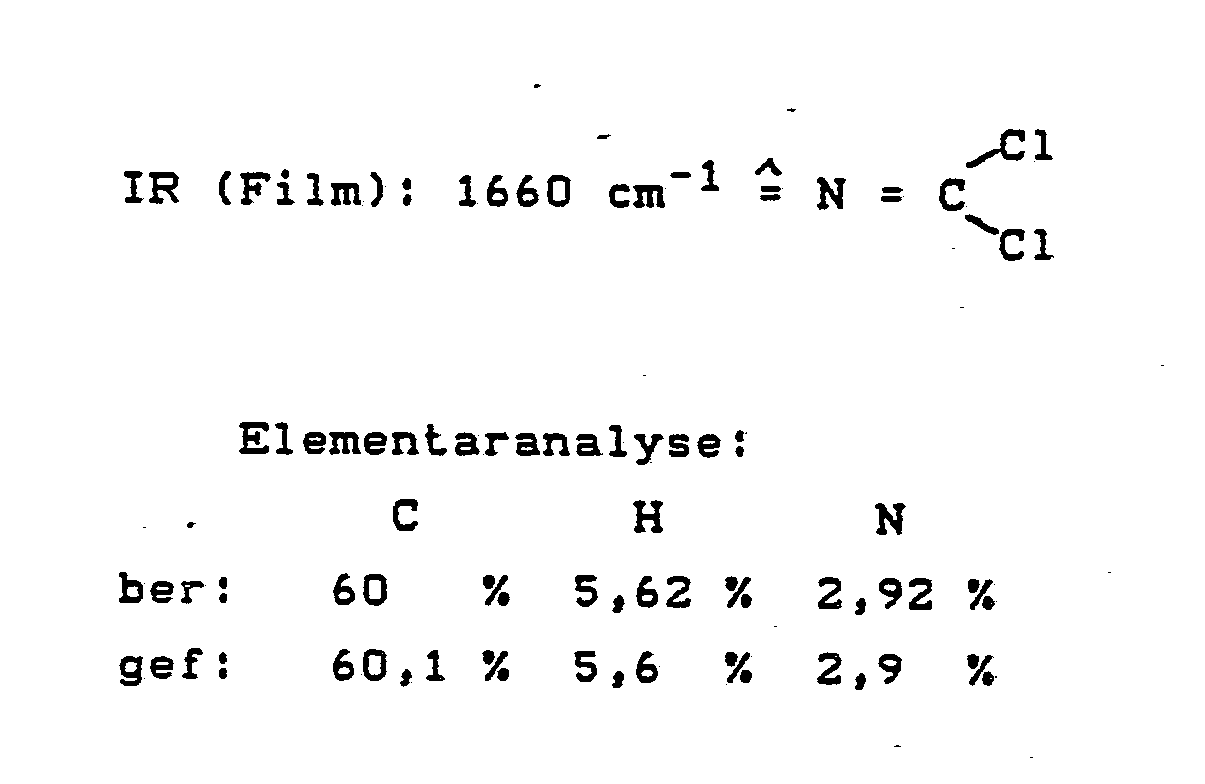
Es werden 12,6 g (= 86,5 % der Theorie) 4-Dichlormethylenimino-4-deoxy-2.3.6-tri-O-benzyl-1-O-methyl-α-D-glucopyranose in Form eines farblosen Öls erhalten.

In die Lösung von 30 g (84,75 mmol) 2-Isocyano-2-deoxy-1.3.4.6-tetra-O-acetyl-β-D-glucopyranose in 300 ml Chloroform wird bei -5 bis -10°C so lange Chlor eingeleitet, bis sich IR-spektroskopisch keine Isonitrilgruppe nachweisen läßt. Anschließend wird das Lösungsmittel bei -10°C entfernt. Der Rückstand wird aus 300 ml Cyclohexan umkristallisiert.In the solution of 30 g (84.75 mmol) of 2-isocyano-2-deoxy-1.3.4.6-tetra-O-acetyl-β-D-glucopyranose in 300 ml of chloroform at -5 to -10 ° C Chlorine introduced until no isonitrile group is detected by IR spectroscopy leaves. The solvent is then removed at -10 ° C. The residue is recrystallized from 300 ml of cyclohexane.
Es werden 21,6 g (= 60 % der Theorie) 2-Dichlormethylenimino-2-deoxy-1.3.4.6-tetra-O-acetyl-β-D-glucopyranose in Form farbloser Kristalle vom Fp.: 124-125°C erhalten.

In die Lösung von 3,1 g (11,52 mmol) 3-Isocyano-3-deoxy-1.2.5.6-di-O-isopropyliden-α-D-glucofuranose in 25 ml Chloroform wird bei -15°C langsam so lange Chlor eingeleitet, bis sich IR-spektroskopisch keine Isonitrilgruppe mehr nachweisen läßt. Anschließend wird das Lösungsmittel bei -10 bis 0°C entfernt. Der Rückstand wird mit 50 ml n-Hexan verrührt; dabei geht das Isocyaniddichlorid in Lösung und etwas polymeres Isonitril bleibt ungelöst zurück. Die Lösung wird vom Ungelösten abdekantiert und bei Raumtemperatur, zuletzt im Hochvakuum, bis zur Gewichtskonstanz eingeengt.The solution of 3.1 g (11.52 mmol) of 3-isocyano-3-deoxy-1.2.5.6-di-O-isopropylidene-α-D-glucofuranose in 25 ml of chloroform is slowly so long at -15 ° C Chlorine introduced until no more isonitrile group can be detected by IR spectroscopy. The solvent is then removed at -10 to 0 ° C. The residue is stirred with 50 ml of n-hexane; the isocyanide dichloride goes into solution and some polymeric isonitrile remains undissolved. The solution is decanted from the undissolved and concentrated to constant weight at room temperature, lastly in a high vacuum.
Es werden 3,68 g (= 93,95 % der Theorie) 3-Dichlormethylenimino-3-deoxy-1.2.5.6-di-O-isopropyliden-α-D-glucofuranose in Form eines farblosen Öls erhalten.

In die Lösung von 6,15 g (22,8 mmol) 3-Isocyano-3-deoxy-1.2.5.6-di-O-isopropyliden-α-D-allofuranose wird bei -30°C so lange Chlor eingeleitet, bis sich IR-spektroskopisch keine Isonitrilgruppe mehr nachweisen läßt. Der Rückstand wird in 150 ml n-Hexan gelöst; die Lösung wird mit Aktivkohle geklärt und anschließend im Vakuum bis zur Gewichtskonstanz eingeengt.Chlorine is passed into the solution of 6.15 g (22.8 mmol) of 3-isocyano-3-deoxy-1.2.5.6-di-O-isopropylidene-α-D-allofuranose at -30 ° C. until No more isonitrile group can be detected by IR spectroscopy. The residue is dissolved in 150 ml of n-hexane; the solution is clarified with activated carbon and then concentrated in vacuo to constant weight.
Es werden 6 g (= 77,4 % der Theorie) 3-Dichlormethylenimino-3-deoxy-1.2.5.6-di-O-isopropyliden-α-D-allofuranose in Form farbloser Kristalle vom Fp.: 68°C erhalten.

In die Lösung von 4,6 g (11,25 mmol) 6-Isocyano-6-deoxy-1,2-O-isopropyliden-3,5-di-O-benzyl-α-D-glucofuranose in 50 ml Methylenchlorid wird bei -20°C solange Chlor eingeleitet, bis sich IR-spektroskopisch keine Isonitrilgruppe mehr nachweisen läßt. Anschließend wird das Lösungsmittel im Vakuum destillativ abgetrennt. Der Rückstand wird in 50 ml n-Hexan gelöst; die Lösung wird mit Aktivgkohle geklärt und anschließend im Vakuum bis zur Gewichtskonstanz eingeengt.In the solution of 4.6 g (11.25 mmol) of 6-isocyano-6-deoxy-1,2-O-isopropylidene-3,5-di-O-benzyl-α-D-glucofuranose in 50 ml of methylene chloride chlorine is passed in at -20 ° C. until no more isonitrile group can be detected by IR spectroscopy. The solvent is then removed by distillation in vacuo. The residue is dissolved in 50 ml of n-hexane; the solution is clarified with activated carbon and then concentrated in vacuo to constant weight.
Es werden 4,9 g (= 90,74 % der Theorie) 6-Dichlormethylenimino-6-deoxy-1,2-O-isopropyliden-3,5-di-O-benzyl-α-D-glucofuranose in Form eines leicht gelblich gefärbten Öls erhalten.
Claims (7)

n 0 oder 1,
R₁ eine Schutzgruppe und
R₂ Wasserstoff, Methyl, Ethyl oder -CH₂-R₇ ist,
R₃ für Wasserstoff, Methyl, Ethyl, -CH₂-R₈ oder -C(H)R₉-CH₂-R₁₀ steht und
R₄, R₅, R₆, R₇, R₈, R₉ und R₁₀ unabhängig voneinander für Wasserstoff, Halogen, eine geschützte OH-Gruppe, eine Isocyaniddichlorid-Gruppe oder den Rest eines cyclischen Acetals der Formel

nʹ 0 oder 1,
R₂ʹ Wasserstoff, Methyl, Ethyl oder -CH₂-R₇ʹ ist
R₃ʹ für Wasserstoff, Methyl, Ethyl, -CH₂-R₈ʹ oder -C(H)R₉ʹ-CH₂-R₁₀ʹsteht,
R₄ʹ, R₅ʹ, R₆ʹ, R₇ʹ, R₈ʹ, R₉ʹ, und R₁₀ʹ unabhängig voneinander ist Wasserstoff, Halogen, eine geschützte OH-Gruppe oder den Rest eines cyclischen Acetals der Formel II stehen,
mit der Maßgabe,
daß nur einer der Reste R₄-R₁₀ eine Isocyaniddichlorid-Gruppe ist, daß höchstens einer der Reste R₄-R₁₀ und höchstens einer der Reste R₄ʹ-R₁₀ʹfür den Rest eines cyclischen Acetals der Formel II steht und daß mindestens einer der Reste R₄-R₁₀ und mindestens einer der Reste R₄ʹ-R₁₀ʹ eine geschützte OH-Gruppe ist.2. An isocyanide dichloride group-containing sugar according to claim 1, characterized in that it has the formula
n 0 or 1,
R₁ is a protecting group and
R₂ is hydrogen, methyl, ethyl or -CH₂-R₇,
R₃ is hydrogen, methyl, ethyl, -CH₂-R₈ or -C (H) R₉-CH₂-R₁₀ and
R₄, R₅, R₆, R₇, R₈, R₉ and R₁₀ independently of one another for hydrogen, halogen, a protected OH group, an isocyanide dichloride group or the rest of a cyclic acetal of the formula
nʹ 0 or 1,
R₂ʹ is hydrogen, methyl, ethyl or -CH₂-R₇ʹ
R₃ʹ represents hydrogen, methyl, ethyl, -CH₂-R₈ʹ or -C (H) R₉ʹ-CH₂-R₁₀ʹ,
R₄ʹ, R₅ʹ, R₆ʹ, R₇ʹ, R₈ʹ, R₉ʹ, and R₁₀ʹ independently of one another are hydrogen, halogen, a protected OH group or the rest of a cyclic acetal of the formula II,
with the proviso
that only one of the radicals R₄-R₁₀ is an isocyanide dichloride group, that at most one of the radicals R₄-R₁₀ and at most one of the radicals R₄ʹ-R₁₀ʹ for the rest a cyclic acetal of the formula II and that at least one of the radicals R₄-R₁₀ and at least one of the radicals R₄ʹ-R₁₀ʹ is a protected OH group.
n 0 oder 1,
R₁ eine Schutzgruppe und
R₂ Wasserstoff oder -CH₂-R₇ ist,
R₃ für Wasserstoff, Methyl, -CH₂-R₈ oder -C(H)R₉-CH₂-R₁₀ steht und
R₄, R₅, R₆, R₇, R₈, R₉ und R₁₀ unabhängig voneinander Wasserstoff, eine geschützte OH-Gruppe oder eine Isocyaniddichloridgruppe bedeuten,
mit der Maßgabe, daß nur einer der Reste R₄-R₁₀ eine Isocyaniddichloridgruppe ist und mindestens zwei der Reste R₄-R₁₀ eine geschützte OH-Gruppe sind.3. An isocyanide dichloride group-containing sugar according to claim 1, characterized in that in formula I.
n 0 or 1,
R₁ is a protecting group and
R₂ is hydrogen or -CH₂-R₇,
R₃ is hydrogen, methyl, -CH₂-R₈ or -C (H) R₉-CH₂-R₁₀ and
R₄, R₅, R₆, R₇, R₈, R₉ and R₁₀ independently of one another are hydrogen, a protected OH group or an isocyanide dichloride group,
with the proviso that only one of the radicals R₄-R₁₀ is an isocyanide dichloride group and at least two of the radicals R₄-R₁₀ are a protected OH group.
n 0 oder 1
R₁ eine Schutzgruppe und
R₂ Wasserstoff ist,
R₃ für Wasserstoff, -CH₂-R₈ oder -C(H)R₉-CH₂-R₁₀ steht und
R₄, R₅, R₆, R₈, R₉ und R₁₀ unabhängig voneinander eine geschützte OH-Gruppe oder eine Isocyanatdichlorid-Gruppe bedeuten,
mit der Maßgabe, daß nur einer der Reste R₄, R₅, R₆ R₈, R₉ oder R₁₀ eine Isocyaniddichlorid-Gruppe ist.4. An isocyanide dichloride group-containing sugar according to claim 1, characterized in that in formula I.
n 0 or 1
R₁ is a protecting group and
R₂ is hydrogen,
R₃ is hydrogen, -CH₂-R₈ or -C (H) R₉-CH₂-R₁₀ and
R₄, R₅, R₆, R₈, R₉ and R₁₀ independently of one another represent a protected OH group or an isocyanate dichloride group,
with the proviso that only one of the radicals R₄, R₅, R₆ R₈, R₉ or R₁₀ is an isocyanide dichloride group.
Applications Claiming Priority (2)
| Application Number | Priority Date | Filing Date | Title |
|---|---|---|---|
| DE3617272 | 1986-05-23 | ||
| DE19863617272 DE3617272A1 (en) | 1986-05-23 | 1986-05-23 | SUGARS HAVING ISOCYANIDE DICHLORIDE GROUPS AND METHOD FOR THE PRODUCTION THEREOF |
Publications (2)
| Publication Number | Publication Date |
|---|---|
| EP0247428A2 true EP0247428A2 (en) | 1987-12-02 |
| EP0247428A3 EP0247428A3 (en) | 1989-11-15 |
Family
ID=6301410
Family Applications (1)
| Application Number | Title | Priority Date | Filing Date |
|---|---|---|---|
| EP87106837A Withdrawn EP0247428A3 (en) | 1986-05-23 | 1987-05-12 | Carbohydrate containing dichloromethylenimino radicals, and method for their preparation |
Country Status (4)
| Country | Link |
|---|---|
| EP (1) | EP0247428A3 (en) |
| JP (1) | JPS62283991A (en) |
| DE (1) | DE3617272A1 (en) |
| IL (1) | IL82593A0 (en) |
Cited By (1)
| Publication number | Priority date | Publication date | Assignee | Title |
|---|---|---|---|---|
| US5476924A (en) * | 1989-01-27 | 1995-12-19 | Duke University | Protecting group for acetals and methods of using the same in the activation of saccharides |
Family Cites Families (5)
| Publication number | Priority date | Publication date | Assignee | Title |
|---|---|---|---|---|
| US3575959A (en) * | 1969-05-13 | 1971-04-20 | Merck & Co Inc | 5'-substituted ribofuranosyl nucleosides |
| JPS5175072A (en) * | 1974-12-18 | 1976-06-29 | Tokyo Tanabe Co | RIBOFURANOOZUNONITOROSOKARUBAMIRUJUDOTAINO SEIZOHO |
| JPS56103197A (en) * | 1980-01-21 | 1981-08-18 | Wakamoto Pharmaceut Co Ltd | Novel d-glucose derivative and antitumor agent containing the same as active constitutent |
| JPS56103196A (en) * | 1980-01-21 | 1981-08-18 | Wakamoto Pharmaceut Co Ltd | Preparation of d-glucose derivative |
| DE3429432A1 (en) * | 1984-08-10 | 1986-02-20 | Bayer Ag, 5090 Leverkusen | ACYLATED SUGAR WITH GLYCOSIDICALLY TIED ISOCYANIDE DICHLORIDE GROUP AND THEIR PRODUCTION |
-
1986
- 1986-05-23 DE DE19863617272 patent/DE3617272A1/en not_active Withdrawn
-
1987
- 1987-05-12 EP EP87106837A patent/EP0247428A3/en not_active Withdrawn
- 1987-05-18 JP JP62119176A patent/JPS62283991A/en active Pending
- 1987-05-20 IL IL82593A patent/IL82593A0/en unknown
Cited By (1)
| Publication number | Priority date | Publication date | Assignee | Title |
|---|---|---|---|---|
| US5476924A (en) * | 1989-01-27 | 1995-12-19 | Duke University | Protecting group for acetals and methods of using the same in the activation of saccharides |
Also Published As
| Publication number | Publication date |
|---|---|
| IL82593A0 (en) | 1987-11-30 |
| JPS62283991A (en) | 1987-12-09 |
| DE3617272A1 (en) | 1987-11-26 |
| EP0247428A3 (en) | 1989-11-15 |
Similar Documents
| Publication | Publication Date | Title |
|---|---|---|
| DE68919566T2 (en) | Process for the synthesis of cane sugar derivatives by a regiocselective reaction. | |
| DE69515101T2 (en) | 7-FLUORO-2,3-DIDEHYDROSIALINIC ACID AND INTERMEDIATE PRODUCTS IN YOUR SYNTHESIS | |
| DE3642830A1 (en) | METHOD FOR PRODUCING PYRIMIDINES | |
| DE69014152T2 (en) | Process for the preparation of tigogenin beta cellobiosides. | |
| EP0352504B1 (en) | Process for the simultaneous preparation of 3-dialkylaminopropionitriles, bis-(2-cyanoethyl)-ether and if required ethylene cyanohydrine | |
| DE2608932C2 (en) | Process for the preparation of 3-oxy-4H-pyran-4-one derivatives | |
| EP0014379B1 (en) | Process for the preparation of methylen-bis-(4-phenyl-carbamic acid esters) | |
| EP0247428A2 (en) | Carbohydrate containing dichloromethylenimino radicals, and method for their preparation | |
| DE1962757C3 (en) | Evomonoside derivatives, processes for their production and pharmaceuticals containing them | |
| EP0321833A2 (en) | Process for the preparation of 4-amino-1,2,4-triazol-5-ones | |
| DE1795651B2 (en) | Process for the preparation of 6-substituted 23,5,6-tetrahydroimidazo [2,1-bJ thiazoles | |
| DE2902129A1 (en) | 5-PHENETHYL-2-OXAZOLIDONE DERIVATIVES, PROCESS FOR THEIR MANUFACTURING AND MEDICINAL PRODUCTS CONTAINING THESE | |
| EP0139859B1 (en) | 1,4-dihydropyridines, method for their preparation and their use as medicaments | |
| DE1670711C3 (en) | Process for the production of Thionothiolphosphor - (- phosphonic, phosphinic) acide star | |
| EP0234348A2 (en) | N-glycosyl amide derivatives, method for their preparation and their use as medicaments | |
| EP0316672B1 (en) | Process for the preparation of glyoxal monoacetals | |
| DE4123608C1 (en) | ||
| DE1768627B1 (en) | Process for the preparation of 2- (o- or p-nitrophenyl) alkanols | |
| EP0152856A2 (en) | N-acylated 1-alkylamimo-1-desoxy ketose derivatives, method for their preparation and use | |
| DE4042098C2 (en) | Process for the preparation of optically active quinoxalinyloxy-phenoxypropionic acid esters | |
| DE3106463C2 (en) | Process for the preparation of derivatives of Kanamycin A. | |
| EP0394907A1 (en) | Process for producing etoposides | |
| EP0385194B1 (en) | Process for the preparation of asymmetrical spiroorthocarbonates | |
| EP0171016B1 (en) | Cyclic ethers alpha-substituted by an isocyanide dichloride group, and method for their preparation | |
| EP0060419A1 (en) | Process for the preparation of o- and p-acyl phenols |
Legal Events
| Date | Code | Title | Description |
|---|---|---|---|
| PUAI | Public reference made under article 153(3) epc to a published international application that has entered the european phase |
Free format text: ORIGINAL CODE: 0009012 |
|
| 17P | Request for examination filed |
Effective date: 19870512 |
|
| AK | Designated contracting states |
Kind code of ref document: A2 Designated state(s): BE CH DE FR GB IT LI NL |
|
| PUAL | Search report despatched |
Free format text: ORIGINAL CODE: 0009013 |
|
| AK | Designated contracting states |
Kind code of ref document: A3 Designated state(s): BE CH DE FR GB IT LI NL |
|
| STAA | Information on the status of an ep patent application or granted ep patent |
Free format text: STATUS: THE APPLICATION HAS BEEN WITHDRAWN |
|
| 18W | Application withdrawn |
Withdrawal date: 19891108 |
|
| R18W | Application withdrawn (corrected) |
Effective date: 19891108 |
|
| RIN1 | Information on inventor provided before grant (corrected) |
Inventor name: BONSE, GERHARD, DR. Inventor name: MUELLER, HANNS PETER, DR. Inventor name: HASSEL, TILLMANN, DR. Inventor name: LOCKHOFF, OSWALD, DR. |