EP0246785B1 - Reagensquelle - Google Patents
Reagensquelle Download PDFInfo
- Publication number
- EP0246785B1 EP0246785B1 EP87304105A EP87304105A EP0246785B1 EP 0246785 B1 EP0246785 B1 EP 0246785B1 EP 87304105 A EP87304105 A EP 87304105A EP 87304105 A EP87304105 A EP 87304105A EP 0246785 B1 EP0246785 B1 EP 0246785B1
- Authority
- EP
- European Patent Office
- Prior art keywords
- complexing agent
- gas stream
- reagent
- gaseous phase
- reservoir
- Prior art date
- Legal status (The legal status is an assumption and is not a legal conclusion. Google has not performed a legal analysis and makes no representation as to the accuracy of the status listed.)
- Expired - Lifetime
Links
Images
Classifications
-
- C—CHEMISTRY; METALLURGY
- C23—COATING METALLIC MATERIAL; COATING MATERIAL WITH METALLIC MATERIAL; CHEMICAL SURFACE TREATMENT; DIFFUSION TREATMENT OF METALLIC MATERIAL; COATING BY VACUUM EVAPORATION, BY SPUTTERING, BY ION IMPLANTATION OR BY CHEMICAL VAPOUR DEPOSITION, IN GENERAL; INHIBITING CORROSION OF METALLIC MATERIAL OR INCRUSTATION IN GENERAL
- C23C—COATING METALLIC MATERIAL; COATING MATERIAL WITH METALLIC MATERIAL; SURFACE TREATMENT OF METALLIC MATERIAL BY DIFFUSION INTO THE SURFACE, BY CHEMICAL CONVERSION OR SUBSTITUTION; COATING BY VACUUM EVAPORATION, BY SPUTTERING, BY ION IMPLANTATION OR BY CHEMICAL VAPOUR DEPOSITION, IN GENERAL
- C23C16/00—Chemical coating by decomposition of gaseous compounds, without leaving reaction products of surface material in the coating, i.e. chemical vapour deposition [CVD] processes
- C23C16/44—Chemical coating by decomposition of gaseous compounds, without leaving reaction products of surface material in the coating, i.e. chemical vapour deposition [CVD] processes characterised by the method of coating
- C23C16/455—Chemical coating by decomposition of gaseous compounds, without leaving reaction products of surface material in the coating, i.e. chemical vapour deposition [CVD] processes characterised by the method of coating characterised by the method used for introducing gases into reaction chamber or for modifying gas flows in reaction chamber
- C23C16/45561—Gas plumbing upstream of the reaction chamber
-
- B—PERFORMING OPERATIONS; TRANSPORTING
- B01—PHYSICAL OR CHEMICAL PROCESSES OR APPARATUS IN GENERAL
- B01J—CHEMICAL OR PHYSICAL PROCESSES, e.g. CATALYSIS OR COLLOID CHEMISTRY; THEIR RELEVANT APPARATUS
- B01J4/00—Feed or outlet devices; Feed or outlet control devices
-
- B—PERFORMING OPERATIONS; TRANSPORTING
- B01—PHYSICAL OR CHEMICAL PROCESSES OR APPARATUS IN GENERAL
- B01J—CHEMICAL OR PHYSICAL PROCESSES, e.g. CATALYSIS OR COLLOID CHEMISTRY; THEIR RELEVANT APPARATUS
- B01J4/00—Feed or outlet devices; Feed or outlet control devices
- B01J4/04—Feed or outlet devices; Feed or outlet control devices using osmotic pressure using membranes, porous plates
-
- C—CHEMISTRY; METALLURGY
- C30—CRYSTAL GROWTH
- C30B—SINGLE-CRYSTAL GROWTH; UNIDIRECTIONAL SOLIDIFICATION OF EUTECTIC MATERIAL OR UNIDIRECTIONAL DEMIXING OF EUTECTOID MATERIAL; REFINING BY ZONE-MELTING OF MATERIAL; PRODUCTION OF A HOMOGENEOUS POLYCRYSTALLINE MATERIAL WITH DEFINED STRUCTURE; SINGLE CRYSTALS OR HOMOGENEOUS POLYCRYSTALLINE MATERIAL WITH DEFINED STRUCTURE; AFTER-TREATMENT OF SINGLE CRYSTALS OR A HOMOGENEOUS POLYCRYSTALLINE MATERIAL WITH DEFINED STRUCTURE; APPARATUS THEREFOR
- C30B25/00—Single-crystal growth by chemical reaction of reactive gases, e.g. chemical vapour-deposition growth
- C30B25/02—Epitaxial-layer growth
- C30B25/14—Feed and outlet means for the gases; Modifying the flow of the reactive gases
Definitions
- This invention relates to a reagent source and more particularly to the provision at a controlled mass flow rate of a reagent, e.g. an organo-metallic reagent, into metal organic vapour phase epitaxy (which is conveniently abbreviated to MOVPE).
- a reagent e.g. an organo-metallic reagent
- MOVPE metal organic vapour phase epitaxy
- MOVPE is a widely used process to grow semiconductor layers onto semiconductor substrates.
- the growth is achieved by passing (cold) gaseous reactants in an inert gas stream over a hot. e.g. 600° - 800°, exposed surface of a substrate.
- the reaction occurs in contact with the hot surface and the product is deposited in the form of a single crystal.
- Some examples of epitaxy reactions, i.e. the overall reaction which occurs on the hot surface include:
- R' is an alkyl group, eg an alkyl group with 1 to 5 carbon atoms such as ethyl or, particularly, methyl.
- the organo-metallic reagent is usually a metal alkyl, eg one or more of the trialkyls identified above. These are either volatile solids or volatile liquids and controlling the supply of these is more difficult.
- Liquid and solid reagents are usually supplied into MOVPE by the entrainment method. This comprises passing a stream of gas over a solid or bubbling it through a liquid.
- the vapour pressure is an important control parameter and, because vapour pressure is strongly temperature dependent, even very accurate thermostats provide at best only adequate control. Other sources of error include variations in the efficiency of pick-up and the effect of flow-rate.
- amine complexes of metal alkyls in the gas stream which supplies reagents into the MOVPE reaction chamber in order to suppress undesired reactions during transport.
- an amine complex dissociates to give the metal alkyl and the amine.
- the metal alkyl participates as usual in the MOVPE growth while the amine passes to waste without affecting the growth.
- a gaseous phase complexing agent is caused to diffuse, at a controlled rate, into the presence of the primary source.
- the complexing agent reacts with the primary source to form a gaseous phase complex which is conveyed into the process.
- the partial vapour pressure of the complexing agent is kept low. Under these conditions it has been found possible to supply adequate amounts of reagent into the process and to control accurately the rate of the supply.
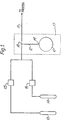
- Figure 1 illustrates a source according to the invention which source is designed to provide a vapour phase organo-metallic reagent into a process such as organo-metallic vapour phase epitaxy and to control this supply to a constant mass-rate.
- the method uses a solid phase complexing agent and a gaseous phase complexing agent.
- the organo-metallic compound will be represented as X
- the solid phase complexing agent will be represented as A
- the gaseous phase complexing agent as B.
- a carrier gas eg helium
- the two complexes will be represented as AX and BX (but the mole ratios of A : X and B : X are to be taken as unspecified). It is emphasised that, at the temperatures and pressures of operation, the molecular species A and AX are solid while the species B and BX are gaseous. The temperature and pressure are chosen so that these conditions apply.
- the overall reaction used by the invention is the deplacement but this may occur in two separate reactions:
- the equilibrium constants are chosen so that at equilibrium, reaction (1) gives a higher vapour pressure of X than reaction (2).
- the preferred species are:
- the source apparatus comprises a reservoir 10 which contains the solid participants A and AX.
- the solid complex AX was placed in reservoir 10 before starting and it is connected into solid phase complexing agent A during use.
- the reservoir 10 is connected to a gas line 11 by means of a capillary tube 12.
- the gas line 11 is supplied from bottles 13 and 14 with mass flow controllers 15 and 16.
- Bottle 13 conveniently contains a mixture of carrier gas and B, e.g. a mixture which contains 8 - 10 mole-% of B.
- Bottle 14 contains pure inert gas.
- the mass flow controllers 15 and 16 provide accurate control of the flow rate and hence they provide accurate control of the concentration of B in carrier gas in the line 11. It will be noted that the reservoir 10 and capillary 11 form a conventional effusion cell in which the rate of diffusion through capillary 12 constitutes the important control parameter. Since diffusion is temperature dependant the reservoir 10 and capillary 12 are located in a thermostat 17. Since the diffusion is only weakly temperature dependent the control is accurate. This arrangement also ensures a suitable reaction temperature.
- the equipment also includes joints (not shown) to permit assembly and dis-assembly, eg for replenishment of solid complex AX in the reservoir 10.
- the control mechanism established by the system described above will now be considered.
- the hypothetical initial state for this explanation is reservoir 10 containing inert gas in equilibrium with solid complex AX at the temperature of thermostat 17.
- the gas line 11 contains a stream of inert gas and gaseous phase complexing agent B at a controlled concentration fixed by the mass flow controllers 15 and 16.
- gaseous phase complexing agent B will diffuse into capillary 12 and thereby establish a partial pressure gradient from the primary end 18 to the secondary end 19 where the partial pressure of the gaseous phase complexing agent B is effectively zero.
- B enters the reservoir 10 it encounters organo-metallic X in the gas phase and it reacts to form gaseous phase adduct BX.
- This reaction has two effects. The first effect is that gaseous phase complexing agent B is substantially removed whereby its partial pressure in reservoir 10 remains substantially zero and the inlet diffusion conditions are substantially unaffected. The second effect is to reduce the partial pressure of organo-metallic X whereby further decomposition of solid adduct AX occurs.
- BX means that its partial pressure in the reservoir 10 rises and hence its diffusion rate out of the reservoir 10 via capillary 12 also rises.
- the steady state conditions in the reservoir 10 should also considered.
- the vapour pressure of organo-metallic X is depressed below the equilibrium with primary adduct AX.
- the result is that the rate of decomposition of AX is matched to the inflow of B.
- gaseous complexing agent B is controlled by its partial pressure at the primary end 18 of the capillary 12 and not by the flow rate of the mixture. Within the operational range, altering the flow rate only alters the amount of the excess but it does not change the partial pressure and hence it does not alter the rate of diffusion.
- the two bottles 13 and 14 and the two mass flow controllers 15 and 16 are needed so as to change the ratio of the two flows.
- the changes consequent upon a higher partial pressure will now be considered.
- Four control mechanisms can be distinguished.
- capillary 12 The diffusion resistance of capillary 12 is clearly an important factor since short fat tubes will allow a faster rate than long thin tubes. In practice the tube is a fixed element and therefore the resistance is constant. A new or different tube 12 would require re-calibration.
- the temperature of the diffusion path also affects the diffusion rate. Gases diffuse slower at higher temperatures and, therefore, the thermostat 17 is needed to provide a constant temperature. It is emphasised that diffusion is only weakly temperature dependant and at 100°C (a convenient working temperature) a thermostat error of one degree ( ⁇ 1 °C) would cause an error in the diffusion rate of about ⁇ 0.5 %. Therefore, with even a moderate quality thermostat, it is possible to control the diffusion process to a very good level of accuracy.
- the partial pressure gradient of agent B applied to the capillary 12 is also a control parameter. Since the partial pressure of gaseous complexing agent B at the secondary end 19 is always very low it can be taken as zero, leaving the partial pressure at primary end 18 as the control parameter. As explained above, this partial pressure is conveniently controlled and adjusted by mass flow controllers 15 and 16.
- control process described above is considerably more accurate than the entrainment method described above because the strongly temperature dependent effect of vapour pressure is replaced by the weakly dependent effect of diffusion rate. Furthermore inaccuracies related to efficiency of pick-up are eliminated.
- the restrictions on supply rate, which are inherent in the modified entrainment method, are overcome because the secondary adduct is gaseous. Thus, even when the primary source is involatile or when it has a low decomposition pressure, adequate amounts of reagent will pass through the diffusive resistance.
- the method of the invention utilises adducts and, therefore, it offers the advantages associated with these.
Landscapes
- Chemical & Material Sciences (AREA)
- Organic Chemistry (AREA)
- Chemical Kinetics & Catalysis (AREA)
- Metallurgy (AREA)
- General Chemical & Material Sciences (AREA)
- Engineering & Computer Science (AREA)
- Materials Engineering (AREA)
- Mechanical Engineering (AREA)
- Crystallography & Structural Chemistry (AREA)
- Saccharide Compounds (AREA)
- Steroid Compounds (AREA)
- Sampling And Sample Adjustment (AREA)
- Feeding, Discharge, Calcimining, Fusing, And Gas-Generation Devices (AREA)
Claims (10)
wobei der Massenfluß des Reagenz mit einer Rate auftritt, die bestimmt und gesteuert wird mittels des Dampfdruckes des in der Gasphase komplexbildenden Agens in dem Gasstrom.
wobei der Indium/Aminkomplex dem MOVPE-Prozeß mit einer Masseflußrate zugeführt wird, die durch den Partialdampfdruck des Trimethylamins in dem Gasstrom gesteuert wird.
Priority Applications (1)
| Application Number | Priority Date | Filing Date | Title |
|---|---|---|---|
| AT87304105T ATE50605T1 (de) | 1986-05-21 | 1987-05-08 | Reagensquelle. |
Applications Claiming Priority (2)
| Application Number | Priority Date | Filing Date | Title |
|---|---|---|---|
| GB8612402 | 1986-05-21 | ||
| GB868612402A GB8612402D0 (en) | 1986-05-21 | 1986-05-21 | Reagent source |
Publications (2)
| Publication Number | Publication Date |
|---|---|
| EP0246785A1 EP0246785A1 (de) | 1987-11-25 |
| EP0246785B1 true EP0246785B1 (de) | 1990-02-28 |
Family
ID=10598233
Family Applications (1)
| Application Number | Title | Priority Date | Filing Date |
|---|---|---|---|
| EP87304105A Expired - Lifetime EP0246785B1 (de) | 1986-05-21 | 1987-05-08 | Reagensquelle |
Country Status (5)
| Country | Link |
|---|---|
| EP (1) | EP0246785B1 (de) |
| AT (1) | ATE50605T1 (de) |
| CA (1) | CA1332694C (de) |
| DE (1) | DE3761773D1 (de) |
| GB (1) | GB8612402D0 (de) |
Families Citing this family (2)
| Publication number | Priority date | Publication date | Assignee | Title |
|---|---|---|---|---|
| US5063166A (en) * | 1988-04-29 | 1991-11-05 | Sri International | Method of forming a low dislocation density semiconductor device |
| US4916088A (en) * | 1988-04-29 | 1990-04-10 | Sri International | Method of making a low dislocation density semiconductor device |
Family Cites Families (3)
| Publication number | Priority date | Publication date | Assignee | Title |
|---|---|---|---|---|
| DE1947463A1 (de) * | 1969-01-30 | 1970-08-06 | Halbleiterwerk Frankfurt Oder | Vorrichtung zum Beladen von Traegergasen |
| FR2569207B1 (fr) * | 1984-08-14 | 1986-11-14 | Mellet Robert | Procede et dispositif d'obtention d'un courant gazeux contenant un compose a l'etat de vapeur, utilisable notamment pour introduire ce compose dans un reacteur d'epitaxie |
| GB8421162D0 (en) * | 1984-08-21 | 1984-09-26 | British Telecomm | Growth of semi-conductors |
-
1986
- 1986-05-21 GB GB868612402A patent/GB8612402D0/en active Pending
-
1987
- 1987-05-08 DE DE8787304105T patent/DE3761773D1/de not_active Expired - Lifetime
- 1987-05-08 AT AT87304105T patent/ATE50605T1/de not_active IP Right Cessation
- 1987-05-08 EP EP87304105A patent/EP0246785B1/de not_active Expired - Lifetime
- 1987-05-15 CA CA000537210A patent/CA1332694C/en not_active Expired - Fee Related
Non-Patent Citations (1)
| Title |
|---|
| Journal of the Chem. Society, Faraday Transactions, Volume 10, 1974,pages 2267-2279 * |
Also Published As
| Publication number | Publication date |
|---|---|
| ATE50605T1 (de) | 1990-03-15 |
| CA1332694C (en) | 1994-10-25 |
| GB8612402D0 (en) | 1986-06-25 |
| EP0246785A1 (de) | 1987-11-25 |
| DE3761773D1 (de) | 1990-04-05 |
Similar Documents
| Publication | Publication Date | Title |
|---|---|---|
| KR920010690B1 (ko) | 유기금속 화학 증착장치 및 그 방법 | |
| US4517220A (en) | Deposition and diffusion source control means and method | |
| JPH06216034A (ja) | 化学蒸着装置用蒸気発生器 | |
| US20010045187A1 (en) | Chemical vapor deposition methods and apparatus | |
| CA1172524A (en) | Manufacture of group iii-v compounds | |
| JPH06509389A (ja) | 金属蒸着法 | |
| EP0286274B1 (de) | Reagenzquelle für Molekularstrahlepitaxie | |
| US4772296A (en) | Method of purifying and depositing group IIIa and group Va compounds to produce epitaxial films | |
| EP0246785B1 (de) | Reagensquelle | |
| US5250135A (en) | Reagent source | |
| EP0362952B1 (de) | Verfahren zur Herstellung einer Indiumphosphid-Epitaxialschicht auf einer Substratoberfläche | |
| KR920009652B1 (ko) | 화합물 반도체 제조 장치 | |
| US5098857A (en) | Method of making semi-insulating gallium arsenide by oxygen doping in metal-organic vapor phase epitaxy | |
| US5502227A (en) | Liquid indium source | |
| Chatterjee et al. | A simplified technique for MOCVD of III-V compounds | |
| Johnston Jr et al. | Liquid and Vapor Phase Growth of III‐V Materials for Photonic Devices | |
| KR900006120B1 (ko) | 도우펀트 운반 화합물로서 디에틸베릴륨을 사용하는 반도체 재료층의 에피택셜 증착방법 | |
| Speckman et al. | Triethylarsenic and arsine as co-reagents: The novel manipulation of in-situ GaAs OMCVD growth chemistry to improve growth efficiency and safety | |
| CA1250511A (en) | Technique for the growth of epitaxial compound semiconductor films | |
| Holstein | Performance of gas saturators in the presence of exit stream temperature gradients and implications for chemical vapor deposition saturator design | |
| JP2700210B2 (ja) | 化合物半導体の気相エピタキシャル成長法 | |
| JP2003347219A (ja) | 気相成長装置 | |
| JPS61263119A (ja) | 気相成長による半導体製造装置 | |
| JPS6124227A (ja) | 気相成長装置 | |
| JPH0817158B2 (ja) | 気相成長による半導体製造装置 |
Legal Events
| Date | Code | Title | Description |
|---|---|---|---|
| PUAI | Public reference made under article 153(3) epc to a published international application that has entered the european phase |
Free format text: ORIGINAL CODE: 0009012 |
|
| AK | Designated contracting states |
Kind code of ref document: A1 Designated state(s): AT BE CH DE ES FR GB GR IT LI LU NL SE |
|
| 17P | Request for examination filed |
Effective date: 19871210 |
|
| 17Q | First examination report despatched |
Effective date: 19890512 |
|
| RAP1 | Party data changed (applicant data changed or rights of an application transferred) |
Owner name: BRITISH TELECOMMUNICATIONS PUBLIC LIMITED COMPANY |
|
| GRAA | (expected) grant |
Free format text: ORIGINAL CODE: 0009210 |
|
| AK | Designated contracting states |
Kind code of ref document: B1 Designated state(s): AT BE CH DE ES FR GB GR IT LI LU NL SE |
|
| PG25 | Lapsed in a contracting state [announced via postgrant information from national office to epo] |
Ref country code: LI Effective date: 19900228 Ref country code: GR Free format text: LAPSE BECAUSE OF FAILURE TO SUBMIT A TRANSLATION OF THE DESCRIPTION OR TO PAY THE FEE WITHIN THE PRESCRIBED TIME-LIMIT Effective date: 19900228 Ref country code: CH Effective date: 19900228 Ref country code: AT Effective date: 19900228 |
|
| REF | Corresponds to: |
Ref document number: 50605 Country of ref document: AT Date of ref document: 19900315 Kind code of ref document: T |
|
| ITF | It: translation for a ep patent filed | ||
| REF | Corresponds to: |
Ref document number: 3761773 Country of ref document: DE Date of ref document: 19900405 |
|
| ET | Fr: translation filed | ||
| PG25 | Lapsed in a contracting state [announced via postgrant information from national office to epo] |
Ref country code: LU Free format text: LAPSE BECAUSE OF NON-PAYMENT OF DUE FEES Effective date: 19900531 |
|
| PG25 | Lapsed in a contracting state [announced via postgrant information from national office to epo] |
Ref country code: ES Free format text: LAPSE BECAUSE OF FAILURE TO SUBMIT A TRANSLATION OF THE DESCRIPTION OR TO PAY THE FEE WITHIN THE PRESCRIBED TIME-LIMIT Effective date: 19900608 |
|
| REG | Reference to a national code |
Ref country code: CH Ref legal event code: PL |
|
| PLBE | No opposition filed within time limit |
Free format text: ORIGINAL CODE: 0009261 |
|
| STAA | Information on the status of an ep patent application or granted ep patent |
Free format text: STATUS: NO OPPOSITION FILED WITHIN TIME LIMIT |
|
| 26N | No opposition filed | ||
| ITTA | It: last paid annual fee | ||
| PGFP | Annual fee paid to national office [announced via postgrant information from national office to epo] |
Ref country code: FR Payment date: 19940413 Year of fee payment: 8 |
|
| PGFP | Annual fee paid to national office [announced via postgrant information from national office to epo] |
Ref country code: SE Payment date: 19940419 Year of fee payment: 8 Ref country code: GB Payment date: 19940419 Year of fee payment: 8 |
|
| PGFP | Annual fee paid to national office [announced via postgrant information from national office to epo] |
Ref country code: DE Payment date: 19940425 Year of fee payment: 8 |
|
| PGFP | Annual fee paid to national office [announced via postgrant information from national office to epo] |
Ref country code: BE Payment date: 19940428 Year of fee payment: 8 |
|
| PGFP | Annual fee paid to national office [announced via postgrant information from national office to epo] |
Ref country code: NL Payment date: 19940531 Year of fee payment: 8 |
|
| EAL | Se: european patent in force in sweden |
Ref document number: 87304105.7 |
|
| PG25 | Lapsed in a contracting state [announced via postgrant information from national office to epo] |
Ref country code: GB Effective date: 19950508 |
|
| PG25 | Lapsed in a contracting state [announced via postgrant information from national office to epo] |
Ref country code: SE Effective date: 19950509 |
|
| PG25 | Lapsed in a contracting state [announced via postgrant information from national office to epo] |
Ref country code: BE Effective date: 19950531 |
|
| BERE | Be: lapsed |
Owner name: BRITISH TELECOMMUNICATIONS P.L.C. Effective date: 19950531 |
|
| PG25 | Lapsed in a contracting state [announced via postgrant information from national office to epo] |
Ref country code: NL Effective date: 19951201 |
|
| GBPC | Gb: european patent ceased through non-payment of renewal fee |
Effective date: 19950508 |
|
| NLV4 | Nl: lapsed or anulled due to non-payment of the annual fee |
Effective date: 19951201 |
|
| PG25 | Lapsed in a contracting state [announced via postgrant information from national office to epo] |
Ref country code: DE Effective date: 19960201 |
|
| EUG | Se: european patent has lapsed |
Ref document number: 87304105.7 |
|
| PG25 | Lapsed in a contracting state [announced via postgrant information from national office to epo] |
Ref country code: FR Effective date: 19960229 |
|
| REG | Reference to a national code |
Ref country code: FR Ref legal event code: ST |
|
| REG | Reference to a national code |
Ref country code: FR Ref legal event code: ST |
|
| PG25 | Lapsed in a contracting state [announced via postgrant information from national office to epo] |
Ref country code: IT Free format text: LAPSE BECAUSE OF NON-PAYMENT OF DUE FEES;WARNING: LAPSES OF ITALIAN PATENTS WITH EFFECTIVE DATE BEFORE 2007 MAY HAVE OCCURRED AT ANY TIME BEFORE 2007. THE CORRECT EFFECTIVE DATE MAY BE DIFFERENT FROM THE ONE RECORDED. Effective date: 20050508 |