EP0246399A2 - Verfahren und Vorrichtung zur on-line-spektralphotometrischen chemischen Analyse von Material in einem Prozessstrom - Google Patents
Verfahren und Vorrichtung zur on-line-spektralphotometrischen chemischen Analyse von Material in einem Prozessstrom Download PDFInfo
- Publication number
- EP0246399A2 EP0246399A2 EP87102438A EP87102438A EP0246399A2 EP 0246399 A2 EP0246399 A2 EP 0246399A2 EP 87102438 A EP87102438 A EP 87102438A EP 87102438 A EP87102438 A EP 87102438A EP 0246399 A2 EP0246399 A2 EP 0246399A2
- Authority
- EP
- European Patent Office
- Prior art keywords
- radiation
- observation chamber
- sample cell
- process stream
- window
- Prior art date
- Legal status (The legal status is an assumption and is not a legal conclusion. Google has not performed a legal analysis and makes no representation as to the accuracy of the status listed.)
- Withdrawn
Links
- 239000000463 material Substances 0.000 title claims abstract description 71
- 238000000034 method Methods 0.000 title claims abstract description 70
- 238000004458 analytical method Methods 0.000 title claims description 40
- 239000000126 substance Substances 0.000 title claims description 18
- 230000005855 radiation Effects 0.000 claims abstract description 61
- 238000002798 spectrophotometry method Methods 0.000 claims abstract description 3
- 238000004891 communication Methods 0.000 claims description 6
- 238000012545 processing Methods 0.000 claims description 5
- 230000003595 spectral effect Effects 0.000 claims description 5
- 230000005540 biological transmission Effects 0.000 claims description 4
- 238000007599 discharging Methods 0.000 claims description 4
- 238000001228 spectrum Methods 0.000 claims description 3
- 229920000642 polymer Polymers 0.000 abstract description 83
- 239000013078 crystal Substances 0.000 abstract description 11
- 238000010521 absorption reaction Methods 0.000 abstract description 9
- 239000000523 sample Substances 0.000 description 72
- 238000004519 manufacturing process Methods 0.000 description 9
- CURLTUGMZLYLDI-UHFFFAOYSA-N Carbon dioxide Chemical compound O=C=O CURLTUGMZLYLDI-UHFFFAOYSA-N 0.000 description 6
- 239000000203 mixture Substances 0.000 description 6
- 238000005070 sampling Methods 0.000 description 5
- 239000000654 additive Substances 0.000 description 4
- 238000010438 heat treatment Methods 0.000 description 4
- 239000002699 waste material Substances 0.000 description 4
- 230000004888 barrier function Effects 0.000 description 3
- 229910002092 carbon dioxide Inorganic materials 0.000 description 3
- 239000001569 carbon dioxide Substances 0.000 description 3
- 238000006243 chemical reaction Methods 0.000 description 3
- 238000002329 infrared spectrum Methods 0.000 description 3
- 239000007788 liquid Substances 0.000 description 3
- 150000002894 organic compounds Chemical class 0.000 description 3
- 239000008188 pellet Substances 0.000 description 3
- 238000011144 upstream manufacturing Methods 0.000 description 3
- XLYOFNOQVPJJNP-UHFFFAOYSA-N water Substances O XLYOFNOQVPJJNP-UHFFFAOYSA-N 0.000 description 3
- 238000004566 IR spectroscopy Methods 0.000 description 2
- 239000004677 Nylon Substances 0.000 description 2
- 235000013361 beverage Nutrition 0.000 description 2
- 239000007795 chemical reaction product Substances 0.000 description 2
- 238000012937 correction Methods 0.000 description 2
- 238000011161 development Methods 0.000 description 2
- 230000000694 effects Effects 0.000 description 2
- 230000013011 mating Effects 0.000 description 2
- 229920001778 nylon Polymers 0.000 description 2
- 230000003287 optical effect Effects 0.000 description 2
- -1 polypropylene Polymers 0.000 description 2
- 239000000047 product Substances 0.000 description 2
- 238000003908 quality control method Methods 0.000 description 2
- 229910001369 Brass Inorganic materials 0.000 description 1
- 229910000669 Chrome steel Inorganic materials 0.000 description 1
- RYGMFSIKBFXOCR-UHFFFAOYSA-N Copper Chemical compound [Cu] RYGMFSIKBFXOCR-UHFFFAOYSA-N 0.000 description 1
- 238000005033 Fourier transform infrared spectroscopy Methods 0.000 description 1
- 239000004698 Polyethylene Substances 0.000 description 1
- 239000004743 Polypropylene Substances 0.000 description 1
- 229910000831 Steel Inorganic materials 0.000 description 1
- 239000004809 Teflon Substances 0.000 description 1
- 229920006362 Teflon® Polymers 0.000 description 1
- HCHKCACWOHOZIP-UHFFFAOYSA-N Zinc Chemical compound [Zn] HCHKCACWOHOZIP-UHFFFAOYSA-N 0.000 description 1
- 239000000853 adhesive Substances 0.000 description 1
- 230000001070 adhesive effect Effects 0.000 description 1
- XAGFODPZIPBFFR-UHFFFAOYSA-N aluminium Chemical compound [Al] XAGFODPZIPBFFR-UHFFFAOYSA-N 0.000 description 1
- 229910052782 aluminium Inorganic materials 0.000 description 1
- 230000003466 anti-cipated effect Effects 0.000 description 1
- 239000010951 brass Substances 0.000 description 1
- 239000011248 coating agent Substances 0.000 description 1
- 238000000576 coating method Methods 0.000 description 1
- 239000000470 constituent Substances 0.000 description 1
- 238000010924 continuous production Methods 0.000 description 1
- 238000001816 cooling Methods 0.000 description 1
- 229910052802 copper Inorganic materials 0.000 description 1
- 239000010949 copper Substances 0.000 description 1
- 230000002950 deficient Effects 0.000 description 1
- 239000000975 dye Substances 0.000 description 1
- 229920006333 epoxy cement Polymers 0.000 description 1
- 238000001914 filtration Methods 0.000 description 1
- 239000012530 fluid Substances 0.000 description 1
- 238000009472 formulation Methods 0.000 description 1
- 238000009413 insulation Methods 0.000 description 1
- 238000012423 maintenance Methods 0.000 description 1
- 229920000728 polyester Polymers 0.000 description 1
- 229920000573 polyethylene Polymers 0.000 description 1
- 238000004184 polymer manufacturing process Methods 0.000 description 1
- 229920001155 polypropylene Polymers 0.000 description 1
- 238000004451 qualitative analysis Methods 0.000 description 1
- 230000001105 regulatory effect Effects 0.000 description 1
- 238000012958 reprocessing Methods 0.000 description 1
- 239000007787 solid Substances 0.000 description 1
- 229910001220 stainless steel Inorganic materials 0.000 description 1
- 239000010935 stainless steel Substances 0.000 description 1
- 230000005654 stationary process Effects 0.000 description 1
- 239000010959 steel Substances 0.000 description 1
- 229920002994 synthetic fiber Polymers 0.000 description 1
- 239000012209 synthetic fiber Substances 0.000 description 1
- 238000004154 testing of material Methods 0.000 description 1
- 239000011345 viscous material Substances 0.000 description 1
- 239000003039 volatile agent Substances 0.000 description 1
- 239000011701 zinc Substances 0.000 description 1
- 229910052725 zinc Inorganic materials 0.000 description 1
Images



Classifications
-
- G—PHYSICS
- G01—MEASURING; TESTING
- G01N—INVESTIGATING OR ANALYSING MATERIALS BY DETERMINING THEIR CHEMICAL OR PHYSICAL PROPERTIES
- G01N21/00—Investigating or analysing materials by the use of optical means, i.e. using sub-millimetre waves, infrared, visible or ultraviolet light
- G01N21/17—Systems in which incident light is modified in accordance with the properties of the material investigated
- G01N21/25—Colour; Spectral properties, i.e. comparison of effect of material on the light at two or more different wavelengths or wavelength bands
- G01N21/31—Investigating relative effect of material at wavelengths characteristic of specific elements or molecules, e.g. atomic absorption spectrometry
- G01N21/35—Investigating relative effect of material at wavelengths characteristic of specific elements or molecules, e.g. atomic absorption spectrometry using infrared light
- G01N21/3504—Investigating relative effect of material at wavelengths characteristic of specific elements or molecules, e.g. atomic absorption spectrometry using infrared light for analysing gases, e.g. multi-gas analysis
- G01N21/3518—Devices using gas filter correlation techniques; Devices using gas pressure modulation techniques
-
- G—PHYSICS
- G01—MEASURING; TESTING
- G01N—INVESTIGATING OR ANALYSING MATERIALS BY DETERMINING THEIR CHEMICAL OR PHYSICAL PROPERTIES
- G01N21/00—Investigating or analysing materials by the use of optical means, i.e. using sub-millimetre waves, infrared, visible or ultraviolet light
- G01N21/01—Arrangements or apparatus for facilitating the optical investigation
- G01N21/03—Cuvette constructions
- G01N21/05—Flow-through cuvettes
-
- G—PHYSICS
- G01—MEASURING; TESTING
- G01N—INVESTIGATING OR ANALYSING MATERIALS BY DETERMINING THEIR CHEMICAL OR PHYSICAL PROPERTIES
- G01N21/00—Investigating or analysing materials by the use of optical means, i.e. using sub-millimetre waves, infrared, visible or ultraviolet light
- G01N21/17—Systems in which incident light is modified in accordance with the properties of the material investigated
- G01N21/25—Colour; Spectral properties, i.e. comparison of effect of material on the light at two or more different wavelengths or wavelength bands
- G01N21/31—Investigating relative effect of material at wavelengths characteristic of specific elements or molecules, e.g. atomic absorption spectrometry
- G01N21/35—Investigating relative effect of material at wavelengths characteristic of specific elements or molecules, e.g. atomic absorption spectrometry using infrared light
- G01N21/3577—Investigating relative effect of material at wavelengths characteristic of specific elements or molecules, e.g. atomic absorption spectrometry using infrared light for analysing liquids, e.g. polluted water
-
- G—PHYSICS
- G01—MEASURING; TESTING
- G01N—INVESTIGATING OR ANALYSING MATERIALS BY DETERMINING THEIR CHEMICAL OR PHYSICAL PROPERTIES
- G01N21/00—Investigating or analysing materials by the use of optical means, i.e. using sub-millimetre waves, infrared, visible or ultraviolet light
- G01N21/01—Arrangements or apparatus for facilitating the optical investigation
- G01N21/03—Cuvette constructions
- G01N2021/0346—Capillary cells; Microcells
-
- G—PHYSICS
- G01—MEASURING; TESTING
- G01N—INVESTIGATING OR ANALYSING MATERIALS BY DETERMINING THEIR CHEMICAL OR PHYSICAL PROPERTIES
- G01N21/00—Investigating or analysing materials by the use of optical means, i.e. using sub-millimetre waves, infrared, visible or ultraviolet light
- G01N21/01—Arrangements or apparatus for facilitating the optical investigation
- G01N21/03—Cuvette constructions
- G01N21/0332—Cuvette constructions with temperature control
-
- G—PHYSICS
- G01—MEASURING; TESTING
- G01N—INVESTIGATING OR ANALYSING MATERIALS BY DETERMINING THEIR CHEMICAL OR PHYSICAL PROPERTIES
- G01N21/00—Investigating or analysing materials by the use of optical means, i.e. using sub-millimetre waves, infrared, visible or ultraviolet light
- G01N21/17—Systems in which incident light is modified in accordance with the properties of the material investigated
- G01N21/25—Colour; Spectral properties, i.e. comparison of effect of material on the light at two or more different wavelengths or wavelength bands
- G01N21/31—Investigating relative effect of material at wavelengths characteristic of specific elements or molecules, e.g. atomic absorption spectrometry
- G01N21/35—Investigating relative effect of material at wavelengths characteristic of specific elements or molecules, e.g. atomic absorption spectrometry using infrared light
-
- G—PHYSICS
- G01—MEASURING; TESTING
- G01N—INVESTIGATING OR ANALYSING MATERIALS BY DETERMINING THEIR CHEMICAL OR PHYSICAL PROPERTIES
- G01N2201/00—Features of devices classified in G01N21/00
- G01N2201/12—Circuits of general importance; Signal processing
- G01N2201/122—Kinetic analysis; determining reaction rate
- G01N2201/1224—Polymerisation
Definitions
- This invention relates to a method and apparatus for spectrophotometric chemical analysis of a material contained within a moving stationary process stream.
- the invention described in this application is intended specifically to be used on-line in a manufacturing or other process environment where rapid analysis of the chemical composition of a material in a moving process stream is critical to efficient and economical quality control.
- the invention disclosed in this application has a very wide range of use.
- the spectrophotometric apparatus uses infrared form of radiation in order to obtain an infrared spectrum for analysis.
- the infrared frequency range (2.5 to 50 microns or 4,800 to 200 wave numbers) has been used in infrared spectroscopy for some time.
- the popularity of infrared radiation as an analytical tool is the result of the relatively large amount of information that infrared spectroscopy provides and .the manner in which it can be generated . It is most widely used for the identification of all organic compounds and many non-organic compounds, and is useful because it can analyze a sample whether in the solid, liquid molten or gas phase and whether the materials are pure or impure. Depending on the manner of use, both qualitative and quantitative information can be provided. Analysis of infrared radiation output data is relatively rapid, lending itself to at least theoretical use in on-line processes.
- additives to the polymer mix reduce the coefficient of friction of yarn manufactured from the polymer so that yarn guides, rings and the like which come into contact with the rapidly moving yarn do not wear out rapidly.
- Other additives and formulation end groups in the polymer control the rate and extent to which the polymer absorbs and reacts with dyes.
- Still other additives affect the strength, elongation, moisture absorption rate and many other characteristics.
- Infrared analysis of polymer is typically carried out by forming a film or melt from polymer flake or pellets. The film or melt is allowed to cool and, when analyzed in the laboratory, is analyzed in its cool state.
- infrared radiation analysis of materials such as polymers on an on-line basis at the process stream.
- On-line infrared analysis of some materials is known.
- infrared analysis of water to determine its sugar and/or carbon dioxide content is carried out using the principle of circular internal reflection.
- a cylindrical crystal of an infrared transmissive material is sealed into a chamber through which flows a sample stream from the beverage line.
- Infrared radiation is focused on one end of the cylinder and reflected internally through it to the other end where, as it exits, it is split into three sections by selected filtration of the infrared spectrum.
- One of the sections passes radiation at the sugar absorption band, the second at the carbon dioxide absorption band and the third provides a reference wavelength.
- the cylinder is referred to as a probe and the radiation samples the liquid which passes across the outer surface of the probe.
- the use of a probe cannot be presently used to conduct infrared analysis of relatively opaque, viscous substances such as polymer melt. This is for a variety of reasons.
- the crystal is difficult to heat uniformly to the temperature of the process stream. In the case of the relatively high temperatures necessary to maintain a polymer melt at its process stream temperature, even momentary contact by the polymer stream with a relatively cooler object such as the probe will cause a relatively thick film or coating of polymer to form and cling to the probe. Thereafter, the infrared radiation is only sampling the stationary material clinging tc the probe to a depth of 4 to 8 microns and not the material in the moving process stream.
- sample cell which permits on-line chemical analysis of polymer melt in a moving process stream permits samples to be taken and quality variations detected with sufficient speed so that corrections can be made before significant amounts of waste or second quality polymers are produced. Furthermore, the development of such a sample cell permits the continuous sampling of the polymer melt. Such a continuous process permits the establishment of alarm limits which automatically alerts production personnel when the chemical composition of the polymer melt varies outside of specifications, diverts defective polymer melt out of the process stream for reprocessing or even, through suitable servo-mechanisms, controlls upstream processes to bring the chemical analysis back within standards.
- the present invention solves this problem by, in effect, taking a moving "slice" of a material, such as polymer melt and, while maintaining it at its precise process stream temperature and pressure, passing infrared radiation through it from one side to the other.
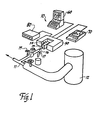
- Apparatus 10 samples a material moving in a process stream 11.
- the material in the process stream is considered to be polymer melt which is flowing downstream of a source such as a reaction vessel 12 where the polymer is created.
- a source such as a reaction vessel 12 where the polymer is created.
- the upstream source may be a heated vessel where polymer in chip, pellet or flake form manufactured elsewhere is reheated to its melted state for further processing.
- Polymer melt is diverted from the process stream 11 through a feeder line 13 which is contained within an insulated jacket 13A to maintain the polymer - its process stream temperature.
- Flow to feeder line 13 may be controlled by a feed pump 13B and a gate valve 15.
- Polymer melt flows from feeder line 13 into a sample cell 14 according to the present invention.
- the sample is analyzed by infrared radiation by means of a spectrometer 50.
- the analysis process is controlled by a computer 60 which also displays the infrared spectra generated by the analysis of the polymer melt.
- the analysis shown on the display terminal of the computer 60 can be obtained in hard copy form from a plotter 70.
- the temperature of the polymer melt within sample cell 14 is controlled by a temperature regulator 80, as will be described in further detail below.
- the spectrometer 50 is contained within a housing 51 which includes a bay 52 within which sample cell 14 is positioned.
- Spectrometer 50 is illustrated in further detail in Figure 4.
- An infrared radiation source 90 is reflected at right angles off a mirror 91 and through a beam splitter 92. Fifty percent of the infrared light is reflected to a fixed mirror 93 and 50 percent of the light is transmitted to a moving mirror 94.
- the fixed mirror 93 returns the infrared radiation by reflection back to the beam splitter along a fixed optical path.
- the moving mirror 94 reflects radiation back at pathlengths that are variable and thus may differ from the fixed mirror.
- the reflected beams then recombine at the beam splitter 92 and a portion of this recombined beam is directed to a focusing lens 95.
- Lens 95 directs the converging infrared beam to a focus point within sample cell 14 where the infrared beam again diverges.
- the beam is reflected again by a focusing lens 96 to an infrared detector 97.
- a laser 98 is used to measure the change in optical path difference within spectrometer 50.
- the laser 98 emits a beam with a very precise interference pattern which yields an interferogram which is a cosine wave. This cosine wave triggers the digitization of the detector signal.
- Spectrometer 50 also includes a laser detector 99 and a white light detector 100.
- Spectrometer 50 is very susceptible to heat. Since, as described below, the polymer melt must be maintained at its process stream temperature, an L-shaped insulated barrier 54 is positioned within bay 52 and prevents heat from sample cell 14 from damaging inferometer 50. As is best shown in Figure 3, barrier 54 comprises a right angle structure of insulative material 54, such as a product known as Microfelt onto which is bonded a highly polished, reflective aluminum or chrome steel sheet 55. Sample cell 14 is mounted in bay 52 through access port 56.
- sample cell 14 is described in detail.
- the core of sample cell 14 is a steel block 18 into which is formed a conduit 19.
- Conduit 19 is substantially U-shaped and begins at a threaded inlet 20 which connects with feeder line 13 and ends at an outlet 21 directly beneath inlet 20 which discharges polymer melt into a discharge line 16.
- Two longitudinally extending bores 22 and 23 are formed in block 18 and receive elongate resistance-type heaters 24 and 25. Heaters 24 and 25 parallel conduit 19 in relatively close relation and are intended to maintain the polymer within block 18 at its process stream temperature.
- Two additional bores 26 and 28 contain elongate resistance heaters 29 and 30, which maintain the polymer melt at its process stream temperature in the area of the observation chamber, as described below.
- a thermocouple 31 monitors the temperature in the vicinity of heaters 29 and 30.
- a like thermocouple 32 monitors the temperature of the block 18 in the area of heaters 24 and 25. Heaters 24, 25, 26 and 28, and thermocouples 31 and 32 are controlled and monitored by regulator 80.
- a threaded temperature sample valve access port 33 is formed in block 18 and communicates with conduit 19.
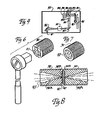
- a plug valve 34 having mating threads thereon is positioned in sample valve access port 33 and is movable between positions wherein polymer melt is permitted to flow into the observation zone and a closed position at which flow to the observation zone is not permitted.
- a bypass valve access port 35 is formed in block 18 and also communicates with conduit 19.
- a bypass plug valve 36 with mating threads thereon is positioned in bypass access port 35 and is movable between open and closed positions. The function of these valves is further explained with reference to Figures 9 and 10, below.
- a threaded retainer bore 37 is formed in and extends through block 18 from one side to the other.
- a threaded retainer 38 is positioned in bore 37 from one side and a like threaded retainer 39 is positioned in bore 37 from the other side.
- retainers 38 and 39 have tapered apertures 38A and 39A, respectively, extending through them from one end to the other.
- An annular shoulder recess 38B is formed in one end of recess 38 and an annular recess 39B is formed in one end of retainer 39.
- Disk-shaped crystals 40 of an infrared transmissible substance such as zinc selinide (ZnSe) are fixedly secured into recesses 38B and 39B by a high temperature adhesive such as epoxy cement.
- the crystals 40 form "windows" through which infrared radiation is directed. which for example are .72 in. (18mm) in diameter and .16 in. (4mm) thick are supported on virtually their entire surface area by retainers 38 and 39, respectively, with only a central exposed aperture of .32 in. (8mm) diameter allowing for the transmission of radiation. This permits crystals 40 to withstand very high temperature and pressure.
- retainer 38 includes in its end opposite crystal 40 a square cutout 41 adapted to receive the socket of a socket wrench. This is but one of many means by which either one or the other or both of retainers 38 and 39 can be adjusted relative to each other.
- bore 37 intersects conduit 19 downstream of sample valve access port 33.
- Retainers 38 and 39 are positioned in bore 37 in closely spaced-apart relation.
- the space between crystals 40 in retainers 38 and 39 define an observation chamber 42.
- Discharge line 16 can be valved with a valve 17 so that the polymer melt may be discarded or reintroduced back into the process stream 11, as desired.
- sample valve 34 is closed and bypass valve 36 is opened at predetermined intervals. In this configuration, the polymer melt is blocked from entering observation chamber 42 and instead passes through bypass valve access port 35 into conduit 19 upstream of observation chamber 42 and out through discharge outlet 21, as described above.
- sample valve 34 and bypass valve 36 both open to a predetermined extent. This would most usually be done when continuous sampling is desired.
- sample valve 34 is opened sufficiently so that, for example, approximately 10 percent of the polymer melt in conduit 19 flows past sample valve 34 and into observation chamber 42.
- Bypass valve 36 is opened to a considerably greater extent so that the remaining 90 percent of the polymer melt bypasses observation chamber 42 and exits through discharge outlet 21.
- sample valve 34 valve 35 restive to each other, the percentage of the polymer melt in conduit 19 which is sampled and analyzed in observation chamber 42 can be varied to obtain a more rapid sample.
- Block 18 is contained within an insulated cover 43. Suitable apertures are formed in cover 43 to permit access to block 18. Block 18 is supported within cover 43 by the insulation and also by a pair of stand-offs 44 and 45 which attach to the cover 43 by screws. Block 18 and cover 43 are secured within bay 52 of spectrometer 50 by means of a male mounting plate 46 which is secured through cover 43 to block 18 by screws 47 and stand-offs 48, one of each of which is shown in Figure 5. Holder 46 mates with a female holder 49 mounted in bay 52 of spectrometer 50. Holders 46 and 49 include apertures 46A and 49A, respectively, through which the infrared beam is passed.
- tubes 101 and 102 mate with retainers 38 and 39 and therefore fully enclose the infrared beam as it passes through sample cell 14. Ordinarily, tubes 101 and 102 are purged to prevent interference from water vapor and carbon dioxide with the infrared radiation.
- retainers 38 and 39 are adjusted so that infrared beam defines a focus point in observation chamber 42.
- the degree of absorption desired to obtain the most accurate results can be achieved. It is anticipated that retainers 38 and 39 will eventually be controlled by calibrated means so that a predetermined space between retainers 38 and 39 will correlate with a desired absorption rate of a particular material being tested. Otherwise, the optimum width of observation chamber 42 is determined empirically by moving the two crystals 40 into contact with each other and then backing one or both of the retainers 38 and 39 out of bore 37 and observing the effect on the absorption rate of the material achieved by increasing the pathlength accordingly. Insofar as in known, the maximum effective pathlength for sampling polymer melt is no more than about 30,000ths of an inch (.76 mm).
- sample cell 14 permits accurate spectrophotometric analysis of a material within a process stream.
- radiation in the visible, ultraviolet and other spectra can be used.
- One major advantage of the sample cell 14 is that the sample is taken and analyzed in a noninvasive manner, as distinguished from the invasive probe known in the prior art.
- sample 14 Coistent with the significant temperatures and pressures to which sample 14 may be exposed, its primary components are constructed of high-grade stainless steel. All of the conduits are polished, as are the machine threads. In addition, the threads can be wrapped with Teflon tape. No brass, copper or other material which might react with the material being analyzed is used.
- a pressure transducer may be provided to monitor pressure within conduit 19.
Landscapes
- Physics & Mathematics (AREA)
- Spectroscopy & Molecular Physics (AREA)
- General Health & Medical Sciences (AREA)
- Chemical & Material Sciences (AREA)
- Analytical Chemistry (AREA)
- Biochemistry (AREA)
- Life Sciences & Earth Sciences (AREA)
- General Physics & Mathematics (AREA)
- Immunology (AREA)
- Pathology (AREA)
- Health & Medical Sciences (AREA)
- Optical Measuring Cells (AREA)
- Investigating Or Analysing Materials By Optical Means (AREA)
Applications Claiming Priority (2)
| Application Number | Priority Date | Filing Date | Title |
|---|---|---|---|
| US06/831,296 US4717827A (en) | 1986-02-20 | 1986-02-20 | Apparatus for on-line spectrophotometric chemical analysis of material in moving process stream |
| US831296 | 1986-02-20 |
Publications (2)
| Publication Number | Publication Date |
|---|---|
| EP0246399A2 true EP0246399A2 (de) | 1987-11-25 |
| EP0246399A3 EP0246399A3 (de) | 1988-03-30 |
Family
ID=25258752
Family Applications (1)
| Application Number | Title | Priority Date | Filing Date |
|---|---|---|---|
| EP87102438A Withdrawn EP0246399A3 (de) | 1986-02-20 | 1987-02-20 | Verfahren und Vorrichtung zur on-line-spektralphotometrischen chemischen Analyse von Material in einem Prozessstrom |
Country Status (5)
| Country | Link |
|---|---|
| US (1) | US4717827A (de) |
| EP (1) | EP0246399A3 (de) |
| JP (1) | JPS62259043A (de) |
| KR (1) | KR870008180A (de) |
| IN (1) | IN166543B (de) |
Cited By (2)
| Publication number | Priority date | Publication date | Assignee | Title |
|---|---|---|---|---|
| EP0322611A3 (de) * | 1987-12-31 | 1990-07-25 | AUTOMATIK Apparate-Maschinenbau GmbH | Gerät und Verfahren zur spektralphotometrischen Analyse eines Materials in einem fliessenden Bearbeitungsstrom |
| WO1997014951A1 (en) * | 1995-10-18 | 1997-04-24 | Shell Internationale Research Maatschappij B.V. | Transmission cell for measuring near infrared spectra of a hydrocarbonaceous material |
Families Citing this family (18)
| Publication number | Priority date | Publication date | Assignee | Title |
|---|---|---|---|---|
| US4861999A (en) * | 1987-08-20 | 1989-08-29 | Gough Terrance E | Supersonic nozzle for use in an infrared spectrometer |
| US4910403A (en) * | 1988-11-02 | 1990-03-20 | Flow Vision, Inc. | Sampling flow cell with diamond window |
| DE3838371A1 (de) * | 1988-11-11 | 1990-05-17 | Hench Automatik App Masch | Messzelle zur spektralanalyse von stroemenden medien, insbesondere kunststoffschmelzen |
| JPH03110358U (de) * | 1990-02-28 | 1991-11-12 | ||
| DE4036201A1 (de) * | 1990-11-14 | 1992-05-21 | Bayer Ag | Spektroskopisches analyseverfahren fuer kunststoffgemische |
| US5369483A (en) * | 1993-05-07 | 1994-11-29 | Basf Corporation | Analysis of polymer melt stream |
| US5519220A (en) * | 1994-06-28 | 1996-05-21 | Janos Technology Inc. | FTIR chemical reaction monitor |
| US5638171A (en) * | 1995-03-03 | 1997-06-10 | Honig; Jordan S. | Spectrophotometer with self-contained module |
| JP3301049B2 (ja) * | 1995-05-29 | 2002-07-15 | 株式会社堀場製作所 | 紫外線螢光分析法を用いたガス分析計 |
| BE1009667A3 (fr) * | 1995-09-25 | 1997-06-03 | Solvay | Procede et dispositif de controle de la qualite de latex de polymeres vinyliques halogenes. |
| US5808301A (en) * | 1996-12-18 | 1998-09-15 | Northern Telecom Limited | Testing of properties in flowable materials |
| US6635224B1 (en) * | 1998-10-30 | 2003-10-21 | General Electric Company | Online monitor for polymer processes |
| AU2001271988A1 (en) * | 2000-07-12 | 2002-01-21 | Hercules Incorporated | On-line deposition monitor |
| AU2003272978A1 (en) * | 2003-04-01 | 2004-11-01 | Nihon University | Method of measuring protein solubility, process for producing crystal and apparatus therefor |
| US7582869B2 (en) * | 2006-07-20 | 2009-09-01 | Sas Photonics, Llc | System and method for optical analysis |
| JP4712745B2 (ja) * | 2007-03-06 | 2011-06-29 | 倉敷紡績株式会社 | 透過光測定用フローセル |
| US20090060783A1 (en) * | 2007-09-04 | 2009-03-05 | Kenneth Charles Barrett | Polymer concentration monitoring system and use thereof |
| JP6549988B2 (ja) * | 2012-11-20 | 2019-07-24 | グラインセンス オーワイGrainsense Oy | 光学的試料測定装置、及びこの試料測定装置の利用方法 |
Family Cites Families (12)
| Publication number | Priority date | Publication date | Assignee | Title |
|---|---|---|---|---|
| GB667896A (en) * | 1950-07-28 | 1952-03-12 | Anglo Iranian Oil Co Ltd | Improvements relating to the measurement of the infra-red absorption of liquids |
| US2690695A (en) * | 1952-01-03 | 1954-10-05 | Perkin Elmer Corp | Variable space absorption cell |
| US2885863A (en) * | 1955-06-20 | 1959-05-12 | Phillips Petroleum Co | Control system for separation processes |
| US3177706A (en) * | 1963-01-24 | 1965-04-13 | Hughes Aircraft Co | Fluid inspection device |
| FR1538351A (fr) * | 1967-04-18 | 1968-09-06 | Roussel Uclaf | Dispositif perfectionné de cuve à échantillon pour mesures optiques |
| US3614243A (en) * | 1969-08-01 | 1971-10-19 | Reno A Del Ben | Variable path-length gas cell |
| US3646313A (en) * | 1970-04-08 | 1972-02-29 | Gilford Instr Labor Inc | Temperature controlled flow cell |
| GB1305214A (de) * | 1970-10-28 | 1973-01-31 | ||
| US3886364A (en) * | 1973-06-19 | 1975-05-27 | Union Carbide Corp | High pressure infrared cell |
| JPS57118348A (en) * | 1981-01-13 | 1982-07-23 | Sony Corp | Electric-discharge displayer |
| JPS599545A (ja) * | 1982-07-09 | 1984-01-18 | Hitachi Ltd | 光度計のフロ−セル |
| US4529306A (en) * | 1983-06-13 | 1985-07-16 | Flow Vision, Inc. | Apparatus and method for polymer melt stream analysis |
-
1986
- 1986-02-20 US US06/831,296 patent/US4717827A/en not_active Expired - Fee Related
-
1987
- 1987-02-02 KR KR870000820A patent/KR870008180A/ko not_active Ceased
- 1987-02-19 JP JP62037685A patent/JPS62259043A/ja active Pending
- 1987-02-20 EP EP87102438A patent/EP0246399A3/de not_active Withdrawn
- 1987-04-21 IN IN312/CAL/87A patent/IN166543B/en unknown
Cited By (2)
| Publication number | Priority date | Publication date | Assignee | Title |
|---|---|---|---|---|
| EP0322611A3 (de) * | 1987-12-31 | 1990-07-25 | AUTOMATIK Apparate-Maschinenbau GmbH | Gerät und Verfahren zur spektralphotometrischen Analyse eines Materials in einem fliessenden Bearbeitungsstrom |
| WO1997014951A1 (en) * | 1995-10-18 | 1997-04-24 | Shell Internationale Research Maatschappij B.V. | Transmission cell for measuring near infrared spectra of a hydrocarbonaceous material |
Also Published As
| Publication number | Publication date |
|---|---|
| EP0246399A3 (de) | 1988-03-30 |
| JPS62259043A (ja) | 1987-11-11 |
| IN166543B (de) | 1990-06-02 |
| US4717827A (en) | 1988-01-05 |
| KR870008180A (ko) | 1987-09-24 |
Similar Documents
| Publication | Publication Date | Title |
|---|---|---|
| US4717827A (en) | Apparatus for on-line spectrophotometric chemical analysis of material in moving process stream | |
| US4888484A (en) | Apparatus and method for spectrophotometric analysis of a material in a moving process stream | |
| Siesler | Near‐infrared spectroscopy of polymers | |
| US7990538B2 (en) | Signal processing for optical computing system | |
| US5886347A (en) | Analytical method for multi-component aqueous solutions and apparatus for the same | |
| Compton et al. | In situ FT-IR analysis of a composite curing reaction using a mid-infrared transmitting optical fiber | |
| US9182282B2 (en) | Multi-analyte optical computing system | |
| US5879629A (en) | Process flow injection analyzer and method | |
| EP0717845B1 (de) | System und verfahren zur probenentnahme und analyse | |
| Watari et al. | On-line monitoring of the density of linear low-density polyethylene in a real plant by near-infrared spectroscopy and chemometrics | |
| US6166804A (en) | Method and apparatus for obtaining fluorescence data | |
| CA2001615A1 (en) | Sampling flow cell with diamond window | |
| Mirabella Jr | Simultaneous differential scanning calorimetry (DSC) and infrared spectroscopy using an infrared microsampling accessory (IRMA) and FT-IR | |
| WO1993016370A1 (de) | Gerät zur analyse einer medizinischen probe | |
| US20020067481A1 (en) | Transmission spectroscopy apparatus for vessels | |
| Watari et al. | Prediction of ethylene content in melt-state random and block polypropylene by near-infrared spectroscopy and chemometrics: comparison of a new calibration transfer method with a slope/bias correction method | |
| Reshadat et al. | In-line near-infrared monitoring of polymer processing. Part I: Process/monitor interface development | |
| Watari | Applications of near-infrared spectroscopy to process analysis using fourier transform spectrometer | |
| Chung et al. | Near-infrared spectroscopy for on-line monitoring of lube base oil processes | |
| CN87103339A (zh) | 在流动的过程流中材料的联机分光光度化学分析方法和装置 | |
| Kaiser et al. | Critical and statistically based evaluation, testing, comparison and optimization of capillary chromatography systems, the “ABT-concept” in capillary GC | |
| JPH0640070B2 (ja) | 示差走査熱量計付フーリエ変換赤外分光光度計測定装置 | |
| Wright et al. | Preliminary tests of an infrared process monitor for polyethylene encapsulation of radioactive waste | |
| Arendale et al. | Spectroscopy and multivariate analyses applications related to solid rocket nozzle bondline | |
| Varnhorst et al. | Blue coloration of KNbO3 caused by scattering |
Legal Events
| Date | Code | Title | Description |
|---|---|---|---|
| PUAI | Public reference made under article 153(3) epc to a published international application that has entered the european phase |
Free format text: ORIGINAL CODE: 0009012 |
|
| AK | Designated contracting states |
Kind code of ref document: A2 Designated state(s): AT BE CH DE ES FR GB GR IT LI LU NL SE |
|
| RBV | Designated contracting states (corrected) |
Designated state(s): BE CH DE FR GB IT LI NL |
|
| PUAL | Search report despatched |
Free format text: ORIGINAL CODE: 0009013 |
|
| AK | Designated contracting states |
Kind code of ref document: A3 Designated state(s): BE CH DE FR GB IT LI NL |
|
| 17P | Request for examination filed |
Effective date: 19880816 |
|
| 17Q | First examination report despatched |
Effective date: 19891222 |
|
| STAA | Information on the status of an ep patent application or granted ep patent |
Free format text: STATUS: THE APPLICATION HAS BEEN WITHDRAWN |
|
| 18W | Application withdrawn |
Withdrawal date: 19910111 |
|
| RIN1 | Information on inventor provided before grant (corrected) |
Inventor name: HARVEY, ROBERT J. |