EP0246064A2 - Programmierbarer Difibrillator - Google Patents
Programmierbarer Difibrillator Download PDFInfo
- Publication number
- EP0246064A2 EP0246064A2 EP19870304203 EP87304203A EP0246064A2 EP 0246064 A2 EP0246064 A2 EP 0246064A2 EP 19870304203 EP19870304203 EP 19870304203 EP 87304203 A EP87304203 A EP 87304203A EP 0246064 A2 EP0246064 A2 EP 0246064A2
- Authority
- EP
- European Patent Office
- Prior art keywords
- energy
- patient
- delivered
- voltage level
- voltage
- Prior art date
- Legal status (The legal status is an assumption and is not a legal conclusion. Google has not performed a legal analysis and makes no representation as to the accuracy of the status listed.)
- Granted
Links
- 230000035939 shock Effects 0.000 claims abstract description 62
- 238000000034 method Methods 0.000 claims abstract description 39
- 230000003247 decreasing effect Effects 0.000 claims abstract description 6
- 206010061592 cardiac fibrillation Diseases 0.000 claims description 15
- 208000001871 Tachycardia Diseases 0.000 claims description 14
- 230000006794 tachycardia Effects 0.000 claims description 14
- 230000000747 cardiac effect Effects 0.000 claims description 9
- 230000008569 process Effects 0.000 claims description 6
- 230000004936 stimulating effect Effects 0.000 claims description 5
- 238000007599 discharging Methods 0.000 claims description 2
- 230000000638 stimulation Effects 0.000 claims description 2
- 230000001105 regulatory effect Effects 0.000 claims 8
- 238000012544 monitoring process Methods 0.000 claims 3
- 230000001276 controlling effect Effects 0.000 claims 1
- 239000003990 capacitor Substances 0.000 abstract description 54
- 230000000977 initiatory effect Effects 0.000 abstract description 4
- 206010047302 ventricular tachycardia Diseases 0.000 abstract description 4
- 231100000518 lethal Toxicity 0.000 abstract description 3
- 230000001665 lethal effect Effects 0.000 abstract description 3
- 230000009977 dual effect Effects 0.000 abstract description 2
- 238000013101 initial test Methods 0.000 abstract description 2
- 206010003119 arrhythmia Diseases 0.000 description 25
- 230000006793 arrhythmia Effects 0.000 description 22
- 238000012360 testing method Methods 0.000 description 22
- 238000010586 diagram Methods 0.000 description 13
- 230000002600 fibrillogenic effect Effects 0.000 description 11
- 230000008859 change Effects 0.000 description 7
- 230000000994 depressogenic effect Effects 0.000 description 7
- 230000001862 defibrillatory effect Effects 0.000 description 6
- 229940079593 drug Drugs 0.000 description 6
- 239000003814 drug Substances 0.000 description 6
- 238000001356 surgical procedure Methods 0.000 description 6
- 238000002560 therapeutic procedure Methods 0.000 description 6
- 238000013194 cardioversion Methods 0.000 description 5
- 230000007831 electrophysiology Effects 0.000 description 5
- 238000002001 electrophysiology Methods 0.000 description 5
- 230000003287 optical effect Effects 0.000 description 5
- 230000008901 benefit Effects 0.000 description 4
- 230000033764 rhythmic process Effects 0.000 description 4
- 230000036772 blood pressure Effects 0.000 description 3
- 230000006870 function Effects 0.000 description 3
- 210000005003 heart tissue Anatomy 0.000 description 3
- 238000003825 pressing Methods 0.000 description 3
- 210000001519 tissue Anatomy 0.000 description 3
- 230000002159 abnormal effect Effects 0.000 description 2
- 238000003491 array Methods 0.000 description 2
- 230000006378 damage Effects 0.000 description 2
- 238000002651 drug therapy Methods 0.000 description 2
- 238000005259 measurement Methods 0.000 description 2
- 238000009877 rendering Methods 0.000 description 2
- 230000004044 response Effects 0.000 description 2
- 230000002861 ventricular Effects 0.000 description 2
- 208000003663 ventricular fibrillation Diseases 0.000 description 2
- 208000007204 Brain death Diseases 0.000 description 1
- 206010042434 Sudden death Diseases 0.000 description 1
- 208000003443 Unconsciousness Diseases 0.000 description 1
- 206010047281 Ventricular arrhythmia Diseases 0.000 description 1
- 206010065341 Ventricular tachyarrhythmia Diseases 0.000 description 1
- 230000003213 activating effect Effects 0.000 description 1
- 238000004458 analytical method Methods 0.000 description 1
- 230000003288 anthiarrhythmic effect Effects 0.000 description 1
- 238000013459 approach Methods 0.000 description 1
- 230000036471 bradycardia Effects 0.000 description 1
- 208000006218 bradycardia Diseases 0.000 description 1
- 230000006931 brain damage Effects 0.000 description 1
- 231100000874 brain damage Toxicity 0.000 description 1
- 208000029028 brain injury Diseases 0.000 description 1
- 230000003111 delayed effect Effects 0.000 description 1
- 230000000881 depressing effect Effects 0.000 description 1
- 230000000694 effects Effects 0.000 description 1
- 230000008451 emotion Effects 0.000 description 1
- 238000004146 energy storage Methods 0.000 description 1
- 230000036541 health Effects 0.000 description 1
- 230000005802 health problem Effects 0.000 description 1
- 208000019622 heart disease Diseases 0.000 description 1
- 238000002513 implantation Methods 0.000 description 1
- 230000006872 improvement Effects 0.000 description 1
- 208000028867 ischemia Diseases 0.000 description 1
- 238000002955 isolation Methods 0.000 description 1
- 239000011159 matrix material Substances 0.000 description 1
- 238000002483 medication Methods 0.000 description 1
- 230000028161 membrane depolarization Effects 0.000 description 1
- 208000010125 myocardial infarction Diseases 0.000 description 1
- 230000002265 prevention Effects 0.000 description 1
- 230000009467 reduction Effects 0.000 description 1
- 230000000717 retained effect Effects 0.000 description 1
- 230000002441 reversible effect Effects 0.000 description 1
- 230000007480 spreading Effects 0.000 description 1
- 238000011477 surgical intervention Methods 0.000 description 1
- 230000002459 sustained effect Effects 0.000 description 1
- 238000010998 test method Methods 0.000 description 1
- 238000012956 testing procedure Methods 0.000 description 1
- 230000000007 visual effect Effects 0.000 description 1
Images




Classifications
-
- A—HUMAN NECESSITIES
- A61—MEDICAL OR VETERINARY SCIENCE; HYGIENE
- A61N—ELECTROTHERAPY; MAGNETOTHERAPY; RADIATION THERAPY; ULTRASOUND THERAPY
- A61N1/00—Electrotherapy; Circuits therefor
- A61N1/18—Applying electric currents by contact electrodes
- A61N1/32—Applying electric currents by contact electrodes alternating or intermittent currents
- A61N1/38—Applying electric currents by contact electrodes alternating or intermittent currents for producing shock effects
- A61N1/39—Heart defibrillators
- A61N1/3925—Monitoring; Protecting
- A61N1/3937—Monitoring output parameters
- A61N1/3943—Monitoring output parameters for threshold determination
-
- A—HUMAN NECESSITIES
- A61—MEDICAL OR VETERINARY SCIENCE; HYGIENE
- A61N—ELECTROTHERAPY; MAGNETOTHERAPY; RADIATION THERAPY; ULTRASOUND THERAPY
- A61N1/00—Electrotherapy; Circuits therefor
- A61N1/18—Applying electric currents by contact electrodes
- A61N1/32—Applying electric currents by contact electrodes alternating or intermittent currents
- A61N1/36—Applying electric currents by contact electrodes alternating or intermittent currents for stimulation
- A61N1/372—Arrangements in connection with the implantation of stimulators
- A61N1/37211—Means for communicating with stimulators
- A61N1/37235—Aspects of the external programmer
- A61N1/37247—User interfaces, e.g. input or presentation means
Definitions
- This invention relates to a programmable defibrillator, for use in the field of cardiac electrophysiology.
- heart disease is a major health problem. Of the 1.5 million people per year who suffer a myocardial infarction, about 680,000 survive that have ischemia (dead heart tissue) which is the basis for cardiac arrhythmias. Approximately 400,000 people a year die from the most serious types of cardiac arrhythmias.
- Arrhythmias can be classified into three broad types. Bradycardia is an abnormally slow heart rhythm. This problem has been successfully treated for a number of years with implantable pacemakers which induce the heart to beat at a faster, normal rhythm. The remaining types of arrhythmias are more difficult to control.
- Tachycardia is a rapid cardiac rhythm generally defined as a heart rate greater than 100 beats per minute. There are normal physiologic tachycardias due to exertion or emotion as well as abnormal nonphysiologic tachycardias in which a high rate results in loss of blood pressure. Sustained ventricular tachycardia can result in severe loss of blood pressure, loss of consciousness and can deteriorate into ventricular fibrillation which is fatal if not quickly interrupted.
- Fibrillation unlike tachycardia, is a disorganized cardiac rhythm wherein the heart quivers rather than beats. This quivering is a result of multiple waves of cardiac depolarization spreading and colliding throughout the ventricular tissue. Ventricular fibrillation results in a precipitous decrease in blood pressure followed quickly by brain damage and death.
- Arrhythmias are treated using either medication, surgery or implantation of a medical device.
- Drug therapy is employed initially in the majority of cases and involves the use of various medications to prevent an arrhythmia from starting or being sustained.
- the main advantage of drug therapy is that no surgical intervention is required.
- the major drawback to the exclusive use of therapy is the lack of backup therapy to terminate a potentially lethal arrhythmia should the drug eventually fail to prevent the arrhythmia from recurring. Additionally, in attempting to achieve adequate tachycardia prevention, drug related side effects often preclude using an adequate dose of medication.
- Surgery involves locating the cause of the arrhythmia and removing or isolating it from the healthy cardiac tissue.
- the advantage of surgical therapy is that the procedure is curative when successful.
- the disadvantage of surgical therapy is the morbidity and mortality associated with open heart surgery and the technical difficulty and high cost of the procedure. These factors have restricted the practice of antiarrhythmia surgery.
- Implantable defibrillators sense fibrillation and automatically deliver a high energy pulse. Subsequent studies have indicated that these devices are effective in preventing sudden death from fibrillation. Presently, no single implantable device has been developed to control all three types of arrhythmias.
- invasive testing is carried out in a variety of situations. For example, invasive testing is common during a selection process used to determine which patients might be candidates for implantable defibrillators. Invasive testing is also utilized in trying to assess and characterize tachycardia which is then treated with drugs. In any case, in the testing process, catheters are inserted into the heart and the patient's arrhythmia is provoked with programmed electrical stimulation. When the arrhythmia manifests itself, the physician attempts to terminate it with antitachycardia pacing. Antitachycardia pacing is described in the literature and consists of a series of low voltage pulses designed to reset the normal heartbeat. If pacing fails, the patient is either cardioverted with a substantially higher voltage shock or defibrillated with a very high voltage energy pulse.
- Low energy cardioversion utilizes pulses with energy levels far greater than pacing pulses but lower than high energy defibrillation pulses. With energies of less than 5 joules, this mode of therapy is based on the theory of interrupting the arrhythmia by stimulating the tissue, rendering it nonexcitable. Low energy cardioversion has been clinically demonstrated as effective. Its drawbacks include patient discomfort and the fact that improperly timed pulses can accelerate tachycardias and occasionally induce fibrillation.
- high energy defibrillation uses pulses with energy levels tens of thousands of times greater than pacemaker pulses. High energy defibrillation is accomplished by stimulating a large portion of the ventricular tissues simultaneously and rendering it nonexcitable, thereby terminating the arrhythmia. If a patient is found suitable, an internal defibrillator can be implanted to control the arrhythmia. During the operation, the patient's defibrillation threshold must be determined. First, the patient is fibrillated using a programmable stimulator, then a special defibrillator is used to determine the energy required to defibrillate the patient.
- the invention described herein facilitates the assessment of arrhythmias and defibrillation thresholds resulting in improved patient care and substantially decreased patient risk.
- the programmable stimulator includes a means to pace the patient's heart with critically timed stimuli to provoke the cardiac arrhythmia. These devices are then used to terminate the arrhythmia using antitachycardia pacing. If the pacing accelerates the arrhythmia or fails to terminate it, then a standby defibrillator device must be set up and the patient cardioverted or defibrillated. Frequently, the patient is cardioverted or defibrillated externally. More recently, internal catheters have been provided to deliver the defibrillation shock.
- an external cardioverter/defibrillator is used during implantable defibrillator procedures to assess the patient's cardioversion/defibrillation threshold.
- the unit When the patient is fibrillated using a programmable stimulator, the unit must be disconnected before a test defibrillation pulse can be applied. Frequently, the test pulse fails to defibrillate the patient. Once the physician recognizes the failure to defibrillate, he must program a new, higher voltage rescue shock into the defibrillator. The unit must then recharge prior to delivery of the rescue shock. This procedure takes considerable time and there is ample opportunity for operator error. Any delay in defibrillating the patient is a serious health risk and improving the response time to the delivery of the rescue shock substantially reduces patient risk. Accordingly, it would be desirable to eliminate any unnecessary time between delivery of the test shock and rescue shock.
- Another drawback of the defibrillation devices available in the prior art relates to the fact that little or no measurement and visual feedback is given to the surgeon regarding the defibrillation pulse. More specifically, the surgeon typically sets a pulse width and a voltage level for a test shock. If this test shock fails, the surgeon cannot be sure whether it was the result of shorted leads, an unexpectedly high resistance in the heart or whether the voltage was just too low to stop the defibrillation. There presently exists some low voltage pacing devices which have been designed to provide additional information to the surgeon regarding patient resistance and energy delivered. However, to date, no systems have been provided to calculate and display this information in a defibrillation setting. In a life-threatening situation, such as cardiac fibrillation, such information is extremely important and can aid the surgeon in assessing the type of rescue shock necessary to end the fibrillation.
- the energy delivered to the heart of a patient is generally measured in joules.
- the energy level of the shock is analogous to a dosage in therapy.
- the surgeon sets the defibrillation shock by adjusting a voltage level and the pulse width.
- no information is given to the physician as to the energy which will be received by the patient if a shock with those set parameters were delivered. Therefore, it would be desirable to provide a device which displays the estimated energy based on the set voltage level and pulse width.
- the subject invention accordingly provides a single device that can be used in electrophysiology labs during ventricular tachycardia procedures.
- the invention integrates an innovative two-channel defibrillator with a programmable stimulator in a manner that enhances response time to the patient and provides more information to the surgeon.
- a number of new features have been included which address unique problems encountered when treating severe arrhythmia.
- an indwelling defibrillating catheter with pacing capabilities is inserted into the heart.
- the arrhythmia can be induced by the subject apparatus and, if necessary, the patient can be defibrillated within seconds of the initiation of the arrhythmia.
- an automatic interrupt means is provided to protect the delicate circuits of the stimulator from the high voltage discharge delivered by the defibrillator without shunting current to the patient.
- Another advantage of the unique combination found in the subject invention is that the time necessary to initiate defibrillation is much shorter than is currently possible, resulting in decreased patient risk. To enhance the rapidity of defibrillation, the unit always remains charged to the programmed defibrillating voltages.
- the defibrillation circuitry of the subject apparatus includes two independent channels. Each channel includes its own storage capacitors which can be independently programmed. Prior to a surgical procedure, the surgeon can program one channel with a test shock and the other channel with a much stronger, rescue shock. The independent capacitor arrays will automatically be charged to these two independent levels.
- the test shock can be used to attempt defibrillation. If this test shock does not revert the fibrillation, the rescue shock can be delivered immediately. This is in sharp contrast to any existing device where 20 or 30 seconds might elapse before a rescue shock can be applied.
- a memory capability is also provided to instantly change the program settings of the two defibrillation channels to previously selected values. Since the charging of the high voltage capacitors is automatic, this provides an effective way to quickly change to a maximum energy setting if the initial two shocks fail to defibrillate the patient.
- a similar memory capability is included in the programmable stimulator. By this arrangement, when the electrophysiologist induces the patient's arrhythmia he can instantly go to a previously selected set of antitachycardia pacing parameters and thereby attempt to terminate the arrhythmia without the delay of further programming.
- the subject invention provides a means to calculate and display such information. More specifically, in conjunction with each defibrillation shock, the unit will display to the physician the actual energy, measured in joules, delivered to the patient, as well as the patient's electrical resistance. If the resistance is abnormal, this could indicate a problem with the electrode system. Without the displayed information, a physician might not be alerted to the problem thereby compromising patient's safety. In a preferred embodiment, the residual charge of the capacitor is measured and is used to calculate the energy delivered and patient resistance.
- the subject invention also provides a means for calculating and displaying the energy which is estimated to be delivered during a defibrillation shock.
- the energy delivered will vary based on a variety of parameters, such as the voltage level, pulse width and patient resistance. All of these parameters are used by the apparatus to calculate the expected energy to be delivered. By this arrangement, the physician can best gauge the proper voltage and pulse width settings needed to deliver the desired energy level shock.
- FIG. 1 there is illustrated a system block diagram of the apparatus 10 of the subject invention.
- the apparatus 10 is microprocessor controlled.
- a 68HC11 microprocessor manufactured by Motorola, is used.
- a microprocessor board 20 includes standard components, such as a program ROM, RAM, bus drivers and latches.
- Support board 24 includes display drivers, switch decoders, an optical encoder, and other standard interface circuits.
- the microprocessor writes information to the display drivers and receives information through the optical encoder and switch matrix interfaces.
- the elements in boards 20 and 24 are standard and any suitable alternatives can be utilized.
- the subject apparatus includes six other principal boards which communicate with the microprocessor.
- a pair of high voltage regulator boards 30 and 32 are programmed by the microprocessor to charge the high voltage capacitors 34 and 36 to the voltage entered on the front panel 22 by the physician. Details of the high voltage regulators will be discussed below with reference to Figures 5 and 6. After defibrillation, data is read back from the regulator boards that contain information on energy delivered and the patient's electrical resistance. This function will be discussed below with reference to Figure 8.
- Output boards 40 and 42 include high voltage electrical switches to connect patients to the high voltage energy storage capacitors through the rear panel 43 for the duration selected on the front panel 22 by the physician.
- the output boards will be discussed in greater detail in conjunction with Figure 11.
- the subject apparatus further includes a programmable stimulator board 44.
- the programmable stimulator board also interfaces with the microprocessor 20 to generate the pulses that are programmed into the front panel by the physician. A more detailed description of the programmable stimulator board will be made with reference to Figure 12.
- the apparatus 10 is powered by a 12 volt rechargeable battery 50 connected to a power supply regulator board 52.
- Board 52 regulates the system power supply and provides a signal to the microprocessor board when the batteries need recharging.
- the front panel includes an array of LCD displays, push-button switches and an optical encoder 60.
- the basic operation calls for the physician to depress the switch next to the parameter he wants to adjust.
- the selected switch lights up indicating that the optical encoder 60, labelled "parameter adjust", will control the associated parameter.
- the knob 60 By rotating the knob 60, the parameter next to the lighted switch will be varied.
- the left portion of the front panel controls the defibrillator operation, while the right portion controls the programmable stimulator.
- All electrical hookups are routed to the rear panel 43 as shown in Figure 3.
- the two channels of the programmable stimulator terminate in standard BNC connectors 62A and 62B (labelled CH1 and CH2). Used separately, pacing pulses can be delivered to different parts of the heart, although the outputs may be ganged together.
- the high voltage outputs 64A and 64B are high voltage connectors which can be left separate or can be shorted together using a toggle switch 66. When the outputs are shorted together, the output from both channels is delivered through the Pl output.
- Figure 3 also shows an input 67 to receive a charge line to recharge the storage batteries. The charger is controlled by switch 68.
- the physician refers to the LCD display block 69, labelled "OUTPUT" on the front panel. As illustrated in Figure 2, Pl has been selected and is displayed in block 69. If P2 is displayed and the physician wants Pl, he can press the output switch to toggle to Pl. The "parameter select" switch below the output switch will be discussed in greater detail below.
- the electrophysiologist can verify that the voltage and pulse width are correct. This information is displayed in the top display block 70 of Figure 2. As discussed above, these parameters can be adjusted by depressing the associated switch and rotating the encoder knob 60. If the parameters are changed, an automatic charging circuit discussed below will adjust the voltage in the capacitor bank to the proper level. When charging is complete, a ready light 72 will be illuminated, indicating that the charge can be delivered.
- a second, rescue shock prior to initializing a test procedure, can also be programmed.
- the surgeon would also adjust the parameters for the P2 shock.
- the parameters are shown in display block 74.
- the second rescue shock will have significantly greater voltage and a longer pulse width since it would be assumed that the first defibrillation shock failed to revert the fibrillation.
- the patient can be defibrillated by pressing the deliver switch 76 which will deliver the voltage stored in the Pl capacitor 34. If this shock fails to defibrillate the patient, the "OUTPUT" button is depressed causing the associated display to toggle to P2. The deliver button is then depressed and the energy in capacitor 36 will be immediately delivered.
- FIG 4 is a flow diagram that describes the software in the microprocessor used to deliver the Pl and P2 charges.
- the front panel switches are continually scanned in steps 100 and 102. If any switch is pressed, priority is given to the deliver switch in step 104. If the deliver switch has not been depressed, the other switches will be serviced in step 105. If the deliver switch 76 is depressed, the outputs of the programmable stimulator will be protected via the disconnection step 106.
- the circuit 46 for disconnecting and protecting the programmable stimulator is shown in Figure 10. Any signals from the stimulator must pass through this circuit before reaching the rear panel. Normally, the microprocessor leaves this circuit on by setting the ON/OFF line 140 to the RF oscillator 141 high.
- the RF oscillator 141 couples energy to the gates of the high voltage switches 142 (Motorola MTM5N100 MOSFETs) through a small pulse transformer 144. To turn the switches 142 off, the microprocessor sets the ON/OFF 140 line low, disabling the RF oscillator.
- the source-to-source connection of the MOSFETs along with the transformer isolation of the gate drives 146 results in a symmetric (+,-) 1000 volt protection. In this arrangement, the high voltage from the defibrillator pulse is not shunted back to the patient through the pacing leads since the disabled MOSFETs define an open circuit. This approach is therefore superior to a more simple shunt circuit, such as a Zener diode placed across the pacing leads.
- the stimulator would be protected, but the high voltage would be shunted to the pacing leads such that the characteristics of the defibrillation shock delivered would change, which can reduce efficiency and could damage heart tissue.
- the ground line from the programmable stimulator also goes through a set of protection switches to avoid defibrillation current shunting during high voltage output, as shown in Figure 12.
- the front panel parameters are checked in step 108 and the proper pulse width for the associated pulse is selected in steps 110A or 110B of Figure 4.
- the microprocessor then commands the appropriate output board to connect the patient to the previously charged high voltage capacitor in step 112A or 112B.
- FIG 11 is a block diagram of the output board 40 for capacitor P1.
- the microprocessor turns on the RF oscillator 150 for the programmed duration.
- the series-paralleled IGFETs 152 (Motorola MTP20N50) provide a 50 amp drive capability with low output leakage.
- the transformer 154 couples a square wave of voltage from its primary to its secondary. This voltage is rectified, and held by the gate capacitance of the IGFETs.
- a pull down resistor 156 discharges the gate capacitance turning off the IGFETs.
- the ground connection is made to the patient through lead 158, and the high voltage capacitor is connected through the other lead 160.
- the current is led through high voltage diodes 162 in series with the patient. The diodes provide reverse voltage protection for the IGFETs.
- the residual voltage on the capacitor is measured in step 130A or 130B.
- residual voltage is measured to permit the calculation of resistance and energy delivered to the patient as discussed in greater detail below.
- the capacitor is automatically recharged in step 132 shown in Figures 4 and 5.
- a test shock and a rescue shock of different voltages can be delivered with virtually no time delay therebetween.
- the physician will observe whether the test shock has succeeded in defibrillating the patient and if that has failed, a second, higher voltage rescue shock will be delivered.
- Another unique aspect of the subject invention which reduces the time necessary to respond to a critical situation concerns the automatic recharging of the capacitors.
- all prior art devices required that the voltage be set and thereafter a charge button be pressed to raise the capacitor bank to the desired level to avoid false triggering problems.
- both the capacitor banks 34, 36 will be charged to their set levels.
- the capacitors will begin to immediately recharge.
- the microprocessor will determine if the high voltage (P1 or P2) parameter has changed as shown in step 204.
- a change in the high voltage parameter could result from data entered via the optical encoder 60.
- the setting could also be changed as a result of pressing the parameter select switch 80A and will be discussed below.
- the processor will determine if it has increased in step 210.
- the capacitor will be charged, while if the parameter has been decreased, the capacitor will be discharged. As shown in Figure 5, if the capacitor has been discharged by delivering its energy to the patient, the processor will instruct the regulator board to charge the capacitor as indicated by the input 132, also shown in Figure 4.
- charge line 260 on the regulator board shown in Figure 6 will be set high. If the capacitor is to be discharged, discharge line 262 will be set high.
- the microprocessor will also load the voltage read from the selected switch (P1 or P2) into the digital to analog converter (DAC) 264 in step 216.
- a comparator 266 compares the high voltage from the storage capacitor (P1 or P2) to the output of the DAC 266. Note that the output from the capacitor bank is divided down through a resistor array 268 prior to entering the comparator.
- comparator 266 is fed back to the microprocessor which detects when the output of the capacitor matches the output of the DAC 266 in step 218. The charging or discharging is then halted. As seen in the circuit diagram of Figure 6, where the capacitor is being charged, low voltage from battery V BATT is supplied to a low to high voltage DC to DC converter 270 to charge the storage capacitor.
- another unique advantage of the subject invention is the ability of the microprocessor to store a number of preset parameters. In this manner, the physician can program all the necessary parameters prior to initiating the surgical procedure. This ability is provided in both the programmable stimulator and defibrillator sections of the apparatus. As illustrated in the front panel in Figure 2, both sides of the display include "SELECT" buttons 80A and 80B. By pressing either button, the display and electronics toggle between parameter set A and parameter set B. Each parameter set is independently adjustable and all the information is retained in the RAM on the microprocessor board 20.
- the steps taken by the microprocessor in relation to this selection process are shown in Figure 7. More particularly, the front panel switches are scanned in steps 300 and 302. If a switch other than the select switch 80 is pressed, as determined in step 304, the other switches will be serviced as shown in step 305. If a select switch 80 has been pressed, the microprocessor determines what is currently being displayed in step 306. This current display is then changed in step 308A or 308B to the alternate set of parameters.
- the microprocessor also functions to reprogram the hardware in step 310.
- the voltages in the capacitors will be reprogrammed to the new Pl and P2 voltage levels.
- the recharging will be automatic, enabling the physician to respond quicker to a particular situation.
- the combination of the multiple storage parameters as well as the automatic charging feature and two channel capacitor array interact to improve patient care. More particularly, if a patient has gone into fibrillation, the physician can deliver a Pl pulse from parameter set A as a test shock. As soon as that shock has been delivered, the Pl capacitor begins recharging. If a surgeon determines that the first shock was insufficient to revert the fibrillation, the P2 shock from parameter set A can be given. If the P2 shock is also insufficient to revert the fibrillation, the physician can then select parameter set B. As noted above, prior to this selection the capacitors would already be recharging.
- the device would then have to merely complete the automatic recharging of the capacitors to the new levels of parameter set B and then the ready light will illuminate, permitting the physician to deliver a third shock.
- 20 or 30 seconds elapsed between each successive shock whereas in the subject invention, this time period can be significantly reduced.
- a series of pulses have been programmed as parameter set A. As seen in block 85 all the pulses are programmed to have a 4.8 volt amplitude and a 0.45 millisecond pulse width.
- the parameter set A pulse series includes 8 pulses, each spaced 500 milliseconds apart (S1) followed by another pulse in 450 milliseconds (S2).
- the channel 2 pulses (which may be sent along the channel 1 line to the same spot in the heart) provide two more pulses each spaced apart at 400 and 350 milliseconds, respectively. This sequence is a typical of one intended to induce a tachycardia episode.
- Parameter set B can be programmed to have a series of pulses designed to revert the tachycardia. For example, a group of eight, similar pulses, spaced apart 300 milliseconds can be used to try to revert the tachycardia. The exact pulse train which is used to revert the tachycardia will vary based upon the patient. It should be noted, however, that the subject invention allows the physician great flexibility in programming the pulses. Furthermore, if the intended reversion pulses fail, the surgeon can immediately deliver a defibrillation pulse from the same device along the same leads. As noted above, in this case, the programmable stimulator leads will be automatically disconnected, preventing damage.
- the subject apparatus is also provided with a "PAUSE" switch 82 shown on the front panel in Figure 2.
- a "PAUSE" switch 82 shown on the front panel in Figure 2.
- the series of pulses in block 84 will be delivered once, each time the start button 86 is depressed. If the pause switch is on, the series will be delivered repeatedly, every 10 seconds, giving time for the physician to alter the parameters in block 84 between each delivery. In this way, small changes can be made until a tachycardia is induced.
- Switch 87 labeled "S1” is used to set the number of S1 pulses which will be delivered.
- FIG. 12 is a simplified block diagram of the programmable stimulator.
- the microprocessor writes the desired pacing voltage to a DAC 320 in HEX format.
- the output of the DAC is buffered with an op-amp follower circuit 322 to increase its output current drive capability.
- the microprocessor paces the heart by sending a pulse of the programmed width (as selected on the front panel) to the PACE line 324.
- the pulse width is timed using the timer built into the 68HC11 microprocessor.
- the microprocessor After timing the first pulse, the microprocessor times the programmed pulse-to-pulse interval (500 msec for S1, as shown on the front panel; 450 msec for S2; etc.).
- the microprocessor stimulates the heart by activating the PACE line for the programmed pulse width.
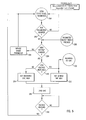
- step 400 the steps taken by the microprocessor for calculating and displaying energy and resistance are illustrated. More specifically, after the high voltage is delivered in step 400, the residual voltage on the capacitor is measured.
- the residual voltage on the capacitor is measured by setting to low both the charge and discharge lines 260, 262 on the regulator board shown in Figure 6.
- the residual voltage of the capacitor will be supplied to the positive lead on the comparator 266.
- the microprocessor then varies the output of the DAC 264 in a successive approximation fashion. More specifically, if the voltage output from DAC 264 is higher than the input from the capacitor, the comparator output will be low and the microprocessor will drop the voltage output of the DAC. If the new output from the DAC is not low enough to change the output from the comparator, further reductions in the output will be made until the comparator output toggles to high. Then the voltage from the DAC will be increased until the comparator output toggles back to low. This procedure will continue until a change in the least significant bit of the code to the DAC is enough to toggle the output of the comparator. At this point the code in the DAC represents the residual voltage on the capacitor voltage.
- the microprocessor After the residual voltage on the capacitor is measured, the microprocessor begins the recharging procedure 404 as discussed in detail with regard to Figures 5 and 6. The microprocessor will also calculate the energy and resistance delivered in step 406.
- the front panel also includes a display block 92 for illustrating the estimated energy.
- This display is intended to supply the physician with information about the expected energy to be delivered if the pulse that is presently selected on the LCD output of the panel were to be delivered.
- the physician In order to make this calculation, the physician must enter the expected resistance of the patient. Prior to any testing, this resistance will be set to a standard level. After some initial testing, the physician may be able to provide a more accurate number for this resistance.
- Figure 9 illustrates the steps taken by the microprocessor to carry out this function.
- the microprocessor will scan the front panel parameters in steps 500 and 502. If none of the defibrillator panel switches have been changed, the other parameters switches can be serviced in step 504. However, if any of the defibrillator panel switches have been changed, a new estimated energy must be calculated. Note that any change entered by the physician to the expected resistance, pulse width or voltage level will initiate the calculation of a new estimated energy. The calculation of the estimated energy takes place in step 508.
- the variables listed above are the same as those discussed with relation to the display of actual resistance and energy.
- the resulting energy in joules is then displayed on the front panel as shown in step 510.
- the subject invention advantageously combines a programmable stimulator with a defibrillator.
- the apparatus is provided with a number of features intended to improve operation, facilitating use by the physician and decreasing patient risk. Included in these improvements is an automatic charging circuit coupled with a dual channel capacitor defibrillator to substantially reduce the time to deliver a rescue shock if a test shock has failed.
- the subject system further includes ability to store multiple parameters enabling the unit to be preprogrammed prior to initiation of cardiac procedure.
- the unit also displays the energy and resistance present in a defibrillation shock.
- a display feature is also provided which gives information to the physician regarding the estimated energy of a pulse to be delivered having a specific voltage and pulse width.
Landscapes
- Health & Medical Sciences (AREA)
- Cardiology (AREA)
- Heart & Thoracic Surgery (AREA)
- Engineering & Computer Science (AREA)
- Biomedical Technology (AREA)
- Nuclear Medicine, Radiotherapy & Molecular Imaging (AREA)
- Radiology & Medical Imaging (AREA)
- Life Sciences & Earth Sciences (AREA)
- Animal Behavior & Ethology (AREA)
- General Health & Medical Sciences (AREA)
- Public Health (AREA)
- Veterinary Medicine (AREA)
- Electrotherapy Devices (AREA)
Applications Claiming Priority (2)
| Application Number | Priority Date | Filing Date | Title |
|---|---|---|---|
| US863181 | 1986-05-14 | ||
| US06/863,181 US4827936A (en) | 1986-05-14 | 1986-05-14 | Apparatus for stimulating the heart with protected pacer |
Publications (3)
| Publication Number | Publication Date |
|---|---|
| EP0246064A2 true EP0246064A2 (de) | 1987-11-19 |
| EP0246064A3 EP0246064A3 (en) | 1990-05-30 |
| EP0246064B1 EP0246064B1 (de) | 1995-02-01 |
Family
ID=25340471
Family Applications (1)
| Application Number | Title | Priority Date | Filing Date |
|---|---|---|---|
| EP87304203A Expired - Lifetime EP0246064B1 (de) | 1986-05-14 | 1987-05-12 | Programmierbarer Difibrillator |
Country Status (4)
| Country | Link |
|---|---|
| US (1) | US4827936A (de) |
| EP (1) | EP0246064B1 (de) |
| JP (1) | JPS6323675A (de) |
| DE (1) | DE3751031T2 (de) |
Cited By (8)
| Publication number | Priority date | Publication date | Assignee | Title |
|---|---|---|---|---|
| EP0288234A3 (en) * | 1987-04-24 | 1989-04-12 | Minnesota Mining And Manufacturing Company | Biological tissue stimulator with time-shared logic driving output timing and high-voltage step-up circuit |
| FR2650958A1 (fr) * | 1989-08-16 | 1991-02-22 | Cardiac Pacemakers Inc | Systeme combine de stimulation et de defibrillation cardiaques |
| EP0526175A1 (de) * | 1991-07-31 | 1993-02-03 | Physio-Control Corporation | Benutzeraktiver Defibrillator mit Bildschirmdarstellung |
| EP0540266A1 (de) * | 1991-10-28 | 1993-05-05 | Angemed, Inc. | Verfahren zur Behandlung von Herz vor einer Defibrillation |
| GB2280557A (en) * | 1993-06-17 | 1995-02-01 | Hewlett Packard Co | Solid-state relay for defribrillation |
| EP0691870A4 (de) * | 1993-03-31 | 1996-06-05 | Survivalink Corp | Mechanismus zum verhindern von leckströmen bei einem defibrillator |
| GB2348139A (en) * | 1999-03-25 | 2000-09-27 | Heartstream Inc | Electrotherapy device |
| US7133272B2 (en) | 2004-03-12 | 2006-11-07 | Stanick Steve R | Solid-state replacement for locomotive relay |
Families Citing this family (33)
| Publication number | Priority date | Publication date | Assignee | Title |
|---|---|---|---|---|
| US4989602A (en) * | 1989-04-12 | 1991-02-05 | Siemens-Pacesetter, Inc. | Programmable automatic implantable cardioverter/defibrillator and pacemaker system |
| US5033467A (en) * | 1989-08-16 | 1991-07-23 | Cardiac Pacemakers, Inc. | Combined defibrillator pacer system utilizing pacer tip lead switch |
| US5265604A (en) * | 1990-05-14 | 1993-11-30 | Vince Dennis J | Demand - diaphragmatic pacing (skeletal muscle pressure modified) |
| US5251626A (en) * | 1990-07-03 | 1993-10-12 | Telectronics Pacing Systems, Inc. | Apparatus and method for the detection and treatment of arrhythmias using a neural network |
| US5235979B1 (en) * | 1991-03-15 | 1994-11-01 | Angeion Corp | Dual battery system for implantable defibrillator |
| US5405363A (en) * | 1991-03-15 | 1995-04-11 | Angelon Corporation | Implantable cardioverter defibrillator having a smaller displacement volume |
| US5184616A (en) * | 1991-10-21 | 1993-02-09 | Telectronics Pacing Systems, Inc. | Apparatus and method for generation of varying waveforms in arrhythmia control system |
| US5697953A (en) * | 1993-03-13 | 1997-12-16 | Angeion Corporation | Implantable cardioverter defibrillator having a smaller displacement volume |
| FR2709026B1 (fr) * | 1993-08-10 | 1995-10-13 | Ela Medical Sa | Convertisseur continu-continu pour charge à tension variable. |
| US5549652A (en) * | 1993-11-15 | 1996-08-27 | Pacesetter, Inc. | Cardiac wall motion-based automatic capture verification system and method |
| US5957956A (en) * | 1994-06-21 | 1999-09-28 | Angeion Corp | Implantable cardioverter defibrillator having a smaller mass |
| US5611815A (en) * | 1994-12-08 | 1997-03-18 | Heartstream, Inc. | Defibrillator with training features |
| US5690693A (en) * | 1995-06-07 | 1997-11-25 | Sulzer Intermedics Inc. | Transcutaneous energy transmission circuit for implantable medical device |
| US5702431A (en) * | 1995-06-07 | 1997-12-30 | Sulzer Intermedics Inc. | Enhanced transcutaneous recharging system for battery powered implantable medical device |
| US5620471A (en) * | 1995-06-16 | 1997-04-15 | Pacesetter, Inc. | System and method for discriminating between atrial and ventricular arrhythmias and for applying cardiac therapy therefor |
| US5713925A (en) * | 1996-01-11 | 1998-02-03 | Physio-Control Corporation | Adapter for isolating pacing and defibrillation signals |
| US5713939A (en) * | 1996-09-16 | 1998-02-03 | Sulzer Intermedics Inc. | Data communication system for control of transcutaneous energy transmission to an implantable medical device |
| US5974339A (en) * | 1997-11-26 | 1999-10-26 | Procath Corporation | High energy defibrillator employing current control circuitry |
| US6421563B1 (en) | 2000-03-01 | 2002-07-16 | Medtronic Physio-Control Manufacturing Corp. | Solid-state multiphasic defibrillation circuit |
| US7162298B2 (en) * | 2002-09-10 | 2007-01-09 | Uab Research Foundation | Devices for detecting the presence of cardiac activity following administration of defibrillation therapy |
| US7529589B2 (en) | 2003-06-04 | 2009-05-05 | Synecor Llc | Intravascular electrophysiological system and methods |
| US8239045B2 (en) * | 2003-06-04 | 2012-08-07 | Synecor Llc | Device and method for retaining a medical device within a vessel |
| US7082336B2 (en) * | 2003-06-04 | 2006-07-25 | Synecor, Llc | Implantable intravascular device for defibrillation and/or pacing |
| US7617007B2 (en) * | 2003-06-04 | 2009-11-10 | Synecor Llc | Method and apparatus for retaining medical implants within body vessels |
| JP2007514482A (ja) * | 2003-12-12 | 2007-06-07 | シネコー・エルエルシー | 前置移植外骨格を有する移植可能な医療デバイス |
| CA2553681A1 (en) * | 2004-02-10 | 2005-08-25 | Synecor, Llc | Intravascular delivery system for therapeutic agents |
| US8005541B2 (en) * | 2005-05-11 | 2011-08-23 | Cardiac Pacemakers, Inc. | Implantable cardioverter defibrillator with programmable capacitor charging level |
| US8498698B2 (en) * | 2008-10-31 | 2013-07-30 | Medtronic, Inc. | Isolation of sensing and stimulation circuitry |
| US9192769B2 (en) * | 2008-10-31 | 2015-11-24 | Medtronic, Inc. | Shunt-current reduction techniques for an implantable therapy system |
| US8560060B2 (en) * | 2008-10-31 | 2013-10-15 | Medtronic, Inc. | Isolation of sensing and stimulation circuitry |
| US8473057B2 (en) * | 2008-10-31 | 2013-06-25 | Medtronic, Inc. | Shunt-current reduction housing for an implantable therapy system |
| US11065047B2 (en) * | 2019-11-20 | 2021-07-20 | Farapulse, Inc. | Systems, apparatuses, and methods for protecting electronic components from high power noise induced by high voltage pulses |
| WO2021191988A1 (ja) * | 2020-03-23 | 2021-09-30 | 日本ライフライン株式会社 | 心腔内除細動カテーテルシステム |
Family Cites Families (13)
| Publication number | Priority date | Publication date | Assignee | Title |
|---|---|---|---|---|
| US3236239A (en) * | 1962-07-17 | 1966-02-22 | American Optical Corp | Defibrillator |
| US3345990A (en) * | 1964-06-19 | 1967-10-10 | American Optical Corp | Heart-beat pacing apparatus |
| US3857398A (en) * | 1971-12-13 | 1974-12-31 | L Rubin | Electrical cardiac defibrillator |
| US3862636A (en) * | 1972-01-20 | 1975-01-28 | Health Technology Labs Inc | Computer controlled defibrillator |
| US3920024A (en) * | 1973-04-16 | 1975-11-18 | Vitatron Medical Bv | Threshold tracking system and method for stimulating a physiological system |
| US3886950A (en) * | 1973-10-01 | 1975-06-03 | Spacelabs Inc | Defibrillator |
| EP0008505B1 (de) * | 1978-08-22 | 1983-06-29 | Siemens-Elema AB | Vorrichtung zum Untersuchen oder Regeln einer erhöhten Herzfrequenz |
| US4375817A (en) * | 1979-07-19 | 1983-03-08 | Medtronic, Inc. | Implantable cardioverter |
| US4328808A (en) * | 1980-10-09 | 1982-05-11 | Hewlett-Packard Company | Defibrillator with means for determining patient impedance and delivered energy |
| US4384585A (en) * | 1981-03-06 | 1983-05-24 | Medtronic, Inc. | Synchronous intracardiac cardioverter |
| US4523595A (en) * | 1981-11-25 | 1985-06-18 | Zibell J Scott | Method and apparatus for automatic detection and treatment of ventricular fibrillation |
| DE3229134A1 (de) * | 1982-08-04 | 1984-02-09 | GS Elektromed. Geräte Günter Stemple, 8912 Kaufering | Elektrische schaltung zur erzeugung von energieimpulsen an zwei schockelektroden eines defibrillators |
| FR2559068B1 (fr) * | 1984-02-06 | 1990-01-26 | Medtronic Inc | Circuit de protection pour un dispositif de retablissement cardiaque implantable |
-
1986
- 1986-05-14 US US06/863,181 patent/US4827936A/en not_active Expired - Fee Related
-
1987
- 1987-05-12 DE DE3751031T patent/DE3751031T2/de not_active Expired - Fee Related
- 1987-05-12 EP EP87304203A patent/EP0246064B1/de not_active Expired - Lifetime
- 1987-05-14 JP JP62118062A patent/JPS6323675A/ja active Pending
Cited By (14)
| Publication number | Priority date | Publication date | Assignee | Title |
|---|---|---|---|---|
| EP0288234A3 (en) * | 1987-04-24 | 1989-04-12 | Minnesota Mining And Manufacturing Company | Biological tissue stimulator with time-shared logic driving output timing and high-voltage step-up circuit |
| FR2650958A1 (fr) * | 1989-08-16 | 1991-02-22 | Cardiac Pacemakers Inc | Systeme combine de stimulation et de defibrillation cardiaques |
| DE4026001A1 (de) * | 1989-08-16 | 1991-03-28 | Cardiac Pacemakers Inc | Kombiniertes defibrillator-herzschrittmacher-system unter verwendung eines schalters in der schrittmacher-reizelektrodenleitung |
| EP0526175A1 (de) * | 1991-07-31 | 1993-02-03 | Physio-Control Corporation | Benutzeraktiver Defibrillator mit Bildschirmdarstellung |
| US5243975A (en) * | 1991-07-31 | 1993-09-14 | Physio-Control Corporation | Defibrillator with user-interactive screen display |
| EP0540266A1 (de) * | 1991-10-28 | 1993-05-05 | Angemed, Inc. | Verfahren zur Behandlung von Herz vor einer Defibrillation |
| EP0691870A4 (de) * | 1993-03-31 | 1996-06-05 | Survivalink Corp | Mechanismus zum verhindern von leckströmen bei einem defibrillator |
| GB2280557A (en) * | 1993-06-17 | 1995-02-01 | Hewlett Packard Co | Solid-state relay for defribrillation |
| US5594287A (en) * | 1993-06-17 | 1997-01-14 | Hewlett-Packard Company | High voltage solid state relay |
| GB2280557B (en) * | 1993-06-17 | 1998-02-18 | Hewlett Packard Co | Defibrillator |
| GB2348139A (en) * | 1999-03-25 | 2000-09-27 | Heartstream Inc | Electrotherapy device |
| US6208898B1 (en) | 1999-03-25 | 2001-03-27 | Agilent Technologies, Inc. | Impedance estimation with dynamic waveform control in an electrotherapy apparatus |
| GB2348139B (en) * | 1999-03-25 | 2003-08-13 | Heartstream Inc | Electrotherapy apparatus |
| US7133272B2 (en) | 2004-03-12 | 2006-11-07 | Stanick Steve R | Solid-state replacement for locomotive relay |
Also Published As
| Publication number | Publication date |
|---|---|
| US4827936A (en) | 1989-05-09 |
| EP0246064A3 (en) | 1990-05-30 |
| EP0246064B1 (de) | 1995-02-01 |
| DE3751031D1 (de) | 1995-03-16 |
| DE3751031T2 (de) | 1995-06-08 |
| JPS6323675A (ja) | 1988-01-30 |
Similar Documents
| Publication | Publication Date | Title |
|---|---|---|
| EP0246064B1 (de) | Programmierbarer Difibrillator | |
| US5014697A (en) | Programmable defibrillator | |
| US6553257B2 (en) | Interactive method of performing cardipulmonary resuscitation with minimal delay to defibrillation shocks | |
| US6671547B2 (en) | Adaptive analysis method for an electrotherapy device and apparatus | |
| US5447518A (en) | Method and apparatus for phase related cardiac defibrillation | |
| EP0536873B1 (de) | Einrichtung zur Induzierung einer Arrhythmie in einem Arrhytmie-Regelsystem | |
| US4572191A (en) | Command atrial cardioverter | |
| US4693253A (en) | Automatic implantable defibrillator and pacer | |
| US6405082B1 (en) | Method and apparatus for distinguishing between therapy modes in a defibrillator | |
| EP2344243B1 (de) | Extravaskuläre induktion von arrhythmie | |
| US7085601B1 (en) | External atrial defibrillator and method for personal termination of atrial fibrillation | |
| US4316472A (en) | Cardioverting device with stored energy selecting means and discharge initiating means, and related method | |
| US5522854A (en) | Method and apparatus for the prevention of arrhythmia by nerve stimulation | |
| US8560064B2 (en) | Extravascular arrhythmia induction | |
| US5350404A (en) | Lead system for use with an atrial defibrillator and method | |
| WO1995022372A1 (en) | Semiautomatic defibrillator with synchronized shock delivery | |
| US5115807A (en) | Programmable defibrillator with pulse energy and resistance displays and methods of operating the same | |
| US5609618A (en) | Apparatus and method for inducing fibrillation | |
| US20040138713A1 (en) | External defibrillation and transcutaneous pacing device and methods for operating the device | |
| US6353758B1 (en) | Apparatus and method for delivering a low energy therapeutic pulse to a patient | |
| US5709711A (en) | Implantable defibrillator with electrophysiologic testing capabilities | |
| US5813999A (en) | Implantable atrial defibrillator providing reduced cardioversion discomfort | |
| US5649971A (en) | Apparatus and method for inducing fibrillation | |
| EP0023134A1 (de) | Implantierbares Gerät zur Herzrhythmuskorrektur | |
| US5944742A (en) | AAMI specification optimized truncated exponential waveform |
Legal Events
| Date | Code | Title | Description |
|---|---|---|---|
| PUAI | Public reference made under article 153(3) epc to a published international application that has entered the european phase |
Free format text: ORIGINAL CODE: 0009012 |
|
| AK | Designated contracting states |
Kind code of ref document: A2 Designated state(s): DE FR GB |
|
| PUAL | Search report despatched |
Free format text: ORIGINAL CODE: 0009013 |
|
| AK | Designated contracting states |
Kind code of ref document: A3 Designated state(s): DE FR GB |
|
| 17P | Request for examination filed |
Effective date: 19900730 |
|
| 17Q | First examination report despatched |
Effective date: 19920430 |
|
| RAP3 | Party data changed (applicant data changed or rights of an application transferred) |
Owner name: VENTRITEX, INC. |
|
| GRAA | (expected) grant |
Free format text: ORIGINAL CODE: 0009210 |
|
| AK | Designated contracting states |
Kind code of ref document: B1 Designated state(s): DE FR GB |
|
| REF | Corresponds to: |
Ref document number: 3751031 Country of ref document: DE Date of ref document: 19950316 |
|
| ET | Fr: translation filed | ||
| PLBE | No opposition filed within time limit |
Free format text: ORIGINAL CODE: 0009261 |
|
| STAA | Information on the status of an ep patent application or granted ep patent |
Free format text: STATUS: NO OPPOSITION FILED WITHIN TIME LIMIT |
|
| 26N | No opposition filed | ||
| PGFP | Annual fee paid to national office [announced via postgrant information from national office to epo] |
Ref country code: GB Payment date: 19980505 Year of fee payment: 12 |
|
| PG25 | Lapsed in a contracting state [announced via postgrant information from national office to epo] |
Ref country code: GB Free format text: LAPSE BECAUSE OF NON-PAYMENT OF DUE FEES Effective date: 19990512 |
|
| GBPC | Gb: european patent ceased through non-payment of renewal fee |
Effective date: 19990512 |
|
| PGFP | Annual fee paid to national office [announced via postgrant information from national office to epo] |
Ref country code: DE Payment date: 20000508 Year of fee payment: 14 |
|
| PGFP | Annual fee paid to national office [announced via postgrant information from national office to epo] |
Ref country code: FR Payment date: 20000510 Year of fee payment: 14 |
|
| PG25 | Lapsed in a contracting state [announced via postgrant information from national office to epo] |
Ref country code: FR Free format text: LAPSE BECAUSE OF NON-PAYMENT OF DUE FEES Effective date: 20020131 |
|
| PG25 | Lapsed in a contracting state [announced via postgrant information from national office to epo] |
Ref country code: DE Free format text: LAPSE BECAUSE OF NON-PAYMENT OF DUE FEES Effective date: 20020301 |