EP0245750A2 - Unterscheidung von geschachtelten Strukturen durch Farbe - Google Patents
Unterscheidung von geschachtelten Strukturen durch Farbe Download PDFInfo
- Publication number
- EP0245750A2 EP0245750A2 EP87106468A EP87106468A EP0245750A2 EP 0245750 A2 EP0245750 A2 EP 0245750A2 EP 87106468 A EP87106468 A EP 87106468A EP 87106468 A EP87106468 A EP 87106468A EP 0245750 A2 EP0245750 A2 EP 0245750A2
- Authority
- EP
- European Patent Office
- Prior art keywords
- color
- text
- nested
- level
- program
- Prior art date
- Legal status (The legal status is an assumption and is not a legal conclusion. Google has not performed a legal analysis and makes no representation as to the accuracy of the status listed.)
- Ceased
Links
Images

Classifications
-
- G—PHYSICS
- G06—COMPUTING OR CALCULATING; COUNTING
- G06F—ELECTRIC DIGITAL DATA PROCESSING
- G06F8/00—Arrangements for software engineering
- G06F8/30—Creation or generation of source code
- G06F8/33—Intelligent editors
Definitions
- This invention relates to the analysis and differentiation of multiple levels of nested expressions, procedures, statements and other structures of information, particularly in programming languages.
- Nesting in data processing, is the incorporation of some kind of structure into another structure, often of the same kind; e.g., nesting one loop or subroutine (the nested loop or subroutine) within another loop (the nesting loop or subroutine).
- Nesting also includes embedding subroutines or data in other subroutines or data at a different hierarchical level, so that different levels of information may be executed or accessed as interruptions in the execution of higher levels of information.
- a programmer or designer is studying the text of a computer program.
- one or more nested sub-levels of logic may be encountered. Whenever this occurs, the study of the immediate logic level cannot be completed until the function of the nested level is understood.
- the nested level in its turn may also contain nests. The programmer or designer must remember enough information about each level of logic to permit a resumption of the examination of that level when evaluation of each piece of nested logic encountered is complete.
- the extent and type of examination performed by the designer for each nest and level of logic depends upon the purpose for which the information is needed. For program language translation and compilation, it differs for various languages, as do the characters and syntax formats which delimit the nested structures.
- the invention deals with a method for formatting text, typically computer programs, in color as the text is moved from one storage area, e.g., a file storage, to another storage area, typically a display area in a data processing system.
- Different colors are specified for the different nesting levels. (Different intensities and shades of the same color are also included within the term "different colors”.)
- the preferred method includes an analysis program (analyzer) to perform the nesting evaluation which is activated and terminated by commands specified by the user.
- the analy-zer is tailored to the particular program language so as to recognize the appropriate delimiters. (The particular language of the program being analyzed may be specified by a command to a generalized analyzer.)
- the analyzer reads the program which is to be examined by the programmer. Nesting analysis is done for each statement (or set of statements) in the text as it is prepared for display. An initial color for the display of the beginning statement or portion of a state-ment (the highest level of logic in the text being ana-lyzed) is selected from a list of those available for display, and a scan of the text is begun.
- a code for the color used to display the current logic level is saved by the analyzer as the latest entry in a first-in/last-out table (stack) arrangement.
- stamp first-in/last-out table
- This table represents a list of incomplete logic levels. Any text for a level being suspended (not yet complete) which has not yet been moved to the display area is placed there now, in the appropriate color for that level.
- the starting syntax just recognized for the new logic level is also placed in the display area in the same color as the level being suspended. Then, the next color from the list of those available is selected, and the analysis process begins again with the new, lower logic level.
- any text for the logic level just completed which has not yet been moved to the display area is placed there in the appropriate color for that logic level.
- the color to be used for the display of the delimiter and the text following that delimiter is then taken from the previous, lower entry in the first-in/ last-out table of incomplete logic levels. This color represents the next higher level of logic, now being resumed. Any information necessary to continue the scan of that logic level is also taken from the table entry; and the entry is then removed from the list. The scan of the higher logic level may then be continued.
- Each input statement of the text of computer program source code is scanned for parenthetical nests, each level of which within the statement is displayed by a separate color.
- input statements are scanned for segments of code delimited by the FOR...NEXT word pair.
- the statements or phrases within such a segment are shown in a color different from that used outside the segment.
- Other code segments defined by other delimiting word or symbol pairs could be highlighted in the same way. For example, other combinations such as IF...THEN, BEGIN...END, etc.
- Color codes to control the display of the text in different colors are defined in a fixed array, termed COL.
- a Basic Color index termed BCDX, is used to indicate the color currently in use for the phrases at the parenthetic nest level zero. Index BCDX also is used for text with no nesting and any levels of FOR-NEXT nesting.
- the index BCDX is stepped up and down the array COL in accordance with the finding of FOR and NEXT words. Each time the BCDX index is stepped, the newly identified color code is sent to the display, which sets the color of the following text.
- the color codes used to highlight parenthetic nests are taken from the same fixed array, COL, starting with the next color after the one being used for the material at parenthetic level zero.
- the colors for parenthetic nesting are placed in a second array, termed UCOL, which is indexed by a second index, termed UCDX.
- UCOL which is indexed by a second index
- This second array is the last-in, first-out stack previously referred to; and it may be viewed as a color use list.
- the second index UCDX is also stepped up and down the second array UCOL as each left and right parenthesis is found. As with the first index, each time the UCDX index is stepped, the color code just indicated is sent to the display which sets the color of the text following the parenthesis.
- the colors in the array COL are constant, and in my preferred embodiment the same colors are always used to identify the same levels of FOR-NEXT nesting.
- the colors in the UCOL array indexed by UCDX, used to identify parenthetic nests will vary as such nests are closed and new ones opened.
- Table I lists the color codes as they appear in the first (fixed sequence) color table COL, representing the colors used in my analyzer to highlight different levels of nested logic.
- the codes are those used in the BASIC COLOR command to change the color of the text to be displayed.
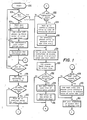
- the program which is the best mode for implementing the method to distinguish nested expressions with different colors is illustrated in the flow diagram shown in FIG. 1.
- a diamond-shaped block represents a logical operation, such as a test or compare function
- a rectangular block represents a step in a sequence step, such as initialize, load, save and the like
- a circle represents the entry into or the return to another part of the figure.
- the analysis program then begins at block 102; and the first operation determines in decision block 104 whether the program has reached the end of the text file. If the answer is yes, the analysis program is finished and the file is closed. If the answer is no, the next input line of text is read at block 106.
- the first color selected would be yellow because that is the first color shown in Table I.
- the program selects a predetermined color and puts the color for the phrase in the first entry of the color use array, UCOL, as shown in block 108.
- the parenthetic nest color is set equal to the present color of the phrase.
- the initial screen display location for this input line is set, and a scan of the input line from the beginning to the end of the statement is initialized, block 112.
- the program determines in decision block 114 whether the end of the statement has been reached.
- the program returns to decision block 104 where the process is repeated for the next line. If the answer is yes, the program returns to decision block 104 where the process is repeated for the next line. If the answer is no, the next character of the input line is obtained as shown in block 116. This character is analyzed to determine whether it begins or ends a level of logic (i.e., whether a nest delimiter character or word has been found) or whether it does not affect the analysis.
- the program proceeds to block 128 where it prepares to show the following characters on the screen in the color selected from the present color use array.
- the present input character is then added to the output line as shown in block 130.
- decision block 132 A decision is then made in decision block 132 as to whether the present character is a beginning parenthesis "(". If the answer is yes, the program obtains the next color from the available list of colors in COL as shown in block 134, and puts that color into a new entry in the color use list UCOL as shown in block 136.
- decision block 132 determines whether the character string "FOR" is the next input. If the answer is yes, the program puts the next color for the phrase (from the available colors list in COL) in the present entry of the color use list, COL, as shown in block 140. If the answer in decision block 138 is no, the program skips this step and proceeds to block 150 where the next character of the output line is added to the display line. The program then proceeds to C where a test is again made in decision block 114 as to whether the end of the statement has been reached.
- FIG. 2 illustrates portions of the text of a computer program which has been color-coded in accordance with my invention.
- Each line of text has been analyzed in accordance with my invention, and the text is displayed in selected colors which are identified in the legend in the lowest part of the Figure.
- the identifiers of the different colors in the legend have been chosen so as not to obscure the program text, which would have been the case if standard hatchings had been used. Also, for the purpose of clarity and to avoid unnecessary identification, the numbers of the lines of program have not been coded although, typically, the line numbers would appear in appropriate colors.
- the text is coded in accordance with the sequence of colors shown in Table I (COL).
- a first logic level delimiter FOR appears in yellow and the subsequent text is coded blue, the second color in Table I.
- a second logic level FOR delimiter appears, which is also coded blue.
- the following text within the second FOR...NEXT loop is color-coded brown, the third color in Table I.
- the (last-in, first-out) color use list, UCOL now contains the sequence: brown, blue, yellow (where yellow was the first entry, and brown the latest), indicative of two incomplete logic levels.
- Line 2415 contains the first delimiter of the third level FOR...NEXT loop as well as three parenthetical nests, all of which are on the same level (second level). It will be noted that the text in each of these parenthetical nests is in a different color, the first in line 2415 being green, the second being magenta and the third being cyan. As noted previously, the reason for this is that I have chosen to ensure that the nested structures within different parenthetical nests in the same programming statement (line of code) have different colors. As an alternative I could have chosen to encode all of the nested text the same color, for example, green.
- Line 2435 represents the end of the third level FOR...NEXT loop, and the delimiter has the same color as its companion on line 2415. Similarly, the NEXT delimiters on lines 2600 and 2610 have corresponding colors to their companions on line 2200, respectively.
- Line 2615 continues the program being illustrated with no FOR...NEXT loop in effect; and the color of the text therefore is yellow, with the parenthetical expression on line 2615 being coded blue, the second color in Table I.
- Line 3200 presents a good illustration of the invention because the line contains two separate levels of parenthetical nests, a single first level nest and three second level nests.
- the parentheses of the first level nest are coded in yellow, the same as the preceding text, while the text within the parentheses, including all second level parenthetical delimiters, is coded blue.
- the text in the first, second and third second-level parenthetical expressions, respectively, is coded brown, red, and green.
- the text structures within each of the second level parenthetical nests are coded in different colors because I have chosen, as noted, to use a rule that no text within a parenthetical expression in one line will have the same color as the text in another parenthetical expression on the same line. However, if these same parenthetical expressions had been on different lines, the text within each parenthetical nest would have had the same color.
- the analyzer program when a nested structure is recognized, assigns a different color to the structure but retains the previous color for the delimiters.
- the alternatives of either assigning a different color to the delimiters but not to the structure within the delimiters, or assigning a different color to both the delimiters as well as the structure therewithin are in the scope of my invention.
Landscapes
- Engineering & Computer Science (AREA)
- Software Systems (AREA)
- General Engineering & Computer Science (AREA)
- Theoretical Computer Science (AREA)
- Physics & Mathematics (AREA)
- General Physics & Mathematics (AREA)
- Debugging And Monitoring (AREA)
- Stored Programmes (AREA)
- Executing Machine-Instructions (AREA)
- Document Processing Apparatus (AREA)
- Spectrometry And Color Measurement (AREA)
- Inspection Of Paper Currency And Valuable Securities (AREA)
Applications Claiming Priority (2)
| Application Number | Priority Date | Filing Date | Title |
|---|---|---|---|
| US06/864,175 US4965765A (en) | 1986-05-16 | 1986-05-16 | Distinguishing nested structures by color |
| US864175 | 1986-05-16 |
Publications (2)
| Publication Number | Publication Date |
|---|---|
| EP0245750A2 true EP0245750A2 (de) | 1987-11-19 |
| EP0245750A3 EP0245750A3 (de) | 1990-06-06 |
Family
ID=25342682
Family Applications (1)
| Application Number | Title | Priority Date | Filing Date |
|---|---|---|---|
| EP87106468A Ceased EP0245750A3 (de) | 1986-05-16 | 1987-05-05 | Unterscheidung von geschachtelten Strukturen durch Farbe |
Country Status (3)
| Country | Link |
|---|---|
| US (1) | US4965765A (de) |
| EP (1) | EP0245750A3 (de) |
| JP (1) | JPS62274429A (de) |
Cited By (1)
| Publication number | Priority date | Publication date | Assignee | Title |
|---|---|---|---|---|
| EP0397991A3 (de) * | 1989-03-27 | 1991-09-18 | Bull HN Information Systems Inc. | "C"-Programmblockannotierer |
Families Citing this family (8)
| Publication number | Priority date | Publication date | Assignee | Title |
|---|---|---|---|---|
| US5133070A (en) * | 1988-06-30 | 1992-07-21 | International Business Machines Corporation | Method of nesting and processing mixed data objects within a data stream utilizing selective environment inheritance |
| US6216143B1 (en) * | 1994-12-05 | 2001-04-10 | International Business Machines Corporation | Apparatus and method for generating animated color coded software traces |
| GB2312973B (en) * | 1996-05-08 | 2000-05-03 | Ibm | Programming aid |
| US6279017B1 (en) * | 1996-08-07 | 2001-08-21 | Randall C. Walker | Method and apparatus for displaying text based upon attributes found within the text |
| US5737520A (en) * | 1996-09-03 | 1998-04-07 | Hewlett-Packard Co. | Method and apparatus for correlating logic analyzer state capture data with associated application data structures |
| JP2008033479A (ja) * | 2006-07-27 | 2008-02-14 | National Institute Of Information & Communication Technology | 強調表示装置及びプログラム |
| US10691422B2 (en) * | 2018-03-21 | 2020-06-23 | Texas Instruments Incorporated | Programmable device providing visual feedback of balancing of opening and closing statements of programming structures and nesting level |
| US11188716B2 (en) | 2019-01-16 | 2021-11-30 | International Business Machines Corporation | Text display with visual distinctions per class |
Family Cites Families (5)
| Publication number | Priority date | Publication date | Assignee | Title |
|---|---|---|---|---|
| US3909797A (en) * | 1973-12-13 | 1975-09-30 | Honeywell Inf Systems | Data processing system utilizing control store unit and push down stack for nested subroutines |
| JPS57189239A (en) * | 1981-05-15 | 1982-11-20 | Yokogawa Hokushin Electric Corp | Listing system for program list |
| GB2126054A (en) * | 1982-08-11 | 1984-03-14 | Philips Electronic Associated | Display system with nested information display |
| JPS5945549A (ja) * | 1982-09-07 | 1984-03-14 | Toshiba Corp | プログラム表示装置 |
| JPS59180738A (ja) * | 1983-03-31 | 1984-10-13 | Fuji Electric Co Ltd | 文字表示装置 |
-
1986
- 1986-05-16 US US06/864,175 patent/US4965765A/en not_active Expired - Fee Related
-
1987
- 1987-03-13 JP JP62057037A patent/JPS62274429A/ja active Pending
- 1987-05-05 EP EP87106468A patent/EP0245750A3/de not_active Ceased
Non-Patent Citations (2)
| Title |
|---|
| "Unix Programmer's Manual", 1983, page 25, Bell Telephone Laboratories, Inc., Murray Hill, New Jersey, Holt, Rinehart & Winston * |
| RESEARCH DISCLOSURE, no. 267, July 1986, page 375, Emsworth, Hampshire, GB; anonymous: "Color highlighter for computer program" * |
Cited By (1)
| Publication number | Priority date | Publication date | Assignee | Title |
|---|---|---|---|---|
| EP0397991A3 (de) * | 1989-03-27 | 1991-09-18 | Bull HN Information Systems Inc. | "C"-Programmblockannotierer |
Also Published As
| Publication number | Publication date |
|---|---|
| JPS62274429A (ja) | 1987-11-28 |
| EP0245750A3 (de) | 1990-06-06 |
| US4965765A (en) | 1990-10-23 |
Similar Documents
| Publication | Publication Date | Title |
|---|---|---|
| KR890002329B1 (ko) | 테이블형 언어 번역기 | |
| US4974191A (en) | Adaptive natural language computer interface system | |
| US6081804A (en) | Method and apparatus for performing rapid and multi-dimensional word searches | |
| EP0424032A2 (de) | Natürliche Sprache verarbeitendes Gerät | |
| US4692896A (en) | Method of processing a plurality of code systems | |
| US4965765A (en) | Distinguishing nested structures by color | |
| EP1195675A1 (de) | Kommentargesteuerte Verarbeitung | |
| US5822592A (en) | Method and system for determining source code location | |
| Mikelsons | Prettyprinting in an interactive programming environment | |
| US5721924A (en) | Method and device for obtaining a value of a referred to variable defined in a source program having a specific variable name | |
| Rosen et al. | PUFFT—the PURDUE university fast fortran translator | |
| Neuhold | The formal description of programming languages | |
| Wuu | How to merge program texts | |
| Richards | The BCPL programming manual | |
| EP0371944A2 (de) | Rechnersystem und Verfahren zur Übersetzung eines Programms | |
| EP0371943A2 (de) | System und Verfahren zur Erzeugung von Programmiersprachenübersetzern | |
| Koskimies | A specification language for one-pass semantic analysis | |
| Brinkley | Intercomputer Transportation of Assembly Language Software through Decompilation. | |
| Healy | Towards Fortran VI? | |
| EP0202007A2 (de) | Generator für Programmgeneratoren | |
| Hoeppner | A multilayered approach to the handling of word formation | |
| JP3018579B2 (ja) | 名前検索処理装置 | |
| Evered et al. | A flexible object invocation language based on object-oriented language definition | |
| Napper et al. | ALEC—A user extensible scientific programming language | |
| WO1997007452A1 (en) | Programmable compiler |
Legal Events
| Date | Code | Title | Description |
|---|---|---|---|
| PUAI | Public reference made under article 153(3) epc to a published international application that has entered the european phase |
Free format text: ORIGINAL CODE: 0009012 |
|
| AK | Designated contracting states |
Kind code of ref document: A2 Designated state(s): DE FR GB IT |
|
| PUAL | Search report despatched |
Free format text: ORIGINAL CODE: 0009013 |
|
| AK | Designated contracting states |
Kind code of ref document: A3 Designated state(s): DE FR GB IT |
|
| 17P | Request for examination filed |
Effective date: 19900621 |
|
| 17Q | First examination report despatched |
Effective date: 19921210 |
|
| STAA | Information on the status of an ep patent application or granted ep patent |
Free format text: STATUS: THE APPLICATION HAS BEEN REFUSED |
|
| 18R | Application refused |
Effective date: 19940306 |
|
| RIN1 | Information on inventor provided before grant (corrected) |
Inventor name: BROWN, MAX RICHARDS |