EP0245070B1 - Herabsetzung von Sphärolithen in Polyamiden - Google Patents
Herabsetzung von Sphärolithen in Polyamiden Download PDFInfo
- Publication number
- EP0245070B1 EP0245070B1 EP87303986A EP87303986A EP0245070B1 EP 0245070 B1 EP0245070 B1 EP 0245070B1 EP 87303986 A EP87303986 A EP 87303986A EP 87303986 A EP87303986 A EP 87303986A EP 0245070 B1 EP0245070 B1 EP 0245070B1
- Authority
- EP
- European Patent Office
- Prior art keywords
- polymer
- spherulites
- filaments
- spherulite
- nylon
- Prior art date
- Legal status (The legal status is an assumption and is not a legal conclusion. Google has not performed a legal analysis and makes no representation as to the accuracy of the status listed.)
- Expired - Lifetime
Links
- 239000004952 Polyamide Substances 0.000 title description 4
- 229920002647 polyamide Polymers 0.000 title description 4
- 229920000642 polymer Polymers 0.000 claims description 45
- NBVXSUQYWXRMNV-UHFFFAOYSA-N fluoromethane Chemical compound FC NBVXSUQYWXRMNV-UHFFFAOYSA-N 0.000 claims description 22
- 238000009987 spinning Methods 0.000 claims description 20
- DDMOUSALMHHKOS-UHFFFAOYSA-N 1,2-dichloro-1,1,2,2-tetrafluoroethane Chemical compound FC(F)(Cl)C(F)(F)Cl DDMOUSALMHHKOS-UHFFFAOYSA-N 0.000 claims description 17
- 229920002302 Nylon 6,6 Polymers 0.000 claims description 13
- 239000000835 fiber Substances 0.000 claims description 13
- 238000000034 method Methods 0.000 claims description 9
- 239000004604 Blowing Agent Substances 0.000 claims description 8
- 229920002292 Nylon 6 Polymers 0.000 claims description 4
- 239000004338 Dichlorodifluoromethane Substances 0.000 claims description 3
- PXBRQCKWGAHEHS-UHFFFAOYSA-N dichlorodifluoromethane Chemical compound FC(F)(Cl)Cl PXBRQCKWGAHEHS-UHFFFAOYSA-N 0.000 claims description 3
- 235000019404 dichlorodifluoromethane Nutrition 0.000 claims description 3
- 229940087091 dichlorotetrafluoroethane Drugs 0.000 claims description 3
- RFCAUADVODFSLZ-UHFFFAOYSA-N 1-Chloro-1,1,2,2,2-pentafluoroethane Chemical compound FC(F)(F)C(F)(F)Cl RFCAUADVODFSLZ-UHFFFAOYSA-N 0.000 claims description 2
- 235000019406 chloropentafluoroethane Nutrition 0.000 claims description 2
- 239000000047 product Substances 0.000 description 6
- 230000015572 biosynthetic process Effects 0.000 description 4
- 239000000155 melt Substances 0.000 description 4
- 230000000694 effects Effects 0.000 description 3
- 239000000203 mixture Substances 0.000 description 3
- 229920001778 nylon Polymers 0.000 description 3
- 238000010791 quenching Methods 0.000 description 3
- 125000006850 spacer group Chemical group 0.000 description 3
- 239000004677 Nylon Substances 0.000 description 2
- VSGNNIFQASZAOI-UHFFFAOYSA-L calcium acetate Chemical compound [Ca+2].CC([O-])=O.CC([O-])=O VSGNNIFQASZAOI-UHFFFAOYSA-L 0.000 description 2
- 229960005147 calcium acetate Drugs 0.000 description 2
- 235000011092 calcium acetate Nutrition 0.000 description 2
- 239000001639 calcium acetate Substances 0.000 description 2
- 238000002347 injection Methods 0.000 description 2
- 239000007924 injection Substances 0.000 description 2
- 239000002932 luster Substances 0.000 description 2
- 238000004519 manufacturing process Methods 0.000 description 2
- 239000000463 material Substances 0.000 description 2
- 238000002074 melt spinning Methods 0.000 description 2
- 239000002245 particle Substances 0.000 description 2
- 239000012255 powdered metal Substances 0.000 description 2
- 230000000171 quenching effect Effects 0.000 description 2
- 238000001953 recrystallisation Methods 0.000 description 2
- 150000003839 salts Chemical class 0.000 description 2
- 239000000523 sample Substances 0.000 description 2
- 238000004804 winding Methods 0.000 description 2
- 244000027321 Lychnis chalcedonica Species 0.000 description 1
- 229920001007 Nylon 4 Polymers 0.000 description 1
- 150000001412 amines Chemical class 0.000 description 1
- 125000003178 carboxy group Chemical group [H]OC(*)=O 0.000 description 1
- 239000003795 chemical substances by application Substances 0.000 description 1
- 238000010622 cold drawing Methods 0.000 description 1
- 238000010276 construction Methods 0.000 description 1
- 229920001577 copolymer Polymers 0.000 description 1
- 238000002788 crimping Methods 0.000 description 1
- 239000013078 crystal Substances 0.000 description 1
- 239000007857 degradation product Substances 0.000 description 1
- 238000001125 extrusion Methods 0.000 description 1
- 238000001914 filtration Methods 0.000 description 1
- 239000006260 foam Substances 0.000 description 1
- 238000010438 heat treatment Methods 0.000 description 1
- 238000004949 mass spectrometry Methods 0.000 description 1
- 239000002667 nucleating agent Substances 0.000 description 1
- 230000003287 optical effect Effects 0.000 description 1
- 230000000704 physical effect Effects 0.000 description 1
- 238000006116 polymerization reaction Methods 0.000 description 1
- 239000011347 resin Substances 0.000 description 1
- 229920005989 resin Polymers 0.000 description 1
- 238000007789 sealing Methods 0.000 description 1
- 239000002689 soil Substances 0.000 description 1
- 229910001220 stainless steel Inorganic materials 0.000 description 1
- 239000010935 stainless steel Substances 0.000 description 1
- 230000003068 static effect Effects 0.000 description 1
- 230000001629 suppression Effects 0.000 description 1
- 238000010998 test method Methods 0.000 description 1
- 229920001169 thermoplastic Polymers 0.000 description 1
- 239000004416 thermosoftening plastic Substances 0.000 description 1
- 238000011144 upstream manufacturing Methods 0.000 description 1
Images



Classifications
-
- D—TEXTILES; PAPER
- D01—NATURAL OR MAN-MADE THREADS OR FIBRES; SPINNING
- D01F—CHEMICAL FEATURES IN THE MANUFACTURE OF ARTIFICIAL FILAMENTS, THREADS, FIBRES, BRISTLES OR RIBBONS; APPARATUS SPECIALLY ADAPTED FOR THE MANUFACTURE OF CARBON FILAMENTS
- D01F6/00—Monocomponent artificial filaments or the like of synthetic polymers; Manufacture thereof
- D01F6/88—Monocomponent artificial filaments or the like of synthetic polymers; Manufacture thereof from mixtures of polycondensation products as major constituent with other polymers or low-molecular-weight compounds
- D01F6/90—Monocomponent artificial filaments or the like of synthetic polymers; Manufacture thereof from mixtures of polycondensation products as major constituent with other polymers or low-molecular-weight compounds of polyamides
-
- D—TEXTILES; PAPER
- D01—NATURAL OR MAN-MADE THREADS OR FIBRES; SPINNING
- D01D—MECHANICAL METHODS OR APPARATUS IN THE MANUFACTURE OF ARTIFICIAL FILAMENTS, THREADS, FIBRES, BRISTLES OR RIBBONS
- D01D4/00—Spinnerette packs; Cleaning thereof
-
- D—TEXTILES; PAPER
- D01—NATURAL OR MAN-MADE THREADS OR FIBRES; SPINNING
- D01D—MECHANICAL METHODS OR APPARATUS IN THE MANUFACTURE OF ARTIFICIAL FILAMENTS, THREADS, FIBRES, BRISTLES OR RIBBONS
- D01D1/00—Treatment of filament-forming or like material
- D01D1/10—Filtering or de-aerating the spinning solution or melt
- D01D1/106—Filtering
-
- D—TEXTILES; PAPER
- D01—NATURAL OR MAN-MADE THREADS OR FIBRES; SPINNING
- D01F—CHEMICAL FEATURES IN THE MANUFACTURE OF ARTIFICIAL FILAMENTS, THREADS, FIBRES, BRISTLES OR RIBBONS; APPARATUS SPECIALLY ADAPTED FOR THE MANUFACTURE OF CARBON FILAMENTS
- D01F1/00—General methods for the manufacture of artificial filaments or the like
- D01F1/02—Addition of substances to the spinning solution or to the melt
- D01F1/10—Other agents for modifying properties
-
- D—TEXTILES; PAPER
- D01—NATURAL OR MAN-MADE THREADS OR FIBRES; SPINNING
- D01F—CHEMICAL FEATURES IN THE MANUFACTURE OF ARTIFICIAL FILAMENTS, THREADS, FIBRES, BRISTLES OR RIBBONS; APPARATUS SPECIALLY ADAPTED FOR THE MANUFACTURE OF CARBON FILAMENTS
- D01F6/00—Monocomponent artificial filaments or the like of synthetic polymers; Manufacture thereof
- D01F6/58—Monocomponent artificial filaments or the like of synthetic polymers; Manufacture thereof from homopolycondensation products
- D01F6/60—Monocomponent artificial filaments or the like of synthetic polymers; Manufacture thereof from homopolycondensation products from polyamides
Definitions
- This invention relates to polyamide yarns with reduced spherulites and the process for making such yarns.
- thermoplastic fiber-forming polymers are composed of long-chain molecules which organize themselves into crystalline and amorphous regions during melt spinning, the chains becoming more nearly parallel and the crystalline order more perfect during the subsequent drawing operation which is required to develop maximum strength.
- some polymers such as polyamides develop spherulites, by which term we mean regions in which the chains pack radially outward from a nucleus to form a spherical structure. Spherulites are undesirable for two reasons - they may scatter light to make otherwise clear polymers cloudy, and they impede the ordering of crystal structure into preferred alignments during drawing and can result in brittleness or lower strength.
- Spherulites form and grow when the polymer passes through particular temperature ranges as it cools following extrusion into filaments from a spinneret.
- the range is from about 230°C to 180°C, and the maximum rate of growth occurs at the recrystallization temperature.
- this temperature is about 217°C.
- the rate of growth of spherulites is also influenced by the viscosity of the melted polymer, higher viscosity usually giving lower spherulite growth rate. Since this is a rate phenomenon, the longer the material remains in the critical temperature range, the greater the size of the spherulites.
- US-A-4,562,022 discloses a method of forming foam fibres wherein a molten polymer containing a blowing agent and, usually, a nucleating agent, is spun into fibres with screen packs or equivalent structures upstream of the spinning apertures.
- screen packs enables the production of fibres with finer bubbles, which are therefore susceptible to greater melt-drawdown and post-drawing and can have better tensile properties. Quenching the melt downstream results in the production of foamed polyamide fibres with average bubble diameters one-twentieth or less, compared with the effective fibre diameter.
- the polymer In conventional melt spinning processes, the polymer is exposed to relatively high shear resulting in substantially reduced melt viscosity and increased temperature which promotes spherulite growth.
- melt viscosity of a polymer may be minimized by reducing polymer shear in the polymer meter pump by using a higher capacity pump which can deliver the required throughput at lower rotational speed, in the spinning filter pack such as by using a more porous filter medium, and/or in the spinneret by providing capillaries of larger diameter.
- Such measures reduce the work done on the polymer, lowering the heating input and ninimizes the decrease in viscosity.
- spherulites may be reduced by filtering the polymer through denser filter media which produce higher shear.
- a polyhexamethylene adipamide fiber having less than 6% nylon 6 is made by a process comprising forming a nylon 6,6 molten polymer, spinning the polymer through a spinning pack containing a pack filter to produce a fiber, and reducing spherulites to a spherulite rating of 1 in the fiber, without forming cells in said fiber, by injecting a fluorocarbon blowing agent into the molten polymer in advance of the filter pack while maintaining a low shear throughout the process.
- the preferred fluorocarbon blowing agent is selected from the group comprising dichlorotetrafluoroethane, monochloropentafluoroethane and dichlorodifluoromethane.
- the product of the invention is a polyhexamethylene adipamide fiber having less than 6% nylon 6 characterized by: a spherulite rating of 1, and a detectable level of a fluorocarbon selected from the group comprising dichlorotetrafluoroethane, monochloropentafluoroethene and dichlorodifluoromethane.
- the suppression of spherulites caused by the combination of low shear and the addition of fluorocarbon blowing agents primarily contributes clarity and high luster to the filaments. This benefit is seen most readily in bright yarns lacking any delustering agents, but the accompanying improvement in physical properties and operability through avoiding broken filaments occurs in both high luster and delustered products.
- the reduction in sheer which minimizes the reduction in melt viscosity, can reduce the tendency of nylon polymer to gel.
- the presence of dissolved fluorocarbon blowing agents permits spinning at somewhat reduced temperature, giving less chance for thermal degradation products of either the polymer or fluorocarbon to contaminate the filaments.
- smell amounts of certain fluorocarbon blowing agents which do not decompose at the temperatures to which a molten polymer capable of forming spherulites is exposed may be injected into a molten polymer ahead of the spinning pack, mixed to distribute and dissolve the fluorocarbon in the polymer, and spun into filaments under conditions which do not form cells in the filaments.
- the fluorocarbon lowers the recrystallization temperature so that the polymer is at a lower temperature when it reaches the maximum growth rate for spherulites, and at the same time, the melt viscosity is higher because of the lower temperature. The higher viscosity then impedes the formation of spherulites.
- the melt viscosity may be increased by operating the process at as low a melt temperature as is practicable, which also speeds the quenching of the extruded filaments and reduces their residence time in the zone of most rapid spherulite growth.
- the size and/or number of spherulites may be reduced so that a spherulite rating of 1 is achieved by shear reduction and addition of fluorocarbon.
- fluorocarbons may also produce random cells in filaments.
- the delustering effect of spherulites is less objectionable in a yarn where cells are desired for delustering or soil hiding, and the effect of spherulites on fiber strength or spinning operability is more important.
- the presence of sufficient fluorocarbon to form the desired cell size and frequency may suppress spherulites sufficiently to avoid a strength problem. Where cells are not desired and maximum clarity of the polymer is essential, low shear throughout the process is desirable.
- the small amounts of fluorocarbons have little or no effect on the relative viscosity, amine ends or carboxyl ends as measured on the product after winding.
- the presence and type of fluorocarbon in a yarn sample can be identified by Direct Probe Mass Spectrometry.
- Fig. 1A is a photograph of a cross-section of a nylon 66 yarn with a spherulite rating of 1 taken at a magnification of 340.
- Fig. 1B is a photograph of a cross-section of a nylon 66 yarn with a spherulite rating of 2 taken at a magnification of 340.
- Fig. 1C is a photograph of a cross-section of a nylon 66 yarn with a spherulite rating of 3 taken at a magnification of 340.
- Fig. 1D is a photograph of a cross-section of a nylon 66 yarn with a spherulite rating of 4 taken at a magnification of 340.
- Fig. 2 is a schematic drawing of the spinning pack assembly for Example 1.
- Fig. 3 is a photograph of a cross-section of Example 1 taken at a magnification of 340.
- Fig. 4 is a photograph of a cross-section of Example 2 taken at a magnification of 340.
- Fig. 5 is a photograph of a cross-section of Control A taken at a magnification of 340.
- Fig. 6 is a photograph of a cross-section of Example 3 taken at a magnification of 460.
- Fig. 7 is a photograph of a cross-section of Control B taken at a magnification of 460.
- Fig. 8 is a photograph of a cross-section of Example 4 taken at a magnification of 340.
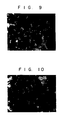
- Fig. 9 is a photograph of a cross-section of Example 5 taken at a magnification of 340.
- Fig. 10 is a photograph of a cross-section of Example 6 taken at a magnification of 340.
- Fig. 1A shows filaments covered with less than 20% spherulites and has a spherulite rating of 1.
- Fig. 1B shows filaments covered with between approximately 20% and 40% spherulites and has a spherulite rating of 2.
- Fig. 1C shows filaments covered with between 40% and 60% spherulites and has a spherulite rating of 3.
- Fig. 1D shows filaments covered with more than 60% spherulites and has a spherulite rating of 4.
- Fig. 2 is a schematic drawing of the spinning pack assembly for Example 1.
- Molten polymer enters lid 10 of the spinning pack assembly through ports 11, using gaskets 12 for sealing.
- Holder 13 has four cavities 14, two for each spinning threadline, into which filter media are inserted.
- the media used for each Example are listed in Table 1, in the order in which they are inserted (reading from bottom to top).
- a gasket 15 seals between each cavity and lid 10.
- gasket 16 Following holder 13 is gasket 16, spacer 17 and distributor 18 having 270 holes for each threadline, the holes each having a diameter of 0.158 cm and lenght 1.59 cm.
- gasket 19 screens 20 comprising one having 19.7 openings per cm in both directions one having 78.7 openings per cm in both directions (200 mesh) with the 200 mesh down, gasket 21 and spacer 22.
- gasket 19 through spacer 22 is installed.
- Spinneret 23 has capillaries as specified in Table 1.
- Frame 24 completes the assembly, which is held together by bolts 25 at top and bottom.
- the particles of powdered stainless steel furnished by Metallurgical Supplies of new Jersey are smaller with 25 higher grade number.
- FC-114 is injected at a rate of 0.39 gms/min. into a pipe carrying molten nylon 66 polymer, giving 0.056% FC-114 in polymer.
- the FC-114 dissolves in the polymer at the pressure of 9983 kpa (101.8 kg/cm2) and temperature of 290°C.
- the polymer then passes through a meter pump producing a shear rate of 14,121 sec ⁇ 1 and through a low-shear spinning pack and spinneret as described in Table 1.
- the spinneret has a larger diameter capillary than is typical for melt spun filaments, which is preceded by a significantly larger counterbore wherein the polymer resides at low pressure.
- the exit of this passage is in the form of three radial slots, giving filaments of trilobal shape.
- filaments are down away at a drawdown ratio of 658.3.
- the filaments are solidified, cold drawn 2.33x, heated on hot rolls, crimped in a hot air jet, deposited on a slowly-moving screen drum, then are tensioned for winding on a package.
- the pump shear rate on all Examples and Control is approximately the same.
- Example 2 is produced similarly to Example 1 except that in Example 1 the low shear pack is constructed from a combination of screens and coarse powdered metal whereas the low shear pack of Example 2 relies on a series of screens only.
- FC-114 is injected at a rate of 0.32 gms/min., giving 0.046% FC-114 in polymer.
- Control A is similar to Examples 1 and 2 except that no fluorocarbon is injected and the spinning pack gives extra-high shear, contributed by the double set of gaskets and screens just above the spinneret.
- FC-114 when FC-114 is injected into nylon and spun under low shear, the fluorocarbon does not expand to form voids but suppresses the formation of spherulites. Both Examples 1 and 2 have fully acceptable spherulite ratings of 1 while Control A made with higher shear and without fluorocarbon has an unacceptable rating of 4.
- FC-114 is injected at a rate of 0.87 g/min. into a pipe carrying a salt blend copolymer of 96% nylon 66 and 4% nylon 6, giving 0.16% FC-114 in the polymer.
- the FC-114 dissolves in the polymer at the pressure of 12307 kpa (125.5 kg/cm2) and a temperature of 287°C.
- the polymer then passes through a meter pump producing a shear rate of 13034 sec ⁇ 1, through a filter to remove foreign matter and gelled polymer then through a low shear spinning pack and spinneret described in Table 1.
- filaments are drawn away at a drawdown ratio of 446.
- the filaments are solidified, cooled by crossflow quench air and are collected.
- Control B is produced similarly to Example 3 except that no fluorocarbon is added, a high shear spinning pack is used, the spinneret capillary and counterbore as indicated in Table 1 are smaller and more nearly conventional, and consequently the shear rate in the spinneret is higher.
- the jet velocity of the polymer is therefore higher and the drawdown lower, but the denier of the filaments of both Example 3 and Control B after stretching between the spinneret and the first powered roller are approximately 4.5 tex (40.6 denier) and after cold drawing are approximately 1.6 tex (14.4 dernier).
- Each product is crimped in the mechanical stuffer box, adjusted to give approximately equal crimp elongation under a standard load.
- Example 3 employing low shear and fluorocarbon have no cells and a fully-acceptabled spherulite rating of 1, whereas Control B has no cells but an unacceptable spherulite rating of 4.
- Example 4 is made with the same low shear spinning pack as Example 1 but without FC-114.
- the spherulite rating of this item is 2, acceptable for products not requiring maximum clarity. It demonstrates that low shear alone can give fewer spherulites than the extra high shear of Control A.
- Examples 5 and 6 use high shear packs similar to those of Examples 1 and 4 except that smaller particles of powdered metal are used. Both have 0.467 gms/min. FC-114 giving 0.067% FC-114 in polymer. In addition, Example 5 has 0.01% calcium acetate which is added to the nylon salt before polymerization.
- the filaments of both Examples 5 and 6 have spherulite ratings of 1, showing in the case of Example 6 that fluorocarbon can satisfactorily suppress the formation of spherulites when a high-shear spinning pack is used.
- the filaments of both Example 5 and 6 have cells formed by the expansion of fluorocarbon which is promoted by high shear, but Example 5 has more cells than Example 6, contributed by the calcium acetate.
Landscapes
- Engineering & Computer Science (AREA)
- Textile Engineering (AREA)
- Chemical & Material Sciences (AREA)
- Chemical Kinetics & Catalysis (AREA)
- General Chemical & Material Sciences (AREA)
- Mechanical Engineering (AREA)
- Manufacturing & Machinery (AREA)
- Artificial Filaments (AREA)
- Spinning Methods And Devices For Manufacturing Artificial Fibers (AREA)
Claims (2)
Applications Claiming Priority (2)
| Application Number | Priority Date | Filing Date | Title |
|---|---|---|---|
| US86025086A | 1986-05-06 | 1986-05-06 | |
| US860250 | 1986-05-06 |
Publications (3)
| Publication Number | Publication Date |
|---|---|
| EP0245070A2 EP0245070A2 (de) | 1987-11-11 |
| EP0245070A3 EP0245070A3 (en) | 1989-04-05 |
| EP0245070B1 true EP0245070B1 (de) | 1991-12-27 |
Family
ID=25332803
Family Applications (1)
| Application Number | Title | Priority Date | Filing Date |
|---|---|---|---|
| EP87303986A Expired - Lifetime EP0245070B1 (de) | 1986-05-06 | 1987-05-05 | Herabsetzung von Sphärolithen in Polyamiden |
Country Status (7)
| Country | Link |
|---|---|
| US (1) | US4804512A (de) |
| EP (1) | EP0245070B1 (de) |
| JP (1) | JPS6399320A (de) |
| KR (1) | KR870011287A (de) |
| AU (1) | AU593908B2 (de) |
| CA (1) | CA1281482C (de) |
| DE (1) | DE3775457D1 (de) |
Families Citing this family (3)
| Publication number | Priority date | Publication date | Assignee | Title |
|---|---|---|---|---|
| US5104601A (en) * | 1986-01-03 | 1992-04-14 | E. I. Du Pont De Nemours And Company | Process for producing a polyhexamethylene adipamide, caprolactam and polypropylene fiber |
| NL8601159A (nl) * | 1986-05-06 | 1987-12-01 | Akzo Nv | Vezels en garens uit een mengsel van aromatische polyamiden. |
| GB9004048D0 (en) * | 1990-02-22 | 1990-04-18 | Ici Plc | Improvements in/or relating to nylon yarn |
Family Cites Families (19)
| Publication number | Priority date | Publication date | Assignee | Title |
|---|---|---|---|---|
| GB1062086A (en) * | 1963-08-16 | 1967-03-15 | Du Pont | Improvements in or relating to ultramicrocellular structures |
| GB1126213A (en) * | 1965-09-14 | 1968-09-05 | Ici Ltd | Filaments of a synthetic polyamide |
| US3506753A (en) * | 1967-04-07 | 1970-04-14 | Monsanto Co | Melt-spinning low viscosity polymers |
| US3583949A (en) * | 1968-06-27 | 1971-06-08 | Fiber Industries Inc | Polyamide composition |
| US3538203A (en) * | 1968-07-10 | 1970-11-03 | Shell Oil Co | Production of expandable and cellular resin products |
| US3956020A (en) * | 1968-10-31 | 1976-05-11 | General Electric Company | Ultrafine porous polymer articles |
| DE2002489A1 (de) * | 1970-01-21 | 1971-07-29 | Huels Chemische Werke Ag | Kristallisationsfaehige thermoplastische Massen |
| DE2002650A1 (de) * | 1970-01-22 | 1971-10-07 | Huels Chemische Werke Ag | Kristallisationsfaehige thermoplastische Massen |
| GB1431894A (en) * | 1973-06-26 | 1976-04-14 | Frank F C Keller A | Oriented crystallisation of polymers |
| JPS5122548A (de) * | 1974-08-13 | 1976-02-23 | Omura Sei | |
| JPS5941969B2 (ja) * | 1974-09-09 | 1984-10-11 | 住友化学工業株式会社 | 速効性殺虫、殺ダニ組成物 |
| JPS5191969A (ja) * | 1975-02-08 | 1976-08-12 | Hatsuhotainoseizoho | |
| DE2550080B2 (de) * | 1975-11-07 | 1978-03-09 | Akzo Gmbh, 5600 Wuppertal | Verfahren zur Herstellung von Filamenten mit nicht durchgehenden Hohlräumen |
| JPS5431026A (en) * | 1977-08-11 | 1979-03-07 | Nippon Tungsten | Electric contact material |
| US4312960A (en) * | 1979-01-18 | 1982-01-26 | Monsanto Company | Foam crystallization of condensation polymers |
| US4357288A (en) * | 1980-02-25 | 1982-11-02 | Deacon Machinery, Inc. | Method of making clear transparent polypropylene containers |
| US4331619A (en) * | 1980-12-08 | 1982-05-25 | Allied Corporation | Ethylene-chlorotrifluoroethylene copolymer foam |
| US4386129A (en) * | 1981-03-31 | 1983-05-31 | Standard Oil Company (Indiana) | Porous polymeric films |
| US4562022A (en) * | 1983-04-29 | 1985-12-31 | Allied Corporation | Producing foamed fibers |
-
1987
- 1987-04-30 CA CA000535994A patent/CA1281482C/en not_active Expired - Lifetime
- 1987-05-04 KR KR870004349A patent/KR870011287A/ko not_active Ceased
- 1987-05-05 DE DE8787303986T patent/DE3775457D1/de not_active Expired - Lifetime
- 1987-05-05 EP EP87303986A patent/EP0245070B1/de not_active Expired - Lifetime
- 1987-05-06 JP JP62109092A patent/JPS6399320A/ja active Pending
- 1987-05-06 AU AU72537/87A patent/AU593908B2/en not_active Ceased
-
1988
- 1988-03-21 US US07/171,173 patent/US4804512A/en not_active Expired - Fee Related
Also Published As
| Publication number | Publication date |
|---|---|
| AU593908B2 (en) | 1990-02-22 |
| US4804512A (en) | 1989-02-14 |
| CA1281482C (en) | 1991-03-12 |
| EP0245070A3 (en) | 1989-04-05 |
| JPS6399320A (ja) | 1988-04-30 |
| AU7253787A (en) | 1987-11-12 |
| KR870011287A (ko) | 1987-12-22 |
| EP0245070A2 (de) | 1987-11-11 |
| DE3775457D1 (de) | 1992-02-06 |
Similar Documents
| Publication | Publication Date | Title |
|---|---|---|
| US3659989A (en) | Apparatus for improving spinnability and property of composite filament | |
| EP0080274B1 (de) | Verfahren zum Schmelzspinnen einer Mischung eines faserformenden Polymers und eines unvermischbaren Polymers und entsprechend hergestellte Fasern | |
| EP0527489B1 (de) | Schmelzgeblasener Vliesstoff aus Polyethylenterephthalat und Verfahren zu dessen Herstellung | |
| US4163770A (en) | Melt-spinning acrylonitrile polymer fibers | |
| EP0049412B1 (de) | Multifilament-Polyestergarn und Verfahren zu dessen Herstellung | |
| EP0208099A2 (de) | Verfahren zur Herstellung von geschäumten Fasern und damit erzeugte Gegenstände | |
| EP1309742A2 (de) | Schmelzgesponnene fasern aus polytetrafluoroäthylen und tetrafluoroäthylen-perfluoroalkyl vinyläther-copolymer mischungen | |
| EP0251452A2 (de) | Gekräuselte, zellige Faser mit in den Falten zusammengefallenen Zellen | |
| US5318738A (en) | Process of making hollow polyamide filaments | |
| JP2003506588A (ja) | 高強度ポリエステルフィラメント及びその製造方法 | |
| EP0615554A1 (de) | Feine denier-stapelfasern | |
| AU603096B2 (en) | Cellular fibers via soluble fluid injection | |
| EP0245070B1 (de) | Herabsetzung von Sphärolithen in Polyamiden | |
| EP1350874B1 (de) | Bauschiges polyester multifilament-verbungsgarn und verfahren zu dessen herstellung | |
| JP2013155454A (ja) | リサイクルポリアミド捲縮糸とその製造方法 | |
| US4514350A (en) | Method for melt spinning polyester filaments | |
| EP0140559B1 (de) | Hochgeschwindigkeitsverfahren zur Herstellung eines vollverstreckten Polyesterfadens | |
| Gupta | Solution-spinning processes | |
| US6740404B1 (en) | HMLS-fibers made of polyester and a spin-stretch process for its production | |
| EA003882B1 (ru) | Способ формования и намотки полиэфирных мононитей с применением прядильных добавок, полученные способом формования полиэфирные мононити, текстурирование полиэфирных мононитей в процессе вытягивания и полученные текстурированием в процессе вытягивания объемные полиэфирные мононити | |
| US5219506A (en) | Preparing fine denier staple fibers | |
| US4605364A (en) | Melt-spinning apparatus for polyester filaments | |
| KR20030065503A (ko) | 중합체 혼합물로부터 합성사의 제조방법 | |
| KR100616190B1 (ko) | 폴리에스테르 부분연신사 및 그 제조방법 | |
| EP0129317A2 (de) | Verfahren zur Herstellung von Polyamidfasern und mittels dieses Verfahrens hergestellte neue Fasern mit runzeliger Oberfläche |
Legal Events
| Date | Code | Title | Description |
|---|---|---|---|
| PUAI | Public reference made under article 153(3) epc to a published international application that has entered the european phase |
Free format text: ORIGINAL CODE: 0009012 |
|
| AK | Designated contracting states |
Kind code of ref document: A2 Designated state(s): BE DE FR GB IT NL |
|
| PUAL | Search report despatched |
Free format text: ORIGINAL CODE: 0009013 |
|
| AK | Designated contracting states |
Kind code of ref document: A3 Designated state(s): BE DE FR GB IT NL |
|
| 17P | Request for examination filed |
Effective date: 19890919 |
|
| 17Q | First examination report despatched |
Effective date: 19900213 |
|
| GRAA | (expected) grant |
Free format text: ORIGINAL CODE: 0009210 |
|
| AK | Designated contracting states |
Kind code of ref document: B1 Designated state(s): BE DE FR GB IT NL |
|
| PG25 | Lapsed in a contracting state [announced via postgrant information from national office to epo] |
Ref country code: NL Effective date: 19911227 Ref country code: FR Effective date: 19911227 Ref country code: BE Effective date: 19911227 Ref country code: IT Free format text: LAPSE BECAUSE OF FAILURE TO SUBMIT A TRANSLATION OF THE DESCRIPTION OR TO PAY THE FEE WITHIN THE PRE;WARNING: LAPSES OF ITALIAN PATENTS WITH EFFECTIVE DATE BEFORE 2007 MAY HAVE OCCURRED AT ANY TIME BEFORE 2007. THE CORRECT EFFECTIVE DATE MAY BE DIFFERENT FROM THE ONE RECORDED.SCRIBED TIME-LIMIT Effective date: 19911227 |
|
| REF | Corresponds to: |
Ref document number: 3775457 Country of ref document: DE Date of ref document: 19920206 |
|
| PG25 | Lapsed in a contracting state [announced via postgrant information from national office to epo] |
Ref country code: GB Effective date: 19920505 |
|
| EN | Fr: translation not filed | ||
| NLV1 | Nl: lapsed or annulled due to failure to fulfill the requirements of art. 29p and 29m of the patents act | ||
| PLBE | No opposition filed within time limit |
Free format text: ORIGINAL CODE: 0009261 |
|
| STAA | Information on the status of an ep patent application or granted ep patent |
Free format text: STATUS: NO OPPOSITION FILED WITHIN TIME LIMIT |
|
| 26N | No opposition filed | ||
| GBPC | Gb: european patent ceased through non-payment of renewal fee |
Effective date: 19920505 |
|
| PG25 | Lapsed in a contracting state [announced via postgrant information from national office to epo] |
Ref country code: DE Effective date: 19930202 |