EP0244320B1 - Verfahren zur photochemischen Spaltung von Nukleinsäure mit Hilfe von 2,7-Diazapyrenium-Dikationen, Diazapyren-Derivate - Google Patents
Verfahren zur photochemischen Spaltung von Nukleinsäure mit Hilfe von 2,7-Diazapyrenium-Dikationen, Diazapyren-Derivate Download PDFInfo
- Publication number
- EP0244320B1 EP0244320B1 EP87400980A EP87400980A EP0244320B1 EP 0244320 B1 EP0244320 B1 EP 0244320B1 EP 87400980 A EP87400980 A EP 87400980A EP 87400980 A EP87400980 A EP 87400980A EP 0244320 B1 EP0244320 B1 EP 0244320B1
- Authority
- EP
- European Patent Office
- Prior art keywords
- diazapyrene
- formula
- ppm
- dap
- derivatives
- Prior art date
- Legal status (The legal status is an assumption and is not a legal conclusion. Google has not performed a legal analysis and makes no representation as to the accuracy of the status listed.)
- Expired - Lifetime
Links
- 0 CCc(cc1)ccc1Oc1ccc([*-])cc1 Chemical compound CCc(cc1)ccc1Oc1ccc([*-])cc1 0.000 description 3
Images

Classifications
-
- C—CHEMISTRY; METALLURGY
- C07—ORGANIC CHEMISTRY
- C07D—HETEROCYCLIC COMPOUNDS
- C07D471/00—Heterocyclic compounds containing nitrogen atoms as the only ring hetero atoms in the condensed system, at least one ring being a six-membered ring with one nitrogen atom, not provided for by groups C07D451/00 - C07D463/00
- C07D471/02—Heterocyclic compounds containing nitrogen atoms as the only ring hetero atoms in the condensed system, at least one ring being a six-membered ring with one nitrogen atom, not provided for by groups C07D451/00 - C07D463/00 in which the condensed system contains two hetero rings
- C07D471/06—Peri-condensed systems
-
- C—CHEMISTRY; METALLURGY
- C07—ORGANIC CHEMISTRY
- C07H—SUGARS; DERIVATIVES THEREOF; NUCLEOSIDES; NUCLEOTIDES; NUCLEIC ACIDS
- C07H1/00—Processes for the preparation of sugar derivatives
Definitions
- the present invention relates to a process for photocleavage of nucleic acids using dications 2,7-diazapyrenium DAP 2+ or their dimeric bis-DAP 4+ species.
- 2,7-diazapyrenium dications coupled to oligonucleotides can constitute photoexcision reagents specific for nucleic acids.
- metal complexes which have been used, there may be mentioned in particular the compounds carrying EDTA-Fe (II) groups and the 1,10-phenanthroline-copper complexes.
- HERTZBERG et al. [J. Am. Chem. Soc. 1982 104 p. 313-315] recommends the use of (methidiumpropyl-EDTA) -Fe (III) as a cofactor in cutting DNA for a certain number of anti-tumor antibiotics.
- Methyl viologene which is 1,1'-dimethyl-4,4'-bipyridinium chloride, commonly known as MV 2+ , can damage DNA under these conditions.
- US Patent 3,652,149 relates to a light filtration device using a redox compound capable of forming a stable and colored free radical by the addition of electrons.
- the diazapyrenic compounds used as redox compounds according to this US patent are those of formula: in which R 1 and R 2 are respectively chosen from hydrogen, an alkyl, an aralkyl and an aryl and A- is an anion.
- the present invention relates to a process for the photocleavage of nucleic acids which consists in bringing a nucleic acid into contact with a solution of a 2,7-diazapyrene derivative as defined below and in subjecting the reaction mixture obtained to irradiation with visible light.
- diazapyrenic derivatives which are suitable for the purposes of the invention correspond to formula (I) below: in which :
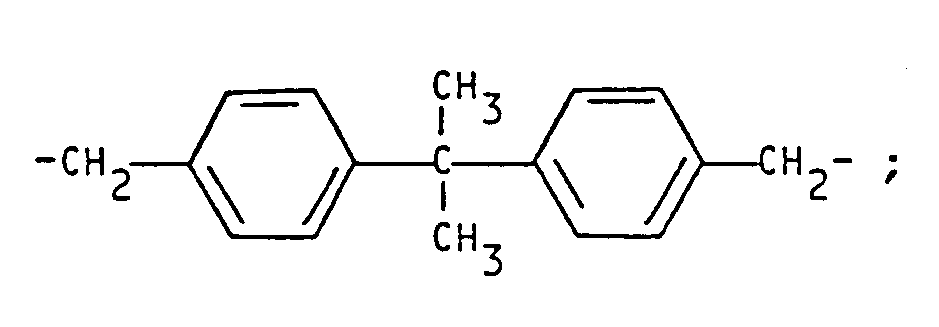
- R ' is hydrogen or a C 1 -C 6 alkyl group and R is hydrogen or a substituted alkyl group chosen from the groups of formulas - (CH 2 ) n -SH, - (CH 2 ) n -OH and - (CH 2 ) n -NH 2 , in which n is between 1 and 10, X- is an anion, with the condition that R and R 'are not at the same time hydrogen, or else R and R 'are identical and represent (a) the group of formula -R 1 Y-, in which R 1 is - (CH 2 ) 3 - and Y- the sulfonate ion, SO- 3 , or (b) the group of formula : and X - is an anion.
- the aliphatic hydrocarbon radicals preferably have 1 to 10 carbon atoms. Linear or branched alkyl groups having 1 to 6 carbon atoms are particularly preferred.
- the diazapyrenic derivatives of formula (I) and (II) can all be obtained from 2,7-diazapyrene or DAP by one of the methods below.
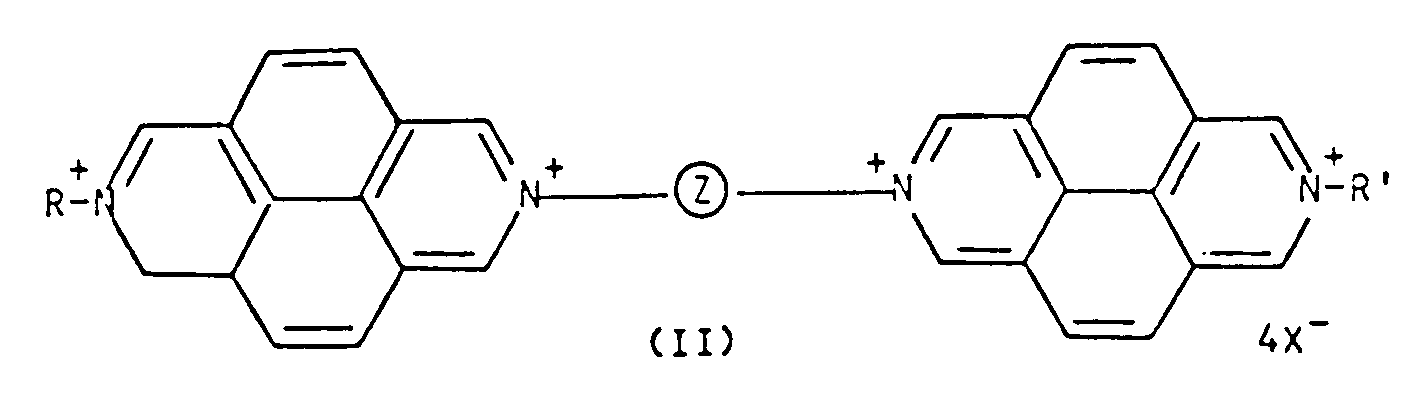
- the diazapyrenic derivatives of formula (I) will be designated by the expression "DAP 2+ derivatives” and those of formula (II) by the expression "bis-DAP 4+ derivatives".
- Xi and X 2 identical or different, have the same meaning as X.
- This process essentially comprises two stages of N-substitution of DAP, respectively by the radicals R and R ′, the compound obtained can then be optionally transformed, by ion exchange, into the corresponding compound in which Xi and X 2 are identical. It will be noted that when R and R ′ are identical, the two substitution steps are carried out simultaneously. These steps are carried out in an appropriate solvent, for example dimethylformamide (DMF), chloroform or acetonitrile.
- DMF dimethylformamide
- chloroform chloroform
- acetonitrile for example dimethylformamide (DMF), chloroform or acetonitrile.
- Ts - anion, for example tosylate
- Ts- can be replaced by another anion.
- This process is suitable for obtaining the DA p2 + derivatives in which the radical R is an aliphatic hydrocarbon radical substituted by a hydroxy group, in particular a hydroxyalkyl group and R 'is an alkyl group, for example methyl.
- This process consists in first of all manufacturing a 2-dinitrophenyl-2,7-diazapyrenium salt, for example tosylate, as a synthesis intermediate by reaction of DAP with a 2,4-dinitrophenyl salt, such as tosylate.
- the second step is an N-substitution step with a halide of formula R'X as in method A.
- a suitable solvent for example a chloroform / methanol mixture at reflux
- This process is suitable for obtaining the DA p2 + derivatives in which R 'is an alkyl group, for example methyl and R is an aliphatic hydrocarbon residue substituted with an amino group.
- R ' is an alkyl group, for example methyl and R is an aliphatic hydrocarbon residue substituted with an amino group.
- This process is similar to process B above with the only difference that a diamine is used as an amine, one of the amine functions of which is protected, which is then deprotected before the second substitution step.
- 2-dinitrophenyl-2,7-diazapyrenium tosylate is a new compound useful as a synthetic intermediate; it constitutes another object of the invention.
- This process is suitable for obtaining the DAP 2+ derivative in which R and R 'are identical and represent a radical R, Y - as defined above;
- This process consists in reacting together DAP partially dissolved in anhydrous acetone and propansultone at the reflux temperature.
- This process therefore consists in reacting DAP with aziridine in the presence of collidine and collidinium chloride.
- the process for obtaining these bis-DAP 4+ derivatives essentially consists in reacting two molecules of DAP with a molecule of a dihalide of formula X 1 -Z-X 1 in which Xi, X 2 and 0 are as defined above and then proceed to N-substitution of the remaining nitrogen in the DAP molecules.
- Each step is advantageously carried out in acetonitrile at the reflux temperature.
- the diazapyrenic derivatives according to the invention are fluorescent compounds.
- the diazapyrene (DAP) used as starting material in the above syntheses can be obtained from the 1,4,5,8-naphthalene tetracarboxylic anhydride of formula VI commercially available according to the reaction scheme below:
- the 1,4,6,8-naphthalene tetracarboxylic anhydride of formula VI is first transformed into the corresponding bis (N-methylimide) of formula X by reaction with methylamine at the temperature ambient.
- Imide X is then treated with a LiAIH 4 / AlCl 3 mixture in tetrahydrofuran at reflux to form the compound of formula XI, which is then reacted for approximately 4 hours in the presence of selenium at a temperature between 265 and 300 ° C to obtain the DAP.
- the diazapyrenic derivatives of formulas (I) or (II) comprising one or two dications 2,7-diazapyrenium have a planar structure. These compounds, thanks to this flat structure, interact with the nucleotides of DNA or RNA in the same way as intercalation drugs, such as actinomycin, bleomycin. In addition, under the action of irradiation with visible light, the derivatives according to the invention can cut DNA or RNA into several strands.
- the derivatives of formula (II) or bis-DAP 4+ derivatives are more reactive than the derivatives of formula (I) or DAP 2+ derivatives because of the presence in their molecule of two cations 2, 7-diazapyrenium. They also have greater selectivity and stability during photocleavage.
- the derivatives of formula (I) in which one of the substituents R or R 'is an aliphatic hydrocarbon radical substituted by a hydroxy or amino group can be coupled by covalent bond to an oligonucleotide or an oligodeoxynucleotide comprising a chain natural nucleotides, possibly modified or synthesized.
- This coupling can be achieved by methods known to those skilled in the art.
- the synthesis methods described in patent FR 83 01 223 cited in the present application may be used for reference. These methods consist, inter alia, of coupling the hydroxyl of the DAP 2+ derivative with a 3′-phosphodiester or 5′-phosphodiester oligonucleotide, with a 3′-oligonucleotide, 5′-bis (phosphodiester), or with a 2′-oligodeoxynucleotide phosohodiester, the oligonucleotides or oligodeoxynucleotides being properly protected.
- oligonucleotide or oligodeoxynucleotide
- DAP 2+ or DAP 2+ -oligonucleotide or oligodeoxynucleotide
- DAP 2+ coupling products which can constitute very selective photoexcision reagents.
- the oligonucleotide or oligodeoxynucleotide chain of the coupling product can selectively bind to any complementary sequence. Thanks to the presence of at least one 2,7-diazapyrenium dication in this coupling product, it is easy to selectively cut DNA or RNA at particular sites, the position of which is determined by the oligonucleotide which binds to the complementary sequence.
- the oligonucleotide -DAP 2+ coupling product can subsequently be coupled with another reagent, which can be any revealing agent, for example a marker, such as in particular an acridine dye or an intercalating agent, and provide a bifunctional coupling product, one of the functions being photocleavage, the other function being provided by the second reagent.
- another reagent which can be any revealing agent, for example a marker, such as in particular an acridine dye or an intercalating agent, and provide a bifunctional coupling product, one of the functions being photocleavage, the other function being provided by the second reagent.
- the tests were carried out by illumination for one hour at 3 ⁇ 1 ° C with visible light (250 W projector-slit fitted with an adequate filter to allow only visible light ⁇ > 395 nm) to pass through.
- aqueous solution containing supercoiled circular double-stranded DNA 2.6 10 -8 M
- a chloride or bis-MDAP 2+ 4+ MDAP 2.6 10- 4 M
- the reaction was carried out in the presence or absence of air (oxygen) or EDTA.
- scDNA The supercoiled circular double-stranded DNA, hereinafter called scDNA, was prepared according to known procedures using E. coli bacteria infected with the plasmid pBR 322 and subsequently purified by electroelution so as to be practically free of cut scsc DNA. .
- the plasmid pBR322 gives, by incubation with the restriction enzyme ECORI, a linear plasmid or double-stranded linear DNA which was used as a marker in the electrophoresis analysis carried out after the above photocleavage test.
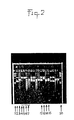
- the MDA p2 + effectively cleaves the DNAsc under irradiation with visible light under the conditions used, mainly by giving ADsc cut by cleavage of a single strand , but also linear DNA by cleavage of the two strands when the reaction continues.
- the bis-MDAP 4+ decreases effect at lower concentrations, the cleavage is still to complete 10 -5 M but only low at a lower concentration.
- the electron donor may be ribose, as it has been found that ribose itself photoreduces MDAP 2+ .
- proflavin is an acridine type dye and it was found that proflavin is a reagent for photocleavage of DNA comparable to Bis-MDAP 4+ and that it gives the concentration of 2 10- 4 M an extensive cleavage of DNA into linear DNA. At lower concentrations of 10- 6 M 2 2 10 -7 M, the efficiency decreases.
- the derivatives of the invention being flat molecules, they interact with nucleotides in DNA or RNA in the same way as intercalation drugs, such as actinomycin, bleomycin, etc. It has also been noted that the fluorescence of the derivatives disappears when there is attachment to the DNA. It is therefore possible to follow the progress of the photocleavage reaction by fluorescence.
- Solutions MDAP 2+ and bis-MDAP 4+ concentrations up to 4.10- 4 M were prepared with distilled water twice and adjusted to pH 7.6 with hydrochloric acid.
- Circular scdNA and circular ssDNA were obtained respectively from the plasmids pBR 322 and M13mp19 and purified by conventional electroelution methods.
- diazapyrenic derivatives used in the process according to the invention keep their property of photocleavage of DNA even when they are incorporated in micelles or in liposomes.
- Diazapyrenic derivatives containing a long chain hydrocarbon radical are particularly suitable for this type of use, since the hydrocarbon radical allows better fixation on the liposome or the micelle.
- the methylation step can be carried out by mixing the product of the above formula with methyl bromide at 40-50 ° C in closed bottles for two to three days. A yellow product soluble in water is then obtained.
- the yellow precipitate formed was filtered and redissolved in methanol; The new precipitate formed was washed in an excess of ether. The yellow precipitate obtained was then dried under vacuum.
- the amine function was then deprotected by reacting the product obtained with a mixture of acetic acid and hydrobromic acid at room temperature.
- the product obtained corresponded to the formula + DAP + - (CH 2 ) 2 -NH + 3 , 3Br-whose elementary analysis is as follows:
- the NMR spectrum (D 2 0, TMPS) of this product revealed peaks at 9.93 ppm, 8.80 ppm, 8.86 ppm, 10.09 ppm, 5.56 ppm and 4.00 ppm.
- 5-amino-1-pentanol was dissolved in anhydrous methanol and placed in a dry 100 ml container under argon and under anhydrous conditions. was dissolved in anhydrous methanol and poured dropwise via a dropping funnel into the solution of 5-amino-1-pentanol with stirring at 20 ° C. The solution is obtained red, then dark red. Stirring was continued for another two hours and the methanol was then removed in vacuo almost to dryness. 250 ml of ether were then added to the residue and a brown precipitate formed; it was separated by filtration, taken up in methanol and dried.
- the whole was heated from 20 ° C to 100 ° C with stirring for 2 hours.
- the solution changed from dark brown to dark yellow and was decanted, then evaporated to dryness by heating to 50 ° C.
- This derivative is prepared according to method C defined above.
- This amine was then purified, after having reduced the reaction mixture obtained to dryness, by extraction with CHCl 3 and basic water (containing LiOH). The CHCl 3 fraction was filtered and dried.
- This derivative is also prepared according to method B defined above by reacting the DAP - DNP Ts- on the amine of formula
Landscapes
- Chemical & Material Sciences (AREA)
- Organic Chemistry (AREA)
- Genetics & Genomics (AREA)
- Molecular Biology (AREA)
- Engineering & Computer Science (AREA)
- Biochemistry (AREA)
- Biotechnology (AREA)
- General Health & Medical Sciences (AREA)
- Health & Medical Sciences (AREA)
- Life Sciences & Earth Sciences (AREA)
- Pharmaceuticals Containing Other Organic And Inorganic Compounds (AREA)
- Heterocyclic Carbon Compounds Containing A Hetero Ring Having Oxygen Or Sulfur (AREA)
- Saccharide Compounds (AREA)
- Nitrogen Condensed Heterocyclic Rings (AREA)
- Photoreceptors In Electrophotography (AREA)
- Organic Low-Molecular-Weight Compounds And Preparation Thereof (AREA)
- Nitrogen And Oxygen Or Sulfur-Condensed Heterocyclic Ring Systems (AREA)
Claims (12)





Priority Applications (1)
| Application Number | Priority Date | Filing Date | Title |
|---|---|---|---|
| AT87400980T ATE78036T1 (de) | 1986-04-29 | 1987-04-29 | Verfahren zur photochemischen spaltung von nukleinsaeure mit hilfe von 2,7-diazapyreniumdikationen, diazapyren-derivate. |
Applications Claiming Priority (2)
| Application Number | Priority Date | Filing Date | Title |
|---|---|---|---|
| FR8606212A FR2597871B1 (fr) | 1986-04-29 | 1986-04-29 | Procede de photoclivage des acides nucleiques a l'aide de dications 2,7-diazapyrenium, nouveaux derives diazapyreniques |
| FR8606212 | 1986-04-29 |
Publications (2)
| Publication Number | Publication Date |
|---|---|
| EP0244320A1 EP0244320A1 (de) | 1987-11-04 |
| EP0244320B1 true EP0244320B1 (de) | 1992-07-08 |
Family
ID=9334745
Family Applications (1)
| Application Number | Title | Priority Date | Filing Date |
|---|---|---|---|
| EP87400980A Expired - Lifetime EP0244320B1 (de) | 1986-04-29 | 1987-04-29 | Verfahren zur photochemischen Spaltung von Nukleinsäure mit Hilfe von 2,7-Diazapyrenium-Dikationen, Diazapyren-Derivate |
Country Status (7)
| Country | Link |
|---|---|
| US (1) | US4925937A (de) |
| EP (1) | EP0244320B1 (de) |
| JP (1) | JPH01500189A (de) |
| AT (1) | ATE78036T1 (de) |
| DE (1) | DE3780206T2 (de) |
| FR (1) | FR2597871B1 (de) |
| WO (1) | WO1987006584A1 (de) |
Families Citing this family (1)
| Publication number | Priority date | Publication date | Assignee | Title |
|---|---|---|---|---|
| US4967008A (en) * | 1990-01-12 | 1990-10-30 | Sherex Chemical Company, Inc. | Polyamines and their preparation |
Family Cites Families (4)
| Publication number | Priority date | Publication date | Assignee | Title |
|---|---|---|---|---|
| BE755563A (fr) * | 1969-09-02 | 1971-03-01 | Polaroid Corp | Dispositif de filtrage variable de lumiere |
| US3853589A (en) * | 1970-11-09 | 1974-12-10 | Ici Ltd | Metal deposition process |
| ZA706357B (en) * | 1970-09-17 | 1971-05-27 | Ici Ltd | Radiation sensitive materials containing nitrogenous cationic compounds |
| DE3620332A1 (de) * | 1986-06-18 | 1987-12-23 | Bayer Ag | Verfahren zur herstellung von tetrachlornaphthalintetracarbonsaeuredianhydrid und -diimid, sowie die neue verbindung 2.3.6.7-tetrachlornaphthalin-1.4.5.8.- tetracarbonsaeurediimid |
-
1986
- 1986-04-29 FR FR8606212A patent/FR2597871B1/fr not_active Expired - Lifetime
-
1987
- 1987-04-29 AT AT87400980T patent/ATE78036T1/de not_active IP Right Cessation
- 1987-04-29 JP JP62502670A patent/JPH01500189A/ja active Pending
- 1987-04-29 US US07/141,607 patent/US4925937A/en not_active Expired - Fee Related
- 1987-04-29 DE DE8787400980T patent/DE3780206T2/de not_active Expired - Fee Related
- 1987-04-29 WO PCT/FR1987/000142 patent/WO1987006584A1/fr not_active Ceased
- 1987-04-29 EP EP87400980A patent/EP0244320B1/de not_active Expired - Lifetime
Non-Patent Citations (1)
| Title |
|---|
| Science, 1985, 227, pages 849 and following * |
Also Published As
| Publication number | Publication date |
|---|---|
| FR2597871B1 (fr) | 1990-11-16 |
| DE3780206D1 (de) | 1992-08-13 |
| DE3780206T2 (de) | 1993-02-11 |
| JPH01500189A (ja) | 1989-01-26 |
| US4925937A (en) | 1990-05-15 |
| EP0244320A1 (de) | 1987-11-04 |
| FR2597871A1 (fr) | 1987-10-30 |
| WO1987006584A1 (fr) | 1987-11-05 |
| ATE78036T1 (de) | 1992-07-15 |
Similar Documents
| Publication | Publication Date | Title |
|---|---|---|
| EP0180492B1 (de) | Makropolyzyklische Komplexe von seltenen Erden und Verwendung als fluoreszierende Markierungen | |
| Armstrong et al. | Total synthesis of palytoxin carboxylic acid and palytoxin amide | |
| EP0394111B1 (de) | Lipopolyamine, deren Herstellung und Verwendung | |
| EP0541467B1 (de) | Verwendung von Alkyldiamiden mit zwei Zucker-Gruppen als amphiphilische Verbindungen zur Herstellung von Tensiden | |
| EP0214908B1 (de) | Verbindungen, enthaltend eine oligonukleotide Sequenz, gebunden an eine Interkalierungsverbindung und an eine aktivierbare chemische Verbindung, ihre Synthese und Verwendungen als artifizielle sequenzspezifische Nuklease | |
| EP1848725B1 (de) | Ungesättigte dipyrromethen-bor-borkohlenstoffverbindungen | |
| EP0117777A1 (de) | Verbindungen,welche eine oligonucleotide Sequenz enthalten, die an einen Interkalationsstoff gebunden ist, Verfahren zu deren Synthese und deren Verwendung | |
| FR2607507A1 (fr) | Nouveaux derives a-d-oligonucleotides, leur preparation et leur emploi | |
| WO1988004301A1 (fr) | OLIGONUCLEOTIDES alpha | |
| WO2007096134A1 (en) | Lipidated oligonucleotides | |
| FR2470774A1 (fr) | Derives de nucleosides, leur preparation et leurs utilisations therapeutiques | |
| EP0244320B1 (de) | Verfahren zur photochemischen Spaltung von Nukleinsäure mit Hilfe von 2,7-Diazapyrenium-Dikationen, Diazapyren-Derivate | |
| JPH0912605A (ja) | シクロデキストリン誘導体、その調製方法、および疎水性分子を有機界面活性システムに組み入れるためのシクロデキストリン誘導体の使用 | |
| EP1084126B1 (de) | Neue vinca-alkaloidderivate und verfahren zur herstellung | |
| WO2004063208A1 (en) | New phosphoramidite compounds | |
| EP2820003B9 (de) | Diaminophenothiazinderivate zur markierung von biomolekülen, verfahren und substrat zur markierung von oligonucleotiden und dadurch gewonnene oligonucleotide | |
| Franceschin et al. | A new perylene bisimide bola amphiphile: synthesis, characterization, fluorescent properties and applications as a potential probe | |
| JPH10505353A (ja) | オリゴヌクレオチド複合体、構成成分及びリボ核酸の分解方法 | |
| WO2010027108A1 (ja) | 蛍光性糖誘導体化合物及びそれを用いるセンサー | |
| FR3045053A1 (fr) | Agents complexants hydrosolubles a base de triazapyridinophane et complexes de lanthanide fluorescents correspondants | |
| WO2006028229A1 (ja) | ベンゾナフタセングリコシド誘導体およびその使用 | |
| JPH0261960B2 (de) | ||
| WO2026038142A1 (en) | Receptor for the transport of zwitterions through organic membranes and a method of transport of zwitterions through organic membranes using said receptor | |
| CN107652190B (zh) | 一种非对称寡聚苯乙炔的制备方法及其抗菌应用 | |
| WO1988008419A1 (fr) | Ligands d'oligobipyridines, procedes d'obtention et application a titre d'agents complexants |
Legal Events
| Date | Code | Title | Description |
|---|---|---|---|
| PUAI | Public reference made under article 153(3) epc to a published international application that has entered the european phase |
Free format text: ORIGINAL CODE: 0009012 |
|
| AK | Designated contracting states |
Kind code of ref document: A1 Designated state(s): AT BE CH DE ES FR GB GR IT LI LU NL SE |
|
| 17P | Request for examination filed |
Effective date: 19880429 |
|
| 17Q | First examination report despatched |
Effective date: 19891026 |
|
| RAP1 | Party data changed (applicant data changed or rights of an application transferred) |
Owner name: CIS BIO INTERNATIONAL |
|
| GRAA | (expected) grant |
Free format text: ORIGINAL CODE: 0009210 |
|
| AK | Designated contracting states |
Kind code of ref document: B1 Designated state(s): AT BE CH DE ES FR GB GR IT LI LU NL SE |
|
| PG25 | Lapsed in a contracting state [announced via postgrant information from national office to epo] |
Ref country code: IT Free format text: LAPSE BECAUSE OF FAILURE TO SUBMIT A TRANSLATION OF THE DESCRIPTION OR TO PAY THE FEE WITHIN THE PRE;WARNING: LAPSES OF ITALIAN PATENTS WITH EFFECTIVE DATE BEFORE 2007 MAY HAVE OCCURRED AT ANY TIME BEFORE 2007. THE CORRECT EFFECTIVE DATE MAY BE DIFFERENT FROM THE ONE RECORDED.SCRIBED TIME-LIMIT Effective date: 19920708 Ref country code: NL Effective date: 19920708 Ref country code: AT Effective date: 19920708 Ref country code: SE Effective date: 19920708 Ref country code: GR Free format text: LAPSE BECAUSE OF FAILURE TO SUBMIT A TRANSLATION OF THE DESCRIPTION OR TO PAY THE FEE WITHIN THE PRESCRIBED TIME-LIMIT Effective date: 19920708 |
|
| REF | Corresponds to: |
Ref document number: 78036 Country of ref document: AT Date of ref document: 19920715 Kind code of ref document: T |
|
| REF | Corresponds to: |
Ref document number: 3780206 Country of ref document: DE Date of ref document: 19920813 |
|
| PG25 | Lapsed in a contracting state [announced via postgrant information from national office to epo] |
Ref country code: ES Free format text: LAPSE BECAUSE OF FAILURE TO SUBMIT A TRANSLATION OF THE DESCRIPTION OR TO PAY THE FEE WITHIN THE PRESCRIBED TIME-LIMIT Effective date: 19921019 |
|
| GBT | Gb: translation of ep patent filed (gb section 77(6)(a)/1977) | ||
| NLV1 | Nl: lapsed or annulled due to failure to fulfill the requirements of art. 29p and 29m of the patents act | ||
| PG25 | Lapsed in a contracting state [announced via postgrant information from national office to epo] |
Ref country code: LU Free format text: LAPSE BECAUSE OF NON-PAYMENT OF DUE FEES Effective date: 19930430 |
|
| PLBE | No opposition filed within time limit |
Free format text: ORIGINAL CODE: 0009261 |
|
| STAA | Information on the status of an ep patent application or granted ep patent |
Free format text: STATUS: NO OPPOSITION FILED WITHIN TIME LIMIT |
|
| 26N | No opposition filed | ||
| PGFP | Annual fee paid to national office [announced via postgrant information from national office to epo] |
Ref country code: DE Payment date: 20000408 Year of fee payment: 14 |
|
| PGFP | Annual fee paid to national office [announced via postgrant information from national office to epo] |
Ref country code: CH Payment date: 20000413 Year of fee payment: 14 |
|
| PGFP | Annual fee paid to national office [announced via postgrant information from national office to epo] |
Ref country code: GB Payment date: 20000425 Year of fee payment: 14 |
|
| PGFP | Annual fee paid to national office [announced via postgrant information from national office to epo] |
Ref country code: FR Payment date: 20000502 Year of fee payment: 14 |
|
| PGFP | Annual fee paid to national office [announced via postgrant information from national office to epo] |
Ref country code: BE Payment date: 20000511 Year of fee payment: 14 |
|
| PG25 | Lapsed in a contracting state [announced via postgrant information from national office to epo] |
Ref country code: GB Free format text: LAPSE BECAUSE OF NON-PAYMENT OF DUE FEES Effective date: 20010429 |
|
| PG25 | Lapsed in a contracting state [announced via postgrant information from national office to epo] |
Ref country code: FR Free format text: THE PATENT HAS BEEN ANNULLED BY A DECISION OF A NATIONAL AUTHORITY Effective date: 20010430 Ref country code: BE Free format text: LAPSE BECAUSE OF NON-PAYMENT OF DUE FEES Effective date: 20010430 |
|
| PG25 | Lapsed in a contracting state [announced via postgrant information from national office to epo] |
Ref country code: LI Free format text: LAPSE BECAUSE OF NON-PAYMENT OF DUE FEES Effective date: 20010528 Ref country code: CH Free format text: LAPSE BECAUSE OF NON-PAYMENT OF DUE FEES Effective date: 20010528 |
|
| BERE | Be: lapsed |
Owner name: CIS BIO INTERNATIONAL Effective date: 20010430 |
|
| REG | Reference to a national code |
Ref country code: CH Ref legal event code: PL |
|
| GBPC | Gb: european patent ceased through non-payment of renewal fee |
Effective date: 20010429 |
|
| PG25 | Lapsed in a contracting state [announced via postgrant information from national office to epo] |
Ref country code: DE Free format text: LAPSE BECAUSE OF NON-PAYMENT OF DUE FEES Effective date: 20020201 |
|
| REG | Reference to a national code |
Ref country code: FR Ref legal event code: ST |